




Abstract
This study examines how job quality and performance management influence career initiative in the workplace. Based on signaling theory and the notion of internal fit in performance management and HRM, we argue that performance management with a learning orientation further enhances career initiative, whereas performance management with a results orientation constrains it. Combining the two performance management types is expected to diminish career initiative. In addition, we expect the positive effect of job quality to be contingent upon the performance management types. A total of 772 employees working in the (public) service industry or manufacturing industry and nested within 53 work units rated their job quality (job variety and job autonomy) as well as career initiative. Line managers from these work units rated the performance management types practiced. Results indicate that job variety and learning-oriented performance management positively relate to career initiative. The positive relationships between learning-orientated performance management, job variety, and career initiative are weakened when line managers simultaneously practice results-oriented performance management. These findings underline the need to focus on how performance management orientations and job quality combine to influence career initiative.
Introduction
Organizations are facing the challenge of how to achieve an agile organization and a flexible workforce (Boxall & Purcell, 2008). To be responsive to these challenges, organizations need employees to contribute to innovation and flexibility (Boxall, 2007; Dyer & Shafer, 1999; Unsworth & Parker, 2003). A category of employee behavior that seems particularly important in achieving these goals is proactive employee behavior related to their own development and career (Frese & Fay, 2001; Grant & Ashford, 2008; Parker & Collins, 2010). We refer to this type of proactive behavior as career initiative. Career initiative entails the self-starting of activities related to learning and gaining experience in the workplace, which include career planning and skill development (Claes & Ruiz-Quintanilla, 1998; Seibert, Kraimer, & Crant, 2001; Tharenou & Terry, 1998). These activities fuel human capital, facilitate employees’ careers and/or opportunities for future employment, and are essential if organizations are to achieve organizational adaptability (G. S. Becker, 1964; Warr & Fay, 2001).
Research on determinants of employee proactivity has hitherto mainly focused on individual dispositional characteristics and job quality–related factors (Frese & Fay, 2001; Parker, Williams, & Turner, 2006). Of all job quality–related variables studied as antecedents of employee proactivity, including career initiative, it has been consistently found that the level of autonomy and complexity in the job is positively related to such behaviors (Frese, Kring, Soose, & Zempel, 1996; Parker & Ohly, 2008). In jobs with higher discretion and variety, initiative whether in task execution or in taking steps to preserve or develop one’s career is to a certain extent inherent: it goes with the job. Any attempt at further enhancing career initiative should therefore show how it adds to these well-known job quality effects.
Although a need to study the impact of the wider organizational context and the role of leadership has been expressed in the literature (Grant & Ashford, 2008; Griffin, Neal, & Parker, 2007; Parker, Bindl, & Strauss, 2010; Strauss, Griffin, & Rafferty, 2009; Unsworth & Parker, 2003), little research has so far addressed these issues. This lack of attention is surprising, because scholars have suggested that organizational characteristics (such as Human Resource policies and practices) play an important role in affecting employee behaviors (Johns, 2006; Rousseau & Fried, 2001). The few empirical multilevel studies along this line have indeed revealed a number of contextual variables that influence proactive employee behaviors, including HR system configurations (Batistič, Černe, Kaše, & Zupic, 2016), change-oriented HRM systems (Lee, Pak, Kim, & Li, 2016), and initiative-enhancing HRM systems (Hong, Liao, Raub, & Han, 2016). These findings underscore the need for more empirical research exploring the cross-level effects of contextual HRM-related antecedents on proactive behaviors of employees.
Performance management, as enacted by line managers, is a potentially important contextual determinant of career initiative. This is the main instrument through which managers communicate their expectations of employees’ contributions to the work unit, and/or their expectations of employees’ personal development (Aguinis, 2009; Boxall & Purcell, 2008; Den Hartog, Boselie, & Paauwe, 2004). In addition, as a human resource allocator (Toh, Morgeson, & Campion, 2008), performance management signals, guides, and rewards the desired allocation of employee resources to the attainment of organizational goals (Bergeron, 2007). Accordingly, we examine the role of performance management in influencing career initiative. Performance management can be practiced through various approaches, depending on the goals management is striving for (Boxall & Purcell, 2008; Den Hartog et al., 2004). In line with earlier research on performance management (Aguinis, 2009; Anderson & Oliver, 1987; Dewettinck, 2008), we distinguish between learning-oriented and results-oriented performance management. Building on signaling theory and its application in HRM and performance management literature (e.g., Bowen & Ostroff, 2004; DeNisi & Smith, 2014), we posit that learning-oriented performance management facilitates career initiative behaviors, whereas results-oriented performance management constrains career initiative behaviors. In addition, drawing on notions of internal fit (e.g., Delery & Doty, 1996) in HRM literature, we propose that the positive effect of job quality on career initiative is contingent upon the performance management type practiced.
This study extends previous research in three ways. First, in line with directions for future research proposed by Grant and Ashford (2008) among others, we contribute to knowledge on the contextual antecedents of career initiative. We examine the influence of performance management, as a relevant organizational HRM practice, and explore its interaction with the inherent potential of a job to generate career initiative, as derives from its job quality. Second, by including performance management as enacted by line managers, we respond to the Strauss et al. (2009) call for studies that focus on leader behavior in relation to employee proactivity, like career initiative. Finally, although the majority of extant research has so far been restricted to the employee level of analysis, the need to extend this research to multiple levels of analysis has been expressed recently (Hong et al., 2016; Parker et al., 2010; Parker, Van den Broeck, & Holman, 2017; Strauss et al., 2009). By making use of a two-level, two-actor design, we respond to this need. In our study, performance management as practiced in work units is rated by line managers, while ratings of job quality and career initiative are obtained from employees.
Below, we provide a short review of the literature on career initiative and performance management. Following this, we introduce our hypotheses and explain the methodology and findings of our empirical study. We conclude the article by interpreting our results and discussing the limitations and practical implications of the findings.
Theory
Job Quality and Career Initiative
Several concepts have been proposed in the literature over the past 15 years that relate to employee proactivity directed at development and career such as personal initiative to develop (Frese, Fay, Hilburger, Leng, & Tag, 1997), flexible role orientations (Parker, Wall, & Jackson, 1997), and employability orientation (Van Dam, 2004). Parker and Collins (2010), in taking stock of existing constructs and measures in the area, suggest the term proactive person–environment fit behavior for this category of employee proactivity. According to them, such proactivity aims to a sustainable fit between the person and the environment. In this study, we focus on a set of self-initiated activities that concern learning and gaining experience to promote one’s career maintenance and/or opportunities for future employment (Warr & Fay, 2001). In particular, we study two main career initiative behaviors: proactively engaging in skill development and career planning (Claes & Ruiz-Quintanilla, 1998; Seibert et al., 2001; Tharenou & Terry, 1998).
Existing empirical evidence shows that employees working in high-quality jobs show higher levels of employee creativity (Oldham & Cummings, 1996), innovative work behavior (Dorenbosch, van Engen, & Verhagen, 2005), and proactive work behavior (Salanova & Schaufeli, 2008). Two important aspects of job quality in this respect are job autonomy and job variety (Barling, Kelloway, & Iverson, 2003; Grote & Guest, 2016). Job variety reflects the extent to which a job offers a set of tasks that uses the multitude of skills a person has, and as such also requires a certain complexity and unpredictability in job tasks (Grant & Ashford, 2008). Job autonomy concerns the amount of control or discretion an employee has over major aspects, such as work method and timing, of job performance. It is argued in the literature that a broader job scope, in terms of skills and/or control, encourages employees to know more, learn more, make more connections between the things they know, and be more creative in advancing alternative possibilities to improve their own skills base—in short, to increase their career initiative behaviors (Axtell, Holman, Unsworth, Wall, & Waterson, 2000; Parker & Ohly, 2008; Parker et al., 1997; Parker et al., 2006). Therefore, we expect that:
Performance Management and Career Initiative
Performance management is a process that involves three important stages: setting expectations and measuring performance outcomes, tracing these outcomes back to the efforts of employees and feeding this information back to employees, and finally formulating consequences in terms of rewards as well as future employee work behaviors (Aguinis, 2009; Kinicki, Jacobson, Peterson, & Prussia, 2013; Latham, Sulsky, & MacDonald, 2007). In line with recent recommendations by Pulakos and O’Leary (2011), we focus on how these performance management activities are implemented by line managers on a continuous basis.
According to Den Hartog et al. (2004), performance management is the dominant channel through which line managers communicate organizational goals to employees. Depending on the kinds of goals that management is striving for (Boxall & Purcell, 2008; Den Hartog et al., 2004), different types of performance management can be appropriate. In the literature, distinctions are made between administrative versus developmental, behavioral versus outcome, input versus output, developmental versus evaluation, and soft versus hard performance management types (Aguinis, 2009; Anderson & Oliver, 1987; Dewettinck, 2008). Based on these available distinctions, we choose to contrast two performance management types: results-oriented and learning-oriented in this article. The reasons for this choice are twofold: first, the contrast between results- and learning orientation captures the common denominator based on the sources mentioned above, and second, the contrast between results and learning would seem to be highly relevant for the kind of dependent variable that we are researching in the current study.
Learning-oriented performance management is targeted at achieving work-unit goals by guiding future employee development toward those behaviors necessary to maintain and/or improve work-unit goals related to innovation, flexibility, and agility (Boxall & Purcell, 2008; Dyer & Shafer, 1999). Performance management with a learning orientation focuses on stimulating professional growth, both horizontally (within the same job) and vertically (to other jobs). Given the emphasis in current organizations on constant innovation and quality improvement, (continuous) professional learning and development has become a mainstay in HRM for many workers, hence it gets a lot of attention in performance management for many workers as well (Den Hartog et al., 2004).
When a learning-oriented type of performance management is enacted by the line manager of a work unit, we would expect employees to be encouraged to seek opportunities for development as well as to improve their own abilities (Boxall & Purcell, 2008; Dyer & Shafer, 1999). In such a setting, the performance management type is congruent with initiatives by employees to behave proactively in job-related innovation and creativity (Janssen & Van Yperen, 2004; Madjar & Shalley, 2008). Career initiative, like other proactive employee behaviors, typically involve a great deal of resource expenditure as these require anticipation, planning, and sustained action directed toward a future outcome (Frese & Fay, 2001; Grant & Ashford, 2008), working extra hours and taking on additional responsibilities (Bolino, Valcea, & Harvey, 2010). Under learning-oriented performance management, time and resources allocated by employees toward career initiative are not at the expense of negative performance appraisals and their related consequences (Kanfer & Ackerman, 1989). Summarizing, this type of performance management signals (Bowen & Ostroff, 2004; Ehrnrooth & Björkman, 2012) employees that career initiative is congruent with organizational goals, and that actions directed at development and career are valued by line managers in the long run. This signaling theory builds on earlier work in social psychology on situation strength (Mischel, 1977): only situations that send coherent, consistent, and repeated signals to people result in certain behaviors in a more or less predictable way. In weak situations, no systematic patterns of behavior emerge. In a related vein, the more a line manager consistently emphasizes employee development by practicing a learning-oriented type of performance management in all three stages of the performance management process, the stronger is the signaling effect of this enacted performance management type (DeNisi & Smith, 2014). Frese et al. (1996) empirically confirmed the importance of long-term developmental organizational goals for engagement in personal initiatives at work. This therefore leads to our second hypothesis:
In contrast, results-oriented performance management emphasizes the attainment of results-based goals and links these with rewards to reinforce desirable employee behaviors and/or labor output (Den Hartog et al., 2004; Stiles, Gratton, Truss, Hope-Hailey, & McGovern, 1997). As work-unit performance becomes increasingly dependent on the efficient deployment of human capital, results-oriented performance management aims to direct employee effort toward the attainment of individual performance results that conform with work-unit goals in terms of labor productivity and proficiency (Boxall, 2007; Tsui, Pearce, Porter, & Tripoli, 1997). This kind of performance management is traditionally used with low-skilled workers (Arthur, 1994), but in recent years it has also become increasingly common with high-skilled workers in both the private and public sectors (Aguinis, 2009), hence also giving rise to many high-skilled workers being confronted with the combination, for example, being confronted with targets in terms of results and learning simultaneously.
When results-oriented performance management is enacted by the line manager of a work unit, management actions are aimed at shaping a work situation in which it is clear to employees what it takes to be successful and proficient in the job, as well as providing structured and direct feedback as to the extent to which employees behave and/or perform in line with work-unit productivity targets (Den Hartog et al., 2004; Stiles et al., 1997). Based on signaling theory (Bowen & Ostroff, 2004; DeNisi & Smith, 2014; Ehrnrooth & Björkman, 2012), one can predict that—in this context—employees are more likely to allocate resources to adequately accomplishing their immediate tasks and to task proficiency, at the cost of a long-term proactive orientation toward changing work processes and updating skills to meet future career demands (Unsworth & Parker, 2003). This argument is in line with Bergeron (2007), who also proposes a trade-off between the time allocated by employees to task performance behaviors versus organizational citizenship behaviors. The short-term focus of the immediate task takes precedence over the long-term perspective of the career. Thus, our second hypothesis becomes:
The Interplay Between the Two Performance Management Types
Based on signaling theory, we have argued that learning-oriented performance management will enhance career initiative, whereas results-oriented performance management will constrain it. In organizational practice, the two performance management types are not necessarily mutually exclusive and can coexist in a work unit’s overall HR approach. Line managers can emphasize both achieving higher levels of productivity and attaining higher levels of employee flexibility and innovativeness (Boxall & Purcell, 2008; Quinn & Rohrbaugh, 1983).
Such a combination can be expected to send mixed signals to employees on how to allocate their efforts. This relates to the notion of internal fit as is often used in the explanation of HR system effects on employee behaviors (Delery, 1998; Delery & Doty, 1996; Huselid, 1995). HR practices will only have impact when they are coherent, for example, correctly bundled together in a HR system, and consistently enacted toward employees. Some bundles provide positive combinations while others provide deadly combinations (B. E. Becker, Huselid, Pickus, & Spratt, 1997; Delery, 1998).
In our study, a deadly combination refers to a situation where a line manager attempts to combine HR practices that are detrimental to employee behaviors when used together. If a work unit is already triggering career initiative through using learning-oriented performance management, making additional use of results-oriented performance management is likely to generate confusion: Should I focus less attention on the long-term and emphasize more my short-term proficiency? The mixed signals may result in a deadly combination in relation to career initiative. Therefore, in our third hypothesis, we expect that:
How Performance Management Types Interact With Job Quality
The argument of internal fit can be extended to not only apply to HR practices or systems. Several authors have emphasized that how employees behave toward strategic organizational goals is simultaneously influenced by whether HR initiatives have an internal fit with the typical work systems chosen by the organization. Indeed this is one of the ideas underlying the notion of high-performance work systems (Appelbaum, 2000; Boxall & Purcell, 2011). Following this line of argument, if job quality is high, a learning-oriented type of performance management will demonstrate internal fit: The combination of the two serves to further strengthen situational cues of the appropriateness of career initiative. However, when in the same high-quality jobs a results-oriented type is implemented, a deadly combination may be expected, for example, where the job itself would be conducive to career initiative, the performance management system focuses efforts on the short-term rather than the long term, counteracting the inherent potential to mobilize career initiative of the job. Therefore, in our fourth hypothesis, we predict:
An overview of all the hypothesized relationships is presented in Figure 1.

Conceptual model.
Method
Procedure
Data were collected from 12 Dutch organizations (four organizations operating in the service industry, four organizations operating in the manufacturing industry, two governmental organizations, one hospital, and one elementary school) to boost the variance in our independent variables. For this study, we needed access to and cooperation from line managers and employees in a range of work units. From the 12 organizations selected, 53 work units were willing to participate in the study. The average number of participating work units per organization was thus 4.4 (standard deviation 3.7). In the participating units, surveys were sent out to employees to collect data on job quality and career initiative. At the same time, for each work unit, data on performance management orientations and on the number of employees per work unit were obtained from the first-line managers responsible for executing performance management. Face-to-face interviews were conducted on site by a PhD candidate and several trained research assistants.
Sample
A total of 1,795 surveys were distributed, either on paper or by intranet, to all nonmanagerial employees working in all the 53 work units with the help of each work-unit line manager or an external research institute. In total, 772 employees completed and returned the questionnaires; a response rate of 43%. The average number of responses per work unit was 14.6, the number of responses per work unit ranged between 4 and 41. The sample includes both high- and low-skilled jobs. The average age of the sample was 40.9 years (standard deviation 10.5 years). In the employee sample, 50.4% were male and 35.9% held higher vocational or university degrees. The average number of contractual hours per week was 32.1 (standard deviation 9.1 hr/week). The average number of years working in the organization was 10.8 (standard deviation 10.2 years).
Measurement of Dependent Variable Career Initiative at the Employee Level of Analysis
To measure career initiative we included five items. The items of the career initiative scale reflect the degree to which (a) employees set challenging goals and actively look for situations in which they can expand their skills and knowledge (skill development) and (b) employees are concerned with and self-assess future skills and knowledge needs, as well as take action to adapt to these estimated future needs (career planning). The first item was derived from the Job Aspiration Scale (Warr, 1990), the second and third items were adapted from the Learning Motivation Scale (Taris, Kompier, De Lange, Schaufeli, & Schreurs, 2003), the fourth item was adapted from the Employability Orientation Scale (Van Dam, 2004), and the last item was self-developed (all items can be found in the Appendix). Items were answered on a 5-point response scale (1 = strongly disagree to 5 = strongly agree).
Although for all items the full range of possible responses is found, all items (and the mean score of the items) are skewed to the right. To reduce the skewness of this measure, we recoded the five items described above (score 1-3 = 0, 4 = 1, 5 = 2), and summed up the recoded scores. The resulting sum score can range between 0 and 10 and shows an approximately normal distribution across employees. The reliability of the resulting scale is good (α = .82). A series of confirmatory factor analyses (available upon request) showed that career initiative is clearly discriminated from other kinds of work attitudes and behaviors such as affective commitment, energy availability, and task enjoyment (Bakker, van Veldhoven, & Xanthopoulou, 2010; Salanova & Schaufeli, 2008).
Measurement of Independent Variable Job Quality at the Employee Level of Analysis
Job variety was measured using a four-item scale taken from a recognized Dutch questionnaire on the experience and evaluation of work (VBBA; Van Veldhoven & Meijman, 1994). Employees were asked to rate their experience of job variety, opportunities for creativity, and skill use in their job on a 4-point frequency scale (1 = never, 2 = sometimes, 3 = often, and 4 = always). A sample item is as follows: “Do you have enough variety in your work.” The reliability of this scale was good (α = .84). Job autonomy was similarly measured with a four-item scale from the same questionnaire using the same 4-point frequency answering scale, again with good reliability (α = .86). These items pertain to the extent of autonomy regarding work methods and timing, and are similar to those proposed by Jackson, Wall, Martin, and Davids (1993). A sample item is as follows: “Do you have an influence on the pace of work?” The two survey scales have shown good correlations with observations by trained observers (Meijman & Van Ouwerkerk, 1999). In addition, evidence for the validity of these scales in relation to employee wellbeing and health has been reported in several studies (Bakker et al., 2010; Van Veldhoven & Broersen, 2003).
Measurement of Independent Variable Performance Management Orientation at the Work-Unit Level of Analysis
We used structured, face-to-face interviews with line managers
1
that followed a predefined response format (see Neal, West, & Patterson, 2005, for a similar approach). In the interview, the performance management questions were preceded by the following introduction:
The following questions refer to the way employees in your unit are managed and motivated to do a good job. Basically, there are two orientations: (a) managing worker input in terms of making clear what employee attitudes and behaviors are expected and need to be developed, and (b) managing worker output by communicating clear performance expectations in terms of results. Which of these orientations (learning, results, or both) do you apply in your work unit?
When line managers indicated they practiced both kinds of performance management orientations, six follow-up questions were asked related to the strength and quality of learning and results performance management orientations practiced. When line managers indicated that they only managed and motivated using a single orientation, three follow-up questions were asked for that type of performance management orientation (in this case, the three questions not asked—because they related to a performance management orientation not practiced—were coded with the lowest possible value). All of the line managers claimed to apply at least one of the two performance management orientations.
Based on the notion that performance management is a stepwise process, the questions covered the goal-setting strength, performance review intensity, and extensiveness of follow-up goal setting (Aguinis, 2009; Latham et al., 2007). First, the “goal-setting strength” was measured by asking the extent to which line managers involve organizational (“yes/no”), team (“yes/no”), and individual (“yes/no”) level goals in communicating learning/results expectations regarding to their subordinates. Second, “performance review intensity” was measured by asking the extent to which performance reviews with employees clearly provided feedback to what extent the learning/results expectations of line managers were met by employees. Finally, the “extensiveness of follow-up goal setting” taps the extent to which line managers raised their learning/results expectations in setting follow-up goals when employees were evaluated as having successfully attained their current goals. The performance review intensity and the extensiveness of follow-up goal setting were assessed using a 5-point answering scale (1 = to a very little extent to 5 = to a very large extent).
To create an overall index reflecting the two performance management orientations, the six items with different answer categories were recoded into categories of low (0), moderate (1), and high (2). Goal-setting strength was determined from the three yes/no answers and recoded as follows: three no’s = a low goal-setting strength (0); a mix of yes’s and no’s = moderate goal-setting strength (1); all yes’s = high goal-setting strength (2). Based on the distribution of the scores, performance review intensity was recoded based on the Likert scale scores 1 or 2 = (0), 3 or 4 = (1), 5 = (2), and extensiveness of follow-up goal setting was recoded based on the Likert scale 1 or 2 = (0), and 3 = (1), 4 or 5 = (2). An overall index was then created by summing the three recoded items on learning and on results. The range of scores for the two indices covering the learning and results performance management orientation was thus between 0 and 6.
The reliability (based on the recoded items) of both resulting scales was good (α = .84 and α = .79 for learning- and results-orientation, respectively). To investigate whether the two performance management orientations captured different constructs, we conducted a series of confirmatory factor analyses. We compared a model in which all the items for both performance management orientations were loaded onto a single factor with the hypothesized two-factor model. The hypothesized two-factor model fitted the data significantly better than the one-factor model: Δχ2(1) = 59.20, p < .05; one-factor model: Tucker–Lewis index (TLI) = .11; comparative fit index (CFI) = .47; two-factor model: TLI = .84; CFI = .91. These results support the discriminant validity of using our two measures. The factor loadings of the items for learning and results performance management orientations ranged between .53 and .97.
The 53 work units studied are nested within 12 organizations. Therefore, before proceeding further, we assessed the extent to which the performance management orientations differed between the 12 organizations. Results of two F-tests showed that the variances attributable to organization were not significant (p > .05). On this basis, we concluded that the work-unit level was the appropriate level of analysis for the performance management types, and did not include a third level (the organization) in our analyses.
Measurement of Control Variables
In the analysis, based on prior research (Frese & Fay, 2001; Taris et al., 2003; Warr & Fay, 2001), we controlled for three individual-level demographic variables: gender (1 = female, 2 = male), age, and education (1 = lower education to 6 = higher education). At the work-unit level, we controlled for work-unit size as this could influence the instruments used to align individual and work-unit interests (Snell, 1992). Given that the survey research was targeted at surveying all employees working in the selected work units, we used the number of distributed surveys per unit (which corresponds with the number of employees per work unit) as our measure of unit size.
Analysis
First, to examine whether job quality and career initiative (both were measured in the employee survey) captured different constructs at the individual employee level, we conducted a series of confirmatory factor analyses. We compared a model in which all items for career initiative, job variety, and job autonomy were loaded onto a single factor with the hypothesized three-factor model. The hypothesized three-factor model fitted the data significantly better than the one-factor model: Δχ2(3) = 1,914, p < .05; one-factor model: TLI = .35, CFI = .46, root mean square error approximation (RMSEA) = .21; three-factor model: TLI = .93, CFI = .94, RMSEA = .07. These results support our career initiative and job quality measures having discriminant validity. Second, bivariate correlations were calculated between all the variables measured at both the individual level and the work-unit level. The data are hierarchical (macro-micro) in nature as employees are nested within work units. This nesting is likely to result in dependency in our data, making multilevel analysis the statistical method of choice (Snijders & Bosker, 1999). To further justify the application of multilevel analyses, we tested whether there was sufficient between work-unit variance in our dependent variable, career initiative, and indeed found significant between work-unit variance (intraclass correlation coefficient = 0.07).
We tested our hypotheses with a set of multilevel analyses using MLwiN (Rasbash, Browne, & Goldstein, 2003). In the first step, we included our control variables and the two job quality variables after grand mean centering (H1a and H1b; Model 1). In the second step, we added the two performance orientations after grand mean centering (H2a and H2b; Model 2). Following guidelines proposed by Baron and Kenny (1986) and by Aiken and West (1991), the product of the two performance management orientations was added in a third step (H3; Model 3). Finally, we added the four interaction terms between the performance management orientations and the job quality measures to test the hypothesized cross-level interactions (Aiken & West, 1991; H4a and H4b; Model 4).
Results
Descriptive Statistics
Table 1 shows the means, standard deviations, and correlations of the variables under study at the individual (bottom left) and work-unit levels (upper right). The two performance management orientations do not correlate at the work-unit level (r = .03). The learning orientation is practiced in the work units at a slightly higher intensity than the results orientation. Our dependent variable, career initiative, appears to correlate with autonomy (r = .10**), with job variety (r = .37***), and with education level (r = .15**), and these latter two variables in turn are also strongly correlated (r = 30***).

Note. Gender: 1 = female 2 = male. For work-unit size, learning PMO, and results PMO, the means and standard deviations are reported at the unit level; for gender, age, education, job autonomy, job variety, and career initiative, the means and standard deviations are reported at the individual level. PMO = performance management orientation.
Bottom left.
Upper right.
p < .05. **p < .01. ***p < .001.
Job Quality and Career Initiative
First, we assessed the main effects of both job quality variables on career initiative (see Model 1 in Table 2). Job variety is positively related to career initiative (t = 9.86), supporting H1a. However, for autonomy (H1b), no significant effect on career initiative (t = 0.05) was found. 2 Regarding the control variables, only age is negatively associated with career initiative (t = −2.25).
Results of Hierarchical Linear Modeling.

Note. B is the parameter estimate. Predictors are grand mean centered. Gender: 1 = female, 2 = male. PMO = performance management orientation.
p < .05. **p < .01.
Performance Management Orientations and Career Initiative
We now turn to the hypothesized effects of the two performance management orientations on career initiative (Model 2 in Table 2). Learning-oriented performance management is positively associated with career initiative (t = 2.02), supporting H2a. No significant negative relationship between results-oriented performance management and career initiative is found (t = 1.00), thereby rejecting H2b.
Including the interaction effect of the two orientations results in a significantly improved model, Δχ2 = 4.71 (1), p < .05. The product of the two performance management orientations has a significant and negative effect on career initiative (t = −2.32). To be better able to interpret this significant interaction, we plotted the relationship between learning-oriented performance management and career initiative at low and high levels (one standard deviation below and above the mean) of results-oriented performance management following the suggestion of Aiken and West (1991).
As presented in Figure 2, when results-oriented performance management orientation is high, career initiative is high and not influenced by learning-orientated performance management. Simple slope analysis confirmed that in this case the relationship between learning-oriented performance management and career initiative does not differ significantly from zero (t = −0.07). However, when results-oriented performance management orientation is low, the relationship learning-oriented performance management and career initiative is significantly positive (t = 3.07). This indicates that results-oriented performance management weakens the positive association between learning-oriented performance management and career initiative. These results support H3 and are further interpreted in the discussion section.
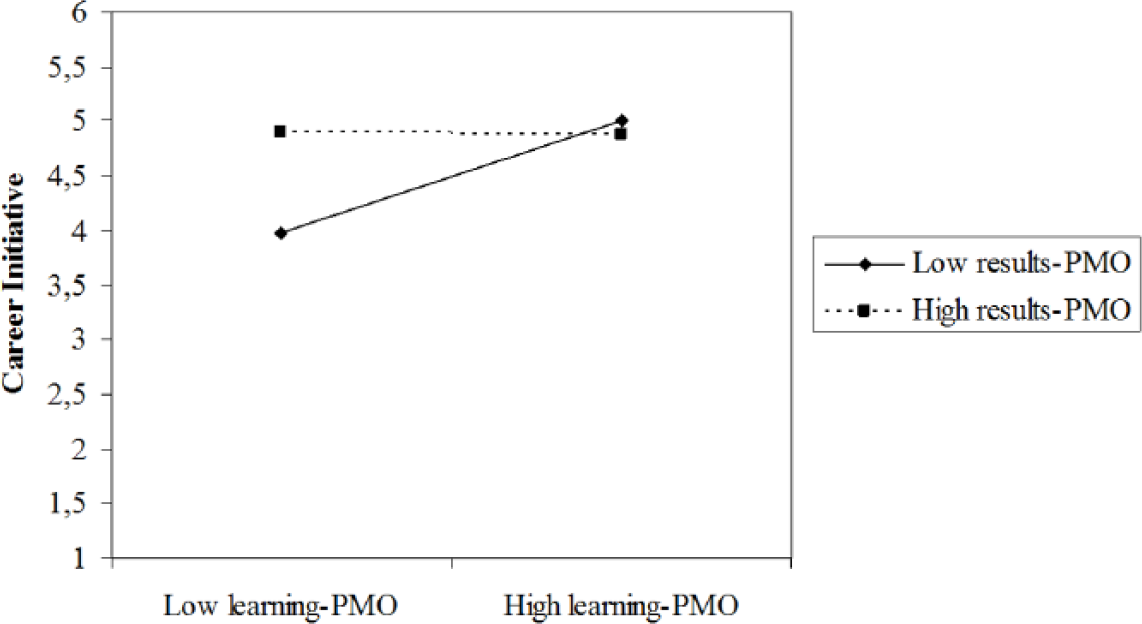
Combination of performance management orientations with career initiative as the dependent variable.
To give an indication of the extent to which the performance management orientations predict career initiative, we calculated the reduction in unexplained variance in career initiative as a result of adding the two performance management orientations and their interaction effect at Level 2 (referred to as RR2 by Snijders and Bosker; 1999). From this calculation, we conclude that the two performance management orientations and their interaction together accounted for an additional (above the effects of the control and the job quality variables) 22% of the between-unit explained variance in career initiative.
Job Quality, Performance Management, and Career Initiative
Including the four interaction terms (Model 4) did not result in a significantly improved model, Δχ2 = 5.12 (4), p > .05. In fact, only one of the four interaction effects was significant: the product of results-oriented performance management and job variety had a significant negative effect on career initiative (t = −1.97), indicating that the positive relationship between job variety and career initiative is stronger when there is low results-oriented performance management. No such interaction effect was found for job autonomy (t = 0.81). In terms of learning-oriented performance management, neither job variety nor job autonomy moderated its relationship with career initiative (t = 1.10; t = −1.46, respectively), thereby rejecting H4a.
To further examine the moderating effect of results-oriented performance management, we graphically illustrate the interaction in Figure 3 (Aiken & West, 1991). As Figure 3 illustrates, under conditions of low results-orientated PMO, there is a stronger positive association between job variety performance management and career initiative than under conditions of high results-oriented PMO. A simple slope analysis (Aiken & West, 1991) confirmed the positive relationship between job variety and career initiative under conditions of low (t = 7.49) and high (t = 4.76) results-oriented PMO. These results provide limited support for H4b, only for job variety the hypothesis is confirmed.

Combination of job variety and results-oriented performance management with career initiative as the dependent variable.
Discussion
We have investigated relationships between job quality, performance management type, and career initiative. First, job variety is positively associated with career initiative supporting H1a. This finding fits the idea that a job offering a set of tasks that uses the multitude of skills a person has encourages an employee to know more, learn more, make more connections between the things they know, and be more creative in advancing alternative possibilities to improve their work or their own skills base (Axtell et al., 2000; Grant & Ashford, 2008).
Based on previous research on employee proactivity (Grant & Ashford, 2008; Parker et al., 2006), we had expected job autonomy to also play a role in the linkage examined. However, we did not find any support for this in the current sample. This may be a consequence of the Dutch context, where levels of job autonomy are usually high and to a certain extent institutionalized in workplaces (Boselie, Paauwe, & Jansen, 2001) and where the national culture points to the importance of control and discretion in the Dutch working situation (Schwartz, 1999). Other studies using Dutch data have also found that job variety matters more in the Dutch context than job autonomy (Van Veldhoven, Taris, De Jonge, & Broersen, 2005). In addition, the relationship between autonomy and career initiative might be contingent on individual dispositional characteristics, for example, the level of self-efficacy of employees (Den Hartog & Belschak, 2012).
Second, the findings support the idea that under learning-oriented performance management, employees are encouraged to seek opportunities for development. Based on signaling theory (e.g., Bowen & Ostroff, 2004), we expected that the more a line manager practices a learning-oriented type of performance management in all three stages of the performance management process, the stronger is the signaling effect of this enacted performance management type (DeNisi & Smith, 2014). In such a situation, career initiative is congruent with performance management signals from the line manager: It is clear to employees how they should allocate resources (Janssen & Van Yperen, 2004; Kanfer & Ackerman, 1989; Madjar & Shalley, 2008; Parker & Ohly, 2008).
However, the expected negative effect of results-oriented performance management was not found. An explanation for this finding might be that such a performance management type triggers two counteracting processes. In a context where employees are strongly managed toward results, employees are likely to allocate resources to adequately accomplishing their immediate tasks (Bergeron, 2007; Unsworth & Parker, 2003). Employees, however, are also likely to develop new skills and competencies that help in coping with the complexities and/or hindrances involved in meeting with immediate productivity targets (Frese & Fay, 2001). In addition, following the self-determination theory (Deci & Ryan, 1985), employees’ need for autonomy and/or competence is more likely to be thwarted in a situation where employee are managed toward results, and this frustration might trigger proactive employee behavior.
Third, the interplay between the two performance management orientations was explored based on the notion that line managers can emphasize both achieving higher levels of productivity and attaining higher levels of employee flexibility and innovativeness (Boxall & Purcell, 2008; Quinn & Rohrbaugh, 1983). Our findings indicate that in a low results-oriented performance management setting, practicing a learning-oriented performance management stimulates employees to allocate resources to career initiative. However, in a high results-oriented performance management context, career initiative is already stimulated, as the results-oriented performance management may trigger a coping mechanism to be able to achieve productivity targets. Simultaneously, deploying learning-oriented and results-oriented performance management is not significantly detrimental for career initiative. Although, in this case the performance management orientations send different signals, having both did not ensure even lower career initiative.
As a final step in our analysis, we also explored how performance management interacts with job quality. Results-oriented performance management interacted in a negative way with job variety but not with job autonomy. The positive relationship between job variety and career initiative is weakened when line managers practice results-oriented performance management but still remained significant. This suggests that high job variety is less helpful for enhancing career initiative when a results-oriented performance management is practiced compared to when such a performance management type is not practiced. No interaction effects were found for learning-oriented performance management. The combination of a stimulating job with high variety of skills used and learning-oriented performance management does not further strengthen career initiative. This finding fits with earlier work reported by Neal et al. (2005) in a study on HRM and organizational climate in U.K. manufacturing firms, testing the so-called limited capacity hypothesis. Based on their arguments we could argue that in our sample the attentional and energetic resources that employees can allocate to career initiative are limited. In so far as learning-oriented performance management is able to trigger career initiative, it is unlikely that such management activities will achieve greater career initiative in employees who are already allocating substantial attention and energy to this kind of behavior because of the opportunities presented by the quality and design of their job. Another interpretation is that job quality mediates a link between HR practices (such as performance management) and career initiative. Such an HR process model (e.g., Boxall & Purcell, 2011) would expect management that is steering toward innovation to create better jobs for already highly educated workers, who then display more career initiative, which contributes to more innovative products and services for the company. Here, the aim is successful delivery of innovative products and services which will sustain the positive cycle described. This scenario resembles what Hobfoll (2011) has recently called a resource caravan passageway.
Limitations and Strengths
We have used the line manager as a single rater of the performance management types practiced in a work unit. Gerhart, Wright, McMahan, and Snell (2000) have shown that the reliability of such a single rating for a unit-level variable is likely to be low. However, they also showed that using multiple items for measuring variables in such a measurement context does improve reliability, and we followed this advice in our study.
We need to be somewhat cautious concerning our specific measures of the two performance management types, and the specific typology that we used. Due to time limits on the interviews with line managers, only three items were used to measure the two performance management variables. Other researchers into performance management have focused on the detailed steps, elements, and partial practices included in this major area of HRM (Den Hartog et al., 2004; Fletcher, 2001), and might have chosen a diffrent typology. Our approach has been to measure the main orientation of the performance management activities as we deemed relevant for our dependent variable, and this may overlook other important facets involved in performance management, such as contingent pay or procedural fairness. Our approach was never intended to substitute for more elaborate ways of operationalizing performance management, but does seem adequate for our current research aim (Button, Mathieu, & Zajac, 1996; Parker & Collins, 2010).
A weakness in the research on employee proactivity is that what we currently know about its antecedents is mostly based on employee self-reported (Parker & Collins, 2010; Parker et al., 2006) and therefore open to common source bias. A strength of this study is that the independent and dependent measures were collected from different sources and on different levels, linking line management interview data at the work-unit level to employee-level survey data. However, we should recognize that multisource correlations are usually lower than single-source correlations in research (Doty & Glick, 1998). Nevertheless, considerable associations at the between-unit level were shown in this study: at the work-unit level more than 22% of the variance was explained.
Related to this point, it should be noted that although the sample contained high- and low-skilled jobs, employees in jobs where cognitive competence and continuous learning are important are moderately overrepresented in our sample (e.g., teachers, nurses, and engineers). This might explain the relatively high scores on career initiative in our study, as employees working in this type of job might be more willing to self-initiate career activities. Previous work design research also suggests the possibility of such occupational effects. In occupations with high levels of cognitive demands, employees have more opportunities for information processing and problem solving (Dierdorff & Morgeson, 2013). To understand these occupational influences on relationships between performance management types, job quality, and career initiative, additional research is needed explicitly designed to compare these relationships in multiple occupational settings (e.g., teachers vs. assembly-line workers).
Finally, this study used a cross-sectional design in which all the variables were measured at approximately the same time. As such, no causality can be confidently attached to the relationships established. Longitudinal research is needed to confirm (or reject) the hypothesized temporal order between job quality, the performance management types, and career initiative.
Implications
This is one of the first studies researching the linkages between job quality, performance management, and career initiative. Implications and possible leads for research are many; implications for practice are at the moment still modest, pending further research.
A first implication for research is that more studies are necessary that look into how career initiative operates when management emphasizes performance in terms of short-term results. Our results suggest a straightforward diminishing of career initiative is not found in this context, and we have offered a coping interpretation of any career initiative in such a setting. A study directly addressing such a “career initiative as coping” thesis would seem important.
A second research implication concerns how job quality and performance management type combine. We found that especially when jobs are high on skill variety, emphasizing learning during performance management is likely not to be adding much career initiative from employees (a limited capacity view). The alternative interpretation we offered suggests that high job quality follows positive managerial decisions as to the job design and quality needed in a particular job to achieve proper performance. Employees repay managers for such decisions by showing initiative and more innovative and flexible work performance. In this way, caravan passage ways of positive resource exchange might be stimulated between employer and employee. New studies are important on these linkages, especially if they could pit alternative theoretical explanations against each other (Wall & Wood, 2005).
For practice, our findings—if only modest at this stage—inform the many organizations that are grappling with the problem of finding and implementing organizational practices triggering employee work behaviors such as career initiative to achieve organizational agility and workforce flexibility. More and more, this is also being recognized as an issue for whole countries and economies, in the process of global competition on the labor market and for a wealthy future (Gratton, 2011; Macleod & Clarke, 2011).
Following recent recommendations (Grant & Ashford, 2008; Parker et al., 2010; Strauss et al., 2009), our study explored the cross-level effects of a contextual antecedent of career initiative, and in particular we addressed an intermediate level and involved line managers who enact performance management. We can offer as a practical finding that when line managers emphasize a learning type of performance, this is positively related to career initiative, and the same holds for the level of variety in their employees’ jobs. What line managers do in this context apparently makes a difference.
Furthermore, there is a risk of mismatching the inherent mobilizing effect of learning-oriented performance management with an emphasis on short-term results. Having both types does not ensure higher career initiative and appears to hamper career initiative somewhat, so organizations may want to tread carefully here. Finally, it appears that making line managers spend a lot of effort on results-oriented performance management is not always likely to pay off very much in terms of career initiative, especially in employees holding high-quality jobs. To summarize, performance management as enacted by line managers certainly appears to matter, but it pays to keep a keen eye on where it matters most.
Footnotes
Appendix
Declaration of Conflicting Interests
The author(s) declared no potential conflicts of interest with respect to the research, authorship, and/or publication of this article.
Funding
The author(s) received no financial support for the research, authorship, and/or publication of this article.