




Abstract
In a meritocratic system, the tension between educational competition and youth job quality hinders human capital optimization and social mobility. Drawing on nationally representative survey data, this study examines the relationship between the educational attainment of Chinese youth and their job quality from both objective (e.g., obtaining socially recognized positions) and subjective (e.g., job satisfaction and efficacy) dimensions. Special attention is given to the mediating role of meritocracy-induced overeducation. We uncover a central paradox: while higher education attainment improves youths’ access to socially recognized good jobs, it simultaneously erodes their sense of job efficacy. This paradox is closely linked to the pressures of overeducation fostered by meritocratic values. Moreover, rural-origin youth experience lower objective returns but report higher job efficacy than urban peers. These findings challenge the assumption that more education uniformly yields higher returns, highlighting overeducation’s paradoxical effects and rural–urban divergence in China’s labor market. Policymakers should therefore look beyond mere educational expansion to build a more diversified talent evaluation system, so as to mitigate the psychological and occupational strains induced by credential-centric competition.
Introduction
In recent years, online public forums in China have witnessed a surge in self-deprecating and self-mocking expressions regarding professional roles among highly educated youth, such as shechu (corporate slave), dushi liren (metropolitan office drudge), and dagong malou (migrant worker). This cultural shift is set against the backdrop of an increasingly crowded and competitive labor market, where a record 11.48 million college graduates entered the job search in 2023 alone (National Bureau of Statistics, 2024). Originally, such self-mocking terms were more common among groups with relatively low levels of education. However, they have now spread widely among this highly educated cohort, who navigate an economy struggling to absorb their unprecedented numbers, contradicting traditional expectations. According to classical human capital theory (Becker, 1964), individuals with higher educational credentials typically secure more respectable and better-paid occupations, placing them in a more advantageous social stratum. However, this theory appears inadequate in explaining the apparent contradiction between high-quality employment and low occupational identity. As a result, understanding the disjunction between anticipated returns on educational investments and the actual sense of professional fulfillment has become a critical theoretical lens for addressing the challenges faced by youth.
This paradox between high human capital and low occupational identity is closely linked to the pervasive meritocracy. From a meritocratic perspective, the relationship between education and employment is reinforced by a linear effort–achievement–reward logic: individuals attain higher educational levels through ability and perseverance, which in turn should enable them to secure higher-paying and more prestigious jobs, achieving personal success (Sandel, 2020). Society’s value system further stratifies individuals based on performance, nurturing the social notion that studying hard leads to a good job, which ultimately elevates one’s social status. However, with the expansion of higher education and the emergence of a diploma society (Sandel, 2020; J. Wang, 2022), an increasing number of young people are experiencing overeducation. Their educational qualifications far exceed the requirements of their actual job positions, yet they fail to receive commensurate employment rewards or workplace recognition. This mismatch engenders doubts about the meaning of work and personal efficacy, sometimes leading to widespread burnout and an existential crisis. Moreover, current measurement of job quality limits existing theoretical explanation. Traditional metrics of good jobs focus predominantly on objective attributes such as salary, job stability, and social prestige (Leschke & Watt, 2014; Z. Li & Yuan, 2017). However, these objective indicators fail to capture the complex perceptions that youth hold regarding their work or to account for the new forms of alienation experienced in the contemporary labor market. Although some scholars have begun to explore the subjective dimensions of job quality, such as job satisfaction, occupational identity, and psychological well-being (Cabanas & Illouz, 2019; Nie, 2019), these studies often rely on generalized scales that do not adequately reflect the coexistence of both achievement and fatigue that many young people report experiencing in their jobs.
Regarding these considerations, this study moves beyond the existing literature on credential inflation and job mismatch, which has primarily documented the objective wage penalties and macroeconomic inefficiencies. It does so by integrating both objective and subjective dimensions of job quality to examine the employment of contemporary Chinese youth. The significance of this study is threefold. First, by combining objective and subjective approaches, it comprehensively captures the complex coexistence of external achievement and internal fatigue highly educated youth experience in their work, thereby addressing the limitations of unidimensional metrics. Second, by examining the impact of overeducation, the study offers new insights into the structural oppression and internalized penalties inherent in meritocracy, specifically revealing its role in creating the paradoxical state of achieve without achieving. Third, the widespread career confusion among highly educated individuals highlights inherent contradictions within current talent evaluation systems. By illuminating these psychological dynamics, this study provides new insights for reconfiguring talent cultivation in higher education and for optimizing the alignment between human capital and labor market demands.
Literature Review and Theoretical Hypotheses
“Higher Education, Better Jobs, and Elevated Social Status”: The Meritocratic Narrative of Education and Employment
Merits originally refer to achievements or virtues, recognizing an individual’s abilities. In this context, meritocracy advocates for a social distribution mechanism in which, under conditions of equal opportunity, social and economic rewards are allocated based on one’s abilities, efforts, and achievements, ensuring that those who perform best prevail (Sandel, 2020). The concept of meritocracy was first systematically articulated by British sociologist Michael Young in The Rise of the Meritocracy, wherein he critiqued a social stratification mechanism dominated by aptitude and achievements by imagining a dystopian society (Young, 1958). Later, Daniel Bell reframed meritocracy as an ideal social paradigm in The Coming of Post-Industrial Society, proposing that technical ability and educational attainment should determine one’s social standing (Bell, 1976). More recently, discussions by scholars such as Sandel (2020) and Markovits (2019) have renewed academic interest in these issues. Against this backdrop, a growing body of work grounded in non-Western contexts, particularly Singapore, China, and South Korea, has further expanded the global conversation on meritocracy (Harney, 2020; Howlett, 2021; Tan, 2024).
The contemporary popularity of meritocracy is closely intertwined with neoliberalism, a modern capitalist paradigm that champions free competition, efficiency, and market-based distribution, emphasizing that individual capability determines rewards (J. Wang, 2022). The core of the meritocracy is the notion that success depends on individual effort rather than luck or inherited advantage, aligning with the market-individualist values of neoliberalism (Sandel, 2020). In the flexible labor markets shaped by economic globalization, the ongoing pursuit of efficiency and competitiveness elevates an achievement paradigm that supersedes traditional disciplinary framework. Individuals become achievement subjects, compelled toward self-directed action, personal growth, and constant self-improvement (Han, 2015). Under market individualism, people believe that one’s own actions determine one’s fate. This emphasis on individual agency aligns with the trajectory of modernity, providing a broad social foundation for the legitimacy of meritocracy.
Education serves as the primary means through which individuals acquire knowledge and skills, and the allocation of rewards based on merit is one of the fundamental principles of the meritocratic system. Under this principle, formal education, operating as a subsystem within society, has become a critical arena for the functioning of meritocracy (Wu & Gao, 2023). Specifically, during the industrialization process of modern society, an efficiency-driven production logic has profoundly shaped modern educational practices: schools compress multidimensional individual abilities into quantifiable test scores through standardized examinations; educational objectives are progressively limited to passing exams, and diplomas become the certifying markers of one’s educational level. This quantifiable system transforms diplomas into signals of human capital quality, allowing employers to swiftly assess a worker’s professional skill set. Moreover, a rigid linkage between educational credentials and occupational status has been constructed—an individual’s socioeconomic status is determined by their type of occupation, while entry into these occupations is closely tied to their level of education (J. Wang, 2022). Ultimately, a meritocratic narrative emerges.
Education and Objective Job Quality: Societal Valuations of “What Constitutes a Good Job.”
Contemporary society is increasingly defined by an achievement-oriented meritocratic paradigm that, through institutionalized social processes, establishes explicit standards for value judgments. This meritocratic ideology not only dictates a hierarchy of occupational prestige but also shapes the evaluative criteria by which society values its members. Within this paradigm, formal education serves as a filtering mechanism reinforcing the positive correlation between education and occupational status, encouraging individuals to seek higher credentials in exchange for a good job, one that is widely recognized and thus presumed to offer a higher level of objective job quality. As a socially constructed concept, objective job quality reflects the institutionalized standards that rank the worth of various occupations.
Although objective job quality is often employed as a key metric for evaluating the value of different jobs, it is a multifaceted notion. Scholars generally agree that it should encompass at least salary, job stability, work environment, and prospects for advancement (Kalleberg, 2011; Leschke & Watt, 2014; Z. Li & Yuan, 2017). In addition, because labor takes place within specific social contexts (K. Zhang, 2015), the dimensions of job quality are shaped by local cultural backgrounds and influenced by public value judgments (Sandel, 2020). Within the contemporary Chinese context, therefore, conceptions of a good job are shaped by a range of historical, cultural, social-structural, and macroeconomic factors. At its core, there is a persistent emphasis on pursuing stability and avoiding precarity.
First, China’s traditional class hierarchy—shi, nong, gong, shang (scholar, farmer, artisan, merchant)—continues to influence modern perceptions and value orientations regarding occupations (Fei, 1992). Within this framework, occupations associated with the traditional shi stratum, such as civil servants and teachers have historically been regarded as stable and respectable good jobs (C. Li, 2005) and have become ideal career targets for the college-educated (L. Li & Zhang, 2008; Lin & Bian, 1991). Second, the social transformations currently underway in China have heightened recognition of and preference for positions within the public sector. On the one hand, social transformations have intensified perceptions of market risk, reinforcing employees’ pursuit of job security (Hacker et al., 2013; Kalleberg, 2012). On the other hand, the COVID-19 pandemic underscored the relative resilience of public-sector employment, making it all the more appealing to educated job-seekers (C. Li, 2020). Finally, amid China’s new economic realities, supply-side structural reforms are reshaping the labor market (Su & Lai, 2018). With the rapid growth of emerging industries such as information technology and the digital economy, workers now place greater value on workplace autonomy and flexibility.
In summary, a good job in contemporary China generally features multiple dimensions of high objective job quality: high income, strong stability, and predominantly full-time employment in terms of occupational status; significant autonomy and managerial authority in terms of job empowerment; and a favorable work environment characterized by a balanced work-life dynamic, minimal overtime, and robust employee benefits. From a meritocratic perspective, educational credentials, the core proof for securing the aforementioned multidimensional good jobs, are expected to enhance individuals’ job quality in three domains: occupational status, job empowerment, and the job environment. Accordingly, we propose the following hypothesis:
Education and Subjective Job Quality: Young Workers’ Self-Perceptions of Their Jobs
Within a meritocracy-driven cultural paradigm, the definition of a good job is typically dominated by a single, socially constructed standard of evaluation. At the same time, the educational system exhibits a high degree of standardization, compressing individuals’ career choices into predetermined pathways and driving them toward homogeneity in their pursuit of social recognition (Sandel, 2020). On the one hand, meritocracy’s evaluative framework centers on external indicators of achievement rather than personal well-being (Cabanas & Illouz, 2019). Within a rigid educational model dominated by standardized testing, individuals have limited opportunity to explore their own interests (Robinson & Aronica, 2015), impeding their personal growth. On the other hand, individuals are shaped into achievement subjects (Han, 2015), ceaselessly pursuing self-optimization and embroiled in an endless credential arms race (P. Brown et al., 2011). Through ongoing self-exploitation, they aim to secure a good job deemed by social norms.
Yet within the institutional structure of an achievement society, this process often leads to burnout and a crisis of meaning in the workplace. Since occupational choices are not guided by genuine personal interests but are instead dictated by socially constructed meritocratic indicators, individuals frequently subject themselves to continual self-surveillance (W. Brown, 2015; Carter et al., 2013), becoming trapped in a permanent performance review (Han, 2015). This institutionalized oppression prevents workers from attaining genuine meaning in their work; as career choices become mere contests for symbolic labels, the inherent creative value of labor is stripped away, reducing work to a subsistence strategy that fails to nurture the realization and development of individual capacities (Standing, 2011).
Thus, it becomes clear that merely measuring objective job characteristics cannot capture the alienation that workers may experience in an achievement society. A comprehensive assessment of how employment affects well-being must also incorporate subjective dimensions, such as an individual’s sense of purpose and value at work, into the concept of job quality (OECD, 2013). In other words, it is essential to consider employees’ subjective evaluations in constructing a framework for subjective job quality (Weng, 2016).
Building on the foregoing analysis, we can posit a theoretical relationship between educational attainment and subjective job quality. On the one hand, high academic achievers are better able to obtain objectively high-quality jobs through accumulated human capital and diploma signaling (Bol & Van de Werfhorst, 2013). In turn, perceived competence-job fit (Cable & DeRue, 2002) and external recognition of merit (Judge & Kammeyer-Mueller, 2012) reinforce positive attitudes toward those jobs, leading to high job satisfaction. On the other hand, as Luthar et al. (2013) point out, even those who prevail in elite competitions often cannot escape the invisible pressures of meritocracy: the tool-driven logic of performance evaluation limits deep thinking, exploration, and self-reflection in the workplace, eroding workers’ sense of efficacy. Individuals also become enmeshed in an unending cycle of competitive performance assessments, experiencing persistent fatigue and burnout, what eventually amounts to a psychosomatic depletion among young workers. Hence, we arrive at these hypotheses:
Overeducation: A Consequence of Meritocracy and a Source of Inefficacy for Young Workers
The above literature review suggests a structural tension between the objective and subjective dimensions of job quality. In the competitive, meritocratic system, holding a higher educational credential enhances the likelihood of securing a job that is highly regarded within society; paradoxically, however, this group often reports lower assessments of job meaning and self-identity. This discrepancy between objective and subjective indicators underscores the complexities of how meritocracy shapes the relationship between education and employment. A closer examination of meritocracy’s inner workings reveals that overeducation, arguably an inevitable outcome of meritocratic competition, may be the critical mechanism driving the widespread burnout among high achievers and the consequent imbalance in their job quality evaluations.
First, meritocracy readily fosters overeducation. By promoting the belief that education can change one’s fate and boost socioeconomic mobility, meritocracy convinces the public that expanding access to higher education is the primary route to reducing inequality (Sandel, 2020). This view drove many countries in the late 20th century to rapidly expand higher education, as exemplified by Western nations’ efforts at massifying higher education during the 1960s and 1970s (Bie & Yi, 2018) and China’s own large-scale expansion of higher education around 1999. 1 However, existing research indicates that the growth rate of the highly educated labor force typically surpasses that of high-skilled or high-level jobs, creating a structural imbalance (Bishop, 1995). Once the expansion of higher education exceeds the labor market’s demand for advanced human capital, systematic mismatches between educational qualifications and job requirements inevitably result in overeducation (F. Li et al., 2009; McGuinness, 2006). This phenomenon that an individual’s educational attainment exceeds the requirements of their job has become a widespread and consequential feature of labor markets globally (Verhaest & Omey, 2006).
Moreover, overeducation, as a structural consequence of the devaluation of credentials in a meritocratic system, is a primary factor in eroding individuals’ sense of efficacy. At the individual level, overeducation often produces job mismatch, leading to wage penalties and satisfaction penalties in both labor-market returns and psychological well-being, thereby further weakening perceived efficacy (McGuinness et al., 2018). At the societal level, educational investment is constructed as the chief evidence of individual agency, and a collective imagination pervades that attending college is the pathway to upward mobility (Sandel, 2020). Failing to strive for higher credentials is pathologized as a moral failing, leaving no individual exempt from the relentless educational bidding war. As higher education becomes more widespread, shifting from elite to mass education, the once-elite credential of a college degree is increasingly commoditized. When most job-seekers hold a college diploma, the credential loses its scarcity value and signaling function (Ning, 2006; K. Zhang, 2015), forcing individuals to chase still higher degrees.
However, given the fixed supply of elite positions, overeducated individuals find that even a race to the top strategy does not significantly enhance their career prospects. Higher education often becomes merely a defensive investment, a way to stave off downward mobility (Thurow, 1975; Van de Werfhorst & Andersen, 2005). This phenomenon of educational rat race ultimately fails to propel society toward a knowledge-based order and instead transforms it into a diploma society. When individuals invest 10 to 20 years of education only to see their expectations thwarted, the sense of inefficacy produced by educational mismatch is further intensified. In many cases, such disappointment is accompanied by significant psychological strain. Prolonged, high-intensity academic competition during one’s formative years generates persistent mental stress (Sandel, 2020), which does not necessarily subside after graduation but may instead transform into chronic workplace burnout (Fitzsimmons et al., 2000). Based on the above analysis, we formulate the following hypotheses:
Building on the existing literature, this study proposes a correlation model as shown in Figure 1 to examine the relationship between educational attainment and job quality within a meritocratic framework.

Research framework of the relationship between educational attainment and job quality within a meritocratic context.
Data Source, Variable Descriptions, and Models
Data Source
This study employs data from the Survey on Chinese Youth’s Perspectives toward Career and Social Labor, conducted in 2022 by a joint research team from two major Chinese academic institutions. The survey collected information on young people’s employment status and work-related values. It was administered via the Chinese online survey platform Credamo, using simple random sampling within Credamo’s China sample database of over 3 million respondents. 2 To improve sample representativeness, the sampling design employed multidimensional quota controls on gender, age, employment status, and geographic region.
The survey targeted individuals aged 16 to 35 at the time of data collection (i.e., those born between 1987 and 2006). A total of 2,230 questionnaires were distributed, and responses underwent integrity and logic checks, resulting in 2,225 valid cases. Of these, 1,679 respondents were employed at the time of the survey. After excluding cases with missing values on key variables, 1,665 valid samples remained for analysis, accounting for 74.83% of all valid responses.
Variable Descriptions
Dependent Variable: Job Quality
Drawing on the prior conceptual analysis, this study measures job quality across two dimensions: objective job quality and subjective job quality. Objective job quality captures the attributes of a good job under a meritocratic framework, jobs deemed desirable by societal standards while subjective job quality reflects individuals’ personal evaluations of the jobs they hold.
The survey includes several questions about respondents’ work conditions, each reflecting different facets of objective job quality: Annual income (1 = no income, 2 = under 10,000 RMB, 3 = 10,000–30,000 RMB, 4 = 30,000–80,000 RMB, 5 = 80,000–150,000 RMB, 6 = 150,000 RMB and above). Job stability (0 = unstable job, 1 = stable job). Position status (0 = part-time, 1 = full-time). Job autonomy (1 = no autonomy at all, 2 = very little autonomy, 3 = moderate autonomy, 4 = considerable autonomy, 5 = complete autonomy). Managerial authority (1 = supervised by others only, 2 = neither supervising nor supervised, 3 = both supervising and supervised, 4 = supervising others only). Overtime frequency (1 = over 3 hr per day, 2 = 2–3 hr, 3 = 1–2 hr, 4 = under 1 hr, 5 = no overtime). Labor protection and benefits (0 = lacks protection, 1 = has protection)
These seven indicators underwent factor analysis. Bartlett’s test of sphericity yielded p = .000, and the Kaiser-Meyer-Olkin (KMO) measure of sampling adequacy was 0.688, indicating that factor analysis was appropriate. Principal component analysis extracted three factors: Factor 1 loads heavily on annual income, job stability, and position status and is labeled “Occupational Status.” Factor 2 loads heavily on job autonomy and managerial authority and is labeled “Job Empowerment.” Factor 3 loads heavily on overtime frequency and labor protection/benefits and is labeled “Job Environment.” An overall objective job quality index was then constructed by weighting each factor according to its proportion of explained variance relative to the total extracted variance and summing these weighted scores.
Similarly, the questionnaire included a series of items gauging respondents’ subjective impressions of their current jobs (1 = strongly disagree, 2 = somewhat disagree, 3 = neither agree nor disagree, 4 = somewhat agree, 5 = strongly agree). We conducted a reliability analysis of these items. The subjective job quality scale yielded a Cronbach’s α of .828, indicating good internal consistency. These indicators also underwent factor analysis. Bartlett’s test (p = .000) and a KMO value of 0.873 indicated suitability for factor extraction. Principal component analysis again identified three factors: Factor 1, capturing items on career development (e.g., skill utilization and promotion opportunities) and economic security (e.g., income sufficiency and handling living costs), is labeled “Job Satisfaction.” Factor 2, comprising items such as “My job expands my social network,”“My job fosters a sense of responsibility,” and “My job makes me more independent and confident,” is labeled “Job Efficacy,” as these items assess whether work helps individuals realize personal value and adapt effectively to society. Factor 3, reflecting items like “My current job affects my physical health,”“My job negatively impacts my family or personal relationships,” and “I feel daily work is painful, full of anxiety and burnout,” is labeled “Job Negative Affect.” Because this factor represents negative appraisals, it was reverse-coded before computing the subjective job quality index. The final composite score was calculated in the same manner as the objective job quality index, with weights determined by each factor’s share of total explained variance.
Key Independent Variable: Educational Attainment
This study focuses on how meritocracy influences youth employment through their educational achievements. Educational level is measured by years of education (Card, 1995; Mincer, 1958), defined as follows: 9 = junior high school, 12 = high school (including general high school, vocational high school, and technical secondary school), 15 = junior college, 16 = bachelor’s degree, 19 = master’s degree, and 23 = doctoral degree.
Control Variables
Guided by the general principles for selecting control variables proposed by Shiau et al. (2024), this study includes four sets of controls to more accurately estimate the net effect of years of schooling on job quality: individual characteristics (gender, age, health status), family characteristics (marital status, childbearing, homeownership, household registration), job characteristics (weekly working hours, Internet use at work, public-sector employment), and regional characteristics (type of the current city of residence). Individual characteristics are standard controls in human capital models (Bernerth & Aguinis, 2016). Health status is measured using a survey scale and summarized via factor analysis; higher scores indicate better health. Family characteristics capture how socioeconomic background and caregiving responsibilities shape occupational choices (T. Wang et al., 2025). Among job characteristics, weekly working hours directly indicate work input and intensity. Additionally, we include the Internet use at work to account for the potential influence of digital skills and digitally intensive work environments on job quality (DiMaggio & Bonikowski, 2008; Mao et al., 2019). We also control for public-sector employment to reflect a key institutional segmentation in China’s labor market that bears directly on job stability, benefits, and social standing (Lin & Bian, 1991; H. Zhang & Yuan, 2024). Finally, regional characteristics control for macro-level market differences associated with city hierarchy (Lai et al., 2011).
Descriptive statistics for these variables are provided in Tables 1 and 2.
Descriptive Statistics for Continuous Variables.

Descriptive Statistics for Categorical Variables.

Note. Property w/ mortgage indicates ownership of property for which the mortgage has not yet been fully repaid. Property w/o mortgage indicates ownership of property with no remaining mortgage. Public-sector Employment refers to positions in party-government agencies, state-owned or state-controlled enterprises, or collectively owned or collectively controlled enterprises. For city types, First-tier cities are Beijing, Shanghai, Guangzhou, and Shenzhen. New first-tier cities include Chengdu, Chongqing, Hangzhou, Xi’an, Wuhan, Suzhou, Zhengzhou, Nanjing, Tianjin, Changsha, Dongguan, Ningbo, Foshan, Hefei, and Qingdao. Other cities refers to Chinese mainland cities outside these two categories.
Analytical Strategy and Model
The empirical analysis proceeds in two stages. First, multiple linear regression models are constructed to examine the impact of educational attainment on both objective and subjective job quality, thereby testing the first two sets of hypotheses. The general specification is:

where JQi denotes the dependent variable, JQ1 for Objective Job Quality and JQ2 for Subjective Job Quality. The term edu is the key independent variable (educational attainment). Controls is a vector of control variables covering individual, family, work, and regional characteristics; β0 is the intercept; β1 and α are the coefficients for the key independent variable and the control variables, respectively; and ε i is the error term.
Second, to investigate the mechanism through which meritocracy operates in shaping youth employment outcomes, specifically, the impact of overeducation, this study identifies the overeducated group and analyzes the relationship between their educational achievements and job quality. A similar multiple linear regression is used based on Equation 1, with the main independent variable replaced by an overeducation indicator overedu, thereby testing the third set of hypotheses.
Analysis of Regression Results
The Impact of Educational Attainment on Youths’ Objective and Subjective Job quality
Baseline Regression Results
Table 3 presents the baseline regression results for the effect of individuals’ educational attainment on their objective job quality. In Model (1), the dependent variable is the objective job quality index. The coefficient for years of education is positively significant at the 1% level (β = .028, p < .01), indicating that each additional year of education raises the by 0.028. This finding suggests that the higher an individual’s level of education, the more likely they are to obtain a good job recognized by society. Looking at the control variables, there is no significant gender difference in objective job quality. Both age and health status exhibit a significantly positive correlation with objective job quality. Among family characteristics, marital status, childbearing, and household registration do not show a significant effect on objective job quality. However, homeownership matters: compared to those without property, individuals who own property have higher objective job quality. Concerning work characteristics, weekly working hours are positively and significantly associated with objective job quality, whereas the use of the Internet at work shows no significant effect. Public-sector employment has a significantly positive effect, reflecting the general societal preference for jobs in government agencies or state-owned enterprises. Regarding city-level characteristics, there is no significant difference in objective job quality between new first-tier cities and China’s four major first-tier cities (Beijing, Shanghai, Guangzhou, Shenzhen), whereas other cities fare significantly worse.
Effects of Educational Attainment on Objective Job Quality.

Note. Standard errors are reported in parentheses.
p < .10. **p < .05. ***p < .01.
Models (2) through (4) take each of the three factors composing objective job quality as the dependent variable. This breakdown helps clarify how education affects different dimensions of objective job quality. Specifically, years of education is positively associated with occupational status (β = .024) at the 10% significance level, suggesting that higher educational attainment increases both income and job stability, as well as the likelihood of full-time employment. Furthermore, educational attainment is significantly and positively correlated with job empowerment (β = .049, p < .01), indicating that more education enhances both job autonomy and managerial authority. However, there is no significant relationship between education and job environment. In sum, H1a and H1b are supported, whereas H1c is not. Thus, meritocracy appears effective in delivering on its promises regarding individual competitive resources and power, yet it struggles to overcome the structural constraints imposed by organizations and institutions.
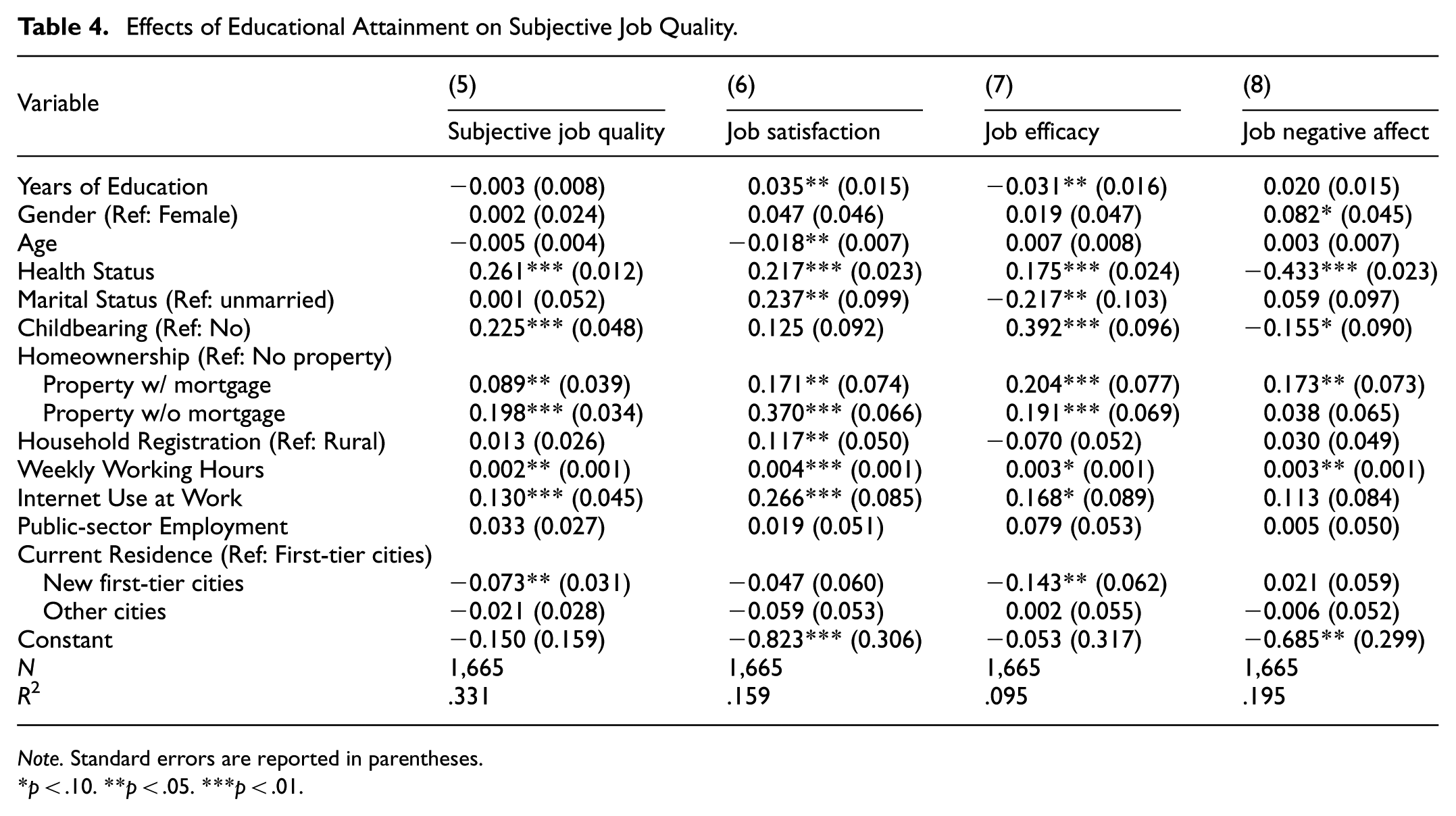
Table 4 reports the regression results for the effect of individuals’ educational attainment on their subjective job quality. In Model (5), which uses the composite subjective job quality index as the dependent variable, years of schooling is negatively related to subjective job quality but does not reach statistical significance. To gain deeper insight, Models (6) through (8) separately examine the three components of subjective job quality: job satisfaction, job efficacy, and job negative affect.
Effects of Educational Attainment on Subjective Job Quality.
Note. Standard errors are reported in parentheses.
p < .10. **p < .05. ***p < .01.
In Model (6), years of education (β = .035, p < .05) has a significantly positive effect on job satisfaction, indicating that as education increases, individuals become more satisfied with their jobs, likely because they believe their jobs align with their higher credentials. This finding supports H2a. In Model (7), however, years of education is negatively and significantly associated with job efficacy (β = −.031, p < .05). In other words, those who excel in higher education do not necessarily experience stronger self-perceived gains in areas such as social network expansion, responsibility, and personal value fulfillment; instead, they develop more negative perceptions. This result confirms H2b. Finally, education and job negative affect are positively correlated, implying that higher-educated individuals may experience greater exhaustion or burnout at work. However, the relationship is not statistically significant, so H2c is not supported. This result also indicates that the pressures of meritocratic competition manifest less as overt physical or material hardship than as a deeper, internalized deficit of meaning and purpose.
Subjective evaluations of job are also shaped by other factors. Among individual characteristics, health status is positively and significantly related to subjective job quality, whereas gender and age are not significant. Within family characteristics, individuals with children display higher subjective job quality than those without, largely due to stronger job efficacy and lower negative affect. Homeowners also exhibit more positive attitudes toward work than non-homeowners. Regarding work characteristics, both weekly working hours and the use of the Internet at work show a significantly positive effect on subjective job quality, whereas working in the public sector has no significant effect. Regarding cities, respondents in new first-tier cities evaluate their jobs more negatively than those in the four major first-tier cities, but no significant difference is found between the latter and other cities.
Robustness Tests: Changing the Sample and Variable Substitution
To verify the robustness of the baseline results, the analysis focuses on the occupational status and job empowerment from objective job quality dimensions, as well as the job satisfaction and job efficacy from subjective job quality dimensions.
First, the sample is restricted to individuals who were employed before the COVID-19 pandemic to rule out the negative impact of the pandemic on university graduates’ employment (C. Li, 2020; Mao & Zeng, 2022). The results remain consistent: years of education is significantly and positively related to objective job quality, individuals with more education have better job status and higher job empowerment. Concurrently, education is positively correlated with job satisfaction and negatively correlated with job efficacy, mirroring the baseline findings.
Second, the sample is further restricted to ordinary employed youths by excluding employers, self-employed individuals, military personnel, and police officers. The results remain unchanged. Third, a variable-substitution approach is employed by representing educational attainment in categorical terms (high school or below, junior college, bachelor’s degree, and graduate degree), using “high school or below” as the reference group. The findings show that compared to those with a high school education or lower, having any college degree significantly improves objective job quality. For subjective job quality, junior college graduates do not differ significantly from high school or below in terms of job satisfaction, but those with a bachelor’s degree or above report significantly higher job satisfaction. On the other hand, the relationship between education and job efficacy is negative, and notably, it is significantly negative for those with graduate degrees. These robustness checks confirm the consistency of the baseline results (Table 5).
Robustness Checks.

Note. Standard errors are in parentheses. All robustness check models include the following control variables: gender, age, health, marital status, parenthood, homeownership, household registration, weekly working hours, Internet use at work, public-sector employment, and current residence. Due to space constraints, the results for these controls are not displayed.
p < .10. **p < .05. ***p < .01.
The Effect of Overeducation on Objective and Subjective Job Quality
Under meritocracy, success is tied to academic achievement and competitive intensity, which often pushes students and parents to seek ever-higher levels of education. However, such educational investments may exceed actual needs, leading to overeducation, a phenomenon that may in turn harm individuals’ professional development. This study measures overeducation using the empirical-statistical method (i.e., the mean-based approach). 3 First, the mean years of education among workers in a given occupation is used to define that occupation’s required educational level. Next, each worker’s years of education is compared against the occupational average. If a worker’s years of education exceeds the occupational mean by at least one standard deviation, they are defined as overeducated (Shao, 2024; Verdugo & Verdugo, 1989; You & Li, 2023). An analysis of the average educational levels across occupations yields a range of [14.947, 16.522] years of education, indicating that a university degree is already a widespread requirement in the labor market. Adding one standard deviation to these means yields the range [16.748, 18.078], illustrating that those holding master’s degrees or above surpass typical occupational requirements and thus constitute the overeducated.
To investigate the relationship between education and job quality, the sample is restricted to individuals with at least a bachelor’s degree. As shown in Table 6, the marginal returns to education begin to diminish. For respondents who already hold a bachelor’s degree, further educational attainment does not significantly improve occupational status, suggesting that additional education does not guarantee a more favorable job. Although advanced degrees do significantly enhance job empowerment, notably in terms of job autonomy and managerial authority, they do not significantly increase job satisfaction. This finding implies a mismatch between the higher education system and labor-market demands. Even as youths pursue graduate or professional degrees, they often do not gain better employment opportunities than bachelor’s degree holders, resulting in no substantial boost in job satisfaction. Moreover, higher levels of education have a significantly negative effect on job efficacy (Model (4): β = −.052, p < .05), highlighting the adverse consequences of overeducation, what Han (2015) calls achieve without achieving. Individuals who adhere to the meritocratic culture of excellence, continuously striving for higher degrees and better exam scores, find that their heightened aspirations may not be realized in the labor market, eroding their sense of workplace efficacy.
Overeducation and Youth Job Quality.

Note. Standard errors are in parentheses. All models include a set of control variables. Due to space constraints, the results for these controls are not shown.
p < .10. **p < .05. ***p < .01.
Subsequently, the entire sample is used to examine the effect of overeducation on youth job quality by creating a dummy variable that equals 1 if an individual’s years of education exceed the occupational average by at least one standard deviation and 0 otherwise. In Models (1) to (3) of Table 6, the overeducation coefficient is not statistically significant, whereas in Model (4) it is negative and significant at the 5% level (β = −.183, p < .05). These results underscore the limitations of the meritocratic notion that higher credentials should yield better jobs. Overeducated individuals, despite investing more in education, do not obtain better jobs than their non-overeducated peers; hence, their objective job quality shows no significant advantage. Unable to translate their higher educational credentials into corresponding workplace rewards, their subjective evaluation of employment becomes more negative, job satisfaction is difficult to raise, and they struggle to experience meaningful job efficacy. Thus, H3a and H3b are supported.
Mean Difference Tests
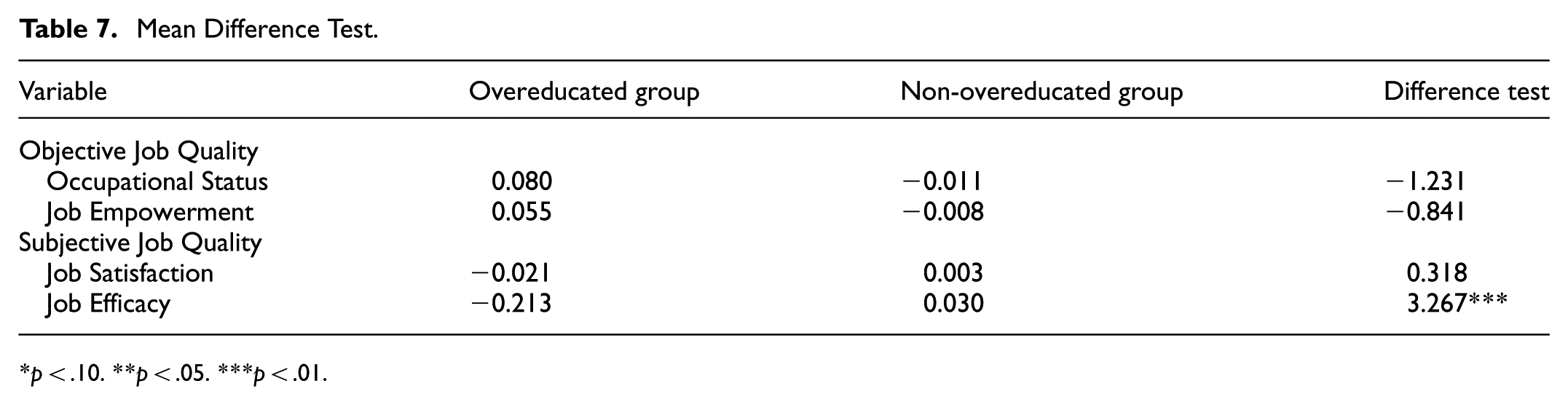
To further investigate the effects of overeducation, the sample is divided into overeducated and non-overeducated groups for a mean difference test of objective and subjective job quality (Table 7). On the one hand, the mean values of occupational status and job empowerment are negative for the non-overeducated group but positive for the overeducated group; however, the mean differences between the two groups are not significant. This suggests that having a higher level of education does not substantially improve one’s actual working conditions. Although meritocracy posits an education advantage, it does not translate into significantly enhanced human capital in practice. On the other hand, the overeducated group shows negative mean values for job satisfaction and job efficacy, whereas these values are positive for the non-overeducated group. Notably, the mean difference in job efficacy between the two groups is significant at the 1% level, confirming the markedly negative effect of overeducation on one’s sense of personal efficacy at work.
Mean Difference Test.
p < .10. **p < .05. ***p < .01.
Robustness Test: Propensity Score Matching
Overeducation is selective (J. Li, 2016). On the one hand, a degree from a prestigious university has become a vital pathway for upward social mobility. Middle-class parents who hope their children will ascend in social status often invest heavily in education, buying property in elite school districts, for example (Chen & Miao, 2021; L. Zhang, 2024). On the other hand, elite families view higher education as a key means of preventing downward mobility. By meticulously preparing their children for college applications in a fierce meritocratic competition, they transform their own economic capital into their offspring’s cultural capital, aiming to maintain or even enhance the family’s social position (Sandel, 2020).
Given these dynamics, this study applies Propensity Score Matching (PSM) to address potential selection bias. First, the sample is divided into a treatment group (the overeducated) and a control group (the non-overeducated). A Logit model then estimates each individual’s propensity to be in the treatment group. Nearest neighbor (1:1), radius (R = .02), and kernel matching methods are subsequently used to pair treatment and control individuals. Table 8 reports the results. Under all three matching techniques, only job efficacy shows a significantly negative average treatment effect on the treated (ATT) at the 5% or 1% level; none of the other job-quality dimensions differ significantly between the two groups. Moreover, in terms of effect size, this negative impact is approximately 0.2 standard deviations, reaching what psychology considers a practically meaningful effect (Funder & Ozer, 2019). This indicates that the decline in efficacy associated with overeducation is not a trivial statistical fluctuation. Its magnitude is sufficient to be distinctly perceived in everyday work and life and to manifest as an observable form of psychological strain. In other words, given broadly similar conditions, overeducated individuals report significantly lower job efficacy compared with their non-overeducated peers. This result remains consistent even after controlling for selection bias. Ultimately, overeducation offers no significant advantage in occupational status, job empowerment, or job satisfaction and indeed exerts a negative effect on job efficacy. Balance tests confirm that matching substantially reduces the covariate differences between treatment and control groups, meeting the balance requirements and indicating effective matching. 4
Propensity Score Matching Results.

Note. Standard errors are in parentheses, calculated via the Bootstrap method with 500 iterations.
p < .10. **p < .05. ***p < .01.
Heterogeneity Analysis
Meritocracy’s emphasis on personal effort and achievement is highly appealing to students from rural or small-town backgrounds, who believe that by studying hard and passing competitive entrance exams to elite universities, they can achieve upward social mobility. The motto that knowledge changes destiny motivates these students to embrace meritocratic ideals. However, upon entering university, they often lack family endowments, such as financial, social, or cultural capital, thus reducing their ability to tap into the resources that would enhance competitiveness in their subsequent academic or professional pursuits (Dai & Li, 2021). Moreover, university life and its multifaceted evaluation criteria differ markedly from the regimented, test-oriented environment of high school. This gap may lead students from rural or small-town backgrounds to feel alienated, and such emotional challenges can persist through future education, job searches, and work experiences. In Chinese online discourse, these students, who excelled under an exam-centric system and gained admission to top universities are often labeled as xiaozhen zuotijia (Q. Li & Xia, 2021).
Against this backdrop, the present study examines differences in the relationship between educational attainment and job quality for these small-town students compared to their urban counterparts. Specifically, a dummy variable is created based on one’s household registration at age 14: individuals whose registration was in a rural area or township receive a value of 1, whereas all others receive 0. This variable and its interaction with years of education are then included in the regression model. Table 9 shows that the interaction terms are statistically significant in Model (1) and Model (4), indicating notable differences in both objective and subjective job quality across urban and rural–township groups.
Heterogeneity Analysis.

Note. Standard errors are reported in parentheses.
p < .10. **p < .05. ***p < .01.
On the one hand, the improvement in occupational status brought by education is significantly moderated by one’s region of origin. Although small-town students may match urban students in academic performance, their relative lack of inherited resources places them at a disadvantage in the labor market, making it harder to secure highly valued good jobs (Q. Zhang & Liu, 2021). On the other hand, these individuals exhibit higher job efficacy than urban students. Their challenging upbringing endows them with stronger resilience and adaptability, which helps them navigate workplace demands, develop independence, bolster self-confidence, and enhance their sense of responsibility. Consequently, they tend to report a higher sense of efficacy at work. In essence, these findings show that although higher education does confer potential upward mobility for students from rural or small-town backgrounds, its positive impact remains limited by unbalanced resource allocation in society.
Concluding Remarks
Empirical Conclusions
Drawing on meritocracy theory, this study focuses on the phenomenon of educational rat race among Chinese youth during a period of social transformation. It examines how educational attainment shapes job quality and further investigates the impact of overeducation on young people’s career development. An empirical analysis of random survey data yields the following conclusions: First, there are dual effects of education on job quality. On the objective dimension, higher educational attainment significantly improves individuals’ likelihood of securing good jobs that enjoy broad social recognition, reflected primarily in better occupational status and greater job empowerment. On the subjective dimension, the impact of education is more complex. Although additional years of education are significantly and positively associated with job satisfaction, they are also linked to a marked decline in job efficacy. Second, this complex outcome is closely tied to overeducation generated by meritocratic pressures. Meritocracy and its evaluative framework drive individuals to pursue increasingly higher degrees, eventually resulting in a disjunction between educational supply and labor market demand. The findings indicate that overeducation not only fails to improve objective job quality but also undermines subjective job quality, particularly by significantly reducing job efficacy. This result remains robust even after controlling for selection bias through propensity score matching. Third, the effect of education on job quality exhibits heterogeneity among students from different home regions. Compared with urban students, higher education has a limited impact on improving the objective working conditions of rural or small-town students. Nevertheless, their job satisfaction is not significantly different from that of urban students, and they even display higher job efficacy.
Theoretical and Policy Implications
This study provides key empirical evidence for theoretical debates on meritocracy and extends existing critiques in an important respect. Our findings corroborate Sandel’s depiction of the “tyranny” of meritocracy, namely, its burdens on all participants. Yet by revealing the central paradox of the coexistence of high objective job quality and low subjective work efficacy, we further demonstrate the hiddenness and complexity of this tyranny: the meritocratic system does not simply reject individuals; rather, through the key mechanism of overeducation, it simultaneously confers external social rewards (good jobs) while systematically eroding individuals’ internal sense of efficacy. These results indicate that when diligence becomes the badge of personal worth, labor effort is tightly coupled to income rank, and workplace ethics evolve into a fervent veneration of high skill and extraordinary exertion, the arena of competition expands continuously from education into employment. Individuals not only cannot step off the treadmill; they are compelled to intensify their efforts, ultimately becoming exhausted by unending upward striving. Although, on the surface, the highly educated indeed obtain good jobs that symbolize elite status, the occupational halo obscures a bleaker reality: through persistent self-exploitation, workers become trapped in a dual predicament of psychosomatic exhaustion and a loss of meaning (Markovits, 2019). Under meritocracy, there are no winners. Within a discourse that equates struggle with justice, both those who lose in higher education and those who win are confined within the system’s cage, the former subjected to stigmatizing judgments of ability deficits (Sandel, 2020), the latter ensnared in perpetual performance anxiety. In the end, both are subjected, to varying degrees, to the systemic disciplining of labor alienation.
The paradox of the contemporary performance society lies in the transformation of its promise of human emancipation into a new form of oppression. Breaking this cycle requires institutional reconstruction of evaluative regimes on two fronts: for one thing, demystifying the ideological illusions of meritocracy; for another, building flexible frameworks that accommodate plural developmental pathways, enabling individuals to attain authentic modes of being through autonomous practice. The findings have direct implications for higher education and employment policy, bearing especially on education equity, labor-market segmentation, and urban–rural development disparities. In higher education, talent cultivation structures should be optimized, vocational education strengthened, and tighter linkages forged with labor-market demand, while avoiding expansionary policies that may exacerbate inequalities in educational quality across regions and between urban and rural areas. In the labor market, segmentation rooted in factors such as the elite university halo and the divide between public-sector and private-sector employment should be dismantled, advancing ability-oriented, multidimensional evaluation systems that gradually weaken the decisive role of credentials in hiring and promotion. In the realm of social support, a robust mental-health infrastructure for youth should be established to alleviate the structural pressures generated by credentialism. Only through such systematic institutional reflection and reform can structural mismatches in the labor market be effectively addressed, thereby creating more inclusive career pathways for young people.
Limitations and Future Research
This study has limitations that open venues for future research. First, in terms of measurement, we did not directly measure meritocracy. Instead, we examined the mechanism through which credential competition in the contemporary performance society affects individual job quality by using overeducation as a key behavioral indicator. We recommend that subsequent studies incorporate direct measures of individuals’ value, thereby deepening analyses of the structural linkages between the performance society and youth career development. Second, with respect to methodology, although we employed multiple strategies for the robustness test of our inferences, cross-sectional data are limited in revealing the dynamics of causal processes. Moreover, our data are primarily derived from self-reported survey responses. Future work would benefit from longitudinal designs and the integration of objective data from multiple sources, such as administrative records or behavioral traces to enhance inferential leverage. We look forward to further studies that, building on this foundation, continue to explore how to construct pluralistic evaluation regimes beyond meritocracy, thereby offering theoretically and practically viable pathways for young people to surmount meritocratic strictures and pursue more autonomous career development and fuller self-realization.
Footnotes
Acknowledgements
We are grateful to the anonymous reviewers for their constructive feedback.

Ethical Considerations
This study analyzes de-identified survey data from the 2022 “Survey on Chinese Youth’s Perspectives toward Career and Social Labor,” collected by a joint team at two Chinese academic institutions via Credamo. Risk of harm was minimized by (a) collecting no direct identifiers, (b) restricting access to a de-identified analytic file, (c) storing data on encrypted drives with role-based access, and (d) reporting only aggregate statistics with small-cell suppression. Given the analysis of an existing, fully de-identified dataset, this study was exempt from ethical review.
Consent to Participate
The original data collectors obtained electronic informed consent through Credamo’s interface: participants were shown an information sheet describing the study purpose, voluntary nature, right to skip questions or withdraw without penalty, data-protection measures, and contacts for queries; modest panel compensation was provided by the platform.
Author Contributions
Yudong Lan conceptualized and led all aspects of the study, including data acquisition, data analysis, visualization, and overall project management. Jiayu Zheng contributed to the development of research questions and the theoretical framework, and was responsible for writing and revising the manuscript. Yushi Yang provided assistance with supplementary analyses and minor revisions. All authors reviewed and approved the final manuscript.
Funding
The authors disclosed receipt of the following financial support for the research, authorship, and/or publication of this article: This work was supported by the National Social Science Fund of China (Grant Number 20ZDA095) and Major Project of Philosophy and Social Sciences, PRC Ministry of Education (Grant Number 23JZD036).
Declaration of Conflicting Interests
The authors declared no potential conflicts of interest with respect to the research, authorship, and/or publication of this article.
Data Availability Statement
The dataset cannot be shared due to the data confidentiality policies of the research institution.