




Abstract
Poor quality jobs can impact employees’ health and wellbeing. However, jobs’ changing natures and employees’ increasing diversity mean extant job quality models may inadequately explain employees’ experiences. This qualitative case-study of an Australian organisation aimed to understand mothers’, fathers’ and childless women’s and men’s experiences of qualitative job demands, resources and rewards in the context of multilevel power relations. We used a critical feminist grounded theory approach to analyse 47 employees’ open-ended questionnaire responses and 10 employees’ in-depth interviews. Findings suggested participants had nuanced gendered, classed and aged experiences of qualitative job demands, resources and rewards, emanating from the societally-entrenched organisational growth imperative and mechanisms, and participants’ organisationally and societally-embedded individual, household and community contexts. The study enriches and expands job quality dimensions by suggesting job quality encompasses navigating between personal needs and abilities, and intrinsic task demands, resources and rewards; working (in)authentically within organisational contexts; working with others; and dealing with company change.
Plain language summary
This qualitative study of one Australian organisation aimed to understand mothers’, fathers' and childless women’s and men’s experiences of qualitative job demands, resources and rewards in their individual, household, community, organisational and societal contexts that are influenced at all levels by gender, class and age stereotypes. We analysed 47 employees’ open-ended questionnaire responses and 10 employees’ in-depth interviews. Findings suggested participants had nuanced gendered, classed and aged experiences of qualitative job demands, resources and rewards, emanating from participants’ interacting societal, organisational, community, household and individual contexts. The study suggests job quality includes navigating between personal needs and abilities, and job demands, resources and rewards; working authentically or inauthentically within organisational contexts; working with others; and dealing with company change. The study was limited by the small number of participants and their relatively similar characteristics. However, the findings are important for understanding nuanced experiences of job quality and their multiple levels of influence, and developing strategies to improve job quality for employees with different backgrounds and life contexts.
Introduction
Job quality, including demands, resources and rewards, can positively or negatively impact employees’ physical and mental health, and lives and functioning inside and outside work (Demerouti et al., 2001; Karasek & Theorell, 1990; Pocock & Charlesworth, 2017; Siegrist, 1996). In recent decades, more women and people with different backgrounds and household structures have entered employment (C. L. Cooper et al., 2001; Pocock & Charlesworth, 2017). Consequently, extant job quality models may insufficiently explain employees’ experiences (Polanyi & Tompa, 2004), which are influenced by gender, class and other power relations at individual, household, community, organisational and societal levels (Pocock & Skinner, 2012). This research responds to calls for more qualitative, multilevel research facilitating nuanced understandings of job quality (Cooke et al., 2013; Findlay et al., 2013), by aiming to understand how mothers, fathers and childless women and men working in an Australian organisation, experience and give meaning to qualitative job demands and their associated rewards and resources, within gendered, classed and aged societal, organisational and individual-level contexts.
Before proceeding, we clarify contested terms used in this paper. ‘Middle/working classed’, ‘feminine/masculine’ and ‘older/younger’ describe practices and qualities research suggests have been socially constructed as classed, gendered and aged (Berdahl et al., 2018; Ely & Meyerson, 2000; Maier, 1999; Wajcman, 1998). ‘Capitalist/class’ and ‘patriarchal/gender’ relations refer to unequal power relations between capital-owning and employer classes and employee classes, and men and women (Connell & Pearse, 2015; Wright, 2005). ‘Neoliberal’ alludes to modern capitalism’s replacement of governments’ responsibility for citizens’ social and economic welfare with expectations of economically productive, individually responsible, independent adults (Harris Rimmer & Sawer, 2016; Runswick-Cole et al., 2016). Where required, these terms are shown in brackets to emphasise their use as socially constructed terms.
Theoretical and Empirical Background
Extant models have identified interacting demands, resources and rewards as job quality dimensions (e.g., Demerouti et al., 2001; Karasek & Theorell, 1990; Siegrist, 1996). We have explored quantitative demands, including targets, workloads, hours, intensity, availability and flexibility, elsewhere (Turnbull et al., 2023b). This paper focuses on qualitative job demands, including intrinsic task demands such as skill use, learning, challenge, complexity, responsibility, variety and interest (C. L. Cooper et al., 2001; Karasek & Theorell, 1990) and their congruence with individuals’ abilities (Siegrist, 1996). Emerging qualitative demands include intrinsic task demands’ alignment with individuals’ needs and aspirations, the quality of social relationships and interactions (Polanyi & Tompa, 2004) and personal demands such as high performance standards (Bakker & Demerouti, 2017; C. L. Cooper et al., 2001). Established resources enabling employees to meet qualitative demands include organisational (Cousins et al., 2004), leadership (Bakker & Demerouti, 2017) manager and colleague support (Demerouti et al., 2001; Karasek & Theorell, 1990), and decision-making participation (C. L. Cooper et al., 2001; Demerouti et al., 2001). Emerging resources include personal attributes such as self-efficacy (Bakker & Demerouti, 2017; C. L. Cooper et al., 2001). Rewards for meeting qualitative demands traditionally incorporate extrinsic recognition, career opportunities and income (Bakker & Demerouti, 2017; C. L. Cooper et al., 2001; Siegrist, 1996). Emerging intrinsic rewards include achieving meaning, belonging and accomplishment through work, which can augment motivation, a personal resource (C. L. Cooper et al., 2001; Polanyi & Tompa, 2004; Victor & Hoole, 2021). Job control, flexibility and security (Demerouti et al., 2001; Karasek & Theorell, 1990; Polanyi & Tompa, 2004; Siegrist, 1996) have been identified as both resources and rewards (Aletraris, 2010). Bakker and Demerouti (2017) have also argued individuals’ strategies for managing demands should be included in job quality.
Some researchers have identified multilevel influences on job quality, to the extent job quality dimensions can constitute positive challenge demands, negative hindrance demands (Lepine et al., 2005), rewards or resources, according to individuals’ nuanced multilevel contexts (Bakker & Demerouti, 2017; Cooke et al., 2013; Polanyi & Tompa, 2004). These include societal (Pocock & Skinner, 2012), organisational, leadership and team contexts (Bakker & Demerouti, 2018) and job conditions’ congruence with individuals’ needs, aspirations, characteristics (Findlay et al., 2013; Polanyi & Tompa, 2004), household and community contexts; all of which are influenced by gender, class, age and other power relations (Pocock & Skinner, 2012).
Focusing on Australian studies given the unique societal contexts influencing job quality, there has been little research comparing mothers’, fathers’ and childless women’s and men’s experiences of qualitative job demands. Regarding intrinsic task demands, part-time roles (dominated by mothers) have been perceived as having less challenge and responsibility than full-time roles (Handley et al., 2017; Thornton, 2016). Considering the quality of social relationships, some mothers have felt accepted and supported, while others have felt unsupported, by colleagues (Costa et al., 2012; Dever & Maher, 2004). However, some childless women have felt socially isolated in parent-dominated workplaces (Turnbull et al., 2016). We have elsewhere reported the Australian societal-level contexts based on a comprehensive review of extant literature (Turnbull et al., 2020), and the case study organisation’s contexts emerging from analysing organisational documentation and participant narratives about organisational, leadership, team and workplace cultures, values, policies, practices and expectations (Turnbull et al., 2022). We refer to these contexts in the findings to illustrate multilevel job quality.
Methods
The research was conducted from early 2019 to mid-2020. We employed a critical feminist grounded theory approach to analysing data from a qualitative case study of an Australian organisation (Corbin & Strauss, 2008; Fassinger, 2005; Layder, 1993), given the pseudonym ‘ComCo’. The grounded theory approach enabled an understanding of how participants experienced, understood, resisted or complied with qualitative job demands, resources and rewards (Corbin & Strauss, 2008), while the critical feminist iteration of grounded theory contextualised these understandings within multilevel power relations (Fassinger, 2005; Layder, 1993). Although multilevel power relations theories influenced our sensitising concepts, unravelling multilevel job quality in a unique organisational context required an approach grounded in data that enriched (rather than generated new) theory (Mishra et al., 2014). In accordance with the grounded theory process, we reviewed and incorporated extant job quality theory and literature into the dataset after analysis commenced, in order to contextualise participants’ experiences (Corbin & Strauss, 2008; Fassinger, 2005). Accordingly, such literature is woven through the findings rather than in a separate, comprehensive literature review (Dunne, 2011).
In 2018, ComCo agreed to be involved in the research, including allowing employees to participate during working-hours. However, ComCo consented only to the participation of ‘white collar’ employees paid by annual salary, and not ‘blue collar’ and casual employees’ paid by hourly wage. Employees were invited by email from a ComCo representative in early 2019 to complete an online questionnaire. Forty-seven respondents answered open-ended questions asking them to describe any positive and negative experiences working at ComCo relating to being mothers, fathers or childless women or men. From late-2019 to mid-2020, the lead author interviewed 10 employees (recruited from questionnaire contact details and snowball sampling) twice for 45 to 90 min each interview. Interviews were conducted in person or by telephone if in-person interviews were not possible. The semi-structured interviews commenced by asking how participants experienced working at ComCo as mothers, fathers or childless women or men, and used prompts and probes when necessary. Second interviews explored topics not covered in, and issues emerging from, first interviews. Interviews were audio-recorded and transcribed verbatim. Although all interviewees were given the opportunity, only three validated their transcripts. We intended to commence with a maximum variation sample and proceed to theoretical sampling. Unfortunately, organisational constraints prevented further recruitment. Nevertheless, combining interviewee and qualitative questionnaire data provided varied perspectives and enhanced categorical saturation. As shown in Table 1, there were similar numbers of participants working in ComCo’s different departments, and mothers, fathers and childless women. However, few childless men participated, and people who were managers, full-time employees, head office-based, bachelor-qualified, aged 35 years or over, heterosexual, Australian-born and spoke only English at home, predominated.
Participant Demographics. a
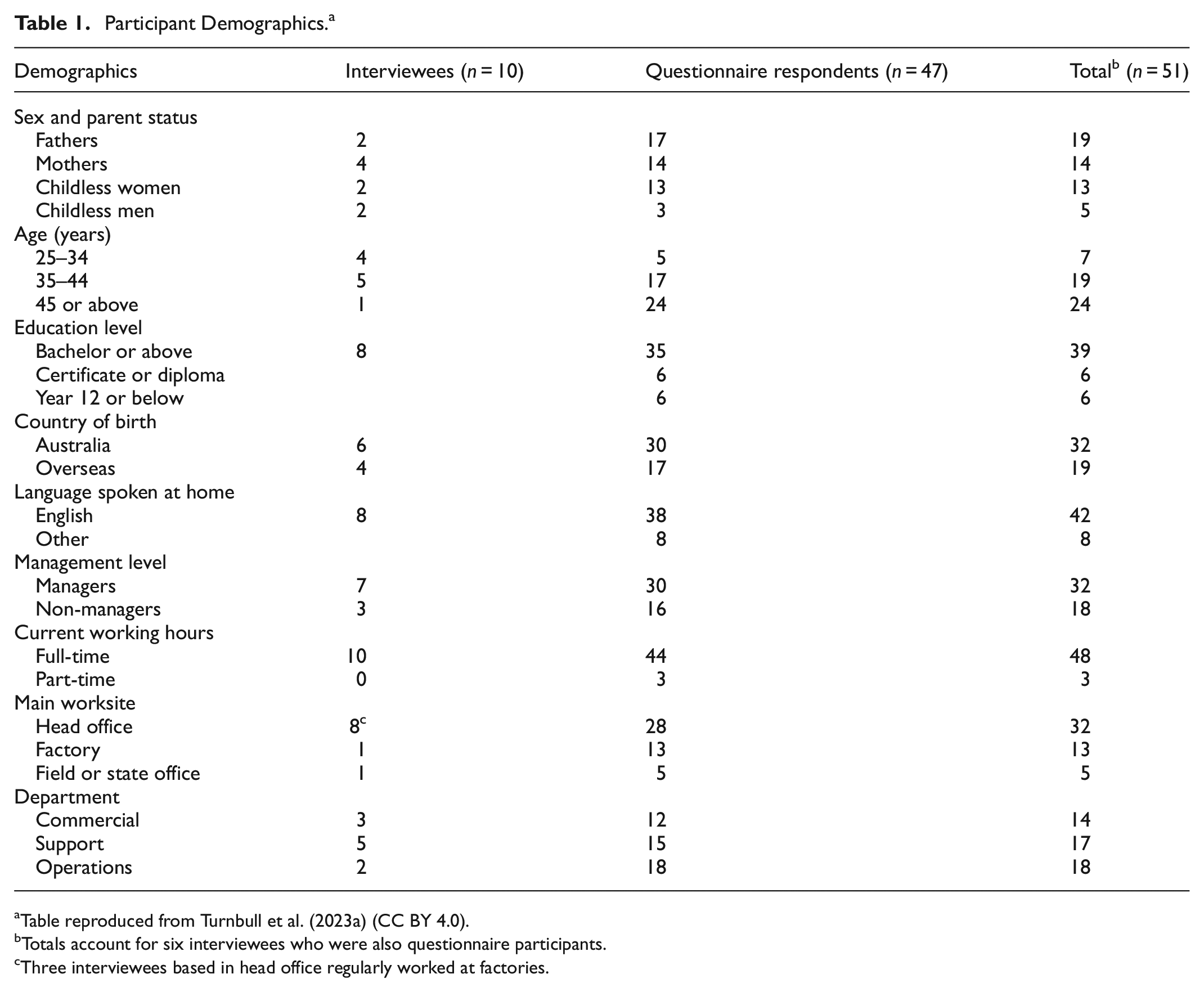
Table reproduced from Turnbull et al. (2023a) (CC BY 4.0).
Totals account for six interviewees who were also questionnaire participants.
Three interviewees based in head office regularly worked at factories.
Using QSR NVivo 12, the lead author commenced with data immersion by comparing interview transcripts with audio recordings and rereading transcripts, then iteratively and inductively analysed data using open, axial and selective coding, aided by memos and constant comparison between data, extant literature and emergent codes and categories (Corbin & Strauss, 2008; Fassinger, 2005; Layder, 1993). The lead author discussed and refined concepts and categories with the other authors throughout analysis. In this respect, because we (as feminists, two childfree women and a recent mother who have our own experiences employment predominantly as childfree women, and researchers who had previously focused on childless women’s experiences) construct knowledge, we stayed open to other perspectives by expanding the incipient research focus from childless women to include mothers, fathers and childless men, analysing data inductively and reviewing previous literature after data analysis commenced.
Open coding consisted of breaking down, questioning and conceptually labelling data (e.g., expectations of high performance of intrinsic task demands and conforming to specified idealised worker qualities). During axial coding, concepts were combined into categories identifying and explicating relationships between categories, which included reviewing theory and literature to clarify relationships with multilevel power relations (e.g., job demands categorised and accorded lesser or greater value, as [feminine] or [masculine] depending on sometimes acknowledged and sometimes unacknowledged gendered societal and organisational contexts, but experienced as positive challenges, negative hindrances, resources and/or rewards depending on participants’ nuanced community, household and individual contexts). A core category emerged during selective coding, which pervaded participants’ experiences and understandings of job quality: ComCo’s societally embedded (neoliberal-capitalist, masculine) ‘ruthlessly commercial’ growth imperative. This core category, and its octopoidal influence on the organisational contexts of diversified cultures, policies, practices and expectations to construct not just masculine, but all workers as existing for company growth, has been evidenced in depth elsewhere (Turnbull et al., 2022), but is referred to in the findings to illustrate multilevel influences on job quality.
The research was approved by La Trobe University's Human Research Ethics Committee [HEC19285]. All participants provided informed consent before participating, which was given online by questionnaire participants, in writing by in-person interviewees and verbally by telephone interviewees. To protect ComCo confidentiality, we broadly identify ComCo’s industry and do not specify its number of employees. In the context of all participants working in a single organisation, it was apparent that allocating participant codes to quotations could enable other ComCo employees to identify participants through unique experiences and perspectives revealed by multiple quotations attributed to a participant. Accordingly, to protect participant confidentiality, we attribute quotations with the minimum descriptors required to explore nuances, similar to other organisational research (Connell, 2006). We present in-text quotations in single quotation marks.
Findings
ComCo, a multinational subsidiary, was an Australian incorporated private company that manufactured consumer products. Employees worked in what participants described as gender-diverse but ‘middle-classed’, ‘heterosexual’ head office, ‘blue collar’, male-dominated factories, state offices and the field; and commercial (male-dominated sales, female-dominated marketing), male-dominated operations (research, development, quality, manufacturing, logistics, supply chain) and support (finance, legal, corporate affairs and female-dominated human resources) departments.
Participants had nuanced experiences of gendered, classed and aged qualitative job demands, whether they were challenges or hindrances, and whether they were intrinsically rewarding and motivating, and extrinsically resourced and rewarded. As detailed in Figure 1, job quality experiences (represented by the central circle) were embedded in interacting societal-level gendered and classed discourses (Turnbull et al., 2020), ComCo’s gendered, classed and aged growth imperative, growth mechanisms and qualitatively conformant and quantitatively extreme worker expectations (Turnbull et al., 2022), and individual, household and community contexts themselves mired in organisational and societal gender, class and age relations (Casey, 1995; Pocock & Charlesworth, 2017).

Multilevel qualitative job demands, resources and rewards.
Nuanced qualitative job demands (aligning predominantly with qualitatively conformant worker expectations), resources and rewards flowing from these multilevel contexts, fell within four categories: navigating between personal needs and abilities, and intrinsic task demands, resources and rewards; working (in)authentically within organisational, leadership, manager, team and colleague contexts; working with others; and dealing with company change.
Navigating Between Personal Needs and Abilities, and Intrinsic Task Demands, Resources and Rewards
Mirroring organisational discourses of idealised (masculine) highly performing workers who achieved ‘high standards of quality’, and (masculine) conformant workers who were passionate, driven, committed, innovative, agile and keen to grow (Figure 1), many participants experienced qualitative job demands such as ‘challenging’ and ‘complex’ work; ‘learning’ and ‘developing’‘skills’ and ‘expertise’, dealing with ‘variety’, ‘ambiguity’ and ‘doing things differently’ in ‘dynamic’ roles; and being ‘responsible’ for important tasks or managing teams, aligning with intrinsic task demands (Karasek & Theorell, 1990). Many participants experienced the intrinsic rewards and resources of ‘loving’, ‘enjoying’ and being ‘excited’ and ‘motivated’ by, and gaining ‘confidence’, ‘strength’, ‘pride’ and ‘achievement’ from, fulfilling such demands, reflecting research (Cooke et al., 2013; Polanyi & Tompa, 2004).
Managing a project, I was sought after for my opinions, expertise, approach to people and experience. My manager noticed my contribution and workload, regularly checked in, but gave me space to fulfil my role. I felt engaged and responsible. I was having a positive impact. I felt proud of my work and myself. [Mother, manager]
However, nuanced experiences of intrinsic task demands, resources and rewards, reflected participants’ multilevel contexts. As elsewhere (Diamond et al., 2007), participants felt intrinsically motivated and rewarded by such demands regardless of sex or parent-status. However, many mothers’ and a childless woman’s appreciation of challenge, stimulation and development, and the ‘confidence’ and ‘strength’ they imparted, counterbalanced non-working lives, in which the mothers prioritised children in accordance with societal intensive mothering discourses, and the childless woman was aware non-working women could be ‘powerless’, reflecting societally subordinated femininities (Figure 1).
You can be a stay-at-home mum and develop yourself, but it’s isolating … I don’t think you’d get the same opportunities to build confidence in knowing you can take care of yourself in the world. [Childless woman]
Many participants perceived career progression as essential to maintaining challenge. Accordingly, some avoided ‘getting stale’ by ‘moving around’ in a ‘big’ organisation through ‘lateral moves’, secondments or promotions, facilitated by organisational environments encouraging personal growth (Figure 1).
I am ambitious. I wanna keep getting promoted and getting new challenges. [Father, manager]
Conversely, other participants felt intrinsically unrewarded and demotivated by inadequate ‘challenge’, ‘stimulation’ or ‘learning’ in ‘boring’ roles not matching their abilities (Polanyi & Tompa, 2004; Siegrist, 1996). Many such experiences related to gendered, aged and tenured barriers to increasing challenge through career progression, to which some participants responded by taking personal responsibility for resolving or avoiding inadequate challenge. In examples of job crafting (Bakker & Demerouti, 2017), a mother unable to relocate for promotions because of her gendered reliance on local grandparental support (Pocock & Charlesworth, 2017), backfilled senior roles to ‘keep [her] job changing’ and ‘continue to learn’; and a younger, non-manager childless man experiencing career barriers attributed to inadequate tenure, ‘[sought] opportunities to lead’ by coaching others. Some parents avoided female-dominated part-time roles’ insufficient ‘challenge’, ‘responsibility’ and ‘career development’ by working full-time. As elsewhere (Elley-Brown et al., 2018; Follmer et al., 2018), a childless man and mother of older children had resigned or were seeking external employment, but some inadequately challenged mothers of younger children continued working at ComCo for its ‘generous’ financial rewards and flexible working arrangements (Figure 1).
What I’m doing has a ceiling … There’s a big question around how much challenge I will have … so I’m looking around. [Mother, manager]
Other barriers to feeling intrinsically rewarded by intrinsic task demands derived from ‘excessive’ (masculine) quantitative demands (Figure 1) stifling other job quality dimensions (Pocock & Skinner, 2012), by depriving participants of time to ‘reflect’ or innovate, in turn impacting their ability to meet challenges.
You end up doing urgent things … It impacts results … because you don’t have time to do things differently. [Father, manager]
Conversely, some women experienced the increased demands accompanying promotions as ‘too much of a challenge’, leaving some feeling ‘overwhelmed’ and doubting themselves, as elsewhere (Andela & van der Doef, 2019). No men described such experiences, reflecting research that has found women are more likely than men to lack confidence in their professional abilities (Cech et al., 2011).
I felt like the last man standing and that’s why I got the responsibility … Asking, ‘Am I cut out for this? Can I do this?’ [Mother, manager]
Similarly, flowing from organisational cultures penalising failure and promulgating positivity (Figure 1), some participants felt ‘down’ or ‘stressed’ from things ‘going wrong’ or not being ‘positive’. Although some felt unsupported by colleagues conforming to ‘positivity cultures’, others received the extrinsic resource of emotional support.
I was stressed and [colleague] was like, ‘What’s wrong?’… I offloaded and his response was, ‘What can I do to help?’ [Mother, manager]
Flowing from (feminine) supportive leadership cultures in parts of ComCo (Figure 1), some participants were extrinsically resourced to meet challenges by managers who ‘supported’ and ‘empowered’ them by giving them ‘control’, ‘autonomy’ and ‘enough rope’ to ‘do [their] own thing’, but when necessary, answering questions, advising on challenging problems and ‘escalating’ to and ‘influencing’ senior leaders or other business areas. This balance between autonomy and support suited how many participants ‘liked to work’, reflecting Gerich and Weber’s (2020) findings that job control increased appraisals of job demands as positive challenges.
All I want is clarity on what to work on … then let me go away and do it. Check in occasionally to say, ‘I’ve got a few questions’. I feel like I get that. [Father, manager]
Conversely, flowing from (masculine-neoliberal) self-interested, authoritarian leadership cultures in other parts of ComCo (Figure 1), other managers were ‘too hands off’, showed ‘no interest’ and failed to ‘escalate’ or ‘influence’. Other managers and senior leaders ‘ordered people to do things’, expected ‘toeing the line’, and created ‘cultures of fear’ where ‘no-one wants make the tough call’ and ‘things aren’t getting done’, as elsewhere (Berdahl et al., 2018).
A project we’d worked on tirelessly … someone [senior] got antsy. My manager said, ‘Okay, we’ll pull it’. I thought, ‘Why is [manager] caving?’ But [manager’s] manager was breathing down [manager’s] neck, saying, ‘Just give ‘em what they want’. [Mother, manager]
Finally, participants had contrasting experiences of being extrinsically rewarded for meeting challenges. Some felt appreciated and valued by colleagues, managers and senior leaders’ recognition and requests for their ‘expertise’ and ‘opinions’. Unlike participants working in commercial and operational roles, who linked financial rewards to quantitative high performance by ‘hitting targets’ (Figure 1), participants working in support roles linked financial rewards to ‘bringing value’ in non-financial ways, or undertaking ‘big change’ projects. Accordingly, some experienced high performance of ‘business as usual’ as inadequately rewarded.
Last year one of my [key performance indicators] I significantly over-achieved … but got achieved overall ‘cause I didn’t have any big change projects. [Mother, manager]
Other participants felt ‘disheartened’ by being inadequately recognised and rewarded for their roles’ challenges and responsibilities.
For over a year I believed my role should have been a grade higher … After my role became redundant … it was regraded a higher grade. [Father, manager]
Working (In)Authentically Within Organisational, Leadership, Manager, Team and Colleague Contexts
In a company in which societally gendered, classed and aged organisational, leadership, manager, team and worker cultures, values, practices and attributes were co-opted to achieving growth (Figure 1), qualitative job demands encompassed not only intrinsic task demands, but also ‘assimilating’ to ways of acting and being that contributed to growth (Casey, 1995). As the following subsections suggest, alignment or misalignment between organisational contexts and participants’ personal values, attributes and aspirations (themselves shaped by organisational and societal contexts [Casey, 1995; Pocock & Charlesworth, 2017]), produced challenges, hindrances, rewards and resources that facilitated or inhibited feelings of authenticity, inclusion and belonging (C. L. Cooper et al., 2001; Polanyi & Tompa, 2004). Some participants described such experiences as affecting their mental, emotional and physical wellbeing, consistent with research (Andela & van der Doef, 2019).
Doing Work With or Without ‘Meaning’: Navigating Between Personal and Company Values
As elsewhere (Lips-Wiersma et al., 2016; Polanyi & Tompa, 2004), many participants felt intrinsically motivated and rewarded when working authentically in accordance with personal values and identities, including doing ‘good’, ‘the right thing’ or something with ‘purpose’ or ‘meaning’. Working authentically was especially salient to some childless participants, who derived meaning from contributing in ways other than raising children, as elsewhere (Wilkinson et al., 2017).
Bringing up great people … isn’t something I want to do to add value to this world … For me, work is the chance to do something worthwhile. [Childless woman]
Some participants whose values, such as (feminine) caring for others and the world, conflicted with ComCo’s (masculine) ‘profit-driven’ culture, experienced hindrance demands, including having to ‘sell out’ to meet ‘growth’ or ‘pushing’ other people ‘too hard’. Many such participants felt inauthentic, alienated, disengaged, unrewarded, ‘stressed’ and ‘ill’. A childless woman resigned in response, facilitated by her financial ‘freedom’, as elsewhere (Follmer et al., 2018).
To push harder is to enable what’s happening to other people … I feel ill because I don’t feel right about the mission. [Childless woman, non-manager]
Conversely, participants whose values aligned with ComCo’s commercial ‘purpose’ felt intrinsically motivated and rewarded. Some felt ‘motivated’ and ‘proud’ to work for a ‘market leader’ where their work contributed to ComCo’s ‘bigger purpose’. Interestingly, some participants’ perceptions that employees who ‘assimilated’ to ComCo’s ‘numbers-driven’ culture were ‘better equipped to succeed’, suggested career and financial rewards may have flowed from conforming, authentically or inauthentically, to such cultures.
Flowing from alignment between personal values and ComCo’s (feminine) beneficent growth mechanisms (Figure 1), other participants felt ‘proud’ of, ‘motivated’ by, and a sense of ‘belonging’ from, working in a company that was ‘inclusive and diverse’ or ‘trying to do the right thing by the environment’. Others felt intrinsically rewarded by aspects of their roles, or non-core activities such as committee membership, in which they contributed to such beneficence, despite such activities being extrinsically unrewarded, as elsewhere (Ely & Meyerson, 2000).
I’ve enjoyed autonomy to give people the right to return [from parental leave] under the right conditions. This has been rewarding, as it lets us do the right thing by people for their families. [Childless man, manager]
Expectations to be ‘Ambitious’ and Go ‘Above and Beyond’ for Personal Growth
Many participants experienced ComCo’s expectation of (masculine) ‘ambition’ (Figure 1) as creating qualitative challenge or hindrance demands. Some gender-conformant childless men and fathers who identified themselves as ‘ambitious’, some gender-deviant mothers and childless women who wanted ‘successful’ careers, and many participants whose challenge needs underlay their ambition, felt intrinsically motivated and rewarded by ‘challenging’ and ‘confidence-building’ development opportunities and ‘progressing through the business’. However, a childless woman adjusted her behaviour to meet such expectations (Follmer et al., 2018) by inauthentically performing ambition.
There was a global job … but I wasn’t ambitious for it … but every end-year review they’d ask, ‘What’s you aspiration?’ and you had to have an answer. [Childless woman, non-manager]
Although career progression was an extrinsic reward for high performance, many participants described performing core roles as inadequate for high performance and in turn meeting personal ambition and organisational growth expectations. Accordingly, many undertook activities, such as ‘broadening’ by working in different areas, ‘stretching’ or ‘voluntary additional’ projects ‘outside’ their roles, committee memberships, working groups, postgraduate qualifications and ‘double hatting’ two roles simultaneously, in order to ‘develop’ themselves, build networks essential to career progression, and ‘demonstrate capabilities’. As elsewhere (Mescher et al., 2010; Perlow, 1998), many participants experienced these ‘over and above’ career growth prerequisites as simultaneously challenging and intrinsically rewarding; quantitatively demanding by exacerbating already ‘excessive’ workloads, working hours and outside-hours availability requirements; and extrinsically recognised and rewarded with broadening opportunities or promotions.
The promotion … is recognition for the respect the business has for the skill set I’ve been proactively building. [Childless man, non-manager]
However, some participants experienced gendered, parented, aged and tenured barriers to meeting organisational and personal ambition and career growth expectations discussed in detail elsewhere (Turnbull et al., 2022), which concurrently inhibited adequate challenge. Briefly, younger and junior employees experienced barriers arising from senior roles and salaries being prioritised for, and hoarded by, a ‘35 to 45’ year-old ‘age club’ of tenured employees, who needed to pay for ‘kids’ and ‘mortgages’. Partnered and sole mothers and a childless woman who were geographically constrained to working close to home, schools, extended families and partners’ workplaces, were unable to relocate for promotions or travel for training; temporally constrained mothers were unable to meet workload-exacerbating ‘above and beyond’ career-growth prerequisites; a father was unwilling to meet senior roles’‘ridiculous’ quantitative expectations; and part-time employees’ development and promotion opportunities were ‘blocked’. Research suggests women and mothers predominantly experience such career barriers due to disproportionate caring and domestic responsibilities (Ely & Meyerson, 2000; Pocock & Charlesworth, 2017), reflecting societal contexts promoting family structures in which caregiving women and mothers support breadwinning men and fathers (Figure 1). For example, before having children, a woman was promoted after ‘double hatting’ for an extended period. However, after having children, she was no longer ‘willing’ to exacerbate her role’s excessive quantitative demands for career growth, because ‘squeezing everything in’ would ‘compromise’ her ‘family life and balance’ and ability to meet organisational and personal performance expectations by ‘doing her best’.
Additionally, some mothers felt inadequately extrinsically recognised for their ‘above and beyond’ efforts to compensate for their inability, resulting from gendered barriers, to meet personal growth demands.
There have been no offers of alternative training if I wasn’t able to travel due to being a sole carer … I have to do research in my own time … to work out what needs to be done to deliver my goals or team goals … then no recognition because management assumed since I didn’t attend training it must have been completed by the team. [Mother, manager]
Accordingly, meeting (masculine) career growth prerequisites and expectations and personal career aspirations, may have been unachievable hindrance demands for people with (feminine) non-work encumbrances such as children, elderly relatives, chronic illnesses and maintaining wellbeing (Perlow, 1998).
Working in Competitive Cultures
Flowing from ComCo’s (masculine) competitive cultures and worker expectations (Figure 1), which a father also understood as ‘masculine’, participants in different areas, from sales to human resources, experienced demands to be competitive in their roles or work in competitive cultures. Some women and men who preferred (feminine) collaboration experienced these demands as hindrances. However, a childless man employed a buffering strategy (Follmer et al., 2018) by reframing his inauthentic but gender-conformant performance of competitiveness, as requiring skills, ‘problem-solving’ and (feminine) relationships that he ‘loved’.
You don’t always win the competition by having the best products. It’s also about capability … problem-solving … the relationships you build. [Childless man, non-manager]
Conversely, a gender-deviant ‘competitive’ mother felt intrinsically ‘engaged’ by, and extrinsically rewarded for, going ‘bigger and better’. However, she was extrinsically penalised with male colleagues’ resentment, as elsewhere (Berdahl et al., 2018; Cheryan & Markus, 2020).
We’re very competitive, so when your team’s constantly winning … you feel like you’re the enemy. [Mother, manager]
Working in Extroverted, Self-Promoting, Confident Cultures
Cascading from organisational cultures rewarding (masculine) ‘confidence’, ‘extroversion’ and ‘self-promotion’, and overlooking (feminine) ‘introversion’ and ‘quiet achievement’ (Figure 1), many participants experienced demands to perform confidence, extroversion and self-promotion, whether within their roles or as essential to being extrinsically rewarded with promotions, salary increases and bonuses for high performance, as in Casey’s (1995) research. Some ‘confident’ or ‘extroverted’ participants recognised they benefitted from aligning with organisational expectations.
I’m lucky I fit into that category of promotion. I’m quite confident. [Father, manager]
However, some ‘self-doubting’, ‘introverted’ or ‘quietly achieving’ participants experienced these demands as hindrances necessitating inauthentic behaviour compromises (Follmer et al., 2018). A ‘quietly achieving’ mother ‘unnaturally’ performed gender-deviant self-promotion to maximise financial rewards for high performance, which she felt was based on ‘self-promotion versus what [she] achieved’. An ‘introverted’ childless man performed inauthentic but gender-conformant extroversion to meet organisational expectations and personal aspirations of (masculine) high performance and career growth, and avoid organisational stereotypes of ‘quiet men [as] weak’ but ‘quiet women [as] accepted’, exemplifying the femininity stigma obliging (feminine) men to perform (masculine) practices, and stigmatising men more than women for performing devalued (feminine) practices (Ely & Meyerson, 2000; Rudman & Mescher, 2013).
I lean to being more introverted, but … I’m well-practiced at doing what I need to do … as the best way of succeeding or … achieving the outcome I need to achieve. [Childless man, non-manager]
Managers and colleagues sometimes influenced the necessity for inauthentic performances. Although a mother’s manager pressured her to promote personal and team success, her ‘extroverted’ team members who ‘loved being in the spotlight’ were happy to do so in her stead. Moreover, inauthentic performances did not remedy some participants’ self-doubt (Follmer et al., 2018). Supporting Bakker and Demerouti’s (2017) contention that personal ‘resources’ and ‘demands’, such as high or low self-esteem, can influence job quality, some participants internalised self-doubt as a personal shortcoming, to which a mother ascribed her stalled career progression, as elsewhere (Cech et al., 2011). However, Howe-Walsh and Turnbull (2016) have argued that self-doubt can be catalysed or exacerbated by gendered team, manager and organisational contexts such as those illustrated in Figure 1 and discussed in this paper, including being disrespected in male-dominated environments; inadequate support networks within (masculine) team and organisational cultures; insufficient support, autonomy and voice under (masculine) authoritarian managers; and the organisation, managers and teams devaluing (feminine) characteristics and practices.
Speaking Out or Toeing the Line
Flowing from ComCo’s (masculine) ‘speaking out’ expectations (Figure 1), some participants experienced ‘influencing’, ‘saying what [they] think’ and ‘holding [their] ground’ as intrinsically rewarding, ‘challenging’, ‘enjoyable’ and confidence-building qualitative demands, in contexts in which ‘speaking out’ attracted the extrinsic resources and rewards of being supported and valued by colleagues, teams and managers. This expands upon job quality models by suggesting voice and decision-making participation are not only resources for meeting demands (C. L. Cooper et al., 2001; Demerouti et al., 2001; Pocock & Skinner, 2012), but can also constitute qualitative demands.
Never imagined … as a woman, I’d be on an … all-male team … having robust conversations where I don’t agree. [Mother, manager]
Conversely, flowing from (masculine) authoritarian leadership and positivity cultures (Figure 1), other participants experienced hindrance demands arising from expectations of (feminine) ‘toeing the line’ and ‘saying yes’, which concurrently reduced the resources of autonomy and decision-making participation. As elsewhere (Follmer et al., 2018), such participants sometimes ‘compromised’ their ethical or ‘outspoken’ identities by which they would otherwise ‘present the true picture’, ‘challenge’ or ‘say no’, adding ‘stress and unhelpful levels of energy’.
There’s times I compromise and give [manager] what I think [manager] wants, versus what I believe in. [Mother, manager]
Some participants experienced ‘speaking out’ and ‘toeing the line’ demands as gendered, classed, aged and tenured. Most participants who experienced ‘toeing the line’ demands were women, reflecting societal and organisational hierarchies of (masculine) authority and (feminine) submission (Figure 1). However, a younger childless man was highly cognisant of a male leader’s ‘toeing the line’ expectations, which he felt some women were rewarded for meeting, and he was penalised for challenging.
People who … don’t have the capability … get opportunity after opportunity. Because they might have blonde hair and blue eyes, and the older, male [leader] likes having them around … because they don’t challenge him. He doesn’t want a young guy … who speaks out. That’s threatening. [Childless man, non-manager]
‘Speaking out’ and ‘toeing the line’ demands produced an additional gendered hindrance demand for women to ‘find a happy medium’ between assimilating to (masculine) norms and not deviating too far from (feminine) norms, reflecting the double bind in which women can be expected to, but devalued for, performing (feminine) subordination and penalised for performing (masculine) assertiveness (Powell & Sang, 2015). As elsewhere (R. Cooper et al., 2021; Howe-Walsh & Turnbull, 2016), when ‘speaking out’ in male-dominated contexts, some women felt unsupported by not ‘getting respect’, and ideas being ‘shot down’ and ‘claimed’ by male colleagues. A mother compromised outward behaviour (Follmer et al., 2018) to speak out in an acceptably (feminine) manner, by inauthentically performing (feminine) ‘niceness’ and suppressing (masculine) ‘aggressiveness’, while simultaneously restraining (feminine) ‘emotions’ and relying on (masculine) ‘facts’; or voicing ideas through male managers in a male-dominated team in which she had little ‘sway’.
I feel like because I’m a woman or a mother … I’m not allowed to be aggressive. But I’ll also have to stand my ground … in a nicey-nice way … If a man is aggressive and driven, that’s seen as positive … they’re motivated. If a woman is aggressive, motivated and driven, it’s like, ‘She’s a bit pushy’. It’s hard to find a happy medium to keep them on your side but also stand your ground. [Mother, manager]
Additionally, some participants’ understandings suggested class intersected with gender to influence such demands. A participant described a colleague with a ‘bold personality’, whose male manager penalised her ‘inappropriate’ outspokenness for simultaneously deviating from (feminine) submissiveness and head office’s ‘middle-class’ culture.
[Colleague’s] a bit rough around the edges and definitely speaks her mind, which puts her offside with her manager … [In her] year-end review … she was rated as achieved. We said, ‘That’s rubbish. She’s gone absolutely above and beyond’. [Mother, manager]
Other participants experienced such demands as aged and tenured. Earlier in their careers, a childless man who had been ‘shot down’ for being ‘outspoken’ inauthentically suppressed his gender-conformant ‘outspokenness’, and a mother had felt ‘shy’ and ‘afraid’ to speak out around ‘senior’ colleagues. However, tenure, experience, results and relationships had increased their confidence and given them ‘a right’ to speak up. This suggested that experiencing ‘speaking out’ as a challenge demand and a job resource (Demerouti et al., 2001), was a reward for meeting ComCo’s aged and tenured qualitative and quantitative expectations.
When I was outspoken earlier in my career, I didn’t have experience to back up my ideas. So, I would let it get shot down … Having been in [ComCo] for [longer], I’ve proven myself not only through my results, but the way I’ve helped others. That gives me more of a right to speak up. [Childless man, non-manager]
Accordingly, both participants uncompromisingly and authentically spoke out and did ‘the right thing’, which was gender-conformant for the man and gender-deviant for the woman, but which both experienced as penalised by (masculine) leaders who expected (feminine) submission.
[I] was told not to support … your job’s done … I didn’t think it was the right thing to do …. so, I didn’t do what I was told, which I don’t think was looked at favourably. [Mother, manager]
Despite the negative consequences, the man felt intrinsically ‘rewarded’ by knowing colleagues ‘who can’t do it themselves’ felt ‘motivated by’ his authentic outspokenness, and extrinsically valued and rewarded with career opportunities by other senior leaders who ‘value the genuine person I am’. Interestingly, he also understood his authenticity as facilitated by his ‘un-enslaving’ financial freedom, and parents’ financial burdens as constraining their willingness to challenge.
If you’re the main breadwinner or you need dual incomes to support a mortgage, dependent children, ageing parents … you won’t stick your neck out where it might risk your ability to care for your tribe … Knowing I don’t have a massive risk profile … allows you to be more challenging of the environment. [Childless man]
Conversely, a childless man experienced the extrinsic resource of his manager’s (feminine) ‘support’ to voice ‘opinions’, confirming supportive leadership’s importance in facilitating the demand, resource and reward of speaking out (Maier, 1999). This may have been particularly so among employees who were young, junior or inexperienced, or lacked the (masculine) confidence and extroversion which can facilitate speaking out (Berdahl et al., 2018; Cheryan & Markus, 2020).
Although I am junior, I have equal weighting in [team’s] approach, my boss always listens to my opinion … my view is always valued … People in a more autocratic situation might not have that benefit. [Childless man, non-manager]
Working With Others
Supporting arguments that supportive, harmonious and inclusive working and social relationships contribute to job quality (Cooke et al., 2013; Demerouti et al., 2001; Karasek & Theorell, 1990; Polanyi & Tompa, 2004), participants’ experiences suggested working with others generated job demands, resources and rewards discussed in the following subsections. However, multilevel contexts influenced nuanced experiences of such demands as hindrances or challenges, intrinsically motivating and rewarding or demotivating and unrewarding, extrinsically rewarded or unrewarded, and providing adequate or inadequate resources for meeting other demands.
Collaboration, Teamwork, Relationships, Networks
Reflecting ComCo’s (feminine) cultures and expectations of collaboration and relationship-building for personal and company growth (Figure 1), which a father similarly identified as ‘feminine’ based on ‘societal norms’, most participants experienced the demands of ‘collaborating’, ‘teamwork’ and ‘building relationships’ as essential to ‘getting work done’ in ‘interdependent’ roles, as elsewhere (Fernando et al., 2014). Many women and men who ‘loved’‘working in teams’, ‘collaborating’, ‘social interaction’ and ‘building and maintaining relationships’, felt intrinsically rewarded, energised and motivated by such demands, unlike research in which women were more likely than men to view socialising as integral to job quality (Cooke et al., 2013). Although childless men tended to feel rewarded by relationships in themselves, a childless woman believed colleague interactions gave her ‘strength’ and ‘confidence’ she would not gain in her personal life, expanding on research with mothers (Diamond et al., 2007). Similarly, many parents counterbalanced workplace relationships against inadequate adult ‘interaction’ in personal lives.
Work’s good for me. I couldn’t be at home. I need interaction. [Father, manager]
Conversely, an ‘introverted’ mother and father built relationships not out of preference, but because their roles ‘required it’, suggesting less relationship-oriented employees may have experienced collaboration as a hindrance demand.
Meeting the demand of building relationships in turn provided resources that enhanced many participants’ ability to manage their jobs’ quantitative demands (Karasek & Theorell, 1990; Polanyi & Tompa, 2004), including helping each other to ‘smooth [workload] peaks’. Similarly, many participants experienced their networks’‘advice’, ‘support’ and ‘expertise’ as imparting ‘confidence’ for meeting other qualitative demands, including solving problems, dealing with things going wrong, seeking growth opportunities such as challenging projects and promotions, and speaking out.
Early in my career, there was a lot I didn’t know. Now … there’s a lot I don’t know, but I can draw on experts’ knowledge. [Mother, manager]
Many participants also perceived networks as integral to being extrinsically rewarded with career development and progression.
It’s the connections you’ve made and people who will … give you the heads up that something’s coming. [Mother, manager]
However, the quantitative demand of excessive workloads and its interplay with life-contexts (Figure 1), inhibited some participants’ from meeting the demand of, acquiring extrinsic resources and rewards from, and feeling intrinsically rewarded by, building and maintaining relationships. Some parents and a childless man sacrificed lunch breaks, ‘incidental’ socialising and after-hours socialising, because parenting responsibilities and wellbeing needs rendered them unable or unwilling to extend office hours beyond those already required by quantitative demands, extending on research with mothers and flexible workers (S. Lewis & Humbert, 2010). Workload barriers to building relationships were particularly salient for newer or early-career employees, who had negligible existing networks (Wajcman, 1998).
Relationships are the most important thing, ‘cause that’s how you get most of your work done… When you’re under the pump, you don’t have time to build those relationships. [Father, manager]
Whether participants experienced relationships’ extrinsic and intrinsic rewards and resources was also influenced by alignment or misalignment between participants’ attributes, preferences and needs, and teams and colleagues’ attributes, behaviours and cultures (Polanyi & Tompa, 2004), all of which existed within organisational and societal contexts. For example, flowing from ComCo’s (feminine) collaborative cultures (Figure 1), many participants felt rewarded, motivated and supported by working with ‘welcoming’, ‘wonderful’ and ‘helpful’ colleagues, which was why some had ‘stayed so long’. Other participants experienced barriers to building intrinsically rewarding and ‘trusted’ support networks, driven by aged, tenured and gendered organisational and team cultures that inhibited supportive cultures and conflicted with and devalued personal attributes. Many women and some men felt alienated and unsupported within (masculine) competitive, self-interested, self-promoting, money-focused teams. Others had felt ‘disrespected’ and ‘laughed at’ in their early careers, in organisational cultures invalidating younger employees.
When things are challenging, it feels like you don’t have the support network … You sit at your desk and look down at yourself for the answer. [Mother, manager]
ComCo’s (feminine) growth mechanism of diversity and inclusion, as well as diverse and homogenous working environments reflecting gendered and classed labour divisions (Figure 1), also influenced demands, resources and rewards flowing from collaboration and teamwork. Some participants felt motivated and rewarded by working with ‘different people’ in ‘diverse’ contexts, or inclusivity that ‘just has to happen’ in teams at ‘different stages of life, cultures and walks of life’. Some women experienced the resource of ‘good working relationships’ enhanced by ‘close friendships’ when working in female-dominated teams. However, participants working in teams, departments or sites in which they were the ‘minority’ had conflicting experiences. Some fathers working in female-dominated teams appreciated (feminine) collaborative cultures where ‘everyone helps each other’. Some women working with male-dominated teams felt ‘respected’ and not treated ‘differently’, or appreciated male managers and colleagues’ benevolently sexist ‘cultivation’ and ‘protection’, unlike their ‘alpha male jostling’ with each other, as elsewhere (Powell & Sang, 2015).
I’m the youngest and a woman, so I’m different in a lot of ways. But … we have good working relationships. They respect me for the role I do. [Childless woman, manager]
However, some women working in male-dominated local or global teams, or with male colleagues and managers from more ‘traditional cultures’, described hindrance demands and inadequate resources and rewards, reflecting research (Berdahl et al., 2018; Connell, 2006; Howe-Walsh & Turnbull, 2016; Powell & Sang, 2015). In addition to male colleagues resenting gender-deviant competitiveness, ignoring or claiming ideas and expecting ‘nice’ speaking out (as previously discussed), some women described ‘boys clubs’ in which they experienced sexist and sexual humour, ‘not getting the respect [they] need’, being ‘constantly left out’ of email banter and non-work socialising and expectations to be the ‘note taker, timekeeper and event organiser’. A mother and childless woman experienced the additional demand of protecting ‘junior’, ‘young’, ‘weak’ and less ‘established’ female colleagues by raising sexist behaviour with managers or human resources, which disqualified them from being ‘one of the boys’ or having a ‘sense of humour’, exacerbated feeling ‘uncomfortable’ and ‘excluded’ in male-dominated teams, and imposed an additional demand to develop the personal resource of resilience (Bakker & Demerouti, 2017), mirroring organisational resilience expectations (Figure 1).
They have these group emails … and I guess because I’ve called them out on [sexual remark about female subordinate] in the past, they exclude me from it … you do feel like, wow, I’m on the outer … I just roll my eyes, let it go … I love my job, I’m not gonna let them sour it … it used to really upset me, but now I’m like, ‘Ah, whatever’. [Mother, manager]
Some participants had nuanced experiences of being the minority in parent or childless-dominated contexts. A younger childless man, despite having ‘good’ working relationships that supported him to do his job, felt his preference for close workplace friendships was hindered by working with ‘older’, ‘married with children’ team members.
Given my age and stage of life, conversations are a little bit stiffer. [Childless man]
Conversely, a father working with childless people and a childless woman working with parents experienced intrinsically rewarding relationships with teams they got along ‘really well’ with, because they were ‘genuinely good people’ and had other ways of ‘making conversation’. However, as elsewhere (Dixon & Dougherty, 2014; Pocock, 2003; Toffoletti & Starr, 2016), some participants experienced the hindrance demand of less inclusive social relationships, resulting from some (but not all) colleagues’ stereotypes based on societal intensive mothering, breadwinning fathering, and immature and incomplete childlessness discourses (Figure 1): some full-time working mothers’ colleagues made them feel like ‘terrible’ mothers, a father felt colleagues stereotyped him as a ‘babysitter’, a childless woman’s colleagues did not understand what it meant ‘not to have kids’ and slotted her into an inaccurate maternal ‘fur babies box’ to feel ‘more comfortable’, and a childless man felt his colleagues thought he was ‘incapable’ of ‘understanding’ families or ‘being a mature leader’.
There’s definitely, ‘You don’t know what it’s like to support a family, therefore I’m gonna hold it against you’… Being single and not having kids, you’re not seen as capable of being a mature leader, because you don’t have a family, therefore you don’t understand, therefore it’s harder for you to manage people. [Childless man, non-manager]
Working With Segregated, Aggressive, Chauvinistic Leaders and Managers
Flowing from commercially successful leaders’ exemption from (feminine) respectful behaviour expectations, which in turn required employee resilience (Figure 1), participants working in some parts of ComCo experienced as demotivating hindrance demands the ‘stress’ of working for and ‘managing’ (masculine) senior leaders and managers who segregated themselves from ‘subordinates’, ‘bullied’, ‘intimidated’ and ‘threatened’ employees, behaved ‘aggressively’ or ‘rudely’, were ‘chauvinistic’ or sexually harassed women. Such experiences support models including leadership styles in job quality (Bakker & Demerouti, 2017; C. L. Cooper et al., 2001).
[Colleague] who had a recent inappropriate interaction with [senior leader] said, ‘I can’t believe we work in a company that promotes people like this and we have to have conversations to work out how to manage his bad behaviour’. [Mother, manager]
These demands, and possessing the personal resource of resilience to cope with them (Bakker & Demerouti, 2017), were especially salient for women and men whose (feminine) working styles (such as connecting with, empowering and supporting others, and thriving under ‘gentle’ and ‘nurturing’ managers) were incongruent with (masculine) leadership styles.
‘Cause I’m so passionate about [leadership], it affects me … But I’ve got a tough skin, so it’s not a big deal, but a lot of people reflect, ‘The only time this leader spoke to me was when they wanted something or I’ve done something wrong’. It makes them feel intimidated, not trusted, not empowered, bullied, and it doesn’t bring the extra five percent people are good for … [Childless man, non-manager]
Being Instrumentally and Emotionally ‘Supportive’ Managers and Colleagues
Mirroring supportive leadership cultures (Figure 1), many participants experienced the demands of being instrumentally and emotionally supportive managers and colleagues (Bakker et al., 2005; Karasek & Theorell, 1990). Many such demands flowed from other qualitative demands, including supporting teams and colleagues to meet challenges and emotionally supporting or ‘shielding’ them when things went wrong; supporting subordinates to ‘navigate’ conflicts between personal values and ComCo’s commercial priorities; understanding and advocating for teams’‘growth’ needs; supporting teams to ‘promote’ themselves; ‘speaking out’, ‘escalating’ and ‘influencing’ on behalf of teams; understanding and including teams’ diverse personal needs and interests; and ‘overcompensating’ for ComCo’s commercial culture and disconnected, self-interested, aggressive leadership by being ‘approachable’, ‘engaging’, ‘empathetic’, ‘connected’ and ‘empowering’.
When you’re in a commercially driven organisation, it needs that injection of human connection … being nice to people. It’s something a lot of our leaders don’t do. [Mother, manager]
Emotional and instrumental labour also resulted from extreme quantitative demands (Figure 1). Some managers performed the emotional labour of understanding teams’ individual ‘working styles’ because ‘that’s how they achieve their best’. Other managers who were ‘worried’ about teams’ workloads, instrumentally ‘supported’ them to ‘cope’, reduce or restructure ‘unsustainable’ workloads, or make the most of workload ‘troughs’ to promote ‘balance’.
Although research has found women perform, and are expected to perform, more emotional labour than men (Strazdins, 2000; Wajcman, 1998), participants performed (feminine) support regardless of sex or parent-status. However, participants experiencing such demands were those whose identities, values or beliefs aligned with (feminine) supportive leadership, leaving managers (usually but not exclusively described as men) who performed (masculine) directive leadership free to devote their time, energy and emotions to ‘delivering results’ and being rewarded for doing so (Ely & Meyerson, 2000). Moreover, whether participants experienced such demands as challenges or hindrances was influenced by other, also gendered, aspects of their identities, attributes and needs (C. L. Cooper et al., 2001; Polanyi & Tompa, 2004). An ‘introverted’ mother who ‘unnaturally’ performed feminine ‘human connection’ to counteract other leaders’ (masculine) growth focus, experienced connecting with others as a hindrance demand exacerbated by her (feminine) non-work encumbrances, which together reduced her capacity to meet (masculine) quantitative workload and performance expectations (Figure 1).
I try to balance … the need to be accessible, approachable and engaging, kitchen chitchat … when I just wanna get my coffee and power through so I can pick up my kids, do dinner, then continue working. It’s something I naturally don’t think of, but I’m trying really hard to do it … But that comes at a cost to your performance. [Mother, manager]
Similarly, a father perceived conflicts between supportive leadership and his role’s quantitative demands, requiring him to temper his (masculine) ‘decisiveness’ to ‘get stuff done’ to perform (feminine) enabling leadership by ‘not steamrolling over people’. Nevertheless, he experienced this demand as ‘challenge’ which would help him to ‘develop’.
I’ve got a challenge where I need to be listening, understanding their strengths, development areas, what they’re looking for from me … There’s a lot more development for me in that space. [Father, manager]
Despite the additional quantitative and qualitative demands, many participants whose identities, values or beliefs aligned with (feminine) supportive leadership, felt intrinsically rewarded and motivated by the positive consequences for others of practicing such leadership (Victor & Hoole, 2021), whether as managers or colleagues. Moreover, some participants felt teams, colleagues and managers ‘respected’ and ‘recognised’ them, including with promotions, for such leadership (Polanyi & Tompa, 2004; Siegrist, 1996).
If you can help people, make them feel as though they’re achieving, it makes work more fun. There’s nothing more rewarding than coaching and watching them succeed … and that gets recognised by my peers and managers. [Childless man, non-manager]
However, some mothers felt their supportive leadership was ‘unfavourably’ judged by directive peers and managers who ‘responded’ as if they were ‘doing a terrible job’, reflecting supportive leadership’s subordination to ‘effective’ autocratic leadership (Ely & Meyerson, 2000); or perceived as inadequate by teams when their support and escalation was ineffective because leaders nevertheless prioritised ‘business outcomes’.
Dealing With Company Change
As elsewhere (C. L. Cooper et al., 2001; Polanyi & Tompa, 2004), ComCo’s neoliberal-capitalist cost-cutting (Figure 1) produced ‘stressful’ hindrance demands for some participants to deal with ‘change’, ‘transition’ and ‘uncertainty’ arising from ‘unsettling’ restructures and redundancies, which impacted other job quality dimensions. Some dealt with ‘things going wrong’ during transitions, hindering their ability to meet job challenges; some had to cope with hostile social and working relationships (Cousins et al., 2004; Polanyi & Tompa, 2004), including ‘passive aggression’ during transitions poorly managed by unsupportive, disconnected leadership (Bakker & Demerouti, 2017; C. L. Cooper et al., 2001); and some experienced lack of job security, a resource enabling employees to cope with job demands (Demerouti et al., 2001).
I’ve never felt more abandoned … We were on our own … All [leaders] were doing was running one monthly meeting … The amount of passive aggression was incredible … you feel like you’re under attack by all the people around you, and you have no support. [Childless man, non-manager]
Many participants perceived cost-cutting restructures as predominantly impacting male and blue-collar dominated factory and operations areas, suggesting such hindrance demands were gendered and classed (Figure 1).
Discussion
This research supports arguments that job quality is a multilevel construct (e.g., Bakker & Demerouti, 2017; Cooke et al., 2013; Pocock & Skinner, 2012). It suggests that the established job quality dimensions of intrinsic task demands, including skill use, development, challenge, interest, variety and responsibility (C. L. Cooper et al., 2001; Karasek & Theorell, 1990), can be experienced as rewarding and motivating challenges, or unrewarding and demotivating hindrances, in the context of alignment between such demands and individuals’ societally organisationally-embedded community, household and individual contexts (Findlay et al., 2013; Polanyi & Tompa, 2004). The findings also identified three categories of qualitative demands beyond traditionally identified dimensions which flowed from multilevel contexts. First, augmenting Polanyi and Tompa’s (2004) emerging dimension of deriving purpose and meaning from the product of work, employees can experience challenge or hindrance demands of working with or without meaning and authenticity driven by alignment or misalignment between personal values and team, manager, leadership and organisational values and cultures. Second, expanding upon the traditional job quality dimensions of colleague and supervisor-provided resources and rewards (Cooke et al., 2013; Demerouti et al., 2001; Karasek & Theorell, 1990; Polanyi & Tompa, 2004), qualitative hindrance or challenge demands can arise from working with others in organisations co-opting and expecting (feminine) collaboration and relationship building, and (feminine) supportive and (masculine) directive leadership, to achieve company goals, depending on organisationally and societally-embedded congruence between individuals and their teams, managers and senior leaders. Third, employees in organisations using (neoliberal-capitalist) cost-cutting to promote growth can experience the hindrance demand of dealing with change and uncertainty (C. L. Cooper et al., 2001; Polanyi & Tompa, 2004). Complying with or deviating from, or merely experiencing, these qualitative demands can facilitate or inhibit employees’ ability to meet other qualitative or quantitative job demands, expanding the job quality dimension of conflict between quantitative demands (C. L. Cooper et al., 2001; Cousins et al., 2004) to include qualitative demands.
Additionally, the findings suggest the traditional job quality dimensions of extrinsic resources (including support, job control and decision-making participation) and extrinsic respect, recognition and rewards (Demerouti et al., 2001; Karasek & Theorell, 1990; Siegrist, 1996), are influenced by alignment or misalignment between societally and organisationally-embedded gendered, classed and aged leader, manager, team and colleague cultures and behaviours, and individual preferences. Further, the research supports arguments that job quality dimensions should include intrinsic rewards (which can be highly salient to employees’ experiences of qualitative demands as hindrances or challenges) and intrinsic resources for meeting demands, including motivation or demotivation, and confidence or self-doubt (Bakker & Demerouti, 2017; C. L. Cooper et al., 2001). Intrinsic rewards and resources can again be influenced by societally entrenched gendered, classed and aged colleague, team, manager, leader and organisational contexts (Howe-Walsh & Turnbull, 2016).
The research also illustrates the multifaceted ways in which organisational, community, household and individual-level influences on qualitative job quality, are immersed in societal-level structures and discourses constructing attributes and practices as gendered, classed and aged. First, employees with (feminine) qualities and identities can experience (masculine) demands as hindrances, and vice versa. However, employees whose attributes align with qualitative demands can experience those demands as challenges, and their attributes as resources for meeting demands, disadvantaging employees with (feminine) qualities when such demands are predominantly (masculine). However, in the context of working with others, any alignment between individuals and job demands constituted as gender-deviant, working-classed or too young, can create additional hindrance demands and place at risk support, rewards and harmonious relationships, arising from colleagues and managers’ gendered, classed and aged expectations of others’ behaviour (Berdahl et al., 2018; Cheryan & Markus, 2020; Rudman & Mescher, 2013).
In turn, employees’ strategies for managing qualitative demands, although confirming previous research, can be gendered, classed and aged. These include: job crafting (Bakker & Demerouti, 2017) to ameliorate inadequate challenge for younger employees and geographically and temporally constrained mothers; gendered, classed or aged identities serendipitously aligning with gendered, classed or aged demands, enabling intrinsically rewarding and motivating authentic conformance (Casey, 1995); inauthentically compromising or suppressing (Follmer et al., 2018) gender, class or age-conformant or deviant identities to meet conflicting gendered, classed and aged job demands; inauthentically suppressing gender-deviant qualities that, despite conforming to qualitative demands, colleagues and managers can stigmatise; intrinsically rewarding but extrinsically penalised authentic (gender, class or age-conformant or deviant) non-conformance to conflicting gendered, classed and aged job demands (Follmer et al., 2018); and resigning to escape gendered and classed experiences of inadequate challenge and career barriers (Andela & van der Doef, 2019; Follmer et al., 2018). Importantly, the gendered, classed and aged individual needs, qualities and identities influencing qualitative demands, resources, rewards and strategies, are embedded within organisational and societal discourses and structures valuing and obliging, or devaluing and suppressing, different qualities in women, men and workers (Ely & Meyerson, 2000; Pocock & Charlesworth, 2017).
Finally, the research suggests gender and parent-status can become salient in the contexts of intrinsic and extrinsic resources and rewards, working with others, barriers to meeting demands, and strategies for managing demands; reflecting and reinforcing societal caregiving mothering, breadwinning fathering and citizen-working, incomplete childlessness discourses (Turnbull et al., 2020). Qualitative demands such as challenge, relationships and working authentically, can be uniquely intrinsically rewarding to women, mothers, fathers or childless people in contradistinction to nuanced contexts in their non-working lives (Diamond et al., 2007; Wilkinson et al., 2017). However, mothers, fathers and childless people can experience hindrance demands and inadequate resources arising from lack of common ground with colleagues, or colleagues’ stereotypes about non-working identities and practices (Dixon & Dougherty, 2014; Toffoletti & Starr, 2016). Predominantly women and mothers’ (Pocock & Charlesworth, 2017) geographic and temporal barriers to meeting time-intensive qualitative demands such as (masculine) career-growth and (feminine) supportive leadership and relationship-building, without reducing time to meet (masculine) quantitative demands, can require constrained choices between fulfilling intrinsically rewarding qualitative demands and extrinsically rewarded quantitative demands (Pocock & Skinner, 2012). Additionally, strategies for managing qualitative hindrances or inadequate resources and rewards, such as resigning, authentic and uncompromising deviation, or inauthentic conformance and compromises, can be influenced by community and household contexts such as financial and caregiving responsibilities (Elley-Brown et al., 2018; Follmer et al., 2018), which in this research provided greater freedom to some childless people and a mother with older children, but constrained some mothers with younger children.
This research’s significance includes demonstrating that exploring multilevel contexts can augment understandings of qualitative job demands, resources and rewards and their influences, barriers and enablers, enabling tailored strategies to enhance job quality. Although the research was limited by the relatively homogenous and small interviewee sample described in Table 1 (e.g., there being almost twice as many participants in managerial compared to non-managerial roles, and from head office compared to other sites), the findings were strengthened by combining interviewees’ deep descriptions, qualitative questionnaire data and extant theory and research. While the findings are unique to ComCo and the exclusively middle-classed, white-collar participants’ perspectives, they may be relevant to similar organisations (J. Lewis & Ritchie, 2013). Future qualitative, multilevel job quality research with participants from a greater diversity of backgrounds would further enhance understandings of job quality.
Footnotes
Acknowledgements
This work was supported by an Australian Government Research Training Program Scholarship. We would like to acknowledge the contributions of Professor Ann Taket to this research.

Funding
The author(s) received no financial support for the research, authorship, and/or publication of this article.
Declaration of Conflicting Interests
The author(s) declared no potential conflicts of interest with respect to the research, authorship, and/or publication of this article.
Data Availability Statement
The data used in this study is not available due to ethics and privacy restrictions.