




Abstract
In this article, we explore mothers’ responses to celebrity mom body (CMB) profiles in popular magazines. Drawing from objectification theory, we frame CMB images as one component of the ubiquitous sexualization of girls’ and women’s bodies, and ask how these images influence mothers’ views of their postpartum bodies. While a good deal of previous research examines the media portrayal of pregnant and postpartum bodies, very few studies go on to ask how these images affect mothers’ self-image and their relationships with men. During in-depth interviews, we showed our sample CMB images and found that most mothers evaluated themselves negatively; however, we add that they evaluated themselves in different ways depending on their social class and educational backgrounds. All mothers identified negative effects of CMB images on men, which diminished mothers’ feelings of sexual attractiveness to male partners.
Keywords
10 celebrity moms flaunt their killer bikini bodies. Princess Kate looks royally perfect 6 weeks after Charlotte’s birth . . . This is, after all, the woman who stepped out a mere 10 hours after giving birth on May 2 looking like she’d just been to the spa. How to lose the post-baby bump.
As these quotes suggest, magazine covers, news headlines, blogs, and social media routinely feature postpartum images of celebrities. Research documents how multiple media forms present celebrity mothers’ bodies as ideal types—in prenatal, pregnant, and postpartum stages (Chambers, 2009; Douglas & Michaels, 2004; Dworkin & Wachs, 2004; Echeveste, 2008; Gentile, 2011; Nash, 2005; Pincus, 2010). Representations of celebrity motherhood begin with tabloids speculating over the celebrity “baby bumps,” followed by a detailed progression of their pregnancies, and then critiques of their postpartum bodies.
Douglas and Michaels (2004) suggest that everyday mothers have several reactions to these “carefully packaged fantasies” (p. 123): Some mothers fully subscribe to these images, wanting celebrity bodies and lives for themselves; other mothers are quite critical, stressing that these images are airbrushed and have nothing to do with real mothers’ lives. Douglas and Michaels suggest most mothers lie somewhere in between—They are somewhat critical of these images but also feel inadequate in comparison.
However, like most research on celebrity mother profiles, Douglas and Michaels (2004) do not directly examine how these images influence everyday women. Our research fills this gap by exploring how noncelebrity mothers react to media featuring celebrity postpartum bodies. We use objectification theory to frame our research and draw from an intersectionality framework to explore a diverse group of mothers and their reactions to media. Using in-depth interviews, we showed our sample of 38 mothers several celebrity mom body (CMB) images in popular magazines to explore their reactions. In this article, we focus on two sets of questions: First, how do women react to the CMB images, and how do their narratives vary across social class and educational attainment? Second, how do mothers interpret men’s reactions to these images, and how do these interpretations influence mothers’ feelings of sexual attractiveness? To the literature reviewed below, our research also contributes a diverse sample of women by race and class; in their own words, these mothers interpret CMB images and discuss their own bodies in light of these images.
Literature Review
The Maternal Body in the Media
A large body of scholarship explores representations of women’s bodies in the media. Here we focus on media representations of the maternal body in the United States, particularly those using celebrities. Scholars suggest that the obsession with celebrity motherhood began with Demi Moore’s Vanity Fair cover in 1991, which became the best-selling single issue in Vanity Fair’s history (Cunningham, 2002; Hopper & Aubrey, 2013). Moore’s cover challenged the historical norm of hiding a woman’s pregnant body, and instead objectified the pregnant female body, providing the maternal image for public consumption and pleasure (Cunningham, 2002). Throughout the 1990s and 2000s, celebrity women emulated Moore by posing nude, and often draped in jewels, while pregnant (Cunningham, 2002; Echeveste, 2008; Nash, 2005). Over the past two decades, pregnancy photos became a lucrative strategy for selling magazines (Hopper & Aubrey, 2013).
Many have argued that popular media—which increasingly featured celebrity narratives over the 1990s and 2000s—perpetuates unrealistic standards of beauty and weight (Bordo, 1993; Roberts, 1997; Wolf, 1991) and sexualizes mothers’ bodies (Douglas & Michaels, 2004; Oliver, 2010). Media portrayals of pregnant women create a beauty ideal in which every part of the body is small and contained, with the exception of the pregnant belly (Bordo, 1993; Cunningham, 2002; Gentile, 2011; Nash, 2005).
For example, Oliver (2010) analyzes the eroticization of the pregnant body in popular culture. She argues that Demi Moore’s body represented an entirely novel form of sexualizing women’s bodies: “Their bodies and their desires are imagined for others, for men, for the viewing audience, and not for themselves or as women themselves experience their own sexuality or desires” (Oliver, 2010, p. 765). Similarly, Chambers (2009) explores the flaunting of the “ornamental bump” in the media. Chambers’s study, done in the United Kingdom, examines the ways popular culture uses fertility to inscribe meanings to women as subjects from 1990s to 2009. Chambers (2009) concludes that “celebrity pregnancy has been become part of a sexy to-be-looked at femininity” (p. 15), adding that certain pregnant women—lower-income women, women of color, and single women—are presented and discussed in a more negative light than upper-income, White, married mothers.
Douglas and Michaels’s (2004) in-depth media analysis of celebrity motherhood uncovers a pervasive “new-momism” ideology that requires perfection in all mothering practices, including “getting back” their slim, toned bodies. This ideology “exemplify[ies] what motherhood has become in our intensified consumer culture: a competition. They [celebrity mothers] rekindle habits of mind pitting women against women that the women’s movement sought to end, leaving the notion of sisterhood in the dust” (p. 138). Douglas and Michaels conclude that the “new-momism” has created an environment of hypercompetition, guilt, and anxiety for women.
A handful of studies explore how media covers postpartum weight loss. Dworkin and Wachs (2004) conduct a content and textual analysis of Shape Fit Pregnancy magazine. Once the celebrity pregnant body has been exposed on the cover or within the magazine, the next step is to monitor the postpartum body, otherwise known as “getting your body back” (Cunningham, 2002; Dworkin & Wachs, 2004). The phrase, “letting the body go,” has often been used to identify new mothers who do not immediately return to their prepregnancy weight (Dworkin & Wachs, 2004, p. 616). Magazines feature before and after photos of women working hard to return to their “normal body.” McRobbie (2006) agrees that the favorite cover image of celebrity weeklies is the “yummy mummy” who is back to her pre-baby weight within weeks of giving birth. O’Donohoe (2008) claims that North American consumption of the “yummy mummy” resembles that in the United Kingdom. In sum, women are bombarded with images of slenderness and containment immediately after pregnancy, a time when “women feel overwhelmingly unattractive” (Dworkin & Wachs, 2004, p. 612).
Indeed, research has shown that after having children, the majority of women’s bodies do not return to their original form, and many women never regain their prepregnancy shape (Cunningham, 2002; Jenkin & Tiggemann, 1997; Johnson, Burrows, & Williamson, 2004). Many women experience feelings of grief and disappointment in regard to their body after pregnancy (Jenkin & Tiggemann, 1997; Johnson et al., 2004). P. Fox and Yamaguchi (1997) examine the relationship between prepregnancy body weight and body image change in 76 women who were pregnant for the first time. Among normal-weight women, feelings of self-consciousness were common, and many said these feelings were caused by an increase in public scrutiny of their bodies. Moreover, Collett (2005) suggests that after their pregnancy, women often remind people or inform them they just had a baby, so as not to confuse her changed body with one of laziness or “letting go.”
A recent study by B. Fox and Neiterman (2015) found considerable variation in how Canadian mothers discussed their postpartum bodies. While many women associated breastfeeding with powerful feelings toward their maternal bodies, most mothers reported being unhappy with their postpartum appearance, particularly their weight gain. However, B. Fox and Neiterman stress that mothers’ material circumstances—the education, jobs, and resources they had—mediated their views of their postpartum bodies; mothers with more education and better jobs tended to feel better about their bodies, in part because they felt they had more control over their lives. (On the contrary, returning to paid work did make many mothers more worried about their appearance.) Drawing from this study, we explore how mothers’ narratives about their postpartum bodies vary by social class and educational attainment.
While many content analyses have examined how media portrayals objectify women, limited research explores the effects of media on pregnant and postpartum women. One important exception is Hopper and Aubrey’s (2013) analysis of celebrity gossip magazines and pregnant women’s self-objectification. Hopper and Aubrey separate 301 pregnant women into three groups: one viewed highly objectifying images of celebrity pregnant women (showing their full bodies in little clothing), one group saw much less objectifying images of celebrity pregnant women (only headshots), and the control group saw baby products. They found that in their first trimester, the pregnant women shown the less objectifying pictures reported the most self-objectification (measured by how often women described features of their own bodies when describing themselves). They suggested, Images of thin, toned, and sculpted celebrity bodies are so prevalent in our culture and these bodies are so frequently objectified by the media that it is likely just seeing their heads triggered these women to visualize images of these celebrities’ bodies that they had previously been exposed to. This visualization, in turn, may have caused them to see themselves as objects to be evaluated by others because their pregnant bodies differed from their visualization of that thin ideal. (Hopper & Aubrey, 2013, p. 782)
Among respondents in their third trimester, the most highly objectifying images lead to more self-objectification as predicted. The authors speculate that because women earlier in their pregnancy are often not immediately identified as pregnant (but may have gained weight), they may self-objectify more than women in the third trimester—who are typically recognized as pregnant. Their study was the only research we came across that explores the impact of pregnant celebrity media images on women’s self-objectification. Our research builds on their analysis by using in-depth interviews to explore mothers’ nuanced and detailed reactions to CMB profiles.
Objectification Theory
Fredrickson and Roberts’s (1997) objectification theory argues that women and girls experience sexual objectification by internalizing an observer’s perspective of their own bodies. In our culture, the “observer’s perspective” separates women’s bodies, or body parts, from the rest of her personhood and views women’s bodies primarily as objects of male sexual desire (Bartky, 1990; Bordo, 1993). Bordo (1993) details how women internalize a male gaze that prioritizes their physical attractiveness, “practices which train the female body in docility and obedience to cultural demands” (p. 27). These practices reduce the importance of women’s bodies outside of their sexual attractiveness to men. More recent scholarship affirms that in our culture, early socialization practices and unrealistic media images cause girls and women to “self-objectify by treating themselves as an object to be looked at and evaluated on the basis of appearance” (Szymanski, Moffitt, & Carr, 2011, p. 8). Objectification theory emphasizes the cumulative effect of the objectification of women’s bodies over their life course, a process through which women internalize the conventional beauty ideals described above (Fredrickson & Roberts, 1997; Hopper & Aubrey, 2013). Indeed, women who self-objectify or routinely experience sexual objectification often feel shameful about their bodies and engage in restrictive dieting (Noll & Fredrickson, 1998), display disordered eating (Tiggemann & Williams, 2012), and have positive attitudes toward plastic surgery (Calogero, Pina, Park, & Rahemtulla, 2010).
The objectification of pregnant women’s bodies is especially problematic, because pregnancy, birth, and breastfeeding can be among women’s most profound bodily experiences (Rich, 1976). The objectification process thus ignores and devalues the power of the female body. Objectifying pregnant and postpartum women’s bodies also shows the extent to which this process is ubiquitous in our society (Fredrickson & Roberts, 1997); women’s weight is surveilled during pregnancy—when women must gain weight to give birth to a healthy baby, and during the postpartum period—when women need extra weight if nursing their babies. The objectification and surveillance of mothers’ bodies devalues the power of the maternal body, mothers’ work as caregivers, and mothers’ many other contributions to society.
Applied to this study on postpartum bodies, sexual objectification can be seen in magazine images where the pregnant body is presented for the consumption of others, through a gazing and inspection of the body (Fredrickson & Roberts, 1997). As this gaze is available for around the clock consumption in our media culture, women internalize the observer’s perspective and self-objectify, or view themselves as objects for male sexual desire (Fredrickson & Roberts, 1997). Consequently, in this study, we pay particular attention to how women evaluate their postpartum appearance when comparing themselves with CMB images and also when comparing themselves with the imagined standards of their male partners.
While previous research has explored various objectification experiences within a woman’s life cycle, such as puberty (Brownmiller, 1984; Dion, Dion, & Keelan, 1990; K. Martin, 1996) and midlife (Rodeheaver & Stohs, 1991), little research using objectification theory has explored sexual objectification in the postpartum experience. Therefore, a main contribution of this research is to explore to how CMB profiles, as one example of ubiquitous media narratives that normalize thinness and conventional standards of beauty, influence mothers’ views of their postpartum bodies.
Intersectionality
Contemporary gender scholarship emphasizes that women’s lived experiences vary considerably by race/ethnicity, social class, nationality, and sexuality (P. H. Collins, 1990, 2004; Roberts, 1997). Our society has long targeted the bodies of women of color for unequal treatment. Patricia Hill Collins (2004) writes that from slavery onward, “Black women were objects to be seen, enjoyed, purchased, and used, primarily by White men with money” (p. 31). Because another article from this study focuses on race in mothers’ postpartum narratives, we do not focus on race in this article. A large body of sociological literature shows that social class and educational attainment influence women’s everyday lived experiences of both motherhood and body image (Edin & Kefalas, 2005; B. Fox & Neiterman, 2015); therefore, here we explore differences in mothers’ narratives across class and education.
Our main research questions include the following:
Method
During 2013 and 2014, the first author conducted 38 in-depth interviews with noncelebrity women who had one or more children. Interviews took place in a moderate-sized metropolitan area in the upper South of the United States. We recruited respondents through personal contacts, and more commonly with flyers and social media advertisements; in flyers, we described the project as an interview-based study of mothers’ views of their postpartum bodies and media images of celebrity motherhood. Some respondents were found utilizing snowball sampling, through which respondents provided names of additional mothers who might participate in the study. To ensure a diverse sample, only five women in the study were found through snowball sampling. The interviews were conducted in public places chosen by respondents or in respondents’ homes.
After each woman filled out a small set of demographic questions, interviews were semistructured; the first author worked from an interview guide but gave women substantial leeway to discuss the issues most important to them. The first author began with general questions on media consumption and went on to ask how respondents felt the men in their lives viewed their bodies before and after pregnancy. Then, the first author showed mothers media images of celebrity motherhood, asking how these made respondents feel about their own bodies, and how respondents thought the men in their lives viewed these images. The media images came from People Magazine, Shape, Us Weekly, Elle, and other popular magazines. We choose these magazines because they have high circulation rates (PSA Research, 2016), routinely feature stories on celebrity mothers, and are featured in grocery store checkout lines and magazine stands throughout the country. All of our respondents were familiar with these magazines. Celebrity mothers on the covers of these magazines included Jessica Simpson, Beyonce, the Kardashians, and Demi Moore (from the iconic 1990s cover). Some respondents focused on the cover of the magazines; others flipped through the magazines to view more images. When viewing these images, respondents typically seemed more engaged and comfortable; they often opened up and discussed more personal experiences and struggles with their own body image.
Interviews lasted between 35 and 75 minutes, most about 45 minutes. All interviews were digitally recorded and transcribed, and all respondents were given pseudonyms.
As seen in Table 1, these mothers came from different racial and socioeconomic backgrounds. We interviewed 23 White women, seven African American women, one Hispanic woman, two Asian women, and five racially mixed women Our sample is somewhat representative of the population of the metropolitan area in which interviews took place, though our sample has more mixed race respondents: The metropolitan area is 77% White, 22% African American, and less than 5% Hispanic, Asian American, or mixed race (U.S. Census Bureau, 2016). Our sample is 61% White, 18% African American, and 13% mixed race, with fewer than 5% Asian American or Hispanic respondents. Due to space limitations, this article explores how mothers’ narratives vary by social class and education; another article focuses on differences in women’s narratives by race/ethnicity—which were substantial.
Mothers’ Race, Family Income, and Postpartum Weight Loss Struggle.
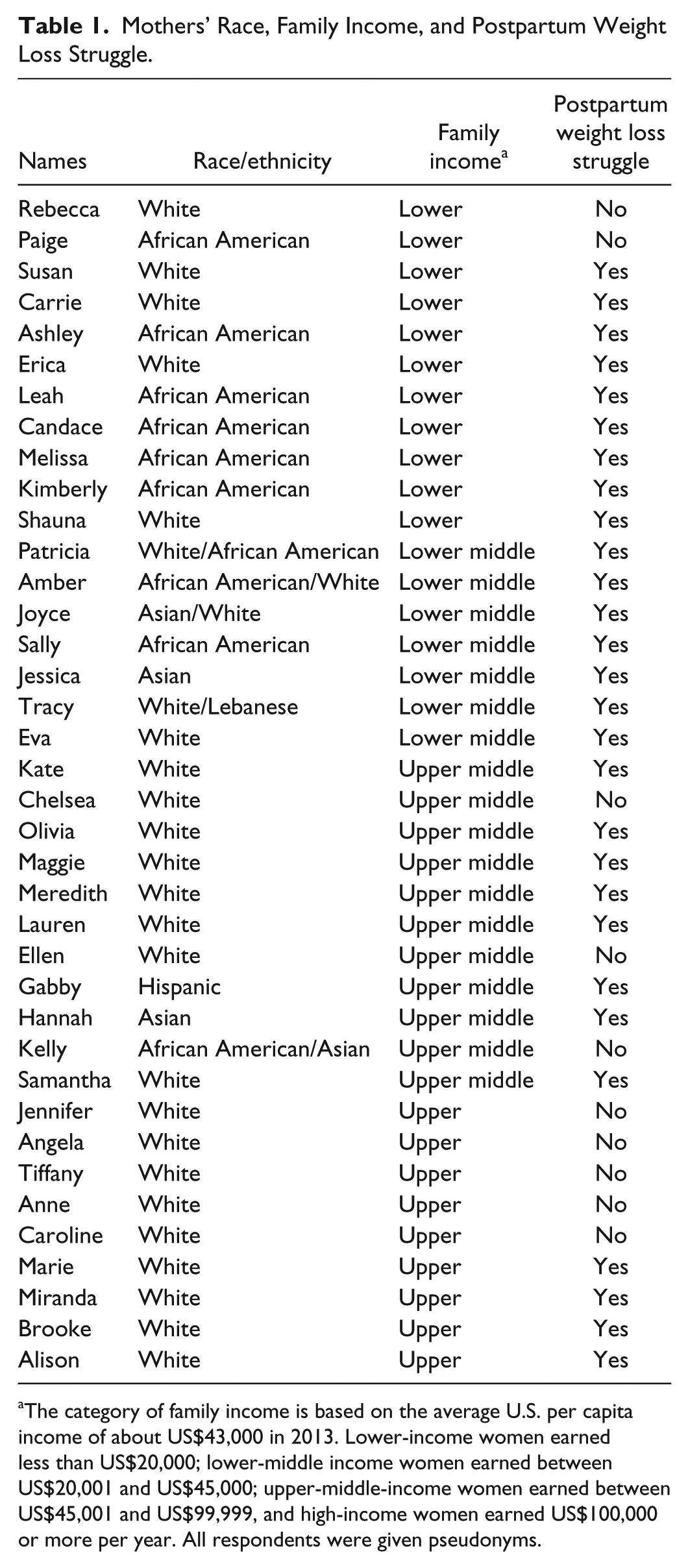
The category of family income is based on the average U.S. per capita income of about US$43,000 in 2013. Lower-income women earned less than US$20,000; lower-middle income women earned between US$20,001 and US$45,000; upper-middle-income women earned between US$45,001 and US$99,999, and high-income women earned US$100,000 or more per year. All respondents were given pseudonyms.
All mothers self-reported they were heterosexual. We measured income by respondents’ self-reports of family income. Eleven mothers were lower-income and earned less than US$20,000 annually; 10 were lower-middle income and earned between US$20,001 and US$45,000; eight were upper-middle income and earned between US$45,001 and US$99,999; and nine were upper income, earning US$100,000 or more per year. Women ranged from ages 19 to 45, with the average age of 31. Respondents had between one and four children.
Once interviews were complete, we reread transcripts several times and then coded each interview according to themes and patterns that emerged from all the interviews (Heese-Biber & Leavy, 2007). Once general themes were found, we coded interviews again for more specific themes related to our research questions (Charmaz, 2006).
Findings
Mothers’ Consumption of CMB Profiles
Mothers in this sample consumed between 1 and 8 hours of popular media, but on average their daily media consumption was around 3.5 hours. Media consumption consisted of viewing popular magazines, TV, online news sources, and smartphone apps. Out of these 38 women, 17 women openly discussed seeking out CMB narratives in the media; they subscribed to popular magazines such as People, Us Weekly, Cosmopolitan, or Shape. Most mothers were more reluctant to admit their consumption. When asked if they ever bought magazines such as People, Us Weekly, Ok! Magazine, or Shape, 21 of the mothers denied such purchases. Some claimed they had no time to follow CMB narratives. However, later in the interview, each of these 21 women specifically mentioned stories from magazines, named celebrity mothers, or described advice they took from particular CMB narratives. Even though all of these mothers showed they had some consumption of CMB profiles, these 21 women seemed to associate these profiles as a kind of “guilty pleasure” entertainment and did not want to be viewed as women who read these magazines.
By the end of the interviews, almost all mothers in the sample reported being a headline consumer of these magazines (even though most did not buy them). Many revealed that they consumed more CMB narratives than they had realized. For example, Paige explained that she did not buy into CMB media and had no time to follow their stories. However, by the end of the interview, she had mentioned 11 celebrity mothers and their pregnancy or postpartum weight loss stories; she said, with embarrassment, “I know so much more than I thought I did!”
Social Class, CMB Profiles, and Mothers’ Evaluations of Their Postpartum Bodies
Upper-income mothers
Of the women interviewed, nine were high-income mothers. As seen in Table 1, all of these women were White. Most of these women were married to influential men in the community, many of them business leaders. However, two of these mothers had PhDs and were married to male PhDs. All nine women graduated from college. As seen in Table 1, these mothers were the least likely to report struggling with postpartum weight loss.
Several patterns emerged in the interviews of high-income mothers: Most believed they could achieve a fit body through hard work and overlooked the resources associated with their high incomes. In addition, most had some kind of plastic surgery, and most compared their bodies with women in their social circle rather than celebrities.
Although many of these women complained about their bodies in interviews, all but two believed you could have postpartum success if you were fit before your pregnancy. In this sense, these mothers were not highly critical of the images of celebrity postpartum bodies. For example, Angela, a personal trainer, was very critical of other mothers who were not physically fit after pregnancy: I do not think women should use pregnancy as a crutch, like oh, I had two children. No, you just don’t work out or you don’t work hard enough. If you had a flat stomach before kids, you can again. If you didn’t before, then no, it is not going to happen.
Another mother, Anne, similarly believed a mother’s postpartum body had a lot to do with how fit she was before pregnancy and with good genes. In contrast, Brooke, a more critical mother, explained, “I grew up in a single mother household. I know what it means to work hard and put everyone before yourself.” For Brooke, postpartum success had a lot to do with her resources and social class. She was aware of the privilege that comes with a high-income lifestyle—nannies, personal trainers, and the ability to buy healthy foods. In contrast, most of the high-income mothers did not seem aware of how their class privilege influenced their postpartum bodies.
All nine of the high-income mothers said they compared themselves with women in their social circle in addition to celebrity mothers. Several of these women displayed a sense of hypercompetitiveness among their friends. Miranda, the first higher-income mother I interviewed, brought this competitiveness to my attention: For the social circle I am in, there is so much pressure to look good . . . So I don’t even have to pick up a magazine to compare myself to—I can just compare myself to my friends and the women at my country club . . . What I am getting at is, I know these magazines are altered . . . so that is not as intimidating as when the people you are hanging out with are totally changing the way they look and flaunting it.
Miranda experienced self-objectification not by evaluating herself in light of the CMB profiles but instead by measuring her body against those in her social circle.
One likely outcome of comparing their postpartum bodies with others in their very high-income social circle was cosmetic surgery: Seven of the nine high-income mothers had Botox or cosmetic surgery to alter their bodies. Mothers like Caroline, Allison, and Brooke were open about having plastic surgery, while Anne was embarrassed to admit having any work done. Anne whispered, “I had a tummy tuck. My friend used the same doctor and hers looked great, so I decided to do it.” When I asked why she whispered to me about her tummy tuck, she replied, I know . . . and I don’t understand why women don’t talk about that more, you know? I mean even among my friends, plastic surgery is a secret. Weight loss efforts are a secret. Everyone has the better nanny or the better trainer . . . Sometimes it just makes me crazy.
Anne suggests that while she compared her body with those of her friends, the methods they use to attain fit bodies are largely secretive.
Other mothers were more upfront about using plastic surgery. Brooke said, I worked my ass off to get in the shape I am. I also paid my doctor a lot of money to keep me looking this way. It was my choice, and I am very open about having plastic surgery and Botox. Most women are not. I see nothing wrong with keeping myself in shape and looking young.
After asking Brooke about particular CMB narratives, she replied, Look, I know that these women are being airbrushed and getting work done. Myself and my friends all get the same work done. . . I know that I don’t have to look like this in order to make it in my business, but in order to make it in my lifestyle and social circle, yes, I have to look a certain way.
Brooke’s quotes suggest that high-income mothers may feel the need to engage in plastic surgery and exercise to meet the high expectations for beauty within their social networks.
Overall, the higher-income respondents felt immense pressure to look their best and keep up with friends and popular celebrity trends. Not all higher-income women evaluate their bodies on the basis of celebrity mothers; most care more about how they look compared with mothers in their social circle. Even if they were critical of the hypercompetitiveness among themselves and their friends, they still felt it necessary. As suggested by objectification theory, these women have internalized patriarchal norms about the ideal female body—as Brooke says, “I have to look a certain way.” The narratives of these high-income women suggest that economic privilege may exacerbate the pressures of self-objectification, as these women can afford to go to more extreme measures (such as plastic surgery) to attain the idealized, thin body after childbirth.
Middle-income mothers
The majority of the women interviewed were lower- to upper-middle-class mothers. A total of 18 respondents had family incomes between US$20,001 and US$99,999. Many of these mothers described consuming CMB narratives as a guilty pleasure, something moms could read with little effort or concentration. Of these 18 women, 15 struggled with postpartum weight loss and had negative thoughts toward their bodies after pregnancy. The main theme emerging from these narratives was ambivalence: Middle-income mothers were both critical of and envious of celebrity mothers who had time to work out and eat healthfully.
All 18 middle-income women were educated and almost all were career-oriented; one was a stay-at-home mother. They had college degrees; many had professional degrees as well. Their education, or their jobs, often led them to be more critical of CMB narratives. Kate explained, I think they (CMB images) are very unrealistic for your average mom, especially if they have more than one child. You have a child that only wants chicken nuggets. And you’re running to three different sporting events. I don’t have anyone to cook for me.
Joyce had similar feelings but also those of jealousy and envy—wanting to be a part of that lifestyle. Seeing how easy everything is for them. I can barely make it to the gym, but I feel like all I see these women doing are working out or playing on the beach. It was always in the back of mind that I needed to lose the weight . . . But time was always a factor, or not having any motivation after work.
Joyce seems to buy into the CMB images, even while she realizes her life is quite different from that of celebrities who “play on the beach” all the time.
Samantha, a part-time professor and college admissions counselor, also showed ambivalence toward CMB narratives. She believed that because of her education, she knew they were unrealistic and avoided comparing herself with them. She said, “These women cannot be that perfect. It also makes me wonder exactly what these women are doing. I think a lot of them probably do more cosmetically than we think they do.” She admitted that she was interested in what celebrity mothers do cosmetically, but because of her education, she did not believe cosmetic surgery was something worth pursuing.
Of these 18 women, three admitted to having plastic surgery. However, 11 middle-income mothers admitted wanting breast augmentation or tummy tucks. Even those who said they would not undergo plastic surgery expressed ambivalence. For example, Lauren quickly answered “no,” when asked if she has or would ever have plastic surgery, but later said, I really don’t like the idea of it because we wouldn’t have the money. But I often fantasize about what a tummy tuck would look like. It is just a fantasy, to finally have a flat stomach.
While Lauren did not want plastic surgery, she did fantasize about the results of it. Her ambivalence when shown and asked about the CMB profiles was also clear: It makes me feel bad. I wish I could be like well, whatever, I am not a celebrity. But it is hard not to think . . . I still look somewhat pregnant seven weeks after the birth of my son. Then I look at these women in their bikinis holding their newborn babies, and who doesn’t want to be this hot mom? Yeah . . . they make you feel so crappy. I don’t think any of us are immune to it.
Like other middle-income mothers, Lauren was critical of CMB profiles but still influenced by them.
As suggested by objectification theory, the internalization of conventional beauty norms is evident in these women’s narratives: Working mothers like Joyce and Lauren, who have little time or energy for working out, still feel pressure to be physically attractive. Lauren asks, “Who doesn’t want to be this hot mom?” The CMB profiles encourage these mothers to discount other important aspects of their lives, such as jobs or parenting skills, and instead focus on whether or not their bodies meet conventional (and for the vast majority of mothers, unattainable) standards of beauty and thinness. While several middle-class mothers were openly critical of the narrow scope of CMB profiles, they had a hard time resisting the conventional beauty standards located therein.
Low-income mothers
Eleven respondents were low-income mothers, earning less than US$20,000 a year. These women were full-time students, working minimum wage jobs, or unemployed. All low-income mothers were single mothers and attributed their inability to regain their pre-baby bodies to a lack of economic resources.
Low-income mothers were high consumers of CMB profiles, some more interested in the pregnancies, others more focused on postpartum narratives. Like other respondents, initially these women expressed ambivalence toward CMB consumption, but once rapport was established, they began to divulge high consumption. The majority of these women were headline consumers, not willing to spend money on popular magazines. However, all of these women admitted to flipping through these magazines or following CMB narratives on television or online.
Two patterns emerged in lower-income mothers’ narratives: First, like the middle-income mothers, they were somewhat critical of the class privileges that undergird CMB images, but at the same time, almost all lower-income respondents said they wanted these kinds of bodies for themselves.
These mothers described an inability to “afford” the perfect bodies in the magazines. These women said that celebrities like Kourtney Kardashian, Jessica Alba, and Jennifer Lopez were able to obtain a beautifully shaped and toned body quickly; for example, a young mother, Susan, said, These celebrity moms put so much pressure on people like me! Look at Kourtney Kardashian, who has 2 kids now and dropped the weight successfully in front of the public in a matter of weeks—it is almost like a slap in the face to normal women.
Lower-income mothers were very aware of the economic resources of celebrities. One mother, Ashley, said, “If you have money, this is what you look like. Without money, I do not think women’s bodies are capable of looking like this immediately after pregnancy.” Similarly, Leah claimed that she did follow celebrity mother’s dieting and fitness advice, but said that they were more successful because, “People like me, I don’t have the time or the money for a personal trainer. I could diet, but that is hard also when you live a life financially struggling.” Almost all of the low-income mothers referred to themselves as “women like me” or “people like me,” which showed a sense of class difference and awareness of the privileges women showcased in CMB narratives.
However, while critical of the class privilege of celebrity mothers, the low-income mothers in this sample also wanted these economic privileges for themselves. For example, Melissa, an African American mother of two, said, “these celebrity women have the money, they have the means to achieve the look they want. These are all things I cannot do, and most women cannot do, because we do not have the same life.” She admitted that she and other women idolized celebrity mothers.
I know this is the body God blessed me with, but looking at these [images], I just feel fat. I feel like I need to lose more weight. They look fantastic . . . and I know they probably had people helping them look this way, so it is not totally realistic.
She later went on to tell me, “I took advice from celebrity moms and tried to work out more and just drink water. But that didn’t always work. I was stressed a lot and wanted chocolate.” Melissa expressed a sense of powerlessness over her own body in regard to postpartum weight loss and CMB profiles. Like Melissa, several other low-income mothers we interviewed had internalized feelings of guilt, inadequacy, and inability to control their own bodies by comparing themselves with socially constructed ideals of beauty and motherhood.
Some respondents attributed their inability to regain their bodies to a lack of willpower. Even 6 years after giving birth to her daughter, Paige admitted that she still continues to follow CMB advice: I have always followed Britney Spears. She would list her daily food regimen, like salmon, rice, and vegetables. That is not always realistic for women like me. I am a single mother and cannot afford all of the fancy and healthy foods all the time. Rather than to cook a healthy meal that costs 25 dollars with salmon and grilled chicken, I can take that money and buy food that will last all week. But it’s not healthy, it is not what celebrity mothers are saying is right, or what mothers like me should be doing.
Paige indicated that a lack of economic resources prevents low-income mothers from obtaining good food, exercise programs, and dietitians. Like Paige, several low-income women in this study seemed to internalize messages from media images that ensure a continued otherness.
Like the high-income mothers, almost all lower-income women admitted to wanting plastic surgery (if they had the money). For example, Erica said, “I have thought about having plastic surgery on my stomach. Maybe in time I will have the money.” Similarly, Candace said, “If I had the money, I would get a tummy tuck and breast-lift in a heartbeat!”
In sum, the lower-income mothers were often critical of the class privilege among celebrity mothers, but they also wanted these economic resources, and celebrity moms’ bodies, for themselves. As suggested by objectification theory, mothers buy into conventional beauty standards and feel quite badly about their own bodies and lives, even when they know celebrity mothers have substantial resources unavailable to them.
The Male Myth: Mothers’ Views of Men’s Reactions to CMB Narratives
In every interview, respondents said they thought the men in their lives expected a quick return to their prepregnancy bodies. All 38 mothers believed that the men in their lives subscribed to what we began to call the “male myth”—the assumption that women’s bodies spontaneously go back to their prepregnancy shape following the birth of a child.
Ellen, a bench clerk in family court, described the attitudes many of the women held regarding men: I think a lot of men expect their wives to look a certain way during and after pregnancy. I mean even Scott [Disick] tells Kourtney Kardashian she needs to lose weight, or makes crappy comments to her about weight gain . . . If it happens in celebrity lives, it happens 1000 times more in our lives.
Lauren, a mother of two, echoed this mentality when sharing a story from her motherhood group: They [the mothers in her group] all complain that they don’t feel like they are in their own body—things are moved around . . . They all talk about how they don’t feel sexy for their husbands anymore, and feel like their husbands do not want to have sex with them. I do not know how to explain it, you just really don’t feel comfortable in your own skin for a while. Then you have these men that want you to look like these famous women. It is hard to understand men, they say, “no no no, I don’t expect you to look like this,” but you know they do . . . you know that’s what they desire.
Lauren then explained, Media teaches us that to be a good mother and a good wife, you have to look like you haven’t had a child six weeks after giving birth. Otherwise you have failed at mothering and you have failed at being sexy for your partner.
This mother clearly believed that celebrity images can make women feel less sexually attractive to their partners.
Many mothers admitted that their negative body image was influenced by how their partner viewed their body. Melissa, a mother of two who struggled with her weight while caring for her ill parent, claimed, Men think all women should look like these celebrity mothers. I think some are okay with the baby weight, but most want you to drop it immediately. The father of my children did. He didn’t want to be around me because I was so big. He told me I was so fat all the time. The doctor would explain to him I was retaining water.
Although she had a medical reason for her weight gain, she associates his negative image of her body during pregnancy with their relationship ending. Similarly, Erica described her partner’s negative reactions: “Since I’ve been pregnant, he doesn’t show me attention. This happened during my other pregnancies as well . . . but I keep putting up with it.”
Some mothers revealed partners’ severely negative reactions to their postpartum bodies. Kate said, [He] put me down a lot when I was pregnant . . . every chance he got. He called me a fat slob. He threw food away and told me I couldn’t eat certain things. I remember crying and asking for ice cream and he laughed and said I had already gained enough. . . It took me six years to boost my confidence back up.
Kate admitted on several occasions that she believed his negative attitude toward her pregnant body was directly related to CMB profiles; she said, Six years ago these images devastated me. These celebrities . . . you see Britney and you’re like, oh wow, she is gorgeous and not huge . . . And then my boyfriend comes home after looking at these like why are you so fat and they aren’t? It puts off a persona that you stay skinny while pregnant.
Likewise, Kimberly, a mother of three, whose husband left her for another woman during her last pregnancy, explained that “some men have complete aversions to pregnancy and weight gain. My ex-husband did not like it. He was like EW! I would do little belly dances to tease him and he would be disgusted.” Samantha explained her view of men’s aversion to pregnancy in more depth: I think men in general are freaked out by pregnant women. Women’s bodies have been so sexualized . . . I think when the body changes, it just totally freaks them out. I think some men, once a woman has a baby—they never see their partner outside of their maternal role again. The sex is never the same. I think it is hard for men to separate your role as a mother and your role as a woman. I think men are harder on women about their weight also.
Like Lauren above, Samantha emphasizes how the sexualization of women’s bodies can make postpartum women feel sexually unattractive to male partners.
Some women claimed their husbands’ criticisms were healthy criticisms to keep them motivated. Miranda said, “My husband would tell me to go work out, because he knew it would make me feel better about myself. But also, I mean he probably wanted to see the benefits of it.” In addition, Joyce explained that her fiancé was supportive, and encouraged me to eat healthy. He made me a meal plan that was helpful. He was nice. He would make comments that I should start running or get my workout in. But that didn’t hurt my feelings or anything because he was worried about me and wanted to encourage me.
However, later in her interview, she admitted, “I know when things get back to normal we will make it official [long pause] . . . I am working out a lot and getting back into shape. I know he will get excited for a wedding!” While many of these men may have wanted to support their partners in efforts to stay healthy and feel better about themselves, Joyce’s comment implies that a slimmer body may be necessary for their relationship.
In contrast, some women claimed their husbands were happy or even excited about the changes in their bodies during pregnancy. Tiffany explained that her husband enjoyed seeing her body change during her pregnancy: “He was always supportive and would encourage me that I was beautiful.” Lauren similarly shared that her husband “doesn’t pay much attention to magazines I don’t think. I’m sure he compares me sometimes to these women, he is only human. He tells me he thinks I am beautiful and doesn’t expect anything, but he is progressive.” Ellen claimed her husband did not say anything to her during pregnancy: “He made me feel good. Like I was pretty. I had a great pregnancy. But he did mention after the pregnancy that he would work out with me.” Thus, a few mothers suggested that men were comfortable and happy with their partners’ pregnant and postpartum bodies.
Despite these positive experiences with their partners, all 38 women interviewed said that men in general assumed all women’s bodies could resemble those of celebrities in CMB profiles after pregnancy. Jennifer, a psychology professor, said, Most men are under the impression that after the baby, you just go back to your normal weight. If these women did, you can too. Eat healthy, work out, it is easy right? Most don’t realize that many of the changes with our bodies are permanent.
While most mothers viewed male reactions to CMB narratives in a negative light, one woman, Sally, whose husband died of a rare form of cancer while her daughter was very young, expressed an alternative: I have heard men say they think their wives are sexy during pregnancy but once they have their baby it is like “okay honey! Time to get back to normal! Time to get back to that sexy body I married!” It’s like buddy . . . I still am the sexy woman you married . . . I am just trying to raise our new baby. I am still me. I am still sexual. We can’t change the stretch marks, or the new hips. For most people that doesn’t go away. We aren’t airbrushed.
Sally suggests that men should come around to the realization that the real women are not “airbrushed” and can still enjoy sex and their bodies.
As objectification theory suggests, when respondents imagined male reactions to CMB profiles, most viewed their own postpartum bodies as inferior and felt sexually unattractive. However, a few mothers, Sally in particular, openly reject the objectification of women and the male gaze in CMB profiles. But on the whole, these quotes show that most mothers feel their postpartum bodies are inadequate.
Conclusion
This research finds that everyday mothers typically compare their bodies negatively with those of celebrity mothers. Almost all of the women, albeit to varying degrees, shared the experience of feeling their bodies were inadequate in the face of CMB narratives. In addition, all 38 mothers thought men believed a woman’s experience of pregnancy and postpartum body should mimic those of celebrities.
The voices of the 38 women in this sample support objectification theory (Fredrickson & Roberts, 1997): The sexualization and objectification of women’s bodies is inescapable in our culture, even among women who have recently given birth. The CMB images we showed to mothers reinforce patriarchal norms about conventional beauty, most notably the ideal of thinness. Like women in other research, these mothers felt pressure to “get their body back” (Bordo, 1993; Dworkin & Wachs, 2004; Wolf, 1991). Although many of the 38 women interviewed seemed acutely aware of how these images have been stylized and airbrushed, they still viewed their bodies negatively in light of CMB profiles.
However, our research suggests that mothers evaluated themselves in different ways depending on their social class background. Higher-income women framed motherhood in more competitive terms than other mothers, as the former were more concerned with living up to the perceived standards of beauty within their social circles. Douglas and Michaels (2004) argue that mass media’s representation of motherhood has created an environment of hypercompetition, guilt, and anxiety for women. Indeed, in this sample, most high-income women admitted to having plastic surgery to keep up with other mothers they know. As Douglas and Michaels suggest, when women compete against each other, they are unlikely to work together for social change.
While the middle- and low-income mothers did not express motherhood in competitive terms, most still wanted the toned bodies shown in the CMB narratives. The lack of competition in these mothers’ accounts could be because they saw CMB narratives as out of their reach. In contrast, the higher-income mothers had the resources to attain the bodies presented in CMB profiles and may have felt more accountable to them.
Some middle-income mothers said that their education made them more critical of CMB profiles, and that their parenting and paid work made it impossible for them to look like celebrity mothers. Low-income mothers were also critical of the CMB profiles based on their own life experiences; some had tried the diets touted by celebrities, but were unable to afford healthy food, or were unable to keep up with exercise regimens and diets without child care and personal trainers. However, unlike most middle-income respondents, most low-income mothers openly wished for the resources of celebrity mothers and felt a sense of personal failure when their bodies did not meet the (unrealistic) standards of CMB profiles. Thus, our research suggests that college-educated, middle-income women were the most critical of the images, with several saying they knew they should not pay attention to them. Nonetheless, as predicted by objectification theory, every mother in this sample had to some degree internalized an ideal of thinness for women’s bodies, even soon after childbirth. As Lauren, one of the most critical, middle-income mothers, concluded in her discussion of CMB images, “I don’t think any of us are immune to it.” This points to the pervasive effects of early socialization and media forms in promoting conventional norms of thinness and beauty—even among women who feel they should “know better.”
Likewise, despite differences across class and education, all women in this sample believed that CMB profiles had negative effects on men, and most mothers believed that men in the lives evaluated their postpartum bodies unfavorably; many mothers in this study believed that their postpartum bodies were not “sexy” to the men in their lives. Because we did not interview the male partners of the mothers, we can only go by mothers’ interpretations of how men in their lives approached CMB profiles and viewed mothers’ bodies. Further research could explore men’s views of CMB profiles, and their expectations of postpartum bodies, in more direct ways. More research on sexual objectification and mothers’ use of plastic surgery is especially needed.
Last, we would argue that this research, and other research in this vein, can serve as a form of consciousness-raising among mothers. Many of the women commented on a lack of dialogue among mothers concerning their expectations for and experiences of postpartum weight loss. In addition, higher-income mothers felt pressure to stay fit because they compared themselves with other women in their social circle; some, like Angela, chastised women who did not lose their pregnancy weight, thus surveilling the bodies of other mothers. If women were more open and honest with each other about their feelings of guilt and inadequacy in the face of CMB narratives, this could lead to less competition among higher-income mothers and more solidarity among lower-income mothers. More open dialogue could also lead to fewer women following and purchasing media featuring unrealistic CMB profiles.
Structural changes are also necessary. Women in this sample with higher levels of education were generally more critical of CMB narratives; this suggests that higher education can help women challenge these pervasive narratives. In addition, a few online sources, such as “The Shape of a Mother” website, provide accurate portrayals of postpartum mothers—with stretch marks, ample bellies, and sagging breasts. As suggested by Sally, more realistic portrayals could help affirm and celebrate real women’s postpartum bodies, those that “are not airbrushed.” More realistic images of postpartum bodies could help women feel better about their postpartum bodies and more sexually attractive to their male partners.
Footnotes
Declaration of Conflicting Interests
The author(s) declared no potential conflicts of interest with respect to the research, authorship, and/or publication of this article.
Funding
The author(s) received no financial support for the research, authorship, and/or publication of this article.