




Abstract
The relationship between experiencing major stress events (MSEs) and changes in appearance (CAs) was studied in a sample of 128 participants. All participants completed the Major Stress Event and Changes in Appearance Inventory. Results indicated a significant correlation between experiencing MSEs and considered or actual CAs (r = .50 p < .01). Scores on the Changes in Appearance Inventory were significantly higher in groups with moderate to high scores on the Major Stress Event scale. This relationship between MSEs and CAs was affected by age but not gender. These results suggest that stressful life events may prompt body image dissatisfaction and underlie motivations for changes in body appearance to promote self-image. Successive or dramatic appearance changes may be an important signal of stressful experiences.
Body image, and perceptions and attitudes about one’s body and appearance, is a multiperceptual concept heavily influenced by internal and sociocultural factors. A central component of body image and bodily satisfaction is physical appearance. Internal negative evaluation of one’s physical appearance, or body image dissatisfaction (Presnell, Bearman, & Stice, 2004), may result in negative affective symptomatology, including depression, anxiety, and hostility (Bradford & Petrie, 2008). Stressful life events may prompt body image dissatisfaction and underlie motivations for changes in body appearance to promote self-image. Whereas previous research has largely focused on physical changes in the context of psychopathology, the present study examined the relationship between stressful life events and resulting alterations in appearance as physical markers of self-change in a nondiagnosed population.
Stressful life events have been defined as “objective events that disrupt or threaten to disrupt the individual’s usual activities” which require the employment of adaptive, readjusting, or coping behaviors (Dohrenwend, 1973, p. 168). The accumulation of such events can have profoundly negative impacts on physical health and have been directly linked to onset and severity of illness and disease (Wyler, Masuda, & Holmes, 1971), and significant decreases in life satisfaction (Luhmann & Eid, 2009). Furthermore, stressful life events have been found to have a significant impact on the emergence and expression of many mental illnesses. For example, accumulated stressful life events have been shown to create symptoms of depression unique to the events experienced (Keller, Neale, & Kendler, 2007), borderline personality disorder is highly correlated with early childhood physical or sexual abuse (Brown & Anderson, 1991; Zanarini & Frankenburg, 1997; Zanarini, Gunderson, Marino, Schwartz, & Frankenburg, 1989), and schizophrenia has been proposed as a complex interaction between genetic factors and stressful life events (Day et al., 1987). In particular, events that are undesirable, uncontrollable, and unexpected have potential to induce great psychological stress (Kiecolt, 1994) and induce changes in behavior or lifestyle as a coping mechanism. Alterations in physical appearance are one quite common lifestyle change as a reaction to stressful events.
Kiecolt (1994) postulated a theory of intentional self-change following multiple stress events, at least one of which being a critical stress event of personal significance. Inten-tional self-change, as described by Kiecolt, is “an effort to construct a particular kind of self,” which may include changing one’s self-concept to match more closely to an ideal self or changing the self to meet the requirements of life more realistically. Whereas intentional self-change is often a private and introverted event, reorganization of the self is sometimes displayed or signaled to the external world by intentional changes to one’s physical appearance (Kiecolt, 1994).
Intentional changes to one’s physical appearance may take many forms. Understanding these different forms could potentially yield great insights into the nature of body image and motivations for change. The gamut of potential changes is well illustrated by the types of “body modificationist” professions which “instruct people to redesign, rehabilitate, reconstruct, and extend their bodies” (Atkinson, 2004, p. 134). Such professions include personal trainers and stylists, dieticians, cosmetic surgeons, aestheticians, tattoo artists, and other similar occupations (Atkinson, 2004). These professions illustrate well how changes can include both relatively short-term and permanent changes. Studies of clothing choice, for example, have found that fashion is an important, everyday form of body modification and self-image expression that is used to directly manipulate an individual’s appearance, others’ perceptions, and one’s own self-esteem (Frith & Gleeson, 2004; Hobza, Walker, Yakushko, & Peugh, 2007) without making permanent physical alterations of the body. Use of personal cosmetics similarly is a nonpermanent alteration in appearance.
Conversely, other appearance-altering behaviors, such as cosmetic surgery, tattoos, and body piercing, are more permanent, and thus, more far-reaching forms of appearance alteration (Atkinson, 2004; Oksanen & Turtiainen, 2005). Wohlrab, Stahl, and Kappeler (2007) identified 10 motivations for obtaining tattoos and piercings with the three most common reasons being individuality (creating or maintaining self-identity), beautifying the body, and displaying personal values and attributes. As one undergoes intentional self-change, as described by Kiecolt (1994), the motivation to display this change physically in the form of tattoos or body piercings may increase due to a desire to individuate the self not only from others but also from one’s previous self. Similarly, tattooing or piercing the body provides a means for the external display of personal values or attributes (Wohlrab et al., 2007) or to reflect changes in one’s values and attributes as a consequence of experiencing life changing, emotionally trying, or major stress events (MSEs).
Most previous research on bodily changes and body image has focused on pathological, socially unacceptable alterations of appearance commonly seen in the context of psychopathology. Nonsuicidal self-injury can be used to cope with stress (Nock, Prinstein, & Sterba, 2009; Stepp et al., 2008), and is commonly seen in a variety of mental disorders, including borderline personality disorder and depression (Diagnostic and Statistical Manual of Mental Disorders, 4th ed., text revision [DSM-IV-TR]; American Psychiatric Association, 2000; Campo, Hardy, Merckelbach, Nijman, & Zwets, 2007; Gratz & Chapman, 2007). Self-injury can also be a feature of posttraumatic stress disorder and body dysmorphia (American Psychiatric Association, 2000; Cheng, Mallinckrodt, Soet, & Sevig, 2010). Eating pathologies such as anorexia and bulimia involve self-destructive means of excessive weight control (American Psychiatric Association, 2000; Ross, Heath, & Toste, 2009; Smyth, Heron, Wonderlich, Crosby, & Thompson, 2008) and often co-occur with self-injurious behaviors (Favazza, DeRosear, & Conterio, 1989). In these disorders, the externalization of internal pain allows for easy management of negative feelings that are a result of adverse situations (Andover, Pepper & Gibb, 2007; Cheng et al., 2010; Ross et al., 2009). In many cases, these disorders are subsequent to a particularly salient life event or an accumulation of negative, stressful life events. Furthermore, the more serious the pathology of the individual, the more changes made to their appearance. Campo et al. (2007), in their examination of four groups reflecting different pathologies (healthy participants, participants with major depression, participants with borderline personality disorder, and participants with schizophrenia), reported a doubling in the number of changes made to appearance between the group of healthy participants and participants with schizophrenia (Campo et al., 2007).
By contrast, comparatively few studies have examined the effect of stressful life events on common, everyday manipulations of physical appearance such as changes in hairstyle, dress, or physique in nondiagnosed populations. Frequent, normative changes in appearance (CAs) have been positively correlated with prepsychotic symptoms in a normal, college-age population (Campo, Nijman, & Merckelbach, 2004) and severity of psychological disorders across several categories of psychopathology (Campo et al., 2007). Yet, CAs in an everyday population without actual or possible pathology have been largely unexamined. Furthermore, previous work has examined short-term (such as fashion and cosmetic changes) as well as permanent changes. In the present study, we examined the relationship between the occurrence of stressful life events and subsequent changes made to physical appearances in an adult, nondiagnosed population, focusing specifically on long-term alterations in appearance.
Method
Participants
Participants were a sample of convenience of 128 individuals (73 women, 55 men; M age = 31.0 years [range = 18-68]) recruited from various housing and retail locations in Philadelphia and the surrounding communities during the months of October and November 2009. Each participant was verbally briefed on research goals, participant confidentiality, and participant anonymity before reading the consent statement prior to survey administration.
Measures
All participants completed a three-page Major Stress Event and Changes in Appearance Inventory. The inventory consisted of 51 questions evaluating stressful events and appearance changes within the previous two years. Responses were delivered on a 5-point Likert-type scale ranging from 0 to 4.
The first 30 questions asked participants to indicate what MSEs they have experienced within the past 2 years (a 0 indicated the participant did not experience the MSE) and to rate the event’s personal significance as not significant, neutrally significant, somewhat significant, or very significant. The questions were based on and consolidated from the life events identified on the Holmes and Rahe (1967) Social Readjustment Scale, one of the most widely used measures of stressful life events. Questions on this portion of the survey included events such as “I was hired at a new job,” “I became involved in a serious relationship,” and “A close family member, significant other, or friend was hospitalized.” Because the Holmes and Rahe scale avoids the psychological meaning, emotion, or social desirability of the life event, focusing instead on the amount of adaptive change required by the occurrence of each event, we included ratings of the personal significance of each event to identify Kiecolt’s (1994) “critical events,” which promote self-change and require a certain amount of personal meaning.
The remaining 21 questions asked participants to indicate which CAs they have made (“I have done this more than once” or “I have done this once”) or considered making (“I have often considered doing this,” “I have considered doing this,” or “I have not considered doing this”) within the last 2 years. This portion of the inventory was loosely based on the Changes in Appearance Scale used by Campo et al. in their 2004 study of CAs and schizotypy in normal participants. Items on this portion of the inventory included CAs such as “I got a tattoo,” “I grew out my hair when it is usually short,” “I purposefully injured myself in order to leave a visible mark,” and “I have tanned in order to noticeably darken my skin color.” Our version of the inventory, as opposed to the Campo et al. (2004) inventory, emphasized the CA rather than the appearances themselves. For example, the Campo et al. inventory asks participants if they have “at one time cut or shaved all of [their] hair,” while our inventory was worded to emphasize the change: “I shaved my head completely when I normally have a full head of hair.” This portion of the inventory included several additional bodily appearance changes not on the Campo et al. inventory, such as tanning and growing a beard, and placed correspondingly less emphasis on clothing and accessories, which compromised 12 questions of the Campo et al. 22-question inventory.
Procedure
After participants were approached, consented to participate, and briefed, they were provided an inventory to take elsewhere, complete, and return to the researcher. Participants completed the survey anonymously in a single sitting of approximately 15 to 20 min. All returned surveys were completed fully. All participants were treated in accordance with the APA code of ethics (American Psychological Association, 2002).
Results
Scores on the MSE portion of the inventory could potentially range between 0 and 120. Actual scores ranged between 0 and 111 with an overall mean score of 30.71 (SD = 18.2). There was no significant difference in MSE scores by gender (Males: n = 55, M = 28.13, SD = 18.6; Females: n = 73, M = 32.66, SD = 17.88); t(126) = 1.40, p < .17. However, MSE scores were significantly negatively correlated with age, r(128) = -.42, p < .001: Younger individuals reported significantly higher levels of stress than did older individuals. MSEs experienced most frequently included having a family member, close friend, or significant other experience emotional difficulties (64.1%); starting a new job (62.5%); experiencing emotional difficulties (59.4%); and the hospitalization of a family member, close friend, or significant other (56.2%). Events least frequently experienced included going through a divorce (2.3%), undergoing (or having their significant other undergo) an abortion (4.7%), pregnancy (7.0%), parental divorce (7.0%), and getting married (8.6%).
The MSEs rated as most personally significant for those reporting the occurrence of the event include graduating school (n = 45, M = 3.71, SD = 0.63), going through a divorce (n = 3, M = 3.67, SD = 0.58), pregnancy (n = 9, M = 3.67, SD = 0.71), the start of a serious relationship (n = 52, M = 3.65, SD = 0.62), and the death of a loved one (n = 54, M = 3.57, SD = 0.66). Events with the lowest means for personal significance included legal problems (n = 19, M = 2.37, SD = 1.17), parental divorce (n = 9, M = 2.56, SD = 1.24), difficulties with friendships (n = 52, M = 2.63, SD = 1.05), illness (n = 28, M = 2.71, SD = 1.05), and hospitalization (n = 43, M = 2.72, SD = 1.18).
Scores on the CA portion of the inventory had a possible range of 0 to 84. Actual scores ranged between 0 and 53, with a mean score of 17.24 (SD = 12.95). There was no significant difference in MSE scores by gender (Males: M = 16.98, SD = 14.6; Females: M = 17.45, SD = 11.7); t(126) = 0.20, p < .85. The most commonly made or considered CAs included weight changes (60.2%), working out to alter body shape (58.6%), tattoos (55.5%), and changes in hair color (54.7%). CAs least made or considered included wearing nonprescription glasses (6.2%), receiving plastic surgery (7%), shaving off one’s beard (10.2%), wearing contacts rather than prescription glasses (10.2%), and altering the shape of one’s eyebrows (10.2%).
Pearson correlational analysis revealed a significant positive relationship between overall stress experience (MSE total) and real or contemplated CAs; CA scores: r(128) = .50, p < .001. Individual stress events and their relationships to CA scores were then assessed through correlational analysis. The results, presented in Table 1, revealed that several individual stress events were significantly correlated with CA scores, including stresses related to school, relationships, and mental health issues.
Correlations of Individual Stress Events with CA Score.

Note: MSE = major stress event; CA = change in appearance. All MSEs and CAs occurred within the same 2-year period.
“Other” indicates a close family member, significant other, or friend.
p < .05. ** p < .01.
A quartile division of MSE scores were used to classify participants into one of four groups (see Table 2): Low (MSE scores of 0-18), Mild (19-28), Moderate (28-42), and High (43-110). A one-way ANOVA revealed highly significant differences in CA scores across the four groups, F(3, 124) = 16.81, p < .001 (see Figure 1). Post hoc testing (Fisher’s Least Significant Difference [LSD]) revealed significantly different CA scores for all group pairs at the p < .005 level or better, except for between the Mild and Moderate MSE groups (p < .34; see Figure 1).
MSE Groups’ Means and Standard Deviations for Overall CA Score, CA Actual Changes, and CA Permanent Changes.
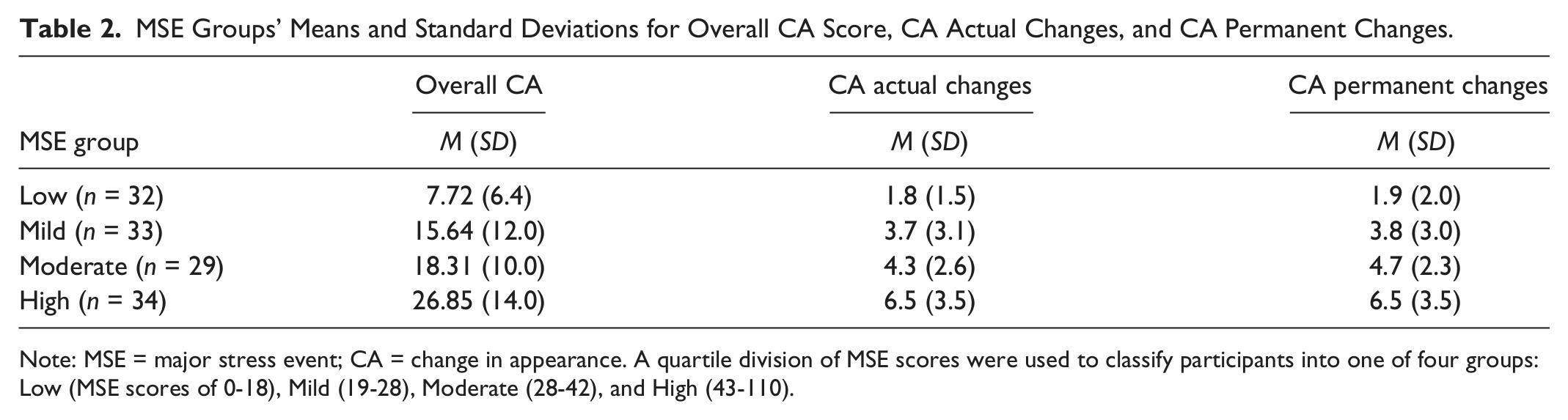
Note: MSE = major stress event; CA = change in appearance. A quartile division of MSE scores were used to classify participants into one of four groups: Low (MSE scores of 0-18), Mild (19-28), Moderate (28-42), and High (43-110).

Mean change in appearance (CA) score for major stress event (MSE) groups.
The above analysis examined both actual and contemplated changes. We then examined actual appearance changes only by excluding “intent” responses on the CA portion of the inventory (scores of 1 [I have considered doing this] and 2 [I have often considered doing this]) and focusing on “action” responses (scores of 3 [I have done this once] and 4 [I have done this more than once]). One-way ANOVA analysis confirmed the relationship between MSEs and CA scores for only actual appearance changes rather than considered changes, F(3, 124) = 15.63, p < .001. Again, post hoc testing (Fisher’s LSD) revealed significantly different CA scores for all group pairs at the p < .006 level or better, except for between the Mild and Moderate MSE groups (p < .39).
We further examined the relationship by considering only the subset of changes that are permanent or relatively permanent CAs (getting tattooed, pierced, plastic surgery, and weight gains/losses). One-way ANOVA analysis revealed significant differences in CA scores for permanent changes across the four groups, F(3, 124) = 15.73, p < .001. Post hoc testing confirmed that the High and Low groups were significantly different from all other groups (p < .01), whereas the Mild and Moderate groups did not have significantly different CA scores (p < .24).
Finally, multiple regression analysis was used to identify predictors of CA scores. This analysis confirmed the role of MSEs in influencing CAs (β = .33, t = 4.27, p < .001). Furthermore, age significantly affected the relationship between stress events and CAs (β = .42, t = 5.50, p < .001): Younger participants were significantly more likely than older participants to alter appearance in response to MSEs. Gender, surprisingly, however, did not significantly predict variation in CA score (β = .07, t = 1.03, p < .31).
Discussion
In the present study, stressful life events were strongly and positively correlated with both considered and actual CAs. Individuals who experienced more personally meaningful stressful life events within a 2-year period changed or considered changing their appearance significantly more often than individuals who had fewer or less personally meaningful stressful experiences. This relationship between MSEs and CAs was observed for both relatively minor changes (e.g., haircuts) and relatively permanent appearance modifications (tattooing, piercing, plastic surgery, and weight change). These findings suggest that experiencing personally meaningful stressful life events is a major driving force behind one’s intent or decision to change outward appearance in some manner.
One intervening factor influencing the relationship between stress and CAs was age. Younger individuals were significantly more likely to report greater exposure to significant major life events and to CAs in response to MSE than were older individuals. Campo et al. (2004) did not find any effect of age on CAs, although it is important to note, as the authors did, that their sample of college undergraduates was homogenously young. In their subsequent study of a sample with a wider age range, these researchers (Campo et al., 2007) did find that age significantly impacted changes made to appearance.
This age difference in changes to appearance may reflect diverse stress experiences occurring in early and later adulthood. Early adulthood is often a time of life with major life events occurring frequently, often while beliefs and attitudes are still malleable. As individuals age, the occurrence of daily stressors decreases (Stawski, Sliwinski, Almeida, & Smyth, 2008), major life events become more infrequent, and beliefs and attitudes become crystallized (Caspi & Roberts, 2001). Major life events that challenge these beliefs or attitudes are often ignored or are viewed as less significant or influential to the individual. Thus, younger individuals may more readily encounter critical stress events of personal significance, the driving force for intentional self-change proposed by Kiecolt (1994). The high incidence rate of stressful life events and the greater significance of many of these events for individuals in early adulthood coupled with the fixed sense of self and belief crystallization seen in older individuals may contribute to the observed age-related differences.
A further explanation for the age difference may lie in that fact that half of the stressful life events on the inventory involved interpersonal events (e.g., death of a loved one, loss of friendship, experiencing a break up, etc.). Younger individuals tend to place greater importance on establishing interpersonal and intimate relationships than older individuals who often have already experienced these developmental identity tasks (Jackson & Finney, 2002). Tanti, Stukas, Halloran, and Foddy (2008) found that the individual self becomes more socially oriented as one moves through pre-, early-, mid- and late-adolescence. These changes in social environment are generally more influential to younger individuals and can even shift a young adult’s developmental trajectory (Galambos, Barker, & Krahn, 2006). The substantial number of interpersonal life events on the inventory may also help explain the age-related differences in appearance change.
Finally, existing research points to the greater resiliency of older individuals in the face of stressful events (Foster, 1997). Ong, Bergeman, Bisconti, and Wallace (2006) reported that positive emotions, which can mitigate stressful events, are higher among high-resilient individuals, whereas individuals with low resilience tend to show greater negative emotional responses and a heightened reaction to stressful events. Thus, older individuals’ ability to cope with stressful experience coupled with the reduced number of stressors may provide the best explanation for the age-related differences observed in the present study.
We failed to find a significant difference by gender for either stress scores or CAs scores, contrary to the gender difference for CAs reported in both Campo et al. (2004, 2007) studies. These researchers noted in both studies that females were significantly more likely to report CAs than were males. The discrepancy in findings is likely due to difference in the types of changes assessed on the relative scales. The Campo et al. (2004, 2007) inventory, the Changes in Appearance Scale, had comparatively more items assessing changes in clothing and accessories, such as “I love wearing conspicuous looking clothing,” “I sometimes wear clothes that do not fit or are not meant for my age group,” “I sometimes wear too many clothes on top of each other,” “I wear sunglasses, even when the sun is not shining,” and “I sometimes find that I am not wearing enough clothes” (Campo et al., 2004). Our inventory, although it included many of the same changes studied by Campo et al. (e.g., tattooing, hair dying, piercing, make-up, plastic surgery, etc.), was focused on more substantial and long-lasting changes and less so on short-term changes involving a minimal expenditure of energy (such as fashion, cosmetic, and jewelry changes). The discrepancy in findings between the current study and the previous work likely reflects the range of appearance modifications assessed by the respective scales.
Alternatively, the gender differences observed in the Campo et al. (2004, 2007) studies may be attributable to unique characteristics of their assessed populations. The 2004 study found a correlation between CAs and levels of schizotypy in a normal population, whereas the 2007 study examined CAs made in populations of individuals with various mental disorders. Perhaps females with mental disorders (or who are susceptible to them) are more likely to alter their appearance than males with mental illness. Our research was conducted exclusive of ties to mental disorders or behaviors indicative of susceptibility, and this critical population difference may explain why we found no significant difference in appearance changes between males and females. In either case, the present results indicate that males as well as females consider or make CAs in response to stress events.
The occurrence of appearance changes in association with stressful events highlights the transformational role of these events as motivators for intentional self-change as a coping mechanism (Kiecolt, 1994). Folkman and Lazarus (1988) have identified eight types of coping behaviors as adaptive mechanisms to stressful life events, including confrontive coping, distancing, self-control, seeking social support, accepting responsibility, escape-avoidance, planful problem-solving, and positive reappraisal. Physical alterations of appearance may reflect three of Folkman and Lazarus’s eight identified coping mechanisms: self-control, seeking social support, and positive reappraisal. Positive reappraisal, a common coping mechanism, involves reassessing the self or changing one’s self-concept when confronted with an emotionally poignant event, for example, “I changed or grew as a person in a good way,” “I came out of the experience better than when I went in,” “I rediscovered what is important in life” (Folkman & Lazarus, 1988, p. 468). One possibility is that individuals directly modify physical appearance as a means of regaining control of one’s body and one’s self. Alternatively, an individual may be reaching out nonverbally to a particular social group or category through altering physical appearance in a manner that matches that group. Finally, individuals may use the experience gained from a stressful life event to grow in a positive new direction (positive reappraisal). As the external self often is a display of one’s internal self, a new, reappraised internal self may warrant the alteration of one’s external appearance.
Tattoos, a relatively common, permanent, and intentional change to one’s physical appearance often used as a mechanism to cope with stress and mismanaged emotions (Atkinson, 2004; Oksanen & Turtiainen, 2005), reflect several of the coping behaviors identified by Folkman and Lazarus (1988). Most obviously, the physical change to self embodied in tattoos is a direct illustration of the positive reappraisal method of coping behavior (Folkman & Lazarus, 1988): Tattoos are often used to illustrate directly life changing or emotionally poignant events on the body by physically marking the beginning or end of a transitory state in an individual’s life (Oksanen & Turtiainen, 2005). Furthermore, tattooing exemplifies the coping mechanism of self-control (Folkman & Lazarus, 1988), as one is able to regulate one’s emotions, values, and cultural identity by directly controlling one’s physical appearance (Atkinson, 2004). Finally, tattooing may represent a way of symbolically joining a social group, as observed in Atkinson’s (2004) study of Canadian tattoo artists, and thus illustrates the coping mechanism of seeking social support (Folkman & Lazarus, 1988).
From a clinical perspective, the current research, based on a nondiagnosed heterogeneous population, suggests that frequent or subsequent changes to physical appearance may be an external indication that an individual is undergoing significant, multiple life stressors. Dramatic, major CAs thus may signal a person in emotional distress and in need of strong interpersonal support. Campo et al. (2007) determined that frequent appearance changes may act as an indicator or predictor of susceptibility to a mental disorder, such as depression or anxiety. A patient’s alteration to his or her physical appearance may very well represent a meaningful nonverbal behavior, communicating to the therapist that an important internal event is occurring. As with all nonverbal behavior in a therapy situation, “everything a person does, every action or movement he makes, can be used by a trained, knowledgeable, and sensitive observer as a basis . . . for categorizing . . . the individual—his state, thoughts, feelings, personality, or cultural patterns” (Wiener, Devoe, Rubinow, & Geller, 1972, p. 187), and may be interpretable as revealing an internal state involuntarily or unknowingly. DePaulo (1992) argues that nonverbal behaviors, traditionally associated with emotional expression, may also communicate opinions, moods, values, personality dispositions, psychopathologies, and physical and cognitive states. Furthermore, nonverbal behavior is not necessarily spontaneous and unregulated, but rather potentially controllable behavior that can be systematically used to create a particular impression on the observer (DePaulo, 1992).
Thus, therapists are often aided by addressing noticeable changes in a client’s appearance, in light of the possibility that the change may reflect a recently experienced significantly stressful event. The decision to alter appearance may reflect underlying concerns or conflicts, and external changes to appearance may occur before an individual has the ability to verbalize internal changes. In particular, therapists are likely to benefit by focusing close attention to the physical appearance and presentation of their patients. Whereas appearance changes alone—such as tattoos, piercings, surgeries, clothing choice, make-up use, and so on—may have some relevance to therapeutic situations, dramatic changes from one appearance to another during the course of therapy are of particular importance and may provide the opportunity for the skilled clinician to encourage exploration of life events surrounding the appearance change.
Although these results show many strong correlations between the occurrences of stressful life events and altering one’s physical appearance, further research is needed to establish the parameters of this relationship. In particular, an examination of other demographic factors (such as ethnicity and religion) would be instructive, as would assessment of people from different living environments. The majority of participants in the present study completed the inventory in an urban environment. Individuals who live in cities are often more open to and accepting of unconventional dress and appearance than individuals who live in suburban and rural locales. Further research on the occurrence of stressful life events and alterations of appearance may want to consider these important factors.
The present research has demonstrated a significant relationship between experiencing stressful life events and altering one’s physical appearance. These findings offer a glimpse into the construction of body image by suggesting that the way one perceives and displays one’s self physically is closely related to one’s inner psychological world. Body image dissatisfaction as a consequence of stressful life events may provide the direct motivation for changes in body appearance to promote self-image. A marked alteration in appearance may not be change for change’s sake but rather an important indicator of a shift in the internal perceptions of self.
Footnotes
Declaration of Conflicting Interests
The author(s) declared no potential conflicts of interest with respect to the research, authorship, and/or publication of this article.
Funding
The author(s) received no financial support for the research and/or authorship of this article.
Author Biographies