




Abstract
Jibondo Island is widely known as the most disadvantaged area in Mafia Island, Tanzania, where there is virtually no cultivable soil. The Island is mainly covered by coral rag, which has tended to serve as a dominant factor for explaining the seemingly absence of crop production in the area. Evidence suggests that most people in Jibondo are often food insecure than people in other villages which have conducive soils for crop production. This article employs a range of qualitative methods to analyze the narratives of various actors about food production in Jibondo. It is argued that while actors have tended to blame coral rag for constraining crop production, they must recognize and respond to other social-ecological factors to understand why crop production is problematic in the area. It is further argued that it is necessary to consider how changes in livelihood activities, land use changes, rainfall variability, soil erosion, changes in the marketing of fish and octopus as well as changes in various cultural traditions have also emerged as key constraining factors, which have often been overlooked. Furthermore, the article points out that it is necessary to show how different actors have contributed to the making and strengthening of coral rag-based explanations as a dominant narrative that continues to persist. The article concludes by pointing to the measures that are crucial for enhancing resilience of both food production and food security in changing social-ecological conditions.
Keywords
Introduction
The wide spread of coral rag soils in Jibondo Island, Tanzania, have tended to serve as a dominant factor for explaining the seemingly absence of crop production in the area. Some studies such as Bryceson et al. (2006) report that “there is no farming because the island is rocky with very little soil” (p. 37). Furthermore, the International Resource Group (IRG; 2008) report also states that “some islands, like Jibondo, do not have cultivable land” such that fishing remains as the only livelihood activity (p. 116). This explanation has thus tended to serve as a dominant factor for explaining why livelihoods in Jibondo are totally dependent on fishing and seaweed culture–related activities (Bryceson et al., 2006; Mwaipopo, 2008).
While the coral rag narrative dominates in Jibondo, there is evidence that crop production on coral rag fields is normal elsewhere (Borsa, 1987; Koenders, 1992). In England, for example, coral rag soils are suitable for cultivating turnips, clover, barley, wheat, and corn (Morton, 1840). In Zanzibar, coral rag soils support cultivation of root crops such as cassava and sweet potatoes, and seasonal or drought-tolerant crops such as maize, sorghum, and various types of peas (Fagerholm & Käyhkö, 2009). According to Eilola, Käyhkö, Fagerholm, and Kombo (2014), more than half (56%) of agricultural fields in Cheju, one of Zanzibar’s administrative regions, are on coral rags. Tobisson (2009) adds that the people of Jambiani village in Zanzibar also grow cassava, papaya, maize, sweet potatoes, and some pulse varieties that “can manage almost without top soil” (p. 133).
Coral rag constitutes coarse calcareous mass and sandy partings which form thin sand soil (Morton, 1840). As such, coral rag soils are usually shallow, porous, and have high contents of calcium (Brereton, 1957; Nowak & Lee, 2013). Farming in coral rag areas is laborious because mechanization and use of animal power remain impractical on shallow soils (Eilola et al., 2014). Swidden farming technique and polyculture are most common in coral rag areas (Eilola et al., 2014; Tobisson, 2009). For example, a typical field in the Cheju coral rag fields usually constitutes up to 10 crop species, nine fruit tree species, and eight forest tree species (Eilola et al., 2014). Although the use of industrial fertilizers is less common, the coral rag fields have been reported to be productive even during periods of rainfall scarcity (Eilola et al., 2014). As such, coral rag areas are generally important for enhancing food security. 1
The fact that such coral rag areas are useful for crop production elsewhere begs the questions why Jibondo’s coral rag is argued not to be useful for crop production, despite crop production being practiced in the area? And why has the coral rag narrative prevailed? Using narrative analysis, this article aims to revisit the coral rag narrative to understand the true meaning behind the explanation. Narrative analysis comprises of analytical approaches that are useful for assessing texts and people’s stories of various social-ecological experiences and events to understand the meaning behind such stories (Riessman, 2008). Because stories can reflect how various people interpret their experiences by using a narrative, they have the ability to provide nuanced understanding of complex realities of people’s lives (Kramp, 2004). Thematic narrative analysis as a way to assess what narrators say (Riessman, 2005) is thus used to analyze what internal and external actors say about crop production in Jibondo. The analytical approach is useful for understanding the various processes in the making of “there is no cultivable land” narrative dominant, and in the making of farmers’ counternarrative marginal.
Study Area and Methods
Jibondo Island is a village that lies completely within Mafia Island Marine Park boundary (Figure 1). Jibondo is a small island which covers about 4.5km2 and was estimated to have a population of 1,707 in 2008 (Mwaipopo, 2008; United Republic of Tanzania [URT], 2011). As other parts of Mafia Island, Jibondo receives long rains between March and May, and short rains between November and January. Fishing, octopus gleaning, and seaweed culture are among the key livelihood activities in Jibondo. However, since the establishment of Mafia Island Marine Park in 1995, fishing has been gradually constrained and fishers can no longer access their traditional fishing grounds (Bryceson et al., 2006; Mwaipopo, 2008). The Park was established to stop dynamite fishing, which had become a common practice among nonresident fishers (Benjaminsen & Bryceson, 2012; Walley, 2004). However, since 2000s, the Park began to implement restrictive policies through zoning scheme, fishing gear prescriptions, and confiscation strategies thereby reducing local participation and hence lost people’s support (Benjaminsen & Bryceson, 2012; January & Ngowi, 2010). Although the Park also introduced alternative livelihood activities, the people of Jibondo have not gained the anticipated returns and hence they have not experienced substantial improvements in their lives (Benjaminsen & Bryceson, 2012). Most basic needs are met through credits and fund-raising fishing (Moshy, Mwaipopo, & Bryceson, 2015).

Map of Mafia Island Marine Park showing the study site.
This study is based on data that were collected between September 2009 and March 2011. The study is mainly qualitative; thus it employed various qualitative data collection techniques, including informal interviews, life history interviews, direct observation, in-depth interviews, and focus group discussions. Members of 16 in-depth interviews and three focus group discussions were purposively selected based on their knowledge of crop production over time. These were mainly elders, women farmers, livestock keepers, and village and Mafia district officials who were able to share their knowledge about crop production history in their area, and provide their interpretation of changes in food security in the study area. The number of in-depth interviewees was determined by a saturation point that indicated that no new answers would emerge from recruiting any additional interviewees. Informal interviews were also conducted and field notes were taken to gain in-depth understanding of the complexities of crop production in the area. Direct observations were made on the soil profile whenever villagers were digging pits for garbage disposal or for constructing water storage facilities. Observations were further made on the types of crops grown and cattle rearing practices to validate local explanations that were provided. Review of various literature and historical records was also done to gain further understanding of the data.
To obtain general impression regarding crop production in the area, a total of 66 respondents were randomly selected from the three wealth group categories. This sample size was about 18% of the total households in Jibondo, which was reported by the village government to be 364 during data collection period. Because structured questionnaires were administered to respondents to only obtain simple quantitative indications of their ownership of agricultural land and livestock to complement qualitative data, the 18% sample size was estimated to be large enough to serve the purpose. The three wealth categories were obtained from participatory wealth ranking exercise. First, participants of the wealth ranking exercise were chosen from each subvillages; then they defined wealth, identified wealth groups, and explained the key indicators for each wealth group. Thereafter, participants carried out the wealth ranking exercise by classifying the 364 households into the three identified wealth categories. As such, the categories formed a basis for randomly selecting the 66 respondents.
The analysis of qualitative data was done through thematic narrative analysis, which means the focus was on the content of the data that were collected rather than how such content was presented (Riessman, 2005). Thus, the data obtained were used to create various conceptual themes which represented various narratives and diverse experiences that emerged under each narrative. Quantitative data were analyzed though descriptive statistics and presented in percentages.
Results and Discussion
There are three prevailing narratives that explain about crop production situation in Jibondo: dominant, intermediate/transitional, and distressed narratives
The “No Cultivable Land” Narrative
While this remains as a dominant narrative in various contemporary texts (Bryceson et al., 2006; IRG, 2008; Mwaipopo, 2008), it was also an immediate narrative to both external and local nonfarming actors, particularly, the youth fishers and the livestock keepers. This narrative was usually provided in short accounts, that there was no cultivation at Jibondo, as one livestock keeper illustrated: “There are only stones, there is no cultivation here, and even if you cultivate, you will not harvest anything” (Interview 10, 2010). District agricultural and livestock officials also explained that Jibondo village is not included in the list of villages practicing agriculture, and thus there were no any agriculture project there (Interviews 8, 2011, and 9, 2011).
The dominance of this narrative suggests that other local narratives patterning to crop production remained unheard. In fact, the narrative has become powerful in the political arena. For example, during the 2010 general election campaigns, the flag of the ruling party, Chama Cha Mapinduzi (CCM), was raised on the sea (and looked like a fishing gear mark), whereas the flag of the opposition party, Civic United Front (CUF), was raised on a large submerged stone, Mtowebwe, which made it visible from a distance. This practice went hand in hand with a slogan “Jiwe letu, bahari yao” [Our stone, their sea]. This meant to maintain the argument that the people of Jibondo were left with a stony land that was not cultivable, while the Park, through the ruling party, has taken all the rich traditional fishing grounds and designated them as core zone, where fishing was prohibited. The slogan thus intended to motivate the people of Jibondo to vote for opposition party candidates to maintain their struggles for opposing Park’s restrictive policies and regain their rights to access traditional fishing grounds.
As also pointed out in Mwaipopo (2008), it should be noted that the struggles to oppose Park’s restrictive policies began since 1999, and during the 2000 local government elections, CUF’s candidates ran for various village government positions to help fishers to regain their freedom to fish without Park interference. However, only one candidate won a seat as a village government member. The struggles peaked in the 2005 local government elections when a CUF’s candidate for the village chairman position won given the instilled idea that CUF was determined to defend people’s rights. As such, the candidate won again during the 2010 elections. The coral rag narrative thus has an important role to play in the local politics and is likely to remain dominant for some years to come given the interests of the powerful nonfarming local actors, the district officials’ stance on village categorization that disqualify Jibondo from practicing crop production, and the long-term determination by both local political leaders and majority of the people to maintain Jibondo as a typical fishing village that requires exceptional consideration by the Park, given the fact that fishing is the main source of income for the majority of men in the area.
Narrative of Past Cultivable Land
This was a common narrative among middle-aged fishers, and it was a transitional narrative that was usually blanketed. As such, actors of this narrative tended to provide the immediate narrative, that there was no cultivable land, but further questioning yielded the transitional narrative, that there was cultivation in the past, and thereafter returned to the immediate narrative. When asked to explain about general food situation and availability, one focus group discussant presented this narrative as follows:
It depends on the money you have because there is no cultivable land here. The stones [coral rag] that you see on the coast have also spread all the way to the upland. There is no cultivation. What we eat here is fish. Fish is our food, together with the food brought from Dar es Salaam. You will starve us to death if you constrain fishing, we won’t eat. [Question: So how do you compare past and current food situation?]. The current food situation has worsened than the previous one. In the past when we were with our elders, we found them with gardens and we used to harvest some food crops. But currently such fields are no longer fertile, there are no gardens anymore. [Question: How did the elders cultivate if there are stones everywhere?]. There are stones but there were areas for cultivating vegetables and cassava. Now there are only exhausted soils and stones, and in addition to that, there were three people but now there are ten. Therefore, even the exhausted areas are not enough anymore, so we buy everything now. (Focus Group Discussion [FGD] 1, 2009).
The first key element in this narrative is about the complexity of events that is used to strengthen the dominant narrative. As Riessman (2005) argues, strategic interests tend to influence the manner in which narrators link incidents to ensure that what is communicated to listeners makes sense. In this article, not only did the narrators ensure that multiple incidences of exhausted soils and population increase were meaningful to the researcher, but they also made sure that they safeguard their long-term interest to project Jibondo as a typical fishing village, a key argument against the marine protectionist policies and violent management strategies by the Park (Benjaminsen & Bryceson, 2012; Mwaipopo, 2008). As such, the narrative constituted multiple narratives that actually ended with a same point: cultivation was only possible in the past. The multiple narratives with the same ending line may also suggest that free or uninterrupted narrations can blanket important incidences or the multiple narrative embedded in the key narrative, which when known may actually endanger narrators’ interests to safeguard both fishing and livestock keeping activities.
The second element of this narrative relates to food insecurity, which was often used to argue for the need for the Park to remove oppressive protectionist fisheries policies, particularly those related to fishing areas and gears. The key argument here was that fishing is among the key sources of food security because it provides food for direct consumption and income for food purchase as crop cultivation was no longer viable. All interviewees reported that in the past when cultivation was still practiced, the people of Jibondo used to purchase only sugar and rice because all the food that was consumed was locally produced. As such, lack of crop production remained a key factor of food insecurity, which was exacerbated both by Park’s restrictive conservation strategies and low economic returns from fish trade under market-based economy (Benjaminsen & Bryceson, 2012; Moshy et al., 2015).
Soil erosion and/or exhaustible soils are yet important emerging elements in the narrative. The key argument in the narrative was that in the past, there were lots of grasses and trees that shaded leaves, which eventually decomposed and supported soil formation. However, people began to clear the land for constructing houses on previous cultivable land, which left bare soils that were gradually swept away by wind, rain, and through sweeping (Interview 2, 2010). At the same time, lack of shifting cultivation exhausted soils because the land was cultivated continuously without replacing soil nutrients (Interview 12, 2010).
The element of population increase is vivid in the narrative. Most interviewees, particularly the middle aged reported that their households are located on areas which they previously cultivated with their parents. During 1960s, there were only three subvillages in Jibondo. By 2011, however, there were six subvillages, which meant the additional subvillages (Juu maji, Kichangachui, and Shinyanga) occupied the area that was traditionally designated for farming. A recent study (Moshy, 2016) also report a change in the number of households in the area from 364 households in 2007 to 620 households in 2011, and presented a participatory map of Jibondo (Figure 2) to illustrate people’s explanations of how various land uses were traditionally planned and how the expansion of settlement have contributed to substantial changes of land uses. As such, the farming land has been shrinking over time, which was also used as an argument for explaining about why crop cultivation is quite problematic in their area. Nonetheless, because fishing is a dominant livelihood activity in Jibondo, the coral rag explanation in the two narratives originated from fishers, and has become somewhat an accepted “truth.” Such explanation, however, continues to marginalize crop producers in the area.
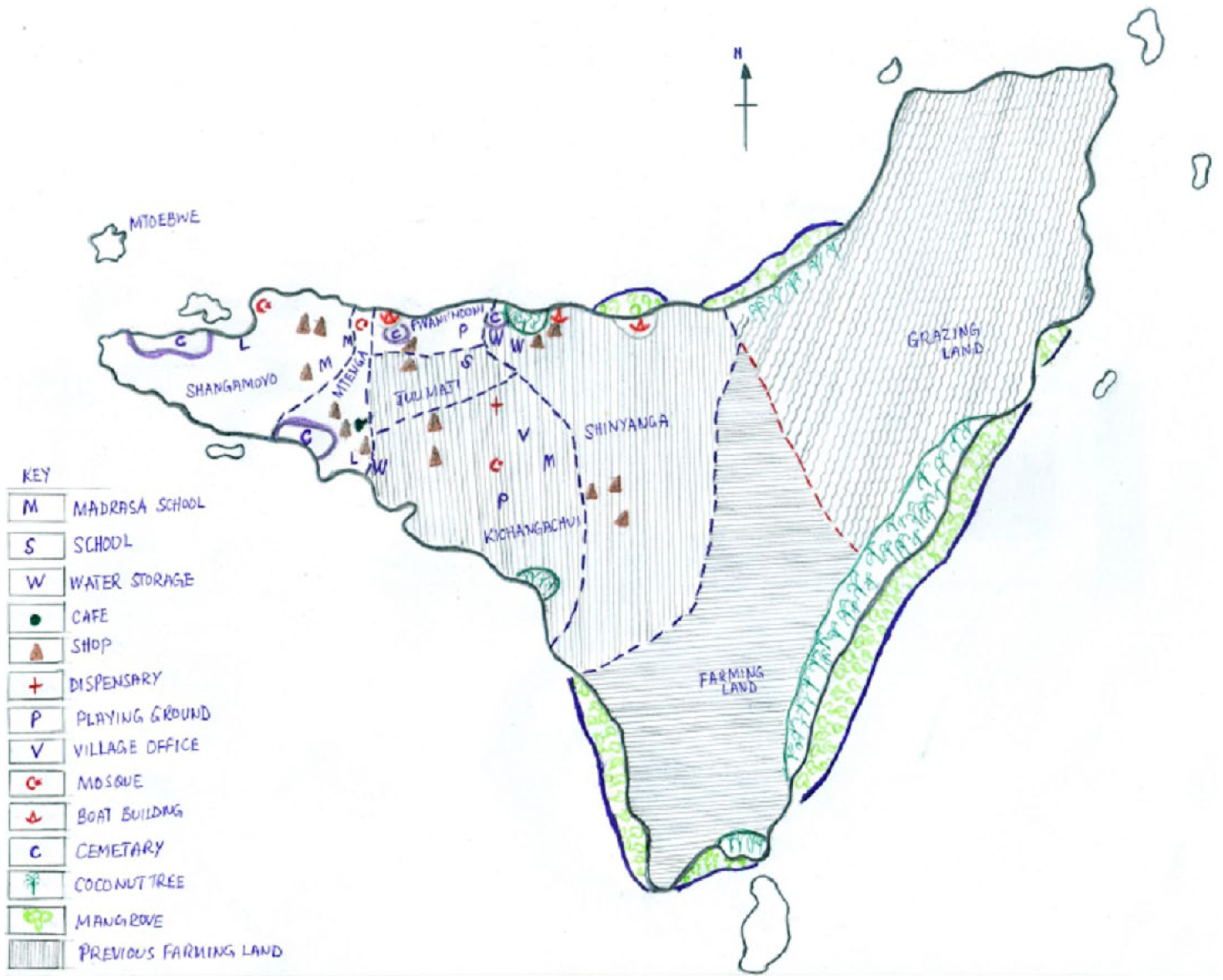
Modified participatory sketch map of Jibondo village showing decreased size of land for crop production.
The “Cultivable Land” Narrative
While the preceding local narratives by fishers and livestock keepers were indeed part of the crop production story, they all provided incomplete story, which eventually emerged among the marginalized narrators, the farmers as active actors in crop production. As such, the third narrative emerged as an exceptional narrative that was the most important narrative to both local and external farming actors in explaining about their varied experiences and events in relation to crop production. Part of this narrative is also supported by historical texts. The narrative stresses that cultivation was and is still practiced in Jibondo, but there are serious disappointments and constraints for its success, as one elderly farmer explained:
Three years back I harvested about four bags of cassava. But last year’s harvest was not enough to consume throughout the year. Livestock keepers broke in and fed their livestock. We brought the matter to leaders but that leadership caused inconveniences so I took them to police but the police insisted that we settle our matters out of court. When we came back the situation remained the same, they are bribed by livestock keepers while we just continue to face hardships . . . the problem is that those who deal with livestock keepers make them big headed. I just request the responsible persons to help us on this matter so that we, the people of Jibondo continue to cultivate. Nobody coming here should be told the land has rocks, like the way the visiting government leaders have been told to witness the rocks around the coast while there is cultivable land and we can cultivate. Livestock is the only problem . . . that is all I can say. I request for help to ensure livestock are controlled—which is all we need, or else, blood will be shed here. (Interview 6, 2009)
In an effort to identify and interpret prominent themes that emerge from the above quote, and understand how the elements of the identified themes relate to the rest of results, it was necessary to repackage the themes in a manner that facilitates further understanding of crop production problem in Jibondo village. In this regard, five key elements emerged from the above farmers’ counternarrative: evidence of cultivable land, crop damage by livestock, power asymmetry between farmers and livestock keepers, hopes to continue with cultivation, and evidence of desperation. Each of these elements is further discussed below.
Evidence of cultivable land
Historical notes on Jibondo described the island as having solid coral rock mass with pockets of reddish gritty soil where lima beans were cultivated (Piggott, 1941). Direct observations revealed that there were areas with virtually no cultivable soil and those with cultivable soils (Figures 3a and 3b). The latter had a depth of 23 to 30 cm above the coral rag in the soil profile, which was locally classified as red loam soils suitable for cassava cultivation. This observation also accords with a recent study that found most Jibondo respondents (59%) owning farming plots, locally known as konde, 2 located at Mchanganyuma area, whereas 36% owned gardens around their homesteads (Moshy et al., 2015). The size of each konde was generally small and ranged between a quarter of an acre to 2 acres. Farmers used traditional small hand hoes (Figure 3c) to dig the pockets of cultivable land where they usually planted cassava, sweet potatoes, pumpkins, maize, tomatoes, watermelons, cucumbers, pulses mostly lima beans, and various vegetables. The respondents owning konde also inherited or grew coconuts, and they owned between four and 230 coconut trees. Various fruit trees such as banana, pawpaw, lemon, bilimbi, custard apple, and soursop trees were also grown, around the homesteads. Farm preparations usually took place between October and November before various vegetables were planted during the short rains in December. Crops such as cassava, sweet potatoes, and maize were grown during long rains. As such, farming activities generally took place during the rainy seasons and during neap tides.

(a) Areas with no cultivable soil, (b) areas with soil, and (c) a traditional hoe.
Traditionally, both men and women, practically every household engaged in crop cultivation activities because fishing was only practiced during dry seasons and spring tides (Moshy & Bryceson, 2016). Currently, given the shift from selling dry to fresh fish and octopus catches, the number of people engaged in farming activities has actually declined because most youth and middle-aged people spent much time in fishing to obtain quicker returns than the ones obtained in farming (Moshy et al., 2015). However, the study further reports that the fishers received low prices for their catches; thus the income derived from fishing did not cover household expenses for purchasing basic food supplies. Hence, as also noted in Allison and Ellis (2001), livelihood diversification was in this case, a key strategy for enhancing household food security in the past.
All interviewees reported that Jibondo had no food shortage in the past. In fact, various crops, particularly cassava, was usually taken to the main Island for exhibition during previous Farmers Day, which took place every July 7th (Saba Saba Day; Interview 2, 2010). Cassava grown in Jibondo was of better quality than cassava which was grown in other parts of the Island such that most people within and outside Mafia (such as Rufiji and Songonsongo) preferred cassava from Jibondo (Interviews 2, 2010; 14, 2010; 15, 2010). However, the farmers reported substantial decrease in crop production, including vegetable, in their area. Thus, it reduced food security because all food supplies were mainly purchased since 1990s, and not everybody was having the purchasing power. A vegetable seller from the main island, for example, reported to sell up to 80 bundles of vegetable during neap tide and about 35 to 40 bundles during spring tide, which were few compared with the number of households in the area. Few farmers still produced some food which lasted up to 3 months. During the 2009 farming season, for example, a 51-year-old woman practicing farming reported to harvest about 30 pumpkins, 60 cucumbers, one 25 kg bag of maize, vegetables, watermelon, sweet potatoes, okra, banana, pawpaw, and lots of cassava, which were sun-dried and sold at Rufiji (Interview 2, 2010).
The challenges of achieving food security among fishing communities in developing countries are still immense partly due to high dependence on fish, formation and expansion of restrictive marine protected areas, increased demand for fish in developed countries, and unrestricted fish trade (Fiorella et al., 2014; Hardy, Béné, Doyen, & Schwarz, 2013; King, 2000; Pauly, Watson, & Alder, 2005). Local food crop production, and distribution and trade of various food commodities as part of key food systems play a key role to ensure food is made available in sufficient quantities (Gregory, Ingram, & Brklacich, 2005). However, environmental conditions such as climate and soil properties must support crop cultivation, and people must have purchasing power to afford sufficient quantities of the traded food supplies, which have to be accessible at all times (Food and Agriculture Organization of the United Nations [FAO], 2010; Gregory et al., 2005). The people of Jibondo are also far from achieving food security due to the increasing restrictive policies by Mafia Island Marine Park, and low returns from fish trade, which has compromised their purchasing power to buy the traded food (Benjaminsen & Bryceson, 2012; Moshy et al., 2015). As such, both food availability through crop production, and food accessibility through trade of various food supplies remain problematic in Jibondo. This was generally because farmers, mainly the elderly men and women who can no longer practice fishing, octopus gleaning, and seaweed culture, or those middle-aged persons determined to engage in both fishing and farming were heavily constrained by free range livestock keeping.
Crop damage by livestock
While wild boar remain the major cause of crop damage on cultivable coral rag areas in Zanzibar (Tobisson, 2009), all the interviewed farmers reported crop damage by livestock to be the most constraining factor in crop production. Historical notes on the number of cattle in Mafia Island by Grothusen (1912) had no records for Jibondo, which may suggest that there was no livestock keeping at Jibondo. Interview data revealed that cattle-keeping began around 1970 (Interview 15, 2010). This also somewhat conform to district livestock data (Table 1), which show the oldest available data began in 1978. Although the available data has missing values, the table shows the number of cattle and goats kept in Jibondo has been fluctuating. However, the number of livestock kept in the past, during late 1970s and early 1980s, was generally low than in the present, during 2000s. In most cases, the livestock kept in Jibondo are consumed at weddings and funerals, and during various spiritual rituals. As such, those few villagers who can afford beef have to purchase it from the main Island. Livestock are also important assets that are sold in times of crisis, particularly those which resulted from Mafia Island Marine Park operations. A good example that occurred during this study was the 2010 confiscations of fishing equipments which caused crisis in the area (Benjaminsen & Bryceson, 2012; Moshy et al., 2015). In addition, during low rainfall years such as 2004, 2008, and 2009, some livestock are also taken to the fields in the main island where availability of fresh water is less problematic.
Number of Cattle and Goats in Jibondo.
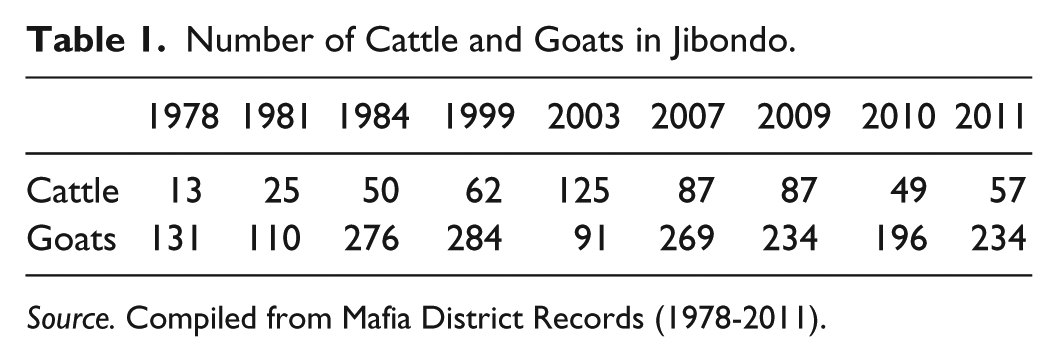
Source. Compiled from Mafia District Records (1978-2011).
The designated cattle grazing area shown in Figure 2 was reported to be effective in the past until 1980 when tethering and later free range practices began and intensified in 2003 (Interview 6, 2009). Since then, there has been an increase in livestock-related disappointments. Increasing number of cattle and free range practice have been causing frequent crop damage, pollution of water in the community’s water storage facilities, and conflicts between crop producers and livestock keepers. Due to lack of support from livestock keepers, village leaders, and district officials to resolve livestock disappointments, farmers resorted into fencing their cultivable plots although such response was not effective to resolve the problem (Moshy et al., 2015). Plot fencing, which began since 1980, is practiced differently depending on location and type of plants that have to be fenced (Figures 4a-4f).

(a and b) A fenced lemon tree and a section of bilimbi tree around a homestead, (c-e) fenced gardens around homesteads, and (f) a fenced konde field at Mchanganyuma area.
Fencing of cultivable plots is, however, laborious for farmers especially those with relatively large plots (1.25-2 acres) and the elderly women, as two women illustrated below:
People have stopped cultivation because livestock are scattered everywhere. Livestock keepers treat farmers with contempt and people are tired of losing their efforts without attaining success. Fencing is tough work and thorns pierce us. Thus there is conflict between farmers and livestock keepers. The livestock keepers say “what is grown here, there are only stones in Jibondo.” (Interview 2, 2010) Cattle, goats and theft have tended to win people off cultivation. People build fences but cattle break in and graze on crops. Just think about it, will you go and lose your efforts again? Will you lose efforts? (Interview 14, 2010)
Data from focus group discussion (FGD 2, 2010) also show that fencing required patience and perseverance; thus, given their nature, most middle-aged men abandoned cultivation. This category of men was also driven by other changing socioeconomic and cultural conditions. Discussants explained that when men earned money from fishing, they did not want to cultivate. It was also argued that since the introduction of jeans clothing, men do not go to farms after they returned from fishing trips. Moshy, Masenge, and Bryceson (2013) also found that, men spent nonfishing time visiting the main Island at Kilindoni for shopping to catch-up to the current fashion trends; thus, they usually lacked time to mend their fishing nets. Apart from fencing, the elderly men who continued with cultivation also opted for surveillance strategy whereby temporary palm huts were built at Mchanganyuma for them to spend daylight hours there to watch over their crops from damage and theft (Interview 13, 2010). Furthermore, about 14% of respondents reported to own farms at the main island, which also indicated that there were efforts to continue with crop production elsewhere.
Power asymmetry between farmers and livestock keepers
According to wealth ranking data, ownership of livestock, cattle, and goats is among the most important indicator for the “wealthy” group. Such conceptualization made livestock owners more powerful than those who owned pockets of agricultural land. The livestock owners thus let their cattle and goats graze freely on grass, and on various crops that are still grown in the area despite various challenges and difficulties that the remaining crop producers faced. About 12% of the respondents reported to own cattle, 24% owned goats while 64% owned chicken (Table 2). Villagers who owned cattle were considered to be wealthier because cattle values were higher than the fish or crops they produced. For example, the price for a standard cow ranged between US$ 215 and US$431.They also gained some income from selling milk and organic manure. One bag of manure, for example, was sold at a price of about US$0.3 to the main Island because there was no crop cultivation in Jibondo (Interview 10, 2010). Given the value of livestock, and the strand of district officials, the livestock keepers thus became powerful than other members of the village such that they could bribe the responsible people and continued with free range practices. Farmers explained that there were also politics around livestock keeping because the livestock keepers were always favored while no attention was given to farmers, hence free range persisted, as two discussants said:
Livestock keepers have been paying fines and then break the fence and then graze their cattle. Even though we fenced our gardens, they will just enter the cattle by themselves by force. (FGD 2, 2010) I am saying there are politics involved, even when you catch a livestock keeper and take him to the district, the district commissioner will just say you are wasting your time because they did nothing to resolve the matter. (FGD 1, 2009)
Livestock Ownership Among Respondents in Jibondo.

Furthermore, because most of the people of Jibondo were relatives, it was also difficult to resolve the emerging livestock challenges effectively. This was also compounded by lack of extension officers’ support. It should also be noted that all livestock keepers were male whereas most farmers were women; thus, it was further difficult for the farmers to deal with livestock keepers because men were more powerful, constituting of both fishers and livestock keepers, who were all determined to safeguard their livelihoods and thus opposed crop cultivation.
Hopes to continue with cultivation
Although it has been difficult to resolve crop damage problem, farmers were still determined to keep on cultivating, and hoped to increase their efforts if the livestock issue would be resolved. During informal interviews, farmers frequently argued that if nothing grew on Jibondo land, what did the cattle eat? Ironically, when a livestock keeper was asked to provide opinions regarding livestock keeping in Jibondo, the interviewee said that there was a need for forage seeds that would be planted, harvested, and stored to feed cattle throughout the year. This was because it was difficult to feed cattle during dry season while there was also a need to increase the number of cattle to even 100 if possible (Interview 11, 2010). Such anticipations conform to the argument that there is cultivable land in Jibondo and suggest that crop damage problem would persist unless there was external support to farmers. However, the external supporters, including leaders, must be willing to pay attention to the farmers’ narrative and be ready to walk to the Mchanganyuma area, which is about 35-min walk from the main harbor. Farmers were concerned that the coral rag narrative persisted because external actors only observed the stony land by the coast without talking to the farmers and walking across the village to Mchanganyuma to establish whether the narrative still holds (Figures 5a and 5b).

(a) Part of coconut trees at Mchanganyuma area and (b) a section of coral rag area around at a homestead near the coast which is usually shown to external actors who observe it without paying a visit to Mchanganyuma area.
The chairperson of farmers union reported that the union had about 75 registered farmers and there were also other farmers who continued with crop cultivation but were not registered (Interview 6, 2009). The farmers agreed that there were also various social-ecological factors such as those mentioned in the second narrative, and others such as prolonged dry season; they were in view that their hopes to continue with crop production will materialize if measures are taken to control both the number of livestock and free range practice. However, farmers’ hopes to revive crop production in Jibondo (farmer, personal communications, 2014) have somewhat faded because the three elderly farmers, who were the key men (including the chairperson) behind the struggles for farmers’ rights had died between 2011 and 2014.
Evidence of desperation
Shedding blood is usually an option of last resort. Farmers’ counternarrative showed that farmers almost ran out of options because their efforts to resolve livestock problem both at village and district level were not effective. Farmers were particularly desperate because their ability to produce food was compromised; and yet, they were not strong enough to engage in somewhat reliable income activities such as pull-net fishing, octopus diving, and seaweed culture, which also meant they had limited ability to have food purchasing power. The politics in handling livestock issue meant that farmers’ voices remained unheard because the dominant narrative by powerful actors was mostly heard and publicized. To illustrate how desperate the late elderly farmer and a chairman of farmers union said,
There are long rains in this island. However, there are no crops in our farms. The livestock have been grazed on all the crops that we planted. Hence is there any life here or we are just waiting to witness our deaths with our children? There is nowhere to run to, and during long rains nonmotorized fishing vessels are often grounded due to strong winds. So where is life? (Interview 6, 2009)
Conclusion
This study has contributed insights into the complexity of social dimensions in marine protected areas from the perspectives of land use and food security. It has illustrated three key narratives that explain why crop production is problematic in Jibondo. The findings of the first two narratives described how various actors contributed to the making of coral rag explanation as a dominant narrative in the explanation of why there is no crop production in Jibondo. The narratives were only dominant to nonfarming actors and did not project the whole picture of the story. These narratives prevailed despite the available evidence partly because they serve as a political argument that aims at persuading the Park management to reduce restrictive conservation policies or, remove the village from the list of Park’s village to regain their traditional fishing ground. The findings of the third narrative thus revealed an exceptional part of the missing story. The narrative projected a more comprehensive picture of the problem, encompassed all the key elements of the previous narratives, and was a dominant narrative among all interviewed farmers. Furthermore, the narrative emphasized that there was cultivable land, and the problem of crop production is actually politicized through seemingly “coral rag reality,” and can simply be addressed only if livestock free range practices are halted and livestock keepers discontinue their purposive practices of grazing cattle on cultivable land. As such, the farmers’ efforts to continue with crop production under prevailing conditions, and their hope of increasing crop production in the future (if livestock are controlled) actually challenge the first two narratives. However, farmers were marginalized because they were the least powerful in terms of age, gender, and economic position since they were mostly elders who could not engage in fishing, and crop production had low returns.
While uncontrolled livestock grazing remain the key element in farmers’ counternarrative on crop production, other constraining social-ecological factors must not be ignored. Changes in livelihood activities, cultural traditions, marketing of fish and octopus, and land use, as well as rainfall variability, and soil erosion also constrained crop production. Indeed, there is cultivable land in Jibondo, which supports crop production, a key source of food security among most nonfishing individuals. Therefore, to ensure that measures to improve both environmental and socioeconomic conditions, particularly food security among Park residents are effective, it is important to consider the complexity of constraining factors, including the role of local and external nonfarming actors in strengthening the dominant narrative. In particular, marine park conservation measures that encompass land use issues, and measures that not only focus on controlling extractive activities but also on strengthening traditional activities such as farming, and on controlling the marketing mechanisms to ensure correct pricing of the extracted resources and reasonable returns to fishers are crucial for enhancing resilience of both food production and food security in changing social-ecological conditions.
Footnotes
Acknowledgements
I would like to thank the people of Jibondo for their efforts to provide enormous knowledge about their local experiences in relation to crop production. I also thank various government officials, particularly Mafia district officials for providing information required to accomplish this study. I would also like to thank the Norwegian Centre for International Co-Operation in Higher Education (SIU) under the Norwegian Program for Development Research and education (NUFU) for funding this study. I am thankful to Claude Mung’ong’o, James Giblin, and the anonymous reviewers for their useful comments on this article.
Declaration of Conflicting Interests
The author(s) declared no potential conflicts of interest with respect to the research, authorship, and/or publication of this article.
Funding
The author(s) disclosed receipt of the following financial support for the research, authorship, and/or publication of this article: The author received financial support for the research from Norwegian Centre for International Co-Operation in Higher Education (SIU) under the Norwegian Program for Development Research and education (NUFU).