




Abstract
Australia is considered a highly food-secure nation; however, this is not always the case for every individual, household, and community. This article examines the physical and financial access to food of the population of Dorset, a rural municipality in North East Tasmania (Australia); the impact that socio-economic factors have on their food security; and the coping strategies they use when food shortages occur. A mixed-methods approach was used: Quantitative data were collected through the Tasmanian Household Food Security Survey and qualitative data through nine community focus groups conducted throughout the Dorset municipality. A total of 364 respondents (response rate 63%) completed the survey. Two main themes were identified within the data: food availability and food access. Food availability considered food origin, sustainability, and food production, whereas food access considered physical access, financial access, and other access issues such as awareness, skills, cultural preferences, and social support. The data revealed the wide-ranging effects of the importation of cheaper food alternatives, which had long-term implications not only on individuals’ health but also on the economic health of the community. A number of respondents indicated they were at times unable to buy nutritious foods due to limited finances, which led some to go without food or use other strategies to feed themselves. This study highlights the inappropriateness of the continuation of individual behavior change as a policy focus, as many of the problems facing communities are beyond individual abilities. Thus, the implications for policy from this study are centered on providing further support for strategies that focus on ensuring equity and food security for all, particularly the rural inhabitants of many food-secure nations.
Introduction
Food security is defined as a situation that “exist when all people, at all times, have physical, social and economic access to sufficient, safe and nutritious food that meets their dietary needs and food preferences for an active and healthy life” (Food and Agriculture Organization [FAO], 1996). Food security is the ability of individuals, households, and communities to acquire food that is sufficient, reliable, nutritious, safe, acceptable, and sustainable (Grewal & Grewal, 2012; Rychetnik, Webb, Story, & Katz, 2003). As such, food security, in addition to environmental justice and sustainability, has a direct influence on health and well-being outcomes of communities (Agyeman & Evans, 2003). For this reason, food security remains a key concern for public health nutrition, in terms of the capacity for individuals, families, and communities to secure a diet that is consistent with dietary guidelines and recommendations (National Health and Medical Research Council, 2013; Queensland Health Treasury, 2000).
Food access refers to the extent to which individuals are physically and economically able to obtain nutritious foods (Apparicio, Cloutier, & Shearmur, 2007) and represents the consumer determinant of food security. Food access is determined by physical resources (including transport, time, and mobility, and the presence/absence/proximity of food-related facilities), financial resources, social support, and the skills and knowledge to make appropriate choices. The two concepts of food affordability (the ability to pay for healthy nutritious food) and food awareness (the knowledge and skills needed for food preparation and cooking) are also encapsulated in the idea of food access.
Food security has become a topical issue at both international and local levels. Its pervasiveness as a major concern may be attributed to global vulnerability to climate change and variability, the scarcity of non-renewable resources (Davis, 2010), the fragility of the global food system (The Prime Minister’s Science, Engineering, and Innovation Council [PMSEIC], 2010), and unequal access to the available dietary diversity (Dixon et al., 2007). The global economic downturn with its consequent rise in some food prices has further highlighted the issue of food security (Bodor, Rose, Farley, Swalm, & Scott, 2008). Food security has long been a concept associated with the prevention of famine across developing countries; it has more recently become an issue in developed countries. For example, according to Nord, Andrews, and Carlson (2007), in 2005, 35 million people across the United States (12.1% of the population) lived in food-insecure households. In Canada, 10% of the population were classified as food insecure (Vozoris, Davis, & Tarasuk, 2002) while this rate was reported to be approximately 14% among the adult population in New Zealand (Russell, Parnell, Wilson, & et al., 1999). Australia is considered a highly food-secure nation (Rychetnik et al., 2003). However, over the last decade, it has been shown that many Australians struggle to feed themselves adequately (McCluskey, 2009; VicHealth, 2007) and face physical and financial constraints to access nutritious food on a daily basis. The 2006 Victorian Population Health Survey showed that 3.6% of two-parent families with dependent children and 20.6% of one-parent families with dependent children had in the previous year run out of food and had no money to buy more (Department of Human Services [DHS], 2007). Some groups such as unemployed people, single-parent households, low-income earners, rental households, and young people are more vulnerable to food insecurity than others (Burns, 2004).
Income is closely related to food security in that it affects the financial accessibility of consuming a variety of the five healthy food groups (fruit, vegetables, meat, dairy, and cereal) recommended to be by the Australian Guide to Healthy Eating (Roberts, 1998; Savige, Ball, Worsley, & Crawford, 2011). According to Rose (1999), income is regarded as one of the most significant determinants of food insecurity and hunger. Residents living in geographically disadvantaged regions are more likely to face unemployment, or have a low income and experience financial hardship due to a combination of environmental and structural barriers. The 2001 New South Wales (NSW) Child Health Survey revealed that parents from low-income areas were 3 times more likely to experience food security issues than parents from other areas (NSW Health, 2002).
Recent literature highlights a link between food security and regional disadvantage. By definition, regional disadvantage is reliant on socio-spatial, socio-economic, and socio-relational determinants (Gleeson & Carmichael, 2001; Gleeson & Randolph, 2000). Generally, geographical remoteness, low income, and social isolation are some of the easily recognized causes of being disadvantaged.
Beyond income, geographical factors also play an essential role in ensuring food security (Jaynea et al., 2003; Smith, Amani, Obeid, & Jensen, 2000). In Australia, there is growing research that confirms the association between food security and geographical disadvantage nationwide, whereby the disparity in food availability and access between advantaged and disadvantaged communities is underscored (Queensland Health Treasury, 2000). For example, healthier foods were found to exhibit the greatest geographical price difference with fruit, vegetables, and dairy all higher in price in remote areas (Department of Health in Western Australia, 2010; Meedeniya, Smith, & Carter, 2000), and geographical access to healthy food stores and availability of healthy foods within stores were better in the more advantaged neighborhoods (Ball, Timperio, & Crawford, 2009). Differential access to healthy foods between socio-economically advantaged and disadvantaged groups has led to inequality in diet or healthy food intake. Low-income households and those in remote areas are less likely to consume the recommended intake of fruit and vegetables per day (Australian Institute of Health and Welfare [AIHW], 2010; Second Bite, 2011). These inequalities can partially explain why there is food insecurity in otherwise food-secure nations.
Food Security in Rural and Remote Areas of Tasmania
Tasmania, an island state off the south-east coast of mainland Australia, has much higher levels of socio-economic disadvantage, a more rurally dispersed population, and an older population when compared with other Australian states (e.g., 23.2% of Tasmania’s population is 65 and older, compared with a national average of 14.0%). Tasmania has higher level of regional disadvantage compared with other states in Australia. Most Tasmanian areas have an Index of Remoteness Accessibility (RA) ranging from Australian Standard Geographical Classification (ASGC) RA2 (Inner Regional) to ASGC-RA5 (very Remote; AIHW, 2011). The unemployment rates for most local government areas (LGAs) in North West and Northern Tasmania are reported to be slightly above state levels (5.6%) and national levels (5.1%; Department of Education, Employment, and Workplace Relations [DEEWR], 2012). In addition, the proportion of the working age population (15 to 64 years) in receipt of a Centrelink or social security benefit in North West and Northern Tasmania region (26.0%) is higher than that of Tasmania (25.0%), and much higher than the national level (17%; Neville, 2011). According to the Socio-Economic Indexes for Areas (SEIFA; Australian Bureau of Statistics [ABS], 2008), 8 out of 12 of the LGAs in North West and Northern Tasmania fall into a score between the 1st and 3rd deciles, indicating an area that is in 30% of most disadvantaged areas.
Over the last three decades, the level of long-term unemployment in Tasmania has been highest among the 15 to 24 and 25 to 44 age groups. The average duration of unemployment remains slightly higher in Tasmania than the national average (Department of Treasury and Finance, 2011), with the north west of Tasmania experiencing the highest levels of long-term unemployment (Department of Treasury and Finance, 2005). According to Department of Education, Employment, and Workplace Relations(DEEWAR) (2011), Small Area Labor Markets–December quarter 2011, the unemployment rates for most LGAs in North West and Northern Tasmania are reported to be slightly above state levels (5.6%) and national levels (5.1%).
Previous studies have found that the cost of food is a major ongoing concern for some families in Tasmania (Flanagan, 2010; Madden, 2004; Tasmanian Government, 2004). This is especially evident in the more remote areas, where a range of exclusionary factors including low income, poor access to transport, the high cost of essentials, and high levels of illness and disability have undermined people’s ability to get affordable, nutritious food (Madden & Law, 2005). Declining and rapidly aging populations coupled with economic decline have made food access a formidable challenge for these geographically disadvantaged residents.
While substantial efforts have been made to address the issue of food security nationwide, more attention, time, and energy are required to bring about marked improvement with a greater emphasis on local self-reliance in food (Grewal & Grewal, 2012). This is particularly evident within Tasmania, with around one third of its population depending on government benefits as their main source of income. As a state, many of its residents are facing formidable challenges in ensuring food security for all, especially with cost of living pressures, rising unemployment, and increasing food prices (Tasmanian Government, 2009). Difficulty in establishing the extent of the problem or monitoring trends over time has been identified as a major obstacle to effective investment and improved food security (Seal, 2010). Without proper understanding of the scope and nature, as well as the depth and breadth of this issue, practical solutions to food insecurity for certain groups of the population will remain elusive.
In 2012, the Tasmanian Food Security Council issued Food for All Tasmanians: A Food Security Strategy (Tasmanian Food Security Council [TFSC], 2012). The strategy emphasizes the need to ensure that food security is achieved through community approaches, particularly those targeting Tasmanians most at risk, which include people on low incomes, children, older people, and people living in isolated areas. The four priorities to address food insecurity covered in the strategy are increasing food access and affordability, building community food solutions, regional development and supporting food-focused social enterprises, and planning for local food systems.
It is within this context that assessing and monitoring food access are required to be a high priority in any workable solution toward improved food security, locally and nationally. Against this background, the Dorset study was conducted with a view to building a more evidence-based understanding of the issue of food security in Tasmania, which could also be of value to other communities with similar contexts.
Method
This article reports a number of findings of a larger study, which examined the physical and financial access to food that people have in a rural region of Tasmania, the impact socio-economic factors have on food security, and what coping strategies they adopted when there were food shortages.
Existing literature on food security in Tasmania was found to be of limited use because of differences in the questions and methodology used between studies. The primary nature of this research project was exploratory and descriptive. To obtain a comprehensive description of current food security in Dorset LGA, the use of combined data collection methods was considered to be the most appropriate.
As suggested by the mixed-methods methodologists, Driscoll, Appiah-Yeboah, Salib, and Rupert (2007), gathering quantitative and qualitative data would capture not only the breadth but also the depth of the issue under study. Therefore, a mixed-methods approach was used in this research project, including both quantitative and qualitative data collection methods (Ivankova, Creswell, & Stick, 2006). A simple mixed-method design was used where the dominance is neither given to the quantitative or qualitative methods but used to strengthen the knowledge claims of the research (Creswell, Plano Clark, Gutmann, & Hanson, 2003). The two data sets were combined in the interpretation stage of the study to combine their strengths inherent within both methods (Creswell, 2009; Creswell et al., 2003; Creswell & Tashakkori, 2007; Morse, 2005; Tritter, 2007).
As such, a qualitative approach using community focus groups was used to complement the quantitative data analysis gathered by the Tasmanian Household Food Security (THFS) Survey and to gain an understanding of food security, issues, and challenges relating to food access. Ethical approval for the study was obtained by the Human Research Ethics Committee (Tasmania) Network prior to commencing the study.
The Study Area
Location
The study examined food security issues in the Dorset LGA, North East Tasmania (Figure 1). Dorset LGA has an area of 3,227 km2, with a population of 7,100 spread over 40 townships and population centers, and a population density of 2.2 people per square kilometer.

Main population centers, Dorset LGA, Tasmania.
Socio-economic profile
To understand the level of disadvantage in Dorset, the SEIFA Index of Relative Socio-Economic Disadvantage (IRSD) provides an indication of the relative level of socio-economic disadvantage based on a range of census characteristics. The index is derived from attributes that reflect disadvantage such as low income, low educational attainment, and levels of employment in relatively unskilled occupations. Dorset is ranked at 11th highest (most disadvantaged) out of the 28 LGAs in Tasmania in terms of IRSD. When compared with the remaining 560 LGAs Australia wide, Dorset is ranked at 100th, which equates to the 18th highest level of disadvantage (ABS, 2013). Overall, 39.3% of the Dorset population are living in the lowest decile of socio-economic disadvantage with only 48.8% of the working age population in some form of employment, as indicated in Tables 1 and 2. Dorset has a high level of socio-economic disadvantage when compared with other regional areas and state levels, particularly in the areas of education and employment, which are two of the most powerful determinants of health.
Percentage of Population in the Lowest Decile of Socio-Economic Disadvantage (IRSD).

Note. IRSD = Index of Relative Socio-Economic Disadvantage.
Dorset Working Age Population and Those in Employment.

Source. Australian Bureau of Statistics (ABS; 2012).
Twenty-five percent of Dorset’s working population is employed in primary industry (agriculture, forestry, and fishing; Table 3), particularly forestry, dairy, and cropping potatoes, onions, and other vegetables. However, the area has experienced social and economic challenges associated with the loss of industries and infrastructure. For example, the closure of a large vegetable processing plant and dairy, a reduction in forestry activities, and, in recent years, farmers have also been affected by drought followed by flooding in the agricultural areas of Dorset (The Dorset Economic Development Group, 2007).
Top Ten Industries of Employment by Occupation in Dorset.

Source. Australian Bureau of Statistics (ABS; 2012).
In addition, Dorset has experienced a population decline of 5.2% in the period 2001-2011 (ABS, 2012) and is characterized by a rapidly aging population. Accessing services can be difficult as 96% of Dorset’s population is classified as living in Outer Regional Australia and 4% is classified as living in Remote Australia (AIHW, 2011).
Quantitative Data Collection
In Dorset, the THFS Survey (Le et al., 2013) was distributed as a self-administered questionnaire. The survey was randomly distributed through local post offices within the main population centers of Bridport, Scottsdale, Ringarooma, Winnaleah, and Gladstone. Distribution was weighted according to the number of occupied and unoccupied dwellings in the municipality. Prior to the survey being distributed, there was promotion through various media including the local newspaper and radio, flyers, and school newsletters. In addition, surveys were randomly distributed to dwellings throughout the LGA using stratified sampling. A total of 571 surveys were distributed with an expected survey response of 400. Follow-up surveys were distributed to obtain greater response.
The THFS was designed to enhance community response and capture the relevant information (Le et al., 2013). Questions were grouped into five topics: demographics, food access, food availability, food affordability, and food awareness. Several of the demographic data questions aligned with questions from the ABS (1995). This was considered important to enable meaningful comparison with future surveys. Existing literature on food security in Tasmania is of limited use because of differences in questions and methodology used. An expert external reference group was formed to provide advice on the development of the research tool and content of the questionnaire, which was subsequently piloted and revised prior to full implementation (Appendix A).
Qualitative Data Collection
Community focus groups were chosen to explore issues around food security and were open to all residents of Dorset to ensure that a detailed and contextualized understanding of individual experience was produced (De Laine, 1997; Rice & Ezzy, 1999). Advertising of the community focus groups occurred through all forms of local media with participants registering their interest in attending. The participants were a mix of age, gender, and social background with work experience in agriculture and the business sector.
Nine focus groups of five to eight participants per group were scheduled to be held in the townships of Bridport, Scottsdale, Ringarooma, and Winnaleah, which are spread throughout the Dorset LGA (Figure 1). Each of the focus groups occurred between September and October 2011 and was audio recorded. Focus group questions were developed in consultation with project stakeholders, experts in the field of food security, and a review of relevant literature. They were designed to stimulate discussion about access to food, its availability, and what participants saw as the barriers and enablers to food security in their households and communities (Appendix B).
Data Analysis
Data from the THFS survey were coded, entered, checked for integrity, and analyzed using SPSS Version 20.0. Descriptive statistics such as frequencies, percentage, mean, and median were used as part of the preliminary analysis of a larger study to examine food security in Tasmania (Le et al., 2013). In addition, the qualitative data sourced from the focus groups and the open-ended sections of the surveys were transcribed, collated, de-identified, coded, and entered into NVivo 9.0 software (Qualitative Solutions and Research (QSR) International, 2012). The data were analyzed thematically to identify key patterns and trends in the data and to compare expressed views (Aronson, 1994; Braun & Clarke, 2006; Fereday & Muir-Cochrane, 2008). The quotations are included in the results presented here to illustrate and support the findings emerging from the textual responses. The focus group participants were coded according to the community focus group(FG) they participated in (e.g., FG 1, FG 2).
Results
Demographic Characteristics of the Study Participants
The total number of participants in nine focus groups was 45 (16 males and 29 females), ranging in age from 21 to 98, with an average age of 57. A total of 364 respondents (response rate 63%) completed or partially completed the THFS survey in Dorset. There were many more females than males who responded to the survey (20.3% male and 79.7% female). Respondents ranged in age from younger than 25 to above 65; however, the age range was skewed, with only 2.3% younger than 25 and 53.9% aged 55 or above. Regarding family size, the highest proportion (49.1%) of the participants reported living in a family of two members, with 19.1% living by themselves. Just under a quarter (23.8%) came from a family of three or four members, and the remaining 8.1% reported living in larger families of five to seven members.
With regard to levels of schooling, 39.7% of the participants reported completing Year 12 or equivalent and 38.6% completing Year 10 or equivalent. Of those who continued their education after high school, 17.9% reported obtaining a diploma or advanced diploma, 22.4% a bachelor’s degree, and 8.7% a postgraduate degree.
Responding to the question about current employment status, 25.6% of the participants reported not being in the labor force. This high proportion may reflect that more than half of the survey participants were aged 55 and above. While 49.3% were employed either full-time, part-time, or casual, a small proportion (2.8%) reported themselves being unemployed. This proportion is less than the Tasmanian average unemployment rate. These diverse employment backgrounds were in line with the varied family weekly income of the participants, which ranged from nil income to $3,000 or more per week. It is important to note that the reported income did not cluster around any of the weekly ranges but were spread across the 15 ranges. Selected characteristics of the survey participants are presented in Table 4.
Characteristics of THFS Survey Respondents.

Note. THFS = Tasmanian Household Food Security.
Data analysis from the survey and focus groups highlighted two main themes: food availability and food access. Food availability considered food origin, sustainability, and food production; and food access considered physical access, financial access (the capacity to buy fresh and nutritious food with your regular income), and other access issues such as awareness, skills, cultural preferences, and social support. These two themes were also discussed in terms of the actual consumption of nutritious foods, choices of food for consumption, and coping strategies used during food shortages. Please note this study was part of a wider research project identifying food access in rural areas of Tasmania, Australia. A summary of themes and subthemes emerged from interview data of the whole project is provided in Appendix C.
Food Availability
Food origin
Food availability and supply in Dorset as a determinant of food security was conceptualized by participants as strongly connected and influenced by the origin of the food. Participants discussed “the abundance of imported over locally produced food,” “exports from the north-east being available interstate at cheaper prices,” “access to north-east food being limited,” and a growing necessity to support local farmers and local businesses by “investing locally.” Three participants specifically highlighted an issue that others had discussed: [Produce] usually goes to [large city] first and then comes back . . . [as] packaged vegetables . . . I can’t understand why the locals don’t sell directly to the supermarkets here. It would be a lot cheaper. (FG 3) Even local food like onions is cheaper in [the city] than what they are here and they come from here just over the road. (FG 1) Grapes imported from the USA to Australia—there is something wrong and apples from New Zealand when we used to be the “Apple Isle.” (FG 6)
Food origin was also discussed in terms of “the future of food in a global sense.” Participants discussed “the need to eat what’s in season—be less fussy—accept a blemish.”
We are running out of petrol and to bring stuff in from China by plane or by Peru by plane is ridiculous when we can grow it here. (FG 2) I’m wondering whether people would be better to eat what was in season, rather than expect the whole range of vegetables all year. (FG 3)
Food origin in terms of labeling was considered important and of major concern across the Dorset LGA.
[Food] security, I think is being able to buy produce that you don’t have to check where it is made, where it has come from. You have security in the knowledge that it is locally grown and produced. (FG 6)
Sustainability
The sustainability of the local food system was also raised as an issue in Dorset, but in terms of sustainable food production rather than sustainable distribution systems. This perspective echoed the backgrounds and occupations of the community members. For example, sustainability was considered an important issue, particularly the issues of land usage and future food supply when one individual stated, I’m worried about the farmers in Australia losing arable land, I mean the whole of Australia, we have got one issue coming up now with coal underground . . . but in the North-East . . . farm land is being planted out with trees . . . you can’t eat trees, that is a big concern of mine. (FG 1)
Food production
The production of food was also highlighted in the community focus groups, and it was evident that food availability and supply were an emotive issue across the municipality. A specific concern was the inability to process the fruit and vegetables that were grown in the area and the possible impact this may have on current and future food production. To this end, two participants stated, We are vegetable growers . . . we only grow onions now because it is not profitable to grow any other crops. We’ve grown broccoli, onions, potatoes, pyrethrum, poppies, all those things and we’re just down to just one small crop of onions now. (FG 6) Well the markets aren’t there, every year you grow these crops and we haven’t sold an onion this year yet, the prices are so low from imported onions. As soon as the price starts to get up the suppliers bring in imported onions from overseas. (FG 2)
Quality was considered an equally important issue to price. The quality of food available in local food outlets was mentioned as being a concern. It was discussed in terms of the length of time produce is kept in the cool store and the possible loss of nutrient value as a result.
I do think sometimes some of the vegetables in the supermarket have been in cool stores too long and so they don’t keep when you take them home . . .. I know sometimes the age of some of the vegetables and it’s months and they’ve been in cool sore so once you take them they deteriorate very quickly. So I think that’s a problem with nutrition as well, I’m not sure but I would think so. (FG 8)
Reflecting on the value of traveling the distance to the larger regional center, rather than shopping in Dorset, another participant stated, The quality deteriorates because you tend to get what you can . . . but . . . you are running a risk at the end of the fortnight because you know it is no longer fresh but it’s better than you get here and you get it cheap. (FG 6)
Food access
The theme of access to shops was frequently discussed and closely linked to the issue of whether people could afford to buy food. The issues and barriers that people faced were many and varied with some people facing more than one barrier, which compounded an already challenging situation. Despite this, the two main challenges highlighted were physical and financial access.
Physical access
The survey explored the physical access to fresh and nutritious foods through the measurement of the distance to food shops, transport to food shops, and frequency of food shopping. Physical access to food is largely determined by the distance required to travel to food outlets. Figure 2 shows the location of all food outlets in the Dorset LGA.
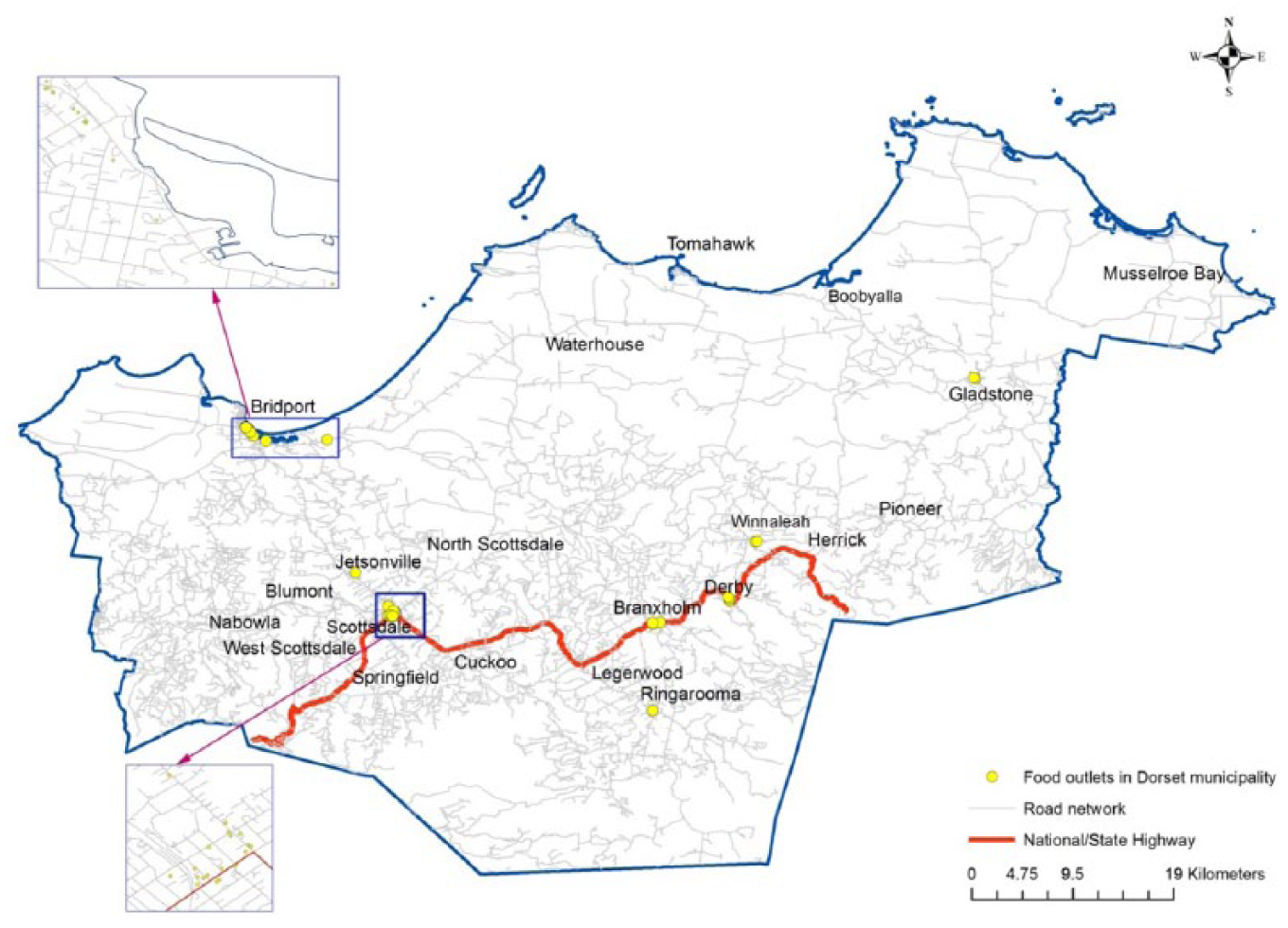
Location and distribution of all food outlets in Dorset by road network (Le et al., 2013).
The survey indicates that a large number of people (277, 75.3%) reported that their most visited food shop was centered on Scottsdale. However, 124 of these respondents did not live in this area and were traveling some distance to do their regular food shopping. In addition, a number of participants (6.6%) in Dorset traveled outside of their LGAs, for their regular food shopping. This included traveling to a major regional center, which is well out of the Dorset municipality. Survey respondents indicated they lived various distances from the most frequented shops (Table 5) with only 23.9% living within walking distance (1 km) of the most frequently visited food shop and 37.8% living more than 20 km from the most frequently visited food shop.
Travel Distance to Most Frequently Visited Food Shop.

Despite these findings, 88.5% of the respondents reported that they did not have difficulty in getting to food shops. This was encouraging although attention should be paid to assisting the remaining 11.5% who reported experiencing access difficulties. Of those respondents who experienced access difficulty, 65.9% said the high cost of petrol was the main barrier to traveling for food shopping. This finding was supported by the qualitative data from focus group discussion. A number of participants spoke about transport costs affecting food access and the dependence on private vehicles as transport. They made comparison between the price of petrol in different areas and associated costs if one did travel out of the area.
The fuel here is ridiculous; Legerwood at the moment is $1.56 a liter, $1.44 in Scottsdale . . . but in Launceston [major regional center, not in Dorset LGA], it’s $1.37—Why? (FC 3)
Poor physical access was not just a factor of the physical placement of food outlets. The presence of young children and frailty or disability were all reported as factors that had an impact on people’s physical access to food outlets and which pushed people to use “convenient” food outlets rather than preferred food outlets. Participants reported that the consequence of poor physical access to food outlets was a reduction in access to a variety of fresh food.
Apart from the option of physically traveling to and from food shops, online shopping offers another choice, which may facilitate food access. However, the survey indicated that online shopping was not a common choice for residents in Dorset: only 0.9% reporting that they would order online for home delivery of foods.
Another indicator of physical access to fresh and nutritious foods is frequency of shopping. Most respondents reported shopping for food either 2 to 3 times per week (33.1%) or weekly (41.2%), while 7.7% reported shopping for food every day. The percentage of respondents who shopped for food every 2 weeks or every month was 15.7, which has implications regarding the quality of food consumed by those residents and the availability of appropriate storage facilities to maintain the shelf life of fresh food.
Survey participants were also asked to indicate their coping strategies if the foods they wished to buy were not available in the area in which they usually shopped. In all, 41.0% of respondents said they would travel to another area to buy the food unavailable in their area, while 54.1% said they would go without.
Financial access
Financial access refers to the ability to buy fresh and nutritious foods with your regular income. Survey participants were asked about their financial ability to buy nutritious foods and whether they had gone without food in the previous 12 months due to a lack of money. A total of 15.9% of the respondents reported shortage of money as a barrier to their access to nutritious foods, while 5.0% stated that they had gone without food at some time in the previous 12 months because of shortage of money. In all, 10.5% of respondents reported running out of nutritious food weekly, 10.5% fortnightly, and 15.8% monthly during the previous 12 months. A further 42.1% reported running out of nutritious food at least 3 to 4 times per year and 21% once per year.
Respondents highlighted a number of barriers to buying nutritious foods: 22.2% indicated they did not buy nutritious foods because they were too expensive, 15.6% stated nutritious foods were not available, while 14.2% stated they had spent money on other non-food-related essentials. Others commented on how they would make their food budget go further. Strategies to achieve this were growing and cooking their own foods rather than buying processed foods or eating out, buying in bulk, buying discounted food, or choosing cheaper brands.
Although financial access and affordability were considered by the focus group participants, as with physical access, it was discussed in a global sense such as transport costs, rather than in terms of the amount of individual income and capacity. For example, two participants stated, I think one of the biggest things here is petrol . . . the [cost of] fuel here is ridiculous . . . That’s something people who live in other parts of Tasmania don’t understand because everything is available to them, even though you are only 10 minutes away from [another town], it is a matter of . . . the average cost in getting there. (FG 2) I travel every fortnight to the [city] and I stock up . . . that puts at least an extra $20 on the cost of the vegetables. (FG 7)
From these initial discussions, the conversation moved from financial cost to other social costs such as the risks involved when driving on unsafe roads to the city to access lower cost foods. Participants highlighted the conditions of the LGA’s roads as inhibitory to travel to food outlets. The condition and safety of the roads were in reference to heavy traffic such as trucks and farm machinery traveling on roads that are steep, narrow, and winding. Coupled with this was the weather, which, depending on the season, may be windy, heavy rain, ice, and snow.
Other access issues
Other issues relating to food access such as food variety, price, social support, and gardening skills were addressed in the survey when participants were asked to indicate possible solutions to access difficulties (Table 6). A total of 69.5% of the respondents felt there was nothing that could be done to improve their physical and financial access to sufficient healthy food. For those who chose the strategies suggested in the survey, different food choices in local shops were the most common choice.
Possible Solutions to Make Sure There Is Always Enough Nutritious Food to Eat.

Food Shortages and Coping Strategies
As previously indicated, respondents have developed skills and strategies to cope and manage when experiencing food shortages. One of the coping strategies in these times of food shortage was to access support services, such as emergency food relief. Four respondents used emergency food relief services when they could not afford to buy food. This occurred 3 to 4 times per year for two respondents, while the remaining two indicated that it only occurred very irregularly.
However, the reason some respondents in need did not use emergency food relief services, despite experiencing food shortages, was that they relied on family for support (43.8%), were unaware of the services in their area (18.8%), or did not have transport to get to the services (6.3%). These findings suggest that more could be done to increase the awareness of existing food relief services and the need to increase the distribution network of these and other food support services so as to reach more people in need.
For the majority of those who were faced with food shortages, other strategies were adopted such as skipping meals, reducing the size of meals, getting help from friends and family, eating cheaper foods, cutting down on essentials or nutritious food items, and growing fruit and vegetables at home.
A recurring theme within the focus groups was the importance of having adequate resources at home for storing and preserving food. In particular, access to a freezer was essential to take advantage of home produce, and buying in bulk or bargain buying. For other participants, coping strategies were focused on making a behavioral shift to maintain healthy diet.
Now in really busy times with calving and things like that I will just get the basics. We make do until we have more time, so time influences the shopping as well; availability of my own time. (FG 3) [It] was a major cultural shift I had to make when I came here. It was an adjustment because I was used to . . . having the Vietnamese and Greek delis and all the lovely fresh produce dripping with water. [When I came] here and I had to start to come to terms with using canned products, packets, mixes or going to [major regional center] or [Capital city]. (FG 2)
Discussion
At the time of this research, nationwide studies were being conducted on specific aspects of food insecurity such as access and affordability, as well as focusing on specific groups or contributors such as low income, poor health, or unemployment (Anglicare Tasmania, 2005; ABS, 1995, 1997; DHHS, 2009; Coveney et al., 2010; McCluskey, 2009; Palermo & Smith, 2009; Queensland Health Treasury, 2000). This article presents geographically specific, population-based research that seeks to expand our knowledge of food insecurity by examining four aspects of food insecurity: food availability, food affordability, food knowledge, and food awareness and access.
In Dorset, the major themes, which emerged from the community consultations and survey, were around food availability, access, and supply. This research found that factors that drove choice around food consumption, and whether or not participants consumed nutritious foods, were strongly associated with availability, supply, and whether people can get access to appropriate, affordable, and preferred foods. Food consumption, specifically the choice of what to eat, was largely influenced by place of residence within the municipality. The Dorset municipality has diverse areas from rugged coast, dense bush, and rich farming land. While participants indicated an awareness of what was required for a nutritious meal, their capacity to obtain it was challenged by where they lived in the municipality.
In addition, concerns were expressed about the origin of food being purchased and the distance it had traveled before sale, with additional concerns reflecting the conundrum of living in an agriculturally productive area where it is difficult to purchase locally grown food. These findings mirrored those of Meedeniya et al. (2000) in rural South Australia
Furthermore, participants were concerned about food availability and supply, particularly the inadequate labeling of imported food. While food labeling laws are governed by Food Standards Australia and New Zealand and set within the Food Standards Code to make sure food is safe and suitable for use to eat, clearer labeling (e.g., country of origin, content of local produce and buying locally) remains an issue of major concern and shared with other Western countries (Chambers, Lobb, Butler, Harvey, & Bruce Traill, 2007; Grewal & Grewal, 2012; Umberger, Feuz, & Sitz, 2003).
The export of produce out of the municipality and the lack of availability of local produce were identified as major concerns. This was discussed in terms of second-grade produce being sold locally, with first-grade being exported, and a need to bring the food back to its place of origin, ensuring freshness, the future of local food production, and the need to eat what is in season. Furthermore, the participants emphasized a greater self-reliance on food that is grown locally. This was felt to have an impact not only on accessibility of fresh timely produce but also on employment and on the local economy with a need to specifically focus on the agricultural sector by supporting the local farmers (Grewal & Grewal, 2012).
The 2003 closure of the Scottsdale vegetable processing plant was highlighted by the focus group members and generated discussion about the need for a vegetable processing plant to be re-established in the area. The rationale was that this would encourage a greater variety of produce to be grown locally, supporting the desire to be able to eat locally produced food, while increasing employment opportunities locally. This concern is not only confined to Tasmania but is a global concern affecting rural communities worldwide (FAO, 1996;; Gender Insight, 2012).
In rural areas such as Dorset, transport to food outlets remains a challenge, and having access to a private car was considered essential due to very limited or no public transport. The road conditions and personal transport expenses such as petrol can be costly, with food choice largely influenced by the associated transport costs. Within this study, cost was significantly influenced by where the person resided in the municipality, coupled with their employment and family status. This finding is also supported by previous research studies, which indicate that people living in rural areas can be disadvantaged in accessing food due to transport costs and limitations on availability (Larson, Story, & Nelson, 2009; Pearson, Russell, Campbell, & Barker, 2005).
Poor physical access was not just a factor of the physical location of food outlets. Participants reported that the consequence of poor physical access to food outlets was a reduction in access to a variety of fresh food. A number of coping strategies were discussed in terms of “making do” and time management, where people reported feeling “time poor” with busy lifestyles limiting the amount of time they could spend on food shopping, which then took second place on a personal list of priorities (Marie, James, Corinna, & Marc, 2010). In addition to being “time poor,” people reported that shop opening hours were not always convenient, specifically in relation to school hours and other shop closing and opening hours affecting their ability to manage their time well.
A theme that emerged from the discussions was food consumption, specifically the choice of what to eat, which was largely influenced by place of residence within the municipality. Some participants highlighted that many food distributors had a tendency to promote less healthy food. They were clearly familiar with marketing patterns, which dominate food stores; they suggested that shoppers have “too much access” to the wrong type of food in supermarkets and made particular reference to how food was placed in stores, with fresh fruit and vegetables at the back of the shop and confectionary prominently placed at the entrance and near checkouts, which has been shown to influence their purchase (Miranda, 2008; Piacentini, MacFadyen, & Eadie, 2000).
Although participants indicated an awareness of what was required for a nutritious meal, their capacity to obtain it was challenged by where they lived. Popular coastal holiday areas were subject to seasonal price rises while inland areas were subject to availability challenges. While growing your own is often put forward as an option, it is not always possible in all areas. For example, in some areas, wildlife can destroy vegetable gardens overnight unless there has been a substantial investment to build solid structures to keep them out.
There was awareness for the need to increase skill levels throughout the community in terms of growing, cooking, and preserving food, an approach that has been utilized in other areas of Australia and Western countries (Davis, 2010). School gardens were highlighted as an approach to addressing aspects of food security in the area. Participants pointed out the level of skill necessary to grow food and expressed a desire to see these skills embedded into the school curriculum.
A small proportion of participants indicated they turned to social support, such as emergency food relief services as a coping strategy to deal with food shortages in times of difficulty. The majority of those who could not regularly afford nutritious foods drew on other coping strategies such as cutting down on meal size, missing meals, eating cheaper foods, eating less higher cost nutritious food items, growing fruit and vegetables, cutting down on non-essentials, or getting help from family and friends.
Implications for Policy
If food security is defined as a situation that exists “when all people, at all times, have physical, social and economic access to sufficient safe and nutritious food that meets their dietary needs and food preferences for an active and healthy life” (FAO, 1996), then Dorset, as an example of a “developed” society that experiences several social and economic disadvantages, has not fully achieved food security in its broadest sense. Physical and financial access to food is a social determinant of health: Populations with better physical and financial access to food are healthier than those with limited physical and financial access to food (Larson et al., 2009; Powell, Slater, Mirtcheva, Bao, & Chaloupka, 2007). The findings from this study revealed that residents within these types of communities have limited physical and financial access to food. Therefore, ensuring food supplies are affordable and accessible to all people in the community, regardless of their financial means or geographical location, will begin to address some of the health issues and inequalities in many similar communities. From a local and statewide perspective, this research reinforces the Food for all Tasmanians: Food Security Strategy (2012) and other similar communities where access and affordability remain among the first priorities of each community.
The difference between the findings presented here and others is that many studies focus on targeting individuals for change rather than on targeting the social determinants of health. This study highlights the inappropriateness of the continuation of individual behavior change as a policy focus, because many of the problems facing communities are beyond individual abilities. For example, this study identified transport accessibility and affordability as a challenge influencing access to nutritious food systems, and transport underpins food security as a key determinant known to influence an individual’s standard of health and well-being. Overcoming the challenge of transport accessibility and affordability is unlikely to be achieved by individual behavior change. Through this identification, it is possible to contextualize the policy drivers necessary for formulation and implementation of policy to effect significant change to the present food system.
Importantly, policy frameworks built around the social determinants of health aim to tackle aspects of regional inequity associated with specific determinants of food insecurity. Issues of inequity within the context of food access, a key indicator of food security, are highlighted in this study as a major concern. With an increasing focus on achieving equity in health, there is an urgent need to move from “individual based” to “population health” based policy. Within Tasmania, there is a shift in emphasis within the health policy framework to take a social determinants of health approach to addressing health and wellness, which is also an ideal opportunity to consider policy alternatives with an equity focus. In this respect, the state and the community are shifting toward equality, justice, and sustainability within their discourses, which help to enhance greater sustainable community development, alternative measures of success, and ultimately, food security among its people (Agyeman, 2008; Hamstead & Quinn, 2005).
The findings of this research also indicate the importance of government being kept accountable for continued policy commitment to the social determinants of health. While the issue of preventive health in public policy is on state and national government agendas, there needs to be a sophisticated understanding of how to include social determinants of health in these agendas. Elucidating strategies that enable policy makers to make the radical changes necessary to public policy such as including social determinants of health is essential. While there may never be agreement on priorities in terms of health, this study has shown there could always be agreement on the importance of policy, which is reflective of the social determinants of health.
Conclusion
Australia is considered a highly food-secure nation; however, over the last decade, many Australians have struggled to feed themselves adequately, particularly in rural areas. This article has examined the physical and financial access people have to food in the Dorset LGA, Tasmania, and the coping strategies they use when food shortages are experienced. In addition, the study has provided a broad description of the lived experience of food insecurity, which members of the Dorset community encounter as they live and work in the municipality. The residents of Dorset are physically limited by distance and transport when accessing food shops. There are wide-ranging and long-term economic and social implications for importing cheaper food alternatives, not only on health but also in terms of the economic health of the community. Residents are also concerned with their vulnerability to food insecurity, which was a consequence of access, availability, affordability, and knowledge issues. The group most vulnerable to food insecurity was identified as those who were living on a lower income and greater distances from populated areas. This study further supports the inappropriateness of the continuation of individual behavior change as a policy focus, as many of the problems facing communities are beyond individual abilities. Thus, the implications for policy from this study are centered on providing further support for strategies that focus on ensuring equity and food security for all, particularly for the rural inhabitants of many food-secure nations. Despite these findings, the study identified a sense of social connectedness and highlighted a number of coping strategies used by the residents to ensure adequate food security.
Footnotes
Appendix A
| Q1. |
|
|||||||
| Q2. | Are you? | |||||||
| ☐ Male | ☐ Female | |||||||
| Q3. |
|
|||||||
| Q4. |
|
|||||||
| ☐ Year 8 or below |
☐ Year 11 or equivalent |
|||||||
| Q5. |
|
|||||||
| ☐ Yes | ☐ No |
|||||||
| Q6. |
|
|||||||
| ☐ Certificate (not further defined) |
☐ Bachelor’s degree |
|||||||
| Q7. | What is your current employment status? | |||||||
| ☐ Not in the labor force |
☐ Employed—away from work |
|||||||
| Q8. |
|
|||||||
| ☐ Negative / Nil income |
☐ $1,000-$1,199 |
|||||||
| Q9. |
|
|||||||
| Q10. |
|
|||||||
| Q11. |
|
|||||||
| Q12. |
|
|||||||
| Part B: Food Security | ||||||||
| Q13. |
|
|||||||
| ☐ Never |
Monthly |
|||||||
| Q14. | ||||||||
| Q15. |
|
|||||||
|
|
||||||||
|
|
||||||||
|
|
||||||||
| ☐ Less than 1 km |
☐ 20 km to less than 30 km |
|||||||
|
|
||||||||
| ☐ Walk |
☐ Public transport |
|||||||
|
|
||||||||
| ☐ Daily |
☐ Fortnightly |
|||||||
|
|
||||||||
| ☐ Close to where I live |
☐ It is good value for money |
|||||||
| Q16. |
|
|||||||
|
|
||||||||
|
|
||||||||
| ☐ Less than 1 km |
☐ 20 km to less than 30 km |
|||||||
|
|
||||||||
| ☐ Walk |
☐ Public transport |
|||||||
|
|
||||||||
| ☐ Daily |
☐ Fortnightly |
|||||||
|
|
||||||||
| ☐ Close to where I live |
☐ It is good value for money |
|||||||
| Q17. |
|
|||||||
|
|
||||||||
|
|
||||||||
| ☐ Less than 1 km |
☐ 20 km to less than 30 km |
|||||||
|
|
||||||||
| ☐ Walk |
☐ Public transport |
|||||||
|
|
||||||||
| ☐ Daily |
☐ Fortnightly |
|||||||
|
|
||||||||
| ☐ Close to where I live |
☐ It is good value for money |
|||||||
| Q18. |
|
|||||||
| ☐ Yes | ☐ No |
|||||||
| Q19. |
|
|||||||
| ☐ Lack of private transport |
☐ Petrol is expensive |
|||||||
| Q20. | ||||||||
| Q21. | ||||||||
| Q22. | ||||||||
| Q23. | ||||||||
| Q24. |
|
|||||||
| Daily | 2-3 times per week | Weekly | Fortnightly | Monthly | Quarterly | Never | ||
| a) Fruits and vegetables (tinned, fresh, or dried) | ☐ | ☐ | ☐ | ☐ | ☐ | ☐ | ☐ | |
| b) Meat, chicken, fish, nuts, and legumes | ☐ | ☐ | ☐ | ☐ | ☐ | ☐ | ☐ | |
| c) Eggs, milk, cheese, and yoghurt | ☐ | ☐ | ☐ | ☐ | ☐ | ☐ | ☐ | |
| d) Bread, cereals, and grains | ☐ | ☐ | ☐ | ☐ | ☐ | ☐ | ☐ | |
| Q25. |
|
|||||||
| Daily | 2-3 times per week | Weekly | Fortnightly | Monthly | Quarterly | Never | ||
| a) Fruits and vegetables (tinned, fresh, or dried) | ☐ | ☐ | ☐ | ☐ | ☐ | ☐ | ☐ | |
| b) Meat, chicken, fish, nuts, and legumes | ☐ | ☐ | ☐ | ☐ | ☐ | ☐ | ☐ | |
| c) Eggs, milk, cheese, and yoghurt | ☐ | ☐ | ☐ | ☐ | ☐ | ☐ | ☐ | |
| d) Bread, cereals, and grains | ☐ | ☐ | ☐ | ☐ | ☐ | ☐ | ☐ | |
| Q26. |
|
|||||||
| ☐ Money spent in other areas |
☐ Nutritious foods are not available |
|||||||
| Q27. |
|
|||||||
| ☐ Nothing—there is always enough |
☐ More community eating opportunities |
|||||||
| Q28. |
|
|||||||
| ☐ Go out of usual shopping area (travel to another area) |
☐ I go without |
|||||||
|
|
|
|||||||
| Q30. | ||||||||
| Q31. |
|
|||||||
| ☐ Yes | ☐ No | |||||||
| Q32. |
|
|||||||
| ☐ Yes | ☐ No |
|||||||
| Q33. |
|
|||||||
| ☐ Weekly |
☐ 3-4 times per year |
|||||||
| Q34. |
|
|||||||
| ☐ Yes | ☐ No |
|||||||
| Q35. |
|
|||||||
| ☐ Weekly |
☐ 3-4 times per year |
|||||||
| Q36. |
|
|||||||
| ☐ Unaware of services in the area |
☐ I have other supports such as family or friends |
|||||||
| Q37. |
|
|||||||
| ☐ Skip meals |
☐ Cut down on nutritious food items (such as meat, fish, dairy, vegetables, or fruits) |
|||||||
| Q38. |
|
|||||||
| ☐ Yes | ☐ No |
|||||||
| Q39. |
|
|||||||
| ☐ Convenient |
☐ Family request / demand |
|||||||
| Q40. |
|
|||||||
| ☐ Daily |
☐ Fortnightly |
|||||||
| Q41. |
|
|||||||
| Q42. |
|
|||||||
| ☐ Yes | ☐ No |
|||||||
| Q43. |
|
|||||||
| ☐ Nutrition Information Panel (NIP) |
☐ Glycemic GI symbol |
|||||||
| Q44. |
|
|||||||

Source. Le et al. (2013).
Note. Tasmanian Food Access Research Coalition (TFARC): Research report. Hobart: Tasmanian Food Access Research Coalition.
Appendix B
Sample list of questions used in community consultations Dorset community forums/focus groups.
Appendix C
Acknowledgements
We would like to acknowledge Tasmanian Government Department of Premier and Cabinet (DPAC), which provided funding for the Food Access study through the Tasmanian Food Security Council. We would also like to thank residents of the Dorset Municipal Council who generously gave their time to participate in the study. Special thanks must also go to the Dorset Council for assisting with the delivery of the study within their municipal council area.
Declaration of Conflicting Interests
The author(s) declared no potential conflicts of interest with respect to the research, authorship, and/or publication of this article.
Funding
The author(s) disclosed receipt of the following financial support for the research and/or authorship of this article: We would like to acknowledge Tasmanian Government Department of Premier and Cabinet (DPAC), which provided funding for the Food Access study through the Tasmanian Food Security Council.