




Abstract
Insights from traditional ecological knowledge (TEK) of the marine environment are difficult to integrate into conventional science knowledge (CSK) initiatives. Where TEK is integrated into CSK at all, it is usually either marginalized or restricted to CSK modes of interpretation, hence limiting its potential contribution to the understanding of social-ecological systems. This study uses semi-directive interviews, direct observations, and structured open-ended questionnaires (n = 103) to explore TEK of marine ecological changes occurring within the Mafia Island Marine Park, Tanzania, and factors contributing to these changes. It illuminates TEK insights that can be valuable in parallel with CSK to provide a more nuanced understanding of ecological changes. In some areas, fishers observed coral reef growth, increased fish abundance, and increased sea temperatures, whereas in others, they reported decreases in sea level, coral cover, fish abundance, catch composition, catch quantities, and fish size. They associated these changes with interrelated factors emanating from environmental processes, conservation outcomes, marketing constraints, population dynamics, and disappearance of cultural traditions. Utilizing TEK without restricting it to CSK modes of interpretation has the potential to improve CSK initiatives by promoting complementarity and mutual enrichment between the two kinds of knowledge, thereby contributing new insights that may enhance adaptive management and resilience in social-ecological systems.
Keywords
Introduction
Over the past three decades, traditional ecological knowledge (TEK) has increasingly been recognized in the conventional science knowledge (CSK) community (Bryceson, 1981; Francis & Bryceson, 2001; Haggan, Neis, & Baird, 2007; Johannes, 1989). A great challenge remains, however, on how to achieve meaningful integration of these two knowledge systems (Nadasdy, 1999; Thornton & Scheer, 2012). Not only is there no specific “rule” guiding the integration of TEK into CSK practices, but the integration process has often necessitated processing TEK through statistical analysis and mathematical approaches based on CSK standards and principles of objectivity, precision, testable quantifications, and generalization (Berkes & Berkes, 2009; Haggan et al., 2007; Mackinson & Nøttestad, 1998; Tesfamichael, Pitcher, & Pauly, 2014).
Because neither TEK nor CSK are comprehensive in understanding marine social-ecological systems (SESs), maximizing the potential of each knowledge domain offers benefits for enhancing resilience and sustainability of the SES (Carr & Heyman, 2012; Daw, Robinson, & Graham, 2011; Haggan et al., 2007). One way in which the potential of TEK can be maximized is through reframed integration which holds that the originality, standard and philosophical stances of each knowledge system should be maintained to avoid dilution of either during the integration process (Bohensky & Maru, 2011). Simply put, TEK holders should still be able to identify and understand their knowledge contributions even after the integration process has taken place.
Despite these positive indications, current integration practices have not changed much. Tendencies to “stretch” TEK toward CSK standards prevail. Some CSK holders still fail to integrate TEK into their undertakings because they consider it to be subjective, general, qualitative, and even backward, especially in areas where TEK holders lack formal education (Berkes & Berkes, 2009; Huntington, 2000; Nadasdy, 1999; Walley, 2002). They are not only reluctant to retain TEK standards before incorporating it into CSK but are also often disrespectful to TEK holders, assuming that they hold a more powerful position in knowledge production processes than the TEK holders (Carr & Heyman, 2012; Drew, 2005; Huntington, 2000; Mackinson & Nøttestad, 1998). As a result, these attitudes instill reluctance among TEK holders to share their knowledge.
A recent study that innovates toward retaining TEK originality on a global scale used a multiple-evidence-based approach to combining TEK and CSK by first allowing each knowledge system to “speak for itself,” in its own context (Tengö, Brondizio, Elmqvist, Malmer, & Spierenburg, 2014, p. 6). This approach requires the establishment of equivalent points of departure for the two knowledge systems; that is, TEK should first be established based on its own values, after which equal sharing of the contents of the two systems can be enabled. The resulting enriched picture is then processed with mutual respect for the values of each knowledge system (Tengö et al., 2014). This promising study clearly shows that more empirical studies at smaller geographical scales are needed, to further explore the potential of retaining TEK originality as a way of dealing with current challenges of knowledge integration.
The Mafia Island Marine Park (MIMP) in Tanzania is an example of an area with such knowledge integration challenges. Although the TEK of fishers has been largely ignored since the 1990s (Walley, 2002), Bryceson and colleagues (2006) based their study upon TEK inputs as a way of demonstrating the value of TEK. However, none of the existing studies have solely used fishers’ TEK to study marine ecological changes. This is despite the fact that the MIMP lacks systematic monitoring (United Republic of Tanzania [URT], 2011a), even after Tanzania began to allow the export of marine finfish on a trial basis since 2002 (Bryceson et al., 2006). Such situations can, in the long run, compromise the resilience of the Park’s SES.
Based on the idea of retaining originality and values of TEK (Bohensky & Maru, 2011; Tengö et al., 2014), this article attempts to explore fishers’ TEK of marine ecological changes, including changes in fish and octopus catches, and changes in the fishing areas. We show that retaining TEK originality on a small geographical scale such as the MIMP has the potential for producing new knowledge and insights which can be valued in parallel with CSK to improve the efficacy of conservation efforts in the SES. We neither intend to present TEK in a manner that strictly appeals to scientific principles of specificity, preciseness, and objectivity, nor to compare it explicitly with CSK, because the inherent characteristics of the two systems are quite distinct from each other (Berkes & Berkes, 2009). As such, processing the enriched picture requires mutual engagement of participants from the two knowledge realms, to avoid processing it solely from CSK perspectives as has been done elsewhere (Daw et al., 2011; Drew, 2005; Tengö et al., 2014; Yasue, Kaufman, & Vincent, 2010). Hence, we focus on fishers’ understandings and estimates of long-term ecological changes, and their causes, without pursuing precise categorization of species and habitats, or precise measurements of the extent of changes as per CSK requirements. Our aim is to contribute context-specific insights, as holistic and as simple as they appear, to the understanding of marine ecological changes, and to relate them with CSK to identify insights that might have the potential to improve conservation efforts under a multiple-evidenced approach.
TEK, CSK, Adaptive Management, and Resilience
We conceptualize TEK as knowledge that comprises practices, insights, and experiences that local and visiting fishers have accumulated by living in, interacting with, and continuously observing their environment (Berkes, 1993; Huntington, 2000). Hence, our epistemological stance on the understanding of marine ecological changes rests on a constructivist approach (Guba & Lincoln, 1994). We base TEK production on the perspectives of fishing communities interacting with the marine environment for their livelihoods whereby they experience nature and change processes; and to a lesser extent, also on our own experience during the course of interacting with them and participating in their social discourses.
Because TEK is centered on real-life experiences through livelihood undertakings, it is rich in its observations (Mackinson & Nøttestad, 1998), context specific (Berkes, Mahon, McConney, Pollnac, & Pomeroy, 2001), practical (Haggan et al., 2007), ethical (Huntington, 2000), holistic (Berkes & Berkes, 2009), up to date (Carr & Heyman, 2012), adaptive (Berkes, Colding, & Folke, 2000), and resembles a monitoring system (Evans, Brown, & Allison, 2011). TEK provides a more nuanced understanding of marine processes such as changes in the marine SES (Tesfamichael et al., 2014; Yasue et al., 2010). Furthermore, TEK contributions foster knowledge diversity, which is a key source of SES resilience (Bohensky & Maru, 2011).
Unlike TEK, CSK is obtained through Western formal education, is relatively new, and is based on positivist approaches that focus on precision, which can sometimes be irrelevant to the real world. CSK often overlooks contextual explanations of the SES in question, and can lead to erroneous conclusions (Berkes & Berkes, 2009; Berkes et al., 2001; Johannes, Freeman, & Hamilton, 2000). The production of CSK remains scarce and costly, and has often not succeeded in building resilience in SESs (Berkes, Colding, & Folke, 2003; Mackinson & Nøttestad, 1998).
We define resilience as the capacity of marine SESs to manage changes, learn, and develop, while retaining their functions and structures (Folke et al., 2002; Walker, Holling, Carpenter, & Kinzig, 2004). The concept of resilience includes the ability of systems like the MIMP to anticipate and deal with changes, and plan for the future, while maintaining ecosystem functioning, marine resources sustainability, and progress in community development (Jones, Qiu, & De Santo, 2013; Ruiz-Mallén & Corbera, 2013). As a component of adaptive capacity, resilience can benefit from adaptive management, an approach that recognizes the changing nature of the environment, and requires natural resource management systems to monitor management outcomes and respond to environmental feedback (Berkes & Folke, 1998).
Management bodies generally respond to changes by changing their practices based on comprehensive knowledge obtained through continuous learning among managers, researchers, and TEK holders (Berkes et al., 2001; Carpenter & Gunderson, 2001; McFadden, Hiller, & Tyre, 2011). In so doing, TEK contributes new insights that management bodies can use as a basis for adjusting management practices over time (Berkes et al., 2001). Hence, the integration of TEK into adaptive management serves as a resilience building strategy, because both TEK and adaptive management are able to deal with uncertainty, based on feedback learning, which, in turn, enhances diversity (Berkes et al., 2000).
Study Area and Method
The MIMP (Figure 1) incorporates part of Mafia Island, a district located 120 km south-east of Dar es Salaam. The MIMP covers 565 km2 of water and 407 km2 of land which was inhabited by 46,438 people in 2012 (Bryceson et al., 2006; URT, 2013). Mafia Island stretches across the trade wind system, where the northeast monsoon blows from December to April, and the southeast monsoon blows from June to October. These winds influence climatic and oceanic conditions, including the air temperature that ranges from 20 to 32 °C, and the sea surface temperature that ranges from 25 to 31 °C (Bryceson et al., 2006).

Chole and Jibondo villages within the Mafia Island Marine Park area.
We selected Mafia district as a suitable area to study marine ecological changes, due to the presence of multiple interacting drivers of changes. It is the country’s richest marine biodiversity district, contains the highest number of fish landing sites in coastal Tanzania (International Resource Group [IRG], 2008), and has the first, largest, foreign-owned marine finfish and octopus processing factory in the country (TANPESCA Ltd.). The district has octopus-collecting companies (Sea Products Ltd. and Bahari Foods Ltd.), and the first marine park in Tanzania (MIMP). The MIMP was established in 1995, and constitutes 13 villages (URT, 2011a). Two villages, Chole and Jibondo, were selected for this study to reflect contextual variations within the MIMP villages. Chole is located in close proximity to the MIMP headquarters and is considered to be compliant with MIMP regulations (Mahingika, 2007). Jibondo is a typical fishing village located far from the MIMP headquarters, and is considered to be non-compliant with MIMP regulations (McClanahan, Cinner, Kamukuru, Abunge, & Ndagala, 2009).
Data for this study were collected during 8 months between August 2009 and March 2011. Being mainly qualitative, this study draws on methods of collecting TEK data suggested by Huntington (2000), that is, semi-directive interviews, informal interviews, direct observations, and questionnaires. Semi-directive interviews were conducted with 42 individuals and 12 discussion groups. The participants, particularly the elders and fishers who represented each type of fishing gear, were purposively selected to share their knowledge about the changes. The participants were able to freely discuss changes in catch composition, catch quantities, and sizes of individual fish caught. They described changes they had observed in the fishing areas, and were able to surmise why such changes had occurred, without strict direct questions and time limits, as suggested by Huntington (1998, 2000). Although they provided local names of fish in Swahili (Table 1), for simplicity, we present them in this study in English, based on Food and Agriculture Organization (FAO) species identification sheets (Bianchi, 1985; Bryceson et al., 2006; Lieske & Myers, 2002).
Local Swahili Names of Fish and Their English and Scientific Family Names.
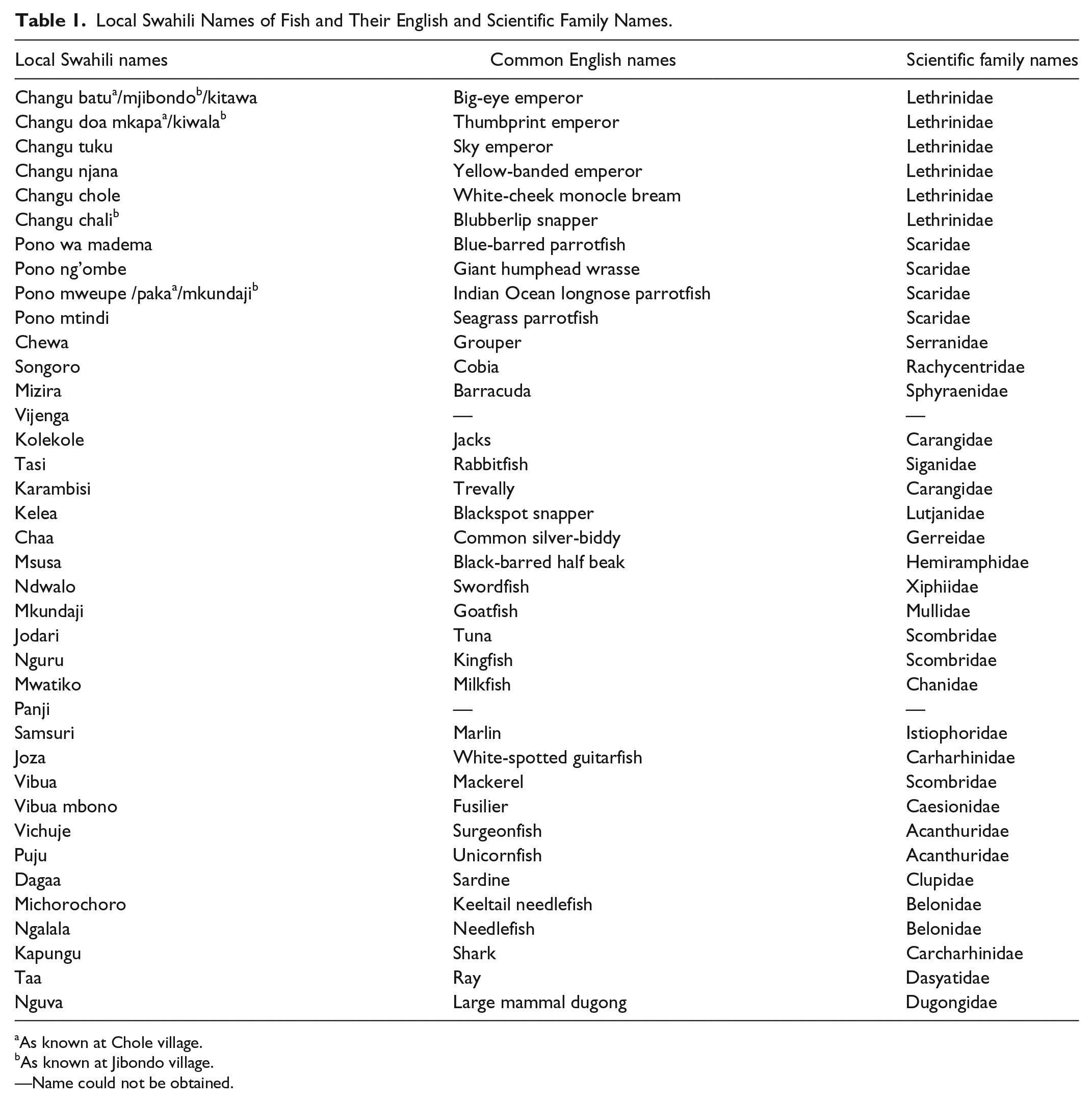
As known at Chole village.
As known at Jibondo village.
—Name could not be obtained.
To detect changes in fish and octopus catches from the 1980s to 2010/2011, fishers recalled past and present types of fish caught, average sizes of fish and octopus caught, and estimated catch quantities. They recalled ranges of good and bad catches in spring and neap tides, and during northeast and southeast monsoons. Weight estimates were provided mainly in local units such as the sado, a 10-L bucket, which is equivalent to around 25 medium-sized fish. Length estimations were based on parts of their hands, for example, wrist to middle finger tip is equivalent to 6 in., middle forearm to middle finger tip is 12 in., and the pima—the length between the ends of two middle fingers when arms are widely stretched sideways—is about 1.8 to 2 m. Local units were then converted to individual numbers or modern units to understand the nature of change. Changes in the types and sizes of fish consumed in households were provided as proxy indicators of changes in catch composition.
To describe changes in areas where they fished, retired and elder fishers recalled characteristics of fishing areas as far back as the 1940s. Fishers below the age of 50 years described current characteristics in comparison with those observed during the 1980s. Their major indicator for detecting changes was the existence of fish and octopus in their fishing areas. We use the term abundance to refer to this indicator. Other indicators were types and size of fish sighted, oceanographic conditions (including water depth, speed, warmth, and clarity), and benthic cover characteristics. Time spent in searching for fish and octopus before they actually fished was provided as a proxy indicator.
Toward the end of the fieldwork period, structured questionnaires with open-ended questions were administered to 103 heads of households, about 20% of the total recorded households in Chole (226) and Jibondo (364). This method was useful in obtaining additional insights, triangulating, validating, and obtaining simple quantitative indications of specific changes and their contributing factors that had emerged from the qualitative methods (Huntington, 2000; Tengö et al., 2014). Respondents were selected under stratified random sampling based on the three and six sub-villages in Chole and Jibondo, respectively, to investigate changes in types and sizes of fish consumed in households across the villages and wealth groups; and to find the extent of respondents’ relationship to the marine environment. Questions concerning proxy indicators were posed to all respondents, whereas questions concerning specific fishery information were posed to respondents who practice fishing as their primary livelihood activity.
To address possible biases and increase the reliability and validity of TEK data, 19 interviews were conducted with seasonal visiting fishers, fish traders, officials from catch collection companies, tourist hotels engaged in underwater tourism, the MIMP, Mafia district, and the World Wildlife Fund for Nature (Tanzania Office). The interviews were useful in triangulating fishers’ perceptions of trends on overall catch estimates, and their observations of changes in the marine environment. Continuous observation was conducted on catches, fishing gear, number of fishing days, as well as informal interviews and talks throughout the study period, all of which were useful in corroborating the TEK collected.
Qualitative data were analyzed manually by means of thematic analysis. Textual data were read repeatedly to glean a general understanding of the issues at hand. The data on types of changes observed were categorized into general thematic categories, based on research objectives. The data about why such changes occurred were also read repeatedly to identify emerging themes, which were then further reviewed to determine key themes and extract analytical meanings. These meanings were then related and used to develop and discuss major factors of change and the potential for improving CSK initiatives. Quantitative data from questionnaires were entered in Microsoft Office Excel before being summarized, coded, analyzed descriptively, and presented as percentages and frequency distribution tables.
Results
Fishers’ explanations of changes were non-linear and holistic in nature, and all aspects that caused changes in types, quantities, and sizes of fish caught, and in fishing areas, were described in depth. Overall, 36% of respondents were practicing fishing as their primary livelihood activity. Thus, they were able to provide further systematic explanations and quantitative indications of the changes observed. The explanations for changes fall into six major intertwined themes: environmental changes, conservation and management achievements and challenges, changes in fishing practices, marketing constraints, population dynamics, and disappearance of cultural and management traditions. In presenting the reasons for changes, the appropriate themes are interwoven into the following sections on reported changes.
Changes in Catch Composition, Quantity, and Size of Fish and Octopus
Catch composition
Fishers mentioned the key types of fish that are most common in current catches, types that are increasing and decreasing, and types that are seldom observed in current catches but have been caught in the past (Table 2). They linked the disappearance and decrease of some types of fish mainly to warmer water conditions. They linked the increase mainly to increasing fishing depths, as explained further in the following sections. Catch composition also depends on the type of fishing gear used. The dominant types in Jibondo are pull nets, shark nets, and basket traps, whereas hand lines, basket traps, set nets, and fence traps are common in Chole.
Estimates of Changes in Fish Catch Composition, Quantities, and Individual Fish Size Over Time.

The English name could not be obtained.
The changes in catch composition revealed through proxy indicators are also shown in Table 2. Respondents who consumed better types of fish pointed to an improved marine environment, changes in fishing gear, and increased ranges of fishing. Meanwhile, most respondents consumed inferior types of fish, including juvenile fish locally known at Chole as visolola, due to declining fish stocks in shallow waters (25%), constraints imposed by the MIMP (25%), the need for cash (19%), and the lack of fishers in a household (7%). About 16% did not provide reasons and 3% did not know the reasons for such changes. Detailed explanations for declining trends are rooted mainly in environmental changes, and will be provided in the “Changes in Fishing Areas” subsection. Other explanations are described below.
Catch quantities
The least common views during interviews and discussions were that catch quantities per individual fisher or vessel remain the same, or have increased. Data from questionnaires also showed this trend (Table 2). The dominant view in both villages was that individual catches are decreasing in quantity. For example, a pull-net fisher in Jibondo reported decreased fish catch quantities from 180 to 210 buckets in 2005 to 30 to 90 buckets in 2011. Further examples of catch decrease for specific fish types are presented in Table 2.
Overall catches per village were reported to have increased in Jibondo and decreased in Chole, as one elder fisher at Chole expressed,
. . . the first change is that there are no fish like we used to get . . . we used to get lots of fish, even a full vessel in one day. If you sit at that side and I sit this side you won’t see me for the fish was plenty . . . (Interview [I] No. 7, 2009)
Quantities for octopus catches show decreasing patterns for both individual and overall catches. At Jibondo, women reported a substantial decrease in their catches (Table 3) and were observed to return with about zero to six octopuses each. These fishers’ descriptions of the changes in fish and octopus catch quantities confirm traders’ observations in the two sites.
Changes in the Catch Quantities and Size of Individual Octopus Per Trip From Four Experienced Fishers.

Apart from declining abundance, which is further addressed later in this article, fishers explained declining catch quantities as a result of MIMP restrictions. Zoning plans and gear prescriptions have contributed to decreased catches, particularly in Chole. Rich fishing grounds have been permanently closed, which hampers traditional rotation among fishing grounds to allow fishery recovery. As a result, continuous fishing in the few and less-endowed remaining grounds has contributed to decreased catches. An elderly fisher at Chole explained their inability to fish in this way,
. . . they [the MIMP] have restricted all the [endowed] areas. In the beginning there was slavery; now slavery is back. Blessed be the former slavery for in the evening you would eat at your master’s place; in the current slavery you neither eat at your master’s, nor are you going to find food for yourself where it is found . . . (I No. 30, 2010)
Furthermore, it was argued that the prescribed fishing gear (3-in. set nets and shark nets) contributes to decreased catches because of their ineffectiveness. The set nets have to be operated in shallow areas where there are no fish; some fish species, like the white-cheek monocle bream and black-barred half beak are too small in their natural size to be caught using 3-in. nets; and shark-net material and odor tend to spoil fish catches. Thus, in Jibondo, pull nets dominate, operated in deep waters by means of 11 motorized pull-net fishing boats. Each boat has a pull-net of about 15 to 30 joined pieces of net operated by about 30 fishers, whereas in the past, three sail boats, each containing one to 10 joined pieces of fishing net were operated in shallow waters by about five fishermen.
The dominance of pull nets has contributed to increasing overall fish catches at Jibondo; this is because fishers perform underwater searching to find a large enough school of fish before setting the net, to avoid small catches. However, the large numbers of fishers in each boat have contributed to decreasing catches per individual fishers. Furthermore, pull nets are confiscated by the MIMP, and hence, some pull-net fishers tend to shift to octopus fishing for a while.
The increasing overall fish catches and decreasing octopus catches are further related to marketing constraints and population dynamics. There is an increasing demand for fish and octopus because traders and factory agents, particularly in Jibondo, provide a continuous ready market for low prices for fishers. Thus, fishers need to fish more, just to meet their basic necessities. The market also contributes to the dominance of pull-net fishing, for it guarantees quick and large catch quantities per trip. However, the low income per individual crew member has resulted in the need to spend more time fishing. Because the fish market is a quick source of income, it has contributed to lower crop production at Jibondo, which, in turn, has increased income needs. Prior to the 1970s, villagers produced their own food, and rainy seasons and neap tide days were allocated to farming. Since then, more people 1 have become dependent on fisheries, which has contributed to increased overall catch.
Furthermore, the population increase has contributed to increased numbers of fishers in Jibondo competing for the remaining fishing grounds. Traditionally, fishing in Mafia was practiced only by villagers in Jibondo and Bwejuu, who rotated fishing grounds and camped at various areas. However, villagers from other parts of Mafia have since begun fishing and there are now permanent settlements on previously camped areas.
The population at Chole has also increased, but this was not considered to be a direct factor in the decrease in fish catches. Participants attributed the decrease mainly to the low number of fishers, following out-migration, and the abandonment of fishing activities by most fishers as a result of MIMP restrictions. Six fishers migrated to Kilindoni between 2009 and 2010. Some remaining fishers rent out all their boat engines and four boats to distant areas; there remain three net-fishing non-motorized boats (each operated by about six fishers), three sail boats, and 13 canoes. Alternatively, they fish for small fish on foot. Thus, most fish traders and agents have left Chole, and the remaining ones often obtain only small catch quantities that are mostly sold locally.
The dwindling fishing activities in Chole were confirmed by respondents, as the percentage of fishers engaged in fishing as a secondary activity is higher (32%) than those for whom fishing is a primary activity (22%). The decrease was also linked to the disappearance of cultural traditions, including TEK of the marine environment among youth fishers. Because most knowledgeable fishers have now abandoned fishing, youth fishers would go fishing at certain fishing grounds because they previously saw or even fished with elder fishers, not because they knew what type of fish could be caught where, on which lunar day, or at what specific time. The previously mentioned explanatory factors for the decrease in individual catch quantities were also reported by 78% (n = 29) of respondent fishers, who reported decreased catches as shown in Table 4.
Multiple Responses to the Question “Why Do You Experience a Decrease in Catch Quantities?”

Size of fish and octopus caught
Current catches generally consist of smaller sized fish than in previous years (Tables 2 and 3). Large-sized fish occur in catches only occasionally. However, migrant fishers from Pemba, whom I interviewed, visit Jibondo seasonally and conduct fishing further offshore; they often catch large fish such as tuna, swordfish, kingfish, marlin, sharks, and panji. The proxy indicator for decreasing size of fish revealed that the majority of people consume mainly small fish today, in contrast with the 1990s when they consumed large fish.
In the octopus fishery, large octopuses that reached about 15 kg in the past are no longer found (Table 3), as also evidenced by an experienced octopus gleaner in Chole:
. . . mmmh! Now it is very rare (to have large octopus), they are totally finished. I tell you octopus mantle was like this [showing her head] and then its arms were like this [showing her arm]. But now there is no such octopus, only very small ones . . . (I No. 21, 2010)
There was also consensus among traders and officials from catch collection companies and the MIMP that the sizes of fish and octopus collected have decreased.
Changes in Fishing Areas
Oceanic conditions
A decrease in sea water depths was one of the most prominent changes that fishers observed in the fishing areas. This was attributed to reef growth and the rise of the seabed. 2 Fishers stressed that most intertidal pools have filled up with sediment and that areas which never dried up during spring tide are now doing so, including some parts of Mto Mkuu and Makutani which are now easily accessible on foot. The water depth at Mange (Majambani) was reported to have reduced from 18 m in 2005 to 16 m in 2011; and at Mchanga Nyuma, areas that used to have water up to chest height (about 1.4 m) were only knee deep (about 0.5 m) in 2011.
A more vivid example of decreasing water levels around Jibondo was provided with reference to the Mtowebwe reef (Figure 2). One elderly interviewee explained that

View of Mtowebwe reef from Jibondo Island.
. . . the sea floor has risen. At Rasini coast vessels were not grounded (pwelewa) because the water was full all the time and vessels could leave anytime . . . During spring tide Mtowebwe was seen as a cap and more vaguely seen during neap tide. Vessels with captains having little expertise could even knock it. But now Mtowebwe is seen as soon as you leave Utende. It is uncovered now . . . (Group Interview (GI) No. 8, 2010)
Furthermore, fishers observed increased speed of ocean currents, which hampers the setting of passive fishing gear such as shark nets. They added that increasingly rough waves are now causing higher turbidity than five decades ago. Meanwhile, the effects of the 1998 El Niño, prolonged dry seasons, and increased air temperatures are causing warmer conditions in shallow waters. These changes make conditions unfavorable for marine life and fishers, as expressed by an elderly fisher at Chole:
. . . now the environment is ruined, the ocean has become murky and rough that when you dive you don’t see, which is different from the past when it was clear . . . this is just because of changes in air conditions because when changes happen very far from here it also changes conditions here. In other days when you pass by, you find fish are just dead. They are harmed when they find such air conditions . . . (I No. 16, 2010)
Abundance of fish and octopus
The heavy decrease in fish abundance within the shallow inshore areas is another prominent change that was mentioned during interviews. Fishers linked this to three main factors: rising sea temperatures and resultant fish redistribution, uncontrolled industrial scale fisheries, and declining traditional practices.
Rising sea temperatures
Fishers explained that increasing warmth is causing large fish like groupers to move into deep cool waters and sea channels. Large mammal dugongs and giant humphead wrasse are no longer sighted in their fishing areas. They also observed a substantial decrease in seagrass parrotfish populations due to their low survival rates in warm shallow waters where they usually lay their eggs. Other relatively small fish, juvenile fish, and sardines are still observed within shallow waters around Chole and Jibondo.
However, fishers have observed relatively large fish in shallow areas during good rainfall seasons which are coupled with decreased warmth. They also observed large fish and increased fish abundance in the areas enclosed by the MIMP; however, they argued that such areas had high abundance even before the establishment of the MIMP, and are relatively deeper. They are also closer to, and have openings to the open sea, which allows the entrance of colder water from the deep sea during the processes of tidal ebb and flow. Hence, such areas remain cooler than others. Officials in the tourist hotels also reported increased abundance and size of fish in the enclosed areas where they frequently observe schools of parrots, emperors, groupers, and mixed types and sizes of fish, including rays, cobia, barracuda, and the giant humphead wrasse ranging from 0.7 to 1.8 m.
Fish movements into deep waters thus contribute to changes in fishing practices, depth, and time at Jibondo. In the past, fishers successfully fished with set nets to a depth of about 8 m. Currently, they use large pull nets (about 360-560 m in length and 14-40 m wide/deep) in waters that are 20 to 30 m deep. Furthermore, instead of operating gill nets at 12 m and catching fish on the same day, they now need to fish to a depth of between 120 and 200 m, without a guarantee of obtaining catch on the same day. The majority of fisher respondents (65%) also reported spending increased time fishing. About 16% still spend the same amount of time fishing, 11% use less time, and 8% did not provide their perceptions. Moreover, octopus fishers now need to search for octopus for long hours, whereas in the past, octopus were plentiful and easily seen.
Uncontrolled trawling, long-lining, and purse-seining by large-scale industrial fishers
Fishers argued that the MIMP does not control trawling, long-lining, and purse-seining practices by large-scale industrial fishers within Tanzania’s exclusive economic zone and territorial waters. These fishers extract large quantities of fish, including non-targeted fish, and cause unsettled ocean waters and seabed disturbance, thereby decreasing fish abundance and inflow to shallow waters. Although pull-net fishing is also thought to decrease abundance, major concerns focus on large-scale industrial fishing vessels, as one fisher explained,
. . . currently, the government allows us to use 2 inch mesh nets, but the same net becomes illegal when it is operated as a pull net. At the same time, about 10 foreign ships fish offshore using 0.25 to 1.5 inch nets pulled by machines. Now their type of fishing, when they fish with one ship for one day, it is equal to the whole of Jibondo fishing for six months . . . (GI No. 10, 2011)
Thus, fishers feel unfairly treated because there is maximum control of their small-scale practices, yet minimum control of large-scale industrial fishing. They further argued that the lack of control of practices by investor in processing factory has contributed largely to the decline in octopus abundance. Although the Hellas Company, a previous factory in Mafia, allowed octopus recovery by having 3-month closures each year, the TANPESCA factory operates throughout the year, and offers low prices. Because fishers need to fish continuously to obtain money for survival, the combined effects have eventually contributed to a decline in octopus numbers.
Declining traditional practices
Because fishers feel unfairly treated, they have lost morale in attempting to reduce time spent fishing, curtailing pull-net fishing, and maintaining cultural traditions in environmental management; consequently, this has contributed to decreased abundance and continuous habitat disturbance. Traditionally, Jibondo fishers had about 15 fishing days per month because tidal patterns determined fishing practices. Elders fished during spring tide days (from the 10th to17th day of a month and 25th to1st day of the next month) and used neap tide days (from the 2nd to 9th and 18th to 24th day of a month) for mending nets and farming. They used to fish for 8 months a year, leaving the rainy season (March to June) for farming. Observations reveal that today, pull-net fishers spend about 25 days per month fishing, whereas octopus divers reported that they fish almost throughout the year, regardless of tides and rainy seasons.
Traditionally, fishers would stop fishing whenever there were community events such as burials, initiations, and wedding ceremonies, and on Fridays (prayer day). Presently, some fishers continue fishing on such days, with impunity. Furthermore, octopus fishing through gleaning was traditionally a women’s activity practiced in intertidal areas; now, men have begun diving for octopus in deep waters to access factory markets and avoid the Park’s fishing gear restrictions, thereby contributing to the decline in octopus numbers. Women traditionally fished on foot in nearby areas from July to September during spring tides, and did not fish during pregnancy and maternity. However, they are now transported in large groups 3 to distant areas by factory agents, and fish for 2 or 3 days in each spring tide throughout the year, because after those days, the chances of returning empty-handed would be high. They now continue to fish until the late stages of pregnancy, and return to fishing just a few weeks after delivery. This reduced adherence to cultural traditions is perceived as being directly linked to decreased abundance of fish and octopus; the people believe that such practices have awakened the wrath of supernatural powers that have now inflicted human suffering through decreased fish abundance.
Benthic cover
Fishers observed increasing coral cover in most areas because corals are now recovering from earlier dynamite fishing. Breakage of branched and small corals, and decreased coral coverage were observed in some fishing areas. Fishers also reported a decrease in seaweed and seagrass coverage in a few areas (Table 5).
Example of Fishers’ Observations on Changes in Major Fishing Grounds.

Fishers further attributed damaged coral and benthic cover to the dominance of pull-net fishing practices which, as explained below, damage the coral and disturb benthic cover by
. . . dragging branched corals, because the net must be dragged on the seabed to fish blackspot snappers, rabbit fish and emperors. When these corals are trapped on nets, they are bitten to be broken so that they fall off, because sorting them takes up time under water . . . but at the same time fishers avoid these corals for their nets will be trapped . . . (I No. 19, 2010)
The changes in fishing areas were mentioned by 60% of fisher respondents (Table 6). Five per cent said they had not observed any changes, and the rest (35%) did not know whether there have been changes.
Multiple Responses to the Question “What Are the Observed Changes in the Areas That You Fish?”

Discussion
This study has made a case for retaining TEK originality and applying multiple evidence-based approaches to understanding marine ecological changes (Bohensky & Maru, 2011; Tengö et al., 2014). We have related results of the study to the available TEK and CSK 4 literature, to build part of an enriched picture of the reported changes and identify new knowledge. For simplicity, we have grouped together results that align with CSK, and identified results that require CSK attention because they contradict CSK; we then present new knowledge gained from TEK. Reflections from applying the approach are then provided to affirm its potential for improving marine conservation.
TEK That Aligns With CSK
Fishers’ accounts of current catch composition, increasing overall catch quantities, decreasing sizes of individual fish and octopus caught, trends in fish and octopus abundance, and the overall status of coral reefs are closely aligned with CSK. For example, results on types of fish most frequently caught are similar to those reported in CSK of the same area by Machano (2005). His study also aligns well with fishers’ observations of increased fusiliers in current catches. Such similarities between the two knowledge systems suggest a common understanding of catch composition, and hence enhance TEK reliability. Thus, the results on types of fish that are no longer common, or are either decreasing or increasing in current catches remain applicable, and can indicate further ecological changes in marine food webs, and/or changes in individual species populations. These results require further CSK vindication to complete the enriched picture in understanding trends in catch composition.
The results on increasing overall catch quantities in Jibondo align well with CSK documentation on increasing trends (Machano, 2005; URT, 2011a). However, this might not suggest an increase in fish abundance per se, but rather, it may reflect changes in fishing gear and practices, increased number of fishers, attempts to fish in deeper waters, and continuous catch collections by traders. A wide range between minimum and maximum catch quantities might reflect increased uncertainty in recent times in obtaining catches following increased protectionism (Benjaminsen & Bryceson, 2012) and difficulties in fishing in deeper waters. This observation aligns well with Machano’s (2005) research in the same area finding that 7% of fishing trips resulted in no catches at all. Results on decreasing size of individual fish and octopus caught also align well with both TEK and CSK (Gaspare, Bryceson, & Mgaya, 2015; Kincaid, Rose, & Mahudi, 2013; Machano, 2005). Machano (2005), for example, reported that the majority of fish caught weigh significantly less than 1.2 kg, and 73% of octopus weigh less than 1.5 kg.
Concerning the status of fishing grounds, results on both fish abundance and coral cover variables resonate well with those of CSK. Fishers’ observations of decreasing abundance in inshore areas align well with findings reported in CSK, for example, by Kamukuru, Mgaya, and Öhman (2004). Such decreasing trends have also been reported elsewhere by Masalu, Shalli, and Kitula (2010); and by Blythe, Murray, and Flaherty (2013). Observations of increasing fish abundance in enclosed areas were also vivid among hoteliers and in CSK reports such as Machano (2003); the URT (2011a); Baker (2013); Hemsworth, Jensen, and Gill (2015); and Lewis, Margeriso, Sobkowiak, and Fanning (2011).
Similarly, observations and interpretations of both improved and damaged coral cover are consistent with those from CSK. For example, observations of coral recovery after the effects of dynamite fishing and the 1998 El Niño align well with the documented increase in coral cover from 14% (Garpe & Öhman, 2003) to 52% (Hemsworth et al., 2015). Furthermore, observations of slow recovery of damaged coral are in accord with those of Roberts (2014) that reported dead coral cover of up to 63%. This may affirm the argument that coral reef recovery in protected areas tends to be slower than that in fished areas, partly due to higher initial coral cover (Graham, Nash, & Kool, 2011). Nonetheless, CSK concludes that marine ecosystems within the MIMP are healthy (Lewis et al., 2011; URT, 2011a).
TEK That Contradicts CSK
TEK results showing decreasing catches per fisher and overall catches in Chole reveal contradictions with CSK. Although results reflecting decreasing catches per fisher in both sites is consistent with other TEK within the MIMP and elsewhere (Blythe et al., 2013; Gaspare et al., 2015; Kincaid et al., 2013; Masalu et al., 2010), they contradict CSK which show increasing trends (Machano, 2005). A similar inconsistency is reported in the Mnazi Bay Marine Park, in southern Tanzania, where Machumu and Yakupitiyage (2013) reported increasing catch trends, whereas Kamat (2014) reported decreasing trends. Such inconsistency may reflect variations between qualitative and quantitative methodological approaches in understanding TEK of ecosystems (Mackinson & Nøttestad, 1998). It may also further reflect the importance of multiple evidences, and the need for mutual engagement of TEK and CSK holders in processing the enriched picture about the changing trends in individual catches (Tengö et al., 2014).
However, although decreasing individual catches was a major concern among fishers, this features less in CSK. Furthermore, decreasing overall catches in Chole also contradict CSK (Machano, 2005). This affirms the important need to consider contextual variations, even at local scale (Child & Barnes, 2010), and might indicate reliance on overall catch data in explaining ecological conditions within the MIMP (URT, 2011a). Nonetheless, increased overall catches have shown no substantial positive impact to individual fishers in terms of meeting their livelihood needs. The lack of attention to individual catches and local contextual variations may undermine the ability of MIMP officials in the long run to notice and anticipate ecological changes that may result from efforts by individual fishers to deal with decreasing individual catches.
Our results illuminate some such efforts by local fishers. These include an increase in free-diving fishing practices, increased numbers of fishing days, and increased pressure on the octopus fishery. In 1994, for example, CSK reported that fishers used 12 fishing days per month and that octopus fishers returned with up to 30 octopuses (Hooper, 1996). This is quite different from our results which show that fishers use 25 fishing days per month. Thus, although Darwall (1996) concluded that pull-net fishing in Mafia was within sustainable levels of exploitation, and Guard (2003) considered octopus fishery in Jibondo to be sustainable, joint research between TEK and CSK researchers is required to re-examine the current situation.
TEK That Presents New Knowledge and Novel Insights
Although long-term fishers’ observations of falling sea levels, reef growth, and rising sea temperatures present knew knowledge as illustrated below, their explanations of the causes of the changes (presented in the “Results” section) yield new insights which require attention from CSK. Such emerging TEK has not been communicated to CSK practitioners due to bureaucracy, increasingly hostile relationships between fishers and MIMP officials, and lack of effective community participation in MIMP undertakings (Benjaminsen & Bryceson, 2012; Mwaipopo, 2008; Walley, 2002, 2004).
The falling sea level and reef growth
The observation that the sea level is falling due to reef growth within the MIMP does not feature in CSK. However, the same observations by fishers in other parts of Tanzania are consistent with CSK. In Zanzibar, for example, fishers noted that some fishing grounds are currently reachable on foot, even by children (Mustelin et al., 2010). This concurs with some CSK reporting of a substantial decrease in sea level in parts of the western Indian Ocean, including southern Tanzania and Zanzibar, following changes in subsurface winds and tectonic uplift (Benjaminsen, Bryceson, & Maganga, 2008; Han et al., 2010; Han et al., 2014; Reuter, Piller, Harzhauser, Berning, & Kroh, 2010). According to Kebede and Nicholls (2011), Tanzania’s sea level is fairly stable or falling. This is consistent with previous and current findings in other parts of the east African coast that reveal stable or falling sea levels compared to 50 to 30,000 years ago, partly due to long-term reef growth (Mönner, 2013; Salm, 1983). Although the results of this study show fishers’ explanations of falling sea level are based on reef growth, much remains to be established about CSK of the causes and extent of falling sea levels and reef growth to establish multiple pieces of evidence.
Nonetheless, both TEK and CSK of falling sea levels challenge the mainstream narrative of climate change studies, which report sea-level rise in the Indian Ocean (Inter-governmental Panel on Climate Change, 2007; Stammer, Cazenave, Ponte, & Tamisiea, 2013; Yanda, 2013). Such similarities and differences in observing and interpreting sea-level changes confirm that matching and/or mismatching of findings within and between TEK and CSK are inevitable. This is so because TEK is at small scale, and is based on long-term observations and conceptual interpretation by the people inhabiting a particular geographical setting; whereas CSK can cover large geographical scales, and is based on positivist principles of precision and objective collection, and quantification and interpretation of hard data (Berkes et al., 2001; Mackinson & Nøttestad, 1998; Tesfamichael et al., 2014). Nevertheless, each knowledge system has significant potential for contributing to the enriched picture of understanding changes at a particular scale (Carr & Heyman, 2012; Daw, 2008; Haggan et al., 2007).
Rising sea temperatures
Results indicating that sea temperatures are rising also do not feature well in CSK. Bryceson et al. (2006) and URT (2011a), for example, showed that sea temperatures within the MIMP have large seasonal variations, but are fairly stable over periods of many years. Other studies have observed seasonal variations of surface temperatures (Mahongo & Shaghude, 2014) and extreme temperature shifts during the 1998 El Niño, and reported impacts on coral reefs (Garpe & Öhman, 2003; Hemsworth et al., 2015). Thus, CSK of long-term changes in sea temperatures and the impact on fish distribution is required to harmonize and establish multiple evidences, which are crucial for processing the enriched picture. The CSK of temperature trends is crucial, particularly because there is CSK evidence of weak correlation between the percentage of coral cover and fish abundance within the MIMP (Hemsworth et al., 2015). Thus, TEK of rising temperatures and the implications for fish abundance and distribution can be valid. Such TEK also accords well with TEK from Mtwara, on the southernmost coast of Tanzania, where fishers associated increased warmer conditions with fish migration to offshore areas (Bunce, Rosendo, & Brown, 2010). It further accords well with CSK from elsewhere that shows that changes in sea temperatures caused shifts in marine fish abundance and distribution (Brander, 2007; Perry, Low, Ellis, & Reynolds, 2005; Soto, 2002).
Causes of marine ecological changes
Fishers’ interpretations of the causes of marine ecological changes emphasize the influence of non-linear, multiple, interrelated social-ecological factors. These interpretations indicate fishers’ ability to comprehend both proximate causes and underlying forces underpinning the reported changes and fishers’ actions (Lambin et al., 2001). Fishers’ interpretations are also in accordance with findings that emphasize the importance of TEK-based social-ecological factors in understanding ecological changes, providing critical direction for research, and informing management challenges (Blythe et al., 2013; Evans et al., 2011). However, most CSK within the MIMP is dominated by proximate causes, with a focus on fishers’ actions as the leading cause of changes. A case in point is the persistence of the narratives of overfishing, use of destructive fishing gear, and resultant damaged habitats as major causes of decreases in fish and octopus abundance and catches (Kamukuru et al., 2004; Mahingika, 2007; URT, 2011a).
The argument that there is overfishing in Mafia waters, for example, is problematic because it overlooks the underlying factors, thus narrowing the potential for improving conservation. It is further problematic because suspicions about overfishing are not always accurate (Haggan et al., 2007). This is especially vivid when overfishing is said to occur when overall catches begin to decrease (Kolding & Zwieten, 2011), yet the overall catch numbers within the MIMP are increasing (URT, 2011a). Results in this study show that increased catch numbers relate to the breakdown of traditional management practices, including greater fishing depths, number of fishers and fishing days per month, use of active gear, and diving practices, compared with previous observations (Guard, 2003; Hooper, 1996). Nonetheless, the changing traditions and the resultant increased catches indicate not only fishers’ response to economic opportunity (Lambin et al., 2001) but also the effect of low prices for their catches, inefficacy of the MIMP’s prescribed fishing gear, falling sea levels, and rising sea temperatures (Bryceson et al., 2006; Moshy, Bryceson, & Mwaipopo, 2015).
One may argue that fishers’ attribution of reduced abundance to sea temperatures and depths might suggest what Daw (2008) called “cognitive dissonance,” where fishers tend to explain resource decline by pinpointing environmental factors rather than their own actions. However, environmental-related factors also dominated at Chole, where fishing activities are dwindling. Thus, fishers do not deny the effects of their fishing practices on abundance and coral conditions, but they are against the narrow and simplified interpretation of ecological changes that discount the underlying factors (Lambin et al., 2001). Furthermore, some fishers used environmental factors to provide additional interpretations of increasing abundance in enclosed areas, as water movement from the open sea cools the water in such areas, automatically supporting fish existence. This interpretation differs from the dominant interpretation that the MIMP’s achievement in halting dynamite fishing is the reason for increased abundance.
Nonetheless, results suggest that the MIMP is a key underlying institutional factor that contributes to decreasing catches and abundance in fished areas. For example, new insights into the decline of TEK transferring across generations in Chole, less overall adherence to former TEK-based conservation strategies, and increased pressure on the octopus fishery at Jibondo, all point to the downside of MIMP undertakings. Fishers linked the decline of transferring TEK to the dwindling fishing activities following MIMP restrictions. Although there were 70 fishers in Chole in 1988 (Howell et al., 1989), district data show that the number of fishers dropped to 27 in 2009 and only 12 in 2010. This is also reflected in the decrease in the number and types of fishing gear in Chole bay by 38%, with users from Chole accounting for only 10% of all users (Machano, 2005).
Because learning and transferring of TEK depend on the continuous practice of livelihood activities in building up-to-date knowledge (Berkes et al., 2000; Carr & Heyman, 2012; Haggan et al., 2007), it would appear unlikely that future generations will possess TEK about the sea as their predecessors. Thus, by contributing to diminishing TEK, the MIMP has also minimized its own chances of nurturing knowledge diversity (Berkes et al., 2003) to improve conservation outcomes in the future.
Although establishing and transmitting TEK from generation to generation is a lifetime process (Berkes, 1993, 2008), the recent gradual reduction of TEK among the youth in Chole had been witnessed only 16 years after the inception of the MIMP as a relatively rigid management body. Meanwhile, although pull-net fishers in Jibondo are the most knowledgeable about current oceanic conditions, they have a poor relationship with MIMP officials. It has been found that hostile relationships between TEK holders and managers often hamper knowledge acquisition (Drew, 2005). Hence, without building mutual respect to improve such relationships, managers will still fail to acquire TEK and fail to realize its importance (Tengö et al., 2014).
The MIMP has further contributed to decreasing adherence to TEK conservation strategies among fishers, by failing to control companies that continuously buy fish and octopus catches at low prices, and large-scale industrial fishing fleets observed in Mafia waters. The fleets were reported as causes of ecological changes, but they are not as tightly controlled as local fishers who fish for their livelihoods. A recent ministerial report (URT, 2014) has also reflected such concerns. The report shows, for example, that in the fiscal year 2013/2014, a total of 800 man-days of patrols were conducted in Tanzania’s marine parks and reserves, whereas the Tanzania Deep Sea Fishing Authority conducted only 8 man-days of patrols in the deep sea off Tanzania’s coast (URT, 2014). This reflects fishers’ concerns that large-scale industrial fishing fleets invade inshore waters, and scientists’ observations that they operate in an unregulated manner (Tamatamah & Bryceson, 2009). Deep sea fishing in Tanzania has increased from 12 fleets in 2002 (Jiddawi & Öhman, 2002) to 72 fleets in 2011(URT, 2011b). However, current efforts are more focused on controlling small-scale fishing than large-scale industrial fishing, and in promoting the latter rather than controlling it. These tendencies have reduced fishers’ willingness to adhere to CSK-based conservation strategies.
Furthermore, the results indicate that the MIMP’s zoning scheme contributes to both the breakdown of traditional fishing rotation practices, and increase in fishing pressure in fished zones. As a result, narratives about the reportedly human-induced coral damage, decreasing individual catches, and octopus decline are likely to persist. Furthermore, octopus decline is often linked to declining fish catches and octopus marketing opportunities (URT, 2011a) rather than the low prices offered, or MIMP actions such as fishing restrictions, violent patrols, and gear confiscations (Benjaminsen & Bryceson, 2012). These circumstances press more people into octopus fishing. This insight into octopus decline within the MIMP has been overlooked, but has the potential for improving the management of octopus fisheries.
Marine protected areas are often incapable of managing larger seascapes (Berkes et al., 2006), do not always succeed in reducing user pressure (Allen, Mourato, & Gulland, 2011), and require marketing operations to contribute toward achieving conservation goals (Jones, 2014). Addressing these issues will require the MIMP to strengthen collaboration with institutions which deal with the licensing and control of foreign investments, trade, and research. This will create new spaces for dealing with the key underlying environmental, economic, and institutional factors that are driving the proximate causes of changes within the MIMP, minimizing their undesired outcomes, and eventually building a sense of equitable treatment and respect, thus restoring trust and local support for conservation.
Some Reflections on the Multiple Evidence-Based Approach
Unlike the previous dominance of CSK within the MIMP (Walley, 2002), the process of exploring ecological changes through TEK has enabled its owners to freely share their knowledge of the sea. The process has produced spaces for enhancing the equal treatment of TEK and CSK by promoting effective participation of TEK holders in knowledge production, before it was considered in parallel with existing CSK (Tengö et al., 2014). However, some TEK owners have been skeptical about sharing their TEK, probably because they feared that it might backfire on them; and in the past, their TEK was undervalued (Walley, 2002), which hampered its meaningful integration into CSK (Bohensky & Maru, 2011; Carr & Heyman, 2012; Cornwall, 2002; Nadasdy, 1999).
The TEK documented in this study reflects how fishers picture and interpret marine ecological changes in their area, and how such picturing is related to CSK. These findings indicate the need for mutual engagement of TEK and CSK holders in processing an enriched picture of a particular phenomenon; and may imply that studies that simultaneously produce TEK and CSK would be likely to succeed. This is because each knowledge system must first have equal chances of “speaking for itself,” on its own terms, and within its own context (Tengö et al., 2014). This entails removing CSK standards from the initial phase of exploring TEK, and using them in the second and third phases (i.e., when producing CSK and in processing the resulting enriched picture of a particular phenomenon). The involvement of both social and natural scientists who respect TEK remains critical to remove CSK interference from TEK exploration. Such researchers are most likely to present TEK as it appears and can empower TEK owners to participate in processing the enriched picture more effectively. Such an approach could also resolve the failure to integrate TEK in CSK due to social scientists documenting TEK which lacks conventional science standards or overlooks important biological realities (Haggan et al., 2007).
Meanwhile, TEK that contributes new knowledge and insights can facilitate adaptive management for enhancing social-ecological resilience of an area. If practitioners can learn from and react adaptively to sea level and temperature trends and the multiple factors causing marine environmental changes, they will eventually create space to enhance resilience by making practical data-based decisions that consider social-ecological and conservation concerns. In fact, by focusing mainly on local resource use and its effects on the marine ecosystem (URT, 2011a), the MIMP has been overlooking the underlying factors contributing to changes (Lambin et al., 2001). TEK can present new insights into the contexts of marine ecological changes and contribute new priorities in CSK research and monitoring. This is especially so when research within the MIMP “has been sporadic and often without particular research priority” (URT, 2011a, p. 27); furthermore, TEK is important in identifying areas of special concern (Drew, 2005; Haggan et al., 2007).
Such insights also form an important feedback mechanism enabling MIMP officials to detect changes, which may, in turn, increase their potential to learn, and build their ability to anticipate the outcomes of such changes and future changes. However, it is practically worthless to notice such changes without making significant efforts to improve management strategies and create space for designing mechanisms to deal with observed changes in adaptive ways. The best potential way to deal with such changes is to adopt a multiple evidence-based approach (Tengö et al., 2014). This implies producing enriched knowledge from equal treatment, empathy, and mutual respect for TEK and CSK values that are embedded in each knowledge system, and confirms the need to diversify knowledge systems as a strategy for building resilience (Berkes et al., 2003; Tengö et al., 2014). It is necessary to combine efforts within relevant institutions to build capacity for dealing with the underlying factors of marine ecological changes (Jones et al., 2013). Such efforts can, in turn, foster rapid and flexible data-based decision making (Carr & Heyman, 2012; Evans et al., 2011; Ruiz-Mallén & Corbera, 2013), and restore respect, trust, equality, and good relationships between fishers and conservationists as a way of renewing local support for conservation. Addressing practical issues, which hamper the realization of social, ecological, and conservation needs, offers the potential for improving resource management and enhancing social-ecological resilience.
Conclusion
Seeing through the perspective of fishers’ knowledge has contributed new insights to understanding marine ecological changes in the MIMP. Fishers provided contextual data to show that sea levels are falling in their area. They also illuminated that environmental factors, conservation outcomes, marketing constraints, population dynamics, and the disappearance of cultural traditions are among the underlying causes of marine ecological changes, besides overexploitation which is a dominant explanation in CSK. For example, the decline in fish abundance in shallow areas within the MIMP is due to decreased water depth and rising sea temperatures, increased fishing pressure after enclosing traditional fishing areas, declining rotational schemes, increasing population, and low prices paid for local catches.
A dominant CSK narrative perceives fishers as a cause of ecological changes and a threat to marine conservation. This study found that increasing efforts to control their actions without dealing with the underlying causes may impair conservation efficacy in marine protected areas, and may not necessarily be the best option for dealing with marine ecological changes. Genuine cross-scale collaborations between TEK and CSK holders can contribute feedback and learning to enhance adaptive management, a key resilience building strategy that can balance the concerns of fishers, conservationists, and researchers. Nonetheless, such collaboration will depend upon the willingness by CSK holders to prioritize multiple evidence-based researches, and upon political willingness to place equal emphasis on conforming to global conservation policies and meeting local social-ecological needs.
Footnotes
Acknowledgements
We are grateful to Chole and Jibondo fishing communities for sharing their valuable knowledge to us. We thank officials from the five tourist hotels, Mafia Island Marine Park, and Mafia District for their support throughout this study. We express our appreciations to Claude Mung’ong’o, Betsy Beymer-Farris, and Andrei Marin for their helpful comments on earlier drafts of this article. We also thank Norwegian Centre for International Cooperation in Education (SIU) under Norwegian Programme for Development, Research and Education (NUFU) for funding this study.
Declaration of Conflicting Interests
The author(s) declared no potential conflicts of interest with respect to the research, authorship, and/or publication of this article.
Funding
The author(s) disclosed receipt of the following financial support for the research and/or authorship of this article: This study was supported by Norwegian Centre for International Cooperation in Education (SIU) under Norwegian Programme for Development, Research and Education (NUFU).