



Abstract
Current research used comprehensive literature taken from 50 prominent research articles related to health journals, and the direct and indirect relationships of the retrieved independent attributes, such as food security, human lifestyle, social norms, eating habits, and food insecurity, were checked on the model’s dependent variable, health issues. Data was obtained from 1,125 respondents of the northern region of Punjab, India through a well-written questionnaire mirroring the extracted variables and their 28 supporting items on a 5-point Likert scale and demographics such as health perception, location, age, and qualification on a nominal scale. Robust estimation standards of PLS-SEM, such as discriminant validity through (Heterotrait-Monotrait Ratio), outer and inner collinearity to check common method bias, reliability, effect size, consistency, control variable effect, relationship of nonlinearity, R2, and finally, tool fitness standards aided in the study model’s final verification and analysis (t and p values). This research has focused on studying the various scenarios of people’s eating lifestyles based on their location and has attempted to determine under what conditions its influence on people’s health is greatest. Also, research novelty and practical contributions focus on businesses, consumers, and governments in developing and developed countries to alter their current strategies with a focus on prioritizing health issues, quality food items, and long-term sustainable strategies.
Plain language summary
Purpose Current research used comprehensive literature taken from 50 prominent health-related articles from prominent journals to frame a health model for youngsters, whereby the influence of independent constructs, such as food security, human lifestyle, social norms, eating habits, and food insecurity, was checked on the model’s dependent variable, health issues. Design/methodology/approach Robust estimation standards of PLS-SEM, such as discriminant validity through (Heterotrait-Monotrait Ratio), outer and inner collinearity to check common method bias, reliability, effect size, consistency, control variable effect, relationship of nonlinearity, R2, and finally, tool fitness standards aided in the study model’s final verification and analysis (t and p values). Findings The preceding data explicitly stated model sturdiness, with young consumer health concerns having a direct link with food insecurity (.686), food security (.075) and eating behavior (.178) and model attributes like human lifestyle (.257), social norms (.378), having a direct impact on eating behavior R2 (.341) along with an indirect or mediating influence on consumers’ health with a model final predicting the variance of R2 (.642). So it can be concluded that food insecurity should be addressed as a priority, followed by eating behavior, which is supported by features such as human lifestyle and social standards, and lastly, food security, in order to improve the living health circumstances of people across the world. Practical implications Given the fact that nearly 1 billion people are obese, which has resulted in several noncommunicable diseases affecting people’s liver, joints, hearts, reproductive systems, and kidneys, their predominance is anticipated to grow by the year 2025. As a result, businesses, consumers, and governments in developing and developed countries must alter their current strategies, focusing on prioritizing health issues for themselves as well as for their surroundings, and then idealizing factors in order to modify their working practices in order to minimize the hazardous effects of consumer health-related issues with quality food items and long-term sustainable strategies. Originality/value Previous researchers have tried to focus on individual attributes influencing consumer buying intent for food products, but current research tried to build a model using extensive literature extracted from 50 health-related articles from prominent journals and then analyzed the influence of the retrieved independent components, such as food security, human lifestyle, social norms, eating habits, and food insecurity, on the model’s dependent variable, health issues. Limitations India being is a diverse cultural country with a large population living in poverty, particularly in rural areas. Adopting developed-nation strategies will take time, so different approaches are required to understand their psychological mindsets and, eventually, improve their health conditions. Social Research highlights that food insecurity should be addressed as a priority, followed by eating behavior while emphasizing on human lifestyle and social standards to improve the living standards of youngsters with reflection of hedonic consumption for positive emotions, trust, and satisfaction.
Introduction
Obesity is now a global health concern, and its prevalence is increasing in all income groups, beginning with high, middle, and now low income groups in all developed and developing countries (da Silva et al., 2022; WHO, 2020). As per the WHO (2022), nearly 1 billion people across the world are obese, which has led to an array of non-communicable diseases affecting the liver, joints, heart, reproductive system, and kidneys of people, and their frequency will increase by 2025. Available food options nowadays, which are high in saturated fats, sugars, and salt, are commonly treated as unhealthy, and taking into consideration their intense consumption by people, there is a direct association with health issues and increased body weight gain with the passage of time (Pagliai et al., 2021; Zhu et al., 2022). In adolescence, when children begin to feel autonomous in their lifestyle decision-making and also imagine they are big enough to choose their own food from diverse available foods (Green et al., 2021), this even results in the intake of less nourishing snacks when they are grown up and are away from their home (Ryan et al., 2020). There has been substantial evidence that parental feeding habits during the upbringing of adults have a direct association with their future eating behaviors and controlled weight gain (Wang et al., 2022; Wooldridge et al., 2020). While exploring the food composition during breakfast even has a direct influence on body weight, and having a deep understanding of nourishment for food intake is essential to evaluating better health norms (Hassan et al., 2021). Moreover, past studies have tended to measure up traits across target respondents related to weight gain or loss, which no doubt is a valuable move to frame long-term strategies related to weight issues, whereas examining psychological mindset with eating habits, if considered, can contribute in a candid way to bodyweight management (Gatzemeier et al., 2022). Although previous studies have undoubtedly made a substantial contribution to understand the relationship between eating behavior and health issues, but a model framework is still required to identify eating behavior attributes and their directly or indirectly associated health issues.
Literature Work (Construct/Variable)
This section of research will thoroughly study the eating behavior attributes, that is, food security, human lifestyle, social norms, eating behavior and food insecurity and finally hypothesis will be framed on the pretext of the exhaustive studies on mentioned attributes.
Food Security ⊆ Heath Issues
The meaning of food security has evolved and changed over the last 50 years, whereas the four commonly cited boundaries of food security, such as utilization, access, stability, and availability, are undeniably important, and with the intervention of the other two pillars related to the environment and food, any nation’s policy will be shaped in a much better way (Clapp et al., 2021; Hudak et al., 2022). Also, maintaining food quality and safety is critical for both suppliers and end consumers, and the notion of non-destructive monitoring helps in maintaining food quality without causing damage, ultimately ensuring customer satisfaction (Gopalakrishnan et al., 2021). Even growing food at home can improve diet and nutrition by increasing access to nutritious foods such as vegetables and other complementary foods (Cauchi et al., 2021; Hassan et al., 2021), which can contribute to food security by increasing the likelihood of children and adults receiving iron-rich foods (Blakstad et al., 2022). It has been vividly demonstrated that constant communication and free voucher strategies can be adopted to reduce the risk of chronic malnutrition caused by moms who lack knowledge about child nutrition and a paucity of food resources (Han et al., 2021). Moreover, food stamping has a substantial influence on individual health since it eliminates the fear of adulteration, reduces physician visits, and ultimately reduces the government’s healthcare burden (East & Friedson, 2020). Meanwhile, Wei et al. (2021) also found that access to familial and legal rights gives household women a greater priority in making decisions, resulting in a large rise in their control over resource utilization and food choices, hence ensuing food security. The following hypothesis is proposed by the preceding research:
H1: It is worth emphasizing that food security is an essential factor in choosing healthy food options.
Human Lifestyle ⊆ Eating Behavior ⊆ Heath Issues
Obesity and its associated health problems have grown dramatically in recent decades as a result of prevalent lifestyle patterns influenced by a variety of psychological, epidemiological, economic, and medical factors (Blue et al., 2021). Olstad et al. (2022) even examined several socioeconomic characteristics, such as education and income, as well as psychological aspects that represent social status, among people living in countries with varying income levels and discovered that these factors have both direct and indirect effects on people’s health. It was interesting to discover that the food intake lifestyles of consumers are even directly linked to different generations of consumers living in Nordic countries, the United States, central Europe, and Southeast Asian countries, and the findings indicate that there are five generations in the current scenario with different food intake lifestyles (Arenas-Gaitán et al., 2021). Furthermore, in today’s environment of abundant availability of high-calorie meals, human memory instinctively prioritizes high-calorie item locations, resulting in unhealthy obesity implications in an individual’s eating behavior (de Vries et al., 2022; Salvatore et al., 2021). It was even evident that people over purchase food as a result of children’s pressure during supermarket visits, which often promotes impulse buying of advertised items, selective eating habits, and frequently changing tastes, resulting in over-preparation of non nutritious food and influencing health concerns (Chan et al., 2022; Kansal et al., 2022). Lee et al. (2022) and Nayyar (2022a) studied if individuals who spend less time on food preparation, household shopping for food, and more on social media, in comparison to those who do these activities on a regular basis, have a more healthy lifestyle. As a result of the previous research, the following hypotheses were developed:
H2a: It’s worth noting that human lifestyle appears to have a big impact on consumer eating patterns.
H2b: It is indeed important to mention that, while evaluating people’s day-to-day lifestyles, eating behavior had a justifying effect on their health.
Social Norms ⊆ Eating Behavior ⊆ Heath Issues
Nayyar (2022b) and Halkier and Holm (2021) deliberated that insight research is needed to understand the role of attributes, that is, socioeconomic inequalities, lifestyle, social media, food, and health, as they have direct influence on the eating habits of people. Abshire et al. (2021) even stated that if males and rurality are correctly examined, it can lead to a reduction in obesity since rural men are hesitant to seek adequate food measures, which leads to health difficulties such as obesity and its related chronic diseases. Furthermore, socio-demographic characteristics such as male geographic location, lower education level, lower physical activity, and smoking behaviors influence high sugar content beverage consumption, which has a significant influence on people’s health lifestyles (Nayyar, 2018; Phulkerd et al., 2022; Pomeranz & Harris, 2020; Tandon et al., 2021). Even Savelyev et al. (2022) established that education does have a beneficial long-term causal effect on the health of people and their eating lifestyles, and further, he emphasized that if parents are paid for discrepancies in their children’s endowments, it can lead to better health outcomes among the same children when they grow up in society. The following hypotheses were established as a consequence of the current research:
H3a: It’s also worth mentioning that social norms appear to have influenced consumer eating habits.
H3b: It is crucial to note that, when assessing social norms impacting consumer health, eating behavior also found to have a mediating effect.
Eating Behavior ⊆ Health-Related Issues
A recent study shows how lowering the price of fat or sugar-rich foods alters eating habits and leads to a 15% increase in diabetes and obesity-related problems (Gračner, 2021). According to Choi et al. (2020), high-sugar sweet beverage procurement may have a major influence if linked with nutritious assistance awareness initiatives addressing the risk of obesity and dental concerns due to high calorie intake among youngsters. Moreover, young individuals who eat high-calorie foods late at night can affect their digestive systems, which further can directly or indirectly affect the nervous system, resulting in sleepless nights for youngsters (Ucar et al., 2021). Even employees who work at night have a higher calorie intake of food or drinks on the same day, leading to poor eating habits (Hulsegge et al, 2020; Lin et al., 2020). As per Farbmacher et al. (2022), those with greater stress levels, complicated eating habits, and fewer sleeping hours are more likely to have negative health outcomes. Furthermore, healthy eating habits in early childhood ensure optimal growth, health, and logical development in children, and the same pattern continues as they enter adolescence (García-Muñoz et al., 2022). Food packaging design has a significant role in attracting parents’ and their children’s behavioral mindsets for product selection and final purchase, so it should be mandatory for authorities to consider children’s health and promote healthy eating habits by promoting nutritious products with food labels on their packaging (Ares et al., 2022; S. Gupta et al., 2021). Also, with the introduction of higher excise taxes in countries such as France and Hungary, people began to consume fewer sugar-rich foods, although this pattern of consumption did not last for a longer period of time (Kurz & König, 2021). The following hypotheses were derived as an outcome of the preceding research:
H4: It’s fascinating to learn that the eating habits of consumers reflect human lifestyles and social norms and also have a direct influence on consumer health.
Food Insecurity ⊆ Health Issues
Food insecurity has a direct negative impact on health by causing nutritional deficits or encouraging the use of low-cost excessively processed foods, which have been linked to an increased risk of obesity (Bertoldo et al., 2022). Even S. S. White (2020) stated that food insecurity is common among students who require nutritious food at an affordable price, but access to such food is limited. According to a study, children born in affluent environments have better health due to healthy eating habits than those born in low-income environments, which has a prolonged effect when the children of these environments are grown up (De Cao et al., 2022). Also, mothers with a lack of information about child nutrition and a scarcity of food resources lead to a deprived diet among children in underdeveloped countries, elevating the risk of chronic malnutrition and poor healthy lifestyle (Han et al., 2021). Pace et al. (2022) highlighted a study where direct cash transfer programs among people in developing nations have benefited people by increasing liquidity for the desired beneficiaries, leading to increased food affordability and better food intake. The previous literature aided in the formulation of the following hypothesis:
H5: Food insecurity is found to have a direct influence on consumers’ health
Gap of the Study
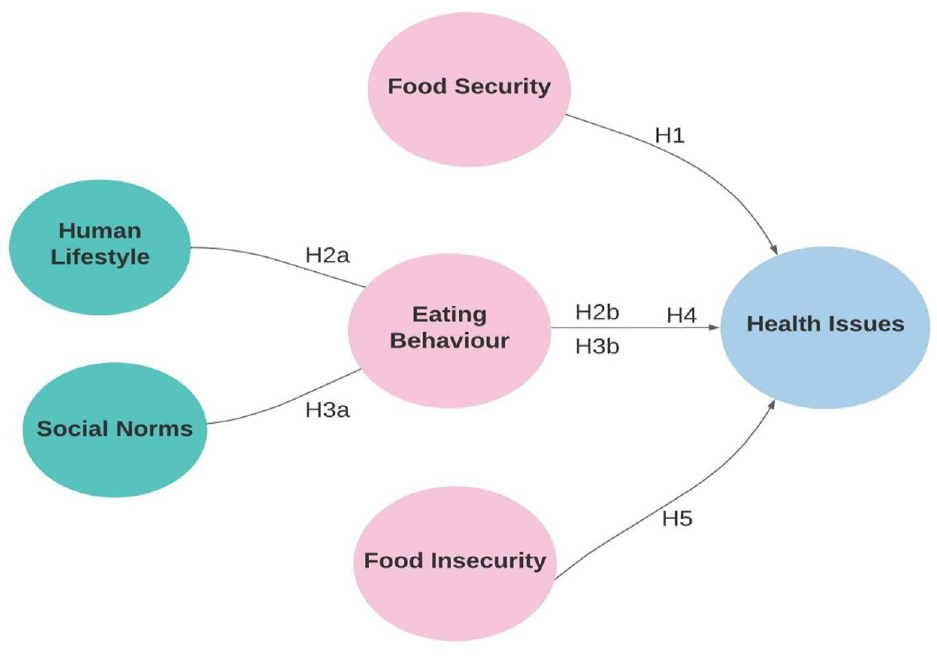
The model was built using systematic literature extracted from 50 prominent research articles related to health journals, and the direct and indirect relationships of the retrieved independent attributes, such as food security, human lifestyle, social norms, eating habits, and food insecurity, will be checked on the model’s dependent variable, health issues (Figure 1 and Table 1). Given the fact that nearly 1 billion people are obese due to their eating lifestyle, which has resulted in several non-communicable diseases affecting people’s livers, joints, hearts, reproductive systems, and kidneys, their prevalence is anticipated to grow by the year 2025 (WHO, 2022). As a result, this research has focused on studying the various scenarios of people’s eating lifestyles based on their location and has attempted to determine under what conditions its influence on people’s health is greatest. Also, research novelty and practical contributions will focus on businesses, consumers, and governments in developing and developed countries to alter their current strategies focusing on prioritizing health issues and, after idealizing the extracted factors, modify their working practices to minimize the hazardous effects of consumer health-related issues with quality food items and long-term sustainable strategies.
Model framed.
Scope of Prior Research.

Source. Extensive Literature.
Research Originality
After coming across studies from prominent health journals linking health issues of people living across the nations, current work has tried to identify dietary behavior attributes that earlier were studied individually but never framed in a model, but it has been done in current research while considering food security, human lifestyle, social norms, eating behavior, and food insecurity as model attributes, which were further assessed for the direct and indirect associations on the health issues of people (Ozbekhan et al., 1970). “Health issues in this study reflect the most common problems of obesity and malnutrition among people.”
Data Collection Summary
To identify independent and dependent variables, as well as their supporting items, a thorough review of the literature was conducted (Table 1 and Figure 1; Calder et al., 2021). Data was obtained from 1,125 respondents in the northern region of Punjab, India, through a well-written questionnaire mirroring the extracted variables and their 28 supporting items on a 5-point Likert scale (Table 2) and demographics such as health perception, location, age, and qualification on a nominal scale, out of which 698 were urban respondents regularly visiting retail malls and eating joints, and finally, a Google link was sent to their WhatsApp number. The remaining 427 were rural respondents visiting nearby Kariana stores and small eating stalls or joints, for which a questionnaire was transcribed in the regional language Punjabi, and then money was paid per person for face-to-face interaction. The purpose of choosing these respondent profiles is to highlight their purchase behavior and personal eating habits without considering the health risks connected with such conduct. Concerns raised by Brislin (1970) concerning biased replies benefited data collection; 109 respondents were pilot tested, and items indicating the constructs were reversed transitioned to prevent biased replies. Also, to eliminate missing values in data collection, respondents were required to answer all questions. The sample percentage was calculated using the “ten times rule” on the basis of variables with higher reflective items or statements, as advised by Hair et al. (2011). The demographics of the participants picked for this study are shown in Table 3.
Items Representing Extracted Constructs/Variables.

Source. Review work.
Note. FS = food security; HL = human lifestyle; SN = social norms; EB = eating behavior; FI = food insecurity.
Demographic Variables.

Source. Primary Data.
Research Methodology
The study constructs are exploratory (Romo-González et al., 2018) and multifaceted due to five independent constructs, namely food security, human lifestyle, social norms, eating behavior, and food insecurity depending on the model’s response variable, health issues (Table 1 and Figure 1). To assess and evaluate the presented model’s fitness (Chin et al., 2020), PLS-SEM has been used for its reliable and consistent measuring standards. The effect size (f2) was used to assess the predictors’ suitability for the explanatory variable for the model predicted in the research (Cohen, 1992; Kock, 2014). Afterwards, speculations about collinearity were identified across predictor variables, eventually supporting the explanatory variable to crosscheck common method bias (Hair et al., 2017; Kock, 2015). To further access the model, Cronbach’s alpha (α) was computed α = m × c/a + (m − 1) c, where m stands for construct-defining items, c for covariance defining items, and a for average variance defining items (Cronbach, 1951), then
Data Analysis
Model Estimation and Anticipations (PLS-SEM)
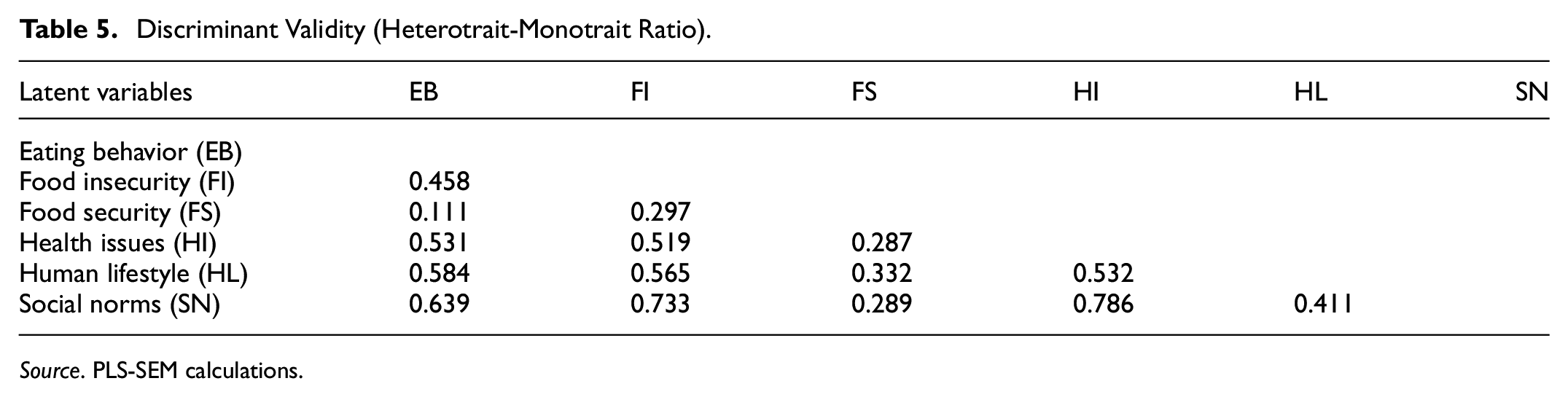
After a comprehensive analysis of the literature, the study model was proposed (Calder et al., 2021), was evaluated and predicted in light of the works of Hair et al. (2011, 2019). The amount of uncertainty for extracted variables in the existing models was first mitigated by comprehensive literature (Downey & Slocum, 1975), and then to minimize the amount of bias in the data acquired, MacKenzie and Podsakoff (2012) idea of cognitive bias was instilled by structuring responses in such a manner that there was no right or wrong option available to respondents while answering the questionnaire’s questions. The greatest estimates of inner (VIF-2.018) as well as outer (VIF-2.990) as per Kock (2015) theory of multicollinearity, which measures correlation across predictor variables, were significantly below the optimum value (Tables 4 and 5). This shows that there is no significant collinearity, implying that the suggested model has no common method bias, as evidenced by the inner VIF values of constructs chosen as explanatory constructs one by one (Table 5), and that the items are well supported by their independent variables (Hair et al., 2017; Kock, 2015).
Inner VIF Values (Common Method Bias).

Source. PLS-SEM Calculations.
Discriminant Validity (Heterotrait-Monotrait Ratio).
Source. PLS-SEM calculations.
The model has been further evaluated by analyzing the attributes’ validity and reliability through Composite Reliability (CR > 0.8) Average Variance Explained (AVE > 0.5) and Cronbach Alpha > .7 and, as stated (Tables 3 and 6), identifying all reflecting constructs meeting the standards and an indication to continue with the study’s stated research hypothesis (Hair et al., 2011, 2017, 2019). Cohen (1992) study on fitness measurements of predictor variables by evaluating effect size (f2), indicated a large to medium effect, ranging from .43 to .27, with the exception of food security, showing a low effect of .10 (Table 3), demonstrating the fitness of the variables in the developed model. Moreover, Discriminant Validity through (Heterotrait-Monotrait Ratio), as discussed by Henseler et al. (2015), evidently predicted intervals that were clearly forecasted and met the requirements with all values lower than the standard value of 0.9 (Table 5), validating the diversity of the variables as well as significantly predicted by their reflective items.
Model Assessments.

Source. Review work.
Note. FS = food security; HM = human lifestyle; SN = social norms; EB = eating behavior; FI = food insecurity.
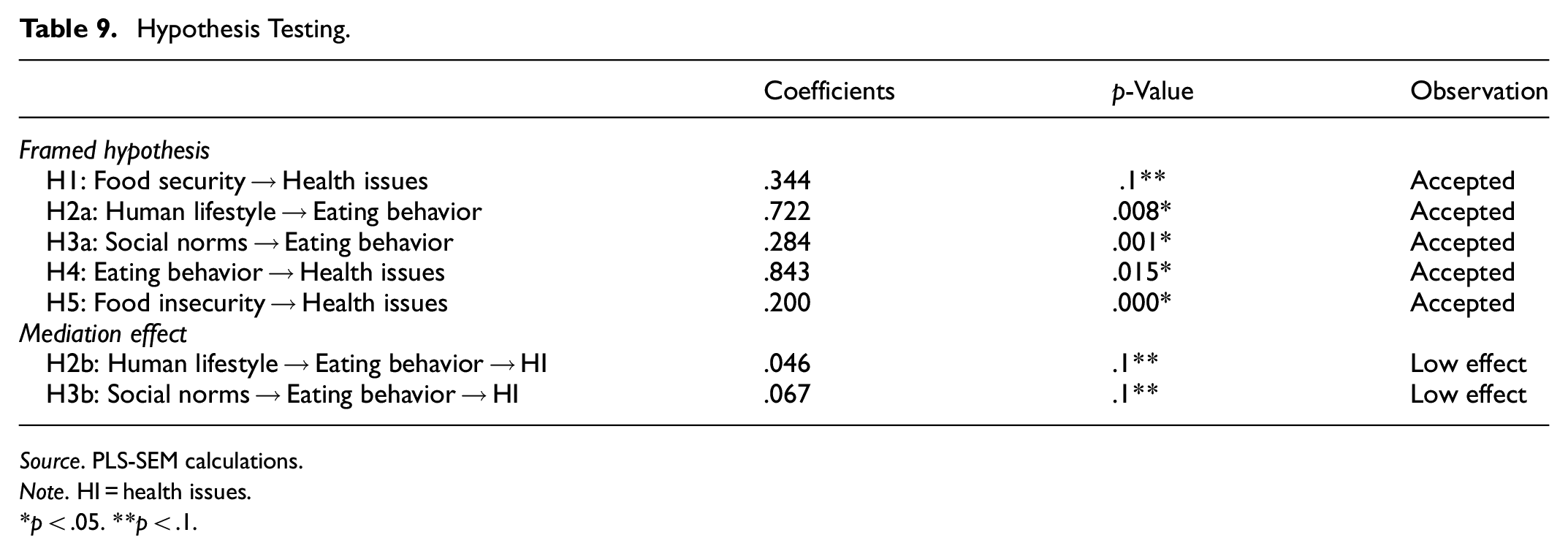
The non-linear associations predicted by the extracted variables (Figure 1) were checked using composite scores as per the guidelines of Ramsey (1969), moreover partial regression amid HL, SN for EB and EB, FS, and FI for HI with values of F = 0.818, 0.608, p = .371, .171 (Table 7), offered a decent notion of the lack of non-linear relationships between predictor factors and hardly any influence on the variation caused by response variable. Cross-validation of the influence of control variables (demographics) such as human perception, location, age, and qualification on the hypothesized model dependent variable (Health Issues), exhibited insignificant relationships leaving human perception and location significant at .1** (Table 8). During model fitness, the bootstrapping command in PLS-SEM was used, and likewise, with t > 1.96 and p < .05, all of the independent constructs and formulated hypotheses exhibited significant positive direct and indirect effects (Table 9 and Figure 2; Hair et al., 2011, 2017, 2019), H1 (t = 3.873; p = .1**), H2a (t = 2.512; p = .00*), H3a (t = 3.300; p = .00*), in eating behavior with (R2, .341), and finally H4 (t = 2.326; p = .00*), and H5 (t = 10.107; p = .00*) for health issues, the dependent variable in this study with the highest explained variance of (R2, .642).
Ramsey Test of Non-Linear Relationships.

Source. Calculated Data.
Effect of Control Variables.

Source. PLS-SEM calculations.
Note. EB = eating behavior; HI = health issues.
p < .05. **p < .1.
Hypothesis Testing.
Source. PLS-SEM calculations.
Note. HI = health issues.
p < .05. **p < .1.

Model assessment and validation.
Theoretical Prediction/Novelty of the Study and Policy Implication
The study’s goal was to discover health-related issues among people’s modern-day eating behaviors while examining the influence of latent variables such as food security, human lifestyle, social norms, eating behavior, and food insecurity. The framed research model revealed that consumer health concerns have a direct link with food insecurity (.686), food security (.075), and eating behavior (.178), and an indirect link with human lifestyle (.257), social norms (.378), which have a direct impact on eating behavior (R2 of .341), finally predicted the overall model variance of (R2 of .642; Figure 2). So it can be concluded that food insecurity should be addressed as a priority, followed by eating behavior, which is supported by features such as human lifestyle and social standards, and lastly, food security, in order to improve the living health conditions of people with a supportive eating lifestyle.
Theoretical Prediction (H1)
The model results clearly indicated that food security is an important factor in selecting healthy food options because it draws the attention of governing authorities to providing quality and nutritious food to their nationalists. Also, it is evident that family culture frames a cognitive mindset among the youngsters, which has a direct influence on their intent to buy nutritious food products, resulting in a healthy way of living. While coming across rural segments of people, different sorts of issues are prevalent among this segment as they are still deprived of not only the appropriate quantity of food but also malnutrition that is evident among small children and even their mothers.
Policy Implication (H1)
With a plethora of eating options available to satisfy people’s appetites, regulatory authorities must create a strict and vigilant environment in which manufacturing firms bear primary responsibility for providing those food items for human consumption, resulting in easy access to nutritious food without fear of adulteration. Even with constant communication for growing food in a garden, free voucher schemes and food stamping are still required by government authorities to motivate rural people to purchase nutritious food and reduce food insecurity (Cauchi et al., 2021; Clapp et al., 2021; East & Friedson, 2020; Gopalakrishnan et al., 2021; Han et al., 2021; Hudak et al., 2022; Wei et al., 2021).
Theoretical Prediction (H2)
According to the research, people’s social status, backed up by a good education and a healthy income, creates an environment of convenience in buying foods without considering their price, and most of the time family demand for food even results in intake of low nutritional level foods, which over time is developing a mindset where future youngsters will hardly have a line of difference when they start buying food for their families. Also, the hectic work schedule of many people creates a lower interest in family routines, which in turn has led to unhealthy eating and its related health outcomes.
Policy Implication (H2)
It’s worth noting that socioeconomic characteristics, such as education, income, and social status, among people of varying income levels have direct effects on intake of high-calorie food items as well as over purchasing of food from supermarkets as a result of children’s pressure. This is an alarming level of behavioral intent among today’s consumers, but governments and industry, rather than focusing solely on taxes and profit margins, must think twice before selling high-calorie food items (Arenas-Gaitán et al., 2021; Blue et al., 2021; Chan et al., 2022; Kansal et al., 2022; Olstad et al., 2022).
Theoretical Prediction (H3)
People’s upbringing, culture, and surroundings result in a closed frame of mind that restricts their ability to act, leading to unhealthy eating behavior, which indirectly increases health-related issues; additionally, people living in rural areas with an uneducated mindset encourage them to participate in lower physical activity and higher usage of unhealthy products such as tobacco, smoking, and so on, leading to obesity and chronic diseases.
Policy Implication (H3)
Consumer social norms provide a better understanding of socioeconomic inequalities by indicating stringent government norms in motivating men, particularly those living in rural areas, to have regular health checkups and raising awareness about the negative consequences of lower education, lower physical activity, and smoking behaviors (Abshire et al., 2021; Halkier & Holm, 2021; Phulkerd et al., 2022; Savelyev et al., 2022).
Theoretical Prediction (H4)
The eating behaviors of people are subjected to their lifestyles and social norms, and these attributes, due to modern job culture, a higher stress level, the attraction of social media, and a lack of parental control, overpower the ethical living standards of people and indulge them in leading an unhealthy lifestyle. It is also worth noting that youngsters who eat high-calorie foods late at night and sleepless have a direct impact on their digestive systems, leading to several chronic diseases in their mid ages.
Policy Implication (H4)
People’s eating habits should be ensured in early childhood, as the same pattern continues into adolescence; additionally, the government should ensure that people avoid purchasing fat or sugar-rich foods by increasing taxes; and companies should ensure that their food packaging displays the aftereffects of having fat or sugar-rich foods. Moreover, young people have to avoid high-calorie foods late at night, and the same has to be taken care of by companies by sharing nutritious food items with their employees during their night shifts (Bertoldo et al., 2022; De Cao et al., 2022; Farbmacher et al., 2022; García-Muñoz et al., 2022; Nayyar & Batra, 2020; Pace et al., 2022).
Theoretical Prediction (H5)
Access to nutritious food items has been discovered to be lacking among people living in rural areas, as they belong to a lower income group, and with lower promotional offers from government agencies, a lack of nutritious food purchases is evident among people of all ages in rural areas.
Policy Implication (H5)
It is crucial to highlight that food insecurity should be eradicated withy government intervention by providing direct cash transfer programs resulting in increasing liquidity to the desired beneficiaries. Targeting better health awareness by educating mothers can further reduce the risk of chronic malnutrition among people from birth to adolescence (Bertoldo et al., 2022; Chen et al., 2021; De Cao et al., 2022; Han et al., 2021; Pace et al., 2022).
Future Research and Study Limitations
Besides, India is a diverse cultural country with a large population living in poverty, particularly in rural areas Adopting developed-nation strategies will take time, so different approaches are required and understand their psychological mindsets to improve their health conditions. Also, the current study’s unexplained variance R2 (35.8) may be improved by addressing the above issues and also by understanding the consumption of plant based food substitutes for meat, which highlights the new perspective of dietary change having a direct influence on positive eating habits and better health (S. K. White et al., 2022). Coming to future scenario recent programs launched in the U.S. authorizing incentives to online retailers for nutrition assistance in the food products being sold online have influenced low income groups first to have enhanced access to online nutritious food items and then healthy eating habits (Trude et al., 2022). Even excessive access to digital screen activities has had a significant influence on children’s mental health and obesity, which has even escalated to a higher level with time (Nieto & Suhrcke, 2021). Further, in developing countries, machine learning intelligence may be used to predict food-borne diseases, and this kind of innovation of forecasting disease-damaging foods in advance is highly appreciable and dynamic (Lebelo et al., 2021). Finally, realizing that stress-related factors are chronic and typically associated with poor health, reducing stress-related factors can improve an individual’s health (Rohner et al., 2022).
Footnotes
Declaration of Conflicting Interests
The author declared no potential conflicts of interest with respect to the research, authorship, and/or publication of this article.
Funding
The author received no financial support for the research, authorship, and/or publication of this article.

Data Availability Statement
The data pertaining to the current study is not on any public domain but it can be available upon request.