




Abstract
In many countries in recent decades, great importance has been placed on the concept of quality assurance in education. In Slovenian schools, quality assessment and assurance processes are based on a combination of self-evaluation and external evaluation, although significantly more weight has been attached to self-evaluation than external evaluation lately. Efforts to achieve the highest possible levels of quality and school work performance are based on the assumption that the concept of quality should be developed at the level of the professional autonomy of schools and individual teachers. Our empirical research, which was conducted on a sample of 1,530 teachers, counselors, and headteachers of primary and secondary schools in Slovenia, showed that the majority of professional workers in education recognize the importance of conducting self-evaluation for their profession. Using factor analysis, it was established that the frequency of conducting self-evaluation in schools is most affected by the following factors: (a) the opinion of headteachers, teachers, and school counselors on the positive effects of self-evaluation; (b) the school climate; (c) the attitude of headteachers, teachers, and school counselors toward research; and (d) the attitude of headteachers, teachers, and school counselors toward their own professional development. Multiple regression analysis of the obtained factors was made, and a model was designed to predict the frequency of the performance of self-evaluation. It was established that the frequency of conducting self-evaluation is most strongly affected by the attitude of headteachers, teachers, and school counselors toward their own professional development and by their opinions on the positive effects of self-evaluation.
Introduction
Modern concepts of quality assessment and assurance of school work are based on the professional autonomy of schools and teachers. One of the main reasons for the need to transfer greater responsibility and autonomy to the school in the process of quality assurance is that increased organizational authority of schools enhances their flexibility, thus enabling higher quality work adapted to the realities of the job. Processes of quality assessment and assurance are closely linked to research work: more specifically, to conducting self-evaluation research (Podgornik & Mažgon, 2015). The idea that teachers should conduct research work, and that they should be reflective practitioners, originates from the English Ford Teaching Project (1973-1976), within which teachers were trained to carry out action research and self-evaluation of educational practice (Stenhouse, 1975). Research work was addressed as an integral part of the daily tasks of teachers, and the results served as a basis for further planning of educational work (Podgornik & Mažgon, 2015).
Many researchers (e.g., Berger, Boles, & Troen, 2005; Ermenc Skubic & Mažgon, 2015; Grimmett, 2007; Moore, 2007; Smith & Sela, 2005; Vogrinc & Valenčič Zuljan, 2009; Wilson, 2000) have established that teachers’ research work, including self-evaluation, is an important factor of their professional development, and of achieving quality educational work. According to researchers, self-evaluation or research work enables teachers to become more familiar with students, the institution and themselves as teachers, resulting in changes in their teaching practice in line with research findings. Teachers consequently feel more competent and advance professionally, they are able to better reflect on their classroom work, they gain a deeper insight into the process of teaching and educating, their research work facilitates the transfer of their theoretical knowledge into practice, and so on.
Evaluation studies are focused primarily on changing the existing status, with a fundamental objective of achieving progress in practice. Based on the ongoing and final conclusions of evaluation research, plans for further work are developed that include the introduction of changes and improvements directly into educational practice (Podgornik & Mažgon, 2015). Evaluation in education is therefore a process aimed at determining the extent and manner of achieving educational goals. It is the process of systematically collecting information on the achievement of these goals, with a view to resolving current issues directly in educational practice. Factors that are proven to have a positive impact on the achievement of the set goals are retained in the future, while in areas where the set goals have not been achieved, it is necessary to consider the reasons for this and to seek improvement.
In general, evaluation is therefore the process of gathering information (according to relevant criteria, with measurements and corresponding analysis) to establish a rational basis for assessment in decisive situations (Stufflebeam, 1985). Through evaluation, evidence and verifiable findings are obtained regarding the quality of programs, projects, services, organizations, and the work of individuals (Stufflebeam & Shinkfield, 2007).
Self-evaluation is not, however, a subjective, arbitrary assessment of work by the individual school or teacher; objective understanding is required. The basic sense of self-evaluation is that the school and teachers assess their own status by employing various research methods, data collection techniques and instruments that can be standardized or designed for the needs of specific evaluation studies. Self-evaluation is always associated with a tendency to provide the highest quality of school work. There are, however, differing views on what actually constitutes the quality of school work and which approaches are most appropriate to quality assessment and assurance.
Principles and Approaches to Quality Assessment and Assurance in Education
Quality is an elusive concept, as it varies in space and time. It depends on the context in which it appears, as well as on the interests, values, beliefs, and so forth of the individual society, or even of individuals. Quality in education must be seen in the context of the respective cultural discourse (Stronach, 1999). At the European level, quality in education is perceived as a structured concept comprising 16 indicators in four different fields of education: (a) attainment (indicators: mathematics, reading, science, information and communications technology (ICT), foreign languages, learning to learn, civics), (b) success in the transition between different levels (dropout rates, completion of secondary education, and preparation for tertiary education), (c) monitoring of school education (evaluation and steering of school education, parental participation), and (d) resources and structures (education and training of teachers, the level of participation in pre-primary education, the number of students per computer, and the educational expenditure per student; cf. “Indicators on the Quality of School Education,” 2000).
According to Sallis (2002), the quality of school work is a dynamic concept that cannot be specified, because quality has many meanings. To define quality, the factors contributing to a good school must therefore be discussed. Sallis identifies four imperatives of quality: (a) the moral imperative, which dictates that all “clients” or “users” (students, parents, community, etc.) are entitled to the highest quality educational services; (b) the professional imperative, which is closely linked to the moral imperative, that is, all institutions are obliged to provide students with an educational process that meets the highest professional standards; (c) the competitive imperative, that is, the ability of educational organizations to cope with the challenge of competition, with one of the most effective approaches being constant care for improving the quality of their services and processes; and (d) the imperative of accountability, according to which educational organizations are part of their environment and are expected to act responsibly toward the funders, which includes ensuring a public demonstration of the high standards of the processes and services of the organization. Within the process of quality assessment and assurance, Sallis distinguishes three basic approaches 1 to quality: (a) quality control, (b) quality assurance, and (c) total quality management.
Quality control includes the planned and systematic supervision of the process and the status outcome, as well as the necessary corrections of activities to fulfill the set requirements. It therefore includes the identification and elimination of processes and services that do not meet the standards. Quality assurance is a proactive approach whose main task is to prevent errors or their repetition. This approach is adopted internally by all employees, who aim for the quality improvement of their work, with the standards and criteria being established within the organization (Dahlgaard, Kristensen, & Kanji, 2002; Sallis, 2002). Quality is therefore embedded in the process of operation of an institution, aiming at ensuring conditions for its operation that allow for the achievement of the pre-established goals. Total quality management is a proactive approach that builds on approaches to quality assurance. It is a conceptual approach that relies on internal and ubiquitous quality improvement, focusing on the integration of all employees at all times and in all processes. The philosophy behind it is never-ending, long-term quality improvement, undertaken step by step and focusing on the needs of the user (Dahlgaard et al., 2002; Sallis, 2002).
Eurydice (2008) data show that the arrangements made for evaluating the quality of educational institutions and adopted in various countries can be classified into three systems. The first system emphasizes the evaluation function of inspection bodies and the standardization of evaluation criteria; the second system focuses on the role of the national accountability structure in schools and includes the development of national standards, while the evaluative role is transferred to local authorities and the funders of educational institutions; and the third system includes countries that have not formally established the system of accountability.
Assessment and Quality Assurance Processes in Slovenian Primary and Secondary Schools
In Slovenia, compulsory basic education (from now onwards primary school)
lasts for nine years and is divided into three educational triads. Children enter primary school at the age of 6. In the first educational triad, pupils are taught by a class teacher. From Year 4 to Year 6, the number of subject teachers gradually increases, so that pupils can get used to having several teachers. Subject teachers teach exclusively in the third educational triad and in upper-secondary schools. (Valenčič Zuljan, Cotič, Fošnarič, Peklaj, & Vogrinc, 2011, p. 296)
Primary schools provide a compulsory and extended curriculum. The compulsory curriculum must be provided by schools and studied by all pupils. It consists of compulsory subjects, electives, home room periods, and activity days (culture, science, sports, technology). School must provide the optional elementary school curriculum, but pupils are free to decide whether they will participate (“Educational System in Slovenia,” 2009). At the end Year 6 and Year 9, pupils are assessed in national examinations in the mother tongue and mathematics, in Year 6 also in a foreign language, and in Year 9 in a subject determined by the Minister (out of compulsory subjects from the Year 8 and 9). Results do not affect pupils’ grades; they are only an additional information about their knowledge levels (“Assessment in Single Structure Education,” 2016).
Upper-secondary education is organised in general and professional grammar schools (so-called gimnazije), with a duration of four years, in technical and professional schools (with a duration of four years), and in vocational schools (three years, except for shorter vocational education courses, which last for two years). The objectives of professional and technical education and training are to develop key competences, skills and vocational qualifications at an internationally comparable level and to provide knowledge and skills for employment, further education and lifelong learning. (Valenčič Zuljan et al., 2011, pp. 296-297) Technical and professional schools end with a Vocational Matura exam (exam in four subjects; the exams are prepared externally and assessed internally). (“Educational System in Slovenia,” 2009, p. 2) Gymnasia offer students four years of general education aimed at upgrading and extending the knowledge gained during compulsory education. Gymnasia ends with a Matura exam—an externally prepared and assessed exam in 5 subjects, 3 of which are compulsory and 2 which are elective. (Valenčič Zuljan et al., 2011, pp. 297-298)
All teachers and school counselors who would like to work in primary and upper secondary schools are required
to complete a second-cycle study programme and attain a master’s degree (300 ECTS) in order to be able to enter the teaching profession. Teacher education study programmes comprise the study of the subject discipline, education sciences (included Research in Education where they gain knowledge about self-evaluation) and pedagogical training. School counsellors have to complete a master study programme in psychology, pedagogy, social pedagogy, special education, inclusive education or social work. Teachers and school counsellors also have to pass the State Teacher Certification Examination, a national exam, taken before the National Examination Board for professional competency examinations in the field of education, which is appointed by the Minister of Education. (Valenčič Zuljan et al., 2011, pp. 299-302)
The State Teacher Certification Examination consists of oral examination that includes the constitution of the Republic of Slovenia, the constitution of the European Union and its legal system, and regulations specifying human and children’s rights and basic privileges, legislation in the area of education, and Slovenian written language (Valenčič Zuljan et al., 2011).
The weekly teaching load is up to 22 teaching hours for teachers in primary school and up to 20 teaching hours for teachers in secondary school. Rest of the time (till a 40-hr weekly workload), teachers spent on lesson preparation, assessment of pupils products, the implementation of self-evaluation, care for their own professional development, and so on. School counselors have a 40-hr weekly workload and one of their main task is also self-evaluation of school work. Teachers and school counselors that wish to gain new knowledge can participate in in-service training throughout their careers. They are enabled by their employer to participate “in programmes of professional education that are published within the selection of programmes of further education and training at least 5 days a year or at least 15 days in three years” (Valenčič Zuljan et al., 2011, pp. 311-312). However, there are also other programs or models important for their professional development like: thematic conferences, study groups, professional staff networks, research work, and so on.
The Organisation and Financing of Education Act (2008) provides the formal and legal framework for quality assessment and assurance in education, assigning the obligation to assess and assure quality to the headteacher. As a type of evaluation, the execution of self-evaluation is also the responsibility of the headteacher. The school management is obliged to produce an annual report on self-evaluation in the school, which must be adopted by the School Council. Furthermore, schools undertake an analysis of the implementation of the annual work plan. This can also be understood as a form of self-evaluation and is a useful starting point for the further planning of work.
In Slovenian primary and secondary schools, the processes of quality assessment and assurance are based on a combination of self-evaluation and external evaluation, although lately significantly more weight has been attached to self-evaluation. External evaluation is carried out by the Ministry of Education within the scope of accreditation processes, when determining the fulfillment of the basic requirements for the fundamental quality of work (verifying the suitability of premises, staff, programs and other conditions). A special form of external evaluation in Slovenia falls within the tasks of the Inspectorate of the Republic of Slovenia for Education and Sport (The School Inspection Act, 2005). School inspection includes monitoring the implementation of laws, other regulations, and acts governing the organization and implementation of education and training provided by kindergartens, primary schools and secondary schools. Thus, the principal task of school inspection is monitoring the correct fulfillment of formal requirements, whereas pedagogical decisions (e.g., the choice of learning forms and methods of work, the realization of the curriculum, etc.) are within the domain of the individual teacher or school.
Other activities in the system of quality assessment and assurance are based on the self-evaluation approach. Thus, Slovenia has decided to move away from focusing on quality assessment and assurance as a process of control over the work of educational institutions and teaching staff (Podgornik & Mažgon, 2015). Rather than emphasizing external verification of the results achieved and planning processes to ensure their improvement, there is a tendency to transfer the care for the quality of education to the institutions and teachers.
In Slovenia, the process of self-evaluation is supported by various national projects for quality assurance. Most of these projects are based on self-evaluation, with the data sources being both objective (achievements that can be determined relatively objectively) and subjective (opinions of various participants, acquired in very different ways).
The use of different databases has even become an element of quality assessment and assurance. Primary and secondary schools typically assess the learning performance of their population in relation to national results (external knowledge examinations in primary school and at the end of secondary school), while teachers perform individual and group reflection on the performance of their students in individual subjects.
In Slovenia, data on the learning outcomes of students are collected every year by the National Examinations Centre through the compulsory National Assessment of Knowledge (NAK) in Year 9 of primary school, and, since the 2013-2014 school year, also in Year 6 of primary school. At the secondary-school level, these data are collected through the school-leaving exam taken at the end of grammar school (so-called Matura) and secondary technical and vocational schools (so-called Vocational Matura; The Matura Examination Act, 2007; The Primary School Act, 1996, 2006). The data obtained can be combined with other data and used to evaluate the national education system. In primary school, the NAK has a formative role and students’ knowledge is not assessed, but the data are nonetheless collected to monitor the progress of students in terms of meeting the set knowledge standards.
Slovenia also participates in various international studies (e.g., PISA, TIMSS, etc.) based on the comparison of learning outcomes of students from various countries in specific areas (e.g., mathematics, science, literacy, etc.). If properly analyzed and interpreted, this information provides the state with an important element for assessing the international comparability of the education system.
To accurately define the quality status of the education system and to devise a plan that should lead to improvements in this area, it is important to analyze and take into account the data collected by external assessment (e.g., international knowledge research, NAK), but findings from self-evaluation research are also used in the interpretation of these data. A single data source is not sufficient for a detailed analysis, as each approach has its advantages and disadvantages. External assessment enables more objective data collection, ensuring greater objectivity of the produced, evaluated, and interpreted results, and allowing for a comparison of the achievements of the individual with his or her peers on the national (i.e., NAK, Matura) or international level (e.g., TIMSS, PISA). This provides teachers with important additional (more objective) feedback on their students’ knowledge, and thus, indirectly, on their own work. The weakness of external assessment is that the interpretation of results does not take into account the characteristics of the individual institutions in which students learn and teachers work. Such information is easier to obtain using a self-evaluation survey implemented by teachers who are very familiar with the institution in which they work. To interpret the data collected by external assessment correctly, it is necessary to consider the whole context: the sociocultural environment in which the institution is located, the characteristics of the students, the nature of cooperation between parents and teachers, which professional development options are available to teachers, how the institution is equipped, and so on. It is therefore important that external assessment data are combined with data collected through self-evaluation studies, and that on this basis measures are proposed that should lead to higher quality educational work.
Purpose and Method of the Research
The research work of practitioners can be understood as an attempt to link teaching and research so that they are no longer two separate tasks, instead becoming interrelated and complementary activities (Cole & Knowles, 2004). It is crucial that the research work of teachers is carried out by the teachers themselves (possibly with the assistance of external research experts), and that it follows the criteria of scientific research and thus also the principles of research ethics.
In the present empirical research, the focus was on the conducting of self-evaluation research in Slovenian primary and secondary schools, based on the assumption that, if we want the results of self-evaluation to form the basis for the further planning of educational work, the concept of quality needs to be developed at the level of the professional autonomy of the school and the individual teacher (Podgornik & Mažgon, 2015).
The frequency of self-evaluation research depends on many factors (e.g., the teacher’s knowledge of conducting self-evaluation research, etc.), with the views of headteachers, teachers, and school counselors on the importance of conducting self-evaluation research being an important element. The focus of the present empirical research was therefore the views of respondents on research and the performance of self-evaluation, as well as on their own professional development.
The empirical research established:
Whether headteachers, teachers, and school counselors of primary and secondary schools differ in their opinions on the importance of self-evaluation for their profession;
How pedagogical workers (headteachers, teachers, and school counselors) at primary and secondary schools rate their qualification to perform certain activities within a self-evaluation survey (setting goals or content planning, methodological planning, designing instruments for data collection, etc.);
How the following factors act as predictors of differences in the frequency of the performance of self-evaluation: (a) the opinion of professionals on the positive effects of self-evaluation, (b) the school climate, (c) the attitude of professionals toward research, and (d) the attitude of professionals toward their own professional development.
Basic Research Method
The basic research methods are the descriptive and causal non-experimental methods of pedagogical research. The study is based on the quantitative research paradigm.
Sample
The research involved 1,530 respondents. The sample was selected systematically, with primary and secondary schools from various geographical areas of Slovenia being included in the survey. The sample is representative and is further specified.
A total of 1,109 respondents from 107 primary schools responded to the questionnaire on the performance of self-evaluation in primary school. The overall responsiveness of schools was 71.3%. (Table 1)
The Description of the Sample From Primary School.

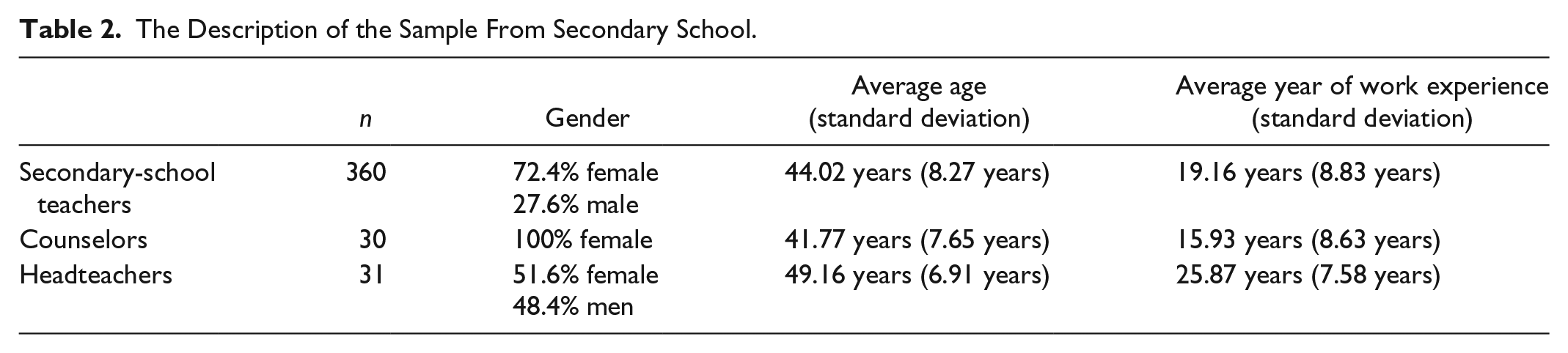
The questionnaire on the performance of self-evaluation in secondary school was completed by 421 respondents. The questionnaires were returned by 33 secondary schools. The response rate was 66.0%. (Table 2)
The Description of the Sample From Secondary School.
Data Collection and Instrument
The data were collected using questionnaires designed for primary and secondary-school headteachers, teachers, and counselors. Six content-related questionnaires were compiled, each tailored to a specific group of respondents (e.g., the statement from the questionnaire for teachers “Teachers must evaluate their work” was changed into “Headteachers must evaluate their work” in the questionnaire for headteachers and into “School counselors must evaluate their work” in the questionnaire for school counselors). When drawing up the questionnaire, an analysis of the literature on the performance of self-evaluation was considered, and the empirical research already conducted in this area was reviewed (e.g., Partnership of Faculties and Schools, Research on Teaching Practice and Direct Application of the Results in the Educational Work: Teacher-Researcher and Inter-Subject Links; for more detail, see Krek & Vogrinc, 2007). The data were collected by a questionnaire, consisting of seven rating scales (the rating scale of the areas of subjected to the self-evaluation of teachers and counselors; the rating scale of the reasons that affect the frequency of self-evaluation; the rating scale of the approaches that could contribute to the more effective implementation of self-evaluation; the rating scale of the headteachers’, teachers’, and school counselors’ competence for the implementation of the various stages of self-evaluation; the rating scale of knowledge of national projects to identify and provide for the quality of educational work; the rating scale of the characteristics that the pedagogical staff attach to self-evaluation; the rating scale of how much time the teachers of primary and secondary schools devote to the reflection of specific areas of their work) and of the Likert-type scale of attitudes. In the article, only the data collected by the Likert-type scale of attitudes, which was used to establish the attitude of headteachers, teachers, and counselors to their professional development, research, and the implementation of self-evaluation (the Likert-type scale of attitudes comprised 22 items) and the data collected by the rating scale of the headteachers’, teachers’, and school counselors’ competence for the implementation of the various stages of self-evaluation (the rating scale comprised eight items) shall be presented.
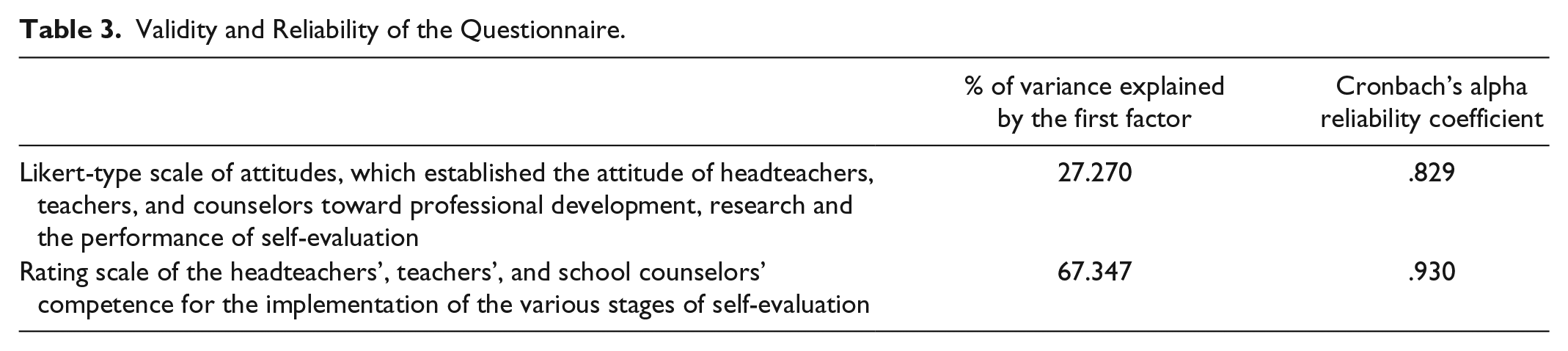
The validity of the questionnaire was checked with factor analysis—specifically, the percentage of variance explained by the first factor—while the reliability of the questionnaire was tested with Cronbach’s coefficient alpha.
From the data presented (Table 3), it is evident that the scales achieve sufficient reliability (Cronbach’s α coefficient ≥ .60) and validity (more than 20% of the variance is explained with the first factor).
Validity and Reliability of the Questionnaire.
An envelope was sent to each school containing one questionnaire each for the headteacher and the counselor, as well as 10 questionnaires for primary-school teachers and 15 questionnaires for secondary-school teachers. The headteachers were asked to distribute the questionnaires to teachers in alphabetical order (regardless of the class they taught, the subject they taught, the educational program they taught, etc.). If a particular school employed more than one counselor, it was requested that the questionnaire be completed by the counselor with more years of work experience. The headteacher appointed a person to collect the questionnaires at the school and send them to the authors of the present article.
Data Processing
The data from the questionnaires were processed using descriptive and inferential statistics: frequency distribution (f, f%) of attributive variables, basic descriptive statistics of numerical variables (mean, standard deviation), the Kullback 2Î test (because the condition of the theoretical frequencies for the chi-square test was not fulfilled), Levene’s test for equality of variances (F test), the t test. Factor analysis was also undertaken: the major components method, Varimax rotation, and multiple regression for analysis of the relationship between a single dependent variable and multiple independent variables, in which the method of least squares was used and all of the selected variables were simultaneously incorporated in the model (Enter method). The data are presented in tabular form. The percentages are calculated on individual issues, depending on the number of respondents who answered a particular question (i.e., valid answers).
Results and Discussion
The major advantage of self-evaluation is that the school is responsible for raising and maintaining its own quality independently, exploiting its own strengths and resources. Over time, good self-evaluation evolves in a continuous process of improving operational and organizational quality and efficiency, significantly affecting all aspects of the life and work of the school. Furthermore, the research showed that the majority of the respondents were aware of the importance of the performance of self-evaluation. Although the responses of different groups of respondents to this question showed a statistically significant difference (2Î = 71.935, g = 20, α = .000), the majority of the respondents replied that they perceived conducting self-evaluation as important or very important for their profession. In the present research, the group with the largest proportion of respondents who believe that conducting self-evaluation is important or very important is primary-school headteachers (89.7%), followed by secondary-school headteachers (86.2%), primary-school counselors (80.5 %), and primary-school teachers (79.5%), while the share of secondary-school counselors (66.7%) and secondary-school teachers (66.4%) who share such opinions is slightly lower (Podgornik & Mažgon, 2015).
For headteachers, teachers, and school counselors to be able to explore pedagogical practice and effectively carry out self-evaluation, it is assumed that they possess appropriate methodological knowledge in addition to knowledge of their area of expertise. Headteachers, teachers, and school counselors evaluated their ability to set the goals of self-evaluation (content planning, what to evaluate), its methodological design (research plan, sample, data collection process, etc.), the development of instruments for data collection, data processing, interpretation of the results, report writing, and informing the public (teachers, parents, etc.) of findings, as well as their ability to plan improvements of school practice based on the findings of self-evaluation research. Respondents were asked to assess their ability to perform specific activities within self-evaluation process, with the Grade 5 indicating a very good level of qualification, and the Grade 1 reflecting a very poor level of qualification (Table 4).
The Ability of Headteachers, Teachers, and School Counselors to Perform Specific Activities Within Self-Evaluation Process.

Pedagogical workers from primary school gave the highest rating to their ability to write reports on the findings of self-evaluation, followed by their ability to interpret results, to inform the public (teachers, parents, etc.) about the findings, to set goals and plan the content of the self-evaluation, and to process the collected data. Pedagogical workers from secondary school feel most qualified to interpret the results and to set goals or plan the self-evaluation regarding content. Both pedagogical workers from primary and secondary school assigned the lowest rating to their ability to devise instruments for data collection, and their ability to undertake the methodological planning of self-evaluation (research plan, sample, data collection process, etc.).
As professionals, teachers cannot be mere implementers of decisions; they should participate actively in the formulation and adoption of decisions, and in the evaluation of their implementation (Niemi & Jakku-Sihvonen, 2006). The education of teachers based on a culture of research follows from the assumption that teachers should be trained to monitor and critically evaluate new findings and achievements of sciences that are important for their professional conduct as well as for self-studying, developing and evaluating teaching. According to MacBeath (2011), a paradigm shift from a passive and subordinate role to an active role takes place, with educators becoming the primary initiators of self-evaluation and taking responsibility for their individual and collective professional development.
Using factor analysis, the present study established which factors affect the frequency of performing self-evaluation. Some 22 variables were included in the factor analysis, that is, 22 statements with regard to which the respondents indicated the extent of their agreement. The respondents were asked to assess their opinions on a 5-point Likert-type scale, on which by selecting the rating 5 the respondent strongly agrees with the statement, whereas by selecting the rating 1 the respondent strongly disagrees with the statement (Table 5).
Mean Value, Standard Deviation, Communalities, Own Factor Value, Percentage of Explained Factor Variance, and Cumulative Percentage of Explained Variance of Factors (Initial Statistics Prior to Reduction of the Number of Factors).

The outcomes of the Kaiser-Meyer-Olkin test and Bartlett’s test showed the factorization to be reasonable and justified (Table 6).
KMO (Kaiser-Meyer-Olkin) Test and Bartlett’s Test.

After the extraction of the factors, they were rotated according to the Varimax (orthogonal rotation) and oblimin (oblique rotation) methods. Based on Thurstone’s simple structure criteria, we decided that the Varimax rotation was the better solution, as the structure is simpler and more transparent according to this rotation.
Four factors account for 60.523% of the total variance: 31.970% of the variance was explained by the first factor, 14.037% by the second factor, 8.089% by the third factor, and 6.427% by the fourth factor.
Four factors were obtained (Table 7). Based on the contextual characteristics, they were named as follows: (a) positive effects of self-evaluation (this factor comprises statements showing the attitude of the respondents toward self-evaluation and their opinions regarding the positive effects of carrying out self-evaluation), (b) school climate (this factor consists of statements relating to the climate in the institution, the attitude of colleagues and the headteacher toward a teacher who conducts surveys and takes part in research projects, etc.), (c) the attitude of teachers toward research (this factor consists of statements that relate to the attitude of the respondents toward the survey, the publishing of articles in which they present the findings of the empirical research to inform the wider professional public about their work, etc.), (d) the professional development of teachers (the fourth factor consists of variables referring to the respondents’ attitude toward their professional development; it also comprises a variable that indicates teachers’ awareness of the impact of self-evaluation research on their professional development).
Principal Component Analysis With Varimax Rotation Method.

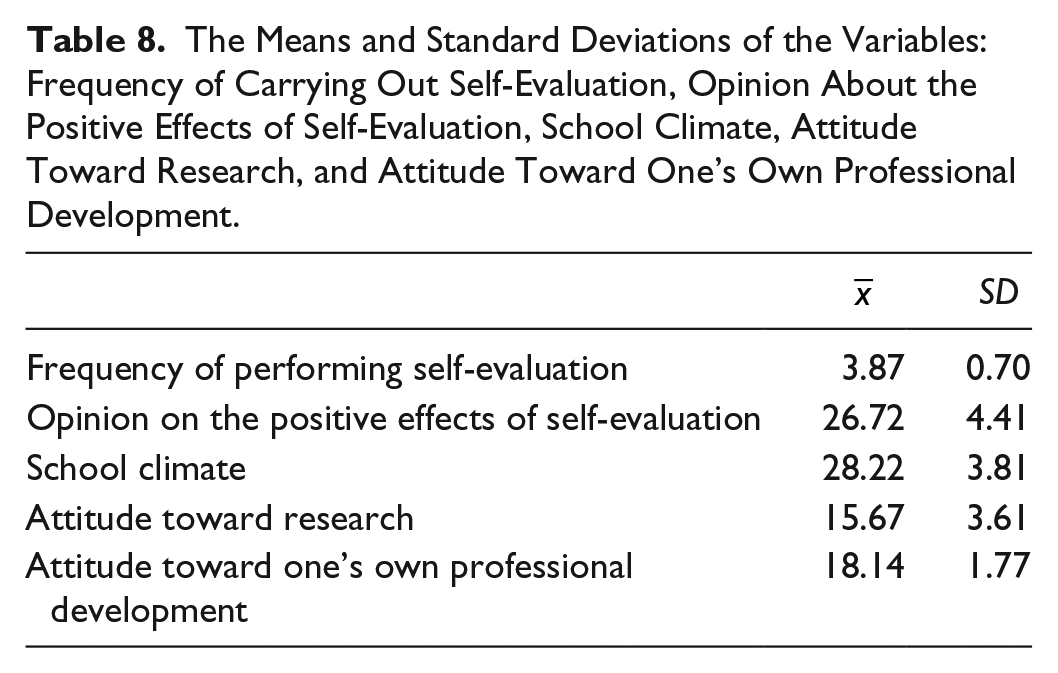
The influence of these four factors (the opinion of professionals on the positive effects of self-evaluation, school climate, the attitude of teachers toward research, and the attitude of teachers toward their own professional development) as predictors of differences in the frequency of carrying out self-evaluation was also examined (Table 8). The frequency of self-evaluation was assessed on an annual basis, regardless of the content area in which self-evaluation was carried out (e.g., the effectiveness of approaches to teaching, establishing the classroom discipline, classroom climate, etc.). A model was formulated with multiple regression analysis using the method of least squares, with all of the variables being simultaneously included in the model (the Enter method).
The Means and Standard Deviations of the Variables: Frequency of Carrying Out Self-Evaluation, Opinion About the Positive Effects of Self-Evaluation, School Climate, Attitude Toward Research, and Attitude Toward One’s Own Professional Development.
The determination coefficient (R2) shows that the obtained regression model accounted for 7.4% of the variance. The ANOVA value was statistically significant (F = 28.228, α = .000), which means that the presented model significantly improves the forecast of the frequency of carrying out self-evaluation (Table 9).
Determination Coefficient.

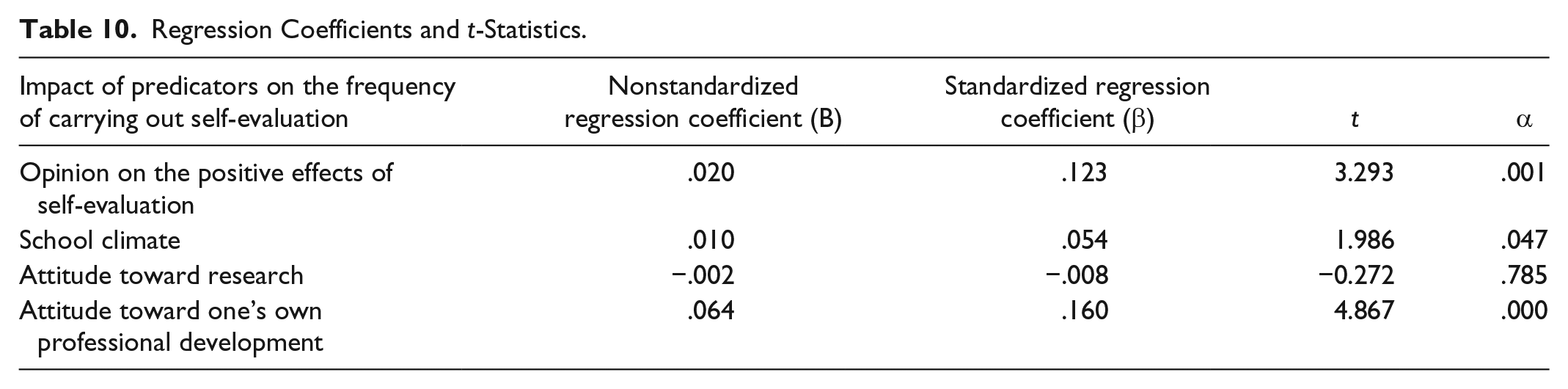
The model shows (Table 10) that the frequency of performing self-evaluation is statistically significantly influenced by the following factors: the opinion of teachers on the positive effects of self-evaluation, the school climate, and the attitude of teachers toward their own professional development. Based on the statistical significance of the t values, it can be concluded that the frequency of performance of self-evaluation is most strongly affected by the attitude of teachers toward their professional development, followed by their opinion on the positive effects of self-evaluation; the weakest, but still statistically significant, link is between the frequency of the performance of self-evaluation and the opinion of teachers on the school climate regarding the performance of a self-evaluation.
Regression Coefficients and t-Statistics.
Conclusion
The empirical research showed that among headteachers, teachers, and counselors there are statistically significant differences in their opinions on the importance of self-evaluation for their profession. Despite the fact that all the groups of respondents viewed conducting self-evaluation to be important for their profession, the primary-school headteachers (89.7%) were most convinced of its importance, whereas the secondary-school teachers (66.4%) were least convinced of its importance. Elementary and secondary pedagogical workers estimate that during the various stages of the implementation of self-evaluation studies they are best qualified for the interpretation of the results, for report writing, setting the self-evaluation goals (content planning, what to evaluate) and for informing the public (teachers, parents, etc.) of the findings. The empirical research shows that the frequency of performance of self-evaluation is most strongly affected by the attitudes of headteachers, teachers, and school counselors toward their professional development, followed by their opinion on the positive effects of self-evaluation.
For teachers to perceive the performance of self-evaluation as a permanent and important professional task that is a prerequisite to successful quality assessment and assurance, it is necessary to create the appropriate climate in schools, enabling each pedagogical worker to pursue research work and perform self-evaluation, and ultimately encouraging them to do so. The key factors that influence the creation of such a school climate are: mutual trust, understanding and cooperation between the employed pedagogical workers, personal assistance and professional support, and open communication. In addition, it is important for teachers to feel that their work is appreciated and that their proposals, ideas, advice and the like are accepted in good faith and taken into account by their colleagues. Teachers should also be able to turn to their colleagues or the headteacher if needed. Based on the findings of the present study, it can be concluded that good conditions for research and the performance of self-evaluation have been established in Slovenian schools: Most of the respondents judge that their colleagues accept their ideas, advice, and so on, that pedagogical workers cooperate well at their school and help each other, that the professional performance of teachers is appreciated in collective bodies, and that a teacher wanting to introduce a specific innovation in the teaching at their school can count on the moral support of the headteacher.
Some authors (e.g., MacBeath, 2011; Vanhoof, Van Petegem, Verhoeven, & Buvens, 2009) consider that school should establish and develop a culture of learning, that is, a “Learning Network,” which involves cooperation, learning, sharing of knowledge, views, experiences, and so on between education practitioners. Teachers should be able to connect and engage with their counterparts from other schools, with external experts, and so on. It is also necessary to include students and their parents in the processes of quality assessment and assurance, as different views are appreciated in discussions on the findings of self-evaluation and on the follow-up measures. This does not mean that representatives of all stakeholders should be involved in making decisions all the time, but they should be included where necessary and appropriate (taking into account their knowledge, experience, possession of information, etc.). It is recommended that a special team of teachers should be established to carry out self-evaluation at school, with a core mission of planning and carrying out self-evaluation within a specified time period. On the basis of prior joint decisions (of all pedagogical workers) about the priorities and substantive areas of self-evaluation, such a group should provide a self-evaluation research plan and decide on the methodology of work, the selection of predesigned instruments and/or the creation of new instruments (for the needs of the specific research). It should collect data, analyze and interpret data, and, when the research is concluded, draw up a report on the research findings and organize debates at school at which proposals for further work are formed based on the findings of the self-evaluation survey. In the performance of self-evaluation, schools can also collaborate with external institutions, for example, with the faculties that educate future pedagogical workers. External experts may provide professional assistance and support (regarding content and methodology) to the school in the process of carrying out self-evaluation. Some authors (e.g., Lunenberg, Ponte, & Van de Ven, 2007; Michalak, 2010; Somekh, 1995) emphasize the importance of linking researchers and practitioners to achieve the common objective, that is, to establish a school system of the highest possible quality.
Many authors (e.g., Burton & Bartlett, 2005; Cochran-Smith & Demers, 2008; Cole & Knowles, 2004; Gore & Gitlin, 2004; Krek & Vogrinc, 2007; Lunenberg et al., 2007; Meijer, Oolbekkink, Meirink, & Lockhorst, 2013; Michalak, 2010; Niemi, 2008; Niemi & Jakku-Sihvonen, 2006; Ponte, 2005; Seberová, 2010; Vogrinc, Valenčič Zuljan, & Krek, 2007; Zeichner & Noffke, 2001) believe that the research work of teachers is a highly effective way of promoting their professional development, while also contributing to an improved reputation/status of the teaching profession in public. Research promotes the development of the critical and analytical abilities of teachers, enabling them to critically reflect on their work, gain knowledge and experience of research work, become familiar with new insights into theory and practice, and so on. The research work of teachers has a positive impact on teaching and learning, and it is strongly associated with the introduction of innovations and changes into teaching practice. Teacher-researchers can also use their knowledge and experience to help their colleagues and to contribute significantly to the development of the school as a whole, while practitioners’ research contributes important new insights into education.
Educators should also possess at least a basic knowledge of methodology to be able to systematically monitor and analyze their own practice, as well as to use the lessons learned in their future work. Learning content related to the methodological planning and carrying out of self-evaluation should be integrated into courses dealing with the subject matter in the field of research (Podgornik & Mažgon, 2015). Learning content pertaining to quality assessment and assurance in education should be addressed in other subjects, as well. In this respect, interdisciplinary seminars designed to help students make sense of methodological knowledge, and to connect research with the pursuit of other professional activities, can be of great benefit (Podgornik & Mažgon, 2015). We believe that this should be taken into account when designing study programs (in all three cycles: undergraduate, master’s, and doctoral studies) for future teachers and other education professionals, as well as when formulating continuing education programs and training for education professionals.
To achieve the highest possible level of quality of educational work, it is particularly important that all education professionals in schools, especially headteachers, constantly seek to establish and maintain a school climate that in its core supports individual professional development and the development of the school as a whole.
Footnotes
Declaration of Conflicting Interests
The author(s) declared no potential conflicts of interest with respect to the research, authorship, and/or publication of this article.
Funding
The author(s) received no financial support for the research, authorship, and/or publication of this article.