




Abstract
The purpose of this study is to look into the importance of educational processes, practices, and research activities in predicting knowledge skills and competences (KSC) and employability in Indonesian higher education. A survey was used in the quantitative research approach. Respondents to this study selected 500 instructors and students from 31 universities in Indonesia that offer outstanding approved study programs. The Indonesian Ministry of Education, Culture, Research, and Technology oversees all universities. Scoring and structural equation modeling were used to evaluate the data. The educational process is significantly influenced by facilities. Significant relationships have been discovered between facilities and practicum activities, facilities and research activities, practical activities and employability, research activities and employability, research activities and KSC, and practical activities to KSC. There is no significant relationship between the educational process and employability, nor between the educational process and KSC. This study’s findings also show that the educational process does not mediate the effect of facilities on employability but does mediate the effect of facilities on KSC, that the effect of facilities on employability was mediated by the practical activity variable, that practical activity variables mediated the effect of facilities on KSC, and that research activity variables mediated the effect of facilities on employability. Variables related to research activity influenced the effect of facilities on KSC. This research’s contribution can become literature for future research and can be used by education stakeholders to identify applicable policies to assist KSC and its graduates’ employability.
Introduction
Globalization and free markets have had an impact on many elements of social, political, and humanities life, and this can be seen in the sphere of education. The demand for capable workers is growing in tandem with the intensity of economic competition. Many countries encourage universities to increase their students’ abilities so that they can satisfy labor market demands. Since many worldwide universities have attempted to recruit students, there have been numerous requirements that various educational institutions have attempted to achieve, such as standards from the government and associations in the field of study.
Changes in the laws and regulations governing education in Indonesia have resulted in changes to the educational paradigm, educational content, learning method, evaluation of education, and oversight of education performance. Changes in education implementation occur at several levels in Indonesia, ranging from elementary school through higher education. There are currently at least three types of activities in the field of higher education that are largely focused toward assuring the quality of higher education, either individually or collectively. The relevant activities are Self-Evaluation-Based Study Program Evaluation (EPSBED), Higher Education Accreditation (including by BAN-PT), and Quality Assurance (Quality Assurance).
It is believed important to construct a National Policy on quality assurance in higher education as a new type of oversight for implementing higher education for the three activities with the same purpose of creating synergistic support for quality assurance efforts in higher education. Article 50, paragraph 2 of the Law requires the development of this National Policy for Quality Assurance. The National Education System states that the government creates national policies and standards to ensure national education excellence. The three activities are housed in a system known as the Higher Education Quality Assurance System (SPM-PT); as a system, the three activities must use the same data and standards, support one another, and avoid duplication.
Currently, stakeholders of higher education institutions must be committed to making continuous improvements to the graduates’ knowledge, skills, and competencies, as well as their employability; this is due to the exceptional contribution of higher education institutions to the development of human resources for sustainable development. Increased enrollment in higher education helps produce graduates with competitive, employable skills. To ensure the quality of higher education institutions, students must have the necessary knowledge, skills, and competencies to evaluate their future professional performance.
The two key challenges with quality assurance are (1) communication between institutions and students on the knowledge, skills, and competences they must obtain; and (2) understanding how to apply knowledge, skills, and competencies to future jobs or employability. Employability has been a topic of discussion among stakeholders in higher education institutions. It is specifically claimed that if graduates lack the skills and competencies necessary by end users, problems would arise in the job. The unemployment rate may serve as a proxy for the employability rate. The educational process, practicum activities, and research activities are all contributing factors. As a result, it is critical to comprehend the aspects that influence knowledge, skills, competencies, and employability.
The flow of students, educators, and job seekers outside the borders of emerging nations is expanding and intensifying in the current period of globalization. As a result, stakeholders are increasingly demanding national review of quality standards and alignment with international norms. BAN-PT has formed collaborations with numerous regional and worldwide organizations in the field of quality assurance in order to get international recognition for its achievements and to seek harmonization with international standards. The establishment of networks with worldwide institutions is essential for the harmonization of evaluation standards and techniques, as well as the eventual recognition of BAN-PT results.
The selection and appointment of BAN-PT members as functionaries in various international organizations, such as members of the Board of Directors at IN-QAAHE (International Quality Assurance Agency in Higher Education), members of the Board of Directors at APQN (Asia Pacific Quality Network), members of the Executive Committee of AQAN (ASEAN Quality Assurance Network), and members of the Executive Committee of AQAAIW, reflects BAN-current PT’s performance (Association of Quality Assurance Agency of the Islamic World). Due to its remarkable performance, BAN-PT was asked to participate in various international quality assurance initiatives, such as assessors and invited reviewers, in addition to being selected as functionaries.
This acknowledgment is crucial for the future expansion of continuing education. Lambrechts and van Petegem (2016), Bratianu and Vatamanescu (2017), Gora et al. (2019), Nicolescu and Nicolescu (2019), and Herlambang et al. (2021) have already investigated lecturers’ and students’ opinions on KSC and employability. However, it has not been completed thoroughly for all Indonesian universities. As a result, the primary purpose of this research is to identify the qualities that influence. (1) KSC and (2) employability among university lecturers and students in Indonesia. Referring specifically to Herlambang et al. (2021], three research objectives were linked: (1) describe the effect of educational processes, facilities, research activities, and practical activities on knowledge, skills, and competencies; (2) the impact of educational processes, facilities, activities, and practical activities on work; and (3) the role of facilities in predicting educational processes, practical activities, and research activities. Those research objectives that we intend to analyze are an important indicator that can explain the quality assurance of education at a university. In theory, the research findings provide a foundation for future researchers, particularly those planning to do research in developing countries. If data computations reveal crucial links, education stakeholders may use the practical consequences of this research to establish suitable policies to aid KSC and the employability of its graduates. The current study takes this viewpoint as its primary contribution. The importance of this research is demonstrated by the fact that there are still few academics that study this phenomenon, particularly in Indonesia.
Literature Review
Previous study has extensively examined knowledge, skills, competencies, and employability in schooling. Nicolescu and Nicolescu (2019)] establish a paradigm for business school students based on employability-aligned abilities using pathway analysis. Their findings help to explain the four skill categories that are thought to influence employability confidence. Exogenous elements like as quality, transferable social skills, professional abilities, and job search have a substantial impact on students’ confidence in finding work. Meanwhile, transferrable skills of firms and individuals are not important determinants of employment. Lambrechts and van Petegem (2016) discovered that sustainable development abilities had a substantial predictive power on research skills. According to the conclusions of their study, research competence substantially aids to achieving competences in sustainable development.
Gora et al. (2019) conducted study in Romania to investigate the direct and indirect effects of supporting infrastructure and equipment, educational procedures, practical activities, and research on knowledge, skills, competencies, and employability. According to the findings, the quality of the educational process, as well as practical and research activities, has a favorable and direct influence on student competency. The quality of the educational process and research activities has only a positive and direct impact on students’ opportunities to work in the job market. In the current research. Facilities, educational process, practical activities, research activities, knowledge, skills, competencies, and employability were among the six characteristics considered.
Buildings, cutting-edge classrooms, labs, and other equipment are required for teaching, learning, and research (Cohen & Bhatt, 2012). There is substantial evidence that high-quality tools provide more appropriate didactic activities that increase learning and teaching outcomes and lower dropout rates. Institutional circumstances or facilitation facilities continue to be a key impediment in Indonesia, as do development gaps between rural and urban educational institutions. This condition generates a gap in students’ knowledge, abilities, and competencies, which has an impact on job acceptance (Sujarwoto & Tampubolon, 2016). Infrastructure helps students improve their knowledge, abilities, and competencies, especially in specialized subjects. Students can build strong competencies and study abilities thanks to the accessibility and suitability of facilities, which improves their future work prospects as professionals. Similarly, facilities must be linked to knowledge, skills, competencies, and employability (Suryadarma et al., 2006).
Facilities were expected to affect instructional processes, practical activities, and research activities in the current study environment.
Hypothesis 1 (H1): Facilities will positively influence educational processes.
Hypothesis 2 (H2): Facilities will positively influence practical activities.
Hypothesis 3 (H3): Facilities will positively influence research activities
Because of diverse employment needs, people are compelled to seek new information, skills, and abilities (Gora et al., 2019). Graduates’ knowledge, skills, and competences will improve if there is a link between the knowledge they obtain at higher education institutions and the knowledge, skills, and competencies they gain through practical activities (Trancă, 2016). When practical activities are the major focus, students’ knowledge, skills, and competencies will be shaped in critical ways. Universities must be equipped to help teachers integrate lecture and practical activities that promote the development of knowledge, skills, and capacities. The demand for specific abilities and skills with actual exercises is increasing, resulting in increased employability-related labor market competition (Wiek et al., 2011). Previous research has reported statistical attempts to calculate the predictive capacity of practical activities in knowledge, skills, competencies, and employability (Butum, 2017). For example, Gora et al. (2019) discovered a substantial relationship between practical activities and knowledge, abilities, and competences but not between practical exercises and employability.
Hypothesis 4 (H4): Practical activities will positively influence KSC.
Hypothesis 7 (H7): Practical activities will positively influence employability
Critical thinking is required for research efforts that are viewed as a scientific learning process. The exercise develops the tools and strategies for improving employability through improving cognitive capabilities, perception, creativity, talents, and capacities. According to Lambrechts and van Petegem (2016) research competency is described in numerous ways based on the objectives or specific fields. Higher education must include research activities in order to play an important role in education. Similarly, research learning in higher education classrooms has been recognized as an important method for deep learning processes and a great tool for competency-based learning (Simons & Elen, 2007). In essence, one of the challenges is conceptualizing re-search functions as part of research efforts to improve students’ knowledge, abilities, competencies, and employability in order to generate high-quality graduates (Brew, 2010).
Hypothesis 5 (H5): Research activities will positively influence employability.
Hypothesis 6 (H6): Research activities will positively influence KSC.
The educational process is incorporated to forecast the knowledge, skills, competencies, and employability of Indonesian students. Education is critical in improving the quality of higher education institutions (Lambrechts & van Petegem, 2016). Policymakers in higher education should construct and define curriculum, program design, and goals based on the evaluation of the educational process. The educational process involves curriculum quality, teaching staff, and instructional activities. Because higher education institutions are urged to improve the efficacy of education in a variety of ways, the learning process should be given more attention (Knight & Yorke, 2003).
To obtain certification, all stakeholders in education, including lecturers, teachers, administrative staff, and education officials, must collaborate to foster a quality culture in higher education. This is to attract more students to enroll in the university and to prepare outstanding graduates for extensive job. Several steps must be done to preserve and improve the substance of the educational process, including the organization of scientific disciplines and the compatibility of the classroom and extracurricular activities. It aspires to develop students with strong knowledge, skills, and abilities, as well as an acceptable degree of employment to meet future involvement (Waltner et al., 2019). The system must have an ongoing educational process (Allui & Sahni, 2016). As a result, higher education institutions should keep an eye on future employment demands. Additionally, chances for graduates to further their studies must be explored.
Hypothesis 8 (H8): Educational processes will positively influence KSC.
Hypothesis 9 (H9): Educational processes will positively influence employability.
Methodology
This study’s methodology employs a quantitative approach and a survey, and the findings on the effectiveness of quality assurance in higher education are provided. This research looks at two main concepts: (1) KSC and (2) employability. Indicators include the educational method, facilities, practicum activities, KSC, and employability. The population of this study includes both students and teachers from Indonesian universities. As a result, the sample is drawn from university students and teachers. A structured questionnaire was circulated via Google forms to representative universities as the data gathering instrument for this study. The poll was conducted in the year 2022. A complete literature study was done to confirm the research goals using the survey instrument (Kalbarczyk et al., 2019). The researcher will conduct a Forum Group Discussion before distributing the instrument to respondents (FGD). To delve deeper into problems and identify solutions, data collection is supplemented with observations and in-depth interviews with a variety of colleges. The instrument details are shown in the Appendix. FGDs were also held with responders from several Indonesian universities.
Structural equation modeling is used in this work. Several previous studies (Miraja et al., 2019; Nadlifatin et al., 2020; Persada et al., 2019) for various higher education behavioral assessments used SEM analysis. Researchers demand high-quality research tools in order to produce high-quality data. Prior to beginning data analysis, it is vital to assess the validity and reliability of the data. To put the assessment model to the test, examine the significance relationship calculated using the path, t-value, and p-value.
This study’s sample included 500 students and professors from 31 Indonesian universities with highly recognized study programs. Focus group talks and online surveys were utilized to collect data, and respondents acknowledged that the information they provided would be used for this study. We tested the provided data for validity and reliability and passed the classic assumption test.
Result and Discussion
Quality assurance is a collaborative procedure carried out by universities to verify that academic institutions maintain the quality of the educational process in accordance with self-established criteria (Wilger, 1997). Process-focused quality assurance is one of the most important parts of higher education. The purpose of this research is to identify the internal and external constituents that the institution uses to achieve high-quality results. Quality assurance then clarifies (makes transparent) accountability for quality at numerous stages throughout the institution; quality is everyone’s responsibility inside the organization. Furthermore, quality assurance is a continuous, active, and responsive process that incorporates preliminary evaluation as well as critical feedback. Communication is critical to the effectiveness of a quality assurance system. This study investigates nine (9) hypotheses, with the computations shown in Table 1 generating the following results.
Hypothesis Results.

It tested hypothesis 1 to see if there is a beneficial association between facilities and educational processes. As stated in the table above, the estimated parameter value of the conventional regression weight coefficient is .147, and the CR value is 3.617%. The results show a link between facilities and educational processes; the better the facilities, the better the educational processes. When the association between the two variables is tested, the probability value is .000 (p = .10), indicating that facilities and the educational process have a substantial influence. This relationship should be strengthened by increasing the amount and quality of infrastructures aimed at improving educational processes (Gora et al., 2019). Facilitating environments have had a significant impact on the technology-based teaching and learning process. Previous research by Herlambang et al. (2021) lends support to this theory.
It investigates hypothesis 2 to see if there is a link between facilities and practical activities. The estimated parameter value of the standardized regression weight coefficient is .123, and the CR value is 3.384, according to the table above. The findings indicate that there is a favorable association between facilities and practical activities. As a result, the better the facilities, the more practical the activities, with both being significantly associated. Testing the association between the two variables yields a probability value of .000 (p = .10), indicating a strong influence between facilities and practical activities. In a similar context to this work, Gora et al. (2019) and Herlambang et al. (2021) introduced the relationship.
Furthermore, the structural model evaluation confirmed hypothesis 3. The availability of facilities had a considerable impact on research efforts. For educational processes, practical and research activities, all supporting infrastructures, such as adequate buildings, technologically equipped classrooms, laboratories, and other equipment, are required. They investigated the third hypothesis to see if there is a link between facilities and research activities. As indicated in the table above, the predicted parameter value of the standard regression weight coefficient is .259, and the CR value is 5.348. The findings show a link between facilities and research activities. As a result, the bigger the quantity of research activities, the better the facilities. When the association between the two variables is tested, the probability value is .000 (p = .10), indicating that facilities and research activities have a substantial influence.
It tests hypothesis 4 to see if there is a favorable association between practical activities and employability. As indicated in the table above, the estimated parameter value of the standard regression weight coefficient is .152, and the CR value is 3.771. The findings show a link between practical activities and employability; the higher the quality of the practical activities, the higher the employability. When the association between the two variables is tested, the likelihood value is .000 (p = .10), indicating that practical activities and employability have a substantial influence. Herlambang et al. (2021) back up this study’s findings that there is a link between practical activities and employability. Gora et al. (2019) discovered, however, that practical experience was not a significant predictor of employability. It is suggested that teachers encourage their pupils’ functioning talents. It strives to increase the quality of graduates in order to fulfill the labor market’s high demand, and hypothesis 5 was evaluated to see if there is a beneficial association between research activities and employability.
The estimated parameter value of the standardized regression weight coefficient is .061, and the CR value is 2.040, according to the table above. The findings indicate a link between research activities and employability. Better research efforts will boost employability in this way. Testing the link between the two variables yields a probability value of .041 (p = .10), indicating that there is a significant relationship between Research Activities and Employability. The findings of Gora et al. (2019) and Herlambang et al. (2021) are supported by this report. Experience in research is required for institutions to be recognized for their efforts to develop themselves. As a result, this element may have a significant impact on how students evaluate their employability for future careers (Balcar et al., 2014).
It tests hypothesis 6 to see if there is a favorable association between research activity and KSC. As indicated in the table above, the estimated parameter value of the standardized regression weight coefficient is .132, and the CR value is 4.026. The findings reveal a beneficial link between research activity and KSC. As a result, the more successful the research efforts are, the more successful KSC will be. The association between the two variables is tested and yields a probability value of .000 (p = .10), indicating that research activities and KSC have a substantial influence. According to Webster and Kenney (2011), improving research knowledge, abilities, and competences is critical in today’s social and technical environment, when everyone with Internet connection has quick access to information. Similarly, Gora et al. (2019) and Herlambang et al. (2021) discovered that KSC-related research activities have reliable predictive power.
This study looked at hypothesis 7 to see if there was a link between practical activities and KSC. As indicated in the table above, the estimated parameter value of the standard regression weight coefficient is .082, and the CR value is 1.847. The data show a link between practical activities and KSC. As a result, the higher the KSC, the more effective the practical actions. The association between the two variables is tested and yields a probability value of .065 (p = .10), indicating that practical activities and KSC have a substantial influence. The extension backs up the findings of Gora et al. (2019) and Trancă (2016), who found that KSC was related to students’ practical activities. The more practical activities students participate in, the more likely they are to pass the KSC.
It investigates hypothesis 8 to see if there is a link between the educational process and employability. The estimated parameter value of the standardized regression weight coefficient is .082, and the CR value is .742, as shown in the table above. The findings indicate a positive association between schooling and employability. Testing the association between the two variables yields a probability value of .458 (p > .10), indicating that the educational process has no significant influence on employability. It could refer to the quality of educational processes that could boost student admission rates into relevant institutions. Gora et al. (2019) and Sá and Serpa (2018) discovered that educational processes predict employability.
Hypothesis 9 is investigated to see if there is a correlation between Educational Process and KSC. The estimated parameter value of the standardized regression weight coefficient is .096, and the CR value is 2.425, as shown in the table above. The findings show that there is a favorable association between Educational Process and KSC. As a result, the better the Educational Process, the better the KSC. Testing the association between the two variables yields a probability value of .015 (p = .10), indicating that the educational process has a considerable influence on KSC. It promotes the notion that KSC for sustainability in Indonesian institutions must strengthen pedagogical and instructional characteristics. Specifically, it pertains to the quality of the curriculum, educational activities, and evaluation.
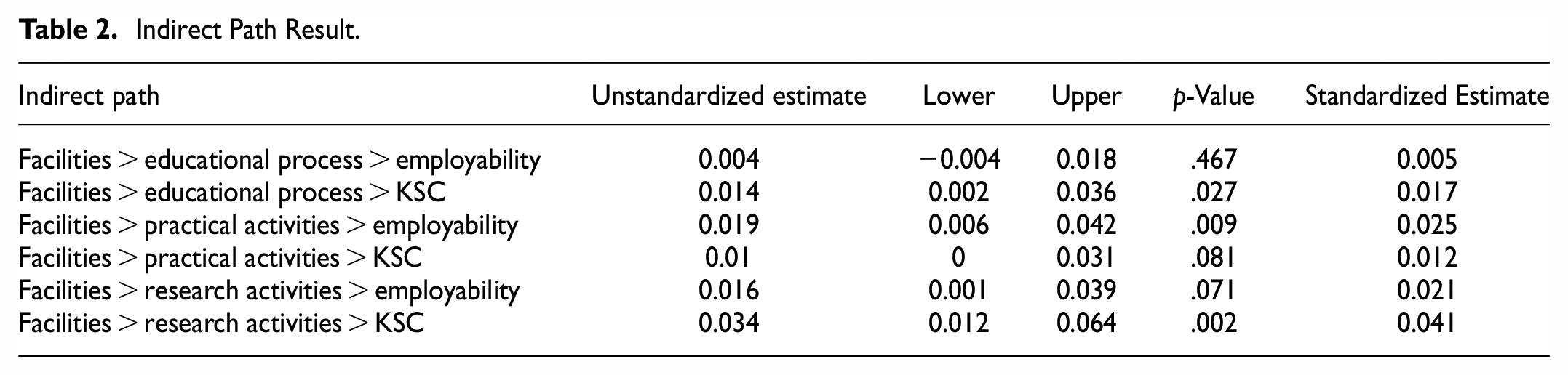
According to the findings of this study, Indonesian higher education institutions should improve their pedagogical and content quality to assure employability. Students are at the center of the educational process, and new issues develop on a daily basis. It is vital to improve students’ thinking, values, habits, self-concepts, needs, diversity, and academic background. Good feedback should be used to help students improve their knowledge, skills, and abilities (KSC) as well as their employability. Several prior research investigated how university professors implement learning. In various ways, they all strive to uncover fundamental characteristics or facets of teaching excellence. According to the study’s findings, effective learning implementation has clear objectives, is well-prepared and organized, has in-depth knowledge of the subject matter, is adept at communicating, makes appropriate use of information and communication technology, sequences materials and manages time, teaches and tests for higher-order cognitive outcomes, fosters student empathy, prioritizes goal alignment, education, and assessment, actively engages students, and is based on the research. Calculations and analysis of the indirect path between the variables employed in this study were performed as an additional test. Table 2 and Figure 1 show the results obtained.
Indirect Path Result.

The results estimated through SEM.
The results show that the influence of facilities on employability is not mediated by the educational process variable, implying that there is no indirect impact on the employability variable. A p-value of .467 or greater than .10 indicates that the results are significant. Facilities have a positive and significant effect on KSC through the educational process as a supported intervening variable, which can be asserted if there is an indirect relationship between facilities and KSC. The p-value of .027 (p = .10) demonstrates the outcome. The influence of facilities on employability is mediated by the practical activities variable, which means that facilities have a positive and significant effect on employability via practical activities as a supported intervening variable and can be stated if there is an indirect effect between facilities and employability—as indicated by the p-value of .009 (p = .10).
The influence of facilities on KSC is mediated by the variable of practical activities, which means that facilities have a positive and significant effect on KSC via practical activities as a supported intervening variable, and this can be stated if there is an indirect effect between facilities and KSC. The p-value of .081 (p = .10) demonstrates this. The influence of facilities on employability is mediated by the research activities variable, which means that facilities have a positive and substantial effect on employability as a supported intervening variable and can be asserted if there is an indirect connection between facilities and employability. The findings are based on a p-value of .071 (p = .10). Facilities have a positive and significant effect on KSC through research activities as a supported intervening variable, which can be claimed if there is an indirect connection between facilities and KSC. The p-value of .002 (p = .10) indicates the outcome.
The Plan-Do-Check-Act (PDCA) method is a useful methodology for improving the quality of an institution’s processes. Mursalim (2010) mentions various stages. The plan comprises evaluating which processes need to be improved, which improvements to make, and the data and information required for process improvement. Doing so entails gathering primary data about the process’s progress, executing desired adjustments (on a small scale), and maintaining data to determine discrepancies (there are improvements or not). The check covers the actions taken by the leader to interpret the implementation results (whether successful or not) or the leader’s efforts to learn more about the process under his jurisdiction. Act in the form of decision-making on which changes will be adopted, the creation of standard operating procedures, retraining for key members, and ongoing monitoring. Internal quality assurance in higher education is primarily concerned with providing quality assurance on the outputs. This assurance makes education, research, and community service more uniform (Tri Dharma).
Conclusions
The majority of the hypotheses in this investigation were confirmed, which has theoretical and practical ramifications. The educational process, practical activities, and research activities all have a substantial impact on KSC and employability. Similarly, facilities have a strong influence on instructional processes, as well as practical and research activities.
Facilities and the educational process, facilities and practicum activities, facilities and research activities, practical activities and employability, research activities and employability, and research activities and KSC all have significant linkages. The educational process has little effect on the impact of facilities on employability. It did, however, mediate the impact of facilities on KSC; the practical activity variable mediated the impact of facilities on employability; and the practical activity variables mediated the effect of facilities on KSC. Variables related to research activities moderated the impact of facilities on employability. The impact of facilities on KSC was moderated by variables related to research activities. The findings of this investigation are consistent with the findings of Gora et al. (2019) and Herlambang et al. (2021).
The correct regulations can encourage Indonesian universities to take responsibility for the evaluation and accreditation of their institutions in order to improve their graduates’ KSC and marketability. Sustainable learning environment regulations will help students by improving outcome-influencing factors.
The scope, sample size, and methodology of this study all have limitations. Additional researchers can widen the field of Higher Education Quality Management research, increasing its application. The sample size can then be extended so that the research findings can be more extensively generalized to universities in Indonesia. The final question concerns the technique, as the current study relies solely on questionnaires and limited focus group discussions. Future researchers can add methods like observation, experimentation, and interviews, which will be useful for similar tasks. Several limitations must be addressed in this study, including the study’s topic, sample size, and technique (Matadi & Uleanya, 2022). Further scholars can broaden the scope of their research into Higher Education Quality Management, expanding the reach of current research. Then, it can enhance the number of samples so that the research findings can be more extensively generalized to universities in Indonesia. The final point is concerning the approach, as the current study solely employs questionnaires and limited focus group discussions. Other methods, like as observation, experimental investigations, and interviews, can be added by future researchers to interest comparable tasks.
Footnotes
Appendix

| Educational Process | ||
|---|---|---|
| 1 | The Institution provides consulting services for students—EP1 | 1/2/3/4/5 |
| 2 | The Institution handles student complaints—EP1 | 1/2/3/4/5 |
| 3 | Learning achievements in each course is based on previous teaching and research results—EP2 | 1/2/3/4/5 |
| 4 | The order of teaching, knowledge, skills, and methodology used in the learning process follows each course’s learning outcomes—EP3 | 1/2/3/4/5 |
| 5 | The Institution has an information system used for each course’s learning process—EP4 | 1/2/3/4/5 |
| 6 | Lecturers and students collaborate in research—EP5 | 1/2/3/4/5 |
| 7 | The learning method used in the learning process is Student Center Learning—EP6 | 1/2/3/4/5 |
| 8 | Institutions support the implementation of learning that focuses on Student Center Learning—EP | 1/2/3/4/5 |
| 9 | Lecturers and students collaborate in implementing the Tri Dharma of Higher Education—EP7 | 1/2/3/4/5 |
| 10 | The learning tools used in the learning process are updated regularly—EP8 | 1/2/3/4/5 |
| 11 | The official regulations of the Institution determine the assessment component for each course—EP9 | 1/2/3/4/5 |
| 12 | The learning outcomes obtained follow the learning process that has been implemented—EP10 | 1/2/3/4/5 |
| Facilities | ||
| 1 | Classroom facilities and infrastructure owned by the Institution support the learning process—F1 | 1/2/3/4/5 |
| 2 | Classroom facilities and infrastructure owned by the Institution support the achievement of student learning outcomes—F1 | 1/2/3/4/5 |
| 3 | Classroom facilities and infrastructure owned by the Institution guarantee the implementation of the learning process well—F1 | 1/2/3/4/5 |
| 4 | Classroom facilities and infrastructure owned by the Institution are well maintained and managed—F1 | 1/2/3/4/5 |
| 5 | The learning information system owned by the Institution supports the learning process—F2 | 1/2/3/4/5 |
| 6 | The learning information system owned by the Institution supports the achievement of student learning outcomes—F2 | 1/2/3/4/5 |
| 7 | The Institution’s learning information system guarantees proper implementation of the learning process—F2 | 1/2/3/4/5 |
| 8 | The learning information system owned by the Institution is properly maintained and managed—F2 | 1/2/3/4/5 |
| 9 | The owned learning information system informs about the learning process, effectiveness, and student satisfaction—F2 | 1/2/3/4/5 |
| 10 | Internet access owned by the Institution supports the learning process—F3 | 1/2/3/4/5 |
| 11 | Internet access owned by the Institution supports the achievement of student learning outcomes—F3 | 1/2/3/4/5 |
| 12 | Internet access owned by the Institution ensures that the learning process is carried out properly—F3 | 1/2/3/4/5 |
| 13 | Internet access owned by the Institution is maintained and managed properly—F3 | 1/2/3/4/5 |
| Practical Activities | ||
| 1 | Merdeka Belajar Kampus Merdeka’s program opens opportunities for students to get hands-on learning—PA1 | 1/2/3/4/5 |
| 2 | Institutions support students to take part in the Merdeka Belajar Kampus Merdeka program—PA1 | 1/2/3/4/5 |
| 3 | Students have the opportunity to take part in the Merdeka Belajar Kampus Merdeka program for 4 (four) semesters—PA2 | 1/2/3/4/5 |
| 4 | Lecturers can participate as field assistants in the Merdeka Belajar Kampus Merdeka program—PA2 | 1/2/3/4/5 |
| 5 | The Institution always informs about Merdeka Belajar Kampus Merdeka’s program, which students and lecturers can participate in as Field Assistants—PA3 | 1/2/3/4/5 |
| 6 | Each Merdeka Belajar Kampus Merdeka program has a clear timeframe to make it easier to communicate with partners—PA3 | 1/2/3/4/5 |
| 7 | Field Lecturers accompany students in the Merdeka Belajar Kampus Merdeka program to help communicate with partners—PA3 | 1/2/3/4/5 |
| 8 | Partners in the Merdeka Belajar Kampus Merdeka program have a special assessment format based on applicable regulations—PA4 | 1/2/3/4/5 |
| 9 | Lecturers and students in the Merdeka Belajar Kampus Merdeka program obtain grades according to applicable regulations—PA4 | 1/2/3/4/5 |
| 10 | The Merdeka Belajar Kampus Merdeka program contributes to the development of student knowledge—PA5 | 1/2/3/4/5 |
| 11 | The Merdeka Belajar Kampus Merdeka program contributes to developing student competencies—PA5 | 1/2/3/4/5 |
| Research Activities | ||
| 1 | The teaching materials include the latest books, literature, and other scientific works—RA1 | 1/2/3/4/5 |
| 2 | Several courses require students to compile scientific work—RA1 | 1/2/3/4/5 |
| 3 | Doses are required to have scientific papers every year—RA1 | 1/2/3/4/5 |
| 4 | Institutions require professors to conduct research with students—RA2 | 1/2/3/4/5 |
| 5 | Students have the same opportunity to conduct research with the Professor—RA2 | 1/2/3/4/5 |
| 6 | Lecturers and students collaborate in scientific paper writing training—RA3 | 1/2/3/4/5 |
| 7 | Lecturers and students collaborate in the National Seminar—RA3 | 1/2/3/4/5 |
| 8 | Lecturers and students collaborate in International Seminars—RA3 | 1/2/3/4/5 |
| 9 | The Institution facilitates lecturers and students to collaborate in research—RA4 | 1/2/3/4/5 |
| 10 | The Institution provides awards in the form of incentives for national scientific publications—RA4 | 1/2/3/4/5 |
| 11 | Institutions provide awards in the form of incentives for international scientific publications—RA4 | 1/2/3/4/5 |
| 12 | Institutions always socialize regarding research activities to be carried out—RA5 | 1/2/3/4/5 |
| 13 | The Institution periodically holds training on writing scientific papers—RA5 | 1/2/3/4/5 |
| 14 | Institutions facilitate lecturers and students to collaborate in obtaining research funding—RA5 | 1/2/3/4/5 |
| 15 | Each research collaboration has the opportunity to obtain Research Funding from Institutions—RA6 | 1/2/3/4/5 |
| 16 | Lecturers and students can get scholarships when they excel in research—RA6 | 1/2/3/4/5 |
| Knowledge, Skill, and Competencies | ||
| 1 | The curriculum and learning outcomes set by the Study Program encourage students to improve their communication skills—KSC1 | 1/2/3/4/5 |
| 2 | The Institution facilitates students to be able to develop communication skills—KSC1 | 1/2/3/4/5 |
| 3 | The curriculum and learning outcomes set by the Study Program encourage students to increase their knowledge in their field—KSC2 | 1/2/3/4/5 |
| 4 | The curriculum and learning outcomes set by the Study Program encourage students to improve their competence in their field—KSC2 | 1/2/3/4/5 |
| 5 | The curriculum and learning outcomes set by the Study Program encourage students to improve their teamwork skills—KSC3 | 1/2/3/4/5 |
| 6 | The Institution facilitates students to be able to take part in activities to develop teamwork skills—KSC3 | 1/2/3/4/5 |
| 7 | The curriculum and learning outcomes set by the Study Program encourage students to improve their organizational skills—KSC4 | 1/2/3/4/5 |
| 8 | Association activities at the Faculty and Institution level improve organizational skills—KSC4 | 1/2/3/4/5 |
| 9 | The curriculum and learning outcomes set by the Study Program encourage students to improve their analytical and problem-solving skills—KSC5 | 1/2/3/4/5 |
| 10 | The learning method used increases the ability to analyze and problems solving—KSC5 | 1/2/3/4/5 |
| 11 | The curriculum and learning outcomes set by the Study Program encourage students to improve their entrepreneurial skills—KSC6 | 1/2/3/4/5 |
| Employability | ||
| 1 | Learning outcomes meet the eligibility requirements for students and graduates in similar fields—EM1 | 1/2/3/4/5 |
| 2 | Elements of the curriculum implemented by the Institution support students and graduates to meet job requirements in similar fields—EM1 | 1/2/3/4/5 |
| 3 | The Institution monitors the placement and career development of graduates in similar fields—EM1 | 1/2/3/4/5 |
| 4 | Learning outcomes meet the eligibility requirements for students and graduates in related fields—EM2 | 1/2/3/4/5 |
| 5 | Elements of the curriculum the Institution implements support students and graduates to meet job service requirements in related fields—EM2 | 1/2/3/4/5 |
| 6 | The Institution monitors the placement and career development of graduates in related fields—EM2 | 1/2/3/4/5 |
| 7 | Learning outcomes meet the eligibility requirements for students and graduates so they can open their businesses—EM3 | 1/2/3/4/5 |
| 8 | Elements of the curriculum implemented by the Institution support students and graduates to meet job service requirements so they can open their businesses—EM3 | 1/2/3/4/5 |
Declaration of Conflicting Interests
The author(s) declared no potential conflicts of interest with respect to the research, authorship, and/or publication of this article.
Funding
The author(s) disclosed receipt of the following financial support for the research, authorship, and/or publication of this article: This research was funded by Mapúa University Directed Research for Innovation and Value Enhancement (DRIVE).
