




Abstract
The Positive Metacognitions and Positive Meta-Emotions Questionnaire (PMCEQ) of Beer and Moneta measures adaptive metacognitive beliefs when facing challenging situations. The psychometric properties of a Polish version of the PMCEQ are reported. The cultural adaptation of the instrument was conducted in a representative sample of adult Poles (n = 600). The original three-factor structure of the PMCEQ was corroborated by confirmatory factor analysis. Further psychometric analyses indicated that the instrument produces valid and reliable measurements of adaptive metacognitive beliefs in the Polish population.
Introduction
Adaptive metacognition as conceptualized by Brinol and DeMarree (2012) plays important self-regulatory functions in opposition to maladaptive metacognition (Wells & Cartwright-Hatton, 2004). According to Beer and Moneta (2010), “the adaptive use of object and metacognitive modes requires metacognitive beliefs of an agentic type that support identification of alternative pathways and flexible goal restructuring” (p. 978). Moreover, the authors propose that such adaptive metacognitive beliefs require meta-emotions of interest and curiosity in an individual’s own emotional responses to challenging situations.
Beer and Moneta (2010) identified adaptive metacognitive beliefs that foster success in facing challenging situations among highly self-regulated and resilient individuals. Thematic analysis revealed three main metacognitive factors that helped them to manage challenges successfully: awareness of the need to free attention resources and experience positive emotions, confidence in interpreting emotions as cues that help to solve the problem, and confidence in setting a sequence of goals even in long-term hierarchies that make success plausible. The latter means that a person is able to systematize the hierarchy of goals—from elementary to final ones.
Further analysis permitted constructing the Positive Metacognitions and Positive Meta-Emotions Questionnaire (PMCEQ; Beer & Moneta, 2010). Beer and Moneta clearly support the three-factor structure of the PMCEQ in two independent studies. Factor 1 is called the “Confidence in Extinguishing Perseverative Thoughts and Emotions” with items such as “I tend to overreact when things are really going wrong” (reversed). Factor 2, named “Interpreting Own Emotions as Cues, Restraining From Immediate Reaction, and Mind Setting for Problem Solving” was assessed via items such as “I can stop any ‘negative thinking spirals’ and focus on what I can do in the situation.” Factor 3, called “Confidence in Interpreting Own Emotions as Cues, Restraining From Immediate Reaction, and Mind Setting for Problem Solving,” was represented by items such as “If I were overwhelmed by a big task, I would stop and take smaller steps.”
Beer and Moneta (2010) not only produced the clear factorial structure of the instrument but also provided an assessment of the concurrent validity of the PMCEQ. Each of the three factors of the PMCEQ was negatively correlated with the five factors of the Maladaptive Metacognitions Questionnaire (MCQ-30) developed by Wells and Cartwright-Hatton (2004). Moreover the three factors of the PMCEQ correlated positively with intrinsic motivation, but they correlated negatively with extrinsic motivation (Work Preference Inventory; Amabile, Hill, Hennessey, & Tighe, 1994, based on self-determination theory, Deci & Ryan, 1985).
The objective of our study was to establish the construct and concurrent validity of a Polish version of the PMCEQ developed by Beer and Moneta (2010). To this end, we examined the factor structure of the Polish version of the PMCEQ, and we hypothesized the exact three-factor structure of the original PMCEQ (Beer & Moneta, 2010). We extended our analysis of construct validity by establishing convergent validity with a popular Big Five measure: the International Personality Item Pool - Big Five Markers - 20 (IPIP-BFM-20; Strus, Cieciuch, & Rowiński, 2014, based on Goldberg, 1992), and the Neuroticism-Extraversion-Openess Personality Inventory-Revised (NEO-PI-R; Costa & McCrae, 1992).
We also aimed to examine the reliability and concurrent validity of the instrument. This was done by correlating the three factors of PMCEQ with another adaptive metacognitive measure (Metacognitive Self Questionnaire [MSQ-24], Brycz & Konarski, 2016) and another maladaptive metacognitive measure (MCQ-30, Cartwright-Hatton & Wells, 1997, Polish version—Dragan & Dragan, 2011).
The metacognitive-self pertains to accurate knowledge about an individual’s own biases and psychological regularities that foster self-regulation, such as pathetic illusion (Deutsch, 1960), positivity bias (Weinstein, 1980), rules of social learning theory (Bandura, 1977), the perception of nonverbal behavior (Argyle, 1991), and others. Each psychological law, or bias, is presented in an episodic way, for example, for positivity bias “I tend to judge other people positively rather than negatively.” The MSQ-24 measures accurate self-insight in an individual’s own biased behavior. A person acquires this specific kind of insight while thinking about his or her own biased behavior and experiencing, even at first glance, negative emotions. An individual with a highly developed metacognitive-self accepts, over time, biases or psychological regularities as immanent aspects of human behavior. Thanks to a high degree of metacognitive self-insight, an individual is more persistent in the face of challenge, accepts uncontrollability (Brycz, Jurek, Pastwa-Wojciechowska, Peplińska, & Bidzan, 2014), and exhibits better self-regulatory functions (Brycz, Wyszomirska-Góra, Bar-Tal, & Wisniewski, 2014). However, there is no correlation between MSQ-24 and self-esteem (Rosenberg & Gara, 1985). We hypothesize either a negative correlation or a lack thereof between PMCEQ Factor 1 and MCQ-24. If our suppositions are true, this might result from the necessity of engaging in perseverative thoughts or negative emotions as the first step of accurate self-insight knowledge acquisition. MCQ-24 allows for better goal attainment and flexibility of behavior in concordance with current affect, while current affect is treated as a cue in concordance with the meaning of PMCEQ Factor 2. Moreover, because we know that a higher metacognitive-self fosters self-regulation and goal attainment, we hypothesize a positive correlation between PMCEQ Factors 2 and 3 (mind setting for problem solving) and the MSQ-24.
Our further suppositions are related to correlations between five factors of the MCQ-30 and the three of the PMCEQ. The MCQ-30 (Cartwright-Hatton & Wells, 1997) was created to measure maladaptive metacognition. Results of numerous studies (Wells, 2009; Yilmaz, Gencoz, & Wells, 2011) indicate that negative beliefs about worry concerning uncontrollability of thoughts and danger, and cognitive resource limitations are crucial for Cognitive-Attentional Syndrome (CAS). Moreover, the results of these studies show that positive beliefs about worry and the need to control thoughts are strong predictors of both anxiety and depression. The MCQ-30 consists of the five following factors: (a) cognitive confidence that measures confidence regarding beliefs about the need to control attention and memory, (b) positive beliefs about worry that measures the tendency of a person to monitor his or her own thoughts and focus attention inward, (c) cognitive self-consciousness that measures the extent to which a person thinks that perseverative thinking is useful, (d) negative beliefs about the uncontrollability of thoughts and danger that assesses the extent to which a person thinks that perseverative thinking is uncontrollable and dangerous, and (e) beliefs about the need to control thoughts that assesses the extent to which a person believes that certain types of thoughts need to be suppressed. In accordance with the results of Beer and Moneta (2010), we expect the same negative correlations between MCQ-30 factors (MCQ-30, Cartwright-Hatton & Wells, 1997; Polish version—Dragan & Dragan, 2011) and the three PMCEQ factors in the Polish population.
Moreover, it is plausible to predict positive correlations between the three PMCEQ factors and at least two of the IPIP-BFM-20 factors of conscientiousness and emotional stability, which are personality traits that favor personal and professional success.
Method
Participants
A nationally representative sample of n = 600 adult Poles between the ages of 17 and 85 participated in the study. Among the participants, 312 were female (M age = 44.74 years, SD = 15.97 years) and 288 were male (M age = 46.69 years, SD = 17.10 years). The education structure of the sample matched that of the Polish population and comprised 20.5% participants with primary, 24.7% with basic vocational, 35.7% with high school, and 19.1% with higher education.
Procedure
The study was approved by the Polish Ethical Committee as compliant with ethical principles. Participants were selected randomly from the personal identity number registry and approached individually at their places of residence. The participants were informed about the scientific aims of the study, and assured about anonymity. There was no reward for participation in the study. Each participant completed the entire battery of questionnaires that included the PMCEQ, the MSQ-24, the MCQ-30, and the PIP-BFM-20 (described below). Completion of the questionnaires took approximately 25 min. At the end of each interview, all participants were thanked and fully debriefed.
Measures
The PMCEQ (Beer & Moneta, 2010) is an 18-item instrument that assesses three factors of adaptive metacognitive beliefs: (a) Confidence in Extinguishing Perseverative Thoughts and Emotions; (b) Confidence in Interpreting Own Emotions as Cues, Restraining From Immediate Reaction, and Mind Setting for Problem Solving; and (c) Confidence in Setting Flexible and Feasible Hierarchies of Goals. Each factor is measured by six items with a four-point response scale: 1 = do not agree, 2 = agree slightly, 3 = agree moderately, and 4 = agree strongly. The questionnaire was translated to Polish and then back-translated into English by an individual not previously involved in the translation process. Discrepancies between original and back-translated items were discussed and resolved through revision of the Polish translation. A copy of the Polish version of the PMCEQ is presented in the appendix.
The MSQ-24 (Brycz & Konarski, 2016) is a short version of the MSQ-40 (Brycz & Karasiewicz, 2011). The MSQ-24 assesses a single metacognitive factor with 24 items in four content domains (memory, attribution, great laws of psychology and persuasion, and social influence). Each item presents a bias or psychological law in the form of episodic behavior. For each item, individuals are asked to respond to the following question: How much is each statement congruent with your behavior, thoughts, and/or feelings. Responses followed a six-point Likert-type scale ranging from 1 (definitely not) to 6 (definitely yes).
The Polish version of the Metacognitions Questionnaire–30 (MCQ-30; Dragan & Dragan, 2011; Wells & Cartwright-Hatton, 2004) is a 30-item version of the MCQ (Cartwright-Hatton & Wells, 1997) developed to assess five correlated metacognitive factors: (a) cognitive confidence, (b) positive beliefs about worry, (c) cognitive self-consciousness, (d) negative beliefs about uncontrollability of thoughts and danger, and (e) beliefs about need to control thoughts. Each factor is measured by six items with a four-point response scale ranging from 1 (do not agree) to 4 (agree very much).
The short version of the Polish adaptation of the 50-item Big Five Personality Traits (Goldberg, 1992) questionnaire (Strus et al., 2014), IPIP-BFM-20 (Topolewska, Skimina, Strus, Cieciuch, & Rowiński, 2014) is a 20-item version of the 50-item Polish adaptation of the Big Five (IPIP-BFM-50; Strus et al., 2014) that assesses five personality factors: (a) extraversion, (b) agreeableness, (c) conscientiousness, (d) emotional stability, and (e) intellect/imagination. Each factor is measured by four items with a five-point response scale ranging from 1 (completely inaccurate as a self-description) to 5 (completely accurate as a self-description).
Results
Psychometric Analyses
The first task in the current study was to confirm the construct validity of the PMCEQ in the Polish population. The three-factor structure developed by Beer and Moneta (2010) for the PMCEQ was evaluated by confirmatory factor analysis (CFA) for discrete indicators using LISREL 8.8 (Jöreskog & Sörbom, 2006). The CFA model was tested using the robust (diagonally) weighted least squares estimator with a polychoric correlation matrix. Because the value of the chi-square model-fit test statistic is inflated by large sample size, fit was also assessed using three widely used indices of fit: the root mean square error of approximation (RMSEA), the comparative fit index (CFI), and the adjusted goodness of fit index (AGFI).
Prior to the assessment of convergent validity, the reliability of the measures was estimated. It is widely known that traditional internal consistency reliability indices such as Cronbach’s alpha underestimate reliability when items are not essentially tau equivalent (when they have unequal factor loadings; Graham, 2006) or when the item response scale is not continuous (Gadermann, Guhn, & Zumbo, 2012). As the assumption of tau equivalence is unlikely to hold for our measures and the item response scales are ordinal, we utilized internal consistency reliability based on nonlinear CFA utilizing polychoric correlations.
Concurrent validity was assessed by correlating the three subscale scores of the PMCEQ with measures of related metacognitive constructs (MSQ-24, MCQ-30), whereas convergent validity was assessed by correlating the three subscores of the PMCEQ with five personality factors (IPIP-BFM-20).
Testing the PMCEQ Factor Structure in the Polish Population
Prior to performing the statistical analyses of the PMCEQ, the direction of the response scale of the six items of the first factor (Item 1 to Item 6) was reversed to be congruent with the remaining items. The chi-square test statistic of the hypothesized three-factor model was statistically significant (
Factor Loadings With Standard Errors (in Parentheses) for a 3-Factor Model for the PMCEQ Items.
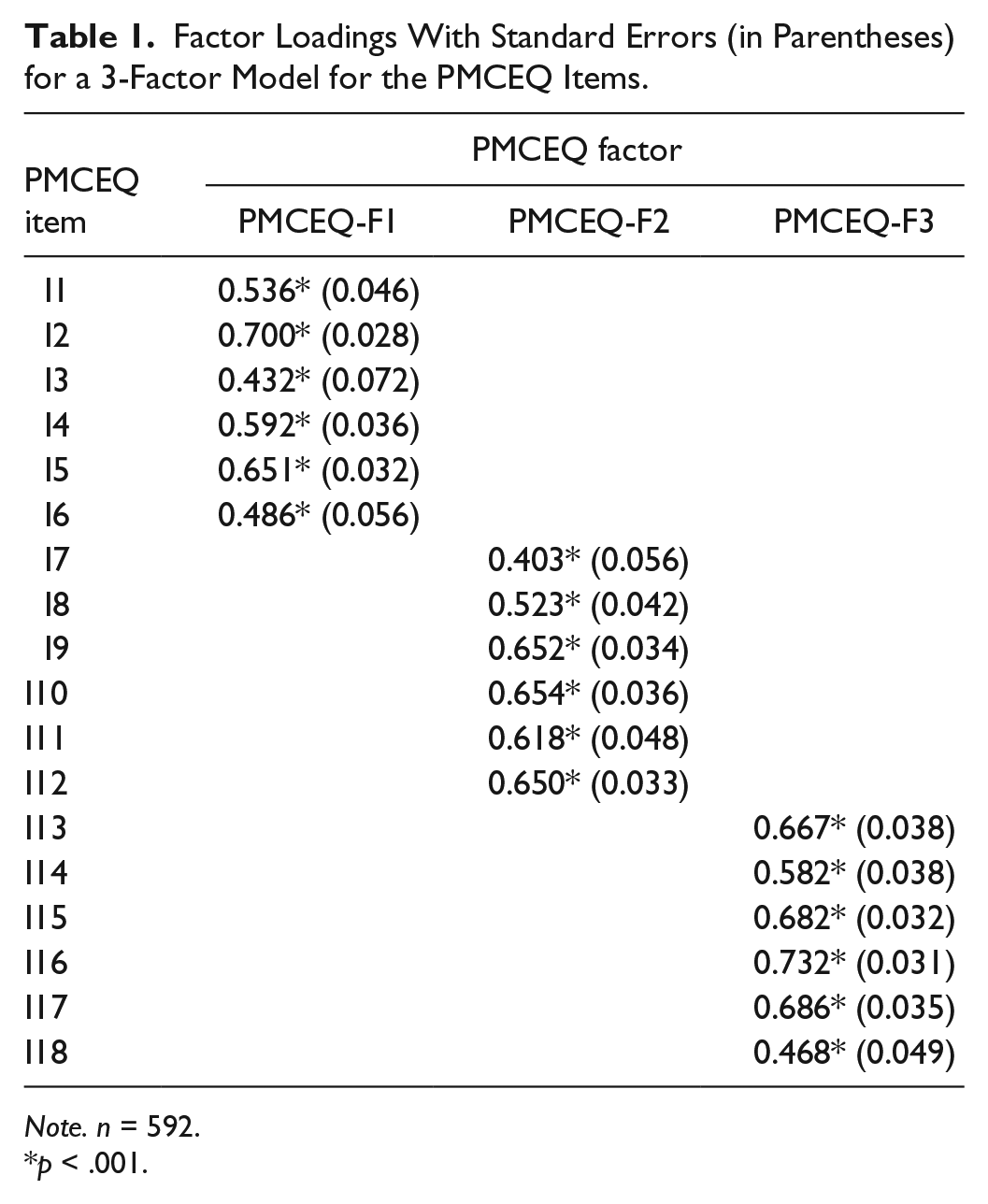
Note. n = 592.
p < .001.
The relatively high correlation between PMCEQ-F2 and PMCEQ-F3 led us to test the adequacy of a two-factor model, in which the items of PMCEQ-F2 and PMCEQ-F3 were indicators of a single (“combined”) factor. Although the fit of the two-factor model was acceptable (
Reliability of the Measures
Reliability coefficients omega (McDonald, 1999), based on polychoric correlations for the measures obtained with the psych-package (Revelle, 2015) for the R system, are presented in Table 2.
Means, Standard Deviations, and Ordinal Reliability Estimates for the Measures in the Study.

Table 2 shows acceptable levels of measurement reliability for all measures used in this study. The reliability indices range from .75 to .93, while those for the three PMCEQ factors range from .79 to .86. Overall, the lowest levels of reliability were obtained for the five personality factors (IPIP-BFM-20-F1 to IPIP-BFM-20-F5), which can be explained by the relatively short (four-item) subscales in the IPIP-BFM-20.
Assessment of Concurrent and Convergent Validity
Validity coefficients corrected for attenuation (McDonald, 1999) for the three factors of the PMCEQ are shown in Table 3. It shows that the pattern of validity coefficients is as expected with negative coefficients between PMCEQ-F1 and the MSQ-24 and the five factors of the MCQ-30 within a range of −0.44 and −0.21. Moreover, as expected, the two remaining factors of the PMCEQ—PMCEQ-F2 and PMCEQ-F3—show relatively high positive correlations with MSQ-24 and the five personality factors of IPIP-BFM-20-F1 to IPIP-BFM-20-F5.
Convergent Validity Correlation Coefficients Corrected for Attenuation.

Note. n = 600.
p < .05 for uncorrected correlation coefficients. **p < .01 for uncorrected correlation coefficients. ***p < .001 for uncorrected correlation coefficients.
Discussion
We demonstrated construct validity and acceptable measurement reliability for the PMCEQ (Beer & Moneta, 2010) in a nationally representative sample of Poles. The analyses of the factor structure of the PMCEQ confirmed the three-factor structure of the original English version of the instrument. Moreover, the measurement reliability of the PMCEQ in the Polish population was shown to be similar to that obtained by Beer and Moneta (2010).
The results of the assessment of concurrent validity followed those obtained by Beer and Moneta (2010). As can be seen in Table 3, all five factors of the MCQ-30 negatively correlated with the three factors of the PMCEQ, which indicates the difference between maladaptive (MCQ-30) and adaptive (PMCEQ) metacognition. The more participants were immersed in positive meta-emotions and thoughts (PMCEQ), the less they were prone to depression connected with CAS (Wells, 2009).
Moreover, concurrent validity assessment revealed the expected positive correlations between PMCEQ Factors 2 and 3 and the MSQ-24, which indicated that participants who highly favored the hierarchy of goals (Factor 3, PMCEQ) and valued mind setting for problem solving and treating emotions as clues restraining from immediate reaction (Factor 2, PMCEQ) were also high in the accurate assessment of their biases. Both Factors 2 and 3 are more associated with cognition, social cognition, and rational thinking about self-regulation and goal pursuit in the face of challenging circumstances. The MSQ-24 is also a good indicator of the adaptive metacognition. However, the MSQ-24 was not created to assess emotions. Positive meta-emotions embedded in Factor 1 of the PMCEQ correlated negatively with the MSQ-24. The direction of the correlation obtained was as predicted. It is evidence based that a person who tries to acquire accurate knowledge about his or her own biases has to experience a long process during which negative emotions about his or her behavior are balanced by the acceptance of his or her social behavior as typical behavior of human beings. However, once a person possessed high metacognitive self-knowledge, she or he has the self-regulation ability to foster goal pursuit and to undertake challenges.
Convergent validity was assessed by correlating the PMCEQ factors with the Big Five (IPIP-BFM-20) personality factors. As predicted, the PMCEQ factors correlated positively with the conscientiousness and emotional stability factors. Emotional stability correlates highly with all three PMCEQ factors. Conscientiousness correlates positively with PMCEQ Factors 2 and 3. The positive correlations found between PMCEQ Factors 2 and 3, and extraversion, agreeableness, and intellect of the IPIP-BFM-20 seem very interesting. The IPIP-BFM-20 recognizes extraversion as a trait in which cordiality plays an important role (Ashton & Lee, 2001). A similar approach to agreeableness saturates the trait in question more with morality and modesty. Positive emotions embedded in extraversion and agreeableness are in concordance with Beer and Moneta’s (2010) understanding of the adaptive and positive role of meta-emotions. Moreover, intellect/imagination positively correlates with the three PMCEQ factors.
The results suggest that the Polish version of PMCEQ has good psychometric properties, and it appears to be a valid and reliable instrument for research in the area of adaptive metacognition.
Hopefully, the Polish version of the PMCEQ will help researchers in further inquiries on the role of metacognition and adaptive positive meta-emotions in prohealth behavior and goal attainment, and in general adaptive behavior. Metacognition is one of the most studied psychological phenomena, and it is crucial to distinguish the positive role of metacognition (PMCEQ) from the maladaptive (MCQ-30).
Footnotes
Appendix

| Pyt. |
KWESTIONARIUSZ NILS BEER & GIOVANI MONETA
|
Nast. pyt. | ||||
|---|---|---|---|---|---|---|
| Zdecydowanie się nie zgadzam | Raczej się nie zgadzam | Raczej się zgadzam | Zdecydowanie się zgadzam | |||
|
|
Trudno mi zmienić nastrój, gdy mam “dół psychiczny.” |
|
|
|
|
|
|
|
Jeśli sprawy nie układają się po mojej myśli, mam tendencję do długiego dumania I zastanawiania się nad tym. |
|
|
|
|
|
|
|
Kiedy przytłacza mnie żałość walczę z próbą zmiany nastroju na lepsze/ nie chcę kontrolować mego kiepskiego nastroju. |
|
|
|
|
|
|
|
Reaguję nadmiernie, gdy moje sprawy źle się układają. |
|
|
|
|
|
|
|
Gdy coś mi się nie układa mam skłonność do “zawieszania” myśli na tej sprawie. |
|
|
|
|
|
|
|
Myślę, że moje obawy mogą stać się rzeczywistością. |
|
|
|
|
|
|
|
W trudnych sytuacjach “racjonalizuję” swój lęk i oceniam co jest dla mnie korzystniejsze: ucieczka czy zmierzenie się z problemem. |
|
|
|
|
|
|
|
Staram się potraktować swoje uczucia jako fakt i właściwie je ocenić. |
|
|
|
|
|
|
|
Potrafię zatrzymać spiralę nakręcającą negatywne myśli i skupić się na tym co mam zrobić w danej sytuacji. |
|
|
|
|
|
|
|
Gdy pojawia się nieprzewidywalna sytuacja to zamiast się złościć próbuję racjonalnie ocenić co się dzieje. |
|
|
|
|
|
|
|
Potrafię swobodnie podjąć decyzję dotyczącą moich ważnych spraw i czuć się pewnie nawet gdy borykam się z trudnymi zdarzeniami. |
|
|
|
|
|
|
|
Kiedy wiem, że będę surowo oceniany/a staram się działać w myśl motta “Nie ma problemów są tylko rozwiązania.” |
|
|
|
|
|
|
|
Umiem łatwo podzielić ważne długoterminowe cele (plany) na osiągalne i krótkoterminowe cele składowe. |
|
|
|
|
|
|
|
Potrafię znaleźć priorytety wśród moich potrzeb i według nich systematyzować cele. |
|
|
|
|
|
|
|
Kiedy wiem że ogromne zadanie, które przede mną stoi jest zbyt trudne do rozwiązania natychmiast, mam skłonność do uporządkowania zadania według małych kroków by osiągnąć ten duży cel. |
|
|
|
|
|
|
|
Potrafię działać stopniowo krok – po kroku, by usunąć przeszkody gdy progres (wyraźny efekt mej pracy) wydaje się zbyt wolny lub utrudniony. |
|
|
|
|
|
|
|
Gdy problem wydaje się nie do pokonania, wiem, że to w rzeczy samej kwestia “poszatkowania” problemu w mniejsze cząstki – podcele. |
|
|
|
|
|
|
|
Gdyby jakieś duże zadanie mnie przytłoczyło, zatrzymam się i będę realizować mniejsze zadania. |
|
|
|
|
|
Beer and Moneta (2010) , (za zgodą autorów).
Declaration of Conflicting Interests
The author(s) declared no potential conflicts of interest with respect to the research, authorship, and/or publication of this article.
Funding
The author(s) received no financial support for the research, authorship, and/or publication of this article.