




Abstract
The emergence of decentralization throughout the world has provoked question whether decentralization has played several important roles in fostering accountable and responsible governance. As the concept of governance expanded, so did thinking about the rationale, objectives, and forms of decentralization. Decentralization now encompasses not only the transfer of power, authority, and responsibility within the government but also the sharing of authority and resources for shaping public policy within society. One of the important reasons that drives Indonesian government to deliver a democratic decentralization is political motivation. This relates to the growing intention to local development throughout the country posed the need for political and administrative arrangement to meet the country’s diversity. This study describes and explores the nature and the process of political devolution in the context of local government in Indonesia, in particular assessing the political devolution performance in the regency of Jember. This article employs a model that combines Boex and Yilmaz and the Local Governance Barometer framework for assessing political devolution performances. The article focuses on those issues and on the opportunities for the local government to improve the most important basic needs of the people—education and health sectors in Indonesia.
Political Devolution and the Notion of Democratic Local Governance
The emergence of decentralization throughout the world has provoked the question whether decentralization has played several important roles in fostering accountable and responsible governance. As the concepts and forms of decentralization have become more diverse so have the objectives of its advocates. Cheema and Rondinelli (2007) outline three forms of decentralization, that act as a way for transferring authority, responsibility, and resources—through deconcentration, delegation, or devolution—from the center to lower levels of administration. These conceptions can be traced back to the 1980s, when Cheema and Rondinelli studied the implementation of decentralization in a developing country context. Their study outlined that in diverse units of government, local autonomy in a decentralized mode of government (DMG) is more likely to produce a diversity of policy responses. It is offering an option for the local government for producing and opportunities of local development that is attached to the needs of the locals. Also, democratic local governance requires governments to create or strengthen channels and mechanisms for public participation in the decision-making process as well as abiding the rule of law, increasing transparency in public procedures, and holding officials accountable (Kaufmann, Kraay, & Mastruzzi, 2004).
Political decentralization, also known as political devolution, focuses on organizations and procedures for increasing citizen participation in selecting political representatives and in making public policy; changes in the structure of the government through devolution of powers and authority to local units of government; power-sharing institutions within the state through federalism, constitutional federations, or autonomous regions and institutions; and procedures allowing freedom of association and participation of civil society organizations in public decision making (Siedentopf, 1987; Smith, 1997; World Bank, 2000).
As one of the important aspects of decentralization, political devolution is largely focused on organizations and procedures for increasing citizen participation in selecting political representatives and in making public policy. Moreover, political devolution promotes the principles of democratization in the sense of assisting the development of responsive policies and services, and provides more meaningful opportunities for participation in the political process (Cheema & Rondinelli, 2007). In short, it will promote the values of “bringing government closer to the people.” From this framework, we can understand decentralization provides people a greater accessibility, accountability, and responsibility to the local jurisdictions of political and administrative authority.
Many theoretical reasons have been put forth over many years as to why democracies should exhibit better quality of government than autocracies. Promoting the values and the principle of democratization, decentralization also aims to increase the quality of government. The quality of government has been often associated with the term of governance (University of Gothenburg, Department of Political Science, The Quality of Government Institute, 2010). The most frequently used definition of governance is derived from World Bank. Governance is
the traditions and institutions by which authority in a country is exercised. This includes: (1) the process by which governments are selected, monitored, and replaced, (2) the capacity of the government to effectively formulate and implement sound policies, (3) the respect of citizens and the state for the institutions that govern economic and social interactions among them. (Kaufmann et al., 2004, p. 254)
Moreover, Rondinelli and Cheema (2003) argue that decentralization processes include government structural and institutional reform and development of the legislature. With this we see that decentralization provides an opportunity to achieve better governance. This is seen as a precondition of good governance. On the contrary, the supporters of decentralization convince that decentralization will benefit and promote the quality of government as well as good governance. Several theorists endorse decentralization as an important tool for improving the quality of government. Some of them are as follows: Ostrom, Schoreder, and Wayne (1993); Tiebout (1956); and Inman and Rubinfield (1997). Those theorists believe that decentralized units of government have a greater incentive to be more efficient, as well as providing competition among local governments.
This means that decentralization is assumed to increase the possibility that government will respond to local demand (Tiebout, 1956). Furthermore, competition allows a variety of bundles of local public goods to be produced, and individuals can reveal their preferences for those goods by exercising some forms of extreme exit options such as moving jurisdictions to satisfy their tastes. Logically, then, local government should pay attention to the preferences of the citizens to avoid risking the loss of tax revenue (Oates, 1972). Treisman (2002) in his study of Decentralization and the Quality of Government explores three reasons for expecting that decentralization should improve the quality of government. They are as follows: making local officials more accountable, improving public officials’ knowledge of local conditions, and facilitating a better matching of policies to local needs and interests.
From the perspective of political devolution, Burki, Perry, and Dillinger (1999) propose that the trends toward decentralization are an outcome of the declining credibility of the centralized state and are part of a broader trend toward democracy. Moreover, many agree that there is a relationship between decentralization and the spread of democratic principles. Among these theorists are Smith (1985) and Burki et al. (1999). In addition, donors such as the World Bank (2000) have been supporting and endorsing decentralization.
Decentralization is regarded as transformative. Falleti (2010) argues that decentralization is transformative in its ability to transfer the role of central government under the principle of subsidiarity. That is, decentralization enables smaller localities to collect and allocate resources and make public policy decisions at the lowest possible level of government. Furthermore, Smith (1985) argues that decentralization is transformative because it has several educative aspects on the principles of democracy. He believes that decentralization attaches training in democratic political leadership in a local government setting. This will provide local seedbeds for prospective political leaders to develop their skills in policy-making processes. Decentralization will provide the local stakeholder with a training ground that attaches to its own localities as well as to local wisdom. This will create a talent pool that will enhance the quality of local and regional politicians.
In addition, political devolution offers the local sphere, a local wisdom, that endorses the fulfillment of localities interest. Thus, the decentralized system will attach more importance to the notion to supporting the potential of localities in a creative process than in a centralized government context. Highly centralized government tends to be unresponsive, inefficient, as well as detaching localities from their local wisdom. This article argues that political devolution endorses the value of diversity of government units in autonomy and is more likely to produce a diversity of policy responses that responds to the localities’ preferences.
Approach for Assessing Political Devolution in a DMG
In assessing the political devolution performance in the governance of health and education sectors, this article combines two existing models as a framework: the universal local governance index model develops by United Nations Development Programme (UNDP) and Impact Alliance (Laberge, Moretto, Narang, & Wilde, 2010) and the framework of comparative decentralization developed by Boex and Yilmaz (2010). A distinct feature of the framework developed by Boex and Yilmaz is its flexibility in capturing variations across countries, while, on the contrary, the universal model of local governance index remains valid in any country context, although it is essential that it is transformed into a “specific/local model” to reflect the local context and local priorities (Laberge et al., 2010, p. 61). Thus, this article will adjust the model by presenting a scale of performance, a simple presentable scale that strengthens, simplifies, and converts the qualitative data from the fieldwork and interviews. With this adjustment, both of these models complement each other, especially in providing a framework of assessment that reflects and represents the local context and local priorities for describing the strengths and weaknesses of a specific governance situation (Laberge et al., 2010).
Table 1 represents the assessment framework for data analysis for the study reported in this article following merging of these two models.
Framework for Assessing Political Devolution Performance in a DMG.

Source. Constructed from Boex and Yilmaz (2010) and Laberge, Moretto, Narang, and Wilde (2010).
Note. DMG = Decentralized Mode of Government.
In the process of data analysis, this research uses qualitative framework analysis to provide clear steps to follow and produces highly structured outputs of summarized data (Gale, Heath, Cameron, Rashid, & Redwood, 2013). The process of data analysis comprises two stages. The first stage incorporates interactive data analysis following Miles, Huberman, and Saldana’s (2014) argument on three concurrent flows of activity known as the “interactive data analysis.” In the second stage of analysis, data display, data from the first stage become the baseline for the application of bipolar scale for weighing the answer of the key informant, as well as marking their answers and preferences (McCroskey, Richmond, Emmert, & Barker, 1989) toward the performance of political devolution and its impact to governance of the health and education sectors in a DMG.
The analysis process started with the application of bipolar scale. The bipolar scale is a rating measurement response format which the respondent registers his or her position along a continuum of value, characterized by a continuum between two opposite end points, such as “extremely agree” and “extremely disagree” (Kennedy, 2008; McCroskey et al., 1989). The second stage of analysis uses bipolar scale for weighing the answer of the key informant, as well as marking their preferences to several questions from the semistructured question surround the political devolution performance on the governance of allocating resources for the health and education sectors in the regency of Jember.
Table 2 presents the value scale for marking the governance performance. This value scale ranges from +1 to −1. The simple scaling process of the barometer was achieved by using Microsoft Excel. The data analysis at this stage proceeded by scoring each answer from the key informants and followed by generating average score from the key informant answer. This was calculated by comparing real values (data inputs) with reference to the semistructured interviews with the research key informant, local and central government documents, and local references such as local media and civil society opinion. Finally, all of the scores were processed using Microsoft Excel to produce a barometer of political devolution performance.
Value Scale of Political Devolution Performance in a Decentralized Mode of Government.

The setting for the research reported in this article is local governments’ regencies in East Java bounded by specific characteristics. The regency of Jember represents a local government area with an urban characteristic, with annual regional gross domestic products of 19,210.151 trillion rupiah (East Java Province Bureau of Regional Planning and Development, 2011). It covers an area of 3,092.34 square kilometers, incorporating 31 subdistricts and 248 villages as well as 82 small islands. The discussion will continue to focus on the performance of the political devolution performance on the governance of the health and education sectors in the regency of Jember, especially with the focus whether the political devolution enhances the governance of the health and education sectors in a decentralized mode of local government in Indonesia.
Decentralization and the Shape of Local Governance in Indonesia
Up to 1998, the process of decentralization in Indonesia was, at best, well planned but poorly implemented. The legal frameworks for implementing decentralization at provincial and local government levels, embedded in Law No. 5/1974, held promise for decentralization (Devas, 1997). The system carrying out the implementation was itself centralist (Ferrazzi, 2000; McAndrews, 1986; J. W. Schiller, 1996). Since the fall of the Soeharto regime in 1998, a flurry of openness about the newly decentralized system has emerged in Indonesia.
Law No. 22/1999 was the new law producing new directions toward decentralization in Indonesia. In short, Kaho, Bayo, Parlindungan, Jamson, and Mada (2012) conclude the essence of the new law reversed the old directions of communication between central and local government while giving more responsibility to the provinces, cities, and regencies. Moreover, local government is now assigned to functions other than those explicitly handled by the local government. Several important points from the Law No. 22/1999 are as follows: First, area, the territory of Indonesia, is divided into autonomous provincial regions, regency regions, and municipal regions, this means that’s a region has full authority in the field of governance (Chapter II); second, the complete and full implementation of local autonomy is the responsibility of each regency/municipality/city (Chapter III); third, head of the district (Bupati) is responsible to DPRD (Dewan Perwakilan Rakyat—local Parliament), while DPRD can propose the dismissal of Bupati to the central government (Chapter V); and fourth, this law also regulates village governance and its apparatus as Kepala Desa (head of the village) and Badan Perwakilan Desa (BPD—Village Representative Board) (Chapter XI).
Law No. 22/1999 empowers local government with the right to regulate, allocate, and utilize national resources, as well as intergovernmental fiscal relations between central and local government. However, the law creates confusion on the aspect of authority for distribution between provincial and regional government (Seymour & Turner, 2002). Chapter IV of Law No. 22/1999 sets out new areas of responsibilities for provincial and regional governments under a DMG. The central government retains control over international politics, defense, national security, judiciary, monetary and fiscal policy, and religion. Provincial and regional governments were granted authority outside these areas.
Furthermore, Seymour and Turner (2002) conclude the new law only added more confusion about power distribution between tiers of government. It confuses local government stakeholders, as well as the business sector and international investors. Changes to Law No. 22/1999 in the absence of a transition period have given rise to various problems for the local government in a DMG. The lack of capacity of local government institutions, the emergence of the Raja Kecil (Little Kings) or local elites who dominates the local politics (Barr et al., 2006), conflict between the local Parliament/legislatures (DPRD) and head of the local government, and a variety of other problems are some of the issues that are attached to the arrival of decentralization in Indonesia (Erb & Anggal, 2009; Mietzner, 2009; J. Schiller, 2009). Table 3 above shows several lists of the differences between the Law No. 5/1974 and the Law No. 22/1999.
Several Aspects of Differences Between the Law on Decentralization.

Source. Constructed from Kaho, Bayo, Parlindungan, Jamson, and Mada (2012).
However, the substance of Law No. 22/1999 was considered vague in several parts. As a result, this triggered conflict between the central and the local government, a conflict molded by different interpretations and different understandings of the division of authority, as well as problems around the endowment of general allocation funds (DAU—Dana Alokasi Umum) and territorial boundary issues (Kaho et al., 2012).
Conflict arising in decentralization in Indonesia moved the national government to introduce a new law on local government, Law No. 32/2004, to address problem that emerged during the early stages of decentralization, as well as synergize the arrangement of local government and address various problems that arise (Butt, 2010). Moreover, Law No. 32/2004 uses “concurrence functions.” These functions mean the concurrency principle is applied to any government affairs. Thus, whatever and whenever the central government exercises its power, it means that provincial authorities and the authorities of the regency/municipality have the similar power to exercise it, only its scale is different. Thus, if the central government has the authority that covers national or interprovincial, then province shall have the authority that covers province or interregent/municipal, while municipality or city has the authority those cover 31 government affairs which are decentralized by the central government. Law No. 32/2004 attempts to correct some deficiency produced by the confusing Law No. 22/1999 by stating some new regulations, such as Peraturan Pemerintah—Government Regulation (PP) No. 38/2007, to clarify and to provide the details of the distribution of authorities. In this regulation, aside from the six authorities which are maintained by the central government, there are 31 other government tasks (urusan pemerintahan) which are distributed to the all tiers of government.
DMG: A Tale of Political Devolution From the Regency of Jember
Although it offers some benefits in fostering local development, still there are unresolved arguments over the merits of political devolution for enhancing the health and education sectors, a DMG, particularly in a developing country. Political devolution in Indonesia is marked by the arrival of democratization at local government level by local election of heads of the regional government (Pilkada—Pemilihan Kepala Daerah) and local legislative election (Pileg—Pemilihan Legislatif). Recent development of Pilkada in Indonesia has shown some problems concerning corruption, money politics, and strong patronage relationships between candidates and voters (Hadiz, 2010; Mietzner, 2010), while, on the contrary, Indonesian legislature is lacking accountability when it comes to making policies that reflect the voters’ preference (Sherlock, 2010). Furthermore, political devolution in a DMG compounded with the unpreparedness of civil society at local level. Thus, in exchange for votes and loyalty, voters expect candidates to care for them not only through cash handouts at rallies but also through other donations and provisions during election time (Simandjuntak, 2012). This condition has largely created off-budget and illegal transfers among candidates and voters, and has resulted in a significant number of corruption cases against district members of local legislative and heads of regional government (Mietzner & Aspinall, 2010).
The first Pilkada in the regency of Jember was taking place in 2005. DJAKA (acronym of MZA Djalal and Kusen Andalas) were the first Bupati and Wakil Bupati directly elected by the people in Jember. The winning of DJAKA couple is understandable; MZA Djalal, the Bupati candidate, was a high-ranking bureaucrat in the East Java province before he moved back to his hometown of Jember. As a bureaucrat, Djalal has manifested a long, strong experience in the provincial government of East Java. His capability as an experienced bureaucrat and its advantage as a Putra Daerah (local figure) boosted his popularity. At the same time, his running partner, Kusen Andalas, was also known for a steadily run term, serving as one of the vice of the head of the local legislature from the Partai Demokrasi Indonesia Perjuangan (PDIP) party. In short, both Djalal and Kusen were candidates with experienced backgrounds as a bureaucrat and as a politician, respectively. The winning of DJAKA in the first Pilkada in the regency of Jember actually echoes with what happened all across Indonesia—the winning of bureaucrats who were paired with local politicians. Rinakit (2005) finds that almost 87% of the winnings in these regional elections were won by incumbents and local bureaucrats who were, generally, paired with businessmen. In relation to the governance of allocating resources for the health and education sectors, the first Pilkada did not produce any instant effect for the development of health and education sectors in Jember. Moreover, in the middle of 2006, the new Bupati of Jember, MZA Djalal, had to face a prominent problem in the education sector, the high number of illiteracy in Jember. The Bupati of Jember had to acknowledge 31,038 people who were illiterate.
The subdistricts of Jelbuk, Silo, and Ledokombo possessed a significant number of illiteracy in the regency of Jember in 2006. In total, there are 196,340 people living in the subdistricts of Jelbuk, Silo, and Ledokombo, or roughly 10% of Jember’s population. Although 10% is a relatively small number, electorally speaking, these three districts are widely known as the traditional vote-getter areas for the Partai Kebangkitan Bangsa (PKB) and PDIP, the two parties that contributed to the winning of DJAKA.
The PKB and PDIP political endorsements contributed highly to the winning of Djaka, but the endorsement is rather a practical political move rather than an idealistic endorsement that could benefit the electoral jurisdiction of PKB and PDIP. Moreover, there is no real impact for the winning of Djaka to the voters in the electoral jurisdiction of PKB and PDIP. This has largely confirmed Buehler and Tan’s (2007) notion on the collapsing relationship between political candidates and parties after the Pilkada election day.
In the case of Jember, the low connection between the parties and the candidate exhibits low institutionalization of the local issues for both political parties and the winning candidate, Djaka. What happened in Jember reveals how this collapsing connection exhibits the artificial and pragmatic connection between the party and the candidate. The pragmatism connection between political parties and the candidate in the Pilkada is misleading, as well as producing a nonfavorable outcome for leveraging Pilkada as one of the political momentums that contributes to the development of health and education sectors. At this point, we can conclude that a DMG, political devolution, is far from empowering the development of better governance for health and education sectors in local level.
The second Pilkada in the regency of Jember was taking place in 2009. Once more, the incumbent of DJAKA managed to win the second Pilkada. The winning of incumbent actually has set an alarm off for the development of decentralization, especially political devolution. Smith (1985) perceived decentralization facilitates a democratic training facilitates for local political leadership. This provides prospective local political leaders an opportunity for developing their skills in the policy-making process. Furthermore, decentralization will provide local political stakeholder with a training ground that enhances local wisdom. Thus, this will benefit the local political stakeholders for developing their skill in the arena of policy making at local level.
Finally, this will create a talent pool that should enhance the quality of the local and regional politician. What has happened in the regency of Jember is demonstrating the opposite effect other than was proposed by Smith (1985). This is largely because the fact DJAKA are closely associated as the “local kids” of Jember, it is important to remember that MZA Djalal is an ex-bureaucrat who was not born from the local political seedbeds of the area. On the contrary, Kusen Andalas is the head of PDIP of Jember, a position that entitled him to make strategic decisions for the PDIP—one of the important decisions that he is responsible for his nomination of the candidates for Pilkada. It is not surprising to see him again as a running mate for MZA Djalal.
After winning the Pilkada on July 7, 2010, the Ministry of Internal Affairs issued a letter of nonactivation for their positions as Bupati and Wakil Bupati on November 9, 2010. This was largely because of a case of corruption that related to them. Back in 2004, MZA Djalal was named a suspect in the corruption case of Asphalt Machine, while he was still holding the position as a bureaucrat for the provincial government in East Java. In addition, Kusen Andalas was named as a suspect for the corruption case of the Jember operational fund in 2004 when he was serving as the vice of the heads of DPRD. This event largely depicts the local political constellation in Jember as still being in its infancy stage. The political scene is far from producing a fully functional devolution that is required to promote a healthy process of political recruitment. In the case of Jember, some of the parties are reasonably blinded by the power vested by the incumbent; they are failing to recognize the importance of endorsing a local candidate who responds to the people’s hopes and aspirations. Instead, the trend of endorsing a candidate who has been lawfully accused of corruption seems to be emerging.
Ufen (2011) believes that Indonesian Pilkada contributes to the fragmentation between political parties and candidates at the local level. Decentralization has been delivering a profound administrative and political devolution at the local level, resulting in pressures from the political parties to delegate power to local/regional level and to nonparty actors. These nonparty members include bureaucrats and even some politicians with weak ties to parties. The incumbent winnings in the regency of Jember vividly affirm Ufen’s notions of the unhealthy and fragmented relationship between the parties and the candidates during the processes of Pilkada.
Another venue of political devolution is the direct legislative election (Pileg). This has mainly reshaped the structure and local political constellation, especially for political party in a DMG. In Jember, political party constellation under a new decentralized resembles the political party structure at the national level, which is dominated by religious-based parties and nationalist parties (Tan, 2006). In addition, the dynamics of party politics in Jember are still marked by aliran (streams) where the biggest political parties are still identified with specific milieu. Decentralization has brought the first direct election in the regency of Jember for choosing political party candidates for the DPRD through Pileg. Although the Pileg intended to develop a local political leader with a preference to local issues, especially in the health and education sectors, the output of first Pileg and its impact has been relatively low to the improvement of governance of allocating resources for health and education sectors. Prior to 2007, the Bupati of Jember has acknowledged there are 31,038 people who are illiterate in the regency of Jember. The high number of illiterate people in the regency of Jember is a serious matter, and awareness should be raised in the legislature, with the electoral areas of Jelbuk, Silo, and Ledokombo being represented. In total, there are 196,340 people living in the subdistricts of Jelbuk, Silo, and Ledokombo, roughly 10% of Jember’s population (Djunaidy, 2006). Although 10% is a relatively small number, politically speaking, these three districts are widely known as the traditional vote-getter areas for PKB and PDIP, two parties that hold 24 seats in the DPRD. Moreover, the absence of political party’s initiatives at the local level indicates weak knots between political parties and their constituent for a specific issue.
Although decentralization has the potential for facilitating political devolution, the members of DPRD elected by the first Pileg in 2005, confirming how political devolution at the local government level, fail to achieve Smith’s (1985) ideal notions of decentralization. The notion perceived decentralized government will provide a localized training ground for local politicians to produce a designated policy preference that reflects local interest. The absence of policy-making initiatives for improving health and education sectors during the period of 2005-2009 (first Pileg) ratifies how most of the political parties in Jember are idle for maximizing political devolution for developing a local political arena that resonates and delivers a designated outcome for their constituent.
Second, Pileg in Jember was taking place in 2009 and shown some changes of the political landscape in Jember. Several traditional parties like PDIP, Golkar, and PKB still dominate the local political sphere; however, parties with a nationalist ideology such as the Democratic Party (DP) are beginning to champion the local political sphere in Jember. The domination of Partai Demokrat (PD) in the regency of Jember could be understood as the result of the trickle-down effect on the popularity of President Susilo Bambang Yudhoyono (SBY), one of the prominent founders of PD. Moreover, the internal conflict within the central structure of PKB in Jakarta delivers a positive outcome for Partai Kebangkitan Nahdlatul Ulama (PKNU), a party that practically has the same base as religious mass organizations, such as PKB, which is Nahdlatul Ulama.
Overall, the results of the second Pileg in the regency of Jember still largely indicate how the political parties at the local level are highly influenced by the party structure in the central government. The PD has championed the DPRD with nine seats, as well as claiming the head of the local Parliament (Ketua DPRD). This largely proves how the dominance of PD at the national level could play a significant role in boosting votes at the local level. Although the second pile indicates prevailing problems with the system of party institutionalism at local level and, which the event above largely confirms.
According to Mainwaring and Scully (1995), institutionalized party systems are mainly defined as a system with regularized interparty competition and parties characterized by strong roots in society, legitimacy, and highly developed organization. Furthermore, the institutionalized party systems can be found in the most advanced industrial democracies while also being able to fulfill one of their most important democratic functions: allowing voters to be able to hold the government accountable. On the contrary, in relatively weak institutionalized party systems, parties are often weak as organizations and its social roots are frail leading to instability, as voters float from one party to another. Thus, it is important to underline there has been an absence of significant policy from the legislature at local level in improving the quality of health and education sectors in the localities. This largely confirms the second Pileg output has not performed adequately for delivering a strong party capacity that reflecting the interest of the greater society in Jember, a better heath and education sector improvement.
The third Pileg in Jember was taking place in 2014, and the sense of weak political party institutionalism at local level largely still prevails. One vivid indicator for this is the debate that surrounds the local government plan to conduct student virginity test as one of crucial element which determines student graduation. The gap of preference between the DPRD and the people of Jember on the issue of the student virginity test could be understood as a signpost for the failure of the local legislature of capturing the preference of the people. The difference of the interests between people and the members of the legislature is actually affirming Sherlock’s (2010) arguments on how the Indonesian legislature is lacking accountability when it comes to making policies that reflect the voter’s preference. The case of student virginity testing in the regency of Jember has vividly captured how the members of the local Parliament are failing to capture the preference of the people, especially in the interest of the better management of the education sector.
The case of student virginity testing in the regency of Jember acknowledges the failure of political parties Jember for institutionalizing the governance of health and education as a priority. A study on the institutionalism of political parties of Indonesia at the local government level by Buehler and Tan (2007) confirms low institutionalization of political party systems in Indonesia, especially in the local government context. The event above also acknowledges the failure of political parties Jember for institutionalizing the governance of health and education as a priority. A study on the institutionalism of political parties of Indonesia at the local government level by Buehler and Tan confirms low institutionalization of political party systems in Indonesia, especially in the local government context. Furthermore, a key informant from the leading political party in Jember concludes the problem of political party institutionalism is adding some discrepancies to the process of allocating resources for the health and education sectors in Jember.
Some faction in the DPRD mostly only focuses their attention on how big the budget (resources) is. Most of the political party faction at the DPRD will not be going to bother on how the local government uses the budget, or guarding the implementation process of the resources, especially in the health and education sectors, which is very complex. Although most parties in the regency of Jember acknowledge those two sectors are important, but it is rare to see how they are monitoring the resource allocation implementation process. (Interview with Mlumj, February 2014).
The explanation above underlines several crucial problems surrounding the governance of the health and education sectors in the regency of Jember, such as the latent problems of the high number of illiterate people (Solicha, 2014) and the high maternal mortality rate among other regencies in East Java (Juliatmoko, 2013). Furthermore, the problem of health and education sectors in the regency of Jember above signals the low capacity of political parties for responding to address the issues on the governance of health and education sectors.
The Performance of Political Devolution in a DMG: The Regency of Jember
The performance of each indicator for political devolution that contributes in fostering development for the governance of the health and education sectors in the regency of Jember is actually fairly low.
Figure 1 displays that the performance of each indicator for political devolution that contributes in fostering the development governance in Jember is varied. Political devolution is central in a DMG. However, evidence indicates that this is either not happening in Jember or has been occurring at a minimal level. The local political structure and the nature of political party system performance in Jember are performing fairly poor with the score of −0.10 and −0.05 points, respectively. On the contrary, the performance of the structure and the quality of local electoral systems, and the local political participation and accountability, have shown a positive result by falling in the range of fairly good performance. Several key informants noted that the structure of political parties in Jember was still determined from a centralized structure. There has been an absence of local political structures that resonated with the demands of local people had failed on several occasions. Some reasons for this emerge from an exploration of the indicators of political devolution.
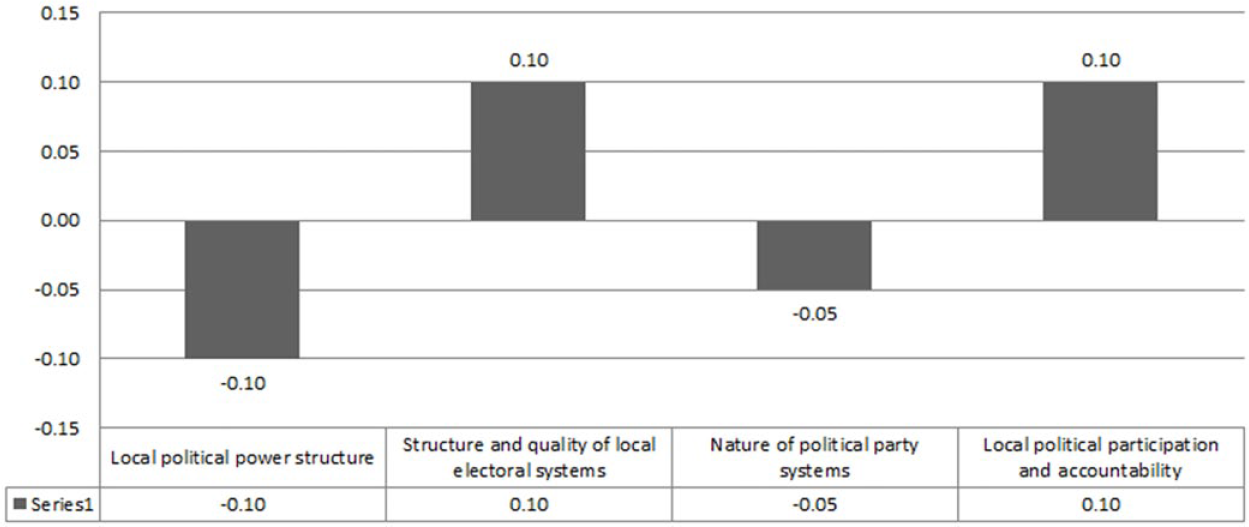
The performance of political devolution in Jember.
Local Political Power Structure
In the case of Jember, the local political structure has been too inadequate to play a driving force for delivering greater improvement for the health and education sectors through its local democratic political seedbeds. The weakness of local political structure of executive, legislative, and political parties in Jember for delivering a well-grounded policy for improving health and education sectors is evidenced by the lack of political initiatives within the local political structure for capturing the interests of the citizens for the greater needs of better service delivery in health and education. Under a DMG local structure of political parties could be expected to grow and take on local autonomy. Local political power structure, for example, fails to develop local structures that influence the policy-making process in allocating resources, and they should be able to influence local government to respond to local needs. On the basis of generally negative comments from the key informants on the indicator of political power structures resulted in a scale scored −0.10, placing it in the neutral range of performance of local political structure in Jember. However, it is important to note that the neutral score of −0.10 is falling toward the range of negative performances in advancing improvement on the governance of allocating resources for the health and education sectors.
Structure and Quality of Local Political Systems
The structure and the quality of local political systems in Jember are marked by the absence of strong local political leadership at the local level, especially local political leadership that pays great attention to the improvement of health and education sectors. The key informants generally provide a dissenting comment on the local political structure. However, there has been a growing notion among the key informants regarding the low quality of local political structure in fostering a strong local political leadership that endorsed and prioritized the health and education sectors as a top priority for Jember. The slightly positive comments from the key informants on the indicator of the structure and quality of local political systems resulted in a scale scored 0.10, placing it in the neutral range of performances. In addition, it is important to note that the score falls down toward the lowest end of the neutral range. In other words, this score represents a low performance on the robustness of the participation, accountability, and the quality of local electoral system in Jember in fostering a further development of the health and education sectors.
The Nature of Political Party Systems
Political devolution delivers a democratic local electoral system by a direct local election (Pilkada). However, most of the key informants signal that Pilkada is far from what it is expected, especially for producing a local political party leadership that is responding and answering to their grassroots, rather than too obedient to the political party structure at central government level. Indonesia’s decentralization creates a gap between the political party structure at the central level and the local government level. This gap has created a domination of central political party structure over the political party structure at local government level.
This domination is crucial in hampering local political party structures from developing or initiating a local political seedbed that contributes to the development of local government, especially in the health and education sectors. A weak institutionalized local level party structure makes governance difficult in a number of ways. First, when parties tend to rise and fall so rapidly, it becomes difficult to hold members of legislature accountable because of a lack of connection between a party and specific policies enacted. Cheema and Rondinelli’s (2007) notion endorses the view that decentralization has the potential for delivering political devolution at local level. However, Jember showed that political devolution has only produced a weak party structure at local government level, especially for responding to crucial sector issues in local government level, such as health and education. On the basis of generally negative comments from the key informants on the indicator of nature of political party systems resulted in a scale scored −0.05, placing it on the neutral range of performance. However, it is important to highlight that this score falls down into the range of negative performance or performance of local political party systems for advancing the improvement of the governance of allocating resources for the health and education sectors in Jember.
Local Political Participation and Accountability
The crucial element that is missing from political devolution in Jember is the poor functioning mechanism for people’s participation in the decision-making process for local development. Several participatory planning forums such as Musrenbangdes (village forum for local government development), the lowest level of participatory planning forum, and Musrenbangda (local government forum for development), the highest level of participatory planning forum, have been transformed into more of a “ceremonial” forum rather than a strategic forum that should carry more substantive weight for the greater good of local government, especially for health and education sectors in Jember.
On the basis of key informants, slightly positive comments on the indicator of local political participation and accountability resulted in a scale scored 0.10, placing it in the neutral range of positive performance. In addition, it is important to underline that this score represents a fairly low performance on the robustness, the agililty, and the accountability of the participation mechanism such as Musrenbang in Jember in fostering a further development of the health and education sectors governance.
In summary, it is important to note that political party structures at local government level are often ill-attuned to the constituents’ interests. In turn, legislators as party representations in the Parliament could fail to produce strong, well-grounded policies reflecting the political parties’ social roots and interests. In other words, political devolution is only luring citizen of Jember with the illusion for better governance of health and education sectors, while, on the contrary, political devolution fails to produce a strong local political infrastructure that permits directly measurable citizen control over the crucial process of allocating resources as well as the development of the health and education sectors in Jember.
One of the purposes of decentralization is the transfer of political devolution from the central government to the local government. This is actually bringing democracy closer to the people. Moreover, several theorists agree with the relation between decentralization and the spread of democratic principles of local government. Among the theorists are Smith (1985), Burki et al. (1999), Blair (2000), Grindle (2007), and Ahmad and Brosio (2009), and one should not forget to mention international donors like World Bank (2000) that has been supporting and endorsing decentralization. In the case of Jember, political devolution largely inadequate to play as a driving force delivering the greater improvement for the health and education sectors through its local democratic political seedbeds. The absence of strong local political leadership confirmed that political devolution in Jember largely was still at infant stage, especially for fostering the local political stakeholders in contributing development for the health and education sectors. Moreover, the weak political structure of executive, legislative, and political parties in Jember for delivering a well-grounded policy for improving health and education sectors is vividly displayed by the lack of political initiatives by the political structure for capturing the interest of the citizen for the greater needs of better service delivery in health and education sectors.
On the contrary, although political devolution delivers a democratic local electoral system by Pilkada and Pileg at local level, both of them in Jember have been malfunctioning. This is related to the lack of local political leadership in Jember in furthering the development for health and education sectors. As I have outlined previously, decentralization actually creates a gap between the political party structure in the central and the local government level. This gap largely creates a domination of central political party structure over the political party structure at local government level. This domination is actually considered crucial in hampering local political party structure for developing or initiating a local political seedbed that contributes to the development of local government, especially in health and education sectors. Moreover, a weak institutionalized local level party structure makes governance difficult in a number of ways. When parties tend to rise and fall so rapidly, it becomes difficult to hold members of legislature accountable because of a lack of connection between a party and specific policies enacted.
Conclusion
There are several lessons learned from the practice of political devolution in a DMG. Jember experience on political devolution and its impact to the governance of the health and education sectors provides us with several lessons that political devolution delivers a weak political structure of executive, legislative, and political parties at local government level, especially for delivering a well-grounded policy for improving the health and education sectors. Another pitfall is the low quality of the local electoral system (Pilkada) for enhancing the quality of the local electorate in the local political process. This is mainly because the prevailing central party domination over the local political party structure, as well as the gap of authority between the political party structure in the central and the local government level.
Moreover, political devolution fails to produce a strong local political infrastructure that permits a direct measurable citizen control over the crucial governance of allocating resources as well as the development of the health and education sectors. This subsequently leads to the failure of political parties in local government level for institutionalizing the development of health and education as priority sectors. This factor also compounded by malfunctioning structure and quality of local political systems contributes to the failure of the local political stakeholders in fostering development for the health and education sectors.
In Jember, decentralization fails to produce a stimulus for the political party to develop an underlying structure in response to the interests of constituent at the local level. In turn, it is difficult for the voters to discipline the political parties, as well as their candidate who win in Pilkada. In summary, it is important to note that political party structures at local government level are often ill-attuned to the constituents’ interests. In turn, political devolution is only luring citizen of Jember with the illusion for better governance of health and education sectors, while, on the contrary, political devolution fails to produce a strong local political infrastructure that permits directly measurable citizen control over the crucial process of allocating resources as well as the development of the health and education sectors in Jember.
Footnotes
Declaration of Conflicting Interests
The author(s) declared no potential conflicts of interest with respect to the research, authorship, and/or publication of this article.
Funding
The author(s) received no financial support for the research and/or authorship of this article.