




Abstract
This article looks into the question of whether trust between works councillors and managers affects their preferences for plant-level negotiations compared with industry-wide or multiemployer bargaining. The main hypothesis is that when a high degree of mutual trust exists, both parties are more likely to show a preference toward the plant level. When the level of trust is low, the bargaining parties rely more on supraplant-level bargaining and collective bargaining power. This article uses data from a survey of 1,000 German companies of at least 100 employees, including 1,000 personnel managers and 1,000 works councillors, that is, those persons responsible for negotiating working conditions at the plant level. Logistic regression analyses show that trust has no significant effect on the managers’ preference for decentralized bargaining, whereas it can be found to affect the works councillors. The authors finally discuss the question of why the effect of trust is different for the bargaining parties.
Research Questions and Background
Does trust between works councillors and managers affect their preferences for plant-level negotiations 1 compared with industry-wide or multiemployer bargaining? This is the question our article sets out to address. Our main hypothesis is that the higher the degree of mutual trust between management and works councils, the stronger the preference of both parties for plant-level bargaining. The basic rationale for this hypothesis is the assumption that trust furthers interaction between the bargaining parties (Axelrod, 1984; Thompson, Wang, & Gunia, 2010) and reduces uncertainty. This implies a higher preference for plant-level bargaining and a lower preference for supraplant-level bargaining, that is, multiemployer bargaining. We will elaborate the hypothesis and the rationale in detail below.
Relationships of trust and bargaining do not exist in a social vacuum. They are rather embedded in both a legal and factual regulatory framework and a discursive context. Currently, in Germany, quantitative working conditions (e.g., the number of working hours and above all pay) are still primarily negotiated at the regional and industry levels, that is, between unions (e.g., the metal workers union IG Metall) and employers associations (in this example, Gesamtmetall for the metal industry; Keller & Kirsch, 2011, p. 209 ff.). Although some companies conclude their own enterprise or company-level agreements with a trade union, Germany has, compared with other industrialized countries, a medium (industry- or region-wide) collective bargaining coverage rate (Keller & Kirsch, 2011). In 2010, 56% of employees in western and 37% in eastern Germany were covered by industry-wide agreements (63% and 47%, respectively, in 2000; Ellguth & Kohaut, 2011). Multiemployer bargaining is still significant, but developments since the 1990s indicate an erosion of the typical German system of collective bargaining. First, the rate of employees covered by industry- or region-wide collective agreements is slowly and steadily decreasing. Accordingly, an increasing proportion of employees (7% and 13%, respectively, in 2010) work either in companies with an enterprise or company-level agreement or in companies that are not bound by any collective agreement (37% of all employees in western and 47% in eastern Germany; Ellguth & Kohaut, 2011). There are many reasons for this development, including the tendency for newly founded firms not to organize in employers’ associations and for existing firms to leave them. Second, we also observe a “tacit escape from collective agreements” (stille Tarifflucht; Keller & Kirsch, 2011, p. 211), meaning that firms are still members of an employers association and bound by an industry-wide collective agreement but do not comply with its terms. Third, the character of collective agreements itself is changing; an increasing proportion of industry-wide collective agreements contain what are known as “opening clauses” (Öffnungsklauseln), which allow deviations from the agreed standards and give partial bargaining rights to works councils and management at the company level. All these factors combine to produce a development that can be characterized as the “decentralization of bargaining,” with a stronger emphasis on company or plant-level bargaining (see Haipeter, 2011a, 2011b).
These material changes have been accompanied by a controversial political discussion on the decentralization of bargaining—whether a shift in bargaining from the supraplant and collective level to the plant or company level should be supported, welcomed, or opposed, and to what extent. Critics of the German multiemployer bargaining system regard the industry-wide, supraplant-level bargaining of wages, working hours, and so on by unions and employers associations as inflexible (see Berthold & Stettes, 2001; Schnabel, 2003, 2006; Zohlhöfer, 1996). According to this position, multiemployer bargaining agreements should, at most, encompass framework regulations because through decentralized bargaining, better consideration would be given to company-specific circumstances, which in turn would increase efficiency. According to the Works Constitution Act (1972), works councils and management are allowed to conclude works or company agreements, but it is illegal for works agreements to deal with remuneration and other conditions of employment that have been or are normally fixed by collective agreement (except a collective agreement expressly authorizing the making of supplementary or divergent works agreements by way of the “opening clauses”). Some critics, nevertheless, call for multiemployer bargaining agreements to be completely replaced by works agreements (see Bispinck, 2004). This raises the question of the consequences for the bargaining parties at the company level. Interestingly, we know not only very little of the consequences but also of the preferences of the central actors responsible for bargaining at the company level, in particular works councillors and human resource managers. This is surprising because a clear break from the multiemployer bargaining system would mean that they would have to bear all the consequences, negative as well as positive. Preferences for or against different systems of bargaining are not least influenced by the social relationship between the bargaining parties, in particular the relationship of trust. One of our main theoretical assumptions here is that the preference for plant-level bargaining is influenced by the level of trust between the bargaining parties. We will return to this in the theory section below, but the argument in brief is as follows: A high level of (mutual) trust furthers a positive preference for bargaining between the parties in the relationship of trust; this implies a preference for plant-level bargaining. Low (mutual) trust, thus, has a positive effect on a preference for industry- or sector-level bargaining. To test these assumptions, we draw on data from a questionnaire survey of 1,000 managers and 1,000 works councillors involved in joint bargaining relationships regarding their position on decentralized bargaining. We also measure the mutual trust of these protagonists using a well-tested trust scale. Specifically, we ask how high or low the level of trust is, that is, the extent of trust placed in the respective bargaining party; how frequently configurations of mutual mistrust, unilateral trust, and mutual trust occur; and how the level of trust and trust configurations affect the preference for decentralized bargaining and a specific bargaining partner.
Our study draws on country-specific data, but it also aims to answer a more general question by analyzing the relationship between trust relationships and bargaining processes at the plant level. Although the data refer to the German bargaining system, the research question and the results should be transferable to countries with different systems, particularly those with works councils, but also with other bargaining relationships, for example, plant-level bargaining between unions and management or industry-level collective bargaining between unions and employers associations.
The article begins by outlining the state of (theoretical and empirical) research on trust relationships between management boards and works councillors and on the preferences of these actors in terms of decentralized bargaining (see section titled Previous Research). We then go on to formulate our hypotheses (section titled General Theoretical Ideas and Hypothesis for Further Analysis). The data and the operationalization of the variables are described in the section titled Data and Operationalization, and the results of our analysis in the Results section. The article concludes with a discussion of the findings and conclusions for further research (Discussion and Conclusions (For Research)).
Previous Research
Why does trust play such an important role in industrial relationships (Fox, 1974) and particularly in relationships between management boards and employee representatives? And why do we suppose trust between management and works councils to have a positive effect on their preference for decentralized (plant-level) bargaining? Trust can be of benefit to bargaining (Kerkhof, Winder, & Klandermans, 2003). A high degree of trust in the other party increases the probability of integrative bargaining and reduces that of distributive bargaining (Walton & McKersie, 1965); the protagonists define their respective situation less as a zero-sum game, and their willingness to compromise increases (see Butler, 1995; Kramer, 1999; Ross & LaCroix, 1996). In turn, mutual trust between management and works councils should therefore also influence preferences as to whether working and pay conditions are negotiated at the plant level or, alternatively, at the supraplant level—thereby effectively delegating bargaining and reducing the potential for conflict at the plant level.
Findings relating to trust relationships (e.g., mutual trust, unilateral trust, or mistrust) between management boards and works councils are scarce. Kerkhof et al. (2003) used a shortened form of the Organizational Trust Inventory (Cummings & Bromiley, 1996) in the Netherlands (in two surveys) to measure the degree of trust over 300 works councillors placed in their respective management boards. They found a relatively high level of trust but also quite considerable differences from company to company. The question remains open as to how management trusts works councillors and what impact this has on a preference for decentralized bargaining.
Only a few surveys explicitly deal with managers’ preferences for decentralized bargaining, but these studies do not examine the reasons for the differences in these preferences. Bahnmüller (2002) carried out a survey of managers and works councillors in three sectors that also addressed the evaluation of the multiemployer bargaining system. Only the results of companies bound to collective agreements were included in the report. In all, 23% of managers believe that there is no need for change, 60% believe that changes are necessary although the system has proven itself, and 14% say that the system has not proven itself and bargaining should only take place at the plant or company level. Around 3% are of the opinion that only individual agreements should be concluded and that collective bargaining agreements should be done away with altogether. The proportion of managers who believe the multiemployer bargaining system to have proven successful thus stands at 83%.
At first glance, and maybe not very surprisingly, members of works councils massively reject decentralization of bargaining. This is repeatedly shown in surveys of works councils (see Bispinck, 2005). Only 12% of those interviewed believe that decentralized bargaining should be “welcomed,” whereas almost a third (30%) are “undecided,” and 53% think it would prove to be “generally problematic.” However, a closer look reveals that the picture is not quite so clear: 49% think that the works council would have more freedom of scope and 48% that circumstances at the respective company could be better taken into account through decentralized bargaining. In the Bahnmüller (2002) survey, on one hand, 56% of works councillors believe that the multiemployer bargaining system has proven itself and requires no change, and only 4% think the system has not proven itself and bargaining should take place at the plant, company, or individual level. On the other hand, a sizable 40% think it has proven itself but is in need of change.
In summary, first, there are no reliable results relating to the level and configuration of trust between management and works councils. Second, no study exists that simultaneously analyzes the preference for decentralized bargaining and other characteristics of both bargaining parties within the same company. Third, the influence of trust on the preference for decentralized bargaining has not been investigated. This study aims to close these research gaps.
General Theoretical Ideas and Hypothesis for Further Analysis
Our general theoretical idea is simple: The preference for decentralized bargaining is dependent on trust and also on the objective situation of the company and the perceived consequences of decentralized bargaining.
Our main hypothesis is that management and works council will take a more positive (or less negative) stance on decentralized bargaining (i.e., plant-level bargaining) if it deems the other party trustworthy. Mutual trust implies that the behavior of the other party is more predictable and that the perceived probability of integrative and less distributive bargaining is higher compared with a situation of low trust. A high level of trust does not only mean a reduction of uncertainty and expectations of a win–win situation. It also means lower expected transaction costs, for example, a lower level of conflict or a less time-consuming bargaining process. Trust also furthers interaction between the parties, which reenforces trust (Axelrod, 1984; Thompson et al., 2010). All these factors together lead us to the assumption that the preference for decentralized bargaining (plant-level bargaining) will be stronger in a situation in which both parties trust each other. The less trust put in the other party, the lower the acceptance level of that party in terms of decentralized bargaining. In this situation, the party will have a higher preference for more centralized bargaining, that is, with the help of a more powerful partner, in other words the employers association for the employer (or management) and the trade union for the works council. Expressed in statistical terms, we expect both a main effect and an interaction with respect to trust. In a configuration characterized by mutual trust, both sides should be more likely to regard plant-level bargaining as a win–win situation. By contrast, a party that mistrusts the other respective party would focus more strongly on the relative benefits of supraplant bargaining, such as the externalization of conflicts (or transaction costs), and be less inclined to support decentralized bargaining.
Primarily, our interest focuses on the effects of trust; however, other potential influencing factors are also taken into account in the form of control variables.
Objective factors (such as economic context or size of firm) do not exert their assumed influence on both corporate parties to an equal extent and in the same direction. We hypothesize that managers in a company experiencing an unfavorable economic situation would be more aware of the benefits of decentralized bargaining and, in such a situation, more likely to be in favor of decentralized bargaining. Conversely, the same economic situation could have the opposite effect on the position of a works council if it fears that a greater level of decentralized bargaining could result in wage reductions and/or longer working hours. The effects of company size also require differentiation: In larger companies, the management position on decentralized bargaining is expected to be one of skeptical opposition because the savings effect of multiemployer collective bargaining agreements in terms of bargaining costs is more relevant in their case. Although even potential bargaining with individual employees is comparatively straightforward and not overly time-consuming in small enterprises, bargaining regimes that offer more comprehensive cover generally prove less costly in larger companies. In the case of works councils, the impact could well be the same, albeit for a different reason. Works councils in large companies potentially have greater bargaining power and thus see themselves better equipped for a shift of bargaining to plant level. We furthermore argue that the existing form of bargaining (or the existing degree of decentralization) could have an effect on the preferences for plant-level bargaining. In particular, the existence of a binding multiemployer collective agreement could have a positive or negative effect on the preference for decentralized bargaining, depending on the experience with this type of regulation and the respective protagonist. The degree of unionization (of the works council) can have a negative effect with respect to management, because the latter may well be reluctant to get involved in major conflicts with a highly organized and possibly confrontational works council. The effect of this particular variable on the works council is unclear because it is difficult to interpret. On one hand, a higher unionization rate is equated with greater bargaining power and consequently with a positive effect on the preference for decentralized bargaining; on the other hand, higher unionization reflects a stronger alignment of union positions, which could be accompanied by a negative effect, namely, rejection of decentralized bargaining.
Another important factor is the influence of the anticipated consequences of decentralized bargaining. Essentially, the assumption is that the more the protagonists associate positive consequences with decentralized bargaining, the greater the preference for decentralized bargaining will be.
Data and Operationalization
Data
In 2005, a representative telephone survey was carried out (by TNS EMNID) involving 1,000 personnel managers and 1,000 works councillors in as many companies, each with at least 100 employees. In each company, a management representative responsible for negotiating with the works council was identified and interviewed. Taking this person as a starting point, the interviewers then also questioned a member of the works council (responsible for bargaining with the management).
A random sample was drawn from the Hoppenstedt database and divided into four size categories (100-199, 200-499, 500-999, and 1,000 or more employees). The survey included all those companies with at least 100 employees from all sectors—with the exception of agriculture and forestry, the fishing industry, and the educational sector. Thus, our results are primarily representative of manufacturing companies and large companies with a works council.
Operationalization of Variables
Trust and trust relationships
The following statements (drawing on a questionnaire by Kerkhof et al., 2003) were applied to measure perceived trust (here in the formulations used in relation to management trust in the works council):
The works council abides by agreements.
The management can rely on the works council if the company experiences a difficult situation.
The works council is trustworthy.
The works council deems the achievement of a mutual solution to be important when bargaining with the management.
The works council is open to management proposals.
All in all, the works council and management have a good relationship.
The trust the works councils place in management was also analyzed using the respective questions for works councillors.
Factor analyses show a one-factor solution for managers and works councillors alike (explained variance: 62% for management and 63% for works councils). Cronbach’s alpha was .88 for both scales. For ease of interpretation, the trust index adds the affirmative responses for each respective question and divides the sum by the number of questions. In addition, dichotomous variables that can assume the values 0 (low degree of trust) and 1 (high degree of trust) are computed; the limits by which “low” and “high” are determined have yet to be established. This point will be addressed later in the study.
Trust relationships are conceptualized by cross-classifying the dichotomized management and works council trust variables, which logically results in four possible combinations: a low degree of mutual trust, unilateral trust on the part of the works council, unilateral trust on the part of the management, and a high degree of mutual trust.
Preference for decentralized bargaining
The preference for decentralized bargaining is measured on the basis of three questions derived from surveys carried out by the Institute of Economic and Social Research in the Hans Böckler Foundation, Germany (Bispinck, 2005) and the general debate on decentralization and decentralized bargaining.
The first question relates to the perception that collective bargaining agreements should only function as framework regulations. “In the past, framework regulations were negotiated in many collective bargaining agreements that had to be implemented at the plant level (e.g., working hours). This is consequently regarded as a ‘decentralization’ of pay rate policy and ‘decentralized bargaining’ of work and pay condition regulations. How would you evaluate this development?” (scale: extremely positive–positive–neutral–negative–extremely negative). For the logistic regression analysis, we calculate a dummy variable, that is, the first two positive values are coded as 1, otherwise as 0.
The second question seeks to ascertain the position vis-à-vis a greater shift of bargaining to plant level and the incorporation of plant protagonists: “There is also increasing discussion about whether collective bargaining should take place less at the supraplant level between employer associations and unions. Many suggestions call for a greater shift of collective bargaining to plant level, in other words, between managements and works councils. How would you evaluate these suggestions?” (scale: extremely positive–positive–neutral–negative–extremely negative). The dummy coding is the same as for the first question.
The third question relates directly to a rejection or endorsement of multiemployer collective bargaining agreements: “All in all, I endorse a more intensive break away from a system of multiemployer collective bargaining” (scale: I fully agree–I tend to agree–I tend to disagree–I totally disagree). For the logistic regression analysis, we calculate a dummy variable with the positive values (agree) coded as 1 and the negative (disagree) as 0.
The above questions refer to different aspects of bargaining decentralization and hence they are used separately as specific dependent variables.
Context or control variables
One important context variable is the present type of bargaining regulation, or in other words, the existing degree of decentralization. The type or form of regulation is measured by a variable with the four following attributes: (a) existence of an industry-wide collective bargaining agreement; (b) existence only of a plant collective bargaining agreement with a trade union; (c) no binding collective bargaining agreement, but a collective agreement is used as orientation (i.e., firms not covered by collective agreements are influenced by the regulations set in industry-wide agreements by the “orientation” of their managers toward such agreements); or (d) no existing collective agreement and no orientation toward a collective bargaining agreement. These statements will also be used as dummy variables (reference category: existing industry-wide collective bargaining agreement).
Industry-sector affiliation is also to be included as a control variable (manufacturing sector; yes = 1).
The size of a company is measured by the number of employees (up to 150 employees [reference category], 151-250, 251-500, more than 500 employees).
We hypothesize that managers in companies located in the newly formed German states (=1), recently established companies (founded after 1990 = 1), and companies in an unfavorable economic position (achieved profit = 1, otherwise 0) would tend more toward decentralized bargaining because they would attach greater importance to the anticipated positive consequences of decentralized bargaining (particularly alignment and pay reduction). Any future organizational change could also play a role in terms of the preference for decentralized bargaining (production or products will change within the next 2 years = 1). To control for other potential differentiations in corporate structure and processes, we incorporate the demographic composition of the workforce by using the proportion of academics, women, and skilled workers as proxies.
The degree of unionization of the works council members (≥ median 80% = 1) should prove a better indicator than the unionization rate of a firm’s total workforce. With regard to the (perceived) power of the works council, both parties were asked, “In your opinion, how much influence does your works council have in comparison with other companies?” (1 = above average, 0 = average/below average). With regard to management preference for decentralized bargaining, we draw on the manager’s own assessment of power; for the works councils’ preference for decentralized bargaining, we likewise draw on their own assessment.
Assessments of the consequences of decentralized bargaining are obtained by considering a large number of statements (drawing on Bispinck, 2005) relating to the specific consequences of a greater “break away from multiemployer bargaining agreements—in other words, a more intense use of opt-out clauses and a shift of bargaining to the plant level involving the works councils and managements.” The interviewees could express their endorsement or rejection (on a respective four-stage scale ranging from “totally agree” to “totally disagree”) of the following statements: (a) would take the different company situations better into account, (b) would lead to conflicts within the company, (c) would result in lower pay, (d) would give more power to the unions within the company, (e) would weaken the power of unions in Germany, (f) could help save jobs, (g) would give the works council more influence and freedom of scope, (h) would give the management more influence and freedom of scope, (i) would unduly expend too much time and effort, (j) would overtax the works council, and (k) would overtax the management. To eliminate the possible effect of the response option order, the order of most of the statements was randomly changed from interview to interview. A factor analysis, the results of which are not reported in detail here, led to a three-factor solution for both management and works councils. The first factor can be interpreted as a cost factor encompassing transaction costs (conflicts, time consumption) and production costs (primarily pay reductions). The second factor is regarded as an alignment and workplace effect factor, whereby the assigned values for the following items were particularly high: greater influence for the corporate protagonists, enhanced alignment in terms of corporate concerns, and a positive impact on jobs. The third factor ascertains the weakening of the unions in both a company and supracompany sense. Overall, these three factors account for 55% (management) and 58% (works council) of the variance.
Results
Descriptive Findings
On average, the degree of trust (Table 1) is surprisingly high in both parties (see Table 3 for descriptive statistics). The management achieves levels of affirmative responses between 83% and 98% in the form of statements indicative of high trust, whereas the levels attained by the works council are only slightly lower (between 73% and 88% depending on the statement). The summarizing statement “All in all, a good relationship” achieves affirmative response levels of around 90% in respect of both parties (management 92%, works council 88%). The trust index, which principally varies between 1 (low degree of trust) and 4 (high degree of trust), produces a median of 3.28 for the management and 3.07 for the works council (SD = 0.52 and 0.54).
Trust in the Respective Bargaining Partner (Management, Works Council)

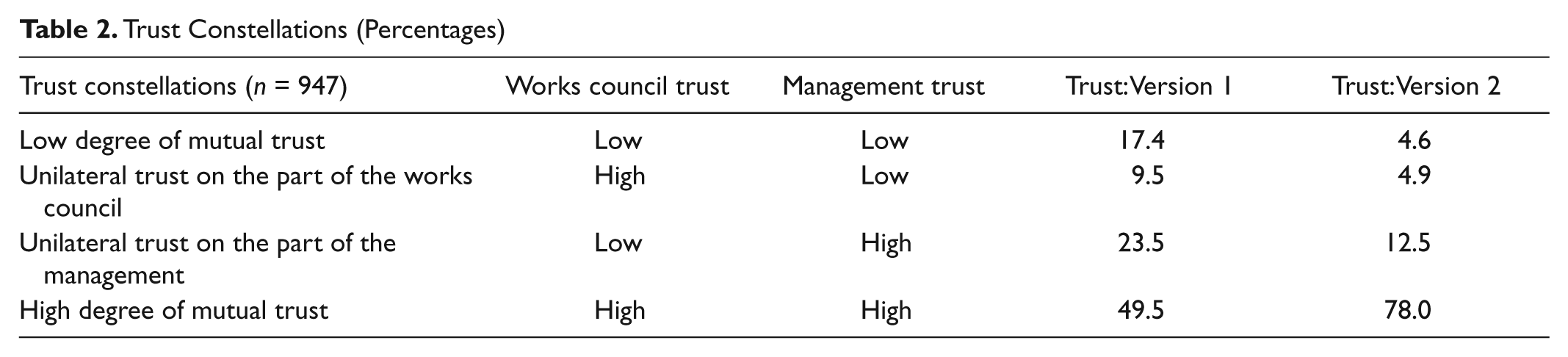
Trust Constellations (Percentages)
Variables and Descriptive Statistics

Not only includes factor values used in the regression models but also values from additionally formed indices. Accordingly, variables are added that have the highest loading on the respective factor, and the resulting value is then divided by the number of items per index. The reference point is formed by the factor structure in relation to the manager, thus allowing a comparison of the index values in spite of the other marginal structure of works council responses.
Nearly all cases (947 of 1,000) can be classified. If a high trust level value is allocated only when all the statements receive an affirmative response, then “only” 49.5% of cases fall into the “mutual trust” constellation. If the threshold is lowered and a high trust level value is allocated for four affirmative responses, then the percentage of relationships characterized by mutual trust rises to 78%.
Preference for decentralized bargaining
Managers and works councils differ in their degree of preference for decentralized bargaining (Table 4). Only between 20% and 31% of works councillors endorse decentralized bargaining, whereas the corresponding percentages for managers are between 65% and 85%.
Preferences for Decentralized Bargaining (Management and Works Council)

Consequently, a problem arises if a distinction is to be made between “high” and “low” trust.
We calculated two different dichotomized trust variables for each party. For Trust Variable 1, trust is coded as high (=1) if all six questions receive an affirmative response; otherwise the value of the variable will be zero. For Trust Variable 2, a high value is allocated (=1) if at least four questions receive an affirmative response (0 otherwise).
Both trust values are then cross-classified. The four possible combinations are shown in Table 2.
Overall, this provides a clear picture: Managers take a negative position against a multiemployer collective bargaining system and show a high degree of preference for decentralized bargaining. The evaluations of the works councils are largely a mirror image of the managers’ evaluations. Only a minority of works councils (20%) were in favor of a break away from a system of multiemployer collective bargaining, compared with 83% of the managers.
The question now is whether we can explain such differences. We hypothesize that trust relationships between the works councils and management (independent of other company characteristics and the consequences of decentralized bargaining) will have an impact.
Determinants Relating to the Preference for Decentralized Bargaining
The following is an analysis of the determinants relating to preference for decentralized bargaining. Although the focus is on the impact of the trust relationship, we also want to know whether, and to what degree, other (contextual) factors may also have an effect. We estimate a binary logistic regression model. Trust is conceptualized using the trust constellation variable (Version 1, see Table 2) and coding each constellation as a dummy variable. For instance, “low mutual trust” is coded as 1 if each party shows a low level of trust; otherwise the variable is coded as 0. Thus, we apply three dummy variables; the reference category is “high degree of mutual trust.” The results are presented in the two following tables, which encompass a total of six regression analyses.
To begin with, let us look at the effects relating to the managers’ preference for decentralized bargaining (Table 5). 2 Trust has no statistically significant effect on the preference for decentralized bargaining among managers; the strength of the effect is negligible. The only nonsignificant effect coefficient worth reporting on account of its strength does not coincide with our hypotheses: In a situation where there is a low degree of mutual trust, the chance that a manager will endorse a break away from a multiemployer collective bargaining system is higher by a factor of 1.602. 3 As such, our trust hypotheses are not corroborated in relation to three core aspects of the preference for decentralized bargaining (collective bargaining agreements as a framework, shifting of bargaining to plant level, and endorsement of a break away from multiemployer collective bargaining agreements).
Effects of the Trust Constellation, Plant Structure, and Situation on Preference for Decentralized Bargaining (Management)—Logistic Regression
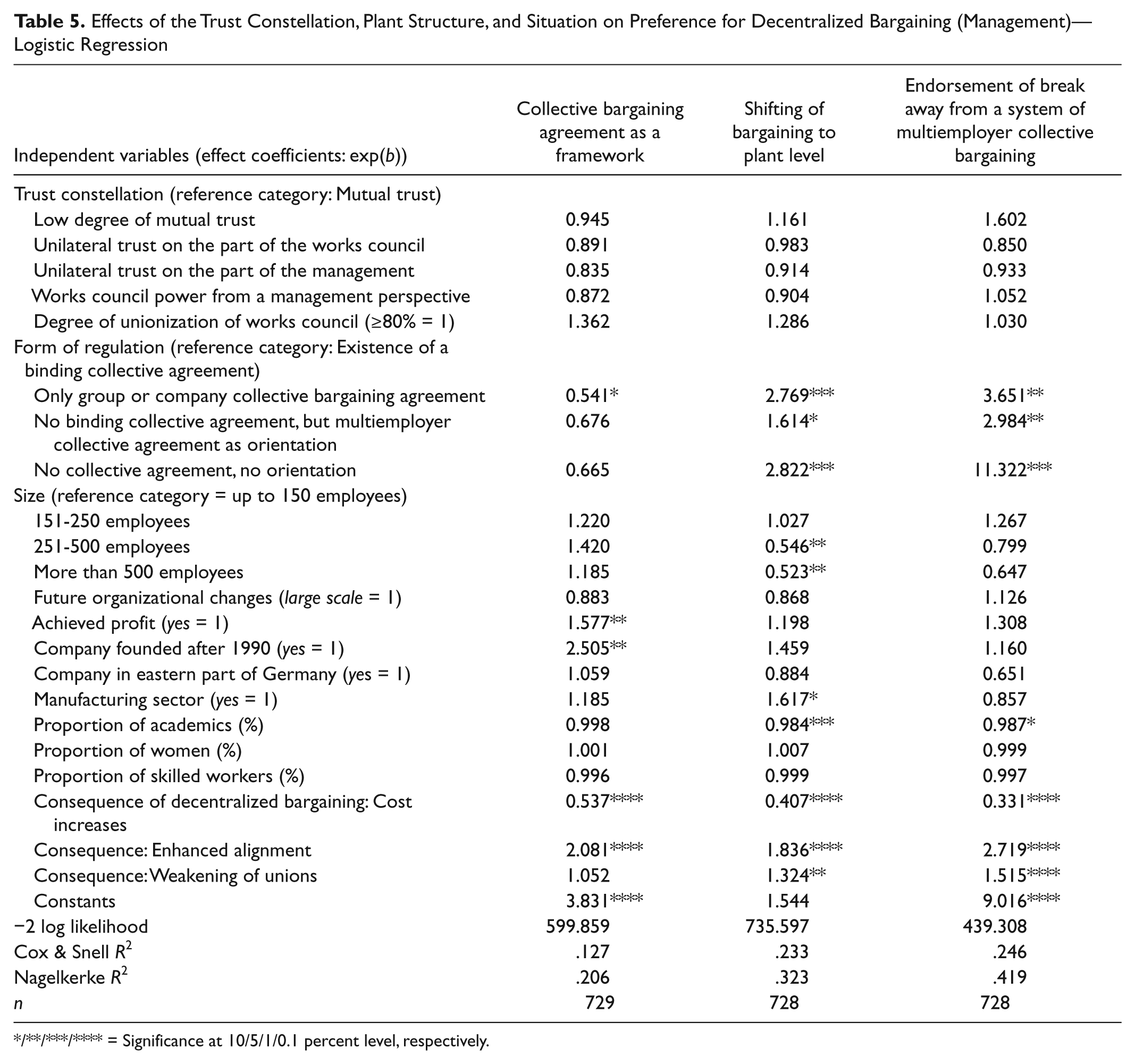
/**/***/**** = Significance at 10/5/1/0.1 percent level, respectively.
By contrast, the form of regulation has a relatively strong impact. When compared with the situation in companies bound by multiemployer collective agreements, the chance of a manager endorsing a break away from this multiemployer bargaining system is around 11 times higher in the case of managers at companies not bound by collective agreements and not using such agreements for orientation (effect coefficient = 11.322). That the anticipated consequences of decentralized bargaining have a relatively strong and significant effect is compellingly evident: Those who anticipate higher costs in relation to decentralized bargaining are likelier to reject it or, in the case of managers, endorse it to a lesser extent. Those who perceive enhanced alignment as a consequence are likelier to endorse decentralized bargaining.
For the works councillors (Table 6), the pattern of results corresponds with our trust hypothesis. We find a consistently negative effect of low mutual trust on all three dimensions of the preference for decentralized bargaining. In a constellation of low mutual trust (compared with the reference category), the preference for collective bargaining agreements only in the form of regulating frameworks is significantly lower (effect coefficient = 0.404). For the two other dimensions, the effect coefficients are negative as hypothesized, but not significant. Although we view these findings as a (albeit weak) corroboration of our trust hypothesis with regard to the works councils, we must admit that we weigh the direction (and to some extent also the strength) of the coefficients higher than their significance.
Effects of the Trust Constellation, Plant Structure, and Situation on Preference for Decentralized Bargaining (Works Council)—Logistic Regression
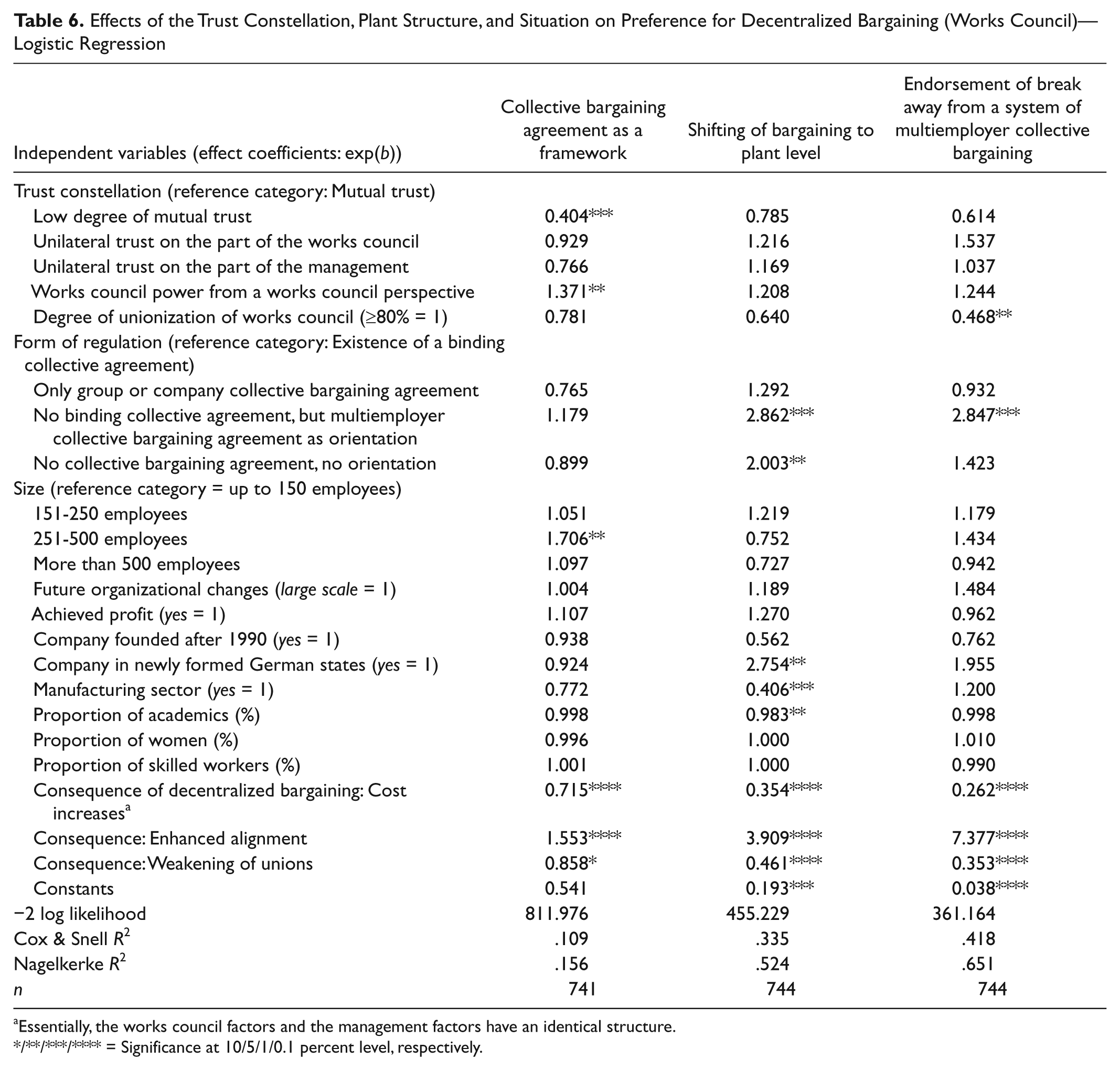
Essentially, the works council factors and the management factors have an identical structure.
/**/***/**** = Significance at 10/5/1/0.1 percent level, respectively.
It is interesting that the preference for decentralized bargaining—in relation to shifting bargaining to the plant level and a general break away from the multiemployer collective bargaining agreement system—is significantly stronger among works councils in companies that use collective bargaining agreements merely for orientation than among those in companies bound to collective bargaining agreements.
To summarize, it can be said that trust only has a weak effect in the case of works councils in the regression analyses. No effect can be identified in the case of managers. It is now necessary to check whether these findings are indeed reliable, for example, by including further variables and other means of operationalization. This is dealt with below.
Discussion and Conclusions (For Research)
The effects of trust on the preference for decentralized bargaining in relation to the level of regulation are not verifiable in terms of the management. From a works council perspective, mutual trust has (albeit weak and in part nonsignificant) positive effects on the preference for decentralized bargaining in general and on the preference for bargaining at the plant level. This fact notwithstanding, a number of questions and problems still need to be addressed, and these are discussed in the following section.
Overestimation of the Level of Trust
The degree of trust appears to be very high, and it could well be that it has been overestimated. We have, therefore, subsequently considered whether only companies in which a high degree of trust prevailed actually responded. No information is available to us in relation to companies in which the management were not willing to respond. In this situation, it is not possible to determine the potential basis for overestimation definitively. The fact that we used well-tested and only slightly modified items for measuring trust means that few measurement problems are likely to arise. Ultimately, the assumption relating to overestimation can only be clarified in further surveys. Perhaps the very reason why trust is so important in industrial relationships, which are characterized by contrasting interests and latent or manifest conflicts, is because it is so fragile. This is conceivably one reason why the protagonists are more likely to provide affirmative responses to the generally positively formulated trust-item questions. Other comparative measurement procedures should thus be used to measure the extent of trust and its various constellations.
Preference for Decentralized Bargaining
In conformity with other studies, the preference for decentralized bargaining on the part of works council members is marginal. Conversely, managers show a strong preference for decentralized bargaining. There is no evidence of measurement problems. As the correlations relating to the consequences are contextually plausible in practically all instances and are also sufficiently high, we conclude that the measurement was valid.
Determinants Relating to the Preference for Decentralized Bargaining
First, we cannot rule out the possibility that we have not covered all aspects of the regulation of bargaining for all companies. For instance, we do not measure whether “wild” decentralization, in other words, firms illegally deviating from binding collective agreements, is used as a way out of the collective bargaining system. Similarly, we do not know how long a firm is bound or not bound to a collective agreement; this may be significant because the length of experience with the respective bargaining regulation could influence the preference for decentralization.
In terms of the preference for a specific level of bargaining, trust has no significant or notably strong effect on the preference for decentralized bargaining among managers. In the case of works councils, we tend to regard our hypothesis on the positive effects of mutual trust as at least partly corroborated. The second point thus concerns the open question as to why such an effect is apparent in one case and not in the other. One assumption is that works councils are less powerful; it follows that trust relationships, and consequently the differences in trust relationships, have greater significance for them than for management. Those who have less power are more reliant on interpreting the actual and anticipated behavior of those with greater power. Trust accordingly plays a role in this context. The party with the greater power can also impose its will on the other party—consequently defining power—and has no need for trust. It may show trust, but it is not obliged to do so. Moreover, differences in trust are not relevant in terms of the more powerful party imposing its will on the less powerful. The relationship between power and trust would be an important subject for further research.
Footnotes
Acknowledgements
We would like to thank the Hans Böckler Foundation for supporting our research project financially and also Manuela Maschke and the project advisory committee for their helpful guidance.
The author(s) declared no potential conflicts of interest with respect to the research, authorship, and/or publication of this article.
The authors received financial support for the research from the Hans Böckler Foundation.