




Abstract
A case-control study was conducted to determine the relationship between household livestock keeping and malnutrition levels of under-5 children. A questionnaire was used to capture data on the hypothesized risk factors. Fisher’s Exact test was used to determine associations between categorical variables and binary logistic regression analysis to determine predictors of malnutrition among under-5 children. A total of 145 households were sampled using a stratified random sampling method. About 72.4% (95% confidence interval [CI] = [63.9%, 81.0%]) of households in the study area kept livestock and the overall level of malnutrition was 34.5% (CI = [21.3%, 47.7%]). Livestock keeping among households that were cases was 31.4% (95% CI = [22.5%, 40.3%]) and slightly lower than those from households that were controls at 68.6% (95% CI = [57.9%, 59.3%]) although this was not statistically significant (p = .243). Crop farming alone was also found not to be significantly associated with malnutrition of under-5 children at household level (p = .447). However, mixed farming (growing crops and keeping livestock) at household level was found to be significantly associated with malnutrition levels of the under-5 children (p = .008). The level of mixed farming among the cases, 31.6% (95% CI = [17.7%, 45.5%]), was lower than those among the controls, which was 68.3% (95% CI = [59.1%, 77.5%]). There was no association between livestock keeping and malnutrition in both the cases and control groups. However, mixed farming (crop farming and keeping livestock) was associated with a significant reduction in malnutrition among under-5 children.
Introduction
Malnutrition is insufficient, excessive, or imbalanced consumption of dietary energy and nutrients. It manifests in different forms, such as undernutrition, over-nutrition, and micronutrients malnutrition (Smith & Haddad, 1999). Malnutrition in early childhood is associated with functional impairment in adult life as malnourished children are physically and intellectually less productive when they become adults (Smith & Haddad, 1999). Children who are malnourished tend to have increased risk of morbidity and mortality and often suffer delayed mental development and reduced intellectual achievement (Babatunde & Qaim, 2010). Among all the countries in the southern part of Africa, Zambia is reported to have very high rates of malnutrition, with a prevalence of stunted growth among children being 40%, while 15% of them are underweight and 6% wasted (Central Statistical Office [CSO], 2014; UNICEF, 2006). Previous studies done in Zambia indicate that stunting is greater in rural areas (42%) than in urban areas (CSO, 2014; Smith, Ruel, & Ndiaye, 2005). However, the prevalence of wasting, which is an indication of current poor nutritional status, is significantly higher in the urban population (CSO, 2014; National Food and Nutrition Commission, 2014). There is also variability in the distribution of malnutrition among the provinces in Zambia with Northern Province having the highest proportion of stunted children (49%), followed by Muchinga (44%) and Eastern Province (42%). Western province has the lowest number of stunted children in the country at 36% (CSO, 2014).
Eastern Province, despite having the third highest prevalence of malnutrition among the under-5 children in the country (CSO, 2014), is among those with the highest cattle population (Lubungu, Chapoto, & Tembo, 2012). This situation is contrary to the view that livestock keeping has a positive impact on the food and nutritional security of developing countries (Randolph et al., 2007; J. Smith et al., 2013). Livestock production is known to provide many incentives at family level including income, quality food, fuel, draft power, building materials, and fertilizer, thus contributing to livelihood of household, food security, and nutrition (Rich, Baker, Negassa, & Ross, 2009). Thus, the situation obtaining in Eastern Province of Zambia makes one wonder whether in certain areas livestock keeping has no cumulative benefits on the nutritional status of under-5 children. Therefore, the aim of this study was to determine whether there was an association between livestock keeping and the malnutrition levels of under-5 children in households of rural parts of the Eastern Province. Specifically, this study was conducted to (a) determine whether malnourished children were more in households that did not keep livestock than in those that kept livestock, (b) quantify the relationship between rural household livestock keeping and the malnutrition levels of the under-5 children, and (c) determine other factors apart from livestock keeping, which might be determinants of malnutrition in under-5 children in the study area.
Materials and Method
Study Design
This was a case-control study design. For the purpose of this study, a case was defined as a household with at least one malnourished child, whereas a control group was households with no malnourished children. Cases were identified from the communities through the health center registers and followed up through community-based growth promoters. For each case identified, two appropriate controls of the same age, and living within the same community as the case, were identified (matched case-control study). This was done to increase the power of the study and also to control for confounding.
Furthermore, a household was considered as keeping livestock if it had one or a combination of the following: two or more cattle, six or more goats, six or more sheep, or 15 or more adult birds such as chickens; otherwise, it was considered not to keep livestock. A household was considered growing crops if it was able to harvest crops that would be adequate for home consumption for more than 6 months or grew cash crops. The crops that were considered in the study included maize, sorghum, millet, groundnuts, and cash crops.
Study Sites
The study was conducted in Chipata, Chadiza, and Lundazi districts of the Eastern Province of Zambia. The province was chosen because it remains among the top three in Zambia with a high prevalence of malnutrition (CSO, 2014). Furthermore, Chadiza district was chosen because in 2009, 2010, and 2011, it had the highest underweight (malnutrition) level among the under-5 children in the province, while in Lundazi, the level of this problem had been increasing in each of these 3 years (CSO, 2014). Chipata district had remained with the lowest levels of malnutrition in the years under review (CSO, 2014).
Eastern Province is estimated to have a population of 1,707,731 people, of whom 104, 255 (6%) are from Chadiza, 452,428 (27%) from Chipata, and 314,281 (18%) from Lundazi (CSO, 2010). Of this population, 49% are males while the rest are females. The number of children who are younger than 5 years of age for Chadiza, Chipata, and Lundazi were 20,851, 90,486, and 62,856, respectively, representing 20% of the population in the districts (CSO, 2010).
Target Population
The reference population were under-5 children in the study area, while the study population were those children who met the inclusion criteria set out below. However, from this population, cases were any child who had been reported underweight from the clinical records at the health center and in community registers and were identified using the mid-upper arm circumference (MUAC) tape and/or presence of edema at the time of sampling.
Inclusion Criteria
All children who were between the ages of 6 months and 59 months and were on treatment of malnutrition or found to be malnourished during data collection in the area were included in this study.
Exclusion Criteria
Children who were exclusively breast-fed and those previously treated for malnutrition and had recovered were excluded from the study.
Sampling Procedure
Two sampling frames were generated; one for the cases and the other for the controls. For each case that was sampled, two children, who were not malnourished, but of the same age and coming from the same area, were identified from the list of children with no malnutrition. Sampling was done using stratified random sampling method. Where no controls could be identified in the registers, efforts were made to identify them from the community where the case came from. The assumption was that the frequency and distribution of cases in the clinic registers was equal to that in the community from which they came from.
The sample size was calculated using the formula described by Eng (2003, page 310) for comparing proportions:
The two groups comprising N were assumed to be 1/3 cases and 2/3 controls in number. Therefore, a significant level of 0.05 and a power of 0.95 were chosen, with assumptions that the difference between the proportions in the control and case groups was 0.17. The equation yielded the sample size of 145 households, out of which 48 households were cases and 97 were controls.
The MUAC tape measurement and edema assessment methods were used to confirm the nutritional status of the children. Each and every child had to be measured on arm using the MUAC tape and assessed for edema. This was done to rule out edema once MUAC measurement indicated green, which may sometimes show that the child is malnourished when he or she is actually not. The measurements on the tape were interpreted as described in Myatt, Khara, & Collins (2006), where
To diagnose edema, normal thumb pressure was applied to the tops of the feet for about 3 seconds. If there was edema, an impression remained for some time (at least a few seconds) where pressure had been applied. The child was only to be recorded as edematous if both feet were pitting.
Data Collection Tools
A structured questionnaire was used to collect data from 145 households. The questionnaire was prepared in English and translated into local languages during interviews. The questionnaire was pretested for quality control purposes.
Data Analysis
Data collected were analyzed using statistical package for social sciences (SPSS Version 16). Initially, descriptive statistics were generated for each of the variables under study. Then associations between categorical variables were determined using the Fisher’s Exact test. Stratified analysis was used to check for confounders. Any differences larger than 10% between the crude and specific estimates (odds ratio) were considered to be due to confounding.
To determine the association between livestock keeping and other variables on the nutritional status of under-5 children, a stepwise binary logistic regression was used. Independent variables that had a p value of not more .250 in the univariate analysis were included in the final model. Initially, three models were built, one that included both livestock keeping and mixed farming together with all other variables that met the criteria for inclusion in the model, the second one was for livestock keeping and other variables that met the criteria for inclusion, and the third one was for mixed farming and other variables that met the criteria for inclusion in the model. Criteria used in determining whether each of the constructed models adequately fitted the data were, a non-significant Hosmer and Lemeshow Test (p > .05) and a significant Omnibus Test of Model Coefficients (p < .05). All statistical tests were considered significant at p < .05.
Ethical Matters
Ethical clearance was obtained from the Excellence in Research Ethics and Science (ERES) Converge, reference number “2014-Feb-007.” Further permission to conduct research was also obtained from the Provincial Medical Office. Only those households that consented to the research were included in the study.
Results
A total 145 households were included in the study of which 48 were cases and 97 were controls. The overall cases in the three districts was 34.5% (95% CI = [21.3%, 47.7%]). From each district, the percentage of cases were 52.4% (95% CI = [31.5%, 73.3%]) from Chipata, 21.3% (95% CI = [–4.1%, 46.7%]) from Chadiza, and 32.1% (95% CI = [10.5%, 53.7%]) from Lundazi. There was a significant difference in the number of households that had malnourished children among the districts (p = .01).
Among the cases, Chipata district had the highest percentage of households that kept livestock, 81% (95% CI = [67.8%, 94.2%]), followed by Chadiza, 72.3% (95% CI = [57.3%, 87.3%]), and Lundazi, 66.1% (95% CI = [50.9%, 81.4%]). There was no significant difference in some households that kept livestock among the districts (p = .261). The livestock that these households kept included cattle, goats, chicken, and sheep.
Descriptive statistics of the associations between a number of variables studied and malnutrition in under-5 children in the study area are shown in Table 1. The results show that keeping livestock only and growing crops only were not significantly associated with malnutrition. However, mixed farming (keeping livestock and growing crops at the same time) was found to be significantly associated with malnutrition in under-5 children at household level. The other variables that were significantly associated with malnutrition in under-5 children were the marital status of the guardians, birth interval of siblings, and current number of under-5 children in a household (Table 1).
Relationship Between Household Livestock Keeping and Malnutrition in Children.
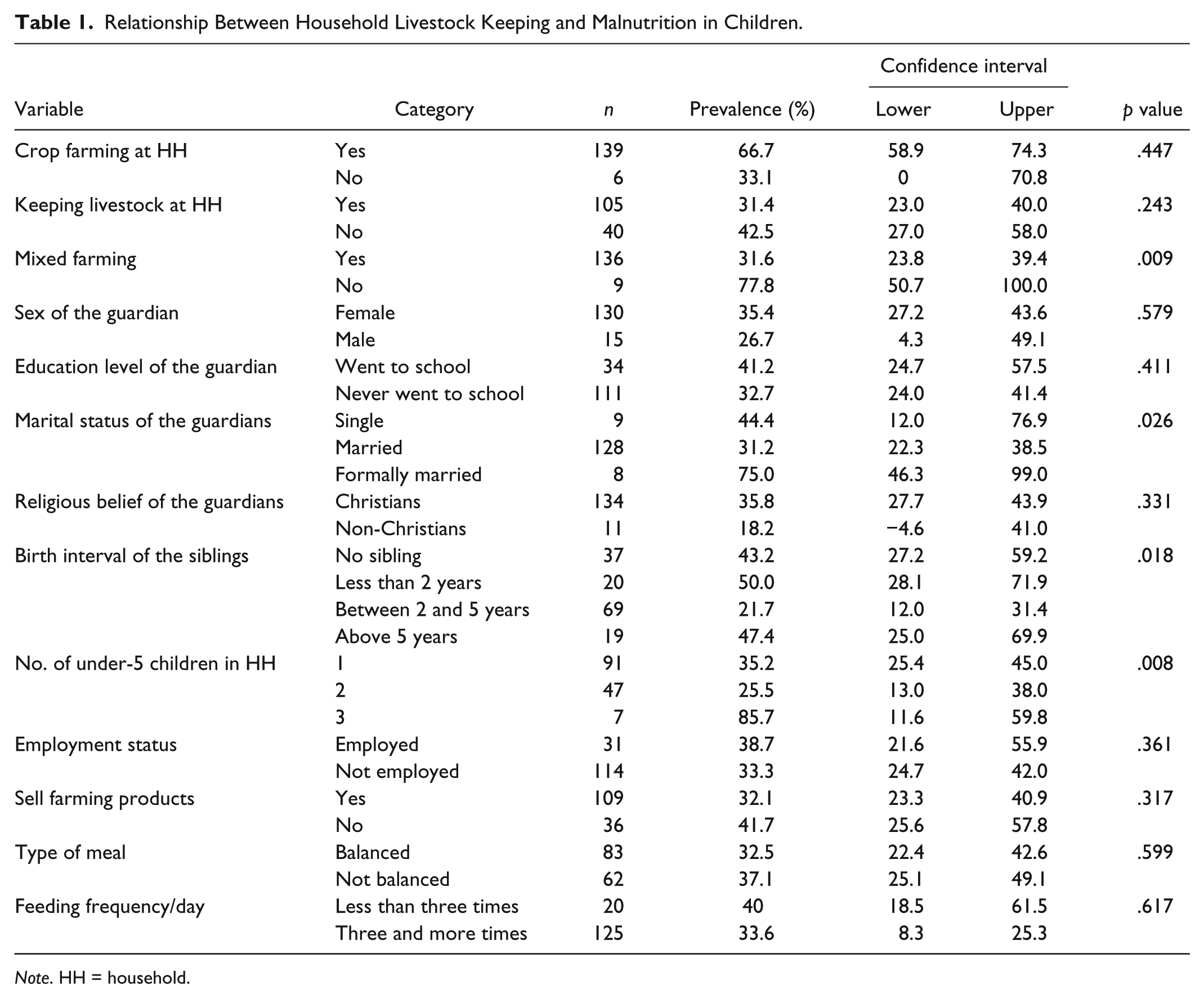
Note. HH = household.
Predictors of Malnutrition in Under-5 Children
Logistic regression analysis was used to determine predictors of malnutrition in under-5 children in Chipata, Chadiza, and Lundazi Districts. The Hosmer–Lemeshow test was non-significant (p > .050) and the Omnibus Test of Model Coefficients was significant (p < .050), indicating that all the three models fitted the data. However, in all the three models (results not shown), livestock keeping alone was not a significant predictor of nutritional status of under-5 children in the study area. As such, only the model with mixed farming was retained and the results are presented here in Table 2. The results of the analysis indicated that marital status of the guardian, mixed farming, and birth interval of the siblings were significant predictors of the status of under-5 children. The CIs of the estimates were wide, indicating the levels of uncertainty in the estimates.
Predictors of Malnutrition in Under-5 Children.

Note. CI = confidence interval.
Reference category.
Children in households in which their guardians were married were 0.16 (95% CI = [0.04, 0.69]) times less likely to be malnourished compared with those whose guardians were previously married (divorced or widowed; p = .014). Furthermore, households with siblings who had a birth interval of between 2 and 5 years were 0.14 (95% CI = [0.16, 1.03], p = .059) times less likely to have malnourished under-5 children compared with those with no siblings (p = .047). Households that practiced mixed farming were 0.09 (95% CI = [0.01, 0.75]) times less likely to have malnourished children compared with those who did not practice mixed farming (p = .026)
Discussion
There was no association between livestock keeping alone at household level and the level of malnutrition of under-5 children. However, the level of malnutrition in comparison with those households that kept livestock was slightly lower than those who did not. This is despite the reasons given by the respondents in all the districts that indicated that they were using the livestock for plowing and traditionally villagers did not slaughter their livestock for consumption unless when there was a big and important event.
The above finding is in agreement with what Freeman, Kaitibie, Moyo, & Perry (2007) found, that livestock enable savings, provide security, allow resource-poor households to accumulate assets, and help finance planned expenditures as well as those that are unplanned (e.g., illness). Livestock function as insurance policies and bank accounts in many parts of the developing world. This would clearly show that the resource-poor people’s households would prioritize other expenses as opposed to providing food for the under-5 children.
Households that engaged in mixed farming were less likely to have malnourished children than those that did not. Another reason for such a finding appeared to be that keeping livestock and growing crops tended to supplement each other in terms of food and other resources to generating income for the household. This study observed that the level of livestock keeping among under-5 children whose household sold farm products was significantly associated with livestock keeping. This affirms that although livestock keeping is not independently a predictor of malnutrition, once a household supplements with crop farming, malnutrition would be reduced.
Where a lot of funds were generated from either livestock or crop selling, the other produce would be used for consumption and the other to purchase supplementary foods hence increasing food availability. This finding agrees with the study done by Mahgoub, Nnyepi, and Bandeke (2006), who found that the prevalence of underweight decreased significantly as family income increased due to practicing mixed farming. In addition, Freeman et al. (2007), found that in marginal areas with harsh environments livestock provided a means of reducing the risks associated with crop failure and a diversification strategy for resource-poor small-scale farmers and their communities. The contribution of livestock to crop production through the provision of draft animal power and manure cannot be over-emphasized. Livestock contribute to achieving more efficient and more sustainable resource use through enhanced energy and nutrient cycling.
This study also found that there was no association between crop farming and the malnutrition level of under-5 children. This was despite the number of households who reported producing crops. This could have been because most households were selling most of their farm products and could thus run out of food before the next farming season. In addition, some of the households were not producing enough food to last the whole year. Notwithstanding this situation, the level of malnutrition among under-5 children whose households were doing crop farming was slightly lower than among those who were not. The majority of the households in the control group were doing crop farming as opposed to their counterparts in the case group.
Employment status of the guardian was not significantly associated with malnutrition levels of under-5 children. Despite employment not being significant to malnutrition reduction, it was found that it was significant in the livestock keeping. Household guardians who were employed were also found to own livestock. This is contrary to work done by Mahgoub et al. (2006) in Botswana, who reported that underweight children were less prevalent among those whose parents worked in the agricultural sector than among children whose parents were involved in informal business. The assumption was that a working guardian will concentrate on work than feeding children.
The level of malnutrition among under-5 children whose guardians were married was significantly lower than those whose guardians were previously married (divorced or widowed) or single in both the control and case groups. This finding is in agreement with that of Mahgoub et al. (2006) who reported that children brought up by single parents suffered from underweight to a significantly higher level than children living with both parents. The married couples tend to share the responsibility of looking for resources to feed the family. In rural areas, men may be involved in generating revenue, while women may concentrate on feeding the children while selling some little but viable goods at their door step.
Level of education of the guardian was not a risk factor of malnutrition in under-5 children in both the control and case groups. This is because the study was conducted from the rural areas of the districts where educational levels of the caretakers of under-5 children were homogeneous. However, this is in contrast to what was reported by Masiye, Chama, Chitah, & Jonsson (2010), who found education level of the head of the household to be an important positive predictor of better nutrition. In this study, the area where the study was conducted could have contributed to the lack of an association between level of education of guardian and the nutritional status of the under-5 children. The study was conducted from rural areas of the three districts where almost all individuals had low educational backgrounds, which would not help them to earn extra income. Khin-Maung et al. (1992) found that low level of mothers’ education was associated with a high relative risk and high etiologic fraction for malnutrition. Ideally, the higher the educational level of the mothers, the better the preparation, and estimation of malnutrition in their children.
Birth interval between siblings was found to be significantly associated with nutritional status of under-5 children in both the case and control groups. That is to say, the wider the birth interval of children a household had, the more the food was available for sharing, hence the lesser the malnutrition. In addition, the household that had only one child or no sibling was less likely to have malnourished children than those with more than one child in the household. Therefore, this showed that number of children in a given household is significant in the reduction or increase of malnutrition levels. Furthermore, Tembo & Sitko (2013) found that the cause of malnutrition of under-5 children was high in households with high population that includes the number of under-5 children, which results in reduced amount of food available for each member of the family. This overcrowding made it difficult for the household to be food secure. The end product of this food insecurity was insufficient household nutrition resulting in malnutrition among the under-5 children. This is in agreement with (Park, 1999) who found that family size is an important determinant of child health.
The number of times the under-5 children were fed per day was not significantly associated with their nutritional status. Even then, the prevalence of malnutrition among under-5 children who were fed less than three times per day was slightly higher than those who feed more than two times per day. Ahmed, Elkady, Hussein, & Abdrbou (2011) found that 60.8% of the mothers, who fed their children three times a day or more, had no significant bearing on their children’s nutritional status. However, this could have been due to low nutritional status of the food that was given to children. In this study, no information was collected on the nutritional status of the food that the children were given.
Conclusion and Recommendations
The study revealed that there was no association between livestock keeping and malnutrition in both the cases and the control groups. However, mixed farming (crop farming and keeping livestock) was associated with a significant reduction in a number of malnutrition cases among under-5 children. Birth interval of siblings, marital status of the guardian, and number of children in a household were associated with a significant reduction in malnutrition of under-5 children at household level.
The authors recommend that households in the study area must be encouraged to practice mixed farming (keep livestock and grow crops) to avert malnutrition in under-5 children. Households must properly space the birth of subsequent children by at least 2 or more years to avoid malnutrition of under-5 children. Further and much wider research must be undertaken so that the findings could well be generalized nationally.
Footnotes
Declaration of Conflicting Interests
The author(s) declared no potential conflicts of interest with respect to the research, authorship, and/or publication of this article.
Funding
The author(s) disclosed receipt of the following financial support for the research, authorship, and/or publication of this article: This study was supported through a grant WTO 87546MA from the Welcome Trust to Southern Africa Centre for Infectious Disease Surveillance (SACIDS).