




Abstract
It is generally accepted that, to move the governmental sector toward better performance, governmental agencies need to adopt high-performance management techniques. One such technique is the HPO (high-performance organization) Framework, which has been applied successfully in many countries. However, most of these applications were in developed countries and in the private sector, which raises the question of whether the framework would work equally well in an African governmental setting. Specifically, this study posits, and proposes to answer, the following three research questions: (a) Can the HPO Framework be used to evaluate the strengths and weaknesses of Zambian governmental institutions and yield tangible recommendations to achieve sustainable high performance? (b) If so, can the performance of these institutions subsequently be shown to improve over time? (c) What is the role of the institutions’ managers in a successful implementation of the framework? To explore these considerations, the HPO Framework was applied at three Zambian governmental institutions. In a longitudinal research set-up, the application and accompanying organizational results were tracked. The study results showed that the HPO Framework is indeed applicable in the Zambian governmental sector and can significantly contribute to it becoming high-performing. However, the study’s results also made clear that full commitment from management has to be ensured before embarking on an HPO transition. This research is the first of its kind: a longitudinal study of the workings and effects of an HPO framework, in the context of a developing country’s governmental sector.
Introduction
It is generally accepted that, to move the governmental sector toward better performance, government agencies need to adopt and institutionalize high-performance management principles, such as those from the New Public Management (NPM) framework (Andrews & Van de Walle, 2013; Dzimbiri, 2008). NPM reforms focus on empowering citizens to put legitimate pressure on governmental organizations to do better (Government of the Republic of Zambia, 2008), and for the realization of Zambia’s “Vision 2030” (Government of the Republic of Zambia, 2006). NPM has been cited as the favored system with which to achieve higher gross domestic product (GDP) growth rates and poverty reduction (Government of the Republic of Zambia, 2005). However, despite these reforms, the performance of Zambian governmental institutions has continued to fail, in terms of both the quantity and the quality of services expected by taxpayers. As Mulenga (2013) observed, “The abysmal state of the governmental sector in Zambia is no secret to the consumers.” In part, this failure is due to the disappointing effectiveness of the NPM model in developing countries, caused, according to Atreya and Armstrong (2002), Bartley and Larbi (2004), and Mongkol (2011), by the fact that developing countries (a) lack the capacity to successfully implement NPM reforms; (b) their governmental sectors are afflicted by corruption and nepotism, and such practices hinder NPM; (c) their infrastructure for managing reforms is not sufficiently effective in supporting market-oriented shifts; (d) they do not have adequate laws and enforcement mechanisms in place to manage contractual arrangements for service delivery; (e) not all aspects of the NPM framework are useful for them and the NPM commitment to privatization is difficult to realize because there isn’t the administrative capacity to undertake this complex task successfully.
A common reason for failure is that governmental organizations in developing countries are simply not robust enough to support significant reform, and so governmental sector officials are seeking techniques that will help to improve and strengthen their organizations so that they can become capable of such improvement. One of these techniques is the “high-performance organization (HPO) framework.” An HPO has been defined as
an organization that achieves financial and non-financial results that are exceedingly better than those of its peer group over a period of time of five years or more, by focusing in a disciplined way on that what really matters to the organization. (de Waal, 2012, p. 5)
Thus, the HPO Framework aims to transform standard organizations into high-performing ones, and it has been validated in many contexts, among them Zambia (de Waal, Goedegebuure, & Mulimbika, 2014). Furthermore, the framework has been corroborated in longitudinal studies that have established that it can help organizations obtain sustainable high performance (de Waal, 2012; de Waal & Chachage, 2011; de Waal & de Haas, 2016; de Waal & Frijns, 2011; de Waal, Mooijman, & Ferment, 2015). However, such longitudinal research has not yet been carried out in a governmental context, which constitutes a gap in the current literature. Hence, the present study sets out to demonstrate that applying the HPO Framework can help governmental institutions to achieve sustainable high performance, and the objective of our research is to evaluate whether this assertion is true for Zambian governmental institutions in particular. To test our hypothesis, we focus on answering three research questions:
This last research question is of interest as recent research (de Waal & Goedegebuure, 2017) has found that managerial involvement is crucial for a successful implementation of the HPO Framework. The theoretical contribution of the present study is that it will extend and enhance existing research about the achievement of high performance in the African organizational context, specifically in the governmental sector, a topic that has not received much academic attention to date. The practical contribution, especially with respect to the answer to our third research question above, is that this study’s findings offer insights regarding how a successful transitionto an HPO should be conducted and how management must act to make this happen.
The remainder of this article is structured as follows. In the next section, the HPO Framework is introduced, followed by a description of the case study governmental institutions. Subsequently, the research approach, results and analysis are presented. The article ends with a conclusion and a discussion of the limitations of the study as well as future research opportunities.
The HPO Framework
The HPO Framework was developed from a descriptive literature review and an empirical study (de Waal, 2006, 2012). The first research phase consisted of collecting studies on high performance. Criteria for inclusion were whether the study
was aimed specifically at identifying HPO factors or best practices;
consisted either of a survey of a sufficiently large number of respondents that the results could be deemed (fairly) representative, or in-depth case studies of several companies in which the results were at least valid for more than one organization;
employed triangulation by using more than one research method;
included written documentation containing an account and justification of the research method, research approach and selection of the research population, a well-described analysis, and retraceable results and conclusions that allowed the quality of the research method to be assessed.
The literature search yielded 290 studies that satisfied all or some of these criteria. Next, the characteristics of an HPO were identified. First, elements that the authors regarded as essential for high performance were drawn from each of the selected publications. Because different authors used different terminologies in their studies, similar elements were placed in groups and each group—later to be named “characteristic”—was given an appropriate description. A total of 189 characteristics were identified. After that, the “weighted importance” (i.e., the number of times a characteristic occurred in the individual study categories) was then calculated for each. Finally, the characteristics with a weighted importance of at least 9%—a total of 89—were chosen as the characteristics that potentially make up an HPO.
During the second research phase, the 89 potential HPO characteristics were included in a questionnaire that was administered during lectures and workshops given by the authors to managers all over the world. The respondents were asked to indicate how well their organizations performed on the various HPO characteristics, on a scale of 1 (very poor) to 10 (excellent), and also how their organizational results compared with those of the peer group. Two types of competitive performance were established (Matear, Gray, & Garrett, 2004) as follows:
relative performance (RP) versus that of competitors, calculated as RP = 1 − ([RPT − RPW] / [RPT]), in which RPT is the total number of competitors and RPW is the number of competitors with a worse performance;
historical performance (HP), over the past 5 years (three possible answers: “worse,” “the same,” or “better”).
These subjective measures of organizational performance are accepted indicators of real performance (Dawes, 1999; Heap & Bolton, 2004; Jing & Avery, 2008). The questionnaire yielded 2,015 responses from 1,470 organizations.
HPO Factors and Characteristics
Using correlation analysis and factor analysis, 35 characteristics—categorized under five factors (management quality, openness and action orientation, long-term orientation, continuous improvement and renewal, employee quality)—that exhibited a significant and strong correlation with organizational performance were extracted and identified. The factor scales showed acceptable reliability (Hair, Anderson, Tatham, & Black, 1998) with Cronbach’s alpha values close to or above .70.
These five factors and their accompanying 35 characteristics (see the appendix) show a direct and positive relationship with the competitive performance of an organization, as follows:
Management quality—HPO managers focus on encouraging belief and trust in each other. They value loyalty and live with integrity; they treat their staff members with respect and maintain individual relationships with employees. HPO managers are committed and have a strong set of principles and standards. They are supportive and help employees in achieving their results, as well as holding them accountable for those results. HPO managers act as a role model for the rest of the organization.
Openness and action orientation—HPO managers value the opinions of employees and always involve them in important business and organizational processes. Making mistakes and taking risks are continuously encouraged in an HPO, as they are considered to be opportunities to learn, develop new ideas, and exchange knowledge for improvement.
Long-term orientation—Long-term commitment is more important than short-term gain for an HPO. Stakeholders of the organization benefit from this long-term orientation, and are confident that the organization is maintaining mutually beneficial long-term relationships with them. HPO managers are committed to the organization, and new positions are filled from within the organization. An HPO is a secure and safe workplace where people feel free to contribute the best they can.
Continuous improvement and renewal—An HPO possesses a unique strategy that makes the organization stand out in the sector. It is responsive to market developments through the continuous innovation of its products and services, thereby creating new sources of competitive advantage. An HPO makes sure that it keeps core competencies within the organization and it outsources noncore competencies.
Employee quality—HPO employees are flexible and resilient, as they are trained (both formally and on-the-job) to achieve extraordinary results. As a team, they are diverse and therefore complementary, so they can deal with a variety of issues and propose additional alternative ideas for improvement.
HPO Diagnosis
Under the HPO Framework, an organization can evaluate its HPO status by conducting an “HPO Diagnosis.” This process begins with an awareness workshop for the organization’s management team and other interested parties. During the workshop, the organization learns about the HPO Framework, the diagnosis process, and the possible transitionprocess. Then, for the actual HPO Diagnosis, management team members and other employees fill in the HPO questionnaire, consisting of questions based on the 35 HPO characteristics (see the appendix). Individual scores are averaged to provide scores on the HPO factors for the complete organization. These average scores indicate which HPO factors and characteristics the company needs to improve to become an HPO. The questionnaire has been validated and the statistics performed on data collected worldwide, and the main principles of the HPO Framework have been shown to remain unchanged, regardless of the type of company or industry being assessed.
The Case Institutions
The ministry is a Zambian government institution responsible for formulating and administering policies and regulatory activities. It is in charge of several statutory bodies of which three were selected for our study, based on their willingness to participate and the support of the Secretary to the Cabinet who granted permission to apply the HPO Framework in these institutions. Institution A employs approximately 70 people, Institution B has a staff team of 100, and Institution C has 20 staff team members.
Research Design
Rainer (2011) identified four types of longitudinal study: (a) describing a phenomenon; (b) exploring a phenomenon to find out what is happening; (c) explaining a phenomenon, to seek (causal) explanations of events and processes as they change over time; and (d) improving the phenomenon, with investigators seeking to improve over time some aspects of the phenomenon. As the objective of the present study was to measure the effectiveness of an organizational improvement technique, we used the fourth type of longitudinal study, with the phenomenon in question being organizational performance. In addition, we used a prospective and a priori-focused longitudinal study design, as our research was based on repeated data collection from the same subject over a period of time (Hassett & Paavilainen-Mäntymäki, 2013), and featured a preplanned research design in which data collection had been planned and decided upon beforehand (Alfodi & Hassett, 2013).
The study was divided into four phases. In Phase 1, the HPO Framework was introduced to the ministry and initial data were collected from managers working at the ministry using the HPO questionnaire (de Waal, 2012). Subsequently, a workshop was organized for representatives from the ministry, at which the HPO Framework was introduced, the questionnaire results were discussed, and support was garnered for a case study. After this workshop, confirmatory factor analysis was conducted on the collected data, the results of which confirmed that the framework was indeed applicable in the Zambian context (de Waal et al., 2014).
In Phase 2, an HPO diagnosis was conducted at the three case institutions. This entailed distributing the HPO questionnaire to all personnel at the institutions, analyzing the collected data, and organizing a series of workshops. At each institution, this comprised an initial workshop with the management team to review the HPO status of the institution and discuss possible improvement actions. Then, one or two further workshops were organized for the institution’s employees (one in Lusaka, the capital of Zambia, and, if necessary, another in one of the regions) to again review the HPO status of the institution, but, this time, alongside suggestions made by the management team, and discuss and agree upon improvement actions.
In Phase 3, one person per institution was asked to function as a liaison officer (“HPO Champion”) between the institution, the Ministry, and the HPO Center in the Netherlands. Other persons were asked to be pioneers of the HPO transition in the institutions (the “HPO Coaches”). The HPO Coaches became the focal point for their colleagues during the transition process and were key in organizing HPO activities aimed at improving the performance of the institutions (de Waal, 2012).
In Phase 4, after 2 years, the HPO questionnaire was readministered to the three case institutions. The aim of this was to review the HPO status of the institutions following the implementation of the recommendations originating from the first HPO diagnosis. During this phase, progress and bottlenecks of the implementation were studied, with a particular focus on the role of the institutions’ management teams.
Results
Table 1 gives an overview of the number of respondents for the HPO questionnaire during both HPO diagnoses.
Number of Respondents on the HPO Questionnaire.

Figure 1 depicts the HPO scores for the three institutions in 2013/2014, compared with the scores of HPOs and the average scores of the Zambian government. The latter scores have been collected over the years in the database of the HPO Center in the Netherlands.

HPO scores of the case institutions in 2013/2014.
Figure 1 shows that the three institutions are not HPOs, although Institution A is almost there for the HPO factor “long-term orientation.” Figure 1 also suggests that the three institutions are typical Zambian governmental organizations, as the shapes of their HPO graphs are virtually the same as the average shape for the Zambian government. In the following sections, the results of the HPO questionnaires are discussed for each institution.
Institution A
Figure 2 gives the HPO scores for Institution A for both HPO diagnoses. The analysis of the scores and the subsequent discussions in the workshop during the first HPO diagnosis in 2014 yielded several strong points of the institution—for example, it had employees who were good at improving and changing, all for the benefit of clients and stakeholders—and five “attention points” that needed to be addressed in order for Institution A to become an HPO. The latter are discussed below.

HPO scores of Institution A, in 2014 and 2016.
Attention Point 1: Make it possible for all people to perform
This attention point concerns HPO Characteristics 5 and 6, respectively: “In our organization, everything that matters to the organization’s performance is explicitly reported” (score = 7.4) and “In our organization, both financial and nonfinancial information is reported to organizational members” (score = 5.4). In the workshops, the reasons for the scores were identified as a lack of a structured information dissemination structure in Institution A made it difficult for management to easily convey information to employees, resulting in employees not knowing exactly what was going on in the organization; a mainly one-way flow of information from top to bottom; management not involving employees in information and decision processes; an “information asymmetry,” as the circulation of financial information was limited to within the management team and was usually only passed down to employees at management’s discretion; and an inconsistent procedure for getting feedback from employees to management. During the workshops, several ideas for improvement were suggested, including organizing quarterly meeting for all employees with management to discuss what is going on in the organization; management should inspire employees with Institution A’s vision and mission so that they can feel part of the Institution A team; management should include employees in Institution A’s activities and processes so they too can have an influence and do not feel that things are imposed on them; creating a quicker information flow to the provinces; and encouraging interdepartmental communication, such as through, for instance, heads of department talking more with heads of other departments.
Attention Point 2: Use all of the institution’s intellect and knowledge
This attention point concerns HPO Characteristics 10 and 12, respectively: “Organizational members spend much time on communication, knowledge exchange, and learning” (score = 7.0) and “The management of our organization allows making mistakes” (score = 5.0). In the workshops, the reasons for these scores were identified as people being too busy with urgent issues all the time; employees not being involved early enough in the process; a lack of engagement of people at all levels in making a contribution to Institution A’s operations; a “rift” between administrative and professional staff, where the former is seen as a “second-class citizen”; an unhealthy competiveness between members of staff, as rewards are based on departmental results and not on cooperation; too many fixed standards and rigid procedures, with a legal framework which prohibits making mistakes; and a general feeling that “one cannot make a mistake—or else.” During the workshops, several ideas for improvement were suggested, including reducing workloads, to create more time, by prioritizing work in terms of its contribution to Institution A; communicating priorities more effectively; engaging all employees in important projects; ensuring employees can act as each other’s “backup”; emphasizing the importance of communication and knowledge sharing; management to become more transparent during decision-making and ensuring they are seen to be fair by explaining their decisions; creating dialogue during appraisals; and regularly talking about what types of mistakes can occur.
Attention Point 3: Create the leaders for high performance
This attention point concerns HPO Characteristics 15, 17, 20, and 33, respectively: “The management of our organization is trusted by organizational members” (score = 7.6), “The management of our organization is a role model for organizational members” (score = 7.4), “The management of our organization coaches organizational members to achieve better results” (score = 7.4), and “The management of our organization has been with the company for a long time” (score = 6.5). During the workshop with management, a profile of an Institution A high-performance manager was created, which was then refined during the workshops with the employees. This yielded the following profile: The Institution A high-performance manager gives guidance; provides direction in a professional and helpful manner; is a team player and a team leader; is part of implementation processes, and not just the decision-making stages; is innovative and thinks “out of the box”; is consistent in his/her management approach; is flexible and open to criticism; is able to accommodate other views and opinions, and knows that criticism will improve managerial efforts; is time-conscious; does not compromise; beats deadlines; has integrity; is honest, sincere, and objective; treats employee information confidentially; is a visionary; knows Institution A’s vision, mission, and values, and conveys these; is an expert in a functional field and has higher academic qualifications; shows exemplary conduct and is disciplined; is a mentor, helping junior staff to rise to higher levels; knows when someone has completed the task cycle; has a good track record; is an inspiration for employees; and delivers on promises.
Attention Point 4: Create the employees for high performance
In a similar vein, the profile of an Institution A high-performance employee was compiled, as follows: knows the vision and mission of Institution A, and relays it to consumers; is willing to change behavior; meets targets; works according to an agreed plan; gives and receives criticism in a positive way; has ideas on how to make Institution A an HPO, and participates in executing these ideas; does better than before; delivers good-quality work; recognizes that a mistake that was made should not be repeated; represents Institution A in a positive way; is open and honest; and interacts with fellow employees and with management.
Attention Point 5: Create a picture of the organization as a high-performance institution
Finally, a perception of Institution A as an HPO was developed, initially by management and then further refined by employees. A high-performance Institution A offers faultless service delivery, provides service with a smile and enthusiasm, is a winning and flexible team, has high job satisfaction that leads to growth of the institution, resolves problems, has openness, shows high integrity, is efficient, and demonstrates a good attitude. It also has no communication barriers between management and employees; is highly efficient with respect to Institution A’s mandate; shows uniformity in the treatment of its employees; has openness, transparency, and truthfulness in conducting appraisals; has a highly motivated staff; and has a properly aligned workload according to the job descriptions. It was agreed during the workshop that this initial view should be further refined.
Furthermore, following the workshop, Institution A’s management decided to concentrate on two HPO attention points: “1. Make it possible for all people to perform” and “5. Create a picture of the institution as a high-performance agency.” Accordingly, during the period 2014-2016, Institution A undertook the following actions:
Appointment of HPO Coaches. Management appointed eight HPO Coaches, four each for the Northern and Southern regions, with the HR manager taking on the role of HPO Champion. After the training of the HPO Coaches, they came up with an HPO action plan, with activities to be undertaken until December 2016. This plan was used as a mechanism for monitoring and evaluating the performance of the HPO activities.
Development of an HPO vision—In June 2015, Institution A developed an HPO vision—“To be a team that delivers exceptional public service”—and an accompanying HPO “signature” (i.e., motto)—“Excellence, our way of life.” The latter was incorporated into the official email so it would appear as a commitment to serve all stakeholders with excellence.
Development of employee pledges—Employees proposed “pledges” with regard to how they were going to serve the Zambian people. These pledges were printed on pop-up banners and placed in all of the provincial offices, to allow stakeholders to hold Institution A staff accountable for the pledges to which they had committed themselves. Examples of staff pledges were as follows: “I pledge excellent and high-quality work” (administrative assistant), “I will ensure that you have access to safe and high-grade food” (public health officer), “I will do right by you” (executive director), “I pledge to serve with integrity and enthusiasm” (HR manager), and “I pledge to quit doing less than excellent work to serve you” (chief investigator).
Improvement of communication between management and employees—To enhance communication in the organization, Institution A implemented several strategies, such as a mailing group to facilitate easy sharing; WhatsApp messaging to facilitate informal interactions regarding various issues of interest and to break down communication barriers between management and staff; Skype meetings every Friday, which were particularly helpful for the provincial offices; regular meetings with HPO Coaches from the provincial offices to brainstorm on matters that needed attention; meetings between HPO Coaches and management twice a month regarding the progress of the HPO transition; “HPO Fridays” every last Friday of the month when employees wore branded HPO T-shirts as a reminder of and commitment to the organization as an HPO; informal interactions in which employees were stimulated to freely interact regarding any matter with coaches and among themselves over a cup of tea or a meal; team-building events at which all employees played two HPO “games,” one writing one positive change the HPO transitionhad brought to their work or personal lives, the other writing one suggestion/idea that they would like to see implemented/improved on; and an orientation scheme for new employees through which all new staff who joined Institution A were inducted in the HPO program.
The second HPO diagnosis
The second HPO diagnosis in 2016 showed that Institution A more or less had become an HPO (see Figure 2). During a workshop discussing the diagnosis outcomes, the impact of the HPO transition on Institution A was observed to have been that the team spirit in the agency had increased; there was greater unity among the people, departments, and regions; and there was a sense of belonging among employees that positively affected their performance and departmental collaboration. Staff team members were more open and able to communicate with each other freely. People were more performance driven, and everybody willingly remained accountable to their pledges. All employees now felt they were important, and they fully understood the critical role they played in attaining Institution A’s objectives.
Despite the good results perceived at this stage, though, Institution A felt that several areas could still be improved, and so decided now to work on the following:
The HPO Coaches in the Northern region were going to visit those offices where there were no coaches at least once a quarter, and also endeavor to phone them regularly. As an additional measure, coaches were going to circulate minutes of the biweekly Tuesday meetings to the regional offices.
Management would stress once more that staff had to own the HPO transition, and that full engagement with it should not be perceived to be for HPO Coaches only.
The HPO Coaches would help employees understand the financial and nonfinancial information provided on Institution A.
HPO Coaches felt that “making mistakes” was a source of concern, as it attained the lowest score in both diagnoses. Therefore, discussions were going to be organized to ensure that employees better understood the definition of “mistake.”
The appraisal system and process would be further enhanced: Employees had to understand more clearly that they were responsible for their results, while management should endeavor to deliver correction in a way that did not distress or discourage employees.
Employees would be encouraged to upgrade their qualifications and to show even more proactivity.
Finally, Institution A developed a new vision—“To be a team that delivers exceptional public service”—with the goal of enabling the organization to attain HPO status by December 2016 and to maintain it. Specific objectives to achieve this were also formulated, such as to further spread HPO knowledge throughout the organization, and “ignite the HPO fire” among more managers and employees; have more pioneers for HPO transition activities; promote cooperation and meaningful dialogue between units, people, and managers and employees; and develop top talent into HPO leaders who will help the organization grow, continue to be an HPO and enable Institution A to undertake subsequent HPO diagnoses.
Organizational performance
The second HPO diagnosis showed that the efforts of Institution A to become an HPO had paid off. The commission attained an average score of 8.4, which essentially meant it now was an HPO. This status was confirmed by the International Competition Network, which, in 2016, in conjunction with the World Bank, named Institution A as one of the best governmental institutions in Africa, of the 43 competing institutions. In addition, financially, Institution A had seen a steady increase in the income generated from its operational activities. Figure 3 shows that, from the time that the HPO transition began, the commission’s income—generated from fees and fines—increased from ZK 4.8 million in 2014 to ZK 11.7 million in 2015, representing a rise of 144%. During the period 2014-2015, Institution A recorded an increase in the number of resolved consumer cases from 827 to 1,791. Furthermore, in 2015, the institution successfully recovered ZK 1.5 million in product refunds and replacements nationwide, compared with ZK 0.7 million in 2014.

Financial results of Institution A.
Institution B
Figure 4 presents the HPO scores for Institution B from both HPO diagnoses. As can be seen from comparing these with those given in Figure 1, the HPO score and graph of Institution B are almost the same as those of Institution A. From the analysis of the scores and subsequent discussions in the workshop during the first HPO diagnosis in 2014, it became clear that both the strong points—the institution had people who were good in improving and changing—and the attention points were the same for Institution B as they were for Institution A. However, the discussions during the workshops for Institution B took a slightly different course and therefore yielded different outcomes. These are discussed below.

HPO scores of Institution B, in 2014 and 2016.
Attention Point 1: Make it possible for all people to perform
This attention point concerns HPO Characteristics 5 and 6, respectively: “In our organization, everything that matters to the organization’s performance is explicitly reported” (score = 6.0) and “In our organization, both financial and nonfinancial information is reported to organizational members” (score = 3.9). In the workshops, four main reasons for these scores were identified, accompanied with suggestions for improvement, as follows:
There was inadequate communication among management. To improve this, it was recognized that managers should trust each other, regardless of respective attributes (such as academic qualifications); they should appreciate that each of them has a role to play in realizing Institution B’s vision of becoming an HPO; they should view one another not as competitors but as belonging to a team; they should realize that “core departments” are not more important than support departments; they should speak a common language; and they should all have the successful implementation of the institution’s HPO status as one of their key performance indicators.
There were inadequate feedback mechanisms in the organization. To improve this, it was recognized that management should encourage a culture of feedback (e.g., acknowledging receipt of suggestions and/or complaints); people should use the available IT communication options more regularly; employees should be more active in asking for follow-up; and there should be special officers charged with follow-up and providing status reports.
There was a negative attitude toward received information, as illustrated by this quote: “We don’t take the time to look at it and then later use the excuse that we didn’t receive anything.” To improve this point, it was recognized that there should be increased access to the email system; a new communication policy incorporating hard-copy memos should be implemented, with the second copy to be retained with acknowledgment of receipt; and there should be zero tolerance for petty or unprofessional excuses regarding the receipt of organizational information.
Management felt that not every employee needed to be privy to certain financial and nonfinancial information, and were concerned that, when financial information was revealed, it would prompt unreasonable requests for additional resources. To improve this point, it was recognized that managers need to develop more confidence in their subordinates; appreciate that good ideas can also come from nonmanagers; respect dissenting views; and encourage dialogue between management and employees (e.g., by encouraging rapport, and having informal meetings and informal activities).
Attention Point 2: Use all of the institution’s intellect and knowledge
This attention point concerns HPO Characteristics 10, 11, and 12, respectively: “Organizational members spend much time on communication, knowledge exchange, and learning” (score = 6.5), “Organizational members are always involved in important processes” (score = 6.9), and “The management of our organization allows making mistakes” (score = 3.9). In the workshops, the reasons for these scores were identified as a lack of information sharing after an event (e.g., when people have gone to a training seminar, they don’t share what they learned); sending the wrong people for training (e.g., the person sent for training is different from the person performing the relevant duty); no value added but value lost from training (e.g., people who go for the same training year in, year out); a lack of regular departmental meetings; a lack of people providing information directly and without being prompted (“We give information when asked, but we don’t provide it proactively”); resolutions not being monitored and evaluated to assess their impact; and a lack of follow-up with respect to critical information. During the workshops, several ideas toward improvement were suggested, as follows: create a meeting schedule for each department; send out reminders for important meetings; record resolutions made during meetings; monitor and evaluate the execution of resolutions; make employees feel important and valued, regardless of their position in the organization, so they don’t lack the confidence to give their views or suggestions on certain matters because of fear of intimidation; make it mandatory after a training to not only submit a written report but also give a presentation on what has been learned; develop effective criteria for selecting employees for training; and create personal development plans for each individual.
Specifically regarding the issue of mistakes, causes were identified as follows: a lack of consistency when applying judgments, repeated mistakes go unpunished and gradually become the norm, the use of untrained personnel in some roles (e.g., an office assistant acting as registration officer), and a lack of room for experimentation through fear of punishment. Possible resolutions were advanced that included allowing mistakes as long as they are not repeated, whereas repeated mistakes should no longer be tolerated; more flexibility and consistency from management and supervisors with regard to dealing with mistakes; more team-building events, which encourage interaction and enhance self-confidence among staff team members, thereby creating the environment necessary for innovation; training for employees who are prone to making mistakes; and trained personnel should be assigned to appropriate roles.
Attention Point 3: Create the leaders for high performance
This attention point concerns HPO Characteristics 15, 17, 18, 19, 25, and 34, respectively: “The management of our organization is trusted by organizational members” (score = 7.1), “The management of our organization is a role model for organizational members” (score = 6.9), “The management of our organization applies fast decision-making” (score = 7.1), “The management of our organization applies fast action taking” (score = 7.2), “The management of our organization is decisive with regard to nonperformers” (score = 6.8) and “New management is promoted from within the organization” (score = 6.1). During the workshops, the shortcoming of managers that were mentioned included them not being open, transparent, or consistent enough; not trusting subordinates enough to delegate or share knowledge; not treating employees as = being too empathetic and thus lacking courage to deal with nonperformers; rarely supporting employees’ ideas and innovations; and lacking implementation power for new ideas. During the workshop, management created a profile of an Institution B high-performance manager, which was further refined during the workshops with employees. This yielded the following profile: The Institution B high-performance manager is honest, trustworthy, and has integrity; is transparent and open to dialogue; maintains confidentiality; is competent and professional; is good at strategy implementation and resource mobilization; is results-oriented; adheres to rules and procedures with flexibility; knows employees and their duties, has confidence in them and takes care of their welfare; is supportive of subordinates’ grievances and ideas and recognizes their efforts; is a good coach and team player; looks after staff development and promotions; gives direct feedback; is open to criticism; is decisive and bold; and is customer-focused.
Attention Point 4: Create the employees for high performance
During the workshops, poor-performing employees were perceived as having a lack of motivation, displaying a negative attitude, and being ineffective communicators. A profile for an Institution B high-performance employee was compiled as follows: is skilled, qualified, self-motivated, and self-disciplined; has integrity and is honest; is customer-oriented; has a positive attitude; is organized, dependable, and reliable; is focused toward achieving organizational goals; is passionate and committed; is focused on quality; and loves what she or he does.
Attention Point 5: Create a picture of the institution as a high-performance agency
This attention point was first addressed by developing a draft vision for the agency, as follows:
Institution B is an oasis of integrity in its service delivery. It is an effective and efficient agency where it is fun to work. It serves it clients increasingly better in registration, by reducing the period of issuing certificates through the use of electronic signatures.
Then, a preliminary view of Institution B as an HPO was developed by management and further refined by employees. A high-performance Institution B was conceived of as follows: Institution B is the employer of choice in Zambia, with a low turnover and good conditions of service; the agency is customer-focused, with simplified user-friendly processes which are electronically accessible; and there is an improved work culture, with staff possessing a good work attitude and a sense of responsibility. In addition, according to this conceptualization, Institution B is synonymous with integrity; is effective and efficient in all services given to clients; issues certificates within 24 hr countrywide, by introducing electronic signatures, and provides clients with quality information; treats clients as the reason for the existence of the agency; has great working conditions with a good reward system, monthly recreational activities, consistent training programs, internal promotions according to merit, and advertisements for vacant positions internally before opening them up to the public; has good internal communication, and is a fun organization.
At the end of the workshops, Institution B’s management undertook an immediate assessment of the HPO Framework, and concluded the following: It provided realistic and candid feedback from the employees and thus created a lot of learning for management; it was “the best workshop I have ever attended because it helped greatly not only for Institution B but also for my personal development”; it showed that there were “zombies” among both management and employees who needed to be dealt with to help the CEO to realize his ideas; it showed that Institution B needed “less passengers on the bus and more ‘bus drivers’”; and it showed that, if people could become high-performance managers and employees in a harmonized way, it could only get better at Institution B. Following the workshop, management decided to concentrate on HPO Attention Point 2, “Use all of the institution’s intellect and knowledge.” For this, the organization developed a “behavioral change plan,” which described actions aimed at changing the mind-set of Institution B staff in order for them to become high-performance employees. The behavioral change plan was expected to transform employee behavior, as the first step to addressing the challenges noted during the HPO workshop, through four courses of action: record and maintain knowledge, train staff to utilize knowledge, learn from mistakes, and shape and inspire proactive, innovative staff team members.
The second HPO diagnosis
The second HPO diagnosis in 2016 showed that Institution B had the same average HPO score as in 2014, with slight differences per HPO factor (see Figure 4). The reasons for these results were discussed during a workshop. First, the positive impact of the HPO transition process on Institution B was noted: There had been an improvement in openness and commitment among staff; team spirit and togetherness had been strengthened; staff participation in activities had increased; staff felt more accountable; and there was improved internal communication. Regarding the behavioral change plan, it was found that its activities were still being executed and therefore it was too early to evaluate whether the plan had worked. Institution B had introduced a “manager and coach of the month” scheme, to encourage managers’ participation in HPO issues. Every manager was encouraged to come up with new ideas that would push Institution B forward. So far, this intervention seemed to have worked well. Also, the performance review and motivational processes had been improved. “One-on-one HPO day talks” had encouraged openness and commitment among the staff team members. A yearly sports day had reinvigorated team spirit, and the Monday motivational talks had become more structured. Buy-in from employees had steadily increased, as could be seen from their participation in HPO activities. However, there were also challenges that came out of this second HPO diagnosis. The initial lack of buy-in from the staff had adversely affected the implementation speed of HPO activities, causing delays; HPO attention points were generalized, which meant that nobody in the agency felt ownership of them, and, hence, they were not given the priority needed by the organization; HPO Coaches did not meet frequently enough, resulting in a lack of follow-up on HPO activities; most of the activities outlined in the HPO action plan were not budgeted for, resulting in a failure to implement many of the activities. It was concluded that, as an organization, Institution B had embraced the principles of a HPO, but, in some notable instances, the buy-in of managers and employees had been too low and too slow. The renewed and updated HPO action plan should, it was thought, take care of this, and it was hoped that, after its implementation, the agency’s status would improve. To support this, Institution B needed to quickly devise a training program for HPO Coaches, free up budgets for HPO activities, and actively engage regional offices in the implementation of the HPO action plan.
Organizational performance
The performance of Institution B was evaluated using the fee revenue collected from the businesses that had submitted annual returns (see Figure 5). Financially, Institution B experienced a decline in annual nontax revenue generated from its activities, from about ZK 46 million in 2014 to about ZK 36 million in 2014—representing a decline of 21.7%.
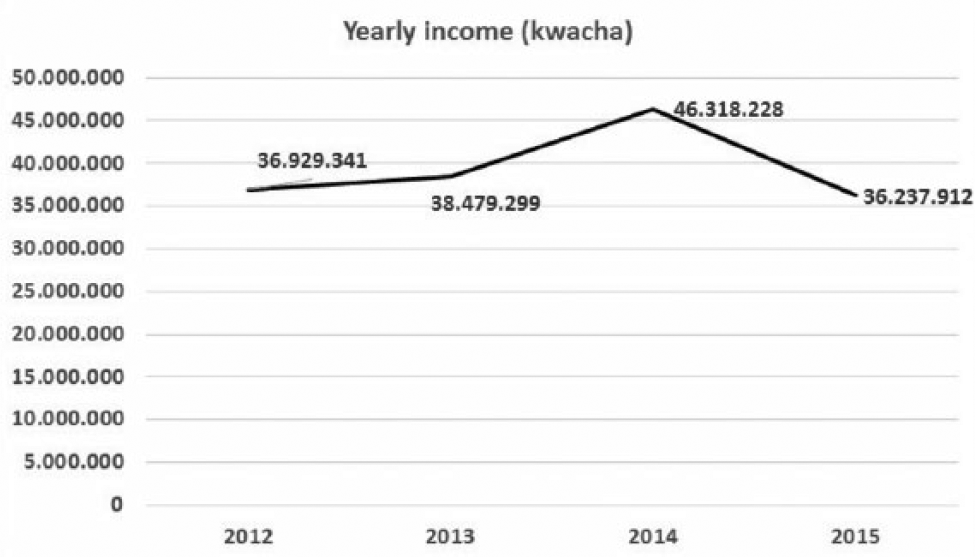
Financial results of Institution B.
Institution C
Figure 6 gives the HPO scores for Institution C from both HPO diagnoses. As can be seen, the HPO graph of Institution C from the first HPO Diagnosis is almost the same as that of Institution A and Institution B, and the HPO score is also in the same range as that of the other two institutions. The strong points for Institution C were that it possessed good management and a good external focus on clients and stakeholders. There were also four attention points for the agency, as follows.

HPO scores of Institution C, in 2013 and 2016.
Attention Point 1: Make the institution more innovative
This attention point concerns HPO Characteristics 1, 7, and 8, respectively: “Our organization has adopted a strategy that sets it clearly apart from other organizations” (score = 5.8), “Our organization continuously innovates its core competencies” (score = 6.2), and “Our organization continuously innovates its products, processes, and services” (score = 5.8). The workshops concentrated on identifying options for improvement. For example, for Institution C to be distinctive in respect to other agencies, it should concentrate on customer satisfaction and customer awareness of the institution. This could be achieved by setting up more regional offices to be closer to the clients, creating publicity and awareness on the topic of consumer protection, and sending employees to targeted organizational training sessions. To become more innovative, the agency could involve stakeholders more in its innovation process, regularly hire consultants to bring in outside knowledge and ideas, increase motivation and skills for innovation by investing in employee training, improve planning for better use of resources, contemplate outsourcing, and create synergies with outside parties through partnerships.
Attention Point 2: Make it possible for all people to perform
This attention point concerns HPO Characteristics 5 and 6, respectively: “In our organization, everything that matters to the organization’s performance is explicitly reported” (score = 6.9) and “In our organization, both financial and nonfinancial information is reported to organizational members” (score = 4.7). Institution C could improve its performance management system by using the strategic plan as a guide to formulate better critical success factors and key performance indicators, incorporating specific indicators to measure customer and client satisfaction, as well as scheduling regular reviews of the strategic plan’s execution. In addition, all employees should be made aware of Institution C’s mission, vision, short- and long-term goals and objectives, and critical success factors and key performance indicators should clearly relate to these. The accompanying information flow to personnel could be improved by looking at how they could receive (electronically) information and how the distribution of hard-copy information could otherwise be increased.
Attention Point 3: Use all of the institution’s intellect and knowledge
This attention point concerns HPO Characteristics 10, 11, and 12, respectively: “Organizational members spend much time on communication, knowledge exchange, and learning” (score = 5.7); “Organizational members are always involved in important processes” (score = 6.8); and “The management of our organization allows making mistakes” (score = 3.2). Better communication mechanisms are needed, such as regular emails, telephone calls, memoranda, knowledge meetings, and easy access to the Internet, to improve the knowledge and information sharing between departments and between locations. The fear of making mistakes should be reduced so that people dare to come up with new and inventive ideas. This could be achieved through a new approach for talking about mistakes (in confidence, one on one) and more acceptance (the wrongdoer should accept that she or he did wrong). Management should act in more of a counselor role than as a punisher when mistakes are made. Employees should also be willing to learn from previous mistakes, to seek guidance when they do not understand something so they better understand what needs to be done, and to learn from colleagues.
Attention Point 4: Increase the quality of management and employees to an HPO level
To know what caliber of people Institution C would need in the future, first, a picture of what Institution C would look like when it was a high-performance agency had to be created. Managers and employees agreed that a future, HPO-level Institution C is the best agency in Zambia, from which nobody wants to leave (because going anywhere else would be going downhill jobwise); is financially stable; has no problems with any hygiene factors, so there is a strong base from which to grow toward HPO status; has a high-quality reputation and recognition from both within Zambia and abroad; is triple the current size, but with no vacancies and high-caliber professionals all wanting to work at the institution; is a leader in the application of technology, focusing on added-value activities for customers while outsourcing bread-and-butter activities; and with a staff group that has developed through the ranks and achieved a reputation as a team of high-quality professionals.
Subsequently, the profile of an Institution C high-performance manager was established: one who safeguards the reputation, continuity, and sustainability of the institution; is confident, competent, and self-disciplined; is an inspiring role model for whom people want to work; is a good mentor who allows employees to make mistakes and supports them in making better decisions in the future; contributes to the team spirit, and lets the organization move in union; makes employees want to be better by continuously challenging them; and leaves a positive legacy and is missed by employees when she or he is no longer at the agency. In addition, the employees of Institution C developed their own profile of an Institution C high-performance employee, with the following characteristics:
professional—possesses the right skills, knowledge, and understanding to deliver high-quality work; looks presentable; is sober minded and has high integrity and trustworthiness;
committed to Institution C—is dedicated to the agency’s goals and objectives, looks at the bigger picture in the long term, has passion for the job, and is a great team worker (sharing ideas and duties, inspiring colleagues);
disciplined and focused—is reliable and punctual, focused on the right things at the right times and result-oriented (setting, meeting, and exceeding targets);
self-starter—demonstrates initiative, is capable of simplifying and improving the work, is adaptable to change, continuously innovates, believes in herself or himself and is courageous;
self-developer—continuously develops herself or himself (academically, technologically, vocationally);
customer-oriented—offers high-quality customer service, has good interpersonal skills, and is a good communicator;
is healthy and happy.
The second HPO diagnosis
The second diagnosis showed that the average HPO score for Institution C had reduced from 7.0 in 2013 to 4.9 in 2016 (see Figure 6). In a follow-up discussion with managers and employees, a mixed message came out. On one hand, employees seemed to be quite dissatisfied with the management team and the board of directors, whose commitment to improve the performance of the institution was seen to be severely lacking, as illustrated by this remark: “The current management needs a total overhaul. It has lost its vision and direction, and the board of directors also needs to change." Furthermore, it became apparent that there was a conflict between the HPO Coaches and the employees. The implementation of the HPO Framework was seen as a distinct role, different from the normal duties of employees. As a result, HPO Coaches were viewed as having special authority over other employees, which created resentment. On the other hand, the discussion also revealed that both managers and employees were of the opinion that the HPO Framework promoted healthy competition between peer institutions thereby stimulating a sense of urgency to become more competitive, while the institutions learnt from each other, hence being able to achieve more. The HPO Framework continued to be a permanent agenda item at all meetings in Institution C, which helped to ensure a certain level of commitment. HPO activities that were being implemented included the spreading of the implementation of the HPO Framework to the regions, coming up with staff pledges as personal commitments to the HPO principles, instituting an HPO “Coach of the Year” award, team-building activities, more action in respect of nonperformers and a joint HPO sports day with Institutions A and B.
Organizational performance
The performance of Institution C was evaluated according to the fee collected for the weights, measures, and instruments submitted for approval, verification, and reverification (see Figure 7).

Financial results of Institution C.
Analysis
In answer to the study’s research questions of whether, first, the HPO Framework could be used to evaluate the strengths and weaknesses of Zambian governmental institutions and generate tangible recommendations toward the achievement of sustainable high performance, and, second, if so, whether the performance of these institutions would improve over time, Table 2 and Figure 8 summarize the financial and nonfinancial results of the three case study institutions.
Overview of the Nonfinancial Performance of the Institutions From 2014 to 2016.


Change in revenue versus previous year (in %).
The definition of an HPO (de Waal, 2012) states that it achieves financial and nonfinancial results that are increasingly better than those of its peers. This means that an organization that has a higher HPO score should also have better organizational results than a comparable organization with a lower HPO score. Thus, in the case of the present study’s three sample institutions, Institution A should have better results than Institution B and Institution C, and Institution B should have better results than Institution C—and the data presented in Table 2 and Figure 8 suggest that this is, in fact, the case. Table 2 shows that Institution A’s nonfinancial results have all improved, and, in addition, the institution was named as one of the best governmental institutions in 2016. In contrast, Institution B and Institution C both experienced mixed results that were not as good as those of Institution A (see Figure 8). An analysis of the respective annual reports showed that, between 2014 and 2015, Institution A’s revenue increased by 114%, compared with 1% for Institution C and −22% for Institution B during the same period.
Role of Management During the HPO Transition
The reason for the varied results across the three institutions can be found in answering the third research question, concerning the role of the institutions’ managers in the implementation of the HPO Framework. This question was investigated through discussions and interviews with employees and managers in the institutions, with the goal of obtaining in-depth information on the process as it happened at each institution (Gupta & Gupta, 2012). The discussions took place during meetings of the HPO Coaches with employees and managers at which the authors were present and took notes, and during the workshop that each institution organized after the results of their second HPO diagnosis were known (here again, the authors were present and took notes). In addition, the authors conducted interviews with the CEO of each institution.
These discussions and interviews revealed distinct differences in management commitment toward the implementation of the HPO Framework and HPO improvements. Institution A assembled a team made up of employees and managers, from both Lusaka and the regions, who became HPO Coaches, and turned out to be a dynamic group of people committed to turning Institution A into an HPO. Also, practically every Institution A employee was actively involved in at least one of the HPO activities. During this time, Institution A developed an open and action-orientated culture in which the management team visibly began to value the opinions of the other employees. There were informal interactions with the management team, specifically during the weekly Tuesday morning meeting, which everyone could attend and express an opinion or venture ideas. The management team fully bought into the concept of HPO status and spent a lot of time on it—especially the HPO Champion, who was the HR manager and drove the transition process.
Institution B used a different approach. Although many of its employees worked in various locations across the country, the appointment of HPO Coaches was restricted to employees from the head office in Lusaka. Therefore, regional officers were not actively involved in the HPO activities and had less commitment to the HPO transition. Furthermore, despite having a good HPO action plan, which was developed after the first HPO diagnosis, it transpired that the management team was not fully committed to its execution. The motivation of the management team was, basically, to follow instructions from the Secretary to the Cabinet to implement the HPO Framework recommendations, but their heart was not fully into it. As a result, not much improved in the processes, culture, and activities of the institution, as reflected in its unchanged HPO score.
When Institution C began the process, its CEO was fully committed and excited about the HPO Framework. However, shortly after the first diagnosis, he left the agency and, for a while, there was no successor, which meant that the institution turned its attention from HPO concerns to ongoing matters, leaving the HPO Champion and HPO Coaches without much support. The newly appointed CEO did not prioritize the HPO transitioneither, which created further frustration among the HPO Coaches. Combined with the fact that the HPO Champion spent a lot of time out of the office, this noncommitment and lack of leadership toward the HPO Framework created a discouraging and indifferent atmosphere, resulting in decreased HPO results.
From this analysis, it is clear that the management team at Institution A paid appropriate attention to the HPO Framework and thus achieved higher results, in contrast to the management teams of Institution B and Institution C, who seemed to “ignore” the influential importance of management commitment for a successful HPO transition. This inference mirrors earlier findings from de Waal & Goedegebuure (2017), who similarly observed, in a comparison of two units in one company undergoing an HPO transition, that one unit achieved a higher HPO score and organizational results while the other attained a lower HPO score and organizational results. The reason for those dissimilar results turned out, likewise, to be related to the seriousness with which the management team of the respective units applied the HPO Framework.
Conclusion, Limitations, and Further Research
This study has found that the HPO Framework is applicable in the context of the Zambian governmental sector and that it can significantly contribute to organizations therein becoming high performing. All three institutions participating in the study found the framework and diagnoses useful in providing direction to their improvement efforts, which represents a positive answer to our first research question. In addition, the organizational results of one of the institutions, Institution A, increased considerably through the use of the HPO Framework, signifying a positive answer, at least in part, to our second research question. The results of the study also made clear that an organization’s management team has a significant role in a successful HPO transition. Explicitly, Institution A, in contrast to Institution B and Institution C, exhibited strong management acceptance of the HPO Framework, and had, after 2 years, essentially achieved the HPO status, with increased organizational results (thereby offering evidence in support of our third research question). From these results, we infer that full management commitment must be present during an HPO transitionin order for it to be successful. This finding matches those of previous longitudinal studies regarding the HPO Framework—in particular, the studies of de Waal & Chachage (2011), de Waal & de Haas (2016), and de Waal et al. (2015)—in which the main factor for a successful transition of an organization toward HPO status was identified as being the commitment of the management team to the transition.
The theoretical contribution of the present study is that it extends and enhances existing research on the longitudinal effects of the HPO Framework. Thus, the framework can be used by future researchers to study the effects of high-performance transitions in other settings and contexts. The practical contribution of this work is that governmental sector managers now have at their disposal a validated framework that can help them improve their organizations.
There are also some limitations to this study. First, all three institutions were part of the same ministry, which means that the research results cannot universally be applied to other government departments or public sector bodies. Future research should therefore concentrate on conducting longitudinal research of the application of the framework at other institutions. The same consideration applies to generalizing the study results to apply to governmental sector institutions in other African and non-African countries. At the case institutions, further research could investigate the rationale of management in behaving as they did, and consider how management commitment could be improved. Finally, this longitudinal study covered a period of approximately 3 years, and so additional study over a longer period will be necessary to evaluate whether the identified increased organizational performance endures.
Footnotes
Appendix
Declaration of Conflicting Interests
The author(s) declared no potential conflicts of interest with respect to the research, authorship, and/or publication of this article.
Funding
The author(s) received no financial support for the research, authorship, and/or publication of this article.
Author Biographies
 ). He is also director of StatMind Magement Research & Development, a business school based in the Netherlands, Tanzania and Zambia.