




Abstract
The purpose of this study was to examine the frequency of use of different types of humor in the classroom for a possible relationship with perceived and actual learning. This relationship was examined using quantitative methods. Participants answered questions about their perceived and actual learning and the type of humor to which they were exposed (examining the frequency of such exposure). Student’s final grade in the course served as the measure of actual learning. The study consisted of 195 undergraduate students ranging in age from 18 to 25. A factor analysis identified two distinct types of humor (relevant/appropriate and non-relevant) used in the classroom with relevant/appropriate humor predicting perceived learning. No relationship was found between the different types of humor and actual learning. There was also no difference in the interaction between different types of humor with gender.
Introduction
The current study considers the use of humor in the classroom as related to two specific constructs: perceived learning and actual learning. Research on the relationship between the use of humor and different forms of learning spans several decades (Kaplan & Pascoe, 1977; Matarazzo, Durik, & Delaney, 2010). Although the body of research is significant, there are several issues. First, some research was studied in a restricted manner. For example, in the area of actual learning (specific leaning outcomes), most studies were limited to short interventions, while only a few lasted an entire semester. The last researcher to conduct an extensive study lasting an entire semester was Ziv (1988). A second area of concern centers on the number of humor resources on websites and within books not based on empirical evidence. These resources are often based on anecdotal evidence provided by instructors resulting from individual humor experiences within the classroom and presented as instructional technique (Lundberg & Thurston, 2002; Strean, 2011). A third issue concerns the different variables (e.g., gender) that play a role in the relationship between humor and learning. For example, in these studies, the gender of the instructor using humor within the classroom was a factor in how humor was perceived by the average student and the impact of humor use (Bryant, Comisky, Crane, & Zillmann, 1980; Van Giffen, 1990). Few studies have looked at the gender of students in this regard.
Types of Humor Used in Educational Settings
To gain a more comprehensive understanding of the relationship humor might have with different types of learning, it is important to understand the kinds of humor used in educational systems. A comprehensive study by Wanzer, Frymier, Wojtaszczyk, and Smith (2006) found several appropriate and inappropriate uses of humor by teachers in the classroom. For that study, participants were undergraduate students who were given open-ended questions and asked to describe an example of teachers’ use of both appropriate and inappropriate humor within the classroom. Several categories of appropriate humor emerged. The categories included the following: (a) related humor strategies or behaviors linked to course material, (b) unrelated humor strategies or behaviors not associated with course material, (c) self-disparaging humor directed at oneself, and (d) unintentional humor that was considered spontaneous or unplanned. The inappropriate uses of humor that emerged were (a) disparaging humor-targeting students (e.g., making fun of them in the class), (b) disparaging humor-targeting others (e.g., making fun of a celebrity), (c) offensive humor (e.g., sexual jokes), and (d) self-disparaging humor used in a way to laugh about oneself (Wanzer et al., 2006). Based on Wanzer’s et al. (2006) findings, the current research examined the relationship between the types of humor recognized by students (appropriate-relevant/in appropriate) and different educational outcomes (perceived and actual learning/course grade) with gender as a covariate.
Humor and Learning
Short-term interventions
Humor has been recognized as an influence on learning. Most of the initial research about humor with a possible relationship to learning was done using short-term interventions that mostly examined retention and recall. One group of researchers (Hauck & Thomas, 1972) looked at incidental and intentional associative learning. Intentional learning was defined as learning that was sought, while incidental learning occurred by was not sought. These researchers, using elementary schoolchildren, discovered humor influences retention when learning was incidental. Kaplan and Pascoe (1977) proceeded by using three types of humor in a lecture: humorous examples related to the concepts in the lecture (concept humor), unrelated to the concepts (non-concept humor), or a combination of concept and non-concept examples (mixed humor). Their study examined retention and comprehension of material immediately after the lecture and 6 weeks later. These researchers found immediate comprehension was not influenced by the use of humor. However, retention of concept humor related material significantly improved after 6 weeks. To further investigate the influence of humor on a specific type of learning, Clabby (1979) had participants select nouns and non-nouns. When participants selected nouns, their choice was followed with cartoons that were humorous. When participants selected non-nouns, non-humorous cartoons followed. It was found that humor did influence learning, especially for participants low in creativity.
Snetsinger and Grabowski (1994) also examined the effect of humorous and non-humorous learning. These authors considered two types of learning in the context of a computer-based instructional (CBI) lesson on tick identification (i.e., ticks that cause Lyme disease). They found that there were no differences between the two groups (humor and non-humor) when it came to learning, retention, or enjoyment. The authors report a difference between the humor groups when it came to being worried about ticks with the humorous group being more worried about ticks than the group learning in a non-humorous manner.
During the same period, Schmidt (1994) looked at memory for humorous and non-humorous versions of sentences. He found sentences containing humor were remembered better than non-humorous sentences. This was true with both free- and cued-recall, and also with measures of word and sentence recall. Garner (2006) examined the impact of curriculum-specific humor on retention and recall. He found a positive impact on content retention. Hackathorn, Garczynski, Blankmeyer, Tennial, and Solomon (2012) discovered the use of humor significantly increased students’ overall performance on exams, predominantly on knowledge and comprehension quiz items, but not on application items. The prior body of research has proven significant but since there was an emphasis on short-term interventions, a need to examine these issues over a semester period was needed.
Semester-long interventions
The first comprehensive study that was not a short-term intervention about the influence of humor on learning, and examined overall actual learning (student’s final grade in a course) was done by Ziv (1988). In this study, instructors completed a seminar about the use of humor in the classroom, and at the end of the seminar, instructors judged to have the “best” type of humor were chosen to teach a statistics class. The instructors taught one class throughout a semester using three pre-determined jokes in each and every class period. Instructors taught another section in the exact way but without the use of humor. At the end of the semester, all students took a multiple-choice exam on the material studied throughout the semester. Those students who studied in the humorous section achieved higher grades on the final test than students in the non-humorous section. This author replicated the study (using an introductory psychology class) with similar robust findings (Ziv, 1988). However, much of the research following Ziv did not conduct a semester-long study of the relationship between humor and learning (Hackathorn et al., 2012).
Students’ perception of instructors’ use of humor
Several researchers have taken a different approach and examined how students perceive instructors’ use of humor and its influence on learning. According to Kher, Molstad, and Donahue (1999), humor can be a part of the classroom because humor creates an atmosphere of respect between students and the teacher. When the students feel safe, they revel in the learning process. Conkell, Imwold, and Ratliffe (1999) examined the effects of humor in learning fitness concepts and students’ perceptions of a teacher who used relevant humor while teaching. They had students view either a humorous or non-humorous lecture on body composition and weight control via videotape. Later the researchers asked the students about the content and delivery of the lecture. They discovered with regard to content examination, there was little difference between the humorous and non-humorous groups. Students were more accepting of the instructor that incorporated humor into the lecture. In addition, students in the humorous group were more motivated to increase personal fitness levels. Other studies have found a robust association between humor and learning (Torok, McMorris, & Lin, 2004; Ulloth, 2002).
Few studies examined both constructs (throughout an entire semester) in the same study with the same participants, meaning, the relationship between actual learning and perceived learning with humor that is used in the classroom. It is of interest to examine in one study with the same students: if there is a relationship between humor and the perceived learning of the students and the actual learning, if there is a relationship between humor and only one of those constructs, or if there is no relationship at all between humor and those two constructs. A certain finding can indicate whether the use of humor in the classroom is related to only one type of learning, to both, or to none of those. In addition, the Ziv (1988) studies only included one measure of evaluation (exams), the measurers in this study included different course requirements such as quizzes, papers, participation, attendance, extra credit assignments, and research-related requirements.
Gender and humor
When it comes to the classroom, previous research has shown that male teachers use humor significantly more often than female teachers, with women in small classes being especially unlikely to use humor (Crawford & MacLeod, 1990). Previous research about instructor gender and humor in the classroom also suggested differences between the perceptions of humor for males and females. If the instructor was a male using humor, humor positively related to appeal, delivery, and teaching effectiveness. If the instructor was a female, only the use of hostile humor was associated with enhanced appeal. However, use of some non-hostile forms of humor was associated with a loss of appeal (Bryant et al., 1980). Darling and Civikly (1987) found that a male teacher using non-tendentious humor and a female teacher using tendentious humor are perceived as more self-protective than helpful. A male teacher using no humor is perceived as more forthright and truthful than the same teacher using either tendentious or non-tendentious humor.
Van Giffen (1990) reported ratings by students of their instructor’s sense of humor was a better predictor of how the student would rate the instructor on course evaluations, if the instructor was a female rather than a male. Prior research is not conclusive for whether a difference exists if the student is female or male, when it comes to humor as an instructional technique and its relationship with different educational outcomes. Older findings imply if the instructor was male, a favorable view is reported. However, in more recent times, it seems that this perception has changed. In some instances, female instructors are viewed more favorable when using humor.
But the research about the gender of the students and how the use of humor by the instructor might have relationship with perceived or actual learning is not comprehensive. There is a significant body of research, however, about the differences between the genders in regard to humor outside of the classroom. When it comes to gender and humor, some researchers found differences between the genders in the perception of humor. Jackson and Jackson (1997) had male and female participant’s rate jokes with either a male initiator/female joke or vice versa. They found that the gender of the joke target made no difference for the male participants. Jokes with male targets had a significantly higher rating than jokes with female targets, when the participants were female.
Research Questions
The literature review that was presented illustrates that study of the relationship between humor and learning was either studied in the form of short-term interventions without considering the gender of the students, and there is no one study to be found that examined both the relationship between different types of humor and perceived and actual learning through an entire academic semester. It is of interest to examine whether those two types of learning both have a relationship with different types of humor in the same study using the same participants and with the same kind of circumstances (course content).
In this study, the perceived learning of students was measured by how much they felt that they learned in the course and actual learning as measured by their final grade in the course. The study sought college students as participants. The main reason for selecting college students is that humor is more developed in this cohort as compared with those in early childhood (McGhee, 1983). When looking at college age humor, different types of humor are more understandable and can have a stronger relationship compared with earlier years where sense of humor is less developed. Childhood humor might demonstrate a lower familiarity with various types of humor along with no formal preference for different types of humor. The present study also examined whether there were differences between the genders for student participants in predicting different educational outcomes by different types of humor.
Method
Participants
Participants were students who enrolled in an introductory psychology class at a medium size public university located in the rocky mountain region with approximately 90 students enrolled in each section. The course is a liberal arts elective. Students were required to either participate in studies to receive credits or write a paper instead. Based on a power analysis conducted with G*Power 3.1 software (Faul, Erdfelder, Buchner, & Lang, 2009), a sample size of 92 participants was required for this study with an effect size of 0.15, error probability of 0.05, power of 0.8, and four predictors. Table 1 provides descriptive characteristics of participants.
Descriptive Statistics (N = 195).

Procedures
Participants were recruited by using the computerized recruiting pool. All participants were students taking one of several introductory psychology class. Different instructors taught the various sections of this format similar course. The department requires all instructors to use the same textbook and teach the same assigned topics. In the study, there were participants from all seven sections of a general psychology course offered during a semester. Six different instructors taught these sections (one instructor taught two sections).
Participants were invited to answer the study questions in a lab setting with approximately 1 month left in the academic semester. After completion of the consent process and agreeing to participate in the study, participants were asked to complete questions on perceived learning and their instructor’s sense of humor. Verbal instructions for each survey along with a copy of the informed consent were provided. Student final grades were obtained at the completion of the semester.
Instrumentation
Demographic measure
Using a self-report questionnaire, demographic information was collected to describe the sample characteristics of the groups. This instrument included questions about participant age, gender, ethnicity, major, minor, academic year, cumulative grade point average, and course specifics (e.g., course title, instructor’s name).
Humor measure
To examine humor use by the instructor, a questionnaire was developed. The questionnaire was developed using humor items recognized by Wanzer et al. (2006). For example, participants were asked of how frequently their instructor used relevant humor, non-relevant humor, appropriate humor, inappropriate humor, offensive humor, self-deprecating humor, self-deprecating others types of humor, and spontaneous humor. Questions about relevant and non-relevant humor were asked 3 times by varying the wording so as to examine reliability. Students were asked the following:
How often does your instructor use humor that is relevant to the topic? How often does your instructor use humor that promotes understanding of the topic? How often does your instructor use humor that is related to the course content? How often does your instructor use humor that is NOT relevant to the topic? How often does your instructor use humor that does NOT promote understanding of the topic? How often does your instructor use humor that is NOT related to the course content? How often does your instructor use humor that is appropriate? By appropriate we mean: you feel comfortable with the sense of humor being used. How often does your instructor NOT use humor that is appropriate? How often does your instructor use self-disparaging humor to laugh about oneself? How often does your instructor use disparaging humor, i.e., targeting students by making fun of them in the class? How often does your instructor use humor that is spontaneous and unplanned? How often does the instructor use disparaging humor-targeting others (e.g., making fun of a celebrity)? How often does your instructor use offensive humor (e.g., sexual jokes)?
Possible answers for the questions were as follows: never, less than once a class period, once or twice a class period, and more than once or twice a class period. Answers were given a number ranging from zero through four.
Perceived learning measure
This measure for the current study asked students to reflect on how much they believed they learned in the course. A Likert-type scale was used to measure this perception. The measure asked the following question: When thinking about PSY 120 (Principles of Psychology), how much would you say that you learned from the instructor in your class? Possible answers were as follows: (a) I did not learn at all; (b) I learned a little bit; (c) I learned something not too little, but not too much; (d) I learned a lot.
Actual learning measure
The student’s final grade in the course, reported by the instructor, served as the actual learning measure for the study. Participants consented to the release of this information.
Analysis
Data analysis was conducted using SPSS version 22. Factor analysis was conducted to determine the number of humor types loaded together. In addition, a reliability analysis was conducted to examine the types of humor that factored together. The study examined the relationship between study variables (using Spearman’s rho correlation) and prediction of normally distributed dependent variables using multiple regression. An interaction between gender and the types of humor as predictors was also examined.
Results
Descriptive and Correlational Statistics
Table 1 provides a breakdown of participant characteristics. In short, the study consisted of 195 undergraduate students, there were 205 participants who filled out surveys but 10 were eliminated with missing data (n = 117, 60% female and n = 78, 40% male). The age of these participants ranged from 18 to 25, with a mean of 18.91 years (SD = 1.29). A total of 146 (74.9%) participants were first year students, 24 (12.3%) were second year students, 19 (9.7%) were third year students, and 6 (3.1%) indicated being in at least their fourth year of undergraduate education. The most reported academic majors were business (n = 33, 16.9%), psychology (n = 27, 13.8%), undeclared (n = 16, 8.2%), athletic administration (n = 13, 6.6%), and other (n = 89, 54.3%). The current study included 121 (62.1%) Caucasian, 26 (13.3%) Biracial, 22 (11.3%) Hispanic, 18 (9.2%) African American, seven (3.6%) Asian, and one (0.5%) Pacific Islander or Native Hawaiian; most of the participants (85.6%) received a course grade of C- or better. Table 2 provides averages for humor types, as well as correlational statistics between humor types and educational outcomes. The average course grade for each section is as follows (on a scale of 0 to 4): Section 1 (2.59), Section 2 (2.57), Section 3 (2.96), Section 4 (2.63), Section 5 (3.17), Sections 6 and 7 (2.39) had the same instructor. Participants from these two sections were submitted with no section identifiers.
Correlational Statistics Between the Different Humor Types and the Educational Outcomes.
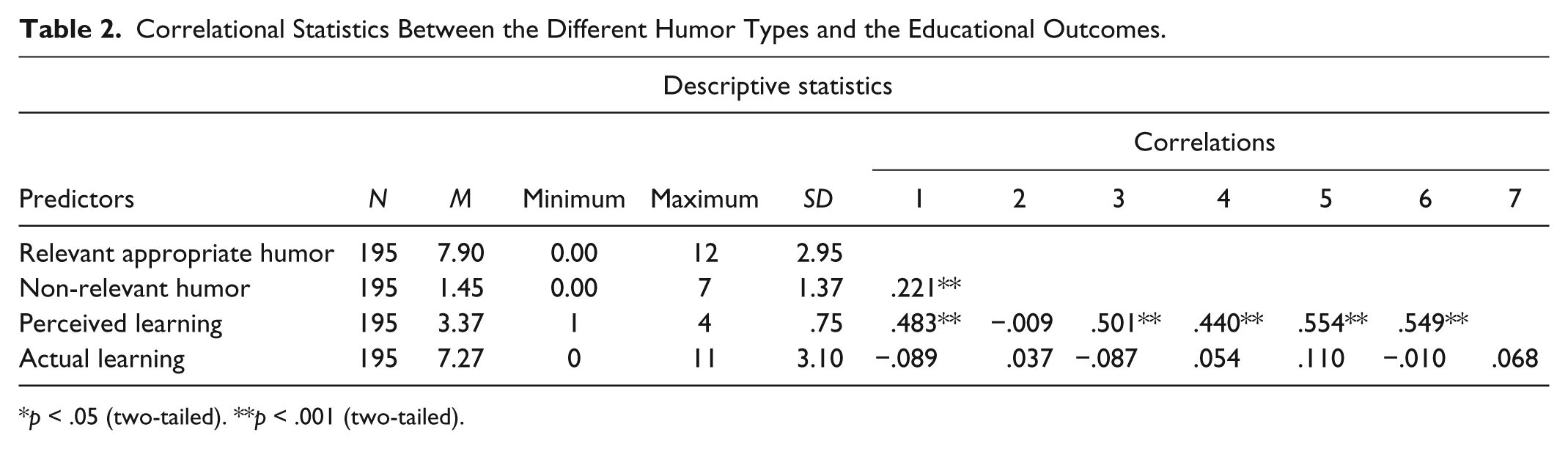
p < .05 (two-tailed). **p < .001 (two-tailed).
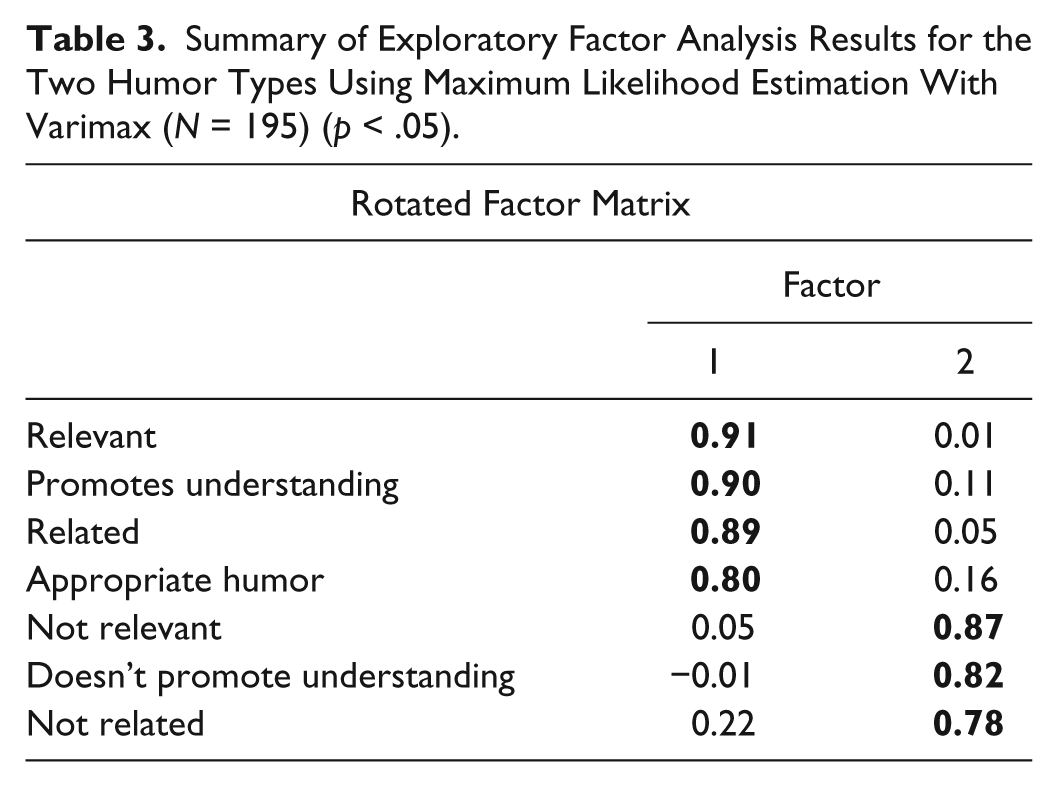
An Exploratory Factor Analysis (EFA) using the Maximum Likelihood extraction methods with a varimax (oblique) rotation method for the different questions about humor types was conducted on data gathered from the same 195 participants. First, all of the humor styles were entered; at this point, four major factors emerged. Factor 1 included the three items that asked about relevant humor in three different ways (using the words: relevant, promotes understanding, and related) and two additional items that asked about spontaneous humor and appropriate humor. Factor 2 included the three items that asked about non-relevant humor (using the words: not relevant, does not promote understanding, and not related). Factor 3 included one item that asked about self-disparaging humor, and one item that asked about disparaging others (students). Those items had a low factor loading. Factor 4 included three items. One item asked about relevant humor, one about appropriate humor, and one item about offensive humor. Two of those items (relevant humor and appropriate humor) cross-loaded with the first factor loading, but with weaker value. Factors 1 and 2 showed the most significant values (more than .70).
The spontaneous humor item had a low loading on the first factor loading and was dropped. With this item dropped, all of the relevant humor items loaded with one another. Appropriate humor also loaded with the three questions that asked about relevant humor. All of the non-relevant humor items also loaded together. This resulted in a two-factor solution: related/appropriate humor and non-related humor. Reliability for the four items measuring related/appropriate humor was .90, and reliability for the three items measuring non-relative humor was .78. Table 3 displays results for the oblique rotation. The first factor had an eigenvalue of 3.16, and it accounted for 45.21% of the variance in the data. Factor 2 had an eigenvalue of 2.11 and accounted for a further 30.18% of the variance.
Summary of Exploratory Factor Analysis Results for the Two Humor Types Using Maximum Likelihood Estimation With Varimax (N = 195) (p < .05).
Thus, two humor types were considered in the remaining portion of this article (relevant/appropriate and non-relevant). It is worth mentioning that negatively worded items might fall into the same factor and should be considered alongside study results.
Primary Analyses
Subsequent analyses examined the different research questions. For each research question, several regression analyses were conducted with different independent and dependent variables and moderating variables.
Research Questions
The first question asked, “Which type of humor (relevant/appropriate non-relevant) would have a positive type of relationships with the educational outcomes of perceived learning and actual learning?” And the second research question asked, “Would gender moderate the relationship of the types of humor with the different educational outcomes (perceived and actual learning)?”
A linear regression was conducted. In Step 1, gender was entered; in Step 2, the humor types of relevant/appropriate and non-relevant were entered; and in Step 3, the interactions of each humor type with gender were entered. Interactions were entered separately for each of the educational outcomes after variables were centered.
Perceived learning
In Step 1, with just gender as a predictor, the model explained 1.2% of the variance: F(1, 193) = 2.27, p < .13. Gender did not significantly predict perceived learning. In Step 2, with the two humor types entered, the model explained 25.4% of the variance. There was statistically significant change in r2: F(2, 191) = 30.94, p < .00. Relevant/appropriate humor significantly predicted perceived learning (β = .50, p < .00), but non-relevant humor was not a significant predictor (β = −.10, p = .10). In Step 3, the gender by humor type interactions were entered. There was not a statistically significant change in r2 (p = .79) and none of the interactions predicted perceived learning. Table 4 presents these results.
Perceived learning by using gender and the two humor types.

p < .05. **p < .01.
Actual learning
In Step 1, with just gender as a predictor, the model explained 2.2% of the variance: F(1, 193) = 4.33, p < .03. Gender significantly predicted actual learning (β = .14, p < .00). In Step 2, with the two humor types entered, the model explained 3.8% of the variance. There was no significant change in r2: F(2, 191) = 2.54, p = .19. Relevant/appropriate did not predict actual learning (β = −.11, p = .12), and neither did non-relevant humor (β = .09, p = .21). In Step 3, the gender by humor type interactions were entered. There was no statistically significant change in r2 (p = .33), and none of the interactions predicted actual learning (Table 5).
Actual Learning by Using Gender and the Two Humor Types.

p < .05. **p < .01.
Discussion
The relationship between different forms of humor and different types of learning is an important question. Humor is used within the classroom in various ways (Wanzer et al., 2006) with some instructors using humor as an instructional technique (Lundberg & Thurston, 2002). Accordingly, it was of interest to examine the relationship of different types of humor with perceived and actual learning. It was also of interest to examine possible mediating factors. Gender was chosen as a factor to be examined, due to the fact that there is not a significant amount of research in this area (Jackson & Jackson, 1997). With the educational system divided into differing levels (elementary, middle school, high school, college), university/college students were chosen as the focus for the potential toward a greater understanding of humor types and individual preference.
With regard to the four measures of humor, factor analyses revealed appropriate and relevant humor loaded together with the only reliable types of humor being relevant/appropriate and non-relevant. Accordingly, only two types of instructor humor were evaluated. It was found that certain types of humor were positively related to certain educational outcomes. The analysis suggests that the use of relevant/appropriate humor by an instructor predicts higher levels of perceived learning.
Appropriate humor is the type of humor students feel comfortable with and can predict positive emotions among students. Appropriate humor was positively associated with perceived learning. The current study found the more appropriate humor used, the higher perceived learning reported by students. According to Instructional Humor Processing Theory (IHPT), if there is a positive affect, the message enhances student ability to process information with reports of learning and retention occurring (Wanzer, M. B., Frymier, A. B., & Irwin). For the current study, relevant humor positively correlates with perceived learning. This affirms IHPT (Wanzer et al., 2010), which suggests instructors who use related humor during a course promote learning in a positive manner. For the current study, students report the more instructors use relevant humor, the more students believe they learned from the instructor in the course. Therefore, humor may relate to the perceived learning of students for that specific course.
There may be no relationship between different types of humor and actual learning, this may suggest that the use of humor by an instructor does not directly contribute to higher levels of actual learning. In previous studies, a relationship between types of humor and actual learning was found (Ziv, 1988). Perhaps in the current study, humor was not targeted in the same deliberative manner as in the Ziv study where specific jokes were chosen so as to relate to course materials and used throughout the entire semester. In the present study, the type of humor used varied and not all related to course materials. Also, the current study incorporated more measures of actual learning by comparison, while the Ziv study used the final exams as actual learning and integrated three purposeful types of humor. These variations may have affected why different conclusions are drawn from Ziv (1988).
There were no differences in the classroom between males and females in the manner in which different types of humor related to different educational outcomes. It may be that because of the similar experiences for both males and females, similar humor preferences allow for similar impressions.
Recommendations
There are three specific recommendations resulting from the present study. First, relevant/appropriate humor correlated with perceived learning in a positive manner. This indicates specific types of humor used in the classroom are associated with higher levels of student perceived learning. If instructors use humor that is relevant and appropriate in the classroom, it may contribute to higher levels of perceived learning for that specific course and for those specific students. Second, there were no differences in the classroom between males and females in the manner in which different types of humor related to different types of learning. It may be that because of the similar experiences for both males and females, similar humor preferences will allow for similar impressions. Third, when taking into account the Ziv (1988) study, actual learning can have a relationship with different types of humor. This may be the case if humor is specific to course material and targeted in such way to emphasize that specific information.
Limitations
The present study is of value in understanding the use of instructor humor within the college classroom. However, there are several limitations. The first limitation of this study is that this was not a cause and effect study, and the author could not conclude the use of humor will result in higher or lower levels of different types of learning. Future studies will want to consider a cause and effect design.
The second limitation is the fact that all of the instructors were female. This happened by chance. Instructors who taught the class in the prior semester included both males and females. The original intention of the study was to examine both the gender of students and teachers. However, because only female instructors were teaching the course at the time of data collection, it was only possible to consider student gender. Future research needs to examine instructor-related gender issues.
Directions for Future Research
The limitations presented in the previous section provide a roadmap to how the study was conducted. Suggestions for possible improvement toward gaining a more thorough understanding of the relationship between different types of humor and specific types of learning are provided. There are at least two potential directions for future research.
First, an experimental design should be used so research can draw a cause and effect conclusions about the relationship between different types of humor with different types of learning. Specifically, future research could test the suggested causal relationship: relevant/appropriate humor increases perceived learning and also the possible relationship that was found in previous studies between relevant humor and actual learning. Second, future research should continue to examine both female and male instructors and their use of humor in the classroom. This may shed light on whether there are additional differences in the manner in which humor is judged by students and its relationship with perceived and actual learning, if the instructor is male or female. This kind of research will also make it possible to look at the relationship between gender of the student and gender of the instructor. Including both genders with equal male to female ratios would be preferential.
Footnotes
Declaration of Conflicting Interests
The author(s) declared no potential conflicts of interest with respect to the research, authorship, and/or publication of this article.
Funding
The author(s) received no financial support for the research and/or authorship of this article.