



Abstract
Due to the rapid advancement of the Internet and technology, blended learning has gradually gained widespread acceptance among students, teachers, and educational institutions, emerging as the new norm in the post-pandemic era. This study aims to examine the factors influencing active engagement of undergraduate English-as-a-foreign-language (EFL) students in blended learning and the moderating role of gender in these relationships. Self-Determination Theory and Technology Acceptance Model are the theoretical frameworks of this study. A total of 381 questionnaires were collected from six universities in Jiangxi Province. Data were analyzed by Smart-pls 4.0. The results indicate that except for perceived ease of use, perceived autonomy, perceived relatedness, perceived competence, and perceived usefulness were significant predictors of active engagement. Furthermore, the results of the multigroup analysis revealed that there were no significant gender differences in the effects of perceived autonomy, perceived relatedness, perceived competence, and perceived usefulness on active engagement. The details of the results and both theoretical and practical implications have been described in the paper.
Plain language summary
Keywords
Introduction
Blended learning, which refers to using both online and face-to-face learning experiences, provides students with both benefits (Al-Obaydi et al., 2023; Wong, 2022), specifically, offering flexible and personalized learning approaches, accessing to diverse learning resources, promoting interactivity, and providing timely feedback. For example, numerous studies prove that blended learning could effectively improve English language learning performance (Abroto et al., 2021; Chiu, 2021a; Hh et al., 2022; Müller & Mildenberger, 2021). By utilizing Learning Management Systems (LMS), autonomous learning applications, and online course platforms, students can independently manage their learning schedules and access educational resources anytime and anywhere (Huang & Yoon, 2023). The convenience of this technology further enhances student engagement, especially in the process of language learning, where students can achieve more interaction and immediate feedback through technology (Xu et al., 2022). Moreover, technology helps EFL students overcome the spatial and temporal limitations of traditional classrooms, enabling them to better balance their studies with their personal lives (Muthuprasad et al., 2021). Therefore, exploring the relationship between technology and EFL students is crucial for understanding their learning behaviors in a blended learning environment.
However, learners may encounter challenges while acclimating to the new learning environment, such as the requirement to adjust to diverse learning scenarios and paces, as well as the selection and evaluation of online learning resources (Bayu & Saputra, 2023; Chiu, 2021a; Hu et al., 2022). To overcome various challenges, extensive efforts have been devoted to investigating the factors influencing English language proficiency and learning efficiency in blended learning (Han et al., 2021; Ubu et al., 2021). The findings consistently highlight that active engagement (AE), in which students invest energy in their learning processes, thus rendering it a meaningful strategy for them, is one of the most crucial factors. Hence, enhancing college students’ AE and achieving success in English language learning has become a primary concern for universities and higher education institutions.
Empirical studies have revealed that the factors influencing AE in blended learning include multiple task characteristics and teacher roles (Leo et al., 2022), three basic psychological needs (autonomy, competence, and relatedness; Cents-Boonstra et al., 2022; Pan et al., 2023; Zhi et al., 2024), academic self-efficacy (Pan et al., 2023), learner’s engagement (Shakki, 2023), the usefulness of systems and teaching presence (Salas-Pilco et al., 2022), teacher and parent support, students’ academic self-efficacy (M.-T. Wang & Hofkens, 2020). Furthermore, to examine the magnitude of these factors on AE in blended learning, different theories and models have been adopted in the literature, such as the self-determination theory (Chiu, 2021a), social cognitive theory (Panigrahi et al., 2022), the theory of motivation (Sucaromana, 2013), interactive learning theory (Q. Q. Wang, 2022).
Although existing research has thoroughly explored various aspects of AE in blended learning, there has been no concerted effort to simultaneously employ the Technology Acceptance Model (TAM) and Self-Determination Theory (SDT) in analyzing student AE within blended learning contexts. The application of TAM is instrumental in understanding how students accept and utilize the technological components inherent in blended learning, while SDT offers insights into students’ intrinsic motivation and psychological needs. The synthesis of these two theoretical frameworks may afford a more comprehensive and nuanced perspective, elucidating the complexities of student AE in blended learning. Such an integrative approach stands to provide educators with targeted strategies that could enhance the learning experiences of students, thereby potentially contributing to more effective instructional design and implementation within the paradigm of blended learning. In addition, it is approximated that China boasts the largest percentage of English-as-a-foreign-language (EFL) learners in Asia, even globally (Li et al., 2018). Hence, investigating the factors that influence AE among EFL students in blended learning will significantly enhance the likelihood of achieving success in English language learning.
Therefore, the objective of this study is to investigate the factors influencing AE among EFL students in blended learning, using the TAM and SDT as the theoretical framework. Given the complexity of blended learning, the AE of EFL students should be considered by considering both technological and psychological factors. The second objective of this study is to explore the gender differences in the AE among EFL students in blended learning. The technical and psychological aspects of learners may vary depending on gender (Escobar-Viera et al., 2021; Hsieh et al., 2021; Voss et al., 2021), thus suggesting that the relationship between these factors and AE may also exhibit gender differences.
The remaining parts of the study are structured as described below: it begins by outlining its theoretical foundation and providing a literature review on TAM and SDT. Following that is a section on methodology and data analysis results. The final section includes the discussions and the limitations and future work of the study .
Literature Review and Hypothesis
Literature Review
Existing Research on Blended Learning
Blended learning, which combines traditional classroom instruction with online learning, has been extensively studied and applied in recent years. Research indicates that blended learning exhibits significant advantages in flexibility, personalized learning, and interactivity (Müller & Mildenberger, 2021). Through online platforms and Learning Management Systems (LMS), students can choose their learning content and pace according to their own needs, thereby enhancing their capacity for autonomous learning. Additionally, blended learning provides a diverse array of learning resources and immediate feedback, enhancing students’ learning experience and sense of achievement (Wong, 2022). For example, Abroto et al. (2021) demonstrated that blended learning effectively improves students’ academic performance and motivation, particularly in language learning and other courses requiring long-term engagement.
Moreover, blended learning has excelled in increasing student engagement. Studies have shown that courses employing a blended learning model can inspire greater student involvement, especially in self-directed learning and collaborative teamwork (J. C. Sun & Rueda, 2012). By flexibly scheduling face-to-face and online classes, blended learning retains the benefits of traditional classrooms while overcoming the drawbacks of reduced interaction in online learning, enabling students to better manage their learning processes (Garcia-Morales et al., 2021).
Despite its many advantages in education, the implementation of blended learning still faces several challenges. Research indicates that students adapting to a blended learning environment may encounter technological barriers, difficulties in self-management, and issues in selecting online learning resources (Muthuprasad et al., 2021). Particularly in regions with high technological demands, students may face a lack of adequate equipment or unstable internet connections, which can affect their learning outcomes. Furthermore, although blended learning can enhance engagement, it also places higher demands on student self-discipline, especially in the absence of face-to-face supervision (Xu et al., 2022).
Current research primarily focuses on the implementation effects of blended learning, technological support, and student learning outcomes. However, there is still a research gap in exploring how individual differences, such as gender and cultural background, affect the learning experience in blended environments (Y. Wang et al., 2022). Therefore, further investigation into the learning behaviors and engagement differences among various groups within blended learning, particularly gender differences, will help provide deeper theoretical support for personalized education.
Self-Determination Theory
SDT is a prominent macro-level theory pertaining to studying human motivation (Luo et al., 2021). The theory identifies two motivations: extrinsic and intrinsic. According to the SDT, human beings have three primary psychological requirements: perceived autonomy (PA; i.e., a feeling of being self-governed and self-initiating in one’s endeavors), perceived competence (PC; i.e., a sense of being efficient, which is comparable to the concept of self-efficacy), and perceived relatedness (PR; i.e., a feeling of closeness with other people; Deci & Ryan, 2011; Ryan & Deci, 2000). If these basic psychological demands are met in the classroom, students are more likely to internalize their motivation and engage in more autonomous learning (Hsu et al., 2019).
Previous research has concentrated on the validity of SDT in educational environments, including both traditional classrooms (Lo & Hew, 2020), online learning environments, such as K-12 online learning (Chiu, 2021b), MOOCs (Lan & Hew, 2020; Y. Sun et al., 2019), and blended learning environments (Chiu, 2021a; Hh et al., 2022). In particular other research, self-determination factors have been observed as antecedents that impact learners’ perspectives, for instance, motivation (Pugh, 2019), continuance intention (Luo et al., 2021), and attitude (M. Wang et al., 2021).
Numerous recent studies have found that the satisfaction of these psychological requirements facilitates engagement and sustains satisfying learning outcomes (Chiu, 2021a, 2022; Lan & Hew, 2020; Zhou et al., 2022). For example, Zhou et al. (2022) focused on the degree of students’ AE in online English learning. They revealed the basic psychological need to predict students’ four dimensions of online learning engagement, and competence proved to be the strongest predictor. Chiu (2022) concluded that remote learning proves to be better equipped to adapt to students’ varying needs. The three psychological needs in SDT hold predictive value for gaging students’ level of engagement, and relatedness support are critical. Meanwhile, Y. Sun et al. (2019) found that competence needs strongly influence students’ psychological engagement, ultimately enhancing behavioral engagement in MOOCs. Moreover, Shah et al. (2021) proved that the effect of an online learning environment on student engagement is moderated by how students perceive the extent to which their basic psychological needs are fulfilled or unfulfilled. Similarly, McEown et al. (2014) discovered that when students’ motivation was more substantial, they were more likely to desire to keep studying the language.
Technology Acceptance Model
TAM adapted from the Theory of Reasoned Action (TRA) to better forecast users’ acceptance of Information technology (IT) and introduced two crucial concepts: perceived usefulness (PU) and perceived ease of use (PEOU; Davis et al., 1989). PU in this study refers to the extent to which students perceive that engagement in blended learning will improve their learning effectiveness. PEOU is the degree to which students believe engagement in blended learning is effortless. Furthermore, according to TAM, attitude is the most critical factor of a user’s behavioral intention and actual usage, which in turn is a combination of PU and PEOU. Numerous empirical studies have confirmed the causal relationship between all of these concepts (Ab Rahman et al., 2019; Alalwan, 2022; Alismaiel et al., 2022; Peng et al., 2022).
As technology continues to advance, using technology for educational purposes is now an integral part of everyday life, and various learning technologies have increased (X. Wu & Wang, 2018, 2020). As a result, research on the relationship between learners’ perceptions of new technology and their engagement has been done (Bernacki et al., 2020; Binder, 2022; Bond et al., 2020; Code et al., 2020). For example, H. E. Kim et al. (2021) considered that learners’ perceptions of MOOCs’ usefulness substantially affected learning engagement, enhancing learning results. Furthermore, the PEOU of MOOCs learning systems is an essential factor influencing learning engagement. To enhance the explanatory power of flipped learner engagement, Min (2021) effectively extends TAM by incorporating two additional external variables, specifically social influence and cognitive instrumental processes. By integrating SDT and TAM, C. Sun et al. (2020) designed a predictive framework for higher education students’ engagement in online learning. The findings indicated a significant correlation between PU and significantly influencing emotional and cognitive engagement.
Hypothesis
PA in the context of education refers to individuals actively choosing learning strategies and regulating the learning process (Arvanitis, 2017). Several studies have demonstrated a positive correlation between PA and positive outcomes (Guay, 2022; Nalipay et al., 2020; Ryan & Deci, 2020). For instance, Ryan and Deci (2020) pointed out that in online self-regulated learning, when individuals believe that their behavior is motivated by internal forces, they are more inclined to believe that they have control over particular objectives and link actions to positive results. In this study, blended learning offers a multitude of approaches to appropriately address the needs of diverse learners’ language acquisition in foreign language education, which enables students to regulate their learning process without being guided by the teacher, thereby enhancing their autonomy (Nalipay et al., 2020; Racero et al., 2020). This way also enhances learning efficacy, thereby enhancing students’ perceptions of usefulness and ease of use. As a result, the following hypotheses are put forth:
The concept of relatedness involves establishing emotional connections with others (Ahn & Back, 2019; Gupta, 2020; Luo et al., 2021). Gupta (2020) deemed that when individuals were in an environment of autonomous support coupled with a robust sense of relatedness, it can engender an augmented incentive for them to engage in educational undertakings. Thus, PR is a manifestation of social influence that parallels the subjective norm within the field of information systems (Rahi et al., 2021; Xie et al., 2020). Prior research has indicated subjective norms’ impact on PU and intrinsic motivation (Pugh, 2019; Rahi et al., 2021). Nikou and Economides (2017) also discovered a positive correlation between relatedness, PU, and PEOU. Based on that, we hypothesize that:
PC is analogous to self-efficacy and exhibits common characteristics (Roca & Gagné, 2008). It refers to an individual’s belief in whether they can complete a particular task successfully and accomplish their objectives (Sørebø et al., 2009). This belief relates to users’ perceptions in technology-enhanced areas, such as PU and PEOU. Meanwhile, it is anticipated that PC (an intrinsic motivation factor) would affect PU (an extrinsic motivation factor; Lee et al., 2015). In addition, previous research has demonstrated a positive correlation between self-efficacy and PEOU using digital systems. Thus, it is assumed by this study that the perception of system usefulness and ease of use will increase among Chinese English learners if they feel confident in utilizing language learning technology within a blended learning setting. Based on the above discussion, the following hypotheses are proposed:
Numerous recent studies have reported that fulfilling psychological needs increases engagement and fosters positive learning outcomes and outstanding achievement (Benlahcene et al., 2021; Conesa et al., 2022; Jin et al., 2022). For example, Stiegemeier et al. (2022) compared participants in Small Private Online Course (SPOC) who completed the course with non-completers and discovered that engagement could be predicted significantly by basic psychological needs. The research conducted indicated that relatedness was a potent incentive for learning engagement. The relatedness-supportive learning environment in educational settings resulted in greater active learning engagement. Jin et al. (2022) also concluded that when individuals perceived that they had the necessary abilities and resources to complete a task, they were more inclined to exhibit self-determined behavior and were more engaged. Conversely, they may lose confidence and reduce their engagement. Regarding foreign language learning studies, it had been shown that fundamental psychological needs could foresee AE among college students (Shirvan & Alamer, 2022; Y. Wang et al., 2022). Therefore, based on the prior literature, we hypothesize:
In blended learning, the student’s traits and the learning platform or social media devices should be the main focus (H. E. Kim et al., 2021; Panisoara et al., 2020). The relationship between perceptions of technology and their actual engagement had been proven by existing research (Jin et al., 2022; Luo et al., 2021; Xia et al., 2022). For instance, Rahi et al. (2021) proposed that students’ engagement with blended learning may be influenced by the characteristic of the platform, particularly its usefulness and that this relationship should be explored further. In addition, the PEOU of the platform is another essential factor affecting student engagement (Arvanitis, 2017; Ryan & Deci, 2020; Xia et al., 2022). Hence, the PU and PEOU are expected to affect EFL students’ AE in blended learning. As a result, the following hypotheses are put forth:
Gender is a vital factor to consider when developing a model of motivation and engagement (Oga-Baldwin & Nakata, 2017). Similarly, Lietaert et al. (2015) also believed that females exhibited greater diligence and engagement in classroom activities and demonstrated heightened attentiveness and endurance compared to their male counterparts. Moreover, while learning a language, a large body of research shows that females are more skilled in their native tongue-related fields, and this trend has also extended to other languages. Females often fare marginally better than males while learning English as a foreign language. Meanwhile, differences in how males and females engage with language learning may result from differences in basic interaction styles and identity (Hsieh et al., 2021; Lilleker et al., 2021). Hence, gender differences warrant careful attention, and it is necessary to study potential contributing factors that can inform teaching practices and facilitate educators in fostering increased student AE in foreign language acquisition.
Evidence suggests gender differences exist in ability-related domains (Fu et al., 2022; Niu et al., 2022; Shen et al., 2022). For instance, compared to males, females reported a higher level of competence beliefs in language but a lower level of competence in athletics (Bayu & Saputra, 2023). To account for these gender gaps in stereotypical areas, Li et al. (2018) proposed that due to gender-role socialization differences, males and females acquire different patterns of competence beliefs and values, and thus different levels of engagement across a wide range of activities, which are consistent with their gender role. Based on the above discussion, this study deems that the differences in male and female PC will affect their enthusiasm to participate in foreign language learning. Therefore, the following hypothesis is proposed:
Several studies have explored gender differences concerning the relationship between PR and AE (Akhrib & Zohra Mebtouche Nedjai, 2021; Rezaeian & Abdollahzadeh, 2020; Y. Wu & Kang, 2023). For instance, Salmela-Aro et al. (2022) considered that PR had a more significant impact on male engagement than females. This was primarily attributed to the fact that males were deemed to be more susceptible to academic maladjustment. Other studies have reported that, compared to their male counterparts, females often tended to exhibit more positive attitudes toward their interactions with instructors and peers (Aditomo & Hasugian, 2018; Almusharraf et al., 2023). Based on the above discussion, we deem that the relationship between PR and AE in blended learning is moderated by gender. Accordingly, the following hypothesis is proposed:
A limited amount of prior research has been conducted regarding gender differences in the correlation between PA and AE (Akhrib & Zohra Mebtouche Nedjai, 2021; Hsieh et al., 2021). Conesa et al. (2022) analyzed a cohort of 274 seventh-grade pupils from Belgium. They revealed that the correlation between perceptions of PA and behavioral engagement had been more pronounced in males than females. On the contrary, Rezaeian and Abdollahzadeh (2020) found that females usually exhibit more self-discipline than males because they are more inclined to plan, set goals, and self-monitor than males. It is anticipated that there are substantial gender differences in the correlation between PA and AE in blended learning. Thus, the following hypothesis is put forth:
Blended learning is an instructional strategy that builds on the foundation of conventional classroom instruction and adds auxiliary teaching means such as network technology (Du et al., 2022). In this setting, female students are more likely to pursue high-quality learning experiences, making them more likely to perceive the utility of foreign language learning and thus enhance their enthusiasm for participating in blended learning (Arifin & Ad, 2019; Arvanitis, 2017). Conversely, male students typically favor individual learning and self-exploration, placing less emphasis on the practical application value of learning (Maon et al., 2021). In light of this, we hypothesize:
PEOU refers to the degree to which learners perceive the convenience of using a specific tool or technology (Davis, 1989). Research shows that in blended learning, male learners were more likely to perceive the ease of foreign language learning than female learners (Bayu & Saputra, 2023; Benlahcene et al., 2021). This may be because males are better at using technical tools, more confident, and willing to try new technical tools to assist learning (Chibisa & Mutambara, 2022; Du et al., 2022). Based on the above discussion, we propose the following hypothesis:
Through a comprehensive arrangement and analysis of the literature and empirical support, we have devised a research model illustrated in Figure 1.

Theoretical framework.
Methodology
Sample and Data Collection
This study employed a random sampling method to ensure the representativeness of the sample and the broad applicability of the research results. Random sampling minimizes sample selection bias, giving each potential participant an equal chance of being selected for the study. Data collection took place from April 10 to May 20, 2023, at six universities in Jiangxi Province, China, where university students were enrolled in blended EFL courses. These universities were chosen because they extensively use blended learning as a teaching method for English courses.
Before the start of data collection, all participants were informed of the purpose of the study, which aimed to investigate the factors affecting the active engagement of EFL students in a blended learning environment. Researchers assured participants that all personal information would be kept confidential and their privacy fully protected. Participants were also informed of their right to withdraw from the survey at any time without providing any reason.
Participants were selected through a random sampling method from these six universities, ensuring that the sample adequately represented the broader EFL student population at these institutions. The questionnaire was distributed electronically via the professional online survey platform, Wenjuanxing (https://www.wjx.cn), which ensured the security and efficiency of data collection.
Before participating in the survey, all participants provided written informed consent, acknowledging their understanding of the research purpose and agreeing to participate in the study. To further enhance the representativeness of the sample, we ensured it included students from different academic years (freshmen, sophomores, juniors, and seniors) and with varying experiences of blended learning. Specifically, the sample included 56.17% freshmen, 38.06% sophomores, with a balanced gender distribution of 50.13% male and 49.87% female. Most respondents (45.95%) had more than 3 months of blended learning experience, 37.53% had less than 1 month, and 16.54% had 1 to 3 months of experience (Table 1). This diversity in gender, academic year, and blended learning experience allows for a comprehensive exploration of factors affecting student engagement in blended learning environments, as these variables might influence students’ attitudes and experiences differently. For example, newer students or those with less blended learning experience may differ in autonomy or relatedness from more experienced students, which could affect their active participation.
Information Regarding the Demographics of the Respondents (N = 381).

Instruments
The survey comprised two segments. In the first section, researchers offered demographic information. The second section necessitated the respondents to express their levels of agreement or disagreement toward items by using a five-point Likert scale ranging from “strongly disagree” (1) to “strongly agree” (5). Table 2 displays detailed information on the scale.
Items of the Constructs.

Data Analysis
This study employed a cross-sectional research design aimed at exploring the factors influencing the AE of Chinese university students in a blended learning environment and analyzing the moderating role of gender among these factors. Cross-sectional designs enable data collection at a single time point, effectively analyzing the correlations between different variables (Ringle et al., 2015). The collected data were processed using various statistical analysis methods. Initially, descriptive statistical analysis was used to outline the basic characteristics of the sample. Subsequently, Smart PLS was utilized to test the research hypotheses to determine the relationships between independent and dependent variables. There are several rationales behind employing Smart PLS in this research: (1) small sample size and non-normal distribution of data; (2) the ability to handle complex models involving moderating effects; (3) it allows for model comparison and validation between different groups to determine model consistency and differences (J. Hair et al., 2021). Additionally, the moderating role of gender was examined using Multi-Group Analysis (MGA).
Results
The Outer Model
To ensure that the data was consistent with the research model, it was imperative to evaluate the reliability and validity of each indicator within the questionnaire. Reliability measurement mainly uses indicator reliability and internal consistency reliability. Meanwhile, convergence validity and discriminant validity tests are carried out to evaluate the validity of each indicator.
Factor loadings were used to evaluate the items’ reliability. Table 3 reveals that all items exhibit factor loadings surpassing 0.708, indicating a satisfactory level of reliability (Bagozzi, 1981).
Reliability and Validity Evaluation.

Internal consistency reliability was assessed using composite reliability (CR) and Cronbach’s alpha (CA). CA varied from .835 to .885 above the 0.7 threshold recommended in the literature (Henseler et al., 2009), satisfying the value requirements. Furthermore, J. F. Hair et al. (2017) stated that CR values between 0.60 and 0.70 were acceptable, 0.70 and 0.90 were generally regarded as satisfactory, and values above 0.90 (particularly > 0.95) were undesirable. The CR in Table 3 ranged from 0.837 to 0.886, demonstrating the entire dataset met the requirements above.
Convergent validity, evaluated using the Average Variance Extracted (AVE), refers to the convergence or correlation of items to measure the same variable (Trockel et al., 2018). The AVE values ranged from 0.752 to 0.814 over the recommended value of 0.50, meaning sufficient convergent validity (Henseler et al., 2015b).
Discriminant validity is the degree to which one construct can be genuinely distinguished from another (Zaiţ & Bertea, 2011). Fornell-Larcker criteria and cross-loading method could be used to assess the discriminant validity.
First, according to the Fornell-larcker criterion, the square roots of the AVE for a particular construct should outweigh correlation values with other constructs (Henseler et al., 2015b). Table 4 displays that the square root of the AVE of each construct is higher than its highest correlation with other constructs. Hence, the findings meet the criteria.
Analysis Outcomes of Discriminant Validity (Fornell-Larcker Criterion).

Note. The bold values on the diagonal is the square root of AVE.
In addition, the research employs a comparative table of cross-loading items to assess discriminant validity. Cross-loading among indicators is evaluated by analyzing the inter-relationship between one particular indicator and another. When the relationship between an indicator and its variables surpasses that of the other indicators, it is considered to be established (Henseler et al., 2015a). The findings presented in Table 5 demonstrate that the aforementioned criteria have been fulfilled, thereby establishing discriminant validity.
Analysis Outcomes of Discriminant Validity (Cross-loadings).

Note: The bolded values represent the outer loadings corresponding to each construct.
The Inner Model
Collinearity Test
The Variance Inflation Factor (VIF) is a commonly used metric for detecting multicollinearity among independent variables. It quantifies the degree of linear relationship between each independent variable and all other independent variables, thereby assisting researchers in determining whether multicollinearity exists in the model (J. F. Hair et al., 2017). A VIF value of 5 or more indicates a serious collinearity problem among indicators (Purwanto, 2021). Therefore, criteria with values below five were deemed acceptable in this research. The VIF value, as evidenced in Table 6, displays a range of 2.132 to 4.426, indicating a lack of collinearity issues.
Collinearity Statistic (VIF).

Significance Testing of Hypotheses
The findings of the research hypotheses are tabulated in Table 7 and Figure 2. As can be observed, PA was positively linked with PU (β = 5.593, p < .001) and PEOU (β = 4.736, p < .001), supporting H1 and H2 correspondingly. As for PR, it is positively related to PU (β = 3.997, p < .001) and PEOU (β = 3.229, p < .001), confirming H3 and H4, respectively. As anticipated in the previous hypothesis, PC positively influences PU (β = 9.645, p < .001) and PEOU (β = 7.341, p < .001), providing support to H5 and H6. The analytical results demonstrated that PA was positively associated with AE (β = 5.807, p < .001), confirmed H7. Additionally, PR meaningfully predicts AE (β = 8.040, p < .001). Therefore H8 is acceptable. The direct relation from PC to AE was significant (β = 3.438, p < .001), providing support H9. PU directly and significantly affected AE (β = 4.067, p < .001), and H10 was supported. Regarding the relationship between PEOU and AE, the results demonstrated that PEOU did not influence AE (β = .617, p > .05), and H11 was rejected.
Path Coefficients and Results of Hypotheses Testing.

p < .001.

Structural model path coefficients.
Explanatory Power
The coefficient of determination (R2) value reflects how well the independent variable predicts the latent dependent variable. As recommended by Chin (1998), R2 values of .19, .33, and .67 are regarded as weak, moderate, and substantial, respectively. Accordingly, the R2 values obtained from the assessments of .661, .773, and .762 show acceptable levels of predictive accuracy (Table 8).
The Predictive Power of Construct.

Effect Size (f2)
The effect sizes (f2), based on changes in R2 values, were evaluated (J. F. Hair et al., 2017). Following Cohen (1988)’s guidelines, effect sizes with values of 0.02, 0.15, and 0.35 are categorized as small, medium, and large, respectively. PA and PC were found to have a small substantive effect on students’ engagement, with 0.064 and 0.023, respectively. Moreover, PR exhibits a moderate effect size (f2 = 0.243) (Table 9).
The Effect Size.

The Multigroup Analysis for the Moderator Effects
To test the moderating effect of gender, it is required to assess the measurement invariance of the female and male produced in accordance with the variables (Henseler, 2012). Thereby, the three-step measurement invariance of composite models (MICOM) procedure recommended by Henseler et al. (2015a) was used to assess the measurement invariance for gender before the PLS-MGA. MICOM包括 configural invariance, compositional invariance, composite equality. This is an effective method for determining whether a measurement model assesses the same attributes across different conditions (Henseler, 2015). According to Leguina (2015), since the maximum number of arrows pointing toward a construct in this study is 5, to reach the minimal R2 of .10 at a 5% significance level, both subgroups must exceed 147. Meanwhile, J. F. Hair et al. (2019) emphasize that although the sizes of two subpopulations need not be identical, they must be comparable. Consequently, the criteria have been met by both sample groups included in this research.
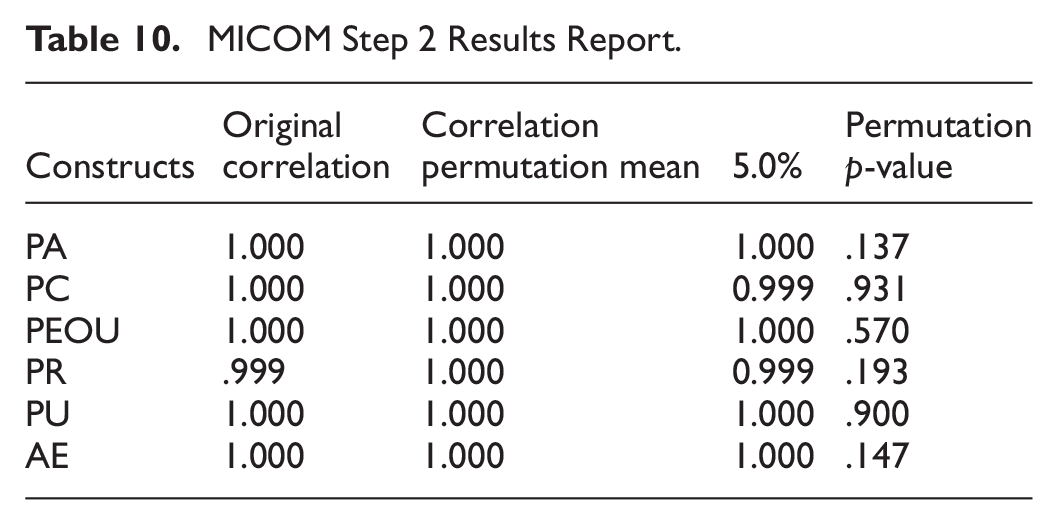
Firstly, the evaluation of configural invariance involves assessing the measurement model across all groups to determine whether the same underlying factor structure—specifically, the same number of constructs and their corresponding measurement items—is present in all groups (Henseler, 2015).Consequently, configural invariance has been verified using the same data processing, measurement, and structural models, as well as algorithm settings. Secondly, permutation tests are employed to examine whether statistical evaluations demonstrate compositional invariance. Table 10 indicated that compositional invariance was also proven to exist because the original correlation is always equal to or higher than the 5% quantile (Cheah et al., 2020).
MICOM Step 2 Results Report.
The third stage evaluates the composite equality of mean values and variances across groups. It is essential to fulfilling two prerequisites in this phase. First, the mean original difference must fall within the 95% confidence interval. Second, the original variance difference must be a number that falls within the 95% confidence interval (Henseler et al., 2015a). Tables 11 and 12 show that Step 3 was not satisfied.
MICOM Step 3 Results Report—Part 1.

MICOM Step 3 Results Report—Part 2.
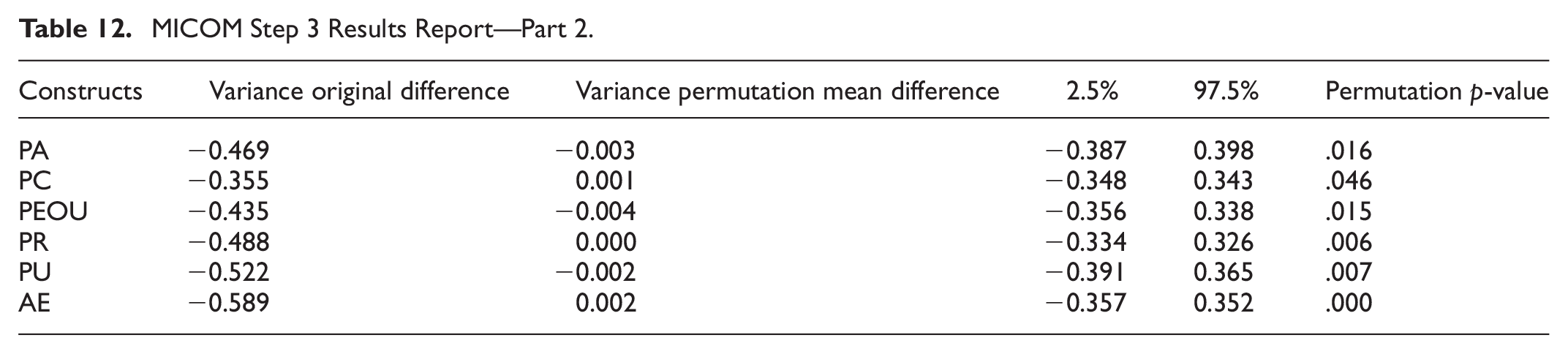
Partial measurement invariance was built in circumstances where Steps 1 and 2 were confirmed, while Step 3 only satisfied one criterion. The partial measurement invariance proved sufficient to use the PLS-MGA to compare structural paths between groups (Henseler et al., 2015a).
Once invariance has been validated, the subsequent stage necessitates conducting a multigroup analysis (Table 13). Based on the outcomes of both permutation tests and PLS-MGA analyses in Table 14, there are no significant differences between the two genders in blended learning. Accordingly, H12a, H12b, H12c, H12d, and H12e are all rejected.
Bootstrapping Results for Males and Females Separately.

Multigroup Analysis Results.

Common Method Bias
Common method bias (CMB) should be considered while performing quantitative research. Following Kock (2015)’s recommendation, Harman’s Single Factor Test was carried out. The principal component factor was used to analyze each item in SPSS. The findings in Table 15 demonstrated that the first cumulative value was lower than 50%, indicating that there were no problems with the CMB in current research (S. B. Kim & Kim, 2016; Podsakoff & Organ, 2016).
Total Variance Explained (Herman’s Single Factor Test).
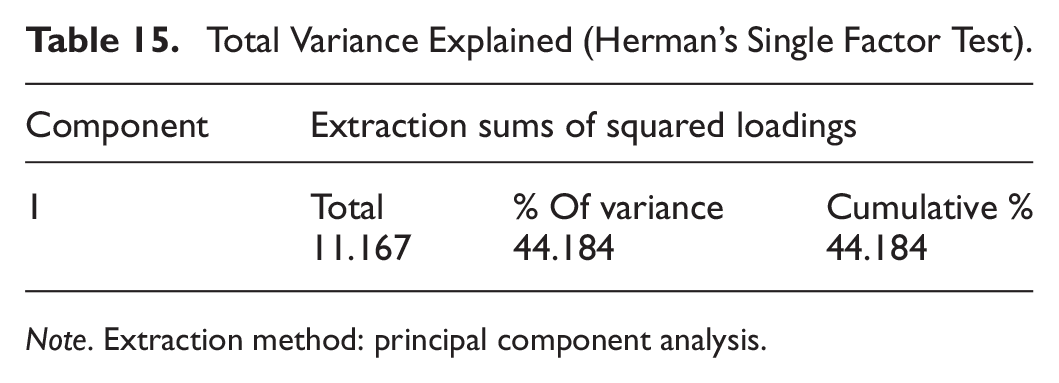
Note. Extraction method: principal component analysis.
Discussion
The present study puts forth an extended model of TAM that incorporates the motivation factors derived from SDT. Then empirical research was conducted to examine the relationship between the constructs in the hypothesized model with gender as a moderating variable. The findings suggest that 76.2% of the variance in the learners’ AE is explained by the determinants of SDT and TAM, which exhibits that the combination of TAM and SDT offers an appropriate framework for learners’ AE. The following segments furnish an in-depth analysis of the study’s findings.
This research discovered that PA could enhance PU, which corresponds with the findings of Nambiar (2020). One plausible justification could be that blended learning allows EFL students to make choices depending on their interests and learning goals by offering different learning means, thereby improving their autonomy. In this autonomous learning environment, EFL students are more likely to experience a sense of achievement and satisfaction in learning, thus believing that blended learning is beneficial. Therefore, H1 is supported.
PA is confirmed as a powerful predictor for PEOU. One explanation is that blended learning provides rich online learning resources, encompassing video tutorials, interactive exercises, and learning communities. EFL students can independently choose and explore these resources based on their own needs and learning styles. When students perceive that the platform can provide this autonomous support, they may think that using the platform is easy because it matches their learning needs. This discovery is consistent with several studies that demonstrate the close relationship between PA and PEOU (Abou-Khalil et al., 2021; Rezaeian & Abdollahzadeh, 2020). Therefore, H2 is supported.
Congruent to the findings of Luo et al. (2021), PR produces significant positive effects on PU. In this study, blended learning offered a collaborative platform for EFL learners to interact and engage with each other. By engaging in active learning, effective communication, and productive collaboration, students can feel a sense of connection and belonging to others. This perception of correlation can enhance the PU of learning resources and activities, as learners recognize that interaction and collaboration with others can improve learning outcomes. Therefore, H3 is supported.
Our findings strongly supported the hypothesis that PR positively impacted PEOU. This result is partly linked to prior research conducted by Y. Wang et al. (2022), which indicated that PR played a significant role in forecasting PEOU. When EFL students perceive an increased correlation with others, it can promote more opportunities for communication and feedback. This communication and feedback can help learners better understand how to use blended learning tools and resources by providing practical guidance and suggestions, thus improving PEOU. Therefore, H4 is supported.
PC was meant to be a good predictor of PU and PEOU. These results were confirmed by the findings in prior studies (Cents-Boonstra et al., 2022; Rahi et al., 2021; Werle et al., 2021). In blended learning, technical tools and platforms are frequently utilized, including online learning platforms and speech recognition software. When EFL students feel that they have sufficient technical skills to effortlessly use learning tools and platforms, their learning may become more efficient, enhancing their perception of the usefulness and ease of use of blended learning. Therefore, H5 and H6 are supported.
The structural model results reveal that PA is the crucial antecedent for AE. This outcome is in line with research done by Bayu and Saputra (2023) in synchronous online English courses. In blended education, promoting an atmosphere of autonomy can effectively enhance AE among EFL students. This is because autonomous learning gives students a greater sense of control and autonomy over their learning. Simultaneously, EFL students are more likely to delve deeper into topics or issues that pique their interest, and they are also more likely to experience joy and a sense of accomplishment, which makes them more willing to engage in blended courses. Therefore, H7 is supported.
It is affirmed that PR significantly affects learner AE, which is accordant with results from previous research (Bayu & Saputra, 2023; Conesa et al., 2022). When studying a foreign language, EFL students may face various obstacles and challenges that might induce anxiety and result in a sense of isolation. In this situation, PR makes EFL learners feel connected to others, which can encourage them to exchange ideas with instructors and peers, share learning experiences, and overcome difficulties together. Consequently, a feeling of relatedness will motivate them to engage more in foreign language learning. Therefore, H8 is supported.
PC has positive effects on AE as well. The outcomes correspond with the results of research conducted by Conesa et al. (2022) on Chinese EFL learners. This finding may be explained by the fact that Chinese culture impacts EFL students’ learning styles, which makes them more dependent on the teacher and less able to study on their own. Additionally, the traditional one-way educational approach makes students less confident and timid in communication and expression. However, blended learning can provide more opportunities for oral English practice and communication. In such an environment, EFL students can perceive their competence to learn English, which boosts their confidence and passion in class and enables them to engage in more active English learning. Therefore, H9 is supported.
For EFL students, PU, while adopting blended learning, significantly correlated with their AE. This indicates that if EFL students deem the blended learning approach to be efficacious in heightening their academic achievement, it is plausible that they may exhibit heightened involvement in foreign language learning. One explanation of this result is that blended learning combines traditional face-to-face teaching with online learning. Therefore, in blended learning, EFL students can obtain rich learning resources through online learning platforms, which can help them better understand and master language knowledge. The outcome aligned with a previous study by El-Sayad et al. (2021), which showed that the usefulness of online learning systems positively affected emotional and cognitive engagement. Therefore, H10 is supported.
On the contrary, PEOU, while adopting blended learning, did not significantly affect AE for EFL students. This may be because EFL college students may have more technical proficiency and digital literacy than other age groups. They are generally more familiar with using computers, the Internet, and various online tools. Therefore, they may be more concerned with realizing learning outcomes and the quality of teaching content, and ease of use may not be their primary concern. This result is aligned with prior research by Jung and Lee (2018), who revealed that PEOU is not a significant predictor when exploring the factors influencing students’ engagement in massive open online courses (MOOCs). Therefore, H11 is rejected.
There is no significant gender difference in the relationship between PA and AE for EFL students. One explanation may be that blended learning offers impartial and equitable learning opportunities where male and female students receive comparable autonomy support. This includes the ability to autonomously choose learning content, control the learning process, and perceive their learning abilities and effectiveness. This equal learning environment reduces the moderating effect of gender on these relationships. This result is aligned with prior research by Heilporn et al. (2021), who revealed that regardless of gender, an autonomous learning environment can promote students’ AE in online learning. Therefore, H12c is rejected.
Our results showed no significant gender difference in the relationship between PC and AE for EFL students. This discovery contradicts the findings of Rinaldi et al. (2023)’s research, which found that male students demonstrated a higher inclination than their female counterparts to self-evaluate their competence positively in second and foreign language acquisition. A plausible rationale is that the assessment of competence is predominantly shaped by aspects such as personal cognition, learning style, learning motivation, and previous learning encounters, which are not distinctly associated with gender. Furthermore, blended learning often incorporates technological tools and online resources. This learning approach facilitates EFL students in modifying their learning strategies and availing resources as per their progress and needs, consequently reducing the impact of gender on their perception of learning competence. Therefore, H12a is rejected.
Regarding the relationship between PU and AE, there was no discernible gender difference for EFL students. That is to say, both male and female youths prefer incorporating blended learning to achieve their self-improvement goals, such as refining oral communication and collaborative skills, as well as proficiently mastering and applying the English language. It might be claimed that in this situation, regardless of gender, EFL students will adopt any practical techniques to improve English learning effectiveness. The discovery is demonstrated to align with the results of Gligor et al. (2022) research. Therefore, H12d is rejected.
There was no significant gender difference observed in terms of their levels of PR and AE for EFL students. There is a plausible explanation that EFL students can engage in language communication and learning activities with peers and teachers through online platforms in blended learning. This virtual environment helps to alleviate potential gender stereotypes and biases in face-to-face interactions. EFL students can freely express their opinions and ask questions without worrying about the influence of gender on their acceptance or recognition. This equal environment encourages EFL students to actively participate in foreign language learning. The finding aligns with previous research that has also identified similar outcomes (Ganotice et al., 2022; Hsiao et al., 2022). Therefore, H12b is rejected.
The research observed no gender difference concerning the relationship linking PEOU and AE for EFL students. The outcome was not unexpected and consistent with previous research results (Niu & Wu, 2022; X. Wu & Tian, 2022). As technology advances and learning platforms are developed, contemporary blended learning platforms generally provide more user-friendly and easy-to-use user interfaces. This development has led to less apparent gender differentiation in users’ perception of ease of use. Moreover, the proliferation and pervasive utilization of blended learning may increase EFL students’ acceptance and familiarity with learning platforms, thereby reducing gender differences in PEOU. Therefore, H12e is rejected.
Implications
Even though this study was conducted in China, it has specific theoretical and practical implications for EFL students in other countries.
Theoretical Implications
The theoretical implications of this study primarily encompass two aspects as follows. Firstly, the present research jointly adopted TAM and SDT as theoretical frameworks to explain EFL students’ AE in the context of blended learning. TAM and SDT have been widely used to describe EFL students’ AE in other contexts (Hoang Hoa, 2020; Su & Chiu, 2021). This study confirmed that SDT and TAM could be employed to explicate the AE of EFL students in blended learning by testing the relationships between SDT and TAM constructs with AE. The results suggested that SDT and TAM constructs were also important determinants of EFL students’ AE in blended learning. Secondly, this study tested the gender difference in the active engagement of EFL students in blended learning. Despite previous research suggesting gender differences in the effects of PA, PR, PC, PU, and PEoU on AE in other contexts (Bayu & Saputra, 2023; Hsieh et al., 2021). However, this study confirmed that there were no significant gender differences in the relationships between PA, PR, PC, PU, and PEoU on AE among EFL students in the context of blended learning.
Practical Implications
Firstly, the research results indicate that in blended learning environments, students’ PA, PR, and PC have a significant positive impact on AE in learning. Therefore, educational institutions should strive to provide more personalized learning environments to meet students’ basic psychological needs. Firstly, educational institutions should ensure the provision of stable and convenient online learning platforms for students to flexibly access learning resources. Additionally, institutions should regularly update platform features to enhance interactivity and ensure students can seamlessly integrate online and offline learning. Secondly, educational institutions should offer technical support and training to teachers and students to ensure they can proficiently manage and utilize online learning platforms and related tools. Furthermore, to address technical obstacles students may encounter when using technological tools, institutions should establish dedicated technical support teams to provide immediate assistance. Thirdly, educational institutions should develop policies to promote and implement blended learning models, such as providing teachers with additional teaching resources and time, encouraging the use of more online interactive tools, and enhancing students’ learning experiences.
Secondly, the research results demonstrate that the role of teachers in blended learning environments significantly influences students’ learning experiences. Particularly, teachers can effectively increase students’ active engagement in learning by enhancing their autonomy and competence. Firstly, teachers should encourage students to exercise autonomy during the learning process by providing personalized learning path options, allowing students to choose learning resources and pace according to their individual needs. By regularly providing personalized feedback, teachers can help students enhance their confidence and competence in learning, thereby stimulating their motivation to learn. Secondly, teachers can make greater use of online interactive tools, such as forums, discussion areas, and virtual classrooms, to promote interaction and collaboration among students, enhancing their sense of relatedness. This not only helps to improve students’ learning experiences but also assists students in better integrating into the learning community and reducing feelings of isolation. Thirdly, teachers need to combine the advantages of online and offline teaching to design flexible and diverse teaching activities. For example, teachers can have students preview course content through videos or online materials before class, and then focus on interaction and discussion during class to enhance teaching effectiveness.
Finally, the study found that students’ AE in blended learning is significantly influenced by autonomy, relatedness, and competence. Firstly, students should learn to effectively manage their time and tasks, establish reasonable study plans, and ensure that they can complete learning tasks within the set timeframe. Secondly, students should fully utilize resources available in learning management systems and online platforms, including video tutorials, online exercises, and discussion forums. These tools can help students gain a deeper understanding of the learning material and resolve any uncertainties through interactions with teachers and peers. Thirdly, students should actively participate in online discussions and group collaborations, enhancing their sense of relatedness through interactions with classmates and teachers. This not only aids in academic performance but also enhances the sense of achievement and motivation in learning.
Limitations
It is necessary to note that this study has a few limits. First, the present study solely opted for college students from Jiangxi Province of China, potentially restricting the generalizability of the research findings. Future studies should endeavor to broaden the scope of the research by incorporating a more varied population to explore further whether the results are robust across different samples and environments. Second, the variables examined in this study account for 76.2% of the variation in AE; however, it is crucial to note that not all variables capable of affecting AE were considered. Therefore, future research investigates other variables from the expanded TAM and SDT frameworks. Thirdly, the present study uses quantitative methodologies in the short run, which may not adequately uncover the underlying impact mechanisms of EFL students’ AE in blended learning. Consequently, a mixed-methods research design and longitudinal tracking of learning activities should be employed to expand the range of research outcomes. Finally, this study focused on exploring the gender differences in the impact of independent variables on active engagement within a blended learning environment. The results indicate that in this study sample, gender is not a significant moderating factor for active participation in learning. Future research should expand the scope of investigation to include a more diverse range of learning environments and demographic variables to identify the key factors influencing student active engagement.
Conclusion
The present study employs SDT and TAM as the theoretical framework to explore the influencing factors of EFL students’ AE in blended learning and analyze gender differences in the relationships. The present study has garnered noteworthy results: PA, PC, PR, and PU are critical predictors of EFL students’ AE in blended learning. However, there is not a significant connection between PEOU and AE. Furthermore, PC is related directly and significantly to PU and PEOU, and PR is associated significantly and directly with PU and PEOU. Finally, PA is also significantly related to PU and PEOU. The research also found that, there was no significant gender difference in the impact of PA, PR, PC, PU, and PEOU on AE among EFL students in the context of blended learning.
Footnotes

Ethics Statement
The researchers confirm that all research was performed in accordance with relevant guidelines/regulations applicable when human participants are involved (e.g., Declaration of Helsinki or similar). This study was approved by the Research Ethics Committee of Nanchang Institute of Technology (approval no. NIT-2023-01-0012) on January 10, 2023.
Informed Consent
Informed consent was obtained from all participants involved in the study.
Funding
The author(s) disclosed receipt of the following financial support for the research, authorship, and/or publication of this article: This research was supported by the Jiangxi Provincial Social Science Planning Fund (No.:21YY16) and the Jiangxi Provincial Teaching Reform Project (No.: JXJG-22-18-18).
Conflicting Interests
The author(s) declared no potential conflicts of interest with respect to the research, authorship, and/or publication of this article.
Data Availability Statement
All data relevant to this study are available from the corresponding author upon request.