




Abstract
This study investigates the current teaching trends and practices in teaching oral English in rural Sinhala-medium schools in Sri Lanka and their relevance to the current theoretical, empirical, and pedagogical perspectives of second-language acquisition (SLA). The present study, which was conducted in two Sri Lankan Sinhala-medium rural schools, is a case study in which the classroom observation, interviewing of the participants, and videotaping of students’ interaction were included as data collection tools. The spoken data were analyzed using the Communicative Orientation of Language Teaching (COLT) scheme designed by Fröhlich, Spada, and Allen, while the numerical data obtained from the structured speaking test (Cambridge Key English for Schools Test) were analyzed using independent samples t test. The findings of the study indicate that the instructional method used by English teachers does not provide the learners with adequate input of the target language to improve their oral communication skills in rural school contexts. As a result, a majority of students from rural schools in Sri Lanka demonstrate a limited or a low proficiency level in oral communication in English. Therefore, possible reasons for the lack of greater awareness towards more communicative teaching are discussed, and suggestions for promoting changes in teaching English as a Foreign Language (EFL) in rural school contexts are offered.
Introduction
English education programs in rural areas of Sri Lanka have been found to be minimally successful, compared to the large investments made on them over the last few decades (Karunaratne, 2003). Some studies that investigated the students’ English proficiency in rural schools report that those students show relatively low or limited proficiency in English in general and in oral proficiency in particular (Karunaratne, 2003; Perera, 2001). Given the importance of teaching oral English to students in rural schools, the present study aims to investigate why a majority of students fail to achieve oral proficiency in the target language and how this problem is addressed in the domain of teaching English as a second language (ESL) in Sri Lankan context.
Research Problem
In most of the Sinhala-medium government schools (72%; Ministry of Education Sri Lanka, 2008) in Sri Lanka, English is taught as compulsory foreign language commencing from Grades 1 to 12. For classroom instruction, teachers use government textbooks, which are freely distributed to students. For English language education, the Educational Publications Department provides teaching and learning materials for all school grades. The materials consist of a pupil’s book, workbook, and a teacher’s instructional manual. Sri Lankan students generally study English during their school period and also receive opportunities to study various English courses at university or other higher education institutions, provided they gain entry into one of them through competitive exams. Despite all the opportunities and facilities which Sri Lankan students have for learning English, a majority of them, especially rural students, do not gain mastery in oral proficiency (Karunaratne, 2003). Moreover, the World Bank (2005) report mentions that the school completers and graduates have low generic skills in English language fluency and information technology (IT), which are demanded by the labor market, and as a result, they have to remain unemployed even though they are educated.
The researcher’s observations and the analysis of the data gathered from classroom teacher–learner interaction and reviewing the literature related to the current study have revealed that the teaching practices in the context of Sri Lankan rural schools do not necessarily cater for the learners’ communicative needs. Therefore, students who study English in such a background as described above find it difficult to engage fluently and accurately in conversations in real-world situations. As a majority of students from rural areas fail to achieve oral proficiency in the target language in school context, the present study was undertaken to investigate the factors that negatively affect learners achieving oral proficiency in English. Based on the findings, the present study suggests possible ways and means to improve teaching materials and the instructional practices that can help low achievers develop their oral communication skills. To engage with the research problem as stated above, two research questions were formulated as below.
Research Questions
To answer the research questions as stated above, two hypotheses were postulated.
Research Hypothesis
Objectives of the Study
By conducting this study, the researcher hoped to achieve the following objectives:
To find out why a majority of students in rural schools fail to achieve oral proficiency in the target language and suggest practicable measures.
To examine the extent to which the instructional practices help learners develop their oral proficiency in the target language in such contexts as stated above.
To inform the English teachers, English language training (ELT) material producers, authorities, and policy makers who are responsible for English education in Sri Lanka the extent to which the current ELT teaching and learning materials used in government schools are deviant from the pedagogical views of second-language acquisition (SLA) and how this gap is bridged.
Literature Review
This section focuses on theoretical base of communication skills and a brief description of CLT, and then provides a general overview of empirical and pedagogical aspects of teaching oral English to ESL/English as a Foreign Language (EFL) learners. Moreover, the studies that have investigated the instructional practices used in L2 classroom teaching in Sri Lankan context are explored with reference to published literature and their relevance to the current study.
Theories of Basic Communication Skills
According to Canale and Swain (1980), a theory of basic communication skills can be ascribed to one that emphasizes the minimum level of (mainly oral) communication skills that a learner is required to cope with the most common second/foreign language situations the learner is likely to encounter. They, furthermore, suggest that more effective second-language training can take place if emphasis is placed on the meaning of the message rather than on the grammatical appropriateness of one’s utterances. As a result of research on applied linguistics, psychology, and sociolinguistics, a lot of changes have taken place in the field of second-language learning and teaching. As Brown (2000) puts it, “Foreign language learning started to be viewed not just as potentially predictable developmental process but also as the creation of meaning through interactive negotiation among the learners” (p. 245). Thus, the concept of communicative competence (Hymes, 1972) became established, and the CLT approach replaced the traditional teaching methods used in most L2 teaching contexts.
In general, CLT involves developing language proficiency through interactions embedded in meaningful contexts. This approach to teaching provides authentic opportunities for learning that go beyond repetition and memorization of grammatical patterns in isolation. According to adherents of CLT, the central concept of the communicative approach to language teaching is to develop communicative competence in the learners, so that they will be able to understand and use language appropriately to communicate in real-world and academic environments. Even though CLT is not the only language teaching approach that can account for success in L2 acquisition, most of the language teaching techniques (information gap activities, language games, role-plays, and simulations) and the type of materials (mostly authentic) used in CLT classrooms, where ESL/EFL learners had limited chances to use the target language, have been found helpful in that learners have been able to develop proficiency in the target language (Liao, 2000; Rao, 2002; Shin, 1999).
Teaching Oral English
As discussed above, the main objective of teaching oral communication skills to learners is to make them competent users of a target language. It is evident that most rural students in Sri Lanka can read and write in English, but they do not know how to speak (Karunaratne, 2003; Perera, 2001). They need to learn how to communicate in real-world situations such as workplace, school, and other life-related events. Given the present status of oral communication skills of the linguistically disadvantaged rural students of Sri Lanka, it seems necessary for English teachers to figure out ways and means through which they can help their learners to improve oral proficiency in the target language. To this end, teachers can easily use several classroom techniques as suggested in CLT (role-plays, language games, information gap activities, and authentic materials) where learners will find the samples of real language spoken by real people outside the class. The idea of exposure to authentic materials is important in Sri Lankan rural context as most students have limited opportunities for practicing the target language outside the classroom. Several authors (Crookall & Oxford, 1990; Larsen-Freeman, 2000; Ments, 1989) have observed that role-playing activities can provide learners with opportunities for them to engage in modified interaction with their peers and the teacher. Moreover, Crookall and Oxford (1990) and Littlewood (1992) have asserted that role-plays not only help learners develop their oral proficiency in the target language but they also provide opportunities for students to appropriate the kinds of linguistic behavior patterns which they will need to produce outside the classroom.
Empirical Evidence of L2 Instructional Practice in Sri Lanka
The studies cited below are similar to the current study in some aspects. In a school-based study conducted by Karunaratne (2003), it has been reported that the teaching styles adapted by teachers were not in line with the CLT approach and that the teachers heavily depended on the English textbook. Therefore, in classroom teaching, no authentic, teacher-prepared material or communicative activities were used. The researcher concluded that the teacher–student interaction was completely in their native language. Therefore, learners received no opportunity to improve their communication skills in the target language. A similar study, which was conducted by Perera (2001) to find out the role of classroom interaction in L2 acquisition in Sri Lankan secondary school context, has found similar results to those of Karunaratne’s study. However, Perera (2001) used the Communicative Orientation of Language Teaching (COLT) scheme same as the researcher of the current study did in classroom observation and found that some teachers were not proficient enough to deliver lesson effectively in that they resorted to use the native language to explain the lesson. One of the weaknesses in both studies cited above is that both studies were conducted in urban contexts where more facilities and opportunities to learn English are readily available than in rural and semi-urban contexts. However, the present study was conducted in rural school contexts.
Method
In this study, a mixed-methods research framework was used to investigate the type of teaching practices used by English teachers in rural school context. The design of the research entailed a case study in which classroom observation, interviewing of the participants (students), and videotaping of students’ interaction were included as research instruments to gather data. The data gathered from the three research instruments were analyzed qualitatively and quantitatively to answer the research questions posed in the study. The study was conducted in two Sinhala-medium state rural schools in Sri Lanka in two consecutive days in December 2015. The two schools were selected based on the common assumption that students in rural schools fail to achieve oral proficiency in the target language even though they can achieve proficiency in reading and writing.
Participants of the Study
The participants in this study were school children studying in Grade 10 from two Sri Lankan state schools; as noted above, both schools were from a rural area. The two schools are named A and B hereafter for identification purpose. The Grade 10 students from School A consisted of 11 boys and 14 girls making a total of 25 students aged 15, while the Grade 10 students from School B consisted of 14 boys and 15 girls making a total of 29 students aged 15. All students from both schools belong to Sinhala ethnic group. Moreover, the structured interview conducted with the students revealed that most of the students in both schools come from low-income-generating families. These students have less or no opportunities to hear or use English except in the classroom.
Data Collection Tools
In this study, to gather data, three research tools were used as follows:
Classroom observation: As noted above, classroom observations were conducted in two schools (Grade 10) in two different days, and each observation lasted 40 to 45 min.
Videotaping of the students’ interactions: Two teaching sessions were video recorded from the beginning to the end, and later the classroom data were transcribed and analyzed using the COLT scheme designed by Fröhlich, Spada, and Allen (1985) to identify the communicative features of the lessons.
Structured interview (students): To test the basic communication abilities of the learners, the speaking test of the Cambridge Key English for Schools Test (Cambridge English: Key English Test, n.d.) was used because Cambridge English: Key (KET) is an elementary level qualification set at Level A2 of the Common European Framework of Reference for Languages (CEFR). However, in Part 2 of the test, some adaptations were made to suit the learners’ social context.
Procedure of the Data Collection
After obtaining permission from the principal and the teacher, the researcher first observed a lesson conducted at School A by a male English teacher for Grade 10 students. It was a speaking activity in which one student interviewed his or her friend to find out his future plans after he or she leaves the school. The lesson was video recorded from the beginning to the end. After the lesson, the researcher, with the teacher’s permission, selected 15 students (seven boys and eight girls) randomly from the same class, and they were interviewed after the school in their classroom. The same procedure was followed with School B to gather research data.
Ethical Consideration
The researcher obtained the permission from the principals of the two schools after explaining the purpose of the study, and then met the two teachers and explained to them the purpose of the research. The two teachers voluntarily agreed to conduct lessons for the researcher to observe and video record the classroom activities. For ethical reasons, the teachers and the students were informed that the data collected from them would be used for study purposes only. Furthermore, the researcher got the participants’ permission to publish the date (samples of spoken data) anonymously in any referred local or international journal.
Data Analysis
Analysis of the Data Collected Through Class Observation From Students in Both Schools
Analysis of the data of the classroom interactions of both schools was done by using the COLT scheme designed by Fröhlich et al. (1985). The COLT scheme was selected to analyze the classroom data because the COLT analysis can quantify the teacher–pupil interactions in relation to the type of activities (group work or individual). In addition, it includes the modalities in which the students were engaged in each lesson as well as the type of learning materials and the way L1 and the target language were used in the class. Moreover, the COLT scheme can address the research questions posed at the beginning of this study. Finally, the analyses of the two lessons and interview data were used to answer the two research questions posed as well as to accept or refute the two hypotheses postulated at the beginning of the study. Table 1 shows the summary of the lesson conducted in School A, the time taken at each stage of the lesson, and the behavior of the teacher and the students.
Summary of the Lesson Conducted in School A (Grade 10).

Note. Nine pairs presented, while four pairs did not.
Analysis of the lesson using COLT
As Table 1 indicates, the lesson was based on interviewing a friend to find out his or her future plans after he or she left school. The COLT analysis category “Participant organization” provides opportunities to analyze the ways in which the students were organized within the task. Table 2 shows the participant organization of the lesson as a percentage of class time. The total duration of the lesson was 45 min.
Participant Organization by Class Time.
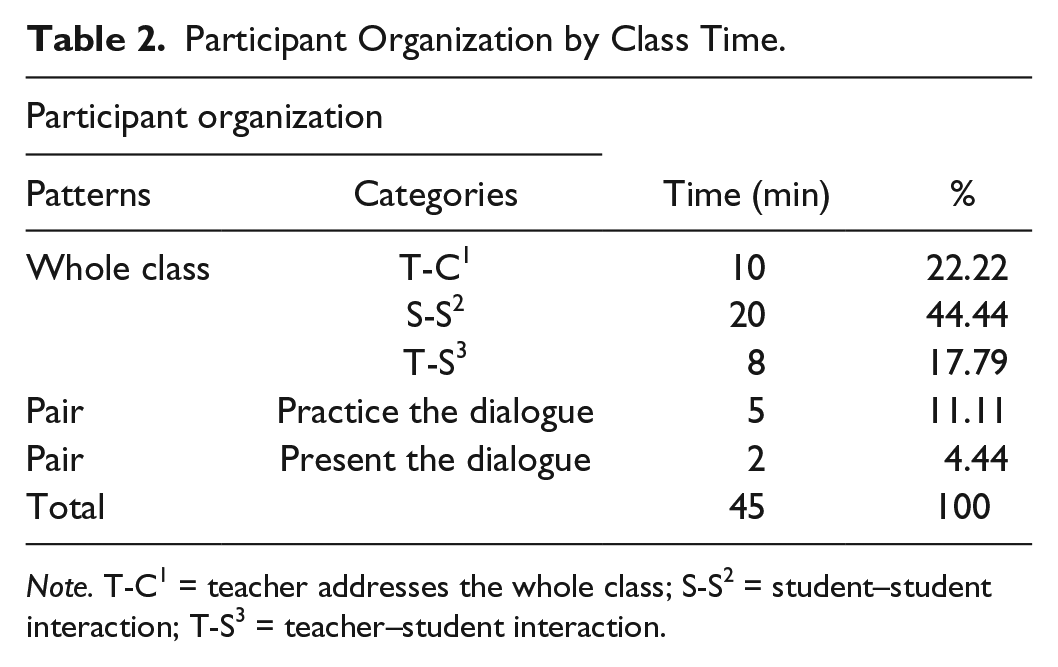
Note. T-C1 = teacher addresses the whole class; S-S2 = student–student interaction; T-S3 = teacher–student interaction.
As indicated in Table 2 below, the students involved in whole class, pair, and individual work in this lesson. Most of the class time (60%) was spent on student-involved activities, while the teacher played the role of a facilitator. Individual and pair work occupied the 48% of the class time. Most students involved in the activity, and only four pairs could not present their interviews due to time constraints.
As noted above, according to the COLT scheme, the next category is material which is discussed below. The teacher used the pupils’ textbook to teach the lesson. Table 3 indicates the main modality for the majority of students as a percentage of class time. According to Table 3, most students spent a good amount of class time (40%) for speaking, while this lesson also involved the students in listening (22%), reading (8%), writing (22%), and presentation (4%) of the class time.
Student Modality as a Percentage of Class Time.

The content category in COLT scheme refers to the subject matter of the activities. It includes what the teacher and the students were talking, reading, writing about, or listening. The content of the lesson was an interview to find out what they wanted to do after they left school. The teacher used several structural patterns to ask questions and also to answer them using different structures such as I wish to be/I would like to be/I plan to do/I am going to be. The topic for the interview was selected from the class textbook (Educational Publications Department–Sri Lanka, 2014). Concerning communicative activities embedded in the materials, it can be said that this particular lesson was communicative, in that it included an information gap activity in which one student knew something (what he or she was going to be in the future) while the other did not know. Moreover, the speaker had a choice of what he or she would say and how he or she would say it (I wish to be/I would like to be/I plan to do). According to Johnson and Morrow (1981), another communicative feature of the activity above is the feedback, which the speaker receives from his or her listener (Johnson & Morrow, 1981). During the presentation, it was observed that several students who played the role of interviewer provided the interviewee with feedback using utterance such as “Really, that’s great,” “I’m happy to hear that you want to be a nurse. I also like to help sick people.” Moreover, the situation presented in the activity above is related to real world that students are going to experience once they leave the classroom. Adherents of CLT favor the idea that the use of real-world activities will help students transfer what they learn in the classroom to the outside world (Larsen-Freeman, 2000; Nunan, 1981; Ortega, 2007). Table 4 below presents the summary of the lesson conducted in School B.
Summary of the Lesson Conducted in School B (Grade 10).

Analysis of the lesson using COLT
As Table 4 indicates, the lesson was based on how to ask for and give directions in a given social situation. Table 5 shows the participant organization (COLT) of the lesson as a percentage of class time. The total duration of the lesson was 47 min. As indicated in Table 5 below, the students were involved in whole class and pair work in this lesson. A little amount of class time (27%) was spent for teacher–student interactions because these students are from Grade 10, and the majority could understand the teacher’s instruction although they could not express themselves. Pair work occupied 21% of the class time, which is relatively higher than School A. Some pairs were not actively involved in the practice stage, and eight pairs were not able to present their dialogue due to time constraints.
Participant Organization by Class Time.

Note. T-C1 = teacher addresses the whole class; S-S2 = student–student interaction; T-S3 = teacher–student interaction.
As indicated in Tables 5 and 6, according to the content category in COLT scheme, the content of the lesson was to teach how to ask for and give directions to people in real-world situations. The teacher began her lesson with some questions posed to the class to identify whether the students could decide what they would do in a situation where they wanted to get to a certain place but did not know how to get there. Several students answered the teacher correctly, and the topic for the lesson was selected from the pupils’ textbook. The students made use of 48% of the class time for practicing the dialogue and speaking it out. Given the time taken for speaking, it can be stated that the teacher was able to achieve the objective of this lesson to a good extent.
Student Modality as a Percentage of Class Time.

As noted above, the next category of the COLT scheme is material where the teacher used the pupils’ textbook to teach the lesson—On Your Way (Educational Publications Department-Sri Lanka, 2014). The dialogue, which takes place between two boys, is that one wants to drink a cup of tea and he does not know how to get to a nearby hotel, so he asks the other boy for the directions to go to the hotel. The dialogue is scripted, and it is manageable by the students as it contains short utterances.
Analysis of the data collected through structured interview from students in Schools A and B
As described in “Data Collection Tools,” to test the basic communication skills of the students in both school students, Cambridge Key English for Schools Speaking Test was used. However, it should be noted that these students need to acquire academic language proficiency as they progress from school to higher education because most of the educational and professional programs in higher education contexts are conducted in the medium of English. The speaking test consisted of two parts. In the first part, each candidate interacted with the researcher, using the language normally associated with giving factual information of a personal kind. Part 2 was based on prompt cards, and the interaction was between two candidates. The researcher read out the instruction and gave a question card to Candidate A and answer card to Candidate B. After the candidates had asked and answered the questions, they changed the cards and did the same. Each part of the test was scored out of 10. Table 7 shows the descriptive statistics of the speaking test marks obtained by the students in both schools for the Key English Speaking Test.
Independent Samples t-Test Results of the Speaking Test Marks Obtained by the Students in Schools A and B for the Cambridge Key English Test.

Note. SEM = standard error of the mean.
According to the descriptive statistics shown in Table 7, the students in both schools performed equally well in general. However, in part wise, the results indicated that the students in both schools performed well only in the first part of the test. When it came to the second part of the test, a majority of students in both schools did not perform well because the second part included an information gap activity in which two candidates were expected to ask each other questions to which they did not know the answers. According to Underhill (1987), these kinds of tasks have the advantage of producing concrete evidence of oral proficiency or the lack of it. Moreover, the test results show the t value to be 0.66 and the p value to be .50, and these statistics indicate that the two samples are not significantly different at p < .05.
Findings
Findings related to classroom observation of School A
The spoken data gathered from two video-recordings were transcribed separately. The researcher first analyzed the spoken data gathered from School A using COLT. After analyzing the data, it was found that the teacher used the Audio Lingual Teaching method to teach an oral task with some communicative features present in the lesson. However, the lesson was not fully communicative. Even though the teacher in School A was quite successful in using the target language in classroom instruction, the teacher displayed some problems relating to pronunciation in particular and language fluency in general. Moreover, the students did not speak in a natural way where they did not display any features of spoken language such as body language or discourse markers (well, right, yes, oh); instead, they read out the dialogue to the class by looking at their note books. The activity was based on the learners’ textbook in which one student required to ask for directions to get to a certain place, while the other had to tell the directions. In an activity like this, learners should use body language to make the spoken language more meaningful and effective for the listener to understand. Therefore, given what was observed in the classroom in School A, the researcher believes that the teacher was not entirely informed of the CLT approach.
Findings related to classroom observation of School B
The instructional procedure that the teacher carried out with Grade 10 children in School B was not much different from School A. However, in terms of content, focus, and organization of the activity, it was much better than School A. The teacher used the target language in classroom proficiently. The teacher started the activity with a good introduction and tried to elicit more language from the class. Particularly, the girls were very interested in the activity and they wanted to communicate. They got into pairs and practiced the activity with the guidance of the teacher and presented it in front of the class, showing several features of natural speech such as eye contact and discourse markers to a certain extent even though they also used their note books. However, the boys just read their scripts from the note books showing no features of spoken language as most of the students in School A did. It was further noted that boys, except a very few, seemed to have no interest in the activity.
Discussion
Discussion related to the first and second research questions
The first research question the researcher formed at the beginning of the study was “Why do a majority of students in rural schools show a low or limited oral proficiency in the target language?” To answer the first question, the researcher formed the following hypothesis that a majority of students studying in rural schools have a low or limited oral proficiency in the target language. This study has shown that the students in rural schools do not receive adequate language input (Krashen & Terrell, 1983) that leads to oral proficiency of the learners. The researcher’s classroom observation and the analysis of the classroom interactions clearly indicate that students of the two schools have potential and willingness to communicate in the target language but the pedagogical constraints imposed by the teachers were a barrier for them to interact in the class. Another crucial factor that emerged from the study can be ascribed to the teachers’ failure to provide learners with communicative activities in the classroom context in which learners can practice and use the target language with ease.
The teaching approach employed by the two teachers in their class activities was not fully communicative oriented even though the classroom in School B displayed some features of communication focus class where students were allowed to interact with each other using the target language to a certain extent. Interaction has been identified as a necessary condition for language acquisition (Long, 1981; Pica, 1994) even though interaction hypothesis has been subjected to criticism from several theoretical perspectives. The students in School A tended to read out the scripted dialogues from the textbook, while the students in School B chose to read the dialogue which they had already written in their note books. Given both situations, it can be argued that both teachers did not make use of the activities so interactive and engaging that learners could not use the target language authentically. This kind of classroom practice will not guarantee learners that they will become proficient users of the target language once they leave the classroom.
As the researcher has argued earlier, neither of the two teachers the researcher observed used the speaking activities in such a stimulating way that triggers interest in students to continue doing it. If the teachers had been careful in planning out their speaking activities, the learners would have been motivated to do them as if they were doing in real world. The teacher who was from School A should have created the classroom into an imaginary town just by moving desks and chairs to look like streets of a town and asked the learners to enact the situation where a student wanted to find out the way to a restaurant. Likewise, the teachers should have created several situations where actually people ask for directions to get to places they want. Given the factors described above concerning the status of rural students’ oral proficiency, the first research hypothesis which the researcher formed that a majority of students studying in rural schools have a low or limited oral proficiency in the target language can be accepted. Likewise, the second research question which the researcher posed in this study was, “Do a majority of teachers of English in rural schools apply CLT approach in their teaching?” In order to answer this question, the researcher formed the following hypothesis that a majority of English teachers teaching in rural schools use the CLT approach in their classroom teaching can now be answered with evidence to prove that a majority English teachers teaching in rural schools are deviant from application of CLT approach in classroom teaching. The methodology that the teacher in School A used, as described in the section “Findings Related to Classroom Observation of School A,” was the audio lingual method in which a lesson is generally taught using the P-P-P cycle (Presentation, Practice, and Production; Richards, 2006), which has been strongly discredited and criticized for its principles are based on behaviorist theory (Larsen-Freeman, 2000). The teacher in School B used the speaking activity in line with some aspects of language (purpose, setting, role, communicative event, language functions, grammatical and lexical contents; Richards, 2006) that are said to be necessary for developing communicative competence. The greatest weakness that was observed in School B teacher could be ascribed to her negligence of the communicative aspects of language as stated above and her unawareness of the extent to which her role as a teacher should change in line with ESL/EFL pedagogy that has undergone many changes at present than it used to be a few decades ago. Given the factors described above, the second hypothesis which states that a majority of English teachers in rural schools use CLT in their classroom teaching can be refuted due to the lack of evidence to accept it.
Limitations of the Study
Even though the results of the present study indicated that the oral proficiency of the study groups was low or limited due to the fact that the teachers did not effectively use communicative activities in classroom situation, there are limitations which must be acknowledged. The first limitation is the sample selection. Even though the two student samples selected from two different schools were from a student population, the sample size was limited to 54 participants; therefore, the results of this study cannot be generalized to a bigger population of school students who study English in rural contexts in or out of Sri Lanka. The second limitation is that the outcomes of this study cannot be generalized to learners studying in schools with more opportunities to use English for communicative purposes. Further research is needed to make a more informed decision as to why a majority of students in rural schools fail to achieve oral proficiency in the target language.
Implications and Recommendations
In answering the research questions, the researcher investigated the classroom practices carried out in L2 classroom in Sri Lankan rural school contexts and found that the current instructional practices in rural schools are deviant from the CLT. The study, furthermore, found that the English teachers were in need of proper training which should coincide with the current theoretical, empirical, and pedagogical views of SLA. During the investigation, it, moreover, became evident that the English Pupils Textbook series introduced by the Department of Educational Publications (DEP) under the directives of the National Institute of Education (NIE) in Sri Lanka highly focus on reading, writing, and grammar while listening and speaking skills are slightly tackled and some speaking activities are intended for writing rather than speaking. The instructional manuals produced by the NIE show instances of mismatch with the textbook series where either the material producers or the manual producers have failed to come into a common agreement concerning the objectives of teaching and learning the target language.
Concerning the application, the researcher concludes that the classroom practices currently used in rural schools are not effective in promoting oral proficiency in L2 learners. Therefore, the researcher believes that providing learners with adequate opportunities to interact in the target language in the class and delivering instruction through unorthodox teaching approaches will promote students’ oral proficiency. Moreover, using learner authentic materials in classroom teaching will help learners produce authentic language spoken by real people outside the classroom.
Conclusion
This study has focused on the instructional practices of local L2 teachers teaching in rural state schools in Sri Lanka and its relevance to current theoretical, empirical, and pedagogical perspectives of SLA. The study, which was conducted in two Sri Lankan state schools, revealed that instructional practices and teaching materials are not effective enough to help students improve their oral communication as the teaching practices and materials are rather deviant from the principles of CLT. Therefore, based on the findings of the current study, it is suggested that using unorthodox teaching approaches and classroom techniques along with the appropriate materials can help students studying English in rural contexts improve their oral proficiency.
Footnotes
Declaration of Conflicting Interests
The author(s) declared no potential conflicts of interest with respect to the research, authorship, and/or publication of this article.
Funding
The author(s) received no financial support for the research and/or authorship of this article.