




Abstract
Second language acquisition cannot take place without having exposure to language input. With regard to this, the present research aimed at providing empirical evidence about the low and the upper-intermediate language learners’ preferred type of audiovisual programs and language proficiency development outside the classroom. To this end, 60 language learners (30 low level and 30 upper-intermediate level) were asked to have exposure to their preferred types of audiovisual program(s) outside the classroom and keep a diary of the amount and the type of exposure. The obtained data indicated that the low-level participants preferred cartoons and the upper-intermediate participants preferred news more. To find out which language proficiency level could improve its language proficiency significantly, a post-test was administered. The results indicated that only the upper-intermediate language learners gained significant improvement. Based on the findings, the quality of the language input should be given priority over the amount of exposure.
Introduction
In today’s audiovisually driven world, technology has become the track upon which the train of education is heading toward its destination quickly. The growth of its application and its rapid development in transforming the process of learning is unbelievable (Mayya, 2007). Computer-assisted language learning (CALL, hereafter), computer and audiovisual equipped classes, the Internet, e-mail, chat, and mobile-assisted language learning (MALL, hereafter) are just a few examples of the application of technology in language teaching/learning. As a result, language learners can have access to various types of authentic language inputs through various technologies such as computers, TV, and CDs/DVDs, apps among others for language learning.
However, there are many internal as well as external factors that influence second language acquisition (SLA). Among them, language input that learners receive in SLA is one of the external factors that plays a fundamental role. However, while the important role of language input in SLA has been advocated by various language learning theories, there has been a controversy in the field of language acquisition between those theories that attribute a small or no role to language input and those attributing it a more important role (Ellis, 2008).
Language input has also been considered to be a major source of data for language learners to construct their competence or mental representation of the language (Patten & Benati, 2010). Indeed, language acquisition process is dependent upon the availability of appropriate input. Considering the fact that some sort of language input is necessary to acquire the language in-and-outside the classroom, various audiovisual programs have the potential to be utilized as sources of authentic language input for SLA.
Taylor (1994) defined authentic language material as any material in English which has not been specifically produced for the purpose of language teaching. Similarly, Nunan (1999) defined authentic language materials as spoken or written language material that has been produced in the course of real communication and not specifically produced for the very purpose of language teaching.
In the last few years, various audiovisual technologies have dominated the world by massive developments in providing language learners/teachers with sources of authentic language input for SLA. Indeed, audiovisual technologies have provided many possibilities for teachers to construct activities for language learners. Accordingly, language learners can have access to various authentic language inputs through different technologies such as computers, TV, and CDs/DVDs for language learning, particularly outside the classroom settings. On similar lines, the integration of different audiovisual programs such as news, films, comedy, cartoons, and songs as sources of authentic language input into language learning has attracted the attention of many researchers (Bahrani & Tam, 2011; Brinton & Gaskill, 1978; Kaiser, 2011; Mackenzie, 1997; among others).
In view of the above, the present research aims at finding out the relationship between greater exposure to a particular type of audiovisual program and language proficiency development in informal settings.
Review of the Related Literature
The effect of exposure to audiovisual news broadcasts as a source of authentic language input has been the focus of research since the 1980s. Brinton and Gaskill (1978) conducted a study concerned with the effectiveness of listening to audiovisual news programs on enhancing English as a foreign/second language (EFL/ESL) learners’ listening skills. The study was carried out in Germany in an EFL context and in the United States in an ESL context. During the study, videotaped news broadcasts from TV were incorporated in advanced EFL/ESL classes once a week for approximately 6 months. According to Brinton and Gaskill (1978), exposure to audiovisual news language input has the potential to improve the listening skill because different newscasts bring reality into the classroom and enable the students to focus on substantive issues. In addition, because of the recycling feature of vocabulary in different audiovisual news, EFL/ESL language learners become more familiar with many contextualized vocabulary items during a long period of exposure.
In the 1990s, the possibility of using audiovisual news reports as language input for lower-proficiency-level language learners has been scrutinized by Mackenzie (1997). Without providing empirical evidence, Mackenzie (1997) rejected the idea that because the newscasters speak very fast, the content is very multifaceted, and the vocabulary is very difficult, audiovisual news cannot be integrated into low levels of language learning classrooms. In contrast, with the careful selection of audiovisual news items and applying some simple techniques such as selecting the content of the news reports based on the language learners’ interest and background knowledge, news reports can be used even at elementary or intermediate levels (Mackenzie, 1997).
More recently, Bahrani and Tam (2011) conducted an experimental research to gauge the effectiveness of exposure to audiovisual news broadcasts materials and non-news materials on improving the speaking proficiency of intermediate language learners. The research was carried out with 60 intermediate language learners who were assigned to two groups. During the experiment, the participants in the first group were exposed to authentic materials from audiovisual news, whereas the second group participants were exposed to non-news materials. The findings indicated that exposure to audiovisual news promotes intermediate language learners’ speaking proficiency more than exposure to non-news materials. According to Bahrani and Tam (2011), the intermediate participants showed their enthusiasm in the creative use of various vocabularies, sentences, and structures in talking about the topics during the interviews (speaking test) in the post-test.
In short, the review of the literature on the use of audiovisual news as a source of authentic language input for SLA reveals that most of the studies were descriptive and examined the pedagogical value, the possibility of using news at all levels of language learning, and the selection criteria without empirical evidence.
Movies have been also regarded as an important source of language learning for language instructors because it is an authentic source of material (Kaiser, 2011). In fact, movies provide language learners with opportunities of exposure to the real language uttered in authentic settings (Stempleski, 1992). The spoken language of movies often includes various types of speeches such as those of various educational levels, the speeches of children and non-native speakers, slang and jargon, rural and urban speeches, and a range of regional dialects that language learners will encounter in the target language country (Kaiser, 2011). However, the review of the quantitative studies regarding the incorporation of movies as a source of authentic language input for language learning is limited.
In a research conducted by Huang and Eskey (2000), the effectiveness of exposure to closed captioned TV on intermediate language learners’ listening comprehension was addressed. The findings of the study showed that captions improved listening comprehension skill. On similar lines, Gebhardt (2004) and Heffernan (2005) anecdotally considered movies to be utilized as motivating materials, which have the potential to enhance language learning.
Supported by empirical evidence, Yuksel (2009) highlighted the effectiveness of viewing movie clips with/without captions on EFL learners’ vocabulary enhancement. The research was carried out with 120 language learners in a preparatory class. The participants were randomly divided into two groups. Before the treatment, the participants in both groups took a sample 20-item vocabulary knowledge scale pre-test. During the study, participants in Group 1 were exposed to some movie clips with captions, whereas the second group participants were exposed to the same movie clips without captions. One month after the treatment, participants in both groups were given another vocabulary knowledge scale test with 20 words as a post-test. The results obtained from the pre–post-tests of both groups revealed that both groups demonstrated significant gains. In fact, viewing the movie clips reinforced the expansion of the vocabulary knowledge of the language learners regardless of the presence or the absence of captions (Yuksel, 2009). According to Yuksel (2009), the development in the vocabulary knowledge stems from the importance of encountering the vocabularies in the real context. In fact, incidental vocabulary learning can be facilitated through contextual cues.
Other studies have mostly focused on the effectiveness of exposure to movies with or without captions/subtitles on developing listening skills (Huang & Eskey, 2000; Markham, 1999; Markham & Peter, 2003). Huang and Eskey’s (2000) research considered the effectiveness of exposure to closed captioned TV on intermediate language learners’ listening comprehension. The findings of the study showed that captions improved listening comprehension skills. Similarly, Markham (1999) carried out a research on the effectiveness of captioned videotapes on listening vocabulary recognition skills. Markham concluded that the captions significantly helped language learners develop their listening word recognition skill.
In a nutshell, the review of the related literature on the use of movies as a source of authentic language input is mostly limited to either some qualitative studies that have considered movies to be pedagogically valuable authentic motivating material for language learning or a few quantitative studies that have focused on the effects of exposure to movies on enhancing listening skill.
Cartoons as authentic language materials have also been considered as excellent teaching tools because they not only add humor to a topic but also illustrate the idea in a memorable way. In this regard, many studies underscore the point that cartoons make learning an enjoyable and, importantly, memorable experience, because the activities in the teaching and learning process using cartoons are interesting and interactive for the students.
In an anecdotal study conducted by Clark (2000), it was highlighted that cartoons can engage the attention of the learners and present information in a non-threatening atmosphere. Besides, cartoons have the potential to reinforce thinking processes and discussion skills (Clark, 2000). Another study was carried out by Doring (2002) focusing on the effect of exposure to cartoons on language learning. The results of the study revealed that the language learners who had exposure to cartoons could produce oral answers that were very proactive and interesting in different discussions held in the classes, which creates non-threatening learning environment for them. Moreover, the discussions were rich and the students had high confidence. It seems that the high confidence that the language learners acquire is due to exposure to cartoons that create low affective filter atmosphere for learning.
Rule and Auge (2005) conducted a study providing evidence of the students’ preferences to use cartoons in language learning. Accordingly, cartoons are preferred because they create a high degree of motivation to recognize and produce humor for the students, enhance the memory, and make connection between the new materials and the prior knowledge through analogy. However, Rule and Auge (2005) did not go further to provide empirical evidence on the effect of exposure to cartoons on language development.
In a recently conducted research, Bahrani and Tam (2012) compared the effectiveness of exposure to audiovisual news, movies, and cartoons as three different sources of language input on language proficiency development of the low-level language learners. To do so, Bahrani and Tam (2012) assigned 60 low-level language learners into three groups. The three groups ran by one of the researchers and met in three different classes once a week for a period of 4 months. Each group had exposure to different audiovisual materials. Group 1 had exposure to news, Group 2 had exposure to movies, and Group 3 had exposure to cartoons. The results of the study showed that those participants who had exposure to cartoons could enhance their language proficiency to a significant extent. In contrast, the participants who had exposure to either news or movies could not gain significant language proficiency development.
A review of the related literature in the area of the incorporation of various songs as another type of authentic material in language teaching provides limited empirical evidence. Schoepp (2001) anecdotally proposed songs in foreign language classrooms to lower anxiety and increase motivation, provide physiological benefits, guide lesson planning and practical classroom, and enhance cultural awareness and sensitivity.
Documentary films as authentic and communicative teaching materials that reflect the real situation have also attracted the attention of some researchers. Recently, Soong (2012) has supported the use of documentary films over other types of audiovisual materials by highlighting the pedagogical values of utilizing documentary films in language learning, particularly oral interpretation classes. The author underscores, unlike other types of audiovisual materials such as movies that use a great number of slangs or even abusive languages in the dialogues, that the language of documentaries is carefully scripted and delivered in Standard English, which makes them more suitable as teaching materials for EFL students. However, documentary films should be carefully selected and even tailor-made for the oral interpretation class, so as not to discourage students (Soong, 2012). Soong (2012) emphasizes the point that language learners can learn how to pronounce new words correctly while watching documentary films. Besides, the key vocabulary items tend to recur throughout the soundtrack, providing EFL students with valuable repeated encounters with the lexical content (Soong, 2012).
To determine the appropriate duration of documentary films in terms of time and content to be utilized in 2 hr oral interpretation class especially with low and pre-intermediate-level students, Soong surveyed 129 students who had been taught oral interpretation for half a year using documentary films. The survey included four questions related to their viewpoints on the application of documentary films as teaching materials. Another source of data came from five teachers who also used documentary films in their teaching for at least a year. The results of the questionnaires and the interview revealed that documentary films are more interesting than textbooks, long documentary films (more than 20 min) should not be used in the classrooms because they may frustrate the students, and documentary films meet the demands of authenticity and communication.
However, Soong’s study lacked empirical evidence on the effect of utilizing documentary films in oral interpretation classes on the students’ scores. Indeed, the conclusions were only based on the students’ and the teachers’ opinions.
In short, wide arrays of audiovisual programs are available as authentic sources of language input for SLA in EFL and ESL contexts. However, the related studies are mostly anecdotal. The quantitative studies have also been mostly investigated in the formal language learning setting. Indeed, informal language learning setting that has great potential for SLA has not been investigated. Importantly, language learners’ exposure to their preferred type of audiovisual program and language proficiency development has not been investigated.
Research Questions
The present research was set to answer the following questions:
Method
Participants
Initially, 134 language learners aged 21 to 26 years majoring in Teaching English as a Second Language (TESL), including both males and females, from Malaysia went through the research voluntarily. Then, a smaller population of 60 participants was selected based on a sample International English Language Testing System (IELTS) pre-test. The 60 selected participants were divided into low level (n = 30) and upper-intermediate level (n = 30) based on the scores which they obtained in the pre-test.
Instruments
The two instruments that were utilized to accumulate the necessary data for the present research were a set of two parallel IELTS language proficiency tests and a self-report sheet. Prior to the main data collection, the sample IELTS language proficiency tests were verified to be parallel to ensure the internal validity of the findings. Both tests were also verified in terms of reliability.
To obtain quantitative data on the type and the amount of the low and the upper-intermediate participants’ most preferred type of audiovisual program in informal settings, a self-report sheet consisting of news, films, cartoons, songs, documentary films, series, game shows, talk shows, speeches, and sport programs as 10 different types of audiovisual materials was prepared and given to the 60 selected participants after the pre-test. The validity of the self-report sheet was also verified through a pilot study.
Procedure
The present research used quantitative method and a pre–post-tests design. The first step to take before the study was carried out was to verify that the two sample IELTS language proficiency tests were parallel to assure the internal validity of the data obtained from pre–post-tests. Parallel tests are two tests of the same ability that have almost the same means and variances when administered to the same group after a short interval (Bachman, 1990).
Accordingly, both sample IELTS language proficiency tests were administered to 20 trial language learners majoring in TESL with a short interval (1 week). Then, the means and the variances of both tests were calculated separately (Table 1).
Descriptive Statistics Related to the Administration of the Two Tests to the Same Group.

The statistical analysis of the data obtained from the administration of both tests to the 20 participants showed that the means and the variances of both tests were almost the same, which indicated that the two-sample IELTS tests were parallel. Moreover, the reliability coefficient of the two tests was calculated as .943 using Cronbach’s alpha formula.
The second instrument to be verified was the self-report sheet. To this end, all the 20 trial language learners were asked to have exposure to various audiovisual programs outside the classroom setting for 1 week and report their preferred type and amount of exposure to various programs by filling out the self-report sheet. In relation to the format and entries, the researchers asked the participants to report any possible difficulty or problem they might face while filling out the self-report sheet. The input extracted from the analysis of the participants’ self-report sheets indicated that it could be used for collecting the necessary data to answer Research Question 1.
After verifying the instruments, the actual data collection started with the selection of the participants. To do so, one of the parallel IELTS language proficiency tests was given to a population of 134 language learners including both males and females majoring in TESL to select 60 participants initially. Then, 30 participants who obtained 4 or 4.5 of 9 in the overall band score were selected as low level and 30 participants who obtained 6 or 6.5 of 9 in the overall band score were selected as upper-intermediate level. The selection criteria were based on the IELTS band score categories.
Following the selection of the participants, the participants of both proficiency levels were asked to have exposure to their preferred audiovisual programs outside the classroom (for 8 weeks) and keep a diary of the type and the amount of the program(s) they watch. At the end of the study, the second IELTS test was administered to all the participants. The data obtained from the pre–post-tests and the self-report sheets provided answers to Research Questions 2 and 3.
Results
To provide answers to the research questions, the data obtained from the pre–post-tests and the self-report sheets were analyzed and tabulated using SPSS 19 statistical analysis software.
Research Question 1
In relation to the first research question concerning the low-level language learners’ most preferred type of audiovisual program, a one-way repeated-measures ANOVA was conducted to assess whether there were significant differences between the mean amounts of exposure to each type of audiovisual program in the low proficiency level. The results indicated a significant main effect of program, F(2.840, 68.160) = 199.974, p < .001, partial η2 = .893, which was a great effect size. This indicated that the mean amounts of exposure to various types of audiovisual programs were not equal (Table 2). Accordingly, low-level language learners’ preferred cartoons more than other types of programs.
Low-Level Language Learners’ Total Amount of Exposure to Each Program During the Period of the Study.

With regard to the intermediate-level participants, a one-way repeated-measures ANOVA was also conducted to assess whether there were significant differences between the mean amounts of exposure to each type of audiovisual program in intermediate proficiency level. The results indicated a significant main effect of program, F(3.142, 43.201) = 185.205, p < .001, partial η2 = .749, which was a great effect size. The results indicated that the mean amounts of exposure to various types of audiovisual programs were not equal (Table 3). As a result, the intermediate-level language learners preferred various news programs more than other types of audiovisual programs.
Upper-Intermediate-Level Participant’ Total Amount of Exposure to Each Program During the Period of the Study.

Research Questions 2 and 3
To answer the second and the third research questions and determine the relationship between the low-/upper-intermediate level language learners’ amount of exposure to cartoons/news and their language proficiency development, the data obtained from the administration of the pre–post-tests to the low-/upper-intermediate-level language learners were first analyzed by means of a paired-sample t test to find out whether the participants in each proficiency level could improve their language proficiency. Then, the correlation between the low-/upper-intermediate-level language proficiency improvement and the amount of exposure to cartoons/news was calculated separately using the means of correlation coefficient.
In relation to the raw scores obtained from the pre–post-tests by the participants in the low-level group, there was a minor increase in the mean score in the post-test. A paired-sample t test was conducted to find out the significance of the improvement. According to the results of the paired-sample t test (Table 4), the value of the t-observed was not statistically significant (p > .05).
Descriptive Statistics Related to the Low-Level Participants IELTS Pre-test and Post-test Results.
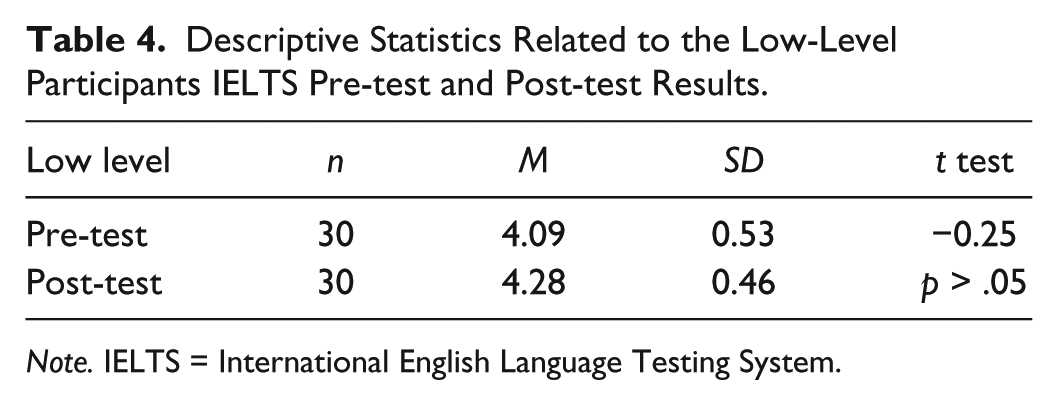
Note. IELTS = International English Language Testing System.
Considering the second research question, the correlation coefficient between the amount of exposure to cartoons and the low-level participants’ language proficiency improvement was low and not significant (r = .122, p = .906).
In relation to the scores obtained from the pre–post-tests by the participants in the upper-intermediate level, there was a bigger increase in the mean score in the post-test compared with that of the low level. To find out whether the increase in the mean score was significant, a statistical analysis of a paired-sample t test was conducted. The analysis of the paired-sample t test (Table 5) showed that the t-observed was statistically significant (p < .05), which was indicative of the fact that the increase in the mean score was significant enough to lead to significant language proficiency improvement.
Descriptive Statistics Related to the Upper-Intermediate-Level Participants IELTS Pre-test and Post-Test Results.
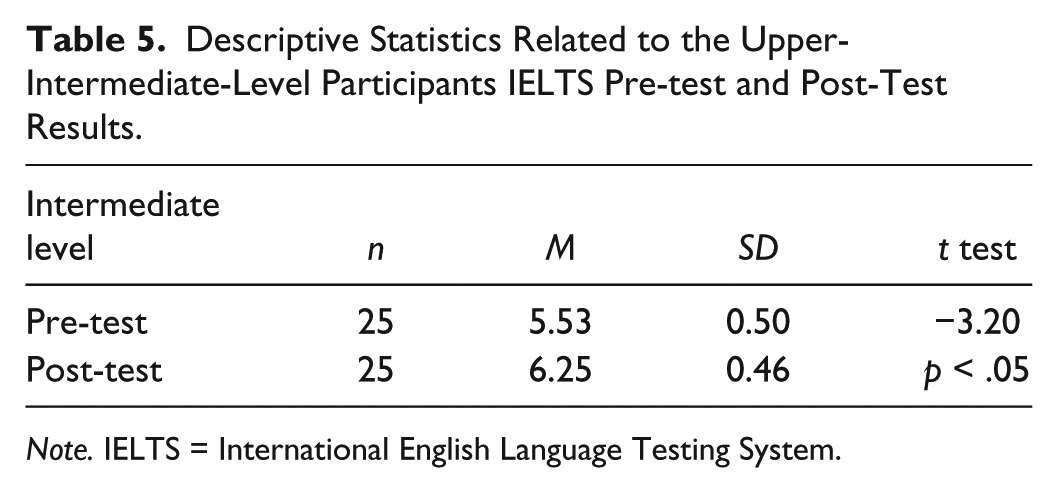
Note. IELTS = International English Language Testing System.
The amount of exposure to news broadcast significantly correlated with the upper-intermediate-level significant language proficiency improvement (r = .429, p = .002).
Discussion
While comparing the amount of exposure of the low- and the intermediate-level participants to their preferred type of program, it was found that the low-level language learners’ total amount of exposure to cartoons as their preferred program was 18,038 min and upper-intermediate-level language learners’ total amount of exposure to news as their preferred program was 16,685 min. However, regardless of the greater amount of exposure, the low-level language learners’ language proficiency improvement was not significant. It can be hypothesized that merely greater amounts of exposure to various sources of authentic language input may not contribute a lot to SLA.
The reason behind the difference in the language proficiency development of both proficiency levels may be due to the quality of the language input embedded in the type of audiovisual programs rather than the quantity. Although both cartoons and news programs are pedagogically valuable authentic language materials that have the potential to be used as sources of authentic language input, the type of language input embedded in cartoons may be, to the most extent, modified or simplified to ease comprehension. In contrast, authentic audiovisual news consists of more unmodified type of language input than the modified one.
While comprehending modified or simplified language input is easier and requires less cognitive processing because of the type of data that is presented in a way to facilitate comprehension, it may not contribute a lot to SLA. In contrast, although the language input embedded in the type of unmodified input such as news requires much more input processing for comprehension, it may contribute much more to SLA than modified input.
The fact that the low-level language learners of the present research showed greater interest in viewing cartoons more than other types of programs can be supported by what Rule and Auge (2005) put forth regarding the high degree of motivation created through viewing cartoons as a type of authentic material in a non-threatening atmosphere. On similar lines, the low-level participants of the present research might have watched cartoons more because they might have had very few problems comprehending the language of cartoons. However, the problem with this type of simplified or modified input may be that it may not include those linguistic aspects that the low-level language learners need to acquire to enhance their language proficiency and go to a higher level of proficiency in short term. As Gass (1997) put forth, simplified input is created on the assumption to facilitate comprehension rather than causing acquisition.
In contrast to cartoons, audiovisual news broadcasts include more unmodified input, a type of authentic language input that is not simplified or modified for the sake of comprehension. While having exposure to unmodified input rather than the modified one, language learners may experience more difficulty comprehending some parts of the input. However, language learners may benefit more from unmodified input because it includes much more linguistic aspects that they had not acquired. Comprehending the new linguistic aspects embedded in unmodified input requires much more input processing effort that can enhance language proficiency. This is supported by White’s (1987) incomprehensible input hypothesis.
In her hypothesis, White (1987) underscored the point that when language learners come across language input that is incomprehensible because, for example, their interlanguage rules cannot analyze a particular second language structure, they have to modify those interlanguage rules to understand the structure. In this way, the incomprehensible input enhances the process of SLA. The fact that the intermediate-level language learners improved their language proficiency through exposure to news broadcasts as an authentic source of language input sheds more light on the studies conducted by Bahrani and Sim (2011), Brinton and Gaskill (1978), and Mackenzie (1997). Accordingly, the present study showed that greater exposure to news might be the reason for the intermediate participants’ significant language proficiency development. The reason behind this might be that there are some characteristics observed in developing any type of audiovisual news as a type of authentic material, which makes it a rich source of unmodified linguistic input to be utilized for language learning.
One of the characteristics of audiovisual news is vocabulary recycling that is considered as redundancy of input that can boost language learners’ comprehension. Another essential characteristic of audiovisual news is speech fluency, which is considered as the use of appropriate pausing, rhythm, intonation, stress, and rate of speaking. Fluency of speech is a marked linguistic feature that can be observed in utterances designed and developed for audiovisual news stories to be read by newscasters. One more important feature of audiovisual news is the special discourse which is used throughout the issue. In this regard, essential factors such as the nature of the news; the cognitive, affective, and social status of both the news items and the audience; and the structure of the news should be of focus.
The point should be highlighted at the end that although the low-level language learners who had exposure to cartoons could not improve their language proficiency in general, further analysis of their language proficiency through pre–post-tests revealed that they could significantly enhance their listening skills. This indicates that cartoons as most preferred type of audiovisual language materials may prove effective in improving low-level language learners listening skills.
With regard to the upper-intermediate-level language learners who could significantly enhance their language proficiency during the period of the research, a closer look at their pre–post-test scores revealed that they could enhance their speaking skill more than other language skills.
Conclusion
It is a proven fact that in any form of language acquisition, input is essential for the success. Although a lot has been written on the role and importance of input in second language acquisition, limited studies have provided empirical data on the source and the type of language input. Considering this point and with the impressive developments in technology and the accessibility of different audiovisual programs that can provide authentic language input, the present article aimed at providing further empirical support on low and intermediate language learners’ preferred type of audiovisual programs as authentic sources of language input and language proficiency enhancement.
Accordingly, it was found out that while the low-level language learners’ preferred type of audiovisual program was cartoons, intermediate language learners preferred news more among other types of programs. The results of the study were indicative of the fact that the low-level language learners’ amount of exposure to cartoons was more than intermediate-level language learners’ amount of exposure to news. However, the higher quantity of exposure to cartoons as a preferred source of authentic language input did not cause more improvement in language proficiency of low-level language learners. This was indicative of the fact that the quality of the type of exposure contributes more to the language proficiency enhancement than the quantity of the language input.
In a nutshell, the results of the study may be important to language teachers, practitioners, and institutions for investment in audiovisual technologies for language learning by exposing the language learners more than before to the most effective types of authentic audiovisual materials.
The point should be noted that this study has some limitations to be considered. First, it has addressed low- and upper-intermediate-level language learners. Consequently, the findings of the study are limited to these levels of language proficiency. The need to conduct the study with intermediate- or advance-level language learners is warranted. Second, the researcher did not further investigate how both group language learners dealt with the comprehension of the type of language input which they had exposure to in informal settings. Finally, it should be mentioned that the present research was conducted in informal settings where many variables which might have influenced the results could not be controlled. Hence, different results might be obtained if the study is conducted in formal settings with control and experimental groups.
Footnotes
Declaration of Conflicting Interests
The author(s) declared no potential conflicts of interest with respect to the research, authorship, and/or publication of this article.
Funding
The author(s) received no financial support for the research and/or authorship of this article.