



Abstract
Developing Oral proficiency remains a persistent challenge for many EFL learners due to limited exposure to the target language beyond class. While project-based learning (PBL) has been increasingly implemented to enhance oral proficiency in English education, empirical studies investigating its impact on learners’ oral proficiency using objective measures remain relatively scarce. This study employed a quasi-experimental design to examine the effects of video-enhanced PBL on EFL learners’ oral proficiency, using quantifiable measures of complexity, accuracy, and fluency (CAF). The study involved 96 first-year students over a 12-week intervention period at a polytechnic in China. The participants were divided into two groups: an experimental group (N = 49) and a control group (N = 47). The experimental group was taught using video-enhanced PBL while the control group followed a conventional teaching method (CTM). Speaking tests and semi-structured interviews were utilized to gather data. The quantitative results reveal that video-enhanced PBL led to greater improvement than the CTM in learners’ complexity (particularly syntactic complexity), pronunciation accuracy, and fluency (supported by speech rate and self-repairs). However, there were no notable differences in lexical complexity and accuracy (mainly syntactic accuracy) between the two groups. The qualitative results indicate that video-enhanced PBL was perceived as an effective method for improving learners’ CAF through increased grammatical awareness, collaborative correction, consistent practice, reduced anxiety, topic exploration, and task completion. This study provides valuable insights for teachers in oral English classrooms, recommending the incorporation of video-enhanced PBL to promote EFL learners’ oral proficiency.
Introduction
English has emerged as a lingua franca, serving as a shared means of communication for speakers with different native languages. The acquisition of English-speaking skills has become a global educational goal worldwide (Mridha & Muniruzzaman, 2020). Especially for English as a Foreign Language (EFL) learners, English proficiency is commonly evaluated based on their oral proficiency (Amoah & Yeboah, 2021). Oral proficiency is constructed by complexity, accuracy and fluency (CAF; Ellis, 2008; Yan et al., 2021). Speaking accurately and fluently is often regarded as a primary objective for many EFL learners in their English learning (Safdari & Fathi, 2020). While oral proficiency is critical to EFL learners’ academic and professional success, the reality shows that a considerable number of Chinese EFL learners struggle to communicate fluently and accurately in English. This is partly due to limited authentic speaking opportunities, as Mandarin dominates daily communication in China, leaving few chances to use English outside the classroom (Shi & Li, 2019). Additionally, the exam-oriented education system in China prioritizes writing and reading skills over oral communication, exacerbating the problem. Another obstacle that EFL learners face is the prevalent use of traditional teaching methods. In conventional classrooms, teachers focus more on the study of theoretical knowledge, often neglecting the development of students’ practical application skills (Ismail & Kassem, 2022). This focus on grammar and vocabulary, rather than communicative competence, further reduces students’ ability to use English in real-life situations. Consequently, learners’ oral production remains a persistent area of difficulty.
In order to develop oral proficiency, project-based learning (PBL) has been extensively utilized in EFL classrooms (Ariani et al., 2023; Li et al., 2024; Mohamad & Tamer, 2021). PBL is considered a connecting link that helps students transition from using English solely within the classroom to applying English in authentic real-life situations outside the classroom (Kemaloglu-Er & Sahin, 2022). PBL offers students ample opportunities and a broad scope to enhance their language fluency, accuracy, and the overall quality of their work during the different phases of the project (Thakur et al., 2019). Despite the arguments supporting the benefits of PBL (Aldobekhi & Abahussain, 2024; Wahidati & Kharismawati, 2023), evidence showing that the effect of PBL on college EFL learners’ oral proficiency is still weak. Additionally, earlier research on the effect of PBL on oral proficiency showed conflicting results (Mantra et al., 2022; Park & Eisenhower, 2019). Thus, there is disagreement regarding the extent to which the implementation of PBL in EFL classes can enhance oral proficiency.
One way to shed light on whether the implementation of PBL in the EFL classroom can improve EFL learners’ oral proficiency is by using objective measures of CAF. Different types of projects are also considered as the main reason for the discrepancies (Farouck, 2016; Spring, 2020). According to Oleiwi and Bunari (2022), PBL through video creation offers specific advantages for developing students’ English communicative skills, including vocabulary expansion, improved pronunciation, and more accurate grammatical use. To this end, this study contributes to the effects of video-enhanced PBL on improving Chinese EFL learners’ oral proficiency by using objective measurement of CAF.
Literature Review
PBL, grounded in Sociocultural Theory (SCT), is a student-centered method that enhances students’ opportunities to use English through collaborative project work. According to SCT, a learner starts by interacting with others and then internalizes and processes the information and knowledge gained from the communication with other people (Vygotsky, 1978). PBL emphasizes the creation of an environment conducive to applying knowledge and engaging in social interaction. Such a context incorporates learners’ cultural backgrounds, community ties, and previous experiences, ensuring that the new learning is perceived as meaningful and relevant (Langhout et al., 2002). Within this environment, learners engage in group discussions that allow them to express their ideas and experiences in English. Their speaking development is further supported through scaffolding by more proficient peers or instructors, enabling them to extend their communicative abilities beyond their present level. Operating within the zone of proximal development, students move past simple repetition and begin to construct and refine new language skills.
PBL has garnered increasing attention in English language education, particularly in enhancing oral proficiency (Bataineh et al., 2020; Zhong et al., 2024). A substantial body of research has examined the impact of PBL on EFL learners’ speaking skills, generally reporting positive outcomes, though with notable variations in scope and methodology. Torres and Rodríguez (2017) examined the development of speaking skills among Colombian EFL learners through the use of PBL. The results revealed that PBL contributed to improved oral production, particularly by expanding students’ vocabulary. Similarly, Sayuti et al. (2020) utilized observations, interviews, and assessment reports to evaluate Malaysian students’ speaking performance before and after integrating Gold Standard PBL through video-based projects. The study found noticeable improvement in students’ speaking abilities. In another study, Sirisrimangkorn (2021) employed speaking tests, questionnaires, and interviews with 31 Business-English undergraduates and observed significant gains in their speaking skills through presentation-based PBL activities. Kristianto and Harendita (2022) explored the use of investment portfolios in a PBL context through questionnaires and interviews, finding improvements in vocabulary, grammar, fluency, and students’ confidence in speaking. Overall, while these studies consistently highlight the potential of PBL to foster improvements in EFL learners’ oral proficiency, their varied designs, contexts, and evaluation methods reveal important gaps that warrant further exploration.
However, not all studies have reported positive effects of PBL on target language communication skills. Eguchi and Eguchi (2006) conducted a qualitative study with 44 Japanese students using questionnaires and classroom observations to examine the impact of English magazine projects on communication skills. The results showed that PBL produced no substantial positive effects on students’ learning. Similarly, Park and Eisenhower (2019) integrated an art-based project into English language learning for Korean EFL college students, but their results showed no significant improvements in speaking proficiency, vocabulary development, or confidence compared with the control group. These divergent findings may result from different project types, learner proficiency levels, or the extent to which projects involved authentic communicative interaction. More importantly, the inconsistencies in measuring oral proficiency underscore the need to identify the conditions under which PBL can effectively enhance oral proficiency.
When objectively assessing oral proficiency, the CAF framework—encompassing complexity, accuracy, and fluency—serves as a key model for evaluating spoken communicative competence (Skehan, 2009; Spring, 2020). Complexity refers to learners’ ability to use a range of sophisticated syntactic structures and diverse lexical items (Suzuki & Kormos, 2020). Accuracy reflects learners’ ability to produce language that aligns with target language norms and minimizes errors in grammar, vocabulary, and pronunciation (Foster & Wigglesworth, 2016). Fluency is defined as learners’ ability to produce smooth, continuous speech with minimal pauses, hesitations, or self-corrections (Suzuki & Kormos, 2020). The three dimensions have been established as three aspects of spoken language that are highly correlated with subjective evaluation (Thai & Boers, 2016).
The CAF framework is grounded in theoretical models of second language (L2) performance that recognize the role of limited attentional capacity and working memory in language production (Skehan, 2009). For example, the trade-off hypothesis posits that allocating attentional resources to enhance one aspect (e.g., fluency) may lead to reductions in another (e.g., accuracy or complexity), reflecting cognitive constraints on simultaneous performance (Skehan, 2009). While CAF provides a structured and quantifiable means of assessing spoken language, it is important to acknowledge its limitations: it may not fully capture pragmatic competence, interactional strategies, or sociocultural influences on oral performance (Housen & Kuiken, 2009). Despite these constraints, CAF remains a widely applied and theoretically justified framework for investigating L2 oral proficiency.
Building on this theoretical foundation, it is notable that empirical investigations directly linking PBL to CAF outcomes remain limited. While CAF provides a structured framework to objectively assess oral proficiency, few studies have applied it to evaluate the specific impact of PBL, and to date, only one study has explicitly investigated this relationship. Spring (2020) conducted a study to explore the effects of PBL on the CAF of Japanese EFL learners. The results indicated modest improvements in fluency, marked by fewer pauses and a small increase in speech rate. Significant advancements were seen in syntactic complexity, as well as in both syntactic and pronunciation accuracy. However, no improvements were noted in lexical complexity. Spring’s (2020) study employed a single-group experimental design without a control group, limiting the ability to compare the effects of PBL with traditional methods. While the study highlights improvements in certain aspects of oral proficiency, the broader comparative impacts of PBL on EFL learners’ CAF remain uncertain.
Furthermore, the type of projects in PBL is recognized as a crucial factor that determines the extent to which students can benefit from PBL (Farouck, 2016). Video creation has also been suggested as a highly appropriate project type for PBL to improve oral proficiency (Oleiwi & Bunari, 2022; Tyas & Fitriani, 2021). Compared with other types of projects, video production requires learners to integrate multiple language skills, including speaking, listening, and writing, while also engaging in meaningful communication and self-expression. These features make video projects particularly suitable for promoting CAF in oral production. However, there is currently a lack of evidence to confirm whether implementing video-enhanced PBL in the Chinese context actually enhances which aspects of EFL learners’ oral proficiency. The aim of this study was to determine the effects of video-enhanced PBL on Chinese EFL learners’ oral proficiency measured by using CAF compared to the conventional teaching method (CTM). This study centered on the two following questions:
(a) Does video-enhanced PBL have more effects on EFL learners’ complexity, accuracy, and fluency than the CTM?
(b) How do EFL learners perceive the impact of video-enhanced PBL on their complexity, accuracy, and fluency?
Methodology
Research Design
This study employed a non-equivalent pretest-posttest quasi-experimental design, which incorporates quantitative assessments and qualitative interviews. This design was used to measure the changes in the dependent variable after the intervention, which did not contain random assignment, and independent variables were not manipulated (Gravetter & Wallnau, 2000). In this study, both the experimental and control groups were selected without randomization. To mitigate threats to internal validity, students’ proficiency levels were matched at the outset. A pretest of speaking proficiency was conducted to confirm equivalence between groups, and the results indicated no significant differences in CAF between the two groups at the pretest stage. This careful matching process enhanced the study’s internal validity, ensuring that any observed differences in outcomes could be attributed to the intervention rather than pre-existing disparities. To gain a more comprehensive understanding of the outcomes, quantitative assessments were conducted to measure EFL students’ oral proficiency, while qualitative interviews were used to explore their perceptions of using video-enhanced PBL to improve their CAF.
Participants
The participants are 96 EFL learners majoring in English Education at a polytechnic in China. They were the first-year students consisted of 92 females and 4 males, with an age range from 17 to 21. All the participants were native speakers of Mandarin Chinese with an intermediate level of English proficiency. They are from two intact classes enrolled in an Oral English course. The two classes were purposefully selected and placed in either the experimental group (N = 49) or the control group (N = 47) based on their comparability in key characteristics (e.g., academic performance and demographic factors). The pretest scores were used to ensure baseline equivalence. The results show that there were no significant differences in the pretest for complexity (p = .687), accuracy (p = .203), and fluency (p = .239) between the two groups. Furthermore, 10 participants were purposefully chosen from the PBL group for interviews to obtain a deeper understanding of their views on using video-enhanced PBL. The choice to interview 10 students was made to reach data saturation, which is generally attained after 6 to 12 interviews (Guest et al., 2006).
Instruments
Speaking tests were used to measure the changes in the participants’ oral proficiency by using video-enhanced PBL and the CTM. The speaking tests were utilized in the study to assess the participants’ oral proficiency before and after implementing the PBL lessons. An individual descriptive oral task, adapted from Part 2 of the International English Language Testing System (IELTS) Speaking Test, was employed. Different IELTS task topics were assigned in the pretest and posttest to ensure that any improvement in performance represented true gains in oral proficiency. This task format was chosen because its requirement for extended individual speech aligns with the course’s emphasis on developing fluency, accuracy, and complexity in oral production. Although the IELTS-style test does not capture the full range of collaborative skills fostered in PBL, it provides a standardized and reliable measure of individual oral proficiency. In the tests, the participants were given a task card on a descriptive topic. They were allowed 1 min to prepare before answering, and then they were asked to speak for up to 2 min.
Semi-structured interviews were conducted following the speaking posttest to explore participants’ perspectives on the effectiveness of video-enhanced PBL in CAF. The interview was done individually with purposefully chosen samples of 10 students from the PBL group. Individual interviews were chosen over focus group discussions to allow students to express their thoughts freely without the influence of peer dynamics. The students participated in the semi-structured interviews guided by, but not limited to, a list of four interview questions. The interview was conducted through online video to promote students’ authentic expression of thoughts in Chinese. The back-to-back translation was conducted for interview questions. The researcher translated the interview questions into Chinese, which were then reviewed and improved by a professional translator. Subsequently, two other professional translators performed English back-translations to ensure similarity and accuracy in meaning between both versions.
Research Procedures
The experiment lasted for one semester, 14 weeks from the end of September to the end of December (See Figure 1). In a one-semester experiment, two classes were purposefully chosen as the experimental and control groups, with different teaching methods: video-enhanced PBL and CTM. All the participants were lectured by the same teacher, and they used the same teaching materials. For example, the PBL group used teaching materials for four projects, while the CTM group was taught the same four topics. The participants in the two groups were exposed to the different activities for the entire duration of the study, which lasted 12 weeks, with each session lasting 90 min.

Procedures of the research.
In the first week, all the participants in the two groups were required to take an English speaking pretest. In the experimental group, the researcher introduced the video-enhanced PBL, outlined its benefits based on existing literature, clearly stated the experiment’s objectives, and asked interested students to sign the consent form. In the control group, the participants were routinely informed of the course outline and requirements.
From the second to the 13th week, two different treatments were used in the two groups. The video-enhanced PBL was applied to the experimental group while the CTM was employed in the control group (See Table 1). In the experimental group, the teacher firstly introduced driving questions through watching videos, appreciating scenery pictures, doing brainstorming, and so on. Students formed groups with six to seven members to discuss project topics that they would like to explore in the project. Following this, scaffolding was provided through structured listening and speaking tasks to support script practice. In addition, considering some extra knowledge on creating videos, the teacher provided some basic guidelines for creating videos in class. Then, the groups created project plans, assigning tasks based on members’ strengths. They collected information using interviews, surveys, and literature reviews, shaping their findings into coherent video scripts. During filming, the students explored various formats—interviews, field trips, or short dramas—while the teacher offered ongoing support. After filming, the groups edited their videos for clarity and coherence by incorporating elements such as voiceovers, dubbing, subtitles, background music, and other editing features. Lastly, the groups showcased their videos in class, responding to peer and teacher questions. The final evaluations included self, peer, and teacher assessments, encouraging reflection in both language use and project skills.
Different Methods in the Two Groups.

Conversely, the control group was taught using the CTM, which followed a structured curriculum and uniform teaching procedures. As in their regular classes, the teacher conducted lessons in a traditional manner, and the specific teaching process was as follows. Each class began with listening to recorded dialogues, where the teacher emphasized pronunciation, intonation, and fluency. Students then read the dialogues aloud, focusing on natural rhythm and accurate pronunciation. Next, the teacher explained key vocabulary, sentence structures, and expressions from the dialogues, offering examples and contextual usage to reinforce understanding. Students engaged by asking questions and taking notes. In the imitation stage, students repeated the dialogues, mimicking the model to refine pronunciation, intonation, and grammar. The teacher monitored closely, offering individualized feedback. Students then created and performed their own dialogues in pairs, applying learned language in new contexts. Finally, the teacher evaluated each role-play based on pronunciation, fluency, and accuracy, and students participated in peer evaluation, offering constructive feedback.
Last week, all participants completed the speaking posttest after the intervention. Additionally, 10 participants from the PBL class were interviewed to explore their perspectives on the effectiveness of video-enhanced PBL in their CAF.
Data Analysis
The data was analyzed using various types of analysis methods. Initially, the speaking tests were recorded, transcribed, and reviewed. The recording of the speaking tests was transcribed into text by IFlytek Voice Input (IVI). IVI, an accessible automatic speech recognition platform, can efficiently convert spoken words into text with a high pronunciation accuracy rate exceeding 90% (Liu et al., 2019). Despite that, the researcher and the other English teacher independently checked the transcripts by listening to the original recordings. They cross-checked the transcripts and discussed the discrepancies until there was an agreement on the results.
Subsequently, the oral transcripts of speaking tests were analyzed to assess the participants’ oral proficiency using CAF measures (Table 2). Complexity in this study was accessed through syntactic complexity and lexical complexity (Norris & Ortega, 2009). Syntactic complexity was measured by words per AS-unit, while lexical complexity was calculated by TTR. Syntactic and lexical complexity were measured using Coh–Metrix, a tool that employs natural language processing to assess discourse. When counting the number of words per AS-unit, false starts, repetitions, reformulations, and replacements are taken into account. However, when calculating the TTR, the repeated or partially self-corrected within the same AS-unit are excluded.
Measures of CAF.
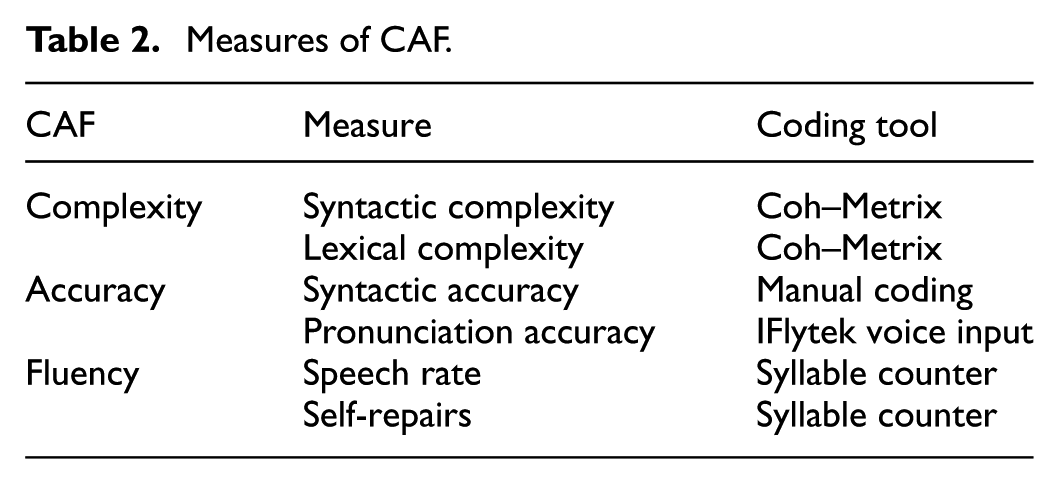
Accuracy was focused on syntactic and pronunciation accuracy (Spring, 2020). Syntactic accuracy was measured by the ratio of error-free AS-units, whereas pronunciation accuracy was calculated by the ratio of correct identified words. In this study, the IVI automatic speech recognition tool was used to assess pronunciation accuracy, calculated by dividing the number of words accurately recognized by IVI by the total number of words. To ensure the reliability of these results, human ratings were also conducted. For inter-rater reliability, 20% of the transcripts (i.e., 20 items) were independently annotated, consistent with recommended practices of using 10% to 25% of the sample (O’Connor & Joffe, 2020). The inter-rater reliability coefficient (Cohen’s Kappa) for syntactic accuracy was .84, indicating high consistency between raters (George & Mallery, 2019). Syntactic accuracy was coded manually by the researcher and the other English teacher, based on a coding system for syntactic errors (Crosthwaite & Raquel, 2019). The inter-rater reliability for syntactic accuracy, measured using Cohen’s Kappa, was .86, demonstrating a high level of agreement.
Fluency analysis was focused on speech rate and self-repairs (Michel, 2017). Speech rate was measured by using the number of syllables per minute (Yousefi, 2016). Syllables were measured using Syllable Counter, an online platform of automatic syllable analysis. Subsequently, speech rate and self-repairs were calculated manually. Before assessing self-repairs, all repeated, reformulated, or replaced syllables, words, and phrases should be excluded from the analysis (Ahmadian & Tavakoli, 2011). The analysis of fluency was conducted prior to examining complexity and accuracy.
Following the CAF analysis, the quantitative data were analyzed using SPSS 27.0. An evaluation of normality was conducted on the scale by examining Skewness values. The findings show that the Skewness values of the questionnaires fall within the range of −2 to +2, signifying a normal distribution of the test scores. Subsequently, an independent samples t-test was conducted to compare the baseline CAF of the two groups in the pretest. The results reveal that no significant differences were found in the pretest mean scores between the two groups for syntactic complexity (p = .703), lexical complexity (p = .552), syntactic accuracy (p = .912), pronunciation accuracy (p = .258), speech rate (p = .199), and self-repairs (p = .187). Ultimately, a one-way MANOVA test was executed to compare the average scores of the CAF between the two groups. The one-way MANOVA test was employed to measure the effects of the independent variable on several dependent variables (George & Mallery, 2019). This helped to determine whether there were significant differences in CAF between the PBL and CTM groups.
Finally, the qualitative data were analyzed using NVivo 12.0 and were subjected to content analysis (Dörnyei, 2007). The process involves three stages: repeatedly reviewing the data for initial coding and categorization, generating insights across codes, and interpreting the data to draw conclusions. As the interview follow-up questions were guided by participants’ perspectives on changes in their CAF within the PBL context, three broad categories aligned with the scale’s dimensions were identified: improvements in complexity, accuracy, and fluency. Two proficient raters conducted the coding of the interview data. The level of agreement between the raters was found to be 83%. Disagreements that arose during the coding phase were resolved through joint discussions, resulting in a shared agreement.
Results and Discussion
Effects of Video-Enhanced PBL on EFL Learners’ CAF
The comparison of the effects of the PBL and conventional methods on EFL learners’ CAF by using One-way MANOVA. The value of the Box Test for the homogeneity of covariance matrices was .52. The assumption of homogeneity of variance was met. Table 3 provides the summary statistics of the multivariate tests of the scores of CAF at posttest.
Comparison of Complexity Between the Two Groups.

As demonstrated in Table 3, a notable difference emerged between the two groups in complexity (t = 2.063, p = .042 < .05). The mean complexity score of the experimental group (M = 7.302, SD = 1.936) slightly exceeded that of the control group (M = 6.632, SD = 1.708), with an effect size (partial η2 = .043) indicating a small to medium effect. Specifically, a marginal improvement was detected in syntactic complexity (t = 2.005, p = .048 < .05), while no substantial difference was noted in lexical complexity (t = 1.679, p = .094 > .05). Similarly, the mean syntactic complexity score for the experimental group (M = 13.915, SD = 3.866) surpassed that of the control group (M = 12.416, SD = 3.437), with an effect size (partial η2 = .041) suggesting a small to medium effect. These findings indicated that the PBL group outperformed the conventional group in overall complexity, particularly syntactic complexity. This outcome may be explained by learners’ reliance on shared meaning-making strategies in collaborative tasks, where communicative effectiveness is prioritized over experimenting with more diverse or sophisticated vocabulary. In such interaction-rich contexts, students often recycle familiar lexical items to ensure mutual understanding, which may limit immediate vocabulary expansion. This interpretation aligns with Vercellotti’s (2017) longitudinal findings that lexical complexity can initially plateau or even decline before showing more substantial growth at the later stages. Similarly, Spring (2020) reported that improvements in overall complexity were largely driven by syntactic rather than lexical development. Thus, the non-significant lexical results underscore that PBL may promote syntactic growth more readily than lexical gains, which appear to require longer-term exposure and possibly more targeted instructional support.
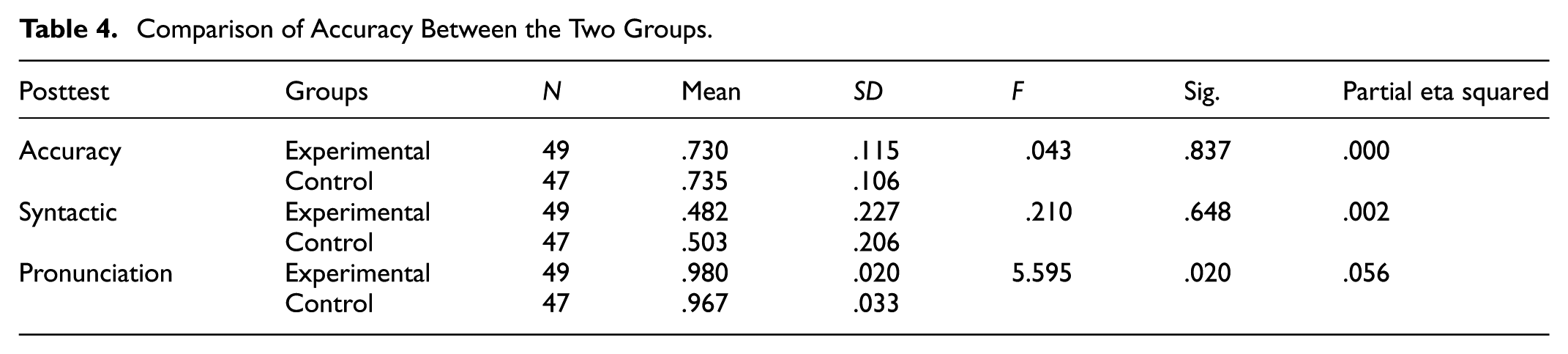
The results in Table 4 revealed that there was no significant difference in accuracy between the two groups (t = −.207, p = .837 > .05). The PBL group’s mean accuracy score (M = .730, SD = .115) was slightly higher than the conventional group’s accuracy mean score (M = .735, SD = .106), with a trivial effect size (partial η2 = −.000). To be more specific, a notable variation was observed in pronunciation accuracy (t = 2.365, p = .020 < .05, partial η2 = .056) but not in syntactic accuracy (t = −.459, p = .648 > .05). The mean scores of syntactic (M = .482, SD = .227) and pronunciation accuracy (M = .980, SD = .020) for the PBL group were slightly higher than those of syntactic (M = .503, SD = .206) and pronunciation accuracy (M = .967, SD = .033) for the CTM group. The findings indicated that the PBL group outperformed the CTM group in pronunciation accuracy. However, there was no significant improvement in overall accuracy, particularly in syntactic accuracy. This non-significance may stem from the nature of collaborative interaction in PBL tasks. While learners co-construct meaning through dialogue, scaffolding, and negotiation, their primary concern often lies in achieving shared understanding and maintaining communicative flow. As a result, attention tends to be directed toward message delivery and linguistic complexity, rather than toward precise syntactic forms. In such contexts, errors in accuracy may be tolerated or overlooked as long as comprehension is not hindered. This interpretation aligns with Guo’s (2024) findings, which suggest that during language production, learners often privilege complexity and fluency at the expense of accuracy. Consequently, accuracy development may require more sustained practice and explicit form-focused feedback beyond what PBL alone provides.
Comparison of Accuracy Between the Two Groups.
The results in Table 5 showed that there was a significant difference between the two groups in fluency (t = 2.479, p = .015 < .05). The mean fluency score for the experimental group (M = 2.612, SD = 1.096) was higher than the mean score for the control group (M = 2.060, SD = 1.083). The effect size (partial η2 = .061) suggests a medium impact. Similarly, significant effects were also observed in speech rates (t = 2.169, p = .033 < .05) and self-repairs (t = 2.779, p = .007 < .05). The mean scores of speech rates (M = 2.660, SD = 1.094) and self-repairs (M = 2.564, SD = 1.103) for the experimental group were also higher than those of speech rates (M = 2.163, SD = 1.150) and self-repairs (M = 1.957, SD = 1.032) for the control group. The effect size (partial η2 = .048) of speech rates was small to medium, while the effect size (partial η2 = .076) of self-repairs was medium. The findings indicated that the PBL group outperformed the CTM group in fluency, including both speech rates and self-repairs. These findings support the results of Zein et al.’s (2023) study, in which incorporating a video project into speaking instruction helps reduce students’ reluctance to speak and enhances their English speaking fluency.
Comparison of Fluency Between the Two Groups.

Perspectives on the Implementation of Video-Enhanced PBL
Participants reported that their speaking accuracy, fluency, and complexity improved through their engagement in PBL. Participants attributed these improvements in accuracy to their increased grammatical awareness and collaborative feedback, fluency to consistent practice and reduced anxiety, and complexity to topic exploration and task completion. To present these findings systematically, each aspect is discussed in detail in the following sections. For confidentiality, all participants are referred to by pseudonyms.
Improving Accuracy Through Grammatical Awareness and Collaborative Feedback
PBL enhances students’ accuracy by heightening awareness of grammar rules and encouraging collaborative feedback. Participants reported that their grammatical accuracy improved as they became more conscious of grammar rules and actively applied them during project activities. Feng, for instance, noted that prior to engaging in PBL, he had not given much thought to grammar and often felt confused. However, after engaging in video-creation project activities, such as scriptwriting and recording voiceovers, he became more conscious of grammatical accuracy. The iterative process of drafting, revising, and feedback emphasized in PBL reinforces the claims made by Nurhayati and Sedubun (2024), who argued that continuous engagement in communicative tasks facilitates deeper grammatical understanding and application. Similarly, Li emphasized that the PBL approach enabled him to internalize grammar knowledge through continuous practice. He noted that engaging in project-based scenario communication encouraged him to seek, practice, and ultimately understand correct grammar usage:
Eventually, we expressed our thoughts fully using correct grammar knowledge, which helped us understand correct grammar usage. (Li)
PBL activities necessitated repeated grammar practice, ultimately leading to internalization. These findings are consistent with Papi and Hiver’s (2025) study, which suggests that producing language compels learners to process and refine their grammatical structures. Overall, PBL fostered grammar acquisition through task engagement, as learners naturally encounter and apply grammatical structures in authentic contexts (Otajonova, 2024).
PBL also positively influenced participants’ pronunciation accuracy through corrective feedback. Participants in the current study, such as Liu, Gong, and Luo, highlighted specific instances in which peer correction and teacher feedback during project activities contributed to their pronunciation development. Liu, for example, noted that consistent feedback from both teachers and peers allowed her to refine her pronunciation. Gong illustrated how peer feedback motivated her to refine her pronunciation. She described a memorable instance in which a disagreement over pronunciation highlighted the value of correction:
While discussing the word Opposite, I mispronounced it and lost a friendly bet with my peer, which helped me notice and improve my articulation. (Gong)
This anecdote highlights how peer interaction fosters pronunciation refinement through active engagement and self-correction. Luo further emphasized the role of peer monitoring and teacher feedback in pronunciation improvement. She noted that during dubbing activities, group members actively identified and corrected pronunciation errors, while teachers provided further refinements after project presentations. The findings illustrate how collaborative learning environments create opportunities for scaffolding, where more proficient peers assist others in refining their pronunciation. This aligns with Chien’s (2018) study, which found that learners improve pronunciation when exposed to collaborative speaking tasks that encourage self-correction and peer monitoring.
The qualitative insights suggest that PBL significantly enhances EFL learners’ pronunciation accuracy particularly through collaborative feedback. PBL offers more opportunities for learners to notice and correct their pronunciation errors. In the process of completing video-creation projects, students were required to rehearse their lines multiple times before and during filming. They practiced oral drafts and engaged in dubbing activities, during which pronunciation was closely monitored and corrected by both peers and teachers. Such deliberate focus on pronunciation aligns with Pennington’s (2021) study that attention to phonological detail positively impacts learners’ accuracy. In contrast, the qualitative data also help explain why PBL did not result in significantly greater improvement in syntactic accuracy compared to the CTM. Although students reported becoming more conscious of grammar and perceiving gains in their syntactic accuracy, the inherently communicative nature of PBL tends to prioritize meaning over the explicit teaching of grammatical structures. According to Sulistyo and Lutviana (2023), PBL is not designed to focus intensively on form but rather on meaningful communication. As a result, while learners may show improvement through increased exposure and usage, PBL may not produce greater gains in syntactic accuracy than the CTM that explicitly targets grammar instruction.
Enhancing Fluency Through Consistent Practice and Reduced Anxiety
PBL provides a practical and effective approach to improving English speaking by fostering continuous practice and boosting learners’ confidence in communication. Participants reported noticeable improvements in fluency, marked by a reduction in speech pauses and increased confidence in verbal expression. This improvement was largely attributed to the iterative nature of project work, which required consistent practice and real-time interaction with peers. Gong emphasized that project execution provided an authentic environment for consistent practice, significantly enhancing her fluency. Similarly, Li highlighted that project tasks, such as discussions, interviews, and presentations, provided abundant opportunities to practice spoken English. He explained:
During projects, summarizing discussions and reporting findings gave me extensive speaking practice, which gradually improved my fluency. (Li)
These findings suggest sustained engagement in project activities—such as interviews, presentations, and group discussions—leads to a noticeable improvement in fluency and confidence among learners. These findings align with those studies indicating that project work offers structured opportunities for language use in authentic contexts, which fosters both fluency and linguistic competence (Komekbaevna & Isabayevna, 2024).
Participants experienced nervousness and stuttering when speaking English prior to participating in project activities. However, they were pleasantly surprised to find that their speaking fluency improved after being exposed to the PBL method. Liu noted that repeated engagement in speaking tasks helped her overcome anxiety and improve fluency. Feng echoed this, emphasizing that project-based learning reduced nervousness and enhanced his ability to communicate. She said:
After a semester of PBL, I now speak with greater fluency and confidence. (Feng)
Liu and Feng’s experiences reflect Cutrone and Beh’s (2024) assertion that task-based and experiential learning reduce learners’ psychological barriers to speaking, allowing for more natural and confident verbal expression. These findings suggest that PBL significantly contributes to reducing speech anxiety and enhancing fluency. Through repeated exposure to speaking tasks in a supportive environment, participants gradually gained confidence and overcame their initial nervousness. These findings are also consistent with prior research indicating that supportive and interactive learning environments can lower affective filters, thereby promoting more fluent language production (Hajiyeva, 2024).
These qualitative findings provide additional evidence explaining why PBL significantly enhances students’ fluency. Unlike the traditional methods, PBL creates an authentic and engaging learning environment that promotes autonomous learning and consistent speaking practice. Through real-world communication tasks such as discussions, interviews, and presentations, students gain extensive opportunities to use English in meaningful contexts. This consistent practice not only improves their fluency but also reduces nervousness, fostering greater confidence in spoken communication. These findings align with Suzuki’s (2022) study, indicating that regular practice and real-life communication tasks enhance speech fluency, which was observed in this study as students demonstrated reduced hesitation and more fluid speech.
Increasing Complexity Through Topic Exploration and Task Completion
The integration of topic exploration and task completion provided participants with opportunities to practice advanced sentence construction, refine their grammatical accuracy, and develop more sophisticated oral communication skills. Participants acknowledged that the thematic nature of PBL projects exposed them to domain-specific vocabulary and a wider range of grammatical structures. As a result, they were able to incorporate these elements into their English-speaking practice. Liang highlighted the impact of thematic projects on vocabulary acquisition:
The project topic of each unit involves many related words and clauses. As we completed these projects, we accumulated vocabulary and grammar knowledge, which enriched our language skills. (Liang)
The process of topic exploration within PBL further contributed to this linguistic development, as students engaged in discussions, analyzed multiple perspectives, and synthesized information. Luo noted that project tasks helped her produce more complex language structures. She reported:
Drafting scripts for projects helped me use subordinate clauses and transform basic ideas into more complex sentences, improving my oral English and understanding of sentence patterns. (Luo)
By delving deeply into various topics, students were not only encouraged to articulate their thoughts with greater precision but also to refine their language use in a more structured and contextually appropriate manner. Jiang noted:
During project interviews, I incorporated transitional phrases and clauses into my responses, along with newly learned vocabulary. (Jiang)
These results underscore how PBL supports linguistic development by fostering the application of advanced language structures in spoken English while simultaneously enhancing students’ ability to explore and express ideas on complex topics.
The participants also elaborated on how the PBL method aided them in acquiring a greater number of words and clauses throughout the task completion. Chen highlighted that descriptive exercises during project tasks contributed to linguistic enrichment:
Introducing scenic spots and using complex structures like inversion and exclamatory sentences enriched my expression and improved my oral English. (Chen)
Gan reinforced that creating video scripts supported analytical learning of grammar and sentence structure:
Writing scripts helped me use subordinate clauses and more advanced structures, which improved my ability to speak English. (Gan)
These findings suggest that participants could expand their vocabulary and acquire additional grammar knowledge through the completion of each project, enabling them to utilize this knowledge to speak English with greater complexity.
The qualitative insights provide further explanation for why PBL outperformed the CTM, particularly in terms of syntactic complexity. This suggests that PBL facilitates students’ acquisition of more complex language structures through thematic exploration and structured task completion. However, while PBL significantly enhanced syntactic complexity, no substantial improvement in lexical complexity was observed compared to the CTM. Although students expanded their English vocabulary through PBL, the overall increase in lexical complexity did not surpass that achieved in conventional instruction. This aligns with previous research by Somjai and Soontornwipast (2020), who noted that while PBL can lead to gains in syntactic complexity, its impact on lexical development may be more gradual and dependent on explicit vocabulary instruction.
Framework of the Impact of Video-Enhanced PBL on Oral Proficiency
Based on the findings of this study, Figure 2 illustrates how the video-enhanced PBL influences EFL learners’ oral proficiency, specifically focusing on the dimensions of CAF. The figure highlights that PBL has a significant positive impact on learners’ oral performance, and this improvement can be attributed to several core elements naturally integrated into the PBL method. First, PBL promotes syntactic complexity by encouraging learners to produce more sophisticated and varied sentence structures through topic exploration and task completion. Engaging with meaningful tasks pushes learners to use a wider range of language forms and express more complex ideas. Second, the video-enhanced PBL improves pronunciation accuracy as learners become more aware of language forms through authentic use and collaborative feedback from peers and teachers, helping them notice and correct errors. Third, fluency improvements are evident through faster speech rates and reduced self-repairs during conversation. Fluency development is further supported by consistent language practice and a reduction in speaking anxiety within a lowered-pressure PBL environment. Overall, the video-enhanced PBL fosters a dynamic and interactive learning atmosphere that meaningfully develops EFL learners’ oral proficiency across multiple dimensions, making it an effective alternative to traditional teaching methods.

Framework of the impact of video-enhanced PBL on oral proficiency.
Conclusion, Implications, Limitations, and Further Research
This study sets out to examine the effects of video-enhance PBL on college EFL learners’ oral proficiency, using the CAF framework as a measurement. The findings indicate that, within the present context, the video-enhanced PBL improved learners’ overall oral proficiency more effectively than the CTM. In particular, improvements were observed in syntactic complexity, pronunciation accuracy, and fluency, especially in relation to speech rate and the reduction of self-repairs. However, no statistically significant gains were found in learners’ lexical complexity or syntactic accuracy. Despite this, the video-enhanced PBL was perceived by learners as an effective instructional approach for improving oral proficiency. The benefits were attributed to increased grammatical awareness, collaborative correction, consistent speaking practice in meaningful contexts, reduced anxiety due to peer support, and the motivation to engage in task-driven topic exploration. These insights suggest that while the video-enhanced PBL is a promising student-centered and communicative approach, its effects should be interpreted with careful consideration to the areas where significant gains were not observed.
This study offers valuable implications for English language teachers, particularly those in the EFL context, on the effective implementation of the video-enhanced PBL in oral English instruction. Given the inherent complexity of applying the video-enhanced PBL, the practical insights presented in this study can guide teachers in enhancing students’ oral proficiency and engagement through task-oriented learning. At the same time, the non-significant improvement in lexical complexity and syntactic accuracy suggests that the video-enhanced PBL alone may not sufficiently promote these dimensions of language development. Therefore, teachers are encouraged to integrate explicit language-focused instruction, such as targeted vocabulary expansion and grammar awareness activities, within the PBL framework to balance fluency with linguistic accuracy. By integrating video production into PBL tasks in an Oral English course, the study provides a clear framework of teaching procedures that can serve as a practical reference for educators seeking to adopt innovative PBL approaches in their language classrooms.
Building upon these findings, several limitations should be acknowledged, which in turn suggest directions for future research. First, the sample size was limited and drawn from intact classes, resulting in an unbalanced gender distribution (92 females, 4 males). While this reflects the actual demographic composition of many English majors in Chinese universities and polytechnics, the imbalance remains a limitation. Future research should use larger, more gender-balanced samples to enhance generalizability. Second, the quasi-experimental design without random assignment may introduce potential biases, even though comparable proficiency levels were ensured at the outset. Future research could employ randomized controlled trials or longitudinal designs to enhance internal validity. Third, the current study examined oral proficiency within a specific instructional context, which may not fully capture the range of learners’ communicative abilities. Expanding the scope to include other dimensions of performance, such as pragmatics or affective factors, would provide a more comprehensive understanding. Finally, as this study focused on a single institution, future work could investigate similar interventions across different educational settings to strengthen external validity.
Footnotes
Acknowledgements
Appreciation also goes to everyone who helped during this review and improved the quality of our final manuscript.

Ethical Considerations
The studies involving humans were approved by the Ethics Committee for Research Involving Human Subjects of Universiti Putra Malaysia. The research was performed in accordance with relevant guidelines and regulations applicable when human participants are involved.
Consent to Participate
Informed consent was obtained from all the participants.
Author Contributions
All authors have accepted responsibility for the entire content of this manuscript and approved its submission.
Funding
The authors disclosed receipt of the following financial support for the research, authorship, and/or publication of this article: This study was supported by the 2025 to 2026 Scientific Research Planning Project (Grant number 202509G359) of Guangdong Society of Vocational and Technical Education and the 2025 Social Science Planning Project (Grant number YJ2025E10) of Yangjiang Federation of Social Sciences.
Declaration of Conflicting Interests
The authors declared no potential conflicts of interest with respect to the research, authorship, and/or publication of this article.
Data Availability Statement
The data used to support the research results are available from the corresponding author upon request.