




Abstract
This study investigated the rhetorical organization of Malay and English research article discussions. A move analysis was carried out for the two sets of data of the present study based on a modified version of Peacock’s model for the discussion section. For this purpose, a total of 40 research article discussions restricted to empirical studies (20 from each corpus) were randomly selected from journals in the field of education. Results show that Malay discussions are more context dependent while English discussions are more context independent and standalone. In addition, compared with its English-language counterparts, the fit between Peacock’s model and Malay discussions is partial. This phenomenon may be due to the preference for rhetorical concepts and values in the local writing community. The findings have pedagogical implications in an English for Academic Purposes classroom.
Keywords
Introduction
Although many genre-based studies have been carried out on the discussion sections of English research articles to examine disciplinary variation (e.g., Holmes, 1997; Hopkins & Dudley-Evans, 1988; Peacock, 2002), fewer have been undertaken to identify the cross-cultural aspects of writing by comparing the rhetorical structures of discussion sections in English and non-English languages. Most cross-cultural genre-based studies have focused on the introduction section (e.g., Ahmad, 1997; Clyne, 1987; Connor, 1988; Eggington, 1987; Jogthong, 2001; Hirano, 2009; Kobayashi, 2003; Martin, 2003; Ostler, 1987; Ventola & Mauranen, 1991). To the best of the researchers’ knowledge, no published research to date has examined the discussion sections of Malay research articles except for our earlier work (Loi, Sweetnam Evans, Akkakoson, Ahmed, & Ahmed, 2015) which is part of this larger research. The examination of the discussion section of Malay research articles thus has not received the attention it deserves. The present genre-based contrastive study of Malay and English research article discussions should fill this small but significant gap.
A further justification for comparing the research article discussions in the two languages (English and Malay) is the pedagogical rationale for extending past genre analyses of the introduction section to the discussion section. Non-native speakers may find the forms and functions of English academic writing “ambiguous and incomprehensible” (Basturkmen, 2009, cited in Salimi & Yazdani, 2011, p. 354). The findings will assist English as a second language (ESL) learners to write a “good” discussion section, which, along with the introduction section, is known to be one of the most difficult and complex sections to write (Mirahayuni, 2002). Using move analysis, students can intentionally exploit the communicative functions and their linguistic features through tasks and materials similar to the ones which they are supposed to understand and write (Brett, 1994), and move analysis is able to provide useful information for novice writers who are not experienced users of a genre, by exposing them to the conventions of a particular genre and also the reasons assumed to underlie such conventions in the social practices of a community (Bhatia, 1997).
In addition, the need for undertaking the present study has, to a certain extent, been motivated by the increasing importance of the discussion section over time. According to Hopkins and Dudley-Evans (1988), there may have been a “marked shift away from unevaluated reporting to lengthy and explicit writer comment” in research articles (p. 119). Their claim is based on the findings that there was a relative decline in the importance of the methods and equipment sections of research articles over time, as compared with the discussion and conclusion sections.
Past studies on the discussion section have identified various move-structure models. One of the earliest studies on the discussion section was conducted by Hopkins and Dudley-Evans (1988). They identified 11 moves in the discussion section of MSc dissertations and articles on irrigation and drainage published in the proceedings of an international conference.
These moves include (a) background information, (b) statement of results, (c) (un)expected outcome, (d) reference to previous research (comparison), (e) explanation of (un)expected results, (f) exemplification, (g) deduction, (h) hypothesis, (i) reference to previous research (support), (j) recommendation, and (k) justification. Dudley-Evans (1994) proposed a nine-move structure suggesting a discussion section comprising the following nine moves, namely (a) information move, (b) statement of result, (c) finding, (d) (un)expected outcome, (e) reference to previous research, (f) explanation, (g) claim, (h) limitation, and (i) recommendation.
These nine moves are suggested along with a three-part framework which includes a series of move cycles combining two or three of the above nine moves. The three-part framework and move cycle series are
introduction (“information move or information move + reference to previous research or statement of results/findings”)
evaluation (“statement of results/findings + reference to previous research”) or (“claim + reference to previous research” or “reference to previous research + claim”)
conclusion (“finding + claim” or “recommendation”).
Based on Hopkins and Dudley-Evans’s (1988) move-structure model of natural science discussion sections, Holmes (1997) proposed a modified version of the model for humanities and social sciences discussion sections, which comprises eight moves including a new move “outlining parallel or subsequent developments” which Holmes found in the concluding paragraphs of history articles. Writers of history articles employed this move to provide a “presentation in summary form of data additional to that given in the main body of the article” (p. 324). Moves in Holmes’s model are therefore (a) background information, (b) statement of result, (c) (un)expected outcome, (d) reference to previous research, (e) explanation of unsatisfactory result, (f) generalization, (g) recommendation, and (h) outlining parallel or subsequent developments.
In a more recent study on the discussion section (Peacock, 2002), articles from seven disciplines were examined, namely physics, biology, environmental science, business, language and linguistics, public and social administration, and law using Dudley-Evans’s 1994 model. Peacock’s (2002) model appears to display a more extensive range of communicative categories than Holmes’s (1997) model due to the inclusion of the three-part framework and move cycle series (see the Method section). As Peacock’s model included the three-part framework and constituted the most recent model among all the other models reviewed in the present study, it was selected as a starting point for the initial coding or as a basis to draw up move categories in the two sets of data. The move analysis of the present study was based on a modified version of Peacock’s model for the discussion section. Similarities and differences between research article discussions were examined, and attempts were made to relate major features to possible contextual factors. The findings have pedagogical implications in an English for Academic Purposes (EAP) classroom. The research questions in the present study are formulated as follows:
Method
As noted above, the present study sets out to compare the rhetorical strategies used in the discussion sections of Malay and English research articles. The discussion section was selected as it is attested in the literature that the discussion section uses a wider range of different rhetorical functions than do other sections of research articles (Mirahayuni, 2002).
Research Design and Corpora
This study investigated the rhetorical organization of Malay and English research article discussions. For this purpose, a total of 40 research article discussions restricted to empirical studies (20 from each corpus) were randomly selected from journals in the field of education. As there might be some differences due to the requirements of the individual journals, conformity with the standard Introduction-Method-Results-Discussion (IMRD) was taken as the first similar feature in the selection of the two sets of empirical research articles from the selected journals. Such conformity to the IMRD structure as a criterion was used in previous genre-based investigations into research articles (e.g., Lim, 2011, 2012). The discussion section is defined as the second last section of a research article which is found after the “results” section and before the “conclusion” section.
In the corpora, some articles use the conventional functional heading of “results and discussion.” Only English and Malay articles with the section labeled “discussion” were selected. The Malays corpus was selected from the Jurnal Pendidikan Bahasa Melayu—JPBM [Malay Language Education Journal—MyLEJ] published by Universiti Kebangsaan Malaysia. The English corpus was selected from the International Journal of Educational Research published by Elsevier. The selected research articles were published between 2009 and 2014.
Forty research article discussions—20 Malay and 20 English—were selected from the above two journals through the following sampling method. Initially, 40 articles were selected from each journal based on judgment sampling. In the judgment sampling, research article discussions were selected according to the principles underlying the data collection as noted above. Later, 20 articles were extracted from the 40 articles, for each language, to form the actual corpus of the present study through a stratified random sampling. The decision to use a stratified random sampling instead of a pure random was to ensure a considerable degree of objectivity, in that articles from different issues are represented in the actual sample.
To obtain a stratified random sample, the 40 articles for each language were first stratified into five subgroups based on publication in the 6 years prior to the year in which the sampling was made (2009-2014). This was followed by a simple random sampling to select articles from each of the five subgroups in proportion to their original representation in the pool. A simple random sampling was employed within each stratum to ensure an unbiased sample.
At the end of the sampling, the selected individual articles in the actual sample (20 articles for each language) were identified by a letter and a number. For example, E1 refers to Article No. 1 in the English corpus, and M2 refers to Article No. 2 in the Malay corpus. The two corpora vary in length as follows: English corpus contains 29,542 words (with an average of 1,447.1 words per research article discussion), and Malay corpus contains 18,200 words (with an average of 910 words per research article discussion). The data show that English corpus is about 1.6 times longer than Malay corpus.
Coding Process
As mentioned earlier in the Introduction section, Peacock’s (2002) model functions as a starting point for the initial coding or as a basis to draw up move categories in the two sets of data. Peacock proposed a revised model comprising a three-part framework of move cycles of two or more of the following eight moves, namely,
information move (background about theory/research aims/methodology),
finding (with or without a reference to a graph or table),
expected or unexpected outcome (comment on whether the result is expected or not),
reference to previous research,
explanation (reasons for expected or unexpected results),
claim (contribution to research - sometimes with recommendation for action),
limitation, and
recommendation (suggestion for future research).
The three-part framework and move cycle series are as follows:
Introduction (Moves 1, or 2, or 6).
Evaluation (the key move cycles are 2 + 4, 2 + 6, 3 + 4, and 3 + 5. Other less common cycles are 6 + 4 and 4 + 6).
Conclusion (Moves 2 + 6, or 8, or 8 + 6, or 7 + 6).
When a move emerging from the corpus could not be described by labels in Peacock’s (2002) model, a new code was developed to accommodate the new move. The new code was chosen to reflect the function of the move as accurately as possible. For the present study, a number of modifications were made. In the coding process, it was found necessary to add one new move “deduction” (see Hopkins & Dudley-Evans, 1988). This move occurred in all 20 English and 20 Malay discussions. In this move, the writers make inferences/deductions based on the data uncovered in the study. An example (M2) from the Malay corpus is presented below to illustrate this phenomenon. M2 shows that the writer deduces that based on the statistical data, the findings have no significant differences in the variable investigated:
M2 Dapatan kajian menunjukkan tidak terdapat perbezaan yang signifikan antara kecerdasan emosi antara murid lelaki dan murid perempuan [Move 4]. . . . M2 (translated version) The findings showed no significant difference in emotional intelligence between male and female students [Move 4]. . . .
The reference to “finding” in Peacock’s (2002) model (p. 492) seems to refer both to data uncovered by the authors’ study and to deductions or inferences arising from the data. It is quite confusing to code the two functions under the same move “finding” (see Holmes, 1997), thus, the decision in the present study to code the two different functions as two different moves. That is, the “finding” move (Move 2) refers to the data uncovered in the study being investigated while the “deduction” move (Move 4) refers to the generalization or inference emerging from the data.
In Peacock’s (2002) model, “claims” (Move 6) integrate both “contribution to research” and “sometimes with recommendation for action” (p. 492). To somewhat extend the scope of the move, the present study separates “claims” into “significance of the study” (Move 7) and “implication of the study” (Move 8). We based therefore our analysis on a modified version of Peacock’s (2002) model for the discussion section. The revised model is presented in Table 1.
The Revised Move-Structure Model for the Discussion Section.

Note. As a result of the move modification, not all currently- used moves correspond to moves in Peacock’s (2002) model.
Methods/Steps
The methods/steps used to answer each of the three research questions formulated in the present study are described below:
Research Question 1: What are the similarities and differences between English and Malay research article discussions in the employment of rhetorical moves?
To answer the above question, the following steps were carried out. After the move classification list was finalized at the end of the coding process (see Section “Coding Process” and the revised model in Table 1), a move analysis was carried out. The results of the analysis were subjected to a quantitative analysis, which included the frequency counts and percentages of English and Malay discussions employing the moves. The use of the moves between the two sets of data was compared and contrasted based on the quantitative data tabulated in Tables 2 and 3.
Frequency and Percentage of English and Malay Discussions Employing the Moves.

Frequencies and Percentages of English and Malay Discussions Employing the Opening Moves.

In addition, the cyclic nature of the moves (cf. Swales, 1990, 2004) in the two sets of data was compared. For illustration purposes, an example of cyclicity given by Swales (1990) is presented. His example shows the cycles of Move 1 Step 3 (reviewing items of previous research) and Move 2 Step 1B (indicating a gap) recur (i.e., M1S3-M2S1B-M1S3-M2S1B-M1S3-M2S1B).
To examine the contrasting cyclic nature of the moves in English and Malay data, after the coding of moves (the labeling of moves followed that of the revised model), the move pattern for each article in the two sets of data was recorded.
The results of the move-pattern analysis were subjected to a quantitative analysis which included frequency counts and percentages of English and Malay discussions displaying a cyclic structure. To compare the complexity of move cycle structures, the number of move cycles commonly occurring cyclically with the repetition of individual moves was examined. For example, the move cycles which occur cyclically with the repetition of three moves (1-5-
Research Question 2: To what extent has the “move” model proposed by Peacock (2002) for the discussion section of research articles been followed by the two sets of discussions?
To answer the above research question, the present study first carried out a coding process (see the section “Coding Process”) and a move analysis (Table 2) to discover the moves found in the two sets of data and the number of discussions employing the moves, respectively. Second, it compared the findings with Peacock’s (2002) framework to find out if the moves Peacock proposed are also present in the two sets of data. If they are present, frequency counts will be made of the number of discussions employing the moves .
Research Question 3: What are the contextual factors that may have influenced the use of “moves” in the two sets of data?
The present study undertook a literature search on the contextual factors that may have influenced the use of the moves in the two sets of data.
Measures Taken to Enhance Coding Reliability
Due to the limitations of using empirical methods to measure inter-rater reliability for move analysis (e.g., Al-Qahtani, 2006; Crookes, 1986), the present study established reliability of move identification by the researchers’ coding of the two sets of discussions on two occasions at the interval of two months and comparing the results for the two rounds of coding. The researchers attempted to refine the moves when the coding of the particular moves differed greatly between the two sets of coding. This attempt involved repeated readings and consideration of the functions realized by the linguistic elements employed by the writers to signal their intentions.
Results and Discussion
In this study, a comparison was made between the discussion sections of English and Malay research articles to first find out the similarities and differences between the two sets of data and second, to see whether and to what extent the move model proposed by Peacock (2002) for discussion section of research articles has been followed.
To deliver the paper, 40 research article discussions (20 from each corpus) were randomly selected from the two selected journals from each language. Overall, the moves in both corpora are commonly realized cyclically rather than linearly or in a composite manner. That is, discussion proceeds from one move to another with recurrence of one or more moves. It is worth noting that in past studies (e.g., Brett, 1994; Holmes, 1997; Hopkins & Dudley-Evans, 1988; Swales, 1990; Yang & Allison, 2003), the discussion section has been shown to be highly cyclical. Eighteen of the 20 (90%) Malay research article discussions exhibit a cyclic order of moves (e.g.,
Although a rather high percentage of discussions in both languages display the cyclicity of moves, English discussions have more complex move cycle structures. In English discussions, the move cycles commonly occur cyclically with the repetition of two (1-
The more complex move cycle structures/less restricted range of cyclic patterns in English research article discussions suggest that cyclicity of moves is more distinctive in English compared with Malay research article discussions. Research article discussions in both languages generally show the presence of all the 10 moves, although some moves, particularly Move 3 ([un]expected outcome), Move 6 (explanation—reasons for expected or unexpected outcome), Move 9 (limitation), and Move 10 (recommendation), are underrepresented in Malay discussions.
The three common moves which are frequently used in the individual corpus are Move 4 (deduction), Move 5 (reference to previous research), and Move 2 (finding). Move 4 (deduction) is employed in 100% of both discussions; Move 5 (reference to previous research) in 100% of English and 90% of Malay discussions while Move 2 (finding) is used in 85% of English and 75% of Malay discussions. As observed, although Move 2 (finding) and Move 5 (reference to previous research) are frequently used in the Malay corpus, the number of English discussions employing the two moves is greater. This phenomenon is generally true for all the moves except for Move 4 (deduction) which is found in 100% of discussions in both languages. This shows that Malay discussions are generally not as rhetorically elaborate and complex.
As Move 4 (deduction) is found in 100% of discussions in both languages, the move can be considered as the core/obligatory element of both discussions. However, Move 5 (reference to previous research) which is found in all 20 English discussions is another obligatory move in English discussions. The use of these two obligatory moves, Move 4 and Move 5, is illustrated in the following Malay example (M2), which shows a cyclic pattern of two cycles with instances of Move 4 followed by Move 5. The core move cycle of “4-5” suggests that the deductions arising from the data are compared with the past findings:
M2 Dapatan kajian menunjukkan tidak terdapat perbezaan yang signifikan antara kecerdasan emosi antara murid lelaki dan murid perempuan [Move 4]. Hasil kajian ini selaras dengan dapatan kajian lepas seperti Roshiza (2002) dalam kajiannya . . . [Move 5]. Dapatan kajian menunjukkan tidak terdapat perbezaan yang signifikan terhadap kecerdasan emosi antara aliran Sains dan Sastera dalam pembelajaran [Move 4]. Menurut Salovey dan Mayer (1990) . . . [Move 5] M2 (translated version) The findings showed no significant difference in emotional intelligence between boys and girls [Move 4]. The results of this study are consistent with previous research findings such as Roshiza’s (2002) study . . . [Move 5]. The results showed no significant difference in the emotional intelligence of learning process between students from the Science and Arts streams [Move 4]. According to Salovey and Mayer (1990) . . . [Move 5]
The results of coding are tabulated in Table 2 and Figure 2:
Referring to Table 3, a closer examination shows the following differences between the two sets of data. Malay discussions tend to start the introductions with Move 4 (deduction; 70%), Move 2 (finding; 25%), followed by Move 1 (information move; 5%). Meanwhile, English introductions tend to start with Move 1 (information move; 55%), Move 4 (deduction; 25%), followed by Move 2 (finding; 20%).
As observed in the introduction part of the Discussion section, English discussions tend to place the main findings (Move 2) and/or deduction (Move 4) on hold, and instead provide background information (information move—Move 1) such as restating the aim of the study, the method of the study, or the related literature review before proceeding with the above-mentioned Move 2 and Move 4 (finding and deduction, respectively).
The information move (Move 1) in the form of restatements of aim, method, or literature review may serve as a useful link between the earlier sections and the Discussion section. It also orients the reader to the subsequent evaluation of the main findings.
The following excerpts (showing the key move that frequently starts the discussion sections of each corpus) are indicative of the phenomenon described above—M11 starts with Move 4 (deduction) + Move 2 (finding) while E9 starts with an information move (Move 1), which reiterates the objectives of the study and the related literature review followed by “reference to previous research” (Move 5) to compare the finding with that of the literature:
M11 Berdasarkan dapatan kajian yang telah dikemukakan, dapat disimpulkan bahawa teknik bercerita memberi kesan yang positif kepada prestasi penulisan karangan murid. Hal ini dapat dibuktikan apabila . . . [Move 4—deduction]. Berdasarkan nilai min yang diperoleh iaitu 14.74 sebelum rawatan, prestasi kumpulan eksperimen meningkat kepada nilai min 23.15. [Move 2—finding] M11 (translated version) Based on the findings, it can be concluded that the storytelling technique had a positive effect on student performance in essay writing. This can be proven when . . . [Move 4—deduction]. Based on the mean values obtained, i.e. 14.74 before treatment, the performance of the experimental group increased to a mean of 23.15. [Move 2—findings] E9 The main objective of the present study was to determine if there are affective costs or benefits of self-evaluation biases in a mathematics education context. Our review of theoretical positions regarding this issue revealed that there exist two opposing views. According to the first, based on expectancy-discrepancy reduction approaches to affect-regulation and control (e.g., Carver, 2003; Carver & Scheier, 1990; Mellers et al., 1997, 1999), one would expect that unanticipated successes might result in more positive satisfaction with performance than . . . [Move 1—information move]. Our findings clearly support the social-cognitive view of the self-fulfilling prophecy role of self-evaluation biases (e.g., Bandura, 1997; Brown & Marshall, 2001). [Move 5—reference to previous research]
As a result, Malay discussions seem to form a less coherent whole of beginning (lack of the informative move that contains information reiterated from the earlier methodology or introduction sections).

An example of cyclicity (Swales, 1990, p. 143).
One possible explanation for the above disparity may be that English discussions are more context independent and standalone than the Malay discussions. Such a phenomenon is also found in Ahmad’s (1997) study. In her corpus comprising the introductions of Malay research articles, Malay writers appear to expect the readers to “do a lot of decoding and to fill in the missing information by themselves” when the writers straight away continue with announcing their existing study after briefly stating the relevant literature review (p. 168).
Malay discussions tended to not conform to the concluding part of the three-part framework in Peacock’s (2002) model in the sense that the moves labeled in the concluding part of Peacock’s three-part framework were hardly found in Malay discussions compared with English discussions. Malay discussions seem to mirror an abrupt ending with no “concluding” moves as labeled in Peacock’s model. These moves are as follows: Move 7 (significance of the study; equivalent to “claims” in Peacock’s, 2002, model), Move 9 (limitation), and Move 10 (recommendation). The quantitative data show that not more than 20% of Malay discussions end with one of these concluding moves while at least 55% of English discussions end with one of the three “concluding” moves. The following excerpts (last paragraph of each corpus) are indicative of the phenomenon described above:
M13 Dalam analisis berdasarkan kepada gender menunjukkan kumpulan murid yang belajar menggunakan kaedah kawalan tidak menunjukkan perbezaan pencapaian antara murid lelaki dan perempuan [Move 4—Deduction]. Namun dapatan ini berbeza . . . Dapatan kajian adalah berbeza dengan kajian oleh Yusuf dan Afolabi (2010) yang tidak menunjukkan sebarang perbezaan antara murid lelaki dan perempuan. Sementara kajian oleh Al-Haq dan Al-Sobh (2001) dan Spradilin (2009) menunjukkan terdapat perbezaan signifikan skor markah berdasarkan gender. [Move 5—Reference to previous research] M13 (translated version) The analysis results based on gender show that there is no difference in performance between the male and female students for the group of students who learned using the control method [Move 4—Deduction]. However, this finding is different . . . The findings are in contrast to studies by Joseph and Afolabi (2010) which showed no difference between boys and girls while the study by Al-Haq and Al-Sobh (2001) and Spradilin (2009) showed that there were significant differences in marks score based on gender. [Move 5—Reference to previous research] E5 Viewed from a practical standpoint, this study may have a number of important implications for human resource strategies in diverse organizations in general and diverse academic organizations in particular. Such strategies could be designed to take into account the types of diversity in the specific context. Moreover, having the different outcome of different types of diversity in mind may help managers to understand the extent to which the demographic differences may enhance performance. With the information provided in our study, managers could better decide how much to invest in addressing these issues (Stewart & Johnson, 2009). It may also aide organizations in determining how the focus of certain human resource management efforts could be directed. [Move 8—Implication of the study
In light of these findings, we deduce/conclude that the two sets of discussions generally support Peacock’s (2002) model as all the moves labeled in the model can be found in the corpora. However, compared with its English-language counterparts, the fit between Peacock’s model and Malay discussions is partial due firstly to the lesser employment of both Move 1 (information move) as an opening move in the introductory part of the discussion sections (only 5%; see Table 3) and the three “concluding” moves (Move 7, Move 9, and Move 10; not more than 20%; see Figure 2).
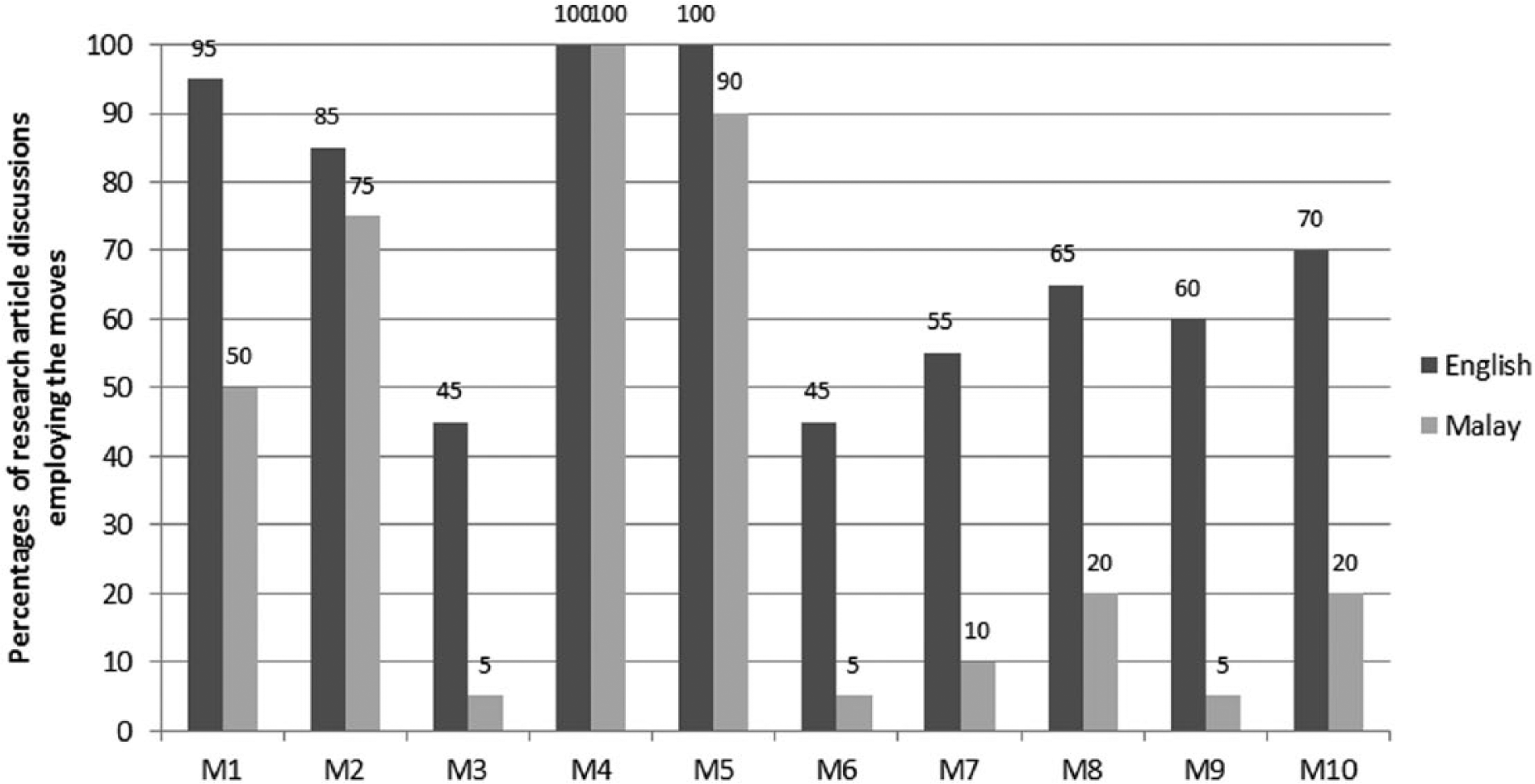
Percentages of English and Malay discussions employing the moves.
Similarly, findings in past contrastive studies (e.g., Clyne, 1987; Connor, 1996; Eggington, 1987; Ostler, 1987; Ventola & Mauranen, 1991) comparing texts in English and non-English languages generally show that different languages and cultures prefer different rhetorical structures (Ahmad, 1997). One possible explanation for the above disparity which shows a lesser fit with Peacock’s model for Malay discussions compared with English discussions may be the preference for rhetorical concepts and values in the local writing community (cf. Xu, Huang, & You, 2016).
The less employment of the three moves, Move 7 (significance of the study), Move 9 (limitation), and Move 10 (recommendation), in the concluding part of Malay discussion sections may be because of the expectations that writers and readers in the local Malay community have of the concluding part of a discussion section (cf. Martin, 2003). Malay writers may have fewer reasons and less inclination to make their work more prominent than do their English-language counterparts (cf. Ahmad, 1997; Taylor & Chen, 1991). This may be due to the fact that research findings in Malay are targeted at local readership, and writers may not face the same pressure of competing for a research space (cf. Jogthong, 2001; Martin, 2003) as English-language writers do. The following reflects this phenomenon.
In the research environment of developing countries, such as Indonesia, where the Malay is its official language, there is a general lack of internationally based research as it is evident from Wiryawan’s (2014) findings that of the total of 145,000 papers published in 2012, only 1,314 papers were published in “international-class journals included in Scopus” (p. 73). The remaining papers were published in national journals, mostly in non-accredited journals.
In contrast, as English articles are targeted at the larger international audience, writers have to face a higher degree of pressure and competition to obtain research funding and have their work published (Fredrickson & Swales, 1994, as cited in Ahmad, 1997; Jogthong, 2001).
The differences observed in the findings might be due to the differences between the two different social and institutional contexts as described above. Such findings illustrate that meaning potential of the genre is experienced differently by scholars in the two different scientific communities (cf. Hirano, 2009). Following up on Hyland’s (1996) claim that scientific discourse is both socially situated and structured to accomplish objectives, it is assumed here that rhetorical means in Malay and English discussions are governed by discoursal expertise that is valued in an academic environment. This assumption is also in line with Ahmed’s (2004) comments that members of the discourse community should not only possess knowledge of the relevant content but should also acquire suitable discoursal expertise and adhere to the guidelines of their discourse community regarding preferred communicative styles if they want to be successful participants in the community (cf. Xu et al., 2016).
The higher employment of the three concluding moves in the English corpus suggests pragmatic aspects that reflect the following interpretive environments. This means that in claiming the significance of the study, the writer reminds the reader of the merits of the research (the significance of the study may have been noted in the introduction section or the abstract prior to the discussion section—see Loi & Sweetnam Evans, 2010), and this may make it more persuasive and convincing to the reader who is more likely to accept the writer’s new findings.
In acknowledging the limitations of a study, writers might make it easier for a reader to ratify their new claims as the claims have been made by taking into consideration the research constraint. This form of acknowledgments could be a kind of implicit negotiation for claim ratification.
In making a recommendation for future study in the concluding part of the discussion section, this may create a dialogue between the writer and reader (cf. Hyland, 1996) and appeal to the reader as a fellow scientist who is capable of being involved in suggested future research as per the writer’s suggestions. In addition, arguably, by including the recommendation move, the writer could be hinting that the study is important enough to be referred to as the basis for future research.
In sum, writers of discussions in both languages seem to consider research article discussions not as linguistic texts but as a form of social interaction with other members of a discourse community. This tends to make the research article discussions more interactive—a phenomenon more obvious in English discussions than Malay discussions. This is in line with past studies which have shown that English research articles are more interactive than non-English ones (see Cmerjkova, 1996).
In addition, the more complex move cycle structures in English discussions might suggest that more efforts have been made by English academics to make their work more prominent in research articles due to the relatively high competitive publishing environment in the international community. This explains why Holmes (2001; as cited in Peacock, 2002) speculates that “the reason for current complex move cycle structures is that authors feel their work must stand out from their competitors” (p. 126).
In brief, the present study, whose strength is in its depth rather than its breadth, is credible enough to generate suggestions regarding the teaching of English academic writing to Malay ESL undergraduates.
Conclusion
This comparative genre analysis provides an insight into the distinctive communicative functions of the discussion sections of research articles in two languages (English and Malay). The differences between the two sets of discussions observed in this study might be due to the contextual factors as discussed above. It is interesting to discover that unlike that of the Malay discussions, the introductory part of an English discussion section tends to serve as a link between the earlier sections and the discussion section by employing the informative moves. The concluding part of these English discussions tends to employ the “concluding” moves as labeled in Peacock’s (2002) model. Compared with the Malay corpus, such a fit between the English corpus and Peacock’s three-part framework suggests that English discussions are more context independent and standalone than the Malay discussions.
This generally shows that there is a recognizably different discourse pattern/move structure used by writers in both languages. In relation to the variations between the two sets of data, it is important to note some differences in the functioning of the longer English research article discussions compared with the Malay discussions. The longer English discussions (about 1.6 times longer) may have encouraged a more varied and elaborate set of rhetorical moves and discursive activities in contextualizing the writer’s own study, including the higher employment of both the information move (Move 1) in the introductory part of English discussion sections and the three concluding moves to present a more comprehensive discoursal pattern in the discussion section.
The present findings have some pedagogical implications in an EAP classroom. In Peacock’s (2002) suggestions for teaching move structure in the discussion section of a research article, claims (contribution to research/significance of the study), acknowledging limitations, and making recommendations are the three significant moves to be taught to non-native speaking(NNS) students or novice writers. A fuller awareness of the cultural differences in academic writing as described in the present study could influence language instructors’ choices of material selection for students to explore in the EAP classroom. As genre knowledge is crucial to participating in the practices of a discourse community (Berkenkotter & Huckin, 1995), the present findings can also benefit NNS novice writers of research articles in English as attested in the literature (e.g., Moreno, 1997; Wood, 2001). NNS writers, particularly those who have “higher-level discourse problems,” might face a greater challenge in getting their articles published (Peacock, 2002, p. 482) in English. Such “high-level discourse problems” may arise as a result of the use of discoursal patterns typical to NNS writers’ first language (Vassileva, 1997).
Although this did enable the researchers to restrict the parameters, this study is limited by its focus on only one field of study (viz., education) and also to only one section of research articles (discussions). Similarly, it is also limited by the small sample size and by its restriction to two journals, with the result that generalizations cannot be made about all English and/or all Malay research articles. The fact that specifically an Anglo-American model was used as the basis for the analyses might also be considered a limitation, but this served as a useful starting point for the subsequent analyses. Future studies might expand their focus by including disciplines other than education, sections of research articles other than discussions and by collecting data from more than two journals. Future studies might also incorporate other models, which adopt an intercultural rhetorical framework, as the bases for the textual analyses of research articles in English and non-English languages.
Footnotes
Acknowledgements
The authors appreciate the reviewers and the editor for their helpful comments which have further improved an earlier version of this article.
Declaration of Conflicting Interests
The author(s) declared no potential conflicts of interest with respect to the research, authorship, and/or publication of this article.
Funding
The author(s) disclosed receipt of the following financial support for the research and/or authorship of this article: This study is supported by a grant from Universiti Malaysia Sabah. The authors thank the University for the financial support.