




Abstract
Few studies have evaluated the effectiveness of a negotiated syllabus on the reading skill of learners. The present study attempts to establish if a negotiated syllabus had any effect on the reading achievement of female EFL learners at intermediate level English proficiency. The study was conducted with the participation of 61 learners placed into the experimental group (n = 32) and the control group (n = 29). The element of negotiation in this study was the topic interests of the experimental group surveyed on an interest areas questionnaire on the basis of which instructional reading passages were selected. Topic interests were not surveyed in the control group and the texts given to them were selected by the teachers. Both groups were tested at the beginning of the experiment and retested at the end of the experiment with a valid reading comprehension test comprising 22 items. A two-sample t-test was performed to compare any means difference between the scores of the experimental group and the control group on the reading test. The results indicated that no statistically significant difference was observed between the mean scores of the experimental and control groups.
Keywords
Introduction
When learning and teaching activities were formally designated to institutions, the requirement for a more systematic manner of teaching was felt at educational institutions. Even in times of personalized instruction, teachers had a plan of what to present. However, teaching plans were very individualistic. As the teaching enterprise was entrusted to teams of instructors and education experts, and the number of learners increased, a better solution was to present the body of knowledge for everyone; that is, a structured and sequenced plan for instruction and learning was inspired. To achieve such a goal, syllabuses had to be developed to meet the learning and teaching requirements and demands of both the teachers and the learners.
Breen (2001, p. 63) defines a syllabus as “a plan of what is expected to be achieved through teaching and learning” and which is part of a larger plan of a course focusing on the contents of the course that meet the goals of the course. However, various views have been presented regarding the definition of syllabus. As a matter fact, Pienemann (1985) defines a syllabus as, “the selection and grading of linguistic teaching objectives” (p. 4). Candlin (1987) states that through a syllabus what is to be learned is specified and planned and prescribed to teachers and learners. Özturk (2013) in defining a syllabus includes variables that are related to the in-class issues, such as learning and teaching processes along with teachers, learners, activities, assessment, and monitoring factors.
A syllabus for a given course has double functions as long as the teacher and the students are concerned. For a teacher, it provides an outline of procedures and guidelines for the course while for the students, it helps them in setting their goals and room for adaptations (Bowen et al., 1985). Bowen et al. (1985) believe that a syllabus provides teachers with “a statement of purpose, means, and standards against which to check the effectiveness of teaching and the progress of the students in each course” (p. 347). Nunan (1988) as well defines a syllabus as, “a statement of content which is used as the basis for planning courses of various kinds, and that the task of the syllabus designer is to select and grade this content” (p. 6).
A single encompassing definition for syllabus, therefore, may seem unrealistic because educational theories and approaches may diverge to agree on a syllabus’ goals and functions. What is safe to say is that syllabuses tend to be representations (Breen & Littlejohn, 2000a), reflecting the originator’s ideas about language learning. As Breen and Littlejohn (2000a) state, such representation of knowledge is shaped and determined by the syllabus designer’s own view of the nature of language, teaching and learning philosophy, and how learning occurs in the learner’s mind.
Curriculum is another almost synonymous term used interchangeably with syllabus. However, some education specialists and administrators make a distinction between the two terms. Johnson (1989) contends that a curriculum includes all the related decision-making processes of all stake holders and that a syllabus is one product of those decision-making processes. He also maintains that in planning a curriculum, the policy makers respond to needs, their own, others’, or those of the whole society. Mican and Wallace (2020) view curriculum as a sociocultural environment for both the administrators and the teachers to allocate resources toward students’ development of knowledge, understanding, and social skills that prepare them for participation in personal, professional, and public domains of their lives.
The present study attempts to investigate the effectiveness of a negotiated syllabus on the reading achievement of Iranian English language learners at the intermediate level. The research question posed in this study is as follows:
Does the implementation of a negotiated syllabus for the reading comprehension module of an English teaching course have any effect on the reading achievement of Iranian intermediate-level EFL learners?
For the above question, the following null hypothesis was assumed:
The implementation of a negotiated syllabus for the reading comprehension module of an English teaching course does not have any effect on the reading achievement of Iranian intermediate-level EFL learners.
Before addressing the foregoing research question, an overview of syllabus design and negotiated syllabus is presented in the following section. Next, the present study will be presented with details on the instruments used, method and data analysis, results, discussion, conclusion, and limitations of the study.
Designing a Syllabus
One stage of syllabus design is materials development. Learning and teaching materials are the “corpus of the curriculum” (Johnson, 1989). Materials development is a process comprising three phases of selection, grading, and sequencing (Yalden, 1987): in the selection phase, which is the most important stage in materials development, appropriate language content is selected from different sources on the basis of certain established criteria and principles, including frequency studies and genre analysis, structural analysis, and contrastive analysis with learners’ first language. In the grading phase, the syllabus content components are graded on the basis of being easy or difficult. Easiness or difficultness of the content is determined on a grammatical continuum (Nunan, 1988). In the sequencing phase, the order in which the syllabus content will be taught is determined. Contents can be sequenced using criteria such as the difficulty of the tasks, frequency (of vocabulary and grammatical structures), or the communicative needs of the language learners (Nunan, 1988).
Selection in syllabus development can be interpreted as choosing the most appropriate developed materials from a variety of prepared materials. These materials, which are usually in the form of course books and their peripherals (audios, videos, and teacher’s guide), are usually generically developed, piloted prior to release, and are sometimes modified or changed. However, the changes are made to meet the market requirements rather than evaluating the product itself (Johnson, 1989). When it comes to syllabus implementation, a major impediment is the mismatch between the actual proficiency level of learners and the proficiency level assumed by the materials.
Yalden (1987) believes that designing a new course requires two indispensable elements to be taken into account: (1) what is already known about the subject matter (i.e., contents) and (2) learner-specific variables which vary from one setting to another (e.g., needs, wants, attitudes, and knowledge of the world). Where syllabus writers may control for the former variable, they may not ensure all the elements inherent in the latter variable. Learner-specific variables, such as epistemological, (e.g., linguistic background or world knowledge), and demographic (e.g., local cultures, age, socio-economic class, and gender) differ from one individual to another, and they are so diverse that one single syllabus may not accommodate all or most of them. Therefore, the idea of one single best syllabus for a great number of learners located in a multiplicity of demographic settings may be unfeasible and the need for a learner-centered syllabus is preferred (Özturk, 2013).
The content of the course is a dimension of syllabus design in which learners can have a share and contribute part of or the whole of the materials needed for class. Concerning learners’ contribution, Nunan (1999) and Abdelmalak (2015) note that advanced learners can be given a greater sense of ownership over their learning by bringing their own authentic data. In learner-centered classes, since one method for all learners may not work efficiently, the teacher may lose their central role as the director of the class to the facilitator (Ballman, 1998; Yalden, 1987) or as a peer. In a learner-centered approach to syllabus design, every effort is made to engage the learners in the planning and implementation of the syllabus. Involvement of learners in syllabus planning fosters a reflective attitude toward the learning process (Nunan, 1993).
Teachers may consider various factors in developing, selecting, or adapting teaching materials (Graves, 2001). Two of the most important factors are effectiveness in addressing the purposes of the course and appropriateness for the target students and the teacher. Appropriateness includes variables such as student comfort and familiarity with the material, their language proficiency level, interest areas, and relevance to their goals. Feasibility and availability are also important to consider (Graves, 2001).
When teachers want to select course books for their classes, the first thing they may consider is the way vocabulary and grammar are presented (focus on form; Yalden, 1987). However, a traditional structure-based syllabus is inadequate when it comes to the reality of life and the situations in everyday communications (Willis, 2021). Therefore, when teachers produce their own materials, it is in response to the feeling that the available materials do not meet the requirements and the needs of their students (Yalden, 1987). When teachers begin designing part or whole of the syllabus or providing some content to the course, it can be inferred that they are not satisfied with the a priori syllabus and consider learners’ needs in more depth (Breen & Littlejohn, 2000b; Yalden, 1987). Therefore, one may conclude that external syllabuses do not in general accommodate all that the teachers and learners require. In other words, learners and teachers should play a role in the design and implementation of a syllabus, as well. In this case, we shall have a syllabus whose design and content rests on a teacher-learner contribution. Nunan’s (1999) one moves further toward the learner end of the continuum, the syllabus becomes more learner centered.
A learner-centered language program is a type of learning/teaching paradigm in which the process of learning is very important rather than the final language product. In a learner-centered language class, teachers should be much more concerned with the way learners interact with linguistic data than with the prior selection and organization of the data (Yalden, 1987). Johnson (1989) notes that learners, too, must have some idea of the syllabus contents and their participation in course design should not be excluded a priori.
As learners participate in and contribute to the design of the syllabus, their role as well as the teacher’s role change. Yalden (1987) contends that in a learner-centered class, the teacher should be concerned with developing an environment in which appropriate types of intake are provided and learners can engage in creative interactions. Nunan (1988) contends that in a learner-centered syllabus, the focal point is the learning process, not the content to be learned and the learner is educated to make the right pedagogical decisions through systematically training in the skills they need to make such decisions.
Since learners themselves own an internal natural syllabus or agenda for learning (Nunan, 1988, 1993, 1999), it is crucial to pay due attention to their needs, learning styles, and other learner-specific variables when planning the design of a language teaching syllabus. Therefore, a first task before the design of a syllabus is the specification of learners’ needs as expressed by themselves or elicited by the teacher or syllabus writers (Brindley, 1990). Needs and interests assessment is one of the bases of school curriculum and class syllabus design (Berwick, 1990). Research has shown that learners’ perceptions of learning differ from that of the teacher (Nunan, 1999). Furthermore, research has shown that presenting learning input on the basis of learners’ interests exerts significant improvement in their learning. One approach to syllabus design that accounts for needs and interests of learners in the planning stage of a syllabus is the negotiated syllabus.
Negotiated Syllabus
In a conventional syllabus, the teaching material is already chosen in its entirety or in part by the teacher, and the teacher is the major authority with regard to planning the syllabus and the curriculum (Brubaker, 2012). The selected materials are usually set and do not change for a long period of time. These materials may lose their interest after some time, especially for those who must re-sit the course. In addition, such materials may not be authentic because they are selected (or sometimes adapted) for teaching purposes and may ignore many cultural and individual variables. In such traditional settings, learners are often absent in the syllabus design process, where teachers mostly by themselves design a plan for the course syllabus (Boon, 2011).
Yalden (1987) comments on traditional methodologies and materials and notes that the methods of language teaching, together with their course books and their supporting materials based on them, have turned out to be unsatisfactory as universal solutions to problems in second language course development. In describing the situation surrounding teaching and learning in the early 20th century, Yalden (1987) observes that teachers and materials did not focus on learning processes and learners’ needs; materials, moreover, were as scholarly as logic and literature and the teacher’s main duty was to impart knowledge to the learners. The traditional syllabus can be conceptualized as a contract between teachers and students, which limits collaboration with learners and their participation in the planning process (Kaplan & Renard, 2015).
Nunan criticizing commercial books and materials believes that the ordering of the structures in most commercial course books is at variance with the natural syllabus of the learners. Breen and Littlejohn (2000b) also contend that in real situations, the predesigned syllabus varies relatively with students’ own plans for learning; therefore, the result is the actual syllabus of the classroom which is a compromise between the original predesigned syllabus and the teacher’s alternatives to those aspects of learner agenda that may be exposed during the course work. Johnson (1989) contends that in an ideal state, the materials developer should be closely associated with the processes of ends/means specification but should have considerable freedom in their implementation.
Willis (2021) concludes that syllabus designers should undertake three responsibilities while developing a specific syllabus: (1) providing appropriate language data for the course, (2) designing meaning-focused communication tasks arising out of those data that engage learners in meaning and that encourage genuine use of language, and (3) designing form-focused language study exercises that raise learners’ awareness of typical and useful formal features of language. Willis (2021) further contends that whatever the nature of the course (e.g., ESP, EAP, and EGP) the syllabus designer should consider the length, complexity, and the conceptual and cultural appropriateness of the materials. It is in consideration of such factors that a negotiated syllabus may prove relevant.
Negotiated syllabus is a variant of the process syllabus. As for the origin and relevance of the term process syllabus, Breen and Littlejohn (2000a) state was created in order to position the conventional content syllabus more explicitly within and as a reference point for teachers who wished to engage students explicitly in developing the actual syllabus of the classroom. Breen and Littlejohn (2000a) refer to three different aspects of the term negotiation: personal (which is mental, as one reads a passage or listens to discourse), interactive (as one interacts with an individual), and procedural (when parties attempt to reach an agreement). Personal negotiation is a psychological process in which one person discovers the meaning of what he or she has heard or read (through mental processes such as discriminating, analyzing, and synthesizing, memorizing, or recalling; Breen & Littlejohn, 2000a). Interactive negotiation takes its sense from studies done in the field of discourse analysis and conversational interaction. Interactive negotiation occurs when the communicating parties fail to understand or to be understood by the other party. In this case, they use different structural or semantic alternatives and strategies to get themselves understood (Breen & Littlejohn, 2000a).
From a historical point of view, Breen and Littlejohn (2000a) identify four views for the emergence of negotiated syllabus: (1) learning in the context of a society where a learner is regarded as a citizen of the community and has a decisive role, (2) learning as emancipatory, (3) learning in social and cultural action, where learning is in collaboration with others, and (4) learning as a self-guided process where the learner is an agent of their own learning. On the other hand, Clarke (1991) contends that four important and overlapping branches of applied linguistics and educational thinking underlie the foundation of the negotiated syllabus, including a largely North American experimentation with a variety of humanistic methodologies intended for an ESL environment, the British EFL emphasis on needs analysis, a general increase in research into issues related to learner individualization and autonomy, and investigations into the nature of learner strategies in the language learning process. What binds these four strands together is a view on the learner-centeredness of syllabus design (Clarke, 1991). Clarke (1991) further states that research into individualization and autonomy is of importance in explaining the negotiated syllabus. As a matter of fact, Özturk (2013) notes that a shift toward learner-centered and leaner autonomy and participation has occurred in the language teaching practice that warrants due attention to negotiated syllabus.
Breen and Littlejohn (2000b) identify six merits of a negotiated syllabus, including negotiation as a tool for responsible membership in the classroom community, as a means of constructing and reflecting on learning as an emancipatory process, as a tool to tap into the social and cultural resources of the classroom group, as a tool to enable learners to exercise their active agency in their own learning, as a means to enrich classroom discourse for language learning, and as a tool to inform and improve a teacher’s teaching strategies.
As for what aspects of a syllabus may be negotiated, Boon (2011) in a qualitative study identified the following aspects of a syllabus that can be negotiated: course content, lesson aims, sequencing, material, homework, evaluation, methodology, groupings, and error correction. In a negotiated syllabus, the content of the course is decided on the mutual agreement between the learners and the teacher (Nunan, 1999). In this approach, a process of negotiation concerning “the content of each language-learning session takes place” (Yalden, 1987, p. 63).
Introducing negotiation in the syllabus design helps students become more familiar with the syllabus and increase their “buy in” experience (Kaplan et al., 2015). In a negotiated syllabus, there is interaction between learner, teacher (or linguist, as Yalden [1987] contends), and resources (Figure 1).

Role relationships in negotiated approach.
As it can be seen, the teacher-learner and the learner-resources relationships are interactive. In a negotiated syllabus, the syllabus is a blank document which will be filled by discussions, decisions, and directions of both the teacher and the learners (Boon, 2011). Language learning within a communicative syllabus comprises communicative interaction between all participants including the various material resources on which the learning is based. Therefore, language learning may be viewed as a process that grows out of the interaction between learners, teachers, texts, and activities (Breen & Candlin, 2001).
Breen and Littlejohn (2000b, pp. 272, 273) list situations where a negotiated syllabus is almost unavoidable, including situations where teachers and learners have different backgrounds, there is time constraint for the selection of materials, learner population is diverse, initial needs analysis cannot be conducted, there is no textbook, learners’ prior experiences must be taken into account, or where the course is open-ended and exploratory in nature.
Gómez and Cortés-Jaramillo (2019) place negotiated syllabus in the context of community-based project (CBP) in which learners are viewed as community members (of the school) and can have a voice in decision making at different levels and to different degrees. In addition, they also viewed the negotiated syllabus in the framework of critical pedagogy. Through interviews and questionnaires, the authors conducted a qualitative study on the effect of negotiated syllabus. The findings showed that students’ awareness, their language ability and use and actions in the community improved noticeably.
A negotiated syllabus symbolizes and manifests a learner-centered philosophy in the classroom in which the views of the learners and the pedagogical agenda of the teacher are fulfilled through a give-and-take process. A negotiated syllabus arises from the humanistic methodologies which are learner-centered and use needs analysis to inform the course contents (Shaker & Rahimi, 2021). In a negotiated syllabus, which is a sub-type of the process syllabus, the learners’ needs, wants, and natural syllabuses are taken into consideration through interacting with the teacher. Breen and Candlin (2001) contend that the learners can contribute as much as they gain, and thereby learn in an interdependent way by recognizing responsibility for their own learning and by sharing that responsibility with other learners and their teacher. Shared decision-making can be incorporated in the classroom in two approaches: a selective approach and a gradualist approach (Breen & Littlejohn, 2000b). In the selective approach, a particular aspect of the syllabus is negotiated (such as content or assessment procedures). However, in the gradualist approach, negotiation gradually envelopes the deeper levels of curriculum decisions (such as moving from the negotiation on how a task will be done to negotiation of which tasks in the future will be selected; Breen & Littlejohn, 2000b).
Negotiation may occur at several levels in the curriculum. Figure 2 (Breen & Littlejohn, 2000b) illustrates different levels in which negotiation is possible. Any decisions on a syllabus will have percussions in the classroom setting. Such decisions may range from the immediate, moment-by-moment decisions made while learners are engaged in a task to the longer-term planning of a language course (e.g., what will be the focus of each lesson), and through to the planning of the wider educational curriculum (e.g., links between foreign language teaching/learning and other subject areas).
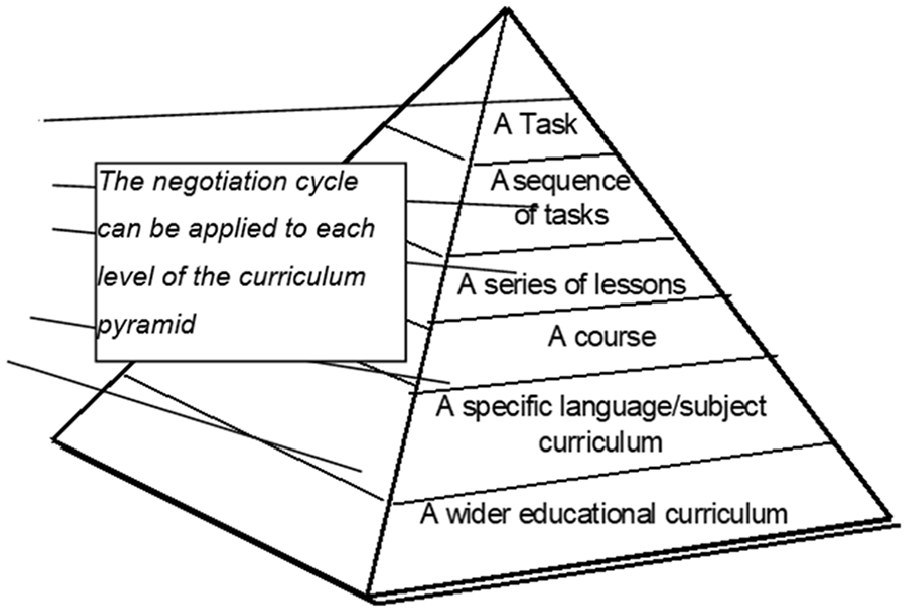
Negotiation levels across the curriculum.
At the top of the pyramid in Figure 2, we have the task, which is a description of activities designed for language learning or assessment. The next level of negotiation involves how those tasks can be sequenced. Below that, a series of lessons, and a course may involve. Next, there is the specific subject/language curriculum which relates to a broader level of planning. The deepest level of the pyramid, the wider educational curriculum, includes the links that connect the course to other educational subject areas and aims (Breen & Littlejohn, 2000b).
The process of negotiation comprises three steps (Breen & Littlejohn, 2000b). At step one, the teacher and students jointly make decisions (e.g., decisions about what tasks they will do or which topics they will focus on). At step two, those decisions are carried out and become the actual experience of the students. At step three, the outcomes of these experiences are evaluated. In case of reading comprehension skill, for example, learners can decide on the topic of the passage or even bring in their own passages of interest. Research has shown that when input selection is partially influenced by learners, positive results may accrue (Behjat, 1999; Schiefele, 1996).
A syllabus based on the contribution of the learners can have many advantages, such as developing more autonomous learners (Pakdaman et al., 2022b; Peyvandi et al., 2021), higher motivation (Abdelmalak, 2015; Pakdaman et al., 2022a), a sense of novelty in terms of materials used, more authentic tasks and materials, and incorporation of local culture, attitudes, and values. On the other hand, Budd and Wright (1992) contend that a curriculum which is a result of the collaborative effort of teachers, learners, and curriculum specialists encourages learners to learn about learning, to learn better, to increase their awareness about language, and about self, and therefore about learning.
In addition, Özturk (2013) notes several advantages of the negotiated syllabus for both the teacher and the learners. As for the teacher, they can control such procedures in their own class, such as pace of work, activities, and assessment and teachers will be aware of the needs and interests of their students. Advantages for learners include a sense of management of their own learning and assessment and higher levels of motivation (Abdelmalak, 2015).
Teachers and students may have different attitudes toward aspects of a syllabus that may be negotiated. In their study, Ghozali et al. (2021) explored the perspectives of Indonesian teachers and students in high school. The aspects of the syllabus which were identified were based on Boon (2011), including course content, lesson aims, sequencing, material, homework, evaluation, methodology, groupings, and error correction. The findings were mixed, though. The teachers believed that elements such as material, homework, evaluation, and error correction are not negotiable. The students believed that course content, lesson aims, sequencing, material, grouping, and error correction are responsibilities of the teachers and therefore, students should not have a role in those areas.
Despite the foregoing merits, there are some criticisms of the process syllabus (Long & Crookes, 1992) such as a lack of formal field evaluation, assuming a high level of competence in teachers and learners (Peyvandi et al., 2021), an implied redefinition of role relationships and a redistribution of power and authority in the classroom that would be too radical and/or culturally unacceptable in some societies, inadequate provision for relating the syllabus to the context in which it will occur (i.e., cultural barriers), emphasis on process and procedure rather than on outcome, possibly resulting in an aimless journey.
Challenges in the way of developing and carrying out a negotiated syllabus can be attributed to learners and teachers. Limiting learner factors may include (Azarnoosh & Kargozari, 2018) learner’s limited awareness of the possible activities, lack of training in negotiation, loss of sense of progress in absence of a book, too diverse needs/interests, among others. Limiting teacher factors may include (Azarnoosh & Kargozari, 2018) waste of valuable class time for negotiation, less workload on teacher, departure from school curriculum if every teacher designs their own syllabus, among others.
A plethora of studies has been conducted on the effectiveness of a negotiated syllabus in different elements of the syllabus, including Abbasian and Seyed-Hendi (2011), Baghbaderani and Afghari (2015), Kassem (2019), Nguyen (2011), Sardarianpour and Kolahi (2021), Seifoori (2020), Suwantarathip and Wichadee (2010), and Tuan (2011).
In an experimental design, Sadeqi and Sarvi (2013) investigated the effect of a negotiated syllabus on the speaking proficiency of intermediate EFL students and their self-efficacy scores. Participants took part in a 4-week study where they would meet three times a week for a duration of one-and-half hours. The researchers administered the relevant tests and questionnaires at the beginning and at the end of the program. The results of the study indicated that students in the experimental group scored statistically significantly higher than the control group both on the speaking scale and the self-efficacy questionnaire, implying the effectiveness of the negotiated syllabus.
In another study, Abbasian and Malardi (2013) studied the effect of negotiated syllabus on the writing proficiency of intermediate students. Elements of negotiation in this study included activities, assessment, contents, and methodology. The authors found that the mean score of students in the negotiated syllabus group was statistically higher than the that of the conventional group students.
Investigating the effect of a negotiated syllabus on the language learning anxiety and learning motivation of Iranian EFL students, Pakdaman et al. (2022a) found that learners in the negotiated syllabus group had significantly less anxiety and higher motivation for learning compared to the traditional syllabus group.
Shaker and Rahimi (2021) applied a negotiated syllabus in a writing course for upper-intermediate EFL students and compared the results with learners in a product-oriented course. The findings showed a statistically significant and higher mean score for the learners in the negotiated syllabus group.
Few studies have investigated the effect of a negotiated syllabus on reading achievement of EFL learners. In the present study, the effectiveness of the negotiated syllabus is explored on the reading proficiency of Iranian EFL learners.
Present Study
The present study aims to investigate if the implementation of a negotiated syllabus on the reading comprehension module of an English language teaching course in terms of negotiation over the areas of interest of learners as the basis on which passages would be selected has any effect on the reading achievement of Iranian intermediate-level English language learners.
The current study was conducted with the participation of 61 female intermediate-level English language learners in the context of EFL in an English language learning center in Tehran, Iran. The participants were placed into the experimental group (n = 32) and the control group (n = 29). The learners shared a homogenous English proficiency level and background (as well as in terms of teaching materials and instructor) as measured on a pretest. This study included one experimental group and one control group. The control group did not receive a similar treatment to that of experimental group. The classes were randomly assigned as experimental group and control group.
Instruments
For conducting the present study, the researcher utilized three sets of instruments for the fulfillment of research and pedagogical requirements, elaborated below.
To verify any effect as of the implementation of the treatment, a reliable and valid test of reading comprehension (with 22 multiple-choice items) was administered to the experimental group (EG) and the control group (CG) at the outset of the experiment. This same reading comprehension test was administered to the EG and CG at the end of the experiment (14 sessions, 5 weeks) in order to verify any indication of learners reading comprehension progress. The items and passages were re-ordered on the second administration to cancel out testing effect on learners (though the time interval was large enough to ensure the non-occurrence of testing effect).
A second instrument utilized in the implementation of this study was an Interest Areas Survey (IAS), which was developed by the author. The IAS was administered at the beginning of the course in order to elicit learners’ areas of interest on the basis of which passages of appropriate reading difficulty were collected and worked upon. The interest areas were graded on the basis of Likert scale (from value 1 as least interesting to value 5 as most interesting). Learners in the experimental group were asked to rate their interest in different topics for passages. The highest rated topics were then chosen and reading passages were selected based on those topics.
A third set of instrument utilized in this study was the passages selected on the basis of the elicited interest areas of learners in the EG attaining the highest rates and passages given to the CG whose topics were not surveyed.
Method
As stated above, the element of negotiation in this study was the interest areas of the EG learners. In order to find out the highest-ranking interest areas of the learners objectively, an Interest Areas Survey (IAS) was constructed and on the basis of the sum of scores, the higher-ranking interest areas were selected as learner-prioritized. Following the higher-ranking interest areas of the learners, appropriate texts were collected.
The reading difficulty level of the collected texts was ±2 standard deviations of the mean reading ease score of the course book passages obtained through Flesch Reading Ease procedure. On the basis of obtained reading scores, passages within range of 54.16 to 74.44 of reading ease were selected as teaching instruments in both groups. The passages taught in the control group, however, were arbitrarily selected by the teacher without the control of the learners as for the interest areas (i.e., there was no learner input on their interests).
Since the selected passages were authentic and were not developed for the teaching purposes, the researcher had to devise reading comprehension exercises. Five types of reading comprehension exercises were assigned to different passages: summarizing the passage, note taking, note making, discussion, and question making. Summarizing and question making were present in all passages and assigned to all learners, but the other reading exercises were assigned to passages of appropriate genre (e.g., fictional passages were assigned presentation, not discussion). These exercises were equally administered in both groups. Overall, 11 passages were selected and assigned to both the experimental and the control groups.
To find out whether this treatment would have any effect on the reading achievement of the learners, the learners in both groups were pre-tested with a valid reading comprehension test comprising 22 items. The same reading comprehension test was re-ordered (to cancel out testing effect) and re-administered at the end of the treatment period to EG and CG.
The research question posed in this study was as follows:
Does the implementation of a negotiated syllabus for the reading comprehension module of an English teaching course have any effect on the reading achievement of Iranian intermediate-level EFL learners?
For the above question, the following null hypothesis was assumed:
The implementation of a negotiated syllabus for the reading comprehension module of an English teaching course does not have any effect on the reading achievement of Iranian intermediate-level EFL learners.
Data Analysis and Interpretations
Table 1 compares the performance of the experimental and the control groups on the pretest using an independent-samples t-test. As can be seen, the observed t statistic is smaller than the t critical; therefore, it can be stated that the two groups were homogenous on the reading comprehension proficiency at the outset of the experiment.
Independent Samples t-Test Comparing EG and CG Mean Scores on Pre-Test.

Table 2 compares the performance of EG and CG on the re-administration of the reading comprehension test at the end of the research. As can be seen, the two groups performed equally well on the posttest and there was no statistically significant difference between the two groups.
Independent Samples t-Test Comparing EG and CG Mean Scores on Post-test.

Note. The results of the two-sample t-tests show that the treatment did not have a statistically significant effect on the reading achievement of the language learners.
Discussion
As stated above, the t value required to reject the assumed null hypothesis was not large enough to reject the mull hypothesis and therefore, the null hypothesis is supported. This warrants inquiry into the tentative causes of the support of the null hypothesis.
One possible explanation could be the effectiveness of the reading comprehension exercises which offset the interest areas variable in the experimental group. That is, the exercises made a balance in the two groups regardless of learners’ interest orientation. The exercises provided to the two groups were identical in type and the reading subskills they focused on and the duration of the course in 5 weeks (14 class meetings) provided enough practice for both groups to develop similarly in reading proficiency, hence obtaining statistically similar mean score on the post-treatment test.
One other possible explanation as for the support of the null hypothesis can be attribeted to the proficiency level of the participants. As has widely been mentioned in the bulk of research literature, negotiated syllabus is most effective in fairly advanced English courses or in ESP contexts. The participants in the current study were at the intermediate level of proficiency, however. Therefore, one may argue that the results of this study support previous findings that a negotiated syllabus is mostly appropriate in advanced levels of language proficiency or in ESP context. This could especially work in ESP contexts because the learners are well aware of the work domains and what language forms are used in those domains. In ESP contexts, the teacher can greatly benefit from the learners’ input in terms of appropriate materials needed.
In addition, as pointed out by Azarnoosh and Kargozari (2018), lack of awareness and training in negotiation over course contents may have also contributed to the results of the study. In this study, learners were randomly selected and their awareness, willingness, and experience in negotiation were not surveyed. Learners were selected from institutions where they had few chances to participate in the design of the syllabus. Therefore, the concept and act of negotiation for these learners were completely novel.
And finally, one could doubt the efficiency of a negotiated syllabus per se, with this caution in mind that the negotiated element in this study was the interest areas of the learners. Other approaches which take another element as for the negotiation might give a different result. In particular, the effectiveness of a negotiated syllabus in reading courses and in the context of general English learning may be questioned. However, additional research is needed to investigate the effectiveness of a negotiated syllabus in different contexts and controlling for other factors, such as prior experience in negotiation, willingness to negotiate, language proficiency level of the learners, the purpose of learning the language, among other factors.
Conclusion
In this study, the researcher attempted to apply an element of negotiation in the syllabus of a language course to investigate if the implementation of a negotiated syllabus would have any effect on the reading achievement of Iranian intermediate-level EFL learners. A null hypothesis was adopted assuming that the negotiated element in the syllabus (i.e., the reading interests of the learners) would have no statistically significant result. The theoretical basis for the present study was the negotiated syllabus model of syllabus design in the broader context of the process syllabus. However, this study assumes Clarke’s (1991) interpretation of the negotiated syllabus where he suggests a selective and procedural approach to the design of this type of syllabus framework. In the present study, the element of negotiation was the interests of intermediate-level language learners in the experimental group. A survey was conducted to poll the interest areas of the learners at the outset of the course. The highest-ranking interest topics were selected and reading passages were selected within those interest areas as the contents of the reading course. The reading difficulty of the passages was within ±2 standard deviations of the mean reading ease score of the course book passages obtained through Flesch Reading Ease procedure. Because the selected passages based on the reading areas of the learners were authentic texts, several types of reading comprehension exercises were developed for each passage, similar to the ones in the control group. Learners were instructed using the passages and practiced their comprehension using the devised exercises. Change in reading proficiency was checked at the end of the course using an independent-samples t-test. The statistical results showed that the gain difference between the two groups was not statistically significant.
Procedural negotiation means agreement over a significant variable. The stronger version of a negotiated approach to syllabus design has often been accused of radicalism and deviation in the research literature. In the strong version of the negotiated syllabus, the total pedagogical plans of the course are based on mutual negotiation between the practitioner and learners. Negotiation, however, is a relative term which can be applied in different compartments of a teaching program. However, as has rightly been alluded to, negotiation is best carried out in contexts where: (a) learners are fairy advanced and possess a sense of direction and (b) learners study for certain areas of specialty (i.e., ESP) and follow a content-wise direction. In the latter case, learners can be initiators of the negotiation process because they are better informed of their academic and professional needs. Therefore, it can be concluded that negotiation is relative in two facets: (1) along the continuum of involved elements (from parts to the whole) and (2) the proportion of negotiation as entitled to the practitioner and the learners (i.e., the extent to which parties can enforce their initiations).
As it has widely been assumed, in the process of syllabus or curriculum design the needs and interest areas of the learners are analyzed and taken into account. This study applied such a procedure. Nevertheless, it turned out that reading achievement in both groups was not statistically different between the experimental and the control groups. One may conclude that needs analysis is mostly useful in language for specific purposes, not general language education. In general language settings, learners usually do not have a specific use domain for their learning outcome, unlike the language for specific purposes. Therefore, in this study, the surveyed interest areas of the learners made little difference in terms of achievement, motivation, and focus of the learners.
Another resultant implication inferable is that negotiated syllabus may not be a proper model at intermediate level of language proficiency or in certain demographic contexts. The research literature strongly recommends the negotiated syllabus be implemented in fairy advanced courses or in courses where learners mostly focus on language for academic and professional purposes (i.e., ESP courses). In our study, the learners were at the intermediate level of language proficiency. Intermediate level language learners may not have enough experience in language learning or confidence in their purpose to engage in negotiation over the contents of the course. Therefore, as the literature in negotiated syllabus suggests, negotiation may work better in advanced levels of language proficiency.
Although the present study has been conducted with much rigor and attention to research design, there are several limitations that need to be considered. First, the participants in this study were all female and therefore not representative of the general population of the language learners. The generalizability of a study depends partly on how well the random sample represents the entire population to infer robust unbiased conclusion. Second, although the gap between the pretest and the posttest was wide enough to counter learning effect, administering different tests at the onset and end of the program would produce more robust results from the viewpoint of research design. Third, the interest areas in the survey were selected by the researcher with no open options to add additional interest areas. Although every effort was taken to include a wide spectrum of interest (topic) areas, there was still possibility for omission of interest areas endorsed by learners but not present in the interest areas survey developed and administered by the author.
To remedy the foregoing limitations, some recommendations can be made. Generalizability of the results can be improved if future studies include both male and female participants in a similar study and compare the results. In addition, repeated measurements can be adopted to measure any changes in the course of the experiment more accurately. Measurement can be conducted using different measures at the beginning and at the end of the program. In this study, the element of the negotiation was the interest areas of the participants. Future studies can incorporate other elements of the syllabus, such as item types and class activities used in the design of exercises, assessment types, skills integration (e.g., presenting audio contents related to the reading topic), and other elements of a syllabus that permit negotiation.
Footnotes
Declaration of Conflicting Interests
The author declared no potential conflicts of interest with respect to the research, authorship, and/or publication of this article.
Funding
The author received no financial support for the research, authorship, and/or publication of this article.
