




Abstract
Refractive error is a common social issue in every walks of human life, and its prevalence recorded the highest among Chinese population, particularly among people living in southern China, Hong Kong, Thailand, Singapore, and Malaysia. Refractive error is the simplest disorder to treat and supposed to cost the effective health care intervention. The present study included 168 Chinese school-going children aged 10 to 12 years; they were selected from different schools of urban Malaysia. It was surprising to see that 112 (66.7%) children had the early onset of refractive error; refractive error was also detected late among the primary school or secondary school students. The findings revealed that the determinants of refractive error among Chinese children were personal achievements and machine dependence. The possible reasons for the above significant factors emerged could be attributed to the inbuilt culture and traditions of Chinese parents who insist that their children should be hardworking and focus on school subjects so that their parents allow them to use luxury electronic devices.
Introduction
The World Health Organization has estimated that there are approximately 314 million people living with vision impairment. The geographical distribution of visual impairment is not uniform, and more than 90% people who are visually impaired are found in the developing and developed countries. The global initiative for the elimination of avoidable blindness (Vision 2020: The Right to Sight) has faced a major challenge that requires a significant increase in the provision and uptake of eye care services around the world (Lewallen & Kello, 2009). The shrinking economies of many countries in the world, especially some poor countries, have been severely over stretched with increasing pressure on health care budgets. Furthermore, the budget for eye health services has been pushed further down in the list of public health priorities competing with the demands of the life-threatening diseases (Kyndt, 2001). According to Thulasiraj, Aravind, and Pradhan (2003), the majority of people with refractive error may have their sight restored back through spectacles, but only a few of them have access to eye examinations because of cost constraints. A study on the prevalence of refractive error among school-going children in Malaysia found that more than half of those with refractive error needed corrective spectacles. There are basically four types of refractive errors with a need of spectacles. Three of them, namely, myopia, hyperopia, and astigmatism, affect children while presbyopia affects those who are above 40 years (Figure 1). Myopia occurs due to the excessive close use of the eyes and when people strain their eyes when looking at objects in the distance (Eulenberg, 1996). Myopia type of refractive errors generally appears at 8 to 14 years in the late primary school or the early secondary school. Furthermore, the progression of myopia may occur in the consecutive 10 to 15 years up to the age of about 30 years.
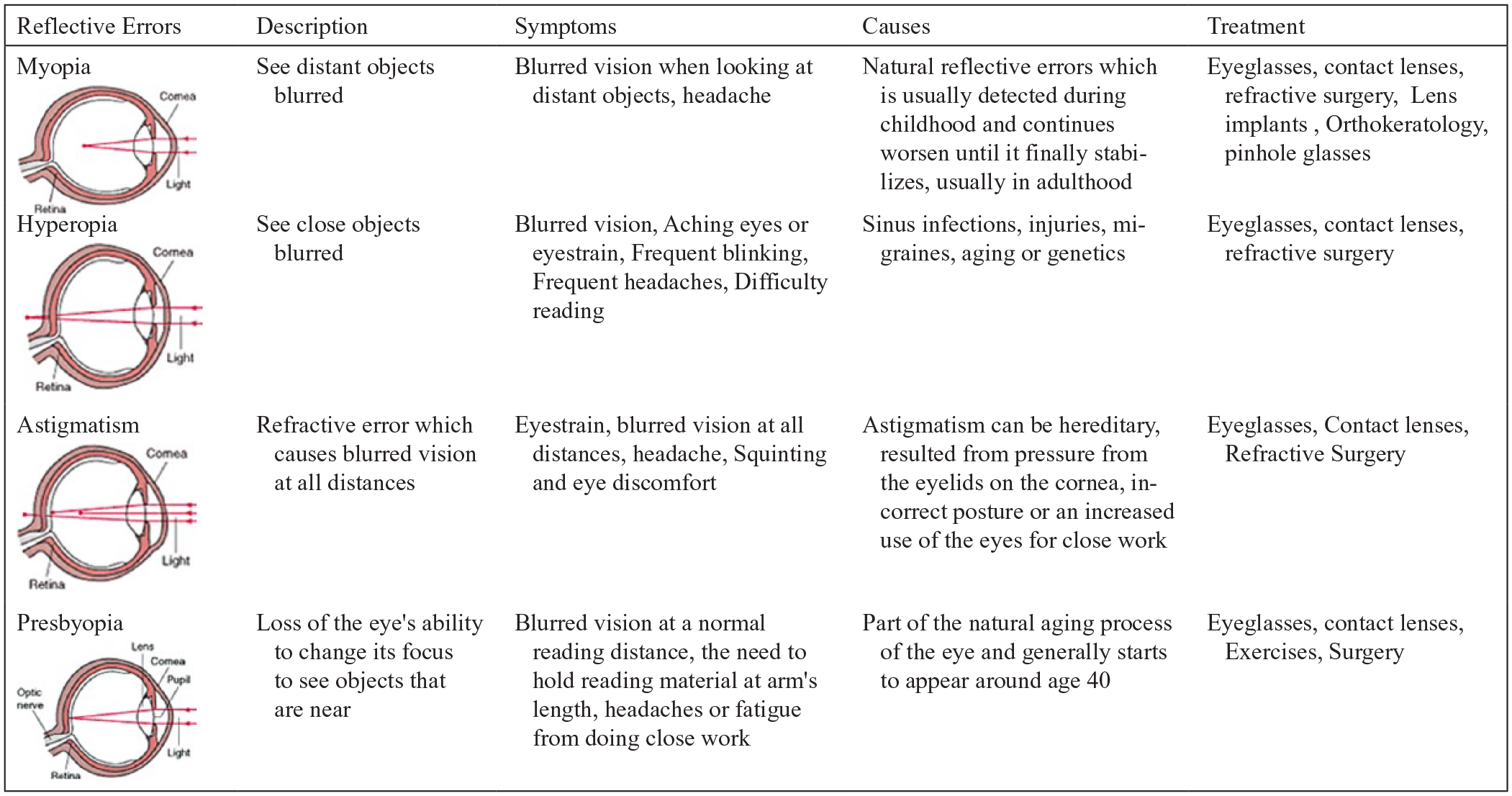
Types of refractive errors.
In recent decades, the prevalence of myopia has dramatically increased, particularly in some Asian countries (Morgan & Rose, 2005; Saw, 2003). Myopia has exceeded 80% in some highly educated groups (Loman et al., 2002). It is the most common type of refractive error among children in Malaysia (Goh, Abqariyah, Pokharel, & Ellwein, 2005). A study in Hong Kong showed that the prevalence of myopia was 82.8% among Chinese students aged 13 to 15 years (C. S. Lam, Goldschmidt, & Edwards, 2004). Compared with Indians, 68.7%, and Malays, 65.0%, Singapore has been reported to be one of the highest areas of myopia (79.3%; H. M. Wu et al., 2001). Schneider (2004) argued that the optical correction of myopia in the school has significantly affected the social activities of millions of children during their productive age group. Myopia in Malaysia is prevalent among 9.2% Malays, 30.9% Chinese, and 12.5% Indians. As the Chinese have the highest prevalence of refractive error among all races in Malaysia, it is crucial to identify the possible underlying factors that contribute to refractive error. Hence, the present study was conducted to identify the factors that cause refractive error among Chinese students in Malaysia and to determine whether age and gender mediate the relationship between these factors and refractive errors.
Risk Factors Related to the Refractive Error
The progression of myopia is thought to be controlled by the retinal image quality, but its triggering factors have not been yet well known (Lundstrom, Mira-Agudelo, & Artal, 2009). In a large number of studies, children with myopic parents are more likely to have myopia than those without myopic parents (Guggenheim, Kirov, & Hodson, 2000; Mutti et al., 2002; Mutti & Zadnik, 1995; Saw, Nieto, et al., 2001; M. M. Wu & Edwards, 1999; Young, 2009). The relationship between parents and children might reflect the shared environments as well as the shared genes with respect to refractive error.
In contrast to the limited evidence for the genetic determination of refractive error, there is considerable evidence of the importance of the environmental factors (Morgan & Rose, 2005). For example, urbanization has created a substantial change in children’s eating habits, including foods that are not fresh due to refrigeration, artificially grown foods, and canned and frozen foods. The genetic factors alone cannot be responsible for the high prevalence of refractive error. However, factors such as a visual experience, lifestyle, and diet may be the cause (Mutti, 2010). Concerning visual experience, Congdon et al. (2008) found that the fear of spectacles could be avoided with positive attitudes, practices, and self-confidence. Literature has revealed that eating habits could have some impact on children’s eye development. For example, Katz and Lambert (2011) reported that myopes were significantly eating less fresh fruits, vegetables, and whole grains in their daily diet. Besides, Edward (1996) also found that the children with myopia tended to have low food intake of protein, fat, cholesterol, vitamin B, vitamin C, phosphorus, and iron. Semba (2007) claimed that vitamin A deficiency caused the deterioration of the mucous-forming cells of the eyes, thereby resulting in conjunctiva necrosis; foamy gray spots which consist of the hardened epithelial cells; and the scarring and softening of the cornea which cause irreversible blindness. In another study, Eulenberg (1996) found that a diet with a high content of carbohydrates, starches or sugars, and low in proteins or fats favors the development of myopia.
Eating habits, which have been established during adolescence, may be difficult to change later. It is, therefore, necessary to create a healthy diet to prevent the development of refractive error or any other health problems during childhood. Saw, Wu, et al. (2001) commented that the hectic educational schedules such as close-up work activities in early childhood and tuition classes during the elementary school were positively related to myopia. Nowadays, busy parents send their children to attend many tuition classes hoping that their children may catch up their school lessons and achieve good results. These results underscore the strong influence of the environment on myopia pathogenesis. Hours of sleep are also related with myopia or myopia progression leading to a myopia risk factor among the young people (Loman et al., 2002). In an extensive study, Hartwig, Gowen, Charman, and Radhakrishnan (2011) found that there was no difference in mean head posture or reading distance between myopes and normals during reading tasks. In accord with the bulk of epidemiological evidence, Teasdale, Fuchs, and Goldschmidt (1988) commented that myopes in general, achieved higher intelligence test scores and higher educational levels than non-myopes. In addition, supporting the epidemiological evidence, Saw, Cheng, Fong, Tan, and Morgan (2007) found that those children with higher examination scores were 2.5 times more likely to have myopic complaints than the children with lower examination scores. According to Yingyong (2010), myopic children spend more time watching television and playing video and computer games. As computers have become an undeniable part of everyday life, more and more children are experiencing a variety of ocular symptoms, including eyestrain, tired eyes, irritation, redness, blurred vision, and double vision referred to as computer vision syndrome.
Model Conceptualization
Figure 2 shows the proposed framework for investigating the effects of eating habits, genetic traits, lifestyle, personal achievements, and machine dependence on reflective error among Chinese children in Malaysia.

Research framework.
Hypothesis Development
Katz and Lambert (2011), Edward (1996), Semba (2007), and Eulenberg (1996) argued that the absence of nutrition such as vitamins A, B, C, protein, and food such as fruits and vegetables could have an impact on visual disabilities and might cause refractive error among children. Accordingly, this study hypothesized as follows:
Young, Metlapally, and Shay (2007) and D. S. Lam et al. (2008) found that there was a positive relationship between parental myopia and probability of myopia development among children, thereby indicating a hereditary factor of refractive error. Accordingly, this study hypothesized as follows:
The different lifestyle factors such as sport activities, extra tuition classes, less hours of sleep, and too much of straining eyes may cause refractive error (Loman et al., 2002; Rose, Morgan, Ip, et al., 2008a; Saw, Wu, et al., 2001). Rose, Morgan, Smith, et al. (2008b) believed that the prevalence of myopia could be caused by reading books in close distance, watching TV in mid-working distance, and doing vigorous outdoor activities. Accordingly, this study hypothesized as follows:
Teasdale et al. (1988), Saw et al. (2007), and Eulenberg (1996) showed that achieving high intelligence test scores and high educational levels and reading more books per week significantly influenced refractive error. Accordingly, this study hypothesized as follows:
Computers and televisions have become important devices in daily life. Blehm, Vishnu, Khattak, Mitra, and Yee (2005); Saw, Wu, et al. (2001); and Yingyong (2010) reported that close-up work activities such as video and computer games have contributed much to refractive error. Accordingly, this study hypothesized as follows:
Research Method
Data Collection
As mentioned above, the early refractive error was prevalent among Chinese primary school children in Malaysia; it was also found in the late primary school or early secondary school. Accordingly, the present study was conducted among Chinese primary school children aged 10 to 12 years. They were selected from different Chinese primary schools in the urban areas of Malaysia. In Malaysia, children go to the primary school only at the completed age of 7 when they are mature enough to respond independently. This schooling time is consistent with the onset of refractive error which starts from 8 years onward. There might be some complaints of wearing spectacles during this time. Data were collected from Chinese primary school students with the permission given by school headmasters to distribute the questionnaires among the students. They were selected based on a proportional stratified sampling design.
The primary data were collected by administering the questionnaires personally to each student in the school while the secondary data were collected based on the existing medical reports in Chinese schools. The detailed questionnaires were administered to each student individually to find the determinants of the early refractive error among the school-going Chinese children in Malaysia. The schoolteachers and the school authorities strongly supported the conduction of the study. They also provided the existing secondary data concerning the visual impairment reports of the children. A total of 168 Chinese children attending the Classes 3 to 5 participated in the study.
The power of a 168-respondent sample was measured using G*Power Version 3.1.9.2 (Faul, Erdfelder, Buchner, & Lang, 2009). A power of 0.873 was obtained at the statistical significance level (α level) of .05. This yield exceeded 0.80, indicating that the power of the current sample was satisfactory (Chin, 2001). This result indicated that the proposed sample size was strong enough to reject the null hypotheses (Faul et al., 2009).
Measure of the Constructs
The questionnaire consisted of five independent variables, namely, eating habits (7 dimensions), genetic traits (2 dimensions), lifestyle (3 dimensions), personal achievements (2 dimensions), and machine dependence (5 dimensions), based on the cite references (see the appendix). The independent variables were measured based on a 5-point Likert-type scale ranging from 1 being strongly disagree to 5 being strongly agree. The dependent variable included two groups, namely, Chinese children with refractive error and those without refractive error. In the present study, refractive error included myopia and astigmatism.
Analysis
Multivariate analysis was used to study the impact of independent variables on the dependent variable. The binary logistic regression was also used for the categorical dependent variable (Hair, Black, Babin, & Anderson, 2010). Prior to testing hypotheses, the present research used factor analysis and reliability tests to determine the validity and reliability of the measures. The exploratory factor analysis was applied through Varimax rotation (Hair et al., 2010).
Significant Findings and Results
Descriptive Statistics
Out of 168 children, 30 (17.8%) were 10 years old, 69 (41.1%) were 11 years old, and the remaining 69 (41.1%) were 12 years old. About 77 (45.8%) were males and 91 (54.2%) were females (Table 1). The sample included 98 (58.4%) children with myopia, 14 (8.3%) children with astigmatism, and 56 (33.3%) children without any refractive error. However, no cases of hyperopia were reported in the sample. It is clear that the prevalence of refractive error was high among the primary Chinese school children. Refractive error was more among female children, 73.6% (67 / 91), than male children, 58.4% (45 / 77).
Profile of the Chinese Children.

Table 2 shows some interesting findings about Chinese children who were suffering from either myopia or astigmatism. Out of 98 children with myopia, 96 (98%) wore spectacles whereas 10 out of 14 (71%) children with astigmatism wore spectacles. As many as 84 out of 100 felt comfortable and reported that wearing spectacles did not affect their face appearance. However, children with astigmatism complained of headache even with spectacles (5 / 10). Also, children with astigmatism said that they could not perform any activities without spectacles, and they had never lost or broken spectacles compared with myopes.
Remarks From Chinese Children.
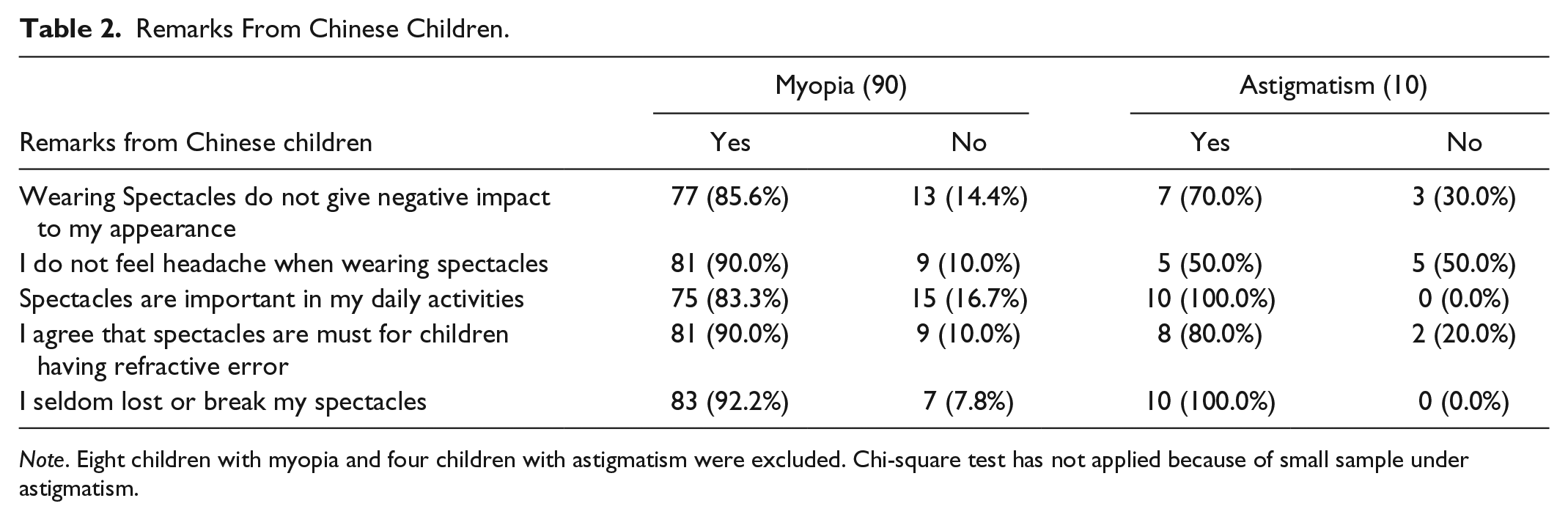
Note. Eight children with myopia and four children with astigmatism were excluded. Chi-square test has not applied because of small sample under astigmatism.
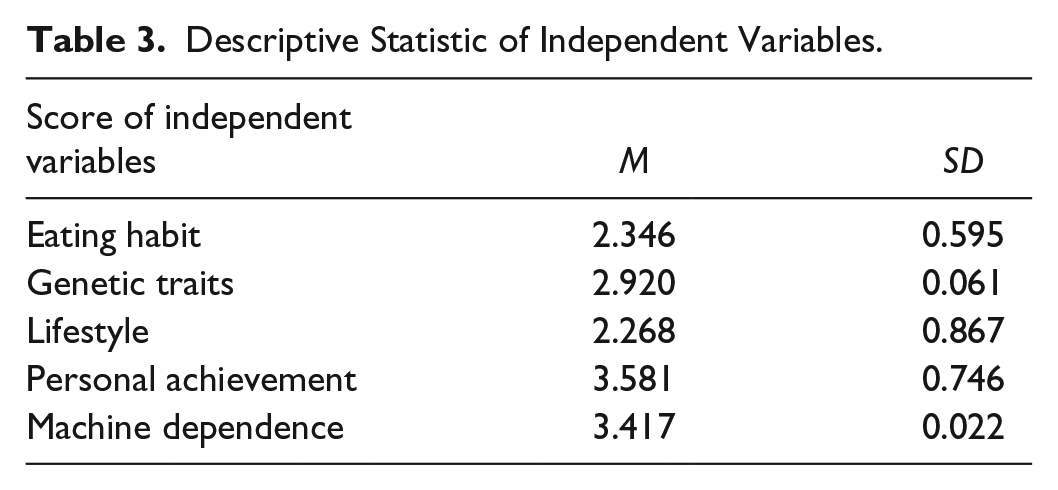
The descriptive statistics were calculated for mean and standard deviation among the 168 Chinese primary school children with respect to each independent variable, including eating habits, genetic traits, lifestyle, personal achievements, and machine dependence. Table 3 shows that students disagreed that they had unhealthy eating habits (M = 2.346). The mean of genetic traits (M = 2.920) shows that approximately half of the students’ family members had refractive error. In addition, the students also disagreed that they lived unhealthy lifestyle (M = 2.268). Furthermore, the mean of personal achievements indicates that students averagely had good personal achievements in their academic life (M = 3.581). Finally, the mean of machine dependence (M = 3.417) shows that the students were spending much time using electronic devices in their daily activities, thus, leading to high machine dependence.
Descriptive Statistic of Independent Variables.
Factor Analysis
Regarding the questions addressing the five independent variables, factor analysis was used to find whether the subjective measurements in the Likert-type scale and their respective variables converged. The main loadings of factor analysis were above 0.5 for 19 dimensions, which were used for further data analysis. The reliability analysis determined whether the measurements of the five variables were consistent. Estimates of construct reliability were measured for each construct. Cronbach’s alpha values were all greater than .5 ranging from .625 to .793, indicating the consistency of the data.
Binary Logistic Analysis
The dependent variable is dichotomous, namely, the children with refractive error (1) and the children without refractive error (2). In the model, all independent variables influenced refractive error with Nagelkerke’s R2 of .225, p < .05, and the overall probability of correct classification was .702 (Table 4).
Result of Binary Logistic Regression.
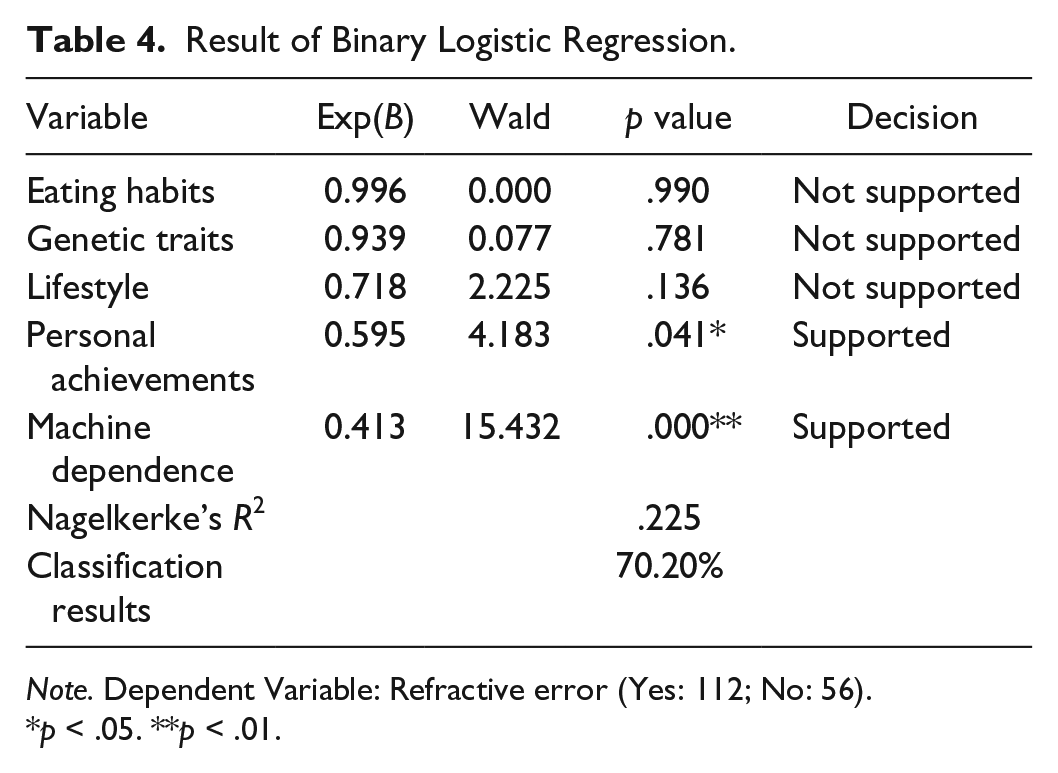
Note. Dependent Variable: Refractive error (Yes: 112; No: 56).
p < .05. **p < .01.
It is interesting to see that personal achievements and machine dependence were found to be statistically significant at 5% level. Therefore, H4 and H5 were supported. Accordingly, it could be claimed that positive relationship between personal achievements and the prevalence of refractive error exists (H4). It should be noted that the concept of personal achievements is viewed in terms of children’s good class grade due to their hardworking quality and high intelligence. Similarly, the variable machine dependence was found to have a positive relationship with the prevalence of refractive error (H5). Nowadays, the technology of the information communication and the features of television are so high-tech and appealing that children spend most of their time using electronic devices for doing their homework, surfing the Internet for information, and playing video or computer games during leisure time. It seems that parents should monitor their children periodically and should not allow them to use electronic devices excessively.
Conclusion
The prevalence of refractive error among Malaysian citizens, particularly Chinese race, is alarming. Chinese children are suffering from refractive error, in particular myopia. The primary data were collected by administering the questionnaires personally to each student in the school while the secondary data were collected based on the existing medical reports in Chinese schools. A total of 168 Chinese children attending the Classes 3 to 5 participated in the study. The early onset of refractive error was among Chinese children in Malaysia; however, it was detected late among the primary school or early secondary school students. Concerning the three types of refractive errors (myopia, hyperopia, astigmatism) prevalent among children, myopia was found to be the most common type of refractive error among Chinese children followed by astigmatism; however, no case with hyperopia was found in the sample. Binary logistic regression was used to measure the impact of the independent variables on the dependent variable. Considering the five independent variables (eating habits, genetic traits, lifestyle, personal achievements, and machine dependence) in the management model, two variables, namely, personal achievements and machine dependence, influenced refractive error and were found to be statistically significant. Because the Chinese are hardworking and workaholic, passing down the same culture to their children results in hectic activities. This could be the reason why Chinese children strain their eyes more than their counterpart races in Malaysia (Malays and Indians). Chinese children generally have a greater focus and a better concentration level than other children. The personal achievements of Chinese children are clearly evident from school records. According to these records, Chinese children are intelligent and get a good class grade due to their hardworking quality. Playing video games, watching TV, and participating more in activities put a strain on Chinese children’s eyes. Therefore, it was not surprising to find machine dependence a significant factor in the development of refractive error. This may be avoided if parents monitor their children periodically and keep them away from the excessive use of electronic devices. Considering the role of gender, male children are more dependent on the machine-oriented activities than female children. Concerning eating habits, because the Chinese are well adapted to a variety of foods, eating habits were not found to be a significant factor in the development of refractive error. The factor genetic traits did not influence refractive error.
Footnotes
Appendix
Declaration of Conflicting Interests
The author(s) declared no potential conflicts of interest with respect to the research, authorship, and/or publication of this article.
Funding
The author(s) received no financial support for the research and/or authorship of this article.