




Abstract
This article aims to examine the relationship between selected behavioral factors and Global Positioning System (GPS) usage among small-scale fishers in Malaysia. An adapted version of the Unified Theory of Acceptance and Use of Technology (UTAUT) was tested among a sample of 400 small-scale fishers to examine the relationship between technology-related behavioral constructs (compatibility, social influence, effort expectancy, learning culture, and performance expectancy) and GPS usage. The sample was selected from 12 fishery districts in Malaysia. Confirmatory factor analysis (CFA) confirmed that all five technology-related behavioral constructs included in the model recorded a significant relationship with GPS usage. The results extend the generalizability of the UTAUT to a previously understudied setting of community technology usage. Understanding GPS usage among small-scale fishers from the extended UTAUT perspective can provide policy makers, public, nongovernmental organizations (NGOs), and other concerned parties with knowledge that can build awareness and shape capacity building efforts for small-scale interventions to increase the use of GPS. This will, in turn, reduce the risks associated with fishing routines and enhance fishing yields.
Keywords
Introduction
Small-scale fishers (SSF) in many countries are reporting multiple threats to their collective livelihood (Food and Agriculture Organization of the United Nations [FAO], 2015; Shaffril et al., 2013, 2015). Drawing on the FAO (2015), poverty is not the only threat to fisher’s livelihoods. Most SSF are located in remote areas where they have narrow access to markets, health, and social services. A considerable portion of SSF also have low levels of education, above-average rates of health problems, and inadequate organizational structures. Moreover, the FAO (2015) accentuated the lack of opportunities available for SSF involvement in alternative livelihoods, youth unemployment, unhealthy and unsafe working conditions, forced labor, and child labor, while having to face the negative impact of pollution, climate change, and natural disasters. These threats further burden SSF who already face challenges in making their voices heard, defending their human and tenure rights, and sustaining limited resources. To address some of these threats, different forms of technology such as Global Positioning System (GPS) have been embraced to enhance fishing yields and buffer the impact of changing weather and climate patterns. Nevertheless, despite its proven effectiveness at helping SSF increase their yields (Bolong et al., 2013; Omar et al., 2012), few studies exist to explain the factors that facilitate GPS usage by SSF.
Understanding the factors behind individual acceptance and use of information technology in general continues to be of great concern to researchers studying technology usage. Given the ubiquitous nature of technology adoption among different groups, researchers continue to study who uses different technologies and why. Toward this end, a number of theoretical models have been developed, rooted primarily in psychology and sociology, attempting to elucidate technology usage among different occupational groups (V. Venkatesh et al., 2003). Among these different theories is the Unified Theory of Acceptance and Use of Technology (UTAUT; V. Venkatesh et al., 2003). For several years now, UTAUT has served as a foundational model for a large number of studies on technology usage, particularly those related to the application of technology in community settings. To meet this need, scholars across the globe have attempted to modify or replicate the entire UTAUT model, or part of it, with the aim of extending the model’s generalizability to diverse groups (Cohen et al., 2013; V. Venkatesh et al., 2003; V. Venkatesh et al., 2012; C. S. Yu, 2012). Their efforts are based on three broad types of UTAUT extensions/integrations. First, researchers have attempted to test the suitability of UTAUT in different community contexts, with different user populations and varied cultural settings such as employees, consumers, travelers, bankers, students, rural communities, and health professionals (Cohen et al., 2013; Muraina et al., 2013; V. Venkatesh et al., 2012; C. S. Yu, 2012). Second, new endogenous variables such as mobile phone usage, digital library usage, and mobile-internet usage have been introduced into the model to expand the scope of its endogenous theoretical mechanisms (V. Venkatesh et al., 2012). And third, new exogenous predictors have been added to the UTAUT model, including habit, visibility, hedonic motivation, and price value (Chan et al., 2008; Y. Sun et al., 2009; V. Venkatesh et al., 2012).
Despite these efforts, reviews of the relevant literature have concluded that UTAUT has been most frequently used in professional, consumer, and education settings (Cohen et al., 2013; V. Venkatesh et al., 2003; V. Venkatesh et al., 2012; C. S. Yu, 2012), leaving a substantial gap on the suitability of UTAUT to explain usage among other types of communities such as agricultural groups like SSF. Furthermore, most prior studies have concentrated on the use of common technologies such as internet and personal computers (Cohen et al., 2013; Kahenya et al., 2014; Muraina et al., 2013; C. S. Yu, 2012), but few attempts have been made to apply the UTAUT framework to more specialized technologies such as GPS.
Against this backdrop, a modified version of the UTAUT model (refer to Figure 1) was developed to understand GPS usage among SSF in Malaysia—a previously understudied population. Without neglecting the importance of voluntary usage and behavioral intention as mediators, and gender, age, and experience as moderators in the UTAUT model, the current study focuses on the direct relationship between technology-related behavioral constructs (i.e., compatibility, social influence, effort expectancy, learning culture, and performance expectancy) and technology usage. To suit the SSF context, we also included learning culture and compatibility as additional technology-related behavioral constructs, while excluding facilitating conditions from the original UTAUT model. Drawing on the revised UTAUT model, we set out to examine the relationship between the behavioral factors of the model (compatibility, social influence, effort expectancy, learning culture, and performance expectancy) and GPS usage among SSF.

The modified version of UTAUT model.
Theorizing GPS Usage Among SSF—The UTAUT
To date, several technology-usage models have been developed (i.e., Technology Acceptance Model [TAM], Technology Acceptance Model 2 [TAM2], Extended Technology Acceptance Model [ETAM], and Diffusion of Innovation [DOI]) to explain community technology usage from a behavioral perspective. TAM, TAM2, and ETAM attempt to explain the relationship between several behavioral factors related to technology usage, while the DOI tries to explain how, why, and at what rate new ideas and technologies spread throughout cultures. Critics of these models, however, have pointed to their questionable heuristic value, limited explanatory and predictive power, triviality, and lack of practical value (Bagozzi, 2007; Chuttur, 2009). This has led scholars to extend the above work to come up with additional ways at theorizing technology usage. Among these efforts is the UTAUT (V. Venkatesh et al., 2003). UTAUT is a combination of eight previous models (theory of reasoned action, TAM, motivational model, theory of planned behavior, a combined theory of planned behavior/TAM, model of personal computer use, DOI theory, and social cognitive theory) that looks at the association of several technology-related behavioral constructs, including social influence, effort expectancy, performance expectancy, and facilitating conditions, on technology usage. The UTAUT model has demonstrated its strengths as a technology-usage explanatory tool. According to V. Venkatesh et al. (2012), the UTAUT model has the ability to explain about 50% of the variance in technology use. The UTAUT model has thus become a baseline model, having been applied to the study of a variety of technologies such as internet, computers, and mobile phones in both organizational and nonorganizational settings, including schools, banks, government agencies, and rural communities (Muraina et al., 2013; Tan, 2013; C. S. Yu, 2012).
Behavioral Predictors of Technology Usage
Social influence has been acknowledged as a prominent technology-related behavioral construct predicting usage (Kim et al., 2009; ten Kate et al., 2010; Tucker, 2011; V. Venkatesh et al., 2003). Social influence refers to how an individual perceives others’ beliefs that the individual should embrace a new technology (V. Venkatesh et al., 2003). It can be seen that social factors such as norms, roles, and values at the societal level can influence an individual (Kim et al., 2009). In other words, an individual is inclined to embrace technology when he or she is surrounded by those who also use technology.
Performance expectancy has also been consistently shown to be a strong predictor of technology usage (V. Venkatesh et al., 2003; V. Venkatesh et al., 2012). Performance expectancy refers to the belief that using technology will produce an added benefit to job performance (V. Venkatesh et al., 2003). V. Venkatesh et al. (2012) stated that the extent of benefits produced by technology will influence how much the individual uses the technology—The more the perceived benefit, the more the individual will use the technology.
In previous studies on technology usage, effort expectancy has been found to be an influential predictor of usage (Ramli et al., 2013; H. Sun & Zhang, 2006; V. Venkatesh et al., 2003). Effort expectancy refers to the belief that a technology is user-friendly (Davis, 1989; V. Venkatesh et al., 2003). Effort expectancy is of particular concern to older populations who might be less familiar with technology. Such individuals often seek technologies that are easy to learn and use, especially given their preferences for more traditional ways of working and fear of the unknown regarding the utilization of technology (H. Sun & Zhang, 2006).
For Malaysian SSF, we believe the learning culture of rural fishing communities can contribute to technology usage through information and experience-sharing. Shaffril et al. (2013) found that technology usage, mostly in the form of traditional technologies, has historically been a staple of SSF culture in Malaysian fishing communities. In a previous study by Palis (2006) found a significant relationship between learning culture and technology usage. We would expect this relationship to be significant among SSF in Malaysia as well due to several reasons. First, the fisher’s belief that the success of other SSF after embracing technology is building up parts of their learning culture. Second, fisher’s long practiced culture of gathering at waqfs (small shelter located at the coastal areas) and coffee stalls and involvement in social activities such as gotong-royong and merewang (mutual cooperation in community-related activities) can influence their decision to use technology through extensive social interaction and experience-sharing (Abu Samah et al., 2019; Hassan et al., 2011).
According to Rogers (2003) and Karahanna et al. (2006), technology is compatible when it is in line with a user’s interest, needs and abilities, work practices, work style, lifestyle, and existing values. Frequent use of current, age-friendly communication technologies strengthens technology compatibility (Li et al., 2019). Compatibility has consistently shown to have a significant association with technology usage among community groups such as teachers, consumers, rural communities, and students (Cheng, 2015; D’Silva et al., 2010; P. J. Hu et al., 2003; Karahanna et al., 2006; Rogers, 2003).
Study Context: SSF and GPS Usage in Malaysia
Although the official number of SSF in Malaysia is disputed, previous studies by Shaffril et al. (2013), Osman et al. (2014), Ramli et al. (2013), and Omar et al. (2012) have confirmed that SSF constitute at least 65% of the overall number of registered fishers in the country. Although some SSF fish commercially, a large majority work at a subsistence level where profits are just enough to support their fishing operations and basic personal and family expenses (Omar et al., 2012; Osman et al., 2014; Ramli et al., 2013; Shaffril et al., 2013). A majority of SSF are males, 40 years old and above, have more than 15 years’ experience, earn below RM1,000 a month (roughly equal to US$250 a month), and spend between 15 and 20 days a month at sea (Bolong et al., 2014; Omar et al., 2012; Ramli et al., 2013; Shaffril et al., 2015). The majority of SSF use small fiber boats (boat made from fiber) or “sampan” (traditional wooden boats usually 22 feet long or smaller); use a lower boat engine capacity (40 horsepower or lower); rely on seines, fishing rods, portable traps, or rawai (local catching tool) as their main catching tools; conduct daily fishing trips (between 4 and 8 hr per day); and operate less than five nautical miles from shore. As registered fishers, SSF receive a monthly allowance of RM300 (approximately US$70) and are given a 65-cent fuel subsidy by the federal government (Bolong et al., 2014; Omar et al., 2012; Ramli et al., 2013; Shaffril et al., 2015).
Similar to other agricultural groups, SSF currently face two major threats to their socioeconomic well-being: stagnating incomes in the face of increasing costs of living and climate change (Shaffril et al., 2013). In response, the Malaysian government, via agencies such as the Department of Fisheries Malaysia (DOF) and Fisheries Development Authority of Malaysia (LKIM), have launched several initiatives to help SSF address these challenges, including a campaign to encourage SSF to use GPS in their fishing operations. GPS is widely used by fishers to effectively navigate to marked fishing locations, resulting in reduced duration of fishing time, increased income as a result of minimized fuel consumption and reduced frequency of fishing trips, and enhanced security and safety (Bolong et al., 2013; Osman et al., 2014).
The Current Study
We aimed to address three specific concerns in the study, namely, the need to better understand contributors to technology usage among Malaysian SSF, the need to better understand the usage of specific technologies such as GPS, and the need for a systematic investigation to determine salient factors that fit the context of GPS usage among SSF. To do so, we applied an adapted version of the UTAUT to study SSF who use GPS in their fishing operations. The focus of our analysis was on the direct relationships between three of the original technology-related behavioral constructs in the UTAUT model, namely, effort expectancy, performance expectancy, and social influence, and two additional behavioral constructs, compatibility and learning culture, with GPS usage.
We chose to exclude facilitating conditions from the analysis due to its lack of relevance to SSF in Malaysia. In a study by V. Venkatesh et al. (2003), the authors stressed that the inclusion of facilitating conditions as a construct in technology-usage research needs to be supported by the availability of factors such as consistent trainings and other related supports that involve no costs and are fairly invariant across users. However, within the scope of the Malaysian fishing industry, such conditions are either nonexistent or highly variant by type of GPS used, strength of satellite signal received, availability of workshops to repair broken GPS, training and courses, and the availability of officers and agencies to assist SSF (Osman et al., 2014). Based on this, we chose to exclude facilitating conditions from the analysis.
Compatibility is an important variable recurrent in technology studies but missing from the UTAUT (Karahanna et al., 2006; Rogers, 2003). Compatibility measures the extent of congruence between a given technology and various aspects of the individual and the situation where the technology is used. We also added learning culture to our adapted UTAUT model. People’s learning cultures are constructed by their beliefs, symbols, and values, which define actions within a culture. These actions include learning, which is influenced by situations and cultural doings (Palis, 2006). To date, however, no studies have looked at the role of compatibility and learning culture in predicting GPS usage among SSF.
Although the original UTAUT model includes three moderating variables—gender, age, and experience—and two mediating variables—voluntariness and behavioral intention, the current study focuses on the direct relationships between the technology-related behavioral constructs and GPS usage. These direct relationships have been supported by several studies depicting stronger overall model performance without the inclusion of the mediating or moderating factors (Bagozzi, 2007; Ramli et al., 2013). Furthermore, this approach provides a more direct explanation of the relationship between the technology-related behavioral constructs and technology usage. Understanding the most salient technology-related behavioral constructs among SSF users can help identify the significant constructs relating to GPS usage.
Method
Participants
The respondents for the study were SSF from four selected fishery districts in Malaysia. Prior to their selection, the SSF had to meet several criteria in line with the official definition of SSF in Malaysia. These included use of small fiber vessel (or sampan) for their fishing operation (24 feet in length or less), use of a lower engine capacity (40 horsepower and below), conducting of fishing operations for 3 to 10 hr per trip, and using nets, fishing rods, portable traps, or rawai (local call for horizontal bottom longline) as their main catching tools.
The mean age of the respondents was 43 years old and all of them were male. Most of the respondents possessed a low level of formal education with only 4.1% having completed a tertiary degree. The mean household income was RM1,231.60 (roughly equivalent to US$295.35) with 22.2% of them earning less than RM1,501 per month; 74.6% of the respondents had more than four household members.
The mean number of years of fishing experience was 18.8 years, with 32.5% having more than 21 years’ experience. The mean number of years using GPS was 5.1 years with 29.8% having used it for at least 6 years. Among our sample, the mean number of days fishing per month was 19. Most of the respondents used fiber boats (86.8%) as compared with sampan (13.3%). Furthermore, 36% of the respondents spent between 8 and 10 hr per day for their fishing operation and most targeted fish as their main catch (87.0%) while 9.0% targeted prawn and another 4.0% targeted other species such as crabs, cuttlefish, and cockles. The respondents relied on seines as their main catching tool (55.3%), while some relied on portable traps (4.8%), fishing rods (22.3%), and nets (2.0%). The mean weight of total catch per week was 148.9 kilos with 19.8% able to catch 200 kilos or more; 74.0% of the respondents learned GPS from other fishers. In addition to having limited access, this might explain why most of the sample (94.2%) did not attend technology courses offered by the relevant agencies.
Procedures
The total population of SSF who used GPS in their fishing operation was 27,963 (Omar et al., 2012; Osman et al., 2014). Drawing on Raosoft’s online calculator, the minimum sample size to represent the study population was 379. A multistage cluster approach was used as the main sampling strategy for the study. The sampling process involved four stages of random selection. At the first stage, all five zones in Malaysia were listed, namely, East Malaysia, Southern zone, Northern zone, East Coast zone, and Central zone, and four were randomly chosen. As a result, the Southern zone, Northern zone, East Coast zone, and Central zone were selected. In the second stage, all the states from the selected zones were listed, namely, Negeri Sembilan, Malacca, Johor (southern zone), Perlis, Kedah, P. Pinang (northern zone), Pahang, Terengganu, Kelantan (east coast zone), and Selangor and Perak (Central zone). At this stage, all of the mentioned states (each listed on a piece of paper) were put into four different bowls that represented each of the selected zones and one piece of paper was randomly selected from each bowl. From this process, a total of four states were selected, namely, Terengganu (East Coast zone), Johor (Southern zone), P. Pinang (Northern zone), and Perak (Central zone). In the third stage, the same process was repeated with the fishery districts. As a result, 12 districts were selected (3 districts × 4 states; please refer to Table 1 and Figure 2). At the final stage, based on the list of the fishers, a computer-aided random selection was performed to randomly select 100 fishers as study respondents.
Selected States, Fishery Districts, and Number of Respondents.

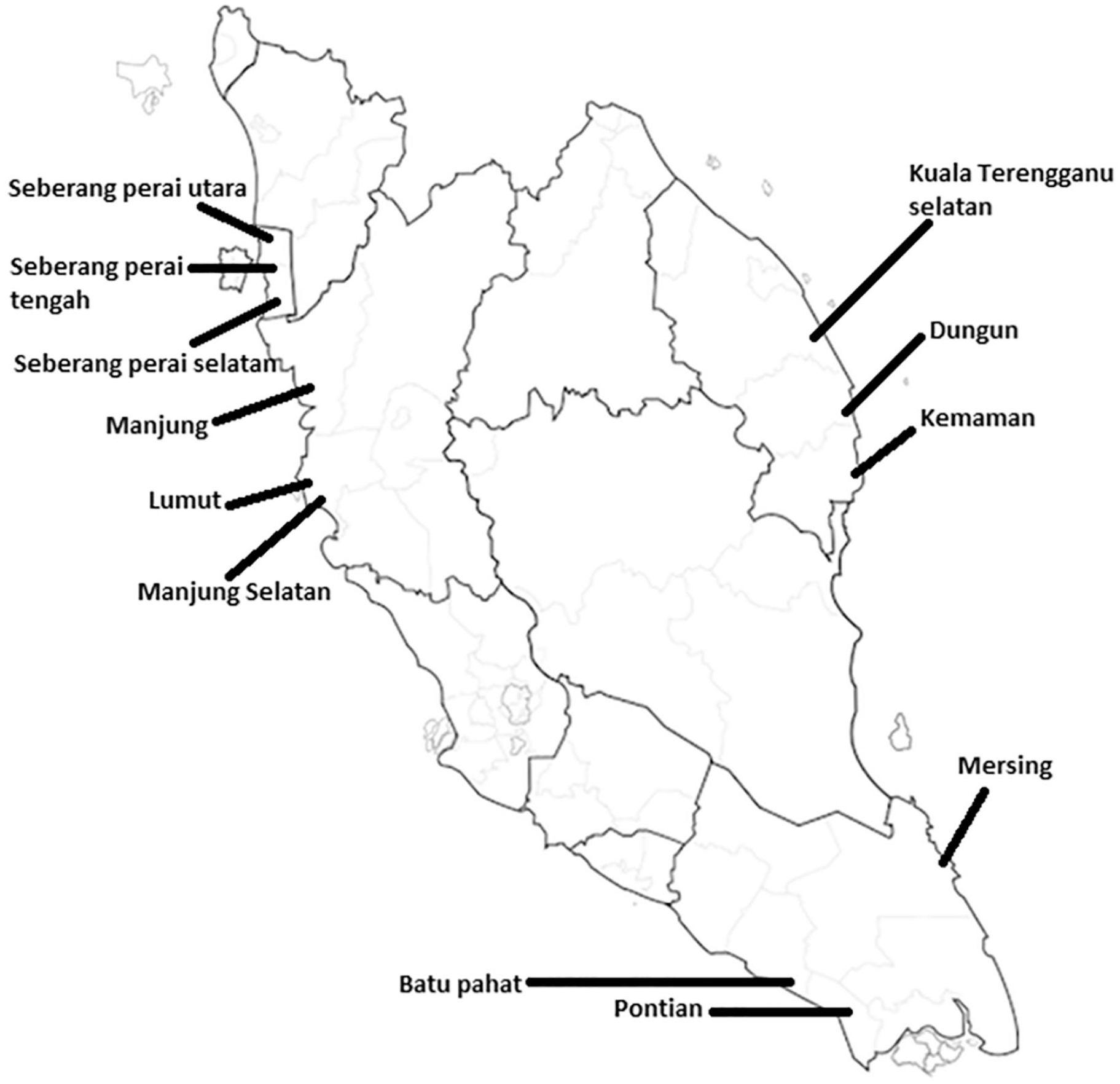
Areas of study.
Prior to full data collection, the research team established connections with village leaders, jetty leaders, and relevant officers to gain permission to enter SSF places of interests to collect the data (e.g., waqfs [small shelter usually located at the coastal villages] and coffee stalls). Experienced enumerators were hired and trained to assist with the data collection process. Survey questionnaires were used to collect the data. For each of the respondents, the enumerators took between 20 and 25 min to read the questions in Malay to the respondents and then provide them with the response options.
Measures
The survey questionnaire consisted of 63 items broken down into three sections, including a demographic profile, GPS usage, and the five technology-related behavioral constructs (refer to Table 2). The items included in the questionnaire reflected the operational definition of each variable; however, where applicable, items from existing studies that indirectly fit the operational definition of each variable and were consistent with the objectives of the study were also considered. After the questionnaire was developed, a number of meetings with research team members were conducted to further strengthen the wording of the items.
Study Measures.

The questionnaire was pretested with 30 SSF from Kuala Pahang. The findings indicated low Cronbach’s alpha values on three variables (learning culture, social influence, and GPS usage), which all failed to exceed the recommended value of .70 (Nunnally, 1978). To further strengthen the reliability of these three variables, items were rephrased and reworded that were not clear or difficult to understand based on feedback from enumerators. The modified questionnaire was then presented to two experts on technology usage, who helped to improve the content of the measures.
Data Analytic Strategy
The collected data were analyzed using SPSS and AMOS. Using SPSS, descriptive statistics such as frequency, percentage, mean score, and standard deviation were first carried out.
AMOS was used to ensure the reliability and validity of the survey instrument whereby confirmatory factor analysis (CFA) was first performed examining model fit, convergent validity, and construct reliability. The model fit test was used to determine fit indices and individual factor loadings. CFA was performed rather than exploratory factor analysis (EFA) as CFA offers more parsimonious solutions and greater modeling flexibility than EFA (Suhr, 2006).
Following CFA, the measurement model was established. The measurement model included all latent constructs without assignment as exogenous and endogenous factors. The model was run to test for model fit, discriminant validity, assumption of normality, and test for outlier in the dataset. To examine the model fit we used the following parameters as criteria: relative chi-square (χ2/df) less than 5.0 (Bentler, 1990; Marsh & Hocevar, 1985), absolute fit measure; goodness-of-fit index (GFI) greater than .900, adjusted goodness-of-fit index (AGFI) greater than .900, root mean square error of approximation (RMSEA) less than .08, and incremental fit measure indices such as comparative fit index (CFI), normed fit index (NFI), Tucker–Lewis index (TLI), and incremental fit index (IFI) exceeding .900. After establishing the model fit, the r value was computed to determine the relationship between the behavioral factors and GPS usage.
Results
Below, we present the CFA results for each measure included in the model, followed by results from the measurement model analysis.
CFA: Compatibility
Following CFA for compatibility, four out of the original seven items were removed. Coefficient values for the remaining items ranged from .592 to .937. These items fit the CFA model of compatibility with χ2(2) = 0.124; p = .940; χ2/df = 0.62; GFI = 1.000; AGFI = .999; CFI = 1.000; TLI = .998; RMSEA = .058. The analysis confirmed the values of .590 for average variance extracted (AVE) and .806 for construct reliability signaling that both values achieved the minimum requirement of .500 and .700, respectively (Table 3).
Factor Loading, AVE, and CR of the Technology-Related Behavioral Constructs and GPS.

Note. AVE = average variance extracted; CR = construct reliability; GPS = Global Positioning System; CFA = confirmatory factor analysis.
CFA: Social Influence
Following CFA for social influence, three out of the original seven items were removed. Coefficient values for the remaining items ranged from .529 to .982. These items fit the CFA model of social influence with χ2(2) = 6.604; p = .037; χ2/df = 3.302; GFI = .992; AGFI = .960; CFI = .996; TLI = 0.989; RMSEA = .076. The analysis resulted in values of .623 for AVE and .863 for construct reliability (Table 3).
CFA: Effort Expectancy
Out of seven items included, only five items were maintained. The remaining items produced the coefficient values ranged from .537 to .956. These items fit the CFA model of effort expectancy with χ2(2) = 16.093; p = .003; χ2/df = 4.023; GFI = .984; AGFI = .941; CFI = .992; TLI = 0.979; RMSEA = .087. Resulting AVE and construct reliability values were .611 for AVE and .882 for construct reliability, respectively (Table 3).
CFA: Learning Culture
Following CFA for learning culture, two out of the original eight items were removed. Coefficient values for the remaining items ranged from .538 to .891. These items fit the CFA model of learning culture with χ2(2) = 14.493; p = .044; χ2/df = 2.063; GFI = .988; AGFI = .965; CFI = .995; TLI = 0.990; RMSEA = .052. Resulting AVE and construct reliability values were .501 for AVE and .853 for construct reliability, respectively (Table 3).
CFA: Performance Expectancy
Out of nine items included, only four were retained after running the CFA. The remaining items’ coefficient values ranged from .634 to .852. These items fit the CFA model of performance expectancy with χ2(2) = 0.403; p = .525; χ2/df = 0.403; GFI = .999; AGFI = .995; CFI = .1.000; TLI = .998; RMSEA = .000. Although the RMSEA value was low (.000), according to L. T. Hu and Bentler (1999), an RMSEA value of .000 is considered within the close fit range (.000–.500). The results further showed AVE and construct reliability values of .583 and .847, respectively (Table 3).
CFA: GPS Usage
Following CFA for GPS usage, five out of the original eight items were removed. Coefficient values for the remaining items ranged from .563 to .914. These items fit the CFA model of GPS usage with χ2(2) = 54.967; p = .000; χ2/df = 4.997; GFI = .961; AGFI = .899; CFI = .984; TLI = 0.970; RMSEA = .100. The resulted value for these indices managed to pass the minimum requirement. The results further showed AVE and construct reliability values of .623 and .827, respectively (Table 3).
Measurement Model
Analysis of the study’s measurement model produced the fit model, χ2(25) = 1,024.970; χ2/df = 2.351; GFI = .886; AGFI = .855; CFI = .937; NFI = .902; IFI = .937; TLI = 0.926; RMSEA = .064 (Table 4 and Figure 3). Such findings indicate that all of the indices exceeded the recommended value of <.900 as recommended by Chau (1997), Segars and Grovers (1993), Bentler (1990), Hatcher (1994), and Bentler and Bonett (1980).
GOF Fit Indices of Structural Model.

Note. CMIN = chi square; GOF = goodness of fit; GFI = goodness-of-fit index; CFI = comparative fit index; NFI = normed fit index; IFI = incremental fit index; TLI = Tucker–Lewis index; RMSEA = root mean square error of approximation.

The measurement model.
Relationship Between Technology-Related Behavioral Constructs and GPS Usage
Analysis of the relationships between the behavioral construct measures and GPS usage confirmed positive significant relationships between compatibility and GPS usage (r = .471, p < .05), social influence and GPS usage (r = .183, p < .05), effort expectancy and GPS usage (r = .538, p < .05), learning culture and GPS usage (r = .363, p < .05), and performance expectancy and GPS usage (r = .226, p < .05). Based on the resulted findings, it can be concluded that all of the study’s hypotheses were supported (Table 5).
Study Hypotheses.

Note. GPS = Global Positioning System.
Discussion
Despite scholars’ success in extending the UTAUT model to diverse communities, few attempts have been made to apply UTAUT to traditionally understudied agricultural communities. In the current study, we set out to determine the salient UTAUT constructs most relevant to the context of GPS usage among a sample of SSF from Malaysia. To do so, we added two additional technology-related behavioral constructs, namely, compatibility and learning culture, and removed facilitating condition from the original UTAUT model. Without neglecting the importance of voluntariness of use and behavioral intention as mediators, and gender, age, and experience as moderators, we focused our analysis on the direct relationships between compatibility, social influence, effort expectancy, learning culture and performance expectancy, and technology usage. All of the hypotheses of the study were supported by the findings. The primary contribution of the current study is in extending the generalizability of UTAUT to an understudied context of community technology usage. The results showed that all the technology-related behavioral constructs were significantly associated with GPS usage.
In response to Bagozzi (2007), who called for alternative behavioral factors in predicting technology use to further this stream of work, we included compatibility and learning culture as predictors of technology usage. The analysis confirmed a significant and moderate relationship between compatibility and GPS usage. This result is supported by several previous studies (P. J. Hu et al., 2003; Karahanna et al., 2006; Rogers, 2003). D’Silva et al. (2010) and Cheng (2015) argued for the importance of knowledge and experience as contributors to technology compatibility. Our results showed that the SSF possessed considerable experience using GPS (most had 5 years’ experience or more using GPS), which provides them with a significant level of knowledge of—and thus compatibility with — the technology. In addition, Rogers (2003) and Li et al. (2019) emphasized the importance of interests, needs, and abilities as contributors to compatibility with a given technology. Among the SSF in the study, interest in GPS is driven by its significant benefits and simplicity, which is well suited to the SSF’s abilities (especially the seniors) and routines of fishing. With GPS, SSF are able to locate their fishing locations in a more timely manner than if they used traditional methods, and the technology also offers significant fuel cost savings.
We also found empirical support for effort expectancy and social influence as correlates of GPS usage. This factor was moderately correlated with GPS usage. It is well established that most people seek—and use—technologies that are easy to use and functional, rather than overly technical (H. Sun & Zhang, 2006). The majority of GPS systems are designed to be highly user-friendly, thus appealing to a broad swath of the population. Our findings showed that certain types of GPS, such as those made by Garmin, were preferred by the majority of the SSF due to their ease of use, primarily in navigating to potential fishing locations (Bolong et al., 2014).
Learning culture was significantly related to GPS usage, albeit the strength of the association was weak. This finding is in line with Palis’s (2006) study who stressed that from a sociocultural perspective, community learning is driven by situation and cultural doings. SSF is a unique group that possesses their own body of knowledge and practices as well as their own learning culture. Information and experience-sharing are among the common learning cultures practiced. Usually in the evening after returning from sea, most of the SSF in our study gather at waqfs or coffee stalls to discuss fishing-related topics such as technology usage, climate change, and current market prices (Shaffril et al., 2015).
Performance expectancy showed a significant yet weak relationship with GPS usage. This is consistent with several past studies (e.g., H. Sun & Zhang, 2006; V. Venkatesh et al., 2003; V. Venkatesh et al., 2012). SSF in Malaysia expect several benefits from GPS usage such as minimized costs, shortened durations at sea, increases in the number fishing trips (resulting in greater yields), and enhanced safety while at sea (Bolong et al., 2014). Such expectancy might derive from the social influence of successful fishers who might inform their colleagues of the benefits offered by GPS. Their expectancy might also derive from regular gathering at waqfs or coffee stalls where information about GPS’ benefits is shared.
Social influence also had a significant yet negligible relationship with GPS usage. Despite the weak relationship, the findings lend to social influence as an important factor in determining technology adoption (Kim et al., 2009; ten Kate et al., 2010; Tucker, 2011; V. Venkatesh et al., 2003). Social influence from colleagues, family members, and local leaders (e.g., skippers and village leaders) in Malaysian SSF communities are trusted sources of support and tend to influence their decisions around technology usage (Ramli et al., 2013). Among the frequent social cultural practices of fishing villages in Malaysia that might work to enhance social influence are gathering at waqfs or coffee stalls, gotong-royong (mutual cooperation for community projects), and merewang (mutual cooperation during wedding festivals) (Abu Samah et al., 2019; Omar et al., 2013).
Conclusion
Technology-related behaviors have been shown by past scholars to be powerful predictors of technology usage (V. Venkatesh et al., 2012). Along these lines, the current study findings support the UTAUT as an important model for predicting technology use among SSF in Malaysia. Within the scope of the current study, all of the technology-related behavioral constructs were positively associated with greater GPS usage. From the perspective of the UTAUT framework, our inclusion of learning culture and compatibility as additional technology-related behavioral constructs extends the theory’s relevance to a rural, non-Western agricultural setting, where little previous research had been conducted. The findings point to the need for further theoretical development in other understudied communities, where new technologies are increasingly becoming a part of the everyday fabric of work and life.
Limitations and Future Research
Although the findings extend previous research, there were limitations to the study. Our sample age was somewhat skewed (M age = 43), and the findings might not apply to younger SSF. Second, our focus was limited to only one category of fishers—the SSF—and one fishing-related technology—GPS. Third, our study included only male fishers due to their domination of the fishery industry in Malaysia. We recommend that future research focus on other categories of fishers (e.g., deep sea) and include other, more advanced, fishing technologies such as remote sensing, echo sounders, and sonar while considering having an equal balance of fishermen and fisherwomen in their study where possible.
Future research should also consider additional constructs and methods that may help us understand the applicability of UTAUT within a broader range of SSF technology-use contexts. Other areas that should be explored include the impact of social and learning activities conducted in informal settings on technology usage among fishers. For instance, Bolong et al. (2013) concluded that there were significant differences between Malaysia’s East Coast (more waqfs) and West Coast fishers (fewer waqfs) in regard to technology usage. Research is needed, therefore, to understand the role that informal learning environments play on technology adoption in different types of communities.
Footnotes
Declaration of Conflicting Interests
The author(s) declared no potential conflicts of interest with respect to the research, authorship, and/or publication of this article.
Funding
The author(s) disclosed receipt of the following financial support for the research, authorship, and/or publication of this article: The project was funded by Universiti Putra Malaysia (Putra Grant), grant no GP-IPS/2014/9433938.
