




Abstract
Burglary continues to yield low detection rates, and although the characteristics of how burglaries are committed has been investigated in some detail, less is known about how burglars avoid detection generally and in particular the activities of non-apprehended burglars. To investigate this issue, one can at least in principle investigate the special case of burglars who claim to have avoided apprehension in spite of the fact that they have committed a large number of burglaries over time. The approach taken here was to thematically analyze the interview data from a previous study comparing the crime scene movements of a small group of non-apprehended burglars with experienced but apprehended burglars. The results here from a thematic analysis of that previous study revealed marked differences in the rationales between the experienced, apprehended burglars and the experienced non-apprehended burglars when implementing different crime scene behaviors. A series of techniques and strategies emerges, which appear to aid in avoiding detection around the burglary scene and are summarized with implications discussed.
Keywords
Burglary is one of those offenses that repeatedly results in a relatively low detection rate (e.g., reported burglars during 2009/2010, resulted in a sanction for 12.7%; 2010/2011 = 13.3%, Taylor & Chaplin, 2011; and 13% for 2011/2012, Taylor & Bond, 2012). That said, it has been noted that burglary rates have declined since the peak period of reported crime around 1994-1996 (Nee, 2004). However, rates have stabilized at approximately 550,000 per year, although no significant increase in detections for crimes overall has been observed (see Smith, Taylor, & Elkin, 2013). There are a number of potential reasons why burglary detection rates are lower than for other offense types: Maguire and Bennett (1982) summarized these as follows: There is no prior offense relationship between the burglar and the victim on many occasions (hence, fewer leads for the police to pursue); offenses are typically reported many hours after being committed, by which time the trail has gone cold and they are usually committed in the absence of witnesses—the single greatest source of evidence that the police rely on for recording and investigating reported crime (Carrabine, Iganski, Lee, Plummer, & South, 2004). Moreover, existing detection rates would be almost halved but for the number of additional burglaries that apprehended offenders admit to while in custody (see Taylor & Chaplin, 2011). Many of these burglaries are unlikely to have ever been solved without the admissions by apprehended offenders under the “taking into consideration” (TIC) scheme. Briefly, the TIC scheme is affected through police interviews of offenders in custody, and “wipes the slate clean” (Maguire & Bennett, 1982). The difficulty for the TIC scheme is that it relies on apprehending offenders in the first place and then persuading them to admit to as many burglaries as they can remember committing, although admissions often depend on the perceived strength of the evidence against the suspect (see Moston & Engelberg, 2011). Nevertheless, improving initial apprehension rates is critical not only in its own right but also to increase the effectiveness of the TIC scheme.
In Hockey and Honey (2013), the analysis was concerned with plotting the movements around the burglary crime scene for each participant. The data were generated from semi-structured interviews. In Hockey and Honey (2013), it was only the data that related to a participant’s whereabouts at the crime scene, which was analyzed. The results showed that the non-apprehended burglars engaged in a pattern that was quite different from the apprehended burglars. Although the apprehended burglars operated in a linear approach, by attacking the property in as short a number of stages as possible and retreating in a similar way, the non-apprehended offenders moved forward and backward on a number of occasions before attacking the property. Each new advance forward took the non-apprehended burglars closer to the point of entering the building. That study focused on the statistical movement of the participants through the use of lag-sequence analysis. In this article, the remaining interview data from Hockey and Honey (2013), is thematically analysied. A comparison of the rationale and decision making between the two groups is explored and located within the script theory framework. One aim of this study was to seek an explanation for the marked differences in the patterns of movement between the apprehended and non-apprehended burglar groups. To re-cap, a small group of non-apprehended offenders had self-declared a long history of burglary, had retired from burglary without adult convictions, and came by recommendation from known offenders within the Criminal Justice System. The small group of apprehended offenders were experienced repeat burglars with multiple convictions. The thematic analysis conducted here was intended to shed further light on the differences between the two groups by understanding more about the patterns of movement initially revealed through the lag-sequential analysis.
General Issues Regarding Detected and Undetected Offenders
Letkermann (1973) views apprehension as inevitable for habitual offenders; therefore, “uncaught” offenders do not exist. Similarly, West and Farrington (1973), and Fox and Farrington (2012) concluded from self-report studies that detected offenders are similar to undetected offenders in many respects. However, Muller (2000), Blackburn (2001),Maguire and Bennett (1982), Poyner and Webb (1991), and Alison and Eyre (2009) have cautioned against drawing inferences about the characteristics of the offending population as a whole from the characteristics of the apprehended population, whilst high levels of undetected crime remain a feature of annual figures. Indeed, Mawby (2001) suggests that known burglars may be very different from successful ones. At the very least, habitual offenders must be non-apprehended for a period of time to be able to become “habitual.” An issue then is whether some habitual offenders behave in a way, both at the crime scene and perhaps during the post investigation phase that enables greater capacity in evading detection until they desist from offending or switch to “lower” risk activities (Halliday, 2001).
To explore this in the context of burglary, Hockey and Honey (2013) compared the hypothetical movements generated by the non-apprehended group and the experienced but apprehended group during a burglary scenario. They used a lag-sequential analysis, which revealed that the non-apprehended offenders took more steps to progress through the different stages (i.e., prior to entry; during the acquisitive phase and withdrawing from the scene). Also, having advanced to a given stage in the burglary sequence, the non-apprehended offenders repeatedly retraced their steps back to previous locations where they paused before returning once again to the more advanced stage in the sequence (see top row of Figure 1 below). In contrast, the apprehended group moved forward through the various stages without retracing previous steps, thus creating a linear sequence of movements (see bottom row of Figure 1 below). Although the differences between these two groups were marked and consistent, their origin remains a matter of considerable interest. One way in which to pursue this important issue is to conduct a further and more detailed analysis of the responses made by the participants who generated the patterns found in the lag-sequential analysis. Such an analysis may bring additional clarity to earlier findings regarding hard to catch burglars.
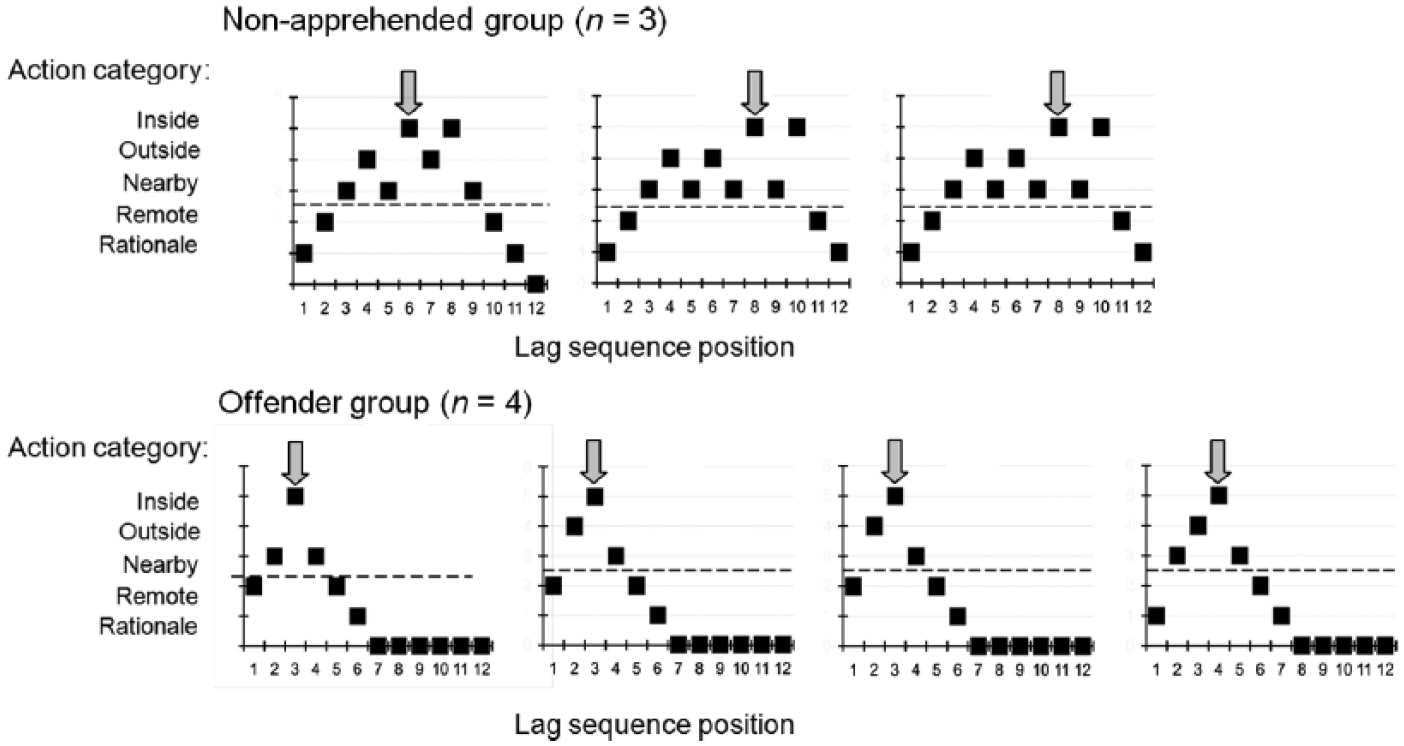
Individual lag sequence plots for participants in the non-apprehended group (n = 3; upper row) and the offender group (n = 4; lower row) for the actions surrounding a burglary.
Summarizing Burglar Performance Characteristics
Drawing from different methods and aims, a number of influential studies have researched the phenomenon of burglars, resulting in a range of views (Maguire & Bennett, 1982) around issues relating to the competencies of experienced burglars. For example, Merry and Harsent (2000) describe what they call “high skilled” burglars, or “Breaksmen.” These are skilled artists, knowledgeable and secretive, who plan ahead and attack the most vulnerable entry point. Their search is neat and tidy, and they are self-disciplined. However, other research has found that it is not uncommon for less experienced burglars to attack the most vulnerable entry points, and many failed burglars use search methods that do not make a mess of the contents of the property (see Wright & Decker, 1994). Canter and Alison (2000) argue that it is the degree of planning in contrast to the casual opportunist burglar or those that impulsively attack a property that produces the salient variation between crimes and offenders.
However, Cromwell, Olson, and Avary (1991) suggest that being an opportunist does not of-its-self differentiate the skilled from the novice or amateur, although the skilled do not typically commit opportunistic burglaries, they plan and execute their crimes with deliberation and have excellent contacts. They describe the “Professional” as the “elite” of the burglary world, with a high degree of technical skill and organizational ability. Baker (2000) also described how “Professionals” committed burglary in such a way as to minimize the risk of being apprehended and select targets on the basis of the value of the contents, but stop short of defining criteria for how detection is avoided. These different conclusions may be explained theoretically within the tradition of script theory (Schank & Abelson, 1977). The main characteristics of the theory are that there is a routine that develops from rehearsal. The routine is designed to achieve a concrete goal such as eating a meal in a restaurant. As the script holder becomes more familiar with the routine, less cognitive processing is required to perform it, and the route to obtaining the goal becomes more automated. A number of studies have utilized script theory (Cornish, 1994b; Cornish & Clarke, 1987; Hammond & Brown, 2005; Hockey & Honey, 2013; Huesmann, 1994; Huesmann & Eron, 1989; Michael, Hull, & Zahm, 2001; Nee & Taylor, 2000; Tunnell, 1992; Ward & Hudson, 2000; Wright & Decker, 1994), which have shown offender behavior to resemble the characteristics of scripts. Idiosyncratic routines (i.e., the modus operandi; Alison & Eyre, 2009; Homant & Kennedy, 2006) can develop from the basic offense script (Cornish, 1994a).
Furthermore, experienced burglars may typically make decisions to commit an offence away from a burglary site (Wright & Decker, 1994) but could still take advantage when ‘happening’ upon an immediate opportunity (Davies, Wittebrood, & Jackson, 1997), which may be assessed by similarity to previous targets (Townsley, Homel, & Chaseling, 2003). This makes sense of the different views above because well-rehearsed script style processing not only means efficiency (Nee & Meenaghan, 2006; Wright, Logie, & Decker, 1995) but also directs attention to behaviors consistent with it (Ceci, Fitneva, Aydin, & Chernyak, 2011), or in this context, burglary cues (Cornish & Clarke, 1986). This is particularly poignant when considering the evidence regarding target selection (e.g., Baker, 2000; Clarke & Cornish, 1985; Nee & Taylor, 1988, 2000; Wright & Decker, 1994).
Sources of Detection
For Maguire and Bennett (1982), the best two sources of detection come from identification of the burglar and from subsequent questioning of suspects, leading to either admissions or the discovery of evidence during the investigative stage. However, they noted that these sources tended to be only really effective against certain types of burglars, namely, those local to a specific area and persistent burglars within a town.
As with many other offenders, burglars can be classified into two basic categories “high”- and “low”-volume offenders (Halliday, 2001). As the label suggests, high-volume offenders can commit a lot of offenses before being apprehended, which is then usually for a portion of their offence total . Given that many apprehended burglars admit to additional burglaries, suggests that apprehension for high-volume offenders appears to be almost inevitable sooner or later for at least some of these (for example, see Hearnden & Magill, 2004). Low-volume offenders are perhaps more difficult to apprehend for a number of reasons. One of these may be that the fewer times a burglar goes out to commit offenses, the fewer occasions they are exposed to the risk of being apprehended at the scene or from the post-offence investigation. Over an extended period of time, they may commit as many offenscs as the high-volume offender squeezes into a shorter period, but without the inevitability of apprehension.
Method of Detection Avoidance
For Walsh (1986), if a burglar is winning, he will continue until something stops him, and on this basis, a prison population should contain some past successes that are likely to be typical of offenders who are at large at any given time. However, some offenders switch to lower risk activities (Halliday, 2001) which reduces the ongoing and higher risk of apprehension. Maguire and Bennett (1982) suggest that getting away with a high volume of burglaries before being caught for the odd one is success.
There have also been a number of contributions about what methods work best for avoiding detection over an extended period of time. Merry and Harsent (2000) regard “high craft” burglars as those who perform “proactive” skilled entry with a carried tool, while for Walsh (1986), burglars tend to use forcing tools found at the scene, as equipment carried is as incriminating as the burglary itself (Canter, 1994). Nee and Meenaghan (2006) observed that speed in assessing suitable targets and search methods is associated with “expertise” because of the efficiency in which experienced burglars conduct these tasks. This speed approach is likely to be advantageous for high-volume offending and would support Maguire and Bennett’s (1982) view that success means getting caught for the occasional burglary only. Walsh (1986) reported that his burglars described how they would affect an entrance into a building and then retreat for a period of time to wait and see whether that action had activated a silent alarm before progressing with the next stage of the burglary. Hockey and Honey (2013) also found that when plotted on a graph, the pattern of movements for the non-apprehended group reflected a similar behavior to that found by Walsh.
These various approaches to burglary appear to derive from a general emphasis on the methods used to select and commit burglaries, and the volume of burglaries committed in a given period of time. Committing the offence has a different focus to an offender’s ability to avoid detection. This study sought to focus on the rationales for the most effective approach to avoiding detection according to these non-apprehended offenders.
Method
The method used here was designed to facilitate a direct comparison of the methods used in a burglary scenario between a small group of experienced non-apprehended burglars who had desisted and a comparable group (in terms of mean age and burglary activity) of experienced but apprehended burglars.
A vignette was developed to include distinct stages to a burglary scenario (see the appendix). These stages derived from the body of research alluded to above in conjunction with law enforcement agents, other researchers’ comments, and participants from an earlier burglary study (see Hockey, 2008, unpublished thesis). A semi-structured interview (appendix) was constructed around the key features of the vignette, which consisted of a combination of prompts (open questions) and probes (closed questions) for specific areas of interest (Drever, 2003). The flexibility of this approach supports sufficient structure to the interview to facilitate some direction through the key features, while also allowing adequate opportunity for participants to expand on any area of their account, which they perceived as important to their own experiences.
Participants
The United Kingdom based participants in this study were those who featured in the previous study (see Hockey & Honey, 2013) for full recruitment details. In brief, the non-apprehended participants were all male, self-declared offenders and former burglars, who gave their ages as 33, 37, and 42 years old (M age = 37.33, SD = 4.5). Each participant claimed to have spent (subsequent to convictions as teenagers) many years of their adult lives offending in high-risk activities (e.g., burglary) without detection before moving on to other lower risk criminal activities. They described their burglary experience as “a lot,” “many,” and “countless.” Their recruitment came by a snow-balling technique in terms of recommendation from participants in a previous study (Hockey, 2008, unpublished thesis). The offender group consisted of four male participants, also from the previous study (Hockey, 2008 unpublished thesis), who self-reported multiple convictions for a wide variety of offenses (including burglary) over an extended period of time. They were aged 29, 29, 32, and 43 years old, respectively (M age = 33.25, SD = 6.65). The groups did not differ significantly in age (T = 0.90, p > .05).
Procedure
Participants were met individually, and the purpose of the study, together with the general procedure, was outlined to them. Their ethical rights were also made clear . The vignette questions were read aloud, slowly and purposefully. The use of questions as prompts for participants to provide a description of a sequence of actions was based on the reluctance of some participants (in a pilot study), to provide a list of actions when requested to do so (cf. Bower, Black, & Turner, 1979). Participants took as much time as they wanted, to think about their responses and to write it down in their own words. The next question was only revealed once a participant had indicated that they were ready to move on. On some occasions, questions became redundant, either because the participant had already answered them in the course of a previous answer, or because the option chosen by the participant in the previous question rendered them redundant. As will become clear from the results, the procedure was sufficiently flexible to allow different patterns of actions to be described.
Results were subjected to the Hayes (2000) model of theory-led thematic analysis, which was utilized due to its flexibility to theory (Braun & Clarke, 2006) and semi-structured interview (Hockey, 2014). The process first involves identifying the themes that may derive from a review of the literature. These themes are a little more general and underpin the principal questions that will be asked in the study. The second stage is to prepare the gathered data (i.e., the interview extracts) in a way that allows it to be searched through repeatedly. Third, each theme is taken separately, and a search of the data is conducted to identify all items relating to that theme. Themes are then titled, described, and include relevant data extracts.
Results
Theme 1. The Most Important Goals When Committing a Burglary
The goals are those that the burglar subjectively defines as being the most important objectives when carrying out a burglary.
Burglars are rarely asked whether there are goals of importance other than for profit. If differences exist between apprehended and non-apprehended offenders, these differences may exist in areas that have not been fully explored. For example, Walsh (1986) suggested that burglary is an unpredictable form of income generation, in that without work, there is no pay. Only unknown gains lie ahead as the outcome of burglary opportunities. From this standpoint, Walsh suggests that most burglars would most likely be employed in legitimate work so as to avoid being dependent on an unreliable source of income. This is perhaps more suited to the low-volume offender. It follows that a legitimate source of income alongside the illegal income would reduce the pressure to always obtain high gains on any given occasion, which would facilitate the selection and identification of unsuitable and inappropriate targets to avoid attacking.
All participants from both groups answered this question. However, there was a difference in that the apprehended group responded with two different goals: Two participants said that avoiding being caught was the most important goal (“not getting caught” P1), while the other two participants said that making a profit was (“get top quality goods for money” P2). All four participants from this group then alternated when asked whether there were any additional goals (“not to leave any evidence” P3 & “locate contents of safe and steel” P4).
The non-apprehended group all said that avoiding detection was the most important goal (“avoiding capture” P6 & “getting away with it” P7). The participants from this group agreed that profit was the second most important goal (“making it worthwhile financially” P5 & “earning money” P6).
Although it may not be surprising to expect these two responses (i.e., profit and non-apprehension) to be top priorities, the difference in the ordering is an early indication of the differences between the two groups. The non-apprehended group exclusively saw avoiding detection as the most important goal, while the apprehended group was evenly split between avoiding detection and making financial gains. Bennett and Wright (1984) noted that many of the offenders in their study were not worried about getting caught because they chose not to think about it and focused on the offence gains. Given that the apprehended group are failed burglars, a principal goal of avoiding detection does not of its self ensure success at doing so. The mixed responses from the apprehended group are consistent with previous findings, where there is a chaotic lifestyle generally and an orientation toward the here and now (Ross & Ross, 1995), particularly where there is a need for immediate access to money for those with a drug abuse and/or a dependency problem (Cromwell et al., 1991). In this context, the mixed responses of the apprehended group can be explained in that not all apprehended burglars have the same motivation for immediate access to money. For example, they may not all have a dependency or an illicit drug abuse issue, and although two members of this group said that avoiding detection was the most important goal, that is not of its self, evidence of high levels of “know how.” The non-apprehended group appeared to be less fixated on the need to commit a burglary; in this sense, Walsh’s (1986) notion of not being under pressure to make high gains on any given occasion is plausible here.
Theme 2. When to Commit a Burglary
When to commit a burglary is based on whether an offender commits offences in the day or at night, and this will depend on the individual offender’s preference.
British Crime Survey (BCS; 2002/2003) figures indicate that almost as many burglaries are committed in the day as at night. However, Maguire and Bennett’s (1982) high-level burglars preferred day to night burglaries in the particular circumstances that they operated, while Coupe and Griffiths (1996) found that fewer burglars were caught at night. What is less clear is how many of each type are solved and whether day or night burglars (to assume a dichotomous group for now) are more or less successful in long-term avoidance of detection than the opposite group.
In this study, participants were asked to state when they would prefer to commit a burglary in terms of day or night. Three members of the apprehended group responded by replying with “day” and one with “night.” In a follow-up question, the rationale given for day time burglaries related to the notion that the activity was more accessible (“not expected during the day” P1 & “so they are not at home” P2). The non-apprehended group all responded with “night” (“fewer witnesses, less chance of being disturbed” P5 & “can be more concealed” P7).
The apprehended group’s responses show an emphasis toward physically committing the burglary through a concern with occupancy of the property. Apprehended burglars have previously been associated with using a range of techniques to determine whether a property is unoccupied (Cromwell et al., 1991; Wright & Decker, 1994). However, the risk of burgling a property that is actually occupied remains a strong possibility (for example, see BCS, 2002/2003). In addition, neighbours or passers-by can also play a part in alerting the police to the burglary in progress (e.g., 8% of burglars are apprehended through being seen acting suspiciously; Farrington & Lambert, 2000) and also in identification of the burglar retrospectively (i.e., 7% of burglars are apprehended through witness identification). The non-apprehended groups’ responses suggest that there is greater consideration for reducing the chances of being exposed to either direct interruption or to later identification. Perhaps the cover of darkness provides greater possibilities for this, although Maguire and Bennett’s (1982) “professional” but ultimately failed burglars preferred to commit their burglaries during the day.
Theme 3. Traveling to the Burglary
Traveling to a burglary site is about whether an offender uses a vehicle or walks and the reasons given for those decisions.
Many offenders are thought to commit their offences within a relatively short distance from their typical place of residence (i.e., an approximate 2– to 3-mile radius; Alison & Eyre, 2009; Baker, 2000; Brantingham & Brantingham, 1981; Canter & Youngs, 2010; Wiles & Costello, 2000). This is in part due to their routine activities (Cohen & Felson, 1979) in that their general environment is a relatively small area of familiarity from which they do not tend to leave very frequently, although Hearnden and Magill (2004) found that most of their burglars still used a car.
Participants were asked to explain how far they would travel to the burglary and how they would get there. Consistent with previous research, the apprehended group responses were that they would use a vehicle: (“car” P1 & “drive” P4), although one participant added walking as a possibility (“car or walk” P2). In the initial follow-up question, two of the participants qualified this in terms of distance and time (“3-5 miles” P2 & “minimum 15 mins” P3). When asked how far away from the burglary would they park the vehicle, the responses were similar in terms of strategy (“5 minutes walk out of sight” P1 & “3-4 hundred yards” P4).
The non-apprehended group also stated that a vehicle would be used (“drive” P5 & “drive to the plot” P6). None on the participants in the non-apprehended group commented on how far they would travel to commit a burglary. However, when asked how far away from the burglary they would park the vehicle, the responses showed some difference to the apprehended group (“depends on the layout but about half a mile away” P5 & “a good walk away from where the burglary is” P7). Here again, there is more consideration about where to position the vehicle in relation to the burglary. The apprehended group was prepared to park the vehicle in relative close proximity to where they were about to commit a burglary, which indicates two points: the consistency with earlier findings resulting in Cornish and Clarke’s (1987) “principal of least effort” (though normally associated with break-in techniques) in that the apprehended group showed a propensity toward minimal investment in both time and energy at an earlier stage than the break-in phase; and secondly, it also shows less consideration toward the connection that might be made between the burglary and the vehicle used to transport the offender. The non-apprehended group showed a greater willingness to put in more time and effort to decrease the chances of such a connection being made and thereby reducing one potential source of police enquiry, both at the time of the burglary and in any subsequent investigation.
Theme 4. Approaching the Burglary Site
This theme is concerned with the decisions and strategies that burglars use around the crime scene in preparation to the burglary.
A great deal of work has gone into developing knowledge on burglary target selection and decision making at the scene of the burglary (see Maguire & Bennett, 1982; Nee & Taylor, 2000; Tunnell, 1992; Wright & Decker, 1994). Consistent with that, the apprehended offenders focused on the most suitable property to attack and the most vulnerable points of entry. Their responses amounted to a general description rather than techniques designed to specifically account for avoiding apprehension (“cautiously, make sure next door hasn’t seen me” P3 & “with caution” P4).
The non-apprehended group responded with more detail (“use an approach which can’t be seen by anyone but try to be low profile if you do have to pass by anyone or where you can be seen” P6 & “sneak up so you can see the place but you can’t be seen. I would make sure it is a way that means a good getaway without anyone seeing which way it is” P7). The responses from the non-apprehended group are more detailed and incorporate more consideration toward avoiding being apprehended as well as the desire to avoid interruption.
In the series of follow-up questions relating to what the participant would do once outside of the building, the apprehended group responded in the following way: (“find the easiest route to getting in” P3 and “check the security arrangements, dogs, cameras, guards” P4). These responses are entirely consistent with the notion of the burglar being fixated on the target selection and the execution of the burglary. That said, one participant from this group offered a different response (“escape route, scan local area” P1). This suggests that at least one participant from the apprehended group took the broader view that there are other considerations beyond “how to commit the burglary.” This notion was exemplified by the non-apprehended group who produced more in-depth responses such as the potential for police activity (“find a nearby spot that isn’t part of the grounds. Wait in the dark and observe for a while” P5 & “locate a place away from the building that isn’t seen so you can escape if the law did go to the burglary” P7).
The non-apprehended group sought to establish personal safety in the form of effective hideout spots and escape routes before considering progressing with a direct attempt to commit the burglary. Further follow-up questions regarding what else would be done produced the following from the apprehended group: (“scan the property vacant, was in and out” P1 & “look for weaknesses in security” P2). These responses appear to be concerned with decisions regarding the next stage in the actual commission of the burglary in that the focus is on searching for any occupants and the most vulnerable access point. The non-apprehended group responded with (“go to the building, go around it and go back to the hiding place” P6 & “check out the grounds around the plot and any other places where someone could be hiding from you” P6). Again, the non-apprehended group remains consistent in that there is a clear distinction between decisions about how to commit the burglary and whether to do so by continuing to check its safety as thoroughly as possible before making an actual attempt to break-in. The final question in this section asked the participants whether there was anything else to add. The apprehended group responded with (“no” P1 & “check kit and inhabitation, alarms off” P4), which amounted to a repeat of the burglary orientated responses to the previous questions. The other two participants in the apprehended group did not reply, suggesting that they had no other ideas at that point. The non-apprehended group replied with, (“keep a look out for some time, then go and bring the equipment outside” P6 and “keep watching for any movement around the place last check outside go wait a bit longer” P7). By this point in the process, the non-apprehended group has made very little attempt to consider the most vulnerable point to break in but has spent much more time checking out the grounds of the building, checking escape routes and hidden look out spots than the apprehended group, who by contrast, race ahead with the stages of progressing through the burglary.
Theme 5. Initial Decisions Once Inside the Property
This theme is defined by what the burglars decided to do at this point in the burglary and their rationale for doing so.
Previous findings have indicated that experienced burglars go into search mode by systematically following an idiosyncratic routine (Nee & Meenaghan, 2006; Wright & Decker, 1994). This was borne-out by the responses from the apprehended group in this study (“go to bedroom get quilt cover for goods to go in” P2 & “check all rooms” P3). However, the non-apprehended group did not follow this pattern (“go everywhere that I would intend to go and then get out quick and go back outside” P5 & “go in, get out quick make sure you have a good search” P7). The responses from the non-apprehended group are characterized by the strategy of getting in and out so quickly that there is no time or intention to steal any property at that first point of entrance. The follow-up questions to this section regarding any additional information illustrates this point and increases the contrasting differences between the two groups. The apprehended group responded with, (“get more stuff in” P2 and “make sure nobodys home,”) while the non-apprehended group provided a rationale (“this is the best way to check for any hidden security alarms. If nothing happens for quite a while chances are you have not activated an alarm and so you will be able to go back inside safely” P5, and
once inside you must go round and see if you set off any alarms, then get out and wait to see, you don’t want to be inside the building when the police turn up because of a silent alarm or a witness who has called them secretly. (P6))
This retreat method replicates the earlier findings of Walsh’s (1986) burglars. Here, the non-apprehended group appears to take each stage seriously and continues to minimize the prospect of being interrupted, while providing the maximum prospect of being able to get away should any problems occur. The focus of the apprehended group was to use the time to exploit the opportunity as much as possible to acquire goods. It is not to suggest that once inside and ready to steal, the non-apprehended group would not also use speed, but rather that the apprehended group missed out a complete stage in the process, which, according to the non-apprehended group, is vital to protect one’s self from increasing the chances of being caught inside the building.
Theme 6. Pressurized Decision Making at the Scene of the Burglary
The purpose of this line of questioning was to explore decision making while under immediate pressure from the approaching police.
Farrington and Lambert (2000) showed that 14% of apprehended burglars were caught in the act and 12% were caught near or leaving the scene of the burglary. Decision making in this context is perhaps about having a plan of action in place and ready to utilize it, if and when required. Previous research has emphasized decision making in “experienced” or “expert” burglars (Nee & Meenaghan, 2006) in terms of target selection for the purposes of: avoiding being seen while committing the burglary; vulnerable access points into the property and perceived relative wealth (Clarke, 1997).
Here, the apprehended group makes the basic but obvious statement in that it is simply going to try and get away (“drive off normal” P2 & “leave everything make hast and try to look unsuspicious” P3). References to “normal” and “unsuspicious” suggest that they are expecting to be seen as they do so, which can be related to the earlier responses explored in Theme 3, where the getaway vehicle is parked in close proximity to the burglary. However, is it reasonable to expect the police to allow someone to move off from near a property that is reportedly a burglary in progress?
The non-apprehended group’s responses suggested a subtle difference in that they do not expect to be seen leaving the area (“leave the goods and head in the direction of my vehicle” P5 & “just leave things if the law are near and either run or get in the motor and go” P7). This difference is interpreted within the context that the non-apprehended offendershad positioned their vehicles in more strategic locations further away from the burglary (see Theme 3 above) and that they had previously identified discrete escape routes (see Theme 4 above). These strategies were identified by Poyner and Webb (1991). Although they described the footpaths to places where cars can be left without causing suspicion, as being “short,” in the case of these non-apprehended offenders, the corresponding parking location appears to be further away.
Theme 7. Getaway Strategies and Decisions
This theme is defined by the burglars’ pre-offence decisions about what they would do and be able to do should the police arrive while they are still at the burglary site.
Of all apprehended burglars, 43% are caught within an hour of the offence (Canter & Alison, 2000), suggesting that they have not developed suitable escape strategies or that their capacity to dispose of stolen property is also similarly under-developed (see Jacobson, Maitland, & Hough, 2003, for an example). Not only are burglary detection rates low generally, but that once the first 24 hours have passed, detection rates fall off still further and much of the clear-up rate then comes from TICs.
The apprehended offender group replied with simplified statements about what they would do (“go off somewhere” P3 & “look as calm as possible and walk on” P4). The non-apprehended group provided more detail about what they would do and why (“you should already be far enough away from the burglary so as not to be found during an immediate search around it” P5 & “I always make sure that I don’t stay near the place cus they always search nearby so no point in staying there” P7). It appears that members of both groups have experienced burglary events where the police have closed in during its execution. The responses from the apprehended group do not provide much information about a strategy, which appears to be limited to reactive decisions as opposed to options planned in advance. The responses from the non-apprehended group suggest that they are clear about the need to put as much distance as they can between themselves and the burglary. Given the time and effort that would have gone into planning both effective escape routes and the positioning of the getaway vehicle, these responses are entirely consistent with the general approach to committing a burglary, which has a strongly developed emphasis on avoiding detection.
Discussion
Fox and Farrington (2012) took the view that because many convicted offenders committed most of the offences on a self-report study, it is unlikely that if non-apprehended offenders exist, they will be any different to apprehended offenders. This inductive argument makes a great deal of sense to a point, in that as Maguire and Bennett (1982) noted, some offenders commit a lot of offences before getting caught for the odd one. However, non-apprehended offenders are an unknown quantity both in terms of their numbers and their characteristics. Subtle differences in their approach to offending may result from important differences in those characteristics and there is a sufficient number of unsolved burglaries to allow room for both the unsolved portion of offences from apprehended offenders and those of non-apprehended offenders.
Many of offenders who have participated in the various studies on burglary have had some success in avoiding detection for a period of time. Although some of that success is due to random chance, the techniques and strategies used have also contributed. One of these failed strategies may be committing burglaries during the day, which exposes them to the risks outlined by Farrington and Lambert (2000) in Theme 2 (above).
The participants from the non-apprehended group here all committed their offenses at night. Furthermore, although occupancy is an issue for many burglars of all levels of experience and competence, the reduction of potential targets imposed by the restriction of offences to night time only does not necessarily impose major difficulties for non-apprehended offenders, who by design commit a lower volume of burglaries than failed burglars in the same time frame, which of its self is another risk reducing strategy. Reasons for a lower volume of offending may be due to a more controlled approach, where the offender does not rely solely on burglaries for an income (see Walsh, 1986) and/or that perceived opportunities may be fewer to a burglar who is risk-aversive in that his or her target choice is highly selective to meet those criteria, as opposed to high-profit reasons.
Some offenders use the strategy of speed to commit burglary offences; this, in turn, facilitates a high volume of offences (Halliday, 2001). Nee and Meenaghan (2006) rightly suggest that there is a great deal of efficiency in this approach, particularly during the target selection and search phase. However, in the context of avoiding detection, the burglars’ strategy here is ultimately flawed as it exposes the offender to the repeated risks of committing burglaries many more times over than a lower volume offender (Halliday, 2001) within a short period.
The offenders in the apprehended group of this study, like many others, utilized a simplified technique for accessing the items inside the building. Once they had decided that it was not occupied, they would force an entry and immediately proceed inside to begin stealing items. The non-apprehended offenders utilized a similar technique to some of the offenders in Walsh’s (1986) study in that a more measured approach was used, whereby an entry is effected and followed by a period of waiting in a safe place to test whether any silent alarms had been activated or whether any other problems might occur. This is because there are fewer potential witnesses around during the night, there is greater opportunity to see or hear anyone approaching and that well-devised escape routes are established prior to the burglary. Moreover, the non-apprehended offenders in this study took much more time and caution during the approach and break-in phase. Although this means that they were at the scene for much longer, the strategy intelligently applied, actually reduces the risk of apprehension at the scene, which is the principal source of detection (Canter & Alison, 2000; Farrington & Lambert, 2000). It is interesting to note that Hearnden and Magill (2004) found that their experienced but apprehended burglars perceived being inside the building as virtually risk free.
The advanced planning of the non-apprehended offenders does not necessarily mean that a high-volume of burglaries are not committed, but maybe spread over a much longer period of time compared with the high-volume failed burglars. As predicted from previous research, the experienced apprehended offenders in this study searched and stole from the premises at the first opportunity once inside. The non-apprehended offenders took more time and operated more cautiously by getting in and out as quickly as possible on the first occasion of entering the building, which did not, of its self, occur until a series of precautionary actions were undertaken. They only returned and removed property once they were sure that no one, such as the police, was approaching the building.
Distance between burglary and place of residence is also a contributing feature in the apprehension of burglars. It is generally observed that most failed burglars commit their offences within approximately 2 miles of their base. Those who travel further usually last longer before being apprehended (see Maguire & Bennett, 1982; Walsh, 1986), and although distance may create logistical problems of their own, apprehension for traveling offenders is likely to be due to reasons unconnected to that additional distance, such as being placed under surveillance (see Maguire & Bennett, 1982). Interestingly, the non-apprehended offenders in this study did not provide information about the distances that they traveled to commit burglary, but they did indicate greater distances between where they would position their vehicle and the burglary. Given what is known in the wider context of apprehension rates between those who travel and those who do not, distance, whether it is to the burglary or between the burglary and the vehicle, can be an effective technique in reducing the prospect of apprehension.
The exit strategy for the apprehended group favored leaving the scene in a way that they perceived made them look inconspicuous in the event of being seen by the police. The non-apprehended group did not view that as the most risk-aversive method and had pre-planned their escape routes in such a way as to minimize the risk of actually being seen. Getting away from the scene of a burglary is of paramount importance in terms of avoiding detection. Putting in place exist strategies before the burglary takes place will make an important contribution to this aim compared with attempting a reactive approach to prevailing circumstances. The non-apprehended group took time to work on this before attempting the burglary. This put them in a position whereby in the event of being disturbed, they could exit the building and immediately use these escape routes.
Within the script theory framework, the apprehended offenders appear to follow linear patterns of movement. These are simplified routines or offence scripts (Cornish, 1994a) that have been developed through rehearsal and appear as an heuristic device (Snook, Dhami, & Kavanagh, 2011) for obtaining concrete goal aims as it requires little time, minimal information, and less cognitive capacity Gigerenzer & Goldstein, 1996). Whether this style of thinking and the pursuit of concrete goals are characteristically indicative of this genre of apprehended offender or whether it is adopted due to its perceived success is a matter of further research, although the dysfunctional characteristics of the prison population generally suggest that it is embedded in the offender. The non-apprehended offender group also appears to have a routine, but decisions are based on more abstract planning in that there is a great deal of consideration given to what might occur rather than what is or has occurred. The script offence has more stages in the pattern of movement around the crime scene, which are underpinned by a risk-aversive rationale. There also appears to be more control over any impulse to rush in at the first opportunity; this allows for a more calculated approach, which, although is more time-consuming and restricts available opportunities, is less adverse to risk exposure.
Limitations
Some studies into burglary have utilized large numbers of participants, which is helpful for gaining insights into a wide range of burglary activities. Others have focused on very small sample sizes (for example, see Hockey & Honey, 2013; Maguire & Bennett, 1982) for the finite detail associated with the more successful offenders. These non-apprehended offenders may be genuinely rare, difficult to identify, and less willing to take part in a study. Therefore, it is important to recognize that the few opportunities to study their methods are valuable for greater understanding in its own right (e.g., do non-apprehended burglars use similar or different decision-making strategies to experienced burglars; see Garcia-Retamero & Dhami, 2009). This may also enable understanding of any links between their methods and those of less unsuccessful burglars (e.g., knowledge transfer between groups).
Policy and Research Implications
Previous research (Taylor & Nee, 1988) suggests that there is learning in the development of burglary skills, and what is clear is that there has been a number of burglary prevention exercises conducted with mixed success (Bowles & Pradiptyo, 2004; Hirschfield, 2004; Hope et al., 2004; Millie & Hough, 2004). Over time, offenders adapt to efforts to thwart these measures (Tilley, 2007). Moreover, although Canter (1994) takes the view that learning in the apprehended offender occurs by previous mistakes and convictions, which is a worthwhile starting point, there is currently no overall agreed explanation for this learning process (Bekerian & Jackson, 1997). That said, it is certainly a worthwhile area of study given the paucity of research into the extent of and capabilities of non-apprehended burglars particularly.
Understanding more about the methods of non-apprehended offenders will not only increase the prospect of law-enforcement success but could actually undermine the confidence of some apprehended burglars who may then be deterred if they believed that getting caught is inevitable. For example, the non-apprehended burglars in this study came by recommendation from other offenders, meaning that those doing the recommending were aware of others who avoided detection. Furthermore, given the cognitive errors typically associated with offenders (for example, see Morgan, 2002, for a breakdown of the dysfunctional characteristics in the general prison population; also Wilson, Allen-Bouffard, & Mackenzie, 2005), the existence of non-apprehended offenders may lead apprehended offenders to wrongly believe that they can avoid detection next time and inspire them to carry on trying (see Wilson, 1983, for a discussion on increasing the certainty of sanctions). These questions need to be further explored of course.
Moreover, Harris, Pedneault, and Knight (2013) see burglary as representative of a general pattern of versatility. From versatility, specialization (Farrington, Snyder, & Finnegan, 1988; Klein, 1984) derives, although this is thought to be in relation to themes (Youngs, 2004) rather than specific crimes. If the theme is detection avoidance and offenders who prioritize this switch to low-risk offenses before the process of apprehension finally catches up with them, as was the case in for the non-apprehended offenders here, then this poses a real challenge to law-enforcement agencies as well as to advances in research in relation to this type of offender.
Conclusion
The results from the non-apprehended group suggest that long-term anti-detection success derives in part from using a combination of some of the techniques that are in use by apprehended burglars, while rejecting or adapting others. The effectiveness of these selective techniques is magnified when operated in combination with a more cautious strategy than that of general speed or reactive decision-making approach. Apprehension near to the scene of a burglary or within a relatively short time period afterward represents the best chance of solving the offence from a crime detection perspective. Therefore, any strategy that places a greater emphasis on reducing that risk is going to be more effective. What is of interest here is the psychological constructs that enable these long-term non-apprehension methods and the implications for apprehended offenders.
Footnotes
Appendix
A property located in a secluded area, which you decide to burgle as it is understood to contain some high-value goods.
You have entered the building for the first time.
You are in the building and have located the items you want to take. You do not know how much time you have before anyone arrives. There are a couple of items which are bulky, although you can carry them. They are worth a lot of money, and you could sell them quickly. There is also a larger number of smaller items, which you could sell as a job lot but would not fetch as much money.
You are ready to go when you hear the police in the distance driving hurriedly toward the building. It sounds as if they could be approaching from different directions at the same time.
The police are now searching the area. Some are patrolling in cars while others are on foot searching places where someone might be hiding.
You have got away from the building.
Acknowledgements
The author wishes to thank Professor Rob Honey for his critique of the article and support in its development. The author thanks two anonymous reviewers for their helpful comments on this article.
Declaration of Conflicting Interests
The author(s) declared no potential conflicts of interest with respect to the research, authorship, and/or publication of this article.
Funding
The author(s) received no financial support for the research and/or authorship of this article.