




Abstract
This study aimed to analyze the impact of Crime Prevention Through Environmental Design (CPTED) principles on burglary intentions in high-density low-rise residential areas in South Korea using a virtual reality (VR) experiment. An ordered logistic regression model was developed based on data from a VR-aided survey involving 100 young adults. The findings revealed that the installation of security features, such as barred windows and signs indicating a security system, significantly reduced the intention to commit burglary in single-family houses and walk-up apartments. In contrast to studies conducted in Western contexts, the results indicated that higher fences were associated with a lower intention to burgle in these high-density low-rise residential areas. Territoriality was found to have no significant effect on burglary intentions. These results suggest that CPTED strategies should be tailored to local environmental contexts and community atmospheres.
Plain language summary
In this study, we wanted to find out if certain changes in the way homes are designed and secured can make a difference in whether someone might think about breaking into them. We did this by using a special kind of computer simulation that feels like you’re in a different world, called virtual reality. We asked 100 young adults about their thoughts on burglarizing houses in neighborhoods in South Korea using this virtual reality setup. Our research showed that adding things like strong windows and signs that show a security system in houses and walk-up apartments can make people less likely to consider breaking in. Surprisingly, in South Korea, having taller fences around these types of homes also seemed to discourage the idea of burglary, which is different from what studies in Western countries have found. However, the idea of who “owns” or takes care of a space, which we call territoriality, didn’t seem to make much of a difference in whether someone would think about breaking into a home. So, what we can learn from all of this is that when it comes to making neighborhoods safer from burglaries, we should think about the local environment and how people in the community feel, rather than just using the same ideas that work in other places.
Keywords
Introduction
In 2020, the Federal Bureau of Investigation (FBI) reported 314.2 burglary offenses per 100,000 individuals, and among the incidents involving intrusions, 72.03% occurred in residential buildings. Residential burglary often leads to more severe crimes beyond mere intrusion, such as assault, rape, and murder. Residential burglary also diminishes feelings of personal security, peace of mind, and well-being (Coupe & Griffiths, 1998). Residential burglaries are influenced by the environmental features and physical designs of properties. Therefore, crime prevention through environmental design (CPTED), which is the theory that crime can be prevented by preemptively eliminating, changing, and improving environmental factors that could provoke intrusion, has been emphasized in previous research (Clarke, 1995; Forrester et al., 1988; Montoya et al., 2016; Nee & Taylor, 1988; S. Y. Park & Lee, 2021).
Researchers have compared burgled and non-burgled houses to determine environmental differences between target houses to find ways to apply CPTED principles (Bernasco & Nieuwbeerta, 2005; Brown & Bentley, 1993; Langton & Steenbeek, 2017; Montoya et al., 2016; Vandeviver et al., 2015). Others have conducted interviews and surveys with imprisoned robbers, robbery victims, and experts in related fields, and analyzed the decision-making process for selecting a target by showing images of houses that were broken into and other randomly selected houses (Brown & Bentley, 1993; Cozens et al., 2001; Ham-Rowbottom et al., 1999; Palmer et al., 2002). Meanwhile, there has been an increase in research using interactive and dynamic environmental stimuli, such as virtual reality (VR), rather than static stimuli, such as crime data and images (Huang, 2023; Joseph et al., 2020; Mahmoud, 2001; Sina & Wu, 2023; van Gelder et al., 2014; Zhanjun, 2017). VR-based experiments allow researchers to observe in real time how criminals and mock burglars make decisions and which intrusion routes they choose (Nee et al., 2019), as well as conduct controlled and repetitive hypothetical tests that produce robust and rich data for empirical analysis (Cozens & Greive, 2002; Kavakli et al., 2004; Meenaghan et al., 2018; A. J. Park et al., 2008; S. Y. Park & Lee, 2021; van Gelder et al., 2014; van Sintemaartensdijk et al., 2021).
Still, these various studies also have certain limitations. First, most focused on one or two of the main representative CPTED principles, and the lack of control variables for other principles may have affected the results (Brown & Altman, 1983; Brown & Bentley, 1993; Ham-Rowbottom et al., 1999; Palmer et al., 2002). Second, the effects of CPTED principles differ across countries (Marzbali et al., 2016; Montoya et al., 2016), and most studies have been conducted in European and North American countries (Bernasco & Nieuwbeerta, 2005; Brown & Altman, 1983; Brown & Bentley, 1993; Ham-Rowbottom et al., 1999; Iqbal & Ceccato, 2016; Langton & Steenbeek, 2017; Montoya et al., 2016; Nee et al., 2015; Palmer et al., 2002; Snook et al., 2011; Wortley & McFarlane, 2011). Against this backdrop, this study aims to find new empirical evidence by analyzing the effects of the main CPTED principles on the intention to burgle in high-density low-rise residential areas in South Korea, which is an Asian developing country. To this end, this study used VR technology to substantiate the environmental characteristics that make residences more vulnerable to burglary at the house level. Specifically, two research questions are addressed.
Q1. Which of the main CPTED principles has more influence on the intention to burgle after controlling for all other conditions?
Q2. If the main effects of CPTED principles differ across countries, which of these principles influences the intention to burgle in high-density low-rise residential areas in South Korea?
The remainder of this paper is organized as follows. First, we review prior research to identify variables that represent the CPTED principles (i.e., natural surveillance, territoriality, access control, maintenance and management, and target hardening) and identify research gaps. Next, to build virtual environments (VEs) for the experiment, we modeled residential buildings in high-density low-rise residential areas of Seoul, South Korea, that are vulnerable to burglary. Finally, using these virtual residential areas as mock burglary targets, a VR-aided survey was conducted with 100 young adults. The results of the VR experiment shed light on the architectural design factors that reduce the intention to burgle residential homes and areas.
Literature Review
Previous Studies
In the 1920s, sociological criminology centered on the Chicago School emerged, shifting the study of the cause of crime from individual to societal factors, such as poverty, community disorder, and unstable employment (Bursik, 1988; Kornhauser, 1978; Sampson, 2008; Sampson et al., 1997; Shaw & McKay, 1942). For example, the routine activity theory postulates that crime occurs when the offender has a motive, the target is suitable, and there is a lack of defense mechanisms (Cohen & Felson, 1979), and the rational choice theory states that offenders evaluate risk, reward, and opportunity and commit crimes based on rational judgment (Cornish & Clarke, 1986).
Meanwhile, environmental criminology assumes that specific spaces have higher crime rates and generate more significant fear of crime, and has established a theoretical framework in which building design and layout can affect crime prevention through design principles such as natural surveillance and access control (Jacobs, 1961; Jeffery, 1971; Newman, 1972). This theory eventually evolved into situational crime prevention theory (Clarke, 1995) and crime pattern theory (Brantingham & Brantingham, 1981), which have been used by past empirical studies that analyzed the environmental design of actual residential burglary crime scenes and the decision-making processes of people convicted of residential burglary. Some of these empirical studies have used actual crime data and most employed data from interviews or surveys with burglars or novice burglars. For instance, Brown and Altman (1983) analyzed the environmental design features of burglarized and non-burglarized houses from a territorial perspective, while others have compared neighborhood environments of burglarized and non-burglarized houses (Bernasco & Nieuwbeerta, 2005; Langton & Steenbeek, 2017). Montoya et al. (2016) examined how residential properties and their surroundings influence day- and night-time residential burglary through the CPTED principles of territoriality, surveillance, access control, target hardening, image maintenance, and activity support. They found that the stronger the house-level territoriality and the higher the neighborhood-level number of residential units, the weaker the houses are against residential burglary.
As aforementioned, there have also been studies based on interviews and surveys, which have mostly analyzed the target selection decision-making processes of burglars and novice burglars. Bennett et al. (1984) interviewed burglars aged 16 years or older either on probation or imprisoned and found that risk, reward, and ease factors impacted their decision-making. Brown and Bentley (1993) presented randomized photos of burglarized and non-burglarized houses to burglars and conducted interviews to reveal the standards for evaluating profitability, house maintenance states, and intrusion vulnerability. Ham-Rowbottom et al. (1999) showed photographs to 41 police officers and interviewed them, finding that house territoriality and natural surveillance correlated with vulnerability to burglary. Furthermore, Palmer et al. (2002) surveyed burglars to validate their target selection, preferred intrusion route, and rationale for residential burglaries, and Marzbali et al. (2016) interviewed residents who had lived in an area for five or more years to build a statistical model of the CPTED principles effective against residential burglary. Despite these various contributions, studies using interviews and surveys with burglars have been criticized because of the ethical and logistical limitations in observing burglars’ crime patterns (Brown & Bentley, 1993; Ham-Rowbottom et al., 1999; Palmer et al., 2002).
Simultaneously, there has been a recent increase in the number of studies using VEs instead of face-to-face interviews to study residential burglary (Meenaghan et al., 2018). In a pioneering study, Nee et al. (2015) used VR to compare six men who committed residential burglaries with six graduate students. S. Y. Park and Lee (2021) and van Sintemaartensdijk et al. (2021) also used VR and analyzed main intrusion routes, finding that burglars tended to choose routes with low natural surveillance.
Thus, in general, residential burglary research has focused on examinations at the house and neighborhood levels, analyzed the environmental features influencing residential burglary, and investigated intrusion routes to understand offenders’ decision-making processes. Moreover, most of these studies have delved into a single specific CPTED principle, such as territoriality (Brown & Altman, 1983), natural surveillance (Langton & Steenbeek, 2017; van Sintemaartensdijk et al., 2021), and access control (Langton & Steenbeek, 2017). However, Marzbali et al. (2016) identified that CPTED principles encompass natural surveillance, access control, territoriality, and image maintenance, and Montoya et al. (2016) identified that they include territoriality, surveillance, access control, target hardening, image maintenance, and activity support. Montoya et al. (2016) also went further and extrapolated CPTED variables to understand their individual influence on residential burglary. Thus, it may also be important for residential burglary research using VR to consider all the dimensions of CPTED to ensure a rigorous examination and acquire comprehensive evidence of the influence of environmental features on the intention to burgle.
Research Gaps
A literature review revealed two major research gaps relevant to the current study. First, most existing studies have confirmed the influence of some CPTED principles on the intention to burgle; examples of research that considered one or two CPTED principles include the following: Brown and Altman (1983), Wortley and McFarlane (2011) and Snook et al. (2011) focused on territoriality; Palmer et al. (2002) focused on access control; Amiri et al. (2019) focused on natural surveillance; Brown and Bentley (1993) and Ham-Rowbottom et al. (1999) identified the influence of natural surveillance and territoriality; Langton and Steenbeek (2017) confirmed the impact of natural surveillance and access control. Some studies explored more than two CPTED principles, such as the study by Reynald (2015), which mentioned the relationship between the main CPTED principles and crime occurrence; still, this cited author was unable to confirm the net influence of each principle when controlling for each principle. Marzbali et al. (2016) used a statistical model to analyze the influence of four CPTED principles on residential burglary, but did not sufficiently control for important individual socioeconomic factors such as age, educational level, housing type, and income. To address these gaps and identify which CPTED principles are effective in preventing residential burglary, the current research controlled for individual socioeconomic factors that can influence the intention to burgle and considered all main CPTED principles (i.e., natural surveillance, access control, territoriality, maintenance, and target hardening).
Second, the evidence shows that the influence of CPTED principles on intention to burgle may vary by research location, and particularly that the influence of the territoriality principle of CPTED differs by country and region. Montoya et al. (2016) pointed out that “The perception of territoriality varies across cultures, neighborhoods, and individuals and thus the sense of ownership of individuals toward the public and semi-public space” (pp. 519–520). In fact, the fence variable (i.e., as a representative variable of territoriality) was highly related to the intention to burgle in a study targeting the United States of America (Brown & Altman, 1983). Simultaneously, a study conducted in South Korea showed no association of fence and mural paving with active living and fear of crime (J. Lee et al., 2016). There is also another country-related research gap, as most current studies on the relationship between CPTED principles and residential burglary targeted European and North American countries, and research targeting developing and Asian countries remains insufficient. The current study seeks to close these gaps by identifying the relationship between CPTED principles and residential burglary in high-density low-rise residential areas in South Korea—a rapidly growing, developing Asian country.
To this end, we built a VE representing South Korean residential areas and conducted VR experiments to analyze the environmental factors affecting residential burglary. Previous studies in European and North American countries sought solutions for environmental factors affecting the burglary of single-family houses, which is a representative type of residence in these countries. This study focuses on high-density low-rise residential areas because these are the representative types of residence in South Korea. Specifically, a comparison was conducted of the environmental factors affecting residential burglary between single-family houses and walk-up apartments.
Experimental Design and Method
VR Experiment Procedure
This study analyzed the effects of CPTED principles on intention to burgle residential homes using a VR experiment. First, this study categorized the CPTED principles into five attributes and applied them differently to houses, resulting in 40 residence types. Second, this study built a VE using Unity software with reference to an actual high-density low-rise residential area in South Korea. Third, a VR experiment was conducted as follows: 100 adults in their 20s and 30s undertook a pre-survey, pilot test, main questionnaire (intention to burgle residential homes survey), and post-survey. Finally, this study analyzed the relationship between CPTED principles and intention to burgle residential homes using a logistic regression model (Figure 1).

Study flow.
Modeling House With CPTED Principles
The CPTED planning elements used in the virtual settlement modeling were selected based on a review of previous research and categorized into five dominant CPTED principles: natural surveillance, access control, territoriality, maintenance, and target hardening. It is important to emphasize here that these principles are not independent, but rather linked to each other; for example, access control, natural surveillance, and territorial reinforcement are three CPTED principles that feature representative variables that overlap with one another (Crowe & Fennelly, 2013).
More specifically, the representative variables of access control are physical and symbolic barriers (S. Y. Park & Lee, 2021; Marzbali et al., 2016; Reynald, 2015), entry/exit points that require keys or electronic passes for entry/exit (S. Y. Park & Lee, 2021; Reynald, 2015), and security systems (S. Y. Park & Lee, 2021; Marzbali et al., 2016). The representative variables of natural surveillance are road surveillance (Ham-Rowbottom et al., 1999; Langton & Steenbeek, 2017; Reynald, 2015), ownership and guardianship (Wortley & McFarlane, 2011), street lighting (Montoya et al., 2016; Reynald, 2015), visibility into back gardens, human presence on the streets, evidence of dogs (Montoya et al., 2016), symbolic barriers, whether doors and windows face the street, and boundaries between public and private spaces (Reynald, 2015). For territoriality, the representative variables are symbolic barriers (Brown & Altman, 1983; Reynald, 2015), actual barriers (Brown & Altman, 1983; Ham-Rowbottom et al., 1999), traces (Brown & Altman, 1983; Ham-Rowbottom et al., 1999), detectability (Brown & Altman, 1983), social climate (Brown & Altman, 1983), front garden (Montoya et al., 2016), vehicle, curtains on the ground level, and garages attached to houses (Snook et al., 2011), distinguished public, semi-public, and private spaces (Brown & Altman, 1983; Iqbal & Ceccato, 2016), landscaping (Marzbali et al., 2016), and maintenance of houses and yards (Brown & Bentley, 1993). For image maintenance, the representative variables are the presence of graffiti in the building exterior, broken windows, general disrepair, signs of abandonment, dilapidated exteriors (Reynald, 2015), and house maintenance (Marzbali et al., 2016). The representative variables of target hardening are anti-robbery screens, door and window designs that withstand forced entry, and burglar bars (Reynald, 2015; Tilley & Webb, 1994).
This study used the representative variables of CPTED principles that appear repeatedly in the aforementioned references. For access control and target hardening, we used the representative variables of window type, front door lock type, and the existence of signs indicating a security system. For natural surveillance and territoriality, the representative variable was semi-private/semi-public space design. For maintenance, the VEs were designed such that the level of maintenance indicated the house’s overall condition. For natural surveillance, access control, and territoriality, the representative variable of fence height was used as a symbolic and actual barrier. The fence height standard in South Korea was set at 1.6 m following past evidence (S. Y. Park & Lee, 2021), and fence height ranged from 50 cm, which is the minimum for distinguishing private and public spaces, to 3 m, which is a typical fence height for luxury houses within low-rise residential areas in South Korea. This variance was used to understand the impact of fence height on the intention to burgle residential homes (Tables 1 and 2).
Crime Prevention Through Environmental Design (CPTED) Representative Variables Used in Virtual Settlement Modeling in This Study and Their Relevance to General CPTED Principles.

Conceptual Diagrams and Sample Images for Virtual Environment Simulation Considering the CPTED Principles.

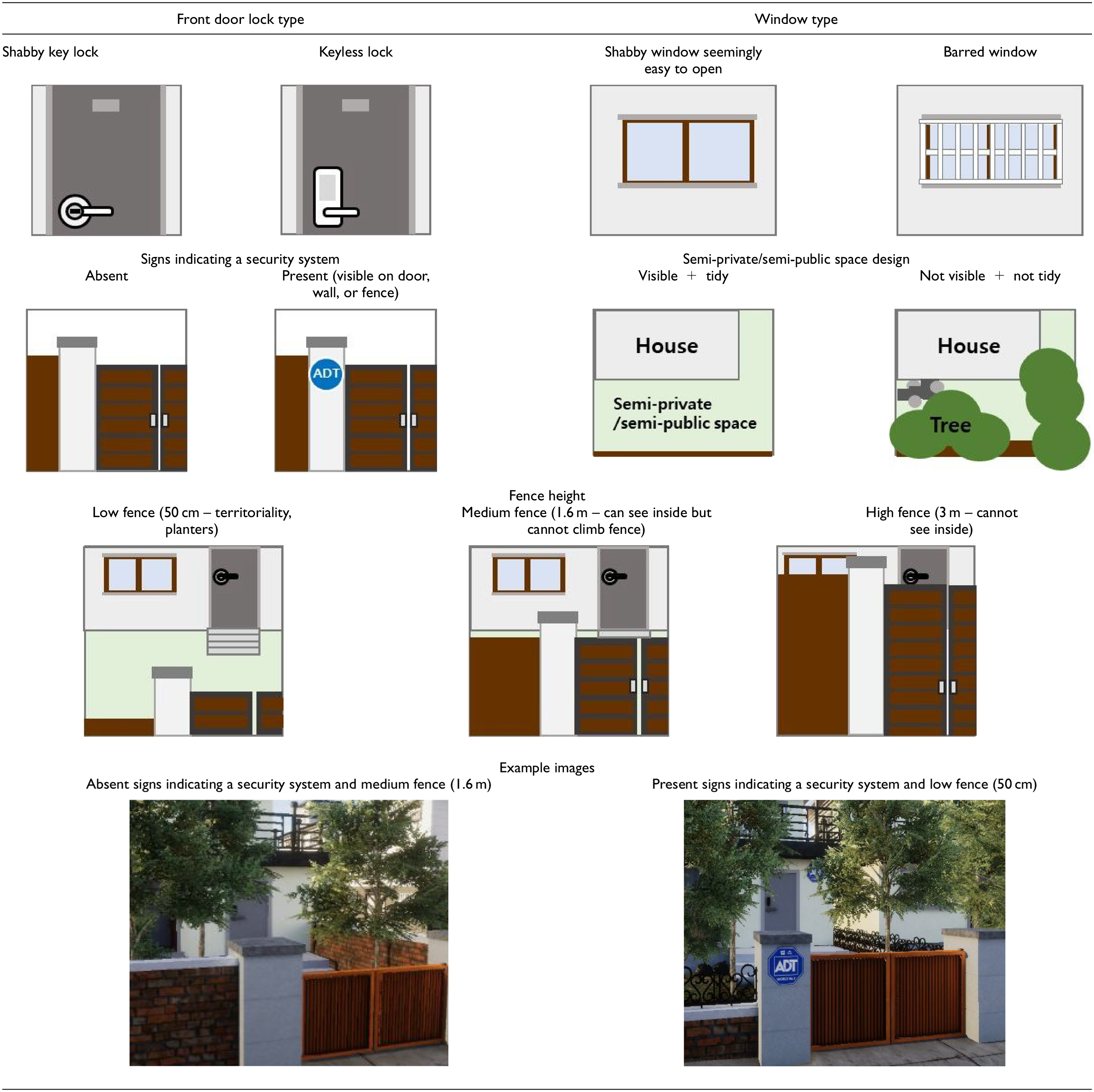
VR Experiment Scenarios (Stimuli) and Simulation
To build VEs of Seoul’s high-density low-rise residential areas, we established typical residential types and specifications for a typical residential street. First, a typical residential street was 6 m wide without sidewalks, and the residential types were limited to single-family houses and walk-up apartments, as these are representative of high-density low-rise residential areas in Seoul. The width of the front façade of each house was set to 10 m, and each side of the street had five buildings. Hence, except for intersections, each block was 50 m long (Figure 2), and the sunlight level was set to that for the day of 26 April at 3 pm.

Example of a street and the surrounding building layout, and examples of the user’s view in the virtual environment simulation (bottom left: environment 1; bottom right: environment 3).
Considering all the aforementioned CPTED principles, there were 96 and 8 profiles for single-family houses and walk-up apartments, respectively. However, constructing each scenario in a VE requires significant time and expense, and participants might experience VR sickness or reduced concentration in VR experiences (especially if they are extensive), which may lead to lower response accuracy. Therefore, instead of constructing 96 different single-family houses in the VE, we employed an orthogonal design to reduce single-family house scenarios from 96 to 32 using SPSS version 25. As the original number of scenarios for walk-up apartments was already low at the beginning, it remained unchanged. In total, we used 40 types of residential designs in the VEs.
Still, if we were to display all 40 types of residence in one virtual town, we would have to consider the impact of location, and requiring participants to evaluate all 40 residence types in a single experiment could once again hinder response accuracy. Therefore, to ensure a more efficient experimental process, that participants would be able to efficiently evaluate the different buildings, and efficient control of variables through the street environment, we created four different streets and placed 10 residence types on each street, meaning that 10 residence types were evaluated in each experiment session. All four streets were identical, except for the different residence types. The presentation of streets occurred randomly in the VR experiment to minimize the impact of the order of display on participants’ responses.
Regarding the distribution of residence types in each of the four streets, first, each street had two walk-up apartments because there were only eight types. Second, as the location of the residences on the street could influence participants’ answers, one of the two walk-up apartments was placed in the center of the street, and the other was placed either at the beginning or at the end of the street. Using these rules, the final placements were determined randomly using Excel’s random function. Afterward, the 32 single-family house types were placed in the remaining spaces, randomized using Excel, and placed as shown in Figure 2.
All VEs, including street and building designs, were simulated using Unity software. Table 3 presents a side-by-side comparison of the actual reference image used to model the VE and the simulation using Unity.
Comparison of the Reference Environment (Real Environment) and the Virtual Environment.
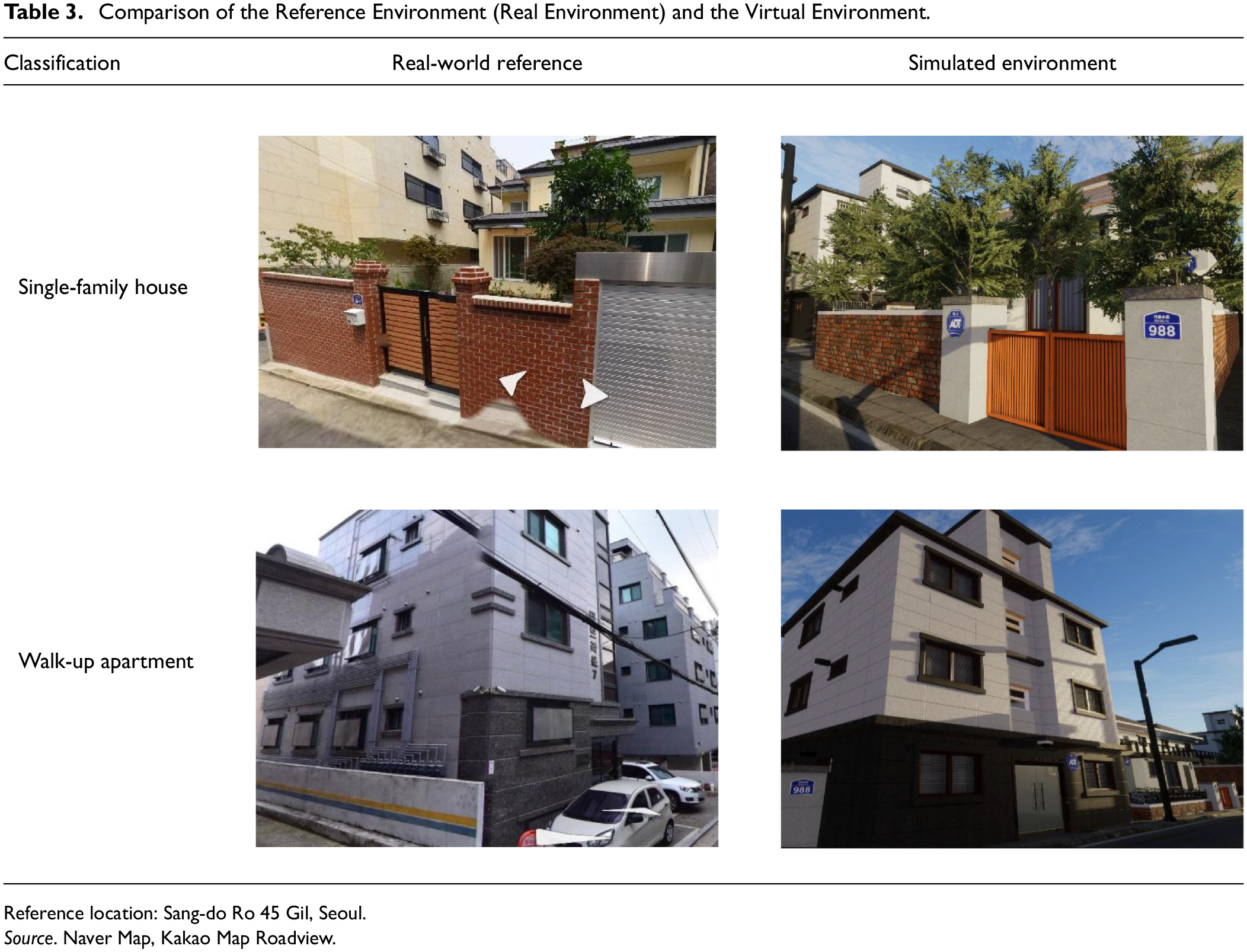
Reference location: Sang-do Ro 45 Gil, Seoul.
Source. Naver Map, Kakao Map Roadview.
Participants
The participants were limited to adults who could use VR technology. We began recruiting participants on 22 June 2022 using on/offline snowball sampling methods and finally recruited 100 participants. Because VR headsets could only be used by one person at a time and only two headsets were used, there were practical limitations for sample size. It may be advantageous for experimental studies that feature sample limitations to conduct experiments by cohorts, as this may ensure more noteworthy analysis results. Similar reasons have led past researchers to conduct VR research with participants from homogeneous groups. For example, Kim and Kim (2019) used VR to analyze the sense of enclosure by square type among 69 urban planning college students. Schwebel et al. (2016, p. 10) included 47 elementary school students as participants in a VR experiment for pedestrian safety education. Additionally, Schneider and Bengler (2020) reviewed 87 experiments that used VR to analyze pedestrian behavior, concluding that the number of participants was typically low (average 69.5, median 49) and that many studies recruited college students as participants. Regarding sociodemographic characteristics, participants of the current study had an average age of 23 years, with 44 male and 56 female participants. Participants’ house type was almost equally split between high-rise apartments and walk-up apartments at 49% and 51%, respectively (Table 4).
Definition of Variables and Descriptive Statistics.

Experiment Procedures and Survey Questionnaire
The experiment was conducted from 22 June to 31 July 2022 at the Chung-ang University Seoul Campus. When the participants arrived at the experimental site, they reviewed the objectives and purposes of the experiment and signed a consent form. Next, each participant completed a pre-survey (Appendix 1), which mostly included questions on sociodemographic characteristics that were used as control variables (Table 4). Once completed, the participants wore the VR equipment and were instructed to use and experience the technology before starting the experiment. To increase familiarity with the VEs and facilitate immersion, we chose a random VE for them to experience and provided participants with the following contextual narration:
You are recently unemployed. You have previous experience in breaking to steal goods from residences to secure your living expenses. You were lucky not to be caught by the police last time. During the recent few months, you have been struggling to make ends meet and you have decided to break into a house to steal money. Based on your prior intrusion experience, you choose a college district that has a mix of single-family houses and walk-up apartments. It’s 3 pm on a weekday, a time when people are most often out of their homes. You are at the entrance of a residential street, looking for a house to steal from.
After the narration, the participants observed each of the four streets with a total of 40 randomly distributed buildings. The experimental assistant ensured that each participant had sufficient time to observe each house. For each house, respondents were asked the following question, which was answered on a scale of 1 to 7 (1, “Very unlikely”; 7, “Very likely”): “With what you can see now and, from a thief’s perspective, how likely are you to intrude and steal from this house?”
All four VEs were presented in random order to minimize the potential order impact. Additionally, every participant was directed, in each VE, to start at the entrance of the street, proceed to the left, right, one step forward, left, and right, and repeat this behavior in this order until reaching the end of the street.
Following the VR experiment, we asked participants an open-ended question, “If you answered that you intended to burgle a home, which features of the house did you consider in your decision?” The answers to this question were used to support the quantitative analysis of the experiment.
The aforementioned experimental process and detailed protocols were adjusted through a pilot experiment a month before the experiment. The pilot allowed us to understand the average time it took for a participant to observe one house and complete the entire experiment, which in turn allowed us to make informed decisions about the compensation amount that would be provided to participants and the daily number of participants that we could implement. Additionally, during the pilot study, we received feedback saying that people without prior crime experience struggled to express their criminal intent. Based on this feedback, we further specified and adjusted the contextual narration, as well as the response scale of intention to burgle from 11 to 7 points.
We used a Vive Pro VR headset with a maximum 4K resolution in the experiment. As the study was conducted during a period when COVID-19 was a problem in South Korea, we followed the COVID-19-prevention protocols strictly by sanitizing the equipment after every use, having the experimental assistant wear a mask at all times, and ventilating the air within the classroom. We also encouraged participants to use hand sanitizers, took their temperatures, and requested them to wear masks upon entering the classroom. The classroom capacity was limited to five people at a time, and because of limited equipment, only two participants could participate in a session, and all participants were requested to experiment during pre-designated times. All study procedures were approved by the Chung-ang University Institutional Review Board (approval number: 1041078-202203-HR-092).
Analysis Method, Variables, and Model Specification
We applied an ordered logistic regression model to the data acquired from the VR experiment to analyze the effects of CPTED principles on the intention to burgle a residential home. The test variables were the representative variables of the CPTED principles, as follows: (1) front door lock type; (2) window type; (3) signs indicating a security system; (4) semi-private/semi-public space design, and (5) fence height. In the model, the fence height was the only continuous variable, and all other elements were used as dummy variables. However, in the case of walk-up apartments, semi-private/semi-public space design and fence height were not included in the VR simulations. Therefore, these two elements are not applicable as test variables for these apartments.
The definitions of the various control variables are listed in Table 4. Most variables, such as participants’ sociodemographic characteristics, were collected through the pre- and post-surveys and are listed in the previous subsections of this paper. One variable that is not mentioned in previous sections is “order of house presentation,” which was used to control for potential order effects (Badland et al., 2010; Mouratidis & Hassan, 2020). Other dummy variables used to control for external factors that could influence the results included participants’ height, whether the participant wore glasses, visual acuity, prior VR experience, and the survey assistant.
Results
Descriptive Statistics
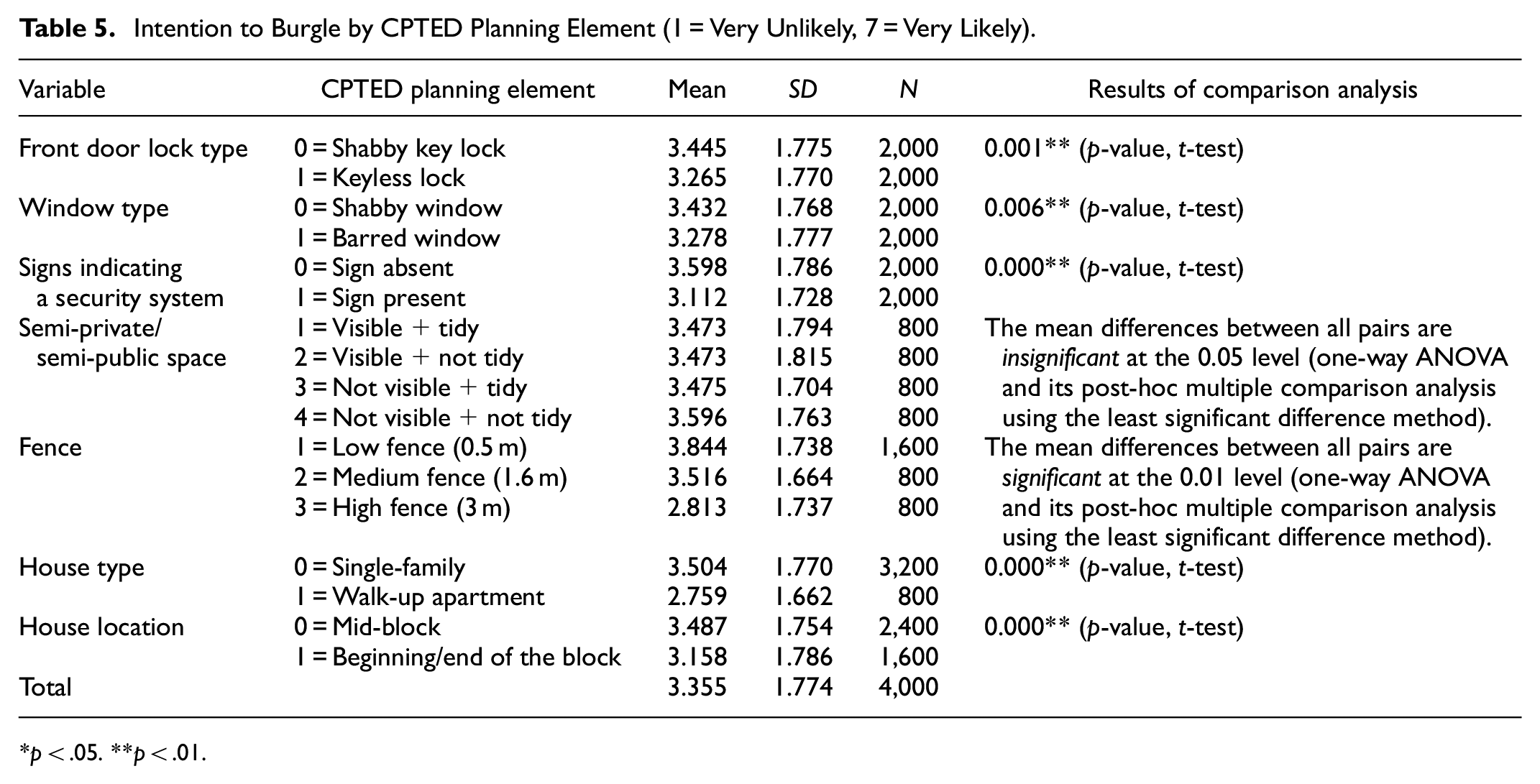
Table 5 presents the average intention to burgle a residential home by the CPTED principle. The average intention to burgle for the 4,000 responses (100 participants multiplied by 40 buildings) was 3.355. For each CPTED principle when not controlling for the other principles, the results were as predicted: intention to burgle was lower for houses that complied with access control CPTED principles, such as keyless front door locks, barred windows, and visible signs indicating a security system. Moreover, the greater the fence height, the lower the intention to burgle. Therefore, in the regression analysis, fence height was considered as a continuous variable rather than a categorical variable. For semi-private/semi-public space design, there were no significant differences by residence type.
Intention to Burgle by CPTED Planning Element (1 = Very Unlikely, 7 = Very Likely).
p < .05. **p < .01.
Intention to burgle was higher for single-family houses than for walk-up apartments. Thus, single-family houses were more likely to be targeted than walk-up apartments, and the intention was higher for housings mid-block than those at either the beginning or the end of the block, explaining the existence of the “eyes on the street” effect (Jacobs, 1961).
Impact of CPTED Principles and Other Control Variables
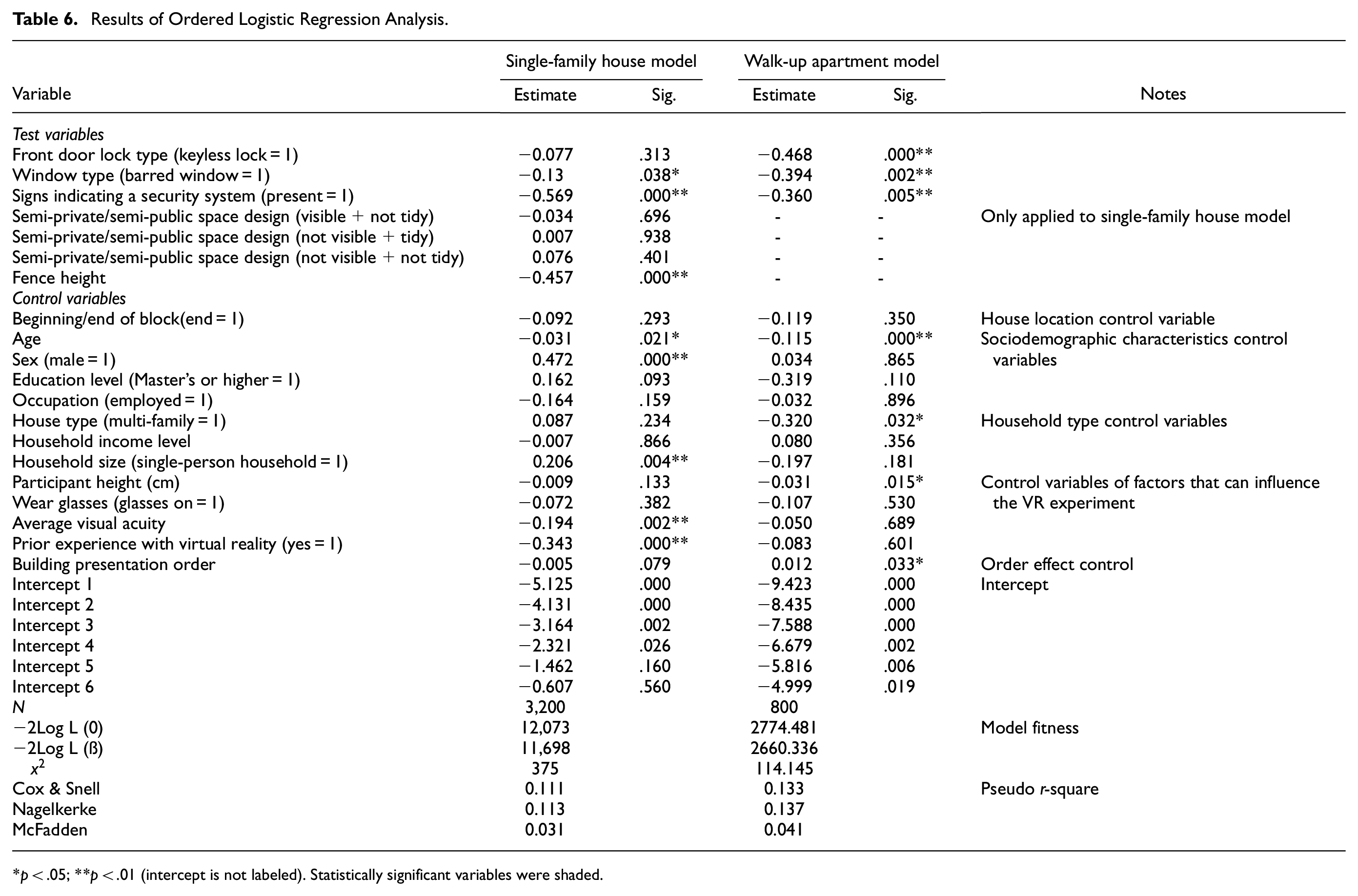
According to ordered logistic regression analysis (Table 6), access control through target hardening, which is known to proactively prevent residential burglaries (Reynald, 2015; Tilley & Webb, 1994), significantly affected the intention to burgle. First, the intention to burgle was lower for single-family houses and walk-up apartments with barred windows or signs indicating a security system. Second, the keyless front door lock variable was negatively associated with the intention to burgle only in the model for walk-up apartments. This was probably because the front door lock types of walk-up apartments were more visible than those of single-family houses.
Results of Ordered Logistic Regression Analysis.
p < .05; **p < .01 (intercept is not labeled). Statistically significant variables were shaded.
Fences are related to both access control and territoriality, and for single-family houses, the higher the fence height, the lower the intention to burgle. This result supported the findings in previous studies showing that physical barriers, including fences, lower the possibility of residential burglary (Brown & Altman, 1983; Ham-Rowbottom et al., 1999; Marzbali et al., 2016; S. Y. Park & Lee, 2021; Reynald, 2015).
Semi-private/semi-public space design did not significantly influence intention to burgle, implying that the maintenance level and visibility of semi-private/semi-public spaces, such as yards, may not affect intention to burgle in Seoul’s typically high-density low-rise residential areas. Housing location also did not significantly affect the intention to burgle, a finding that differs from that in the descriptive statistical analysis.
Some control variables significantly affected the intention to burgle. First, regarding sociodemographic characteristics, the older the participant, the lower the intention to burgle single-family houses and walk-up apartments. Men also reported a higher intention to burgle than women regarding single-family houses—a finding similar to those in past research (Marzbali et al., 2016; S. Y. Park & Lee, 2021). Regarding house type, participants living in apartments had a lower intention to burgle walk-up apartments, whereas those living in single-person households reported a greater intention to burgle single-family houses.
Regarding control variables pertaining to experimental design and settings, there were some significant coefficients. Nonetheless, instead of theoretically interpreting these results, determining how these findings may help prevent the impact on future research may be more useful. For example, the order in which walk-up apartments were presented had a significantly positive coefficient, indicating a stronger intention to burgle as the experiment progressed. Therefore, researchers in the future conducting similar experiments could provide more warm-up tasks to adjust participants to similar experimental conditions.
Discussion
This study used VR technology to analyze the influence of all five CPTED principles on the intention to burgle in high-density low-rise residential areas in South Korea. Access control and target hardening principles, such as barred windows and attaching signs indicating a security system, effectively reduced the intention to burgle. This is consistent with studies in European and North American countries showing that anti-robbery screens, door and window designs that can withstand forced entry, and burglar bars are effective in preventing residential burglary (Reynald, 2015). Specifically, the front door lock variable was found to be significant only in walk-up apartments in the current study, where the safer the door lock system, the lower the intention to burgle. This finding showing that a greater front door lock system provides greater safety may be related to a specific reality of South Korea, where there have been many cases where people were able to copy the front-door key of houses or to break keylocks using the equipment. Moreover, the fence height variable, which is applied only in the single-family house model, significantly influenced the intention to burgle, where the higher the fence height, the lower the intention to burgle.
Upon comparing these findings with those of past similar studies, we can observe similarities and differences. Regarding similarities, access control and target hardening, such as window screening, physical barriers, and housing detachment (i.e., adjoining and terraced) elements, were also found to contribute to lowering the intention to burgle in past research (Marzbali et al., 2016; Montoya et al., 2016). Regarding differences, as representative variables of territoriality, whether the front garden was paved (Montoya et al., 2016) and whether the landscape was organized (Marzbali et al., 2016) were found to have a significant influence on intention to burgle in these cited past studies. Meanwhile, the similar variable in the current study, namely semi-private/semi-public space design, showed a non-significant influence on the intention to burgle. Furthermore, while the maintenance of housing space was found to have a significant impact on the intention to burgle in both cited studies, it showed no significant results in this study.
Regarding fence height, K. H. Lee and Lee (2008) showed results that are opposite to those in the current study. This is likely because the impact of fence and fence height varies by country and region. For example, in Western societies, including the United States of America, increasing natural surveillance by installing fences is effective in reducing residential burglary because houses are generally either unfenced or the fences are lower than the eye level (K. H. Lee & Lee, 2008). In South Korea, single-family houses typically have relatively high fences, and installing high fences that render the house interior not visible to street passersby is perceived to reduce the likelihood of break-ins (K. H. Lee & Lee, 2008; S. Y. Park & Lee, 2021). Moreover, houses with high fences in the high-density low-rise residential areas of South Korea tend to be inhabited by affluent people, and this may lead potential burglars to think that the security system of the house may be more robust. In fact, by using a virtual model of South Korean-style single-family residential neighborhoods, S. Y. Park and Lee (2021) revealed that the intention to burgle was lower when the fence was 1.6 m high than when it was 1 m high.
Several other reasons make fences an important security feature of high-density low-rise residential areas of South Korea. First, most residential entrances are located on narrow streets (which generally are less than 10 m wide) that are used by both pedestrians and cars, making intrusion and flight relatively easy. Second, most similar residential areas in the country have night-time light pollution standards (illumination ≤ 10 lux) and street walls with consecutive buildings along the narrow street sides, which creates an environment with low natural surveillance. Finally, these areas tend to not have private security systems like those present in large, gated apartment complexes, making houses in these areas more reliant on the security system of individual buildings, which are generally less secure. Specifically, according to South Korean Crime and Criminal Justice Statistics from 2020, high-rise apartments had a residential burglary rate of 0.28%, and this figure was 2.07% for single-family houses and walk-up apartments (Korean Institute of Criminology and Justice, 2021).
As aforementioned, the semi-private/semi-public space design, such as yard designs, did not significantly affect the intention to burgle in the current research, suggesting that considering territoriality in residential burglary prevention efforts for high-density low-rise residential areas of South Korea may be ineffective. Traditionally, single-family houses in these areas use high fences to secure privacy, making their yards often perceived as private spaces and non-visible to passersby. A description by Montoya et al. (2016) concurs with these findings, describing that territoriality perceptions differ by culture. In addition, the semi-private/semi-public space design variable is more affected by the quality and adequacy of the VR simulation than all other CPTED variables. Thus, researchers are urged to conduct future investigations on territoriality and its effects on the intention to burgle residential homes.
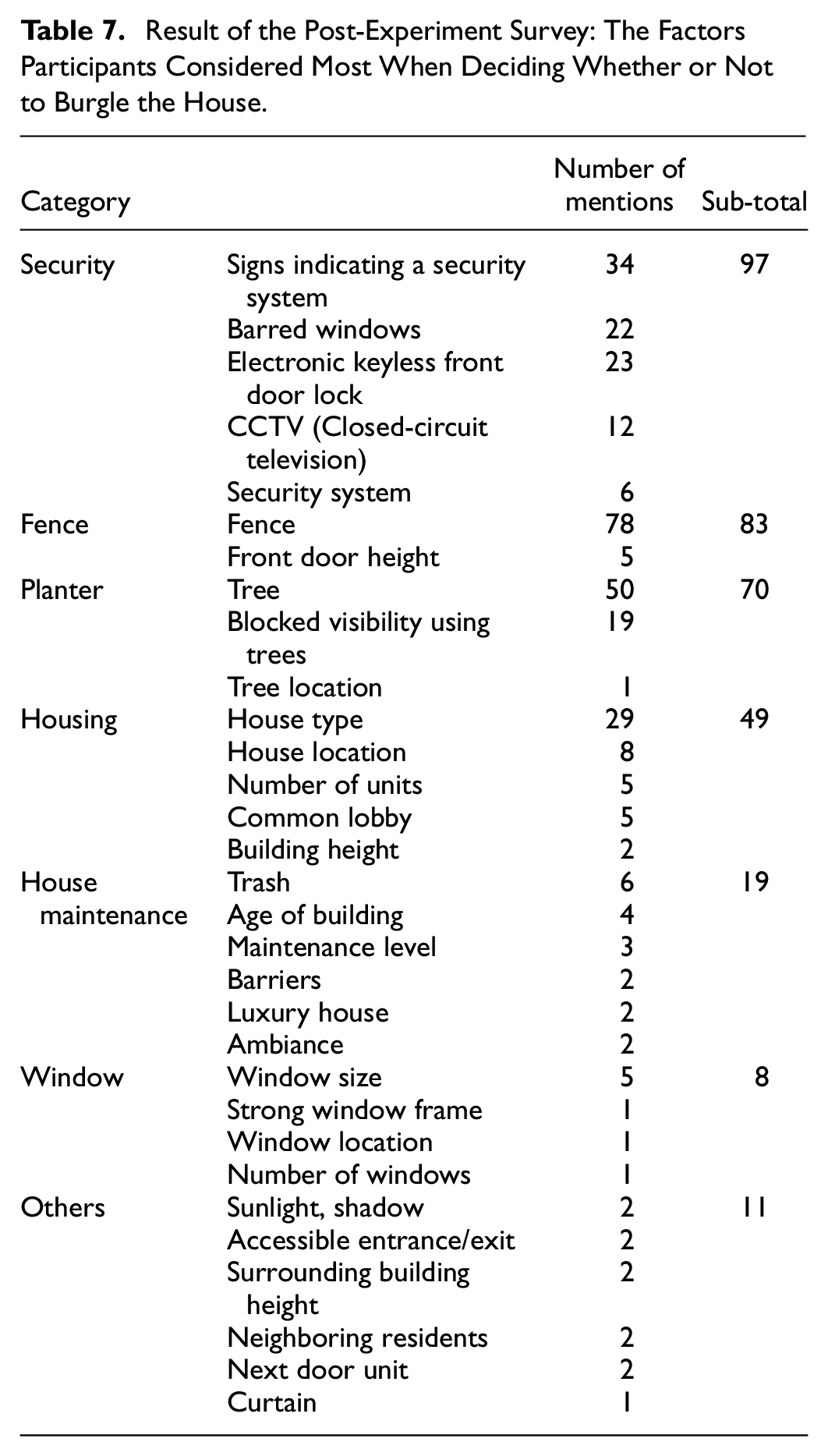
The quantitative research results were generally corroborated in the post-survey responses to open-ended questions. Table 7 presents the participants’ responses to the question of what factors they considered most when deciding whether or not to burgle the house. The most frequently mentioned category was security (97 times), among which the elements most mentioned were signs indicating a security system (34 times), barred windows (22 times), and keyless front door lock (17 times). In contrast, there have been comparatively few mentions of natural surveillance (using trees to block the visibility of the internal space of the house, 10 times) and maintenance (whether there is trash, six times).
Result of the Post-Experiment Survey: The Factors Participants Considered Most When Deciding Whether or Not to Burgle the House.
Conclusion
In this study, VR simulation was used to analyze the effects of CPTED principles on the intention to burgle in high-density low-rise residential areas of South Korea. The key findings are as follows. First, access control elements (e.g., barred windows, signs indicating a security system, and electronic keyless front door locks) decreased the intention to burgle. The post-survey responses to open-ended questions corroborated these quantitative findings. That is, installing crime-prevention facilities and strengthening security services can effectively prevent residential burglaries in high-density low-rise residential areas of South Korea—and these findings comply with past evidence (Montoya et al., 2016; Reynald, 2015; Snook et al., 2011).
Second, several variables showed results that differ from those in past studies conducted in Western countries. Regarding fence height, higher fences lowered the intention to burgle only in the context of single-family houses. Regarding semi-private/semi-public space design, it did not significantly affect the intention to burgle. The traditional and usual characteristics of single-family houses in high-density low-rise residential areas of South Korea may have influenced this result, as these houses tend to have high fences for privacy protection, and their yards are perceived as strictly private spaces. We also found that variables related to house space maintenance did not affect the intention to burgle. These results differ from those of most studies conducted in European and North American countries (Brown & Altman, 1983; Brown & Bentley, 1993; Ham-Rowbottom et al., 1999; Montoya et al., 2016; Snook et al., 2011).
These findings showcase that South Korea’s high-density low-rise residential areas have distinctive characteristics that yielded divergent evidence from those in the literature, and these novel findings could provide diverse perspectives for future residential area designs aimed at crime prevention in Asian developing countries. However, this study has some limitations. The VE did not display the surrounding blocks or the overall neighborhood district, hindering our ability to analyze the neighborhood environment features. The VE was also designed to represent the specific time of day of 3 pm, and this made it impossible for the researchers to compare intent to burgle at different times of the day. Additionally, factors that could affect natural surveillance or strengthening activities, such as people’s movements, street noise, and fence transparency, were not reflected in the VE. Most importantly, although great care was taken to build a realistic VE using Unity software through many simulations and pilot tests, the participants might have been affected by technical imperfections in the realness of the simulation. Although the main CPTED principles are interrelated, this study could not fully verify their interactions. Future research should attempt to use structural equation modeling (SEM) to analyze the factors that influence burglary decision-making (Baki, 2022). Burglary decision-making is not guided by binary logic, such as whether or not to burgle, but rather through fuzzy logic, which in turn proposes various decision-making levels such as low intention and high intention to burgle. Therefore, it is necessary to conduct research on residential burglaries based on fuzzy logic to distinguish between the various decision-making levels of participants.
Future research that builds VEs at the block or neighborhood level could include factors such as pedestrian movement, street noise, time of day, and detailed designs around territoriality to enable a more detailed analysis of the effect of environmental factors on intent to burgle residential buildings. Although territoriality and house maintenance did not yield significant findings in the context of single-family houses in high-density low-rise residential areas of South Korea, similar research is needed on other housing types in the country and other developing countries.
Footnotes
Appendix 1
The pre, during, and post-experiment survey questionnaires (the questionnaires were originally written in Korean, but we have translated them into English for the convenience of the readers).
<
From now on, we will present a total of
“You are recently unemployed. You have previous experience in breaking and entering to steal goods from residences to secure your living expenses. You were lucky to not be caught by the police the last time. During the recent few months, you have been struggling to make ends meet and you have decided to break into a house to steal money. Based on your prior intrusion experience, you choose a college district that has a mix of single-family houses and walk-up apartments. It’s 3 pm in a weekday, a time when people are most often out of their homes. You are at the entrance of a residential street, looking for a house to steal from.”
5. If you answered that you intended to burglarize a home, which features of the house did you consider in your decision?.
Acknowledgements
The authors are grateful for the useful comments from the five anonymous referees and the editor. The authors also thank Woojin Park and Youngseo Kweon for their dedication as experiment assistants.
Declaration of Conflicting Interests
The author(s) declared no potential conflicts of interest with respect to the research, authorship, and/or publication of this article.
Funding
The author(s) disclosed receipt of the following financial support for the research, authorship, and/or publication of this article: This work was supported by the Architecture and Urban Research Institute and was developed based on a research project titled “A Study on Crime Prevention Through Environmental Design (CPTED) Factors Utilizing Virtual Environments.” This research was also supported by the Chung-Ang University research grant in 2023 and the National Research Foundation of Korea (NRF) grant funded by Korea government [RS-2024-00457853].
Ethics Statement
All research processes were approved by Chung-Ang University’s IRB (Approval number: 1041078-202203-HR-092).
