




Abstract
This study assessed the relationship between computer game addiction and computer game usage time, age, gender, BIG-5 personality, and chronotype. Seven hundred and forty-one adolescents from Turkey responded to questionnaires on these topics. We found that computer game addiction, computer game usage time, and chronotype were related with each other. Evening-oriented, younger, and male students had higher computer game addiction scores than morning-oriented, older, and female students. Furthermore, extraverted and agreeable students reported lower computer game addiction. No significant relationship was observed between students’ computer game addiction scores and openness to experience, conscientiousness. We conclude that evening types may be more prone to computer game addiction than morning types.
Introduction
Computer games are the second most frequently used application after social media (Wakoopa, 2012). Computer and online game play rates and sales are increasing every day (Entertainment Software Association, 2012). Computer and online games are preferred by a wide range of people ranging from children and adolescents to adults. Entertainment Software Association’s (2012) research showed that the average game player is 30 years old and 32% of the players are less than 18 years old. Players choose to play games for several reasons such as fun, recreation (Griffiths & Hunt, 1995; Kuss & Griffiths, 2012), coping with stress (Grusser, Thalemann, Albrecht, & Thalemann, 2005; Wood & Griffiths, 2007), sociability, gaining status (Hellström, Nilsson, Leppert, & Åslund, 2012), and escaping real life (Wan & Chiou, 2006; Wood, Griffiths, & Parke, 2007).
Research on video and computer gaming literature reports both positive and negative effects on players. Fifty-two percent of the parents highlighted that computer game playing is positive and an important element of their children’s life (Entertainment Software Association, 2012). Thus, playing games promotes problem solving, visual, motor, and spatial skills and fosters interaction with friends outside of school (Boot, Kramer, Simons, Fabiani, & Gratton, 2008; Phillips, Rolls, Rouse, & Griffiths, 1995). Moreover, games may be effective educational tools and games relieve boredom and stress (Bowman & Tamborini, 2012). Despite the positive effects of playing computer games for adolescents, there are also negative effects, especially addictive computer game playing (Witt, Massman, & Jackson, 2011).
Researchers have been investigating whether computer games can cause time distortion (Rau, Peng, & Yang, 2006), inattention, hyperactivity (Chan & Rabinowitz, 2006), aggressive behavior (Ferguson, 2007), violent acts (Ferguson et al., 2008), and negative emotions (Chumbley & Griffiths, 2006). Furthermore, researchers are investigating whether there is an association between computer gaming and smoking, drug use, depression (Desai, Krishnan-Sarin, Cavallo, & Potenza, 2010), negative self-esteem, social anxiety and loneliness (Van Rooij, Schoenmakers, Vermulst, Van Den Eijnden, & Van De Mheen, 2011), introversion, sensation-seeking, neuroticism, low emotional intelligence (Kuss & Griffiths, 2012), and low well-being (Barnett & Coulson, 2010). Most of this work found correlations between games and negative outcomes, but there are also a lot of studies reporting no correlation or only weak correlations between games and negative outcomes, especially with respect to aggression (see in Sherry, 2001; Elson & Ferguson, 2013a, 2013c; Ferguson, 2007).
Although less than 4% to 5% of the users—adolescents and secondary school students—are addicted to video/computer game (Kuss & Griffiths, 2012), some of the authors expressed that computer game addiction is common in adolescence and this causes a cycle of moral panic (see the moral panic issue of computer games in Barnett & Coulson, 2010; Elson & Ferguson, 2013b; Ferguson, Coulson, & Barnett, 2011). Hellström et al. (2012) found using computer games for escapism and gaining status increased their negative effects and, in contrast, using games for fun and sociability decreased negative effects of games.
Most of these negative effects of games are related to addictive game playing (Witt et al., 2011). Adverse effects may be labeled as “computer game addiction.” Internet gaming disorder is included in the Diagnostic and Statistical Manual of Mental Disorders (5th ed.; DSM-5; Petry & O’brien, 2013). However, there are some problems related with the consensus on definition, criteria, and measurement of computer game addiction in the literature (see Ferguson, 2002, 2007; Ferguson et al., 2011; Wood, 2008). Nevertheless, computer game addiction (CGA) is defined as an addictive gaming that may negatively affect daily life, business or academic life, and health. Some of the key indicators of CGA are as follows: being unable to stop playing games, compensating lack of success in real life with success in games, procrastinating responsibilities because of playing computer games, and preferring games over other activities (Horzum, 2011). Motivation is another important factor in CGA. Most of the players are motivated for games by achievement, sociability, and immersion (Yee, 2006). In the studies of game addiction and playing motives, Hellström et al. (2012) found only escapism to be related with CGA; Kuss, Louws, and Wiers (2012) found escapism and mechanics, Kneer and Glock (2013) found only immersion and escapism, and Klimmt, Schmid, and Orthmann (2009) found achievement, sociability, and immersion to be correlated with CGA. These studies emphasize the role of motivation in CGA.
Gender, Age, Chronotype, and Personality in CGA
Gender and age
Gender and age are important factors of CGA, computer game usage time (CGUT), and choice of genres (Wood, 2008; Xu, Turel, & Yuan, 2012). Boys and men are more addicted (Chiu, Lee, & Huang, 2004; Chou & Tsai, 2007; Griffiths, Davies, & Chappell, 2004; Hartmann & Klimmt, 2006; Horzum, 2011; Quaiser-Pohl, Geiser, & Lehmann, 2006; Walther, Morgenstern, & Hanewinkel, 2012; Xu et al., 2012) and spend more time playing on computers than girls (Chou & Tsai, 2007; Festl, Scharkow, & Quandt, 2013; Lucas & Sherry, 2004; Witt et al., 2011). However, in their large sample, Festl et al. (2013) reported no significant gender differences.
There is a negative relationship between age and CGA/CGUT (Festl et al., 2013; Mentzoni et al., 2011) with 11- to 17-year-old adolescents being more addicted (Festl et al., 2013; Walther et al., 2012; Xu et al., 2012) and spending more time (Lemola et al., 2011) than younger or older adults.
Personality
Wood (2008) highlighted that individual biological and psychosocial variables appear to be important predictors for CGA. Computer game addicted people score higher in neuroticism (Chen, 2008; Huh & Bowman, 2008; Mehroof & Griffiths, 2010; Peters & Malesky, 2008) and openness (Jeng, 2008) but lower in extraversion (Charlton & Danforth, 2010; Huh & Bowman, 2008; Peters & Malesky, 2008; Walther et al., 2012) and agreeableness (Charlton & Danforth, 2010; Collins, Freeman, & Chamarro-Premuzic, 2012; Huh & Bowman, 2008; Peters & Malesky, 2008). Collins et al. (2012) found no relation between CGA and extraversion, neuroticism, conscientiousness, and openness to experiences. Most of these studies focused on online gamers and university students. Their findings are inconsistent. Furthermore, the relationship between personality and CGA may be different in adolescents.
Concerning other personality inventories—for example, Festl, Scharkow, and Quandt (2013) used the California Psychological Inventory, Chumbley and Griffiths (2006) used Eysenck’s Personality Impulsivity Scale, Fang and Zhao (2010) used Temperament and Character Inventory—it is found that high CGA scores were associated with aggression, low sociability, low self-efficacy, and lower satisfaction with life (Festl et al., 2013). Sensation seeking and boredom inclination was related to playing computer games and CGA (Chiu et al., 2004; Chumbley & Griffiths, 2006; Fang & Zhao, 2010).
Chronotype and CGUT
Although recent studies revealed important predictors of CGA, the influence of chronotype has not been assessed. Chronotype or circadian typology is an individual difference in personality. Some people prefer morning hours for work and intellectual and physical activity while others prefer evening hours. These circadian preferences are based on a genetic influence that is reflected in hormonal profiles, heart rate, and body temperature (for a general overview see Adan et al., 2012; but also Randler & Schaal, 2010; Randler et al., 2012; Roeser et al., 2012). This genetic basis is also modulated by social and environmental factors (e.g., Leonhard & Randler, 2009). We know from studies on chemical addiction in adolescents (alcohol, drugs, smoking) that evening types have a higher tendency for cigarette craving and alcohol usage (Adan, 1994; Prat & Adan, 2011; Randler, 2008). Furthermore, studies showed that evening type adolescents differ in their time budgets (Kauderer & Randler, 2013): Evening types spend more time in front of screens (Vollmer, Michel, & Randler, 2012), and increased electronic media exposure predict later bedtime (Knutson & Lauderdale, 2009; Shochat, Flint-Bretler, & Tzischinsky, 2010) and a higher amount of television viewing (Gaina et al., 2006).
Evening types spend more time on computer gaming than others (Urbán, Magyaródi, & Rigó, 2011). Moreover, students who played computer games every day have later sleep and wake times and are more evening-oriented (Krejci et al., 2011). Most of the adolescents studied by Lemola et al. (2011) play computer games during the early night. Higuchi, Motohashi, Liu, and Maeda (2005) highlighted that playing games before going to bed delays sleep onset. These studies on time use and time budgets suggest that CGA—as a psychological variable—might be also related to chronotype.
CGUT is strongly related to CGA (Festl et al., 2013; Kneer & Glock, 2013; Rehbein, Kleimann, & Mössle, 2010). Video or computer game-addicted people spend and loose much time with playing game (Wood et al., 2007).
Current Study
It is emphasized in the DSM-5 that studies are needed to examine internet gaming disorder with associated biological features (Petry & O’brien, 2013). Here, we investigate this relationship for the first time and we hypothesize a relationship between CGA and evening orientation. In addition, to control for covariates influencing CGA, we sampled additional covariates that have been found to influence CGA in previous studies such as age, gender, personality, chronotype, and CGUT.
Methods
We applied a quantitative cross-sectional survey in which all relevant variables were measured instantly at the same time.
Participants
Participants were 741 adolescents studying at different schools in Istanbul, Turkey. Participants voluntarily completed the questionnaire. A convenient sampling method was used for the selection of participants. In all, 294 of the participants (39.7%) were female and 446 (60.2%) were male. A total of 240 of the participants (32.4%) were in sixth grade, 203 (27.4%) in seventh grade, and 298 (40.2%) in eighth grade. The age ranged from 11 to 16 years and the mean (±SD) was 12.89 (±1.05) years. In all, 195 (26.3%) students preferred sport games, 61 (8.2%) preferred strategy and intelligence games, 146 (19.7%) preferred adventure and action games, 77 (10.4%) preferred war and shooting games, and 36 (4.9%) students preferred card games.
Instruments
Composite Scale of Morningness (CSM)
The CSM was adapted to Turkish by Önder, Beşoluk, and Horzum (2013). The CSM is composed of 13 Likert-type scale items (10 items are coded on a 4-point Likert-type scale and 3 items are coded on a 5-point Likert-type scale) and the total score varies from a minimum of 13 (high evening orientation) to a maximum of 55 (high morning orientation). The scale is used in many different countries and shows good psychometric properties and convergent validity (Caci, Deschaux, Adan, & Natale, 2009; Randler, 2009). Cronbach’s alpha coefficient of the scale reported by Önder et al. (2013) was .73.
BIG-5 Inventory
The BIG-5 Inventory was used in its short version consisting of 10 items comprising 5 personality dimensions (extraversion, agreeableness, conscientiousness, neuroticism [the opposite of emotional stability], and openness to experience) with 2 items for each dimension on a 5-point Likert-type scale. The inventory was developed by Gosling, Rentfrow, and Swann (2003) and adapted to Turkish by Günel (2010). The internal consistency of the dimensions ranged from .70 to .89.
Computer Game Addiction Scale
The CGA scale was developed by Ayas, Çakir, and Horzum (2011). The CGA scale consists of one factor and 26 items (see scale and item statistics in the appendix) in the form of a 5-point Likert-type scale. The total score varies from a minimum of 26 to a maximum of 130 with high scores reflecting higher CGA. The internal consistency of the scale was .95 in Ayas et al. (2011) and .92 in this study. We rate relative levels of symptoms of CGA on a continuous scale and we do not apply a clinical diagnosis or cut-off scores.
Procedure
Permission for conduct was obtained from the National Education Directorships. Participation was anonymous and voluntary. One of the researchers applied the scale and if any question from students arose about the questionnaire, he gave information and assisted the participants. For the statistical analyses, we applied hierarchical linear regressions to evaluate how well variables predicted CGA, and to assess if chronotype adds significantly to the well-known predictors of CCGA. These analyses were performed via SPSS 20.
Results
Participants’ age ranged from 11 to 16 years (M ± SD; 12.89 ± 1.06), CGA scores ranged from 27 to 127 (M ± SD; 50.13 ± 18.50), daily CGUT ranged from 0 to 600 min (M ± SD; 108.57 ± 88.62), and morningness−eveningness scores ranged from 13 to 51 (M ± SD; 35.11 ± 6.12). Concerning BIG-5 factors mean scores (±SD) were 3.61 (±0.95) for extraversion, 3.93 (±0.83) for agreeableness, 4.11 (±0.81) for conscientiousness, 2.98 (±1.03) for neuroticism and, finally, 3.45 (±0.95) for openness to experience. In our sample, neuroticism scored lowest and conscientiousness highest.
CGA and CGUT were significantly correlated, r = .576, p < .001. Pearson’s correlations were used to assess bivariate relationships with CGA scores as dependent variables and age, BIG-5 factors, CGUT, and chronotype as independent factors (see Table 1). We found a significant positive relationship between CGA scores and neuroticism. Negative correlations existed between extraversion, agreeableness, conscientiousness, openness and morningness on the one side and CGA on the other. This suggests that extraverted, agreeable, conscientious, open and morning-oriented students are less addicted to computer games. Due to the high sample size, low correlations also became significant.
Bi-Variate Pearson’s Correlations Between Computer Game Addiction With the Predictors Age, Big Five Personality Factors, Chronotype, and Computer Game Usage Time.
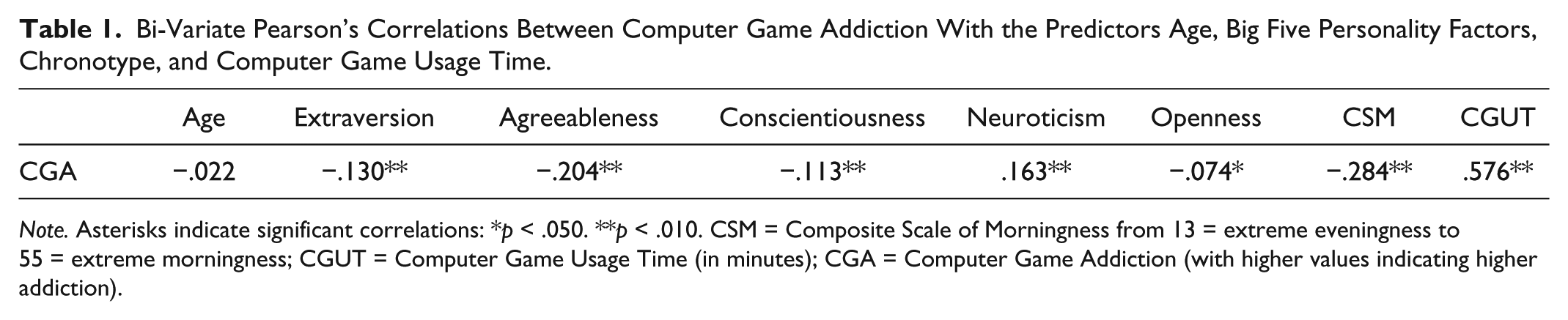
Note. Asterisks indicate significant correlations: *p < .050. **p < .010. CSM = Composite Scale of Morningness from 13 = extreme eveningness to 55 = extreme morningness; CGUT = Computer Game Usage Time (in minutes); CGA = Computer Game Addiction (with higher values indicating higher addiction).
The hierarchical regression model contained age and gender as predictors of CGA in the first block (Table 2). In the first block, F change was not significant: F change (2, 659) = 1.202, p > .05, R2 change = .004. In the second block, BIG-5 factors were added to the predictors. The second block’s F change was significant and R2 change increased compared with the previous block: F change (5, 654) = 9.820, p < .001, R2 change = .070. Third, we added CSM scores as a predictor of CGA scores. The third block’s F change was significant and R2 changed: F change (1, 653) = 50.721, p < .001, R2 change = .066. Finally, we added CGUT as a predictor of CGA scores to the fourth block (Table 2). The fourth block’s F change was significant and R2 change increased compared with the previous block: F change (1, 652) = 294.098, p < .001, R2 change = .268.
Hierarchical Regression Analyses of Computer Game Addiction.

Note. Predictors were entered in four steps. First, age and gender were input, in Step 2 personality based on the Big Five was entered, in Step 3 chronotype was entered, and finally in Step 4 CGUT was entered. Gender: 0 = female, 1 = male. CSM = Composite Scale of Morningness from 13 = extreme eveningness to 55 = extreme morningness; CGUT = Computer Game Usage (in minutes); CGA = Computer Game Addiction Scale (with higher values indicating higher addiction). Durbin−Watson* = 1.696, Tolerance values** range from .378 to .957 and VIF values** range from 1.045 to 2.648.
Durbin−Watson value was near 2, and nonautocorrelation between variables is indicated.
All tolerance values are greater than .20 and VIF values smaller than 5, no multicollinearity problem is indicated.
Significant effects are printed in bold.
There was a significant and strong influence of M/E on CGA with evening type students scoring higher on the CGA. This indicates that CSM scores add to the model of CGA in addition to previously identified factors, such as age, gender, and personality. Students with a higher CGUT scored higher on CGA.
Discussion
As the most important result, we found a strong influence of chronotype on CGA. In the discussion, we follow each aspect separately keeping the structure of the hierarchical regression analyses.
Gender revealed a significant influence on CGA. A higher scoring of males in this trait has been found in many studies (Hartmann & Klimmt, 2006; Horzum, 2011; Walther et al., 2012; Xu et al., 2012) and was confirmed by our findings. Some researchers suggest that males have a stronger motivation to play (Chou & Tsai, 2007) and pick up more positive thoughts from playing computer games, and thus, computers are regarded as a “male toy” (Horzum, 2011). In addition, when playing games, males’ brain satisfaction region seems to be more active than females’ (Hoeft, Watson, Kesler, Bettinger, & Reiss, 2008). Furthermore, males have an inherent advantage in visual memory. Moreover, males perform better in visual memory on male exemplars while females perform better on female exemplars (Ferguson, Cruz, & Rueda, 2008). Most of the games have male exemplars and gender differences may be affected by exemplars or their visual memory affect. Another reason is parental style. In some countries, parents exert more control over internet, computer, and game use of their daughters than of their sons, and parents are more permissive toward their sons (Horzum & Bektas, in press). Families’ permissive parental style causes males to play more often and longer that may lead to higher addiction.
There was a negative effect of age on CGA. These findings are consistent with the literature. In our study, participants’ age ranged from 11 to 16. This age group is most addicted (Festl et al., 2013; Walther et al., 2012; Xu et al., 2012) and adolescents from this age group spent more time with computer games than adults (Lemola et al., 2011).
We found a significant influence of all five personality domains on CGA in bivariate correlations but in the regression model, only the influence of extraversion, agreeableness, and emotional stability on CGA remained significant. This may have several reasons, but one reason might be that BIG-5 personality factors are correlated with morningness−eveningness, especially conscientiousness is strongly related to CSM scores (Randler, 2008), which suggests that the nonsignificant influence of conscientiousness on CGA might be owed to the higher statistical influence of morningness−eveningness. Extraversion and agreeableness were inversely related to CGA. Introverted people are described as solitary, shy, moody, quiet, relying on the decisions of others. Introverted people usually have a poorer social network and experience more rejection by peers (John & Srivastava, 2008). On one side, introverted people may rather express themselves and their feelings by playing computer games, or on the other side, may compensate for or eliminate loneliness while playing computer games. Concerning agreeableness, typical features of disagreeable people are independence, skepticism, irritability, and moodiness. Disagreeable people don’t trust others and prefer competition over cooperation (John & Srivastava, 2008). Therefore, computer games may be suitable for disagreeable people’s feelings of independence and competition.
In the regression analysis, conscientiousness and openness to experience were unrelated to CGA. This finding is consistent with Collins et al. (2012). However, conscientious students have a more organized and planned personality. Therefore, these students’ CGA was expected to be lower than the CGA of less conscientious people—see the results in Table 1—because they keep an eye on their daily duties. Openness to Experience does not seem to be associated with CGA.
The relationship between CGA and eveningness is new and has not been shown previously, although research suggests that this relationship should be highly likely, as, e.g. Kauderer and Randler (2013) found that evening type adolescents spend more time on the computer (based on a time budget study), and Vollmer et al. (2012) reported a longer screen time of evening types (assessed by self-report Likert-type scales). As eveningness is related to higher substance use and misuse (Adan et al., 2012), we here add behavioral computer games addiction as another risk factor for evening-oriented adolescents.
Evening type students have more emotional problems than morning types (Barclay, Eley, Maughan, Rowe, & Gregory, 2010; Gau et al., 2007; Lange & Randler, 2011), show more problems concerning the timing of sleep (Gau & Soong, 1995), and, finally, achievement problems in school and university are higher in evening-oriented students (Beşoluk, Önder, & Deveci, 2011; Preckel, Lipnevich, Schneider, & Roberts, 2011). Game-addicted players are motivated for games because, apart from school, games are an alternative source for achievement and interplayer competition (Klimmt et al., 2009; Kneer & Glock, 2013; Yee, 2006) with more immediate reward. When games are used for escaping everyday stress and for gaining achievement, they were associated with a high risk for addiction (Hellström et al., 2012). Especially evening-type adolescents may choose to play computer games to escape behavioral problems as some kind of coping mechanism.
Students with high scores CGA had a higher daily CGUT. This might be due to the fact that people with high scores CGA have problems with their control over their time and seek to increase the dose similarly to chemical addictions. Moreover, several researcher used CGUT as a criterion to classify internet addiction or CGA (see Festl et al., 2013; Hellström et al., 2012; Kneer & Glock, 2013; Lee et al., 2007; Rehbein et al., 2010; Wood et al., 2007). Their main findings were that students with high scores CGA spend more time with game playing.
Limitations
One limitation is the correlative nature of the study, and prospective work could help to identify causes and effects. Furthermore, we did not assess the sleep−wake cycle (bed times, rise times) that could add further evidence to this relationship. Probably bed times may become a stronger predictor if assessed together with the CSM scores. Another limitation of the study is that it was conducted before the latest edition of the DSM-5 was published. The new edition of the DSM includes criteria related to game addiction, but in this study, these criteria have not been taken into account. The third limitation of this study is that game motives and gaming motivation was not assessed. As there might be relationships between motivation and chronotype, these correlations might explain the results. In school achievement, for example, motivation and chronotype is related with each other. Fourth, CGA was measured by a self-report scale in this study. Thus, this addiction measurement did not include external validity evidence such as brain waves, heart rate, eating, drinking and hygiene habits and parental monitoring.
Conclusion and Recommendation
In conclusion, our study contributes to the relation between CGA and gender, age, chronotype, CGUT as well as BIG-5 personality. Evening types, younger adolescents, and males spend more time with computer games and report higher CGA. Chronotype was a significant predictor in this study, with a higher amount of variance explained compared with other personality factors. We therefore strongly recommend that future studies should assess chronotype preferences when investigating CGA.
Footnotes
Appendix
CGA scale items. Please note: the original items are in Turkish language; please see in Ayas, Çakir, and Horzum (2011) and note that the translation into English is to aid the reader.
| Items | Factor loading | Item total correlation | α if item deleted |
|---|---|---|---|
| I prefer playing computer games to spending time outside. | .672 | .527 | .951 |
| Computer games are more fun than meeting with my friends in real life. | .520 | .472 | .951 |
| I delay eating to finish a computer game. | .650 | .506 | .951 |
| I feel obliged to play a game on a computer. | .676 | .497 | .951 |
| I get angry when someone interrupts me while playing computer games. | .753 | .575 | .951 |
| I look forward to playing computer games. | .642 | .442 | .952 |
| I think about playing computer games when I am not playing. | .795 | .598 | .951 |
| I cannot stop playing computer games even when I want to. | .512 | .383 | .952 |
| I play computer games longer than I am allowed to. | .615 | .515 | .951 |
| I misinform others about the amount of time I spend playing computer games. | .662 | .514 | .951 |
| No matter how much I play, I cannot get enough of computer games. | .655 | .533 | .951 |
| My family is worried because I spend too much time playing computer games. | .652 | .517 | .951 |
| When the computer game is finished, I think about the mistakes I did in the game. | .733 | .547 | .951 |
| If I lose, play again and again to win a computer game. | .738 | .601 | .951 |
| I delay my homework to play a game on the computer. | .758 | .574 | .951 |
| I get angry with my family when they do not let me play a computer game. | .701 | .529 | .951 |
| I do not feel alone when I play computer games. | .696 | .546 | .951 |
| I prefer playing computer games to doing sports, watching TV. | .663 | .537 | .951 |
| I spend most of my time out of school playing computer games. | .720 | .575 | .951 |
| I do not go to school to be able to play computer games. | .649 | .512 | .951 |
| I exhibit the personalities of computer game characters in real life. | .749 | .584 | .951 |
| I happen to talk to myself while playing computer games. | .757 | .626 | .951 |
| I get tired because I played too long game on the computer. | .713 | .607 | .951 |
| I feel bad when I do not play on the computer. | .761 | .642 | .951 |
| I get up at night while everybody is asleep to play a game on the computer. | .661 | .528 | .951 |
| Although the computer disturbs me, I ignore it for the game’s sake. | .541 | .586 | .951 |

Acknowledgements
We thank all students who responded to the data collection instruments. One author of the article (Horzum) thanks the Council of Higher Education and Sakarya University Commission for Scientific Research Projects for financial support to visit the University of Education Heidelberg. We would like to thank Chris Ferguson and two additional reviewers for their highly competent suggestions.
Declaration of Conflicting Interests
The author(s) declared no potential conflicts of interest with respect to the research, authorship, and/or publication of this article.
Funding
The author(s) received no financial support for the research and/or authorship of this article.