




Abstract
Chronotype refers to individual differences in sleep timing and in preferences for a given time of day while sleep duration refers to the hours of sleep. Here, we assessed chronotype, sleep duration, and nightmare frequency in relation to the Big Five personality factors. Overall, 2,492 persons (1,437 women, 1,055 men) completed the online survey between March 23, 2015, and April 8, 2015. The mean age of the sample was 47.75 ± 14.41 years. In bivariate correlations, age, extraversion, agreeableness, and conscientiousness were related to morningness, and openness to experience and neuroticism were related to eveningness. In the multiple regression, gender, neuroticism, and agreeableness were not related to chronotype. Morning types slept less at weekends than evening types, and evening types showed longer sleep latencies. Neuroticism showed the strongest effect on nightmare frequency followed by openness to experience. Nightmare frequency declined with age, and there was a small but significant effect of conscientiousness on nightmare frequency; persons with higher conscientiousness scores reported slightly more often nightmares. Chronotype was not associated with nightmare frequency. To conclude, chronotype is associated with personality factors and sleep behavior (sleep duration on weekends and sleep latency).
Introduction
Why Study Chronotype, Sleep and Personality?
Life is organized in circadian rhythms. This means that many physiological processes have a clear diurnal rhythm which is innate in humans and many other animals (e.g., because they regulate sleep, appetite, mood and cognitive function; Dunlap, Loros, & DeCoursey, 2004). These circadian rhythms affect many psychological processes, for example, positive affect, well-being, and many others (Murray et al., 2009; Tsaousis, 2010). Sleep behavior (as both sleep timing, which is chronotype, and sleep length, as well as nightmares) should be linked with psychological factors, especially the construct of personality. On a genetic basis, an association between the personality factor of extraversion and the PER3 clock gene has been found (Jiménez, Pereira-Morales, & Forero, 2017). This polymorphism is related to chronotype. Therefore, a genetic association between the constructs personality and sleep may exist, which stimulates research in this domain. Furthermore, DeYoung et al. (2010) proposed a neurobiological model of personality based on the Big Five, and these authors linked the meta-trait stability with variability in serotonergic function, and the meta-trait plasticity (combination of extraversion and openness) with variability in dopaminergic function. Serotonin is also involved in the modulation of circadian rhythm in the suprachiasmatic nucleus (Yuan, Lin, Zheng, & Sehgal, 2005); these differences in serotonergic function may be reflected in circadian rhythms (Randler & Saliger, 2011; Tonetti, Fabbri, & Natale, 2009). Thus, there is evidence for a biological basis of the Big Five domains, as well as for chronotype, and both constructs may be linked. However, a link between sleep duration and personality has rarely been tested for a biological basis. In the following paragraphs, we deal with every construct in turn (chronotype, sleep duration, nightmares).
Chronotype
Chronotype refers to individual differences in sleep timing and in preferences for a given time of day (Adan et al., 2012). Morning types prefer to get up and go to bed early, while evening types get up and go to bed later (Adan et al., 2012). This aspect refers to sleep timing (“when to sleep”) rather than to the sleep duration itself, and it is considered a different construct (Randler, 2014). Another aspect is the preference for a given time of day for physical or mental performance (Horne & Ostberg, 1976). Morning types prefer earlier clock times for their peak performance compared with evening types. There are different terms to describe chronotype, for example, circadian preference, circadian typology, and so on; in this article, the term chronotype is used throughout, especially while we use a self-assessment item of chronotype.
Personality has been linked with chronotype based on many different types of personality inventories (for review, see Adan et al., 2012; for meta-analysis, see Tsaousis, 2010). We here focus on the personality concept of the Big Five because it is one of the most widely used conceptualizations of personality. Concerning the Big Five, all studies revealed a positive relationship between morning orientation and conscientiousness (Hogben, Ellis, Archer, & von Schantz, 2007; Randler, 2008; Tonetti et al., 2009; Tsaousis, 2010: r = .33). Second, agreeableness was often related to morningness but with a weaker effect (Tsaousis, 2010: r = .14). This association has been found by DeYoung, Hasher, Djikic, Criger, and Peterson (2007); Hogben et al. (2007); and Randler (2008) but not by Gray and Watson (2002), Jackson and Gerard (1996), and Tonetti et al. (2009). The association with the other dimensions of the Big Five (Neuroticism, Openness, Extraversion) was lower or absent. Concerning single studies, eveningness was marginally but not significantly correlated with extraversion (Jackson & Gerard, 1996), but no other study found a relationship between extraversion and chronotype. Neuroticism was related to evening individuals in some studies (DeYoung et al., 2007; Randler, 2008; Tonetti et al., 2009) but no relationship was found in others (Gray & Watson, 2002; Hogben et al., 2007; Jackson & Gerard, 1996). Concerning openness, evening types had a higher openness (Hogben et al., 2007) while no relationship could be detected in other studies (DeYoung et al., 2007; Gray & Watson, 2002; Jackson & Gerard, 1996; Randler, 2008; Tonetti et al., 2009). In the meta-analysis of Tsaousis (2010), extraversion (0.02) was related to morningness, while openness (–0.02) and neuroticism (–0.05) were related to eveningness, but all three dimensions correlated with a relatively minor effect size (Tsaousis, 2010). In the meta-analysis of Lipnevich et al. (2017), more or less similar results were obtained when considering chronotype as a continuum: These authors obtained correlations of .27 in conscientiousness, .12 in agreeableness, –0.07 in neuroticism, 0.02 in extraversion, and finally, 0.00 in openness.
Age has been found to be one of the most important variables that influence chronotype (Adan et al., 2012; Duarte et al., 2014). Young children at the kindergarten (preschool) age are morning oriented, while during puberty, young people become increasingly evening oriented, and at around the age of 17 to 20 years, a turn toward morningness is reported, supposed to be a marker for the end of adolescence (Díaz-Morales & Randler, 2008; Randler & Truc, 2014; Roenneberg et al., 2004). In adulthood, people become progressively morning oriented again with an increasing age (Paine, Gander, & Travier, 2006; Taillard et al., 2004). Gender or sex differences have been reported in biological factors, for example, with a shorter intrinsic rhythm in women (Duffy et al., 2011), but these effects have not been always found in questionnaire studies. The effect of gender seems small and in many studies, probably masked by age effects (Randler, 2007).
Chronotype is measured by different questionnaires developed for large scale survey (see Di Milia et al., 2013, for a review), and these questionnaires are medium to highly intercorrelated, suggesting that they measure a similar construct (Di Milia et al., 2013). Recently, Loureiro and Garcia-Marques (2015) showed that the self-assessment item of the [Morningness-Eveningness-Questionnaire (MEQ)]/reduced MEQ (rMEQ) was highly correlated with the total score (>0.8 with rMEQ score). Therefore, these authors suggest that this single item can be used in survey studies when time is constraint. We therefore applied such a short measure.
Sleep Behavior
Sleep duration is a different construct than chronotype. Assume a person, who gets up at 6:00 and goes to bed at 24:00, has the same sleep duration as a person going to bed at 22:00 and waking up at 4:00. Comparable to chronotype, sleep duration decreases with age, and there are gender differences with women sleeping longer than men do (see, e.g., Borchers, Ouattara, Vollmer, & Randler, 2015). Most people sleep longer on weekends compared with weekdays (Roenneberg et al., 2007). However, some studies report only a weak correlation between sleep duration and chronotype (Roenneberg et al., 2004), while some studies reported that evening-oriented adolescents had shorter sleep length on weekdays but longer sleep duration on weekends (Collado, Díaz-Morales, Escribano, Delgado, & Randler, 2012).
Concerning sleep duration and personality, also few studies cover these aspects but some did not cover all five dimensions of the Big Five (Friedman et al., 2007; Gray & Watson, 2002; Hintsanen et al., 2014; Randler, 2008; Randler, Stadler, Vollmer, & Diaz-Morales, 2012; Soehner, Kennedy, & Monk, 2007; Vincent, Cox, & Clara, 2009; Williams & Moroz, 2009). Except from one study that reported an association between openness and longer sleep duration (Williams & Moroz, 2009), no other studies have found associations for openness with sleep duration (Gray & Watson, 2002; Randler, 2008; Soehner et al., 2007; Vincent et al., 2009). Agreeableness and sleep duration were not associated (Gray & Watson, 2002; Soehner et al., 2007; Williams & Moroz, 2009), but some studies showed that higher agreeableness is related to longer sleep duration (Hintsanen et al., 2014; Randler, 2008; Randler et al., 2012). One study reported that higher conscientiousness is related to longer sleep duration (Randler, 2008), but other studies reported no association (Gray & Watson, 2002; Soehner et al., 2007; Williams & Moroz, 2009). Higher neuroticism is associated with a tendency to sleep longer (Friedman et al., 2007; Randler, 2008; Vincent et al., 2009), but shorter sleep has also been associated with neuroticism (Gau, 2000; Vincent et al., 2009). Extraversion has not been associated with sleep duration (Gray & Watson, 2002; Randler, 2008; Soehner et al., 2007; Vincent et al., 2009; Williams & Moroz, 2009). These studies show inconsistent results, which are based on—at least partially—relatively small sample sizes. In addition, many studies are based on student populations, which suggests that sleep duration and personality need further study, especially in large samples of the adult population.
Sleep onset latency is related to the time between going to bed (and lights out) and then falling asleep. This trait has not been under study yet.
Sleep quality is related to a set of variables, such as difficulties falling asleep, awakening too early, as well as night awakenings (Buysse, Reynolds, Monk, Berman, & Kupfer, 1989). Concerning sleep quality, sleep disturbance, and related aspects, Emert, Tutek, and Lichstein (2017) revealed a positive correlation between neuroticism and sleep disturbance (more stable people sleep better), a negative one with conscientiousness (conscientious people sleep better), and a small effect of openness with more open people sleeping better.
Nightmares and Chronotype
Nightmares may be shaped by chronobiological processes that influence normal dreaming, especially the ultradian stage oscillations of Rapid-Eye-Movement (REM) and non-REM (NREM) sleep and the circadian variations of REM sleep propensity (Nielsen, 2010). Dreaming intensity is modulated by a sinusoidal, 90-min ultradian oscillation (see review in Nielsen, 2004). Therefore, differences in chronotype could explain the formation of nightmares (Selvi et al., 2012). Nightmares are defined as disturbing mental experiences that generally occur during REM sleep and often result in awakening (American Academy of Sleep Medicine [AASM], 2014). The prevalence of the nightmare disorder (nightmares associated with clinically significant distress or impairment) in the general population is about 5% (Schredl, 2014). Nightmare etiology is best explained by a disposition-stress model, that is, current waking-life stress and personality factors play an important role (Levin & Nielsen, 2007). In a student sample, eveningness was related to a higher nightmare frequency (Selvi et al., 2012)—paralleling the finding of decreased sleep quality in students with evening preference. Nielsen (2010) confirmed the relationship between chronotype and nightmare frequency in a large online sample, but only for women. It has to be noted that the online sample might have been biased toward participants with high nightmare frequencies as the questionnaire was posted on the website of the Dream and Nightmare Laboratory (Hospital de Sacre-Coeur, Montreal, Canada). Large-scaled studies linking chronotype to nightmare frequency are still missing.
Aims of the Present Study
This study was carried out because the relationship between sleep duration and personality is rather inconclusive. Furthermore, studies on personality and chronotype are well-reflected in reviews and meta-analysis (Adan et al., 2012; Tsaousis, 2010), but there is still a need for studies in large samples, especially in nonstudent adult populations. Furthermore, we use regression analysis to study the incremental predictions of the constructs, and study explained variability. In addition, the relationship between nightmares and chronotype has been rarely assessed and never in the general population. Thus, this study contributes to our knowledge because we applied the questionnaires in a large adult population with a wide age range.
Method
Research Instruments
For measuring chronotype, four items of the German version of the Morning-Evening-Questionnaire MEQ were used (Griefahn, Künemund, Bröde, & Mehnert, 2001); a translation of the original publication by Horne and Ostberg (1976). We used the following items. “Considering only your own ‘feeling best’ rhythm, at what time would you get up if you were entirely free to plan your day?” “Considering only your own ‘feeling best’ rhythm, at what time would you go to bed if you were entirely free to plan your evening?” “You wish to be at your peak performance for a test which you know is going to be mentally exhausting and lasting for 2 hours. You are entirely free to plan your day and considering only your own ‘feeling best’ rhythm which ONE of the four testing times would you choose?” and, finally, “One hears about ‘morning’ and ‘evening’ types of people. Which ONE of these types do you consider yourself to be?” The Chronotype sum score ranged from 2 (extreme eveningness) to 22 (extreme morningness). The internal consistency (Cronbach’s alpha) of the four-item scale was high (0.771, N = 2,492). Different short versions of the MEQ are available and are based on a different set of items (Adan & Almirall, 1991; Jankowski, 2012). The four-item measure correlated with .835 with the full MEQ (tested in a sample of N = 71 university students; unpublished data).
Four items were designed for measuring sleep behavior. First, the typical sleep duration (total sleep time without periods awake) for the typical working day was elicited. Second, the participants were asked for the typical sleep duration on weekends. Third, the typical sleep onset latency had to be estimated. Last, the participants were asked to rate their subjective sleep quality on a Likert-type scale ranging from 1 (very poor) to 10 (very good). Because of time constraints, single items were used to assess these four aspects of sleep behavior.
To assess nightmare frequency, an eight-point rating scale was presented (“How often do you experience nightmares?” 0 = never, 1 = less than once a year, 2 = about once a year, 3 = about 2 to 4 times a year, 4 = about once a month, 5 = about 2 to 3 times a month, 6 = about once a week, 7 = several times a week). Retest reliability of the nightmare frequency scale was high (Stumbrys, Erlacher, & Schredl, 2013): r = .75 (4 weeks retest interval). To obtain units in frequency per month, the scale was recoded using the class means (0 → 0, 1 → 0.042, 2 → 0.083, 3 → 0.25, 4 → 1.0, 5 → 2.5, 6 → 4.0, 7 → 18.0), for example, the nightmare frequency “about once a year” was transformed into 0.083 nightmares per month.
The Big Five personality factors were measured with the German version of the NEO-FFI-30 including 30 items (Körner, Drapeau, et al., 2008). For each of the five factors (neuroticism, extraversion, openness to experience, agreeableness, and conscientiousness), the sum score of the six corresponding items were computed. The internal consistencies (Cronbach’s alpha) were neuroticism 0.883, extraversion 0.761, openness 0.750, agreeableness 0.751, conscientiousness 0.798 for this 30-item version (six items per factor). They were comparable to those of the 60 item version of the NEO-FFI and ranged from r = .67 (openness to experience) to r = .81 (neuroticism; Körner, Geyer, et al., 2008).
Procedure and Participants
Overall, 2,492 persons (1,437 women, 1,055 men) completed the online survey between March 23, 2015, and April 8, 2015. The mean age of the sample was 47.75 ± 14.41 years (range: 17-93 years). The link for the study was posted on the online panel www.wisopanel.net. Within this panel, persons with an interest in online studies and with heterogenic demographic backgrounds are registered. For some surveys, prizes or money are offered for study participation, but this study was completely voluntary and unpaid. Concerning educational level, 0.8% had no degree, 10.47% had 9 years of schooling, 28.33% had O-level (middle degree, Realschule, about 10 years), 26.00% A-level (Abitur), 31.7% obtained a University degree, and 2.69% had doctorate.
Data Analysis Strategy
Statistical procedures were carried out with the SAS 9.4 software package for Windows. First, we present bivariate correlations between the dependent variables of interest (the “sleep variables,” namely chronotype, sleep duration, sleep onset latency, and sleep quality) to make them comparable to previous research. In addition, we carried out multiple regressions to assess the influence of our predictor variables age, gender, and personality on the dependent variables simultaneously. Ordinal regressions (cumulative logit analyses) were used for analyzing the effect of different predictors on nightmare frequency. For interval scales, linear regression analyses have been computed.
Results
The means and standard deviations of all variables are depicted in Table 1. The distribution of the self-assessment chronotype item (Item 19 of the MEQ) was as follows: definitely evening type (n = 481), more evening than morning type (n = 743), more morning than evening type (n = 797), and definitely morning type (n = 471). Sleep duration on weekends was longer than sleep duration at workdays. Mean sleep latency was about a quarter of an hour. The mean of the sleep quality items was slightly higher than the scale midpoint (5.5), indicating that sleep quality was rated as quite good. Mean nightmare frequency in this sample was about one nightmare per month (using the recoded scale).
Mean and Standard Deviations of All Variables.

Bivariate correlations of the predictor variables gender, age, and personality with the dependent variables chronotype and sleep behavior are depicted in Table 2. The linear regression analysis for the chronotype scale indicated significant effects of age, extraversion, conscientiousness, and openness to experiences (see Table 3). Whereas age, extraversion, and conscientiousness were related to morningness, openness to experience was related to eveningness. In this sample, gender, neuroticism, and agreeableness were not related to chronotype. Repeating the analysis for the single item regarding the self-estimates about the chronotype yielded similar results, which is expected given the high internal consistency of the 4-item scale.
Relationship Between Age, Gender, and Personality on Chronotype, and Sleep Variables Based on Bivariate Correlations.
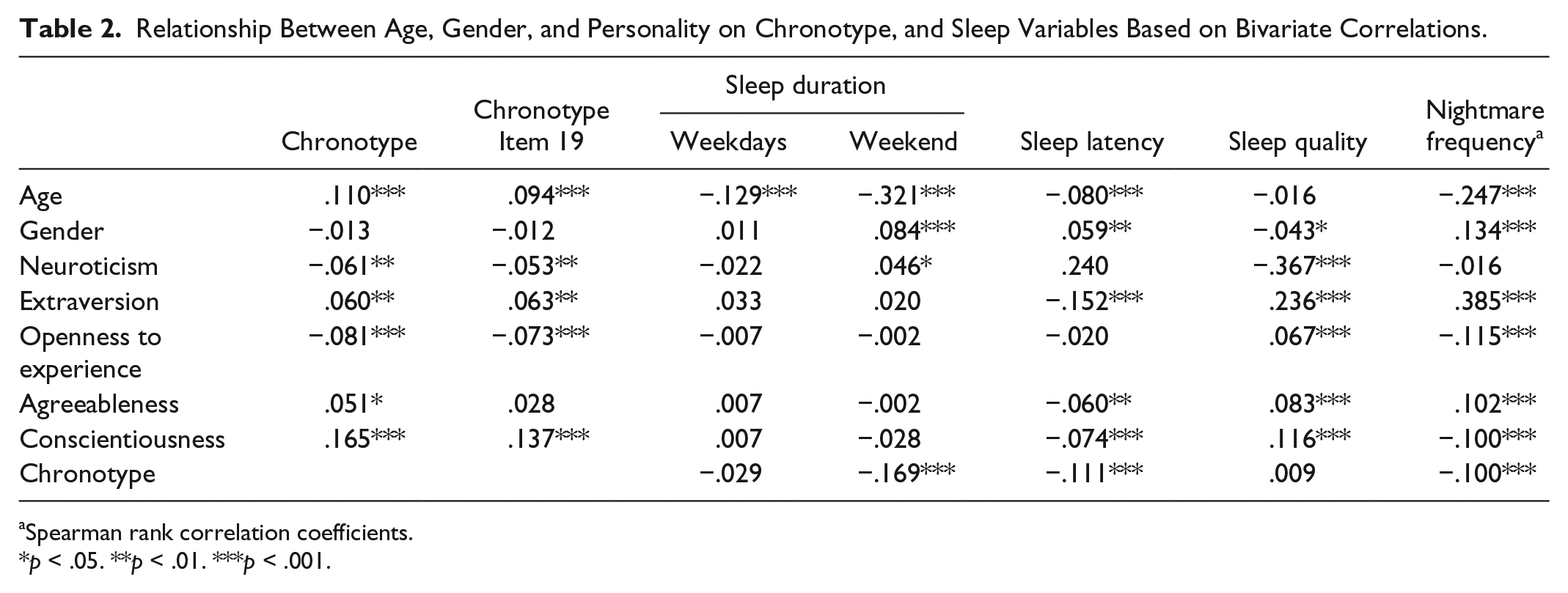
Spearman rank correlation coefficients.
p < .05. **p < .01. ***p < .001.
Linear and Ordinal Regression for Chronotype.

Note. β = standardized estimates; linear regression (Chronotype Scale) and ordinal regression (chronotype Item 19 of the MEQ) include age, gender, and all five personality factors entered simultaneously. R2 adjusted Chronotype Scale R2 =.0420, single Item 19 = 0.0373. MEQ = Morning-Evening-Questionnaire.
For sleep duration on workdays, chronotype was not predictive (only increasing age was related to shorter sleep durations) but for sleep duration on weekends, there was a significant effect (see Table 4). Morning types slept less at weekends than evening types (age was again negatively associated with sleep duration). Chronotype was also related to sleep latency, with evening types showing longer sleep latencies than morning types (see Table 4). In addition, longer sleep latencies were related to neuroticism, whereas extraverted persons reported significant shorter sleep latencies. For subjectively rated sleep quality, no effect of chronotype was detected. Neuroticism and increasing age was negatively associated with sleep quality, whereas extraversion was positively related to sleep quality (see Table 4).
Linear and Ordinal Regressions for Sleep Behavior.
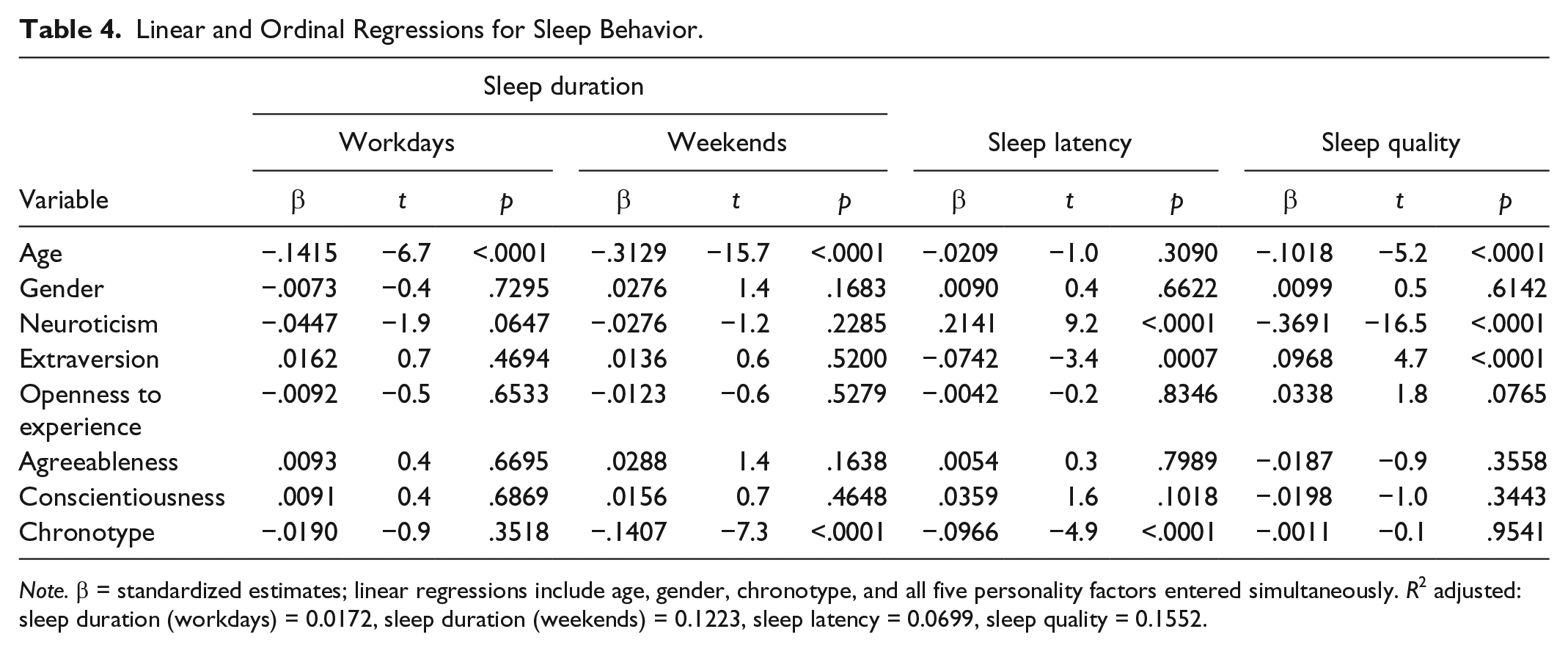
Note. β = standardized estimates; linear regressions include age, gender, chronotype, and all five personality factors entered simultaneously. R2 adjusted: sleep duration (workdays) = 0.0172, sleep duration (weekends) = 0.1223, sleep latency = 0.0699, sleep quality = 0.1552.
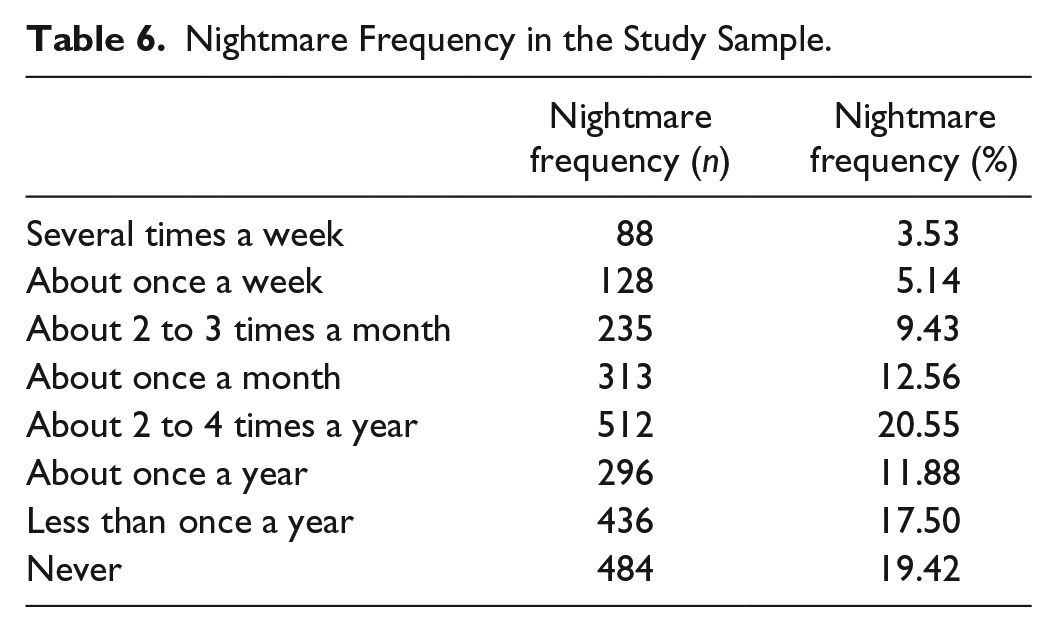
In Table 5, the ordinal regression for nightmare frequency is depicted (adjusted R2 = .1991). Neuroticism showed the strongest effect on nightmare frequency followed by openness to experience. Nightmare frequency declined with age, and there was a small but significant effect of conscientiousness on nightmare frequency; persons with higher conscientiousness scores reported slightly more often nightmares. Chronotype was not associated with nightmare frequency. Nightmare frequencies for the study sample are given in Table 6.
Ordinal Regression for Nightmare Frequency.
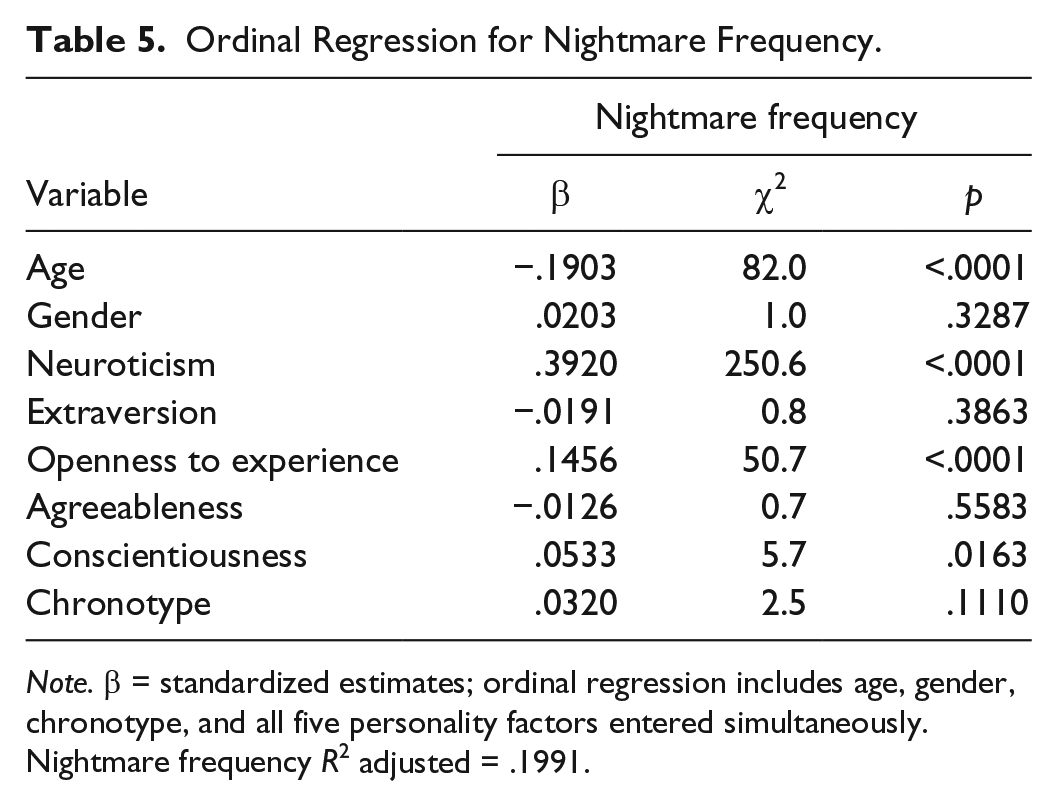
Note. β = standardized estimates; ordinal regression includes age, gender, chronotype, and all five personality factors entered simultaneously. Nightmare frequency R2 adjusted = .1991.
Nightmare Frequency in the Study Sample.
Discussion
The strength of this study is the large sample of German adults with a wide age range. This is important because most studies rely on smaller samples and predominantly on students. A weakness is the self-selection of the participants and—probably—some measurement aspects. In the following, we discuss the aspects of chronotype, its relationship to personality, and then turn to sleep duration and personality and nightmares. Finally, the issue of measurement is addressed.
Age changes in chronotype could be confirmed in this cross-sectional study in the supposed direction with older adults being more morning oriented. Gender differences could not be confirmed, which adds to the somewhat inconclusive results reported in previous studies. This may depend on the large variance in age (>14 years in this study), which masks gender differences (Randler, 2007). On weekends, eveningness was related to longer sleep duration. This reflects the recovery sleep needed to account for the sleep loss during the week. Also, eveningness was related to longer sleep onset latency suggesting that evening types may force themselves to go to bed earlier than would be expected by their internal rhythm. This may lead to longer sleep onset latencies (e.g., Randler, Bilger, & Díaz-Morales, 2009).
Concerning personality, conscientiousness showed the strongest relationship, and it was positively related to morningness. This confirms previous work done in many countries (Adan et al., 2012; Lipnevich et al., 2017; Tsaousis, 2010) and also corroborates findings in adolescents and University students from Germany (Randler, 2008). Openness was related to eveningness; this partly confirms previous findings (Hogben et al., 2007; Tsaousis, 2010; but see Lipnevich et al., 2017), where openness was related to evening orientation, but only to a small extent. Agreeableness was unrelated to chronotype in the multiple regressions but was related in the bivariate correlations, which confirms the meta-analysis (Tsaousis, 2010: r = .14; see also DeYoung et al., 2007; Hogben et al., 2007; Randler, 2008). Neuroticism was unrelated to chronotype in the multiple regression but was negatively related in the bivariate correlations. Similarly, in the meta-analysis of Tsaousis (2010), neuroticism (–0.05) was related to eveningness, which was also found by some other studies (DeYoung et al., 2007; Randler, 2008; Tonetti et al., 2009). Extraversion was positively related to morningness, which contradicts previous studies (Adan et al., 2012), and this is one of the most interesting finding of this study. However, a positive relationship between morningness and extraversion was also found by Ruffing, Hahn, Spinath, Brünken, and Karbach (2013). Jackson and Gerard (1996) also reported a positive relationship between extraversion and eveningness. In our study, we here were able to confirm previous findings of single studies and the meta-analyses in a large adult sample.
In the following studies, most researchers agreed that the missing relationship was due to the different conceptualization of personality (Big Five vs. Eysenck’s PI/PQ; Adan et al., 2012). Nevertheless, this contradictory finding is interesting, because Tsaousis (2010) detected a slight positive effect between morningness and extraversion in the meta-analysis, while there was no relationship in the single studies (with the exemption of Ruffing et al., 2015). This relationship between morningness and extraversion emerged in a similar direction and size in this population. This gives rise to additional questions that should be addressed in the future by combining different chronotype measurements and different personality conceptualizations together in a large sample, because differences between studies might also be related to the different measures of chronotype (Randler, Gomà-i-Freixanet, Muro, Knauber, & Adan, 2015). Furthermore, the results might be dependent not only on the different personality conceptualizations but also on the different forms of the Big Five. While Randler (2008) used the 10-item short version (Rammstedt & John, 2007), Tonetti used the Big Five Observer (40 items, pairs of bipolar adjectives), and in this study, the 30 items were applied. Another explanation might be that the age group comprises adults with a large variation in age, which is an important strength of the study. Probably, the relationship between personality and chronotype may be influenced or moderated by age, because chronotype significantly changes during the life span, while the changes in personality during life span are also visible but less pronounced (Roberts & DelVecchio, 2000). However, Tsaousis (2010) reported that mean age of participants was not related to the relationship between chronotype and personality.
Concerning the association between personality and sleep duration, only a tendency was found for higher neuroticism linked to shorter sleep duration on workdays. This reflects results from previous work (Gau, 2000; Vincent et al., 2009) but is in contrast to other studies where higher neuroticism was associated with a tendency to sleep longer (Friedman et al., 2007; Randler, 2008; Vincent et al., 2009). Thus, the present results fit into the somewhat inconclusive results from other studies.
Concerning sleep quality, sleep disturbance, and related aspects, Emert et al. (2017) revealed a correlation between neuroticism and sleep disturbance (more stable people sleep better) This finding could be replicated in our sample. The negative relationship between conscientiousness and sleep quality (conscientious people sleep better) could not be replicated, while in our study, a relationship between extraversion and sleep quality was found. These differences might be owed to sample, sample size, and age.
As expected, nightmare frequency was related to neuroticism and openness to experience (Schredl, 2014) but not with chronotype and, thus, does not corroborate previous findings in a student sample (Selvi et al., 2012) and an online study (Nielsen, 2010). We conclude that our sample with a broad age range and no specific self-selection regarding nightmares indicate that chronotype is not associated with nightmare frequency when the known etiological factors are statistically controlled for. It would be interesting to study persons with delayed sleep–wake phase disorder (AASM, 2014) because a delayed sleep phase is an extreme version of the eveningness chronotype. This delayed sleep phase can cause considerable distress for individuals who have to adapt to social rhythms, and this increased stress might be associated with heightened nightmare frequency.
In this study, we used a unidimensional construct of chronotype (as in most studies, see, e.g., Di Milia et al., 2013). However, recent findings proposed the multidimensional structure of chronotype with two or more dimensions, such as that morningness and eveningness are separate dimensions and not just the two poles of one continuum, as well as the aspect of amplitude/stability (e.g., Putilov, Donskaya, & Verevkin, 2015; Randler, Díaz-Morales, Rahafar, & Vollmer, 2016; Scherrer, Roberts, & Preckel, 2016). Similarly, sleep quality was measured with a single item, and future studies might use a more elaborated measurement. Furthermore, the ad hoc measurement of chronotype based on four questions should be addressed in future studies, and other measures such as the rMEQ should be used (Adan & Almirall, 1991). Nevertheless, the correlation of the four-item scale with the full 19-item MEQ was .835. In addition, the single-item assessment of chronotype can be discussed because it is a single item, but Loureiro and Garcia-Marques (2015) showed that results are rather similar, whether using only one single item or the full scale. Here, we also show that results are comparable, irrespective if you use the four-item version or the single-item measurement. Both measures of chronotype revealed identical results, which is in line with Loureiro and Garcia-Marques (2015).
To conclude, chronotype is associated with personality factors and sleep behavior (sleep duration on weekends and sleep latency). Future research may either focus on different measures of personality (e.g., more biologically oriented personality questionnaires), use different measures of chronotype, or assess the real sleep–wake cycle objectively by using actigraphy. One practical implication may be to consider personality when treating sleep and chronotype problems.
Footnotes
Declaration of Conflicting Interests
The author(s) declared no potential conflicts of interest with respect to the research, authorship, and/or publication of this article.
Funding
The author(s) received no financial support for the research, authorship, and/or publication of this article.