




Abstract
This study aimed to investigate the association between leisure activities and sleep among older adults, using data from the Chinese Longitudinal Healthy Longevity Survey (CLHLS). The data in this study were from the CLHLS in 2018. Seven activities including outdoor activities, gardening work, reading newspapers or books, raising domestic animals or pets, playing cards or mahjong, watching TV or listening to the radio, and participating in social activities were collected to reflect leisure activities. Subjective sleep quality was classified as normal and poor and sleep time is divided into short sleep duration, normal sleep duration, and long sleep duration by self-report of older people. Logistic regression analyses were employed to test the association between specific leisure activities and sleep. Older adults who usually participated in leisure activities had a lower rate of poor subjective sleep quality and long sleep duration than those who never participated in leisure activities, and no significant differences were found in the short sleep duration group. Compared with older adults who participated in no leisure activity, those who participated in one or more leisure activities had a lower rate of long sleep duration. The findings provide evidence that the greater frequency and number of participations in leisure activities are associated with a lower rate of poor subjective sleep quality and long sleep duration among Chinese older adults. Encouraging older people to participate frequently in a larger number of leisure activities could improve the sleep conditions of older adults.
Introduction
The aging population has emerged as one of the trends in the current population structure worldwide (S. Wang, 2020). According to a United Nations Department of Economic and Social Affairs (2017) report, the global share of the population aged over 60 years is projected to rise from 12.3% in 2017 to 22% by 2050. As a populous country and the fastest aging country in the world, the aging problem of China’s population is extremely urgent. According to the data released by the National Bureau of Statistics of China (2021), as of November 1, 2020, the proportion of people aged 60 years and over in the country has reached 18.7%. Aging usually results in decreased physical function, decline in living standards, and limited amount of exercise performed. The quality of physical performance has a close relation with sleep duration (Fu et al., 2017). Leisure endeavors are the main activities of older adults. Therefore, the relationship between physical activities, subjective sleep quality, and health of older people can be further explored by studying the relationship between their leisure activities and sleep conditions. The results will provide a reference to improve the living conditions of older persons.
Sleep is an important physiological process to restore physical function, and sufficient sleep can maintain vigorous energy and good mental state. The duration and quality of sleep are important indices to measure the quality of sleep. Older persons experience more sleep problems as they get older. Studies have shown that up to 50% of older persons complain of sleep issues, such as waking up too early, too shallow sleep, easy to wake up, waking up at night, and reduced sleep duration. Such problems are more serious in older women than in older men. Various factors can cause sleep problems in older adults. Sleep issues may be caused by primary sleep disorders, such as obstructive sleep apnea, periodic limb movement during sleep, and restless leg syndrome. Meanwhile, these sleep disorders may be secondary to physical diseases, mental illness, drug effects, or psychosocial factors (Dzierzewski et al., 2018). A drop in sleep quality may cause different health concerns, such as cognitive impairment, increased risk of cardiovascular disease, poor overall health, diabetes, and increased mortality (Hoevenaar-Blom et al., 2011; Knutson, 2010; K. L. Stone et al., 2014; Xu et al., 2023; Yaffe et al., 2014).
Moderate sleep duration is the basis of good subjective sleep quality. Long or short sleep duration can cause health problems and has been demonstrated to increase the risk of all-cause mortality, cardiovascular disease, and symptomatic diabetes. According to the 2015 National Sleep Foundation, compared with shorter or longer sleep time, older persons who sleep for 6 to 9 hr have better cognitive function, lower morbidity, and better quality of life. Excessive sleep may be a sign that older people need medical, neurological, or psychiatric evaluation. Older people have reportedly more daytime sleepiness than younger adults (Hirshkowitz et al., 2015). Long sleep duration is even more harmful than short sleep duration in terms of mortality (Hassan et al.,2018).
Studies have shown that moderate physical activities are good for improving sleep quality (Delbari et al., 2024; Reid et al., 2010). However, with aging, the ability and interest in formal exercise gradually wane (Crombie et al., 2004; Whitehead & Blaxton, 2017), and sedentary time increases (Niklasson et al., 2023). Leisure activities usually constitute a large part of the daily activities of older adults because of their shorter time, higher interest, and less physical consumption. Meanwhile, such activities may replace work as alternatives to social participation and mental stimulation (Li et al., 2020). Studies have also shown that active participation in leisure activities can reduce the risk of cognitive impairment and morbidity, enhance happiness, and improve the quality of life of older persons (Baumgart et al., 2015; Caiet al., 2023; Verghese et al., 2006; J. Wang et al., 2024; Zhu et al., 2017). However, few studies have reported on the relationship between leisure activities and subjective sleep quality in China and, in particular, the correlation between leisure activities and subjective sleep quality of older persons. In addition, different demographic characteristics may lead to diversity in the number and frequency of leisure activities. In this study, data were collected from the Chinese Longitudinal Healthy Longevity Survey (CLHLS) to analyze the correlation between leisure activities and the quality and duration of sleep of older persons in China.
Methods
Participants
The CLHLS was aimed to promote research on the health of older persons in China. A questionnaire survey was used in the project. All participants or their legal representatives signed written consent to participate in the baseline and follow-up surveys. CLHLS has been approved by the Health System Institutional Review Board of Peking University. CLHLS data are published online on the official website (http://chads.nsd.pku.edu.cn/index.html) and can be retrieved through online applications.
Inclusion criteria were as follows: older adults aged 65 years and above; complete evaluation of leisure activities; and complete evaluation of sleep duration or subjective sleep quality. A total of 15,874 people were surveyed in the 2018 CLHLS dataset, 103 of whom were excluded because they were under 65 years old. In addition, 366 older persons were excluded because of missing related data on leisure activities. Among the 15,405 people surveyed, 1,237 people lacked data on subjective sleep quality, and 745 people lacked data on sleep duration. Finally, 14,168 people were included in the study of subjective sleep quality and leisure activities, and 14,660 people were included in the study of sleep time and leisure activities (Figure 1).

Flowchart showing the sample selection process.
Evaluation Criteria of the Quality and Duration of Sleep
Subjective sleep quality was measured depending on the answer to the following question: “How is your subjective sleep quality now?” An answer of “very good,”“good,” or “fair” indicated normal subjective sleep quality. However, when the answer was “not good” or “very bad,” the older persons had poor subjective sleep quality. Nighttime sleep duration was measured using the following question: “How many hours do you usually sleep each day?” According to the 2015 National Sleep Foundation (Hirshkowitz et al., 2015), a self-reported sleep duration of less than 6 hr was considered as short sleep, while sleep for more than 9 hr is a long sleep.
Definition of Leisure Activities
Leisure activities were investigated by trained investigators and included seven categories, namely, outdoor activities (e.g., Tai Chi, square dance, visiting and interacting with friends), gardening work, reading newspapers or books, raising domestic animals or pets, playing cards or mahjong, watching TV or listening to the radio, and participating in social activities. Each activity was divided into never, fair (at least once a month or not every month, but sometimes), and frequent (almost every day or at least once a week) according to the frequency of participation. If the frequency of participation in a leisure activity was frequent, the participant was considered to participate in the activity and included in the number of leisure activities.
Definition of Covariates
The covariates in this study were age, height, weight, body mass index (BMI), education level, annual, income, sex ethnicity, current smokers, current drinkers, current exercisers, residence, self-reported health, marital status, coresidence, taking medicines, and taking nutrient supplements. For a stratified study, the participants were divided into the younger old people (<80 years) and older old people (≥80 years) on the basis of age. Meanwhile, the study was also stratified by gender into male and female. BMI was calculated by dividing the weight (kg) by the square of the height (m2). Educational level was determined by considering the participants’ years of education. Annual income was the total income of the family in the previous year. Participants were divided into Han and other ethnic groups for the stratified study according to ethnicity. Participants were defined as “current drinkers,” versus “current non-drinkers,”“current smokers” versus “current non-smokers,” and “current exercisers” versus “current non-exercisers” on the bases of the participant’s current drinking, smoking, or exercise conditions, respectively. In addition, using the place of residence, the participants were divided into city and township dwellers. From the self-assessment of health conditions, the participants were categorized into good, general, and bad. Then, from the marital conditions, participants were divided into three groups, namely, married and living with spouses, widowed, and others. According to coliving conditions, the participants were determined to be living with family, living alone, or living in institutions. Participants were further divided into three categories in terms of occupations before age 60, namely, farmers, workers, and others. As for drug usage, participants were divided into taking drugs and not taking drugs. In addition, participants were divided into those who took vitamins and those who did not.
Data Analysis
The covariate characteristics of the subjects were expressed as percentages, and the characteristics of the values were expressed as mean ± standard deviation. Chi-square test was used for the categorized data, and independent sample t-test was used to examine the difference between distinct sleep durations. Multiple logistic regression was used to analyze the relationship between leisure activities and the quality and duration of sleep. Data that showed the frequency of participation in leisure activities as “never” and the number of participations in leisure activities as “0” were used as reference values. The data were stratified by gender (male and female) and age (young and old). Odds ratio (OR) of sleep time-to-subjective sleep quality and 95% confidence interval (CI) of both parameters were calculated for all multivariate logistic regression analyses. All analyses were performed by SPSS 26.0, and p < .05 was considered statistically significant.
Results
A total of 14,660 participants were included in the study of leisure activities and sleep duration. The results showed that 2,789 of older adults had short sleep, 7,921 had normal sleep, and 3,950 had long sleep. The data are shown in Table 1. The results showed that older adults with normal sleep were younger older adults (88.66 ± 11.19 years vs. 85.01 ± 11.00 years vs. 83.39 ± 11.44 years), with higher BMIs (22.69 ± 4.38 kg/m2 vs. 22.26 ± 4.53 kg/m2 vs. 21.99 ± 4.41 kg/m2), longer years of education (4.01 ± 5.84 years vs. 2.95 ± 6.55 years vs. 2.90 ± 5.83 years), and higher annual income (45,054.21 ± 37,124.41 vs. 43,993.19 ± 36,927.90 vs. 38,746.7 ± 36,920.15). Favorable factors for normal sleep duration were being male, having exercise habits, city dweller, being married and living together, and being a worker before 60 years of age. Among the included variables, no significant effect of current vitamin intake on sleep duration was found.
The Characteristics of Participants According to Sleep Duration.
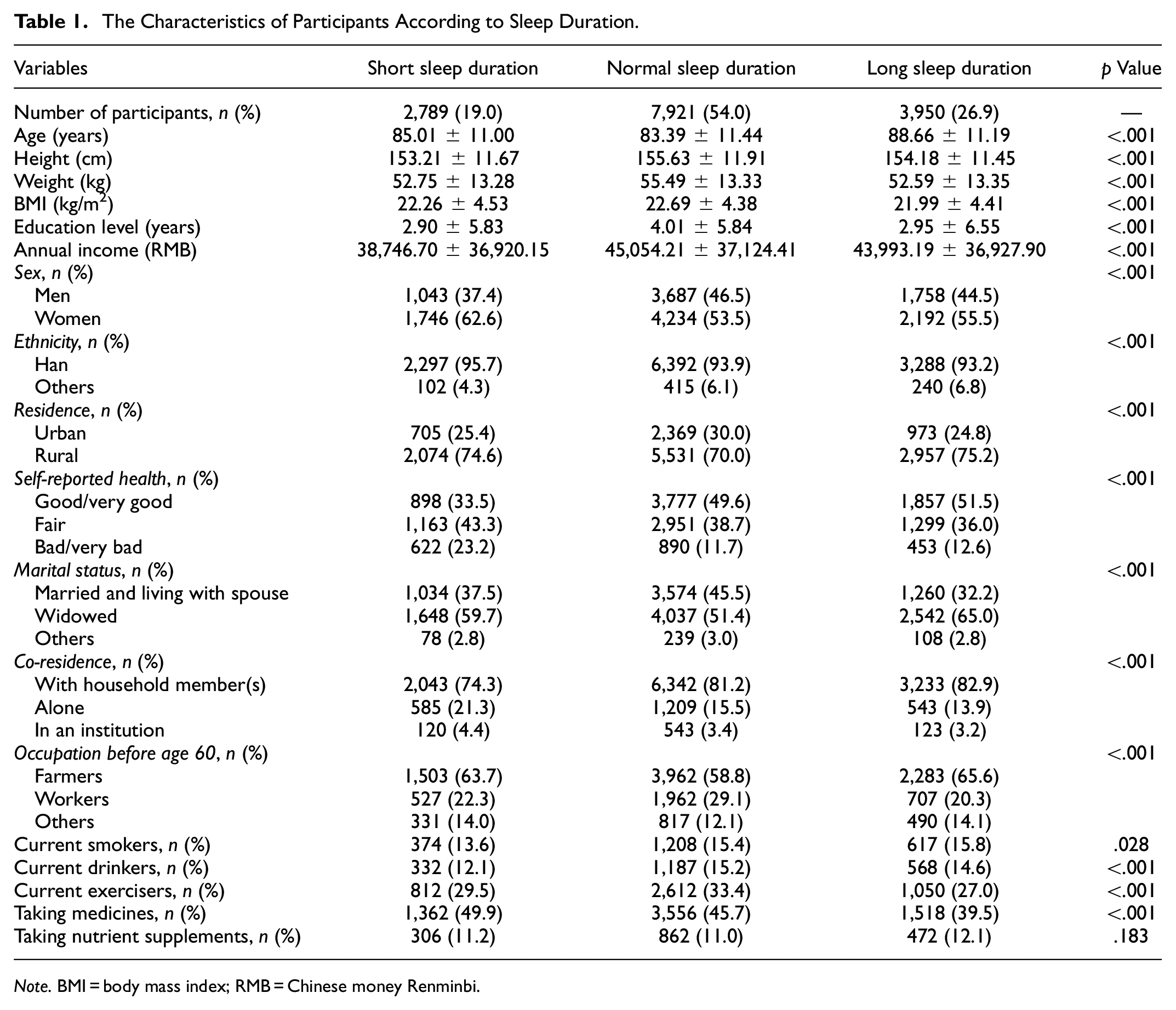
Note. BMI = body mass index; RMB = Chinese money Renminbi.
The results from the multiple logistic regression analysis of leisure activities and poor subjective sleep quality after adjustment of covariates and stratification by gender and age are shown in Table 2. Overall, the OR of low-quality sleep was lower in older persons who often participated in outdoor activities, performed gardening work, watched TV or listened to the radio than those who never participated in such activities (p < .05). The OR of poor-quality sleep in the female older persons who often participate in outdoor activities, gardening work, watching TV, or listening to the radio was lower among the female older people who never attended such activities (p < .05). In terms of age, older persons who regularly watched TV or listened to the radio had a lower ratio of low-quality sleep than those who never watched TV or listened to the radio.
The Association of Leisure Activity with Poor Sleep Quality After Adjusting for Covariates, Expressed as OR (95% CI).

Note. *p < .05 compared to the reference, after adjusting for age, body mass index, education level, annual income, sex, ethnicity, smoking, drinking, exercise, residence, self-reported health, marital status, co-residence, occupation before age 60, taking medicines, and taking nutrient supplements.
Data from the multiple logistic regression analysis after the covariates of leisure activities and short sleep duration were adjusted and after stratification according to gender and age are shown in Table 3. No significant difference was found in the OR of short sleep duration among older adults with different frequencies and numbers of leisure activities. Data from the multiple logistic regression analysis after the covariates of leisure activities and long sleep duration were adjusted and after stratification according to gender and age are shown in Table 4. The OR for long sleep duration was lower in older persons who frequently engaged in leisure activities than in older people who never engaged in such activities (p < .05). In terms of age, in the younger older persons, the older people who regularly participated in outdoor activities, raised domestic animals or pets, and participated in social activities had a lower ratio of long sleep duration than those who never participated in such activities. Compared with the young older people who participated in no leisure activity, no significant difference was found in the OR of long sleep duration among the young older persons who participated in one or more leisure activities. Among the older persons, the older adults who often participated in leisure activities had a lower long sleep duration ratio than those who never participated in such activities. Compared with older adults who participated in no leisure activity, the OR of long sleep duration in older persons who participated in one or more leisure activities decreased significantly.
The Association Between Leisure Activity and Short Sleep Duration After Adjusting for Covariates, Expressed as OR (95% CI).

Note. ORs with 95% CIs were calculated by logistic regression analysis adjusting for age, body mass index, education level, annual income, sex, ethnicity, smoking, drinking, exercise, residence, self-reported health, marital status, co-residence, occupation before age 60, taking medicines, and taking nutrient supplements.
The Relationship Between Leisure Activity and Long Sleep Duration After Adjusting for Covariates, Expressed as OR (95% CI).

Note. *p < .05 compared to the reference, after adjusting for age, body mass index, education level, annual income, sex, ethnicity, smoking, drinking, exercise, residence, self-reported health, marital status, co-residence, occupation before age 60, taking medicines, and taking nutrient supplements.
Discussion
As older persons become older, the physical and physiological functions and the quality of sleep of older people would decrease (Espiritu, 2008). Adequate sleep duration is one of the fundamental pillars of health, and sleep disorders can have an impact on patients’ quality of life (Iranzo, 2022). Decreased sleep quality can lead to various physical problems. Studies have shown that obesity in older people and type two diabetes mellitus were associated with sleep quality (Jean-Louis et al., 2014; Knutson et al., 2006; Kohatsu et al., 2006). This study was performed to analyze the relationship between leisure activities and subjective sleep quality and duration of sleep in Chinese older persons. Long sleep or short sleep may lead to a decline in subjective sleep quality. A reduced subjective sleep quality will not facilitate the full recovery of the human body, and fatigue will not be completely relieved. These phenomena will further aggravate the decline in the physical and physiological functions of older people. Exercise can improve subjectively and objectively the subjective sleep quality and the daytime physical and mental state (Kline, 2014). However, older people usually have reduced physical exercise due to lack of energy, articular pain, and shortness of breath (Crombie et al., 2004). The daily physical activity of older people will be dominated by leisure sports. Studying the relationship between leisure sports and subjective sleep quality of older people can provide insights into improving their sleep experience.
The sociological characteristics showed that older people with normal sleep duration were younger, had higher BMI, longer education years, and higher annual income (Scarlett et al., 2020; Zhao et al., 2022). The female and widowed older people were more likely to have abnormal sleep duration, similar to the results of related studies. With decreasing postmenopausal female hormone, the female sleep circadian rhythm becomes disordered, which will lead to reduced subjective sleep quality in women. Díaz-Morales et al. (2017) showed that after the age of 45, women’s activity patterns will shift from morning-oriented to evening-oriented, and this transition to evening-oriented lifestyle may lead to more psychological issues. Reduced subjective sleep quality may be one of the reasons why the female does not sleep properly (Littman et al., 2007), and the widowed older people are more likely to suffer from depression and other problems due to lack of family companionship. Among the participants with exercise habits, the proportion of older persons with normal sleep duration was higher. This result indicated that physical exercise had a positive impact on the improvement of subjective sleep quality in older adults. Many studies have shown that physical activity could help older persons have improved subjective sleep quality (Littman et al., 2007; Madden et al., 2014). For instance, Madden et al. (2014) showed that high levels of physical activity in older adults could reduce the adverse effects of sedentary behavior in subjective sleep quality. In the current study, drinking, living in the city, marital status as married and cohabiting, and occupation as a worker before the age 60 years were favorable factors for normal sleep duration. Drinking alcohol may cause changes in the body’s physiological rhythms, which can consequently affect sleep duration (Adan, 2013).
Analysis of leisure activities and subjective sleep quality showed that older people who often participated in outdoor activities, gardening work, watching TV, or listening to the radio had a lower ratio of low-quality sleep than those who never participated in such activities. This result indicated that those who often participated in such leisure activities usually had a higher quality of sleep. Stratified analysis by gender revealed that the OR for low-quality sleep among men engaging in leisure sports increased, but the significance disappeared. However, the OR of low-quality sleep on these leisure activities decreased in female older adults. This result may be due to the fact that these leisure activities had a more significant effect on the improvement of subjective sleep quality in female older people. He et al. (2021) found that with poor sleep quality, people with moderate or low physical activity would benefit more from physical activity interventions. More female older people belong to this group, and female older people were more prone to low sleep quality problems (Chaput et al., 2017; Chiu et al., 2016; Habte-Gabr et al., 1991; Reid et al., 2006). This phenomenon may explain why women experience higher sleep quality when participating in leisure activities. Leisure activities may have too small load on male older adults, resulting in no substantial impact on the subjective sleep quality of male older people. No significant difference was found in the effect of various leisure sports on subjective sleep quality among older people at different ages. No significant difference was also noted between the number of leisure activities and the quality of sleep. Madden et al. (2014) believed that mild physical activity had no significant effect on the improvement of sleep quality. In the current study, we believe that some leisure activities only had a significant effect on the improvement of subjective sleep quality in female older adults.
Many studies have associated too long or short sleep duration with various adverse health outcomes, such as sensory impairment, type 2 diabetes, cardiovascular disease, cancer, sarcopenia, cognitive decline, and increased mortality (Chen et al., 2016; Kripke et al., 2011; C. R. Stone et al., 2019; Yang et al., 2024; Yeo et al., 2013, Zhao et al., 2023). Sleep duration and mortality followed a U-shaped pattern, where both long sleep and short sleep increased the risk of all-cause mortality in the general population (Hublin et al., 2007; Zawisza et al., 2015). Inappropriate sleep duration is a common problem in the aging process of older persons. Studies have reported that older people with short sleep duration were less likely to meet physical activity guidance (Štefan et al., 2018), which is contrary to the results of the current study. In this study, the frequency and number of leisure activities did not have a significant effect on the short sleep duration of older persons. In addition, no significant effect was found in older people of different ages and genders. The number of mild physical activities may not have a significant impact on the problem of short sleep.
The results showed that frequent leisure activities could reduce the incidence of long sleep, which was not consistent with previous studies. Štefan et al. (2018) suggested that physical activity increased sleep duration in older persons, possibly because they focused on moderate and high-intensity exercise, with relatively low levels of leisure activity. Monteiro et al. (2023) indicated that the quality of sleep is higher in males compared to females, and they attributed this to the fact that males engage in more frequent physical activity than females. This consistent with our research findings, the number and frequency of leisure activities could reduce the problem of long sleep. The more leisure activities an individual participated in, the higher the likelihood of achieving normal sleep duration. The effect was more obvious in the female and older people, and the female and older persons were usually more prone to low subjective sleep quality. Therefore, old people, especially women and the older, should increase the frequency of leisure activities to ensure that they have a certain amount of time for leisure activities every day, in order to increase the occurrence of normal sleep. Future research seems to also need to consider that older adults not only exert physical effort in leisure activities, but also engage in cognitive activities that may affect sleep.
This study explored the impact of leisure activities on sleep in older adults, particularly investigating the influence of physical activity frequency on sleep quality, which has been relatively overlooked in previous research. A stratified approach based on gender and age was employed to facilitate a focused examination of the sleep patterns among older adults of different genders and age groups. The study also explored the effects of low-intensity leisure activities, which have been neglected in prior research, on the sleep status of older adults, providing supplementary insights to the relevant field. The current study had several limitations. First, this work had a cross-sectional design, so the causal associations between duration and quality of sleep with leisure activities could not be established. The second limitation was the use of self-reported measures was evaluated subjectively. The individuals may have over-reported or under-reported their leisure activities levels and sleeping variables which could have led to the self-reported sleep hours being overestimated and considerable measurement error, recall bias, and social desirability effect (Jackson et al., 2018; Shephard, 2003). Third, the original information did not allow the differentiation between sleep hours during the daytime and the night. In addition, older adults may consider sleep duration as the sole important predictor of their sleep quality. Finally, the detailed mechanism by which sleep duration in older adults is associated with leisure activities could not be explored in the current study.
Conclusions
The relationship between the quality and duration of sleep and leisure activities in older adults was explored. Regular participation in leisure activities could improve the subjective sleep quality of older adults, and the improvement of subjective sleep quality was more obvious in female older people. However, the number of leisure activities had no significant effect on the subjective sleep quality of older persons. The frequency and number of leisure activities had no significant effect on the short sleep duration of older adults. Regular participation in leisure activities and participation in various leisure activities could reduce the occurrence of problems associated with long sleep duration in older persons. The impact on long sleep duration problems in female older persons is more obvious.
Footnotes
Declaration of Conflicting Interests
The author(s) declared no potential conflicts of interest with respect to the research, authorship, and/or publication of this article.
Funding
The author(s) disclosed receipt of the following financial support for the research, authorship, and/or publication of this article: This work was funded by the Zhejiang Provincial Philosophy and Social Science Planning Project (24NDJC070YB), and the Ningbo Public Welfare Science and Technology Project (2022S070).
