




Abstract
Influences of educational level and gender were examined through free drawings. A total of 216 participants were recruited ranging from nursery school to university students. Using an adaptation of Turgeon’s methodology, participants were given a standardized set of colored pens and asked to draw a picture. Pictures were analyzed for the area of the page covered, colors used, number of colors used, and content. Overall, females covered more of the page, and used more colors than males. Females drew significantly more sky, flowers/trees and buildings (in most cases houses), and males drew more people and vehicles. In relation to educational level, nursery children used fewer colors than the other groups and secondary school children used more colors than primary school children. It was concluded that gender differences in content, and color, of drawings exist and these differences remain stable into adulthood. Results are discussed in terms of social and evolutionary theory.
Introduction
Drawing ability begins at a young age and develops through adulthood. Toddlers enjoy scribbling with different colors while children begin to draw more realistic drawings around age 4. This process continues to evolve into and beyond adolescence (Lowenfeld & Brittain, 1987). Age is an important factor in drawing as holding a pencil and drawing precisely requires the finger muscles and general motor control to be sufficiently developed. This is said to happen around the age of 5 years (Oğuz, 2010).
Lowenfeld and Brittain (1987) present a comprehensive account of drawing, outlining six stages of artistic development in children, referring to concepts such as age appropriateness and reflection. Stages are referenced against the child’s age, or expected stage of development. These begin with the scribbling stage (demonstrated by children aged 2 to 4 years), followed by the preschematic stage (age 4 to 7) where children are thought to show their first attempts at representational drawings (e.g., a drawing of a person with a circular head and “stick” legs), then the schematic stage (age 7 to 9) where they demonstrate concepts and are much more confident in their drawings as they resemble objects more than before. Children between 9 and 11 years are “gang age,” also referred to as the preadolescent crisis, and their drawings reflect how things actually look and are expressed in detail, they also become critical of their drawings at this stage. Between 11 and 13 years, children reach the age of reasoning. During this stage, Lowenfeld and Brittain identify that children’s art becomes less of a “spontaneous process.” The final stages of this model (which approximately span the years of puberty, around ages 12 to 17 years) involve more detail, precision, and perspective. The pseudo-naturalistic stage involves the depiction of perspective, 3D objects, shading, and attempts to demonstrate motion. The final stage of the model is the adolescent art stage demonstrated by adolescents aged 14 to 17 years of age, and is said to refer to the crisis of adolescence. Drawings at this stage can span a number of styles. It is at this stage that natural development is said to stop unless a conscious decision is made to continue drawing (Lowenfeld & Brittain, 1987). Based on Lowenfeld and Brittain’s model, we would expect little difference between the drawings of adolescents and adults. For example, Lowenfeld and Brittain state that once individuals are in the final adolescent art stage, skill will only improve if the individual has both the opportunity, and desire, to do this. In addition, Nicholls and Kennedy (1992) examined cube drawing in children and adults and found that there was no difference between the drawings of 14- and 15-year-old individuals and adults. They explained that more sophisticated geometry knowledge in the older children allowed them to produce similar cubes to the adults. Therefore, knowledge of angles, perspective, and scale in adolescents and adults might help explain why their drawings would be expected to be similar.
Lowenfeld and Brittain’s stages focus on the process of drawing and reflection of the art work, rather than the content and color of the drawings. For example, if a drawing is of a dog then the focus would be on the age appropriateness of the drawing. Analyses may be carried out in a number of additional ways to provide us with further rich information regarding the artists and their drawings. One important element that Lowenfeld and Brittain did not focus on was gender differences. Indeed, it is the case that very little research examines color and pictorial content beyond the elementary years.
Several researchers have reported differences relating to content and color of drawings by male and female children. Iijima, Arisaka, Minamoto, and Arais (2001) reported that males aged 5 to 6 years used fewer colors in their drawings than females, and used more grays and blues, while females preferred pink and flesh colors. Milne and Greenway (1999) reported that older male children (between 10 and 14 years) used fewer colors compared with younger males (under 10 years); however, older and younger females used an equal number of colors. They suggested that pubertal males use fewer colors due to the inhibition of emotional responses at this time. Ellis and Ficek (2001) found that male college students preferred to use cold colors such as blue and green, while females preferred warm colors such as red and yellow. There is an argument that sex differences in color preference may be related to the evolutionary division of labor with females evolving to identify yellow fruit, red leaves, and red and purple berries in their role of gatherer (Hurlbert & Ling, 2007). In relation to these findings, He et al. (2011) reported that males preferred blue and green, whereas females preferred pink, purple, and white. They also relate their findings to the hunter-gatherer theory stating that men, as hunters, prefer blue and green, which are considered calm colors and are related to the natural environment such as the blue sky. Women, as gatherers, prefer pink, purple, and white, which are said to be warm and peaceful colors.
Turgeon (2008) examined drawings by elementary school children and found that boys used more cold colors (e.g., black and gray), while girls used more pink, purple, and yellow in their drawings. Previous research has demonstrated that younger children prefer warm colors but as they get older preference shifts to cooler colors. A common method of investigating color preference is presenting pairs of colors to participants and asking for their preference. When using this method, Child, Hansen, and Hornbeck (1968) reported that children between the ages of 6 to 18 years preferred cooler colors. Although most research on color preference has been carried out with children, several studies have examined color preference in adults. Ellis and Ficek’s (2001) work examined color preference in college students while Silver and Ferrante (1995) reported that retired male and females’ favorite color was blue. However, when carrying out research with older adults additional factors have to be addressed such as quality of eye sight and potential color perception difficulties. Dittmar (2001) asked adults ranging from 19 to 90 years to choose their preferred and least preferred color. Older and younger groups preferred blue but older participants preferred green over red, and younger participants preferred red over green. Dittmar suggested that changes in color preference could be explained by social influence; older participants spend more time gardening or on walks outside that may influence their preference for the color green. Finally, Silver et al. (1988) examined color preference among college students and concurred that males chose blue as their favorite color more than females did. The content of children’s drawings has also been investigated. Willats (2005) stated that young children draw familiar objects while older children draw what they see. Iijima et al. (2001) found that boys preferred to draw mobile and mechanical objects such as cars and rockets, while girls preferred to draw people and flowers. Turgeon (2008) found that females preferred to draw flowers, sky, and animals, while boys preferred to draw people. All of the previous studies examined the content of drawings by children who were under 9 years of age, and thus it is relatively unknown whether the content of adolescent’s and young adult’s drawings would continue to demonstrate similar sex differences. Young female children have been reported to use more of the page than males when asked to draw a picture (Iijima et al., 2001; Turgeon, 2008). Female’s drawings are often larger but much of the area is taken up by details such as grass and sky that expand to cover the whole page. To date, no study has examined the content of adults’ free drawings outside of a clinical setting.
Aside from the evolutionary derived hypotheses (e.g., Hurlbert & Ling, 2007), sex differences can be explained through biological and social theories. Biological theory hypothesizes that gender differences are present from birth and are influenced by prenatal androgens such as testosterone (Lutchmaya, Baron-Cohen, Raggatt, Knickmeyer, & Manning, 2004) while social theory indicates that we learn gender roles through observing others, and via sex role socialization through education and the media (Katz & Ksansnak, 1994). Turgeon (2008) proposed that sex differences across a range of ages could signify that drawing has a biological basis due to prenatal androgen exposure. This is supported by the work of Iijima et al. (2001) who reported that females with congenital adrenal hyperplasia (CAH; caused by exposure to higher levels of prenatal androgens) drew more masculine pictures.
Koller (2008) discussed color preference in the context of social theory. Products marketed at women were examined and shown to consist of warm colors and soft shapes, whereas products marketed at men consisted of colder colors and angular shapes.
Cherney, Seiwert, Dickey, and Flichtbeil (2006) state that children’s drawings can be influenced by their education, culture, and society. They state that cultural and society influences can be expressed in drawings through the type of clothing depicted in drawings of people. Girls were also more likely to add detail to drawings that were seen to be relatively stereotypical, such as jewelry, specific hair styles, and details such as fingernails on hands. La Vooy et al. (2001) examined the drawings of Japanese and American children for the number of smiles included, and found that American children were more likely to include smiles in their drawings. La Vooy et al. and Cherney et al. (2006) looked at the heights of humans depicted in drawings and found that female children tended to draw larger human figures. Both studies concluded that the depiction of larger human figures could relate to increased self-esteem and the individual’s worth in their culture.
A question remains as to whether gender differences in free drawing content and color preference continue to be evident throughout adolescence and into adulthood. Most studies examining color use and content in drawing involve relatively young children, or studies that do involve adults often examine neuropsychological measures such as clock drawing (e.g., Hubbard et al., 2008), figure drawing (e.g., Guez, Lev-Wiesel, Valetsky, Sztul, & Pener, 2010), or evaluate changes in the ability to draw the human figure across the life span (e.g., Ericsson, Winblad, & Nilsson, 2001).
To investigate effects of educational level (age) and gender, we examined drawings of nursery school, primary school, and secondary school pupils (all in their final year of study) along with University students (in their penultimate year of study). Each person was asked to complete a free drawing and had the choice of a standard set of 10 colored pens. Drawings were analyzed for the area of page covered, content (using an adaptation of categories defined by Turgeon, 2008), number of colors used, and actual colors used. The content of nursery children’s drawings was not examined due to the lack of pictorial content. Based on previous findings it was predicted that females would cover a larger area of the page, females would use more colors in their drawings, males and females would use different colors in their drawings and would draw different types of pictures. It was also predicted that educational level (age) would affect drawing content and that the number of colors used and the actual colors used would change with age, particularly around puberty.
Method
Participants
A total of 216 participants took part in the study: 47 nursery children (22 males and 25 females) aged 3 to 4 years, 47 primary seven children (18 males and 29 females) aged 10 to 11 years, 42 final year secondary school pupils (21 males and 21 females) aged 16 to 17 years, and 80 University students (24 males and 56 females, ranging from 20 to 51 years—mean age 21 years). This research was carried out in Scotland, UK.
Materials
A standard set of 10 different colored felt tip pens were given to participants (black, gray, blue, pink, red, yellow, orange, brown, green, and purple) along with a blank sheet of A4 paper. The area of the page was assessed using a Perspex grid of 200 rectangles measuring 2 × 1.45 cm. Details of each participant’s gender, age, and education group were recorded. Permission and full ethical clearance was given to carry out this research in each educational establishment.
Procedure
In the nursery school condition, children were given a piece of A4 paper and the standard set of 10 colored pens and were asked to draw a picture. Due to the informal nature, participants were not given a time limit but were still timed; however, no child took more than 10 min to complete their drawing. In the primary school, secondary school and university condition participants were given an A4 sheet of paper, the standard set of 10 colored pens and were given 10 min to draw a picture. After 10 min, drawings were collected for analysis. All the data were coded by the experimenters (area of the page used, colors used [total number and individual colors] and picture content). A standardized checklist was used to record this information.
Results
Number of Colors Used
Figure 1 shows that females in every educational group used more colors, on average, than their male counterparts.
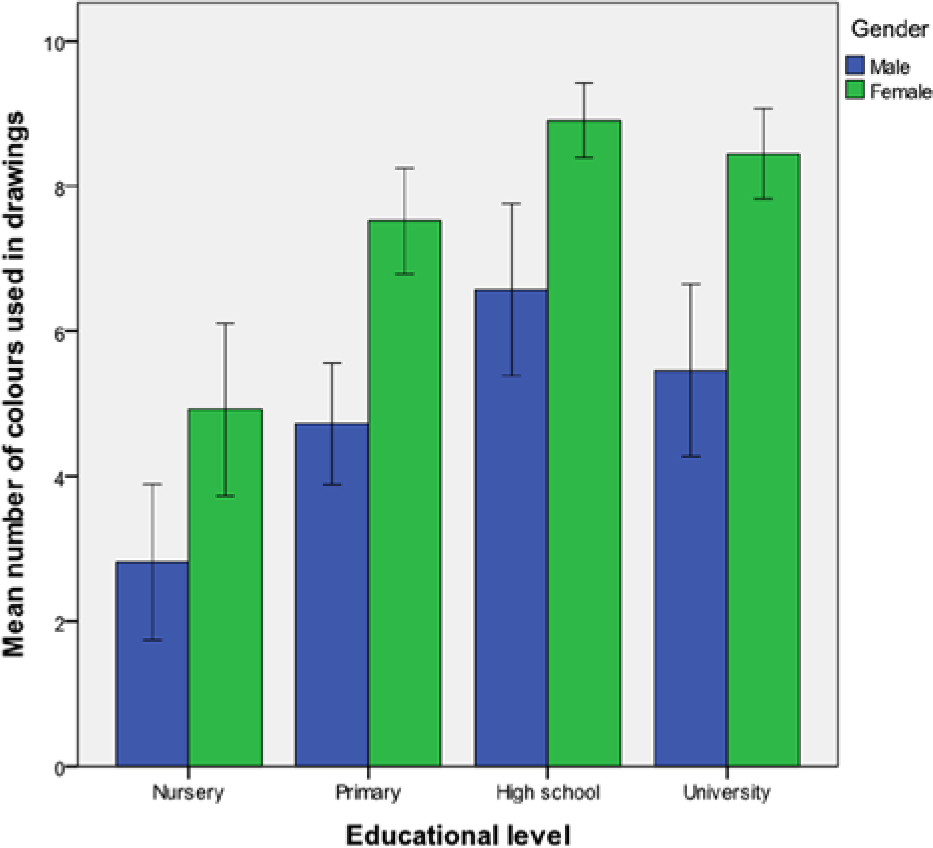
Mean number of colors used in free drawings by males and females across four levels of education.
A 2 (gender) × 4 (education level) between subjects ANOVA was carried out to investigate the number of colors used. There was a significant main effect of gender, F(1, 208) = 59.3, p < .001, partial η2 = .2, and observed power = 1, with females using significantly more colors (average of eight colors) in their drawings than males (average of five colors). There was a significant main effect of education level, F(3, 208) = 24.5, p < .001, partial η2 = .3, and observed power = 1. The interaction between gender and education level was not significant F < 1.
Bonferroni t-tests were carried out to investigate the differences between levels of education for the number of colors used. Nursery children used significantly fewer colors than the other educational levels (primary school children, secondary school children, and university students; p < .001 for all). Primary school children used fewer colors (on average) than secondary school children (p = .008), but there was no significant difference in the number of colors used between primary school children and university students or between secondary school children and university students.
Figure 2 shows that the number of colors used by males and females across each educational level followed the same pattern but females used more colors at each stage.

Average number of colors used across gender and educational groups.
Additional independent samples t-tests were carried out to examine whether females used more colors than males at each educational level. Female nursery school children used significantly more colors than males, t(45) = −2.7, p < .001, r = .4, as did female primary school children, t(45) = −5.1, p < .001, r = .6, female secondary school children, t(40) = −3.8, p < .001, r = .5, and female university students, t(78) = −5.0, p < .001, r = .5.
Area of Page Covered
Figure 3 indicates that females in every educational group covered a larger area of the page, on average, than males.
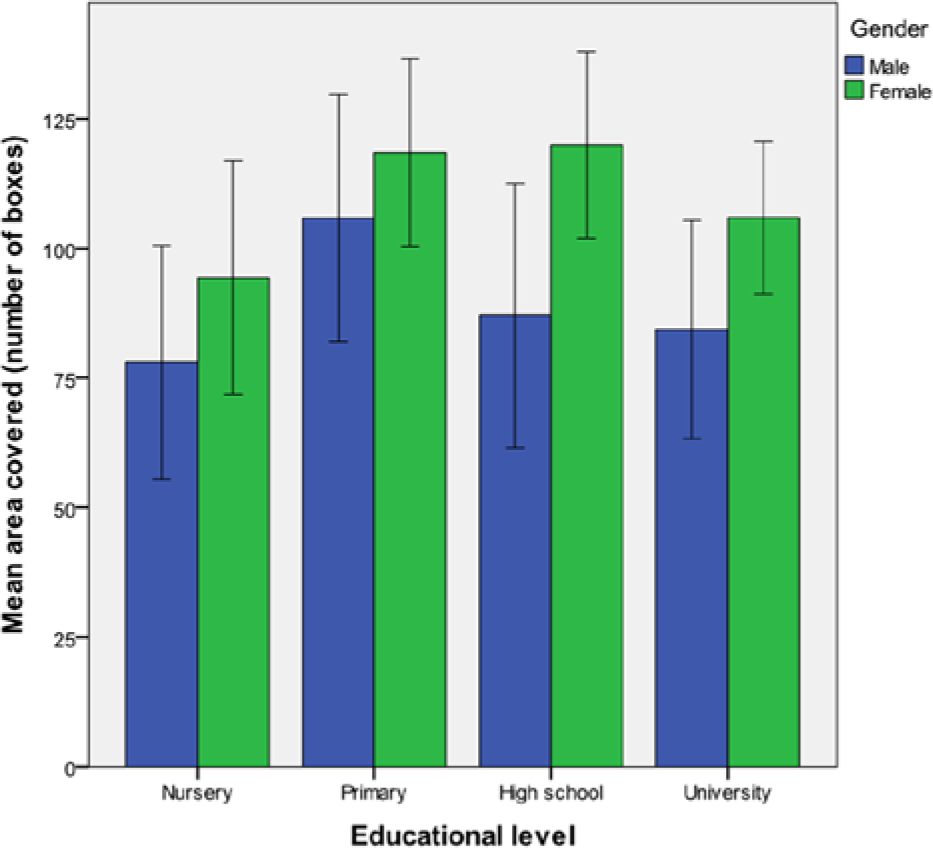
Mean area (measured by the number of boxes containing ink) covered in free drawings by males and females across four levels of education.
A 2 (gender) × 4 (education level) between-subjects ANOVA was carried out to investigate the area of the page covered. There was a significant main effect of gender, F(1, 208) = 8.06, p = .005, partial η2 = .03, observed power = .8, with females covering more area. There was no significant effect of education level (p = .09) and no significant interaction between gender and education level (p = .81)
Individual Color Usage
χ2 analyses were carried out to investigate the individual color usage of participants (by gender and by educational level). Females’ drawings were more likely to contain every color except for black than males’. That is, a higher proportion of females used pink, purple, blue, green, red, yellow, gray, orange, and brown in their drawings than males. Interestingly, but perhaps not surprisingly, the colors used least by males were pink (32.2%) and purple (29.4%). The findings are summarized in Tables 1 and 2.
χ2 Analysis for Individual Colors Used by Males and Females Including Percentage of Colors Used by Each Group.

Note. crv = Cramer’s V effect size.
χ2 Analysis for Individual Colors Used by Education Level Including Percentage of Colors Used by Each Group.
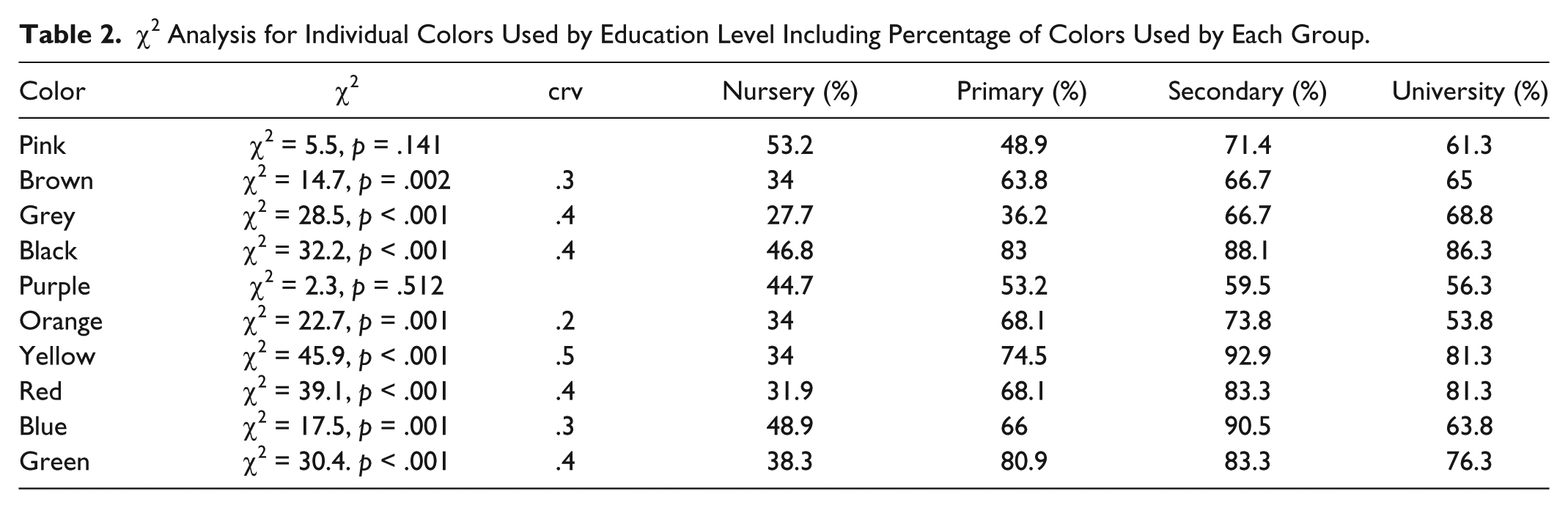
Table 2 shows that there was a significant difference in the colors used in drawings across education level groups for all colors except pink and purple. However, closer inspection of Table 2 shows that the differences might be influenced by the nursery group who have lower representations of the colors compared with the other three groups.
We therefore removed the nursery group from the χ2 analysis and found that only gray and blue showed a significant difference in appearance in drawings across primary school, secondary school, and university groups (gray: χ2 = 14.3, p = .001, crv = .3, and blue: χ2 = 10.4, p = .006, crv = .3). More secondary school students used blue in their pictures than the other groups while fewer primary school pupils used gray in their drawings.
Picture Content
χ2 analyses were carried out to investigate the content of participant’s drawings (by gender and by educational level). It was found that males, irrespective of age, drew more people (χ2
When examining the educational level, it was found that, overall, more primary and secondary school children drew flowers/trees (χ2 = 24.1, p < .001, crv = .4), sports (χ2 = 25.6, p < .001, crv = .4), houses (χ2 = 22.5, p < .001, crv = .4) and wrote more words on their pictures (χ2 = 21.0, p < .001, crv = .4) than university students. However, on further analysis, it was found that each of these effects was driven by the female participants. Female primary and secondary school children, in fact, drew more flowers/trees (p < .001), sports (p < .001), houses (p < .001), and words (p < .001) in their pictures than female university students. When the content of male drawings was examined across each educational group there were no differences (p > .05 for all categories).
The content of drawings by primary school children and secondary school children appeared to be quite similar. Therefore, we looked at this selection of data and found that only the number of drawings of people were significantly different (χ2 = 3.9, p = .049, crv = .2) with 55% of secondary school children drawing people compared with 34% of primary school children.
The most popular drawings among female primary school children and secondary school children were houses and flowers/trees while for female university students it was the sky and houses. The most popular drawing content among primary school, secondary school, and university males was people. Examples of drawings from each gender and age group can be seen in Figure 4.

Examples of drawings from educational and gender groups.
Discussion
In the current study we examined whether sex differences in drawing production were evident beyond childhood and adolescence.
It was hypothesized that gender and age would influence the content, color, and size of drawings. Significant differences were reported for the area of the page that drawings covered, with females using more space than males (irrespective of age), which replicates the findings of Turgeon (2008). Analyses of drawings also revealed significant differences between males and females in the number of different colors used, with females using more colors overall in their drawings than males. We examined gender differences in the number of colors used in the individual educational groups and found that females used significantly more colors in each group. This finding supports Turgeon (2008) and Iijima et al. (2001) who found that young females (age 6 and under) used more colors than males. Nursery school children (both genders) used fewer colors in their drawings than the other groups and, interestingly, secondary school children (males and females) used the most colors. This could be attributed to drawings at this stage being more realistic and advanced thus requiring more colors. Male secondary school students in our sample used an average of seven colors in their drawings while primary school children used an average of five colors. This finding supports Milne and Greenway’s (1999) research suggesting that male color usage fluctuates in relation to emotional response prior to puberty. Our secondary school students were aged 16 or 17 years and arguably these students were at the end of puberty, whereas the primary school students (aged 11 or 12 years) were at the onset of puberty, which may explain their lower color use.
Milne and Greenway suggested that female emotional expression tends to remain relatively consistent and thus the number of colors used by females across the different age groups would be similar. In our sample, the average number of colors used by female primary, secondary, and university students ranged between 8 and 9 (out of a possible 10). Turgeon (2008) found that sex differences in color use were only found in older children, but examining our sample for sex differences in the number of colors used, we found this difference evident even in the youngest group.
We reported nine significant associations between gender and individual colors used with females using every color more except for black. In terms of educational level there were relatively few differences in color usage. Overall, nursery school children used less of each color than the other three groups but interestingly they used as much pink and purple in their drawings. This is contrary to Turgeon’s findings who reported that students in the second and third grade used significantly more pinks and purples than first grade and kindergarten students. One reason that might have influenced this difference could be the number of colors available to our sample (10) compared with Turgeon’s (24). Turgeon refers to “pinks” and “purples” suggesting that there were more than one shade of pink and purple available to participants. Moreover, by increasing the numbers of pens available in Turgeon’s study, there would be an increased likelihood of the more sophisticated artists—that is, the older children—using more shades of each color to define and determine objects in their pictures, thus influencing the age difference in color usage.
Ellis and Ficek (2001) reported that male college students preferred to use cold colors such as blue and green, while females preferred warm colors such as red and yellow. In our sample, over three quarters of females used blue and green compared with just over half of males. In fact, warm colors such as red and yellow were used just as much by males as cold colors. In our sample, there is no clear pattern of males preferring cold colors and females preferring warm colors. Ellis and Ficek measured color preference by means of asking participants what their favorite color was while we looked at color usage in drawings and this may have influenced findings. We propose that the use of color is influenced by the content of the drawing, especially in older groups. It is difficult to make assumptions that colors included in drawings are preferred colors as opposed to functional colors. Embellishing drawings could be one method of identifying color preference. For example, if a person draws a picture of a red car, the car color could indicate color preference.
In terms of picture content, males drew more people and vehicles while females drew more trees/flowers, sky, and houses. The finding that males drew more people supports Turgeon (2008) but fails to support Iijima et al. (2001) who reported that girls were more likely to draw people. Turgeon explained her findings by stating that there was a tendency for the older boys to draw sporting events with people in them. In our sample, 34 males included people in their drawings; however, only 10 of these contained sporting events with people in them. The most common drawing containing people by males was some form of superhero or fireman/soldier. This is perhaps influenced by exposure to television, films and computer games as well as sex role socialization. Recently, there has been an influx of superhero movies, and associated memorabilia (e.g., Iron man, X men, and Spiderman to name a few) that are predominantly aimed at a young male audience, and this perhaps influenced male drawings in our sample. In support of this, Cherney and London (2006) reported that males watched more masculine television programs and watched television for longer than females. We found that there was no difference in the content of male drawings from primary school through to university students. Female participants’ drawing content was similar across the age ranges; however, female primary and secondary school pupils drew more houses, flowers and trees, and sport than female university students. What is interesting, however, is that one of the most common drawings in each female age group was a house indicating that there are similarities across each age group.
Previous research examined gender differences in relation to evolutionary, biological, and social theory. Many researchers have found sex differences in drawings from an early age and this lends support to biological theory. Our youngest participants were 3 years of age, but sex differences were still evident. Arguably, this lends support to a biological argument. Drawings produced by nursery children also support social theory as the largest difference between individual color use by males and females was the inclusion of pink and purple in drawings. Drawings by nursery children were mainly scribbles and this shows evidence of color preference rather than content. Male color usage supports social and evolutionary theory with more males using blue and green in their drawings. The colors used least by males were pink and purple, which supports sex role socialization. It is difficult to draw conclusions regarding evolutionary theory. Although there is evidence that drawings have evolved in terms of their sophistication, we cannot conclude that females in the sample, irrespective of age, preferred colors such as yellow, purple, and red as they used most of the available colors more than males.
If Lowenfeld and Brittain’s stage theory of drawing is to be supported, we would expect little difference between secondary school pupil’s drawings and university student’s drawings as natural development is said to stop around the age of 17 years. In the current sample, most similarities in drawings occurred between secondary school pupils and university students. There was no difference between the numbers of colors used in the drawings nor was there any difference in the area that their drawings covered. Thus, there seems to be some support for the contention that secondary school students produce similar drawings to university students.
One criticism of the current study is that we only provided a standard set of 10 colors, while other studies (e.g., Turgeon, 2008) provided more colors. An increased number of available colors would allow further creativity in drawings. We could also have asked participants to name their favorite color to examine preference differences. In addition, our sample consisted of students who were in their final year of study at nursery, primary, and secondary school and penultimate year of study at university. Although we found differences in the drawings of our current participants, examination of participants who were closer in age to each other, particularly those about to enter, going through, or having just gone through puberty would be extremely interesting (e.g., participants aged 10 through to 15 years). Future studies will measure digit ratio as an indicator of prenatal testosterone exposure. Many of our university students were only 2 or 3 years older than the secondary school students, but there was a relatively large difference between the primary school children (aged 10 or 11 years) compared with the secondary school children (aged 16 or 17 years) and the nursery school children (aged 4 or 5 years). In the current study, we looked at a limited sample of ages but it would be interesting to recruit a wider range of participants to examine if these patterns continue.
In summary, these results support sex differences in color use in free drawings irrespective of age, and indicate that even after puberty and into adulthood, strong sex differences exist in color use and drawing content. At every educational stage, females used more colors in their drawings than males, and secondary school and university students used more colors than the younger groups. Milne and Greenway state that as males approach puberty, their emotional responses are inhibited, and this is reflected in the reduced number of colors in their drawings; the current findings lend support to this work. We also found that there is no difference in the content of drawings between male primary school, secondary school, and university students, so perhaps as previously mentioned, color reflects the developmental differences in males, rather than content. The content of female participants’ drawings differed slightly, but many contained very detailed, and colorful, drawings of houses, which again suggests that drawing content is similar in adulthood. Therefore, gender differences in drawing across a number of age groups show evidence of sex role socialization but also lend some support for evolutionary and biological theory. Future work will allow us to address these theories further.
Footnotes
Declaration of Conflicting Interests
The author(s) declared no potential conflicts of interest with respect to the research, authorship, and/or publication of this article.
Funding
The author(s) received no financial support for the research and/or authorship of this article.