




Abstract
We analyzed the discussions of Japanese municipalities in their process for obtaining certifications for the Geoparks by the United Nations Educational, Scientific and Cultural Organization (UNESCO), the Man and the Biosphere Programme (MAB) by the UNESCO, and the Globally Important Agricultural Heritage systems (GIAHS) by the Food and Agriculture Organization (FAO) of the United Nations. The official records at the municipality diet were analyzed in a quantitative manner from 2011 to 2013. As the first step, we analyzed the eight municipalities of Noto and Sado for the GIAHS, the cities Itoigawa and Hakusan for the Geopark, and Katsuyama Yamanouchi village from Nagano for the MAB. As individual examples, we analyzed City of Suzu with GIAHS, Itoigawa (Geopark), and Yamanouchi town (MAB) with the text-mining approach. For the GIAHS, it was clear that the larger municipalities with city status tended to discuss certification issues more frequently than the smaller towns and villages. Terms such as conservation and certification tended to be used with GIAHS at the Suzu City. The term brand was used with GIAHS and MAB but not for the Geopark. The findings using quantitative methods are at initial stage for analysis of municipality strategies and require further future research.
Introduction
Japanese municipalities are increasingly active in obtaining the institutional acknowledgment for the international status for their characteristics in natural, geographical, or human activities. We call these recognition processes and systems as “certification” in this article. The example of these certifications include three programs of or affiliated with the United Nations Educational, Scientific and Cultural Organization (UNESCO), namely the most prestigious World Natural Heritage, the Man and the Biosphere Programme (MAB; “Ecopark” in Japanese term), and the recently established Global Geoparks Network (GGN). For the Geoparks, there is a domestic registration at the national level of Japan. Globally Important Agricultural Heritage Systems (GIAHS), a program related to agricultural practice by the Food and Agriculture Organization (FAO) of the United Nations, has started its first designation in 2011 for Japan.
The decision-making processes are different from case to case. In the 1970s, for the initial designation of municipalities of the MAB, it was a classical “top-down” style in which the Agency of Environment (currently Ministry of Environment) hardly consulted the local municipalities.
In recent years, local policy makers, including governors, mayors, and official organizations of the municipalities from tourism or education, have become increasingly involved.
Increase of the number of tourists is expected in these movements, which is often not compatible with the implementation of the concept of environmental conservation and biodiversity.However, there is confusion observed. The standards and criteria for the selections are less clear for the GIAHS, MAB, and GGN (or its national registration) compared with those of the World Natural Heritage. The institutional settings for the three systems of GIAHS, MAB, and GGN are relatively new, and the policy institution, including central and local governments and municipalities, is on the phase of adaptation. The unclear lines as to which ministry or administrative bodies are in charge tend to cause uncertainty and confusion because Japan is made of highly centralized states with relatively clear administrative boundaries, particularly at the national level. The green issues or sustainable tourisms involve similar confusion. Yamamura (1994) identifies the sectionalism in environmental problems. In a similar vein, Ichikawa (2008) identifies the inner challenges of the Ministry, using the World Heritage site of Yakushima as an example.
There are uncertainties as to the governance and the application of the certificate. For example, at least four ministries are relevant for the certification processes— Ministry of Environment (MoE), Ministry of Agriculture, Forestry and Fisheries (MAFF), Ministry of Land, Infrastructure, Transport and Tourism (MLIT), and Ministry of Education, Culture, Sports, Science and Technology (MEXT)—which include official contact point in Japan for activities of the UNESCO. At local levels, the tourist associations lead some application processes for MAB, while official education committees lead the process in other contexts. There are tentative administrative units, which shall be mainly in charge for the various certificates, but these are still ongoing issues dependent on certifications and individual local contexts (cf. Table 1).
Summary of International Certification Systems (Ministry of Education, 2011).
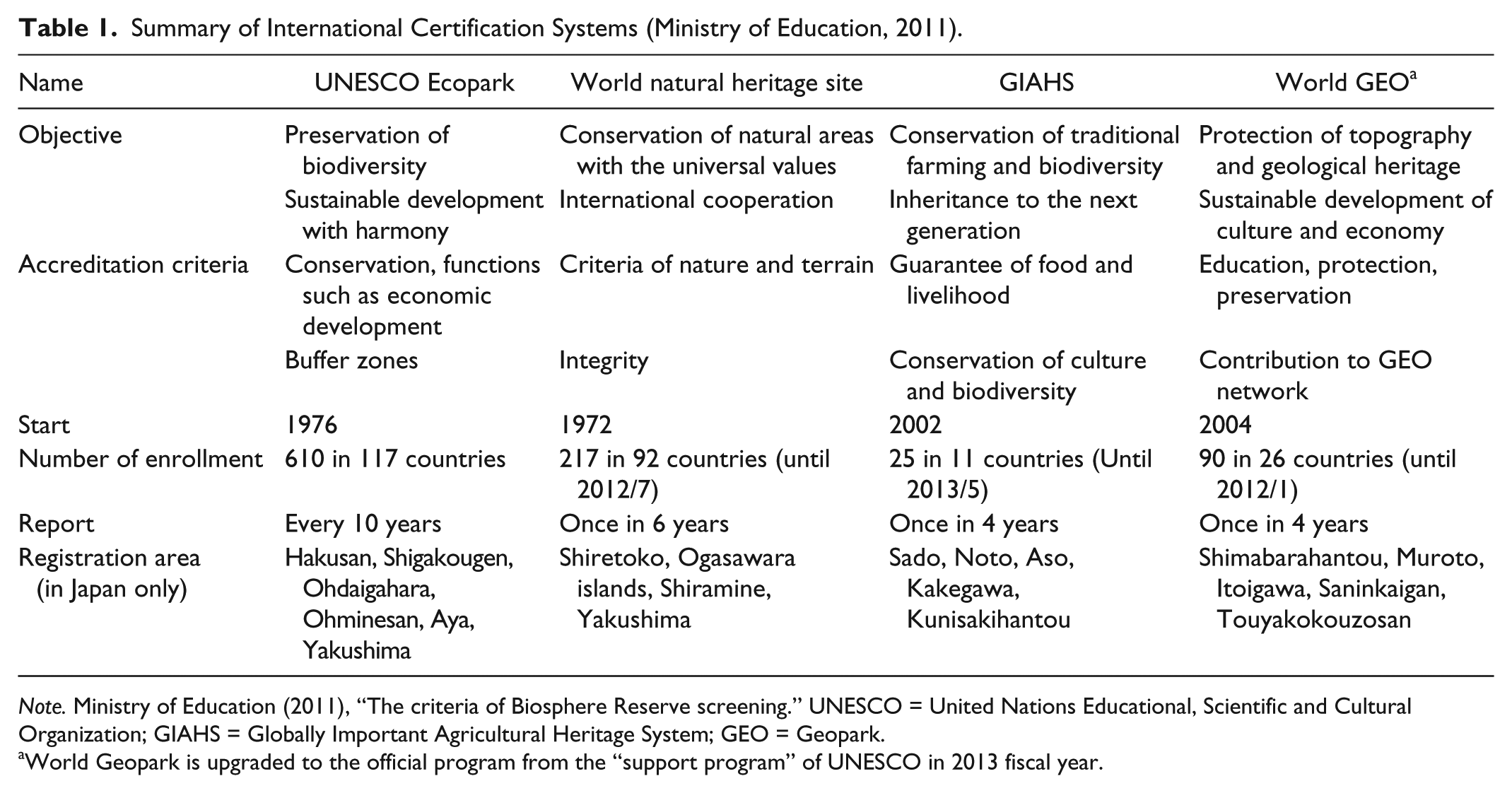
Note. Ministry of Education (2011), “The criteria of Biosphere Reserve screening.” UNESCO = United Nations Educational, Scientific and Cultural Organization; GIAHS = Globally Important Agricultural Heritage System; GEO = Geopark.
World Geopark is upgraded to the official program from the “support program” of UNESCO in 2013 fiscal year.
The other uncertainty is related to the applications of the certificates. The certification process and logos are utilized in agricultural products, including vegetables, rice, or processed sweets and wines in some cases. However, the rules are not yet established and will require further elaborations. Increase in prices of local products or surge of number of tourists or educational programs are often common “indicators” for obtaining the international certificates.
In short, the purpose and organizations of the individual municipalities for applying for the international certifications are more diverse and context dependent for the three systems compared with the World Nature Heritage. For certain municipalities, the main purposes are the educational ones, whereas for the others it is the tourism sector, with possible overlaps.
For certain certifications, the decision-making process becomes highly complex because plural municipalities are involved. For the first two designations of the GIAHS, the Noto Peninsula had four cities and four towns involved, whereas it was a single municipality for the Sado area. The budget and advertising potential will be limited for the single municipality, while the decision-making processes are often faster and simpler.
To date, the existing literature tends to focus on case studies involving single municipalities with a single certification scheme (Berglund et al., 2014; Lu & Li, 2006). For example, Berglund et al. (2014) conduct a comparative study of GIAHS of Japan and Scandinavia. Hall (2006) and Mi et al. (2014) focus on the policies related to the ecotourism of GIAHS in their analyses.
Nakamura, Tsuge, Okubo, Takeuchi, and Nishikawa (2014) and Yiu (2014) investigated the factors that influence farmers, such as cost and actors problem in single area by the system certification. Yet, the process of the certifications is more complex and discursive. In this article, we examine four certification systems consisting of both cases of single and plural municipalities. Furthermore, the quantitative analysis of the formal discussions at the municipality assemblies using text-mining methods are limited and this study has potential to contribute to the methodological discussions as well.
Methodology
The record of formal discussion at the municipal assembly has been explored in the field of political science and other social science. Among others, Lukes (2005) named the official discussions at the parliament as the first layer of power among the three levels (the other two being the agenda settings of “what comes into the agenda” and the last one was related to consciousness of the public). The formal discussions at the official settings are one of the simple and obvious parameters, with certain limitations, of interests at certain contexts. Recent studies have focused more on discourses or governance and institutional settings at the policy implementations (Epstein, Bennett, Gruby, Acton, & Nenadovic, 2014; Ostrom, 2008).
With these limitations and trends in mind, we analyze the official discussions at the municipal assembly with quantitative method. In addition, we further take into account another source of information by interviewing officials with qualitative method. As the first step, we analyzed formal discussions of the municipal assembly at the local municipality level based on the official record. We then interviewed the officials in charge of the certification programs at the individual municipalities. The interviews were structured, and we asked the same questions to the officers.
Personal information including names, age, or gender was not collected in the interviews. All of the municipalities and officials in charge of the subject were informed that their answers would be used for research. We contacted the officials by emails, and consent was obtained through exchange of emails in writing. In case we had the chance to meet the officials in person, we confirmed the consent orally.
By covering both official discussion and personal interviews, we aim to analyze the complex decision-making process involving various municipalities, as we examine four certification systems consisting of both cases of single and plural municipalities. The concrete process of analysis is described in the following sections.
Materials for Text Analysis
We collected the official records of municipal assemblies in eight municipalities of the Noto Peninsula (Hakui, Nakanoto, Nanao, Shika, Anamizu, Noto, and Suzu). These municipalities were the initial members of the GIAHS, and we excluded Houdatsu-Shimizu which joined the status later. We analyzed Sado as a comparative case for the GIAHS case composed of single entities near Noto Peninsula. For the MAB and Geopark, we analyzed the assembly records of Hakusan City of Ishikawa Prefecture and Ohno City of Fukui Prefecture. Hakusan has been one of the initial members of MAB from 1980; moreover, Hakusan and Noto Peninsula are of the same Ishikawa Prefecture. Ohno is the neighboring city of Hakusan, and included in the MAB site of Hakusan region.
Yamanouchi, from Nagano, is analyzed as the case of MAB. In contrast with Hakusan, Yamanouchi is a single entity by MAB. As a matter of principle, we collected data since 2011 when the GIAHS was first designated in Japan. For Suzu and Yamanouchi, the recent data of 2012 and 2013 were analyzed, as they limit the public viewing period for two years. For the other municipalities, we used the data available from the official homepage (cf. Table 2).
The Reference Sources of City and Town Assembly Record.

In short, we analyzed GIAHS, MAB, and Geoparks comparing zones with single and plural municipalities. For GIAHS, it was Noto (plural) and Sado (single); for MAB, it was Hakusan (plural) and Yamanouchi (almost single); and for Geopark, it was Hakusan (plural) and Yamanouchi (single). In the strict sense, the Siga kogen consists of plural municipalities including towns from Gunma Prefecture, but it was obvious that the Yamanouchi was playing the main role, so we regarded it as the single municipality. The certification status is shown in Table 3. The overall size of the texts data of the official records of municipal assembly was 11 million letters with 1.9 GB of data size.
Characteristics of Each Municipality.

Note. GIAHS = Globally Important Agricultural Heritage System.
Japanese Geoparks
Processing of the Relevant Terms
To focus our analysis, we limited the terms to GIAHS, Ecopark (equivalent of the MAB in Japanese), and Geopark. For the GIAHS-relevant municipalities of Noto and Sado, we focused on questions and answers containing the term Sekai-Nogyo-Isan (Japanese term for GIAHS) and GIAHS. For Sado, we also included World Heritage or World Cultural Heritage because Sado has expressed it is interested in obtaining the status. Sado received its status as a Geopark in 2013, but we did not include the term because the keywords, due to the low frequency of term expressed and data of records, were limited. The term World Heritage was expressed more frequently.
For MAB-related municipalities of Hakusan and Yamanouchi, we focused on questions and answers containing the term Ecopark (the Japanese abbreviations for the MAB). For Hakusan, we included the term Geopark and Geo because it is designated as Geopark in addition to the MAB.
Methods of Text Analysis
We compare the frequently used terms in the discussion of municipality assembly with the methods of co-occurrence network and co-occurrence order. These results of quantitative analysis of text mining are then compared with the results of interviews. We adopted the Jaccard index for the similarity coefficient. There are other indexes such as Cosine, but we decided on Jaccard due to large size of the texts data and the representation matrix was frequently sparse.
The definition is as follows:
Definition 1: (Jaccard index)
Jaccard index is a rational number between zero and one. The Jaccard index of an arbitrary term X and term Y, J(X, Y) can be calculated in the following formula:

In this formula, A is the number where the terms X and Y appear in the same text. B is the number of texts where the term X appears alone, and C is the number of texts where Y appears alone. The larger the J(X, Y), the more likely the two terms appear simultaneously (i.e., they are coefficients). We have utilized the software of kh-coder2.Beta31 for the analysis.
Results
The results of frequently used terms for individual sites and municipalities are listed in Table 4. It lists how frequently individual systems of GIAHS, MAB, Geoparks, or World Heritage are referred to during the period. The columns where municipalities have no intentions for applying for the certificates are indicated with a dash “―”. The parts with a “―” are not considered because they are not certified or are not acting for obtaining the status.
Frequency of Use in the Assemblies.
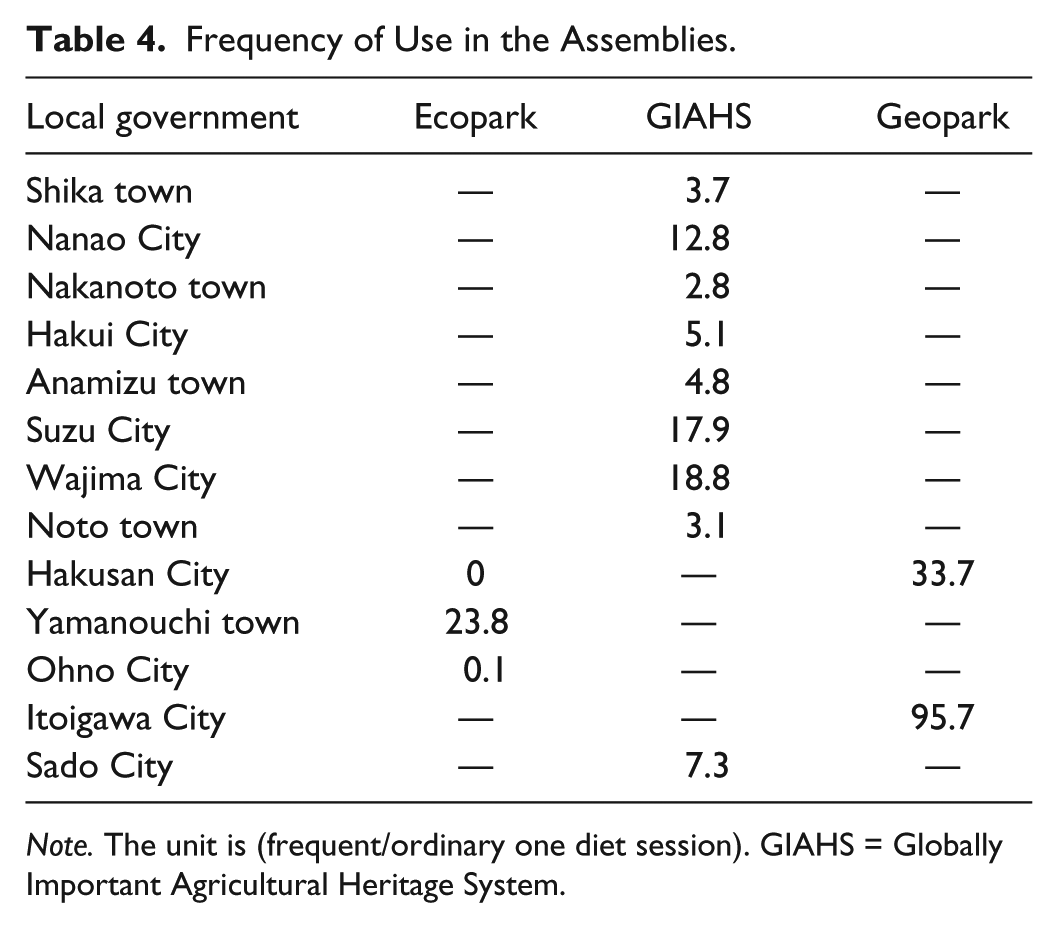
Note. The unit is (frequent/ordinary one diet session). GIAHS = Globally Important Agricultural Heritage System.
We first examined the results of Noto and Sado from GIAHS certification. As a general trend, the cities (Shi in Japanese) tend to express sentences related to GIAHS more frequently than the towns (Machi or Cho). The cities are Suzu, Wajima, Nanao, and Hakui, and the towns being Noto, Nakanoto, Shika, and Anamizu. The frequency was 13.65 for the city and 3.6 per assembly session for individual towns. In short, we identified the differences potentially by the size of the municipalities. For municipalities at the GIAHS, the larger cities such as Nanao, Suzu, and Wajima tended to express the term more frequently than the towns or smaller municipalities.
Besides the differences between the towns and cities mentioned above, the location of the municipalities had an influence. The municipalities of Suzu, Wajima, and Noto at the northern territories, or the region of Okunoto, tended to express the term GIAHS more frequently than the rest of the municipalities. It is clear that there are discrepancies among municipalities in Noto which are at the same GIAHS sites depending on size and location. The cities with larger size tend to express the terms more frequently than the towns. Suzu, Wajima, and Noto in northern area tended to express more frequently than Sika, Nanao, Nakanoto, and Hakui, which are located in the middle or the south.
Sado expresses with less frequency compared with Noto regions. This could be potentially related to the fact that Sado aims to get registration as a World Natural Heritage. (We did not include the frequency of Sado for the World Heritage as the focus here is to compare the GIAHS of Sado with that of Noto).
Next we analyze the MAB with Hakusan and Yamanouchi. Hakusan has overlapping certification of the MAB and the Geopark. The discussion at Hakusan is skewed toward Geopark, with zero reference to the MAB and average per assembly session of 33.7 references to the Geopark.
Hakusan runs the Geopark as a single entity being part of the MAB among 11 other governing units, ranging from four prefectures and seven municipalities. The similar contexts are observed in other municipalities including Ohno in Fukui. For example, the frequency of use the term, MAB is low (0.1) in Ohno.
For the MAB comparison, we analyze the assemblies of Hakusan and Yamanouchi. Hakusan has two certifications of the MAB and Geopark, the frequency of the reference to the MAB was zero and Geopark was 33.7 per assembly during the period. The Geopark is run and organized by a single entity, while MAB is run by plural entities (four prefectures and seven villages). The Geopark was frequently referred to in the assembly discussion. A similar trend is found for Ono and the frequency of the reference was marginal with 0.1 per assembly.
For Yamanouchi, the MAB has been referred to as much as 23.8 per assembly. The frequency is obviously higher for those municipalities with single or limited memberships, possibly with more sense of ownership of the system. Hakusan actually hosts the bureau (titled “Hakusan UNESCO Ecopark Association” or Kyogikai in Japanese) of the MAB with other municipalities, and hence we anticipated that more discussions will be conducted. Ohno is a member of the bureau, but it is not so active in the discussion.
Next we look into the discussion of the Geopark with Hakusan and Itoigawa. They are both run by single municipality. Both municipalities were active in the discussion with the frequency of 33.7(Hakusan) and 95.7 (Itoigawa) per assemblies.
Hakusan has been certified with the two systems, MAB and Geopark (Geopark at the national level). Itoigawa has been certified with the Geopark of global network. It was less referred to in the Hakusan, but both municipalities have actively discussed the certification.
Co-Occurrence Order
We choose Suzu for GIAHS, Yamanouchi for the MAB, and Itoigawa for the Geopark for comparing the discussions with different certifications. All the municipalities discussed relevant issues relatively active in the assemblies. The Suzu City was the first chair of the local GIAHS association and played a central role in registration.
The relationships among municipalities are illustrated in the Tables 5 to 7. We focused on “nouns” to identify the distance of different systems and regulations (the nouns include name of places). Such limitations to nouns are common in the existing literature (Capobianco, De Lucia, Oliveto, Panichella, & Panichella, 2009). We identified the nouns that will appear frequently together with the GIAHS, MAB, and Geoparks.
Co-Occurrence Order of the Words Related to the GIAHS (Suzu City).

Note. GIAHS = Globally Important Agricultural Heritage System.
Co-Occurrence Order of Words Related to the Ecopark (Yamanouchi Town).
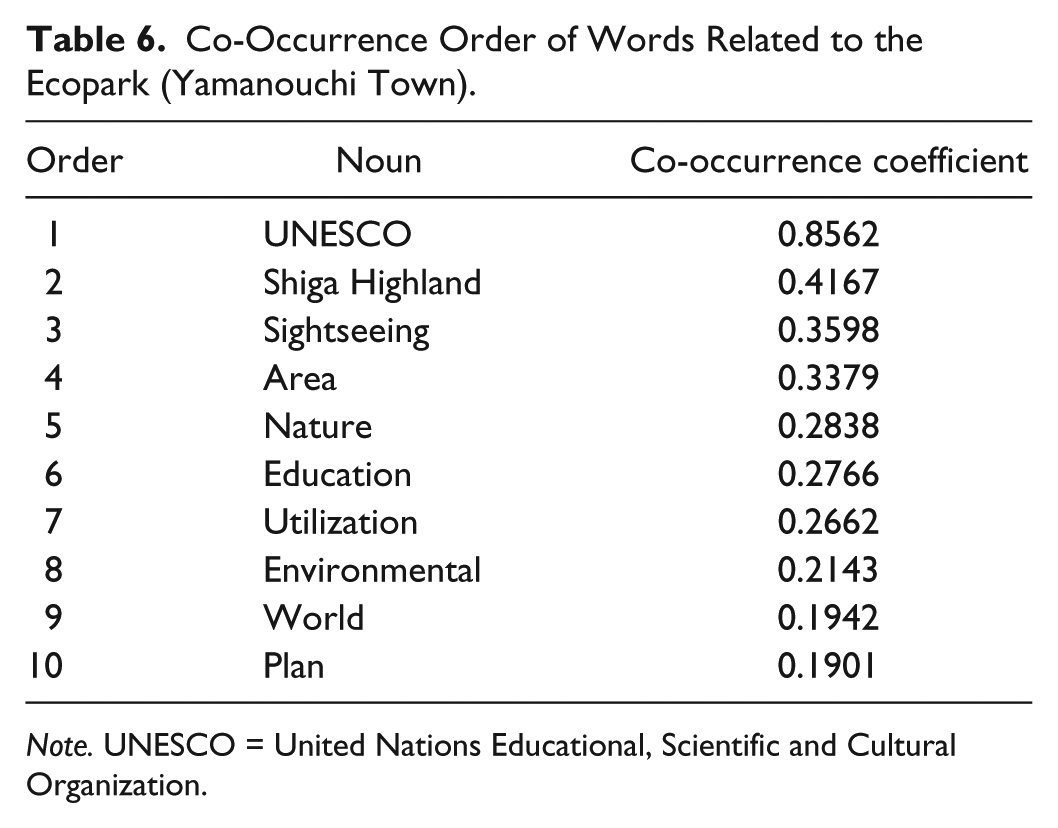
Note. UNESCO = United Nations Educational, Scientific and Cultural Organization.
Co-Occurrence Order of Words Related to the Geopark (Itoigawa City).

We analyzed the distance of the certifying systems and nouns such as conservation, exchange, educations, or tourisms. The hypothesis was the linkage of the assemblies’ discussion and the trends at the sites. By examining the hypothesis, we aimed to identify trends at the gap between synergies of the activities on the ground and the discussions at the political level.
The results are indicated in Figures 1 to 3. The thickness of the circles around the terms signifies the frequency of the terms expressed. The thickness of the lines signifies the frequency of the two terms expressed together. The trends of the discussions at the assemblies are visualized by Figures 1 to 3. In general, in the discussions of the GIAHS at Suzu, the certification is discussed together with the terms agriculture and conservation, while the term tourism is rather independent. For the MAB at the Marunouchi, the certification is more frequently expressed together with the terms tourism and education, in comparison with the GIAHS. For Geopark at Itoigawa, the term bullet train is expressed frequently together as the new transportation system was planned to start in March 2015 and stations were being constructed. Such terms related to transportation were not expressed or visible in the other contexts. Other terms such as agriculture or conservations were not expressed in the contexts, which is a difference compared with the other two certifications of GIAHS and MAB.

Co-occurrence network (Suzu City: GIAHS).

Co-occurrence network (Yamanouchi town: Ecopark).

Co-occurrence network (Itoigawa City: Geopark).
Discussions
As a general trend, we identified the differences by the size of the municipalities. For municipalities at the GIAHS, the larger cities such as Nanao, Suzu, and Wajima tended to express the term more frequently than the towns or smaller municipalities. Furthermore, there were differences depending on the location of the municipalities, with Okunoto, the municipalities in the northern area, being more actively engaged in the discussions.
We have made comparative studies of different certifications within the same municipality. When the municipality obtained a new or additional certification, the older certification tended to get lower frequency for expressions. This was the case for the MAB for the Hakusan, which obtained Geopark in addition recently. For Sado, GIAHS was not so actively discussed as the municipality aim to obtain the World Cultural Heritage, and the latter was more frequently expressed in the assembly. These trends question the sustainability of the certified areas as the attention potentially decreases when the municipality obtains or aims to obtain new certifications. Certain awareness raising and measures are necessary to buffer the decrease in the interests of the existing certifications when obtaining or initiating new certifications.
For the comparison of the three certifications of the GIAHS at Suzu, MAB at Yamanouchi, and Geopark at Itoigawa, the Geopark was most frequently expressed. The comparison is by no means representative of each certification, and it is not possible to compare the average or statistics. The possible cause is that both Hakusan and Itoigawa run the Geopark as single entity, and thus the discussions at the assembly was more active, resulting in such higher frequency for expressions. Another factor for Itoigawa was the new transportation system of bullet train.
As for the content of the discussion at the assemblies, the term GIAHS was used frequently together with certification and conservation.
For Yamanouchi and Itoigawa, the name of the certificate MAB and Geopark was expressed frequently together with the terms tourism, education, and utilization. The term brand was expressed for the GIAHS and Ecopark, which was not the case for the Geopark at Itoigawa.
From the figure of the co-occurrence order for the Geopark at Itoigawa (Figure 3), concrete issues such as bullet trains, number of non-residential visitors (or Koryu Jiko in Japanese), and enterprises were expressed together in the same texts. For Suzu, the terms collaboration, tourism, and utilization were expressed separately from the texts of the GIAHS. For Yamanouchi, the term Ecopark was expressed together with education, whereas industry, brand, and agricultures were expressed separately.
Based on these discussions with limited number of municipalities, we illustrated the characteristics of the certifications systems. For example, Geopark at Itoigawa was expressed frequently with the transportation and visitors, which was strongly influenced with the construction of the new bullet train systems to be completed in March 2015.
For the discussions at the GIAHS at Suzu, term GIAHS was used frequently together with certification and conservation. The terms Satoyama and Satoumi, which means the social and cultural production landscapes and seascapes, were loosely interlinked with nature and brands. Though not direct, the collaboration with the university and human resource development systems were also frequently expressed together as characteristics of the region. For Yamanouchi with the MAB, the linkage with the tourism was strong. Other associated terms were brands, agricultures, and other national-level plans and assemblies.
These illustrations are by no means representations of each certification. Yet we can cautiously suggest that the discussions are embedded in the individual contexts. By compiling such quantitative analysis at the local-level assemblies, the finding suggests the micro-level focus of the certifications.
There are several findings with policy implications. We identified certain pitfalls, that the municipalities tended to focus their discussions on newer certifications and interests for the existing ones tend to decrease. In future studies, it is possible to identify and even partially quantify the political focus and interests of the certifications at different political levels by comparing the different layers of municipalities, prefectures or national assemblies.
For methodology, we have demonstrated that the text-mining methods can be applied to the discussions at the official records of municipality assemblies and showed the rough focus and possible trends of the discussions at the political level, given the availability of official records online even for limited number of years.
The application must be done in a careful manner and individual contexts need to be taken into consideration. For some municipalities, the main discussion may be happening outside of the official assemblies with local NGOs or research groups.
Conclusion
The focus of this study was rather limited with emphasis on official records at the municipality diet from 2011 to 2013. Yet, even with these focused materials with specific time frame, the results of the study indicate the context-specific characteristics of the biodiversity relevant to certification schemes. The terms were largely in the field of conservation, education, or agriculture-related terms. There were less focuses on economic terms such as income and employment in the discussions.
The lack of economic terms is critical, as the immediate expectations from the local communities are economic in nature from the experiences of the authors when visiting these areas. As Bowitz and Ibenholt (2009) illustrated, positive impacts are reported in increase in employment and incomes in case of UNESCO World Cultural Heritage. Whether such impacts are observed in shorter or longer terms remains to be seen for the schemes in this study, the UNESCO Geoparks, MAB, and GIAHS. These schemes are not primarily designed for economic purposes yet the expectations of the local communities are frequently different and expect economic outcomes. These are complex issues linked with sustainability of the overall scheme.
To pursue these explorations, it is necessary to explore additional materials to the official records at the municipality diet. The data and statistics of the economic impact will need to be examined. Furthermore, the methodology of this article can be applied in larger contexts, to examine the multi-dimension of the certification to the local and surrounding communities. Additional materials for text-mining analysis can be outcomes of group discussions, remarks in Social Networking Service (SNS), or advertisements of the designated places.
It is also necessary to follow up the results with longer time frame beyond the year 2013, with a sequel involving pertinent international data and appropriate comparisons and analyses as the study indicates the results from relatively new periods since the introduction of the system in Japan.
Footnotes
Declaration of Conflicting Interests
The author(s) declared no potential conflicts of interest with respect to the research, authorship, and/or publication of this article.
Funding
The author(s) disclosed receipt of the following financial support for the research, authorship, and/or publication of this article: This work was supported by the MEXT Gakushin, KAKEN [26360062, 15H01597, Leader Kohsaka, R.]; the JFE Steel Corporation (2015) [Leader Kohsaka, R.]; the Environment Research and Technology Development Fund [1-1303, Leader Saito, O.].