




Abstract
This study investigates the role of community heritage resources in crisis management in rural Nigeria. Descriptive survey research design and ethnographic method were adopted for the study. Although Yaro Yemen formula was used in downsizing the sample size for the quantitative survey to 399, cluster and purposive sampling techniques were used in downsizing the sample size for interview sections to 50 informants. This size was sampled from five states (Enugu, Borno, Akwa-Ibom, Plateau, and Ondo states) in Nigeria. Data from questionnaires were analyzed using mean and standard deviation, and the hypotheses were tested using the t test. More so, qualitative data were analyzed descriptively. Results from the six indices that were investigated revealed that heritage resources contribute significantly to crisis management in rural Nigeria.
Keywords
Introduction
Heritage value has expressed its significance in most rural communities in Africa, mostly where communal living is the practice. This has given Africa a fair comparative advantage over some developed societies where heritage values have been relegated (Nwankwo & Agboeze, 2014). It has implications for the standard of living of the people (Akpomuvie, 2010). Heritage resources have been able to distinguish perceptions in the rural areas, and this has translated to the identification of most rural communities from their heritage resource base. Heritage values give communities unique identities and distinguished them from their closest neighbors (Morel, 2013). Preis and Mustea (2013) had argued that culture embodies the ideal identity of a people, hence the identification of a people through their cultural manifestations. Heritage resources over the years have demonstrated the historical and cultural antecedents of a people that have culminated in the modification and projection of a people’s identity.
Some of the previous studies on heritage resources concentrated on the inventory and documentation of these heritage resources (see Ekechukwu, 2008; Nwankwo, 2013; Nwankwo & Agboeze, 2014). Others focused on the promotion of these heritage resources for identity promotion, posterity, and tourism development (i.e., Eze-Uzomaka, 2006; Obieluem, Anozie, & Nwankwo, 2016; Okpoko & Okpoko, 2002). This current study, however, intends to see heritage resources, more especially, those that are community based and owned by various communities, beyond the consideration of these previous studies to seek the possibilities of harnessing some other potentialities of these heritage resources toward the development of the rural communities where they are domiciled.
Moreover, it has been identified that among the impediments to accelerated growth and productivity in rural areas in Nigeria are various categories of crisis that are found at these rural communities and their varying dimensions (Adewale & Bamise, 2015; Blench, Longtau, Hassan, & Walsh, 2006). These range from intercommunity crisis, intrafamily crisis, belief crisis, church crisis, and individual crisis to group crisis. Different causes have been attributed to these crises as found at these rural areas. The crises include land disputes, religious disparity, church disparity, individual difference, modern–tradition disparity, boundary disputes, antecedents of previous communal wars, and selfishness (Morel, 2013; Preis & Mustea, 2013). This has greatly prevented these rural communities from attaining meaningful socio-economic and political progress in their various domains. This background has motivated this study to find out how community heritage resources can contribute to crisis management in rural Nigeria. Therefore, the objective of this study is to find out whether community heritage resources play any role in crisis management at these rural communities in Nigeria. This study intends to do this by identifying some intangible heritage resource indices and investigating their potentialities in crisis management in rural areas. The implication of this is that the study will explore potentialities of heritage resources for peaceful existence and further place heritage resources among the viable tools for conflict resolution in rural areas of Nigeria and beyond.
Clarification of Basic Concepts
It is imperative to give a brief explanation of some of the basic concepts that were repeatedly used in this study and also look at the brief background information to the study. Nigeria is a nation in West Africa with over 150 million human populations, judging from the 2006 National Population Census in the country. Although in 2015, World Bank estimated Nigeria’s population at 180 million people (see World Bank, 2015). The nation is politically disintegrated into six geopolitical zones of Northeast, Northwest, Northcentral, Southeast, Southwest and Southsouth. Furthermore, the nation as a whole can be viewed from three dimensions: the urban areas, semi-urban areas, and rural areas. Although urban areas are the massively developed parts of the nation, the semi-urban areas are also developed in terms of social amenities and other necessary provisions but not as much as what is obtainable at the urban areas. Then, the rural areas are the least developed parts of the country and, consequently, suffer the consequence of emigration to urban and semi-urban areas. The rural areas that are the focus of this study are those indigenous communities that are densely occupied by peasant farmers, petty traders, and indigenous people; community lifestyle is inherent in those areas, hence the availability of strong kinship ties (Ekechukwu, 2008; Nwankwo & Agboeze, 2014). The poor economic state of these indigenous communities has enabled them not to completely suffer the incidence of culture diffusion, acculturation, and other cultural infiltration. Hence, their indigenous cultures are mostly found intact, and the concept of heritage resources has many possibilities to discuss at these areas. They have been able to maintain both their cultural and natural heritage resources owing to these enabling factors.
Rural population is the population of people living in rural areas. It is the percentage difference between the total population and urban population. According to World Bank reports, the Nigerian rural population stood at 38,182,080 during the National Independence in 1960, but 95,604,260 in 2016 (see Figure 1). This is 51.40% rural population as at 2016, as against the 84.59% in 1960 (Index Mundi, n.d.). The implication of this decline in value since 1960 is downward movement on the standard of living for the populace. Solomon and Adeyemi (2005) and Madu (2010) are of the view that rural–urban migration is as a result of poor standard of living for people living in the rural areas. Hence, the search for better living motivated the incessant rural–urban migration in Nigeria since 1960. Commensurate distribution of basic amenities and other economic life support projects would encourage rural residence (see Figure 1).

Statistical growth of the Nigerian rural population since National Independence in 1960 through 2016.
However, Eteng (2005) sees rural Nigeria as part of Nigeria that is mostly poorly developed with basic amenities. The few visitors who are living with them constitute only 5% of the entire population. Scarce presence of visitors has helped in the sustenance of traditional values and kingship ties at those rural parts of Nigeria (see Figure 2). Structurally, rural life is found in virtually all the 36 states of the Federation including the Federal Capital Territory (FCT), Abuja. The difference is only established in the size of rural areas in each of these states. Even in each of these states, rural life is scarcely distributed and not concentrated to a particular location. Three rural communities were sampled from each of the five sampled states for the study. More number of males than females were selected for the study. This was because it is believed that most of the time, men are open to culture discuss than women. For instance, Bakshi and Pathak (2016) reported that aging men in rural areas are more committed to communal activities and discussions than their women counterpart. The rural areas visited for the study are Ezimo, Inyi, and Agbaogwugwu (in Enugu State); Bakaima, Abadam, and Anadua (in Borno State); Kwakhwi, Dimmuk, and Chigwong (in Plateau State); Ebebit, Itung, and Uruk Uso (in Akwa-Ibom State); and Abogedegbe, Abagun, and Okitiofa (in Ondo State; see map in Figure 2).

Map of Nigeria showing sampled study areas.
Moreover, what then is community heritage? These rural communities have great number of cultural heritage resources that are unique to individual communities. Heritage resources are subdivided into tangible and intangible heritage resources. Although tangible heritage resources include caves, water bodies, sacred grooves, festival regalia, food, traditional attires, and so on, intangible heritage resources include belief system, value system, traditional dance, marriage system, inheritance strategy, and lot more (Gunlu, Yagci, & Pirnar, 2009). These heritage resources could be of individual, family, village, or communal ownership. However, community heritage resources are those heritage resources that are communally owned by a given community, and hence their managements are bestowed on the chief custodian of the people’s culture. Such heritage resources are the instruments that bind the community together in one accord, giving them a unique identity amid their neighbors. The intangible aspects of them include marriage pattern, kinship inheritance, belief system, value system, communally owned traditional dance, masquerade system, and so on. The tangible aspects include community streams, sacred grooves, shrines, and so on. As noted earlier, the conspicuous less presence of foreigners in these rural communities has helped to sustain these heritage resources. Such communities are found in some other developing nations of the world where indigenous cultures are still held to a very high extent.
Moreover, community heritage resources are seen as the integral part of communal life and hence, have identified these communities (Ababneh, 2016; Ekechukwu, 2008; Glendinning, 2011). For instance, specific heritage resources have been used to identify some rural communities. A typical example is the Nkpokiti Dance of Umunze Community in Southeast Nigeria; Atologwu Dance of Awka people of Southeast Nigeria; Eyo festival of the Lagos part of Southwest Nigeria; Ekpo festival of the Calabar and Akwa-Ibom peoples of Southsouth Nigeria; Argungu festival of the Kebi people of Northeast Nigeria; the Carniriv of the Ikwere people of Southsouth Nigeria, the Igogo, and Sango of the Ondo people of Southwest Nigeria; the Afiaolu by the Nnewi people of Southeast Nigeria; Sharo/Shadi by the Fulanis of Northern Nigeria; among others. These festivals are known to be integral part of these communities and have given them unique identities and roles. Decisions on periodicity, sanctions, mode and extent of celebrations, regalia and makeups, among others, with respect to these festivals and dances are taken by the community and not by an individual (see Akpomuvie, 2010; Benard & Moon, 2000; Linnell, 2013; Morel, 2013; Wollentz, 2014; etc.). In most cases, these intangible heritage resources have religious and ritual inclinations with these rural communities (Nwankwo, 2013; Onyefulu, 2007).
Another concept used in the study is crisis management. One would not look at the meaning of this concept without first of all looking at the meaning of the word “crisis.” This has been viewed from varying dimensions by different authors. It is seen as a state of disharmony in a system involving human beings. A state of disunity as a result of human or other causes (Adewale & Bamise, 2015; Eze, 2011; Morel, 2013). It is both unimaginable and imaginable state of disharmony that threaten the unity and existence of people. This definition is only viewed from human dimension as it relates to the current study. However, crisis management has to do with various attempts, strategies, tactics, and solutions that are aimed at either eradicating crisis or reducing it to a bearable state (Wollentz, 2014). It is worthy to note that most of the times these crisis control measures are human induced: hence, they are targeted at enhancing peace, unity, and meaningful development. In some cases, the measures are not human induced. They are external to human inducement such that they are attributed to either natural causes or indirectly caused by humans. Eze (2011) notes that, regardless of causes, crisis or conflict management is one of the requirements for socio-economic development. It brings stability and progress, which are among the tools that propels human development through history.
However, the unending list of heritage resources as found in rural Nigeria has necessitated the sampling of some of them that have much contribution to traditional values. The focus was on selected intangible resources that are dominant and common among the various cultural groups in a multicultural state such as Nigeria. Cluster and purposive sampling techniques were used for sampling of some intangible heritage resource indices for this study. Traditional marriage rite was one of these indices. This is the traditional way of engaging a man and woman as a married couple. Its process varies among the various cultural groups in Nigeria, but the aim and expectations are the same. The role of this heritage resource to crisis management in rural Nigeria was investigated in this study. Also, another sample heritage resource is the traditional belief system or the religious aspects of the people’s culture. This has to do with the people’s belief in the supernatural, life after death, Supreme Being, gods, and goddesses, which has shaped the religious life of the people. Although there are differentials in the people’s belief system in rural Nigeria, emphasis has been on the foreign and traditional religions. Although the dominant foreign religions have been Christianity and Islam, the traditional religion is still in vogue, more especially, at these rural areas. It is only in the Northern part of Nigeria that the activities of the traditional religion are intermingled with the Islamic culture and religion. This intangible heritage resource shall equally be investigated in the course of this study.
Traditional festival is another sampled intangible heritage resource that is common in rural Nigeria. Each of these rural communities has unique festivals they are identified with, and while some of them are indigenous. Others are learned or borrowed from other communities with similar cultures. The communality in most of these rural communities has helped in the preservation and transfer of these festivals through generations. Some of the traditional festivals in Akwa-Ibom include Usoro Usuuk Udia (New Yam festival), Usoro Idio (festival for clearing farm land), Usoro Ekong (festival of traditional heroes), Atara ukwa (festival for traditional deity), Usoro Abasi (feast of the gods), and so on. Whereas traditional festivals in Borno State include Barakau festival, Durbar festival (to mark Salah activities), Gaorgaram fishing festival, and so on. In Ondo State, they have Ariginya festival (for adolescent females), Egungun festival (masquerade festival), Obitun festival (for maidens before they get married), and so on. Plateau State has Nzem Berom festival, Bel/sombi festival, Puus kaat festival, and so on. Whereas in Enugu State, there are Omabe festival, Ekpe masquerade festival, and so on. Most of these festivals have cultural significances to the people which may be for commemoration of special historical events, agricultural practice or season, or for the gods or goddesses of these communities. The festivals serve cultural, spiritual, and entertainment functions to the people. This study tried to find out whether these festivals play any role in crisis management at these communities. In addition, traditional masquerade system was one of the sampled and investigated intangible community heritage resource indices. Traditional masquerade system has to do with various kinds of masquerades that are peculiar to these rural communities. These masquerades that are found in most of these rural communities may have different nature, process, and exhibition. Most of them are performed to serve cultural, spiritual, and/or entertainment functions to the community. In most cases, the activities of these masquerades are left in the hands of youths in the community, except in exceptional cases where some of them were left to be practiced by the aged. Although the presence of foreign religions are strong threats to some of these practices in most places, their presence are still noticed in most rural communities in Nigeria. This practice is common among rural communities in Nigeria, but their mode of operation, preparation, display, and sociocultural significance may differ from one area to another. In most cases, these communities are known or identified with a particular masquerade system, that is, Ikeji for the Aros, Omabe and Odo for the Nsukka area, Eyo for the Yorubas, Ekpe for the Orons and Ibibios, and so on.
Another socioculturally relevant and ever present intangible heritage resource among the people under study is the traditional myth. These are ancient stories with great historical, heroic, didactic, and eventful values. They are used to transferring knowledge, information, and lessons from one generation to another. These myths could be said to be as old as these rural communities themselves. The myths have been used to unify, sustain, and teach moral lessons in these rural communities even before the arrival of formal education. In most cases, the aged transfer these myths to the younger ones either directly or indirectly. Despite the influence of modernity, most children in these rural communities still yearn for these myths and often meet their parents or other adults who are knowledgeable in their community myths to tell them some of these myths; perhaps, for the purpose of entertainment. For instance, there are three popular myths that are common among the three main ethnic groups in Nigeria that have to do with creation and origin. The Igbos were known for Eri as their progenitor, Oduduwa for the Yorubas, and Usman Danfodio for the Hausas. This traditional myth is among the sampled indices for this study.
Finally, the last but not the least index is the traditional title-taking as found in virtually all the rural communities in Nigeria. This is a widespread phenomenon among the rural communities, despite differences in religion, localities, social status, and educational background. This is the award of different traditional titles to merited individuals by the chief custodian of culture, who is not always restricted to only the members of his primary community. The nature, process, and implications of these traditional titles differ from one community to another and from one ethnic group to another in Nigeria. These traditional title-taking is much more paramount among the Igbos of Southeast Nigeria, the Yorubas of the Southwest, the Hausas of the North, and the Niger Delta people of Southsouth Nigeria. Some of the notable traditional titles include Sarki, Shehu, Mai, and Lamido for Hausas; Enogie, Okao, and Odionwere for the Edo people; Ooni, Alake, Alaafin, Awujale, Olomu, Akarigbo, Orangun, and Olu’wo for the Yorubas; Orodje, Oresuen, Ohworode, Odio-Ologbo, and Odio r’Ode for the Urhobos and Isokos of Southsouth Nigeria; and, Ozo, Owerre, Onowu, Ogbuefi, and Nze for the Igbos of Southeast. These traditional titles are awarded to meritorious individuals who have made or are expected to make great impact in these rural communities either directly or indirectly. And the custodians of these various traditional titles are given enormous cultural values by the people and highly respected at their various communities; hence they are equally seen as culture ambassadors of the communities that gave them such traditional titles. However, traditional titles are much peculiar to the study areas. For instance, some notable traditional titles in Ondo State are Alaboto, Olubo, Laragunshin, Oludoko, Olufira, and lots more. In Plateau State, they have Gbong Gwom, Ponzhi Taroh, Mishkaham, Wellafier, and so on. Borno State has traditional titles such as Dan maliki, Waziri, Madawaki, and Sarki. In Enugu State, there are Nze, Ozo, Ozioko, Ishiwu, Onogwu, Nkposhi, Ichie, among others. Finally, some remarkable traditional titles in Akwa-Ibom State include Obong Uforo, Obong Ifiok, Obong Iberedem, and Obong. The role of this intangible heritage resource in crisis management was also investigated.
Previous Studies
Previously, some studies have been conducted on the subject matter either directly or indirectly. A brief review of them would properly situate the current study in its context. For instance, Adewale and Bamise (2015) said that among the causes of conflict in Nigeria are tribalism, resource control, religion, land dispute, and so on. They went further to note that conflicts can never appear without negative consequences that have the tendencies of disunity among the various interests. Eze (2011) also noted that crises are peculiar to people, hence any crisis management theory should be people centered so as to maximize the gains of the strategy in crisis management. Alsamaray (2014), in his study, recognized the fact that leadership style has impact on crisis management. And hence, a culturally constituted traditional political system plays a role to crisis management in the community. Glantz (2014) advocates that crisis management at communities can be achieved through reliance on information and communication from reliable individuals in the community during crisis management.
Moreover, Morel (2013), in his study, reveals how myth as intangible heritage resources has been helpful in solving conflict among people and regions. He cited that of the “Myth of Kosovo” which was helpful in resolving a long-standing face-off between the people of Kosovo and that of Serbia. This particular myth, he noted, employed historical antecedents in resolving the said crisis. Also, Preis and Mustea (2013), in their study, conceived culture as that integral part of the people that plays great role in peace and reconciliation in rural areas, more especially. Hence, culture is at the center of human activities as well as models attitudes and values. In another related study, Ashworth, Graham, and Tunbridge (2007) argue that heritage resources have the tendencies of fostering division or unity in a pluralistic setting. Among the ways this is possible according to the authors is through identity reconciliation or disparity in a multicultural setting. In addition, the Council of Europe (2011) is of the view that cultural heritage resources play significant role in conflict management at, mostly, rural areas where tenets of culture are held in high esteem.
Glendinning (2011) identified storytelling as an aspect of intangible heritage resources and also that it promotes peaceful coexistence among people in their locality. He went further to note that a combination of storytelling and dialogue is vital in actualizing expectations during peace process. Also, Tunbridge and Ashworth (1996) acknowledged the fact that the past has significant contributions to make in conflict resolution in a place and that a well-managed past would not only reconstruct forgotten memories but also go a long way in resolving conflicts. They further recommended that this can be achieved when information from the past is managed to foster peace and resolve existing conflicts. A similar study by Wertsch and Billingsley (2011) identified oral narratives as a factor in peace building and identity promotion among a people in a given place. Another study by Viejo-Rose (2011) submits that the destruction and reconstruction of a people’s heritage have great impact on community memory and further recommends systematic reconstruction of the destroyed heritage as a means of promoting peaceful living among a people.
A study by Wollentz (2014) identified cultural heritage as a veritable resource in conflict resolution and opines that cultural heritage could contribute to conflict resolution using some distinctive methods such as pluralizing the past, a process-oriented approach through dialogue, the local perspectives and the intangible heritage, and the past as past. The study further argues that cultural heritage can make significant contribution to crisis management in a place through the importance of remembering, promoting tolerance, and promoting democratic values. In the same direction, Ismail, Masron, and Ahmad (2014) note that cultural heritage has potentialities of providing sustainable development in the rural areas through active integration of the host to the plans. Perring and Linde (2009) noted that intangible heritage contributes significantly in the reconciliation process and economic reconstruction of a place. They further said that this could be achieved when cultural heritage management is left in the hands of professional heritage managers. Also, Porter and Salazar (2005) note that the introduction of heritage tourism development has potentialities of introducing conflicts that could destabilize the peace and unity of a place. They further suggested that this could be averted when such development activities are managed by experts.
In addition, Ababneh (2016) believe that conflicting interpretation of values can lead to value crisis in a given community. He further notes that great attention should be given to the proper interpretation of heritage disputes and heritage value misrepresentation and abuse. The study further proposed that preservationists and other heritage experts can be advocates in resolving such disputes which will be translated to solving community crisis. Linnell (2013), in his study on community approaches and crisis management, proposed a communal approach to crisis management in the community. Also that the conflict should be approached from a communal perspective rather than individualizing it. Blench et al. (2006) in their study on the role of traditional rulers in conflict prevention in Nigeria argue that traditional rulers play significant roles in conflict prevention in Nigeria and, hence, should be integrated into national governance through amendments in relevant sections of the Nigerian Constitution.
These studies have made significant contribution to this current study by highlighting the place of heritage resources in collective unity and progress. This direction has enabled the current study to further seek the direct positions of selected heritage resource indices to crisis management in rural Nigeria. This is expected to contribute to the existing literature by identifying the impact of selected heritage resources that are community owned on crisis management in rural Nigeria. It will further open up extensive research on many other community owned heritage resources in Nigeria and some other sub-Saharan countries as a pathway to determining the actual position of community heritage resources in crisis management at the rural areas.
Method
The study adopted descriptive survey research design. The study was conducted in the rural parts of Nigeria. The population of the study is comprised of all 36,440,391 adult males and females in the rural parts of Nigeria (World Bank, 2015). A sample of 399 comprising 133 rural adult males and 266 rural females was used for the study. The sample size was composed using Yaro Yamane formula. The subjects for the study were composed using multistage sampling procedure. At the first stage, purposive sampling technique was used to draw five states from the six geopolitical zones of Nigeria. Second, stratified random sampling technique was used to stratify the subjects into rural males and females from each of the states. Finally, simple random sampling technique was used to sample 99 rural males and females from Enugu State, 65 rural males and females from Borno State, 85 rural males and females from Plateau State, 75 rural males and females from Akwa-Ibom State, and 75 rural males and females from Ondo State, making a total of 399 rural males and females. Questionnaires and ethnographic approach were used to elicit information from the field by the researchers and 15 other research assistants who were engaged for the study. This data collection exercise took place between March and August, 2016, at the 15 sampled rural communities (see Table 1). An instrument titled influence of community heritage resources on crisis management questionnaire was used for data collection. Two groups of variables were used for the study, the main variable (item statements) and the moderating variable (gender). These variables were developed from the literature review. Mean and standard deviation were used to answer the research questions, whereas t test of independent samples was used to test the hypotheses at .05 level of significance. Also, ethnographic method was used to elicit direct information from the rural dwellers. This involved field visitations, detailed observations, and key informant interviews. Meanwhile, cluster and purposive sampling techniques were used to sample 50 key informants and six intangible heritage resources as indices for the study. Data from qualitative method was analyzed descriptively.
List of States and Their Sampled Study Communities.

Hypotheses
Six hypotheses were derived from the literature review to study the six indices of community heritage resources that were investigated in the study:
Results
The results were presented in accordance with the research questions and the hypotheses that guided the study.
Table 2 shows the mean ratings of rural male and female dwellers on the influence of traditional marriage rite on crisis management in rural Nigeria. It shows that the mean ratings of both rural male and female to Items 2, 4, 5, and 6 are more than 2.50 benchmark mean, whereas their mean ratings to Item 3 are less than 2.50 benchmark. This means that both rural male and female agree to the statements of Items 2, 4, 5, and 6 as the influence of traditional marriage rite on crisis management in rural Nigeria. However, there is a variation in the ratings of rural male and female to Item 1. Overall, mean ratings of 2.70 and 2.74 for the male and female rural dwellers indicate that the female rural dwellers had higher mean rating than the male rural dwellers.
Mean and Standard Deviation of the Ratings of Rural Male and Female on the Influence of Traditional Marriage Rite on Crisis Management in Rural Nigeria.

Table 3 shows that the mean ratings of male and female rural dwellers to Items 8, 9, 10, and 12 are more than 2.50 benchmark, whereas their mean ratings to Item 11 are less than 2.50 benchmark mean. This indicates that both male and female rural dwellers agree to the statements of Items 8, 9, 10, and 12 as the influence of traditional belief system on crisis management in rural Nigeria. It equally reveals that the mean rating of male rural dwellers to Items 7 is 2.31, whereas that of the female rural dwellers is 2.91. Thus, the overall mean ratings of 2.73 and 2.98 for the male and female rural dwellers, respectively, imply that female rural dwellers had higher mean rating than the male rural dwellers.
Mean and Standard Deviation of the Ratings of Rural Male and Female on the Influence of Traditional Belief System on Crisis Management in Rural Nigeria.

Table 4 reveals the mean ratings of male and female rural dwellers to Items 13 to 18 border on the influence of traditional festival on crisis management in rural Nigeria. It shows that the mean ratings of both male and female rural dwellers to Items 13 to 18 are more than 2.50 benchmark mean, indicating that they agree to the statements of Items 13 to 18 as the influence of traditional festival on crisis management in rural Nigeria. However, the overall mean ratings of 3.19 and 3.28 for male and female rural dwellers show that female rural dwellers had higher mean rating than their male counterparts.
Mean and Standard Deviation of the Ratings of Rural Male and Female on the Influence of Traditional Festival on Crisis Management in Rural Nigeria.

Table 5 shows that the mean ratings of male and female rural dwellers to Items 19, 20, 21, and 22 are more than 2.50 benchmark mean, meaning that they agree to the statements of Items 19, 20, 21, and 22 as the influence of traditional masquerade system on crisis management in rural Nigeria. It equally reveals that there were variations in the mean ratings of male and female rural dwellers to Items 23 and 24. Overall mean ratings of 3.09 and 3.23 for the male and female rural dwellers imply that female rural dwellers had higher mean rating than their male counterparts.
Mean and Standard Deviation of the Ratings of Rural Male and Female on the Influence of Traditional Masquerade System on Crisis Management in Rural Nigeria.
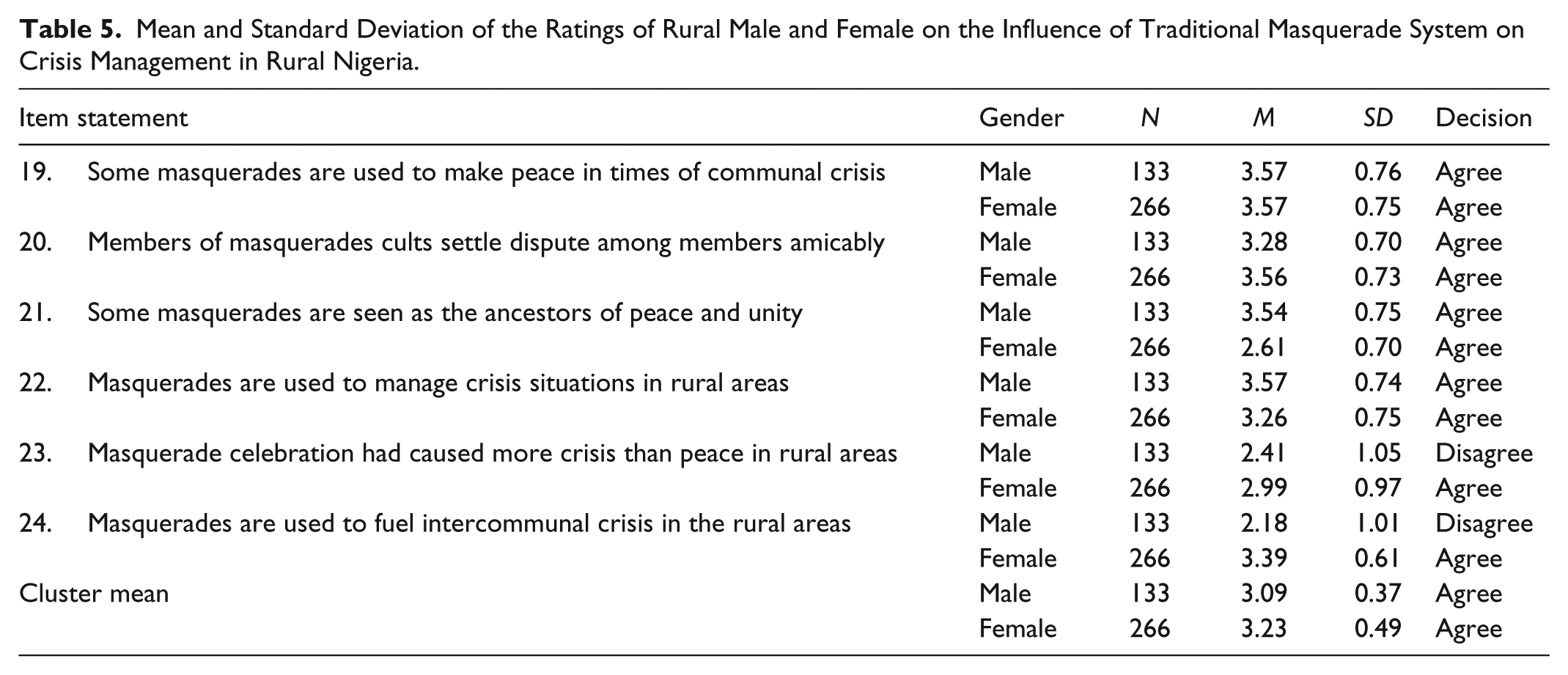
Table 6 shows that the mean ratings of male and female rural dwellers to Items 26 to 30 are more than 2.50 benchmark, whereas their mean ratings to Item 25 are less than 2.50 benchmark mean. This indicates that both male and female rural dwellers agree to the statements of Items 26 to 30 as the influence of traditional myths on crisis management in rural Nigeria. Overall mean ratings of 3.06 and 2.96 for the male and female rural dwellers, respectively, imply that male rural dwellers had higher mean rating than the female rural dwellers.
Mean and Standard Deviation of the Ratings of Rural Male and Female on the Influence of Traditional Myths on Crisis Management in Rural Nigeria.

Table 7 reveals the mean ratings of male and female rural dwellers to Items 31 to 36 which boarder on the influence of traditional title-taking on crisis management in rural Nigeria. It shows that the mean ratings of both male and female rural dwellers to Items 33, 34, to 36 are more than 2.50 benchmark mean, indicating that they agree to the statements of Items 33, 34, and 36 as the influence of traditional title-taking on crisis management in rural Nigeria. This is contrary to their responses to Items 31, 32, and 35, which is less than 2.50 benchmark. However, the overall mean ratings of 2.63 and 2.51 for male and female rural dwellers show that male rural dwellers had higher mean rating than their female counterparts.
Mean and Standard Deviation of the Ratings of Rural Male and Female on the Influence of Traditional Title-Taking on Crisis Management in Rural Nigeria.

Table 8 shows that the calculated t(–1.202) for the difference in the mean ratings of male and female rural dwellers on the influence of traditional marriage rite on crisis management in rural Nigeria had an associated probability value of .230. As the probability value of .230 is greater than the .05 level of significance, the null hypothesis was accepted, meaning that there is no significant difference in the mean ratings of male and female rural dwellers on the influence of traditional marriage rite on crisis management in rural Nigeria.
t Test Analysis of the Difference in the Mean Ratings of Male and Female Rural Dwellers on the Influence of Traditional Marriage Rite on Crisis Management in Rural Nigeria.

Table 9 shows that the probability associated with the calculated t(–1.330) for the difference in the mean ratings of male and female rural dwellers on the influence of traditional belief system on crisis management in rural Nigeria is .078. As the probability value of .078 is greater than the .05 level of significance, the null hypothesis was accepted. Thus, there is no significant difference in the mean ratings of male and female rural dwellers on the influence of traditional belief system on crisis management in rural Nigeria.
t Test Analysis of the Difference in the Mean Ratings of Male and Female Rural Dwellers on the Influence of Traditional Belief System on Crisis Management in Rural Nigeria.

Table 10 shows that the calculated t(–1.996) for the difference in the mean ratings of male and female rural dwellers on the influence of traditional festival on crisis management in rural Nigeria had an associated probability value of .057. As the probability value of .057 is greater than the .05 level of significance, the null hypothesis was accepted, meaning that there is no significant difference in the mean ratings of male and female rural dwellers on the influence of traditional festival on crisis management in rural Nigeria.
t Test Analysis of the Difference in the Mean Ratings of Male and Female Rural Dwellers on the Influence of Traditional Festival on Crisis Management in Rural Nigeria.

Table 11 shows that the probability associated with the calculated t(–.882) for the difference in the mean ratings of male and female rural dwellers on the influence of traditional masquerade system on crisis management in rural Nigeria is .797. As the probability value of .797 is greater than the .05 level of significance, the null hypothesis was accepted. Thus, there is no significant difference in the mean ratings of male and female rural dwellers on the influence of traditional masquerade system on crisis management in rural Nigeria.
t Test Analysis of the Difference in the Mean Ratings of Male and Female Rural Dwellers on the Influence of Traditional Masquerade System on Crisis Management in Rural Nigeria.
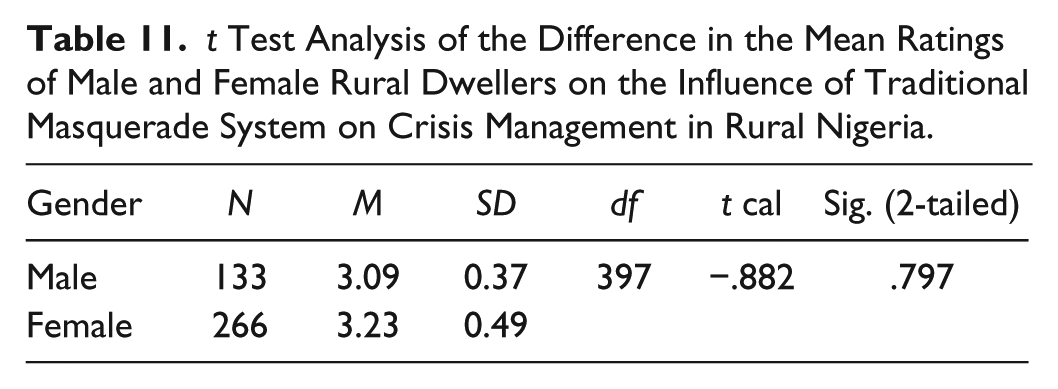
Table 12 shows that the calculated t(–1.790) for the difference in the mean ratings of male and female rural dwellers on the influence of traditional myths as regards crisis management in rural Nigeria had an associated probability value of .066. As the probability value of .066 is greater than the .05 level of significance, the null hypothesis was accepted, meaning that there is no significant difference in the mean ratings of male and female rural dwellers on the influence of traditional myths on crisis management in rural Nigeria.
t Test Analysis of the Difference in the Mean Ratings of Male and Female Rural Dwellers on the Influence of Traditional Myths on Crisis Management in Rural Nigeria.

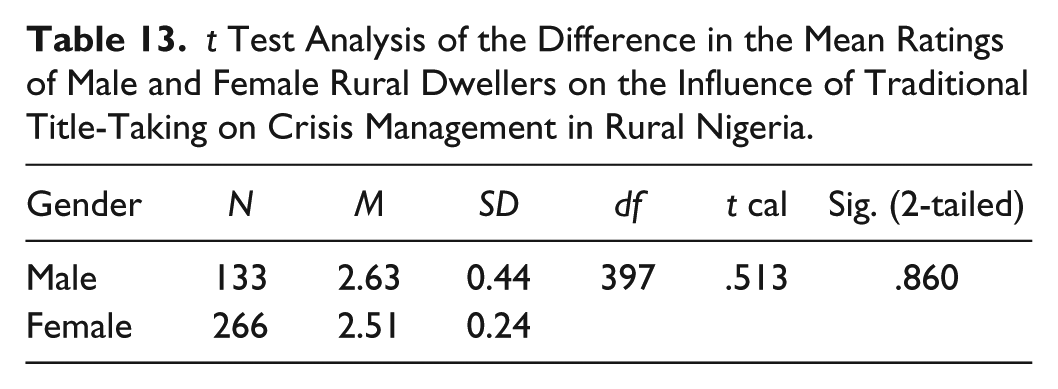
Table 13 shows that the probability associated with the calculated t(.513) for the difference in the mean ratings of male and female rural dwellers on the influence of traditional title-taking on crisis management in rural Nigeria is .860. As the probability value of .860 is greater than the .05 level of significance, the null hypothesis was accepted. Thus, there is no significant difference in the mean ratings of male and female rural dwellers on the influence of traditional title-taking on crisis management in rural Nigeria.
t Test Analysis of the Difference in the Mean Ratings of Male and Female Rural Dwellers on the Influence of Traditional Title-Taking on Crisis Management in Rural Nigeria.
Discussion
This study was an attempt to understand the contribution of community heritage resources to crisis management in rural Nigeria. The focus of the study was on the intangible heritage resources that have remained indelible in the historical development of rural people in Nigeria. This does not necessarily mean that tangible heritage resources do not contribute to crisis management in rural Nigeria; it is rather based on the fact that this is seemingly a new direction in heritage studies in Nigeria. Further studies are expected to go beyond the limitations of this current study. However, as this study adopted both quantitative and qualitative approaches, collated data from the two approaches shall be discussed concurrently. This shall be done under each of the indices that were used in the determination of the role of community heritage resources in crisis management in rural Nigeria.
First and foremost, traditional marriage rite was examined. Results from both research approaches show that this index contributes to crisis management in rural Nigeria. Further information from the ethnographic approach affirmed that people in rural Nigeria value traditional marriage rites more than the White wedding. The influence of modernization has not been able to erode this aspect of life in rural communities. Regardless of the height of educational attainment or exposure, people were bound to pass through the same traditional marriage rites across various tribes in Nigeria, although with minor differences. Then there have been intermarriages and intramarriages within and outside various communities. This has indirectly resolved intra- and intercommunity or family crisis in the rural areas. The case of Izzi and Izza in Ebonyi State and Aguleri and Umueri in Anambra State are good examples. Intermarriages among these previously worrying communities have helped in resolving these issues over the years. Another example is among the Kanuris of the Maiduguri area of Borno Sate. The Ikwere and Ogoni ethnic groups in Rivers State were reported to have explored the potentialities of traditional marriage rites for crisis management to settle a long-standing dispute among them. Inter- and intramarriages have helped in resolving age-long disputes among these communities. Hence, Nigerians have huge regard for their in-laws.
Moreover, traditional belief system was another index that was investigated in the cause of this study. Apart from the fact that result from quantitative data revealed traditional belief system as an intangible heritage resources that contribute to crisis management in the rural areas, ethnographic sources also revealed that people at the rural areas in Nigeria hold their traditional belief system in high esteem. Despite the consistent wind of modern beliefs, these rural dwellers still held tenaciously to their traditional belief system. They see it as the integral part of their culture. Although some have contrary opinions to these traditional beliefs due to their exposure, enlightenment, modern belief, and materialistic lifestyle, those residing in the rural areas have not thrown away these traditional beliefs. Some of the key informants during interview sessions maintained that some of the traditional beliefs such as that of reincarnation, ancestral spirits, and earth goddess have deterred some persons from family and communal crisis due to perceived implications. Also that some of these traditional beliefs such as the earth goddess, water goddess, and land goddess were consulted and invited during some peace processes in the rural areas to ensure sustained peace after the dialogue. Notable shrines are currently consulted by worrying parties in rural Nigeria to seek peaceful resolutions of crisis. People reported that death sentence is meted out to defaulters. Surprisingly, those who already embraced modern religion are still found at those places. This is because people are afraid of the repercussions of breaking the peace agreements owing to the presence of these spirits during the peace pact.
In the case of traditional festival, evidence from the quantitative results shows that it contributes to crisis management among rural dwellers in Nigeria. Ethnographic data went further to elaborate more on how this is achieved. Most of the key informants note that over the years, traditional festivals have played significant role in conflict management in the rural areas. For instance, during the celebration of these notable festivals, various family crisis, communal crisis, and individual crisis in the community are put on hold; hence, various parties in dispute are required to come together for the celebration. This plays more roles in the intracommunal crisis. For example, the Ekpo and Ngwo festivals are among the notable festivals that unite the three major cultural groups in Akwa-Ibom State (the Oron, Anan, and Ibibio). These festivals are common among these cultural groups and have served as a unifying factor among these main cultural groups in the state over the years. The Omabe and Odo festivals also have the tendencies of contributing to crisis management among Nsukka people of Enugu State; just like the Ikeji festival among the Aro communities in Southeast Nigeria. In the West, it is the famous Eyo festival, Igogo festival, Sango festival, and Osun festival that have united the entire Yoruba race over the years. The Shadi/Sharo festival among the Fulanis and Argungu fishing festival in kebbi are among these traditional festivals. These festivals are community heritage resources that belong to the individual communities or entire ethnic group and not to individuals.
On traditional masquerade system, despite the minor variations seen in the quantitative survey, data from ethnographic study maintained that these traditional masquerades play significant roles in crisis management. For instance, in some Aro communities in the southeastern part of Nigeria, special Ikeji masquerades are used in correcting some anomalies in the community. Also, in places such as Abakaliki, Oron, Nsukka, Oshogbo, Nkanu, and Gbokolo, there are some masquerades that have a special function of maintaining peace through punishment of persons that defiled community norms, values, and peace. For instance, the Egungu and Oro masquerades among the Yorubas and the Adanma, and Agaba masquerades among the Igbos are some of the examples of such masquerades. Such masquerades in most cases are seen during the nights alone (such as the popular Achikwu in some parts of Southeast Nigeria). These are known as symbols of truth and impartiality; hence, their judgments are not meant to be questioned. They are seen as the spirits of ancestors mediating in the well-being of the living. One of the informants noted that in most cases people are deterred from engaging in evil acts in these rural areas out of the fear of the expected punishments and embarrassments from these masquerades. These traditional masquerades with these specialized functions are seen as cults; hence, admission is restricted to members who are qualified male members of the community. There were situations when they were reported to the public security agency such as the police. In such cases, the traditional value system of the people is respected; hence, the actions of these masquerades are traditionally justified by the members of the community.
Moreover, traditional myth was another heritage resources index that was investigated. Results from the quantitative survey affirm that these traditional myths play significant role in crisis management in rural Nigeria. This was supported by the results from the ethnographic survey. The implication is that despite the huge influence of Western civilization on the indigenous cultures, most of these traditional myths are still accepted by the people in rural Nigeria; hence, they are guided by the dictates of these traditional myths. An example is found in the Akwa-Ibom area of Nigeria, where people living in the rural areas (Oron, Anan, and Ibibioo) hold tenaciously to the common myths that connect the ancestral origins of these notable peoples in Akwa-Ibom. The Igbos of Southeast are not left out as some informants affirmed that myths told by parents and other respected elders are not easily forgotten; hence, they play major roles in individual and collective decision taking. For instance, the myth that teaches human love, forgiveness, anger of the gods, unity in diversity, and ancestral brotherhood have been very significant in the minds of the people living in the rural areas during conflict resolutions and other activities that may trigger conflicts in the rural areas. This view was supported by Glendinning (2011), Morel (2013), and Wollentz (2014). These studies maintained that traditional myths unite the people as well as encourage unity and progressive living among people in a given locality.
Finally, the last heritage resource index that was investigated in this study was the traditional title-taking. In most African traditional societies, traditional title-taking is highly regarded; hence, in most cases, it defines social status. Women, who are not fully involved like the men, also attest to the fact that these title-holders are bestowed with great trust and respect in their communities, mostly during critical issues that could trigger off individual or collective crisis in the rural areas. For instance, the Ozo title holders among the Igbos of Southeast Nigeria and related title holders in the Southwestern Nigeria have played remarkable roles in the settlement of disputes. These titles are given to men of proven integrity; hence, they are expected to be honest, unbiased, and impartial on judgments of crucial matters such as land disputes, boundary disputes, marriage disputes, inheritance disputes, chieftaincy disputes, and other traditional matters. In most rural areas, these traditional title holders are sought after during such crisis than other established security agencies such as the police. Informants from the Yoruba section noted that it is because of this traditional relevance of the traditional title holders during critical matters that made them to be selective in giving the titles to holders. This is because the peace and progress of the Yoruba nation rest in the hands of these men and women. Information from the ethnographic survey further notes that series of rituals are involved during the initiation of members to these traditional title holders fold. This is aimed at cleansing them and separating them from further involvement in unworthy acts that may mar their traditional integrity as title holders
In understanding the result of the study in the context of the existing literature, previous literatures had outlined the significance of these heritage resources, their roles in communal identity, culture and tourism promotion, and community integration (Ashworth et al., 2007; Glendinning, 2011; Ismail et al., 2014; Preis & Mustea, 2013). It was Morel (2013) and Blench et al. (2006), among others, who noted that heritage resources have potentialities for crisis or conflict management in communities. These result motivated the current study to investigate the direct contribution of selected community heritage resources to crisis management in rural Nigeria. Findings from the six indices that were investigated show that specific intangible heritage resources have the potentialities for crisis management in rural regard if harnessed in that regard. This has revealed that apart from cultural relevance, identity promotion, communal integration, and culture and tourism promotion, community heritage resources play further significant roles in crisis management in rural areas. It is expected that future studies would investigate some other community heritage resources in rural Nigeria to further support or question the result of this particular study in Nigeria and some other sub-Saharan Africa.
Conclusion
This study is an exposition on the implication of heritage resources on human development, which are different from the known implications on culture preservation, promotion, and tourism development (Cobb, 2010; Ekechukwu, 2008). Some previous studies had identified crisis and other human conflicts as the bane of meaningful progress and economic development in the rural communities (Adewale & Bamise, 2015; Eze, 2011; Morel, 2013; Porter & Salazar, 2005). This has contributed to the ever growing rural–urban migration in most parts of Nigeria, at the expense of meaningful development at the rural areas. And Blench et al. (2006) maintain that traditional leadership institutions play significant roles in conflict prevention in Nigeria.
Despite the slight difference in the male and female respondents in the rural areas as identified in the quantitative survey, there are insignificant negative responses to the contribution of community heritage resources to crisis management. Even when some of these heritage resources are gradually loosing grip on the societal structure and belief, their contributions to crisis management cannot be underestimated (see also, Morel, 2013). This study recommends that these community heritage resources should be well preserved and promoted among those in the rural areas, so as to gain from its contributions to integration and progress in rural communities. Culture custodians and other traditional authorities at those rural areas where most of these community heritage resources are still found have a role to play in this regard. Also, the government and the private sector are expected to contribute through meaningful recognition, acceptance, and support to these traditional authorities; hence, an uncontrolled crisis can infiltrate into the urban areas either directly or indirectly. Blench et al. (2006) had advocated for inclusion of traditional political institutions in the national and state polity in Nigeria through amendment of relevant sections of the Constitution. In addition, tourism developers and other development initiatives in the rural areas should value these community heritage resources and work for their preservation instead of destruction in the course of their development activities. It is also recommended that these rich heritage resources should be identified, preserved, promoted, and enlisted by the relevant traditional and government authorities. Hence, they are open to a new way to solving community, and other rural crisis that have hindered the even development and progress of the Nigerian nation since independence owing to its pluralistic and multicultural nature.
The nature of the expected data from the research made ethnography one of the most relevant approaches for the study. For instance, it gave the researchers the clue to the current context and perception of heritage resources in those communities. Evidence from previous studies (i.e., Blench et al., 2006; Morel, 2013; Viejo-Rose, 2011; Wertsch & Billingsley, 2011) has shown that most rural communities in Africa held tenaciously their cultural values. They have not been able to relinquish traditional values in their rich heritage resources that are among the integral aspects of their communal living. This has been possible; hence, visitors and other external persons whose presence should have promoted culture diffusion, acculturation, culture neglect, among others, are not always willing to visit or reside in these rural areas owing to the poor infrastructural base and less economic opportunities at the rural areas. This has really enhanced the sustainability of these heritage values in the rural communities. Moreover, these heritage resources have not only helped in their unity but also in promoting moral standard and most of the time provided the people with entertainment opportunities and fulfillment of basic traditional needs. However, this study was an attempt to investigate other possible benefits that may accrue from these heritage resources to the benefit of these rural communities. Evidence from this study has shown that most of these community heritage resources are effective crisis management tools for rural communities in Nigeria and some other sub-Saharan Africa.
Notwithstanding the success of the research, some limitations were encountered during the study. Most of these rural communities held their culture and traditional values to a very high esteem and easily impose these values on their visitors. For instance, language and culture barrier were among the major obstacles. The researchers could not fit in in their language and cultural practices during the ethnographic studies. Although English language could be used, they flow more in their local dialect. Also, not minding the engagement of many research assistants, it was very difficult to cover most of the selected rural communities during the ethnographic study. These communities were scarcely located, and this makes ethnographic study and distribution of questionnaires almost impossible. Another major limitation was the misinterpretation of purpose. Majority of these rural dwellers do not have formal education, hence they easily misinterpreted the purpose of the research in their community. This nearly frustrated distribution and return of questionnaires, and ethnographic study. Despite these limitations, the study was concluded successfully. It is however imperative to note at this juncture that these limitations can be avoided in future similar researches in the rural areas in Nigeria. This can be done through a prior organization of orientation programs in these communities. This would support further engagement of some members of the communities as part of field assistants during questionnaire distribution and ethnographic study. Also, concentration on one or two communities may combat the challenge of distance for future studies.
Finally, the implication of the study are as follows: (a) It has identified solution to community crisis from communities, (b) It has explored some potentialities of heritage resource apart from the usual preservation and promotion for identity promotion and tourism development, and (c) It has revealed other source of conflict resolution to conflict experts in Nigeria and beyond. However, the authors are calling for further studies on some other indices of community heritage resources in rural Nigeria to verify the claims of this study. Also, further study on the studied indices is necessary to help make a more informed generalization on the contributions of community heritage resources to crisis management in rural Nigeria and in some other African nations where cultural values and lifestyles are held tenaciously, despite the influence of modernization, acculturation, diffusion, and culture hybridization.
Footnotes
Declaration of Conflicting Interests
The author(s) declared no potential conflicts of interest with respect to the research, authorship, and/or publication of this article.
Funding
The author(s) received no financial support for the research, authorship, and/or publication of this article.