




Abstract
Heritage holds considerable potential in advancing environmental sustainability, yet existing studies have largely remained confined to the exploration of singular issues and have seldom articulated an integrated pathway that systematically connects heritage management with the Sustainable Development Goals (SDGs). In particular, the field of sustainable built heritage management has not yet established a comprehensive framework encompassing the entire life cycle, a gap that limits both systematic assessment and strategic application within the broader sustainability agenda. Against this backdrop, this study conducts a systematic review of 115 academic publications focusing on sustainable management of built heritage and based on this analysis, proposes a Sustainable Built Heritage Management (SBHM) framework structured around the full life cycle of built heritage. Compared with existing research that remains fragmented or predominantly value-oriented, this framework systematically embeds sustainability principles into all phases of planning, implementation, monitoring, and feedback, thereby enhancing both the operational feasibility and evaluability of management practices. Furthermore, it strengthens the social adaptability and practical applicability of management processes by establishing multi-stakeholder collaborative mechanisms that can more effectively address complex challenges related to value recognition, ownership structures, distribution of responsibilities, and allocation of benefits. The study concludes by emphasizing the need for future efforts to advance more integrated and multidimensional management systems that can provide stronger support for the realization of the United Nations Sustainable Development Goals.
Keywords
Introduction
Since the World Heritage Committee’s first session in 1977 explicitly required the preparation of management plans for all heritage sites, heritage management has progressively moved toward institutionalization. Early practices were largely concentrated on national parks and natural heritage, while cultural heritage remained marginalized for a considerable period (Cameron & Rössler, 2018). In 1983, UNESCO official Anne Raidl convened an international expert meeting to address the challenges of cultural heritage site management. The meeting emphasized the depoliticization of heritage management and the importance of interdisciplinary collaboration, which were subsequently institutionalized and widely disseminated through the Guidelines for the Management of World Cultural Heritage Sites published in 1993 (Feilden & Jokilehto, 1998). Since then, heritage management has gradually developed into an interdisciplinary research field with both normative and methodological dimensions.
As tangible carriers of cultural, historical, and social significance, built heritage plays an irreplaceable role in shaping community identity, fostering social development, and promoting cultural continuity (Tweed & Sutherland, 2007). Nevertheless, its management and conservation continue to face persistent challenges. On the one hand, insufficient maintenance and institutional fragmentation remain widespread in practice (Jokilehto, 2017). On the other hand, although policy-driven institutions have actively intervened, they often lack professional expertise and long-term strategic perspectives, resulting in management approaches that are formalistic and insufficiently targeted (Jansen, 2014). The overall effectiveness of built heritage conservation is further undermined by shortcomings in interdisciplinary collaboration and multi-level governance.
Although several studies have attempted to systematize the sustainable management process of heritage, these efforts remain relatively limited. For example, Rabady proposed the incorporation of heritage inventories, asset assessments, conservation planning, and interpretation into heritage tourism management to support sustainable tourism (Rabady & Jamal, 2006). Landorf, in research on British industrial heritage, developed a systemic model that divided management into contextual analysis, strategic positioning, implementation, and iterative optimization, emphasizing the role of stakeholder values in shaping sustainable strategies (Landorf, 2009, 2011). Darlow introduced environmental, socio-cultural, and economic dimensions, highlighting dynamic mechanisms of resource management and multi-actor collaboration (Darlow et al., 2012). Gheyle, in studies of militarized landscapes, proposed multidimensional strategies that encompassed defense, investment, and damage control (Gheyle et al., 2014). Kondo advanced the role of digital inventories and diversified evaluation approaches, underscoring information sustainability and interdisciplinary collaboration (Kondo et al., 2016). These studies consistently stress systemic thinking, multi-stakeholder participation, interdisciplinary approaches, multi-level governance, and the importance of dynamic feedback and continuous optimization to achieve sustainable heritage management. However, they have predominantly focused on cultural heritage in a broad sense, and the cyclical and specific characteristics of built heritage have not been sufficiently addressed.
Traditional management pathways for built heritage generally include identification, conservation, maintenance, monitoring, and promotion (Armitage & Irons, 2013; Kayan, 2019; Pickerill & Armitage, 2009; Seduikyte et al., 2018; Toniolo et al., 2015). However, these approaches often remain confined to discrete projects or short-term objectives, with a primary focus on physical interventions and restoration outcomes, while lacking integrated strategies that encompass social, environmental, and economic dimensions (Sukri et al., 2024; Yan et al., 2024). Furthermore, stakeholder participation remains limited in depth, and decision-making mechanisms are still largely dominated by professional institutions, leading to inadequate coordination and weak integration with long-term development goals (Eppich & Grinda, 2019; Naima, 2021).
Within this context, embedding sustainable heritage management strategies and mechanisms into the management system of built heritage not only addresses these shortcomings but also enhances the overall effectiveness of conservation and adaptive reuse. It is therefore necessary to build upon the foundations of sustainable heritage management research and develop a more refined and targeted framework for Sustainable Built Heritage Management (SBHM) that responds to the unique characteristics and methodologies of built heritage. This framework adopts a life-cycle perspective and aims to address the multifaceted challenges faced by built heritage in the contemporary era, while providing systematic guidance for practical management. In doing so, it promotes the balanced development of cultural, environmental, and economic dimensions. Based on this rationale, the present study is guided by three key research questions:
(1) What are the core components of SBHM?
(2) How can SBHM achieve sustainability across environmental, social, and economic dimensions?
(3) How can SBHM contribute to the realization of the United Nations Sustainable Development Goals?
Materials and Methods
To comprehensively cover the research achievements in the field of Sustainable Built Heritage Management (SBHM), this study selected Web of Science (WOS), Google Scholar, and Scopus as the primary literature databases. These databases are among the most authoritative and widely used academic resources, providing systematic coverage of core journals and publications in architecture, heritage conservation, and management-related disciplines (Dimitropoulos et al., 2025). During the search process, Boolean OR/AND operators were applied to connect key terms and construct the research string: TITLE-ABS-KEY (“sustainability” OR “sustainable”) AND (“heritage management”) OR TITLE-ABS-KEY (“sustainable management”) AND TITLE-ABS-KEY (“heritage”). The search was limited to English-language publications, with a timeframe extending until December 31, 2024.
WOS was chosen as the primary data source because of its superior journal coverage and its ability to retrieve the largest number of unique records (Yang & Meho, 2006). Supplementary results were obtained from Scopus and Google Scholar, yielding an initial dataset of 4,105 publications. After removing duplicates, additional refinements were applied to ensure research relevance by limiting the results to specific research categories and Citation Topics, excluding unrelated fields such as pharmacology, toxicology, medicine and health, agriculture, and the biological sciences. Following this initial screening, 320 highly relevant publications were retained, comprising 301 from WOS, 14 from Google Scholar, and 5 from Scopus.
To emphasize the research focus on built heritage, the results were further refined by applying the keywords “building” OR “built” OR “architecture,” combined with systematic screening of titles and abstracts, and in some cases, full-text or introduction-level reviews. At this stage, strict exclusion criteria were applied, and only studies closely aligned with the research themes were retained. Ultimately, a total of 115 core publications were selected, forming the foundational dataset for the literature review and theoretical framework of this study (Figure 1).

Literature screening process for Sustainable Built Heritage Management (SBHM).
Results
A systematic analysis of the final 115 publications focusing on SBHM reveals a marked growth trend in this field over the past decade (Figure 2). By 2024, a total of 22 articles had been published, compared with only three a decade earlier, representing a 7.3-fold increase. This rapid expansion reflects not only the substantial increase in research output but also the rising academic prominence of SBHM within the broader framework of Sustainable Heritage Management. It demonstrates that SBHM is gradually becoming a significant international research topic.

(a) Annual publication counts on Sustainable Built Heritage Management (SBHM) between 1996 and 2024 and (b) distribution of SBHM publications across the top 10 contributing countries.
In terms of national distribution, research is primarily concentrated in several European and Asian countries. Italy ranks first with 23 publications, highlighting its leadership in the field of sustainable management of built heritage. Spain ranks second with 13 studies, followed by China with 10, and the United Kingdom with 9. Portugal contributed five publications, while Lithuania, Norway, and Poland each produced four studies. Other countries contributed relatively smaller outputs. Overall, European nations dominate the field of SBHM research, although participation from Asian countries such as China has increased significantly in recent years, reflecting the globalization of this research domain.
Following the systematic analysis of the 115 SBHM-related publications, the core issues identified were further refined into 37 micro-themes, which were categorized as second-level nodes. These themes appeared a total of 311 times across the literature, with an average frequency of 8.4 mentions per theme, indicating a certain degree of concentration and repetition within the research field. Based on their internal logic, the 37 second-level nodes were further consolidated into 11 first-level categories (Figure 3). On average, each first-level category appeared 28.27 times across all mentions.

Visualization of SBHM research themes and frequency. The orange dotted line (8.4) represents the average frequency across the field, while the yellow highlighted area indicates priority research directions that exceed the average level.
To highlight the most critical topics, the study focused on categories and subcategories with frequencies above the average level, which were incorporated into the core components of the SBHM framework. The results show that among the first-level categories, “Technology and Methods” was the most frequently discussed (52 mentions), followed by “Resource Integration” (50), “Stakeholder Identification” (42), “Strategic Planning” (41), and “Monitoring and Evaluation” (34), which together constitute the five dominant thematic areas. “Identification and Value Analysis” also received considerable attention, with 29 mentions, ranking sixth. It is noteworthy that although some first-level categories did not exceed the average overall frequency, certain subcategories under them still demonstrated practical significance. For instance, under “Legal Support,” the subcategory of “Policy Guidance and Support” was mentioned more than 10 times despite the relatively low frequency of the overall category. Similarly, “Cost Control,” although limited in total frequency, was still addressed nine times, underscoring its relevance to practical management. These focal issues will be further elaborated in subsequent sections of this study.
Discussion
This chapter structures the discussion around the three central research questions proposed in the study and elaborates on them in light of the results of the systematic analysis. On this basis, it further explores the key dimensions of SBHM, its methodological contributions, and the implications for practical applications (Figure 4).

Formation pathway of the SBHM framework.
Core Components of SBHM
A comprehensive analysis of the research findings indicates that eleven first-level categories have been identified in relation to SBHM. Among these, Technology and Methods, Resource Integration, Stakeholder Engagement, Strategic Planning, Monitoring and Evaluation, and Identification and Value Analysis are most widely regarded as its core components. This finding directly responds to
Within the 11 systematic management steps of SBHM, Technology and Methods stands out as the most prominent theme and is broadly recognized as the fundamental basis for life-cycle management. Current studies consistently highlight the significant contributions of tools such as Geographic Information Systems (GIS), Building Information Modeling (BIM) and its derivative Historic Building Information Modeling (HBIM), and Life Cycle Cost Analysis (LCCA) in areas such as spatial cataloging, restoration planning, energy efficiency enhancement, and carbon emission control (Castellano-Román & Pinto-Puerto, 2019; Hull & Ewart, 2020; Murphy et al., 2009; Oostwegel et al., 2022). At the same time, the introduction of emerging technologies such as Digital Twin (DT), Virtual Reality (VR), Augmented Reality (AR), the Internet of Things (IoT), and Artificial Intelligence (AI) is driving a transition of heritage management toward greater digitalization, intelligence, and interactivity (Bertolin & Berto, 2024; Massafra et al., 2022). The second prominent element is Resource Integration, which constitutes both the institutional and practical foundation of SBHM. It primarily manifests at three levels: heritage tourism, cross-sector collaboration, and interdisciplinary cooperation. The development of heritage tourism not only enhances the economic potential and social influence of heritage sites but also strengthens community identity and public participation (Afrić Rakitovac et al., 2019; Folgado-Fernández et al., 2025). Cross-sectoral and transnational collaborations expand knowledge sharing and governance capacities, while interdisciplinary cooperation builds methodological bridges across architecture, environmental sciences, and information technology (Giliberto & Labadi, 2023; Hassan et al., 2024). The third critical dimension is Stakeholder Engagement, which is universally recognized as the social safeguard for the long-term sustainability of SBHM. Studies consistently emphasize the participation of diverse actors, including governments, developers, construction teams, residents, and visitors, with community participation regarded as a key factor in ensuring conservation, financial sustainability, and knowledge feedback (Chen & Wan, 2023; Wang et al., 2019). However, most research remains limited to identifying stakeholder intentions and lacks institutionalized and multi-tiered participatory mechanisms (Dormaels, 2016; Freeman, 2010; Jones & Wicks, 1999). The fourth essential element is Strategic Planning, which provides the overarching framework for SBHM implementation. Existing studies stress the importance of priority setting and risk assessment, and they propose a range of supporting instruments including adaptive reuse tools, digital management and dynamic monitoring platforms, and value assessment frameworks (Nieto-Julián et al., 2021). These instruments play a vital role in improving the transparency and scientific basis of management practices, but their level of integration remains limited, requiring a more dynamic balance between value conservation, energy optimization, and social functionality (Cassalia, 2014). The fifth element, Monitoring and Evaluation, is regarded as a fundamental support mechanism for SBHM, together forming a life-cycle safeguard. Tools such as Heritage Impact Assessment (HIA), multi-dimensional value assessment models, and non-invasive monitoring techniques provide scientific evidence for authenticity, integrity, and risk control. However, there is still a lack of a fully integrated closed-loop mechanism strongly coupled with decision-making processes (Judson & Iyer-Raniga, 2010; Kayan et al., 2021; Naramski et al., 2023). Finally, the discussion of Identification and Value Analysis highlights the cultural dimension of SBHM. The multi-dimensional values of built heritage, including historical, artistic, social, economic, esthetic, and landscape aspects, must be systematically identified and dynamically updated to ensure their continued relevance in rapidly changing social and environmental contexts. Nevertheless, existing research remains insufficient in developing systematic and adaptive value frameworks (De Gregorio et al., 2023; Judson & Iyer-Raniga, 2010; Liao & Tung, 2024; Yasien & Kebede, 2022). Other themes, while less prominently represented in current research, nonetheless play critical roles throughout the overall process and collectively contribute to reinforcing the cyclical and sustainable nature of heritage management.
From a practical perspective, the utility of SBHM lies in its capacity to be transformed into a stepwise and operational pathway, consisting of 11 stages. First, as the starting point of heritage conservation, Identification and Value Analysis should involve systematically identifying the historical, social, environmental, and economic values embedded in built heritage through Heritage Impact Assessment and multi-dimensional value frameworks. Second, Strategic Planning provides an overarching framework that defines priorities and adaptive reuse strategies through comprehensive management plans, thereby improving the transparency and operability of the management system. In terms of Stakeholder Identification and Engagement, it is necessary to establish multi-level governance structures that incorporate governments, experts, construction teams, and community representatives into decision-making and feedback mechanisms to ensure legitimacy and social acceptance.
The stage of Resource Integration and Development emphasizes the combined use of financial resources, tourism revenues, academic expertise, and community strength, while institutionalized networks are built through cross-sectoral, interdisciplinary, and international collaborations. Community Well-being Enhancement can be promoted through legal frameworks, tax incentives, and financial subsidies, ensuring that heritage protection delivers positive effects on community development, social equity, and the improvement of public services. Moreover, Policy and Financial Management provides the prerequisite for implementing the framework by offering fiscal support, tax incentives, and funding mechanisms that sustain the long-term viability of SBHM. At the same time, Technology and Methods, through BIM or HBIM, GIS, LCA, and related tools, provide scientific support for data collection and physical documentation of heritage assets. Prevention and Maintenance emphasizes routine management and periodic protective measures, supported by facility renewal and risk early-warning mechanisms that effectively reduce the rate of deterioration and mitigate sudden threats to heritage integrity. Meanwhile, Monitoring and Evaluation should be developed as a closed-loop mechanism aligned with decision-making processes, employing non-invasive sensors and IoT-based technologies for long-term dynamic monitoring, with continuous feedback into strategic planning and implementation. Finally, Feedback and Improvement serves as the closing stage of the cycle, ensuring that management practices are iteratively refined through reflection on outcomes and reanalysis of monitoring data. This process guarantees iterative renewal of the system and provides institutional assurance for the long-term sustainability of SBHM.
Overall, the practical significance of SBHM lies in its transformation of fragmented theoretical concepts into a systematic and operational tool through a closed-loop, stepwise pathway. This approach not only safeguards the authenticity and integrity of heritage but, more importantly, enhances active collaboration among diverse actors, governments, communities, and markets through deliberate institutional design. By integrating environmental performance, social acceptance, and economic feasibility, it facilitates the sustainable management and value enhancement of built heritage (Figure 5).
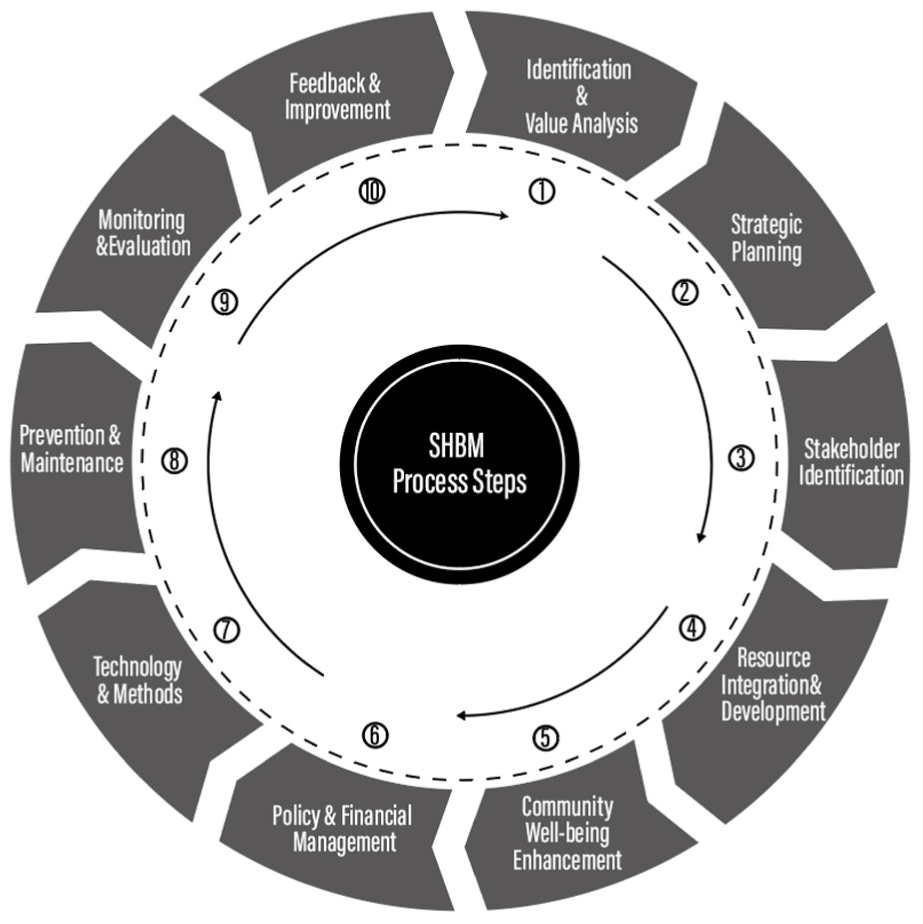
Implementation pathway and operational process of SBHM.
The Role of SBHM Under the Three Pillars of Sustainability
Sustainable Built Heritage Management (SBHM) demonstrates distinctive characteristics compared to general sustainable heritage management in both its pathways and methodologies. Its core contribution lies not only in advancing environmental sustainability but also in producing comprehensive effects across the economic and social dimensions. This tripartite framework directly addresses
From an environmental perspective, SBHM establishes environmental sustainability principles as central to built heritage management, emphasizing comprehensive life-cycle oversight supported by the values of equity, continuity, and common good. By integrating appropriate technological tools, formulating eco-friendly strategies, and prioritizing reversible and minimal intervention measures, SBHM reduces the environmental burden associated with restoration and adaptive reuse while fostering healthy, comfortable, and safe heritage environments. In addition, SBHM relies on advanced building monitoring and risk assessment methods that effectively mitigate potential threats to heritage assets. Environmental monitoring and energy optimization, supported by digital tools, offer greater precision and long-term applicability. Preventive maintenance and the establishment of environmental monitoring systems further strengthen the ecological resilience of heritage sites and their surrounding areas. In this sense, SBHM not only improves the environmental performance of built heritage but also contributes to the health and stability of the ecosystems in which heritage is embedded.
The economic benefits of SBHM are equally direct and significant. These benefits primarily manifest through the cultural value embedded in built heritage, which generates capital assets in both stock forms, such as inheritance, sale, and management tied to ownership, and flow forms, such as entrance fees paid by visitors. Such mechanisms substantially increase economic returns. Furthermore, the sustainable development and management of built heritage generate large numbers of employment opportunities and actively stimulate the growth of related industries, particularly tourism and the cultural and creative sectors. These spillover effects further drive economic development in heritage sites and their surrounding communities, ensuring that management activities create value for multiple stakeholders and achieve shared benefits. In the process of sustainable management, life-cycle cost analysis (LCCA) supports the formulation of more economically efficient maintenance plans, significantly reducing resource consumption and waste generation. This not only improves management efficiency but also strengthens economic sustainability. Thus, SBHM supports sustainable economic development while advancing the conservation of built heritage.
From a social perspective, SBHM empowers stakeholders with the ability to provide feedback, participate, and engage in decision-making processes, thereby reflecting social needs more authentically. As immovable material carriers of local culture and history-built heritage sites provide tangible, interactive spaces that enhance community vitality and strengthen social cohesion. Their embedded sense of place and identity is particularly significant, and effective management reinforces local distinctiveness, deepens community attachment to heritage, and even enables heritage sites to function as places of collective memory. Compared to other forms of heritage, SBHM benefits from more mature technologies and methodologies that have been validated in architectural development and management practices. By selecting and integrating appropriate tools, SBHM not only has safeguards-built structures but also establishes collaborative platforms for heritage management, promoting information exchange, experience sharing, and the dissemination of global knowledge, thereby enhancing the preservation and transmission of built heritage sites.
SBHM and the Sustainable Development Goals
The third core issue concerns the ways in which SBHM contributes to the realization of the United Nations Sustainable Development Goals (SDGs). Although the 17 goals of the 2030 Agenda do not explicitly dedicate a target to cultural heritage, SDG 11.4 clearly calls for strengthening the protection of the world’s cultural and natural heritage. The UNESCO (2015) Policy Document for the Integration of a Sustainable Development Perspective into the Processes of the World Heritage Convention explicitly emphasizes the need to integrate sustainability principles systematically into heritage management processes (Committee, 2015). Subsequently, the ICOMOS (2019) report Futures of Our Pasts: Engaging Cultural Heritage in Climate Action highlighted the pivotal role of cultural heritage in addressing climate change and advancing sustainability (Downes, 2019). Collectively, relevant studies and policy documents underscore the strategic importance of cultural heritage in sustainable development, particularly in advancing SDG 11 (Sustainable Cities and Communities), SDG 12 (Responsible Consumption and Production), and SDG 13 (Climate Action). SBHM, through life-cycle management, digital monitoring, and adaptive reuse, demonstrates unique advantages in reducing resource consumption, enhancing climate resilience, and promoting social equity, thereby making a direct contribution to the broader global sustainability agenda. Unlike traditional heritage conservation approaches that primarily emphasize environmental concerns, the distinctive value of SBHM lies in systematically embedding social and economic dimensions into the management framework, thus responding to the multifaceted objectives of the SDGs in a more integrated manner (Figure 6).

The relationship between SBHM and the United Nations Sustainable Development Goals (SDGs).
More specifically, the protection and maintenance of cultural heritage represent a central component of achieving SDG 11.4. Through scientific identification and value assessment, SBHM not only strengthens the long-term stability of heritage assets but also improves living environments and revitalizes surrounding areas, thereby directly contributing to SDG 11 (Sustainable Cities and Communities). The incorporation of life-cycle assessment (LCA) enables systematic evaluation of resource and energy consumption in interventions, promoting SDG 12 (Responsible Consumption and Production), while simultaneously reducing environmental burdens and enhancing economic viability (Judson & Iyer-Raniga, 2010; Kayan et al., 2021). The maintenance and optimization of built heritage improve energy efficiency, extend building lifespans, and reduce carbon emissions, while strengthening resilience to climate change and natural hazards, aligning with SDG 7 (Affordable and Clean Energy) and SDG 13 (Climate Action; Dos Santos Gonçalves et al., 2025). Adaptive reuse further reduces reliance on new construction, effectively lowering resource consumption and ecological disturbance.
At the social and economic levels, SBHM also demonstrates significant impacts. As a high-quality platform for education and training, built heritage promotes public knowledge dissemination and capacity building, enhancing awareness and appreciation of heritage and thus supporting SDG 4 (Quality Education; El-belkasy & Wahieb, 2022; Lerario, 2022). The development of heritage tourism and cultural and creative industries fosters regional economic growth and job creation, advancing SDG 8 (Decent Work and Economic Growth) and SDG 9 (Industry, Innovation, and Infrastructure; Hampton, 2005). Circular economy models and efficient resource use further reinforce the implementation of SDG 12 (Afrić Rakitovac et al., 2019; Folgado-Fernández et al., 2025).
Moreover, the multi-stakeholder collaboration inherent in SBHM—through stakeholder identification, resource integration, and knowledge sharing—enhances governance transparency and inclusivity, thereby supporting SDG 16 (Peace, Justice, and Strong Institutions) and SDG 17 (Partnerships for the Goals). By addressing the needs of vulnerable groups, SBHM also contributes to SDG 5 (Gender Equality) and SDG 10 (Reduced Inequalities; Dormaels, 2016; Freeman, 2010; Jones & Wicks, 1999). In addition, preventive maintenance and proactive conservation reduce the risks of sudden damage, while digital monitoring and tools such as H-BIM improve energy efficiency and data-driven governance, further advancing SDG 9 (Industry, Innovation, and Infrastructure) and SDG 13 (Climate Action; Judson & Iyer-Raniga, 2010; Kayan et al., 2021).
Taken together, these findings show that SBHM, in contrast to traditional heritage management approaches, contributes not only at the environmental level but also strategically integrates social, economic, and ecological dimensions. In doing so, SBHM demonstrates its unique advantages and strategic value in advancing the global sustainable development agenda.
The three research questions discussed above, when integrated, ultimately converge into a systematic framework that provides a more operational and logically coherent pathway for heritage management. This framework not only enhances the overall sustainability of heritage management but also offers a stepwise and replicable model that can guide diverse types of heritage conservation practices.
In the context of built heritage practice, this framework can be directly applied as a practical tool. When managers are confronted with tasks of conservation and management, the initial step should be comprehensive Identification and Value Analysis. This process should not be limited to assessing the physical characteristics and environmental conditions of the heritage asset but must also include an evaluation of its economic potential, an analysis of community attitudes and differences in public perception, and the identification of diverse socio-cultural values. Such an approach ensures a holistic understanding of the heritage context.
More importantly, the framework’s objective extends beyond integrated heritage management. It emphasizes the alignment of heritage management with the Sustainable Development Goals (SDGs) from a medium- and long-term perspective. By addressing stakeholder interests and perceptual differences during the identification and value assessment stage, the framework can effectively reduce social inequalities and disparities in resource allocation, thereby advancing SDG 10 (Reduced Inequalities) and SDG 11 (Sustainable Cities and Communities). Similarly, by embedding environmental risk assessment and climate adaptation planning, the framework aligns heritage protection with SDG 13 (Climate Action). Incorporating institutional development and multi-stakeholder participation mechanisms into the management process further responds to the objectives of SDG 16 (Peace, Justice, and Strong Institutions).
At each subsequent step, the framework ensures that management practices address not only the heritage asset itself but also broader environmental, social, and economic dimensions while maintaining responsiveness to medium- and long-term sustainability objectives. Through the systematic interlinking of these stages, a closed-loop management process can be progressively established.
Nevertheless, these methods are not static but dynamic and adaptive. At the final stages of project evaluation and feedback, the framework allows for a re-examination and re-implementation of earlier steps, enabling iterative optimization of management pathways and enhancement of heritage value. The specific operational framework is illustrated below (Table 1).
Framework of Sustainable Built Heritage Management (SBHM).

Conclusion
Although some heritage professionals have shared successful experiences, built heritage management continues to face the pressing challenge of knowledge fragmentation. Existing case studies remain scattered and fragmented, making it difficult to integrate them into a systematic theoretical framework capable of effectively guiding practice. Consequently, there is an urgent need to construct a framework that can consolidate and integrate dispersed resources, thereby facilitating the implementation of effective management practices and promoting cross-regional knowledge sharing (Darlow et al., 2012; Fyall & Garrod, 1998; Loulanski & Loulanski, 2011).
Through a systematic review of 115 relevant publications, this study proposes a conceptual framework of Sustainable Built Heritage Management (SBHM), structured around a life-cycle perspective that integrates identification, planning, implementation, monitoring, and feedback into a closed-loop process. The results demonstrate that SBHM effectively responds to the complex demands of built heritage management across the environmental, social, and economic dimensions, while simultaneously aligning with the United Nations Sustainable Development Goals (SDGs). This finding not only provides structured theoretical support for built heritage management but also lays a methodological foundation for its practical application across diverse contexts.
Compared with traditional heritage management approaches, the core contribution of SBHM lies in its systematicity and adaptability. On the one hand, it embeds sustainability principles throughout the entire management process, expanding beyond physical restoration or single-phase interventions to cover multiple stages, including identification, conservation, adaptive reuse, and dynamic monitoring. On the other hand, it emphasizes the integration of interdisciplinary tools and the establishment of multi-stakeholder collaboration mechanisms, highlighting the multiple functions of built heritage in promoting social equity, economic development, and environmental protection. Thus, SBHM is not only a theoretical model but also a management tool that can be translated into practical operations, enhancing both the scientific basis and the operational feasibility of policy-making and project implementation.
The findings of this study provide a foundation for the SBHM framework while also identifying areas that require further refinement. Since the literature review was primarily based on English-language databases, potential regional, and linguistic biases may exist. Therefore, a key priority for future research is to expand the integration of multilingual and cross-regional studies and case evidence. Moreover, the applicability and boundary conditions of the framework need to be tested and refined through diverse empirical projects. Subsequent research should focus on validating and adjusting the framework through widespread case applications to enhance its contextual adaptability and operational feasibility. Furthermore, integrating quantitative indicator systems and dynamic evaluation tools will be essential for establishing a more robust monitoring and feedback cycle. Collectively, these efforts will optimize management processes and comprehensively improve the scientific, systematic, and practical effectiveness of sustainable built heritage management.
Overall, the SBHM framework offers new perspectives and tools for both the theory and practice of built heritage management. It not only addresses existing gaps in life-cycle and systemic approaches but also provides a feasible pathway for the deeper integration of cultural heritage conservation and sustainable development goals. Within the context of the global sustainability agenda, the framework proposed in this study has the potential to serve as a vital foundation for promoting the long-term conservation, adaptive reuse, and maximization of the social benefits of built heritage.
Footnotes

Funding
The authors received no financial support for the research, authorship, and/or publication of this article.
Declaration of Conflicting Interests
The authors declared no potential conflicts of interest with respect to the research, authorship, and/or publication of this article.
Data Availability Statement
Data can be available on request.