



Abstract
This study examines the peer relationships of refugee children in preschool, highlighting early social integration as a foundation for long-term adjustment. Guided by Bronfenbrenner’s theory of ecological systems and sociocultural perspectives on language and belonging, an explanatory sequential mixed methods design was used. Quantitative data from 160 refugee children were gathered through teacher-reported peer relationship assessments, followed by qualitative interviews with five preschool teachers. Findings showed that gender, prior preschool attendance, and Turkish language proficiency significantly influenced peer relationships and social skills, while class size and the proportion of refugee children in classrooms were not linked to peer dynamics. Qualitative insights emphasized the role of language barriers, cultural adaptation, family background, and inclusive practices of teachers in shaping peer experiences. In general, the results suggest that structural factors alone cannot fully explain social integration; instead, peer language match, cultural expectations, and teacher–child relationships are critical. The study calls for context-sensitive interventions and teacher training to promote culturally responsive pedagogy in early childhood education.
Plain Language Summary
This study looks at how young refugee children build friendships and interact with their peers in preschool. Starting preschool can be a big change for any child, but for refugee children—who may have faced war, loss, or long journeys to safety—it can be even more challenging. These children often need to learn a new language, adjust to different cultural expectations, and get used to new ways of playing and learning together. I collected information from teachers about the peer relationships of 160 refugee children in Turkey, and then spoke to five preschool teachers to better understand what these relationships look like in daily life. I found that being a boy or a girl, and whether a child had attended preschool before, made a difference in how easily they formed friendships and joined group activities. Children who could speak Turkish more fluently tended to have better social skills, but language ability was not linked to whether they showed aggressive behavior. Surprisingly, the size of the class and the number of refugee children in it did not have a clear effect on friendships. Teachers told us that language barriers, differences in cultural habits, and family situations could make it harder for refugee children to connect with others. They also highlighted how inclusive teaching methods—such as creating activities where all children can participate—can help build trust and belonging. The findings suggest that making friends and feeling part of the group is not just about class size or school resources. It’s also about creating a welcoming environment where children feel safe, valued, and included. This means teachers need training and support to use strategies that respect cultural differences and encourage all children to take part in the life of the classroom.
Introduction
People are increasingly forced to leave their home countries due to war, political instability, economic hardship, religious and racial persecution, and climate-related challenges. Many seek to rebuild their lives in other nations as refugees. Although refugees are entitled to the right of asylum, they often face harsh living conditions, including inadequate shelter, limited access to nutrition, restricted health and social services, and exposure to violence. Among this population, children—arguably the most vulnerable group—confront additional barriers, particularly in accessing education.
The number of children with different ethnic identities in classrooms in Turkey is increasing as refugee children attend public schools. This growing diversity affects children’s social skills, adaptation processes, and peer relationships. Refugee children may face challenges in the classroom due to language barriers and cultural differences. These factors can negatively influence their social skills, leading to peer rejection, feelings of being unloved, low academic achievement, communication problems, reduced social status, and a lack of motivation towards school (Yumuş & Metin, 2015).
This research aims to investigate the challenges faced by refugee children in early childhood education settings and to examine their peer relationships within this context. Refugee children, who are often unfamiliar with the language, culture, and social norms of the host society, frequently encounter substantial difficulties both in the school environment and in their interactions with peers. Identifying these challenges at an early stage is crucial, as it can inform the development of early intervention programs tailored to support these children. The originality of this study lies in its specific focus on the preschool period, examining both peer relationships, and school adaptation. Early childhood represents a pivotal stage in social, and emotional development, during which peer relationships can have long-lasting effects on later social skills and academic outcomes. These interactions are not merely social exchanges but constitute foundational contexts through which children construct a sense of self, internalize social norms, and develop emotional regulation (Denham et al., 2012; Ladd, 2005). For refugee children, who often experience displacement, trauma, and cultural discontinuity, these early peer interactions play an even more critical role. Preschool may be the first space where refugee children engage in consistent structured peer interaction outside of the family, making it a crucial context to foster belonging, trust, and emotional security (Adair, 2015; Hart, 2006). Furthermore, language development and social integration—often cited as central goals in refugee education—are mediated through peer encounters during early childhood (Toppelberg & Collins, 2010). Thus, peer relationships at the preschool level are not only developmentally significant but uniquely situated to support the relational and emotional recovery of refugee children adapting to new sociocultural environments. While a substantial body of research has examined the educational experiences of refugee children in primary and secondary school contexts—often emphasizing academic adjustment, language acquisition, and social integration—the unique challenges encountered in early childhood education remain comparatively underexplored. This lack of focus on preschool-aged refugee children overlooks a critical developmental period in which foundational social, emotional, and cognitive skills are formed. By neglecting this stage, the literature risks missing key insights into how early educational experiences shape long-term adaptation and peer relationships for refugee children. Although research on refugee children’s education has expanded in recent years, many studies focus on primary and secondary school contexts, emphasizing academic adjustment, language acquisition, and social integration (Block et al., 2014; Pinson & Arnot, 2007; Taylor & Sidhu, 2011). In contrast, early childhood education remains significantly under-researched despite its foundational role in shaping children’s peer relationships and socio-emotional development. Preschool-aged refugee children often experience their first structured peer interactions in early education settings, making this period critical for fostering a sense of belonging and interpersonal trust (Rouse & Hadley, 2018; Tobin et al., 2013). Moreover, the invisibility of refugee children in early childhood research and policy contributes to their systemic marginalization (Kraftl, 2020). This study addresses this gap by focusing specifically on refugee children’s peer relationships in preschool settings—a dimension largely neglected in the broader refugee education literature. This study offers a distinctive perspective by examining how language barriers, cultural differences, and prior educational experiences shape peer relationships among refugee children. The findings are expected to yield practical recommendations for teachers and school administrators, enabling them to more effectively support refugee children in their social adaptation processes. Furthermore, this research will generate valuable data for policymakers and educators, informing the development of strategies that promote integration and strengthen peer relationships for refugee children in schools. In doing so, it contributes to ensuring that refugee children can fully exercise their right to education and achieve social cohesion within their new communities.
This study is grounded in Bronfenbrenner’s (1979) ecological systems theory, which conceptualizes child development within a set of nested environmental systems that interact dynamically. Refugee children’s peer relationships in preschool are shaped not only by individual characteristics such as gender or language proficiency (microsystem) but also by interactions between school, family, and community contexts (mesosystem and exosystem). Broader cultural norms and policies related to migration and education (macrosystem), as well as the time-based nature of displacement and resettlement (chronosystem), further influence how children adapt socially. Employing this ecological lens enables a more nuanced understanding of how structural and interpersonal variables interact to affect refugee children’s peer relationships. It also provides a robust framework for interpreting the quantitative and qualitative findings in relation to social inclusion, adaptation, and early educational experiences.
Literature Review
Challenges in the Lives of Refugee Children
Refugee children encounter a layered set of difficulties affecting their psychological well-being, social development, and educational experiences. These challenges are often rooted in displacement trauma, socio-political instability, and the pressures of adapting to unfamiliar environments (Dalgatov et al., 2024; McBrien, 2005). International literature points to the prevalence of post-traumatic stress disorder, identity dislocation, and exclusionary experiences in both school and community contexts.
However, this narrative of vulnerability is not unidirectional. Studies such as Graham et al. (2016) highlight the role of family resilience, parent advocacy, and children’s agency in fostering academic and social success. Rather than viewing refugee children solely through a deficit lens, it is crucial to consider the interplay between structural barriers and the strengths they mobilize. This duality suggests that policy and practice must shift from reactive interventions to more asset-based, culturally responsive support systems.
Moreover, refugee children’s experiences are not homogenous. Factors such as legal status, ethnicity, gender, and host-country attitudes contribute to the variation in how risks and supports are distributed. Recognizing these internal diversities is critical for developing more nuanced educational responses.
Educational Access and Institutional Barriers
Refugee children’s access to education is shaped by a range of structural and institutional barriers, often intersecting with broader socio-political and economic dynamics. Studies indicate that challenges such as legal status, school fees, language difficulties, child labor, and early marriage continue to disrupt consistent educational participation (Bozdağ, 2018). These factors are rarely experienced in isolation; rather, they accumulate to form a web of disadvantage that places refugee children at the margins of educational systems.
One critical barrier involves the language of instruction, which not only affects academic access but also mediates children’s ability to form relationships with teachers and peers (Hek, 2005; Yiğit et al., 2021). When children lack sufficient proficiency in the host country’s language, they are more likely to experience exclusion or misunderstanding, reinforcing a sense of alienation from the school environment.
In addition, cultural discontinuities between home and school environments, including divergent expectations regarding discipline, participation, and emotional expression, can further alienate refugee children (Rousseau & Guzder, 2008). Teachers may misinterpret culturally rooted behaviors as signs of maladjustment, especially when lacking training in culturally responsive pedagogy (Öztürk et al., 2022). This dynamic can inadvertently position refugee children as “problems” to be managed rather than individuals to be understood, limiting opportunities for meaningful engagement and success.
Even when formal enrollment is achieved, institutional limitations such as overcrowded classrooms, inadequate teacher preparation, and resource constraints continue to undermine refugee children’s inclusion (Palaiologou & Prekate, 2023). Schooling thus becomes a space where both hope and exclusion coexist—offering the possibility of integration while simultaneously exposing children to new forms of marginalization.
However, the literature also highlights protective factors that can buffer against these barriers. Supportive school leadership, inclusive classroom practices, and collaboration with families have been shown to mitigate institutional exclusions and foster more equitable participation (He et al., 2015). Still, such examples remain the exception rather than the norm, indicating the need for more systemic and policy-driven approaches to ensure sustainable educational access for refugee children.
Peer Relationships and Social Belonging
For refugee children, developing peer relationships is not merely a social milestone but a foundational component of belonging and psychological well-being. The early years of education represent a critical period in which children form their first friendships in the host country. Yet, refugee children often encounter multiple relational barriers stemming from cultural, linguistic, and racialized differences (McBrien, 2005; Meeusen, 2014).
The language barrier frequently emerges as a central obstacle to peer integration. Children who are not proficient in the language of the host country face difficulties initiating and sustaining interactions, often resulting in social withdrawal or misinterpretation by others (Hek, 2005; Yiğit et al., 2021). Moreover, language limitations can reinforce existing prejudices, with children being labeled as “different” or “slow” by both peers and educators, further inhibiting social acceptance (Altıntaş, 2018).
Beyond language, visible markers of difference such as race, ethnicity, or religious expression also affect peer dynamics. Research suggests that children as young as three can categorize others based on appearance, often reproducing societal biases (Ramsey, 2018; Woolfolk Hoy, 2015). This early awareness of difference can lead to exclusionary behaviors, even in environments that appear neutral on the surface.
Studies have also documented peer victimization as a recurring theme in refugee children’s school experiences. Bullying, often stemming from a combination of prejudice and communication breakdowns, contributes to feelings of vulnerability and damaged self-concept (Closs et al., 2001; Karataştan & Akcan, 2023). In some cases, the attitudes of local families play a role in reinforcing these dynamics, as they shape their children’s perspectives and behaviors toward refugee peers (Meeusen, 2014).
Despite these challenges, the literature also points to the transformative power of positive peer relationships. Supportive peer interactions have been shown to increase refugee children’s sense of safety, self-worth, and school belonging (Aydoğdu, 2021; Ialuna et al., 2024). Engaging in interactive play, cooperative learning, and structured peer support initiatives can foster empathy and emotional connection (Doll et al., 2003; Zigler et al., 2004), while also serving as a buffer against experiences of marginalization.
Yet, the success of peer inclusion often hinges on teacher mediation and school culture. Teachers’ sensitivity to intercultural dynamics and their ability to actively scaffold peer relationships play a pivotal role in transforming diverse classrooms into inclusive communities (Bozkurt Polat et al., 2020; Öztürk et al., 2022). Without intentional efforts, refugee children may remain on the periphery of classroom life, even in the presence of well-intentioned peers.
Overall, peer relationships in early childhood are deeply influenced by the interplay of individual traits, social context, and systemic forces. While children’s resilience and openness to connection are evident, the quality of peer interactions remains highly contingent on the structural and relational conditions in which they occur.
Developmental Impacts of Peer Relationships
Peer relationships in early childhood have far-reaching consequences that extend beyond the immediate school environment. For refugee children, these relationships not only shape their current emotional well-being but also influence long-term social competence, self-regulation, and educational trajectories (Brown et al., 2001; Ladd, 2009).
Positive peer relationships function as a developmental scaffold, providing children with opportunities to negotiate roles, express emotions, and experience belonging. Through interactive play and collaborative activities, children learn to regulate behavior, develop empathy, and build conflict-resolution skills—all of which are essential for healthy development (Doll et al., 2003; Zigler et al., 2004). These benefits are particularly critical for refugee children, who often carry the burden of displacement-related trauma and disrupted attachment experiences.
Conversely, negative peer dynamics—such as exclusion, bullying, and rejection—can exacerbate developmental vulnerabilities. Children who are consistently marginalized may exhibit lower self-esteem, heightened anxiety, and increased behavioral issues, particularly in environments that lack protective adult mediation (Chen et al., 2011; Farina & Belacci, 2022). For refugee children, the risks are even more pronounced due to the compounded effects of social exclusion and cultural dislocation.
Research has shown that early peer difficulties are predictive of long-term challenges in areas such as school adjustment, academic performance, and emotional regulation (Hanish et al., 2022; Walker, 2004). For refugee children, who are already navigating new cultural and linguistic landscapes, the absence of peer support can entrench feelings of alienation and hinder integration efforts.
The developmental implications are not uniform, however. Factors such as temperament, language proficiency, and the presence of adult scaffolding can moderate these outcomes (Ladd et al., 1996). For example, children who receive support from both peers and teachers are more likely to recover from negative peer experiences and develop resilience over time.
Therefore, peer relationships should not be seen as isolated social experiences but as developmental mediators that interact with broader ecological systems. Ensuring that refugee children have access to safe, inclusive peer environments is not only a matter of equity but also a developmental imperative.
Research Questions Grounded in Ecological Systems Theory
This study seeks to explore the following research questions regarding the peer relationships of refugee children in early childhood education settings:
Method
This study adopted a mixed methods approach, specifically utilizing an explanatory sequential design, to examine the peer relationships of refugee children in preschool educational settings. This design was selected to benefit from the strengths of both quantitative and qualitative data, providing a more comprehensive understanding of the phenomenon under investigation (Creswell & Clark, 2014).
The study was conducted in two sequential phases.
Phase 1—Quantitative Data Collection and Analysis
Quantitative data were collected using the Child Peer Relations Teacher Evaluation Form, adapted into Turkish by Atış Akyol and Güney Kahraman (2021). This teacher-rated scale consists of 18 items distributed across 3 sub-dimensions: Peer Relations (6 items), Aggression (5 items), and Social Skills (7 items), rated on a five-point Likert scale. The internal consistency of the overall scale was reported as α = .78, with sub-dimension reliabilities of α = .85 (peer relations), α = .88 (aggression), and α = .94 (social skills). The quantitative data were analyzed using descriptive and inferential statistics to examine refugee children’s peer relationships based on variables such as gender, level of Turkish language proficiency, prior preschool education, classroom size, and the number of refugee children in the classroom.
The sample size (N = 160) in this study was determined based on accessibility to classrooms with refugee children and ethical considerations inherent in working with vulnerable populations. Comparable international studies on preschool-aged refugee children also used similar sample sizes. For example, Busch et al. (2022) assessed 152 refugee children across several early childhood programs in Germany, while Çiçekoğlu et al. (2019) conducted a peer relations comparison among 40 preschool children (20 refugee, 20 non-refugee). These precedents support the adequacy and validity of the sample size for conducting non-parametric analyses in early childhood refugee education settings.
Although the scale was originally adapted into Turkish for general use in preschool settings, its application in this study was limited to teacher reports and did not involve direct assessment of children. Thus, potential language barriers for refugee children were minimized. The items focus on observable behaviors in classroom settings (e.g., sharing, initiating play, displaying aggression), which are not culturally specific or linguistically demanding. Teachers were instructed to base their evaluations solely on observed behavior, regardless of the child’s native language or cultural background. Furthermore, since all participating teachers had prior experience working with refugee children, their familiarity with the cultural and linguistic diversity in classrooms may have contributed to more context-sensitive evaluations.
However, I acknowledge that standardized tools may still carry implicit cultural assumptions and risks of misinterpretation when applied to linguistically diverse populations. Future studies should prioritize the development and validation of culturally responsive instruments, or the inclusion of co-evaluators familiar with the child’s linguistic and socio-cultural background. In the present study, this limitation was addressed in part by incorporating qualitative data, which provided deeper contextual insights into children’s social interactions beyond the scope of the standardized tool.
Phase 2—Qualitative Data Collection and Analysis
Following the analysis of the quantitative findings, qualitative data were gathered through semi-structured interviews conducted with preschool teachers. The semi-structured interview form was developed by the researcher based on a review of the literature on refugee children’s peer relationships and in accordance with the study objectives. To ensure content validity, the draft questions were reviewed by three experts in early childhood education and educational psychology. The experts provided feedback on the clarity, relevance, and appropriateness of the items. Based on their recommendations, one question was revised to improve its wording. The final form was then used in the data collection process. The final version of the interview form included the following questions:
How do you describe the social behaviors of refugee children in the classroom? What are the difficulties you face?
How are other children’s friendships with refugee children? What do you do to help these children form friendships with refugees?
What are the barriers to refugee children making friends with other children? What should be done about this?
How do you support refugee children in making friends with others?
The qualitative data were analyzed using thematic analysis, aiming to explore in greater depth the classroom social dynamics and to provide interpretive insights that would help explain the patterns identified in the quantitative phase.
To enhance the trustworthiness of the qualitative findings, several strategies were employed. Thematic analysis followed Braun and Clarke’s (2006) six-step approach, and the coding process was carried out manually by the author. To ensure inter-rater reliability, a second researcher independently coded 30% of the transcripts. The agreement rate between coders exceeded 85%, indicating strong consistency. Discrepancies were resolved through discussion until consensus was reached. Triangulation was achieved by comparing qualitative insights with quantitative findings from Phase 1, and interpretive validity was reinforced through peer debriefing with colleagues familiar with refugee education research. While member checking with participants was not feasible due to contextual constraints, reflective memos were used throughout the analysis to enhance transparency and analytic rigor.
Integration of Quantitative and Qualitative Findings
The results from both phases were integrated during the interpretation stage. Qualitative findings were used to elaborate upon and contextualize the quantitative results, offering a more nuanced understanding of the social experiences and peer interactions of refugee children in preschool environments.
Participants
The participants of this study were refugee children enrolled in preschool institutions located in Gaziantep during the 2023 to 2024 academic year. The city center of Gaziantep was selected as the sampling site due to its relatively limited impact from the February 6, 2023, earthquake.
The sample size was determined based on accessibility within selected schools with a high population of refugee students. Due to the exploratory nature of the study and limited access to refugee populations, a non-probabilistic sampling strategy was employed. Although no a priori power analysis was conducted because of logistical constraints, the final sample of 160 children aligns with similar studies in early childhood refugee research (Crea et al., 2022). Future research could benefit from conducting power analyses to determine optimal sample sizes for greater generalizability. Teachers who voluntarily participated completed evaluation forms assessing the peer relationships of refugee children in their classrooms.
Quantitative data were collected through teacher reports on 160 refugee children, using the Child Peer Relations Teacher Evaluation Form. Demographic information regarding the children is presented in the following Table 1.
The Information About Children Who Participated in the Research.

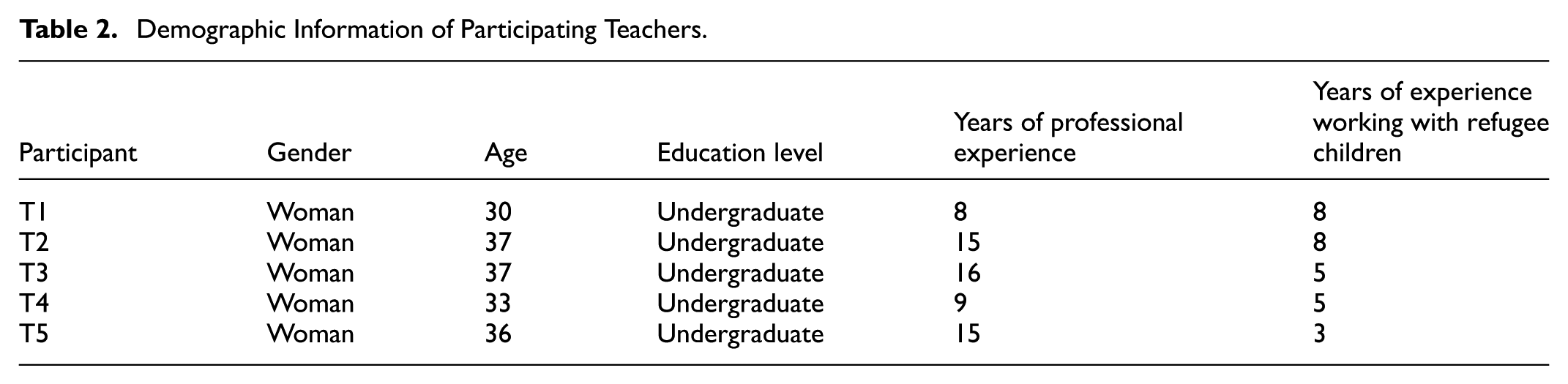
The criterion sampling method was employed to collect the qualitative data for this study. In this approach, individuals, events, situations, or objects that meet predetermined qualifications are included in the sample (Büyüköztürk et al., 2010). For this research, the criterion was teachers of children who had received the lowest scores on the Child Peer Relations Teacher Evaluation Form. Accordingly, qualitative data exploring refugee children’s classroom peer relationships in greater depth were obtained from five preschool teachers. Demographic information about these teachers is presented in the Table 2.
Demographic Information of Participating Teachers.
Ethical Considerations
This study received prior approval from the Institutional Ethics Committee of University adhering to national and international ethical standards, particularly those pertaining to research with vulnerable populations. Given that the participants were young refugee children, a group subject to multiple layers of vulnerability—due to age, displacement, and potential trauma—additional caution and safeguards were implemented throughout the research process.
No direct contact or observation involving children was conducted. All data regarding children were gathered indirectly through teacher reports using a standardized peer relations evaluation instrument. These reports were completely anonymized, and no identifying information (e.g., names, family background, migration status) was collected. Teachers were instructed to base their responses on professional observations, and were explicitly advised not to use identifying descriptors. This approach minimized any potential psychological or social risk to the child participants.
Informed consent was obtained from both the preschool teachers and the legal guardians of the children. Since the children were between 5 and 6 years old, they were not asked to provide formal assent. Teachers participating in interviews provided written consent and were informed of their right to withdraw at any point without penalty. Interview data were anonymized, securely stored, and transcribed with full confidentiality.
Recognizing the ethical sensitivity of conducting research with refugee populations, the study design was structured to uphold the principles of dignity, respect, and non-harm. The potential benefits—such as informing inclusive educational practices and supporting the social adaptation of refugee children—were considered to significantly outweigh any minimal risks. Furthermore, school names and classroom locations were not disclosed in the manuscript to preserve institutional and participant anonymity.
All data were stored on encrypted devices and were accessible only to the principal investigator. The study did not involve the collection of sensitive data such as trauma history, psychological evaluations, or socio-political identifiers, thereby reducing the risk of re-traumatization or stigmatization. By employing an indirect and protective methodology, the study ensured that the voices of refugee children were represented in a respectful, ethical, and rights-based framework.
Data Analysis
Quantitative and qualitative data were analyzed in accordance with the explanatory sequential mixed methods design. First, descriptive statistics were used to examine the socio-demographic characteristics of the participants. To address the main and sub-research questions on refugee children’s peer relationships, data normality was assessed. Given the non-normal distribution, non-parametric tests such as the Mann–Whitney U-test and the Kruskal–Wallis H-test were applied.
To capture the complex dynamics influencing refugee children’s peer relationships, the quantitative analysis included the following key variables:
Gender—Social behaviors and interaction styles often differ between boys and girls; this variable was used to explore any differences in peer relationships.
Turkish language proficiency—As a primary tool for communication and social integration, higher Turkish proficiency may promote stronger peer connections and classroom inclusion.
Prior preschool education—Previous preschool experience may enhance children’s social–emotional skills, positively influencing peer interactions.
Class size—The number of students in a classroom can shape social opportunities and engagement; smaller classes may foster more meaningful peer connections.
Number of refugee children in the classroom—The proportion of refugee students may affect group dynamics, potentially creating both supportive peer groups and instances of social marginalization, depending on the classroom context.
The inclusion of these variables enhances the robustness of the model by enabling the identification of patterns and differences across diverse subgroups. These variables were selected based on their theoretical relevance and support from prior empirical studies, ensuring a more nuanced understanding of the factors shaping the peer relationships of refugee children in early childhood education settings.
In the second phase, qualitative data obtained through semi-structured interviews were analyzed using content analysis. This process led to the identification of four overarching themes.
The social behavior of refugee children in the classroom.
Other children’s friendships with refugee children.
Barriers to refugee children’s friendships with other children.
How to promote friendship in the classroom.
These themes provided deeper insight into and explanation of the quantitative findings. This integration of both data sets aligns with the explanatory sequential design, enabling the qualitative results to be interpreted considering the statistical outcomes. In doing so, the study offers a more comprehensive and nuanced understanding of refugee children’s peer relationships in preschool settings.
Operational Definitions of Key Terms
To enhance conceptual clarity across data phases, the following operational definitions were applied:
Peer relationships refer to the frequency and quality of a child’s interactions with classmates, including pro-social behaviors such as initiating play, sharing, and forming friendships.
Social skills are defined as observable behaviors that facilitate positive interpersonal interactions, such as empathy, cooperation, and emotion regulation.
Adaptation refers to the process by which refugee children adjust to classroom norms, social expectations, and peer dynamics in the host culture.
These definitions guided both the quantitative instrument (Child Peer Relations Teacher Evaluation Form) and the coding of qualitative interview data, ensuring terminological consistency throughout the study.
Conceptual Framework
To enhance the theoretical clarity and guide the analytical lens of this study, a conceptual diagram was developed to illustrate the key variables and contextual factors influencing refugee children’s peer relationships in preschool settings (see Figure 1). Grounded in Bronfenbrenner’s ecological systems theory, the framework visualizes how child-level factors (e.g., gender, language proficiency), institutional characteristics (e.g., class size, teacher responsiveness), and broader sociocultural dynamics (e.g., cultural adaptation, discrimination) interact to shape peer interactions.

Key factors influencing refugee children’s peer relationships in preschool.
This diagram also reflects the explanatory sequential mixed methods design of the study. Quantitative variables such as gender, Turkish language proficiency, and classroom size were statistically examined in relation to peer relationships, social skills, and aggression. These were further contextualized through qualitative data, which highlighted additional dimensions such as cultural mismatch, teacher strategies, and socio-emotional barriers. The framework thus serves as a visual synthesis of the study’s methodological and theoretical orientation, bridging individual, interpersonal, and institutional influences on refugee children's early peer experiences.
Results
Normality Test Results
To decide which tests to analyze the quantitative data obtained in the study, the normality test was performed first. According to the results of the Kolmogorov–Smirnov (K-S) and Shapiro–Wilk test (S-W), the significance level results obtained were lower than the p = .05 confidence level (p < .05). According to this result, it was determined that the distribution of the scores obtained in the scale was not normal and as a result, non-parametric tests were appropriate for analysis.
According to the information in Table 3, there was a borderline, non-significant difference between the scores obtained by girls and boys in the sub-dimension of peer relationships (Z = −1.95, p = .05, r = .15). Significant differences were found in the sub-dimensions of aggression (Z = −2.10, p < .05, r = .17) and social skills (Z = −2.02, p < .05, r = .16). However, there was no significant difference between boys and girls in the total score (Z = −1.57, p > .05, r = .12). The mean peer relationship score of girls (
Mann–Whitney Test Results Regarding Peer Relationships According to Children’s Gender.

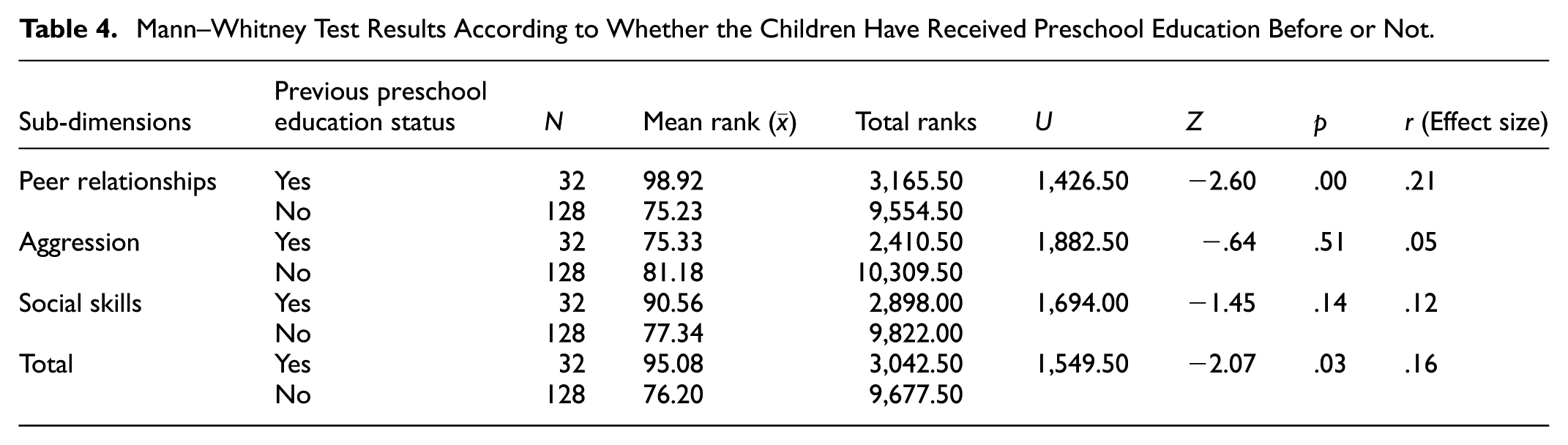
According to the information obtained as a result of the analysis conducted to determine the effect of whether the children had received preschool education before or not on peer relations, there was a significant difference in the sub-dimension of peer relations (Z = −2.60, p < .05, r = .21) and in the total score (Z = −2.07, p < .05, r = .16). When the sub-dimension of peer relations was analyzed, it was determined that the mean scores of those who received preschool education (
Mann–Whitney Test Results According to Whether the Children Have Received Preschool Education Before or Not.
When the results in Table 5 are examined, it is found that there is a significant difference between peer relations, social skills, and total scores in terms of children’s Turkish speaking levels. These significant differences in the peer relations sub-dimension were found between “Cannot Speak-Little Speaks” and in favor of “Speaks a little,” between “Cannot Speak-Intermediate” and in favor of “Intermediate,” between “Cannot Speak-Advanced” and in favor of “Advanced.” In the social skills sub-dimension, significant differences were found between “Cannot speak—speaks a little” and in favor of “Speaks a little,” between “Cannot speak—intermediate” and in favor of “intermediate,” between “Cannot speak—advanced” and in favor of “advanced.” When the total score was examined, it was found that the significant difference was again between “Cannot Speak—Speaks a little” and in favor of “Speaks a little,” between “Cannot Speak—Intermediate” and in favor of “Intermediate,” between “Cannot Speak—Advanced” and in favor of “Advanced.” It was determined that children’s level of speaking Turkish was not a factor in the sub-dimension of aggression (x2 = 7.01, p > .05). For Kruskal–Wallis H-tests, eta-squared (η2) values showed moderate to large effects for Turkish language proficiency on peer relationships (η2 = .226), social skills (η2 = .224), and total score (η2 = .259). These results indicate that children’s level of Turkish language proficiency has a substantial impact on their peer relationships, social skills, and overall social adjustment.
Comparison of Peer Relationships According to Children’s Turkish Speaking Levels with Kruskal–Wallis H-Test.

Note. n.s. = non-significant.
The results of the analysis conducted to determine the relationship between children’s peer relations and class size are presented in Table 6. Accordingly, it is seen that there is no significant difference between peer relations (x2 = .96, p > .05), aggression (x2 = .87, p > .05), social skills (x2 = 1.28, p > .05) sub-dimensions and total score (x2 = 3.48, p > .05) and class size.
Comparison of Children’s Peer Relationships According to Class Size with Kruskal–Wallis H-Test.
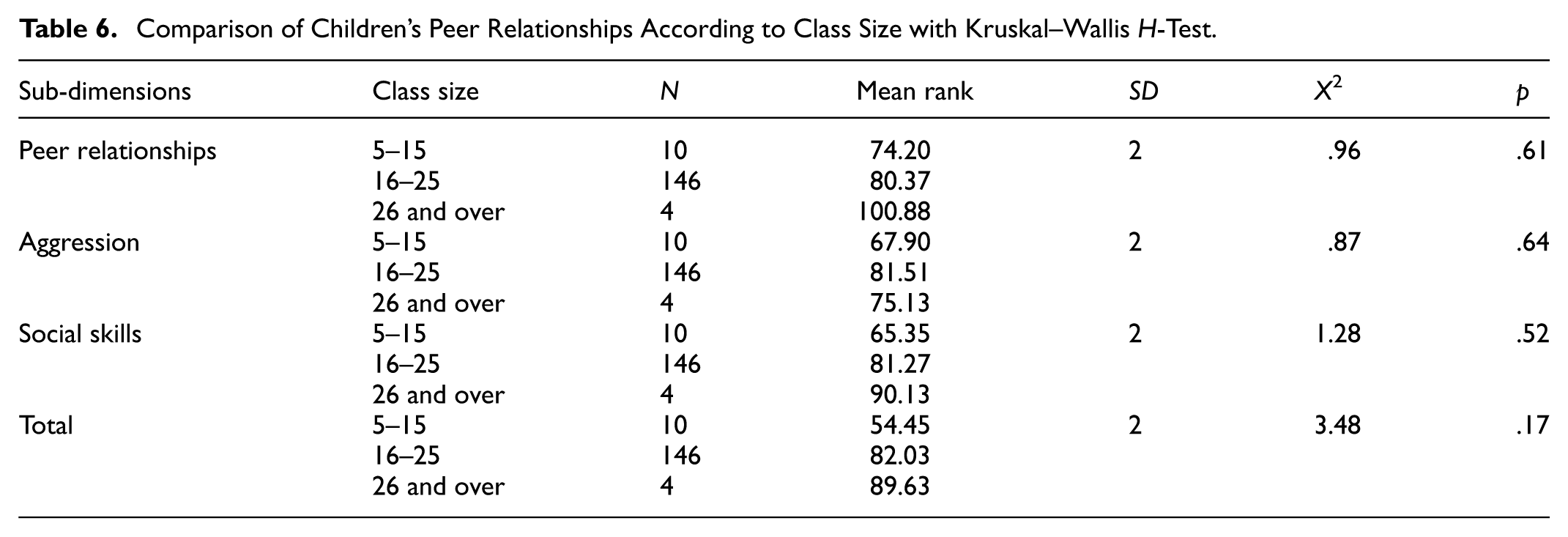
Table 7 shows the results of refugee children's peer relations according to the number of foreign children in the class. Accordingly, it is seen that there is no significant difference between the number of foreign children in the class and peer relations, social skills, and total score. However, there was a significant difference between the number of foreign children in the class and aggression (x2 = 16.76, p < .00). According to the results of the analysis conducted to determine between which groups this significant difference is, it is seen that there is a significant difference between the number of foreign children in the class between “1–3” and “7” and above and this difference is in favor of the “7 and above” group. This shows that the number of foreign children in the class is effective in the sub-dimension of aggression, but not in peer relations, social skills, and the overall total.
Comparison of Children’s Peer Relationships According to the Number of Refugee Children in the Classroom with Kruskal–Wallis H-Test.

The Kruskal–Wallis H-test revealed a statistically significant difference in aggression scores based on the number of refugee children in the classroom (p < .001). The corresponding effect size was η2 = .09, indicating a small to moderate effect. No statistically significant differences were found in peer relationships, social skills, or total scores (p > .05). Eta-squared (η2) was calculated using the formula η2 = (H − k + 1)/(n − k), where H is the test statistic, k is the number of groups, and n is the total sample size.
Qualitative Data
The Social Behavior of Refugee Children in the Classroom
The teachers who participated in the research stated that the social behaviors of refugee children in the classroom vary according to their knowledge of the Turkish language, adaptation to Turkish culture, financial status, and gender.
T1: I have worked with refugee children with good financial situations who speak Turkish and adapt to Turkish culture. The children are more harmonious and respectful. I have observed that their families are more sensitive to education. However, I also have friends who have experienced negative parent and student attitudes in regions with poor financial conditions. T2: Unfortunately, boys are very violent. I have trouble with that.
Other Children’s Friendships with Refugee Children
Regarding the friendship relations between Turkish children in the class and refugee children, teachers stated that there were problems between children in general. It was revealed that children excluded refugee children due to language and cultural differences and the influence of their families, and as a result, there was grouping in the classroom.
T1: If the refugee family and the child are culturally adapted to the community, our children do not understand that they are refugees. On the contrary, exclusion can occur. T4: Some children exclude foreign nationals because of the prejudice of their families. Sometimes I can hear sentences such as “don’t be friends with Syrians” from my parents. I warn both parents and students about this issue as much as I can. I make them sit together in activities to create positive experiences.
Barriers to Refugee Children’s Friendships with Other Children
According to the teachers, the biggest obstacle for refugee children to make friends with other children is language. In addition, family structure and culture were also stated to be effective.
T3: The most important reason is the language problem. This causes them to be socially shy, frightened, and sometimes aggressive. T5: Language difficulties—some of them can be violent. I think family education should be implemented.
How to Promote Friendship in the Classroom
Participant teachers stated that they used play activities, group games, drama, and assigning common tasks for refugee children and other children to make friends, but they had difficulties due to language barriers.
T3: I try to support the children with group games, drama etc. but as I said, I cannot say that it is enough. T4: I emphasize the need for unity in the class and give common tasks. Sometimes this works and sometimes it doesn’t.
Conclusion and Discussion
This study set out to examine the peer relationships of refugee children in preschool settings through an explanatory sequential mixed methods design, integrating teacher-reported quantitative assessments with rich, in-depth qualitative insights. By centering on early peer interactions—a core dimension of social and emotional development—it addresses a critical gap in scholarship on the educational integration of refugee children. The sequential design not only identifies measurable patterns in children’s peer relationships but also contextualizes these patterns through teachers’ perspectives, generating a nuanced understanding that can inform both educational practice and policy.
The results revealed that gender and prior preschool attendance significantly affected peer relationships and social skills, with girls and children who had attended preschool previously demonstrating higher scores in these domains. These findings align with existing research suggesting that early education fosters pro-social behaviors (Sheikhzakaryaie et al., 2012; Tan & Camras, 2011), while also challenging the assumption that gender differences are negligible in all contexts (Crea et al., 2022). Additionally, the finding that girls demonstrated significantly stronger peer relationships and social skills contrasts with literature suggesting minimal gender-based differences in early peer interactions among refugee children (de Wal Pastoor, 2015). This discrepancy may be context-dependent, shaped by cultural expectations and teacher perceptions within the host society. Our findings suggest that in Turkish preschools, gendered socialization and classroom dynamics may reinforce traditional roles, influencing children’s relational behaviors. This study adds nuance to the literature by showing that gender continues to play a role in the early peer dynamics of refugee children, at least within Turkish preschool classrooms.
One of the most significant contributions of this research lies in its detailed analysis of Turkish language proficiency. Findings demonstrated a clear positive correlation between language skills and both peer relationships and social skills, reinforcing the central role of language in social integration. However, language was not a significant factor in aggression levels, suggesting that language acquisition alone may not mitigate all behavioral challenges refugee children face. Interestingly, while this study found no significant relationship between Turkish language proficiency and aggression levels among refugee children, previous research presents mixed findings. For instance, Eisenberg et al. (2010) suggested that limited language proficiency may heighten frustration and lead to increased aggressive behaviors due to communication breakdowns. However, other studies (Winsler et al., 1999) highlight that language barriers do not always manifest as externalized behaviors, especially in early childhood. These contrasting findings may stem from variations in context, age groups, or measurement tools, emphasizing the need for further research into how language mediates emotional expression across diverse settings. This aligns with previous findings from both local (Avcı, 2019; Şahin & Doğan, 2018) and international (Gibbs, 2014) contexts, yet this study advances the discussion by offering a developmental perspective situated within the preschool years—a period often overlooked in refugee research. Moreover, language should not be considered merely as a technical skill but as a socially situated practice. Drawing on Cummins’ (2000) conceptualization of language as identity negotiation, children’s linguistic competencies in the classroom may reflect broader issues of recognition, inclusion, and power.
While the findings revealed significant differences in social skills between refugee children based on their Turkish-speaking proficiency, it is important to acknowledge the complexity and contextual dependence of language in social interactions. The current study did not differentiate whether children were interacting with peers who spoke the same native language, which could influence their social ease and behavior. Thus, it is possible that children who do not speak Turkish may still experience strong peer relationships with peers who share their native language. This constitutes a limitation of the study and points to the need for future research to consider peer language match when examining refugee children’s social dynamics.
The qualitative data further enriched the interpretation of these findings. Teachers highlighted that language skills, cultural adaptation, and family background were central to how refugee children engaged socially. Reports of exclusion, peer grouping, and cultural misunderstandings reflect systemic challenges that go beyond individual traits. Rather than viewing peer exclusion merely as individual resistance or shyness, these dynamics may mirror macro-level socio-political tensions and host/refugee power hierarchies reproduced within the classroom (Arnot & Pinson, 2005). Notably, teachers actively used inclusive strategies such as group activities and role-play to facilitate social bonding yet struggled with persistent communication barriers—underscoring the need for institutional support and targeted training in culturally responsive pedagogy.
Contrary to some expectations, class size and the number of refugee children in a classroom were not found to significantly affect peer relationships or social skill development. This finding diverges from research emphasizing structural classroom factors (Yavuz et al., 2024; Sylva et al., 2006), suggesting that individual-level and cultural-linguistic factors may outweigh classroom-level variables in early social adjustment. From an ecological perspective (Bronfenbrenner, 1979), this non-significance could be interpreted as an indication that microsystem-level interactions—such as peer language match, teacher responsiveness, and emotional safety—have a greater bearing on refugee children’s social inclusion than distal structural conditions like class size. In contrast to earlier studies that emphasize the role of structural classroom features, the present study found no significant impact of class size or the number of refugee children on peer relationships. This contradicts findings from Sylva et al. (2006), who argued that classroom size significantly influences children’s social interactions. Similarly, while this study revealed a strong relationship between language proficiency and positive peer interactions, it did not find a connection between language skills and aggression, diverging from research suggesting that language barriers may increase behavioral difficulties (Winsler et al., 1999). Moreover, beyond class size, another unexpected finding emerged in relation to language and aggression. While some studies indicate that better language skills are associated with reduced relational and physical aggression in preschool children (Ersan, 2020), our data did not support this pattern. This discrepancy suggests that contextual and developmental factors—such as trauma history, teacher response, or peer group dynamics—may moderate how linguistic competence influences behaviors in early childhood refugee populations. These divergences highlight the importance of considering context-specific dynamics and suggest that refugee children’s social experiences may not align neatly with dominant developmental models. Previous research also indicates that for vulnerable populations, the quality of peer and teacher interactions may buffer against environmental constraints (Mashburn et al., 2008; Pianta et al., 2005). This raises important questions for educational policy: while structural quality matters, tailored interventions that address refugee-specific needs—especially language and cultural bridging—are likely more impactful in this context.
This study’s mixed-methods design contributes uniquely by linking measurable peer outcomes with teacher narratives, offering a more holistic understanding of refugee children’s social development. Most existing studies in this area focus on older children or rely solely on surveys; by contrast, this research emphasizes the preschool period, where early interventions can yield long-term benefits.
Strengths and Limitations
A significant strength of this study is its explanatory sequential mixed methods design, which allowed for a comprehensive examination of refugee children’s peer relationships by integrating quantitative and qualitative data. This approach provided a nuanced understanding of both the measurable patterns and contextual factors influencing social interactions. The use of a validated instrument (Child Peer Relations Teacher Evaluation Form) enhanced the reliability and standardization of the quantitative findings. Furthermore, the qualitative data collected through semi-structured interviews with teachers enriched the interpretation of the statistical results and captured lived experiences within the classroom environment.
This study has several limitations that should be considered. First, the sample was drawn from a single metropolitan area (Gaziantep), and schools were selected based on accessibility and the presence of refugee children. While Gaziantep provides a meaningful context due to its high concentration of refugee families, its unique socio-political and institutional characteristics may not reflect those of other urban or rural regions in Turkey or other host countries. Therefore, the transferability of the findings to broader early childhood education settings should be approached with caution. This approach introduces potential sampling bias and limits the extent to which the findings can be generalized to other regions or more diverse educational contexts. Second, all data were collected through teacher reports, which—although insightful—are inherently limited in capturing the internal perspectives and lived social experiences of refugee children. This reliance on a single informant source may also reflect unconscious bias or cultural misinterpretations, particularly in multilingual classrooms. Furthermore, although the peer relations instrument was adapted into Turkish, it was not specifically validated for refugee children, which raises concerns about cultural and linguistic appropriateness. The cross-sectional design restricts interpretations to a single time point and does not allow for understanding how children’s social experiences develop over time. Additionally, all five teachers interviewed in the qualitative phase were women with similar socio-cultural and professional backgrounds. This homogeneity may have limited the diversity of perspectives and introduced potential bias in how refugee children's peer relationships were interpreted. Future research should include participants with more varied gender identities and professional experiences to enrich the analysis and mitigate the influence of interviewer bias. Another limitation concerns the absence of control for potential confounding variables such as children’s age or socio-economic background, which could have shaped the outcomes of peer relations as reported by teachers. Moreover, the study did not include the voices of children or parents, which limits the depth of understanding of peer dynamics from multiple perspectives. Including children's self-reports or parental insights could reveal subjective experiences that are not always visible to teachers. Additionally, the lack of longitudinal data restricts the ability to trace how peer relationships evolve over time and whether observed patterns are stable or context dependent. Finally, interpretations of social behaviors were based on teacher perspectives alone, which may not fully capture the cultural nuances or meaning-making practices of refugee children themselves. Future studies should prioritize multi-informant, culturally responsive, and longitudinal designs to more comprehensively capture the social lives of refugee children. These unmeasured factors may have influenced both peer interactions and teacher perceptions and should be addressed in future studies employing larger and more diverse samples. Finally, the study did not account for peer language groupings, which could have significantly shaped the nature and quality of observed peer relationships. Future studies should also adopt longitudinal and participatory approaches that integrate children’s voices and family narratives to better capture the evolving and culturally embedded nature of peer relationships among refugee children.
Conclusion and Implications
This study explored refugee children’s peer relationships in preschool classrooms using a mixed methods approach. The findings revealed that factors such as gender, Turkish language proficiency, and previous preschool experience significantly influenced peer relations, social skills, and overall social adjustment. In contrast, classroom size and the number of refugee children in the classroom were found to be less significant predictors of peer relationship quality.
The integration of qualitative findings provided deeper insight into these quantitative patterns. Teachers emphasized that language barriers, cultural differences, and social exclusion—often influenced by the attitudes of non-refugee peers and their families—are key challenges refugee children face in forming friendships. Despite these obstacles, supportive educational environments, play-based learning activities, and inclusive teaching strategies were identified as facilitators of positive peer interaction.
This study offers several implications for educational practice and policy. First, targeted language support programs should be embedded in early childhood education to support refugee children’s communication and social inclusion. Second, teacher professional development should address intercultural sensitivity and equip educators with strategies to foster pro-social peer interaction in diverse classrooms. Third, structured play and group activities should be used intentionally to encourage cooperation and friendship between refugee and non-refugee children. Finally, inclusive school policies should involve families and emphasize the positive value of cultural diversity within educational settings.
Future research should extend this work by adopting longitudinal designs to track changes in refugee children’s peer relationships over time. Including multiple data sources—such as child self-reports and parental perspectives—will further enrich the understanding of the social dynamics at play. Ultimately, the study contributes to the growing body of knowledge on refugee education by highlighting the importance of early peer relationships and offering evidence-based recommendations for fostering inclusive and supportive preschool environments.
Footnotes
Acknowledgements
The author is grateful to all teachers who agreed to participate in the study.

Ethical Considerations
The ethical approval was obtained from Adıyaman University before the data collection process, and its ethical codes were followed during the data collection. In this regard, the information about the aim of the research was given to teacher.
Consent to Participate
Informed consent was obtained from participants included in the study in accordance with applicable laws and ethical standards.
Statement Regarding Research Involving Human Participants and/or Animals
This study involved human participants, applicable ethical standards were applied accordingly (including principles of informed consent and approval by the ethics committee).
Author Contribution
The article has one author.
Funding
The author received no financial support for the research, authorship, and/or publication of this article.
Declaration of Conflicting Interests
The author declared no potential conflicts of interest with respect to the research, authorship, and/or publication of this article.
Data Availability Statement
Data sharing not applicable to this article as no datasets were generated or analyzed during the current study.