




Abstract
This study aimed to determine whether competency in digital use among older Koreans affected social participation through social networks by establishing a structural equation model. Data from 7,252 participants aged 65 and older were analyzed using the 2020 National Survey on Older Koreans. Path analysis and mediation analysis were performed to determine the research model and to examine the mediation effect of the social network of older Koreans. Social networks were identified as a mediator between digital use competency and social participation. It was also confirmed that the size of (B = .006, 95% CI [.005, .008]) and satisfaction with (B = .005, 95% CI [.004, .007]) the social network had a partially mediating effect. The results of this study highlight the value of digital intervention for the older population in terms of social participation and the necessity for including strategies to maintain social networks in future interventions.
Plain Language Summary
Why was the study done? This study aimed to determine whether competency in digital use among older Koreans affected social participation through social networks by establishing a structural equation model. What did the researchers do? Data from 7,252 participants aged 65 and older were analyzed using the 2020 National Survey on Older Koreans. Path analysis and mediation analysis were performed to determine the research model and to examine the mediation effect of the social network of older Koreans. What did the researchers find? Social networks were identified as a mediator between digital use competency and social participation. It was also confirmed that the size of and satisfaction with the social network had a partially mediating effect. What do the findings mean? The results of this study will be helpful in investigating the means of expansion and securing of the social participation of older adults.
Keywords
Introduction
Statistics Korea predicts that the older adult population in South Korea will increase rapidly, surpassing 20% by 2025, thus creating a “super-aged” society (Statistics Korea, 2021). In response to the growing proportion of older adults and associated challenges, there has been increasing attention on preventive approaches to maintaining the health and quality of life of healthy older individuals.
The successful aging theory proposed by Rowe and Kahn (1987) indicates that active social participation is a key component of aging, offering both physical and mental health benefits. The importance of social participation for the health of older adults is supported by numerous studies. Sustained social participation helps maintain their self-esteem and promotes active aging through social integration (Cho & Kwon, 2008; Park, Park, & Yum, 2015). Additionally, social participation has been shown to be associated with better health outcomes for older adults (Douglas et al., 2016). Therefore, expanding or maintaining social participation among older adults is essential.
Social networks are recognized as significant factors in the social participation of older adults (Townsend et al., 2021). In particular, social networks involving friends and neighbors have been reported to provide essential information, advice, and new stimuli, encouraging older adults to engage in social activities (An, 2020; Son, 2010). Relationships with friends, neighbors, and acquaintances are shaped by the choices of older individuals, and a lack of opportunities for interaction can increase the risk of isolation and loneliness (Chung & Kang, 2016). Therefore, interventions or measures should be implemented to ensure that the social networks of older adults are well-maintained. Social networks can be broadly classified into structural and functional dimensions (Ayalon & Levkovich, 2019; Siette et al., 2021). The structural dimension refers to the quantitative aspects of social networks, such as the size of the network and the frequency of contact, while the functional dimension relates to the qualitative aspects, including relationship satisfaction and the extent of emotional and instrumental support within the network (Kang et al., 2015). A study by Park et al. (2014) on the social network types of older Koreans addressed both the quantitative and qualitative aspects of social networks. However, most studies on the social networks of older Koreans have primarily focused on the quantitative aspect (Im et al., 2013; Chung & Kang, 2016; Chang & Kim, 2017; Jung & Choi, 2021; Jeon et al., 2012; Park, 2018).
Research has shown that the use of digital tools can help maintain social networks among older adults (Ahn & Shin, 2013). The use of digital technologies is also associated with increased social participation among older individuals (Fischl et al., 2020). White et al. (2002) found that digital use plays a key role in preventing social exclusion by providing essential information to older adults. While the digitalization of daily services offers convenience, it can also exacerbate the exclusion of vulnerable populations, such as those with disabilities or low incomes, who may face challenges in accessing or using online services (Kwon & Hyun, 2014). According to a report on the digital divide in Korea, the older population is the most vulnerable group, with a digital information literacy level of only 69.1% (Ministry of Science and ICT, 2021). This digital vulnerability can lead to exclusion from the information society, negatively impacting their quality of life (Lee, 2021).
Previous studies have examined the relationships between social participation, social networks, and digital use competency among older adults separately (Ahn & Shin, 2013; Kim & Shim, 2020; Pénard & Poussing, 2010; White et al., 2022; Townsend et al., 2021). While the social network is assumed to mediate the relationship between social participation and digital use competency among older Koreans, no research has yet confirmed this structural relationship. This study addresses the limitations of previous research by considering both the structural and functional dimensions of social networks. Its aim is to confirm the mediating effects of older adults’ social networks on the relationship between digital use competency and social participation (Hypothesis 1). In addition, this study further explores and compares the mediation effects of components of a social network: social network size (Hypothesis 2a), frequency of encounters (Hypothesis 2b), frequency of contact (Hypothesis 2c), and network satisfaction (Hypothesis 2d). Investigating the specific role of social networks in the relationship between digital use competency and social participation will provide valuable insights for expanding the social participation of the aging population and inform relevant interventions and policy measures.
Methods
Study Data
Data from the 2020 National Survey on Older Koreans were used for this study. This nationwide survey is conducted every 3 years by the Ministry of Health and Welfare. It employs a stratified cluster sampling method, first stratifying survey areas based on the population, then selecting sample households from these areas. The National Survey on Older Koreans aims to assess the demographic and socio-economic, and health characteristics of the older population in South Korea. The data from the survey are widely used in various fields of research on older adults in Korea (Cho & Kwon, 2023; Jeon, 2020; Moon et al., 2020; Park et al., 2018). While some of the questionnaires based on a specific evaluation instrument, the Korea Institute for Health and Social Affairs, the national research institute responsible for conducting the survey, implemented a thorough verification process to ensure the reliability of the collected data (Lee et al., 2020). The survey was conducted through one-on-one face-to-face interviews with a total of 10,097 individuals from September 14 to November 20, 2020.
Research Model
The questionnaire used in the 2020 National Survey on Older Koreans measured three latent variables: digital use competency, social network, and social participation. These latent variables were assessed using the observable variables from the 2020 National Survey on Older Koreans. All paths were established based on the existing literature. In the first research model used in this study, a direct path was set from digital use competency to social participation, with an indirect path via the social network as a mediator (Figure 1). As an additional test, elements of the social network-namely the size, frequency of encounters, frequency of contact, and network satisfaction (Figure 2) were set as the mediators between digital use competency and social participation.

Research model 1: Mediation model for social network.
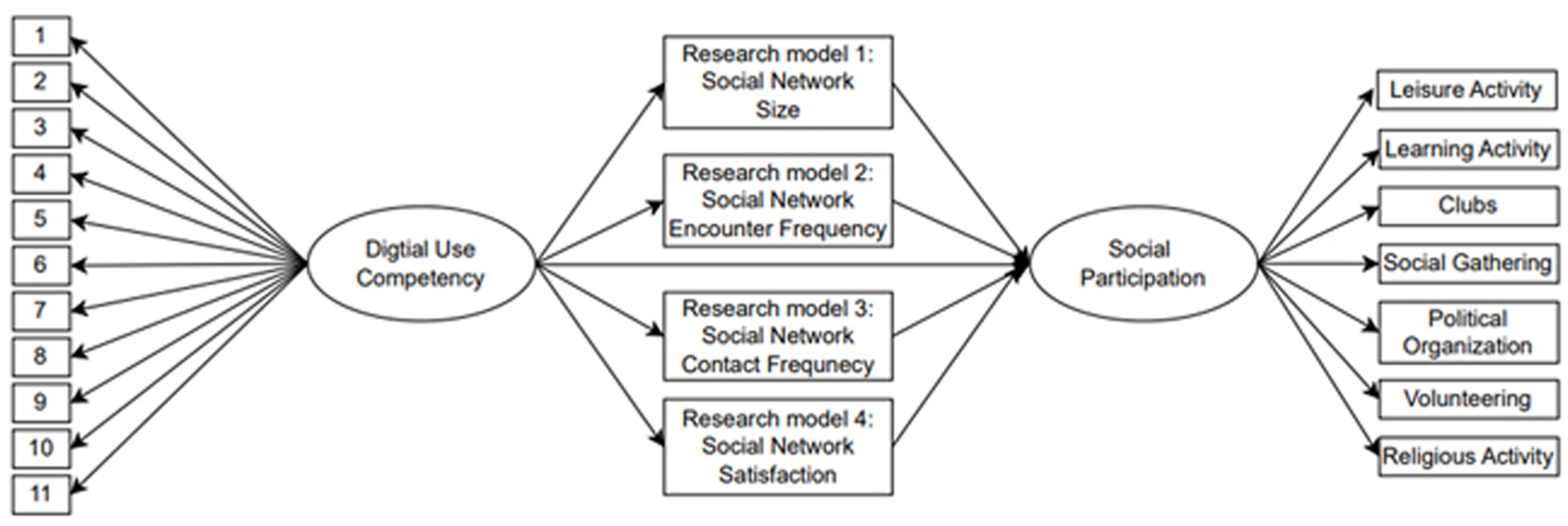
Research model 2: Mediating model for components of social network.
Participants
The following criteria were established to select target participants for analyzing the impact of digital use competency on social participation among older adults. First, individuals who responded on their own behalf were included, excluding proxy respondents. Second, participants with no missing values in the variables used were selected. Third, individuals without outlier values for the relevant variables were included. Finally, participants who were deemed capable of independent living, based on their physical and cognitive functioning levels, were selected.
To meet the final selection criterion, specific requirements were established based on seven activities of daily living: getting dressed, personal hygiene (e.g., brushing teeth), bathing or showering, eating, getting out of bed and leaving the bedroom, using the toilet and cleaning up afterward, and managing bowel and bladder control. Individuals capable of independently performing all seven activities were considered to have a sufficient level of physical functioning for independent living. The criterion for cognitive independence was determined using the Korean Mini-Mental State Examination included in the survey. Participants with scores of 17 or lower were excluded, as they were deemed unable to live independently.
After applying these selection criteria, a total of 7,257 participants were chosen as the research subjects. The data preprocessing steps are presented in Figure 3.

Flowchart of the study.
Ethical Consideration
Participants of the National Survey on Older Koreans gave their written informed consent before enrolling in the survey. This national survey was approved by the Institutional Review Board of the Korea Institute for Health and Social Affairs. This study obtained a review exemption from the Institutional Review Board of Yonsei University Mirae Campus (1041849-202301-SB-003-01).
Study Variables
Digital Use Competency
The independent variable, digital use competency, was measured using a survey questionnaire that asked: “Do you engage in the following 11 activities using a PC, mobile phone, or tablet?” The 11 activities included: receiving messages (e.g., text messages, KakaoTalk, Telegram), sending messages (e.g., text messages, KakaoTalk, Telegram), searching for information (e.g., news, weather), taking photos or videos, listening to music (e.g., MP3s, radio), playing games, watching videos (e.g., movies, TV programs, YouTube), using social networking services (e.g., blogs, Twitter, Facebook, Instagram), engaging in e-commerce (e.g., online shopping, booking, reservations), conducting financial transactions (e.g., online banking, stock trading), searching for and installing applications. Each activity was coded as 0 if not used and 1 if used.
Social Participation
The dependent variable for this study was social participation. This was measured using seven items related to social activities, derived from the survey questionnaire. Each item assessed participation in specific activities over the past year, including: leisure activities, learning activities, club memberships, social gatherings (e.g., alumni meetings, neighborhood gatherings), participation in political or social organizations, volunteering, religious activities. Each of the seven social activities was coded as 0 for did not participate in the past year and 1 for participated at least once.
Social Network
The social network, used as a mediating variable in this study, was measured by incorporating both structural and functional aspects. For the structural aspects, the size of the network and the frequency of encounters and contacts were assessed. The size of the social network was measured using the survey question: “How many close friends, neighbors, or acquaintances (whom you can confide in) do you have?” This was an open-ended question, and responses were recorded as continuous variables. For the analysis, the variable was used in its original form without any transformations. The frequency of social encounters was assessed with the question: “How often did you meet your friends, acquaintances, and neighbors in the past year?” The frequency of social contacts was measured with the question: “How often did you have contact (e.g., phone calls, text messages via mobile phones and KakaoTalk, emails, letters) with your friends, acquaintances, and neighbors in the past year?”
Both items on encounter and contact frequency were measured on a 7-point Likert scale, with response options coded as follows: “Almost never” = 0; “One or two times a year” = 1; “One or two times every 3 months” = 2; “One or two times a month” = 3; “Once a week” = 4; “Two or three times a week” = 5; “Almost every day (four or more times a week)” = 6. For the functional aspect, network satisfaction was assessed. This was measured using a sub-item from the question: “To what extent are you satisfied with the following aspects of your life?” specifically addressing relationships with friends and the local community. Responses were recoded for analysis as follows: “Not at all satisfied” = 0; “Not satisfied” = 1; “Neutral” = 2; “Satisfied” = 3; “Very satisfied” = 4.
Data Analysis
This study was conducted using the data from the 2020 National Survey on Older Koreans. Descriptive analysis was performed using Statistical Analysis System version 9.4, and the structural analysis, path analysis, and mediation analysis were performed using Mplus version 8.0.
To estimate the coefficient of the direct path, weighted least squares mean and variance adjusted (WLSMV) were used. The significance of the indirect path was examined using bootstrapping. The repetition of 1,000 times and 95% confidence interval were set.
Model fit indices were used to check the appropriateness model fit. To index goodness of fit, chi-square (χ2), root mean square error of approximation (RMSEA), comparative fit index (CFI), and standardized root mean square residual (SRMR) were computed. A typical benchmark for χ2 is a value larger than .05 (Hooper et al., 2008). An RMSEA value less than .05 is considered very good, values below .8 are considered acceptable, and values above .1 are interpreted as inappropriate (Browne & Cudeck, 1993). In this study, SRMR values of .10 or less were considered acceptable (Kline, 2015). Values of .9 or higher for CFI and TLI were considered to be reliable indices (Browne & Cudeck, 1993).
Results
Participants
Table 1 presents a descriptive analysis of the general characteristics of the study participants. Their average age was 72.56 years (SD = 6.06), and 58.15% were female; 73.18% of the participants were living in urban areas. Education levels were classified into five groups, and elementary school graduate (31.62%) was the largest group. Living arrangements were classified into four groups, and living with spouse (53.36%) accounted for the most out of other groups. Descriptive statistics for digital use competency, social participation, and social networks are detailed in Supplemental Tables 1 and 2.
Demographic Characteristics of the Participants (N = 7,257).

Test for Convergent Validity
This study used the WLSMV estimation method, as it deals with categorical variables that do not assume a normal distribution. By contrast with the maximum likelihood estimation method, which assumes a normal distribution of variables, WLSMV is suitable for analyzing categorical variables without assuming a normal distribution (Brown, 2006; Muthén & Muthén, 2014). Previous studies have shown that WLSMV estimation requires a large sample of at least 500 participants (Bandalos, 2014; Forero et al., 2009). This study included a total of 7,257 participants, making it appropriate to utilize this estimation method.
The frequency and the percentage or mean and standard deviation of the variables and the convergent validity of the latent variables are presented in Table 2. All latent variables that were utilized in the structural equation model were measured using acceptable items indicating appropriate factor loadings (λ > .3; Hair et al., 2009; Kline, 2015; Tavakol & Wetzel, 2020), with the exception of the observed variables “learning activity” and “religious activity.”
Confirmatory Factor Analysis of the Digital Use Competency, Social Participation, Social Network.

p < .001, **p < .01, *p < .05.
These two items were not used for analysis because of low factor loading.
Correlation and Discriminant Validity
The matrix correlations between latent variables and observed variables for social networks are presented in Table 3. The correlation between digital use competency and social participation was higher than .6, which could indicate multicollinearity problems.
Correlation Matrix of the Study Variables.,

p < .001. **p < .01. *p < .05.
Discriminant validity testing confirmed that the latent variables digital use competency and social participation were distinct constructs. The difference in χ2 between an unconstrained model allowing for a free correlation between the two concepts and a constrained model that fixes the covariance between the concept to 1 was analyzed. Where the difference in χ2 between the two models was higher than 3.84, discriminant validity was confirmed (Woo, 2012). Taking into account that the difference in χ2 between the two model was 7,818.181, which is larger than 3.84, the latent variables digital use competency and social network were confirmed to be distinct constructions.
Final Model Fit
The fit indices of the final research model 1 were appropriate (χ2 = 5,236.356, df = 206, p < .001, SRMR = .089, RMSEA = .063, CFI = .982, TLI = .979). The fit indices for the final research models 2 to 5 were also appropriate and are presented in Table 4.
Research Model Fit Indices.

Note. SRMR = standardized root mean square residual; RMSEA = root mean square error of approximation; CFI = comparative fit index; TLI = Tucker–Lewis index.
p < .001.
Path Analysis
The coefficients, standard errors, and p values for the paths for research models 1 to 5 are shown in Table 5.
Coefficient, Standard Error, and t-Value in Final Research Models.

p < .001, **p < .01, *p < .05.
Note. DC = digital use competency; SN = social network; SP = social participation; SE = standard error; CI = confidence interval.
All paths in research models 1 to 3 and 5 were statistically significant. In research model 3, the impact of digital use competency on the encounter frequency in the social network (β = −.077, p < .001) was statistically significant in a negative direction. The influence of digital use competency on social participation (β = .638, p < .001) and the frequency of social network encounters (β = .105, p < .001) had a statistically significant result. For research model 4, the effect of digital use competency on the social network contact frequency (β = .006, p = .610) was not statistically significant. However, the impact of digital use competency on social participation (β = .629, p < .001) and the frequency of social network contacts (β = .158, p < .001) were statistically significant. In research model 4, it was confirmed that social network contact frequency does not mediate between digital use competency and social participation.
Direct and Indirect Effects Analysis
The analysis of the effects for research models 1, 2, 3, 5 are presented in Table 6. In the research model 1, the overall social network showed significant indirect effects, as the bootstrap confidential intervals did not include zero between the lower and upper confidence intervals. In addition, the size, encounter frequency, and satisfaction in social networks showed significant indirect effects between digital use competency and social participation. Moreover, social network satisfaction showed the largest indirect effect of other social network components, namely, size and encounter frequency.
Direct and Indirect Effects of the Social Network and Components of the Social Network.

Note. CI = confidence interval.
Discussion
Most previous studies on the social networks of older adults using data from the National Survey on Older Koreans have primarily conducted path analyses. However, since the survey questionnaires are not standardized tools, it is essential to confirm whether each component aligns consistently with the study variables. Therefore, this study examined the mediating effects of social networks among older Koreans between digital use competency and social participation using a structural equation model. To the best of our knowledge, this is the first study to examine the mediating effect of social networks of older adults between digital use competency and social participation using structural equation model. The analysis revealed the significance of digital use competency and social networks in influencing social participation among older adults. The findings indicate the importance of digital use interventions for older adults, particularly by strengthening their social networks to promote engagement in social activities and reduce the risk of social isolation. Although this study focused on older adults in Korea, the digital divide among this demographic is a global phenomenon (Seifert, 2020). Furthermore, maintaining social participation among older adults is an important challenge and goal in many cities worldwide (Aroogh & Shahboulaghi, 2020). Thus, the findings of this study have broader implications and could be applied to older populations in different countries.
There have been conflicting findings in previous studies regarding whether digital use competency increases or reduces social network of older adults (Pénard & Poussing, 2010; Zhang & Li, 2022). This study found that digital literacy in older adults positively influences their social networks, supporting the perspective that digital literacy expands social networks (Morris et al., 2014; Yu et al., 2016). Likewise, in the context of social isolation, study of the impact of digital usage on preventing social isolation and promoting social participation has yielded inconsistent results. This study identified a significant influence of digital use competency on social participation among older adults. Internet-based digital devices are powerful tools that enhance individuals’ capabilities (Amichai-Hamburger et al., 2008), and this enhancement of capabilities can expand opportunities for older adults in the local community to access additional resources and connect with their communities, as reflected in the result of previous studies (Harrison et al., 2006; Mehra et al., 2004). This study showed that older adults’ social networks lead to their social participation. Taking into account previous studies supporting the results of this study (Ekström et al., 2013; Lee, Saito, et al., 2008; Nielson et al., 2019; Wilson & Musick, 1997), it appears important for social relationships to have been formed before entering old age for future social participation in old age (Townsend et al., 2021). Positive network formation can foster a sense of belonging in a group (Schorr et al., 2017). The significant influence of older adults’ social networks on social participation, as shown in this study, can be interpreted as indicating that positive networks with friends, acquaintances, and neighbors form a sense of belonging to a group and lead to social participation. For this reason, when social network policies or interventions are considered for enhancing social participation among older adults, it is important to consider not only individuals aged 65 and above but also middle-aged and younger adults as well.
Although the mediating effects of social networks between older adults’ digital use competency and social participation were significant in this study, the partial mediation effect was relatively small. This finding suggests that factors other than social networks are operant between older adults’ social networks and digital use competency and could have influenced the results. For example, other types of relationships beyond social ones with friends and acquaintances might have had indirect effects. Additionally, factors beyond social networks, such as information acquisition (Erhardt & Freitag, 2021) and specific interests in certain domains (Boulianne, 2009) could have mediated between the digital use competency and social participation. While older adults’ social networks showed small indirect effects, the significant results relating digital use competency to social participation suggest that there is a need to include directions that facilitate or maintain social networks in interventions to enhance digital literacy for older adults. The results for research in this direction could be applied to enable older adults to continue engaging in social activity while enhancing their digital use capabilities.
A suppression effect occurs when the direct effect is larger than the total effect (Kühnel et al., 2009; MacKinnon et al., 2000; Shrout & Bolger, 2002). In this study, it was found that the frequency of social network encounters among older adults showed a significant suppression effect between digital use competency and social participation. This result is due to the significant negative effects of digital use competency on the frequency of social network encounters. This finding forms a contrast the results of a study by Jung and Choi (2021), who reported that the use of text messages and social networking services by older adults in South Korea positively influenced of social network encounters within social networks. The data for this study were collected in 2020, at a time when face-to-face interactions were limited as a result of the impact of the COVID-19 pandemic. Thus, it is interpreted that older adults with higher digital use competency were more likely to minimize face-to-face interactions and instead tended to engage in social exchanges without meeting their neighbors in person. This interpretation suggests that the tendency to minimize in person interactions may be reinforced among older adults with higher digital capabilities.
This study found that the influence of digital proficiency on the frequency of social network contacts was not significant, indicating the absence of a mediating effect of network contact frequency. These results differ from the findings of Jung and Choi (2021), who reported that digital proficiency among older adults had an impact on social network contacts in their study participants. However, it should be noted that, while previous studies focused on specific digital activities, including text messaging and the use of social networking sites, this study included a broader range of digital activities. In addition, previous studies controlled for factors such as residential area, education level, and income, which may have contributed to the different results. Therefore, future research should consider controlling for other variables using the structural equation modeling that was employed in this study to obtain a clearer understanding of the causal relationships.
However, in line with the results regarding the size of and satisfaction with social networks in this study, Carpenter and Buday (2007) found that digital use has an impact on a broader range of social network sizes and network satisfactions. Comparing the indirect effects of network size and network satisfaction in this study showed that the mediating effects of satisfaction were found larger. Taking into account the findings of Child and Lawton (2019) on the influence of social networks on loneliness and isolation among older adults, where satisfaction plays a greater role in older adults’ experience of social exclusion than network size or frequency, it is important to include directions that enhance the qualitative aspects of networks with friends, acquaintances, and neighbors in education for the use of digital products to promote social participation among older adults. Systematic studies that focus on qualitative research on the factors influencing older adults’ social participation have identified fear of gossip and conflict, as well as distrust of others, as inhibiting factors (Lee et al., 2022). Taking into account the six elements of digital literacy proposed in British Columbia, Canada, which include not only the ability to effectively use information and technology but also such aspects of digital citizenship as awareness of cyberbullying and legal and ethical responsibilities, it is important to provide education for older adults that both enhances their digital skills and addresses the factors that can hinder satisfaction of their social networks.
This study had several limitations. First, the use of secondary data limited the analysis and the operationalization of variables with respect to the research topic. In this study, social networks were defined and measured in terms of size, encounter frequency, contact frequency, and satisfaction. However, social networks are multidimensional concepts, encompassing diversity and resource sharing. Similarly, digital use is a concept that can be measured through various functions and scales, but it was challenging to reflect this diversity in the study. Second, although the convergent validity for social network, digital use competency as tested through confirmatory factor analysis in this study, was acceptable, the 2020 National Survey on Older Koreans did not employ specific evaluation tools for the three variables. Future studies should consider confirming the structural relationship using standardized tools. Third, this study relied on cross-sectional data from the National Survey on Older Koreans that was conducted in 2020, which makes it difficult to establish a clear causal relationship between older adults’ digital use, social networks, and social participation. Future research should consider adopting a longitudinal design to analyze causality more effectively. Future empirical research on interventions to enhance digital competencies for older adults and measure whether these interventions can effectively enhance relationships with friends, acquaintances, and neighbors and promote social participation would help determine whether the proposed theoretical research model aligns with the actual outcomes of interventions.
Conclusion
The final model developed in this study shows the mediation effects of social network on the relationship between digital use competency and social participation among older adults in Korea. This study shows that the overall, social networks play a mediating role between digital proficiency and social participation. In addition, social network satisfaction was found to show larger mediating effects than the other three components of social network, namely, size, encounter frequency, and contact frequency. These results indicate the importance of digital use intervention for older populations in terms of social engagement and the need for including ways to facilitate and maintain social networks in the intervention.
Supplemental Material
sj-docx-1-sgo-10.1177_21582440251388285 – Supplemental material for Mediating Effects of Social Networks Between Digital Use Competence and Social Participation of Korean Older Adults
Supplemental material, sj-docx-1-sgo-10.1177_21582440251388285 for Mediating Effects of Social Networks Between Digital Use Competence and Social Participation of Korean Older Adults by Hamin Lee, Jongbae Kim and Hae Yean Park in SAGE Open
Footnotes

Author’s Note
All authors meet the criteria for authorship and agree to be listed as authors.
Ethical Considerations
This study was conducted after obtaining approval from the Institutional Review Board of Yonsei University Mirae Campus (1041849-202301-SB-003-01).
Funding
The authors disclosed receipt of the following financial support for the research, authorship, and/or publication of this article: This research was supported by the BK21 FOUR (Fostering Outstanding Universities for Research) funded by the Ministry of Education (MOE) of the Republic of Korea and National Research Foundation of Korea (NRF) (Big data specialized education and research team for cognitive health and social integration of community-dwelling older adults).
Declaration of Conflicting Interests
The authors declared no potential conflicts of interest with respect to the research, authorship, and/or publication of this article.
Data Availability Statement
Supplemental Material
Supplemental material for this article is available online.
References
Supplementary Material
Please find the following supplemental material available below.
For Open Access articles published under a Creative Commons License, all supplemental material carries the same license as the article it is associated with.
For non-Open Access articles published, all supplemental material carries a non-exclusive license, and permission requests for re-use of supplemental material or any part of supplemental material shall be sent directly to the copyright owner as specified in the copyright notice associated with the article.
