




Abstract
This research surveys how graduate level urban planning students think about social justice and equity issues and how academic instruction in urban planning affects the disposition of students toward these issues and themes in the context of their development as urban planning professionals. Although the quantitative findings did not demonstrate that the graduate curriculum and instruction had any appreciable impact on student understanding and navigation of equity and social justice themes, qualitative evidence did suggest that students are understanding and care about issues related to social justice and equity and were interested in incorporating those issues into their professional practice. This research also suggests that graduate academic instruction may fall short in supporting students with the useful integration of social justice and equity issues into their professional practice.
Keywords
Purpose and Rationale
To prepare urban planning students to effectively address equity and social justice considerations in their professional practice, there must be an understanding of their fundamental opinions, beliefs, and values with respect to equity and social justice. If urban planning instructors can gain more insight into student disposition related to themes of social justice and equity, they can then contour and adjust their pedagogical approaches and strategies in ways to more effectively engage students around those issues, as well as better support students in their efforts to integrate social justice and equity principles into their future professional practice.
Overview
The Ideology of Social Justice and Equity in Planning
Notwithstanding the complexities of developing a social-justice-oriented curriculum as well as the inherent pedagogical challenges related to its delivery, there has been a growing interest in advancing social justice and equity as an important ethic for promoting human rights (Johnston, 2009). Within the discipline of urban planning, a practice tradition of advocacy planning emerged in the 1960s, which focused on promoting equitable and socially just communities (Davidoff, 1965; Krumholz & Clavel, 1994; Krumholz & Forester, 1990; Bingham & Mier, 1993; Thomas, 2006). More recent concerns about planning education and its need to address issues related to diverse communities has taken the form of discussions about culturally competent planning education (Agyeman & Erickson, 2012).
Professional planners commit to embracing notions of social and racial justice as an aspiration in their code of ethics and professional conduct (American Planning Association [APA]; 2009). Within the advocacy planning approach, now often referred to as the “progressive planning” approach (Clavel, 1986), there exists a fundamental set of beliefs that value democratic principles of inclusion and participation and encourage planners to play an active role in creating socially and economically just and sustainable communities. That said, there is evidence that the progressive values of planning are having difficulty finding resonance and opportunity to flourish in planning practice in such a way that they can advance a vision and possibility that embraces equity outcomes (Thomas, 2008, p. 227).
In 1965, a period of moral and social reckoning in America, Paul Davidoff posited this thought about the role of planners in promoting democratic and participatory principles in planning: The recommendation that city planners represent and plead the plans of many interest groups is founded upon the need to establish an effective urban democracy, one in which citizens may be able to play an active role in the process of deciding public policy. Appropriate policy in a democracy is determined through a process of political debate. The right course of action is always a matter of choice, never of fact. In a bureaucratic age great care must be taken that choices remain in the area of public view and participation. The ideals of inclusiveness, democracy and public participation remain fundamental to community-based planning. (p. 332)
Davidoff challenged planning educators to train planners in ways that required them to invoke their skills to serve underrepresented low-income communities, as well as advance social objectives and transformative social policy such that racial inequality, economic disenfranchisement, social exclusion, and gender and class bias can be contemplated and grappled with by students in the context of their future planning practice (Checkoway, 1994). In fact, the promotion of these ideals and values associated with planning practice have been argued to be the most persuasive approach—if not the only compelling one—for planners to assume as they seek to reconcile their professionalism with their political engagement (Marris, 1994; Krumholz & Forester, 1990). Yet, the social justice and equity concerns of planning must be understood in the context of the political history and the political economy of the United States. Fainstein and Fainstein (1971) posit that The United States for a variety of historical and cultural reasons has been dominated by the liberal tradition. This tradition values individualism, accepts the primacy of private interests, and prefers minimal government. Thus, the very notion of planning, which assumes an overriding and ascertainable public interest that can be maximized through the positive actions of government is antithetical to general American political values. (p. 357)
The liberal ideology that is decidedly in favor of unfettered free markets makes it very apparent that any planning practice seeking to address the redistributive injustice and inequity of the free market is subject to considerable scrutiny and countervailing pressure by dominant institutional and private sector interests. As Markusen noted, The urban planning profession is losing the battle with economics for the shaping of urban space in part because planners value equity as a normative criterion, whereas economics values market efficiency. Efficiency has won out in whatever war of values might have taken place. (Markusen, 2000, as cited by Thomas, 2008, p. 227)
Navigating the realities of the economic markets and the political environment becomes a key attribute of the planning practitioner’s reality and is of significant concern for those seeking to infuse social justice and equity priorities into their practice. A series of writings by planning scholars in the Spring 1994 volume of the American Planning Association Journal examined in retrospect Paul Davidoff’s notion of advocacy planning. 1 It was evident that the advancement of equity and social justice objectives remained salient, if not fundamental to the vision of planning as conceived by Davidoff and advanced by many others, even though the various commentators articulate their own unique insights and challenges associated with implementing Davidoff’s social-justice-oriented planning approach. What is also evident from those commentaries is that the relevance and contribution of planning practice rest on the core values of inclusion, equity, and justice that form the democratic context in which planning must be positioned. Also manifested in the commentaries are a set of ideals closely held by an earlier generation of planning scholars and practitioners who consciously embrace their role as change agents (Thomas, 2006, pp. 314-315).
Social Justice and Equity Pedagogy and the Training of Urban Planning Professionals
Progressive planning professionals, academics, and practitioners alike, many of whom whose worldviews were shaped by their experience with or being youthful observers of the civil rights movement, recognize that today’s planning students may have little or no framework to draw upon, which allows them to understand or translate principles of social justice and equity into practice (Thomas, 2006, pp. 314-315). Moreover, there is concern that today’s planning students, many of whom grew up in the post-civil rights era, may have little interest or disposition toward issues of equity and social justice. This concern is heightened as there is a growing perception that the United States is now moving into a post-racial era with the election of its first African American president, suggesting that issues related to discrimination, social disadvantage, and equity are becoming less relevant for planners and the discipline as a whole. Thomas (2006), who is recognized for her scholarship related to advancing diversity and progressive ideals in the planning field through pedagogical means, and who is also a proponent for aggressive recruitment of diverse individuals within the student body and planning school faculty, suggests the planning field would be better positioned to advance issues of equity and social justice if it were more racially diverse. She contends that increasing diversity within the planning field would heighten the “motivation” of the field to champion the cause of equity and social justice; at present, this is not occurring to the degree it should because the “pain” of those diverse communities is often “left at the door” and never allowed to cross the threshold into the planning process (Thomas, 2008, p. 234).
Professional urban planners serve an important role in cities, often acting as facilitators and mediators in rationalizing the use of urban space, the deployment of municipal and community resources, and the allocation of community and economic development opportunities. Arguably, planners must achieve these objectives by asserting their role as a mediating influence that balances the needs and interests of private sector stakeholders with efforts to promote the greater public good. 2 The balancing of the public good with the needs and interests of private stakeholders essentially translates into the ultimate distribution of costs and benefits within communities, which of course has tremendous bearing on equity and social justice outcomes. The professional planning code of ethics requires practitioners to consider issues of race, class, and gender as a context for advancing social justice and equity. There is an expectation that students will be equipped in their training to engage and manage equity matters within the context of their professional practice. Although there are numerous skills, technical capabilities, and various sensibilities that planning instructors must help students develop to ensure their effectiveness as planning professionals, there is also a firmly held belief that it is equally critical for those teaching in planning schools today to help students develop a concern for social justice before they enter professional life (Thomas, 2006).
According to a 2011 Association of Collegiate Schools of Planning (ACSP) Diversity Taskforce Report, African American and Latino faculty and students are grossly underrepresented in American planning programs (Wubneh, 2011). This suggests we should not only aggressively work to diversify planning classrooms and planning faculties, but we must also infuse the planning program curriculum with opportunities for students and faculty—all across the ethnic, racial, gender, and economic spectrum—to understand the struggles, the frustration, and inequalities that too often define the experiences of low-income and working-class communities, and particularly low-income communities of color. Understanding how students think about issues of social justice and equity is the first step in moving students along a continuum of development from a “polite appreciation” of social justice and equity issues to a transformational internalization of these issues as a mandate of professional practice.
Research Question
The question this exploratory research investigated was threefold: (a) what are the fundamental opinions, beliefs, and values that urban planning students hold related to social justice and equity issues; (b) how does academic instruction influence the beliefs, opinions, and values of urban planning students, as well as support their embracing of social justice and equity issues in their professional practice; and (c) how do students generally feel about how well social justice and equity issues are integrated into the instruction and the curriculum of their program?
Research Methods
Survey Design
This study involved a survey (see Appendix A) of first and second year Master of Urban Planning (MUP) students. The survey queried MUP students on their opinions, beliefs, and values related to social justice and equity in the context of their roles as aspiring urban planning professionals. The survey was distributed during the initial and final semesters of the students’ tenure in the program to gain an understanding of the influence of the program on student social justice perspectives. The MUP classes were defined by the year the students entered in the program. The class of 2008 was sampled prior to students exiting the program, the class of 2009 was sampled both in the first and final semesters of the program, and the class of 2010 was sampled during the initial semester of the program. This stratified sampling technique allowed for the capturing of students across three different class years.
The survey included 10 multiple choice questions and one open-ended question that asked students to offer suggestions on how the MUP program might improve on its curriculum in dealing with issues of race, class, gender, and other social justice-related topics. Six of the survey questions (Questions 1-6) aimed to measure the students’ attitudes toward social justice and equity by offering students mini-vignettes for them to respond to, which measured the intensity of their support for social justice and equity themes. Questions 1 and 2 sought to gauge student perspectives on the role of professional planners in propagating social justice and equity ideals. Question 3 assessed student perspectives on the scope and purpose of planning intervention in the context of equity and social justice. Questions 4 and 5 evaluated student beliefs related to the efficacy of planners in advancing social justice and equity outcomes in their practice. Question 6 sought to highlight student perspectives on the academic instruction strategies that encourage awareness and exploration of social justice and equity issues. The intensity levels of student responses were characterized as a low, moderate, or high level of social justice activism toward social justice and equity themes. Four questions (Questions 7-10) gathered predictor information about the students’ background, such as comfort discussing topics related to social justice and equity, earlier educational exposure to social justice and equity themes, student perceptions as to whether social justice and equity concerns will be relevant to their professional practice or work experience, and student perceptions of the effectiveness of their graduate level program in addressing issues of social justice and equity.
Sample
Table 1 shows the total enrollment of students in the MUP program during the period of the administration of the survey. As we observe, 58 (85%) of the students in the program are White, with White men and White women comprising 62% and 23%, respectively, of the total population of students. The MUP program had one African American student, two Native American students, three Asian American students, three Latino students, and one foreign-born student comprising 1.5%, 2.9%, 4.4%, 4%, and 1.5%, respectively, of the total population of students.
Total Program Enrollment and Demographics of Master of Urban Planning Students During the Period of the Survey (2008-2010).

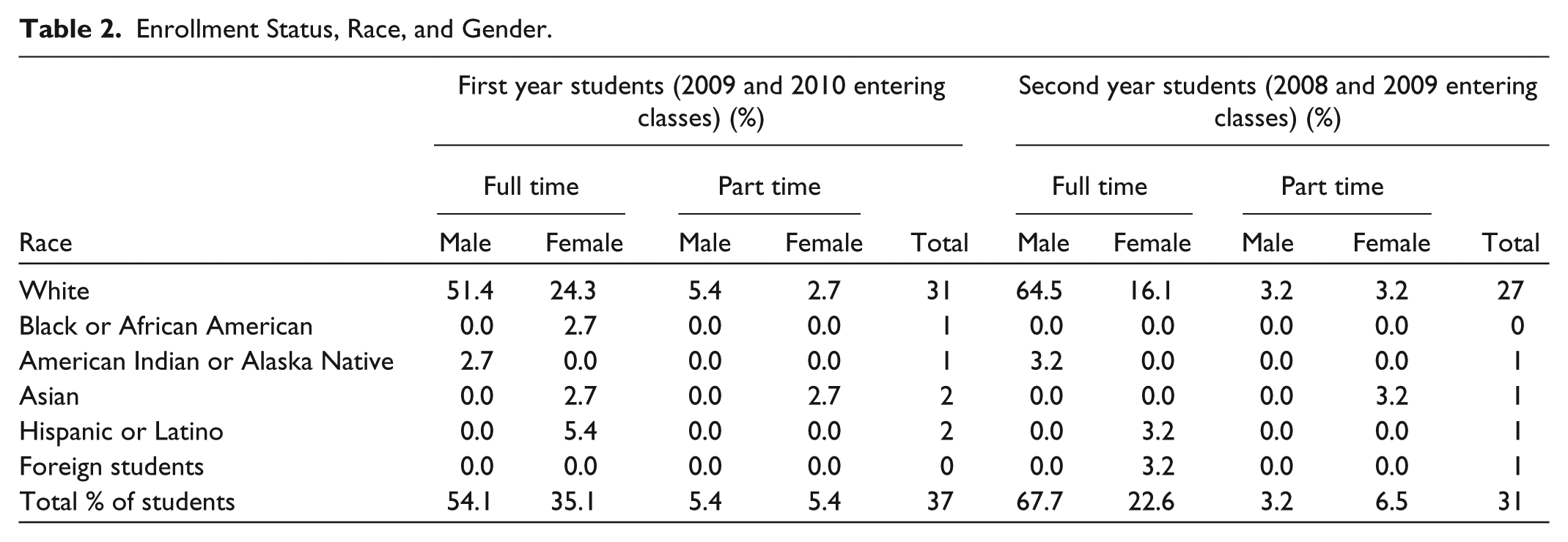
Table 2 shows the demographic distribution for the first and second year classes of students who were surveyed. The demographics for the first and second year classes illustrates that within both classes substantially more than 50% of the students are White men, with White women comprising 20% or more of the student sample. In terms of the racial demographics, there are no significant differences in the racial composition of the first and second year classes. Therefore, we would not expect any difference between the first and second year student response rates based on class demographics.
Enrollment Status, Race, and Gender.
Analytical Methods
The survey data were combined according to when the students were surveyed; thus individual response data were combined so that the responses from individuals just beginning the program (i.e., first year students) were aggregated, and responses from individuals who were in their second year and who had completed the program were aggregated. This allowed us to compare the responses of students who were at the beginning of their tenure to those who were completing their tenure in the MUP program. To summarize the results of the closed-ended survey responses, descriptive statistics were developed. Bar charts were produced to assess the aggregate response patterns and differences in responses of students who were in their initial year of the MUP program as compared with the responses of students who were completing the program. A series of chi-square tests were conducted to determine whether there were significant differences in the responses between first and second year students and to determine whether there was any relationship between student responses to Questions 1 through 6 and the predictor data collected from student responses to Questions 7 to 10. Finally, responses to the open-ended questions were analyzed by grouping them thematically and then undertaking a thorough review of those responses.
Results
Student responses to the closed-ended questions were assessed as being low, moderate, or high in terms of social justice activism based on how supportive the student was of the social justice and equity theme presented in Questions 1 to 6. Figures 1 and 2 compare the response distribution of first and second year students to Questions 1 to 6 of the survey. The general trend is that both first and second year students have a tendency to display moderate or high levels of activism attitudes across all questions.

Distribution of responses of first year students to social justice and equity themes.

Distribution of responses of second year students to social justice and equity themes.
Over 75% of students from both the first and second graduate class years express either a moderate- or high-level disposition toward social justice activism, as compared with the approximately 20% to 25% of students who demonstrate a disposition for low levels of activism relative to social justice and equity. However, a more detailed comparison of the responses from first and second year students indicates some students’ attitudes toward social justice shifted between their initial and final years in the graduate program. The survey distribution results suggest some fluctuation among respondents identifying with moderate versus low levels of activism, with slightly more second year students having a preference for low levels of activism attitudes and slightly more first year students having a preference for moderate levels of activism.
Thirty three percent of all students surveyed displayed a disposition for high levels of activism, with the exceptions of second year student responses in relationship to Question 4, which assessed student perceptions of the efficacy of urban planners. In Question 4, there was a decline in the percentage of second year students who strongly believed in the efficacy of planner, less than 25% as compared with their first year counterparts whose percentages were at 35%. The percentage of high activism preferences varied by question, but neither class demonstrated a substantially greater preference for high levels of activism. A substantial number of students within the sample displayed a disposition for moderate levels of activism.
Although there are similar trends in the social justice attitudes of first and second year graduate classes, some differences in responses to particular questions were found. Overall, first year students tended to be slightly more likely to show moderate activism versus high activism disposition when compared with second year students. In all questions (except for Question 2, which examined students’ perspective on the role of professional planners in propagating social justice and equity ideals in the context historical patterns of racial and gender discrimination and exclusion in the United States), a greater percentage of first year students than second year students selected a moderate response. With respect to Question 5, which highlights the role of professional planners in addressing issues of economic and social justice, first year students had a much larger moderate activism response as compared with second year students, who tended to display a preference for low activism. Questions 3 and 4 asked students about their perspectives related to the role of planners in promoting equitable market outcomes and the power of planners to influence policy decisions, respectively. For both of these questions, moderate social justice activism attitudes were markedly greater in first year students compared with second year students.
Overall, the survey distribution results suggest that a slightly greater number of second year students demonstrated a low activism disposition when compared with first year students. In all questions except for Questions 6 and 2 (that dealt with instructional strategies that encourage social justice awareness and the planner’s role in propagating social justice given historic patterns of racial and gender inequality, respectively), no students selected a low activism response. More second year students showed a disposition toward low-level activism compared to their first year counterparts. This pattern reveals that while the majority of students held moderate or high activist stances in both their initial and final years in the program, there was a shift among some students in their second year of the program, more second year students demonstrated a lower level activism disposition toward social justice issues as those students neared completion of the master’s program. Consequently, the results may indicate that some students become more neutral or dispassionate about social justice and equity issues as they progress to the final year of the program.
Mean Values of Social Justice Activism Responses
The mean values of response percentages of first and second year students were compared to examine how the program curriculum may have influenced student perceptions regarding social justice activism. Table 3 shows the trends in the mean values associated with the student responses. Notwithstanding the aforementioned difference between first and second year student responses discussed earlier, there appears to be no statistically significant distinction between Year 1 and Year 2 students with respect to their attitudes toward social justice activism. The percentages of social justice disposition responses were also evaluated by year: first year (initial year) and second year (final year) in the program. It appears that matriculation through the MUP program does not affect student disposition toward social activism.
Mean Value Results for Social Justice Activism Disposition Responses by Year in the Program.

Chi-Square Analysis of Predictor Data and Levels of Student Disposition Toward Social Justice Activism
Table 4 provides a snapshot of aggregate student responses to the Predictor Questions 7 to 10. Student responses to the predictor questions were categorized as low, moderate, or high. A chi-square analysis was used to determine whether any relationship exists between the four predictor variables (as measured by Questions 7-10) and student responses to the social justice activism categories (as measured by Questions 1-6).
Distribution of Aggregate Student Responses to the Predictor Questions 7 to 10.

Table 5 highlights the relationship between students’ disposition toward social justice activism and their level of experience and exposure to social justice issues in previous academic settings. Results suggest that for first year and second year students, there appear to be no statistically significant relationship between their former educational experience and their disposition toward social justice activism. Although a significant number of first year students with limited or no exposure to social justice themes in their previous educational experience demonstrated a disposition toward high levels of social justice activism, this was significantly less true for second year students.
Social Justice Disposition Response to Question 7: What Statement Best Describes Your Educational Experience Prior to Attending the Master of Urban Planning Program?
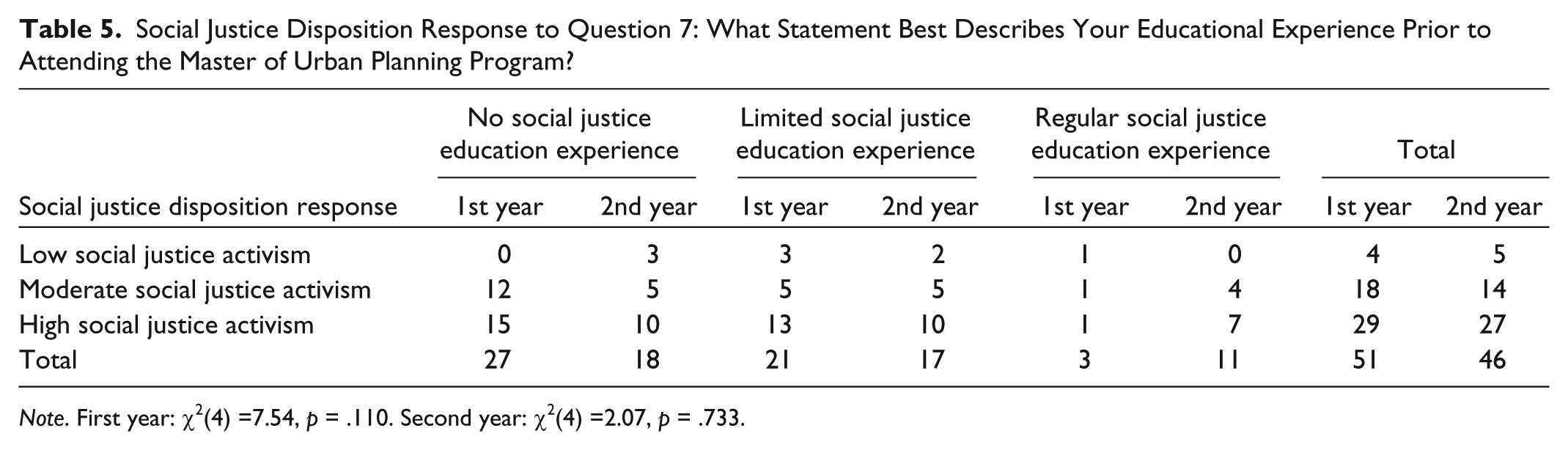
Note. First year: χ2(4) =7.54, p = .110. Second year: χ2(4) =2.07, p = .733.
With respect to the connection between comfort level (as it relates to discussing social justice issues) and student disposition toward activism, Table 6 suggests that there is no relationship between levels of comfort and disposition toward social justice activism for either first or second year students. However, a significant number of first year students who indicated a moderate to high level of comfort engaging social justice themes also demonstrated a greater disposition toward high social justice activism. This trend is also present among second year students, with fewer students expressing moderate comfort and more expressing high levels of comfort with social justice themes. These second year students also expressed a preference for a higher level of social justice activism.
Social Justice Disposition Response to Question 8: What Statement Most Accurately Describes How You Feel?
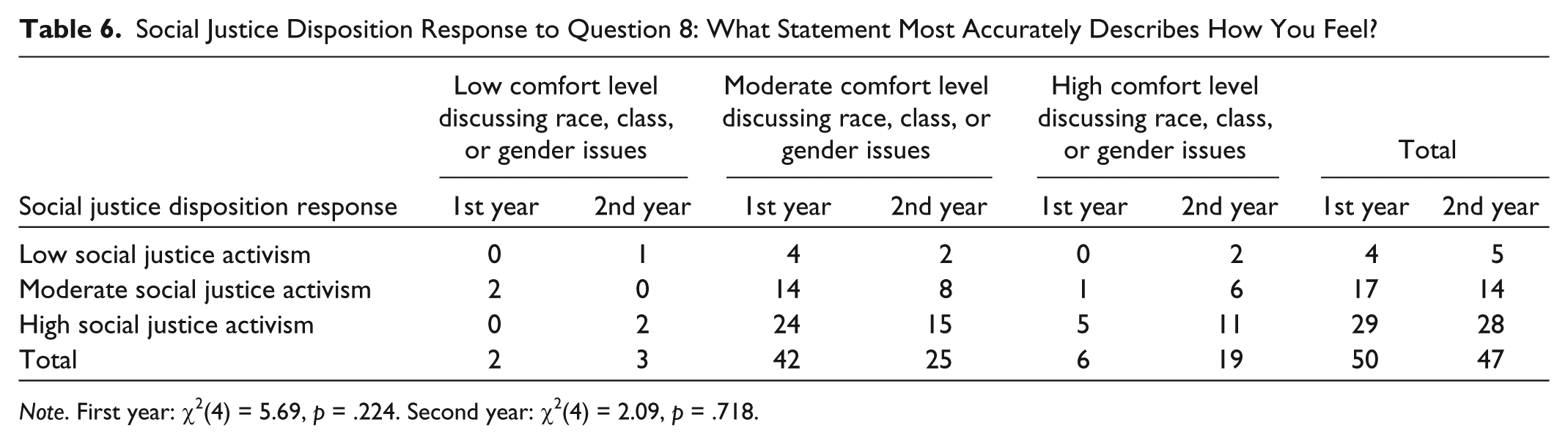
Note. First year: χ2(4) = 5.69, p = .224. Second year: χ2(4) = 2.09, p = .718.
Although not statistically significant, the data in Table 7 illustrate that first and second year students who believe equity issues will be or might possibly be important in their work as a professional planner are more likely to express a disposition toward a high level of social justice activism. Finally, although not statistically significant, the findings in Table 8 show a tendency for first and second year students who indicate that the MUP program does a good job in addressing equity issues to also display a disposition toward high levels of social justice activism.
Social Justice Disposition Response to Question 9: What Statement Most Accurately Describes What You Think?

Note. First year: χ2(4) = 3.81, p = .432. Second year: χ2(4) = 1.87, p = .760.
Social Justice Disposition Response to Question 10: What Statement Most Accurately Describes What You Think?
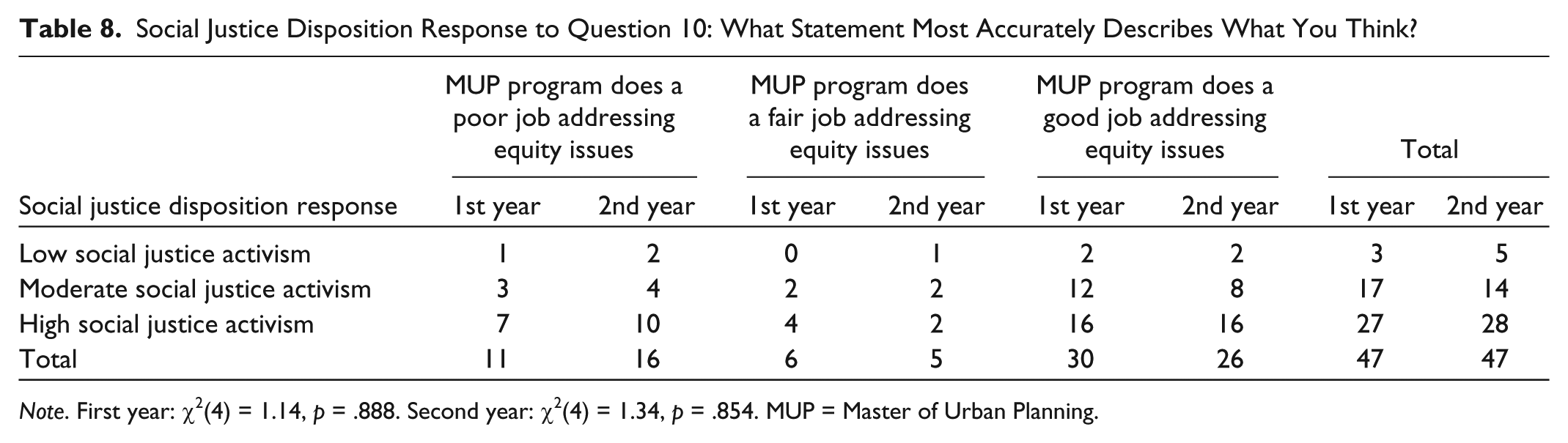
Note. First year: χ2(4) = 1.14, p = .888. Second year: χ2(4) = 1.34, p = .854. MUP = Master of Urban Planning.
As discussed, matriculation through the MUP program did not have any statistically significant effect on student disposition toward social activism. In addition, various predictor variables did not prove to be statistically connected to the student disposition toward social justice and equity. Furthermore, there was no statistically significant relationship between former educational experience and disposition toward social justice activism. That said, some students who showed more comfort toward engaging in social justice issues also were more likely to have higher levels of activism. This finding suggests that these students’ disposition toward higher levels of social justice activism can be attributed to something outside of the realm of their classroom experience, indicating the need for more experiential or more applied learning opportunities.
It should be noted that the sample size may have limited the usefulness of the results from this specific data survey. However, the data trends in the study regarding the curriculum’s impact on student disposition toward social justice and equity suggest that (a) the instruction on issues of social justice and equity in planning had little or no impact or (b) there were not enough classes or opportunities for discussion about social justice and equity in the program to create a sustained resonance with the students.
Qualitative Findings: Student Reflections and Comments
The final question on the survey was open-ended, asking students to offer ideas related to integrating race, class, and gender issues into the MUP program curriculum. Students offered a number of thoughts, reflections, and strategies for improving the delivery and approach to promoting social justice and equity themes within the instructional framework of the curriculum.
The students’ comments were organized into four basic categories:
Appreciating the complexity of the social justice dialogue
Preparation for the social justice dialogue
Advancing strategies for teaching and learning as it relates to social justice issues
Exploring new instructional options for supporting discussion of social justice and equity issues
Appreciating the Complexity of the Social Justice Dialogue
The program discusses the issue but places little emphasis on how to respond to it. The program is too focused on the built form of planning rather than on issues that are often unseen.
Students often acknowledged the complexity of the social justice dialogue, as evidenced by one student’s question: “ . . . how do we balance the need to be neutral and technical experts, yet incorporate social justice into that?” They saw that social justice comprises areas of emphasis including environmental problems, class issues, education, affordable housing, safe living environments, and more. Students stated that race and class issues are becoming even more important today, and that it is important to not overlook the historical context of socioeconomic issues. Students desired more discussions to address these issues essential to planning practice. Examples mentioned for study were the intertwining of environmental problems and social justice, mixed-income neighborhood planning, and practical ways to address social justice issues in everyday planning practice.
Preparation for the Social Justice Dialogue
Overall, I think educators still believe it is a “touchy” subject and may try to shy away from it. However, I feel it is relevant to learn/talk about it. Personally, when in a group of all whites I feel comfortable talking about it, but when I am in a mixed group, I feel uncomfortable and slightly embarrassed.
Rather than shying away from dialogue about social justice, students embraced it and lamented that the academic program did not do more to foster it. They wanted social justice to be directly addressed in class and wanted professors to have training on how to facilitate these types of discussions. Some students felt social justice and equity issues were only discussed in classes as tangential side topics and others noted a lack of comfort in discussing sensitive issues of race and class, especially with other students of a much different background.
Advancing Strategies for Teaching and Learning as it Relates to Social Justice Issues
[LOCATION] is a place full of local race, class and gender issues. More real local examples would be helpful to hit the point home.
Students expressed an awareness of the fact that their class lacked racial and ethnic diversity and wished for more opportunities to discuss social justice and equity issues in class. They acknowledged privilege and felt it was important for them to get out of the classroom and their comfort zones and into the community. Students wanted case studies, seminars, and a required social justice course that directly works on building solutions and strategies that address social and economic inequality.
Exploring New Instructional Options for Supporting Exploration Into Social Justice Themes
I think one of the Planning Policy Analysis course cases should be centered on these issues (one or all of them) to give us some practical experience to go along with what we have learned in class. Hearing about the issues and actually experiencing the difficulties associated with solving/improving them are very different, and I believe that could be addressed while we are still in the structured and controlled setting that the program provides.
Some students expressed their desire for a class dedicated to social justice and equity issues. Many believed such a class should be mandatory and that the urban planning program should suggest classes for them to take outside of the program if none were available within urban planning. Students wanted to see topics of race, class, and gender discussed in less of an abstract context and in more historical and practical ways. They wanted applied classes so they would be able to serve their community at large while being exposed to race and class issues in a controlled and structured environment. Suggestions were made for the planning program to connect with community leaders who are already working on issues of social justice and equity: “We need real-life case studies dealing with these issues. Also, dealing with race, class, and gender issues require a base knowledge of economics and political science, so incorporating these into the curriculum would be beneficial as well.”
The students’ comments and reflections offer some important insights for instructional and pedagogical considerations. In general, students believe social justice issues need to be given more emphasis and support, with higher levels of specificity and regularity in terms of course materials, class discussion, and opportunities to be exposed to community and professional stakeholders who navigate the complexities of social justice issues in their daily lives and/or practice. Students express a desire for effectively facilitated, frank, and balanced discourse about social justice and equity that is solution oriented and practice focused. Students also expressed an interest in having more courses available to them specifically dedicated to social justice issues and themes: “I think issues of race, class, and gender should be directly addressed through instruction when talking about planning. It’s important! Instruction on diversity topics by diverse instructors educated on the issues.”
Comparing these qualitative comments with the quantitative findings, it is fair to conclude that urban planning programs should look for ways to better integrate social justice and equity topics into their current coursework and to potentially establish a new class or classes focusing exclusively on urban social justice. Because students with greater comfort levels involving discussion are also likely to be more oriented toward social justice, instructors should find ways for these students to help lead discussions. All students will enter discussions with different comfort levels, and it is important to create a safe atmosphere.
Planning programs might also consider surveying their new students and graduating students on an ongoing basis to track changes in social justice activism, and to make changes to the curriculum accordingly. Programs also have to be strategic in terms of increasing the confidence of second year individuals who might experience a drop in confidence from Year 1 to Year 2 in term of being able to integrate social justice and equity practices into their professional career.
There is a likelihood that second year students’ confidence levels declined because they gained a greater understanding of the political issues that can stand in the way of change. Educators should inspire students and ensure social-justice- and equity-focused planning education prepares students for the challenges ahead so that students are empowered and not discouraged by the difficulties and barriers they may confront in advancing a social justice and equity agenda as an important component of their professional practice.
Conclusion
We should be exposed to more situations where there are persons of different races/classes to feel out what it is like to do work in that context.
This exploratory study offers some interesting insights into the disposition of graduate planning students toward social justice activism. Survey results showed students of all races and genders are very much in tune with and care about issues related to social justice and equity. The first and second year class cohorts of the MUP program covered under this study displayed moderate to high levels of support for the application of social justice and equity issues in the context of their training as professional planners. A significant number of students in the class cohorts covered by the survey tended to enter into the MUP program with a disposition toward high levels of social justice activism. This was true even when they had limited or no exposure to social justice issues in their previous academic experiences. It appears the MUP program attracts planning students who have supportive views of social justice activism within the context of planning practice. However, as students matriculated through the program, the curriculum did not appear to have much effect on the disposition of students toward social justice activism. Notably, second year students displayed more of a tendency toward low levels of social justice activism. This may suggest that if students are introduced to complex social justice concepts but are not also given strategies to navigate the realities of these issues within their professional practice, they may default to a disposition toward lower levels of social justice activism.
A significant number of students felt moderately comfortable talking about issues related to race, class, and gender and also believed that issues of social justice will possibly be important in their practice as professional planners, which is certainly an important foundation upon which to build from a pedagogical vantage point. In the words of one respondent, “Talking about it in the classroom helps, but getting us out of our comfort zone will do more.” There was a mixed opinion among students about the effectiveness of the program with respect to engaging issues around social justice. However, there was a general sense that more applied and practical knowledge related to these issues would serve students more effectively as they prepare for professional practice: I think the program addresses these concepts well enough in class, but could put more emphasis on how to work for these concepts in a tangible way. Race and class issues are especially difficult to approach, since those are usually multi-faceted problems.
That said, many students also expressed an interest in being challenged and inspired to promote social justice and equity in their professional practice. Moreover, many students from the first and second year classes indicated they would be working for organizations after graduation where issues of race, class, and gender would be important considerations within their work.
The findings of this study are limited but encouraging. Planning students continue to show interest in upholding values of social justice within the context of their planning practice. The comments from students, which capture some of the qualitative aspects of the research, suggests that student input can play a significant and strategic role in helping planning programs consider how instructional and pedagogical approaches might be improved to better support student learning. This is an important charge for faculty within planning schools, which deserves to be taken seriously. More research is needed to perfect strategies for introducing and managing social justice and equity issues and themes within the planning curriculum. These issues related to social justice and equity are only becoming far more complex, nuanced, and challenging to understand and manage. Future research might focus on surveying a larger sample of students across a few planning schools to see if the trends suggested here are generalizable and provide insight for recommended changes to planning programs that could be advocated for and adopted.
Footnotes
Appendix A: Questionaire
Appendix B: Summary of All Qualitative Student Responses Group by Catagory
Declaration of Conflicting Interests
The author(s) declared no potential conflicts of interest with respect to the research, authorship, and/or publication of this article.
Funding
The author(s) received no financial support for the research and/or authorship of this article.