




Abstract
When trying to integrate technology-enhanced learning (TEL) into employees’ competence development, it is necessary for an organization to have an appropriate support system. The research aim was to identify the form of organizational support that is most relevant for employee engagement in TEL. Findings of a questionnaire survey showed that employees become involved in TEL if organizations support their learning. The policy of the organization and its infrastructure-based support are also important for employees while engaging in TEL. Manager and colleague support is slightly more related to engagement in TEL than is infrastructural and institutional policy support. Benefits of organizational support for both employees and employers are mutual. Employees benefit by receiving higher salaries, better working conditions, satisfaction of attention given by managers, and the feeling that their work is meaningful and contributes to the organization’s operations, whereas the organization benefits as its employees are more committed to the organization, and work harder and more effectively. Findings extend the understanding about the relationship of organizational support and its different elements with employees’ engagement in TEL. However, there are aspects that are not covered in this research, and further research should be considered. It might be useful to carry out research in different kinds of organizations, especially in those where the use of technological tools is low. According to scientific literature analysis, not only internal support, but also external support, such as family, influences employees’ willingness to engage into TEL, should be studied.
Introduction
Technology-enhanced learning (TEL) is open to a broad range of interpretations—It is not restricted either to types of technology or pedagogical approaches. It covers all those circumstances where technology plays a significant role in making learning more effective, efficient, or enjoyable. TEL incorporates traditional pedagogy with the advantage of capturing, disseminating, and sharing knowledge throughout the organization (Wild, Griggs, & Downing, 2002). When trying to integrate TEL into employees’ competence development, it is necessary for an organization to have an appropriate support system. Egan, Yang, and Bartlett (2004) reported that organizational support for learning is associated with employee attitudes, such as satisfaction and motivation. Organizational support theory proposed by Eisenberger, Huntington, Hutchison, and Sowa (1986) states that employees form overarching beliefs regarding the extent to which organization supports their needs and values their contributions. According to this concept, perceived organizational support is a valued assurance to employees that they are supported by the organization in doing their job effectively. As a result, organizational support leads to positive, productive responses from employees.
The goal of an educational and psychological foundation for TEL is to motivate learners to engage in meaningful, constructive, active, and productive learning (Li, Hung, & Chang, 2010). Engagement in TEL activities is related to organizational effectiveness (Kane & Alavi, 2007) and to employees’ personal success (Park & Choi, 2009). However, as there is lack of research nationally and internationally on employee engagement in TEL in an organization, it is not clear what kind of support—manager, colleague, institutional policy, or infrastructural—promotes employee engagement in TEL. In this context, the following research questions were raised:
The research aim was to identify the form of organizational support that is most relevant for employee engagement in TEL.
The Forms of Organizational Support for Employee Engagement in TEL
TEL provides an opportunity for a business organization to develop more efficient, effective, and acceptable learning processes. Integration of TEL into an organization’s training should bring faster and more effective employee learning, acquisition of knowledge, and development of necessary competences and skills (Li et al., 2010). Furthermore, TEL unlocks employees’ and organizations’ ability to manage the knowledge and skills gained and apply them immediately. After a TEL course, employee productivity increases because of the competencies gained (Park & Choi, 2009). Despite the major benefit that can be gained by training employees using TEL, it is still organizational change that must be accepted by workers. Properly developed, e-learning creates a growing repository of knowledge that will continuously deliver to employees just what they need to know at any particular moment and in a style that each individual can understand (Wild et al., 2002). One of the well-known models, which helps to understand how people accept changes related to technology and its use, is the technology acceptance model, originally proposed by Davis in 1986.
The technology acceptance model was introduced as a theoretical extension of Fishbein and Ajzen’s (1975) theory of reasoned action, a psychological theory that seeks to explain an individual’s action as determined by a behavioral intention to perform it. Moreover, the theory of reasoned action is a model of social psychology that is concerned with the determinants of consciously intended behavior (Davis, Bagozzi, & Warshaw, 1989). This theory is formulated as a generalized explanation of a broad range of individual behaviors (Kim, Shin, & Umbreit, 2007) and suggests that a person’s behavior is determined by the individual’s intention to perform the behavior and that this intention is, in turn, a function of his or her attitude toward the behavior and his or her subjective norm. The technology acceptance model postulates that external factors, often system design characteristics, contribute to an individual’s perceptions of how to use a new technology and how useful it is considered (Kelly, 2014). Attitudes toward the behavior describe the positive or negative feelings toward a specific behavior, and subjective norm assesses the social pressures on the individual to perform or not to perform a behavior (Davis, 1986; 1989; Figure 1).

Technology acceptance model.
The technology acceptance model provides a tool with which one traces how external variables influence belief, attitude, and intention to use. Two cognitive beliefs are posited by this model: perceived usefulness and perceived ease of use. Legris, Ingham, and Collerette (2003) suggest that perceived ease of use and perceived usefulness are the two most important factors in explaining the use of the system. Perceived usefulness is defined as the degree to which a person believes that using a particular system (e.g., TEL) would enhance his or her job performance. Perceived ease of use refers to the degree to which a person believes that using a particular system would be free of effort. Roca, Chiu, and Martinez (2006) reflect that in the technology acceptance model perceived usefulness and perceived ease of use both affect a person’s attitude toward using the system; these attitudes toward using the system determine behavioral intentions, which in turn lead to actual system use. Furthermore, the technology acceptance model postulates that behavioral intention is viewed as being jointly determined by the person’s attitude toward using the system (in our case, TEL) and perceived usefulness. According to the technology acceptance model, one’s actual use of a technology system is influenced directly or indirectly by the user’s behavioral intentions, attitude, perceived usefulness of the system, and perceived ease of the system (Davis, 1989; Davis et al., 1989). The model also proposes that external factors affect intention and actual use through mediated effects on perceived usefulness and perceived ease of use.
There are many factors influencing TEL integration into a business organization, and these factors should be taken into account. While trying to explain people’s motivation to use information technologies (e.g., for qualification improvement by distance learning), different researchers included other variables into the model (Aggelidis & Chatzoglou, 2009; Al-Gahtani, Hubona, & Wang, 2007; Djamasbi, Strong, & Dishaw, 2010; Kim et al., 2007; Legris et al., 2003; Porter & Donthu, 2006; Roca et al., 2006; Schepers & Wetzels, 2007; Wu, Tennyson, & Hsia, 2010; Yi & Hwang, 2003). The variables included in the technology acceptance model can be grouped into subjective norms, organizational support, individual context, and cognitive absorption (Figure 2).

Technology acceptance model with additional variables.
The technology acceptance model can be developed to help business organizations to integrate TEL. It is useful for organizational management to understand how employees will react and try to deal with the novelty, such as improvement of their competence and skills with TEL. The technology acceptance model may be applied to suggest what kind of support, motivation, and promotion is needed for employees. Nevertheless, the technology acceptance model, as it is, cannot comprehensively predict the whole motivational system of today’s rapidly changing business organization. However, in this research article, from all additional variables, we have chosen to analyze only the relatedness of organizational support to employees’ motivation to engage in TEL.
Kane and Alavi (2007) stated that support mechanisms in various learning processes might result in greater organizational outcomes. Park and Choi (2009) found that adult learners were more likely to drop out of online courses when they did not receive support from their family and organization, regardless of learners’ academic preparation and aspiration. That study showed that organizational support was a statistically significant predictor of learners’ decisions to drop out or persist in online courses. The result implied that learners would be less involved in TEL if they did not receive organizational support. However, Park and Choi (2009) also discussed that learners who perceived that the course was relevant to their job or their life were less likely to decide to drop out. As a result, if the employees saw that TEL was important to their further job prospects, they would be willing to learn.
Lack of organizational support can be a symptom of failure to make changes in the organization. When an employee thinks that the organization will support him or her in doing some kind of job (e.g., improving his or her qualification online), he or she will be more willing to do an assigned job (Kim et al., 2007). This means that organizational support is necessary for employees’ motivation to get involved in TEL.
In research articles, there can be found several forms of organizational support for employees’ learning: manager support (Karahanna & Straub, 1999; Roca & Gagné, 2008; Sela & Sivan, 2009), colleague support (Greer et al., 1998; Roca & Gagné, 2008), institutional policy support (Liu, Huang, & Lin, 2012), and infrastructural support (Liu et al., 2012; Wild et al., 2002).
Manager Support
Learning begins at the top, but most learning takes place in the lower levels of employees (Hamel, Doz, & Prahald, 1989). Maintaining knowledge means evaluating the employees’ tacit and explicit knowledge as well as fostering and providing this knowledge within the company with suitable tools (Wolpers & Grohmann, 2005). Thomas, Zolin, & Hartman et al. (2009) state that the support of top managers ensures richer resources, better communication between different departments, and superior decision making. Igbaria, Zinatelli, Cragg, and Cavaye (1997) claim that management support can take a variety of forms, such as encouragement of employees, providing a wider selection of user-friendly software, and offering various educational programs. In general, while integrating TEL into an organization, the main tasks of managers are to support their employees by formulating learning goals to be achieved by employees. Also, managers should choose suitable tools to facilitate the learning process for the achievement of the specified learning goals.
Managers, especially direct managers, are able to influence employees as they are familiar with them. Managers are able to guide, direct, and assist employees in finding the right time to learn. This simple communication between managers and employees helps to support acceptance of the integration of TEL in an organization. Park and Choi (2009) state that those adults who are involved in online learning may drop out from the course due to increased workload or job change that happens during the course, but some learners may drop out of a course even before they start because of such external reasons. Managers can prevent these external reasons while integrating TEL as they are able to control the work assignments of their employees and observe how an employee is committed to his or her work. This kind of support (application of timetable, adjustment of workload, and promotion of commitment) leads to external employee motivation to engage in the integrated TEL in the organization. Roca and Gagné (2008) state that when managers set out in a controlling way, the employees are likely to become more extrinsically motivated, with resulting consequences for persistence, performance, and satisfaction. In the same research, the authors reveal that the influence of management support for the adoption of TEL has been found positively connected with the further system usage. Summing up the authors’ ideas, we may conclude that managers’ support while integrating TEL could lead to greater involvement and better fulfillment of work assignments, and higher commitment to work as well as job satisfaction.
Igbaria et al. (1997) observe that not only direct managers can influence employee perception of integration of TEL usefulness. The top manager, even organization owners, can support their employees by expressing stated goals and their perceptions about the integration of TEL. Igbaria et al. found that management support is a significant predictor of perceived ease of use and perceived usefulness of systems. Karahanna and Straub’s (1999) research results are consistent with Igbaria et al.’s findings. The researchers confirm that system use is affected through perceived usefulness and perceived ease of use by the degree of social influence exerted by supervisors. These findings suggest that management support helps employees to believe that integration of TEL can be achieved with the minimum possible effort. Furthermore, manager support helps an employee to perceive how integration of TEL in the organization will increase his or her job performance within an organizational context.
Colleague Support
An employee does not work or learn in isolation; innovation, such as the integration of TEL, involves all employees of the organization. Communication and cooperation with peers plays an important role in daily assignments. Also, learning in the organization is often organized for a group of employees (departments, work groups). Keppell, Au, Ma, and Chan (2006) discussed the importance of formal and informal peer learning for technology-enhanced environments. Researchers suggested that informal peer learning occurred when various learning assignments, lectures, and exams were discussed, while formal peer learning occurred when group work and group projects were scheduled into courses. Greer et al. (1998) emphasized that family and peer support were necessary for the success of online learners. Willing and Johnson (2004) confirm Greer et al. (1998) research results by analyzing what factors influence the decision to drop out of online courses. The authors found that external factors such as family issues, lack of organizational support, changing job, and workload were the main factors affecting the decision to drop out of online courses. Roca and Gagné (2008), while analyzing what influences continued intention to get involved in e-learning in the workplace, paid attention to the support by coworkers. Researchers suggested that the support of coworkers was also important as they had to cover for tasks that the e-learner had been assigned during the period that the course lasted. When workers feel connected and supported by coworkers, they use the system simply for the enjoyment they obtain from it (Roca & Gagné, 2008). Sela and Sivan (2009) expand Roca and Gagne’s research, proposing nine success factors for enterprise-wide e-learning. One of these factors was incentives, which included such external motivators as certification, continuing education credit, and peer recognition (Sela & Sivan, 2009). As a result, while implementing TEL in an organization, it is important for colleagues to interact with each other not only for support reasons but also for better results in learning assignments.
Institutional Policy Support
Employee engagement in TEL is a change that should be managed at all organizational levels. First, this change should be reflected in the strategic documents of the organization. Institutional policy refers to the organization’s commitment, goals, and values and how these can be transmitted and achieved (Liu et al., 2012). All employees should know, understand, and implement the new organizational strategy. Devedžić, Radenković, Jovanović, and Pocajt (2010) state that organizational policy services support provision of organization rules and/or objectives relevant to specific content/context. However, integration of TEL should not be only at the documentation level. While integrating TEL, organizations also need to provide incentives that motivate employees to engage in it. According to Liu et al. (2012), incentives could be such as rewards, promotion, or personal growth. The authors state that in the latter stage of TEL establishment, competency assessment helps employees improve their learning skills and directs organizations to renovate functions, courses, and strategies. Ravenscroft, Schmidt, and Cook (2010) state that users are motivated to use TEL when they feel that they, or their representatives, are part of the design and development community, and what results has, or is likely to have, a clear purpose and value in their context. Summarizing, institutional policy support includes not only organizational documentation, which should validate the importance of TEL for organization, but also various incentives for employees. Only then will employees successfully engage in TEL.
Infrastructure Support
According to Ravenscroft et al. (2010), we are no longer dealing with traditional learning problems versus technical solutions, but instead we are developing tools and supporting personalized digitally mediated learning practices that evolve and mutate as learners and workers follow their own learning trajectories that often cannot be predicted or prespecified. Nowadays, there are many technological solutions developed for learning. The main task for an organization is to find the most useful, beneficial, and user-friendly technological solution for more efficient learning. Also, the technology must be constantly upgraded and adapted for organizational needs. Ravenscroft et al. state that when the technology tool design team and user community collaborate in the ways that allow them to understand, or coconstruct their understanding of the relevance, meaning, and value of a TEL innovation, then it is more likely to get adopted and successfully used. Wild et al. (2002) state that integration of TEL is easier and less expensive if the infrastructure is already in place. The resources that organizations have should guarantee a better service during TEL.
Sun, Tsai, Finger, Chen, and Yeh (2008) hypothesized that the quality of technology and the quality of Internet used during TEL would positively influence perceived e-learner satisfaction with e-learning. However, research results showed that these two variables did not influence perceived e-learner satisfaction. In the same research, Sun et al. found that in the environmental dimension diversity in assessment has significant impact on perceived e-learner satisfaction. Liu et al. (2012) argue that a well-designed environment can lead to better information quality; definite learning directions can reduce users’ anxiety. When summarizing these researches, it becomes clear that infrastructure support is important for employees while trying to engage in TEL. Summing up all the presented researches, it may be stated that organizational support is important for employee engagement in TEL. Nevertheless, it is not clear which kind of support, that is, manager, colleague, institutional policy, or infrastructural, is more important for employee commitment to TEL.
Employees are looking for more flexible and easily accessible ways to gain and develop their professional competencies. TEL allows adult learners who have employment, family, and/or other responsibilities to update knowledge and skills related to their job by saving travel costs and allowing a flexible schedule (Park & Choi, 2009). The benefits of TEL for employees are numerous. Liu et al. (2012) analyzed the success of e-learning systems and marked out such e-learning benefits as higher employee satisfaction, better opportunities for career growth, and flexible learning for employees. One of the advantages is that TEL can be personalized and can offer more flexibility as employees can take courses around their schedules, at home, or at the workplace, which helps to save valuable time. As a result, TEL allows updating knowledge and skills related to the job by saving travel costs and allowing a flexible schedule. Therefore, employees who actively engage in learning activities are one of the most important sources of competitive advantage for organizations (Vera & Crossan, 2004).
Method
Design
The whole study was divided into three phases, namely, literature review, quantitative research, and qualitative research, which were performed under the conception of mixed-method design with the concurrent nested strategy in which the equal weight and focus was on both qualitative and quantitative methods (Creswell, 2003). In accordance with Creswell (2003), the qualitative and quantitative data were collected and analyzed simultaneously, but separately, and the qualitative and quantitative findings were not compared and/or generalized but presented as autonomous empirical outcomes. In this research, the case study approach, with the focus on analysis of organizational support for employee engagement in TEL, was combined with questioning survey. In the article, only quantitative findings are provided as autonomous empirical outcomes.
Methodological Approach
Case study was applied as a methodological approach for this research. Case study is a very useful method as it allows expanding and generalizing theories by combining the existing theoretical knowledge with new empirical insights (Yin, 2009). This is especially important in studying topics that have not attracted much previous research attention.
Case studies do not necessarily have to rely on previous literature or prior empirical evidence. Contrary to those research methods that aim at statistical correlations and focus less on their underlying explanations, case research can help to discover causal relationships, understand how and why everything has happened in a certain way, and create thick, interesting, and easily readable descriptions and rich understandings of phenomena in their natural settings (Benedichte, 2001). The case study method enables research to be conducted in places (e.g., institutions, countries, communities) with sample bases too small for using statistical generalization (Vissak, 2010). Moreover, in some situations (e.g., very small countries, industry segments, or specific institutions), there is only one—unique, extreme, or critical—case to study or it is the only one accessible to scientific investigation (Siggelkow, 2007).
Sample
A purposive sampling was performed to collect data from a group of employees working in information technology business companies that are the leaders in their business field and promote development of employees’ working skills through new technologies. The two biggest business companies in Lithuania in the field of telecommunications were chosen for the research. Both companies provide services related to audio, data, video transmission, information transfer, as well as entertainment and financial operations; both are creative organizations that employ groundbreaking technological solutions. The last decade saw enormous change in the telecommunications sector. A consequence is that the employees are involved in continuous professional training as they have to perform in a new way in close cooperation with their partners and yet remain competitive in a highly competitive environment. One of the success factors in both companies is employee management and motivation for competence upgrading in the workplace. Flexibility and integration of technologies in the learning setting is the essential success factor of both business companies.
The total population of both companies consisted of 86 employees: 86 questionnaires were provided and completed, but 11 of those were not applicable to the analysis. The analyzed sample consisted of 75 questionnaires. A total of 33 women (44%) and 42 men (56%) participated in the research. The youngest age of the respondents was 18 and the oldest was 60 years (M = 33.88, SD = 8.74). The average work experience in the organization was 5.45 years (from 1 to 19 years; SD = 6.56); 41% of respondents were managers from various departments, other respondents were administrators, computer engineers, or sales consultants; 97% of respondents gained their degree in universities; and 72% of the respondents stated that they were involved in TEL.
Method
The survey format was a web-based self-completion questionnaire with closed-ended questions and scaled responses, which provided the research participants with a set of answers. Nevertheless, the response rate de facto was 100%, but only 75 questionnaires were accepted for statistical analysis. SPSS 20.0 for Windows was used to process the collected data. The internal consistency and reliability of the questionnaire developed and piloted for this study was tested with Cronbach’s alpha, resulting in a level of statistical significance of α = .05. Pearson’s correlation as a nonparametric measure was used to reveal the association between two variables (Moore & McCabe, 2003) such as “elements of organizational support” and “employees’ engagement in TEL.”
Tool
The original validated questionnaire was used. The tool consisted of seven parts: (a) background, (b) staff development in the organization, (c) strategy and management, (d) resources, (e) quality assurance, (f) support system, and (g) the organizations’ cooperation with universities.
The statements of the questionnaire were carefully constructed to achieve methodological rigor. The tool avoided presenting too much detail in every part of the questionnaire, striving not to predispose the research participants. The tool consisted of 188 statements in total. Every question in the tool is a matrix-type with the answer above the table and the statements in the matrix. The internal consistency of the questionnaire was high (Cronbach’s α = .955). The Cronbach’s values in every part of the tool were .858 to .955. To measure every statement in every part of the tool, research participants were asked to use the Likert-type scale ranging from 1 (totally disagree) to 5 (totally agree).
In this research, the focus was on support systems, which consisted of 15 statements that covered four forms of organizational support: manager, colleague, institutional policy, and infrastructural support and employee involvement in TEL. Samples of questions are the following: (a) Manager support: “Employee learning needs are determined at least once a year,” (b) Colleague support: “There is an opportunity to share the learning experience with colleagues,” (c) Institutional policy support: “Strategic documents of the company highlight the importance of Information and Communication Technology (ICT),” and (d) Infrastructural support: “Online tools are installed in the company and adapted to the company needs.”
Ethics
An ethical statement was received from the board of the Vytautas Magnus University (30-09-2013, Protocol No. 12) that the study is ethically acceptable and could be performed. Written permissions to carry out the investigation were given by the general directors in both companies. The questionnaire was voluntarily and anonymously answered with no possibility of tracing the respondents. Informed consent, right to refuse or withdraw from the study, confidentiality, and anonymity of the participating managers were ensured in the research (Moore & McCabe, 2003).
Findings and Discussion
Analysis revealed that there is a statistically significant relationship between organizational support and employees’ involvement in TEL (r = .6, p < .01; Figure 3). The correlation coefficient shows that the relationship is weak.
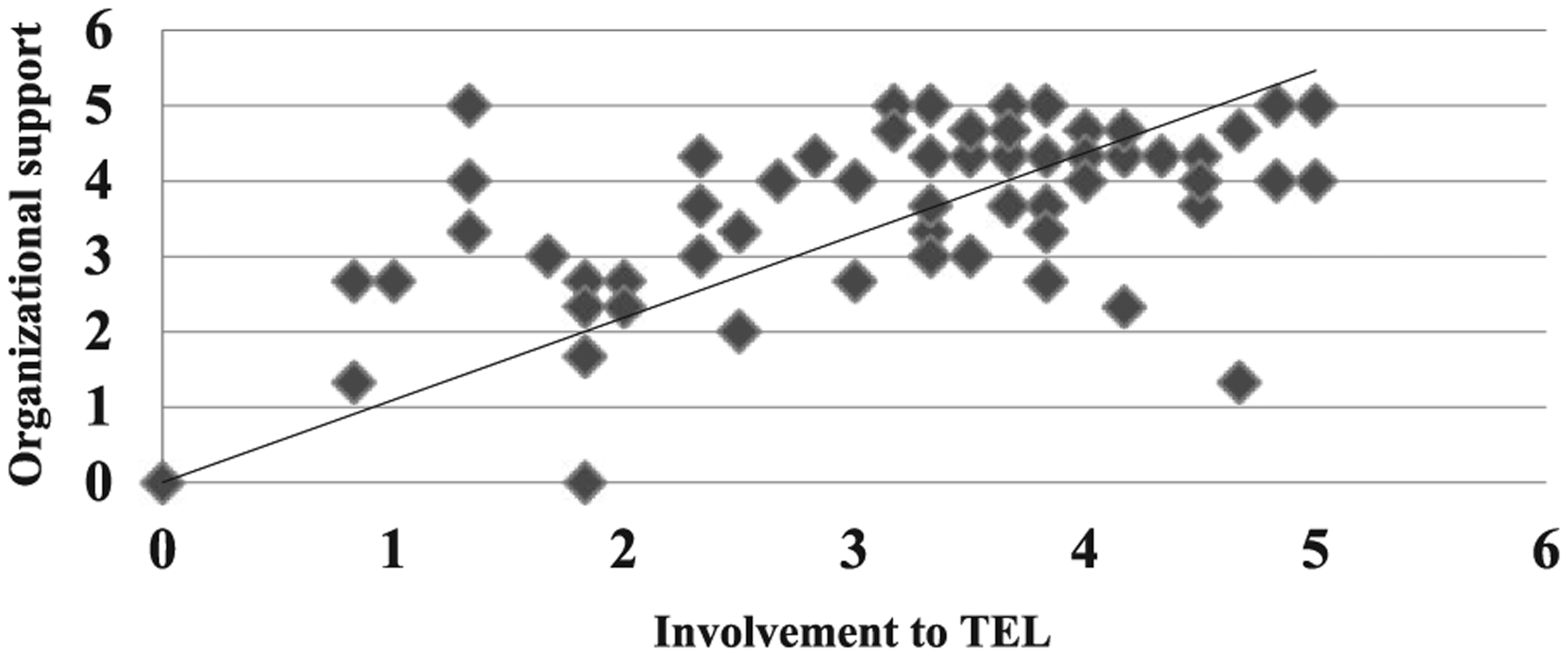
Relationship between organizational support and involvement in TEL.
However, according to statistical data, it can be stated that, if organizational support were stronger, the employees would be more involved in TEL. Correlation analysis revealed that all of the support elements are statistically significant in relation to engagement in TEL (Table 1).
Relationship Between Elements of Organizational Support and Employees’ Engagement in TEL.

Note. TEL = technology-enhanced learning.
Findings showed that manager, colleague, institutional policy, and infrastructural support are statistically significantly related with employee engagement in TEL. Nevertheless, coefficients of correlation of all support forms are different. Correlation of manager and colleague support is moderate (respectively, r = .658, r = .644, p < .01) and support of institutional policy and infrastructure is fairly weak (respectively, r = .577, r = .593, p < .01). The highest correlation coefficient is between manager support and engagement in TEL; the lowest is between institutional policy support and engagement in TEL. Summarizing correlation analysis of different forms of organizational support, it can be said that if there were more significant manager support, colleague support, infrastructural support, and institutional policy support in the organizations, the employees would be more willing to engage in TEL.
Workers want and need knowledge; as a result, TEL is an efficient and potentially fruitful way to get that knowledge (Wild et al., 2002). Čudanov, Savoiu, and Jaško (2012) state that today TEL allows the formation of collaborative networks and generates knowledge in interaction among participants with much more efficiency due to technology enablers, creating an effective and efficient knowledge system that is more than a mere sum of its components. Organizations are looking for more flexible and easily accessible ways to gain and develop their employees’ professional competencies. TEL is a convenient method of successfully organizing the upgrading of employee qualifications. The knowledge developed on the job can give employees a competitive edge and can benefit the employer through the increased job performance levels. With the growing reliance on information systems and increasing rapidity of the introduction of new technologies into the learning environment, identifying the critical factors related to user acceptance of technology continues to be an important issue (Yi & Hwang, 2003). To sum up, TEL gives an opportunity for an organization to develop more efficient, effective, and acceptable learning processes. The integration of TEL into an organization’s training should bring faster and more effective employee learning, acquisition of knowledge, development of needed competences, and skills. Furthermore, TEL is unlocking employees’ and organization’s ability to manage gained knowledge and skills, and apply them immediately. After a TEL course, the productivity of employees’ implemented work assignments increases because of the competencies gained.
The first research question was to identify how organizational support influences employees’ involvement in TEL. Empirical findings of the study show that the greater the organizational support given to employees, the more they will be willing to participate in TEL and to develop professional competencies. Consequently, these research results complement other researches not only from the organizational perspective but also from the employees’ point of view.
The second research question focused on the identification of different forms of organizational support and on the correlation of these different forms of support with employee engagement in TEL. The findings of the empirical research revealed that all forms of support were important in employees’ engagement in TEL. Manager and colleague support are slightly more related to engagement in TEL than are infrastructural and institutional policy support.
There are some limitations to the current study that also need to be addressed. Our study took place only in two business organizations and the sample of the respondents is not very big. This could influence the results as correlation coefficients are not big and the difference between them is not observed. However, there are aspects that are not covered in this research and further research should be considered. It might be useful to carry out research in different kind of organizations, especially in those where the use of technological tools is low. Also, according to scientific literature analysis, not only internal support but also external support—such as family—which influences employees’ willingness to engage into TEL must be studied.
These case studies limit the ability to generalize from the conclusions, models, or theory developed from the selected cases (Vissak, 2010). Authors of this research cannot be sure that these are the typical cases, and the assumptions, findings, and conclusions may hold only for these cases but not for most of the other institutions in which TEL integrated or implemented. As all the richness of the results cannot be demonstrated and all the factors cannot be included in any model, there is still a need for single and/or multiple case studies.
Conclusion
Organizational support is very important when trying to succeed in integrating TEL into employee training systems. Employees perceive organizational support when the workplace environment promotes feelings that the organization cares about them and the work they are doing and that employees are trusted. Benefits of organizational support for both employees and employers are mutual. Employees benefit by receiving higher salaries, better working conditions, satisfaction of attention given by managers, and the feeling that their work is meaningful and contributes to the organization’s operations, whereas the organization benefits as its employees are more committed to the organization, and work harder and more effectively. Organizational support can decrease apathy at work and absenteeism.
If there were more manager support, colleague support, infrastructural support, and institutional policy support in the organization, employees would be more willing to engage in TEL. As a result, while trying to encourage employees to engage in TEL, it is also important for the organization to show that employees’ physical and emotional needs are important. For better integration of TEL, organizational support should be combined with traditional learning methods and forms. A better understanding of what kind of support is more important for employees would lead to greater employee willingness to engage in TEL as an organization would know what needs should be fulfilled. Employee engagement in TEL depends more on manager and colleague support and less on institutional policy and infrastructural support.
Footnotes
Declaration of conflicting interests
The author(s) declared no potential conflicts of interest with respect to the research, authorship, and/or publication of this article.
Funding
The author(s) disclosed receipt of the following financial support for the research and/or authorship of this article: Authors received financial support for the research from the European Social Fund under the Global Grant measure (No.VP-1.3.1-SŠMM-07-K-03-045).