



Abstract
Recent research has highlighted technology-enhanced active learning (TEAL) as a burgeoning area of study. However, the effectiveness of technology-enhanced active learning environments in supporting pre-service teachers’ technological beliefs and TPACK (Technological Pedagogical Content Knowledge) development remains to be further investigated. This study designed and developed a Technology-Enhanced Active Learning Environment (TEALE) and used the classical TPACK framework and Technology Acceptance Model (TAM) to examine the impact of TEALE on pre-service teachers’ TPACK and technological beliefs. This study utilized a comparison research design with control and experimental groups, employing a pre- and post-test approach. The results indicate that: (1) TEALE significantly improved pre-service teachers’ content knowledge, pedagogical knowledge, technological knowledge, technological content knowledge, technological pedagogical knowledge, and technological pedagogical content knowledge, and also enhanced their technological beliefs and engagement. (2) TEALE is not just an assessment tool but a teaching and learning tool that helps pre-service teachers organically integrate technology with personalized learning analytics, instructional design, classroom management, and evaluation activities. This provides valuable insights for improving pre-service teacher education programs, integrating technology, and future teaching practices.
Plain Language Summary
In this study, we delved into the effects of technology-enhanced active learning environments (TEALEs), which are educational settings that integrate technology to actively involve learners in the teaching process. We aimed to understand how these environments could enhance the technological knowledge and pedagogical skills of teachers currently in training. Our goal was to help future educators better utilize technology in imparting their subjects, recognizing the critical role of technological proficiency in effective teaching, student success, and professional teacher development. To achieve this, we constructed TEALEs drawing upon theories related to technology, teaching methods, and the acceptance of new technologies. The focus was on whether participation in these interactive learning setups would bolster pre-service teachers’ mastery of both their academic subjects and technological tools. The outcomes demonstrated that TEALEs significantly improved future teachers’ comprehension of subject matter, teaching techniques, and technological usage, as well as their capacity to integrate these elements cohesively. The research underscores the value of TEALEs in fostering a positive attitude toward technology among aspiring teachers, increasing their engagement in the learning process, and maintaining their motivation. These findings are anticipated to have far-reaching implications for enhancing teacher education on a global scale.
Keywords
Introduction
In recent years, active learning research has received increasing attention. A large number of studies support the use of technology-enhanced active learning to promote college students’ knowledge learning and higher-order thinking. Designing technology-enhanced active learning environments and methods has become a hot research topic in the field of education. Active learning emphasizes that students use higher-order thinking to conduct classroom activities and discussions (Freeman et al., 2014). Incorporating active learning strategies into classroom teaching can promote students’ in-depth understanding, analysis and integration of knowledge (Freeman et al., 2014; Ruiz-Primo et al., 2011). In the early 21st century, the Massachusetts Institute of Technology (MIT) initiated technology-enhanced active learning (TEAL) in the field of physics teaching and learning (Breslow, 2010; Dori & Belcher, 2005), which integrates a variety of teaching methods such as lectures, simulations and hands-on operations, and advocates the use of technology to enrich reflective active learning and classroom teaching. TEAL aims to create an intelligent classroom learning environment with the help of technological tools, increasing interaction between teachers and students as well as among students (Belcher, 2001; Lee et al., 2019; Shieh, 2012). Many studies emphasize that the key to realizing the educational value of TEAL lies in having appropriate technological tools to support it (Dori et al., 2003).
TEAL has been widely used in the field of education. In recent years, researchers have emphasized that it has tremendous potential in cultivating and enhancing teachers’ TPACK (Koehler & Mishra, 2008; Koehler et al., 2004; Michos & Hernández-Leo, 2020; Yeh et al., 2021), strengthening technological beliefs (Cober et al., 2015). Scholars posit that TEAL can offer continuous feedback and create a more favorable learning experience for educators, facilitating students to engage in profound reflection, critical analysis, and metacognitive practices concerning their professional knowledge and competencies (Baran et al., 2019; Howard et al., 2021; Hsu & Lin, 2020; Mouza, 2016; Tondeur et al., 2017). Some researchers have tried to use technology to build some kind of intelligent learning environment to promote teachers’ knowledge and skills (Chen, 2020; Kong, 2010; Tripp & Rich, 2012; Van der Linden et al., 2022). Nevertheless, the impact of TEAL on the Technological Pedagogical Content Knowledge (TPACK) and their practical skills of pre-service teachers remains underexplored (Huang et al., 2022; Kang & van Es, 2019; Matuk et al., 2015; Rutten, 2021; Sablić et al., 2021; Shieh, 2012; Weng et al., 2023).
TPACK, as a core element of teacher professionalism, reflects whether teachers can integrate technical knowledge with subject teaching knowledge, as well as the integration of technology and teaching practice (Deng & Zhang 2023; Graham, 2011; Ifinedo et al., 2020; Schmid et al., 2020; Yeh et al., 2021). It not only emphasizes the importance of developing teachers’ knowledge (Mishra & Koehler, 2006; Niess, 2005; Voogt et al., 2013) but also strives to effectively integrate technology into specific subject teaching (Bates et al., 2016; Herring et al., 2016; Kohler et al., 2023). This is of great significance and value in promoting the effective use of technologies in teaching and achieving higher levels of professional development for teachers (Angeli & Valanides, 2009; Comi et al., 2017; Deng et al., 2017). Therefore, the development of in-service and pre-service teachers’ TPACK has become a major focus and direction for global teacher education (Voogt et al., 2013; Wang et al., 2018).
Some research reports pre-service teachers exhibit relatively low technological beliefs and express limited intent to use technology in future classroom teaching (Bower, 2019; Chien & Wu, 2020; Turner et al., 2010). And, their incorporation of technology into subject teaching knowledge is underdeveloped, and they possess a restricted understanding of how to utilize technology to foster active learning among students during course activities (Hernández-Leo et al., 2018; McCoy & Shih, 2016; Michos & Hernández-Leo, 2020; Van Gasse et al., 2017; Voogt et al., 2015; Yeh et al., 2021).
However, the impact of technology-enhanced active learning environment (TEALE) on pre-service teachers’ TPACK remains underexplored. In intricate educational contexts, quasi-experimental research approach is commonly employed, offering a systematic yet adaptable methodology tailored to specific educational quandaries. In order to evaluate the effect of TEALE on pre-service teachers’ TPACK, TPACK and TPACK-practical skills framework is used as an effective, and practical model to measure pre-service teachers’ professional knowledge and skills (Cui & Zhang, 2021, 2022). The Technology Acceptance Model (TAM) is considered to be a basic framework for assessing an individual’s attitude and behavioral tendency to use technology (Davis, 1989), which is suitable for measuring pre-service teachers’ technological beliefs.
Therefore, this study constructed the technology-enhanced active learning environment (TEALE), drawing on the TPACK, TPACK-practical skills and TAM frameworks. A quasi-experimental study (utilizing a control group and an experimental group, employing a pre- and post-test approach) was conducted to explore the impact of TEALE on pre-service teachers’ knowledge, skills, and technological beliefs. This study focuses on the following questions:
How does TEALE affect pre-service teachers’ TPACK and TPACK-practical skills?
How does TEALE affect pre-service teachers’ technological beliefs?
What are pre-service teachers’ opinions on introducing TEALE into the curriculum?
Literature Review
Theoretical Framework
Technological Pedagogical Content Knowledge
TPACK (Technological Pedagogical Content Knowledge) offers a crucial framework for examining teachers’ knowledge structures (Koehler et al., 2005; Yeh et al., 2021), as well as the design and implementation of technology-enhanced instruction (Brantley-Dias & Ertmer, 2013; Herring et al., 2016). In 2005, American scholars Koehler and Mishra introduced the concept of Technological Pedagogical Content Knowledge (TPACK) as an integration of technology, pedagogy, and content knowledge based on Shulman’s PCK theory (Michael & Rick, 2022). Mishra and Koehler’s TPACK is an extension of Shulman’s pedagogical knowledge framework and is one of the most famous frameworks describing teachers’ pedagogical knowledge for technology integration (Schmid et al., 2024).
TPACK is technology-integrated subject teaching knowledge, which includes three basic elements: technology (T), subject content (C) and teaching method (P); and these three elements constitute four composite knowledge domains—PCK, TCK, TPK and TPACK (Alberto et al., 2022). The dynamic integration of these domains, showcased by TPACK, plays a pivotal role in guiding teachers in the context-specific implementation of technology-enhanced teaching (Koehler & Mishra, 2008). This integration necessitates teacher educators to not only instruct on technology utilization but also to foster teachers’ capability to seamlessly integrate technology into their subject-specific teachings (Niess, 2005; Voogt et al., 2013). In this sense, many researchers emphasize that the development of TPACK must be embedded in a specific social environment or practice context (Carpenter et al., 2020; Rosenberg & Koehler, 2015). Therefore, cultivating and improving pre-service teachers’ TPACK must place them in a real learning environment to use technology so as to obtain continuous feedback and technology experience (Baran et al., 2019; Howard et al., 2021; Hsu & Lin, 2020; Tondeur et al., 2017).
TPACK-Practical Skills
Research has shown that mastering TPACK does not necessarily imply knowing how to effectively utilize technology to enhance teaching methods and content (Dong et al., 2015; Jang & Tsai, 2012; Koh et al., 2013). Consequently, some studies have proposed a TPACK-practical skills framework that considers both theoretical knowledge and practical experience, aiming to explore teachers’ practical capabilities in integrating technology with student analysis, teaching management and assessment, curriculum and instructional design, and subject content integration and design (Ay et al., 2015; Jen et al., 2016; Yeh et al., 2014). It not only provides teachers with specific, reliable pathways for integrating technology into various aspects of education and teaching but also exposes the actual performance of teachers’ TPACK in authentic teaching settings, offering continuous and timely feedback to improve technology-enhanced teaching practices.
TPACK-practical skills is a theoretical model grounded in practical experience and dynamically constructed for educational activities (Cochran et al., 1993). It serves as the foundational model for envisioning the teaching process as the collaborative integration of applied knowledge (teaching experience) and TPACK skills (Ay et al., 2015), encompassing the entirety of the teaching process through integrating subject-specific design, classroom management, and domain-specific skills and practices for assessment (Yeh et al., 2014). It includes eight knowledge dimensions spanning five instructional domains: learners, subject content, curriculum design, pedagogy, and assessment. These dimensions involve using technology to understand students and subject content, planning technology-infused curriculum, using technology representation, integrating technology into teaching strategies, applying technology for instructional management, infusing technology into the teaching contexts, and using technology to assess student (Yeh et al., 2014).
This framework offers a straightforward, recognizable “label” for teachers, especially pre-service teachers, to utilize technology in guiding students to understand teaching content themes and explore the relevant mechanisms of tools used in instructional services. Its theoretical development holds substantial importance for teachers. In the field of teacher education, various approaches as well as professional development frameworks have been utilized to enhance teachers TPACK-practical skills development (De Rossi & Trevisan, 2018). For example, Yapıcı and Mirici (2023) explored the impact of a learning environment supported by intelligent voice technology on teachers’ TPACK-practical skills, while Chaaban and Sawalhi (2023) explored the impact of an intelligent learning environment enhanced by problem-solving technology on pre-service teachers’ TPACK-practical skills based on qualitative evidence.
Technology Beliefs
In this study, the technological beliefs of pre-service teachers are primarily rooted in the classic Technology Acceptance Model (TAM), widely recognized and applied by the international research community (Rafique et al., 2020; Yoon, 2016; Zha et al., 2015). The TAM, initially introduced by Davis, comprises two core elements: perceived usefulness (PU) and perceived ease of use (PEOU) (Davis, 1989).
In technology-supported intelligent learning environments, teachers’ PU and PEOU are important factors in predicting their actual use of technology (Teo, 2009; Vongkulluksn et al., 2018). And it may indirectly affect teachers’ ability to integrate technology into their teaching (Cheng, L., Antonenko, et al., 2020; Chien & Wu, 2020), experiment with innovative teaching methods (Silm et al., 2017), demonstrate perseverance (González et al., 2017), and they select and adjust task materials and cognitive strategies when faced with challenges (Meagher et al., 2011; Siuty et al., 2018). Studies indicate that when teachers hold more favorable beliefs regarding the utility and ease of use of technology, they utilize technology in teaching and facilitating student learning more frequently and effectively (Chien et al., 2018; Ottenbreit-Leftwich et al., 2010). Recent literature suggests that variances in value beliefs may have a qualitative impact on the process of technology integration, thus requiring further investigation (Cheng, S. -L., Lu, et al., 2020). Based on this, it is necessary to further consider the impact of pre-service teachers’ technological beliefs on their TPACK in intelligent learning environments.
The Technology-Enhanced Active-Learning Environments
Active learning emphasizes the key role of individual cognitive development and social interaction in the learning process. Students will carry out activities at a higher level of thinking in the classroom (Freeman et al., 2014). In the early 21st century, the Massachusetts Institute of Technology (MIT) launched Technology Enhanced Active Learning (TEAL) in the field of physics teaching and learning (Dori & Belcher, 2005), which includes teaching strategies such as pauses, lectures, simulations, and hands-on operations. The purpose of TEAL is to use technology to create a physical environment to increase interaction between teachers and students and between students, and to support the sharing of learning experiences (Ertmer, 2005; Lee et al., 2019). Based on the active learning methodology, it provides teachers with new tools and platforms to improve the classroom and gradually enhance students’ confidence in solving problems and completing tasks (Ge et al., 2015).
With the development of technology, many technologies such as Strip sequence, Concept map, Content and function outlines and other cognitive tools (Kommers et al., 1992) have been used to support active learning (Ghani et al., 2017; Kobsiripat, 2015; Tang et al., 2022; Yilmaz-Na & Sönmez, 2023). These technologies offer valuable attributes, prompting the independent development of technology-enhanced active learning environment (TEALE) by our research team. Compared with other technologies, TEALE can promote pre-service teachers to actively participate in teacher education programs and facilitate their in-depth reflection on their professional knowledge and activities. For example, Hassan and Puteh (2017) selected graduating students of the Bachelor of Engineering program at the Technical University Network (MTUN) as the survey subjects and applied TEAL to the practice of teaching technology, pedagogy and teaching content (TPACK) to improve the quality and employability of engineering students by improving the education curriculum. Beukman (2021) explored the dynamic relationship between “pedagogy,”“technology” and “learning space” in the practice of technology-enhanced active learning (TEAL) in the context of higher education. The results provide academic staff in higher education with a two-part framework to (a) evaluate and plan the coordination of pedagogy, technology and space, and (b) a scaffolding tool to select the building blocks for TEAL planning and delivery. In addition, TEAL is also used to provide academic professional development to bring innovation to learning content through the use of pedagogy, technology and classroom design, thereby cultivating high-quality skilled personnel with sufficient employability skills (Hassan et al., 2018).
Methodology
Participants
A total of 338 participants were recruited in this study, all of whom were full-time pre-service teachers at the Master of Education level enrolled in D University, China in 2022. The coverage rate of the selected participants was 100%. All participants provided written informed consent prior to participating in the study, in full compliance with the ethical guidelines and approval processes mandated by the D University Ethics Committee. A total of 338 participants from the same class were divided into two groups: a control group of 170 and an experimental group of 168.
They were recruited because, on the one hand, they already actively participated in K-12 educational practices, dedicating 1 week per month and 7 weeks per academic year to this endeavor. This immersive practice model is an integral component of D University’s teacher education and training program, renowned for its exceptional operational standards and efficacy, consistently ranking among the top tier across all Chinese universities. On the other hand, they have undergone extensive studies in educational psychology, curriculum and instructional theory, providing them with a comprehensive understanding of classroom teaching behavior, TAPCK, and various teaching techniques. They have developed a solid foundation in pedagogical theory, and have garnered significant practical experience in teaching. Their academic pursuits have spanned across nine major disciplines: Chinese, mathematics, English, ideological and political education, history, geography, physics, chemistry, and biology.
Participants in both groups voluntarily completed the same pretest (Q1) to ensure that they had similar learning abilities. As shown in Table 1, the total scores of pre-service teachers in the experimental group on TPACK, TPACK-practical skills and TB were relatively close to those in the control group. The independent sample t test showed that there was no significant difference between the two groups before the experiment (p = .165 > .05).
Sample Statistics for the Pre-Test.

Procedure
This research was approved by the D University Ethics Committee. This study chose a quasi-experimental study, utilizing a comparison research design (control group and experimental group), employing a pre- and post-test approach. This study began on May 13th, 2023, for a three-week period. The researchers worked with curriculum teachers in the design and development of Technology-enhanced Active Learning Environment (TEALE), utilizing it to establish curriculum learning activities for pre-service teachers.
Process such as Figure 1, firstly, participants were recruited and screened 2 weeks before the course began. Secondly, 1 week prior to the course, all participants completed a pre-test, namely Q1 (see Appendix B for full questionnaire of TPACK, TPACK-practical skills and TB for pre-service teachers), the research team introduced TPACK and TEALE’s functionality and operation to these pre-service teachers. Thirdly, during the course, the pre-service teachers in the experimental group independently analyzed 120 teaching videos in TEALE, while the pre-service teachers in the control group analyzed teaching videos using traditional methods (guided by the instructor, without the help of computing intelligence, and manual mapping). Finally, they completed another questionnaire Q2 after the course (Appendix B). Both sets of surveys primarily explored their TPACK, TPACK-practical skills, and TB. And, the research team conducted interviews with willing participants.
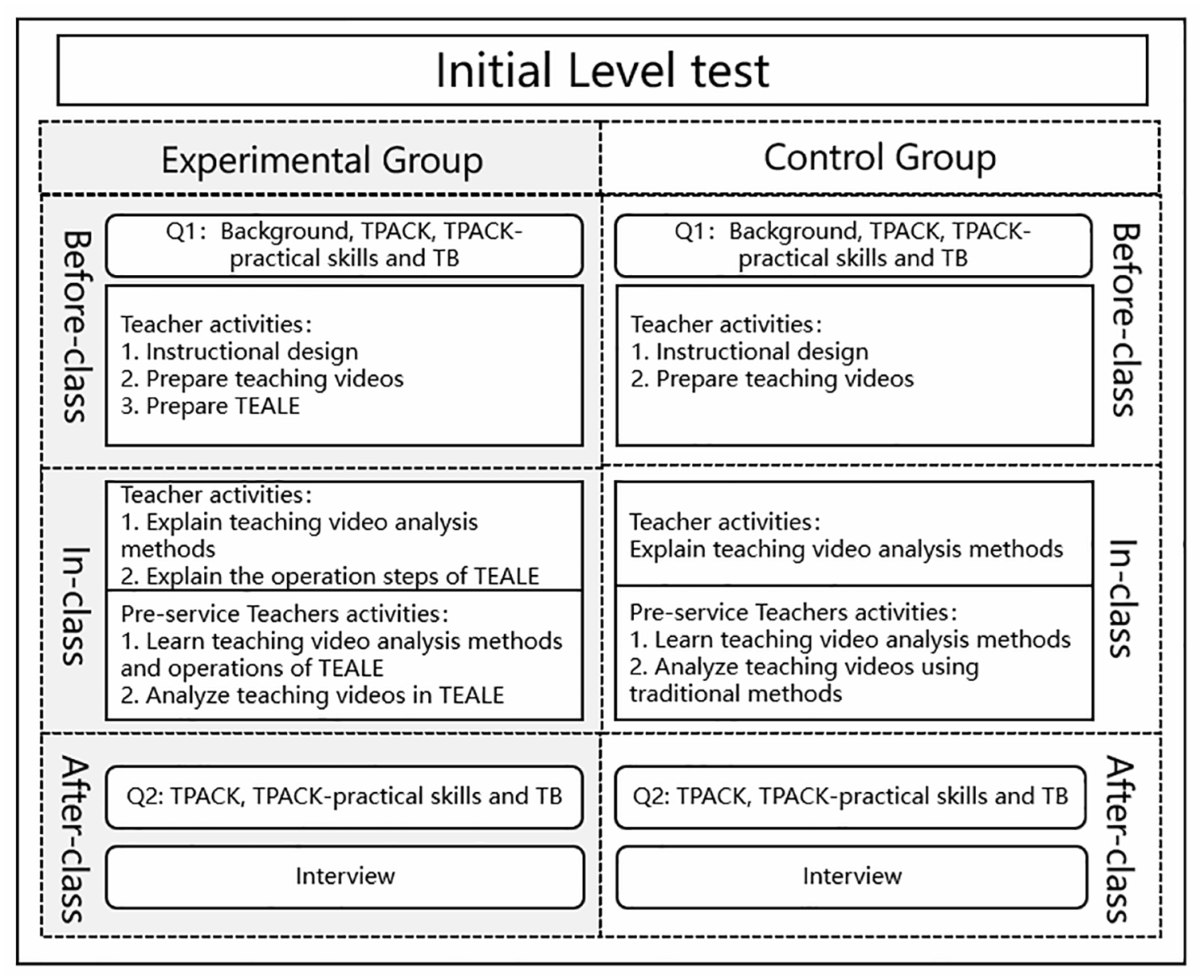
The research design.
Control Group
In the traditional learning environment, the pre-service teachers in the control group used traditional methods to analyze teaching case videos under the guidance of the course teacher (the same as the course teacher in the experimental group). First, the course teacher explained TPACK, TPACK-practical skills, and showed excellent teaching case videos. Secondly, the course teacher and the pre-service teachers jointly analyzed the excellent case videos, coded and recorded the frequency of presentation of teaching behaviors, teaching media, TPACK and other dimensions, and manually drew and calculated the time and frequency of teacher-student interaction, the centrality curve of teaching behaviors and the conversion rate to determine the teaching type of this class (including teaching type, practice type, dialogue type, and mixed type). This process involves tedious manual operations, the manual calculation has a high error tolerance and time consumption, and pre-service teachers can often only analyze a small number of case videos.
Experimental Group
TEALE (as Figure 2) primarily utilizes teaching behavior slice analysis technology and relative centrality algorithms from social network research (Cui et al., 2020; Zhang et al., 2022), and draws on the Interaction Analysis Category System by Flanders and others (Amatari, 2015; Flanders, 1970), Laurillard’s conversational framework theory (Laurillard, 1995), and Mishra and Koehler’s TPACK theory (Koehler & Mishra, 2005) to perform slice coding and visual analysis of teaching videos. Zhang’s research group improved the category system and developed computer assistant classroom teaching behavior analysis system (Zhang et al., 2010, 2020, 2022). The procedural steps typically encompass file importation, pausing and tagging, submission marking, data storage, and chart exporting, totaling five steps. The reliability and validity of the category system and analysis based on this system have been proven in several subsequent studies (Cui et al., 2020; Liu et al., 2021). It can not only identify and evaluate TPACK usage in instructional videos (Falloon, 2016), but also analyze the presence of conceptual misperceptions and challenges (Barth et al., 2019; Tawfik & Jonassen, 2016) and fosters knowledge acquisition and enhancement through comparison, critique, and reflection.
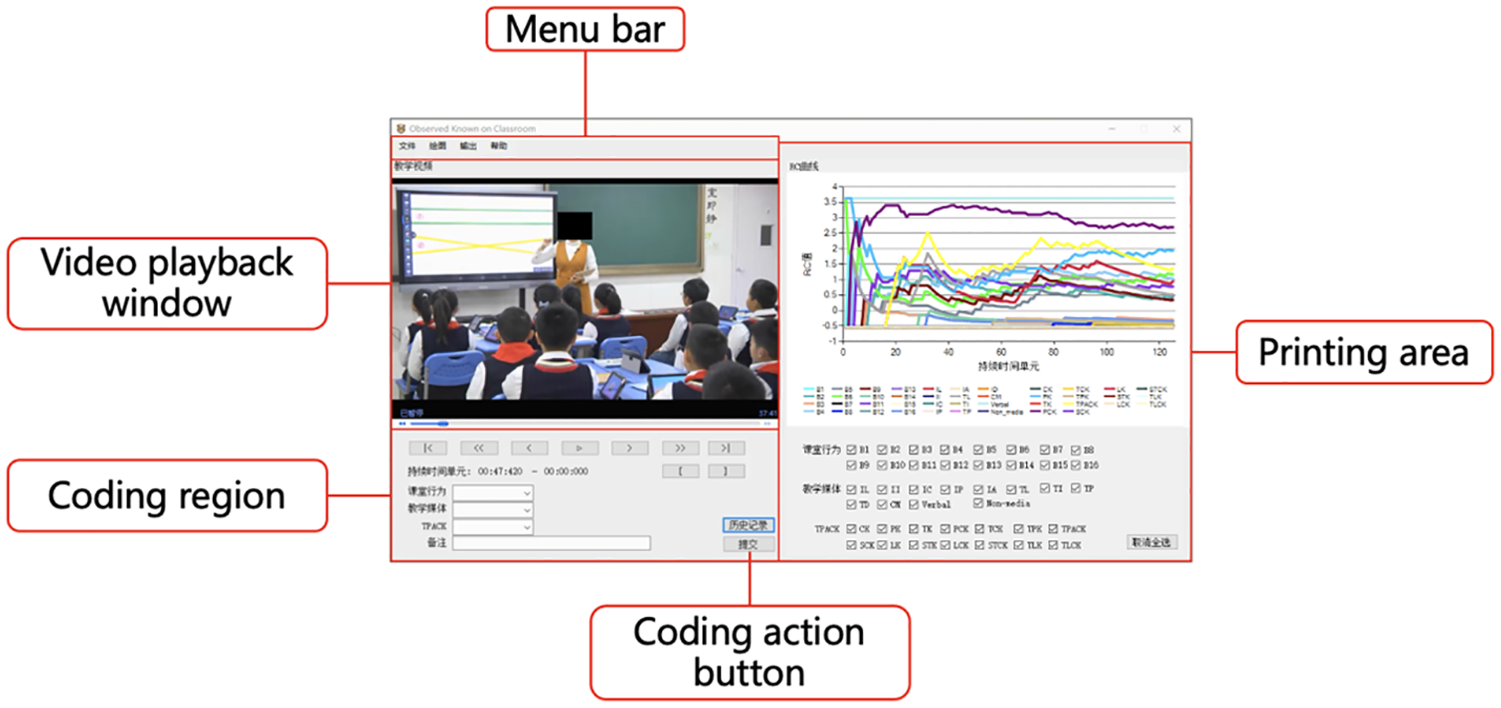
The main interface of the TEALE.
This study adopted the revised framework of CTE-DNA, as defined by Zhang et al. (2020). TEALE segment intelligent classroom videos based on three primary indicators and 33 secondary indicators (as Table 2) related to classroom behavior, media, and TPACK. Firstly, TEALE are compatible with Windows 7 and above, do not require network access, and can analyze video formats such as MP4 and MKV. Secondly, When conducting a formal analysis of video information using TEALE, it is essential to meticulously observe each frame, discern and annotate factors such as classroom behavior and TPACK, such as identifying and marking classroom behaviors like student collaboration and teacher questioning, and utilizing media such as online meeting discussions and simulation programs.
The Revised Framework of CTE-DNA, Based On Zhang et al. (2020).

Thirdly, TEALE employ the relative centrality algorithm from social network research. Centrality is a fundamental measure within a social network, portraying the robustness of connections and core patterns among nodes. To elaborate, TEALE have the capacity to produce centrality curves, offering insights into the concentration trend of specific knowledge and skill sets employed by exemplary teachers during classroom instruction; the higher the concentration trend, the greater the peak of the curve.
Finally, TEALE can automatically generate frequency statistics charts and centrality curves for various classroom behaviors, media in the video. The pre-service teachers can employ these to evaluate their own teaching preferences, the utilization of knowledge and skills in teaching, and to contemplate the suitability of their teaching practices. And they can utilize this to scrutinize the factors contributing to the intensified focus and discern if, and how, a specific classroom node is utilizing essential knowledge and skills.
Instruments and Scale Validations
The study utilized two online questionnaires (Q1 & Q2), which contained identical content, primarily encompassing participants’ demographic information and a formal section addressing TAPCK, TPACK-practical skills and TB. The demographic details mainly covered the participants’ gender, major, practice base, work experience, internship experience, and other relevant information. The items in the formal section of the questionnaire were evaluated using a Likert 5-point scale (“1” - Strongly Disagree, “2” - Disagree, “3” - Neutral, “4” - Agree, “5” - Strongly Agree”). Specific details of the formal content of the questionnaire are described below.
TPACK
The TPACK questionnaire was utilized to assess the integrated pedagogical content knowledge of pre-service teachers. The questionnaire items were predominantly derived from the seminal TPACK scales developed in prior studies (Chai et al., 2011; Schmid et al., 2020; Schmidt et al., 2009; Valtonen et al., 2017), and the questionnaire’s validity was established through multiple validations. To align with the research objectives and field demands, certain modifications were introduced to specific items. The TPACK questionnaire encompasses six dimensions: pedagogical content knowledge (q1–q7), content knowledge (q8–q13), technological knowledge (q14–q20), technological pedagogical content knowledge (q21–q23), technological pedagogical knowledge (q24–q29), and technological pedagogical content knowledge (q30–q33), totaling 33 items.
Of these dimensions, PK delves into educators’ knowledge in the process, practice, or methods of teaching and learning, encompassing educational purposes, values, and objectives. CK evaluates knowledge regarding the specific subjects to be taught. TK assesses whether pre-service teachers comprehend standard technologies and their operation. TCK investigates whether pre-service teachers understand the correlation between technology and content. TPK explores whether pre-service teachers can leverage specific technologies to enhance classroom teaching. TPCK scrutinizes whether pre-service teachers possess the knowledge to effectively employ technology in teaching, requiring an understanding of how technology supports teaching topics.
TPACK-Practical Skills
The TPACK-practical skills questionnaire is primarily utilized to evaluate the proficiency of pre-service teachers in implementing technology during educational practice activities. It is predominantly based on the TPACK-practical skills model and tools proposed by Yeh et al. (2014) and Blackwell et al. (2013). The TPACK-practical skills questionnaire encompasses nine dimensions (Ay et al., 2015; Jen et al., 2016): technology use for student analysis, technology use for subject content analysis, curriculum integration design, stimulating student interest in learning, instructional content presentation design, inquiry-based learning design, classroom management, instructional context creation, and student assessment, comprising a total of 37 items.
Specifically, (a) using technology to understand student includes four items, such as “I can use technology to analyze learners and identify students’ learning difficulties.” (b) Using technology to understand subject content consists of three items, such as “I can gain a better understanding of subject content through technology.” (c) Planning technology-infused curriculum includes four items, such as “I can determine which types of technology integration in the curriculum can facilitate the achievement of challenging teaching goals in practice.” (d) Using technology to stimulate student interest comprises four items, such as “I comprehend which technologies can pique students’ interest in learning.” (e) Using technology representations to present instructional content consists of four items, such as “I comprehend the fundamental principles of using technology for instructional content presentation.” (f) Using technology to design inquiry-based learning includes three items, such as “I can engage in inquiry-based learning design using technology.” (g) Applying technology to instructional management comprises three items, such as “I understand the advantages and disadvantages of employing technology in classroom management.” (h) Infusing technology into teaching contexts incorporates five items, such as “I can use technology to foster the attainment of instructional goals in specific teaching contexts.” (i) Using technology to assess students includes seven items, such as “I understand the disparities between using technology for student assessment and traditional student assessment methods.”
Technology Beliefs
Technical beliefs are primarily grounded in the fundamental elements of perceived usefulness (PU) and perceived ease of use (PEU) within the classical TAM model. Relevant research has indicated that when educators harbor more positive convictions regarding the perceived usefulness and ease of use of technology, they exhibit a greater frequency and quality of technology integration to facilitate teaching and student learning (Chien et al., 2018). In this study, the Technical Beliefs questionnaire drew from the scale developed by Davis (1989) concerning perceived usefulness, perceived ease of use, and user acceptance of information technology, encompassing two dimensions: PU and PEU, constituting a total of nine items.
The PU pertains to the extent to which technology can be effectively employed and is primarily utilized to comprehend the learning experience of pre-service teachers in authentic TEALE, consisting of five items. For example, “Using TEALE allows me to complete video analysis tasks more quickly.” The PEU refers to the degree to which using technology is seamless and is employed to examine the ease with which pre-service teachers utilize analysis tools in TEALE, comprising four items. For instance, “Using TEALE analysis tools is easy for me.”
Interviews
After completing the questionnaire, 36 participants willingly took part in individual face-to-face interviews. These participants represent diverse academic disciplines, including Chinese, mathematics, English, ideological and political education, history, geography, physics, chemistry, and biology, with four participants from each discipline. The interview questions predominantly encompass three key areas: opinions on technology, perspectives on technology-integrated teaching, and the influence of technology on learning. For instance, questions such as: (a) “What impact do you think TEALE has on your lesson integration and learning experience?” (b) “How do these technologies applied in teaching affect the knowledge content you have acquired?” (c) “What are your perceptions regarding this technology?”
The interviews are meticulously documented through note-taking and audio recording, with participants’ prior consent obtained. Each interview is designed to be thorough, lasting no less than 30 min, to ensure a comprehensive collection of data.
Data Collection and Analysis
Data collection involved both online surveys and face-to-face individual interviews. The questionnaire was administered twice, resulting in 168 responses each time, thus achieving a 100% response rate. The quantitative data was analyzed using Statistical Product and Service Solution 26.0 (SPSS 26.0).
Considering that (a) the observable variables in this study are continuous variables, (b) two independent groups of samples were selected as the control group and the experimental group, (c) the collected data passed the normal distribution test (points on either the P-P or Q-Q plots can be distributed in a straight line) and there are no significant outliers, so the independent samples t-test was used to analyze the questionnaire data. Before formal analysis, SPSS 26.0 and AMOS were utilized to conduct exploratory factor analysis (EFA) and confirmatory factor analysis (CFA) to assess the structural and content validity of the questionnaire, enhancing the rationale of each dimension’s structure, and bolstering the reliability and validity of the research findings.
The interview data were analyzed using the qualitative content analysis software MAXQDA. MAXQDA is a tool for organizing, analyzing, visualizing, and presenting qualitative and mixed methods data. Following the standard operating procedures of this software, MAXQDA codes and categorizes the interview data. By converting the frequency of keywords or qualitative codes into numerical variables, the software assists researchers in linking individual qualitative data with a set of quantitative data (Kuckartz & Rädiker, 2019), thereby facilitating statistical analysis of the interview data. The coding and analysis team was a private group consisting of a course instructor (with 15 years of teaching experience), two teachers with 15 years of experience in master of education practice, and two researchers. The coding was implemented based on the TAM (Davis, 1989; Holden & Karsh, 2010), TPACK (Schmid et al., 2024) and TPACK-practical skills (Yeh et al., 2014) models, which categorized student attitudes into six dimensions: perceived usefulness, perceived ease of use, TPACK, TPACK-practical skills.
Results
The Validity and Reliability of Questionnaires
TPACK Questionnaire
Principal component analysis was conducted to ascertain the reliability and validity of the dimensions of the scale in assessing the TPACK, TPACK-practical skills, and technological beliefs of pre-service teachers involved in TEALE. Exploratory Factor Analysis (EFA) is the key statistical method used in this study to assess the structure of the TPACK model. The TPACK results account for a significant total variance of 69.11%, and the overall KMO measure is an impressive 0.857, clearly exceeding the threshold of 0.50, signifying the utility of factor analysis in elucidating pre-service teachers’ TPACK in the context of TEALE. TPACK consists of six dimensions, encompassing a total of 33 items. The Cronbach’s alpha coefficients for the six dimensions were .845, .859, .809, .876, .882, and .854, yielding an overall Cronbach’s alpha of .928, indicating the high reliability of the scale data in evaluating pre-service teachers’ TPACK.
On the other hand, CFA was used to further clarify the content validity and structural validity. Figure A1 illustrates the TPACK factor loadings, where all values exceed 0.7. Additionally, the fit index scores of the model are: CMIN/DF = 2.362, RMSEA = 0.064, RFI = 0.891, NFI = 0.901, CFI = 0.940, IFI = 0.940, and TLI = 0.934. The composite reliability (CR) of each dimension of the scale was greater than 0.8, the average variance extracted (AVE) was mostly above 0.5. These indicate an acceptable and reliable structure.
TPACK-Practical Skills Questionnaire
The EFA results for TPACK-practical skills demonstrate a cumulative variance explained of 75.22%, with an overall KMO measure of 0.916 (exceeding the threshold of 0.50). This underscores the significance of factor analysis in clarifying pre-service teachers’ TPACK-practical skills within the TEALE context. TPACK-practical skills encompasses nine dimensions, comprising 37 items. The Cronbach’s alpha coefficients for the nine dimensions were .886, .770, .851, .830, .832, .823, .784, .843, and .851, yielding an overall Cronbach’s alpha of .969. This demonstrates the high reliability and effectiveness of the scale dimensions and data in assessing pre-service teachers’ TPACK-practical skills in TEALE.
Figure A2 presents the TPACK-practical skills factor loadings graph, demonstrating that all factor loadings are above 0.7. Furthermore, the model’s fit indices fulfill the necessary criteria: CMIN/DF = 2.944, RMSEA = 0.077, RFI = 0.862, NFI = 0.877, CFI = 0.908, IFI = 0.909, and TLI = 0.897. The fitness indicators were good, indicating that the scale structure was satisfactory. Moreover, the composite reliability (CR) of each dimension of the scale was greater than 0.8, the average variance extracted (AVE) was mostly above 0.5, the convergent validity and composite reliability were good, indicating an acceptable and reliable structure.
Technological Beliefs Questionnaire
The results of exploratory factor analysis (EFA) for technological beliefs, explaining a total variance of 57.64%, with an overall KMO value of 0.840 (>0.50), signifying the utility of factor analysis in elucidating pre-service teachers’ technological beliefs within the context of TEALE. Technological beliefs are structured into two dimensions, comprising nine items. The Cronbach’s alpha coefficients for the two dimensions were .794 and .771, yielding an overall Cronbach’s alpha of .821. This demonstrates the high reliability and effectiveness of the scale’s dimensions and data when assessing pre-service teachers’ technological beliefs in TEALE.
Figure A3 depicts the Technology Beliefs factor loadings graph, where it is evident that all factor loadings surpass the 0.7 threshold. Additionally, the model’s fit indices align with the required standards: CMIN/DF = 3.051, RMSEA = 0.078, RFI = 0.939, NFI = 0.956, CFI = 0.970, IFI = 0.970, and TLI = 0.958. The fitness indicators were good, indicating that the scale structure was satisfactory. Moreover, the composite reliability (CR) of each dimension of the scale was greater than 0.8, the average variance extracted (AVE) was mostly above 0.5, the convergent validity and composite reliability were good, indicating an acceptable and reliable structure.
The Pre-Service Teachers’ TPACK, TPACK-Practical Skills and Technology Beliefs
TPACK
Table A1 exhibits the scores of pre-service teachers in the control group and experimental group on TPACK. The scores of pre-service teachers in the experimental group are higher than those in the control group. As shown in Table A2, the scores of pre-service teachers in TEALE (experimental group) PK (M = 4.004, SD = 0.544, p < .001), CK (M = 4.078, SD = 0.487, p < .001), TK (M = 3.892, SD = 0.578, p < .001), TPK (The mean scores of M = 3.971, SD = 0.545, p < .001), TCK (M = 4.028, SD = 0.542, p < .001), and TPCK (M = 4.003, SD = 0.525, p < .001) were significant. Higher than the control group, the significance level is statistically significant (p = .000 < .001). This suggests a significant enhancement in PK, CK, TK, TCK, TPK and TPCK of pre-service teachers due to TEALE usage.
TPACK-Practical Skills
As shown in Table A3, the scores of pre-service teachers in the experimental group in TPACK-practical skills were higher than those in the control group. The t test results show (as Table A4) that in TEALE (experimental group), pre-service teachers use technology to understand students (M = 3.935, SD = 0.555, p < .001), understand subject content (M = 3.939, SD = 0.554, p < .001), present instructional content (M = 3.932, SD = 0.554, p < .001), planning technology-infused curriculum (M = 3.887, SD = 0.596, p < .001), stimulate student interest (M = 3.935, SD = 0.576, p < .001), design inquiry-based learning (M = 3.859, SD = 0.601, p < .001), applying technology to instructional management (M = 3.915, SD = 0.566, p < .001), infusing technology into teaching contexts (M = 3.924, SD = 0.534, p < .001) and assess students (M = 3.885, SD = 0.542, p < .001) have significantly higher skill levels than the control group, has statistical significance. This shows that TEALE has a significant positive impact on pre-service teachers’ TPACK-practical skills.
Technology Beliefs
As shown in Table A5, the average scores of pre-service teachers in the experimental group on PU and PEU were greater than those in the control group. After t-test (as Table A6), it was found that the pre-service teachers in the experimental group had significant differences in perceived usefulness of technology (M = 3.973, SD = 0.546, p = .000 < .001) and ease of use (M = 4.088, SD = 0.490, p = .000 < .001), the performance was significantly higher than that of the control group. This shows that TEALE effectively improves pre-service teachers’ technology beliefs, especially in terms of perceived usefulness and ease of use of technology.
The Pre-Service Teachers’ Interview Results
In order to collect more comprehensive and in-depth data, this study interviewed pre-service teachers to collect and analyze pre-service teachers’ views on introducing TEALE into the curriculum, including their perception of TEALE, the impact of TEALE on their TPACK and TPACK-practical skills, and technology beliefs (usefulness and ease of use).
Firstly, 80% pre-service teachers perceived that TEALE effectively improved the efficiency and quality of analyzing traditional teaching videos, leading to a more comprehensive understanding and retention of essential knowledge for teachers within the framework of digital transformation, including PK, CK, TK, TCK, TPK, and TPCK, thus significantly enhancing their application of TPACK and technology in teaching. As they mentioned in the interview: It (TEALE) is very interesting and has brought me a lot of surprises. I am able to do more with it, such as analyzing some expert teaching videos to gain more inspiration for my own teaching. I can also save my own teaching videos and use it to analyze and reflect on these videos……
Secondly, 85% of pre-service teachers held a high level of technological beliefs. They expressed that the tool was relatively easy to access and operate, and was able to master and use it quickly and easily. As well as, it also provides a systematic and actionable action framework for the professional knowledge and skills essential for intelligent classroom teaching, and is quite practical. They reflected that: I hope to continue using it (TEALE) in future learning and work. Unlike some technologies I have encountered in the past, it makes me feel “faster and easier,” and I no longer need to sit in front of a desk trying to recall……
Finally, The interview data for pre-service teachers also highlighted the impact of TEALE on improving student classroom participation and learning motivation. The preference for TEALE over traditional curriculum activities was apparent among pre-service teachers. Some participants expressed, “I find this tool very intriguing, more innovative than previous courses” and “I prefer learning new content in the classroom.” Evidently, TEALE proves to be more effective in stimulating and reinforcing pre-service teachers’ learning motivation and interest, thereby enhancing their engagement, focus, and effort in curriculum activities. Besides,10% participants still displayed a relatively low level of acceptance of the technology, perceiving the tool as “ordinary,” as a time-waster, of limited utility, or as something they would not use. This is likely related to their usual engagement in course activities and motivation to learn.
Discussion
Previous studies have shown that pre-service teachers have low attitudes and behavioral tendencies in using technology (Bower, 2019; Chien & Wu, 2020), and find it difficult to integrate technological knowledge with subject teaching knowledge and how to use technology appropriately in teaching practice (Michos & Hernández-Leo, 2020; Yeh et al., 2021). To address this problem, this study used cognitive tools as a teaching tool or resource, constructed a technology-enhanced active learning environment, and drew on the TPACK and TAM frameworks. The results of quantitative and qualitative data analysis showed that TEALE effectively enhanced pre-service teachers’ TPACK, TPACK-practical skills, and technological beliefs, and provided action experience for designing and implementing teaching using technology in the future.
Impact on TPACK
The quantitative and qualitative data analysis results showed that pre-service teachers demonstrated stronger TPACK following course completion. Previous studies have ascertained that pre-service teachers, when deploying technology for instructional design and implementation, exhibit a propensity to concentrate on the technological aspects in isolation, neglecting the confluence of technology with pedagogical content and methods. This myopic focus results in diminished manifestations of Technological Pedagogical Content Knowledge (TPACK) (Cui & Zhang, 2021; Koh & Divaharan, 2011). To address this deficiency, TEALE furnishes pre-service teachers with augmented opportunities to seamlessly integrate technology, content, and pedagogical strategies, thereby enhancing their TPACK and fostering a more efficacious learning experience (Srisawasdi, 2012). Throughout their academic tenure, pre-service teachers, under the auspices of TEALE, bolster their confidence in harnessing technology within instructional designs and subject matter appropriation. This augmentation is accompanied by an invigorated zeal for learning and a adeptness in translating this acquired knowledge into tangible pedagogical practices (Rienties et al., 2013). These outcomes corroborate the findings delineated by Graham et al. (2012) and Pamuk (2012), further underscoring the efficacy of an integrated approach toward technologically-enhanced pedagogy.
Compared to traditional, non-technology-enhanced learning activities, TEALE empowered pre-service teachers to scrutinize instructional videos and distill profound insights for educational implementation. This process augmented their grasp of professional knowledge, teaching methodologies, and technological proficiencies. Notwithstanding the varied disciplines represented by the participants, a majority concurred on the merits of TEALE. For example, in the domain of mathematics education, TEALE facilitated the examination of pedagogical strategies employed by educators to elucidate complex mathematical concepts to students via examples, diagrams, and other modalities. This enhanced their understanding of the subject matter and equipped them with a repertoire of suitable teaching techniques. In the context of English education, the analysis of linguistic patterns in English classroom discourse through TEALE fostered a more holistic comprehension of the essence of professional knowledge. Additionally, it provided pre-service teachers with an array of innovative strategies for orchestrating English classroom interactions.
Impact on TPACK-Practical skills
In TEALE, pre-service teachers’ TPACK-practical skills have significantly positive performance, particularly in the utilization of technology for learner analysis, understanding and evaluating subject teaching content and design. In complex educational situations, the level of TPACK-practical skills is closely related to knowledge or experience about students, subject content knowledge, curriculum design principles, teaching practice experience and assessment skills (Cui & Zhang, 2022; Yeh et al., 2014). For the pre-service teachers who participated in this study, they were all pursuing master’s-level education degrees and engaged in 1 week of K-12 education practice per month and 7 weeks per school year in K-12 education practice. At the same time, they also received education in educational psychology, curriculum, teaching theory, etc., and had a certain level of understanding of classroom teaching, TAPCK, and several teaching techniques. The learning and practical activities of these theoretical knowledge have accumulated a wealth of knowledge and experience for them, enabling them to confidently use technology to analyze students’ academic status, their own subject content knowledge, teaching methods, classroom assessment, etc.
Excitingly, TEALE provides a rich and promising learning experience for pre-service teachers, because the use of technology enhances their TPACK-practical skills, and the improvement of TPACK-practical skills gives them a greater sense of achievement and efficacy, which affects their future possibility of using technology for learning and teaching to improve their practical knowledge (Alvarez et al., 2009; Rienties et al., 2012). For example, in the context of chemistry, TEALE can help pre-service teachers analyze how to display and explain chemical phenomena, how to use experimental demonstration methods to carry out effective teaching, how to guide students in experimental operations, etc., accurately analyze students’ learning conditions and classroom environment settings, so as to carry out personalized teaching design. In the field of biology, pre-service teachers use TEALE to assess how to help students understand complex biological concepts and processes through real cases or observation activities, how to design inquiry-based learning activities, and students’ use of tools such as microscopes and biological specimens, which helps to design effective specific subject courses.
Impact on Technology Beliefs
In TEALE, pre-service teachers demonstrated more significant and positive technology beliefs. Firstly, by analyzing teaching videos, pre-service teachers can accurately and effectively identify the strengths and weaknesses of their own professional knowledge, teaching behaviors, etc., thus improving their academic performance and teaching practices (Kale & Akcaoglu, 2018; Nelson & Voithofer, 2022). This allows them to perceive the usefulness of technology in teacher education course learning and future teaching work, and increases their attitudes and behavioral tendencies toward using technology in the future.
Secondly, TEALE is highly inclusive, accessible, and easy to use. Its interface is intuitive and functional, especially in analyzing teaching videos, which is extremely user-friendly. For example, it can automatically generate frequency statistics of various classroom behaviors, TPACK, and techniques in videos, which is very convenient for quickly analyzing teaching video cases, enabling pre-service teachers to evaluate the appropriateness of their own teaching practices and educational experiences. It can be seen that TEALE effectively enhances the ease of use and usefulness of pre-service teachers’ perception of technology in teacher education course learning and teaching practice, and helps to stimulate and strengthen their cognitive participation, emotional participation, learning motivation, etc. in course activities.
Views on TEALE
We learned from face-to-face interviews and further observations that numerous pre-service teachers presented more positive feedback in TEALE facilitate the mastery and practice of TPACK. For instance, they reported, “In analyzing videos, I identified issues I hadn’t previously noticed,”“I started to question my current level of knowledge and skills,” and “after analyzing videos of outstanding teachers, I feel more adept at creating and designing teaching scenarios.” They expressed that their prior video-based learning lacked coherence, hindering their ability to discern the application of TPACK by exceptional teachers in teaching videos and to identify the structural deficiencies in the instructional content. TEALE holds significant promise in this respect; its incorporation of professional terminology not only furnishes pre-service teachers with a framework for perceiving and examining teaching processes and issues, but also directs them toward a practical and dependable pathway for applying TPACK in instructional practice. As they mentioned in the interview: Before this, my understanding of PK, CK, TK, TPK, TCK, and TPCK was quite vague and limited, to say the least. Today, this tool (TEALE) emerged, and its operation is simple and easy to use. Over the past two weeks, by analyzing teaching videos of some excellent teachers, I have gained a deeper understanding and mastery of TPACK. Moreover, I am preparing to apply this knowledge in future learning and work……
Moreover, most pre-service teachers said that TEALE also provided them with a framework for action and experience for integrating technology into their teaching practices in the future. First, the usefulness and ease of use of TEALE strengthened their technological beliefs, making it easier for them to develop attitudes and behavioral tendencies to use technology in their future teaching work (L. Cheng, Antonenko, et al., 2020; Chien & Wu, 2020). Second, using TEALE to analyze their own teaching videos helped them identify and improve problems such as teaching behaviors, technology selection and application (Cui & Zhang, 2021; Zhang et al., 2022), so as to design effective technology-supported teaching activities. They also reflected in the interviews: We’ve seen numerous classic teaching videos, and what stands out about TEALE is its structured framework. It provides clear guidance when our thoughts are scattered. Additionally, it enables precise analysis of teaching videos, helping us understand when specific actions are required and how they interconnect. No more need for idle contemplation……
Surprisingly, there are still a few pre-service teachers with low technology beliefs, which are closely related to their daily learning engagement and motivation. Further observations indicated that they exhibited lower engagement in other learning activities within their courses. They tended not to communicate their concerns, preferences, or learning-related advantages and disadvantages to their instructors, instead identifying as mere “onlookers” or “outsiders.”
Conclusion
Based on the teacher education program, this study constructed TEALE for pre-service teachers and obtained their positive feedback. This study showed two positive results and contributions:
Firstly, TEALE improves the training difficulties and dilemmas of pre-service teachers’ low technological beliefs (Chien & Wu, 2020; Bower, 2019) and weak subject pedagogical knowledge and practical skills of technology integration (Michos & Hernández-Leo, 2020; Yeh et al., 2021) reported in previous studies; it deepens pre-service teachers’ understanding and mastery of subject content knowledge, pedagogical knowledge, technological knowledge, subject content knowledge of technology integration, pedagogical knowledge of technology integration, and subject pedagogical knowledge of technology integration, and further improves their practical skills in using technology for learner analysis, instructional design, instructional management and decision-making, and student assessment, which helps improve classroom teaching practice. In addition, pre-service teachers also show greater learning interest, motivation, and acceptance of technology-enhanced active learning activities and their content and technology, which enhances their perception of the usefulness and ease of use of technology.
Secondly and importantly, this study constructed TEALE using cognitive tools. Technology is no longer just used as an assessment tool (Bereczki & Kárpáti, 2021; Tang et al., 2022; Wijnen et al., 2022), but as a tool for teaching and learning (Yilmaz-Na & Sönmez, 2023; Zhan et al., 2023). It effectively integrates technology with pre-service teachers’ learning activities, providing experience for the integration of technology with pre-service teacher education programs and teaching practices. This design aligns with constructivist viewpoints, emphasizing that courses and knowledge are constructed through interaction in the classroom and social environments, as well as through the interplay of knowledge and technology, teachers, and students. The fusion of technology and education is not sudden, but evolves through continuous adjustment and feedback.
Limitation and Implication
The reported study has certain limitations. First, this study was based on a first-class teacher education program in China and achieved positive results. However, this study only involved pre-service teachers from a normal university in D University. Second, the current technology still has limitations, such as the compatibility of the tool with videos in TEALE, the need for manual marking of video slices, selection bias (pre-service teachers may be more inclined to choose some positive teaching behaviors), and the subjective judgment and accuracy of the operator. These issues involve both the technology itself and its application in the classroom, which requires the joint efforts of teacher educators and technology developers. In the future, first of all, more pre-service teachers and teacher educators from comprehensive universities and normal universities in different regions need to participate. Second, researchers, teachers, and technology developers should work together to use cutting-edge artificial intelligence technologies to improve teaching video slicing and expand TEALE’s compatibility with videos.
Footnotes
Appendix A
T-Test Results of TB.

| Levene’s test for equality of variances | t-Test for equality of means | |||||||||
|---|---|---|---|---|---|---|---|---|---|---|
| F | Sig. | t | df | Sig.(2-tailed) | Mean difference | Std error difference | 95% confidence interval of difference | |||
| T-test | Lower | Upper | ||||||||
| PU | Equal variances assumed | 0.631 | 0.428 | −12.734 | 336 | 0.000 | −0.726 | 0.057 | −0.838 | −0.613 |
| PEU | Equal variances not assumed | 0.489 | 0.485 | −15.175 | 336 | 0.000 | −0.826 | 0.054 | −0.933 | −0.719 |
Appendix B
Acknowledgements
We express our gratitude to all participants who took part in this study, as well as those who assisted with recruitment.

Ethical Considerations
The studies involving human subjects underwent review and approval by the Ethics Committee of the School of Communication, Northeast Normal University. No. STIEAI-EC20230363. All participants provided written informed consent prior to their involvement in this study.
Author Contributions
Hai Zhang designed the study and was responsible for its overall development, including planning the data collection, conducting data analysis, and writing the paper. Wang Zeguo, Jiang Rong, and Wu Haochen participated in data collection and contributed to the writing of the paper. All authors contributed to revising the manuscript, read, and approved the final submitted version.
Funding
The author(s) disclosed receipt of the following financial support for the research, authorship, and/or publication of this article: This work was supported by the project of Jilin Provincial Development and Reform Commission “Jilin Engineering Research Center of Integration and Innovation of Education and Artificial Intelligence”(Grant No. 2019694), the project of Jilin Provincial Science and Technology Department Jilin Province Cross-regional Cooperation Science and Technology Innovation Center of Education and Artificial Intelligence (Grant No. 20200602015ZP), Major Teacher Education Project of “Unveiling and Receiving the Project” in Northeast Normal University(Grant No.JSJY20220102), and Philosophy and Social Sciences Medium and Long Term Research Major Cultivation Project “Growth Mechanism of Future Excellent Teachers in the Age of Artificial Intelligence,” Northeast Normal University.
Declaration of Conflicting Interests
The author(s) declared no potential conflicts of interest with respect to the research, authorship, and/or publication of this article.
Data Availability Statement
The authors will make the raw data supporting the conclusions of this article available without reservation.