




Abstract
Research indicates that the homogeneous perception of prototypical attributes influences several intragroup processes. The aim of the present study was to describe the homogeneous perception of the prototype and to identify specific prototypical subcategories, which are perceived as homogeneous within sport teams. The sample consists of N = 20 soccer teams with a total of N = 278 athletes (age M = 23.5 years, SD = 5.0 years). The results reveal that subcategories describing the cohesiveness of the team and motivational attributes are mentioned homogeneously within sport teams. In addition, gender, identification, team size, and the championship ranking significantly correlate with the homogeneous perception of prototypical attributes. The results are discussed on the basis of theoretical and practical implications.
Teams that comprise members who think similarly and have similar personal characteristics often hold positive associations with success and well-being (e.g., Edwards, Cable, Williamson, Lambert, & Shipp, 2006; Kristof-Brown, Zimmerman, & Johnson, 2005; Zepp & Kleinert, 2014). This similarity or homogeneity refers to prototypical attributes especially and is, therefore, an influential factor when considering both intrateam processes and overall group performance (cf. van Knippenberg, de Dreu, & Homan, 2004). To support the existing literature and to adapt theoretical assumptions into the sports context, the present study aims to describe and analyze the homogeneous perception of prototypical attributes within sport teams, while also identifying contextual and situational factors that influence this homogeneous perception.
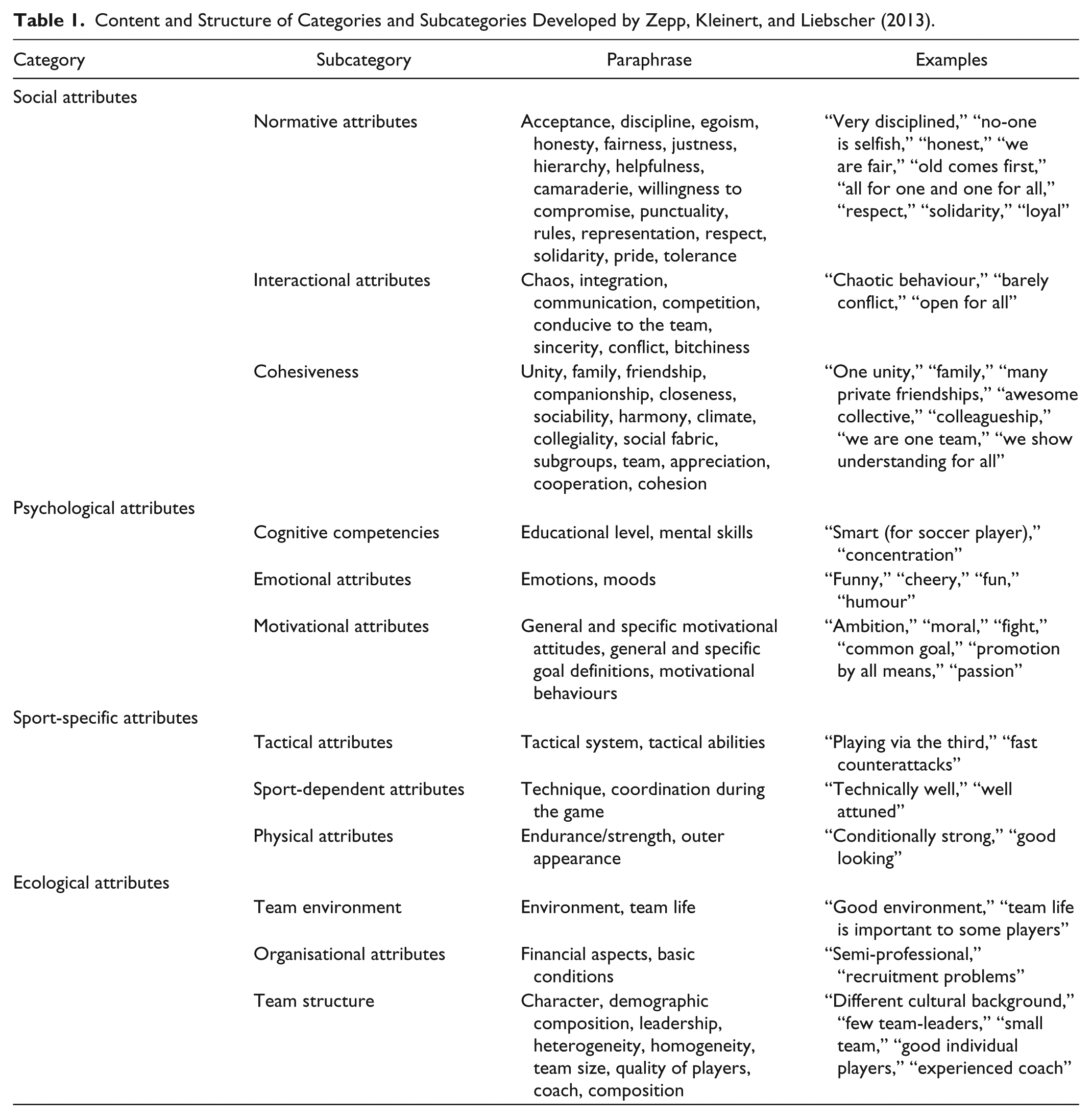
Prototypical attributes, in the context of homogeneity, can be defined based on self-categorization theory (SCT; Turner, 1987). Accordingly, prototypical attributes are characteristics that refer to perceptions, feelings, behaviors, norms, rules, and predominant group values (Turner, Hogg, Oakes, Reicher, & Wetherell, 1987). When structuring and analytically describing the content of prototypical attributes mentioned by sport team members, attributes fitting into social, psychological, sport-specific, and ecological dimensions can be identified (Zepp, Kleinert, & Liebscher, 2013), each comprising three further subcategories (cf. Table 1). These prototypical attributes are shared and either consciously or unconsciously synchronized between all group members (Hogg & Reid, 2006). Moreover, prototypical attributes are able to minimize in-group differences between group members (Terry, Hogg, & White, 1999), provided they are perceived homogeneously (Hogg, 2001).
Content and Structure of Categories and Subcategories Developed by Zepp, Kleinert, and Liebscher (2013).
Prototypical attributes are perceived as homogeneous if “there is one dominant set of norms and values that guide behavior [sic]” (Roccas & Amit, 2011, p. 898), and these norms and values are shared between all group members in a uniform manner (Falomir-Pichastor & Frederic, 2013). In addition, homogeneity of prototypical attributes describes intragroup similarity regarding these shared attributes (Feitosa, Salas, & Salazar, 2012). The greater the proportion of in-group members that possess similar norms, attitudes, or behaviors, the greater the homogeneity within this group (Blau, 1977), enabling an increasingly stable and protective framework for group members that supports the function of in-group membership (cf. Doosje, Ellemers, & Spears, 1995; Falomir-Pichastor & Frederic, 2013; Tajfel & Turner, 1986). In contrast, heterogeneity describes the extent to which group members are distributed among various subgroups within their group (Blau, 1977), with each subgroup possessing a different profile of norms, behaviors, or attitudes. A heterogeneous perception of prototypical attributes occurs when group members perceive different characteristics as representative of their group (Falomir-Pichastor & Frederic, 2013). Moreover, the dissimilar and highly diverse prototypical attributes of heterogeneous groups (Roccas & Amit, 2011) lead to more complex and diverse in-group prototypes and an increased risks of norm violations (Falomir-Pichastor & Frederic, 2013).
The homogeneous or heterogeneous perception of the group prototype affects each group member’s behavior and many intragroup processes (Hogg, 2001), while it also appears to be a significant factor in relation to team performance and effectiveness (e.g., Cleveland, Blascovich, Gangi, & Finez, 2011). For example, homogeneous teams work effectively together due to their shared attributes and demonstrate increases in cohesion, trust, and performance as a result (Horwitz & Horwitz, 2007). Such a relationship between homogeneous prototype perceptions and improved team performance, effectiveness, and trust would be expected to lead to positive expectations toward goals and future team action (i.e., team efficacy).
In contrast, heterogeneity and diversity in prototypical attributes affect the effectiveness of the group by decreasing the quality and quantity of interpersonal relationships and reducing trust and team integration (Curşeu & Schruijer, 2010; Lau & Murnighan, 1998). Furthermore, a group that is heterogeneous in regard to prototypical attributes may also experience higher levels of misfit between individual group members and in the group as a whole (Harrison & Sin, 2007).
Homogeneity and heterogeneity have been assessed in a number of different ways (e.g., Bantel & Jackson, 1989). Blau (1977), for example, developed an index to describe the degree of heterogeneity within a group. This index has seen widespread use (e.g., Bantel & Jackson, 1989; Harrison, Price, & Bell, 1998), but it is an appropriate tool only when the sample groups under investigation are representative of the total population. Various other measures have been developed to analyze population diversity (Greenberg, 1956; Teachman, 1980), although these measures assess the homogeneity or heterogeneity of demographic characteristics. To assess in-group homogeneity over a variety of attributes, Simon and Pettigrew (1990) calculated perceived homogeneity based on the distribution frequency of the sample population within a specific category. When using this measure, a value of 0 indicates complete perceived homogeneity, while a value of 1 indicates the absence of perceived homogeneity. In another approach, the index of agreement (James, 1982; James, Demaree, & Wolf, 1984) was calculated as a measure of the degree to which athletes of a team are in consensus about the team’s level of cohesiveness (Carron et al., 2004; Carron et al., 2003). Given the above described approaches to assess within-group homogeneity, to our knowledge, no measure has yet considered using prototypical categories to allow group members to describe their group homogeneity in detail.
Demographic attributes such as gender influence the perception and, therefore, the homogeneity of prototypical attributes within groups (e.g., Lau & Murnighan, 1998). It has been demonstrated that men and women differ in respect to the attribution of emotional and social competencies (Taylor & Hood, 2011) as well as in risk behavior, empathy, and attitudes toward competition (Croson & Gneezy, 2009). Moreover, it has been demonstrated that women are perceived to be more homogeneous in respect to social attributes than men (Crump, Hamilton, Sherman, Lickel, & Thakkar, 2010). With these gender differences in mind, it is plausible to assume that even homogeneous perceptions of specific prototypical attributes will differ between men and women.
In addition, the homogeneous perception of prototypical attributes strongly relates to the identification (e.g., feelings of identifying with a group) of individuals with a group (cf. Doosje et al., 1995; Yalom, 2010). For example, feelings of identification enhance perceived in-group homogeneity (Kelly, 1989; van Twuyver & van Knippenberg, 1998), while high identifiers accentuate in-group homogeneity (Castano & Yzerbyt, 1998; Falomir-Pichastor & Frederic, 2013). Furthermore, literature suggests that in-group homogeneity and identification are correlated (cf. Castano, Yzerbyt, & Bourguignon, 2003). Thus, it is assumed that the homogeneous perception of prototypical subcategories correlates with identification.
Moreover, homogeneity regarding the prototype depends on the communication and coordination of norms, values, and other prototypical attributes, and is, therefore, particularly influenced by group size (Carron & Eys, 2012; Steiner, 1972). Hence, if a group is large, it might be more difficult for group members to find common perceptions compared with small groups, possibly explaining why prototypical attributes are more often heterogeneously perceived in larger groups.
In summary, existing literature indicates that homogeneous perceptions of the prototype correlate with several intra- and intergroup processes (e.g., Curşeu & Schruijer, 2010; Horwitz & Horwitz, 2007; Jehn, Northcraft, & Neale, 1999). Moreover, studies examining the positive and negative effects of team homogeneity on performance and effectiveness have produced contradictory results (cf. Bezrukova, Thatcher, Jehn, Behfar, & Thompson, 2007; van Knippenberg & Schippers, 2007). To the best of our knowledge, no study has yet investigated homogeneity of prototypical attributes in relation to the different forms of the prototype (i.e., categories and subcategories of the in-group prototype) in the sport context. However, in a previous qualitative content analysis of the answers to one open-ended question, Zepp and colleagues (2013) were able to identify four main categories (social, psychological, sport-specific, ecological), with three subcategories each (cf. Table 1), relevant to the content and structure of prototypes in soccer teams. The present quantitative analysis expands on the qualitative analysis by Zepp et al. as it aims to provide evidence for the importance of within-group homogeneity of the distinct prototypical attributes, along with the correlation of these attributes with different group and individual factors. To do so, three hypotheses will be tested:
Method
Sample
This study sample consists of 20 German soccer teams (12 male teams, 8 female teams) comprising 278 athletes (67% male, 83% German). On average, 13.9 players (SD = 3.4) participated from each team. Six teams competed in the fourth amateur division, 13 teams competed in the third amateur division, and 1 team in the second amateur division. Mean player age was 23.5 years old (SD = 5.0 years), and players had been a member of their current team for an average of 2.2 years (SD = 3.6 years; min. = 0.3 years, max. = 31.8 years). On the team level, team membership averaged 2.8 years (SD = 1.4 years; min. = 0.2 years, max. = 5.1 years). All players possessed good reading and writing skills in the German language. Subject of analyses are the sport teams.
Inclusion criteria for teams were related to the duration of team membership and the competitive level. Reflecting on relevant team attributes happens during a socialization process at the beginning of the team membership and might occur very fast (Levine & Moreland, 1994; Moreland & Levine, 1982). To provide players with enough time to learn and reflect on team attributes, players had to have been a member of their team for at least 3 months, thus ensuring that players had sufficient time to perceive and reflect on relevant team attributes. Regarding the competitive level, inclusion was restricted to competitive teams playing in amateur division four and above, as it was expected that, from this competitive level onward, athletes would focus more on the team’s performance and tasks instead of the social aspects of being a team. Prior to conducting the study, ethics approvals were obtained from the ethics commission.
Measures
Homogeneity of prototypical attributes
Players from each team were asked to answer in writing one open-ended question to assess prototypical attributes describing their team (“In your opinion, which attributes describe the players of your team best or differentiate the players of your team from players of other teams out of your division?”). The question takes into account theoretical knowledge that prototypical attributes exist that are based on similarities between team members of the in-group and both differences between team members of the in-group and team members of other out-groups of the same context (e.g., Turner et al., 1987).
In total, 1,581 attributes were mentioned by players (M = 5.69 attributes by each player, SD = 2.4). In a previous study (Zepp et al., 2013), each attribute was identified through content analysis (according to Mayring, 2010) using a stepwise approach. First, omissions and generalizations were assessed to reduce statements. Statements were also analyzed for content and semantics before being coded using MAXQDA software. Second, 69 paraphrases were generated by combining repeatedly mentioned attributes or attributes that were semantically similar (Mayring, 2010). The third step involved the allocation of each of these 69 paraphrases into four categories (social, psychological, sport-specific, ecological). Finally, the categories were modified and matched (Mayring, 2010). To achieve this, paraphrases were allocated into specific subcategories (cf. Table 1). Intercoder reliability was verified after approximately 25% of attributes were coded and allocated into the developed categories and subcategories. To check the comprehensibility and unambiguity of the developed categorical structure (Mayring, 2010), four independent coders were asked to allocate 50 randomly chosen attributes to the developed categories and subcategories using a coding guideline. Based on the formula developed by Krippendorff (2011), the intercoder reliability was good, α = .863.
In preparation for the homogeneity analysis, the frequencies of all attributes mentioned by each player were assigned to specific subcategories and entered into SPSS 21. Because some players mentioned two or more attributes of some subcategories, the frequency of mentioned attributes had to be normalized to avoid overrepresentation of this subcategory. Normalization was achieved by classifying each attribute variable as either “mentioned” or “not mentioned” for each player.
Subsequently, as a measure to describe the homogeneity of subcategories on team levels, relative frequency (rf) was calculated using the formula rf = Σf / n, in which f is the normalized and aggregated frequency of prototypical attributes within the team, and n is the number of group members. The resultant rf indicates the homogeneity within the team regarding prototypical subcategories. The index lies between 0, representing a subcategory that has not been mentioned by at least one group member within a team and which will not be used to describe the group homogeneously, and 1, representing a subcategory that has been mentioned by all group members within a team and will be used to describe the group homogeneously. Relative frequency as a measure for homogeneity appears to be a plausible yet simple way to describe homogeneity within groups.
Identification
The identification of each player with their respective team was assessed using four questions based on the identification scale developed by Johnston and White (2003). Questions referred to the general identification of the player with other team members (“How much do you feel you identify with your team members?” 1 = not very much to 7 = very strong), the perceived similarity with other team members (“With respect to your general attitudes and beliefs, how similar do you feel your are to your team members?” 1 = very dissimilar to 7 = very similar), the relevance of team membership (“Think about who you are. How important is being a member of your team?” 1 = very unimportant to 7 = very important), and the feelings of relatedness with other team members (“How much do you feel strong ties with your team members?” 1 = not very much to 7 = very much). The identification scale shows a good internal consistency with Cronbach’s α = .78.
Further variables
Besides assessing demographic variables such as age and gender, each team’s current championship ranking, aim for the season, and team size were recorded. Aims for the season were assessed by asking the athletes to indicate which championship ranking the team wanted to achieve at the end of the season. Because the number of positions in the tables differed between the divisions investigated, the team’s championship ranking and the team’s aim of the season had to be standardized to compare the teams using the formula “championship ranking = current position in the championship/number of teams in the championship,” and “aim of the season = aimed position in the standings/number of positions in the standings,” respectively. Representative values for championship ranking and the aim of the season, therefore, lie between 0.05 (first position in the ranking, 20 teams/league = 0.05) and 1.0 (last position in the ranking).
Procedure
The first author contacted soccer coaches and explained the purpose of the study. After the coach’s permission was secured, the first author met with the team and requested the participation of the athletes, which was voluntary. All athletes willing to take part in the study signed an informed consent form before the questionnaire was distributed. Questionnaires were usually administered at a team meeting before training (with the exception of one team who completed their questionnaires after training) in the middle of the season. The importance of independent responses was emphasized before the questionnaires were distributed. Every coach received an anonymous interpretation of their team’s data.
Data Analysis
Because the data are not normally distributed and, therefore, do not meet assumptions of parametric data, nonparametric analyses were conducted. To analyze Hypothesis 1, Friedman’s test was conducted. To follow up findings, Wilcoxon’s signed-rank tests with Bonferroni correction were conducted. In order to test differences between categories of individual and group related factors regarding relative frequencies of prototypical subcategories the Mann–Whitney test (Hypothesis 2) was applied. To analyze correlations between homogeneity and individual and group-related factors, Kendall’s τ-b (Hypothesis 3) was conducted.
Results
An initial exploratory data analysis of the relative frequency highlights the distribution of relative frequency of subcategories (cf. Figure 1). The analysis of differences within the relative frequency of prototypical categories on team levels (Hypothesis 1) shows that relative frequency significantly differs within the subcategories of social, χ2(2) = 27.553, p < .001; psychological, χ2(2) = 35.558, p < .001; sport-specific, χ2(2) = 14.881, p = .001; and ecological attributes, χ2(2) = 36.203, p < .001. Wilcoxon’s tests were used to follow up these results, with Bonferroni corrected at p = .0167. For the social dimension, attributes describing cohesiveness (median = .77) are mentioned with a higher relative frequency than both normative (median = .39; z = −3.823, p < .001, r = .85) and interactional attributes (median = .27; z = −3.846, p < .001, r = .86). Within the dimension representing psychological characteristics of the group, the subcategory incorporating emotional attributes (median = .42) is mentioned more frequently than the subcategory of cognitive attributes (median = .07; z = −3.921, p < .001, r = .88). In addition, motivational attributes (median = .62) are mentioned with a higher relative frequency than cognitive attributes (median = .07; z = −3.921, p < .001, r = .88) and emotional attributes (median = .42; z = −3.480, p = .001, r = .78). Regarding sport-specific attributes, sport-dependent attributes (median = .13) are mentioned more frequently than tactical attributes (median = .00; z = −3.126, p = .002, r = .70). Within the ecological dimension, attributes describing the team structure (median = .37) are mentioned with a higher relative frequency than organizational attributes (median = .03; z = −3.921, p < .001, r = .88), as well as attributes describing the team environment (median = .00; z = −3.921, p < .001, r = .88).

Distribution of relative frequency on the subcategorical level.
Supporting Hypothesis 2, relative frequencies significantly differ between male and female sport teams. Subcategories describing interactional attributes (male: median = .21; female: median = .37; U = 12.50, z = −2.74, p = .006, r = .61), cohesiveness (male: median = .71; female: median = .91; U = 8.00, z = −3.09, p = .002, r = .69), and emotional (male: median = .35; female: median = .57; U = 14.00, z = −2.62, p = .009, r = .59) and motivational attributes (male: median = .59; female: median = .74; U = 16.00, z = −2.47, p = .013, r = .55) are mentioned with a higher relative frequency in female than in male teams.
Regarding Hypothesis 3, the results indicate that the degree of identification is negatively correlated with relative frequency of normative attributes (τ = −.535, p < .001). In addition, team size is positively correlated with relative frequency of environmental attributes (τ = .399, p = .031). Finally, the championship ranking and relative frequency regarding physical attributes is negatively correlated (τ = −.556, p < .001; cf. Table 2).
Descriptive Statistics and Intercorrelations.
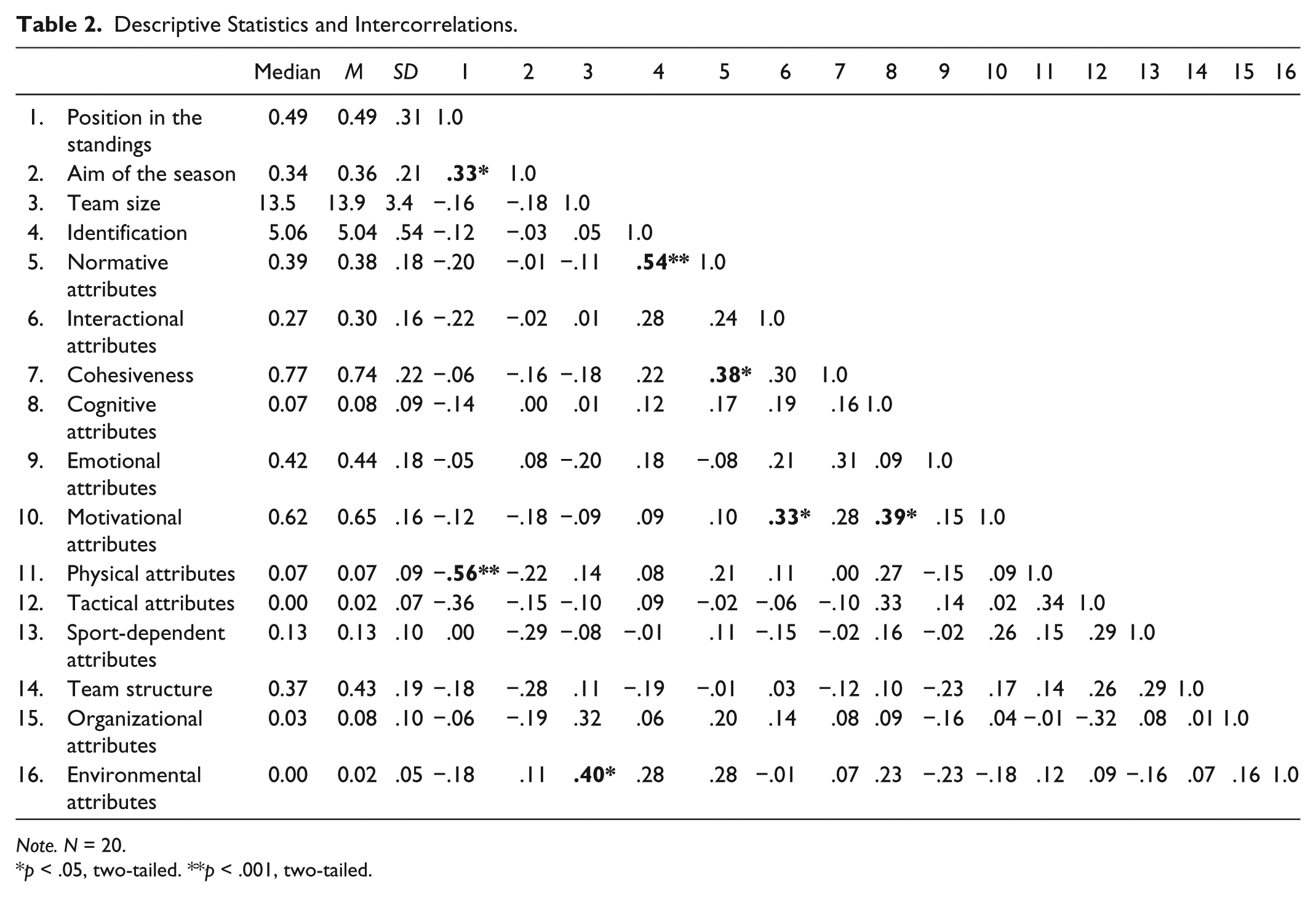
Note. N = 20.
p < .05, two-tailed. **p < .001, two-tailed.
Discussion
This study is the first study to investigate the homogeneity of prototypical attributes and their subcategories based on qualitative answers of group members to open-ended questions. In this study, we demonstrated that the in-group homogeneity of the group prototype significantly differs within prototypical categories in sports teams. Second, we demonstrated that in-group homogeneity of specific subcategories differs between male and female teams. Finally, our results show that identification, team size, and the championship ranking are correlated with the in-group homogeneity of specific prototypical subcategories. With these findings, this study extends previous research on prototypes and demonstrates that some prototypical subcategories seem to be more important for the description of a team’s identity than others.
In contrast to our assumption, we identified some prototypical subcategories that cannot be described as homogeneous within the examined teams, that is, in the majority of cases, only a few team members mentioned these subcategories as prototypical for their team. This finding indicates that specific prototypical subcategories appear to be more important for most group members than others. Furthermore, on a categorical level describing the social aspects of the group, the homogeneity of the prototypical subcategory cohesiveness appears to be very high, indicative of its importance for describing the prototype within sports teams. This result supports previous findings that group members possess a fundamental need to belong, which is expressed in cohesion, and the feeling to be part of a specific and self-relevant group (Baumeister & Leary, 1995). The satisfaction of this need, and thus the development of a feeling of unity, familiarity, and cooperation, is achieved within a group that sticks together and remains “united in the pursuit of its instrumental objectives and/or for the satisfaction of member affective needs” (Carron, Brawley, & Widmeyer, 1998, p. 214).
In addition, homogeneity of the subcategory subsuming normative attributes is relatively low, indicating that such attributes are not inherently necessary for sport teams to describe their prototypical characteristics and properties. This suggests that the prototype itself can act as an overall and implicit group norm (e.g., Hogg & Reid, 2006), while implicit norms or rules do not have to be mentioned as explicit parts of a group prototype.
Regarding psychological team attributes, attributes referring to motivational aspects appeared more often as homogeneous compared with emotional or cognitive descriptions. In our systematization, the motivational subcategory contains motivational attitudes (e.g., ambitious, passionate) and individual and team goals. Goals are an inherent characteristic of teams as individuals become group members to pursue individual goals and to more easily reach these goals (cf. Stahl & Schulz von Thun, 2007), but will leave a group if the group’s goals do not complement their individual goals (Schneider, 1987). It is plausible, therefore, that motivational attributes, which strongly refer toward goals and the pursuance of these goals, are of relative importance for the group prototype and, as such, are mentioned with a higher probability than other psychological attributes.
In terms of individual and group factors (gender, team size, team success) that might interrelate with the homogeneity of prototypical subcategories, we found higher homogeneity scores in female teams compared with male teams. Specifically, the former are more homogeneous in cohesiveness, interactional, emotional, and motivational attributes, with attributes of these four subcategories seeming to be stronger, more salient, and more identifiable within female teams. Moreover, it is interesting that only physical attributes are negatively correlated with championship ranking, that is, the higher the team’s league position, the higher the homogeneity of physical attributes. This can be explained by the fact that successful teams focus on their physical abilities and strength, increasing the salience of physical attributes to players of these teams. In addition, it is of interest that no attributes are correlated with the aim of the season. This could be explained by the timing of the survey completion, that is, as teams were already in the middle of the season when they completed the study questionnaires the aim of the season might have been displaced by other events (e.g., recent performances, injuries, etc.). It is plausible that a correlation between prototypical attributes and the aim of the season might have been found at the start of the season, because the team’s identity would be focused on the aim of the season.
Furthermore, group size correlated positively with the probability of homogeneity for environmental attributes. Thus, for teams consisting of more athletes, the environment around the team is important, including aspects such as team life and the effort that is put into the team.
Because prototype homogeneity might be related to group identification (Turner et al., 1987), the correlation between these two aspects was of particular interest in this study. Among all prototypical factors, we found just one significant interrelation between identification and the homogeneity, specifically in relation to normative attributes. This result is plausible because it can be assumed that the process of identification plays a significant role in the perception of norms, a theory supported by previous studies (e.g., Castano & Yzerbyt, 1998; Doosje et al., 1995; Yalom, 2010). In-group similarity and homogeneity on specific prototypical attributes can partly be defined as some kind of identification, which can be defined as a feeling of belonging to a specific group, including the cognitive and evaluative relevance of this group membership (Tajfel & Turner, 1979). On the other hand, it is surprising that this correlation is limited to norm-oriented prototype structures only. One reason for this could be that, because norms are an inherent part of the prototype (Hogg, 2006), group members identify more strongly with these norms. This again suggests that group members who strongly identify with the group clearly perceive such group norms (Hogg & Vaughan, 2008; Reijerse, 2012) and thus tend to mention such norms more frequently, which in turn might lead to increased perceptions of cohesion (Martin, Paradis, Eys, & Evans, 2013). This finding is in line with other research (Täuber & Sassenberg, 2012) that shows that players who strongly identify with their team deviate from potentially harmful group norms, while weakly identified players adhere to these norms. Thus, it might be of interest, with which specific norms identification correlates.
The results of the study should be interpreted cautiously, however, as the prototypical attributes under investigation were assessed in one specific situation only (i.e., before/after the training session in a locker room). This methodological approach might explain why only specific prototypical attributes were mentioned, which were cognitively represented and salient within this specific situation. It is easily conceivable that the salience of an individual’s perceived prototypical attributes depends on the situation in which a group member is asked to describe these team attributes; thus, prototypical attributes should be assessed either in different situations (e.g., before/after competition) or using instructions that draw the focus of group members to such situations.
From a theoretical perspective, future research should examine the role of complementarity effects on prototypical subcategories within sports teams, rather than solely focusing on similarity effects. Recent studies have demonstrated that the two constructs, similarity (i.e., supplementarity) and complementarity (e.g., regarding values and emotions), are necessary to describe within-group factors (Piasentin & Chapman, 2007). Thus, future research should investigate whether specific intrateam processes (e.g., person-group fit) can be described using such prototypical subcategories.
In conclusion, this analysis of in-group homogeneity regarding prototypical attributes in soccer teams contributes some new perspectives to the understanding of the in-group prototype. From a practical perspective, results of this study might help leaders, managers, and coaches to positively influence both the perception and the objective homogeneity of the prototype. Subsequently, having assessed and described the in-group prototype within teams, it is more likely for new team members to perceive the prototype as it is, to have the chance to identify faster with the prototype, and to integrate faster into the team as a result, before finally becoming an effective part of the team. This is an important step as both the integration (e.g., Ellemers, De Gilder, & Haslam, 2004) and the identification with the team (e.g., Allen & Meyer, 1996) have an influence on the effectiveness and performance of teams.
Footnotes
Authors’ Note
Data presented within this manuscript can be received from the first author.
Declaration of Conflicting Interests
The author(s) declared no potential conflicts of interest with respect to the research, authorship, and/or publication of this article.
Funding
The author(s) received no financial support for the research and/or authorship of this article.