



Abstract
The developing status of the Omani higher education has made this sector subject to both national and global influences. Such influences created inconsistencies between the demands of the local context and those of the increasingly globalizing context, which resulted in a nationally diverse faculty body. This paper draws on the Social Identity Approach (SIA) and the intersectionality theory to argue that identity in the workplace could be understood better through focusing on processes rather than individual narratives since processes reveal much of the complexity of prototypes especially when applied to workgroups. The paper reports the findings of a qualitative case study conducted in an English language-teaching department in Oman. The study explored identity intersectionalities within a workgroup by analyzing the data generated through 16 interviews, eight meeting observations and document analysis. The thematic analysis reveals that identities are constructed based on intersections of language, nationality, contract and professional identity. Such intersections were evident in relation to the process of recruitment, employment security and retention, staff inclusion, and professional identity enactment. These findings demonstrate that analyzing identity at the intra-categorical level sheds light on its effects at the individual level. The paper concludes by highlighting theoretical and practical implications that are relevant to ELT contexts internationally.
Plain Language Summary
The developing status of the Omani higher education has made this sector subject to both national and global influences. Such influences created inconsistencies between the demands of the local context and those of the increasingly globalizing context, which resulted in a nationally diverse faculty body. This paper draws on the Social Identity Approach (SIA) and the intersectionality theory to argue that identity in the workplace could be understood better through focusing on processes rather than individual narratives since processes reveal much of the complexity of prototypes especially when applied to workgroups. The paper reports the findings of a qualitative case study conducted in an English language-teaching department in Oman. The study explored identity intersectionalities within a workgroup by analyzing the data generated through 16 interviews, eight meeting observations and document analysis. The thematic analysis reveals that identities are constructed based on intersections of language, nationality, contract and professional identity. Such intersections were evident in relation to the process of recruitment, employment security and retention, staff inclusion, and professional identity enactment. These findings demonstrate that analyzing identity at the intra-categorical level sheds light on its effects at the individual level. The paper concludes by highlighting theoretical and practical implications that are relevant to ELT contexts internationally.
Introduction
Classifications of identity in higher education abound. Higher education institutions (HEIs) are complex entities with multiple cultures that are influenced by social, global, and personal factors. Using an onion typology, Välimaa (1998) attempts to capture such a complexity by proposing that academic identity is composed of different layers that start with the individual layers at the core of the onion and moves toward the outer layer (national) through layers if disciplinary, professional, and institutional identities. This typology, however, assumes that these layers are separable and hierarchically structured, and that individual identities are a constituent of other identities but the reverse is not true. In effect, identities, whether horizontally or vertically related (through the nexus of power), are rather entangled in each other.
In Oman, as with the other Gulf Cooperation Council Countries (GCC), national and linguistic identities have always been salient. The policies of workforce localization, the increasing number of unemployed Omanis particularly after the outbreak of Covid-19 and the continuous counter-action of employing non-Omanis sustains such salience. The GCC organizational literature indicates that these inconsistent organizational practices created a transient proportion of the workforce that grapples with various disadvantages (Scurry et al., 2013). The flow of international workforce in higher education went in line with the reforms of higher education internationalization and alignment with the long-term development plans in the GCC countries (Ibrahim & Barnawi, 2023). Nonetheless, much of the literature that studied workplace identities in the GCC categorizes the academic market into two broad categories: locals and expatriates. Such broad classifications assume homogeneity within categories and do not tell us much about the dynamics of work in such contexts (Neal, 2010).
This paper uses a social-psychological perspective to study the conceptualization of identity in the English language-teaching (ELT) context in Oman. The context of ELT is often portrayed as a context that is rich of identities where language authority and power relations are experienced. The power and status that English has gained internationally makes it a main competitor with the local languages especially due to the lingua-franca role it plays in the globalizing workplace (Al-Issa, 2020). Nationality as an identity is largely overtaken by the power of Native English Speaking Teachers (NESTs) being proxies for the overarching power of their nations thus constituting a challenge for professional priorities and standards in HEIs (Knott, 2021). However, another stream of the literature indicates that non-local teachers (including the NESTs) in the GCC context are often seen as others and as a potential threat to the local identities (Diallo, 2014; Elyas, 2011; Hillman et al., 2018). Such power relations as highlighted by these two streams of the literature necessitate delving deeper into the context of ELT to explore how identities are conceptualized and what identity effects are created by the different categories salient in this context. Filling such a gap forms the objective of this paper, which will start with conceptualizing identity from a socio-psychological perspective, then it will present a review of the literature on identity construction in ELT and will finally report the findings of a case study conducted in a context of ELT in an Omani HEI.
Conceptualizing Identity
Hammack (2008) argues that research on identity from psychological and socio-psychological perspectives has conceptualized identity mainly in terms of collective broad identities and ignored the variability within groups. The Social Identity Approach (SIA) is an example of such perspectives as it views identity at the level of group, which is defined in terms of a salient commonality such as ethnicity, language, color, religion, or others. Within organizations, the SIA literature defines group in terms of organizational categories such as units, teams, departments or even organizations. This stream of theory argues that the salience of a common category with which individuals identify makes individuals see themselves as representatives of that category, perceive reality based on the same perspective and behave collaboratively based on the same values, norms and objectives (S. A. Haslam & Platow, 2001). As such, individuals perceive the salient social category that forms social identity as a prototypical cognitive image of the social group.
Hogg (2001) defines prototypes as “context-specific, multidimensional fuzzy sets of attributes that define and prescribe attitudes, feelings, and behaviors that characterize one group and distinguish it from other groups” (p. 187). The SIA implies that when a common identity becomes salient, individuals depersonalize their identities and act in accordance with the group’s prototype (Hornsey, 2008). The SIA thus contends that the salience of a group identity submerges the differences between individuals within a group which makes this theory seen as an essentialist perspective (Diallo, 2014; N. Haslam et al., 2000). Group identities cannot submerge differences between individual to an extent that they become identical. Individuals’ identities within a group are variably shaped by social, economic and political factors, which such assimilation does not account for (Kayi-Aydar, 2019). These factors create vectors that intersect together to form individuals’ self-concepts.
The intersectionality of identity vectors is defined as the interconnection between the different identities that influence people’s behavior and which are associated with differential powers (Oleksy, 2011; Parent et al., 2013). Identity in this sense is emergent and complex (Oleksy, 2011; Valentine, 2007). Identities are seen more like processes rather than fixed labels and identity vectors are not seen as mutually exclusive but they mutually constitute each other (Anderson, 1996; Levon, 2015). As a result, people’s experiences vary depending on what identities intersect together to shape their lives (Museus & Griffin, 2011). To illustrate, while being a woman is generally seen as a disadvantaged identity vector in the western literature (e.g., Bhopal, 2016; K. Crenshaw, 1991; Greenwood, 2011; V. Showunmi & Kaparou, 2017), middle class white woman experiences a different level of disadvantage, as opposed to a black woman. In this case, experience is shaped not by gender alone but by the intersection of gender with the different vectors of color (i.e., black and white). K. Crenshaw (1991) reports another example where the domestic violence women of color experienced in migration shelters in the US was shaped not only by their gender or color but also by other structural aspects such as being of Asian origins or being non-speakers of English. This confirms that the effect of increased prototypicality is moderated by the social status of the multiple social categories one belongs to. Hence, the intersectionality perspective conceives of salience as the simultaneous and collective functioning of identities to create certain effects (Powell et al., 2015). In this sense, the concept of prototype is redefined based on the intersecting identity trajectories. Purdie-Vaughns and Eibach (2008) stress that “people who are more prototypical subordinate-group members will be more direct targets of oppression compared to people who are less prototypical subordinate-group members” (p. 328).
Despite its power to unpack the complexity of identities, the intersectionality perspective has largely been interested in studying certain categories that intersect with gender to render the underlying differences (C. Crenshaw, 1997). Having such a limited scope, the intersectionality theory remains rather closed to the fact that identity construction and intersectionality effects are context-specific (Tatli & Özbilgin, 2012). This is especially true as identity intersections are dynamic in nature such that “we must attend to the ways in which different social histories, interpersonal motivations, and local ideological expectations shape the imbrication of categories of experience in real-world empirical encounters” (Levon, 2015, p. 298).
Identity in the Context of English Language Teaching (ELT)
The aspect of language as an identity vector is key to understanding how individuals construct their identities in the ELT context in the GCC countries that have witnessed a steady upgrading of the status of English being the language of science and trade (Hopkyns & Elyas, 2022). This discourse has largely focused on how English presents a significant threat to local identities to an extent that using the concept of “first language” as a classification of Arabic has become controversial in some of these states such as in Qatar (Hillman et al., 2018). Arabic is now largely seen as a language that is more associated with history, religion and family rather than with modern life aspects, future and power (Hopkyns & Elyas, 2022). Despite the depiction of English as a tool for creating competent human capital (Rahman et al., 2022), AlBakri (2017) provides evidence that English presents a threat to the full exploitation of local human capacity. Such an effect was also observed in other GCC contexts such as Qatar that has recently tried to reinstate the status of Arabic in some of its higher education fields (Hillman et al., 2018).
Notwithstanding the rivalry, English is increasingly gaining recognition as the medium of instruction in the Omani higher education. As a consequence, the fluidity of international faculty members, especially of those classified as NESTs has made locals a minority. Within this stream of literature that has arguably fallen into the trap of social identity categorization, NESTs have largely been depicted as a hegemonic category that has earned a superior status ascribed to it by the power of their mother language and origins rather than by virtue (Abrar-ul-Hassan, 2021; Phillipson, 2016). NESTs have been seen as a unique asset and as an indicator of quality despite the rising calls for adopting multilingualism as a more representative approach to the current GCC ecology (Calafato, 2022) and the profound evidence that nativism and professionalism do not necessarily go together in the context of education (Knott, 2021). Hopkyns and Elyas (2022) posit that failing to challenge the fallacy of NESTs’ superiority results in losing the value of diversity. The polarization of NESTs versus non-NESTs, however, should be carefully examined as even the GCC governments, including the Omani one, that started enforcing policies of localizing workforce, see English as a tool for affecting such policies and for development and modernization (Al-Issa, 2020).
In fact, the adoption of English as the language of education in higher education created a multitude of identities whose influences cannot be understood away from the economic, political and social factors influencing the context where these identities interact (Hopkyns & Elyas, 2022). The NESTs versus non-NESTs discourse coupled with the nationalization discourse in the GCC context and the parallel constant flow of international workforce created complex power relations in the ELT context. This affected how people see themselves and how others perceive them in the workplace. Al Muqarshi et al. (2021) report that the perceived low salience of a common group identity in an ELT context in Oman translated into unstable group composition, relationship conflict, low interaction, and impaired collaboration. Altbach (2015) proposes that one consequence of such categorization is the use of different types of contracts depending on the national identity of the employees. This could arguably be also seen as an antecedent for such categorization. In their study of expatriate academics in the United Arab Emirates, Austin et al. (2014) reveal that such employment policies affect the level of employment security which in turn affects commitment to work and perception of equity among employees. Therefore, this study sets out to explore what identity intersectionalities are salient within ELT groups and what effects are created by the active identity intersectionalities.
Methodology
Warner (2008) posits that identities should not be seen as linear but as processes of interactions that are shaped by the context. The complexity associated with identity construction as an emergent and multifaceted construct requires adopting a constructivist approach that allows for such complexity to be unraveled through exploring reality as constructed by those who experience it (Hennink et al., 2011). The paper uses an intersectionality lens to explore how multiple identities work together to shape the experiences and the self-concepts of the participants. The intersectionality approach enables the researchers to approach the study of identity without having prior assumptions about how it works (Romero, 2017). It also enables them to investigate the role of power as it is produced and enacted within the social structure prevailing in a specific research context (Powell et al., 2015). Despite its wide capacity, the intersectionality theory has been minimally used in organizational contexts (Zanoni et al., 2010). Such a lens is of specific value to the nature of the organizational context of ELT in Oman especially with the wide national diversity necessitated by the rivalry of Omanisation, internationalization, and quality standards.
Case Study Design
To avoid the limitations of the previous research designs that tended to categorize academics in the GCC context into two broad categories (i.e., nationals vs. expatriates), this study adopts an intra-categorical approach in order to delve deeper into the organizationally established category of department whilst it studies how identities are constructed in relation to the different group processes within the researched department. Case study design has been used as an effective design to unpack teachers’ identities (Kayi-Aydar, 2019; Nichols & Stahl, 2019) since it enables focused and deep exploration (Creswell, 2007). Case studies are ideal for revealing intra-categorical intersectionalities and invisible identities due to the deep investigation they enable through focusing on a single group (McCall, 2005). This study looks at identity intersectionality as a dynamic process that could be constructed differently considering the various group processes. In addition, the adoption of case study design for this research enables the triangulation of methods to investigate the case especially that the context is an integral element for understanding the phenomena (Baxter & Jack, 2015). According to Gillham (2000), the context has a key role in informing the way people think and feel.
The Research Context
This case study looks at an ELT department at a College of Applied Sciences (henceforth CAS-1) in Oman. CAS-1 is part of a network of colleges that were centrally managed by the Ministry of Higher Education in Oman but has now merged with another network of colleges to form the University of Technology and Applied Sciences. The college’s student body was just below 1,000 and staff members were around 85. At these colleges, English is used as the medium of instruction and thus each college has a department or a centre for teaching English for the purpose of easing students’ transition to higher education and to equip them with the major-related linguistic resources. These departments hire English teachers from different parts of the world, as the number of qualified Omani teachers hired to teach the language is low. The wider national and linguistic diversity in the English departments, as opposed to the other departments at these colleges, allows unique intersections of identities to operate in relation to the different processes.
In the researched department, there were 27 instructors belonging to many nationalities. These instructors teach English as a foreign language, but their mother languages are not necessarily English. With a few exceptions, the majority had different mother tongues such as Arabic, African, Bengali and others (see appendix A). There was also a wide range of specialties, which might not necessarily be related to the field of ELT, such as social sciences and law. There were three channels for recruiting teachers in the Department. Staff members at the English Department were recruited either through the Ministry of Higher Education or outsourced through recruitment companies/agencies. There were seven native English speakers at the English Department based on Phillipson’s (2016) definition of the term that considers the nationals of the UK, the US, Canada and Australia as native English speakers. The interview participants’ bio data, however, showed that the South Africans participants (three interviewed out of five South African teachers) also considered English as their native language, which by extension, means that native English speakers were 12 in total. The rest of the participants were either Arabic native speakers (10 teachers) or speakers of other languages (nationals of India or the Philippines; 5 teachers in total).
Data Collection and Analysis
This study is part of a larger study that employed three main methods: interview, observation and document analysis. The combination of the three methods served the purpose of methodological triangulation that aims at constructing reality based on capturing different perspectives and a variety of data forms (Stake, 2008). The main method of data collection was one-to-one semi-structured interviews with 16 participants selected purposively based on a set of criteria that included national backgrounds and years of experience. Six of the participants worked in micro-level leadership positions at certain points in their employment terms. In addition, 11 regular teachers belonging to different national backgrounds were interviewed. The interviews aimed at constructing a comprehensive picture of reality that draws on understanding the participants’ mental models (Woodside, 2010) which could be optimally explored using interviews (Coleman, 2012). The researchers used interview guides constructed based on the literature and the theory informing the research. Such guides facilitated the conduct of semi-structured interviews that generated context-specific data (Brundrett & Rhodes, 2014; Doody & Noonan, 2013). Such a level of structure also keeps the interviews standardized and rather focused (Gillham, 2000).
As group interactions and dynamics present a good source of data about how identities are enacted, observations of eight team meetings were conducted to collect data about the research context (Bailllie, 2013). Observations are also useful in interpreting the data collected through interviews as they enable the researcher to know better about the participants who were less articulate during the interviews or who could opt for disclosing part of the picture only (Merriam, 1998; Mulhall, 2003; Savin-Baden & Major, 2013; Simons, 2009). In addition to interviews and observations, a wide range of documents (e.g., policy documents, such as CAS Bylaw, Civil Service Law, CAS strategic plan, copies of minutes/reports of six meetings, participants’ CVs; and Employee Handbook) was also collected for the purpose of learning about the values, policies and beliefs of the organization in relation to national diversity. Savin-Baden and Major (2013) contend that because documents are a source of data that has not been created for the specific purpose of the research, they represent a good choice for data triangulation. They also help the researcher widen their scope and validate the data as they provide data that cannot be obtained through the direct interaction with the phenomena (Stake, 1995).
The researchers followed the approach described by Brundrett and Rhodes (2014) to process and analyze the data as depicted in Figure 1 below.

Data analysis process.
The data collected from the interviews was transcribed and analyzed manually. The researchers first coded the data using a descriptive coding technique (Saldana, 2016). Two cycles of coding were conducted to verify and focus the codes. The relevant codes were then used to establish categories that in turn established the themes presented in the findings section. Relevance was determined based on the conceptual framework that enables data interpretation (Hamilton & Corbett-Whittier, 2013). During the processes of data analysis, the irrelevant data was eliminated. The data from the interviews was used to build the structure of the findings and once the themes were established, they were then supported with relevant information from the observation notes and the documents in order to add depth, breadth and validity. The established themes constitute the different group processes since these different processes show what intersections of identities become salient to inform the prototype. The quotes from the participants’ accounts were anonymously incorporated and narrated following the scheme [participant code-role-nationality- employment type].
Findings
This study aimed to explore how identities are constructed at the research context. The findings point out that individual identities are generally constructed along intersectional aspects of nationality, language, mode of employment, and profession. These intersections create a mixture of heterogeneous trajectories that become evident in relation to some processes that include staff recruitment, group longevity, inclusion within the wider organizational context and the conceptualization of professional identity. These intersectional vectors mutually constitute each other and create the dissimilar experiences of the participants in the Department. The following sections present the group processes and illustrate how different intersections shape individuals’ identities.
Staff Recruitment and Access to the Group
The findings show that the recruitment of the faculty is largely outsourced through recruiting agencies/companies. There was a general perception that being a native English-speaking teacher (NEST) makes NESTs a more favored recruitment category and hence more prototypical recruits in comparison to the other linguistic categories. T4 relates that
… there is nothing that is written but this is maybe what we could notice or feel because every company would only recruit… either native speakers or second language learners [to mean speakers of English as a second language] but not Omanis. [T4, leader, Omani, MoHE- permanent]
Whereas there was no evidence of a policy supporting the recruitment of NESTs within the documents reviewed for this study, such a condition was stated clearly in a later recruitment contract between the Ministry of Higher Education (MoHE) and the recruiting agency. This finding asserts the findings of Said and Orabah (2022) in higher education ELT context in Oman. In fact, the tendency to recruit NESTs as typical English teachers is not specific to Omani higher education. Alghofaili and Elyas (2017) report a similar tendency in the Saudi tertiary education sector. Similarly, Mahfoodh and Al-Hashmi (2020) stress that recruiting NESTs is a hidden policy that is implemented in the United Arab Emirates and Bahrain. This seems to explain why NESTs attract recruiters >Omanis who are a minority within the department despite the imperative of Omanisation and the fact that article 69 of the Bylaw of the Colleges of Applied Sciences (CAS) states that Omanis should be given priority in employment (MoHE, 2010).
Group Longevity and Group Membership
Longevity of a group refers to the duration of endurance for a group as a unit and it is used as an indicator for the strength of a prototype as a glue that keeps a group together (Steffens et al., 2021). The findings of this study point out that due to the different employment categories that control the term of employment for the different teachers, the sense of the group is rather vague. In the Department, all the Omanis (eight in total) were recruited permanently through the MoHE, in accordance with Article 12 of the Civil Law (The Omani Civil Service Law, 2004), and such a status affords them a high level of employment security. However, almost 70% (19 teachers) of the Department’s staff members were non-Omanis of whom almost 63% (12 teachers) were outsourced recruits. This category included all the NESTs in addition to other teachers employed on 1-year contracts. Thus, despite being a favored category for recruitment, NESTs were vulnerable because of their contractual identity that ascribed a contingent status to them within the department. Such insecurity that affects the majority of teachers in the department risks the retention of qualified teachers as T15 stated.
… we lost some good teachers because they were always unconfident about whether they would get the next contract or not.. [T15, member, Indian, MoHE-fixed]
Naithani and Jha (2009) maintain that short employment and employer control over contracts creates lack of employment security in the GCC countries generally. Romanowski and Nasser (2015) report comparable findings concerning expatriate university faculty in Qatar who experienced high anxiety because of lack of tenure. Such anxiety encouraged some of them to seek other employment opportunities. Employment uncertainty is also reported as a main concern for non-permanently employed staff in the Canadian context in a review by Breshears (2019). Surprisingly, such findings do not go in line with Khan’s (2011), who relates that expatriate ELT teachers in a state university in Oman feel motivated by their employment security despite being on renewable contract. This inconsistency in findings might be a result of the fact that in CAS-1, a majority of the English Department staff members were outsourced and that staff members are not actually recruited by the same employer.
The lack of employment security among the majority of the English Department members is perceived to affect motivation and accountability, which are desired qualities at CAS that reinforce the strategic value of professionalism (Ministry of Higher Education, 2015). Hence, low accountability undermines professionalism (Chirciu, 2014). Furthermore, lack of employment security is seen as a reason for the lack of motivation to be involved in non-teaching activities among outsourced staff. While NESTs appear to be disadvantaged in terms of employment security, long-term employment is rarely an objective for teachers in ELT. Codó (2018) explains that mobility is increasingly a characteristic of NESTs whose motivation to work in international settings is mainly tourism. Work as a teacher of English becomes mainly a means for securing a living in a specific country before identifying another tourism destination (Knott, 2021). The participants in this study also reported that this is one reason why group membership is temporary in this context. Such intention makes identification with the group unnecessary to such faculty members as their identities are in constant state of configuration.
Inclusion in the Wider CAS-1 Community
While previous literature and research posits that considering non-local instructors as “others” has its roots in some ideologies such as Westerness, Neo-liberalism, Occidentalism and Post-colonialism (Diallo, 2014), the findings of this study indicate that not being a speaker of Arabic is a reason beyond teachers’ feeling of marginalization. Being a speaker of Arabic as an identity vector comes to the fore as one moves to the wider context of CAS-1 where this category becomes more normative as opposed to other linguistic categories. The deanship, the administration staff and the academic support staff at the college were all Arabic speakers. T10, an outsourced NEST, felt that not speaking Arabic results in a feeling of alienation as Arabic is the formal language of communication (but not of instruction).
… I think there is a whole part of what is going on in this College that isn’t accessible to those of us who don’t speak Arabic… [T10, member, British, outsourced]
Language then decides on the extent to which a member is prototypical within the wider college context and the nature of responsibilities that could be assigned to them. T2, T3, and T4 who were Omani team leaders reported that in addition to their duties at the English Department, they were involved in non-teaching activities and committees at the level of CAS-1. To the contrary, T9 as an outsourced teacher reported the perception that their role at CAS is limited to teaching.
… I’ve heard so many people and colleagues say “I am on a private contract; all I have to do is come to College, teach my classes, and then go home. I do not need to come and join cultural activities in the evening after hours, I do not need to join any committees or anything…” [T9, member, South African, outsourced]
T10 also emphasized that the state of uncertainty contributes to alienating outsourced staff and demotivating them to contribute to the non-teaching activities.
Perhaps people who are employed by the Ministry feel more of a duty to be involved in those things. With us everything always feels a little bit uncertain. So, I guess that will hold some of the agency staff back from getting very involved in the College. [T10, member, British, outsourced]
In fact, a non-Omani MoHE contract holder also reported this perception. T1 [leader, Indian, MoHE- fixed] stressed that he had been assigned an additional duty that was reassigned to an Omani colleague. In addition, there was an understanding that even leadership positions are reserved to Omanis in the department.
I think these sort of positions were being like given to Omani colleagues with the idea of, you know, training them and self-reliance [T1, member, Indian, MoHE-fixed]
This indicates that being a speaker of Arabic and being an Omani (thus permanently employed) intersects together to shape the prototype in relation to inclusion in the wider College context and leadership roles. This is contrary to what the CAS Bylaw indicates as it lists various types of responsibilities expected from staff members generally such as teaching, research, community service, academic advising, participation in committees, and supervising students’ projects (MoHE, 2010). Previous research findings by Romanowski and Nasser (2015) report similar findings and point out that such lack of involvement disadvantaged non-locals. There was a perception among the Omani staff interviewed for the current study that such lack of inclusion is overwhelming to the Omani staff occupying leadership roles who at times were also treated as a channel of communication between the CAS-1 senior management and/or administration and the non-Arabic speaking category.
… Even if they [HR] need … certain papers like [teachers’] IDs or any other papers…they will right away contact the [Omani] coordinator to contact the teachers… [T3, leader, Omani, MoHE-permanent]
T3 explained that focusing on Omanis was a sign of trust that was not engendered in relation to non-Omanis because of the lack of knowledge about their potentials in the part of administration. Trust is an outcome of the perception that group members share a group membership that they identify with (Mitchell et al., 2015). Thus, the linguistic identity here seems to marginalize the non-Arabic speakers with whom trust was not engendered. A comparable status was also experienced by minority ethnic academic women in the UK context who experienced lack of trust in their abilities and felt that they were expected to embrace the organization’s culture to fit in (V. Showunmi, 2020).
Professional Identity
CAS’s Strategic Plan emphasizes that professionalism is one of its leading values that could be achieved through “combin[ing] knowledge and skills with competency, honesty, accountability, responsibility, and ethical behavior” (Ministry of Higher Education, 2015, p.1). It also emphasizes, among its goals, achieving quality teaching and learning through focusing on the quality of the staff members and enhancing their morale and retention. In the research context, professionalism was defined in terms of two proxies: academic qualification and knowledge about the context. The first feature of perceived professionalism in this context was academic qualification and the outsourced category of the teachers appeared to correspond to a lesser extent to the professional standards of the research context. These standards were especially seen as inapplicable to the NESTs whose native tongue privileges them over the others and over the professional standards CAS cherishes in its Strategic Plan.
… probably none of these teachers [recruited through agencies] have a masters… not all of them have a degree in English. That is because they are considered to be native speakers… when it comes to the Ministry contract, the Ministry is quite fastidious…in the sense that the teacher has to have a master in English [and]…has to be somebody who has taught for a number of years especially at College level… [T15, member, Indian, MoHE-fixed]
Professionalism was also defined in terms of the sociocultural background that teachers have about the specific context of CAS. T4 [leader, Omani, MoHE- permanent] defines professional teachers in this context as “[teachers who] have real teaching background, one. Second, they know exactly the background that they are working in, I mean the culture”.
Such observations require higher education institutions to invest in making professional identity salient among their staff partially through professional development programs. Such programs, however, appear to be reserved to Omanis only according to article 54: 3.2 of the Omani Civil Service Law (The Omani Civil Service Law, 2004). On the other hand, non-Omanis could get a 5-day leave for unsponsored professional activities. This makes them disadvantages in comparison to the Omanis and less likely to meet the professional standards of CAS. T13 [member, South African, outsourced] thought that they were only involved in what she perceives as a low-quality in-house professional development program.
…we haven’t really had any professional development and I think that is a thing across the whole Middle East… [T10, member, British, outsourced]
These findings confirm the findings reported in Al Ghatrifi (2016) concerning expatriates’ are not offered professional development opportunities as opposed to their Omani counterparts. The findings also go in line with the findings of Scurry et al. (2013) which indicate that self-initiated workers in Qatar reported having no access to training as they were recruited with the expectation that they are skilled employees. As for the knowledge about the context or the sociocultural knowledge, it seems to be a natural result of the high attrition among the non-Omani faculty members. Breshears (2019) reiterates that the unstable work conditions that characterize the field of ELT undermine professional identity as they produce distracted teachers who are concerned about the basic human needs.
Discussion
This study set out to explore how identity is conceptualized in the field of ELT in the Omani higher education. The findings establish that at the micro-level, identities are defined along linguistic, national, contractual and professional trajectories where advantage and disadvantage do not seem to be permanently linked to any of these identities but are evident in relation to specific processes. Being a NEST seems to work as the license that is obtained so easily by some non-Omani teachers which confirms V. Showunmi’s (2020) assertion that being a native speaker of English is generally a privileged identity dimension. Codó (2018) similarly states that teaching positions in the field of ELT are seen as easily obtainable by NESTs even when they have the least training or experience. The assumption that speakers of English are able to teach it in academic context is widely held, as they seem to represent the prototype of competent English teacher (Kiczkowiak, 2020; Said & Orabah, 2022; Yarahmadi & Magd, 2016), as opposed to the non-NESTs who are seen as an inferior category that lacks the necessary command over English in terms of pronunciation, accent, and selection of expressions(Kumaravadivelu, 2016; Song & Castillo, 2015).
From a social identity perspective, the more prototypical an individual is perceived, the more attractive they become (Hogg, 2001). However, this creates a feeling of unequal relations at the level of the group and such perception affects the local and non-locals equally especially when they are highly qualified in the field. Whereas recruiters in a study by Kiczkowiak (2020) did not consider being a NEST as the most attractive feature in candidates, the findings of the current study seem to provide contradictory evidence and to confirm the findings of previous studies that being a NEST overrides academic qualification (e.g., Huang, 2014; Watson & Pojanapunya, 2009). This raises a question about the linguistic policy Omani higher education adopts and the alignment between that and Oman’s educational philosophy that considers fostering the Omani identity—of which Arabic language is a component—a key pillar (Education Council, 2017).
The concerns about the level of professionalism NESTs show in the research context challenges the CAS’s espoused values. Whereas Knott (2021) considers ethics and expertise main proxies for professionalism in a workplace context, Elyas (2011) define professional identity in terms of the values and attributes that distinguish certain professional group from another. Hence, it could become a basis for a group identity. However, the practices of recruitment and professional development management reported in the findings section do not promote the salience of professional identity. Notwithstanding such inconsistencies, professional identity is developmental and context-specific in nature (Clarke et al., 2013; Elyas, 2011; Fitzmaurice, 2013). Chirciu (2014) argues that professionalism standards are not universal and often teachers need to negotiate their identities in new contexts to fit its standards. As professional identity is dynamic and constructed through interaction with other professionals (Knott, 2021), the short tenures and limited scope for interaction within the study context stand as barriers against creating a common professional identity.
The findings also indicate that the definition of the prototypical category seems to change in relation to employment security. The advantage NESTs enjoy in terms of recruitment seems to be rather jeopardized by the low group longevity and the lack of inclusion within the college context. Faculty employed under such conditions are seen as a secondary category that enjoys adjunct or periphery status which makes them a highly vulnerable category (Jackson, 2018; Moore et al., 2010). This explains the lack of motivation expressed by some of the participants to do more than just teaching. van Knippenberg and Hogg (2003) argue that motivation to serve the group is a function of perception of identification with the group, which indicates that there is a lack of identification with the Department. While the SIA suggests that one reason for social identification with a group is achieving certainty (Hogg, 2005), such certainty appears to be affected by the instability that governs group membership.
Surprisingly, advantage and disadvantage in the research context are not linked to one specific identity or intersectionality of identities as intersectionality research generally holds. The group (represented by the academic department) membership as an organizational unit seems to stand as a unit that is steered by a prototype prescribed by the central management, which is separable from the individuals. Members relate variably to this point of reference depending on the extent to which their identities intersect with the prototype feature relevant to the different processes. Such trajectories challenge the concept of social identity as defined by the SIA. The academic unit as a proxy for social identity is not salient whilst different categories prevail. Knott (2021) highlights that when members’ identification with other communities is stronger than their identification with their organization’s culture, they fail to comply with it. The organizational context in the current study seems to only push toward such an effect. The findings of this study are interesting in comparison to previous research findings that usually define disadvantage in relation to specific identities that occupy a lower position in the power structure (e.g., K. Crenshaw, 1991; C. Crenshaw, 1997; V. Showunmi, 2020).
Conclusions
This paper employed the concept of prototype from a social psychological perspective to explore how identity is defined in an ELT context in Oman. The paper presented the findings of a qualitative study that triangulated evidence generated from interviews, observations and document analysis. The findings show that identities are conceptualized as intersections of the vectors of language, nationality, mode of employment and professionalism. The consequences of such intersectionalities are evident in relation to different group processes. The study has policy and practice implications based on the reported findings. There appears to exist a pressing need for mitigating the negative effects of national diversity in order to achieve the objectives of higher education as a min contributor to the Oman 2040 vision. If national diversity is indispensable in the field of ELT, then a diversity-aware management perspective needs to outline Higher Education Institution’s (HEI) organizational behavior so that individuals are selected and retained based on their merits and the value they add rather than the social identities they represent (Lorbiecki, 2001). Toward such an effect, the selection of recruits should be based on their professional qualities and competencies that are valued by HEIs (Knott, 2021). Furthermore, HEIs should be cautions about the consequences of outsourcing teaching faculty since such practice does not only reduce cost but also quality and stability. Bryman (2007) suggests that recruiting and retaining well-established academics enhances institutional reputation. In addition, a level of inclusion needs to be created in order for faculty members to feel equally appreciated and enjoy equal access to professional resources. Effective management in this sense requires finding a climate where all employees feel that they are equal despite their differences (Rosenauer et al., 2016). This could help reduce the costs of staff influx. A high level of professionalism could be a substitute for leadership in higher education departments as Bryman (2007) outlines. Thus, focusing on promoting teacher professionalism enhances the salience of collective/organizational identity.
This study is an original contribution to knowledge as it applies an intersectionality lens to the ELT context where the identities intersecting with language are largely underexplored (Nichols & Stahl, 2019). Thus, it responds to Hammack’s (2008) proposition that identities should be studied within a cultural context and that they should be articulated in relation to processes that are either initiated by the subjects or the context where they function. Theoretically, the study provides context-specific evidence that an intra-categorical approach to studying identity shows how advantage and disadvantage are not permanently linked to a specific category or intersectionality of identities. Rather, they are largely related to the group processes and dynamics. By delving deeper into the ELT department as an organizational group, the study responds to Neal’s (2010) call to avoid using broad categories and focusing instead on the dynamics within groups. The findings reveal that the notion of prototype as advocated by the SIA is rather simplistic as opposed to how groups function in reality. By conceiving of organizational groups as prototypes, organizations turn a blind eye on the disadvantages associated with the variability within a group, which represent part of the structure they officially create.
Moreover, this study reveals that when applying intersectionality lens for studying identity in higher education, focusing on processes as analytical framework rather than individual narratives reveals the points where identities intersect and highlights the ways in which that defines advantage and disadvantage. Furthermore, focusing on processes frees the researcher from the constraints of mainstream intersectionality research that has been limited in scope to studying specific identities that intersect with gender such as race or ethnicity and social class. Constant emphasis on such identities keeps other organizationally constructed identities invisible and defies the purpose of intersectionality research which is “interrogating equity policies and strategies within higher education institutions and, interelatedly, challenging the invisibility of certain social categories” (Nichols & Stahl, 2019, p. 6).
Footnotes
Appendix
Respondents’ Profiles.
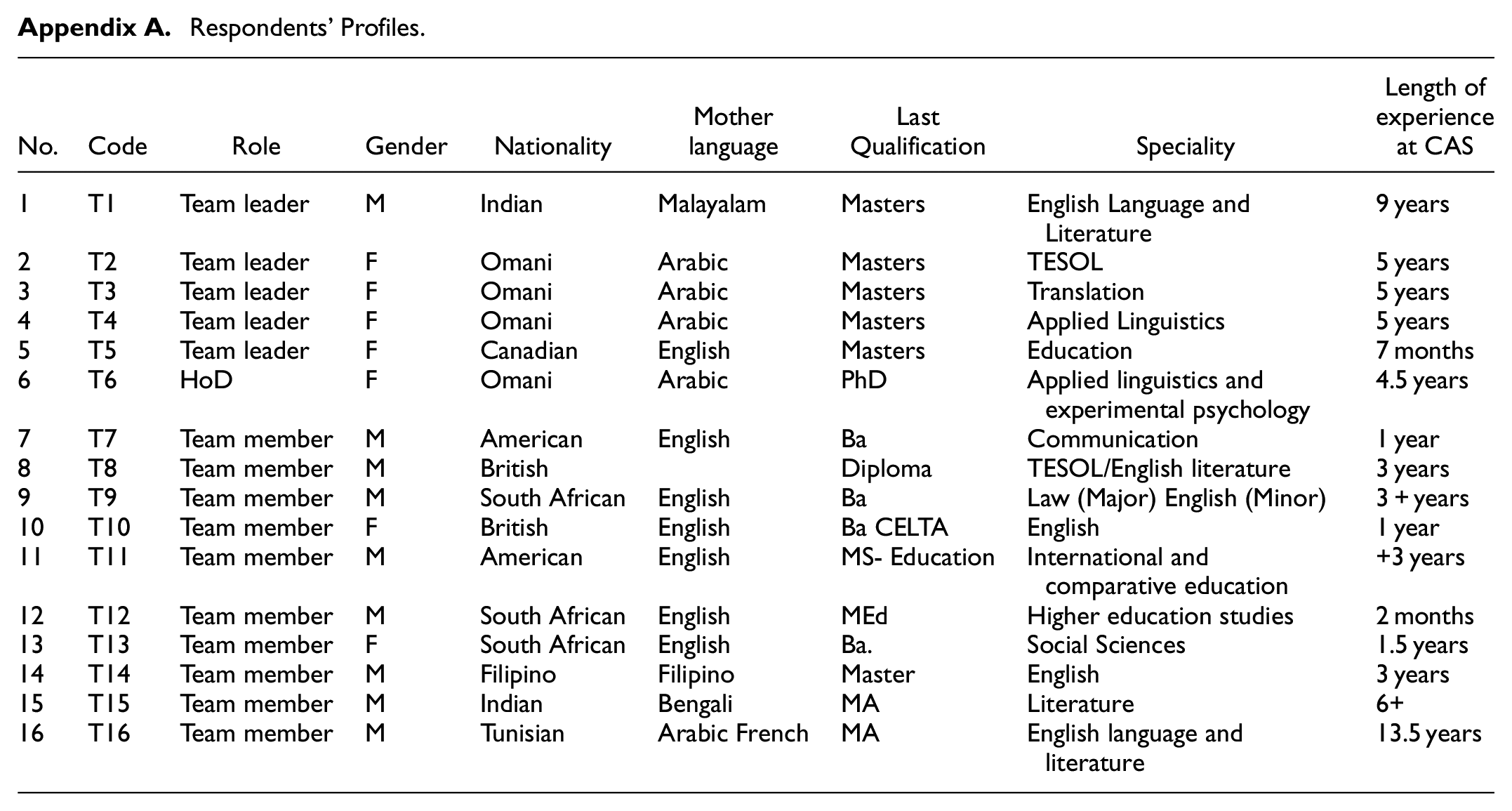
| No. | Code | Role | Gender | Nationality | Mother language | Last Qualification | Speciality | Length of experience at CAS |
|---|---|---|---|---|---|---|---|---|
| 1 | T1 | Team leader | M | Indian | Malayalam | Masters | English Language and Literature | 9 years |
| 2 | T2 | Team leader | F | Omani | Arabic | Masters | TESOL | 5 years |
| 3 | T3 | Team leader | F | Omani | Arabic | Masters | Translation | 5 years |
| 4 | T4 | Team leader | F | Omani | Arabic | Masters | Applied Linguistics | 5 years |
| 5 | T5 | Team leader | F | Canadian | English | Masters | Education | 7 months |
| 6 | T6 | HoD | F | Omani | Arabic | PhD | Applied linguistics and experimental psychology | 4.5 years |
| 7 | T7 | Team member | M | American | English | Ba | Communication | 1 year |
| 8 | T8 | Team member | M | British | Diploma | TESOL/English literature | 3 years | |
| 9 | T9 | Team member | M | South African | English | Ba | Law (Major) English (Minor) | 3 + years |
| 10 | T10 | Team member | F | British | English | Ba CELTA | English | 1 year |
| 11 | T11 | Team member | M | American | English | MS- Education | International and comparative education | +3 years |
| 12 | T12 | Team member | M | South African | English | MEd | Higher education studies | 2 months |
| 13 | T13 | Team member | F | South African | English | Ba. | Social Sciences | 1.5 years |
| 14 | T14 | Team member | M | Filipino | Filipino | Master | English | 3 years |
| 15 | T15 | Team member | M | Indian | Bengali | MA | Literature | 6+ |
| 16 | T16 | Team member | M | Tunisian | Arabic French | MA | English language and literature | 13.5 years |
Declaration of Conflicting Interests
The author(s) declared no potential conflicts of interest with respect to the research, authorship, and/or publication of this article.
Funding
The author(s) disclosed receipt of the following financial support for the research, authorship, and/or publication of this article: This paper is based on a PhD thesis that was funded by the Ministry of Higher Education in Oman and the British Educational Leadership, Management and Administration Society (BELMAS bursary awarded in 2016).
Ethical Approval
This research was granted an ethical approval by the Ethics and Research Governance Online (ERGO) at the University of Southampton, submission No. 23424.
