




Abstract
This study aims to develop a validated scale to measure the sports moral character (SMC) development of Chinese primary and secondary school learners. The primary and secondary indicators in the scale were based on the structural framework of physical education virtues in the “Physical Education and Health Curriculum Standards for Compulsory Education (2022 Edition),” and the measurement questions were designed based on relevant research, 14 senior experts in the fields of school physical education, physical education and training, sport psychology, and ethics assessed the content validity of the scale. The scale consists of three subscales: sports ethics, sports spirit, and sports character, with 33 items embedded in nine dimensions revealed acceptable content validity, internal structure validity, and internal consistency. The SMC scale has a certain degree of scientific validity and reliability and can be used as a valid tool to measure the SMC of primary and secondary school learners.
Plain Language Summary
Sports moral character is an important indicator for cultivating students’ core competencies in physical education class, highlighting the unique functions and values of PE class, and playing an irreplaceable role in human development. Scientific measurement of sport moral character is an important way to develop students’ sports moral character and enrich academic research on sports moral character. After Delphi Method and data analysis, the scale consists of three subscales: sports ethics, sports spirit, and sports character, with 33 items embedded in 9 dimensions, has a certain degree of scientific validity and reliability and can be used as a valid tool to measure the SMC of primary and secondary school learners.
Keywords
Introduction
The implementation of the fundamental task of “cultivating morality and nurturing talents” is a clear requirement for the Chinese school physical education system (Ji, 2022a). In this regard, the Ministry of Education of the People’s Republic of China (2022) issued the Compulsory Education Physical Education and Health Curriculum Standards (2022 Edition; hereinafter referred to as the Curriculum Standards), which underpins countermeasures and programs to cultivate learners’ core competencies in the discipline of physical education and health, and listed sports moral character (SMC) as one of the most significant contents of the core competencies of physical education and health discipline.
Among the key elements of physical education and health competencies, SMC best reflects the unique function and value of physical education, and plays an irreplaceable important role in human cultivation (Ji, 2022b). At the same time, SMC is also a core instrument for testing the effectiveness of school physical education to “cultivating morality and nurturing talents.” In other words, if school sports can realize the objective of “cultivating virtue and cultivating talents,” it is imperative to examine whether or not primary and secondary school learners have formed a good SMC through the learning of the physical education and health curriculum, giving rise to a central research question: How can SMC be effectively measured in compulsory education students?
Regrettably, according to field research and interviews with some primary and secondary school physical education teachers in the compulsory education stage, it was revealed that in the physical education and health teaching curriculum, the evaluation of SMC is mainly based on the subjective evaluation of learners’ classroom performance and attendance, with the simple utilitarian setting of “a good physical education score is a good SMC,” and the evaluation of goal achievement is virtually useless. However, this remarkably affects the accuracy and efficiency of information feedback (S. M. Wang & Xie, 2021). Obviously, the main reason behind this phenomenon is the lack of scientific, systematic, and operable measurement scale.
In view of this, under the multiple contexts of thoroughly implementing the fundamental educational task of “cultivating morality and nurturing talents,” pursuing the development of core competencies in physical education and health disciplines, and the urgent need to quantify moral character evaluation in sports, the development of a qualified and applicable measurement tool for SMC among compulsory education students undoubtedly holds significant theoretical and practical importance.
Literature Review
The Curriculum Standards (2022 Edition) defines the developmental requirements and benchmarks for students’ SMC by outlining its structural framework and evaluation indicators, providing robust theoretical guidance for the development of SMC scales for compulsory education students. However, due to the abstract nature of these indicators and the lack of operationalized measurement items, frontline educators remain unable to quantify comprehensive evaluations of students’ SMC, with most assessments still confined to simplistic and vague theoretical descriptions (S. M. Wang & Xie, 2021).
From a global research perspective, SMC—proposed through extensive surveys, disciplinary feature analyses, reflections on practical issues, and references to international curriculum standards (Ji, 2018; Yin et al., 2020)—represents a core competency in physical education and health education with distinct Chinese characteristics. Consequently, few foreign scholars have explored SMC assessment. Existing international studies primarily focus on developing sports ethics evaluation tools for three groups: elementary students (Sezer et al., 2015), secondary students (Gimeno et al., 2013), and coaches (Bolter & Weiss, 2012). Notably, dimensions such as “respecting opponents,”“adhering to rules,” and “fair competition” in existing sports ethics assessment tools for K-12 students align with the Curriculum Standards (2022 Edition) framework, offering critical references for selecting measurement items in this study.
Domestically, while some scholars (Dai, 2021; Li et al., 2019; Tang, 2019) have investigated SMC assessment, their work exhibits notable limitations. First, evaluation criteria often fail to correspond with the Curriculum Standards (2022 Edition). For instance, Li et al. (2019) categorized SMC indicators into two secondary dimensions—“personal psychology (character)” and “group psychology (benevolence)”—based on Bloom’s taxonomy, diverging significantly from the 2022 standards. Additionally, the absence of specific observational points or measurement items in existing frameworks renders assessment outcomes non-quantifiable. Second, although some studies have developed SMC scales for compulsory education students (Dai, 2021), these primarily rely on the assessment framework established by the General High School Physical Education and Health Curriculum Standards (2017 Edition; hereafter Curriculum Standards 2017 Edition). Comparative analysis reveals discrepancies with the Curriculum Standards (2022 Edition), such as the omission of key indicators: “courage and perseverance” (sports spirit), “respecting referees” and “fair competition” (sports ethics), and “self-esteem/confidence” and “sense of responsibility” (sports integrity).
In summary, existing assessment tools suffer from imprecise indicators, incomplete item coverage, and limited applicability. To address these gaps, this study will develop a SMC assessment tool aligned with the Curriculum Standards (2022 Edition), aiming to provide a scientific, user-friendly, and accurate instrument for evaluating and enhancing SMC among compulsory education students.
Participants and Methods
Participants
The study employed a convenience sampling method to recruit participants from compulsory education institutions. Data collection occurred between December 2 and 18, 2023, across four schools: Binzhou No.1 Experimental Primary School (Shandong Province), Wudi No.2 Junior High School (Shandong Province), Pingtan High School Affiliated to Fujian Normal University (Fujian Province), and Tsinghua University Primary School (Beijing Municipality). Participant eligibility required: (a) regular participation in structured physical activities (≥3 sessions/week), and (b) absence of diagnosed physical or mental health conditions affecting exercise capacity. Questionnaire administration occurred during scheduled physical education classes across all participating institutions.
It should be noted that the selection of these four schools is based on their status as National-level Sports Traditional Demonstration Schools. Such institutions are defined as Sports Traditional Demonstration Schools that (Hui et al., 2016):
Effectively implement quality-oriented education;
Demonstrate outstanding achievements in school sports programs;
Significantly improve students’ physical health standards;
Strictly adhere to the national Physical Education and Health Curriculum Standards;
Develop distinctive student sports activities;
Establish traditions in at least two sports disciplines;
and are jointly designated by educational and sports administrative authorities.
From the initial sample of 1,086 students, 984 valid questionnaires were retained after eliminating invalid responses (exclusion criteria: inconsistent responses to validity check items and incomplete questionnaires ≥20%). The final cohort comprised 512 males (60.7%) and 472 females (39.3%), with grade distribution as follows: fifth grade (13.3%, n = 131), sixth grade (19.2%, n = 189), seventh grade (21.4%, n = 211), eighth grade (27.8%, n = 274), and ninth grade (18.2%, n = 179).
The final sample (n = 984) was randomly split into two equal subsamples using SPSS random case selection function. Subsample 1 (n = 492) served as the calibration sample for item analysis and exploratory factor analysis (EFA) of the SMC Scale. Subsample 2 (n = 492) functioned as the validation sample for confirmatory factor analysis (CFA), with additional psychometric evaluations including internal consistency reliability, convergent validity, and discriminant validity. Educational measurement principles stipulate that scale development requires a 10:1 ratio of sample size to measurement items (Guo et al., 2008; Coe, 2008). Since the initial SMC scale for compulsory education students comprises 45 measurement items, the sample size meets the recommended threshold.
Delphi Method
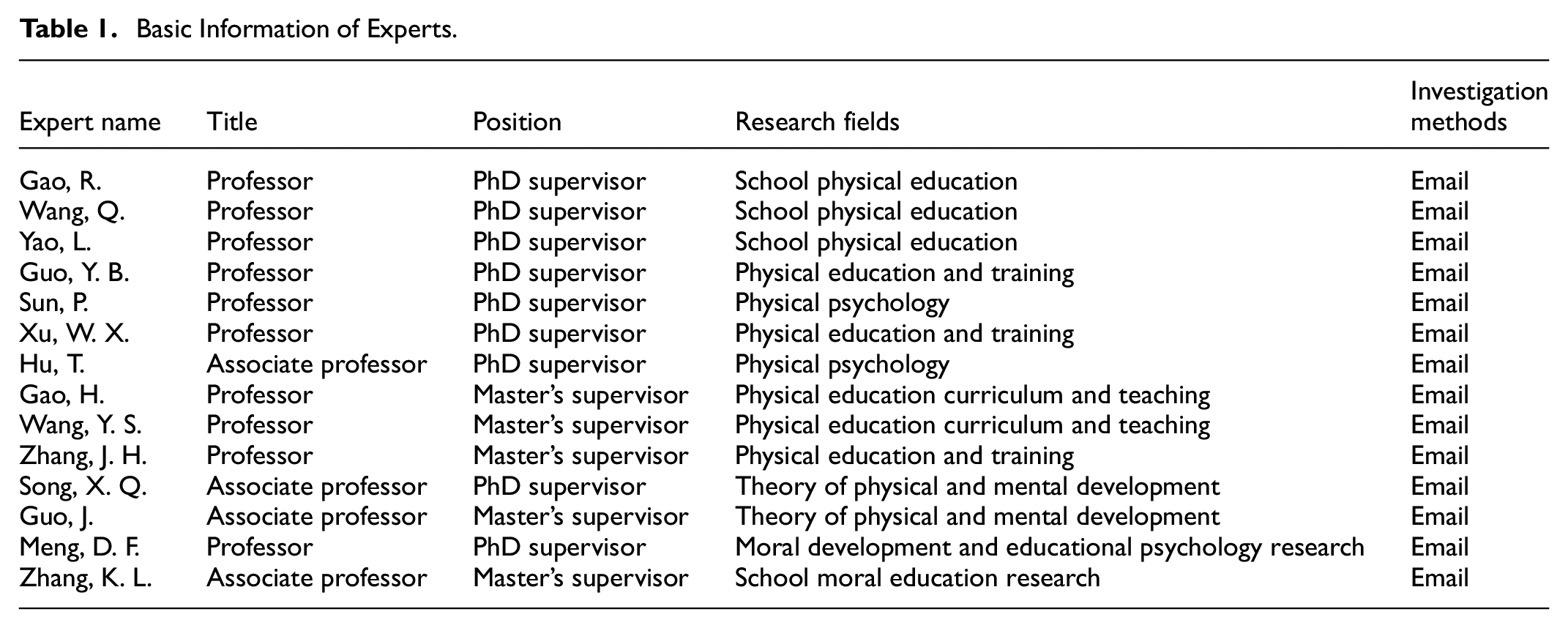
Through three rounds expert survey, this study engaged 14 senior experts in the fields of school physical education, physical education and training, physical psychology, ethics, and other research areas (the information of the experts is shown in Table 1). This took part in to reviewing, enhancing, and evaluating the items of the SMC scale for primary and secondary school learners. This was done in order to ascertain the scientific nature and reliability of the assessment scale for SMC among primary and secondary school learners. The response rate for the three rounds of consultation letters was 100%, with highly active participation from the experts. The expert judgment basis coefficient Ca ranged between 0.8 and 1.0, familiarity coefficient Cs ranged between 0.7 and 1.0, and authority coefficient Cr ranged between 0.8 and 1.0, with an average value of 0.899 indicating a high level of expert authority.
Basic Information of Experts.
Data Analysis
SPSS 27.0 was used to perform item analysis and exploratory factor analysis on the sample I, and to perform reliability and validity tests as well as the calculation of objective weight values and combined weight values on the sample II. Amos 23.0 was used to conduct validation factor analysis on sample II.
Scale Scoring Method
The developed SMC Scale for Compulsory Education Students adopts a 5-point Likert scale, with all items scored on a 0 to 5 point range. Specifically, each item is rated as 5 = Strongly agree, 4 = Agree, 3 = Neutral, 2 = Disagree, 1 = Strongly disagree. The total scale score is calculated by averaging the scores of all items, yielding a 1 to 5 point range. Higher scores indicate stronger SMC development in students.
Development of the SMC Scale for Primary and Secondary School Learners
Rationale and Approach for the Development of the Items of the SMC Scale
The framework of SMC structure is an important premise and basis for developing a measuring scale for learners’ SMC. The “Physical Education and Health Curriculum Standards for Compulsory Education (2022 Edition)” points out that SMC refers to the social behavior norms, sports ethics, and the value pursuit and spiritual outlook formed in sports, which mainly includes sports ethics, sports spirit, and sports character. Among them, sports ethics is mainly embodied in following the rules, respecting the referee, respecting the opponent, honesty and self-discipline, fair competition, and so on. Sports spirit is mainly embodied in the brave and tenacious, proactive, not afraid of difficulties, stick to the end, team spirit, and other aspects; sports character is mainly reflected in self-esteem and self-confidence, civility, consciousness of responsibility, and correct view of outcome (Ministry of Education of the People’s Republic of China, 2022). In view of the authority of this framework, this study is based on the framework of SMC structure in the “Physical Education and Health Curriculum Standards for Compulsory Education (2022 Edition)” to develop SMC scale.
The following four approaches are adopted to collect the assessment items of the SMC scale for primary and secondary school learners: First, drawing on the items of the ethics and character assessment tool in other subject areas, that is, change the context of use and core vocabulary (L. L. Wang et al., 2021). Second, refer to the relevant entries in the “Physical Education and Health Curriculum Standards for Compulsory Education (2022 Edition).” Third, adopting the internationally available sports ethics (Song, 2021) and sports spirit scale items (S. T. Chen et al., 2019). The fourth is based on personal teaching practice experience self-compilation of assessment items. This study finally designed 45 items through the above four approaches.
Pre-Survey of the SMC Scale
In this study, 170 primary and secondary school learners from Pingtan High School Affiliated to Fujian Normal University and Tsinghua University Affiliated Primary School were distributed via convenient sampling method (45 in grade 5, 32 in grade 6, 22 in grade 1, 34 in grade 2, and 37 in grade 3; 87 boys, 83 girls) conducted a pre-survey of the questionnaire to check whether the item expression of the scale was clear, difficult to understand, or had any other problems. Accordingly, the expressions of the item with problems were modified to form the first draft.
Content Validity Test of the SMC Scale
After the compilation of SMC scale items, 14 experts were invited to evaluate all evaluation indicators and items (the first round). The evaluation principles mainly included whether the items were applicable to learners, whether each dimension and item were relatively independent, and whether the items were representative (Meng et al., 2020). In terms of evaluation indicators, eight experts suggested merging “integrity and self-discipline” with “fair competition” in the dimension of sports ethics; twelve experts agreed that the dimensions of “respect for referees” and “respect for opponents” in sports ethics and the dimensions of “civility” in sports character belong to the scope of moral norms, and suggested merging the three dimensions. Ten experts suggested combining “proactive,”“not afraid of difficulties,” and “persevering to the end” in the dimensions of sports spirit; After discussion within the group and access to relevant materials, this study, in accordance with expert opinions, “integrity self-discipline” and “fair competition” are collectively referred to as “integrity and fairness”; “Civility,”“respect for referees,” and “respect for opponents” are collectively referred to as “respect for others” and included in the dimension of sports ethics. The “proactive,”“not afraid of difficulties,”“persevere in the end” collectively referred to as “fight hard”; In terms of measurement items, expert suggestions were adopted to delete two overlapping items in the hard work dimension and one unrepresentative item in the “integrity and fairness” dimension.
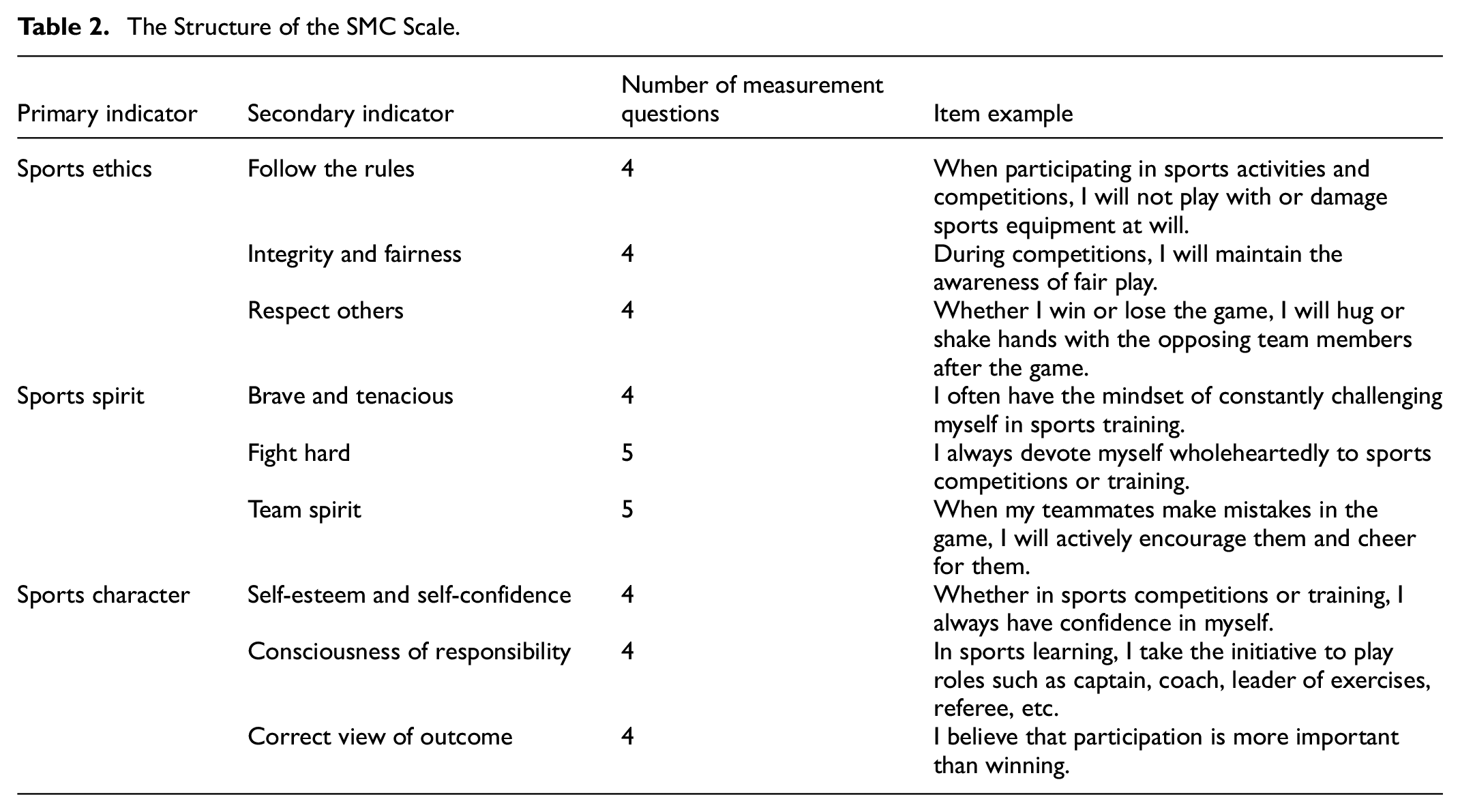
Coefficient of variation (CV) is an important index to measure the degree of coordination of expert opinions. Generally speaking, if the coefficient of variation of the measurement item is greater than or equal to 0.25, it indicates that the degree of coordination of expert opinions of the item is not enough (H. Y. Chen et al., 2018). Therefore, this study compiled the initial SMC scale into a 5-level Likert scale and sent it to 14 experts (the second round). After the questionnaire was collected, the CV was calculated to delete the items. The results showed that the CV of three first-level indexes and nine second-level indexes were all less than 0.25. The CV of the four items 6, 13, 18, and 21 are all greater than 0.25, which indicates that the expert opinions of the above four items are not consistent, so they were eliminated. To sum up, after two rounds of Delphi method, a SMC scale framework consisting of three first-level assessment indicators, nine second-level assessment indicators, and 38 items (as shown in Table 2) was initially formed.
The Structure of the SMC Scale.
Revision of the SMC Scale
Item Analysis
Item analysis is usually carried out by critical ratio (CR) method (also known as extreme decision value method) and total correlation method (Wu, 2010). Firstly, the CR analysis was carried out on 38 items of the initial SMC scale. Specifically, the 38 items were summed and ranked in order of their rank. The first 27% participants were counted as the high group, and the last 27% were counted as the low group. Then an independent sample T-test was conducted for the scores of the same items in the high and low groups. As shown in Table 3, all 38 items reached a highly significant level (p < .001), and CR values were all greater than 3.000, indicating that the 38 items had good discrimination and all met the requirements (Wu, 2010). Secondly, the homogeneity test method is used to analyze the correlation between 38 measurement items and the total score. If the correlation coefficient is less than .4, it means that the individual item has only a low degree relationship with the scale construction, and the homogeneity between the item and the overall scale is not high, so this item should be deleted (Wu, 2010), as can be seen from Table 3. The correlation coefficients of A7 and A18 are both less than .400, so they were deleted. To sum up, after item analysis, 36 items were retained in the SMC scale.
Critical Ratio Value and Correlation Coefficient.

p < .001.
Exploratory Factor Analysis of the SMC Scale
After item analysis, KMO and Bartlett sphericity test were performed on the scale. As can be seen from Table 4, KMO value was 0.958, and Bartlett sphericity test results were χ2 = 5,758.438, df = 795, p = .000. According to Kaiser, the KMO value is above 0.9 and the Bartlett sphericity test reaches .05 significance level, which is suitable for factor analysis (Wu, 2010). Therefore, the above results indicate that the SMC scale is suitable for factor analysis.
Results of KMO and Bartlett Sphericity Test.

Next, principal component analysis and maximum variance tilt rotation method were used to extract factors with feature root values greater than 1, and items were retained and eliminated according to the item judgment criteria proposed by Wu (2010).The results of the first round of factor analysis showed that the commonality of item A14 was lower than 0.20, so it was deleted, and the second factor analysis was performed after the deletion. The results of the second factor analysis showed that the factor load of items A26 and A34 was lower than 0.45, so they were deleted. Then, the third factor analysis is carried out on the SMC scale. The results of the third factor analysis show that the KMO value and the relevant values of Bartlett sphericity test meet the requirements of measurement. At the same time, it can be seen from Table 5 that nine factors with feature root value greater than 1 can be extracted from many common factors by the third factor analysis, and the cumulative variance contribution rate of the nine factors is 73.003%. The gravel diagram is shown in Figure 1.
Results of the Third Exploratory Factor Analysis.


Lithotripsy of the third exploratory factor analysis.
According to the result of factor analysis, the seven factors were named respectively. F1 factor included four items, A1, A2, A3, and A4, and was named “follow the rules.” The F2 factor contains three items A5, A6, and A8, which are named “integrity and fairness”; The F3 factor contains four items A9, A10, A11, and A12, which are named “respect others”; The F4 factor contains three items A13, A15, and A16, which are named “brave and tenacious”; The F5 factor includes four items, A17, A19, A20, and A21, which are named “fight hard”; The F6 factor contains four items, A22, A23, A24, and A25, which are named “team spirit”; The F7 factor includes four items, A27, A28, A29, and A30, which are named “Self-esteem and self-confidence.” The F8 factor contains three items, A31, A32, and A33, which are named “consciousness of responsibility”; The F9 factor contains four items, A35, A36, A37, and A38, which are named “correct view of outcome.”
Confirmatory Factor Analysis of the SMC Scale
According to the results of exploratory factor analysis and the theoretical concept of the structural framework of SMC in the early stage, this study used sample II to build a first-order nine-factor structural model (M1) as shown in Figure 2 and second-order three-factor structural model (M2) as shown in Figure 3. The maximum likelihood estimation method in Amos 23.0 was employed to test and compare the two competing models. Following Bollen & Stine’s (1992) recommended bootstrapping approach, iterative adjustments to the χ2 values of both models revealed that all post-adjustment fit indices—including the χ2/df ratio (chi-square to degrees of freedom), CFI (Comparative Fit Index), GFI (Goodness-of-Fit Index), RMSEA (Root Mean Square Error of Approximation), AGFI (Adjusted Goodness-of-Fit Index), TLI (Tucker-Lewis Index), RMR (Root Mean Square Residual), AIC (Akaike Information Criterion), and BIC (Bayesian Information Criterion)—met established benchmarks (see Table 6). Both models demonstrated acceptable fit, with M2 exhibiting superior goodness-of-fit indices compared to M1. Therefore, based on the consideration of the optimal solution, this study selects the second-order three-factor structure model, and the fitness index shows that the SMC scale has good structural validity.

Structure model of SMC (M1).

Structure model of SMC (M2).
Results of Confirmatory Factor Analysis.

Note. (1) χ2/df ratio: Optimal range 0–3 (values <5 are acceptable); (2) RMSEA: <0.05 (excellent), <0.08 (good); (3) AGFI, CFI, TLI: >0.90 (excellent; Wen et al., 2004); (4) RMR, AIC, BIC: Lower values indicate better model fit.
Reliability Test of SMC Scale
In this study, the main indicators of reliability test are: internal consistency (Cronbach α coefficient) and retest reliability (also known as “diachronic stability”). Among them, the retest reliability test time and sample were as follows: after 2 weeks, 100 primary and secondary school learners were randomly selected from sample I and sample II by convenient sampling method. As shown in Table 7, the Cronbach α coefficient of the total SMC scale was 0.883, and the internal consistency coefficients of the three subscales were 0.893, 0.875, and 0.848, respectively. The retest reliability correlation coefficient of the total SMC scale was .841 (p < .01), and the retest reliability correlation coefficient of the three subscales ranged from .821 to .859 (p < .01). It is generally believed that the internal consistency coefficient between 0.8 and 0.9 indicates that the scale has stable internal consistency, ICC >.80 indicates that the retest reliability is excellent, and .61 to .80 indicates that the reliability is good (Wu, 2010). Therefore, the above results indicate that the SMC scale has good reliability and stability.
Results of Reliability Test.

p < .01.
Validity Test of SMC Scale
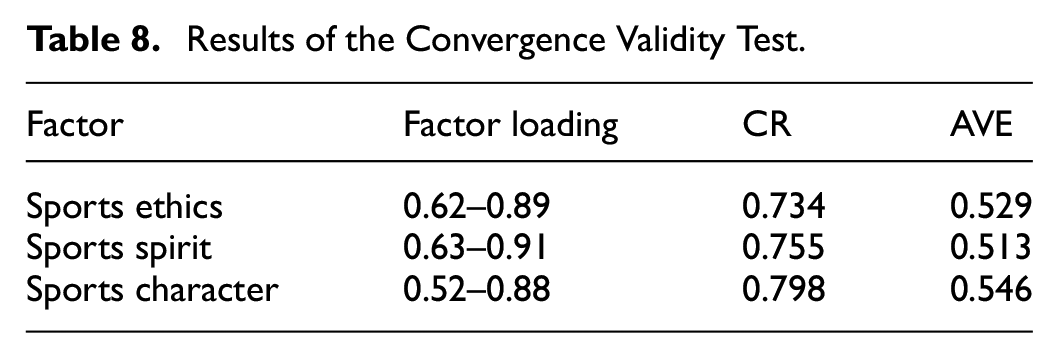
In this study, the main test indexes of validity are content validity and convergence validity. In terms of content validity, this study invited 14 senior experts to evaluate the correlation between the item and its corresponding evaluation indicators. Through calculation, the content validity index S-CVI of the SMC scale is 0.868, and the content validity index I-CVI of the measurement item level is between 0.812 and 1.000, with an average value of 0.853. It is generally believed that I-CVI is not less than 0.78 and S-CVI is not less than 0.8, indicating that the content validity of the scale is good (Robert, 2018). Therefore, the above results indicate that the SMC scale has good content validity. In terms of convergence validity, after testing, the standard factor loading (Estimate) of all items of the SMC scale is greater than 0.500; The mean variance extraction AVE of the three subscales of sports ethics, sports spirit, and sports character was 0.529, 0.513, and 0.546, respectively, and the combined reliability (CR) was 0.734, 0.755, and 0.798, respectively (see Table 8). Wu (2010) pointed out that the scale has good convergence validity only when the following three criteria are met at the same time: (1) the standard factor loading (Estimate) is greater than 0.500; (2) Mean variance extraction (AVE) is greater than 0.500; (3) Combined reliability (CR) is greater than 0.700. Therefore, the above results indicate that the physical character scale of primary and secondary school learners has good convergence validity.
Results of the Convergence Validity Test.
Discussion
Structure Analysis of the SMC Scale
The SMC scale consists of three subscales: sports ethics, sports spirit, and sports character. Among them, sports ethics focuses on ethical rules (Yin, 2019), including follow the rules, integrity and fairness, and respect others. Follow the rules means that primary and secondary school learners following the rules and regulations of physical education classroom teaching and competition rules during physical exercise or competition (Shao et al., 2019); Integrity and fairness means that primary and secondary school learners uphold the principles of honesty and trustworthiness, justice and fairness in physical exercise or competition; Respect others refers to primary and secondary school learners’ respect for the personality of others in physical exercise or competition (Yin, 2019). Sports spirit focuses on the shaping human spirit (Shao et al., 2019), including brave and tenacious, fight hard, and team spirit. Brave and tenacious means that primary and secondary school learners show the mentality of not afraid of difficulties and challenging themselves in physical exercise or competition; The purpose of fight hard is to show that primary and secondary school learners strive to make progress in physical exercise or competition and maintain a willingness to keep moving forward; team spirit means that primary and secondary school learners should show the spirit of mutual cooperation and mutual support in physical exercise or competition. Sports character focuses on character (Shao et al., 2019), including self-esteem and self-confidence, consciousness of responsibility, and correct view of outcome. Consciousness of responsibility refers to a relatively stable psychological quality of primary and secondary school learners to actively take responsibility (X. Chen & Li, 2022); Correct view of outcome refers to the correct understanding, attitude and views of primary and secondary school learners on the results of sports competitions (Shao et al., 2019).
In view of the fact that the scale of SMC of primary and secondary school learners in the stage of compulsory education is still in its infancy, compared with previous studies, the scale structure of physical morality of primary and secondary school learners developed in this study, first, adds observation points of each dimension, so that the evaluation of SMC of primary and secondary school learners can be quantified. Second, in terms of the scale dimension, nine new dimensions were generated: follow the rules, integrity and fairness, respect others, brave and tenacious, fight hard, team spirit, self-esteem and self-confidence, consciousness of responsibility, correct view of outcome, which to a certain extent supplemented the existing studies and improved the richness and comprehensiveness of evaluation indicators. Third, some SMC, such as brave and tenacious, fight hard, self-esteem and self-confidence, have intrinsic recessive characteristics, which can only be manifested through the careful design and situational induction of specific sports situations. Situational assessment method can easily measure the intrinsic recessive sports virtues, and has good reliability and validity (S. M. Wang & Xie, 2021). In this regard, this study sets up certain situations in the process of compiling measurement items, which not only improves the reliability and validity of measurement tools to a certain extent, but also forces physical education teachers to adopt teaching methods or teaching models of moral literacy cultivation. On the whole, the structure of SMC scale developed in this study is more in line with the requirements of the Physical Education and Health Curriculum Standards for Compulsory Education (2022 Edition). At the same time, the addition of observation points is also a refinement of the evaluation indicators of SMC established in the Physical Education and Health Curriculum Standards for Compulsory Education (2022 Edition), which increases the feasibility and operability of the evaluation.
The SMC Scale has Certain Scientificity and Applicability
The development of assessment tools necessitates systematic indicators as foundational elements (Fan & Song, 2019). The scientific validity of evaluation criteria directly determines the methodological rigor of assessment instruments. The Curriculum Standards (2022 Edition) provides robust theoretical grounding for the SMC Scale for Compulsory Education Students through its established structural framework. Building upon this framework, this study integrates insights from domestic and international measurement tools while incorporating practical teaching experience to formulate initial measurement items. Following pilot testing, ambiguous or problematic items were revised based on participant feedback to enhance readability and comprehensibility, resulting in a preliminary scale draft. To ensure criterion accuracy and scientific robustness, two rounds of Delphi expert consultation were conducted for qualitative evaluation. Expert feedback informed revisions to assessment indicators, including linguistic refinement of item phrasing and elimination of flawed questions. Guided by psychometric principles—where item analysis aims to verify the appropriateness and reliability of individual scale items (Wu, 2010)—this study implemented critical ratio analysis, item-total correlation analysis, and principal component analysis for quantitative item screening. This multi-method approach ensured comprehensive evaluation of items from diverse perspectives while maintaining psychometric quality (Sun & Bao, 2011). Exploratory factor analysis (EFA) was conducted to identify latent factor structures and establish construct validity (Wu, 2010). Through principal component analysis, the complex interrelationships among variables were synthesized into three core factors, effectively distilling the multidimensional construct of SMC.
Confirmatory factor analysis (CFA) is primarily employed to assess the model fit and construct validity of the scale (Wu, 2010), and the results show that all the fit indexes of the second-order three-factor structure model are in line with the standard values, which indicates that the SMC scale has good structural validity. It should be noted that compared with other competitive models, this study chose the second-order three-factor structure model for the following reasons: (1) From the perspective of methodology, when both the first-order model and the second-order model have a better degree of fitting, the higher-order model is considered to explain and replace the lower-order model according to the criteria of minimization and optimal solution of the model (Wen et al., 2004). (2) From a data-analytic perspective, empirical studies indicate that when multiple models meet acceptable thresholds for fit indices—including the χ2/df ratio, CFI, GFI, RMSEA, AGFI, and TLI—the optimal model can be selected using RMR, AIC, and BIC (Kline, 2005). As shown in Table 6, the second-order three-factor structural model (MI) demonstrates lower RMR, AIC, and BIC values compared to the first-order nine-factor structural model (M2), confirming its superior parsimony. (3) From a theoretical point of view, the theoretical construction of the above structural framework also supports the existence of this higher-order construct.
After that, the reliability and validity of the SMC scale were examined, and the results showed that the internal consistency reliability, retest reliability, content validity, and convergent validity were all in the ideal value range. The internal consistency coefficient was high mainly because most of the measurement items in this study were based on personal teaching practice experience, that is, rooted in reality, and matched the survey group. The retest reliability coefficient is high, that is, the consistency across time is good, indicating that the scale has good stability. The convergent validity index meets the desirable value, indicating that SMC can be well predicted and measured by the three primary indicators, nine secondary indicators, and 33 measurement items.
Moreover, latent characteristics of SMC—such as courage, self-confidence, proper perspectives on winning/losing, and teamwork—cannot be directly measured or evaluated due to their inherently implicit nature, and must be assessed indirectly through observable contextualized behaviors. Empirical studies confirm that implicit sports moral traits require carefully designed sport-specific scenarios to manifest (S. M. Wang & Xie, 2021). Scenario-based assessment has proven effective in evaluating such latent constructs with strong reliability and validity. Accordingly, this study incorporated scenario-based methodologies during item development, thereby enhancing the psychometric properties of the measurement tool. The latent nature of SMC and the application of scenario-based assessment provide critical pedagogical implications: When using this scale, physical education teachers should construct authentic, naturally occurring scenarios that students may encounter in sports contexts. Examples include: resolving disputed referee decisions during soccer matches; addressing controversial judgments in martial arts competitions; and demonstrating sportsmanship when facing significant score deficits in basketball games. By embedding these value-conflict scenarios—whether retrospectively recalled or real-time occurrences—educators can elicit students’ implicit moral reasoning. Subsequent evaluations should integrate multi-method approaches (e.g., behavioral observation, self-assessment, peer evaluation) to ensure comprehensive and authentic assessments of SMC (S. M. Wang & Xie, 2021).
Although the SMC scale is rooted in China’s Curriculum Standards (2022 Edition), its three-dimensional framework (sports spirit, sports ethics, sports integrity) offers a transferable model for global moral education research. When implementing this scale across diverse cultural contexts, dual adaptation strategies should be considered: (1) Contextual substitution of sport-specific scenarios (e.g., martial arts competitions) with culturally predominant activities (e.g., rugby in Commonwealth nations) while preserving the scale’s core dimensions; (2) Item modification through collaborative engagement with local educators to reconcile cross-cultural value systems, ensuring psychometric integrity during transcultural validation processes.
To summarize, the above research methodology and operation process have good theoretical scientificity, which provides an important guarantee for the scientificity and reliability of the SMC scale. In other words, the SMC scale can provide physical education teachers with tools and theoretical basis for effectively assessing the current situation of SMC of elementary and middle school learners and accurately formulating strategies to promote the development of SMC of elementary and middle school learners.
Practical Implications of the SMC Scale
Amid the deepening implementation of the fundamental task of “cultivating morality and nurturing talents,” the assessment of SMC has emerged as a critical research priority. This study holds threefold practical implications.
First, the current lack of validated assessment tools has hindered comprehensive understanding of SMC development among compulsory education students. By adhering to educational measurement principles in scale development, this research has produced a reliable and valid SMC Scale, effectively addressing the measurement gap in this domain.
Second, national policy documents—including the Overall Plan for Deepening Educational Evaluation Reform in the New Era (CPC Central Committee and State Council, 2020a) and the Guidelines on Comprehensively Strengthening and Improving School Physical Education in the New Era (CPC Central Committee and State Council, 2020b)—emphasize holistic approaches to physical education assessment. However, China’s traditional evaluation practices have been plagued by reductionist tendencies, disproportionately focusing on physical fitness and technical skills while neglecting moral development (Mao, 2019) This scale fills a critical void in China’s physical education assessment system, advancing the comprehensive competency evaluation framework central to ongoing basic education reforms (Chen et al., 2021).
Third, the ideological-political construction of physical education curricula—a cornerstone initiative for realizing the “cultivating morality” mandate and embedding core competencies in sports education—requires transforming physical education into a dual vehicle for physical cultivation and moral development. Current pedagogical practices, however, exhibit imbalanced emphasis on technical instruction over value cultivation (Hu, 2022). Implementing this scale in physical education classrooms can incentivize teachers to integrate moral education elements, develop dual-focus pedagogical models that synergize physical training with character building, and enable organic infusion of ideological-political components into sports instruction. Thus, the tool serves as both an assessment instrument and a catalyst for curricular reform, promoting the latent educational power of sports to shape students’ moral landscapes.
Limitations and Future Research
The deficiencies in this study included the following: On one hand, constrained by human resources, material support, and time availability, the research adopted convenience sampling—selecting students from limited regions and National-level Sports Traditional Demonstration Schools. The limited sample size, restricted geographical coverage, and potential sampling biases may compromise result precision and hinder the scale’s broader application. Future studies should employ systematic sampling and stratified sampling methods to expand sample diversity and size, thereby refining and validating the SMC Scale to enhance its generalizability. On the other hand, the authoritativeness of evaluation criteria might be affected by the limited disciplinary backgrounds and expertise of consulted experts. Subsequent research should expand the expert sample size and enhance disciplinary diversity to ensure the scientific rigor and representativeness of assessment indicators. Additionally, based on the structural framework of SMC in the Physical Education and Health Curriculum Standards for Compulsory Education (2022 Edition), this study mainly adopts the top-down approach to the research idea to obtain the measurement items of the SMC scale, and although the items have a certain degree of scientific validity and applicability, this idea often results in the collection of information that is not comprehensive. Therefore, subsequent research can improve the content of the items by opening the door and practicing in depth (e.g., using semi-structured interviews with front-line physical education teachers and primary and secondary school learners), so that the SMC scale can better serve the development of SMC of primary and secondary school learners.
Conclusion
The SMC scale consists of three subscales: sports ethics, sports spirit, and sports character. The sports ethics scale consists of three dimensions and eleven items: follow the rules, integrity and fairness, respect others; the sports spirit scale consists of three dimensions and eleven items: brave and tenacious, fight hard, team spirit; and the sports character scale consists of three dimensions and eleven items: self-esteem and self-confidence, consciousness of responsibility, correct view of outcome. The SMC scale has a certain degree of scientific validity and reliability, and can be used as a measurement tool for the SMC of elementary and middle school learners in China. The SMC scale has dual functionality as both a diagnostic instrument for classroom practice and a policy-responsive metric for systemic educational reform.
Footnotes

Ethical Considerations
The studies involving human participants were reviewed and approved by the Ethics Committee of Beijing Sport University on 5 March 2024. Before conducting testing and distributing survey questionnaires, each participant would receive an informed consent form. If the participants confirmed that they agreed to participate in the survey, they would continue to fill in the questionnaire; If not, the participant would immediately stop responding.
Consent to Participate
We confirmed that all research was performed in accordance with Declaration of Helsinki, and we obtained informed consent from all participants.
Funding
The author(s) received no financial support for the research, authorship, and/or publication of this article.
Declaration of Conflicting Interests
The author(s) declared no potential conflicts of interest with respect to the research, authorship, and/or publication of this article.
Data Availability Statement
The data can be obtained through corresponding author.