




Abstract
South Korea’s elite-centric sports policy, rooted in the ideology of modern nationalism, is currently undergoing a transitional phase as it clashes with the emerging principle of the “fundamental right to sport.” In this context, the purpose of this study is to establish an academic foundation for understanding the reality of elite-centric sports policies in South Korea. Although elite sports policies have been subject to considerable criticism and debate, little effort has been made to examine its policy reality. Accordingly, this study systematically investigates (1) cases of national sports resource (budget) allocation, (2) the systems and legal foundations implemented to promote elite sports, and (3) identifies key issues surrounding elite sports policies. In conclusion, this study provides a multidimensional analysis of the reality of elite-centric sports policies and offers policy implications based on the findings. South Korean sports policy must now respond to the evolving ideological demand for the “fundamental right to sport,” a process that will inevitably involve intense debates and political conflicts. It is essential to critically reflect on the elite-centric sports policies that have long guided national strategies and to explore future policy directions within broader social and historical contexts.
Introduction
Traditionally, the academic community has maintained a somewhat adversarial relationship when addressing elite sports policy as a research topic. One perspective criticizes the nation’s policy inclination toward elite sports. This discussion emphasizes the allocation of a significant portion of finite policy resources—understood here primarily as financial budgets—to elite sports and their stakeholders (such as student-athletes, professional or semi-professional athletes, national team members, coaches, and administrative personnel), along with the resulting adverse effects.
The other perspective advocates for elite sports policy. This argument focuses on the efficiency and effectiveness of such policies, viewing elite sports through frameworks like the trickle-down model or the virtuous cycle model. In other words, this perspective prioritizes the promotion of elite sports under the rationale that it can enhance the sports industry, including grassroots sports, foster social integration, and strengthen national competitiveness.
However, prior to engaging in the intense debates surrounding elite sports policy, the academic community has been relatively inattentive to systematically analyzing and substantiating the “reality” of elite sports policy. Here, “reality” refers to the material world that exists objectively, independent of human consciousness, as opposed to “ideation,” which is consciously conceived (Philosophy Dictionary Compilation Committee [PDCC], 2023). In fact, many scholars tend to interpret “reality” from an idealistic perspective (PDCC, 2023). This study originates from a critical awareness of the fact that previous research on elite-centered sports policies has often approached the subject idealistically rather than endeavoring to grasp the objective reality of these policies.
In this study, the term elite sports policy refers to a policy orientation that prioritizes high-performance athletics and national prestige over mass participation. Using Hood’s (1983) policy instrument theory, such policies can be analyzed through their reliance on specific tools—financial resources (e.g., budget allocations favoring elite athletes), legal measures (e.g., selection and reward systems), and organizational structures (e.g., centralized sports governance)—to target a narrow group of elite athletes rather than the general public.
Let us consider a few examples. Myung (2024) identified elite-centered sports policy as the guiding direction of South Korea’s sports policy and derived various issues as outcomes of such a policy. However, despite critically reflecting on elite-centered sports policy and proposing future directions, certain gaps remain. Specifically, the study proceeds without presenting the objective fact that central and local governments have allocated policy resources primarily to elite sports. Similarly, previous studies share this limitation. For example, research that highlighted the similarities in policies under the Third and Fifth Republics to report nationalist elite sports policies (Lee et al., 2001), studies that pointed out entrenched elite sports policies and their issues during the 1960s–70s (Lee, 2005), and research that traced the origins of politically dependent sports today to past elite sports policies (Lim & Huh, 2009) all fail to concretely present the process of “policy resource (budget) allocation.” This logical flaw leaves room for counterarguments from stakeholders in elite sports, particularly advocacy groups.
It is now essential to move beyond the idealistic perspective that South Korea’s sports policy is skewed toward elite-centered priorities and to engage in intellectual efforts to accumulate evidence and establish its reality. This study seeks to address the logical flaws in the aforementioned prior research and provide a foundation for future research that will continue to develop. Moreover, the findings of this study can also serve as evidence to further support the critical reflections and discussions on elite sports that have been accumulated through numerous studies to date.
In other words, this study aims to verify the actual direction of sports policy through evidence on budgets and legal systems. While earlier studies emphasized ideological critique, this research focuses on providing empirical evidence for the material reality of policy implementation.
To verify the direction of elite sports policy as a national policy, two major questions must be addressed. First is the question of whether an elite-centered sports policy truly exists. It is necessary to examine whether elite-centered sports policy has indeed served as the primary direction or foundation of national sports policy. Through this process, the academic basis for elite-centered sports policy can be established, enabling subsequent discussions—whether critical or supportive. To this end, the following section examines cases of resource allocation in sports policies by analyzing data on budgets and policies from the government, local governments, and sports organizations.
Second is the reality of elite-centered sports policy as reflected in its implemented systems and initiatives. Policy, as defined by the government or relevant authorities, is a broad and somewhat abstract concept. Therefore, the direction of a specific policy area can be assessed by examining the systems and initiatives implemented in practice. Accordingly, the third section explores the key “systems” implemented to promote elite sports, along with their legal foundations, or “legislation,” that provided the basis for their execution.
In summary, the purpose of this study is to verify the reality of elite-centered sports policy by examining the allocation process of national sports resources (budget), the implemented systems, and their legal foundations. While South Korea’s elite-centered sports policy has been frequently asserted and criticized in numerous prior studies, its concrete substance and supporting evidence remain inadequately addressed. This lack of evidence poses a barrier to expanding and enhancing the persuasiveness of discussions on elite sports policy.
To address this, the study aims to: (1) analyze cases of national sports resource (budget) allocation, (2) examine the systems (or initiatives) implemented to promote elite sports and their legal foundations, thereby identifying elite sports policy as a “policy direction.” Based on these findings, (3) the study diagnoses current issues related to elite-centered sports policy and draws policy implications.
The Cases of National Sports Resource (Budget) Allocation
Budgets serve as an important reference for understanding the policy direction and priorities of governments and local governments. The budgeting system refers to the process through which a country establishes its medium- and long-term goals and plans, that is, policies, and allocates and executes budgets accordingly (Park & Kim, 2021). A typical example is the performance-based budgeting system, which is useful for implementing already established policies (or projects), while the planning budget system helps in combining long-term policy formulation with short-term budget allocation, thereby facilitating rational decision-making and resource distribution (Bae & Yoo, 2005). In this way, the budget provides a useful analytical framework for understanding the policy direction and priorities of specific organizations.
Therefore, in order to understand the policy direction (or orientation) of a specific field, it is essential to closely examine the allocation of its budget. In other words, the distribution of sports budgets provides insight into the direction of South Korea’s sports policy. According to the Ministry of Culture Sports and Tourism (MCST, 2023), South Korea’s sports resources are primarily composed of (1) tax-based national treasury (government), (2) local funding (provincial and municipal governments), (3) fund-based projects (Korea Sports Promotion Foundation), and (4) self-generated funds from sports organizations. This study examined how sports resources have been allocated across various policy areas in order to verify the reality of elite-centered sports policy. The policy areas mentioned are generally categorized into sports for all, elite sports, international sports, sports industry, and sports for people with disabilities. In the case of local governments, additional areas such as workplace (elite) sports teams and sports facilities are also included (MCST, 2023).
Budget Allocation for Sports Resources by Policy Area
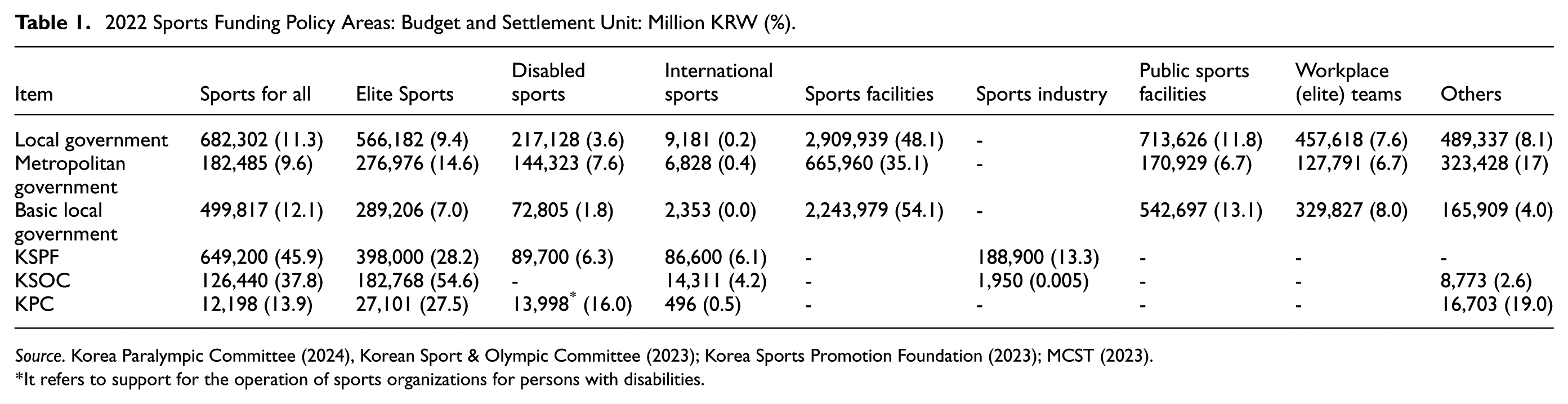
First, local funding from provincial and municipal governments. As of 2022, the total sports budget for local governments (provincial + municipal) amounts to 6.45 trillion KRW, with the budget allocation for each policy area as follows: sports facilities + public sports facility management fees (3,623,565 million KRW), sports for all (682,302 million KRW), elite sports (566,182 million KRW), others (489,337 million KRW), workplace (elite) sports team operations (457,618 million KRW), sports for people with disabilities (217,128 million KRW), and international exchanges (9,181 million KRW; MCST, 2023).
When examining local funding, it is important to distinguish between the overall local government budget (provincial + municipal) and the budgets for provincial and municipal governments individually, as the allocation varies across policy areas. For example, when considering the total local funding (provincial + municipal), sports for all (11.3%) receives a higher proportion than elite sports (9.3%). However, when broken down by the 17 provincial governments, elite sports (14.6%) takes a higher share than sports for all (9.6%). Therefore, local funding should be analyzed separately for the overall local government budget and for provincial and municipal governments, as detailed in Table 1.
2022 Sports Funding Policy Areas: Budget and Settlement Unit: Million KRW (%).
Source. Korea Paralympic Committee (2024), Korean Sport & Olympic Committee (2023); Korea Sports Promotion Foundation (2023); MCST (2023).
It refers to support for the operation of sports organizations for persons with disabilities.
Second, the funds from the Korea Sports Promotion Foundation (KSPF). As of 2022, the total amount of funding from the National Sports Promotion Fund is 1.4124 trillion KRW, with the distribution by sector as follows: sports for all (649.2 billion KRW), elite sports (398 billion KRW), sports industry (188.9 billion KRW), sports for people with disabilities (89.7 billion KRW), and international sports (86.6 billion KRW) (KSPF, 2023).
According to recent disclosures, from 1989 to 2023, a total of 17.96 trillion KRW has been allocated, including 6.9222 trillion KRW for sports for all, 4.8938 trillion KRW for elite sports, 5.1134 trillion KRW for the development of international sports and the sports industry, 926.1 billion KRW for sports for people with disabilities, and 104.5 billion KRW for other youth development and Olympic commemorative projects (KSPF, 2024).
Third, the self-generated funds of sports organizations. In this study, the financial statements of Korean Sport & Olympic Committee (KSOC) and the Korea Paralympic Committee (KPC) are examined as representative examples. Domestic sports organizations allocate and distribute their budgets by policy areas (e.g., sports for all, elite sports, international exchanges) using their funds, while their self-generated revenues (profits) are solely used for other operational expenses. Therefore, in order to understand the budget allocation by policy area within sports organizations, it is necessary to review the overall financial statements, including funds.
In 2022, the KSOC allocated its funds as follows: elite sports (18.2768 billion KRW), sports for all (12.644 billion KRW), international exchanges (1.4311 billion KRW), others (877.3 million KRW), and the sports industry (195 million KRW; KSOC, 2023). Similarly, the KPC allocated its funds as follows: elite sports (2.7101 billion KRW), support for the operation of disability sports organizations (1.3998 billion KRW), sports for all (1.2198 billion KRW), others (1.6703 billion KRW), and international exchanges (49.6 million KRW; KPC, 2024).
In summary, on the surface, it may appear that the national sports funding, or sports policy, is not concentrated on either sports for all or elite sports. However, a closer examination of the detailed nature of budget items and the actual beneficiaries reveals that many projects are allocated with a focus on elite sports. For instance, in the case of local government funding, the “Workplace (elite) Sports Team Operating Expenses” item is listed separately, but it can effectively be interpreted as part of “elite sports.” When the budgets for these two policy areas are combined, it becomes apparent that a larger portion of the local government budget is allocated to elite sports, both in total and across regional and municipal governments. The items for “international exchanges” and “sports for people with disabilities” should also be understood within the same context.
Comparison of Expected Benefit Per Policy Beneficiary for Sports for All and Elite Sports Funding
Furthermore, it is important not to overlook the fact that policy allocation cannot be judged solely by the total budget amount. What should not be missed is the amount of policy resources (i.e., budget) allocated to each individual beneficiary. In other words, it is necessary to assess budget allocation based on the estimated benefit per policy target individual.
The calculation of the estimated benefit per policy target individual is as follows: the total population of elite sports policy beneficiaries is defined as the sum of registered athletes, coaches, referees, and athlete managers under the Korea Sports Association. For sports-for-all, the total population is based on the number of residents registered in the national census by Statistics Korea. According to Article two of the National Sports Promotion Act, “elite sports” refers to athletic competitions conducted by athletes, and “athletes” are limited to those officially registered with sports organizations. At this point, children and youth (under age 19) and the elderly (over age 60) are excluded from the sports-for-all policy population, as sports policies targeting these age groups are not solely governed by the Ministry of Culture, Sports and Tourism but are managed in conjunction with other ministries such as the Ministry of Health and Welfare and the Ministry of Education (Jung, 2023; Park et al., 2021).
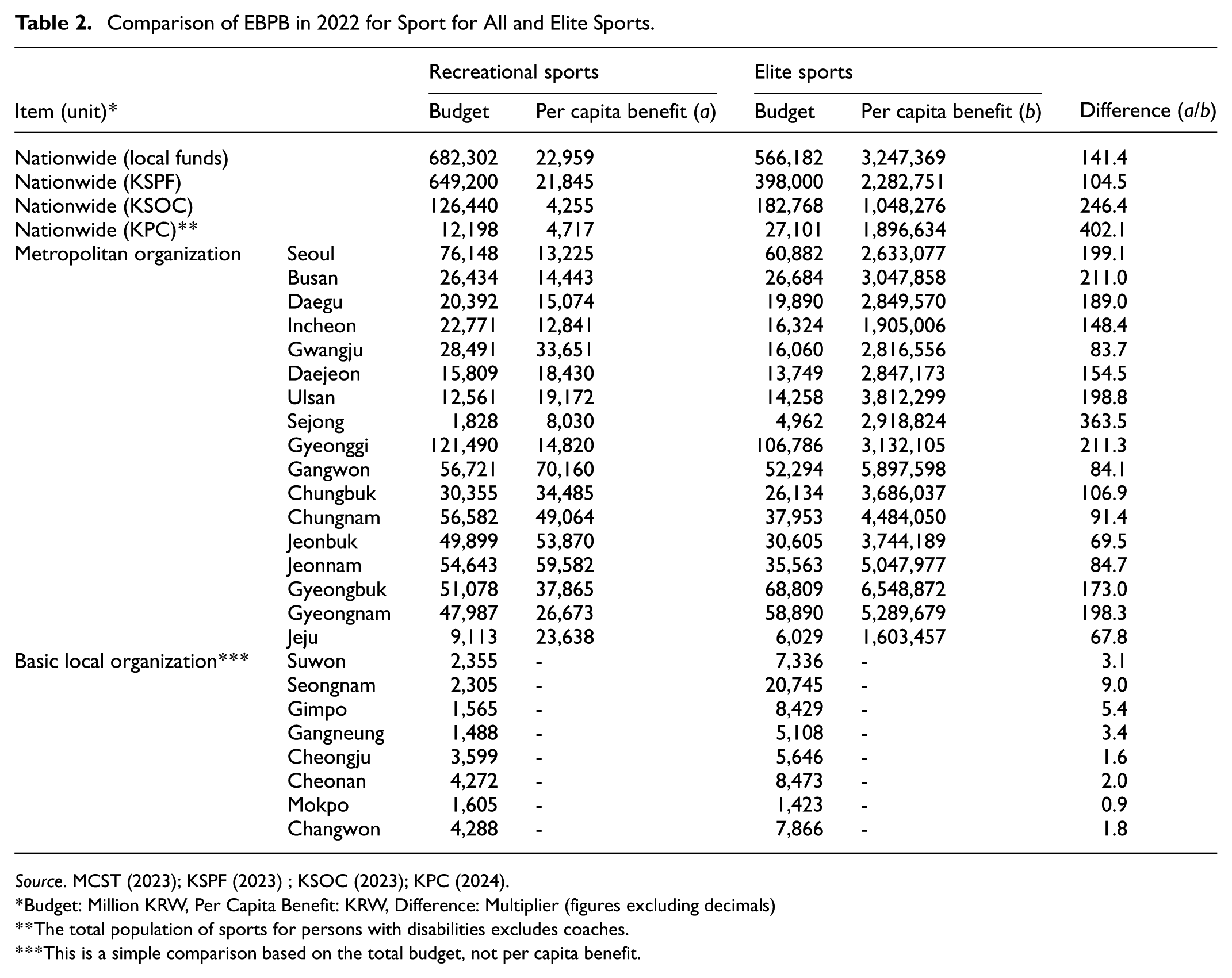
Using this method, sports policy budgets at both the national and local (metropolitan and municipal) levels can be disaggregated based on the population in each region. As of 2022, the total population of sports-for-all policy beneficiaries nationwide (based on local government funding) was 29,717,873, and the corresponding budget allocation was 682,302 million KRW, resulting in an estimated benefit of 22,959 KRW per person (KOSIS, 2025; MCST, 2023). In contrast, the total number of elite sports policy beneficiaries was 174,351 (comprising 140,043 athletes, 25,627 coaches, 8,362 referees, and 319 athlete managers), and the allocated budget for elite sports (excluding corporate teams) was 566,182 million KRW, resulting in an estimated benefit of 3,247,369 KRW per person (MCST, 2023; Sports Support Portal, 2024).
Table 2 compares the estimated benefit per policy target individual between sports-for-all and elite sports. While the total budget allocations may appear similar at first glance, a closer look at the per capita benefit reveals a significant disparity.
Comparison of EBPB in 2022 for Sport for All and Elite Sports.
Source. MCST (2023); KSPF (2023) ; KSOC (2023); KPC (2024).
Budget: Million KRW, Per Capita Benefit: KRW, Difference: Multiplier (figures excluding decimals)
The total population of sports for persons with disabilities excludes coaches.
This is a simple comparison based on the total budget, not per capita benefit.
When comparing the estimated benefit per policy target individualat the national level, it becomes evident that significantly more policy budget is allocated to elite sports than to sports for all: approximately 141.4 times more from local government funding, 104.5 times more from special funds, 246.4 times more from general sports organizations, and 402.1 times more from disabled sports organizations.
A breakdown by metropolitan regions reveals a similar trend. Compared to sports for all, the policy budget for elite sports was approximately 199.1 times higher in Seoul, 211.0 times in Busan, 189.0 times in Daegu, 148.4 times in Incheon, 83.7 times in Gwangju, 154.5 times in Daejeon, 198.8 times in Ulsan, 363.5 times in Sejong, 211.3 times in Gyeonggi, 84.1 times in Gangwon, 106.9 times in Chungbuk, 91.4 times in Chungnam, 69.5 times in Jeonbuk, 84.7 times in Jeonnam, 173.0 times in Gyeongbuk, 198.3 times in Gyeongnam, and 67.8 times in Jeju. These figures clearly demonstrate a disproportionate allocation of policy funding favoring elite sports.
An interesting observation is that, in some basic local governments, even when considering the total budget (rather than the EBPB), a significant portion of the budget has been allocated to elite sports. Notably, places such as Seongnam (9 times), Gimpo (5.4 times), Gangneung (3.4 times), Suwon (3.1 times), Cheonan (2 times), Changwon (1.8 times), Cheongju (1.6 times), and Mokpo (0.9 times) have allocated more budget to elite sports. These local governments share the common feature of operating municipal professional sports teams. The reasons behind this will be explored in more detail in the following section.
It can be confirmed that national sports resources, both at the national level and at the level of metropolitan and local governments, are allocated with a focus on elite sports. This has been reported in several previous studies. Y. S. Lee (1999) examined the budget allocation for various programs by the Sports Bureau of the central government in 1988 and found that the allocation ratio between elite sports and sports for all was 6:1, which is contrary to the practice in developed countries, where the ratio of sports for all to elite sports typically ranges from 1:2 to 1:6. H. J. Lee (2003) reported that 80.7% of the general account sports budget was allocated to elite sports, indicating that the government prioritizes elite sports in its policy. K. H. Han (1994) pointed out that, based on the budget execution of sports administrative organizations in the 1980s and 1990s, the budget was heavily focused on elite sports, particularly the development of outstanding athletes.
A key point of focus in this study is that the difference in the EBPB is quite substantial. Therefore, it has been confirmed that the national sports resources (budget), which is the first research question of this study, are primarily allocated to elite sports policies. In the following chapter, we will examine the systems and legal foundations that have driven elite sports policies to further confirm their existence.
The Reality of Elite-Centered Sports Policy: Implemented Systems and Legal Foundations
This chapter examines the relevant systems and initiatives introduced to promote elite sports. While the UN’s Sport for All principle (Article 1 of the International Charter of Physical Education and Sport) emphasizes the universal right to physical activity, the South Korean Act on sports interprets this right within a development-oriented and institutional framework that remains largely elite-centered. Although there are various systems and initiatives, due to space limitations, the focus will be on the following: the Sports Talent Program (school sports clubs, training camps, National Youth Sports Festival, special university entrance examinations), the Military Service Exemption Program, the Olympic Pension System, the Establishment and Operation of Workplace Sports Teams, the Establishment and Operation of Professional Sports Teams, the National Team Athletes’ Village Program, and the Establishment and Operation of National Military Sports Units. The legal foundations for these systems and initiatives include the “National Sports Promotion Act,”“Sports Welfare Act,”“Higher Education Act,”“Military Service Act,”“Local Government Regulations,” and the “Military Sports Units Regulation.”
To strengthen the methodology, we conducted a policy text analysis of the National Sports Promotion Act. Keyword frequencies (e.g., “national prestige,”“international competitiveness”) were tracked across all 16 amendments from 1971 to 2023, revealing a consistent emphasis on national image and elite performance. Furthermore, applying policy network theory, we mapped the interdependence of major actors including the Ministry of Culture, Sports and Tourism, the Korea Sport & Olympic Committee, and regional governments. These actors form a tightly coupled resource network, which reinforces elite-oriented priorities. The following Table 3 presents the main systems and legal foundations implemented to promote elite sports.
Key Systems and Legal Foundations for the Promotion of Elite Sports.

First, the Sports Talent Program. The Sports Talent Program was legally established on November 9, 1972, under Article 69 of the “Enforcement Decree of the Education Act.” Currently, it refers to a university admission process under Article 34 of the “Higher Education Act,” specifically the “special admission category within the quota.” This admission process involves the use of criteria such as participation in sports events/competitions or achievements in these areas, including past performance or awards, as part of the eligibility or selection process.
The Sports Talent Program is premised on the special university admission process for student-athletes, and it has led to the development of related systems and programs to achieve this goal. Representative examples include the “Sports Talent Special Admission for University Entrance,”“School Sports Teams,”“Student-Athlete Training Camps,” and the “National Youth Sports Festival.” In 1972, the South Korean government introduced the special university admission system for student-athletes to allow them to focus solely on training and competition, rather than the standard educational curriculum (Han, 2009; Park & Kim, 2017). Through this system, student-athletes in school sports teams were exempt from the regular school curriculum, enabling them to gain admission to higher-level schools (secondary and university) based solely on their athletic performance (competition results; Myung, 2017). As a result, this system led to the institutionalization of training camps for youth and adolescent athletes, fostering inhumane and uneducational training environments, such as 6-day training weeks with four daily sessions (Kim, 2011; Lee, 2015). The state chose school sports teams as a means to cultivate elite sports talent and created an environment that allowed student-athletes to focus entirely on training.
Secondly, the Military Service Exemption Program. While the previously discussed Sports Talent Program aims to cultivate potential national athletes, or talent (student-athletes), the Military Service Exemption Program serves as a reward for the morale and motivation of national athletes. The legal foundations for the Military Service Exemption Program was established after the implementation of the “Law on Special Regulations for Military Service Obligations” on April 3, 1973, and its integration with the “Special Measures Law on Punishments for Violations of Military Service Law” on February 28, 1984 (Son, 2011). This program allows athletes who achieve third place or higher in the Olympic Games or first place in the Asian Games to substitute their military service with service as art or sports personnel. Through this system, national athletes, particularly male athletes, were highly motivated to participate in and win international competitions. It has been confirmed that approximately 1,000 athletes have benefited from the Military Service Exemption Program (Jeon, 2024, June 4).
Third, the Olympic Pension System. Similar to the previously discussed Military Service Exemption Program, the Olympic Pension System was introduced to improve the performance and ensure the livelihood stability of national athletes, and it is commonly referred to as the “Sports Pension.” The system began with the establishment of Article 14, Section 5 of the “National Sports Promotion Act” on January 22, 1971, which stipulated that “the state shall provide a living allowance to athletes who have retired after winning medals in the Olympic Games, in accordance with Presidential Decree.” Following several amendments, the system was formally enacted and implemented under Article 8 of the “Sports Welfare Act” on August 10, 2021. According to Article 8, “The state may provide welfare benefits such as prize money, medical expenses, and scholarships as prescribed by Presidential Decree to national athletes and coaches for the purpose of improving athletic performance and ensuring livelihood stability.” According to Article 13 of the Enforcement Decree of the same law, national athletes or coaches of national athletes who win medals in the Olympic Games, Asian Games, World Championships, World University Games, Deaflympics, or any other competitions recognized by the Minister of Culture, Sports and Tourism are eligible to receive performance-based prize money. In addition to performance-based prize money, other types of support, such as living allowances and educational grants, are also provided.
Fourth, the establishment and operation of workplace sports teams. On January 22, 1971, the introduction of Article 9 to 2 of the “National Sports Promotion Act” stipulated that “workplaces as designated by Presidential Decree must establish (elite) sports teams for at least one sport and employ sports coaches.” Initially, this was applied to “workplaces as designated by Presidential Decree,” but in 1993, the scope was expanded to include “government-invested institutions under the Government Investment Institutions Management Act,” and as of 2024, it has further expanded to include “public institutions as designated by Presidential Decree under the Public Institutions Act.” This legal framework essentially provided the basis for the national government and all local governments to establish and operate workplace sports teams. According to Article 10, Section 4 of the “National Sports Promotion Act,” it is specified that “public institutions as defined under the Public Institutions Act and workplaces as designated by Presidential Decree must establish and operate sports teams for at least one sport and employ sports coaches.” Furthermore, it is stipulated that “the mayor, county head, or district head is responsible for the guidance and supervision of workplace sports.”
For example, Haenam-gun in Jeollanam-do operates a workplace (elite) sports team based on the “Haenam-gun Office Workplace Sports Team Installation and Operation Ordinance.” According to Article 1 of the ordinance, “the purpose of this ordinance is to define necessary matters regarding the establishment and operation of Haenam-gun Office workplace sports team, in accordance with the provisions of Article 10 of the ‘National Sports Promotion Act.’” In this context, the workplace sports team refers to a sports team composed of athletes registered with sports organizations affiliated with the Korean Sports Association. In Haenam-gun, based on Article 3 of the ordinance, the county has established and operates athletics and fencing sports teams. In this regard, most metropolitan and local governments operate workplace sports teams, or elite sports teams, funded by taxes.
Fifth, the establishment and operation of professional sports teams. The Korean professional sports leagues were launched as part of the Fifth Republic’s “3S Policy” aimed at mass control, with the professional baseball league starting in 1982 and the professional football league in 1983. However, the legal foundations for local governments to establish professional sports teams, stipulated in Article 16 of the “National Sports Promotion Act,” was amended and enacted in 1998. While workplace sports teams, as discussed earlier, correspond to teams directly managed by local governments, professional sports teams are independent legal entities. Therefore, professional sports teams can be established and operated not only by local governments but also by private corporations. Professional sports leagues, formed by professional sports teams, belong to the market sector rather than the public sector. Nevertheless, local governments in South Korea continue to establish and operate professional sports teams (as foundations) in accordance with Article 16 of the “National Sports Promotion Act.”
For example, Suwon City in Gyeonggi Province operates the K-League team Suwon FC in accordance with the “Suwon City Ordinance on the Establishment and Operation of the Suwon FC Foundation.” Specifically, Article 1 of the ordinance states that the Suwon FC Foundation was established to contribute to the sound development of professional football, the promotion of regional sports, and the harmony of citizens. According to Article 5 of the ordinance, the specific operations include managing and supporting Suwon FC, running youth football programs, promoting the region, engaging in sports marketing, establishing and executing comprehensive plans for operating a professional citizen-owned club, and conducting other revenue-generating activities to cover the foundation’s expenses. An important aspect of the foundation’s establishment is its funding sources. Article 6 of the ordinance specifies that funding comes from Suwon City’s contributions, private donations, revenue from its own income-generating activities, and other sources of income. As of 2024, 15 out of the 25 professional football clubs participating in the K-League (first and second divisions), or 60%, are operated by local governments as public teams. It is not an exaggeration to say that local governments play a central role in the composition of the professional football league.
Sixth, the National Team Athletes’ Village program. The construction of the Taerung Athletes’ Village began in 1966, but the legal foundations for this initiative, Article 33 of the National Sports Promotion Act, was established in 1982. According to Article 33, Section 1 of the National Sports Promotion Act, “The Korea Sports & Olympic Committee (KSOC) shall be established with the approval of the Minister of Culture, Sports and Tourism,” and its business and activities include “programs for the training and development of athletes, as well as projects to improve athletic performance and promote elite sports.” This provision serves as the legal foundation for the National Team Athletes’ Village program.
The National Team Athletes’ Village in South Korea is a program under the KSOC aimed at developing elite athletes. It began with the establishment of the Taerung Athletes’ Village in 1966, under the objective of “promoting national prestige and achieving national unity through sports.” Currently, the country operates several facilities, including the Jincheon National Team Athletes’ Village, the Pyeongchang Winter Training Center, and the Taebaek Athletes’ Village. The specific activities of this program include nurturing national team athletes, reserve athletes, and promising youth, providing systematic and scientific training for national athletes, and achieving excellent results in international competitions such as the Olympics (KSOC, 2024).
As of 2021, the total expenditure of the Korea Sports & Olympic Committee (KSOC) was 353,568,501,785 KRW, with approximately 29%, or 102,315,149,456 KRW, allocated to the elite athlete development program (KSOC, 2022). In other words, about 30% of the KSOC’s budget is allocated to the National Team Athletes’ Village program. Additionally, the Athletes’ Village program is classified as a public interest project.
Seventh, the establishment and operation of the National Military Sports Units. The National Military Sports Units Regulation (National Military Sports Units Act) was enacted and implemented by presidential decree on December 29, 1983, and the National Military Sports Units were established in January 1984. According to Article 1 of the National Military Sports Units Regulation, “The National Military Sports Units shall be established under the Ministry of National Defense to research and develop doctrines for improving the physical fitness of military personnel, and to identify and train athletes with sports talents, thereby contributing to strengthening military combat capabilities.”
The National Military Sports Units are a Ministry of National Defense initiative aimed at preventing career interruptions caused by military service for male elite athletes, with a primary focus on maintaining and enhancing athletes’ performance. According to the Korea Armed Forces Athletic Corps (2024), key projects for 2023 included supporting defense sports, fostering national elite athletes, and promoting international sports exchanges. As of 2024, the National Military Sports Units operate in 25 sports, and eligibility for athlete support is limited to active-duty service members who are not disqualified under Article 10 of the Military Personnel Act and who are registered with sports organizations affiliated with the Korea Sports Council or professional sports organizations. In other words, male elite athletes are the primary target of this program. Athletes selected for the National Military Sports Units are guaranteed the opportunity to train and participate in competitions during their military service, allowing them to maintain their careers as athletes. This constitutes a significant benefit when compared to the general public, who experience temporary career interruptions due to the obligation of military service.
In summary, both the central government and local governments have implemented school sports teams and the sports talent system as means to nurture elite sports talent. The adult athletes discovered within this system were able to maintain their athletic performance and earn a livelihood through workplace (elite) sports teams and professional sports clubs operated by local governments. Notably, male athletes who were subject to mandatory military service were able to maintain their athletic careers through the National Military Sports Units. Among them, athletes selected for the national team had the opportunity to prepare for international competitions at the National Team Athlete Village, while being motivated for top-level achievements through the Olympic Pension System and Military Service Exemption Program. This elite sports talent development system effectively illustrates the reality of Korea’s elite-centered sports policy, specifically the programs and legal foundations that support it.
The Issues and Policy Implications of Elite-Centered Sports Policy in Korea
Earlier, we examined the allocation of policy resources tilted toward elite sports, as well as the systems (programs) and legal foundations that have been implemented through these resources. In other words, we have comprehensively addressed the central question of this study regarding the existence of an elite-centered sports policy. Building on this, this chapter aims to diagnose the issues facing the elite-centered sports policy and discuss its policy implications.
Ideological Conflict: Sports Nationalism versus Sports Fundamental Rights
From the perspective of sociology of health, the elite-centered allocation of sports policy resources can be critically assessed using the concept of “social determinants of health” (WHO, 2008). This framework emphasizes that health outcomes are shaped not only by individual behaviors but also by structural conditions—such as access to recreational facilities, income level, and educational opportunities. In this context, the prioritization of elite sports over sports-for-all limits the health-enhancing potential of physical activity for the general public, particularly among socially marginalized populations.
Furthermore, international charters such as UNESCO's 'International Charter of Physical Education, Physical Activity and Sport' (2024) and WHO's (2024) “Sport for All” initiative assert that access to sport is a fundamental human right. This right-based perspective challenges the ethical validity of policy frameworks that disproportionately favor elite athletes. Public funding, drawn from taxes, should be allocated with regard to public benefit, health equity, and justice.
This study incorporates theoretical frameworks from health sociology by introducing the WHO (2008)’s concept of “social determinants of health” and the principle of sport as a “fundamental human right” as articulated by WHO (2024) and UNESCO (2024). These frameworks are essential for analyzing the structural health impacts of elite-centered sports policy.
This aligns with Daniels (2007) argument that fairness in health policy requires a just distribution of opportunities to be healthy, which must guide public resource allocation, including in sport.
The elite-centered sports policy is not unique to South Korea. It was part of a broader historical and international trend through which modern nation-states strengthened nationalism via sports (Hobsbawm, 1992; Maguire, 2011). The result of projecting modern nationalist ideologies onto sports is the elite sports policy. Mega-sporting events, such as the Olympics and the World Cup, served as key platforms where modern states showcased their national competitiveness and hierarchized their positions. In this context, the 1936 Berlin Olympics have been regarded as the epitome and pinnacle of “sports nationalism.”
However, since the modern era, the ideology of sports nationalism and its practical implementation through elite sports policies began to fade. In Western countries, particularly in Europe and North America, critical reflection and re-conceptualization of sports values emerged. The state-driven elite sports policies, which had channeled policy resources toward a minority (elite athletes), were increasingly seen as marginalizing public sports participation. Particularly, the values of sports were redefined, shifting from nationalism ideals such as national prestige, national competitiveness, and patriotism, to recognizing them as fundamental human rights related to citizens’ leisure, culture, happiness, and quality of life. This transformation became visible as the new ideological movement and social movement known as “Sport for All” (Da Costa & Miragaya, 2002). The “Sport for All” movement marked a significant turning point in sports values and sports policy in the international community (UNESCO, 2024; WHO, 2024).
Public policies that involve national resources (tax revenue) must be premised on public interest. In this context, the decline of the ideology of sports nationalism demands a critical reflection on the “public interest” of elite sports policies. In the past, the ideology of nationalism prioritized the state over the individual, but the modern ideology of “Sport for All”—the era of basic sports rights—prioritizes the sports rights of individuals (the public). This raises questions about the “public interest” of elite sports policies. Interestingly, as identified in this study, the budget allocation centered around elite sports and various systems (programs) aimed at promoting elite sports are premised on public interest. However, policies for a minority of elite athletes do not provide a clear answer regarding their public interest. Unlike in the past, it is now difficult to definitively claim that the victory of national teams takes precedence over the individual’s right to enjoy sports.
As such, the elite “centered” sports policies identified in this study conflict with the modern ideology of “Sport for All.” This is because public policies continue to view the value of sports within the framework of nationalism. In fact, for a long time, South Korea has defined sports as a means of national prestige through the National Sports Promotion Act, which has been the primary sports law. The elite sports policies, as revealed in this study (Chapter 3), were also introduced based on the legal foundation of the National Sports Promotion Act.
However, national sports policies can no longer oppose the modern ideology of “Sport for All,” that is, the right to sports as a fundamental human right. In 2021, the Sports Basic Act was enacted, and around the same time, the term “national prestige” was removed from Article 1 (Purpose) of the National Sports Promotion Act. These legal amendments represent a significant event that reflects social consensus and agreement on the ideology of sports as a fundamental right. It is now time for “sports policy” to align with the modern ideology and the Sports Basic Act. Sports should be redefined as a fundamental right of citizens, and the policy resources that have been skewed toward elite sports should be reallocated to focus on mass sports (sports for all).
Political Conflict: Elite Sports versus Sports Innovation (Sports for All)
Can the shift toward a policy centered on mass sports (sports for all) be achieved solely through the enactment of the Sports Basic Act? To put it simply, the answer is no. Sports, like any other domain, is inherently political. A sports policy free from political influence does not exist. In this context, the proposed policy shift toward realizing sports as a basic right inevitably involves political conflict. A power struggle between interest groups of elite sports and sports for all will be unavoidable due to the limited nature of policy resources.
South Korea has maintained an elite-centered sports policy for a long period. At the same time, elite sports have held the hegemony in the policy-making process and were able to assert dominance in decision-making. In other words, elite sports have retained their vested interests in the policy decision-making process. A representative interest group of elite sports in South Korea is the KSOC. Through various historical events, the KSOC has grown into a large organization that oversees school sports (formerly the Korea School Sports Association), sports for all (formerly the Korea National Sports for All Association), and elite sports (KOC). Additionally, it manages the sports associations of cities, provinces, and districts, as well as member sport organizations. Furthermore, as identified in Chapter 2, unlike the distribution of national and local government funds and other subsidies, organizations like the KSOC and the KPC allocate a significant portion of their policy resources (budgets) to elite sports. In other words, the “priority” policy focus of the KSOC is elite sports.
On the other hand, a social discourse around “sports innovation” was formed to realize the era’s ideology of sports as a basic right and improve elite sports. The central government and the “Sports Innovation Committee (SIC)” can be seen as the practical agents of this discourse. In February 2019, the South Korean government launched the SIC to reform the sports sector, and the committee has made seven recommendations, including improvements to the elite sports system, the establishment of a sports welfare society, sports for all, normalization of school sports, and the protection of athletes’ rights (MCST, January 22, 2020). The focus of these recommendations lies in improving the problems within the elite sports system while emphasizing the public’s right to sports, that is, “sports as a basic right.”
In summary, at a broader level, the central government (MCST and SIC) and sports organizations (KSOC and related interest groups) are in conflict over their respective interests in sports for all and elite sports. On the surface, both groups share the policy goal of advancing national sports, but their methodologies reflect two different philosophies and approaches: the sports for all theory (pyramid model) and the elite sports theory (trickle-down effect model). The conflicts between the SIC and elite sports stakeholders in 2019, as well as the disputes between the MCST and the KSOC surrounding the 2024 Paris Olympics, can also be understood in this context. On August 22, 2019, the KSOC took a critical stance toward the recommendations of the SIC, which had been announced in seven stages, and simultaneously expressed its position on financial autonomy and reform through a petition signed by 2.2 million elite athletes and a resolution rally (KSOC, 2019). Furthermore, recently, the MCST and the KSOC have been embroiled in conflicts over issues such as the formation of the National Sports Policy Committee, the execution of sports for all budgets, and the revision of the KSOC’s bylaws.
This study holds both timeliness and academic significance within the context of the political conflicts (issues) and trends discussed. As mentioned in the introduction, only by confirming the existence of the elite-centered sports policy as a policy direction can we move on to the next phase of discussion, whether it be criticism or defense. By examining the allocation of policy resources that have historically been tilted toward elite sports, this study has provided an opportunity to critically review the outcomes of the elite-centered sports policy. In other words, it has laid the academic foundation for understanding the existence of the elite sports policy and, at the same time, has established the “basis for the debate.” In the same context, the “paradox of elite-centric sports policy” (Myung, 2024), to be explored in the next section, can offer a potential resolution to the conflicts between the two interest groups.
The Unintended Consequences: The Paradox of Elite Sports Policy
Another critical issue lies in the ethical implications of elite-centered policies. Public funds, drawn from taxpayers, are expected to serve the broader public interest. When policy resources disproportionately benefit a small population of elite athletes, they may inadvertently undermine the rights and opportunities of marginalized groups to access sport. This raises ethical concerns regarding distributive justice and the obligation of governments to ensure fair and equitable access to health-promoting activities. Therefore, an ethical framework must be adopted to evaluate whether current policy priorities align with the principles of social equity and public health.
Figure 1 summarizes the results of the elite-centered sports policy as compiled by Myung (2024). In brief, the elite-centered sports policy has led to issues such as player supply and demand, poor working conditions, and inadequate research and development infrastructure, all of which threaten the sustainability of the elite sports ecosystem. In other words, the unintended consequence and paradox of the elite sports policy is that it has made elite sports and athletes even more disadvantaged.

The paradox of elite-centric sports policy in Korea.
The closed structure of school sports has caused the isolation of student-athletes and disrupted the talent pool, leading to a development system that is anti-human rights and non-educational. This has not only led to a large number of dropouts but has also been a major factor contributing to the social maladaptation of retired or prematurely dropped-out athletes.
On one hand, while a small group (student-athletes, professional athletes, and coaches) monopolizes sports policy resources, public sports have been marginalized in the policy framework, which has negatively impacted the public’s demand for sports. The issue is that the low demand for sports from the public diminishes the market value of spectator and participatory sports industries, which ultimately affects elite athletes and physical education majors, who are the primary workforce in these markets. In fact, issues regarding the employment and treatment of elite athletes and physical education majors remain difficult to resolve.
As a result, the social maladaptation problems of retired (or prematurely dropped-out) athletes and poor working conditions have led to player supply issues, closely tied to demographic changes in South Korean society. Additionally, the low market value of the spectator and participatory sports industries has led to decreased demand for physical education majors, negatively impacting the competitiveness of sports science and the sports industry. Ultimately, the elite-centered sports policy isolates the elite sports sector and its stakeholders.
Figure 1 offers important implications for subsequent research related to sports policy. Above all, it provides a new perspective and imaginative approach to the “conflict between the two stakeholder groups (elite sports and sports innovation)” discussed in the previous section. In particular, this study provides an academic foundation for the discussion in Figure 1 and calls for a critical examination of elite sports policy. The establishment and accumulation of such academic evidence are significant in that they can promote not only active debates between the two stakeholder groups (elite sports and sports innovation) but also multifaceted discussions within the academic community.
Conclusion
Today, South Korean sports are experiencing a paradigm shift and the accompanying policy transition. For a long time, the elite-centered sports policy, which viewed the value and utility of sports from the perspective of modern nationalism, is now clashing with the new ideological framework of “sports as a basic human right,” causing growing pains. This has led to political conflicts between the elite sports stakeholders, who have held the hegemony over sports policy, and the groups advocating for sports innovation. The process of reallocating limited policy resources for “Sport for All,” or the public’s right to engage in sports, inevitably triggers such conflicts.
In this context, this study aimed to accumulate academic evidence regarding the reality of the elite-centered sports policy and to lay the groundwork for subsequent discussions in both academia and practice. While there has been considerable criticism and debate surrounding the elite sports policy, little attention has been paid to examining the actual “reality of the policy.” This logical gap has impeded the advancement of discussions (or debates). This awareness of the issue led to the necessity of this study.
The reality of the elite-centered sports policy can be confirmed through the “allocation of budgets (how sports policy resources have been distributed)” and the “implemented systems and legal foundations (what and why sports policy resources have been directed toward certain initiatives).” In this context, this study reviewed the allocation of national sports resources by categorizing them into local government funding (basic and metropolitan governments), funds (Korea Sports Promotion Foundation, KSPF), and sports organizations (Korea Sports Council, KSOC, and Korea Paralympic Committee, KPC). The results confirmed that a significant portion of sports policy resources is allocated to the elite sports sector. Notably, when considering not only the total budget but also the perspective of the EBPB, there is a substantial disparity between the budgets for elite sports and sports for all.
Next, upon examining the systems (projects) introduced to promote elite sports, the study identified the Sports Talent Program (school sports clubs, training camps, National Youth Sports Festival, special university entrance examinations), the Military Service Exemption Program, the Olympic Pension System, the establishment and operation of workplace sports teams, the establishment and operation of professional sports teams, the National Team Athletes’ Village Program, and the establishment and operation of national military sports units. The legal foundations for these systems (projects) include the “National Sports Promotion Act,”“Sports Welfare Act,”“Higher Education Act,”“Military Service Act,”“Local Government Regulations,” and the “Military Sports Units Regulation.”
In conclusion, this study critically examined South Korea’s elite sports policy by analyzing its ideological underpinnings, legal framework, and budget allocation priorities. The analysis revealed that the current elite-centered approach often overlooks broader public health concerns and issues of equity. To address this imbalance, we recommend realigning future sports policies with international norms and the principle of the “fundamental right to sport,” thereby ensuring that all citizens—not only elite athletes—benefit from public investment in sports.
Future research should continue to scrutinize national sports policy, critically reflecting on its ideological foundations and exploring potential avenues for reform. As South Korea confronts the emerging paradigm shift toward recognizing sport as a basic human right, the country will inevitably face political debates and tensions over the direction of its sports policy. In this context, it is crucial to re-evaluate the longstanding elite-centered framework from multiple perspectives and consider alternative models within a broader social and historical framework. In particular, establishing a robust scholarly foundation for shifting the policy emphasis from elite sports to mass participation sports—anchored in the concept of the fundamental right to sport—will be essential for guiding meaningful and inclusive policy transformation.
Therefore, future research should emphasize that mass sports (sports for all) policies ultimately contribute to the sustainability of elite sports. Ironically, the elite-centered sports policy identified in this study has had the unintended effect of isolating elite sports stakeholders and undermining their own ecosystem (W. Myung, 2024). In other words, policies designed to benefit elite sports have paradoxically worsened their long-term viability. To support both elite sports and mass participation, it is essential to reframe sports policy around the principle of the “fundamental right to sport.”
In this context, future studies should also examine how elite-centered budget allocations impact health outcomes in underserved communities. Reduced access to local physical activity programs may negatively affect the physical and mental well-being of low-income or rural populations. As the global paradigm shifts toward the “Sport for All” ideology, South Korea’s policy framework must adapt to prioritize inclusive participation and health equity.
To build an evidence-based foundation for such reforms, we recommend that future research adopt mixed-method approaches, combining in-depth interviews with athletes and policymakers with quantitative analyses of regional sports participation and public health data. These methods can help empirically assess how budget disparities influence access to sport and health outcomes for marginalized groups.
As Powers and Faden (2006) emphasize, public health policy must be rooted in social justice rather than utilitarian efficiency. Likewise, resource allocation in sports should be evaluated based on whether it ensures fair opportunities for all—not just benefits a privileged few.
Footnotes

Funding
The authors disclosed receipt of the following financial support for the research, authorship, and/or publication of this article: This research was funded by Hanshin University.
Declaration of Conflicting Interests
The authors declared no potential conflicts of interest with respect to the research, authorship, and/or publication of this article.
Data Availability Statement
All data used in this study were obtained from published sources, which are fully cited in the References.