




Abstract
The effects of armed conflict on women in post-conflict situations are an area of analysis for social disciplines. This study will analyze the situation in Colombia, currently involved in a peace restoration process. The aim is to verify the efficacy of a coping and emotion regulation program analyzing victimization as well as the coping strategies employed in response to these violent acts. The program focuses on 62 women contacted through the Ruta Pacífica de las Mujeres, a nongovernmental organization. The program had a positive effect on women, reporting lower levels of posttraumatic stress, more functional coping strategies, and less use of dysfunctional strategies. All emotional cognitive and social indicators improved. Women felt emotionally better, perceiving greater social support and more trust in institutions. Survivors had more self-confidence to achieve their goals and solve their problems. The implications in a context of peace reconstruction and search for social cohesion are discussed.
Keywords
Introduction
The devastating consequences of the use of political violence have been widely analyzed by the international community (Amnesty International, 2010). Nevertheless, fewer studies have focused on the role of gender and the effects of war on women’s lives (Ostby, 2016). Moreover, the majority of the current literature centers on periods of active conflict, with only a few studies attempting to evaluate the ongoing impact of violence during post-conflict transition periods. Although men suffer the worst part of the violence perpetrated during direct combat, for women, the consequences of violence persist indirectly over long periods of time (Blay-Tofey & Lee, 2015; Ostby, 2016). As Blay-Tofey and Lee (2015) point out, in societies devastated by war or post-conflict struggles, women often bear the burden of reestablishing family bonds and developing new interaction resources, while at the same time being more likely to suffer violence at the hands of the community, ex-combatants, and family members. Moreover, the perpetrators often go unpunished by either the government or society itself, as they are immersed in a culture characterized by everyday violence, particularly toward the most vulnerable social groups.
This is the situation in Colombia, a country which has suffered almost six decades of sociopolitical violence stemming (most recently and from an institutional perspective) from Ospina Pérez’s dictatorship in 1946, the bombings carried out as part of the LASSO plan in 1964 and the emergence from 1965 onwards of the FARC-EP (Fuerzas Armadas Revolucionarias de Colombia—Ejército del Pueblo: Revolutionary Armed Forces of Colombia: People’s Army), the ELN (Ejército de Liberación Nacional: National Liberation Army) in the Carere area, and the EPL (Ejército Popular de Liberación: Popular Liberation Army) in Alto Sinú, all of which have had a significant impact on the country’s evolution. This violence has resulted in 8,794,542 direct victims (Registro Único de Víctima [RUV], 2018), 20% of the population, mainly civilians. There have been more than 215,000 civilian casualties and 46,813 combat victims. According to the United Nations (2017), women have suffered mainly as the result of forced displacements, homicides, and threats. There were also more than 15,687 registered victims of sexual violence. The social rejection suffered by victims as a result of the violence to which they were subjected (such as rape, recruitment of their children and kidnapping, etc.) has severely hampered their short-term recovery and exposed survivors to systematic cycles of abuse (revictimization). This in turn gives rise to social stigmatization, lack of trust in institutions, and the absence of support networks (Albutt et al., 2017).
For several decades now, there have been attempts to find a solution to the social and armed conflict that has paralyzed the normal evolution of Colombian society (Pinzón Sánchez, 2014). Among the many social organizations operating in the country, the Ruta Pacífica de las Mujeres (RPM; literally the Women’s Peaceful Route) has been working for more than 20 years in the field of peace-building. The RPM is a feminist, pacifist, anti-militarist social movement founded in 1996. It operates in different regions of Colombia and is made up of more than 300 separate women’s groups and organizations. Its aim is to offer a feminist perspective regarding the need to render the effects of the war on women’s lives more visible, fostering political negotiation as a means to put an end to the armed conflict. It seeks to empower women into social and political stakeholders in both the peace process itself and the reconstruction of individual and community historical memory, demanding truth, justice, reparation, and the nonrepetition of the crimes committed during decades of social–political violence in Colombia.
Researchers have striven to understand the interaction in contexts of conflict between the personal, situational, and sociocultural factors that combine to cause violence against women, the aim being to establish a series of guidelines for planning programs aimed at responding to survivors’ health-related and social needs. This study, which is located within the framework of the research–action model, analyzes the main acts of victimization suffered by women in Colombia, as well as the main coping strategies employed in response to these violent acts. The study focuses specifically on women from the Bolívar Department and the Eje Cafetero, two regions that were affected differently by the armed conflict. The Bolívar municipalities suffered harshly during the 1990s and the first decade of the new millennium at the hands of the ELN, EPL, and FARC guerrilla forces, organized paramilitary groups within the AUC (United Self-Defense Forces of Colombia), and the military. For its part, the Eje Cafetero region has always been considered by its governors to be an “oasis of peace,” boasting the highest quality-of-life indicators due to the booming coffee industry. Although the region did not suffer so harshly as the result of the armed conflict, the effects of the violence are nevertheless visible (Toro, 2005). One of the most serious problems affecting this region is that of forced displacements. Many women living in the region come from other areas of the country, areas they were forced to flee to avoid massacres perpetrated by the paramilitary groups, guerrilla occupations, violent conflict between combatants, and the threat of having their children forcibly recruited.
Within this context, it is plausible to assume that one of the main consequences of the violence experienced would be posttraumatic stress disorder (PTSD). In a study carried out with 677 adults exposed to the Colombian armed conflict, with a mean age of 43 (SD = 33.43) (65% women and 34% men), Hewitt Ramírez et al. (2014) found that 24% had been diagnosed with PTSD. The meta-analysis of 290 studies carried out by Tolin and Foa (2006) found that women were more likely than men to meet the diagnostic criteria for PTSD, regardless of the type of study, population, type of evaluation, or other methodology.
Emotions have a major influence on the resolution and negotiation of conflict (Čehajić-Clancy et al., 2016). Research into factors which protect against violence and its consequences often analyzes coping and emotion regulation strategies, as these help mitigate the undesired consequences of violence (Crowe & Murray, 2015; Overstreet et al., 2016; Sylaska & Edwards, 2014). Emotion regulation is the process by which an individual exerts influence over what emotions they feel, when they feel them, and how they are experienced and expressed (Gross, 2015). According to Gross’s (2015) Process Model of Emotion Regulation, this process comprises five phases: (a) situation selection, (b) situation modification, (c) attentional deployment, (d) cognitive change, and (e) emotional response modulation. Situation selection and modification refer to choosing or avoiding certain activities, people, or places in accordance with their expected emotional impact. Attention deployment is the term used to describe the action of focusing on one specific aspect of the emotion triggered by a situation. Cognitive change refers to the action of selecting one of the possible meanings ascribed to the chosen situation, and finally response modification is the process of altering one or more of these response tendencies once they have been triggered. For each of these phases, Gross identifies different coping strategies by means of which it is possible to alter the emotional experience, its intensity, and consequences. Two of the main strategies for modifying the situation include problem-directed action and psychological abandonment, whereas strategies for attentional deployment and cognitive change include rumination, religion, and positive reappraisal. Emotional response modulation strategies include regulated expression, confrontation, venting, and inhibition.
Coping strategies are defined as the set of cognitive and behavioral resources and efforts deployed to solve a problem reduce or eliminate an emotional response or modify one’s initial assessment of the situation (Lazarus & Folkman, 1984). When faced with situations of intense violence, such as those that arise during war or post-conflict periods, female victims generally tend to use suppression or coping strategies based on avoidance and/or silence. As Wilches (2010) and Okeke-Ihejirika et al. (2018) point out, it is a silence stemming from the guilt and shame they feel, which in turn are generated by cultural prejudices and social rejection, which cause social bonds to be broken and women to remain silent rather than denouncing the violence they have suffered. However, over time, this silence can lead to self-destructive behaviors, suicide attempts, nightmares, isolation, depression, sexual problems, low self-esteem, and, on occasions, more serious manifestations of mental disorder. In this sense, Hewitt Ramírez et al. (2014) found that victims of violence used more passive coping strategies, such as giving up, waiting for things to resolve by themselves, or religion.
It has also been found that the use of these passive coping strategies (religion, emotional avoidance, or denial) increases the presence of anxiety–depression, because although they diminish the emotional reaction temporarily (Gantiva et al., 2010), they do nothing to reduce anxiety. Similarly, McGregor et al. (2010) confirmed that the use of religion as a coping strategy may lead to religious and idealist extremism, which in turn encourages anxiety and depression. King et al. (2013) also found that those with spiritual beliefs (linked or not to a specific religion) were 50% more likely to suffer from an anxiety–depression disorder.
In contrast, the use of coping strategies which aim to alter the situation, such as active coping (problem solving) and cognitive change (positive reappraisal), help decrease the presence of anxiety and depression. Studies such as those conducted by Mayordomo et al. (2015, 2016) also found in adults that problem-focused coping strategies positively predicted psychological well-being outcomes. This is because they are strategies through which the individual seeks to learn from the difficulties they face by identifying the positive aspects of the problem. These strategies involve analytical and rational processes for solving the problem (Hewitt Ramírez et al., 2014).
Nevertheless, coping strategies are not merely individual strategies that arise out of an empty context. Rather, in order for female victims in postwar situations to overcome the trauma they have experienced and its consequences, what is required is a favorable environment which provides support and affection. Community support is vital for these women to be able to regain control over their lives, free from pain and suffering (Wilches, 2010).
One of the problems faced by communities in which violence has persisted for decades, with devastating and irreparable consequences, is the destruction of their social fabric as a result of the undermining of the trust which bound members together in the past. Indeed, a vital question in conflicts in which the harm suffered by victims was also caused by government institutions is how to ensure that the civil population can once again feel they can trust those same institutions (Cárdenas et al., 2013).
Research with victims of conflict is particularly useful when it takes the affected person into consideration, protects against revictimization, and is carried out on the basis of collaboration and support. Such studies are also useful when they provide insights which in turn help improve the way in which we strive to help and strengthen those women’s organizations that continue to struggle and resist in their specific regions of the world (Schuler et al., 2012). Thus, the general aim of this study is to verify the efficacy of the coping and emotion regulation training program entitled “Women in the Colombian Conflict (MUCOCO),” which is oriented toward helping women from the RPM to acquire the skills and resources they need to cope effectively with violence and cooperate in the development of a more egalitarian, inclusive, and prosocial society. The specific aims were to test the results of the intervention analyzing possible differences due to the regions in which participants live, and more specifically if the intervention has been more positive for one group of women or another taking into consideration the baseline scores of each group by computing change scores (CSs). It is important to attest if the intervention has positive effects in general, but also to know in which groups this is more noteworthy to develop possible targeted intervention programs.
Method
Sample
The sample comprised N = 62 women from the RPM from the Bolívar (n = 38) and Eje Cafetero regions (Caldas and Risaralda) (n = 24). Of the total sample group, 51.6% (n = 32) were Afro-Colombians, 40.3% (n = 25) were of mixed race, and 3.2% (n = 2) were members of the indigenous population. The data for three of the participants were not provided. The Afro-Colombian women mainly came from the Bolívar Department, whereas those of mixed race were from the Eje Cafetero region. The mean age was 45.18 years (SD = 14.45) (range: 16–75). Just more than half (56.5%, n = 35) lived in urban areas at the time of the study, whereas 40.3% (n = 25) lived in rural villages. Two women failed to provide this information. Just below one-third (30.6%, n = 19) of the participants were single, 29% (n = 18) were married, 16.1% (n = 10) had a consensual union, 11.3% (n = 7) were widows, 9.7% (n = 6) were divorced, and one had a boyfriend. One woman failed to answer this question. As regards their relationship with the RPM, the vast majority (85.5%, n = 53) claimed to participate in the workshops and activities organized by the group and 11.3% (n = 7) defined themselves as members of the organization, rather than mere participants.
Three-quarters (75.8%, n = 47) had been forcibly displaced from their home towns or cities (mostly medium-sized cities, i.e., Chigorodó, and the areas of the Urabá antioqueño and Montes de María). The reasons given were as follows: threats (n = 11), the murder of a family member such as a husband, son, brother, father, father-in-law, brother-in-law, son-in-law, or cousin (n = 11), the taking of their sons as either recruits or hostages (n = 3), massacres (n = 2), extortion (n = 2), torture or the presence of torture (n = 2), public ridicule, intimidation, and rape (n = 2), and attempts against their life (n = 2).
Measurement Instruments
Victimization
Victimization was measured through two items with dichotomous response options (yes/no): “Do you consider yourself a victim of violence perpetrated by the government or its agents?” and “Are there victims of violence perpetrated by the government or its agents among your family members or close friends?”
Violence scale
An ad hoc scale was developed, based on the latest systematic review conducted by Ba and Bhopal (2017) on the physical, mental, and social consequences of sexual violence among civilians in conflict zones. A total of 11 forms of sexual violence were identified (e.g., rape, gang rape, forced marriage, sexual slavery, kidnapping for sexual purposes, etc.), along with 11 forms of physical violence in interpersonal relationships (e.g., being pushed and/or grabbed, etc.) and 10 forms of psychological violence (e.g., being harassed, being criticized, being threatened, etc.). The response option chosen was again dichotomous (yes/no). The reliability of the scale in this study was .896 for the global instrument, .873 for psychological violence, .829 for physical violence, and .775 for sexual violence.
Posttraumatic Stress Disorder Symptom Severity Scale
Posttraumatic Stress Disorder Symptom Severity Scale (EGS-R; Echeburúa et al., 2016) (revised version of the EGS; Echeburúa et al., 1997) comprises 21 items based on the Diagnostic and Statistical Manual of Mental Disorders (5th ed.; DSM-5; American Psychiatric Association, 2013) diagnostic criteria and evaluates the severity of the symptoms pertaining to this clinical presentation (e.g., having unpleasant and recurring dreams about the event). Responses are measured on a Likert-type scale (0–3) in accordance with the frequency and intensity of the symptoms (0 = never; 1 = once a week/not often; 2 = 2 to 4 times a week/fairly often; and 3 = 5 or more times a week/very often). Total scores on the global scale range between 0 and 63, and a symptom is deemed as present when the corresponding item is awarded a score of two or more. The Spanish version of the instrument was found to have an α = .91 (Echeburúa et al., 2016). The reliability of the original scale measured in both a clinical sample and the general population was α = .92.
Attribution of the violence
Participants were asked about violence attribution in the following item: “Whom do you hold responsible for the violence?” There were eight response options (the government, paramilitary groups, guerrilla groups [FARC and ELN], drug traffickers, criminal gangs, don’t know, relatives, and various different actors).
Emotions
This scale (Fredrickson, 2009) (Spanish version by Páez et al., 2013) comprises 20 statements which evaluate the positive (amusement, astonishment, calm, happiness, gratefulness, hopefulness, interest, love, pride, and sympathy) and negative (anger, shame, disdain, disgust, violated, guilt, sadness, fear, hate, and stress) emotions that respondents have felt over the last week. Respondents answer on a five-point scale ranging from 0 = not at all to 4 = a lot. In the study by Páez et al. (2013), the reliability was α = .84 for positive emotions and α = .79 for the negative ones.
Measure of Affect Regulation Style
An adapted 26-item version of this scale (Larsen & Prizmic, 2004; Puente-Martínez et al., 2018) was used to measure the mood or emotional intensity of an experience. The scale enables coping styles and strategies to be compared. It includes strategies oriented toward modifying the situation, such as problem-directed action (“I made a plan or resolution to change this situation”) and psychological abandonment or withdrawal (“I carried on as if nothing had happened”). Of the attentional deployment and cognitive change strategies, rumination (“I tried to understand my feelings by thinking about and analyzing them”), religion or spiritual activities (“I tried to cope spiritually, put my faith in God, or did something religious”), and positive reappraisal (“I tried to put things into perspective”) were included. Of the emotional response modulation strategies, those included were as follows: inhibition (“I tried to not let my feelings show, to suppress any expression”), venting (“I made my emotion clear, verbalizing it and expressing it as strongly as I could with my face, my gestures and my way of behaving”), confrontation (“I expressed my feelings to the person(s) responsible for the situation or tried to get them to change their minds or to improve the situation”), and regulated expression (“I kept my feelings under control while it was convenient, and later, when they would not make matters worse, I expressed them”). Response options range from 0 = never to 6 = always. High scores on the scale indicate a greater use of these coping and emotion regulation strategies.
Social Support from the Community
The questionnaire comprises 14 items which evaluate the feeling of belonging to a community (“I identify with my community”), participation in said community’s social activities (“I participate in the social activities of my community”), and the degree of support perceived from the community’s voluntary organizations (“I could find people who would help me solve my problems”) (Gracia & Herrero, 2006). There are five possible response options, ranging from 1 = completely disagree to 5 = completely agree. The α value of the original version was .87.
Confidence in institutions
This variable was measured using a questionnaire in which respondents were asked to state how much confidence they had in a list of 16 different institutions (grassroots organizations, nongovernmental organizations [NGOs], labor unions, armed forces, police, Church, political parties, Congress, regional and local governments, the courts, the executive government, the press, the United Nations, guerrilla groups, and the Local Women’s Unit) (World Values Survey, 2010–2014). There were seven response options, ranging from 1 = none at all to 7 = absolute confidence.
Program Procedure
To implement the MUCOCO program, coordination meetings were held between the research team and RPM representatives. Subsequently, through the RPM, potential volunteers were contacted, and participants were recruited for the study. A specific training course was run to foster the use of more effective or adaptive coping and emotion regulation strategies among victims. Experts from the RPM worked with one of the researchers who was also a member of this organization to carry out the interventions. A total of five interventions were carried out in the municipalities of Supía and Pereira (Eje Cafetero) and Cartagena, Aragón, and San José del Playón (Bolívar). Each lasted 8 hr divided into two 4-hr sessions held over the course of 1 or 2 days.
The MUCOCO program uses a participatory, active, and reflexive methodology, involving women in the construction of their own knowledge and discourse. Various activities are used to deal with different aspects of the traumatic events experienced by women during the armed conflict. Participants are encouraged to recognize and identify their own emotions by creating self-portraits and effective training is provided in coping strategies (identification of the problem or source of stress, coping strategy used, generation of emotions, and search for new emotional resources or coping strategies) using a group dynamics method. The stories derived from these group sessions were then collected, analyzed, and reinforced by the group itself. Another strategy was also used, which is deeply rooted in the local culture, namely, the application of the RPM mandalas and colors as healing elements which encourage participants to meditate on all aspects of their lives. This took the form of a relaxation activity aimed at healing participants and helping them regain their inner sense of calmness and tranquility. The program uses a self-centered narrative and empowerment methodology and not behavioral modification techniques.
Evaluation Design
To evaluate the program, a pre-experiment and pre- and posttest design was used, with a single intervention group. Once the informed consent forms had been signed, and always respecting the ethical principles established in the Declaration of Helsinki and current Spanish and European data protection legislation, the evaluation protocol was completed in groups of three or four women, under professional supervision. The protocol took around 1 hr 30 min to complete. The pre (time 1: T1) and post (time 2: T2) evaluations were conducted by an expert in direct contact with the victims. The protocol was administered to all five groups of women (number of participants in each group range from 10 to 18) in the aforementioned municipalities, after having been previously approved by the ethics committee of the corresponding institution (CEISH [Ethics Comittee for Research involving Human Beings of the of the UPV/EHU (Universidad del País Vasco/Euskal Herriko Unibertsitatea)] in Spain). Only two women from Supía started the intervention and did not complete all sessions.
Data Analysis
First, descriptive statistics were applied (means, standard deviations, frequencies, and percentages) to describe the sample and study variables. The chi-square test was also used to analyze the differences in the variables between the women from Bolívar and the Eje Cafetero region.
Second, a Student’s t test for independent samples was conducted on the pretest scores to determine regional differences (Bolívar vs. the Eje Cafetero region) in the study variables at T1.
Third, different analyses were used to assess the results of the intervention. Another Student’s t test for independent samples was carried out to identify possible differences between the pretest and posttest scores, as a means of determining whether significant changes had taken place in the global sample group following the intervention. A within-group analysis was also conducted (Student’s t test for related samples) to explore possible differences between the scores obtained at T1 and T2 in each region (Bolívar and the Eje Cafetero). Furthermore, the CSs were calculated by subtracting the pretest scores from the posttest ones, and Student’s t tests for independent samples were conducted to check for between-group differences (Bolívar vs. the Eje Cafetero) in the changes or improvements observed between the pre- and posttests. Finally, Student’s t tests for independent samples were run again to compare the scores obtained by the women from Bolívar and the Eje Cafetero during the posttest evaluation.
In the comparative analyses, the effect sizes (Cohen’s d) were calculated to determine the strength of the effect obtained. Effect sizes of below 0.20 are considered small, whereas those below 0.50 are considered medium and those below 0.80 are considered large (Cohen, 1988).
The significance level established was p ≤ .05 in all analyses. The data were analyzed using the IBM SPSS Statistics program (version 24).
Results
Description of the Variables at Pretest
Of the women from the RPM who participated in the study, 80.6% (n = 50) were victims. The polyvictimization data revealed that 21% (n = 13) had suffered physical, psychological, and sexual violence, 30.5% (n = 19) physical and psychological violence, and only one woman sexual and psychological violence, whereas 27.4% (n = 17) had suffered from only one single type of violence.
In general, participants reported suffering more psychological violence (79%, n = 49), although the incidence rate for physical violence was also fairly high (53.2%, n = 33). The results revealed that the prevalence of sexual abuse was lower than that of other forms of violence (22.6%, n = 14). No significant differences were found in the percentage of women from the two regions of Colombia who had suffered physical, χ2(62) = 0.410, p = .522, psychological, χ2(62) = 0.437, p = .509, or sexual violence, χ2(62) = 2.590, p = .108.
As regards assignation of responsibility, 37.1% (n = 23) of the women in the study claimed that it was either the government or its agents who had perpetrated the violence against them, whereas 40.3% (n = 25) claimed it was a paramilitary group and 30.6% (n = 19) the guerrilla (FARC or ELN). A slightly smaller percentage (14.5%, n = 9) claimed that the violence against them had been perpetrated by other agents and 8.1% (n = 5) claimed that the government alone was responsible. The main motivation attributed to the perpetrators was to generate terror to spread collective fear (33.9%, n = 21) and to bring about the forced displacement of the population (17.7%, n = 11).
As regards the consequences of the violence (see Table 1), participants scored an average of 33.38 (SD = 19.49) on the EGS-R. Polyvictimization was found to be positively and significantly associated with both the posttraumatic stress indicator (r = .474, p ≤ .0001) and negative affect (r = .313, p ≤ .050). Levels of both positive and negative affect were very low, although the results reveal marginally higher levels of negative than positive affect, t(60) = −1.894, p = .063.
Mean Comparison Between Women From Bolívar and the Eje Cafetero at Pretest.

In general, participants claimed to only use coping and emotion regulation strategies “sometimes,” with religion being the most frequently used cognitive coping strategy (between often and very often), and confrontation and regulated expression the least used ones (see Table 1).
Social support from the community was found to be higher than the theoretical mean (M = 35; range: 14–70), whereas confidence in institutions was low (theoretical mean = 4; range: 1–7) (see Table 1). The institution in which the women of the RPM had most confidence was the Church (M = 5.11, SD = 1.97), followed by the Local Women’s Unit (M = 4.67, SD = 2.47), grassroots organizations (M = 4.45, SD = 2.05), NGOs (M = 3.91, SD = 2.44), and regional governments (mayor’s office and ombudsman) (M = 3.75, SD = 2.05). The institutions in which they had the least confidence were the courts (M = 1.90, SD = 1.53), Congress (M = 1.70, SD = 1.43), executive government (M = 1.66, SD = 1.33), and the guerrilla (M = 1.19, SD = 0.55).
As shown in Table 1, the women from Bolívar reported fewer positive emotions than their counterparts from the Eje Cafetero and used the main adaptive coping and emotion regulation strategies (such as problem-directed action, reappraisal, confrontation, regulated expression, as well as rumination and inhibition) less often. Women from the Eje Cafetero perceived greater social support from the community and had more confidence in institutions. In all the variables in which differences were statistically significant, the effect sizes were large, except in the case of inhibition, in which it was medium.
Evaluation of the Program Results
The Student’s t test analyses revealed that, after the program, participants reported lower levels of posttraumatic stress and negative affect and a higher level of positive affect. They also reported using more adaptive coping strategies, such as problem-directed action, rumination, religion, reappraisal, regulated expression, and venting. Consistently, they also reported less frequent use of dysfunctional strategies, such as psychological abandonment. Furthermore, after the program, levels of perceived social support and confidence in institutions were also observed to increase (Table 2).
Comparisons Between Pre- and Posttest Scores and Total Sample.
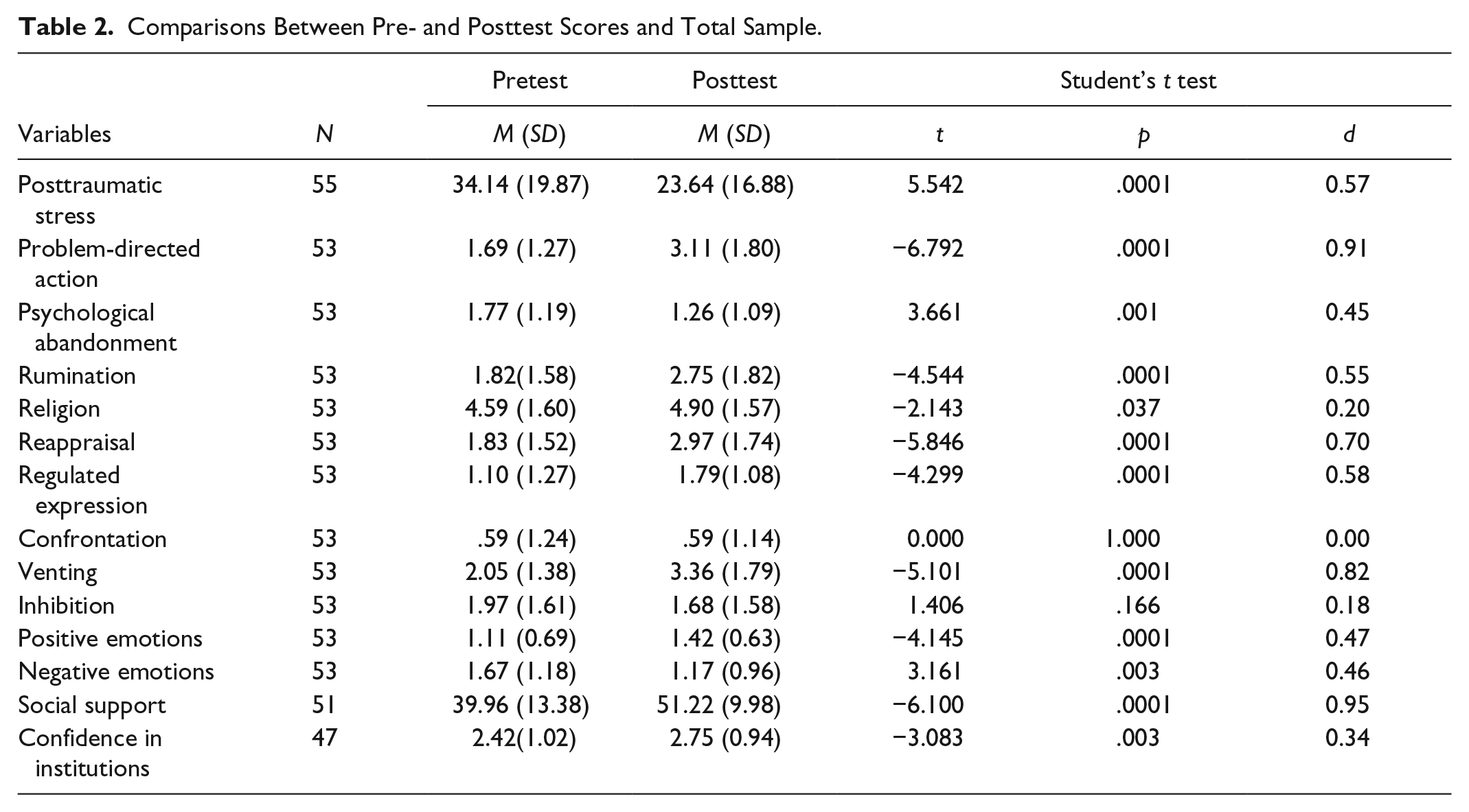
The largest effect sizes were found in the social support, problem-directed action, and venting dimensions. In the case of reappraisal, regulated expression, rumination, and posttraumatic stress, the effect sizes were medium, whereas, for positive and negative emotions, psychological abandonment, confidence in institutions, and religion they were small.
After participating in the program, dysfunctional strategies such as psychological abandonment were used less frequently than other types of coping and emotion regulation strategies (all ps ≤ .0001, except in the case of regulated expression p ≤ .10 and inhibition p ≤ .050). Moreover, the level of positive affect was marginally higher than that of negative affect, t(52) = 1.699, p < .10.
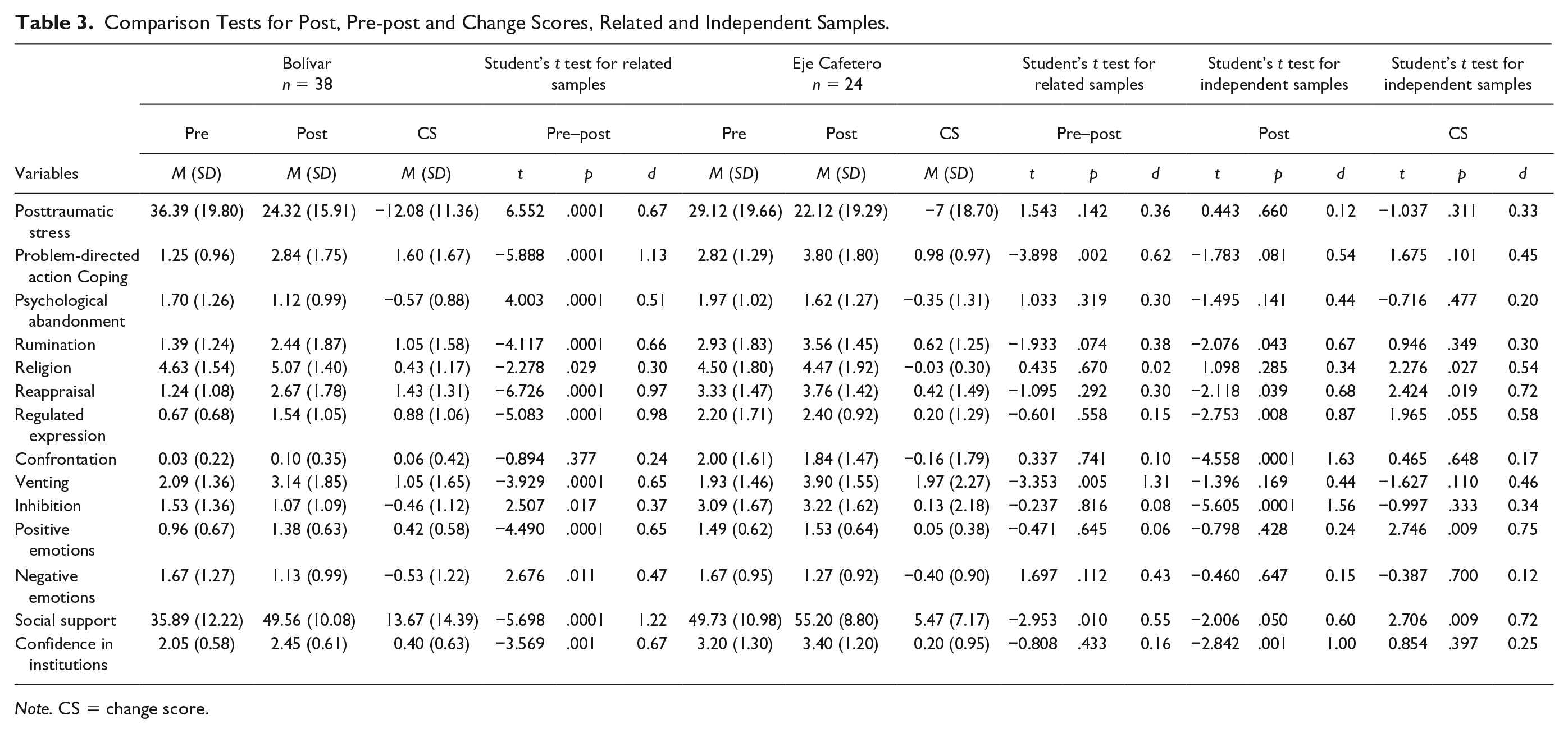
Next, possible differences were analyzed between the scores obtained by the women from Bolívar and the Eje Cafetero (within-group analysis) at T1 and T2 (see Table 3). The means obtained by the women from Bolívar during the pretest differed significantly from those obtained at posttest in almost all variables, with the exception of confrontation. Following the program, this group of women was found to have improved in all the variables analyzed. The effect sizes were large in three of the strategies considered to be adaptive (problem-directed action, reappraisal, and regulated expression), as well as in social support. In posttraumatic stress, psychological abandonment, rumination, and venting, positive emotions and confidence in institutions were medium, and, in religion, inhibition and negative emotions were small. Nevertheless, the mean scores obtained by the women from the Eje Cafetero at pretest only differed significantly from those obtained at posttest in two of the coping and emotion regulation strategies (problem-directed action and venting) and social support. The effect size was large for venting and medium for the other two variables.
Comparison Tests for Post, Pre-post and Change Scores, Related and Independent Samples.
Note. CS = change score.
An analysis was conducted to identify any significant differences in the CSs obtained by the two groups of women (see Table 3). The CS is the difference between the score obtained in the final (posttest) evaluation and that obtained in the initial (pretest) one. Conventionally, scores are calculated so that a positive value indicates a change in the desired direction, assuming that increasing your score is something positive (e.g., in the use of adaptive strategies and social support). However, if what is required is a reduction in the score obtained, then a negative value would indicate the desired change (e.g., in posttraumatic stress or the use of dysfunctional strategies). Significant differences were observed in the CSs for the variables religion, reappraisal, positive emotions, and social support, in accordance with the region in which the program was run. As shown in the table, the women from Bolívar obtained higher CSs than those from the Eje Cafetero. The effect sizes were medium. Although the differences for the other variables were nonsignificant, the pattern of results was the same, with the exception of venting. The women from Bolívar improved more in posttraumatic stress, the different coping strategies, negative emotions, and confidence in institutions. The effect sizes were small, with the exception of regulated expression.
Finally, the differences between the scores obtained by the women from Bolívar and the Eje Cafetero region at the posttest were analyzed (see Table 3). In other words, regardless of the change achieved between pretest and posttest, the aim was to verify whether or not the scores obtained by the women from the two regions in the different study variables were more similar following their participation in the program. An analysis of the posttest scores revealed that, post-intervention, significant differences remained between the women from Bolívar and those from the Eje Cafetero in the majority of coping and emotion regulation strategies (rumination, reappraisal, confrontation, regulated expression, and inhibition), as well as in social support and confidence in institutions. As in the pretest, the women from the Eje Cafetero region obtained higher mean scores than their counterparts from Bolívar.
Discussion and Conclusion
The first conclusion that can be drawn from the data is that more than three-quarters of the women in the study had been forced to leave their homes and move to other places in Colombia. In a situation of institutionalized violence, such as the one that has been prevalent in Colombia for decades, it is hardly surprising for these forced displacements to occur, mainly as a result of the fear generated by threats or as a direct result of the murder of loved ones and/or family members. It is important to bear this situation of vulnerability and loss of local references in mind when striving to understand the suffering experienced by the women from the RPM. Results also revealed that more than 80% of participants had been victims of violence, and that one-fifth of these had suffered from a combination of physical, psychological, and sexual violence. Polyvictimized women are a painful reminder of both the situation with which women have had to deal for decades and the need to give them a voice, listen to what they have to say, and work toward helping them improve their lives and relations with the environment. Violence against women is characterized by its crosscutting nature, because it affects women from different Colombian regions (Bolívar and the Eje Cafetero) in the same way.
As a result of the violence suffered and the social context in which the violent acts occurred, the level of posttraumatic stress is very high in comparison with that of other victims of gender-based violence from the normative population living in other, less sociopolitically violent contexts in Spain (Echeburúa et al., 2016).
As regards social relations and confidence in social institutions, which are both necessary to reconstruct a community following traumatic situations, the Colombian government emerges as a reference for and agent of violence, because more than one-third of the women in our study claimed that it was the government, or forces linked to it, that perpetrated the violence inflicted against either them personally or their friends and family. Nevertheless, the fear and terror felt do not stem only from one single sector. 40% of participants claimed that it was paramilitary groups which perpetrated the violence, and another 30% identified the guerrilla as the culprits. All this reflects the difficulties that may arise when attempting to encourage victims to reestablish their trust in those politicians and members of social movements responsible for rebuilding the country. Another fundamental aspect to bear in mind is the reasons why women believe they have been victims of violence. The most frequent responses postulate violence perpetrated by parties in conflict not only as a means of forcibly displacing certain segments of the population to free up their land for other interests, but also to create a constant and generalized state of tension, anguish, and terror among individuals and communities, so as to enable a greater degree of impunity and social control, as well as a weaker social response to the violent acts perpetrated due to fear of possible consequences.
There can be no doubt that the Colombian conflict, which has persisted for decades and has become an intrinsic part of the country’s everyday life, has far-reaching effects on those directly exposed to it, particularly polyvictimized women (Okeke-Ihejirika et al., 2018). There are two approaches that help us gain greater insight into the aftereffects of violence on mental health. First, for research focusing mainly on trauma, the key factor to bear in mind is direct exposure to violence and potentially traumatic events such as physical assault, the destruction of one’s home, or the disappearance or death of loved ones (Mollica et al., 1992). Second, the advocates of a more psychosocial analysis focus mainly on the stressful social and material conditions caused (or exacerbated) by the armed conflict, such as poverty, malnutrition, forced displacement, conflicts and divisions within communities, the destruction of social networks, and the consequent loss of social and material support, ostracism, and the struggle for survival of specific groups such as ex-child soldiers, widows, survivors of sexual assaults, orphans, and people with war-related disabilities (Boothby et al., 2006; Miller & Rasco, 2004).
The women who participated in this study are characterized by their low emotional reactivity, as they scored low for both positive and negative affect. For example, when the mean scores obtained by participants in this study are compared with those of female victims of gender-based violence in Spain, the results reveal that the positive and negative affect levels of women from the RPM are very low (Puente-Martínez et al., 2018). When faced with the need to deal with the situation in which they find themselves and the events they have suffered, religion seems to be the only frequently used coping strategy. This is consistent with that reported by other studies carried out with victims of displacement (Di-Colloredo et al., 2007; Londoño et al., 2008). It is important to take this finding into account in future interventions and program development, as it reflects the passivity with which these women face their problems.
It is also important to note that women from the Eje Cafetero share a more positive social context and personal resources which allows them to express more clearly their positive emotional state. Nevertheless, the violence and forced displacement trauma have affected both groups of women and negative emotions are expressed quite similarly in both groups.
Although participants had a fairly positive perception of the degree of social support received from their communities, their confidence in institutions and social organizations was very low. These are important aspects for the reconstruction of any community, a process which must necessarily be based on trust and confidence, and are areas that require more work in the future. According to Cárdenas et al. (2015), perceiving the social climate in a positive light and having confidence in institutions are excellent predictors of belief in between-group forgiveness, a key factor in the rebuilding of communities affected by armed conflict. Thus, actions in the field of transitional justice are more effective in contexts in which public confidence has not been severely undermined and in which the institutions operate adequately enough to guarantee the impartiality of the investigations into past events.
In general, the women in our study scored better in the majority of indicators after participating in the intervention, reporting lower levels of posttraumatic stress, a greater use of functional or ambivalent coping and emotion regulation strategies, and a less frequent use of dysfunctional coping strategies such as psychological abandonment. These results indicate that, following the intervention, the women’s health improved, with posttraumatic stress dropping to levels similar to those reported by Spanish victims of family and sexual violence, although important differences remained in comparison with the normative Spanish sample analyzed using the same instrument (Echeburúa et al., 2016). Moreover, the results also revealed an increase in the use of strategies which enable the women in our study to cope with the traumatic situations they had experienced on their own. In accordance with the terminology used in Gross’s (2015) model, following the intervention, the focus of attention on the situation of experienced violence (rumination) increased, which is not necessarily negative, as at the same time these women had access to more strategies aimed at modifying the situation (problem-directed action and less psychological abandonment), as well as an enhanced capacity to modulate their emotional responses (venting, confrontation, and regulated expression). These results may indicate that, after participating in a program in which women are given the opportunity to use words to reevoke and express the experienced trauma in a safe environment characterized by trust, they are more able to activate the emotional resources required to overcome the violence suffered.
Following the intervention, an improvement was observed in emotional (positive and negative emotions), cognitive (i.e., rumination, reappraisal), and social indicators (social support and confidence in institutions), with the women feeling emotionally better, perceiving a greater degree of social support and reporting more trust in institutions. Participants also gained greater confidence in their ability to achieve their goals and plan different alternatives to solve their problems. Although perceptions of social support from the community were high prior to the intervention, after the program participants reported even stronger feelings of belonging and more willingness to participate in community activities and organizations. Consequently, participants claimed to have more trust in the people within their environment as a source of instrumental and emotional support. This greater degree of confidence also extended to institutions and social organizations operating outside the boundaries of participants’ own communities. Although these levels were still not high, they can nevertheless be seen as a first step toward a process of reconstruction involving a wide range of social stakeholders, rather than just the organizations to which participants belong, within a new climate of relations that seeks to overcome historical mistrust.
With the exception of religion, positive emotions, and social support, no differences were found in the CSs obtained by the women from the two different regions studied, thereby suggesting that the improvements gained in the majority of indicators were similar in both groups. Nevertheless, in the case of the women from Bolívar, whose initial starting point was worse than that of their counterparts from the Eje Cafetero as regards coping and emotion regulation strategies, positive affect and social context (despite having similar levels of violence and posttraumatic stress), the improvement observed (differences between mean scores at pre- and posttest) in almost all the variables (n = 13) was significant, whereas, among the women from the Eje Cafetero, significant improvements were only observed in three variables. Despite this, however, the situation of the women from the Eje Cafetero region following the intervention continued to be better than that of those from Bolívar. The only variables in which prior differences had been eliminated were the use of problem-directed action strategies and positive affect.
As stated earlier, these results therefore confirm an important difference between the two regions in which the program was implemented. Although the women from both regions had personally experienced the same type of violence and suffering, with similar sequelae, the women from Bolívar were found to be in a more vulnerable situation, with a more negative state of mind and a more limited capacity to adequately cope with the emotional states caused by the violence suffered. They also received a lower level of social support from their community. Given the differences which exist between the psychosocial contexts of the two regions, as Miller and Rasmussen (2010) point out, one possible explanation for this greater vulnerability may be that, in the case of the women from Bolívar, everyday stressors have served to exacerbate the adverse effects of the violence suffered during the armed conflict. Nevertheless, it was precisely these women who improved most in the different aspects on which the intervention focused. Although they did not manage to achieve the levels gained by their counterparts from the Eje Cafetero region, the improvements observed following the program were significant, thereby indicating that it was these women from Bolívar who benefited most from the intervention, in terms of their psychosocial state.
The main limitations of this study are related to both the sample group itself and the procedure, design, and measurement instrument. First, the sample size was fairly small, due to the difficulty inherent in contacting potential participants as the result of the rough terrain and the presence of new conflicts in certain regions of Colombia. Second, according to Campbell and Stanley (1966), pre-experimental designs pose a serious threat to internal validity due to the weak control of extraneous variables which may affect the results obtained. Nevertheless, pre-experimental designs are useful when researching natural situations in which an exhaustive control of all contextual variables is impossible (Salas Blas, 2013). Third, the sample was not representative, and the application of a randomized procedure also compromised external validity, preventing the generalization of the results to other women in similar situations. Fourth, although the use of a measurement instrument made up of previously validated scales guaranteed the reliability of the results, the extension of the protocol required a major effort in terms of the time required to respond to all the questions, with the consequent risk of respondent fatigue. Finally, the favorable empirical results obtained are only valid in the short term, as the study does not measure whether or not these effects are maintained over time.
Future research may wish to (a) increase the sample size to ensure more precise estimates; (b) apply a quasi-experimental nonequivalent control group design to the pre- and posttests to verify the initial equivalence of the groups and correct for any possible differences in the pretest phase using statistical techniques; (c) with the aim of allowing for a triangulation of results, apply more qualitative analyses of the products created by these women (for instance, self-portraits or their own narratives) to understand the deeper meaning of some results; (d) design different levels of intervention, with differing intensities, in response to the diverse needs of the women in the RPM who live in different psychosocial contexts; (e) adapt and validate abridged versions of the scales to make them easier to administer; and (f) gather information over longer time scales.
One of the aims of any action research study in the field of international cooperation must necessarily be to support those communities in vulnerable situations in their efforts to develop their own coping strategies for the problems they are facing. In situations such as that described in this study, it is important to understand the personal and community demands resulting from decades of collective violence and the impact that this violence has had on the population, particularly in terms of the situation of structural disadvantage in which the women in these contexts find themselves. This study constitutes the first step toward understanding not only the individual strategies employed by these women to cope with situations of violence and forced displacement, but also how these actions may (or may not) help them reconstruct both their personal lives and the social and community fabric. It is important to bear in mind the difficulties involved in healing the wounds caused by past experiences of violence. As such, it is vital to deal with basic questions related to the reconstruction of an entire country, which may help foster both forgiveness and reconciliation. This is no easy task, but the MUCOCO program that was implemented in this intervention is a clear step in this direction, as shown by participants’ reactions and the analysis of the results. These findings present a more nuanced picture of the consequences different types of coping strategies have on women’s perceived health, willingness to engage in social interaction, community engagement, and ways of negotiating their future in Colombia. The contribution of these feminist, anti-militarist voices, which are deeply rooted and engaged in society, may be a good starting point for reconstructing Colombian society from a perspective committed to the truth, the rejection of the violence suffered, and the nonrepetition of the events and impunity of the past.
The results and conclusions of this study allow for the modification and adaptation of the community program to participants’ different situations, with the aim of strengthening those coping and social interaction strategies that have been found to empower women and help improve peaceful coexistence and the recovery of a country such as Colombia devastated by decades of violence.
Footnotes
Acknowledgements
The authors wish to thank Ruta Pacífica de las Mujeres (RPM), Colombia.
Declaration of Conflicting Interests
The author(s) declared no potential conflicts of interest with respect to the research, authorship, and/or publication of this article.
Funding
The author(s) disclosed receipt of the following financial support for the research, authorship, and/or publication of this article: This study was part of a larger project (Proyectos CUD 2017) funded by the Oficina de Cooperación al Desarrollo (Development Cooperation Office) of the Universidad del País Vasco/Euskal Herriko Unibertsitatea (University of the Basque Country, Spain) and the University of Burgos funding for the research group SIQoL (Y133GI).
