




Abstract
The conceptualization of work security provision in universal labor standards does not really question the reasons of powerlessness and vulnerabilities that poor households are exposed to. As a consequence, the work protection in India does not necessarily ensure work security provision to the poorest. This article captures the problem of work security from the life experiences of women workers who earn their livelihood from informal wage work. An important focus of the study remains on the institutional negotiations. Broadly, the article through the experiences of Mahatma Gandhi National Rural Employment Guarantee Act implementation in India has focused on the changing reasons of marginalization and powerlessness.
Introduction
After an overall increase of women’s participation rate in workforce both in the rural and urban areas in the years from 1999-2000 to 2004-2005 as per with the available large scale National Sample Survey (NSS) data, India is experiencing a decline in female labor force participation rate along with its consistent economic growth. It was brought to focus in the latest Employment and Unemployment Survey, which showed that in between the period of 2004-2005 to 2009-2010 women’s labor force participation rate has declined from 33.3% to 26.5% in rural areas and from 17.8% to 14.6% in urban areas (Government of India Planning Commission, 2013). Yoshiteru Uramoto, the International Labour Organisation’s (ILO) Asia-Pacific regional director identified five important causes behind this decline—increase of educational enrolment, increase of household income, women withdrawing from agricultural activities, lack of job opportunity, and error in measuring women’s work (Nigam, 2013).
The government of India and specific state governments, despite their claim of being sensitive toward the issues of women, have achieved nominal success. West Bengal, the context of the present study, went through an era of communism when the Communist Party of India (Marxist; CPI(M)) was in power for 30 years till 2011, but no sincere efforts were made in those years to address the issues of gender, caste, and informal workers. The social rights that workers enjoy are largely limited to pension, inadequate health care, and limited work security, ignoring the broader range of social policies relevant to women as gendered workers.
In India, the Mahatma Gandhi National Rural Employment Guarantee Act (MGNREGA) was passed on August 25, 2005. This is a unique scheme with objectives to legally ensure a minimum 100 days of wage employment in a financial year. As per the provisions of the Act, wage employment should be provided within 15 days of work application by a job seeker. The focus of the scheme is also on creating assets to increase agricultural productivity. Significance of this legislation is that it emerged from mass struggle, first introduced by the state of Maharashtra for overcoming the problems of unemployment in drought-prone regions. Adopted later as a central government scheme, it is being recognized as a unique experiment in the provision of rural employment.
Quite importantly, this scheme has emerged in a historical junction when there is a decline in agricultural profits. Rapid urbanization is creating grounds for unequal competition in villages and small towns. The remote areas are unable to create gainful employment. Men and women from the villages are migrating to the cities for domestic or other kinds of informal wage employment, and this is enhancing unequal work participation.
Broadly, the paper include the following sections, conceptualization of work security provisions in the context of India, a brief overview of MGNREGA from the academic studies, women’s work participation in informal wage work, method of data collection, followed by Brief Introduction of Bengal, profiles of the workers, institutional factors in social policy implementation and conclusion at the end. The analysis section along with illustrating the experiences of individual women has also studied the institutional conflicts that remain in the provision of work protection policies from the perspective of gender.
Conceptualization of Work Security Provisions in the Context of India
The concept of work protection as it emerged in India has its own historical struggle. In spite of having the most comprehensive legal structure for the labor welfare and protection, 93% of India’s workers are in informal employment and cannot access the minimum conditions of work security. The labor welfare laws are mostly for the formal sectors. Farms and establishments employing below a certain number of workers are exempt from the provisions.
Economic liberalization has caused further shift in the framework of planned adjustment. User fee for public services has been introduced, and to a great extent, the services were formally privatized. This proliferation of extra government agencies is constricting the role of government, and this in turn is creating a political crisis for governance in terms of accountability, re-bureaucratization and coordination, control of policy development, and implementations (Chatterjee, 2011).
Among the recent initiatives that the government of India has taken in regard to work security, two seem to be the most important—first, India’s agreement to implement the decent work strategies and, second, an innovative initiative to implement MGNREGA as a national scheme.
The concept of decent work was first introduced by the ILO in the year 1999 in the 87th International Labour Conference. In February 2010, the government of India effectively signed up the decent work agenda by agreeing to implement a 5-year “Decent Work Country Programme” with the ILO. The emphasis is on the strong labor policies, integrated interventions, including the active labor market policies, and micro enterprise development, which can open up work and employment opportunities (Raju, 2010). The decent work has been conceptualized as the central idea of sustainable poverty reduction and as a means for achieving equitable inclusive and sustainable development (Lerche, 2012). The four strategic pillars of the decent work agenda are the full and productive employment, rights at work, social protection, and promotion of social dialogue. Globally, it has been thought for a fairer globalization and good governance.
The scheme of MGNREGA has not derived any motivation or inspiration from the concept of decent work as introduced by ILO. Instead, the MGNREGA as a scheme emerged from the local movements, for promoting strong labor policies through integrated interventions. Thus, even though the scheme of MGNREGA shares a common concern with the idea of ILO’s decent work, these two concepts do not speak similar language.
The next section provides a brief overview of MGNREGA from academic studies. Furthermore, the discussion includes the issues of women’s work participation in general and then gradually brings into considerations more specific experiences as emerged from the study finding from Bengal.
A Brief Overview of MGNREGA From the Academic Studies
At the inception of MGNREGA, women’s empowerment was not in focus, but it showed major positive impact on the women workers in terms of provisions such as the priority for women in the ratio of one third of total workers, equal wages for men and women, and crèches for the children of women workers (Pankaj & Tankha, 2010). In national average, shares of women workers are 41% of total MGNREGA person days in 2006-2007, 41% in 2007-2008, 48% in 2008-2009, 46% in 2010-2011, and 49% in 2011-2012, which exceed the stipulated 33% shares for women. Highest participation is seen in states like Kerala (90%), followed by Pondicherry (80%), Tamil Nadu (77%), and Rajasthan (68%) in 2010-2011. The states with less participation of women are Bihar, Punjab, and West Bengal (Pankaj & Tankha, 2010).
In West Bengal, experiences of MGNREGA scheme implementation are not very appealing, but some districts and regions are performing well compared with others; on an average, performances are not very impressive. However, it has been claimed that in the year 2012-2013, the state spent Rs. 4,475.80 crore, which is the highest in the country, and generated employment for 58 lakh households. However, the national statistic suggests that the state ranked 24th on the list (Kelkar, 2011).
A few important academic studies across India reflected on both the cases of achievements and the reasons of failure in implementation of MGNREGA.
A study by National Federation of Indian Women (NFIW) was conducted in four districts of four selected states (Tamil Nadu, Chhattisgarh, Madhya Pradesh, and Orissa) and, thereby, illustrated how the scheme has increased the employment opportunities for women in those areas. The cash income has enhanced women’s economic independence and decision-making powers. The study argues that receiving wages in person at least has ensured two regular meals a day, and a significant portion of the wages is spent on children’s education and to repay bank loans, health care, and so on. MGNREGA has created reasons and opportunity for people to work and remain in their villages (Jandu, 2008).
Dissatisfactory observations are lack of awareness among the disadvantageous communities, limited access to drinking water facility in the worksites, and complete lack of child care facilities. Lack of active involvement of the females in local Panchayati Raj Institutions is also an important reason of exclusion (Sharma, 2012). De and Bhattacharyya (2013), in context of Assam, spoke about a positive correlation between women’s literacy rate and awareness with higher women’s attendance at the gram sabha (village body) meeting and the capacity of decision making.
Pankaj and Tankha (2010) from the experiences of Bihar, Jharkhand, Rajasthan, and Himachal Pradesh argued that MGNREGA has the potential to address the unequal gender relations in the long run, but the empowerment of rural women has emerged as an unintended consequence of MGNREGA. Because of this, women as a community have been slow in realizing the potential benefits of the scheme, despite their presence in gram sabha meetings, increasing number of women speaking out in gram sabha, and frequent interaction with the government officials. At the same time, working hours for women has increased, but leisure time has vanished.
Findings from Ernakulam district of Kerala bring out the issues of fund misutilization and politicization of the scheme implementation (Shihabudheen, 2013). The same study discusses how a few important measures such as the strong presence of poverty alleviation program, good administrative measures, and natural resource management are beneficial to develop a unique MGNREGA implementation system. Furthermore, to show the negative impact of political interferences, the authors illustrated the case of Kerala and West Bengal to argue that despite the claim of left parties such as the CPI(M) of being instrumental in the enactment of the MGNREGA through sustained pressures on the ruling government because of their commitment toward the upliftment of the poor, in reality, the statistics show that the implementation in the left-dominated states such as Kerala and West Bengal is lagging behind other states (Shihabudheen, 2013).
Quite interestingly, in Wayanad district of Kerala, the implementation of MGNREGA has assured positive benefits because of pre-existing strong poverty alleviation measures and important initiatives such as decentralized monitoring evaluation mechanism including local experts and knowledgeable persons, which in turn has reduced the chance of master roll manipulations. The measures have opened up a space for pro-poor innovations. The peasants have managed to get substantial relief from MGNREGA by getting over their inhibition in working as laborers in richer farmers’ lands by moving to the respectable public works. Its role is also vital in women empowerment, particularly because of reasons such as work is organized by women’s group in Kerala. Women constitute more than 85% of workers in Kerala. For the first time, equal wages has boosted the earnings of women (Shihabudheen, 2013).
Kar (2013) captured one more important aspect of MGNREGA while discussing the challenges of women empowerment in Orissa. The insight the study has focused on is that the effective implementation and empowerment through the MGNREGA depend on what type of scheme it has been prioritized. The study recommended for an in-depth focus on the issues of social and gender inequality, which in turn will create productive assets, and women’s ownership and control over the productive assets.
Similar findings by Pellissery and Jalan (2011) discussed how the work opportunities are not equally available and are not equally useful to women and men. Ensuring work protection depends on the degree to which the program has the potential to support the empowerment of women and transform the gender relations. A need has been realized to go beyond a simple focus on wage earners and to ensure that the benefits of the scheme address gender-specific vulnerabilities.
The important question that the above studies emphasized on is to what extent work participation in work security provisions like MGNREGA in reality can empower women among diverse working poor population. A keen doubt has also been expressed regarding the nature of women’s political participation (Kar, 2013, Pellissery & Jalan, 2011). Controversy has remained regarding the true impact of this policy on women. Following this line of inquiry, this article further probes into the contradiction and conflicts in the experiences of the scheme implementations. The next section is about nature of women’s work participation in informal wage labor work from the experiences as emerging from India.
Women’s Work Participation in Informal Wage Work
A general dissatisfaction among third-world nations regarding women’s work is the theoretical debate that ideation of women’s work participations is mostly grounded on Western enlightenment and the practical experiences of the Western industrial revolution. Because of this, neither the increasing level of education nor the work participation of women in wage labour, either in families or in low paying routine jobs, has strengthened their capabilities (Harris, 2004).
The vocabulary of West European and American scholarship shed little light on the relationship between the dramatic economic transformation and cultural incentives associated with it. However, the global economic transformation with the rapid spread of transnational corporations’ disregard for the national borders provided the framework from further new thoughts and conceptualizations from the developing nations (Harris, 2004).
However, that does not mean that developing nations have not created substantial literature on women, about her dominant relations, and how the relations have changed over time. Substantial contribution in theorizing women empowerment and her wage employment from the third-world standpoint is equally evident. The Indian feminist thinkers have produced enough literature on the marginalization of dalit (the lower caste) women. Gender has been questioned and re-questioned from various dimensions of power relations (Rege, 2003). The exercise of power on poor women is being ensured either by family violence, within the caste groups, or by the domination of the higher caste men and women (Irudayam, Mangubhai, & Lee, 2011).
The literature shows how in India growth in combination with the worldwide recession is continuing with exclusionary practices, and the affect is severe among the poorest of the poor. Saraswati Raju (2010) did a thorough mapping on the regional pattern of women’s work in India, to explain the regional pattern of exclusion. Raju (2010) argued that the post-colonial state in globalizing India where market is becoming extremely competitive, despite remaining committed to collective interests at some social cost in principle, is reconfiguring existing social and gendered constructs to serve the interests of few and marginalize many. (p. 1)
State policy discourses articulate such interests with either alarming naivety or by design only. The caste, class, and ethnicity together complicate the issues further; in many instances, gendered location remains the primary axis along with exclusions and marginalization. The inadequacy of official statistics in capturing the full range of women’s work keeps these issues in silence.
A similar argument in historical context raised by Nirmala Banerjee (2006) in her piece, “Working Women in the Colonial Bengal,” to discuss the British pattern of women empowerment that is being considered as the classic model for all countries of the West has greatly ignored the experiences of modern industrial growth in developing nations. The article did an explorative historical discussion, to illustrate how the impact of modernization was greatly different on the economy of Bengal and on the female workers. Before industrial modernization, Bengal was one of the most industrial regions of India. Before 1881, only one third of women workers were in agricultural work; the industrial modernization had caused more women to lose their non-agricultural work. By 1961, the workforce participation rate in industry was lowest in the country. Their non-agricultural occupation in the traditional sector suffered serious setback mainly because of the intervention of the modern sector into the village economy, and women had neither the skill nor the capital to resist the changes.
Thereby, it is necessary to acknowledge that even though, women’s movement in India remain confined among elite groups, the wave remain successful in raising consciousness among general population, and the efforts have successfully negotiated with the state and its machinery for recognizing the issues of women and enactment of important legislature and required social security and social protection policies.
Method
Methodologically, this is a qualitative study. A single village panchayat (a village council) the Kodaliya gram panchayat was selected as a case study. For the factual understanding about the nature of population, sample surveys of 340 households have been drawn from the population randomly. In the surveys, women from the households were interviewed. The sample survey was drawn with semi-structured interview schedule that provided the opportunity to probe further whenever there was the necessity. The most interesting part of this article is the interviews of village panchayat members and bureaucratic officials to make a sociocultural analysis of the institutional relations. Three categories of women were interviewed for the study—daily wage earning women, women with political affiliation, and women working at the government institutions.
There were nominal numbers of female appointed in the office of local panchayat at the time of interview. At the panchayat’s office, there was only one female MGNREGA officer and one information, education and communications (ICE) female officer at the government official level, and one MGNREGA coordinator was interviewed as they were in close interaction with the studied panchayat. Interviews proceeded in a gradual process; the same women have been interviewed twice or thrice according to the need. The responses were recorded in case of household interviews, and within institutions, field notes were the basis of codification.
Furthermore, interviews of women village representatives were crucial to understand the negotiations of work security provisions at the local level. The selection of village representatives was based on two important criteria, that is, all the three elected village representatives were female and were actively involved in various development activities. Moreover, in all the three villages, the village representatives were the members of CPI(M), the ruling opposition party, and this political position was important to analyze the political transition and its conflicts with the work security provision. Thus, the research discusses the sociopolitical relations through which the civil society intervenes into the problems of the larger political society.
Brief Introduction of Bengal
West Bengal, for long, had remained a strong communist state of India. But in 2011, communist party CPI(M) experienced a political defeat and Trinamul congress (the present ruling political party in Bengal) came in power, and within this timeline, the state is experiencing severe political turbulence. This political background of Bengal is important because it had shaped the labor policies of the state. Analyzing Bengal from a historical perspective of labor welfare will show that even though the state government remains vocal about the issues of labor laws and labor unions, in practice to a great extent, it has failed to be sympathetic toward the problem of women workers and more specifically to address the issues of informal labor. However, it is debatable whether the reason of this non-inclusive development is the rigid structures of CPI(M) the previous ruling communist party or West Bengal in the long run has failed in the competition with other Indian states that once had violated labor laws (narrated by one labor welfare officer). As a result, informalization of labor has become a strategy to survive in the competition. In Bengal, the issues of work protection are very complex and need to be understood in a more decentralized manner.
In West Bengal, implementation of MGNREGA has raised a few important questions. The performance of MGNREGA in West Bengal is poor in comparison with other Indian states. Thereby, one basic question is whether the limitations in MGNREGA implementation are simple technical failure or whether it needs to overcome complex sociopolitical networks that in turn create new structural resistance within the discourse of provisioning.
The second important question is what kind of space the scheme can provide to capture the local initiatives, debates, and arguments. In India, there are many instances of grassroots initiatives and innovative experiments, as they have happened in specific parts of Kerala, but in Bengal in spite of its rich sociopolitical background, in the last decade it has largely failed to respond to the changing labor relations and specifically gender relations. The state, which was one of the pioneers in adopting labor rights and strengthening the labor unions, presently to a great extent is unable to accommodate the MGNREGA scheme as per the needs of Bengal.
This study is focusing among women workers to focus on various dimensions of gender knowledge. The gender is not a category by itself; instead, the notion of gender is sensitive to caste, class, and socioeconomic condition. Moreover, analysis of gender provides the opportunity to pay nuanced attention toward the vulnerabilities that an entire community people are exposed to.
The Profile of the Workers
The population is partially based on agriculture. On average, 75% of household incomes are within Rs. 3,500 a month. In general, women are associated with a range of petty informal activities from domestic work, daily wage, to temporary home-based work. Interview data reveal that the majority of women from below poverty households had joined paid work since childhood, as helping hand of their parents in agriculture or domestic work. A brief overview about the kind of paid labor work women are associated with in the area is important to explore their nature of work participation. Among the varieties of petty earning activities, a few women earn their livelihood from vegetable vending. Women vendors start the day at 4:00 a.m. and travel to the nearby marketplace to sell their products. On an average, women vendors’ income ranges between Rs. 75 and Rs. 100 daily.
Women also work in construction sites as helper, carrier, and cleaner. A few were engaged in plaster of paris work (a kind of wall painting) in construction sites. Some work in local catering groups as cleaner. A few others travel to cities for nursing and care work. A large number of women are associated with paid domestic work. Women also do daily wage work in the local agricultural field and in small factories. Two women (out of 350 households) look after their husband’s tea and grocery stall.
The poor women who are unable to seek outside wage employment but are in acute financial need are involved in strenuous supari (areca nut) cutting activities. The processing of supari, that is, the socking and cutting is hectic and tedious work and sometime the work stretches to late night. It is women and children who are employed for this kind of work with minimum pay of Rs. 7 for cutting 1 kg Supari. Poor women in their day of crisis bring supari from the agents of local supari factory. The business of supari is profitable in the area because of the wholesale supari market in Bangladesh and in Uluberia (a place near Kolkata).
The other petty work women do are beedi (a kind of locally made cigarette) making, groundnut packaging, rakhi (wrist band) making, and assembling electric torch. Wage received for packing 1 kg of ground nuts is Rs. 2, for making 147 rakhis a woman earns Rs. 7, and making papad (local snack) provides 0.50 paisa per piece. On average, the earning of a domestic worker is hardly more than Rs. 1,500 a month, and the earning of the untrained nurse, locally known as ayas, is up to Rs. 180 on the days of employment. In the region, there is a government rice research farm established with the objective to preserve the local breeds of rice and generate local employment. However, during the time of interview, the farm had stopped recruiting workers for permanent posts and was employing daily wage workers seasonally paying Rs. 180 per day.
It appears from the findings that women keep on shifting from one type of job to another according to their need, family responsibility, opportunity, and age. Thereby, it was difficult to categorize women on the basis of paid work, and to avoid these difficulties, the research focused on the vulnerabilities that women from the below poverty households are exposed to. The research captures the vulnerabilities from subjective interpretations.
Now coming to the issues of MGNREGA scheme implementation, it was found that even if the coverage of MGNREGA is limited or is associated with various difficulties at the household level, a basic awareness prevails. On an average, MGNREGA provides 18 to 20 days of work in a year, in the area. However, compared with the need for work security, the employment creation is less. Even among those who worked in MGNREGA scheme, only 25% had completed 100 days of wage work employment (Kodaliya Gram Panchayat, 2012).
Work Profile From the Statistical Overview From 340 Households
As shown in Table 1, 89% of women engage in paid work to support their family, of which, 9% are the single earning households. Table 2 encompasses the reasons of joining paid labor work among the four income quintile groups. The table shows that in the category of “single women earners,” 65% earn not more than Rs. 2,500, whereas close to 50% of women who said they are in paid work to support their family are in the first two quintiles. In the category of “independent earners,” 75% belongs to the fourth income quintile. The pattern clearly suggests that the category of single women earners absorbs the highest proportion of poorest.
Frequency Distribution of Reason for Paid Work.

Reason for Paid Work, by Income.
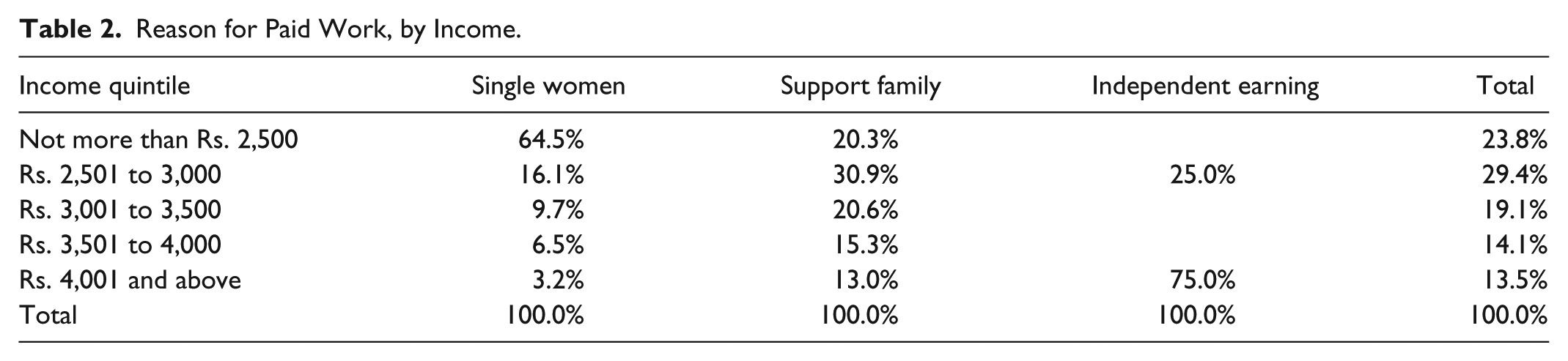
Thereby, joining of women in paid labor work is out of acute need, and to a great extent, her vulnerabilities intensify her conditions of marginalization. Thus, a thorough attention into the narratives will reveal the reasons and conditions of vulnerabilities. The following section depicts the cases of four different poor households and their experiences of exclusion.
First, is the case of a family who migrated from Bihar. The family included father, mother, and five sons and daughters in-law. The family earned their livelihood from daily wage manual labor and was surviving in extreme poverty. The quality of life was further worsened because of the incurred health expenses. The father was suffering from multiple health disorders, and despite poverty, the family bore the burden of a major surgery that cost Rs. 10,000 in a Calcutta medical hospital. The money was borrowed from relatives and money lenders. The health condition of the mother was also worsening because of financial tensions and other responsibilities. In addition, one daughter-in-law was suffering from serious health complications after her second pregnancy. The family could not spend on other expenses because the main portion of their income was spent on treatment of the patients. Their earnings fell below the expenditure and savings. The house, where they stayed, was in an extremely wretched condition. However, as the household is not certified as below poverty line (BPL) by the authority, they never received any government support. They also failed to receive ration cards due to some problem in documentation, and they never received any kinds of work security provision from the MGNREGA scheme.
The interview process came across a woman, who was staying with her husband and two daughters in poor economic condition. Her husband being an alcoholic contributed nothing for the family expenses. As a domestic worker, she earned Rs. 1,000 a month, which was not sufficient to meet the household needs. Her feeble health condition and constant mental pressure further reduced her working capacity. Economic scarcity forced her elder daughter to discontinue her education and join a local factory as a daily wage worker. This provided employment on an average of 12 to 15 days of work in a month. At the time of interview, the elder daughter was desperately looking for better jobs, as the alcoholic father was in need of frequent hospitalization, and she also had to meet the educational expenses of the younger sister. Last time, they were not able to admit the father in hospital due to lack of money. During the interview, it was also found that the family could not earn for two meals a day. The family never received any help from the local political party. They never got any employment opportunity in the MGNREGA scheme as they did not have a job card and also because the area did not have any MGNREGA project; moreover, availing of work in MGNREGA scheme required sociopolitical network.
Another woman who was in feeble health condition took shelter in one of her woman co-worker’s house. She was suffering from high fever and for a long time was suffering from severe pain in the lower abdomen. She was all alone working as a plaster of paris (a kind of wall painting) worker, a job that is again very seasonal and does not provide employment during rainy reasons. The lady explained how rapidly in the last 5 years her working capacity had been reduced and that in turn, had reduced her earning. With the limited earning, she could not support two full meals nor was she able to access doctors. As a consequence, her health conditions were fast deteriorating. More importantly, in her days of suffering, she was able to access neither the food security nor the work security.
One more important family that the research came across was not willing to provide data initially, but later, when the research objective was explained, they agreed for the interview. The family consisted of an elderly couple, their two daughters (one widow and another deserted), and two granddaughters. After the death of the elder daughter’s husband, her in-laws refused to take her responsibility. Since then, the elder daughter, with her only girl child, had been staying with her parents. In the case of the younger daughter, her in-laws were very cruel. She was having problem with her in-laws regarding dowry, and within a year, she gave birth to a girl, but even then, the in-laws did not accept her. Finally, her parents took her back, and during the interview, both the daughters were working as domestic workers with nominal earning.
Regarding social security, the elder daughter applied for widow pension but did not get as she failed to submit all the original documents, such as the voter identity card, ration card, and so on. All her original documents remained with her in-laws, which they are not returning. The family also expressed their grudges against the local panchayat members as they never helped them, nor provided guidance to receive any kind of governmental assistance. The family had a feeling that being women, they were less valued and paid least attention to by the panchayat members. In the words of the mother, As we do not have any son, so we do not have any power and respect in the area. panchayat disregards the claims of women and women headed households. We cannot run around or make networks, so we never receive any provision.
Discussion in the same household also revealed how the gender biased procedural exclusion in association with sociocultural stigmas against women’s paid labor work further reduces the scope of women to access the MGNREGA work provision. When the same woman (the mother) was asked in the interview why her daughters were not working in the MGNREGA work, she replied, Our daughters cannot work in those areas. They are not habituated with all those mud cutting activities. How they can go and work as a daily wage worker, it is better they do domestic work.
Thus, although the earnings of both the daughters were insufficient and, being illiterate, they could not access better work opportunity in the region, they never wished to work as a MGNREGA worker in the area because of sociocultural stigma. It is important to understand that though it is considered the most degraded work, a few families still prefer domestic work to MGNREGA work. This is because the kind of work a MGNREGA worker performs is more exposed to social stigma and at the same time considered as dirty. As a result, both the daughters remain financially dependent on their parent, as the family needs to bear huge education and health expense.
The above four narratives capture the reasons of vulnerabilities along with the grounds of exclusion. The argument is that the idea of work protection in itself is not independent of these marginal relations. The disadvantage of right-based approach is that the rights have to be asked from someone more powerful, and more importantly, this position of power is hardly questioned. Furthermore, from field experiences, it can be claimed that these positions are very conflicting, and it is very difficult to draw a line in between.
Critically, the poorest of the poor who gets a few days of work throughout the year in nominal pay cannot access this kind of work protection at the time of the need. Concentrating on the reasons of exclusion will show that informal sociopolitical relations such as networks and rapport are the important criteria on the basis of which the poorest of the poor gets excluded. Provision of work security is greatly influenced by vote bank politics; that is, the jobs are created in those places where the leading party voters are in maximum numbers.
Here, two things are important: First, a group of people, mostly the political party members, can manipulate these kinds of work security provisions, primarily because they hold the power and, more importantly, because they can manipulate the knowledge of work security, which the poor lacks. Thereby, knowledge is not similar to awareness; perhaps the awareness is lacking in some contexts of research, but more importantly, the reasons of exclusion from work security provision and grounds of networks formation shape the policy knowledge at its implementation phase.
This is a complex web of relation, where the concepts such as the decent work and the idea of work protection through MGNREGA are not independent of each other, at least at the level of implementation. The argument is that the ideology of decent work creates the objective and standardized superstructure, and this superstructure in turn influences the local negotiations in MGNREGA. For analyzing this web of complex hierarchical relations, the next section has included the viewpoints of government officials and of panchayat members and village panchayat sadayshas (politically elected members at the village level).
Institutional Factors in Social Policy Implementation
This section captures “the meaning of social security” as it gets interpreted and re-interpreted at the institutional level. The research studied the important relations in institutional delivery to illustrate institutional drawbacks in terms of the institute’s limited scope to be inclusive and flexible in nature. The factors that affect the provision of work protection under the MGNREGA at the institutional level are “political interference,” institutional hierarchies, and motives with which individuals within institution intervenes the problem. These factors together determine the scope for generating gainful employment in MGNREGA. Although, there are instances of work security provision on sympathetic grounds or from personal networks, in reality, the provision of work security to actual needy is limited in the region. Therefore, from institutional stand points, the motives with which institutions intervene in the problem are critical to understand the nature of social security provisions. To elaborate on the findings, the discussion begins from the corrupt bureaucratic procedures and gradually proceeds with other kinds of discriminatory practices.
Corruption in MGNREGA scheme implementation begins from the issuing of MGNREGA job card. As per the MGNREGA Act, job card is essential for official documentation, not as eligible criteria for work security provision. Regardless of this, in practice, the job card became an essential precondition for provision of work security (Gopal, 2009). At the local level, provision of job card is greatly influenced by factors such as vote bank politics and political and personal preferences and rapport. As a consequence, a very small section of the population can access job card successfully.
A lady in her interview narrated how her husband’s good connection with the local party members helped her to receive the job card. She got her MGNREGA job card within 1 month from the date of application. Her family income is more than Rs. 5,000. Her husband runs a fish shop, and she is the agent of a local chit fund company called RoseValley, and occasionally works as a daily wage worker in the MGNREGA work site. But working as a daily wage worker in the MGNREGA is neither necessary nor preferred by her household members. However, she explained that having MGNREGA job card is a kind of future economic security. The job card can generate a constant income by selling the card (informally) to the other needy families in the area (those who cannot access job card). She explained, how a job card can also generate a constant income of Rs. 20 to Rs. 30 per day without working in MGNREGA projects. In her voice, The prevailing rate for selling a card (informally) is Rs. 20 but some of the households also demand Rs. 30 as commission. Once people come to know that I am selling the card they will line up in front of my house.
The access to job card is greatly difficult among the migrated lower caste population. The information of job card is limited in the vicinity of the panchayat’s office and in the areas where previously MGNREGA work was performed. The areas where migrated households from Bihar, Uttar Pradesh, and Bangladesh reside seem to be negatively discriminated as far as the availability of job card is concerned. As a consequence, this kind of income security has limited or had no impact in strengthening individual’s capability and functioning in future.
As viewed by a senior bureaucrat at the district level, there are instances where information on social security provisions does not penetrate to the household level due to the opportunistic behavior of panchayat members.
Quite importantly, the female village panchayat members were found to have less clarity about provisioning procedures. For instance, the female MGNREGA officer was unaware about the fact that in MGNREGA, the wage employment is compulsory to provide within 15 days of application in demand of wage work.
In narratives, the panchayat officials explained that decisions such as how many people and who will receive MGNREGA work are largely influenced by the issues of political patronage and scope for fund manipulation. As a consequence, the social security provision largely depends on the power of negotiation than fair redistribution.
Similar argument has been raised by Kulkarni (2013) that the implementation procedure provides huge scopes for manipulation of data. The problem is also evident in the flow of the funds, which are often delayed. The data about total work done by a panchayat are misleading, important gaps remain between initiatives and completion of the projects.
To explain the impact of vote bank politics on the distribution of social protection provisions, one village representative mentioned that in the last 2 years, her area had not received any single MGNREGA project, only because she belongs to the opposition CPI(M) party and the panchayat is formed by the Trinamul congress. A section of Trinamul party supporters staying near the panchayat’s office who have good rapport with panchayat members were found to be in a comparatively better off position to bargain with the local panchayat members.
This political connection and personal networks are also important in other local recruitments. For example, there is a rice research farm that appoints casual workers on the basis of need. To maintain a fair and transparent recruitment, the responsibility of selection is bestowed on the local panchayat. Every year, the panchayat prepares the final selection list, but unfortunately, to a great extent, these kinds of lists remain politically biased.
Thus, corruption creates different layers of negotiation. The poor households with minimum or no technical knowledge and limited scope and opportunity to avail information have to rely on panchayats, in particular, on the pre-determined information channels of institutions. The authority with less sympathetic understanding of the poor people’s needs made these provisions even more superficial. In the voice of a man from the most deserted migrant fishing community, The present panchayat pradhan (political representative elected from the panchayat) in the last 4 years has never visited us to see our conditions and our struggles.
Another interesting finding is from government officials and lower level government staffs that in spite of their creative outlook and enthusiasm for social change, they face strong institutional discriminations. Among lower level government staffs, creative outlook is considered as eccentric. The general perception of a government employees are that their primary task is of documentation. It is especially true for the lower level employees. The sensitivities and innovations are not the essential criteria for the lower level workers. They need to follow the order, instructions, and targets.
The attitude of the government employees, in the voice of field officer is, Do whatever one asked to do. Taking extra burden is the sign of foolishness as the salary will be the same.
For the government employees, the active participation at the institutional level is neither desirable nor rewarding, both institutionally and socially. They need to work on the balance of payment, expenditure, Management Information System (MIS), and so on. As a result, most of the government employees interpret the meaning of social policy in terms of government job.
For most of the government employees the government job is important, and that’s why they lack the understanding of the development motives and ideologies.
Most of them neither get any motivation nor the scope to work in favor of development or empowerment. Thus, more than awareness the hindrances in the form of the cultural believes or the positional hierarchies creates different levels of understanding and interpretations, which reflects in their behavior and communication pattern. One important argument was that for most of the employees, having one permanent government job is prestigious and comfortable with secure lifelong pension.
Quite interestingly, gradually, the process of interview reveals the above argument as partial truth. A strong discontentment was expressed against the hierarchical administrative system that, in most of the cases, excluded and penalized individuals for innovative initiatives within the system. The officials at the district and village panchayat level define these practices to be equally responsible for the prevailing work aversion.
Thus, the administrative hierarchies created for better policy implementation or for making decisions can narrow down the scope for social policy implementation to the needy. From the experiences of poor households, it is difficult to define “hierarchy” only in terms of simple administrative positions. Rather, the narratives emphasize that hierarchy needs to be understood from each individual’s part of sociocultural history and contextual reality.
For example, the panchayat pradhan, the democratic authority in the region, is formed by the devolution of power. However, his identity by itself as a part of democratic body is greatly insufficient. It is important to understand to what extent the panchayat pradhan can identify himself or herself with the local groups and communities. For instance, in the present case, the panchayat pradhan is “Brahmin”; this identity of upper caste itself creates a social hierarchy with the lower caste women.
Therefore, it is important to talk about the issues, such as caste, gender, migration, vote bank, and so on, on the basis of which panchayat differentiates. It appears that ensuring democratic justice with all its diversity is extremely difficult. In that way, the democratic bodies, in spite of their given authority of implementation, cannot ensure true democratic participation for all. Thereby, to what extent the democratic bodies are true democratic is a question. Also what are the major hindrances, if it is not so? As data show, the meaning of participation varies within the same democratic process. Therefore, it is important to know about the nature of the conflicts and the stake different individuals have in resolving conflicts.
The influences of party identity are important in determining the kind of stand the local government takes or the kind of developmental initiatives that will be undertaken. The local party members openly claimed that the affiliation of political party is the reason of their power and prestige in the area, so the benefit of the party and voters is above all. However, this might not be true for the non-elected posts like the panchayat secretary because they are not pressurized by the vote bank politics, but have to negotiate with the larger forces either forcefully or willingly. It is an important question to what extents the village panchayat in the current form can be considered to be the institution formed by the people and for the people.
In the present case, the upper caste Brahmin panchayat pradhan was greatly unsuccessful in life in terms of work and success and was not pursuing any other activities except politics for power. For a long time, he was a member of the local Trinamul party and came in power since 2010 with the downfall of the communist party. Thus, more than political shifts, the motives and involvement of the political party members in the development activity matter.
The above description not only illustrates the nature of “corruption” but also argues that institutions retain the reasons of corruption, and more importantly, the agenda of decent work as a global format is not contributing anything to address these reasons of corruption. Instead, this pull of knowledge in the name of fairer globalization is strengthening these social cleavages. Here, a natural question is “how?” The answer is that the codified knowledge about work security provisions does not really question these negotiations at the local level. Although there are sporadic acknowledgements, there is no attempt to strengthen their power for negotiations. As data show, simple monitoring and evaluation do not ensure a decentralized space. This can be explained from the decision-making procedures in implementation of the MGNREGA.
The coordinator of MGNREGA at the panchayat office was appointed on the short term basis for the MGNREGA work, for conducting the social audit, keeping the records, and to disseminate required information. In the interview, while sharing her work experiences, she spoke about work pressure, defined boundaries, and restricted freedom in the workplace. She defined boundaries in terms of both institutional limitations and various social factors. She defines that within institutions, the boundaries are set by the given protocols, structures, and methods.
The institutional issues were more elaborately explained by the block MGNREGA coordinator and IEC (information, education and communication strategy for MGNREGA) officer. The female IEC officer narrated that as a government employee, documentation is the most important function of their work. Sensitivity and innovation are not really valued. Therefore, they need to focus more on the balance of payment, expenditure, and preparation of report. Most of the employees neither get motivation nor get the scope to work for empowerment or for the eradication of poverty. More than awareness, the hindrances in the form of cultural beliefs and the positional hierarchies create different levels of understanding and interpretations.
The emerging idea is that development workers in the government sector develop a tendency to interpret the development projects or social policies in terms of their job profiles or assign responsibilities, which in turn de-motivates them from understanding larger theories and ideologies of development. The block-level female IEC officer, who is responsible for generating awareness among rural population regarding the 100 days of work right, explained her work frustrations. She narrated her relation with the higher officials as dominating and exploitative in terms of work. In her voice, her boss, that is, the district nodal officer, is neither willing to work nor allows his subordinates to take extra burden. She spoke about minimum or no freedom of speech or scope to share the field experiences. Most of the time, she was being asked to do odd jobs like writing letters, proof reading, and so on, apart from her assigned duty. Even if she managed to identify some problems and tried to work on it, the response from her immediate boss was nominal. The boss was more like “do whatever you are asked to do”; her boss preferred to perform only his assigned job. Innovation or identifying other social problems is considered as extra burden, “you are fool if you asked for such a burden for yourself.” Moreover, she explained that in the last 2 months, she had not participated in any single project on awareness generation for the MGNREGA. The previous week, when her boss asked her to take part in a tree plantation program in a local school, she could not revolt openly; however, during the interview, she burst out in frustrations: Tree plantation in school is not my duty, they are engaging me in some other types of jobs which is just not required.
Apart from this, she mentioned about less sympathetic attitudes regarding pregnancy and child care. During interview, she was so frustrated that she was on the verge of leaving her job. She explained that the knowledge regarding the social policies mostly remains confined within the official walls of the district, blocks, and panchayat offices. Dispersion of information is greatly guided by the individual motives.
Thus, not only the bottle necks lie in the conceptual flaws regarding the women’s participations and grounds of emancipation, but also conceptual flaws exist in understanding the institutional power relations.
Creating jobs and spreading awareness highly depends on the efficiency and understanding of the issue at various levels. (Panchayat samity MGNREGA staff)
In the opinion of the panchayat MGNREGA coordinator, complex hierarchical procedures largely compromise with the sensitive understanding of the problem and its scope for the innovative thinking. They spoke about three main hurdles a panchayat faces in implementing MGNREGA work: scarcity of labor (skill labor), resource, and limited scope for work. In the area, the mud cutting is the only recognized activity that MGNREGA workers are suppose to do. It was narrated that in semi-urban areas, scope for generating the labor-intensive work is limited, whereas in the rural areas, the scope for doing manual work is more. Therefore, the creation of labor-intensive work in the semi-urban areas is a challenge.
Thereby, the arguments that are emerging from the findings are that the attempt to ensure the work security provisions in the form of social policy is somewhere disregarding the local innovations and initiatives, even if the importance of local initiatives are acknowledged, but the procedures of policy implementation do not provide the space for democratic or fairer negotiation.
Furthermore, the disparity was also reflected in the narratives of female village-elected representatives. In India, the issues of women empowerment have greatly been conceptualized in terms of her political participation. The 73rd and 74th Amendment Act for one-third women’s reservation is the milestone that India has achieved that ensures wider space for women in political struggles. Recently, these local governments are assigned with the responsibilities of various social security and social protection provisions, and implementation of MGNREGA is an important one in this regard. The village representatives while sharing their experiences of participation in local democratic bodies explained how the power structures are taking a new shape. Women village representatives shared sociopolitical complexities that constricted work freedom. Village women were vocal about the procedural restrictions and limited scope for participation in local affairs. In their opinion, the protocol, standard methods, and procedures of interventions are becoming more important than the independence of local governments. In this process, the local governments are fast losing their powers. Apart from solving the local quarrels and giving advice, the existence of the local self governments seems to be in stake.
In the voice of one village sadaysha, We cannot do anything even if we want to, we have to be in our boundary, and it is more like we are lower level government officials. With more rigid rules and regulations we have become even more powerless. We are only here to keep watch on whether people are following the rules, and to tell them how to follow the rules. We have no power to question the rules neither can we recommend anything for betterment.
Female village representatives often face situations where male villagers are judgmental or pass critical comments on their performances. In addition, the skeptical attitude of the villagers against general corruption and malpractices creates more difficulties for female village representatives to stand above the criticisms of male. To illustrate their limited power, Nandita said, There is huge pressure, hope, and aspiration upon the village panchayat. All the criticisms for the prevailing corruption are also targeted at us.
Apparently, it appears that there is very less connection with the idea of decent work and local corruptions in MGNREGA. But interestingly, if we listen to the narratives, the terms such as the procedural limitation, limited scope, and structural exclusions are emerging as important factors. The gender as a concept is not getting enough space to be empowered neither in government institutions nor in politics. In both the cases, women were more concerned about their submissive or less powerful characteristics in the workplace; interestingly, all these women were very positive about their household support.
Thereby, the concept of decent work, that is, the provision of secure and respectful employment needs a decentralized definition. It has been felt that there is a need to create the space where from the concept will emerge rather as a concept of imposition. It appears that the idea of ensuring “minimum and decent work protection” is greatly insufficient without considering the issues of negotiations. Instead, as discussed above, this particular framework of provisioning is creating a new kind of power structure at the level of politics and institutions. From the above findings, it can be argued that provisioning of the work protection is greatly a political phenomenon. It hardly challenges the issues of institutional hierarchies and procedures of implementation, and more critically, intensifies the hierarchies in implementation procedure that the entire mechanism became less sensitive toward the local initiatives. Bengal, an important state of India, in 2010 experienced a major political shift from the CPI(M) communist party rule to right wing Trinamul congress government. However, this political shift has not made any effort to overcome the previous political biases. The controversies the left government faced in their latter phase such as political patronage and less transparency have not been challenged, because individuals such as the panchayat pradhan in the present case joined the new party to be in power and for making money. They have neither any ideology nor the intention for bringing sociopolitical change in the system. In this unequal space for resistance, the social audit system remains a simple administrative tool in the hand of the government. Poor population are neither aware about the concepts of social audit and its procedures nor is it easy to disseminate the knowledge at the local level without ignoring the power relations. Even though a few politically active women managed to participate in the audit procedures, they remain scared about future consequences. Therefore, the process of social audit is largely used as a political tool.
Conclusion
In India, MGNREGA is a result of prolonged struggle; it emerged as a mass movement and to a great extent is achieving success in breaking the bondage of caste oppression. But even then, to conceptualize MGNREGA from the larger perspective of empowerment or for the inclusion of poorest of the poor, a few concerns needs consideration.
An important concern regarding the gap that remains in social security provisioning system is whether it is because of institutional failure or the very knowledge of social security provisioning is enforcing an essentialist standpoint. In a theoretical tone, it is not only the archaeology of knowledge that determines the way we understand “women” and their relation with wage work and social security provisions but also, to a great extent, the knowledge itself creates grounds for structural exclusion. The aim was to understand the role of policy knowledge in creation of democratic space for local knowledge, and whether this in turn can enhance the scope of women’s participation in decision making at the village level.
It was revealed from the findings that MGNREGA as a work protection scheme, at least in Bengal, is far away to be truly inclusive in nature; it is not to say that the poor people are not being benefited, but many women from marginalized communities (socially and politically) find difficulties in accessing the advantages of MGNREGA. The institutional provision of social protection policies manifests two important dimensions of exclusion primarily on the basis of sociopolitical identity defined by caste, class, and political affiliation, and more importantly, in terms of methods of provisioning.
The sociocultural demarcation determines individual’s capacity to negotiate or to form networks. As was narrated by MGNREGA cell officer how her role as an implanting officer is influenced by her gender identity, her consciousness about her class, educational background and many others. Thereby, the performance of individuals within institutions depends on their capabilities to draw resources, positively negotiate with local politics, and so on.
A question the study began with was whether women’s participation in politics positively contributes to their empowerment. Provisioning of the work protection is greatly a political phenomenon, and in Bengal, political conflicts and issues of political patronage have not created enough space for fairer redistribution. In Bengal, the implementation of MGNREGA has not really talked about the challenges, vulnerabilities, and issues of powerlessness. Even the political shift from communist state to the reign of right wing party has not made a sincere effort to overcome the previous political biases. The controversies the left government faced in its latter phase such as political patronage and less transparency also have not been challenged.
One more prominent reason of discrimination is caste. Apparently, it seems discrimination in the name of caste is not so intense in Bengal. The impact of English education and prolonged rule of the communist government were thought to have some positive impacts on caste discriminations. Ranbir Samaddar (2013) has rightly argued that in Bengal, caste has remained a problem in terms of upward mobility and structural dominations. Popular politics to a great extent has suppressed the voices of dalits and those who migrated from Bangladesh to India after Bengal partition. As a result, a large section of the dalit community continues to be victims of structural exclusion. Neither democratic decentralization nor party politics has favored the dalit community in raising their voices.
Thus, although the modern societies are creating space for resistance through national and transnational networks, to a great extent, this emerging space is unequal among different communities and caste groups. Thereby, in spite of existing labor laws and welfare policies, a large mass of population either remains outside the preview of the legal measures or is excluded on various political and economic grounds. In reality, these create very limited scope for debate and dialogue that mostly remain confined among educated civil society.
Overall, the most important concern that narratives have emphasized on is about the methods and framework of social policy provisioning. The finding depicts that the impact of international intervention in the form of “policy knowledge framework” is strengthening discrimination at the local level. The finding depicts how the pre-determined frameworks of policy knowledge are reducing the scope of decision making at village level. In the opinion of the female village representatives, the village development committees are fast losing power to make decisions and initiate changes. The village representatives are turning into agents of development without becoming equal stakeholders in the process of development.
Furthermore, finding shows that controversies regarding poverty-measuring indices in India are nothing new; similarly, in the context of the present study, the below poverty list is a mockery. In the panchayat’s office, it is a formality to represent a group of people as poor. Large number of poor migrants along with other needy single women earning households cannot afford to enlist their names in the poverty list. Along with discontentment about exclusionary criteria of poverty-measuring indices, village women distrust the power relations involved in the process of measuring poverty, that is, those of surveyors, panchayat members, and government officials.
From the emerging argument, it is to state that exploring “gender” as a dimension of policy knowledge is not enough, there is a need to understand the relation poor women establish with the procedures of implementation and how the whole institutional delivery re-establishes its relation with gender, especially with specific groups of women, because of which in male-dominating panchayats, gender continued to be a critical dimension of exclusion.
Overall it appears, at the local level, social justice and freedom are constantly being threatened by political patronage and corrupt bureaucratic procedures. At the same time, intervention (either in terms of universal poverty-measuring criteria’s or broader human development indices) of international organizations in terms of methods and techniques is not enhancing poor people’s capability. Instead, the pre-determined policy knowledge framework indirectly strengthens the power of local political party and of those who are in administration. As a consequence, there is no institutional motivation, and institutions are unsuccessful in creating spaces for official’s active participation in any development projects.
Thereby, a major concern was expressed regarding the “kind of institution formation” that is often binary in nature, such as the criteria to identify poor households. Broadly, it is not only about the poorly designed model of implementation but also about power relations involved in the procedures of implementation, and how these power relations are changing with the changing discourse of modern economic development.
Footnotes
Author’s Note
Chit fund—In South Asia, it is an institution that accepts savings at interest and lends money for house and other purchases. Dalit—In the traditional Indian caste system, dalit is a member of the lowest caste. Panchayati Raj Institutions—A decentralized form of government where each village is responsible for its own affairs, as the foundation of India’s political system. Panchayat—A village council. Panchayat samity—A group of village panchayat together forms a panchayat samity. Crore—A crore is a unit in the Indian numbering system equal to 10 million (10,000,000; in scientific notation: 107) Lakh—A lakh is a unit in the Indian numbering system equal to 100,000 (scientific notation: 105) Beedi or biri—A type of cheap cigarette made of unprocessed tobacco wrapped in leaves.
Declaration of Conflicting Interests
The author(s) declared no potential conflicts of interest with respect to the research, authorship, and/or publication of this article.
Funding
The author(s) received no financial support for the research and/or authorship of this article.