




Abstract
The Chinese government is actively promoting the rural revitalization strategy and has put forward more comprehensive requirements for rural grassroots governance. In China, the rural grassroots governments refer to township governments and village committees in rural areas. However, the establishment of villagers’ trust in the grassroots government is facing long-term and complex impacts brought about by gender inequality. Especially in underdeveloped areas, this has become a key factor restricting the trust in the grassroots government. Therefore, in-depth exploration of the impact of women’s labor participation on trust in the grassroots government and its mechanism is of great significance for promoting gender equality and achieving modernization of rural governance. Based on this, this paper uses the data from the China Family Panel Studies (CFPS) from 2014 to 2020 and employs a panel data model to demonstrate the effect of women’s labor participation on trust in the rural grassroots government. Subsequently, the paper uses a mechanism test model to examine the role of gender equality concepts in the main influence mechanism. The research finds that an increase in women’s labor participation significantly enhances their trust in the rural grassroots government. The results of the mechanism test show that gender equality concepts have a moderating effect, weakening the overall effect of women’s labor participation on trust in the rural grassroots government. The results of the heterogeneity analysis indicate that for women with an education duration of ≤12 years, the impact of their labor participation on trust in the rural grassroots government is more significant. Additionally, for women under the age of 40, the impact of their labor participation on trust in the rural grassroots government is also more significant. Based on these findings, this paper provides suggestions and policy references from aspects such as promoting the modernization of rural grassroots governance capabilities, promoting women’s labor participation, strengthening gender equality education, and optimizing the willingness to distribute household labor.
Plain language summary
This paper uses the data from the China Family Panel Studies (CFPS) from 2014 to 2020 and employs a panel data model to demonstrate the effect of women’s labor participation on trust in the rural grassroots government. Subsequently, the paper uses a mechanism test model to examine the role of gender equality concepts in the main influence mechanism. The research finds that an increase in women’s labor participation significantly enhances their trust in the rural grassroots government. The results of the mechanism test show that gender equality concepts have a moderating effect, weakening the overall effect of women’s labor participation on trust in the rural grassroots government. The results of the heterogeneity analysis indicate that for women with an education duration of ≤12 years, the impact of their labor participation on trust in the rural grassroots government is more significant. Additionally, for women under the age of 40, the impact of their labor participation on trust in the rural grassroots government is also more significant. Based on these findings, this paper provides suggestions and policy references from aspects such as promoting the modernization of rural grassroots governance capabilities, promoting women’s labor participation, strengthening gender equality education, and optimizing the willingness to distribute household labor.
Introduction
The Chinese government is fully implementing the rural revitalization strategy, aiming to build happy and beautiful villages, which poses higher requirements for rural grassroots governance. Only a clean and efficient rural grassroots government can gain the long-term trust of villagers. In China, the rural grassroots governments refer to township governments and village committees in rural areas. However, the establishment of villagers’ trust in the grassroots government is faced with long-term and complex influences brought about by gender inequality (Ghani et al., 2013). Although the status of rural women has significantly improved in recent years with social progress and the popularization of education, they still remain at a disadvantage in key areas such as the distribution of household labor and family decision-making. This not only restricts the development of women themselves but also hinders the establishment of trust between villagers and the grassroots government (Li et al., 2024). Therefore, the increase in female labor participation is not only a sign of the improvement of women’s personal rights and status but also an important driving force for the development of rural economy and society (Kumari, 2018). On the one hand, rural women’s active participation in social and economic activities can bring additional economic income to their families and improve their living standards. On the other hand, their active labor participation can also accumulate social experience, enabling them to play a more important role in grassroots governance and thereby enhance the trust in rural grassroots governments (Madeira, 2022). For underdeveloped regions, the active labor participation of rural women is particularly crucial. Their active labor participation helps break the limitations of traditional gender roles and promotes gender equality. At the same time, it can also enhance the diversity of family economies and optimize the decision-making mechanism within the family, thereby promoting their social status (Kumari, 2018). Ultimately, to achieve this goal, it requires the joint efforts of policymakers, rural grassroots governments, and women themselves, through measures such as improving women’s labor conditions and formulating fair labor policies to support and encourage women’s participation in labor. Of course, this is also an important process for rural women and grassroots governments to build trust, ultimately contributing to the overall improvement of rural governance (Madeira, 2022). Therefore, in-depth research on the impact of rural women’s labor participation in underdeveloped areas on the trust in grassroots governments is of great significance for promoting gender equality in rural areas and achieving the goal of rural revitalization in China. Such a situation affects the possibility of women in underdeveloped countries participating in rural public affairs.
The labor participation rate of rural women in most developing countries generally increases with the growth of income, the decline of fertility rates, and the improvement of educational attainment (Kumari, 2018). The rise in the labor participation rate of rural women helps to establish an effective interaction between economic empowerment and political empowerment for women, thereby further enhancing their labor participation rate (Ghani et al., 2013). Of course, the path to increasing female labor participation is not limited to political empowerment alone; the transformation of energy consumption also has a positive impact on female labor participation. For instance, the use of clean energy in rural areas of developing countries has liberated women, allowing them to spend less time collecting fuel and thus enabling them to seek employment outside their homes (Li et al., 2024). Additionally, macroeconomic fluctuations and the widening gap between the rich and the poor in society can also affect the enthusiasm of women to participate in the labor force (Kumari, 2018). This phenomenon can explain why developing economies always face the lag and imbalance in female labor force participation. Some real cases further confirm this conclusion. For example, a specific case of African women shows that environmental degradation and governance failure have damaged female labor participation and further analyzes the reasons (Okere et al., 2024). Of course, developed countries are not perfect either. In developed countries where education is generally well accepted, women still face gender discrimination in the workplace, which in turn affects their labor participation (Saha & Singh, 2024). In summary, although the labor participation of women is generally on the rise and is gradually becoming an important force driving rural development and progress, it still faces complex challenges. Therefore, policymakers should promote economic growth through investment and create more employment and development opportunities for women (Madeira, 2022).
The prevailing view in the fields of public economics and public administration holds that women’s labor participation has a positive impact on trust in rural grassroots governments. An increase in the female labor participation rate may enhance women’s attention and participation in rural grassroots governance, thereby strengthening their trust in rural grassroots governments (Altaf, 2019). At the same time, an increase in the female labor participation rate indicates an enhanced status and influence of women in the socio-economic sphere, making them more likely to participate in the decision-making and supervision processes of grassroots governments and exert a direct influence on the governance behavior of grassroots governments (Ajoke, 2017). However, this process is not without obstacles. For instance, cultural conflicts often impede this progress. The case of Nigeria reveals that certain cultural values deprive women of their development potential, relegating them to subordinate roles to men, and such regions often suffer from disorderly governance (Milazzo & Goldstein, 2019). Such backward traditions can lead to a situation where, despite an increase in female labor participation, the influence and contribution of local women to rural governance remain minimal. This issue requires resolution through the improvement of laws and systems (Milazzo & Goldstein, 2019). Some scholars also argue that an increase in female labor participation does not necessarily directly enhance their trust in grassroots governments. For example, one study found that trust in rural grassroots governments is influenced by multiple factors, such as government performance, the quality of government staff, and the political participation awareness of the public. Female labor participation is not the main factor. For rural women themselves, their intrinsic connection with trust in rural grassroots governments is also affected by their own educational levels and age. Rural women with lower educational levels have higher expectations and dependencies on grassroots governments and are more likely to increase their trust in grassroots governments by enhancing their labor participation (Altaf, 2019). Other studies show that the impact of female labor participation on trust in rural grassroots governments is not unidirectional. On the one hand, an increase in the female labor participation rate may bring about new governance challenges and issues, such as the protection of women’s rights and gender equality, which pose higher demands on the governance capabilities of grassroots governments (Jo & Nabatchi, 2021). On the other hand, an increase in the female labor participation rate may also bring new governance resources and impetus, such as the participation of female labor and the rise of female social organizations, all of which contribute to enhancing trust in rural grassroots governments (Adeniji, 2020). Therefore, the comprehensive impact of rural women’s labor participation on trust in grassroots governance is the result of the interaction of various internal and external factors. More data on social norms is crucial for better understanding the reasons behind these constraints and is essential for the development of underdeveloped regions (Bussolo et al., 2024). These results demonstrate the complexity of the impact of female labor participation on trust in rural grassroots governments (Kushi & McManus, 2018).
For the northwest region of China, with the development of industrialization and urbanization, many young and middle-aged men from rural areas have moved to cities for work, leaving the rural permanent residents mainly composed of the elderly, women and children, with women accounting for more than half of the agricultural labor force. However, rural women in the northwest region of China are clearly in a disadvantaged and marginalized position both in the family and in society, which makes it difficult for them to establish trust with the grassroots government (Xuqing & Meng, 2023). The practice of modernizing rural governance in China provides a good opportunity to restore rural women’s trust in the grassroots government, but the reality still faces complex challenges (Zhou & Lai, 2023). For instance, although women have participated in economic activities to some extent, their representation and sense of empowerment in village-level self-governing institutions remain limited. This outcome is caused by many factors, among which the most significant one is that despite the increase in women’s labor participation, the stubborn gender inequality concept in rural areas still confines them to a marginal role in rural governance, and the lack of a voice is not conducive to building trust with the rural grassroots government (Wang & Dai, 2013). Moreover, the majority of young and highly educated rural women usually live outside their villages and have a weak willingness to participate in grassroots governance in their villages (Altaf, 2019), which is also not conducive to enhancing trust in the rural grassroots government through labor participation.
In summary, existing research mainly focuses on the positive impact of women’s labor participation on trust in rural grassroots governments, as well as the differences and challenges faced by women’s labor participation in various cultural and social structures. The research is relatively complete but not deep enough as a whole. Specifically, first, extensive literature has confirmed that the increase in women’s labor participation has a positive impact on trust in rural grassroots governments, but it remains to be verified whether this mechanism applies to the northwest region of China. Second, the stubborn gender inequality concepts in rural areas may suppress women’s willingness and energy for political participation, thereby reducing the comprehensive effect of women’s labor participation on trust in grassroots governments. Therefore, the possible moderating effect of the willingness to distribute household labor needs to be verified. Third, samples of different age groups and educational levels may have different influencing mechanisms. The discussion of heterogeneity is helpful for formulating targeted strategies and enhancing the practical value of the research, but there is currently a lack of in-depth exploration. This study takes the northwest region of China as the research area and uses the data of 1,996 female samples from the China Family Panel Studies (CFPS) from 2014 to 2020. A panel data model is used to verify the influence mechanism of women’s labor participation on trust in rural grassroots governments in underdeveloped areas. Through the mechanism analysis of gender equality concepts, the impact mechanism can be examined more comprehensively. Finally, to discuss the possible differences in the impact of different types of samples, heterogeneity analyses for samples of different age groups and educational levels are conducted respectively.
Theoretical Analysis and Research Hypothesis
Theoretical Mechanism of Women’s Labor Participation Affecting Trust in Rural Grassroots Governments
Multiple theoretical perspectives have demonstrated the positive impact of women’s labor participation on trust in rural grassroots governance. Based on the theory of gender roles, an increase in women’s labor participation rate indicates a shift in traditional gender roles, with women playing a more active role in socio-economic activities (Fortin, 2015). This shift not only enhances women’s social status and influence but also promotes the popularization of willingness to share household chores, thereby influencing evaluations of rural grassroots governance (Xiao Hong, 2016). As women’s role in economic activities strengthens, they are more likely to pay attention to and participate in the decision-making and supervision processes of grassroots governments, directly affecting the governance behavior of grassroots governments and thus improving evaluations of rural grassroots governance (Xuqing & Meng, 2023). From the perspective of resource dependence theory, women in rural areas are more dependent on grassroots governments that provide them with resources and opportunities. An increase in women’s labor participation rate provides more governance resources and impetus for rural grassroots governance (Xuqing & Meng, 2023). Women’s participation in the labor force not only boosts the economic vitality of rural areas but also promotes the diversification of rural society. This development helps enhance the Trustrank of rural grassroots governance and, in turn, strengthens public trust in rural grassroots governance. The rise of women’s social organizations also provides new partners and supporters for rural grassroots governance, further strengthening the governance capacity and service level of grassroots governments (Xiao Hong, 2016). Additionally, from the perspective of institutional change theory, an increase in women’s labor participation rate is part of the institutional changes in rural socio-economic systems (McGinn & Oh, 2017). Such changes not only bring about adjustments in economic structures and shifts in development patterns but also promote reforms and innovations in rural grassroots governance systems. During the process of institutional change, rural grassroots governance needs to constantly adapt to new socio-economic development situations, enhance governance capacity and service levels, to meet the growing demands of the public (André et al., 2013). An increase in women’s labor participation rate is one of the important forces driving this institutional change, which helps promote reforms and innovations in rural grassroots governance systems, enhance public recognition of rural grassroots governance, and improve governance Trustrank (André et al., 2013). For the northwest region of China, economic backwardness leads to a lack of employment opportunities and limited development space for women, resulting in their general lack of conditions and enthusiasm for political participation (Wang & Dai, 2013), which is not conducive to enhancing their trust in grassroots governments. Based on the above analysis, the following research hypotheses can be proposed:
H1: The increase in women’s labor participation helps enhance their trust in local governments.
The Mechanism of the Role of Gender Equality Concepts in the Influence of Women’s Labor Participation on Trust in Rural Grassroots Governments
Gender equality theory holds that the concept of gender equality, as an important component of social culture, not only reflects society’s perception and evaluation of the roles of men and women but also influences individuals’ expectations and trust in the government’s gender equality governance (Gedikli, 2014). The increase in women’s labor participation rate helps break the shackles of traditional gender roles and promotes the popularization of gender equality concepts. As more and more women participate in social and economic activities, their abilities and values at work gradually gain social recognition, which prompts people to re-examine and change their stereotypes about women (Alesina et al., 2013). This shift in perception not only enhances women’s self-identity and self-confidence but also provides a more diverse and inclusive perspective for grassroots government governance. The wide acceptance of gender equality concepts helps raise people’s expectations and demands for grassroots government governance. Under the influence of gender equality concepts, people pay more attention to the fairness and inclusiveness of government governance and demand that the government fully consider women’s rights and needs when formulating and implementing policies (Adeniji, 2020). Such expectations and demands prompt grassroots governments to continuously improve their governance capabilities and service levels to meet the growing needs of the public. Moreover, the concept of gender equality is reflected in efforts to reduce gender discrimination and bias, enabling women to more actively participate in the decision-making and supervision processes of grassroots governments, thereby exerting a more positive influence on the governance behavior of grassroots governments. On the other hand, the concept of gender equality also prompts grassroots governments to pay more attention to women’s rights and needs and formulate and implement more equitable and inclusive policies and measures, thereby enhancing public trust in grassroots governance and improving governance Trustrank (Adeniji, 2020). Based on the above analysis, the following research hypotheses can be proposed:
H2: The concept of gender equality will moderate the impact of women’s labor participation on trust in rural grassroots governments.
Research Design
Research Area and Data Sources
Research Area
The research area of this project is selected in the northwest region of China, mainly including Gansu Province, Qinghai Province, Shaanxi Province, Ningxia Hui Autonomous Region and Xinjiang Uygur Autonomous Region. The reason for choosing this area is that the northwest region holds a unique position and plays an important role in China’s economic and social development.
The northwest region of China is vast in territory and rich in resources, but its economy is relatively backward and it has a large rural population. Rural women in particular play a significant role in agricultural production and social development. However, due to various reasons such as history, culture and social structure, rural women in the northwest region still face many challenges in political participation and labor rights protection, which directly affects their evaluation and participation in rural grassroots governance. Therefore, studying the impact of women’s labor participation on trust in rural grassroots governments in the northwest region of China is of great significance for promoting rural economic and social development in this region, promoting gender equality and women’s empowerment.
The northwest region of China is diverse in terms of geography, culture, and social structure, which provides rich cases and backgrounds for research. Rural women in different regions, ethnic groups, and social economic development levels may have significant differences in labor participation, political participation, and trust in rural grassroots governments, which provides favorable conditions for in-depth analysis of the influence mechanism of women’s labor participation on trust in rural grassroots governments.
With the increasing attention and support from the state to the northwest region and the implementation of the rural revitalization strategy, the northwest region’s rural economic and social development has ushered in new opportunities and challenges. Studying the impact of women’s labor participation on trust in rural grassroots governments can provide theoretical basis and practical reference for formulating more scientific and reasonable policies and measures, and help promote the comprehensive development of rural economy and society and the smooth implementation of the rural revitalization strategy in the northwest region.
Data Sources
The data used in this study is derived from the China Family Panel Studies (CFPS), which was conducted from 2014 to 2020. CFPS is a widely used social tracking survey project in the Chinese academic community, carried out every 2 years. The sample of CFPS covers over 900 districts and counties in 25 provinces, municipalities, and autonomous regions of China. CFPS focuses on collecting economic and non-economic welfare data of Chinese residents, including family economic conditions, educational levels, family structures, and social relationships. CFPS provided survey data for this study on women’s labor participation, the Trustrank of grassroots government governance, and gender equality awareness. To meet the research requirements, the data used in this study was sampled and processed.
Before conducting the empirical research, I screened and cleaned the data to make it suitable for the requirements of this study. Firstly, the individual database was matched with the family database, the children proxy database and the spouse information database through individual sample codes, spouse codes, and children codes, and only women’s samples were retained. In addition, since the research scope is limited to rural areas in the northwest region of China, only samples from underdeveloped provinces in the northwest were retained, and urban samples were eliminated. Moreover, the research subjects of this study must be women with the ability to work. Therefore, samples of those under 18 years old and over 65 years old were eliminated. Eventually, 1,996 samples were obtained from the China Family Panel Studies (CFPS), forming a panel dataset covering 2014, 2016, 2018, and 2020.
Variable Selection
The selection of variables is studied in this paper as shown in Table 1.
Variable Selection.

Dependent Variable
This article selects “Trust in local officials” as the variable to measure the trust in rural grassroots government (Trustrank), and it serves as the dependent variable (Table 1). The reason for choosing this variable is that it is directly related to rural women’s actual feelings towards the work of the grassroots government, and can more truly reflect the subjective evaluation of trust in rural grassroots government (Dabbaghi, 2024). The subjective evaluation of the grassroots government by the public is one of the most intuitive and important indicators for measuring the degree of trust, as it reflects the fairness, transparency, and efficiency of the grassroots government in policy-making, implementation, and supervision (Grimmelikhuijsen et al., 2013). In the CFPS questionnaire, this indicator is scored from 0 to 10, with 0 representing very low trust and 10 representing very high trust.
Core Explanatory Variable
The core explanatory variable of this study is women’s labor participation, and the weekly working hours (Fe_labor) are selected as the indicator to measure the rate of women’s labor participation (Table 1). The reason for choosing this indicator is that it can directly reflect the activity level of women in the labor market. Weekly working hours not only cover full-time and part-time working women but also reflect the balance between women’s family and work. The increase in women’s labor participation means that women play a more important role in social and economic activities, and their abilities and contributions are more recognized and respected. This change helps break the traditional gender role restrictions and thus has a positive impact on rural grassroots governance (Kabeer, 2021). In the CFPS questionnaire, this indicator is defined as the average number of hours worked per week in the past 12 months, excluding lunch breaks but including overtime.
Control Variables
The rural grassroots government trust defined in this article is measured by the evaluation of the government given by rural women, rather than the government’s own performance or relevant assessment indicators. Therefore, the control variables selected are individual characteristic factors that affect rural women’s evaluation of the government’s performance, including age, education level, health status, marital status, etc. (Table 1). The selection of these control variables aims to control other possible factors that may affect rural women’s evaluation of the grassroots government, thereby more accurately revealing the impact of women’s labor participation on rural grassroots government trust (Gök & Ünlüoğlu, 2024).
Mediating Variable
This study selects the willingness to share household chores as the mechanism variable for measuring gender equality concepts (Table 1). The reason for choosing this variable is that it can directly reflect the actual situation of gender equality in society. When more men start to take on the responsibility of household chores, it reduces the burden on women at home, allowing them to have more time and energy to engage in rural affairs and enhance their trust in the rural grassroots government. In the CFPS questionnaire, this indicator is defined as “whether men should share half of the household chores,” with 1 representing strong disagreement and 5 representing strong agreement. The prevalence of the willingness to share household chores will be used as the mechanism variable to analyze the impact of women’s labor participation rate on the Trustrank of the grassroots government.
Research Methods and Model Construction
Research Methods
This study will adopt a panel data model and utilize a panel dataset covering the years 2014, 2016, 2018, and 2020 to capture the dynamic relationship between women’s labor force participation rate and trust in rural grassroots governments. The panel data model can simultaneously consider the differences across time and individuals, making the results more robust and reliable. Through the analysis of the panel data, we can gain a deeper understanding of the impact of women’s labor force participation rate on trust in rural grassroots governments at different time periods, as well as the variations in this impact among different individuals. Additionally, this study will employ a mechanism analysis approach to explore the specific role of the willingness to distribute household labor in the influence of women’s labor force participation on trust in rural grassroots governments. Mechanism analysis helps us to more clearly understand the internal logic of how women’s labor force participation rate affects trust in rural grassroots governments through influencing the willingness to distribute household labor (Valera et al., 2025). The steps of the panel data model are as follows:
Data preprocessing. In this stage, the main tasks include handling missing values, eliminating outliers, and standardizing variables to ensure the accuracy and reliability of the data (Valera et al., 2025).
Establishing a panel data model. Based on research hypotheses and variable selection, a panel data model is constructed. In the model, trust in rural grassroots governments is taken as the dependent variable, women’s labor participation as the core explanatory variable, and control variables are included to eliminate the interference of other factors. Meanwhile, to examine the mechanism effect of the willingness to distribute household labor in the influence of women’s labor participation on trust in rural grassroots governments, the willingness to distribute household labor is introduced as a mediating variable into the model (Valera et al., 2025).
Model estimation. During the model construction process, a fixed effects model is adopted for estimation, with the specific choice determined by the Hausman test results. Statistical software is used to conduct regression analysis on the panel data model, obtaining the influence coefficient of women’s labor participation on trust in rural grassroots governments and the mediating effect of the willingness to distribute household labor (Valera et al., 2025).
Model Construction
Panel Data Model of Women’s Labor Participation on Trust in Rural Grassroots Government
Panel data models can simultaneously account for individual and temporal differences, enhancing the accuracy and explanatory power of the model (Gök & Ünlüoğlu, 2024). The Hausman test results show that chi2(10) = 38.16, prob > chi2 = .000, rejecting the null hypothesis of difference in coefficients not systematic, therefore, a fixed effects model is chosen. The specific model construction is as follows:

In the equation, Trustrankit represents the evaluation of rural grassroots governance by the i-th individual in the t-th period, Fe_laborit is the female labor participation rate of the i-th individual in the t-th period, X is a set of control variables including education level, marital status, health status, etc., ai is the individual fixed effect, and amutha is the random error term. β0 is the intercept term, and β1 is the coefficient of the core explanatory variable Fe_labor that this paper focuses on, indicating the degree of influence of the female labor participation rate on trust in rural grassroots governments. γ is the coefficient of the control variables, and here each control variable and its corresponding coefficient are not listed separately but are represented by a unified term.
(2) Mechanism Test of Willingness to Distribute Equality Labor
Multiple literatures have confirmed that the popularization of gender equality concepts has a positive impact on women’s labor participation (Gök & Ünlüoğlu, 2024). This paper introduces a mechanism variable (Equality) to examine whether the influence of the independent variable (Fe_labor) on the dependent variable (Trustrank) is interfered by the mechanism variable. Specifically, this paper will construct the following equation:


Specifically, Equality represents the concept of gender equality, which is measured by two indicators: equalization of gender division of labor and equal distribution of household chores. In equation (2), this paper tests the impact of female labor participation rate on gender equality. In equation (3), both the female labor force participation rate and the willingness to distribute household labor are simultaneously included as explanatory variables to test the mediating role of the willingness to distribute household labor between the female labor force participation rate and trust in rural grassroots governments. If both β1 and β2 in equation (3) are significant, and the coefficient of β1 in equation (3) decreases or becomes insignificant compared to that in equation (1), it indicates that the willingness to distribute household labor plays a mediating role between the female labor force participation rate and trust in rural grassroots governments. If the coefficient of β2 in equation (3) is not significant, but the coefficient of β1 is significant and has changed, it suggests that there is a partial mediating effect.
Data Processing and Result Analysis
Description and Verification of Variables
Descriptive Statistics of Variables
As shown in Table 2, the average values of all indicators are within a reasonable range. Among them, the average value of rural grassroots government trust (Trustrank) is 5.485, slightly higher than the median, indicating a relatively high level of trust. The average value of women’s labor participation rate (Fe_labor) is 43.963 hr per week, suggesting that women in rural areas generally have a high level of labor participation, with an average working time of slightly over 8 hr per working day. Regarding gender equality concepts, the average value of willingness to distribute household labor (Equality) is 4.337, indicating a relatively high expectation for men’s participation in household chores.
Descriptive Statistics of All Variables.

Multicollinearity Test of Explanatory Variables
This study employed the variance inflation factor (VIF) to conduct a multicollinearity test on the explanatory variables to ensure the accuracy and reliability of the regression analysis. The results are presented in Table 3.
Results of Multicollinearity Test.

The results show that the variance inflation factor (VIF) values of all variables are less than 2, and their reciprocals (1/VIF) are all greater than 0.8. This indicates that there is no multicollinearity problem among the selected variables, and it will not have a significant impact on the subsequent regression analysis.
Stationarity Test of Data
This paper employs the homogeneous panel unit root test command HT test to conduct the stationarity test on the accepted variables and the core explanatory variables (Table 4).
Results of the HT Test for Stationarity.

Note. H0: panels contain unit roots; H1: panels are stationary.
As shown in Table 4, both the dependent variable and the core explanatory variables have passed the stationarity test, rejecting the null hypothesis of the existence of a unit root. This indicates that the data is stationary and can be directly subjected to regression analysis without the concern of spurious regression.
Baseline Regression Analysis
Table 5 reports the results of the benchmark regression. Model_1 presents the regression results without control variables. The results show that there is a significant positive relationship between women’s labor force participation and trust in rural grassroots government, indicating that an increase in women’s labor force participation rate helps enhance their trust in the grassroots government. Model_2 adds control variables to Model_1. The results show that after considering these control variables, the positive impact of women’s labor force participation rate on trust in rural grassroots government remains significant, and the coefficient increases. This result indicates that after excluding other potential influencing factors, the positive effect of women’s labor force participation rate on trust in rural grassroots government becomes more obvious. This result well validates Hypothesis One.
Results of Baseline Regression.

Note. The coefficient values in parentheses represent the cluster standard errors.
, **, and * denote statistical significance at the 1%, 5%, and 10% levels, respectively.
As control variables, the impact of education level on trust in rural grassroots government is not significant. This might be due to the generally low education level of rural women, which lacks significant internal differences statistically. Marital status has a significant positive impact on trust in rural grassroots government, suggesting that married women, under the influence and support of their families, have a higher evaluation of trust in rural grassroots government. Health status has a negative impact on trust in rural grassroots government. According to the variable definition in the CFPS database, health status ranges from 1 to 5, with 1 indicating very healthy and 5 indicating unhealthy. Therefore, the impact of health status on trust in rural grassroots government is actually positive, meaning that women in better health have more confidence in the governance of the grassroots government. Evaluation of the higher-level government (H_Trustrank) has a significant negative impact. Considering the variable definition, the evaluation of the higher-level government ranges from 1 to 10, with 1 representing great achievements and 10 representing no achievements. Therefore, the evaluation of the higher-level government on trust in rural grassroots government is actually a positive impact. Family medical consumption expenditure has a significant negative impact, which reflects that improving medical conditions and reducing women’s family medical expenditures can enhance trust in the grassroots government.
This paper examines the robustness of the benchmark regression by changing the regression model. Model_3 represents the regression results after the model change. In the actual processing, the regression model was replaced with ordinary least squares mixed regression. The results show that after changing the regression model to ordinary least squares mixed regression, the coefficient of women’s labor participation remains significantly positive and increases in value, further confirming the positive impact of women’s labor participation rate on trust in rural grassroots governments. This consistency indicates that changing the estimation model does not affect the potential influence mechanism of the independent variable on the dependent variable. Therefore, the estimation results of this model are robust and reliable (Table 5).
Mechanism Test of Women’s Labor Participation, Gender Equality Concepts, and Trust in Grassroots Government
The mechanism test results of the gender equality concept are as follows:
The willingness to share household chores is a concrete manifestation of gender equality within the family. In the past, women undertook the majority of household tasks while men were less involved. However, with the increase in women’s labor force participation, the distribution pattern of household chores has gradually changed, with men beginning to take on more responsibilities, which contributes to promoting gender equality within the family (Gök & Ünlüoğlu, 2024). As shown in Table 6, after adding the willingness to share household chores to the original model, both the willingness to share household chores and women’s labor force participation have a significant positive impact on trust in grassroots government. However, the coefficient of women’s labor force participation has slightly increased, indicating that the willingness to share household chores has a moderating effect, slightly enhancing the overall effect of women’s labor force participation on trust in local government. The possible reason is that the equal distribution of household chores helps alleviate the dual burden on women between family and work, thereby strengthening the impact of women’s labor force participation on trust in local government (Dabbaghi, 2024).
Results of Testing the Mechanism for Allocating Household Labor.

Note. The coefficient values in parentheses represent the cluster standard errors.
denote statistical significance at the 1% levels.
Heterogeneity Analysis
Heterogeneity Analysis Based on Educational Level
The differences in educational attainment may have different influencing mechanisms. To test whether this hypothesis holds true, this paper conducts a heterogeneity analysis based on samples of different educational levels. According to the definition in the database, the educational attainment takes values from 1 to 6, corresponding to nursery, kindergarten, primary school (6 years of education), junior high school (9 years of education), senior high school (12 years of education), and higher education (16 years of education). In the actual processing, we use whether or not higher education is received, that is, 12 years of education, as the dividing standard. Samples with an educational attainment of 12 or more are grouped together, and samples with an educational attainment of less than 12 are grouped into another group.
As can be seen from Table 7, in the sample group with a higher level of education, the women’s labor participation has no significant impact on the outcome of rural governance. This might be because in the group with a higher level of education, women have already achieved a relatively high social status and the ability to participate in rural governance, so an increase in the labor participation rate has little effect on their willingness and ability to participate in rural governance. In contrast, in the sample group with a lower level of education, the women’s labor participation rate has a significant positive impact on the outcome of rural governance. This indicates that in the group with a lower level of education, an increase in the women’s labor participation rate helps enhance their social status and the ability to participate in rural governance, thereby improving the effectiveness of rural governance.
Results of Heterogeneity Analysis Based on Education Level.

Note. The coefficient values in parentheses represent the cluster standard errors.
and ** denote statistical significance at the 1% and 5% levels.
Heterogeneity Analysis Based on Age Groups
Rural women of different age groups have varying perceptions of the effectiveness of government governance. In the actual processing, we use 40 years old as the dividing line, with samples aged 40 and above in one group and those under 40 in another. The reason for this division is that around 40 years old is typically a turning point for rural women in terms of family responsibilities and career development (Dabbaghi, 2024). At this age, they may have completed their childbearing tasks and start to pay more attention to personal development and career planning. Meanwhile, as they grow older, their roles in the family and society may change, such as taking on the responsibility of caring for elderly family members, which may make them less competitive in the job market. By grouping by age, we can more precisely explore the impact of labor participation of women of different age groups on trust in rural grassroots governments.
As can be seen from Table 8, in the sample of the 40 years old and above age group, the working hours of women’s labor participation have a significant positive impact on the effectiveness of rural governance, with the coefficient increasing but the significance level slightly declining. This might be because the increase in the labor participation rate of women in this age group not only enhances their economic independence but also possibly elevates their status within the family and society, thereby strengthening their trust in the grassroots government. In the sample of the under-40 age group, the working hours of women’s labor participation also have a significant positive impact on the effectiveness of rural governance, but the coefficient value is relatively smaller. This indicates that although the labor participation rate of young women has a positive influence on trust in the grassroots government, its impact may not be as significant as that of older women.
Results of Heterogeneity Analysis Based on Age Groups.
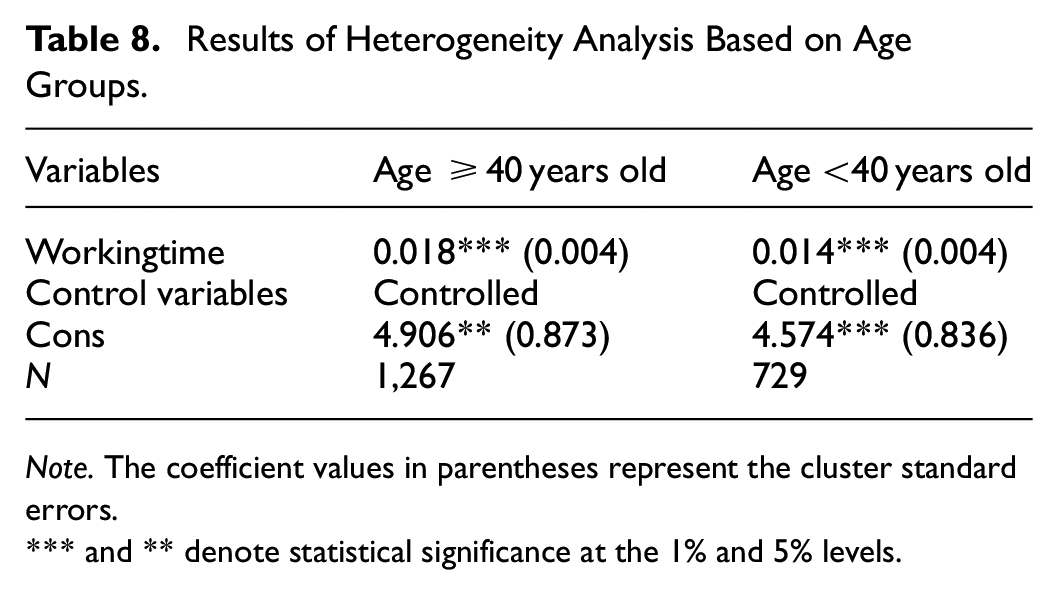
Note. The coefficient values in parentheses represent the cluster standard errors.
and ** denote statistical significance at the 1% and 5% levels.
Conclusion and Recommendation
Conclusion and Discussion
The increase in women’s labor participation can significantly enhance their trust in rural grassroots governments (Xuqing & Meng, 2023). This paper further verifies the applicability of this conclusion in the northwest region of China. The results show that women’s labor participation in rural areas has a significant positive impact on their trust in grassroots governments. The main reason is that as the labor participation rate of women increases, they not only gain more economic independence and autonomy but also receive more recognition and respect in the social sphere (Xuqing & Meng, 2023). This economic independence and social status improvement enable women to more actively participate in various affairs of rural grassroots governance, thereby enhancing their trust and support for governance work. This result validates Hypothesis 1. Further, the mechanism test results show that the willingness to distribute household labor plays a moderating role, weakening the overall effect of women’s labor participation on trust in rural grassroots governments, while the willingness to distribute household labor does not have a significant effect. This result validates Hypothesis 2. The main reason is that as the labor participation rate of women increases, the traditional division of labor begins to change, and women’s roles in social and economic activities become increasingly important. This result not only alters the power structure within the family but also has a profound impact on rural grassroots governance (Gedikli, 2014).
This study explores the mechanism of the impact of women’s labor participation on trust in rural grassroots governments through heterogeneity analysis of panel data models. The research results show that the impact of women’s labor participation rate on trust in rural grassroots governments varies significantly among different educational levels and age groups. Specifically, in groups with lower educational attainment and older women, the increase in women’s labor participation has a more significant impact on trust in rural grassroots governments. This may be because in these groups, the improvement of women’s labor participation rate can more effectively enhance their social status and ability to participate in rural grassroots governance, thereby contributing to an increase in their trust in grassroots governments.
The innovation of the research results in this paper mainly lies in revealing the profound influence of women’s labor participation on trust in rural grassroots governments, especially the significant differences in the influence mechanism under different socio-economic backgrounds. This finding not only enriches the research content in the fields of women’s labor participation and rural governance, but also provides a theoretical basis for formulating more targeted policies (Xuqing & Meng, 2023). Secondly, by introducing the concept of gender equality as a mediating variable, it reveals its bridging role between women’s labor participation and trust in rural grassroots governments, which helps to understand more comprehensively the far-reaching impact of the improvement of women’s status on rural governance, and also provides new ideas for promoting gender equality and social harmony. Finally, through the heterogeneity analysis of the panel data model, it reveals the different influences of women’s labor participation at different educational levels and age stages on trust in rural grassroots governments. This finding not only provides more detailed data support for policymakers, but also offers a new perspective for understanding the roles and contributions of different social groups in rural governance (Dabbaghi, 2024).
Recommendation
The local government should encourage rural women’s labor participation and build a bridge of trust. For instance, it can offer diverse training courses for women who are willing to work outside their hometowns, covering areas such as agricultural technology, handicrafts, and domestic services to meet the employment needs of different women. It should also cooperate with local enterprises to ensure that the training content is closely aligned with market demands, enhancing the practicality and employment rate of the training. A post-training employment tracking mechanism should be established to provide employment guidance and career planning services for the trained women, helping them smoothly transition to their jobs. Utilize government subsidies and corporate sponsorships to offer certain economic assistance to women participating in the training, reducing the economic barriers for them to take part in the training.
Older rural women need a more comprehensive labor security system to address their concerns. Optimize the unemployment insurance system for rural women, expand the coverage and increase the payout standards to ensure their basic living security during unemployment. At the same time, intensify the protection of rural women’s labor rights and interests, and severely crack down on and investigate any infringement of their rights and interests. In addition, actively promote the construction and development of mutual assistance and cooperation organizations for rural women to further strengthen their social security network and enhance their economic risk resistance.
The Women’s Entrepreneurship Fund is an excellent form that can provide start-up capital and loan guarantees for women entrepreneurs, reducing their financial risks in starting a business. On the one hand, the foundation can organize entrepreneurship training and seminars, inviting successful women entrepreneurs to share their experiences and providing comprehensive entrepreneurship guidance including market analysis, financial management, and legal consultation. On the other hand, it can collaborate with financial institutions to offer favorable loan terms and financial support to women entrepreneurs, helping them solve funding problems. Additionally, a women’s entrepreneurship network platform should be established to facilitate information exchange and resource sharing, creating a community environment for mutual assistance and cooperation among women entrepreneurs.
The entire society should actively advocate the concept of gender equality and reduce the burden on women in the family through measures such as optimizing the willingness to distribute household chores. For instance, promoting the socialization of family services, advocating that both husband and wife share household chores, and strengthening community support for families. Through these measures, a more relaxed family environment can be created for women to participate in social labor, promoting their all-round development.
Footnotes
Acknowledgements
The valuable guidance and assistance provided by the team members during the research process have made significant contributions to the completion of this study.

Funding
The author(s) disclosed receipt of the following financial support for the research, authorship, and/or publication of this article: This research was supported by the following funds: (1) Gansu Agricultural University Science and Technology Innovation Fund—public recruitment doctoral research start-up funding (No. GAU-KYQD-2022-40). (2) Gansu Province Science and Technology Program project (No. 23JRZA452). (3) Regional Science Fund Project of the National Natural Science Foundation of China: Financial Support for village-level Collective Economy in Underdeveloped Areas: A study on Policy impact and operation Mechanism (No. 72063027). (4) The Gansu Science and Technology Program of the Gansu Provincial Science and Technology Department (No. 23JRRA879).
Declaration of Conflicting Interests
The author(s) declared no potential conflicts of interest with respect to the research, authorship, and/or publication of this article. Those who funded this research had no role in the study design, data collection, analyses, data interpretation, writing of the manuscript, or decision to publish the results.
Data Availability Statement
The data used in this paper comes from the China Family Panel Studies (CFPS). If necessary, the complete original dataset can be provided.