




Abstract
The purpose of this study was to examine the relationship among Procuring Cause Law, real estate agent years of experience, and real estate commission disputes. A pilot survey was conducted in the southwestern United States among real estate agents, realtor(s), and brokers. After testing the hypothesis, the decision was made to fail to reject the hypothesis and conclude that real estate agent experience and not Procuring Cause Law produced favorable outcomes in disputes. As a result, the following recommendations were made: (a) Agency seller and buyer’s agreements should be used in each transaction to avoid disputes, (b) proper expectations and guidelines should be reviewed prior to starting any real estate transaction, (c) a checklist may assist in the assurance that all valuable information is reviewed, (d) agents could benefit from fully understanding Procuring Cause Law and sharing this information with their clients, (e) state and national regulatory requirements of the law could be modified for easier understanding and use, and (f) consumers who willfully violate the law could be subject to monetary penalties.
Introduction
“Ninety percent of all millionaires become so through owning real estate” (Capelle, 2004, ¶1). Real estate does not fly away, cannot be taken except through an action of eminent domain, appreciates, and can be a wise investment tool for future generations. Since the United States entered the 2008 recession, interest rates have been lower than in decades past. Rapidly advancing technology has empowered the consumer to make decisions without a real estate agent, and builders are throwing thousands of dollars of incentives around like candy (First American Professional Real Estate Services, 2013). The average consumer can view homes, build homes, and purchase homes from the comfort of a home comfort. In this era, real estate agents must transform both customer service activities and marketing strategies to not only gain but also retain consumers who have earned the right to understand the complexities of real estate and expect great service.
The dramatic changes to real estate have escorted the consumer into a new world of enlightenment, but can this lead to misinterpretation? Although many consumers feel savvy when it comes to real estate research, many are left shorthanded when completing the real estate transaction. Websites such as Trulia, Zillow, and Realtor.com offer the consumer opportunities to view homes, compare locations, and even take virtual tours. However, for many consumers it is difficult, if not impossible, to access homes due to varying local real estate laws. Consumers are often forced to turn to the expert agent to help secure a dream home or sell property. Unfortunately, a consumer may end up in a relationship with an agent that may not be a good fit for a variety of reasons ranging from obscene fingernail polish, to an annoying laugh, or rude behavior, and may revert back to personal reliance and fire their agent. This often leaves a trail of debris that can include hurt feelings, ego-bruising, and sometimes legal action.
The subject of real estate and its related jargon is complex and confusing. For the purposes of this research, the following terms and acronyms are relevant.
NAR: National Association of Realtors®. Hereinafter referred to as NAR (www.realtor.org/), this is America’s largest trade association, representing more than one million members involved in all aspects of residential and commercial real estate.
Agent or Real Estate Agent. Hereinafter referred to as agent, this is an individual with a state or provincial license to represent a buyer or seller in a real estate transaction in exchange for a commission.
Broker or Real Estate Broker. Hereinafter referred to as broker, this is an individual licensed to arrange the buying and selling of real estate for a fee and who also acts as an intermediary between the parties selling and buying the real estate.
Realtor®. Hereinafter referred to as realtor, this is a real estate professional who is a member of the NAR. Realtors include agents who work as residential and commercial real estate brokers, salespeople, property managers, appraisers, counselors, and other real estate professionals. Realtors must belong to both a local association or board and a state association.
Procuring Cause. “The proximate cause; the cause originating a series of events which, without break in their continuity, result in the accomplishment of the prime object. The inducing cause; the direct or proximate cause. Substantially synonymous with ‘efficient cause.’” (Highlight of Factors to Consider in Determining Procuring Cause, n.d., p. 1)
From a legal perspective, the NAR is the largest trade association representing more than million members (National Association of Realtors, 2013). Local real estate boards refer to the NAR for legislation, professional standards, and ethical guidance.
A broker will be regarded as the “procuring cause” of a sale, so as to be entitled to commission, if his efforts are the foundation on which the negotiations resulting in a sale are begun. A cause originating a series of events which, without break in their continuity, result in accomplishment of prime objective of the employment of the broker who is producing a purchaser ready, willing, and able to buy real estate on the owner’s terms. Mohamed v. Robbins, 23 Ariz. App. 195, 531 p. 2d 928, 930. (Highlight of Factors to Consider in Determining Procuring Cause, n.d., p. 1)
In layman’s terms, procuring cause precludes a consumer from terminating and cheating an agent out of a commission. Unfortunately, whether willfully or without knowledge of real estate policies, consumers can and do take actions that prevent an agent from receiving a rightfully earned commission. This is a common grievance within the industry and should be addressed prior to increased levels of real estate agent attrition.
Literature Review
The world of real estate is quite complex, requiring that an individual pass all state and federal exams after completing classroom coursework in order to become an agent and hold the designation of Realtor® (Texas Real Estate Commission, 2015). An agent can also become a broker after an extensive amount of criteria has been satisfied while holding a current license (NAR, 2013). If an agent is not a broker, then the individual must partner with a brokerage office to actively participate in real estate (San Antonio Board of Realtors®, 2013). The broker is responsible for holding the agent’s license and is accountable for the agent’s actions.
In standard real estate transactions, a customer will solicit the assistance of an agent to sell a home, and in return, the agent will charge a set percentage for a commission payout based on the final sale of the home (Miceli, Pancak, & Sirmans, 2007). This commission percentage includes the agent’s expertise in setting the list price, advertising the property through a local Multiple Listing Service (MLS), negotiations with the buyer’s agent, and a wide variety of services to help the customer competitively market the property (NAR, 2013). The nationwide average commission for an agent is 6%, which is split equally between the selling and buying agents (Shy, 2009). However, some agencies may attempt to keep listings internal (in house) to avoid sharing the 3% with another brokerage firm (Frew, Jud, & McIntosh, 1993). The phrase in house simply means either the selling agent represents both the selling and buying customer (referred to as dual agency), or two agents from the same brokerage firm represent both seller and buyer (Gardiner, Heisler, Kallberg, & Liu, 2007). In both examples presented, the brokerage firm would retain the entire commission.
The commissions first flow through the brokerage office before being distributed to either one or two agent(s) depending on representation (Yinger, 1981). A common sequence of events regarding a real estate commission is as follows:
The selling agent’s broker receives the full 6% commission.
An amount equal to one half of the full commission (3%) is distributed to the buying agent’s broker.
The selling and buying agents are then paid commission from the respective brokers based on agency agreements. (Yinger, 1981)
Brokerage firm agreements with real estate agents can range from simple monthly fees per real estate transaction to predetermined percentage splits. Each firm sets these expectations prior to allowing any real estate agent to join the firm, and an agent can only join one brokerage firm at a time (Miceli, 1991).
Real estate commission disputes typically arise when customers use multiple agents throughout a transaction (Fleming, 1999). For example,
A customer signs a listing agreement with their real estate agent and then fires their agent, and then their home sells in 30 days.
A buying customer works with an agent for several months, fires their agent, but purchases a home that they viewed with their first agent.
A buying customer views a home with an agent, but wants to pay a lower sales price. The buyer contacts the seller directly and requests a lower price if both agree to not work with any agent. (This example can also work in reverse—seller contacts buyer).
A buying customer signs an exclusive buying agreement with their agent, but decides to use a different agent to purchase a home. (Sanders, 2007, p. 10)
The common denominator in real estate commission disputes is which agent is entitled to the final commission (Sanders, 2007). The customer has significant influence over the perceived performance excellence of the agent who must constantly and consistently meet the needs of customers, or face the outcome of not receiving any commissions after working countless hours with no pay (Mercer & Kleiner, 1997). Even in situations when an exclusive buyer’s agreement has been signed with one real estate agent, disputes can still occur (Braswell & Poe, 1992).
Procuring Cause Doctrine evolved in 1944 after the court’s decision in the lawsuit Taylor v. Dorsey, 155 Fla. 305, 19 So. 2d 876, 878 (Fla, 1994, as cited in Cavendish, 2007). In this particular case, Florida real estate agent Dorsey was solicited by Taylor, Orange County socialite and hotel operator, to procure the sale of a hotel for $55,000 including $25,000 in cash. Dorsey sued Taylor who failed to follow through with the sale of the hotel when presented with willing and able buyers (Cavendish, 2007). Dorsey would have been denied any type of commission because Taylor refused to complete the transaction. Fortunately, Florida procuring cause doctrine has since evolved to protect a broker from losing a commission because the original terms differ from those finally accepted (Naughton & Brogan, 2013).
Although Florida has adopted new provisions, procuring cause doctrine varies slightly from state to state, and even for example, in San Antonio, Texas, acknowledges these differences by placing a provision within their Code of Ethics under article 17 regarding inter-association or lack thereof between State Boards (San Antonio Board of Realtors®, 2015).
Another state with varying language regarding procuring cause doctrine is New York (New York State Association of Realtors® [NYSAR], 2013). The NYSAR® guidelines found in Standard of Practice 17-4 address situations in which non-contractual disputes are subject to arbitration and limit the amount of commission paid to any brokers involved in the real estate transaction in question.
There are many commission dispute lawsuits involving procuring cause doctrine, and resolution varies from state to state. For example, in A.H. Hutchings v. Montgomery Slemons (1943), No. 8104, Supreme Court of Texas, even the original broker agreement with the seller was oral and the appellate court ruled the broker was not entitled to the commission, both the trial court and the Supreme Court ruled in favor of the broker recovering the commission. Cases such as this one show that procuring cause doctrine does protect an agent, because the Supreme Court ruled in favor of the broker recovering the commission. However, in this case and the examples that follow, there is a clear pattern of court ruling, appeals, retrial, and an incredible amount of time spent toward resolution.
In Sanders v. Devereux (1963, No. 231, Maryland Court of Appeals), the seller of Melwood Farm interacted with brokers who introduced buyers and brokers who negotiated the closing of the sale. The case was brought to trial, and the court ruled in favor of the brokers who made the introduction, finding them to be the procuring cause of the sale. This case is similar to A.H. Hutchings v. Montgomery Slemons (1943), where the court ruled in favor of the initial broker and agent who initiated the procuring cause of sale. This is another example of the procuring cause doctrine upholding the original complaint of the plaintiff. This case also demonstrates that regardless the number of individuals involved in a transaction, the first broker to demonstrate procuring cause is granted the commission.
In Kaufman Realty v. Spec Development (Kalodner, 1999), the court ruled in favor of the defendant, a developer who sold property directly to the buyers who failed to inform the developer that they had a licensed broker. The court determined that the developer acted in good faith and, therefore, met the general rule of procuring cause doctrine. This particular case demonstrates the varying degrees of interpretation of procuring cause doctrine. The broker who initially introduced the customers was cut out of the final sale of the townhome. The broker sued, and the court ruled in favor of the defendant, Spec Development. They did not have to pay the broker who introduced the customers, because the customer noted they were not working with anyone. This is a good example of the law being interpreted in varying degrees depending on state.
In Hemispherex Biopharma v. Mid-South Capital, Inc (2012, No. 690, Northern District of Georgia), the ambiguity of the procuring cause doctrine is quite clear and centers around an unsigned engagement letter. The initial decision to grant summary judgment was found to be in error due to insufficient evidence on the part of both parties to the lawsuit. The case was remanded to the District Court after the decision was reversed. This particular case, in which the courts could not agree on summary judgment, has not been resolved because there is no clear interpretation of Procuring Cause Law. This is an example of the law ambiguity and a case that may pend for years without resolution.
The lawsuits reviewed in this literature review have one common thread—the dispute regarding who is entitled to commission on each property. Although an agent might be the one to initiate the dispute resolution of commissions, the broker(s) with whom the agent is employed becomes the plaintiff(s) in the lawsuit. The lawsuits present insurmountable evidence from both plaintiffs and defendants regarding the commissions and to whom the said commission is entitled. In each case, there is judgment summary, an appeal, and counter appeal. There are several instances where the courts cannot determine the interpretation of the law and recommend question certification, which essentially means clarification from another court (Legal Dictionary, 2013).
Research Design
A quantitative methodology and pilot survey approach were utilized to conduct this exploratory research. Based on Creswell’s (2012) guidance on correlation design, this study focused on examining the association or relation of one or more variables for investigation (real estate agent experience, procuring cause doctrine, and outcome of commission disputes). The survey contained three sections. Section A addressed the demographic variables of gender, ethnicity, age, real estate designation, tenure in the real estate industry, and estimated average value of all transactions completed. Section B contained four Likert-type scale items ranging from strongly agree to strongly disagree, which pertained to attitudes about procuring cause doctrine. Section C contained two questions; the first question related to the number of disputes resolved in the respondent’s favor, and the second related to how procuring cause doctrine affected any disputes not resolved in the respondent’s favor. A Chi-Square Test of Independence was used to test the relationships among real estate agent experience, procuring cause doctrine, and commission dispute resolution.
Participants in Dallas, Houston, and San Antonio representing broker offices for Coldwell Banker, Century 21, ERA, Sotheby’s, and Better Homes and Garden were contacted and invited to respond to the web-based survey. The SurveyMonkey® link was available throughout an 8-week period during December, 2013 and January, 2014. Invitation and reminders were sent on three separate occasions through Facebook, email, and text. Individuals were asked to share the link with any real estate agent affiliate, essentially creating a snowball sampling technique. This approach was chosen due to the difficulty in obtaining aggregate email rosters of agents from brokers or real estate associations (state and national). Prior to the research study being implemented, approval was obtained from the University of the Incarnate Word Institutional Review Board, and each respondent was presented with an informed consent statement and the opportunity to decline participation in the survey.
Results
The survey invitation reached approximately 100 individuals, of which 20 individuals (20%) responded. The demographic profile of the respondents
included equal representation of gender (50%/50%);
reflected an ethnicity of White/Caucasian (65%);
demonstrated an age range of 40-49 years (40%) with only 5% age 60 or older;
revealed a majority (75%) held the designation of real estate agent or realtor® (75%) with only 10% designated as broker;
averaged 6-15 years of experience within the real estate industry (40%); and
indicated an average transaction amount within the $100,000-$250,000 range (30%), with 80% of the transactions averaging $250,000 or less, which reflects the nationwide average (NAR, 2013).
Frequencies were also calculated for responses to the following four Likert-type items (strongly agree to strongly disagree) from Section B of the pilot survey and are presented in Table 1 below.
Frequency of Response to Procuring Cause Doctrine Items (n = 20).

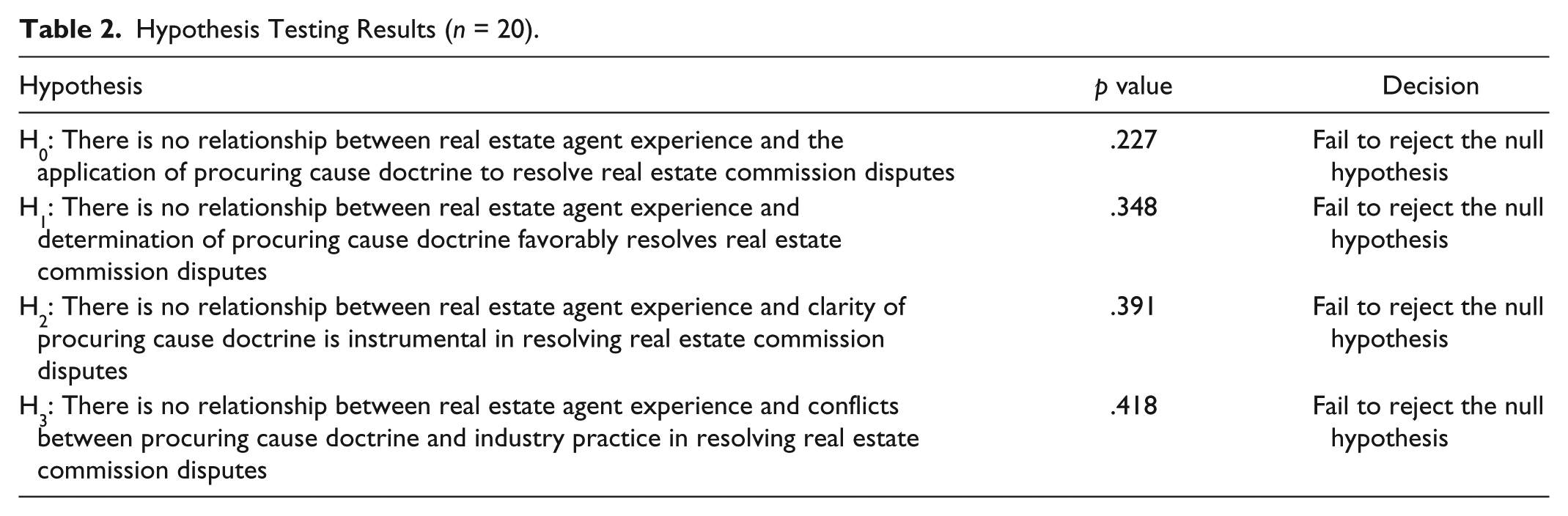
As can be seen in Table 1, the majority of responses for each statement regarding procuring cause doctrine were neither agree nor disagree. The four procuring cause doctrine items were then tested as hypotheses to determine any relationship between real estate agent experience and real estate commission disputes involving procuring cause doctrine. The results of the Chi-Square Test of Independence are presented in Table 2.
Hypothesis Testing Results (n = 20).
Discussion, Conclusion, and Recommendations
In spite of a history of procuring cause doctrine legal cases dating as far back as 1943, the results of this pilot study did not indicate that respondents had issues with or negative experiences concerning the doctrine. This, in large part, is due to the limitation created by the extremely small sample size of 20 respondents who were all affiliated with a well-known broker and the fact that all of the respondents were located in Texas. As shown in Table 2, the majority of respondents were ambivalent about procuring cause doctrine and demonstrated such in their neither agree nor disagree response. The results may indicate that brokers have taken significant steps to create company policy and procedures that prevent the issue of procuring cause doctrine from becoming a conflict or rising to the level of mediation or legal action in a court of law.
Procuring cause doctrine was created and intended to protect real estate agents in commission disputes related to representation of the consumer. Since the adoption of the doctrine, countless disputes have erupted over first right of commission. This arduous and cumbersome process has wasted time and money for all parties involved. The conclusion that the doctrine still holds value is evidenced in documented lawsuits across the nation, similar to those included in the literature review. Unfortunately, the outcome varies from state to state and city to city, and there are limited data to show consistency of outcomes.
Creating policies and procedures to protect an individual’s commission should be a preemptive approach. It is an industry best practice to always ask consumers if they are working with another agent and decline consumers who have existing agreements or have viewed several homes with various real estate agents. If a consumer wishes to terminate a relationship with a current agent, it is recommended that written documentation be obtained from the real estate agent’s broker of record. It is also highly recommended that careful documentation is secured for each client who is being assisted, and all information is available and transparent.
Because the results of the survey were inconclusive, it would be beneficial to redeploy it with a larger sample size and across a broader geographic region consisting of several states. Incorporating data such as sales and commission payments by addressing For Sale By Owner (FSOB) may have highlighted pertinent information to the study. In addition, the survey should be revised to incorporate more specificity with regard to procuring cause doctrine to include measurement questions regarding (a) whether the respondent works for a broker with criteria in place to preclude conflict; (b) whether the respondent has received training in procuring cause doctrine; and (c) whether the respondent has been involved in commission disputes that did not involve procuring cause doctrine.
A final limitation in this research was the time of year the survey was conducted. The survey was sent during the Christmas and New Year holiday season. This is typically a time of year when real estate is slow, brokers and agents take vacation, and commissions are not easily attainable. Real estate agents may not have completed the survey due to negative feelings about their commission income during this time of year. Also, respondents could have been preoccupied with the holiday season and various family obligations. Completing a survey during this time of year may not have been a priority, or could have been simply overlooked if invited participants did not monitor email during the slow season.
For all real estate professionals, whether brokers or agents, it is best to err on the side of caution and not assume that a client has been in contact with another agent for the sale or purchase of a home. Although it is easy to identify a consumer who is using an agent to sell due to local MLS feeds reflecting this information, it is more difficult to confirm or deny a consumer is using various agents to purchase a home. It may be beneficial for broker offices to complete a new client checklist that would systematically omit any obscurity of two agents working for the same individual. It is always best to educate the client about procuring cause doctrine and how it contributes to disputes if ever in question. It should be an industry best practice to protect an individual’s commission by completing proper selling and buyer’s agreements. There may be an opportunity for the industry to create one system that could capture these agreements for real estate agents to verify a client’s intent and to avoid any conflict. In conclusion, the understanding and knowledge of procuring cause doctrine appear not only to vary among real estate agents and brokers, but also to vary in application across states and the nation.
In summary, the results of this study may identify important avenues of clarification for agents and brokers. Agents and brokers may be able to draw on past experiences in procuring cause lawsuits to protect themselves from commission disputes. It is recommended that agents use listing and buying agreements with clear definitions and terms that do not confuse the consumer as an integral component of the real estate engagement. It is also recommended that agents and brokers take a more proactive approach to educate consumers. With regard to real estate consumers, there should be clear remedies to assist when dissatisfied with agent performance. Policymakers, such as the NAR, and future researchers might consider a meta-analysis of procuring cause lawsuits spanning 1943 to the present to determine patterns or common causes of legal action. The finding could reveal not only opportunities to clarify procuring cause doctrine but also ways to introduce consistency and transparency among the many levels of real estate associations, agencies, and providers.
Footnotes
Declaration of Conflicting Interests
The author(s) declared no potential conflicts of interest with respect to the research, authorship, and/or publication of this article.
Funding
The author(s) received no financial support for the research and/or authorship of this article.