




Abstract
This study investigated the influence of age, gender, and emotional intelligence (EI) on conflict management styles among dating age adults in Botswana. A mixed survey and quasi-experimental design was used to assess the relationship between age and gender and the mediating influence of EI on participants’ preferred conflict management strategies (avoidance, competition, compromise, accommodation, and collaboration) in response to violent and nonviolent relationship conflict. One hundred fifty-two participants were surveyed before (with the Wong and Law Emotional Intelligence Scale) and after (with the Conflict Style Questionnaire) watching video clips of nonviolent and violent relationship conflict. Correlations, t tests, and regression analyses were conducted. Findings revealed that women were more likely than men to report use of collaboration conflict strategies in response to the nonviolent video, and men were more likely than women to report accommodation strategies in response to the violent video. In the regression analysis, gender was a significant predictor of accommodation conflict style in response to the violent video, and EI had a significant independent and partial mediating relationship with compromise in response to the violent situation and collaboration in response to both violent and nonviolent conflict situations. Findings highlight the important role of EI in the use of higher-level relationship conflict strategies. Implications in the way of communication and conflict management for dating age adults and couples are discussed.
In Botswana, a land-locked country in Southern Africa with a population of just over 2 million people (Central Intelligence Agency, 2014), there has been a documented increase in the rate of divorce (Balogi, 2004; Maundeni, 2000), high prevalence of intimate partner violence (Jankey, Próspero, & Fawson, 2011; Modie-Moroka, 2009), and reports of relationship stress and strain (Onyewadume, 2006). A recent report on gender-based violence in the country indicates that 62% of women have experienced intimate partner violence and 48% of men have reported perpetrating violence in an intimate relationship (Machisa & van Dorp, 2012). Moreover, various forms of gender-based violence have been reported to have increased by 122% between 2003 and 2011 (Machisa & van Dorp, 2012). Due to the high percentage of divorce and domestic violence, there is a growing need to understand the factors that might improve interpersonal and romantic relationships.
Emotional intelligence (EI) is defined as a group of mental abilities related to understanding, experiencing, and managing emotions (Jensen, Kohn, Rilea, Hannon, & Howells, 2007). There is a large body of research that explores the role of EI in multiple life and interpersonal domains, including academic performance, work life, and intimate and romantic relationships. In the context of romantic and intimate relationships, EI may be able to help explain how individuals understand and deal with conflict. Some research (e.g., Brackett, Warner, & Bosco, 2005) has supported the significant relationship between EI and conflict styles in relationships. For instance, studies have found that EI as well as how couples manage conflict influence multiple relationship dynamics, including perceived relationship quality, communication patterns, and longevity. EI is about seeing and relating with others. In this way, it is expected that EI would affect conflict in relationships and inform the style that individuals adopt to manage conflict situations.
The significance of both EI and conflict management styles in interpersonal relationship functioning has been documented cross-culturally and with regard to multiple relationship types, including work, friendship, family, and romantic relationships (e.g., Schlaerth, Ensari, & Christian, 2013; Stolarski, Postek, & Śmieja, 2011; Veshki et al., 2012). Furthermore, the link between EI, conflict resolution, and relationship satisfaction indicates differences related to gender and other psychosocial variables. The relationship among these variables speaks to the complex individual factors that influence how couples experience and manage conflict (Stolarski et al., 2011). One potentially meaningful direction for understanding relationship dynamics between couples in Botswana is to investigate the connection between EI and conflict management approaches among dating age adults.
EI Explained
EI is a widely studied concept that has been associated with numerous psychological and behavioral domains, including stress and coping, academic performance, ethical and moral behavior, leadership dynamics, worker satisfaction and burnout, leadership, management conflict, and relationship fulfillment (Jensen et al., 2007). Research on the importance of EI in work and leadership roles is plentiful. For example, in a meta-analysis of the relationship between EI and conflict management in the workplace, Schlaerth et al. (2013) analyzed the results of 20 studies and found that EI predicted constructive conflict management, particularly in nonleaders versus leaders in the workplace. Similarly, EI has been found to be a significant predictor of job performance and integrating and compromising conflict styles in the workplace (Shih & Susanto, 2010).
EI involves the relationship of intelligence to emotion and cognition (Aslan & Erkus, 2008). Bar-On (2006) developed a model of emotional-social intelligence (ESI) that focuses on the noncognitive aspects of intelligence. His Emotional Quotient Inventory (EQ-i) measures intrapersonal skills such as self-awareness and interpersonal competencies such as understanding others’ feelings and being able to cooperate with others. According to Bar-On (2006), “Emotional-social intelligence is a cross-section of interrelated emotional and social competencies, skills and facilitators that determine how effectively we understand and express ourselves, understand others and relate with them, and cope with daily demands” (p. 14). Similarly, Goleman’s (1998) model emphasizes different social and self-competencies, including self-awareness and accurate self-assessment, self-control, contentiousness, communication, leadership, and conflict management, which are important for successful functioning in corporate environments. Salovey and Mayer (1990) defined the EI construct—as used in most current psychological research—as interrelated abilities “to monitor one’s own and others’ feelings and emotions, discriminate among them and use this information to guide one’s thinking and actions” (p. 189). Mayer and Salovey’s model of EI focuses on the four areas of perceiving, appraising, expressing, and regulating emotions (Jensen et al., 2007).
These abilities are important for social interaction because emotions play essential communication and social functions in relationships by relaying information about individuals’ thoughts and intentions (Lopes et al., 2004). Intimate relationships involve a complex interaction between one’s own and one’s partner’s needs and require a measure of social and emotional acumen to survive and flourish. Assessment of EI in couples can provide a useful picture of how marriage and intimate relationships are operating.
Currently, there are two general models for measuring EI—the ability model and the trait/mixed model (Aslan & Erkus, 2008). The ability model positions EI as a set of competencies used to navigate different real-life conditions. It is usually assessed using measures of social problem-solving ability. The trait model, however, views EI as a feature of one’s behavior or character that is applied across situations (Jensen et al., 2007). Trait EI is usually measured using self-report questionnaires (Aslan & Erkus, 2008).
Self-report measures of EI have demonstrated utility in predicting various psychological and emotional outcomes (Law, Wong, & Song, 2004; Tett, Fox, & Wang, 2005; Wong, Wong, & Law, 2007). For the purposes of this study, EI is conceptualized using the trait/mixed model that influences multiple areas of functioning.
EI and Intimate Relationship Conflict
While a normal part of intimate relationships, conflict is often a source of stress and turmoil for couples when they are unsure of how to manage it. Social and emotional insight and problem solving—the crux of EI—may be part of the skill set that helps couples handle conflict in healthier ways. Research studies support the significant role of EI in relationship conflict and relationship quality. Stolarski and colleagues (2011) examined the link between EI and conflict resolution strategies among heterosexual couples using self- and partner report, hypothesizing that higher EI would result in the use of constructive and active resolution strategies that are assumed to be healthier in relationships. Their findings revealed a gender effect, such that for women higher EI was associated with the use of constructive conflict management strategies but not for men. However, women judged emotionally intelligent men as having more constructive/adaptive conflict management (Stolarski et al., 2011). In a study that looked specifically at women in Iran, researchers found a significant correlation between EI and marital conflict styles that emphasized cooperation and compromise (Veshki et al., 2012).
Other researchers have investigated the relationship between EI and relationship quality among heterosexual couples. Brackett et al. (2005) found that female partners were generally higher in EI than male partners. They also found a curvilinear relationship between EI and relationship quality. This meant that couples where both partners were low in EI had the lowest scores on positive indices of relationship quality and the highest scores on negative indices such as conflict and negative relationship quality, while couples with both partners high on EI were not consistently higher on positive and lower on negative relationship quality indices. One explanation for how EI contributes to relationship quality is that it could help couples manage conflict and disagreements (Brackett et al., 2005).
Communication and Conflict Styles in Relationships
Northouse (2011) discusses communication within the framework of relational conflict. In this regard, relational communication is seen as an outcome of how the individuals involved perceive their relationship and connection to one another. Sillars (1980) classified three communication conflict approaches—integrative, distributive, and avoidant (Zacchilli, Hendrick, & Hendrick, 2009). Integrative strategies, which include cooperation and collaboration, are constructive; distributive strategies such as criticism and sarcasm are destructive; and avoidant strategies (e.g., changing topics or denying that conflict exists) are neither constructive nor destructive (Zacchilli et al., 2009). Lulofs and Cahn (2000) proposed a similar classification using five conflict strategies: avoidance, accommodation, competition, compromise, and collaboration.
Investigations into the role of communication and conflict management in relationship quality have resulted in a number of significant findings. Noller, Feeney, Bonnell, and Callan (1994) compared pre- and post-marital communication and conflict behavior longitudinally in a sample of 40 couples. Communication style predicted relationship satisfaction for women, while satisfaction predicted how men and women communicated later in the relationship. Spouses high in satisfaction after 2 years of marriage were less likely to avoid dealing with conflict or engage in destructive patterns. Both men and women tended to be consistent in their communication and conflict patterns before and after marriage, but there was evidence that dissatisfied couples tried to alter communication styles once married (by decreasing negative and increasing positive communication; Noller et al., 1994). These findings highlight the reciprocal relationship among communication patterns, conflict, and relationship satisfaction. In a similar study of married couples’ conflict responses and marital satisfaction, researchers found four types of couples based on conflict style—distancing couples, engaging couples, distancing wives, and distancing husbands. Each couple type was associated with different levels of marital adjustment (Ridley, Wilhelm, & Surra, 2001). In other words, conflict style seems to be a fundamental facet of how well couples can weather the storms of marriage relationships.
Exploring gender differences, Hojjat (2000) found disparities in the perception of relationship conflict styles. Women saw themselves as more negative-active in their conflict management style in contrast with men who saw themselves as more positive-passive. The researcher explained that individuals who used a negative-active strategy actively worked on solutions that were not equitable, while those who used the positive-passive strategy wanted an equitable outcome but did not actively work on a solution. Furthermore, women demonstrated greater understanding of their partner’s conflict strategies in that their perceptions of the partner’s conflict behaviors tended to be in agreement with the partner’s self-perception (Hojjat, 2000). Understanding a partner’s style could be related to the level of EI.
Research also suggests that communication and conflict management may be enacted differently in violent versus nonviolent situations. Deficiency in constructive communication skills may prompt the use of verbal aggression among relationship partners (Infante, Sabourin, Rudd, & Shannon, 1990). What is more, people who use violence in their relationships are hypothesized to have difficulty managing social conflict (Infante, Chandler, & Rudd, 1989). Infante et al. (1989) found that verbal aggressiveness as a communication style to deal with conflict led to physical violence during interpersonal conflict. Another group of researchers investigated problem-solving abilities in response to conflict vignettes of violent and nonviolent couples and found that both men and women in violent relationships lacked some of the skills necessary to competently respond to relationship conflict (Anglin & Holtzworth-Munroe, 1997). Findings have also shown that violent couples exhibit more stereotyped sex-role attitudes, more aggressive and passive behaviors, and less marital satisfaction (Telch & Lindquist, 1984). In addition, Bird and colleagues used social exchange theory as a framework for understanding dating violence (Bird, Stith, & Schladale, 1991).
It is clear that conflict management and communication are interrelated and integral to relationship quality and health. In fact, conflict management styles are essentially categories of different modes of communication in relationships. Moreover, the findings discussed here suggest the intersection of multiple factors such as age, gender, EI, situational violence and communication and conflict in marriage and intimate relationship functioning. To better understand these dynamics, this study aimed to examine EI and conflict management strategies in response to violent and nonviolent conflict in the context of intimate relationships.
The bulk of studies that look at EI and conflict management have taken place in the context of workplace functioning and workplace leadership development. The significant role of EI in conflict management within work settings does have implications for intimate relationships; however, investigations that focus specifically on how EI operates to influence conflict management strategies in relationships are important. Furthermore, the literature on EI in relationships includes few if any studies that examine EI, conflict management styles, age, and gender in different conflict situations. By exploring these multiple dimensions of how EI may influence conflict management in relationships, this study aims to contribute to understanding the social, emotional, and communication dynamics that can be activated in relationships. Finally, culture is an important aspect of social interactions, interpersonal skills, and navigating relationships. However, there is little to no research on EI with African samples that would help to extend EI findings to different cultural contexts. We attempt to broaden the EI research in Africa and to add an additional perspective to help understand relationship conflict styles in Botswana.
Current Study
This study investigated the relationship influence of psychosocial predictors (age and gender) and EI on conflict styles among dating age adults in Botswana. Specifically, it looked at the relationship of age and gender to conflict management approaches in response to both a physically violent and a physically nonviolent relationship conflict situation and the mediating impact of EI. Following from the reviewed literature above, we asked how gender, age, and EI would independently and conjointly predict the way that the conflict situations are managed via the conflict styles adopted. Research questions were as follows:
Thus, the following hypotheses were tested:
Method
Design
Survey and quasi-experimental methodology were used to determine participants’ age, gender, self-reported EI and use of avoidant, competition, compromise, accommodation, or collaboration conflict styles in response to a nonviolent and a violent relationship conflict. Exposure to hypothetical violent and nonviolent conflict situations was achieved by having participants watch two video vignettes. A heterosexual couple engaging in a verbal disagreement depicted the nonviolent conflict, and a heterosexual couple engaged in a physical fight depicted the violent conflict. Participants completed the Wong and Law Emotional Intelligence Scale before watching two video clips depicting relationship conflict. Participants then completed the Conflict Style Questionnaire in response to the two video vignettes to assess their preferred conflict management styles in such situations.
Participants
A total of 152 participants were recruited through an advert distributed throughout the University of Botswana student community. To participate, they had to be 18 years or older and enrolled at the University. The sample, representing a wide range of the university population, included 27 males (18.2%) and 121 females (81.8%). Four participants did not identify their gender. The average age was 22.53 (SD = 4.41) and ranged from 18 to 46 years. In terms of other psychosocial variables, 41 participants (27%) were raised in a city, 45 (29.6%) were raised in a town, 63 (41.4%) were raised in a village, and 3 (2%) designated “other.” Eight students (5.3%) reported being married, 57 (38%) in a serious relationship, 33 (22%) casually dating, and 52 (34.7%) not currently dating or in a relationship, with 2 (1.3%) not indicating their relationship status.
Measures
The Wong and Law Emotional Intelligence Scale (2002) is a 16-item self-report measure based on the trait model of EI that assesses how individuals use emotions to solve problems intra- and interpersonally. It includes a global score and scores on four dimensions—self-emotion appraisal, emotion appraisal of others, use of emotion, and regulation of emotion. Responses are answered on a 7-point Likert-type scale from 1 (never) to 7 (always). Originally designed for use in organizational research, it has demonstrated good internal reliability and validity for life satisfaction (Jensen et al., 2007) and has been used cross-culturally (Aslan & Erkus, 2008; Karim, 2010). Alpha reliability coefficient has been documented in the range of .83 to .90 (Aslan & Erkus, 2008). It is continually and intervally measured, so that the higher the score the higher the level of EI. In this sample, the reliability was .776.
The Conflict Style Questionnaire (Northouse, 2011) is a 25-item measure based on Kilmann and Thomas’s (1977) model of conflict styles. The model identifies five conflict styles: avoidance, competition, accommodation, compromise, and collaboration on the dimensions of assertiveness and cooperativeness (Northouse, 2011). The questionnaire, adapted by Rahim and Magner (1995) and later by Northouse (2011), is comprised of five scales, each with five items that correspond to the aforementioned conflict styles. Items are answered on a 5-point Likert-type scale from 1 (seldom) to 5 (always). For this study, the reliability for each scale ranged from .349 to .859, indicating acceptable reliability on average.
The author of the measure defined the five styles as follows:
Avoidance is characterized as an unassertive and uncooperative conflict style, where strategies such as denying conflict or deflecting conflict are used. A sample question on the Avoidance scale is as follows: “I would avoid being put on the spot, I keep conflict to myself.”
Competition is an assertive but uncooperative conflict style, characterized by trying to convince others to achieve one’s goals or meet one’s needs. A sample question on the Competition scale is as follows: “I would use my influence to get my ideas accepted.”
Compromise includes elements of assertiveness and cooperativeness. It is a way of addressing the needs of both parties quickly but without fully resolving the issues. A sample question on the Compromise scale is as follows: “I would propose a middle ground for breaking deadlocks.”
Accommodation involves deference to others in an unassertive but cooperative manner. One problem is that one’s own needs have to be overlooked in favor of addressing others’ needs. A sample question on the Accommodation scale is as follows: “I would accommodate the others’ wishes.”
Collaboration involves both cooperation and assertiveness and should result in both parties’ needs being addressed to resolve the conflict. It is considered the healthiest of the five because it recognizes the inevitability of conflict but focuses both people involved reaching constructive resolution. A sample question on the Collaboration scale is as follows: “I would try to bring all our concerns out in the open so that the issues can be resolved” (Northouse, 2011).
While most people rely on a combination of these conflict styles, individuals are thought to lean more heavily on one conflict management style more than others depending on the situation.
Video vignettes
Participants viewed two short video clips from the dramatic comedy film Why Did I Get Married, Too? The first vignette, which was 1 min 52 s, depicted a verbal, nonphysically violent conflict between a married couple. The second, which was 1 min 45 s, showed a married couple engaged in a violent physical conflict. The conflict in the first vignette involved a wife who was upset about what she believed were phone calls from another woman on her husband’s cell phone. She looked through his phone and accused him of infidelity. The husband responded by explaining that what she believed were phone calls were actually text messages from his job. They talked about the wife’s insecurity and her fear that the husband would leave her for a younger, more beautiful woman. Then, he reassured his wife that he loved her, and they kissed and resolved the conflict. The second vignette also involved a married couple. When it started, it was obvious that the husband had been drinking and he was clearly intoxicated as the couple started to discuss their impending divorce proceedings. They began to verbally argue and the wife yelled at him that he was being unreasonable. The yelling between them escalated and the husband grabbed the wife, pushed her onto the sofa, pressed her mouth, and poured alcohol from his bottle on her.
These particular film excerpts were used because of the reality-based relationship conflicts they portrayed and the likelihood that participants would be familiar with the racial and cultural character depictions.
Procedures
The study was carried out with University of Botswana students in accordance with prescribed ethical research standards. Participants were recruited through their lecturers as well as through adverts that were posted around the campus. In both instances, potential participants were informed that the study was about relationships and that they would be required to answer brief questionnaires and view video clips. They were informed that the study would take no longer than 60 min and that they would receive class credit and become eligible for a small cash prize drawing. As English is the language of instruction and communication at the University of Botswana, all of the study questionnaires and activities were conducted in English. Participants signed in with their name, student ID, and course number on a separate paper to receive participation credit. They were then instructed to write only their student ID number on a small piece of paper that was collected for the cash drawing after completion of the study. Next, the consent form and study questionnaire packets were distributed. At that point, no other participants were permitted to enter the study room. The consent form was read aloud by the researchers, and participants read it themselves as well. They were given the opportunity to ask questions before proceeding to the questionnaire instructions and were instructed not to write their names or other identifying information anywhere on the questionnaires. Once instructed to start, participants completed the Emotional Intelligence Scale, which was in the front of the packet. They were told to stop when they finished the Emotional Intelligence Scale questionnaire, close the questionnaire packet, and wait for further direction. After it was confirmed that all participants had finished the questionnaire, video vignettes were introduced.
Before being shown the vignettes, the researchers briefly explained that participants would see two videos of people who were in a relationship with each other. After viewing the videos, participants were directed to open the questionnaire packet and complete the Conflict Styles Questionnaire and demographics. They were instructed to provide answers in response to each of the videos. Therefore, each conflict style question had two answers—one for the nonviolent video and the other for the violent video. Completed questionnaires were collected after everyone was finished. Finally, participants were debriefed about the study and instructed to contact the researchers if they had any follow-up questions. Those who wanted waited for the cash drawing.
Data Analysis
Data were analyzed using the SPSS program. A series of descriptive statistics, t tests, correlations, and multiple regression analyses were conducted. The analyses examined the impact of the predictor variables, age and gender, as mediated by EI, on the criterion variables, conflict management styles. As such, there were 10 criterion variables—five different conflict styles each in response to the nonviolent and violent situations.
Assessment of Common Method Variance
To test for common method variance, or systematic measurement error as a result of all data being collected using self-report questionnaires (Podsakoff, MacKenzie, & Podsakoff, 2012), a post hoc Harman’s single-factor test was conducted (Harman, 1976; Schriesheim, 1979; Scott & Bruce, 1994). We performed a principle components factor analysis on the items from the 10 criterion variables (the five conflict scales for both the violent and nonviolent videos) and the Emotional Intelligence Scale. The analysis indicated that one factor only accounted for 12% of the variance. This result does not completely rule out the possibility of common method variance; however, it does suggest that common method variance is not likely to confound the interpretations of the data analysis results.
Results
Descriptive Findings
Table 1 lists the mean score for the Emotional Intelligence Scale (M = 62.22, SD = 7.48) as well as participants’ mean score on each of the five Conflict Style Questionnaire scales in response to both the nonviolent and violent video vignettes. In addition, the correlations between each of the scales are listed. The following correlations were significant at the p < .05 level: The Nonviolent Video Competition scale was significantly correlated with the Nonviolent and Violent Video Collaboration scale and the Violent Video Competition scale; the Nonviolent Compromise scale was significantly correlated with the Nonviolent Accommodation scale, the Nonviolent Collaboration scale, and the Violent Compromise scale; the Nonviolent Accommodation scale was significantly correlated with the Nonviolent Collaboration and Violent Avoidance scales; the Nonviolent Collaboration scale significantly correlated with the Violent Competition and Violent Collaboration scales; the Violent Avoidance scale significantly correlated with the Violent Collaboration scale; the Violent Competition scale significantly correlated with the Violent Collaboration scale; the Violent Compromise scale significantly correlated with the Violent Accommodation and Violent Collaboration scales; and the Violent Accommodation scale significantly correlated with the Violent Collaboration scale.
Means, Standard Deviations, and Correlations for the Emotional Intelligence and Conflict Style Scores.

p < .05. **p < .01.
A series of t tests were conducted to compare mean differences on the Emotional Intelligence Scale based on gender, and each of the conflict styles for both the nonviolent and violent videos. There were only two significant mean differences. The mean score for the Collaboration scale in response to the nonviolent video was significantly higher for women (M = 22.18, SD = 2.86) than for men (M = 20.92, SD = 3.16), t(138) = −1.97. The mean score for the Accommodation scale in response to the violent video was significantly higher for men (M = 14.89, SD = 3.62) than for women (M = 12.05, SD = 4.22), t(139) = 3.22. Male/female mean comparisons for each scale are shown in Table 2.
Independent Samples t Test–Conflict Style and Emotional Intelligence Scales by Gender.
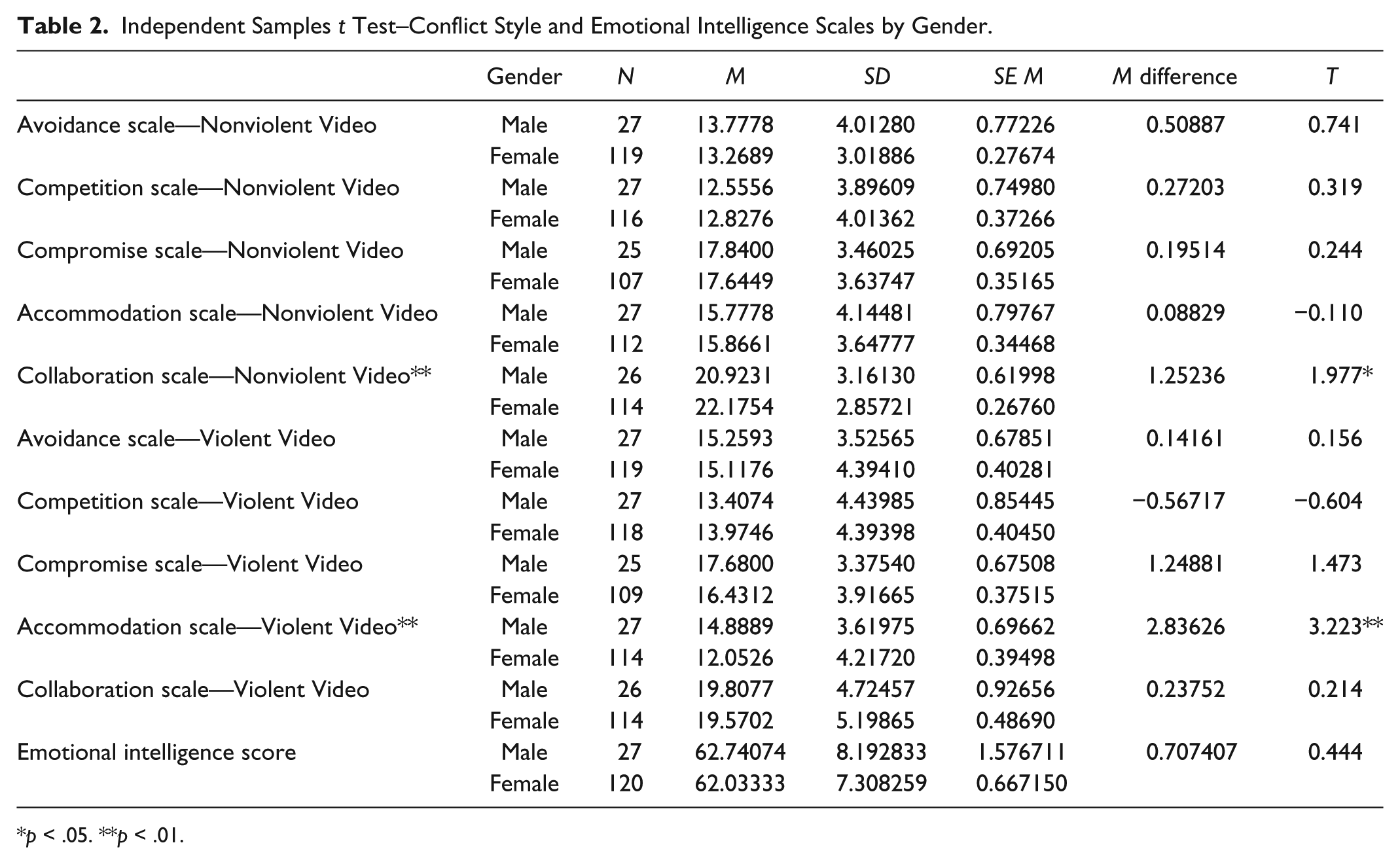
p < .05. **p < .01.
Regression Analyses
To test the hypotheses, a series of regression analyses were conducted (see Table 3). A total of 10 linear regression models were run to account for the direct and mediated relationship between the psychosocial predictors (age and gender), EI, and the criterion variables (the avoidance, competition, compromise, accommodation, and collaboration scales for both the nonviolent and violent videos). The psychosocial predictors were entered into the regression model simultaneously, and then EI was entered to test the mediating effect. In addition, mediation analyses were tested using the bootstrapping method with bias-corrected confidence estimates (Preacher & Hayes, 2004). Where the regression analyses were significant, we reported additional analyses of the 95% confidence interval of the indirect effects obtained with 5,000 bootstrap samples (Preacher & Hayes, 2008).
Regression Model Summary.
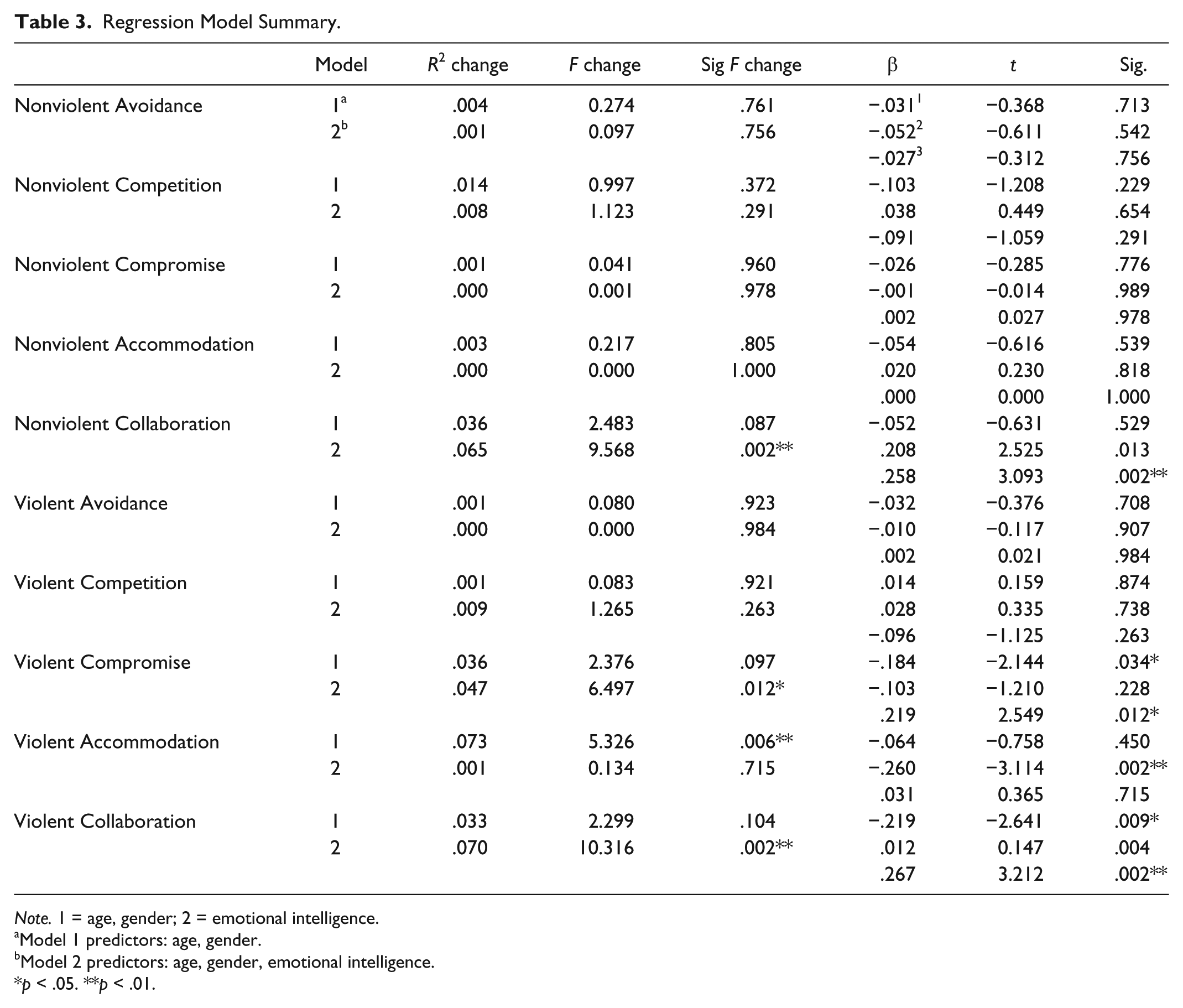
Note. 1 = age, gender; 2 = emotional intelligence.
Model 1 predictors: age, gender.
Model 2 predictors: age, gender, emotional intelligence.
p < .05. **p < .01.
Avoidance scale—Nonviolent Video
The psychosocial predictors explained 0.4% of the variance in the Avoidance scale for nonviolent video, F(2, 140) = 0.274, p > .05. EI explained a further 0.1% of the variance, F(1, 139) = 0.097, p > .05.
Competition scale—Nonviolent Video
The psychosocial predictors explained 1.4% of the variance in the Competition scale for nonviolent video, F(2, 137) = 0.997, p > .05. EI explained a further 0.8% of the variance, F(1, 136) = 1.123, p > .05.
Compromise scale—Nonviolent Video
The psychosocial predictors explained 0.1% of the variance in the Compromise scale for nonviolent video, F(2, 126) = 0.041, p > .05. EI explained a further 0% of the variance, F(1, 125) = 0.001, p > .05.
Accommodate scale—Nonviolent Video
The psychosocial predictors explained 0.3% of the variance in the Nonviolent Accommodate scale for nonviolent video, F(2, 133) = 0.217, p > .05. EI explained a further 0% of the variance, F(1, 132) = 0.000, p > .05.
Collaboration scale—Nonviolent Video** Significant
The psychosocial predictors explained 3.6% of the variance in the Collaboration scale for nonviolent video, F(2, 134) = 2.483, p > .05. EI explained a further 6.5% of the variance, F(1, 133) = 9.568, p < .01. EI was considered to mediate the relationship between the psychosocial predictors and nonviolent collaboration, β = .26, t(133) = 3.093, two-tailed p < .01. Higher EI was associated with higher scores on the Nonviolent Collaboration scale. However, the bias-corrected confidence estimates (CI for age = [−0.001, 0.082]; CI for gender = [−0.724, 0.142]) indicated that the indirect effect was not significant; thus, full mediation of EI in the relationship between psychosocial predictors and collaboration for the nonviolent situation was not confirmed.
Avoidance scale—Violent Video
The psychosocial predictors explained 0.1% of the variance in the Avoidance scale for violent video, F(2, 140) = 0.080, p > .05. EI explained a further 0% of the variance, F(1, 139) = 0.000, p > .05.
Competition scale—Violent Video
The psychosocial predictors explained 0.1% of the variance in the Competition scale for violent video, F(2, 139) = 0.083, p > .05. EI explained a further 0.9% of the variance, F(1, 138) = 1.265, p > .05.
Compromise scale—Violent Video** Significant
The psychosocial predictors explained 3.6% of the variance in the Compromise scale violent video, F(2, 128) = 2.376, p > .05. EI explained a further 4.7% of the variance, F(1, 17) = 6.497, p < .05. EI was considered to mediate the relationship between the psychosocial predictors and violent compromise, β = .22, t(128) = 2.549, two-tailed p < .05. Higher EI was associated with higher scores on the Violent Compromise scale. However, the bias-corrected confidence estimates (CI for age = [−0.003, 0.086]; CI for gender = [−0.553, 0.387]) indicated that the indirect effect was not significant; thus, full mediation of EI in the relationship between psychosocial predictors and compromise for the violent situation was not confirmed.
Accommodate scale—Violent Video** Significant
The block of psychosocial predictors explained 7.3% of the variance in the Accommodate scale violent video, F(2, 135) = 5.326, p < .01. EI explained a further 0.1% of the variance, F(1, 134) = 0.134, p > .05. Of the psychosocial predictors, gender had the only significant standardized regression coefficient with the criterion of accommodation conflict style in response to the violent video, β(136) = −.26, p < .01, and explained about 6.8% of the variance in accommodate conflict style scores. Being male was associated with use of the accommodate conflict style for the violent video. The total variance explained by both psychosocial predictors (gender and age) was about 7%. EI did not significantly explain any additional variance beyond the psychosocial predictors. As the tolerance level for all predictors was greater than .840, multicollinearity was not considered a problem.
Collaboration scale—Violent Video** Significant
The psychosocial predictors explained 3.3% of the variance in the Collaboration scale violent video, F(2, 134) = 2.299, p > .05. EI explained a further 7.0% of the variance, F(1, 133) = 10.316, p < .01. EI was considered to mediate the relationship between the psychosocial predictors (gender and age) and nonviolent collaboration, β = .27, t(133) = 3.212, two-tailed p < .01. Higher EI was associated with higher scores on the Collaboration scale for the violent video. However, the bias-corrected confidence estimates (CI for age = [−0.002, 0.126]; CI for gender = [−1.171, 0.256]) indicated that the indirect effect was not significant; thus, full mediation of EI in the relationship between psychosocial predictors and collaboration for the violent situation was not confirmed.
Discussion
These findings partially support Hypotheses 2 and 3. The findings reveal that women were more likely than men to report use of collaboration conflict strategies in response to the nonviolent video and men were more likely than women to use accommodation strategies in response to the violent video. In the regression analysis, gender was a significant predictor of accommodation conflict style in response to the violent video. When there is a potentially violent conflict situation in the context of a romantic relationship, it is likely that men would prefer an accommodation strategy to manage the situation, and in a nonviolent conflict situation, it is likely that women would adopt a collaboration conflict management strategy. Kelley and Thibaut’s (1978) social exchange theory provides a salient framework for understanding these gender differences. According to the theory, partners primarily seek to increase or maximize their rewards and minimize their costs in relational interactions. As a result, conflict occurs when rewards and costs are not equally balanced between partners (Zacchilli et al., 2009). In the context of these findings, gender differences in the use of accommodation versus collaboration strategies, men and women may perceive different levels of rewards and costs when communicating and using their preferred conflict style. So, when conflict becomes violent, men may choose to accommodate if they believe doing so will be beneficial for themselves as well as their partners. In the case of women in a nonviolent conflict situation, they may see collaboration as leading to a more equitable outcome.
EI had a significant independent and partial mediating relationship with compromise in response to the violent situation and with collaboration in response to both violent and nonviolent situations. In interpersonal romantic relationships, individuals with higher EI would be more likely to compromise in a violent relationship conflict and to use collaboration in relationship conflicts, whether violent or nonviolent. This is noteworthy in that the use of collaboration—which researchers suggest is a more advanced conflict management style (Northouse, 2011) that requires sensitivity to and perception of one’s own and others’ emotions to work on a resolution that satisfies both—is associated with having higher EI.
In the literature, collaboration is seen as the healthiest but most difficult approach to execute. This could be because collaboration necessitates the ability to be both assertive about one’s needs and to cooperate with one’s partner, so that his or her needs can be met as well. It is not surprising, therefore, that EI would be an important factor in helping individuals use collaborative approaches in their relationships. As Northouse (2011) noted, people tend to use a range of conflict management styles. What these findings highlight is that EI is an important factor in the use of higher-level relationship conflict strategies.
From these findings, age did not influence the conflict management styles that participants preferred. Although participants ranged in age, most were unmarried university students. Subsequent studies that include married couples may provide a better picture of the roles that age maturity and developmental stage play in relationship conflict management.
That men seemed to favor accommodation in the violent situation may suggest a willingness or desire to diffuse violent conflict with cooperative overtures toward their partner. This finding is consistent with research showing that men tend to use active conflict approaches (Hojjat, 2000). Another consideration is that the aggressor in the violent video vignette was a male, so perhaps male participants identified the need to actively resolve the violent situation. Women’s preference for collaboration in the nonviolent situation could mean that they would like to be both cooperative and assertive in their approach to conflict as long as there is no physical violence involved in the conflict. Hojjat (2000) found that women were more perceptive of their own and their partner’s conflict styles. Such insight would likely encourage partners to engage in collaborative efforts to resolve conflict in their relationship. The findings also indicate intrapersonal consistency in the use of some conflict styles across conflict situations. That is, when participants preferred the competition, compromise, and collaboration strategies in response to nonviolent conflict, they also preferred each of those strategies for violent conflict.
These results are consistent with Schlaerth et al.’s (2013) meta-analytic findings that EI was significantly associated with constructive conflict management at work. Those findings in the work setting and the current and related findings (i.e., Stolarski et al., 2011; Veshki et al., 2012) in the relationship context help extend the conclusion that EI is a salient aspect of constructive and healthy conflict management in various interpersonal environments.
A limitation to these findings is that participants were asked to report how they believe they would respond (almost an idealized conflict style) to a presented conflict situation. Future studies in this area should examine similar variable relationships in married and nonmarried couples using assessment of their real-life conflict styles. Another limitation is that the respondents’ personal gender preferences, such as masculinity, femininity, and androgyny or bisexual or gay orientations that might color the responses were not assessed or controlled. In addition, a broader study with a representative sample of dating age adults would confirm the generalizability of the results. However, the current findings have practical implications for promoting specific communication and conflict management and resolution approaches for couples and young people approaching the age when they may contemplate dating and having serious relationships. It also supports emphasis on the role of healthy intra- and interpersonal and communication skills development in facilitating individual and relationship well-being. It would be important to consider how to increase individuals’ and couples’ awareness of and capacity to improve these skills, perhaps through modalities such as counseling, psychoeducation, and culturally based social activities.
Footnotes
Acknowledgements
The authors would like to thank Dr. Mpho Pheko, Monde Kote, and Kagiso Tlhabano for their suggestions and assistance with data collection.
Authors’ Note
Please contact the corresponding author for information on accessing the study data.
Declaration of Conflicting Interests
The author(s) declared no potential conflicts of interest with respect to the research, authorship, and/or publication of this article.
Funding
The author(s) received no financial support for the research and/or authorship of this article.