



Abstract
To examine the influence of love styles on specific couple dynamics (conflict, emotional intelligence, emotional flooding, and sexual satisfaction) in romantic relationships from a person-centered approach. Understanding love styles is an essential part of both romantic relationship satisfaction and longevity, but previous research has primarily focused on variable analyses that exclude individual idiosyncrasy without examining whether these styles might interact with specific couple dynamics from a person-centered perspective. The study used a cross-sectional design and recruited 823 Spanish participants through convenience and snowball sampling. Key measures included the Love Attitudes Scale (LAS), the Trait Meta-Mood Scale (TMMS-24), the Emotional Flooding in Couple Relationships Scale, and the Global Measure of Sexual Satisfaction (GMSEX). Latent Profile Analysis (LPA) was used to classify participants into distinct profiles based on their love styles, followed by ANOVA to analyze differences between profiles on conflict, emotional flooding, sexual satisfaction, and emotional intelligence. Four profiles emerged from the LPA: Slightly Unstable Player (SUP), Non-Passionate Selfless (NPS), Unfriendly Non-Player (UNP), and Friendly Non-Player (FNP). The profiles differed significantly on conflict frequency, emotional flooding, sexual satisfaction, and emotional intelligence. Different love styles influence relationship dynamics, with playful and unstable love styles associated with higher conflict and emotional flooding, whereas friendship-based, stable love styles increase sexual satisfaction and reduce conflict. The identification of distinct love style profiles not captured by traditional approaches revealed important differences in couple dynamics, adding new insights to the scientific literature and highlighting its potential for improving relationship counseling.
Plain language summary
This study explored how different ways of loving, called “love styles,” affect important aspects of romantic relationships, such as conflict, emotional intelligence, feeling overwhelmed during arguments, and sexual satisfaction. Love styles reflect how people approach love and relationships, but past research has mostly looked at love styles in a general way, without considering individual differences. This study aimed to fill that gap by focusing on how love styles interact with relationship dynamics in a more personalized manner. The research involved 823 Spanish participants who were asked to complete several questionnaires about their love styles, emotional intelligence (how well they understand and manage emotions), how often they feel overwhelmed in conflicts, and how satisfied they are with their sexual relationships. Using a method called Latent Profile Analysis (LPA), we identified four different love style profiles: Slightly Unstable Player (SUP), Non-Passionate Selfless (NPS), Unfriendly Non-Player (UNP), and Friendly Non-Player (FNP). The results showed that these love style profiles had a big impact on relationship dynamics. For example, people in the "Slightly Unstable Player" profile experienced more frequent conflicts and were more likely to feel emotionally overwhelmed. On the other hand, those in the "Friendly Non-Player" profile, who valued friendship and stability in their relationships, reported greater sexual satisfaction and less conflict. In conclusion, the study found that love styles play an important role in how people experience romantic relationships. Understanding these profiles could be helpful for relationship counseling, as different approaches may be needed depending on someone's love style. This research sheds new light on how love styles shape relationship satisfaction and conflict management.
Keywords
Love is a fundamental component of stable relationships in Western society, shaping both their formation and maintenance. The complexity of love stems from its psychological, emotional and behavioral dimensions, leading to diverse interpretations. Cognitive-behavioral theory views love as a learned mental state shaped by interactions with a partner, while others define it as an emotional attachment, a positive disposition, or supportive behavior (Brenlla et al., 2004; Sangrador, 1993). Despite various theoretical perspectives, love remains a dynamic construct influenced by factors such as physical attraction, shared experiences, and exclusivity, making a universal definition elusive (Pierrakos, 2008). Because individuals are shaped by their environment and personal relationships, love is inherently subjective, affecting relationship dynamics (Cid, 2011; Graham & Christiansen, 2009; Rodríguez, 2013).
Considered one of the most intense and sought-after human emotions, love has been the subject of deep reflection and study throughout history (García del Castillo-López et al., 2024). Currently, the study of love and its connection to crucial aspects such as sexuality is approached from different perspectives. From the more accessible literature, with works such as that of Nagoski (2023), which emphasizes the importance of open communication in the relationship and the need to redefine sexuality in order to maintain passion and intimacy over time, to a neurobiological approach, represented by studies such as that of Fisher et al. (2016), which explores the role of brain chemistry in the dynamics of relationships, defining romantic love as a phenomenon similar to an addiction, finding brain responses comparable to those observed in dependence on certain substances.
As can be observed, there is currently a growing scientific interest in the study of love and its relationships from various perspectives, with love styles and their relationship to individual and couple variables being one of the most prolific areas.
Love Styles and Their Impact on Relationships
The concept of ideal love evolves through personal experiences and is shaped by socialization, culture, and interpersonal interaction, leading to a more realistic view of love teaching us what love is, how it feels, and how relationships should be, shaped by cultural myths (Barrios & Pinto, 2008; Flecha et al., 2005).
This evolution results in different love styles, which represent an individual’s attitudes and beliefs about love and guide their behavior in romantic relationships (Ferrer et al., 2008; Lee, 1977; McGuirk & Pettijohn II, 2008). These styles are personal and reflect how individuals perceive, express, and maintain intimate relationships, which are subject to individual differences and can evolve over time (Ojeda et al., 2010). Recognizing this complexity, several classifications of love styles have emerged, shaping behaviors and experiences in relationships (Shahrazad et al., 2012). Sternberg (1986) introduced the Triangular Theory of Love, identifying three key elements: Intimacy (emotional closeness), Passion (physical attraction), and Commitment (long-term stability). These components interact dynamically, forming different love styles, such as Romantic Love, Companionate Love, and Consummate Love (Salazar & Saldarriaga, 2020). Expanding this model, Sternberg (2000) introduced seven distinct types of love, highlighting how relationships evolve over time based on the relative dominance of intimacy, passion, and commitment. Lee’s Model of Love (Lee, 1973, 1977), also known as Color Theory of Love by their comparison with primary, secondary and tertiary colors, is one of the most widely used and accepted theories in love research because of its multidimensionality and its ability to encompass other theoretical approaches to the study of love (for more depth in models about the study of love see Karandashev, 2022, for a literature-based description of the six love styles in Lee’s theory, see Supplemental Appendix A).
Methodologically, this typological classification is useful for organizing individuals into clusters with shared characteristics, enabling differentiation and comparison through a person-centered approach. Lee’s classification gained significance with the development of the Love Attitude Scale (LAS) by Hendrick and Hendrick (1986), which correlates with other love models. For instance, Hendrick and Hendrick (1989) found positive relationships between Eros, Agape, and Mania with Sternberg’s (1986) Triangular Love Scale components (Intimacy, Passion, and Commitment), while Storge related only to Intimacy. Ludus, however, showed a negative correlation with Sternberg’s components. Other studies also found Eros, Mania, and Agape to cluster together (Davis & Latty-Mann, 1987; Matsui, 1993). Prevalence studies revealed Eros as the dominant love style, followed by Agape and Storge (Cooper & Pinto, 2008; García et al., 2016). Hatfield and Rapson (1993) associated Companionate love with Lee’s Storge style and Passionate love with Eros. Ottazi (2011) suggested that the combination of Eros and Agape represents the “ideal love” portrayed in the media, based on trust, commitment, intimacy, and passion.
In the literature, we can find an extensive application of the Color Theory of Love, analyzing the relationship of love styles with different relationship dynamics. In addition to the mostly variable-based studies, the circumplex structure of the model originally proposed by Lee, in which each style is more closely related to neighboring styles like a colored disk, is generally not discussed. (Lee, 1973, 1977). However, a recent study by Cassep-Borges and Ferrer (2019) challenges Lee’s original configuration and posits a structure in which the spatial arrangement of styles is not organized in a circular fashion, so that styles that should be close according to Lee’s model, such as the Eros and Ludus styles, are actually in opposite positions. In light of this evidence, it is clear that the nature of love styles is more complex than Lee’s original model suggests, and thus the study of how styles are configured according to personal configurations in relation to key relationship variables is relevant.
Love Styles and Conflict
Conflict is an inherent aspect of all romantic relationships, influenced by partners’ expectations, communication patterns, and emotional regulation abilities. As love evolves over time, its components fluctuate, leading to shifts in relationship satisfaction (Ubillos et al., 2004). Yela (1997) identified three phases in the progression of love: an initial phase of falling in love, marked by peak intimacy and passion, lasting about 6 months; a second phase of passionate love, characterized by increased intimacy and commitment, lasting up to 4 years; and a longer phase of companionate love, where passion declines after four years. While these phases are not universal, they show regular patterns influenced by biological, personal, and social factors, through which the conflict evolves in different ways. Conflict is a natural part of romantic relationships because it arises from different perspectives, needs, and expectations between partners (Mozafari & Xu, 2022), from communication problems, insecurity, and different priorities (Chanda, 2024), or even from different evolutionary interests between the sexes that can lead to sexual conflict (Kennair et al., 2023).
About the relationship between love styles and conflict, Eros and Agape love styles are particularly linked to positive conflict resolution strategies. Eros, characterized by passionate and romantic love, encourages partners to engage in open communication and emotional expression during conflicts, fostering resolution and intimacy (Xian et al., 2023). Similarly, Agape, which embodies selfless and altruistic love, promotes understanding and empathy, allowing partners to navigate conflicts with compassion and support (Neto & Wilks, 2017). In contrast, the Ludus love style, which emphasizes playful and non-committal relationships, may lead to less emotional investment in conflicts, potentially resulting in a more relaxed approach to relationship challenges (Vedes et al., 2016; Xian et al., 2023). Moreover, the dyadic approach to studying love styles reveals that partners often mirror each other’s love styles, which can enhance relationship satisfaction and stability (Agus et al., 2021; Odilavadze et al., 2019). When both partners share similar love styles, they are more likely to engage in constructive conflict resolution, as they understand each other’s emotional needs and responses (Agus et al., 2021). Conversely, significant discrepancies in love styles can lead to misunderstandings and increased conflict, highlighting the importance of compatibility in love styles for relationship health (Odilavadze et al., 2019).
Coping strategies also play a vital role in how love styles affect relationship dynamics. Research indicates that altruistic and passionate love styles are positively correlated with effective problem-solving behaviors in relationships (Küçük & Demir, 2021). Partners who adopt these styles are more likely to engage in functional coping strategies, which involve understanding and addressing each other’s needs during conflicts (Ali et al., 2022; Küçük & Demir, 2021).
Despite misconceptions about love’s development, relationship duration is consistently linked to love styles (Diamond, 2003; Hensley, 1996; Smith & Klases, 2016). Specifically, Eros, Agape, and partner satisfaction predict long-term relationship stability and commitment (Ottazi, 2011). Additionally, commitment itself is a key predictor of relationship longevity (Arriaga & Agnew, 2001). Differences in love concepts, expectations, and perceptions between partners can also impact relationship structure and lead to conflicts (Barrios & Pinto, 2008). Romantic love forms the foundation of intimate relationships, initially characterized by eroticism and playfulness, which strengthens the bond and leads to greater commitment over time (Rusbult et al., 1998). As relationships progress, habituation and reduced uncertainty may diminish initial passion (Skinner, 1953). However, intimacy tends to grow with time and shared experiences (Levinger, 1988). Understanding that love components fluctuate at different stages can help set realistic expectations, improving satisfaction and preventing disappointment when passion gives way to stability (Yela, 1997). Partner satisfaction is crucial for mental health (Dekel et al., 2014; Whisman, 2001) and inversely related to conflict (Berenguer-Soler et al., 2023).
The intensity of conflicts predicts relationship functioning, with frequent, intense conflicts making resolution more difficult (Parra & Oliva, 2002; López et al., 2012). Conflict intensity and resolution strategies are key predictors of relationship functioning. Frequent and intense conflicts are linked to dissatisfaction, breakups, and divorce thoughts (Christensen & Walczynski, 1997; Stanley et al., 2002). In this context, emotional flooding, characterized by overwhelming emotional responses during conflicts, can severely impact relationship dynamics (Malik et al., 2020), interfering with communication and escalating conflict (Gottman & Krokoff, 1989). This state can exacerbate feelings of anxiety and depression, particularly in the context of intimate partner relationships, where the emotional intensity can lead to dysfunctional conflict resolution behaviors (Foran et al., 2018).
Mandal and Latusek (2024) highlight that individuals with higher emotional intelligence are better equipped to manage jealousy and mate retention tactics, which can mitigate the intensity of conflicts and emotional flooding. This suggests that emotional intelligence serves as a buffer against the adverse effects of conflict, allowing partners to navigate disagreements more constructively. Additionally, Ogan et al. (2023) emphasize the role of emotional dysregulation in the context of family-of-origin conflicts, indicating that unresolved emotional issues can exacerbate relational tensions and lead to emotional flooding during conflicts. Couples with high emotional intelligence are better equipped to regulate emotions, reduce flooding, and maintain healthier relationships (Berenguer-Soler et al., 2023; Zeidner & Kaluda, 2008).
Emotional flooding negatively impacts sexual satisfaction by reducing sexual desire and intimacy due to distress and negative emotions. Individuals with higher emotional intelligence are better at managing emotions and preventing emotional flooding, thereby preserving sexual health (Zeidner & Kaluda, 2008). Additionally, unresolved conflict and emotional distress from flooding can lead to a cycle of negative interactions, further decreasing sexual satisfaction as partners feel less connected (Brenlla et al., 2004).
As seen, the emotional intelligence of partners plays a crucial role in navigating conflicts; individuals with higher emotional intelligence are better equipped to manage their emotions and respond to their partner’s needs during conflicts, which is particularly evident in relationships characterized by Eros and Agape love styles (Xian et al., 2023). This emotional awareness not only aids in conflict resolution but also enhances sexual satisfaction, as partners who communicate effectively about their desires and boundaries are more likely to experience fulfilling sexual relationships (Gana et al., 2013). On the other hand, love styles such as Ludus and Mania can lead to maladaptive behaviors and increased conflicts. Individuals who identify with these styles often exhibit higher levels of jealousy and possessiveness, which can exacerbate relationship tensions and diminish sexual satisfaction (Faraji, 2024).
Current Study
The literature review highlights that conflict is inevitable in relationships and how couples deal with it significantly affects emotional dynamics. While previous research has explored the relationships between love styles, conflict, emotional flooding, and sexual satisfaction, most studies have used a variable-centered approach, analyzing isolated variables rather than holistic profiles of individuals. This approach overlooks the complex interplay between love styles and relationship dynamics. To address this gap, the present study proposes a Latent Profile Analysis (LPA) to investigate how different love styles influence romantic relationships, particularly in terms of conflict intensity, emotional intelligence, and sexual satisfaction. LPA is a person-centered statistical approach that differs from traditional variable-centered analyses by identifying latent subgroups within a population based on patterns in individual responses. Unlike conventional regression-based or mediation models, which assume uniform relationships across all individuals, LPA allows for the discovery of heterogeneity in love styles and relational experiences. This approach acknowledges that individuals do not necessarily fall along a single continuum but may belong to qualitatively different subgroups, each characterized by distinct configurations of love styles, conflict, emotional flooding, and sexual satisfaction. This method is particularly suited to our study because love styles are multidimensional constructs, and individuals likely experience and express love in diverse, interrelated ways that cannot be fully captured using linear methods. This allows us to assume that, with some probability, people can be classified into different classes with differently configured profiles (For a full explanation, see Spurk et al., 2020). LPA has gained recognition over traditional clustering methods due to its stringent selection criteria and superior data fit, allowing for variation in means and variances between clusters. This approach is particularly suited for analyzing the multidimensional nature of participants’ behavior, aligning with the typological structure of Lee’s theory and the LAS instrument. Although the LPA methodology has been increasingly used in the psychological literature, to our knowledge it has not been applied in the context of romantic relationships to analyze these variables. To this end, the following research questions were posed: (a) are there different groups according to love styles following the original Lee’s structure and measured by the LAS; (b) do love styles affect sexual satisfaction; (c) are love styles related to emotional flooding; (d) is emotional intelligence significant between love profiles; (e) are there differences between groups according to the selected variables; and (f) are there differences between groups according to conflict with the partner, measured by intensity and frequency?
Method
The study uses a cross-sectional design. Latent Profile Analysis (LPA) is used to categorize participants based on their responses. The aim of the study is to identify latent subgroups within the sample that share similar patterns of love styles and to examine how these groups differ in terms of sexual satisfaction, emotional flooding, emotional intelligence and conflict in romantic relationships.
Participants and Procedure
The sampling technique used initially was convenience sampling, recruiting volunteers in romantic relationships through announcements on social networking sites and asking them to share the link to the questionnaires on Google Forms with family and friends, using snowball sampling (Emerson, 2015). The collection of participants began on September 6, 2021 and ended on December 18, 2021. Prior to participating, individuals were informed of the study's objectives, the confidentiality of their responses, and their right to withdraw at any time without consequences. Informed consent was obtained from all participants, ensuring that their participation was voluntary and anonymous. The study was approved by the Research Ethics Committee the Miguel Hernández University, Spain (DPS.AGL.01.21) and conducted in accordance with the ethical guidelines of the Declaration of Helsinki. The inclusion criteria required participants to be either currently in a romantic relationship or to have been in a relationship within the last 3 months. This criterion ensured that participants could provide relevant responses based on recent relational experiences. Single participants who met this requirement were instructed to answer the survey questions based on their most recent romantic relationship. To ensure that all responses were grounded in real-life experiences, the survey included a filter that excluded individuals who had never been in a romantic relationship. The final sample consisted of 823 Spanish people from the general population (MAge = 32.54, SD = 8.95). Of the sample, 87.6% were women with higher education (80.9%), heterosexual (90.4%), 62.6% had a partner at the time of data collection, 23.2% were married, the majority had no children (70.4%), and 11.5% were single. Incomplete or invalid responses were excluded to ensure data quality.
Measures
Sociodemographic information was collected regarding age, marital status, sexual orientation, number of children and educational level.
Trait Meta-Mood Scale
This scale measures meta-knowledge of how individuals recognize and manage moods, emotions, and feelings, using a five-point scale from strongly disagree (1) to strongly agree (5). Factor analysis identified three dimensions: (1) Emotional Attention, assessing attention to emotions (e.g., “I pay a lot of attention to my feelings”); (2) Emotional Clarity, measuring understanding and differentiation of emotions (e.g., “I am clear about my feelings”); and (3) Emotional Repair, evaluating the ability to regulate emotions (e.g., “Although I sometimes feel sad, I usually remain optimistic”). Results are categorized into low, good, or excellent skills for factors 2 and 3, and low, good, or excessive for factor 1. Previous studies confirm the scale’s reliability and validity (Fernández-Berrocal et al., 2004; Górriz et al., 2021; Ruiz-Mamani et al., 2022), with high reliability in this sample (αEA = .90, αEC = .90, αER = .86).
Scale of Emotional Flooding in Couple Relationships
This scale measures self-perceived emotional flooding in romantic relationships, where individuals feel overwhelmed and negatively perceive their partner’s emotions. It includes 18 items on a five-point Likert scale from completely disagree (1) to completely agree (5), based on Gottman’s research (1993). The scale has four factors: Susceptibility to negative attitudes (e.g., “My partner’s negative attitudes overwhelm me”), Unjustified Anger (e.g., “I get overly upset when I argue”), Motivation to Run Away (e.g., “I want to escape during arguments”), and Emotional Self-Regulation (e.g., “I find it hard to control my anger”). Previous studies confirmed its reliability and validity (Berenguer-Soler, 2019; Berenguer-Soler et al., 2023), with an alpha of .93 in this study.
Global Measure of Sexual Satisfaction
This instrument measures sexual satisfaction with a romantic partner using five items on a seven-point bipolar scale (e.g., very bad–very good, very unpleasant–very pleasant). Participants were instructed to reflect on their current stable relationship (minimum 3 months) or their last stable relationship if not currently partnered. Previous studies report high reliability (α > .90; Sánchez-Fuentes et al., 2015; Sánchez-Lamadrid et al., 2022). In this study, Cronbach’s alpha was .93.
Love Attitudes Scale: Short Form
This scale measures attitudes toward the six love styles defined in Lee’s Model of Love (Lee, 1973, 1977). The 18 items assess the love styles explained above (Eros, Ludus, Storge, Pragma, Mania, Agape) with three items for each. The response scale follows a five-point Likert format from strongly disagree (1) to strongly agree (5). Data from the validation study show alpha values ranging from .88 for Agape to .68 for Pragma (Rodríguez-Castro et al., 2013). In this study, the alpha values by love style were αE = = .71, αL = .78, αS = .82, αP = .66, αM = .61, αA = .75.
Conflict
The frequency and intensity of conflict with the partner was measured with two items (i.e., “How often do you and your partner argue?” and “Arguments with my partner are very intense”) with a five-point Likert-type response scale from never (1) to always (5). The alpha value was .68.
Data Analysis
Descriptive analysis, correlations and confirmatory factor analysis (CFA) were performed in JASP 0.18. The CFA was carried out to analyze the original factor structure of the Love Attitudes Scale: Short Form. A first-order maximum likelihood and robust method model was used to obtain all the typed values. The weights and variances absorbed by the factors were analyzed through the R2 of the items. The χ2/gL was calculated to see the overall fit and the RMSEA, CFI, and TLI indices were evaluated. In order to categorize the participants according to their love style, an LPA was performed using Jamovi 2.4.1.0. The best practice recommendations of Spurk et al. (2020) were followed in the construction of research questions appropriate to the LPA methodology, as well as issues related to research design, analysis and selection of the suitable profile. The profile indicators selected were based on Hendrick et al. (1998) Love Attitudes Scale: Short Form and had the potential to form different types of latent profiles based on Lee’s theory of love styles as described above. The database was analyzed to identify and eliminate missing values. The recommendations of Ram and Grimm (2009) were followed to select the most appropriate profile selection. Theoretical plausibility was first assessed by analyzing error messages and out-of-bounds parameters. Standardized scores were calculated for all variables to reduce measurement error and used for the LPA. Latent class solutions ranging from one to ten classes were estimated and compared using goodness-of-fit indices, including the Akaike Information Criterion (AIC), Bayesian Information Criterion (BIC), and sample-size adjusted BIC (SABIC). To assess classification accuracy and determine the optimal number of classes, entropy values and likelihood ratio tests were also examined. A one-way ANOVA was conducted to assess profile differences in standardized scores for conflict frequency, intensity, emotional flooding, sexual satisfaction, and emotional intelligence. Since the data did not meet the normality assumption required for parametric post hoc tests, the Dwass-Steel-Critchlow-Fligner method (DSCF), a non-parametric test suitable for pairwise comparisons following a Kruskal–Wallis test, was applied. This method is robust against violations of normality and effectively controls the familywise error rate while maintaining statistical power (Hollander et al., 2013). Pairwise comparisons using the DSCF method were conducted to identify significant differences between latent profiles.
Model Fit Information Criteria
Several indicators were used to evaluate model fit and guide model selection. The Bootstrapped Lo-Mendell Rubin Adjusted Likelihood Ratio Test (BLRT; Lo et al., 2001) uses bootstrap sampling to assess the log-likelihood difference between models. A non-significant BLRT (p > .05) for the k + 1 class suggests that the more parsimonious model should be retained. The Akaike Information Criterion (AIC; Akaike, 1987) estimates model fit based on log-likelihood and number of parameters. The lowest AIC value indicates the best fit. The Bayesian Information Criterion (BIC; Schwarz, 1978) considering the log-likelihood, number of parameters and sample size. The lowest BIC value indicates the best fit. The Sample size-adjusted BIC (SABIC; Sclove, 1987) is a modified version of the BIC that includes an additional sample size adjustment, with the lower value indicating the best fit. Finally, entropy (Celeux & Soromenho, 1996) indicates how different the classes are from each other. It highlights the accuracy of the assignment of subjects to the different groups. The higher the value, the closer to 1, the better. Values above .80 or more are considered good (Clark & Muthén, 2009). Values between .60 and .80 are also considered adequate (Jung & Wickrama, 2008).
The following stages were carried out to find the model that best fit the data and categorize the participants; Select model (model 1, equal variances and covariances fixed to zero) (Rosenberg et al., 2019), select the number of classes, check model fit indicators, identify the classes and compare the classes. The final model was determined by balancing the lowest BIC and acceptable entropy while ensuring that the BLRT indicated a significant improvement compared to the model with one fewer class.
Power Analyses
To determine an appropriate sample size for Confirmatory Factor Analysis (CFA), established guidelines based on model complexity and parameter estimation were followed. According to Bentler and Chou (1987), it was recommended that at least 10–15 participants per estimated parameter be used to ensure reliable model estimation and factor loading stability.
In the CFA model, 18 observed variables (items) and 6 latent factors were included, resulting in an estimated 40–60 parameters, considering factor loadings, variances, and covariances. Based on Bentler and Chou’s recommendation, it was determined that a minimum sample size of 400 to 900 participants was required for stable estimation, while a sample size of 600+ participants was recommended for more robust results. The final sample of 823 participants was found to fall well within this range, ensuring sufficient statistical power for model estimation, stable factor loadings, and reliable covariance structure interpretation.
Since standard power analyses were not directly applicable to LPA, best practices in mixture modeling were followed (Lubke & Neale, 2008; Tein et al., 2013), ensuring that each latent class contained at least 5% of the total sample to maintain profile stability and reliable parameter estimation. Previous research indicated that sample size sufficiency in LPA depended on the number of profiles, indicator variables, and class separation rather than a single fixed threshold (Nylund-Gibson & Choi, 2018). In this study, four latent profiles were identified based on six indicator variables (love styles), with class proportions ranging from 6.7% to 49.9%. A total sample of 823 participants was found to meet common recommendations for LPA studies, particularly given the entropy value of 0.75, which was considered an acceptable level of classification accuracy (Celeux & Soromenho, 1996). While larger samples would improve precision in estimating class differences, LPA studies in psychology have successfully identified meaningful latent profiles with similar or smaller sample sizes (Spurk et al., 2020). Given the theoretical consistency of the profiles, the clear distinctions in class proportions, and the robustness of the classification metrics, the sample size used in this study was considered appropriate for identifying and interpreting distinct love style profiles.
Based on Cohen (1988) recommendations, and assuming a medium effect size (f = 0.25), a significance level (α = .05), and power (1–β = .80), the analysis suggested that a minimum of 3 participants per group (12 total) would be required to detect an effect with sufficient power for the ANOVA. Given that the final sample size of 823 participants was significantly larger than the computed minimum, statistical power was well above the threshold needed for reliable between-group comparisons.
Results
Descriptive Statistics and Correlations
Descriptive statistics for all variables are shown in Table 1, and correlations in Table 2. Emotional clarity is positively correlated with emotional repair (r = .64, p < .01) and sexual satisfaction (r = .22, p < .01), indicating that greater emotional clarity is linked to better emotional repair and higher sexual satisfaction. Conversely, emotional flooding negatively correlates with both emotional clarity (r = −.25, p < .01) and sexual satisfaction (r = −.25, p < .01). Regarding the correlations of the LAS love styles with the relationship variables included in this study, Eros is positively correlated with emotional attention (r = .14, p < .01), emotional clarity (r = .23, p < .01), and emotional repair (r = .15, p < .01), and negatively correlated with emotional flooding (r = −.27, p < .01). Eros is also strongly related to sexual satisfaction (r = .46, p < .01). Ludus is negatively correlated with emotional clarity (r = −.12, p < .01), emotional repair (r = −.09, p < .05), and sexual satisfaction (r = −.16, p < .01), and positively correlated with emotional flooding (r = .30, p < .01). Storge did not show strong or significant relationships with emotional or conflict indicators. However, a significant positive correlation was found between Storge and Pragma (r = .15, p < .05). Pragma is significantly positively correlated with emotional attention (r = .17, p < .01) and sexual satisfaction (r = .15, p < .01). Mania is negatively correlated with emotional clarity (r = -.08, p < .05) and emotional repair (r = -.10, p < .01), and strongly correlated with emotional flooding (r = .41, p < .01), conflict frequency (r = .13, p < .01), and conflict intensity (r = .19, p < .01). In addition, mania is negatively correlated with sexual satisfaction (r = −.11, p < .01). Finally, Agape correlates positively with emotional flooding (r = .16, p < .01) and sexual satisfaction (r = .11, p < .01).”
Descriptive Data for all the Variables.

Note. N = 823.
Correlation Matrix.

Note. EA = Emotional Attention; EC = Emotional Clarity; ER = Emotional Repair; EF = Emotional Flooding; NA = Susceptibility to Negative Attitudes; DA = Unjustified or Disproportionate Anger; RA = Motivation to Run Away; SR = Emotional Self-Regulation; SS = Sexual Satisfaction; ER = Eros; LU = Ludus; ST = Storge; PR = Pragma; MA = Mania; AG =Agape; CF = Conflict Frequency; CI = Conflict Intensity.
p < .05; **p < .01.
Confirmatory Factor Analysis (CFA)
The CFA was conducted using a first-order model based on the 18-item structure of the original Love Attitudes Scale: Short Form. Table 3 shows the factor loadings, all of which are significant and above .4–.5.
CFA Factor Loadings.

Note. All indicators are significant at p < .001.
The R2 mean of the items per factor reflected a distribution of explained variance above 40 % in all factors. Only Mania was borderline at 34.8 %, although this result does not invalidate the model. The overall fit of the model was optimal (χ2/gL = 2.53; χ2 = 304.07, df = 120, p < .001), as was the relative fit RMSEA = .04 [.04–.05], CFI = .96, TLI = .94.
Latent Profile Analysis (LPA)
Table 4 presents the ten models classifying subjects based on their love attitudes. Model fit statistics for 1–10 latent profiles were displayed. Models with 5 to 10 profiles were excluded due to non-significant LRT p-values (p > .05) and subgroup sizes below the 5% threshold (Rico-Borderá et al., 2024).
Model Fit Indexes.

Note. LogLik = Log-Likelihood; AIC = Akaike Information Criterion; BIC = Bayesian Information Criterion; SABIC = Sample size-adjusted BIC; BLRT = Bootstrapped likelihood ratio test. Model 3 was performed; equal variances and equal covariances.
The four-profile model was selected based on the lowest fit indices (AIC = 13413; BIC = 13640; SABIC = 13487) and good entropy among the one-to-four profile models.
Figure 1 presents the four love style profiles. Table 5 shows the means and standard errors for each profile’s standardized love style scores. Class 1, termed the “Slightly Unstable Player” (SUP) profile, consists of individuals with high Ludus (M = 1.66, SE = 0.05) and slightly above-average Mania scores (M = 0.41, SE = 0.08), representing 19.8% of the sample. These individuals view love as a game and seek multiple partners. Class 2, termed the 'Non-Passionate Selfless' (NPS) profile, comprises individuals scoring well below average on Eros (M = −2.16, SE = 0.11) and slightly above average on Agape (M = 0.25, SE = 0.17). This profile, representing 6.7% of the sample, reflects a selfless approach to love with low physical passion. Class 3, termed the 'Unfriendly Non-Player’ (UNP) profile, includes individuals with slightly below-average Ludus (M = −0.41, SE = 0.03) and moderately below-average Storge (M = −0.59, SE = 0.03) scores. Representing 49.9% of the sample, this profile reflects a low inclination toward both playful and friendly love styles. Class 4, termed the 'Friendly Non-Player’ (FNP) profile, features individuals with high Storge (M = 1.26, SE = 0.04) and moderately below-average Ludus (M = −0.46, SE = 0.04) scores. This profile, representing 23.6% of the sample, reflects those who prioritize friendship and companionship in love but are less playful.
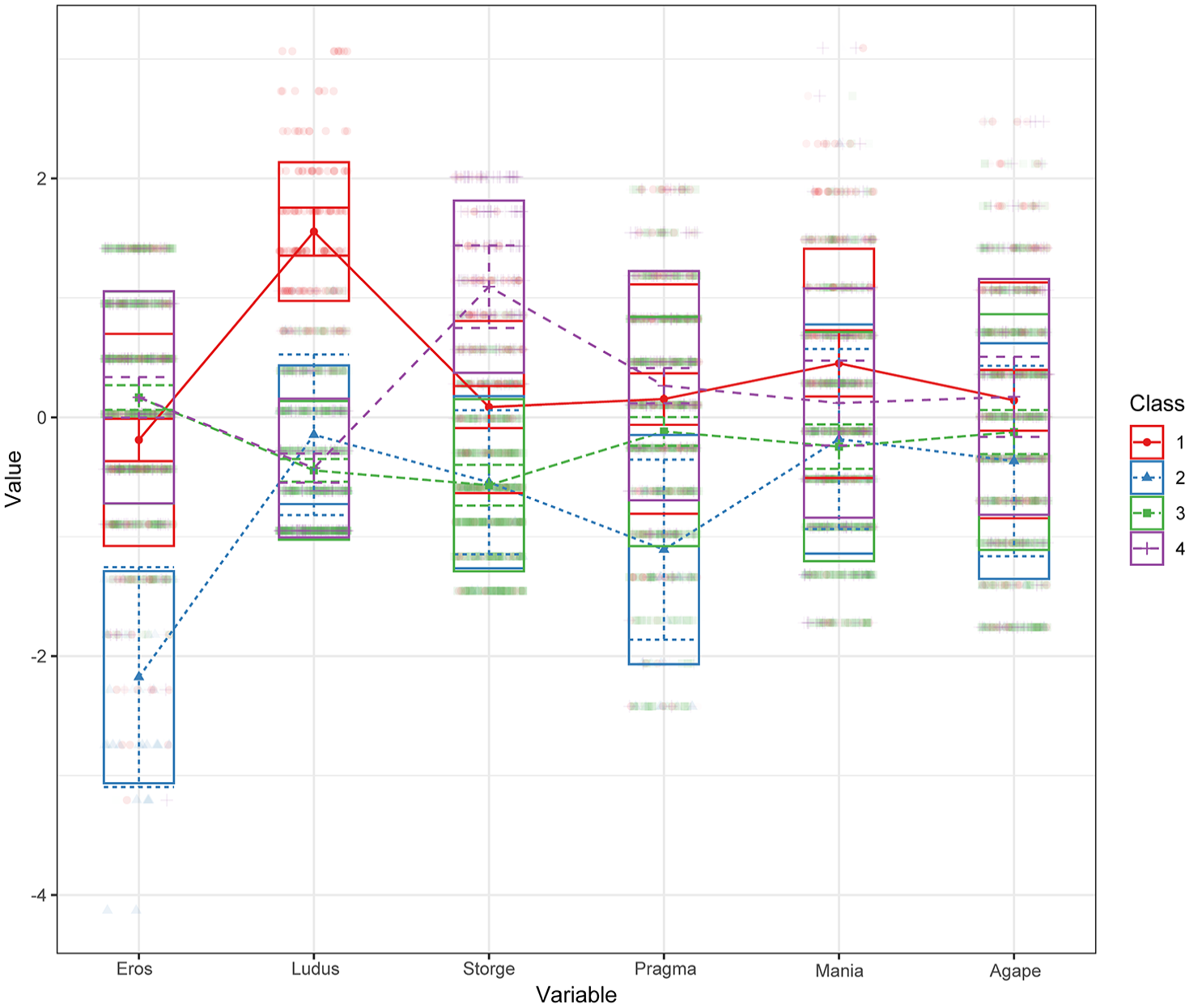
Profiles of love styles.
Means and Standard Errors (z-values) of Love Styles by Profiles.
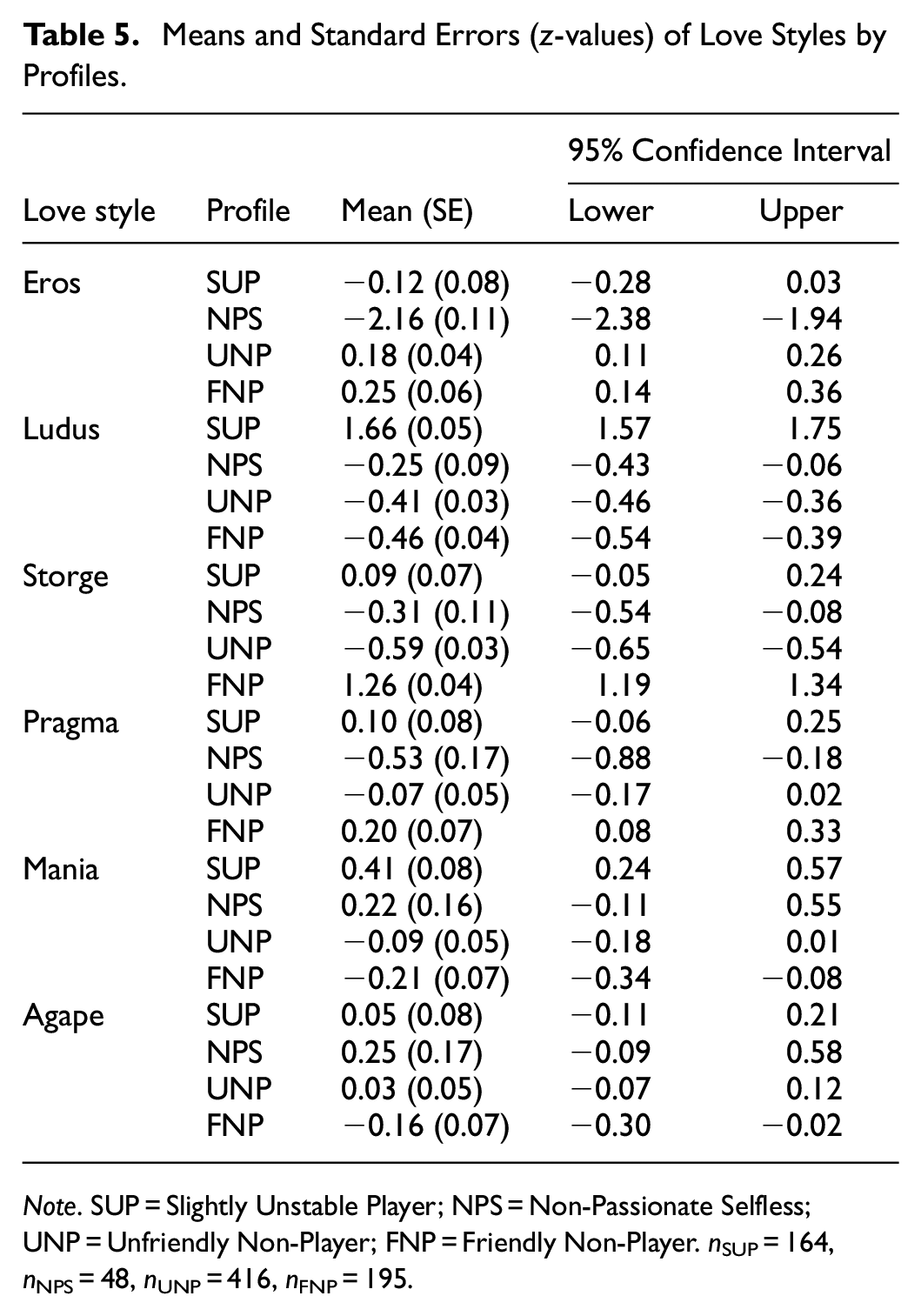
Note. SUP = Slightly Unstable Player; NPS = Non-Passionate Selfless; UNP = Unfriendly Non-Player; FNP = Friendly Non-Player. nSUP = 164, nNPS = 48, nUNP = 416, nFNP = 195.
Individuals in the SUP profile show above-average conflict frequency (M = 0.14, SE = 0.08), conflict intensity (M = 0.26, SE = 0.09), emotional flooding (M = 0.42, SE = 0.08), and attention (M = 0.12, SE = 0.08), with lower sexual satisfaction (M = −0.18, SE = 0.09), clarity (M = −0.11, SE = 0.08), and repair (M = −0.07, SE = 0.08). The NPS profile exhibits extreme scores: highest in conflict frequency (M = 0.66, SE = 0.15), intensity (M = 0.48, SE = 0.15), emotional flooding (M = 0.58, SE = 0.15), lowest in sexual satisfaction (M = −0.97, SE = 0.15), and lowest in emotional intelligence. The UNP profile is near average in conflict, emotional flooding, and emotional intelligence, with slightly above-average sexual satisfaction (M = 0.09, SE = 0.05). The FNP profile shows the least conflict (M = −0.23, SE = 0.06), lowest emotional flooding (M = −0.23, SE = 0.07), highest sexual satisfaction (M = 0.24, SE = 0.06), and near-average emotional intelligence.
Comparison analyses between profiles revealed significant differences in conflict (frequency and intensity), emotional flooding, sexual satisfaction, and emotional intelligence (Table 6). Significant differences were found between the NPS and UNP profiles, with no differences between the UNP and FNP profiles. The largest conflict frequency difference was between the NPS and FNP profiles (WDSCF = −7.92, p < .001), and conflict intensity was most significant between the SUP and FNP profiles (WDSCF = −6.31, p < .001). Emotional flooding differences were greatest between the SUP and UNP profiles (WDSCF = −8.43, p < .001), while sexual satisfaction varied most between the NPS and FNP profiles (WDSCF = 10, p < .001). In emotional intelligence, the SUP and NPS profiles differed most in attention (WDSCF = −4.43, p = .01), and the NPS and UNP profiles differed significantly in clarity (WDSCF = 5.96, p < .001) and repair (WDSCF = 3.77, p = .04).
Means and Standard Errors (z-values) of Relationship Variables by Profile and Post hoc Comparisons.

Note. SUP = Slightly Unstable Player; NPS = Non-Passionate Selfless; UNP = Unfriendly Non-Player; FNP = Friendly Non-Player; CF = Conflict Frequency; CI = Conflict Intensity; EF = Emotional Flooding; SS = Sexual Satisfaction; EA = Emotional Attention; EC = Emotional Clarity; ER = Emotional Repair; χ2 = Chi-square; WDSCF = Post hoc Dwass-Steel-Critchlow-Fligner.
p < .05. **p < .01. ***p < .001.
Discussion
In this study, we set out to analyze the role that the different love styles according to Lee’s classification may play in the dynamics of romantic relationships. Specifically, we wanted to investigate whether the original structure of the Love Attitude Scale developed by Hendrick et al. (1998) to measure these styles of love was confirmed in our sample, resulting in a grouping by profiles, in order to subsequently test whether these profiles differed according to couple conflict, emotional flooding, sexual satisfaction and emotional intelligence.
Confirmatory Factor Analysis
The Confirmatory Factor Analysis results in our study confirm the construct validity of the Love Attitude Scalefor measuring Lee’s love styles, consistent with previous research (Janeczek, 2023). Strong factor loadings exceeded significance thresholds, validating the scale and supporting the applicability of Lee’s theory across cultures (Shahrazad et al., 2012; Todosijevic et al., 2009). The Confirmatory Factor Analysis shows that love styles are empirically distinguishable, which is crucial for clinicians and researchers in identifying styles that contribute to healthier relationships (Raffagnino & Puddu, 2018). These findings support the complexity of love and lay a foundation for future research on its impact on romantic relationships.
Latent Profile Analysis
This study addresses a critical gap in the literature on the influence of love styles on relationship aspects such as emotional regulation, conflict management, and sexual satisfaction. Previous research, largely based on traditional clustering methods, lacked the empirical depth provided by Latent Profile Analysis (Lee, 1973, 1977). By applying Latent Profile Analysis, this study identifies distinct profiles based on love styles that differ from the original circular circumplex structure proposed by Lee, offering a deeper understanding of how individuals experience relationship dynamics. This person-centered approach overcomes the limitations of previous studies focused on single variables, providing insights into how love styles influence relationship outcomes (Howard & Hoffman, 2018). The results reveal that individuals often exhibit a combination of love styles, rather than a single dominant style (Cassepp-Borges & Ferrer, 2019). This study identified four distinct profiles based on unique combinations of love styles, highlighting that love is experienced along a spectrum of beliefs, feelings, and behaviors. Most participants fell into the Unfriendly Non-Player profile, characterized by a balanced view of love but a lower emphasis on playful (Ludus) and friendly (Storge) aspects. Individuals with this profile do not consider love to be an absolute priority, and their emotional investment in relationships is moderate or low. For these individuals, romantic relationships may seem transactional, with little emotional depth or passion. Relationships are seen as practical arrangements in which emotion and deep connection are not necessarily central. Individuals may enter into relationships because of social expectations rather than a strong romantic desire. Behaviorally, they may have lower emotional intensity in relationships, struggling with emotional warmth and relational commitment, resulting in distant or reserved behavior.
As Ludus and Storge are negatively related to general health (Díaz et al., 2018), maintaining a romantic relationship with trust and stability, without reducing it to mere friendship, may positively impact health. The Ludus love style, characterized by a playful and game-oriented approach to romantic relationships, has been linked to various mental health outcomes. Individuals with Ludus style often engage in relationships with less emotional investment and commitment, and may experience lower relationship satisfaction compared to those who embrace more committed love styles such as Eros or Agape (Farooqi, 2014; Galinha et al., 2013; Vedes et al., 2016). This lack of emotional depth can result in superficial connections that may not fulfill deeper psychological needs, potentially leading to feelings of loneliness or dissatisfaction (Hudson et al., 2019). This aligns with findings that emphasize the importance of love styles in mitigating loneliness and enhancing life satisfaction, particularly among university students (Nazzal et al., 2021). The positive correlation between Storge love style and mental health can be attributed to its foundation in companionship and mutual support, which are critical for emotional resilience.
Ferrer et al. (2008) suggest that comfortable relationships foster greater commitment, support, and eroticism, while Ottazi (2011) notes that the ideal love often portrayed in media combines Eros and Agape, emphasizing trust, commitment, intimacy, and passion.
The second most common profile was the Friendly Non-Player characterized by a preference for support, understanding, friendship, stability, and passion in romantic relationships, while avoiding the shallow, non-committal Ludus style. This profile scored highest in the Eros style, combined with Storge. Individuals with this profile view love as deep friendship and companionship characterized by trust, mutual support, and emotional intimacy. They base romantic relationships on stability rather than impulsive passion or strategic commitment. They understand love as the creation of long-term emotional bonds and personal growth with their partner, rather than momentary attraction. Playfulness is not an essential component, but affection, loyalty, and dependability are highly valued. Behaviorally, they have the lowest levels of conflict and emotional flooding, indicating strong emotional self-regulation. They also have the highest levels of sexual satisfaction, suggesting that while passion is not extreme, emotional connection enhances intimacy.
The Eros style is associated with positive outcomes like improved quality of life and well-being (Ortalda & Canale, 2010; Tamarit et al., 2021). The Eros love style has been associated with lower levels of loneliness among adolescents. Neto and Pinto (2003) found a negative correlation between the Eros love style and loneliness, suggesting that those in passionate romantic relationships tend to report feeling less lonely. This relationship points to the potential of Eros love to meet emotional needs and thus contribute to improved mental health. Research shows that Storge and Pragma preferences increase with age due to the desire for stability (Hendrick & Hendrick, 1986). In studies from Peru and Mexico, Storge was the most common, reflecting a preference for trust and companionship, while Ludus was the least favored, and Eros the most prevalent due to its balance of passion and commitment (Espíndola et al., 2018; Molina, 2019). Similar findings were reported by Tarazona and Rueda (2020), where Eros was the most common love style, followed by Storge, with Ludus being the least common. Graham's (2011) meta-analysis identified three higher-order components: love (Eros, Agape, and negatively, Ludus), romantic obsession (Mania), and pragmatic friendship (Storge and Pragma). Of these, the love component is most strongly associated with relationship satisfaction. Our study aligns the Friendly Non-Player profile with Graham's love component, as this profile showed the lowest conflict and emotional flooding, and the highest sexual satisfaction.
The Slightly Unstable Player profile is strongly associated with the Ludus love style and, to a lesser extent, the Mania style. Individuals with this profile tend to have less stable, commitment-averse relationships, focused on fun but with a passionate, obsessive side. Love is seen as a game rather than a deep emotional commitment. Relationships are casual, exciting, and often short-lived, with an emphasis on emotion over stability. Commitment is seen as limiting and emotional depth is often avoided. They see love not as long-term security, but as passion, pursuit, and novelty. Emotional ups and downs are expected, with intense but often fleeting relationships. Jealousy and possessiveness may arise from manic tendencies, even in uncommitted relationships. On the behavioral level, frequent partner changes and avoidance of deep emotional investment, a high frequency of conflict driven by emotional impulsivity and instability, and high emotional flooding and low sexual satisfaction may be observed. Subjects struggle with emotional intelligence, especially clarity and repair, leading to poor emotional regulation in relationships. This profile is prone to "toxic" relationships marked by control, emotional dependence, and jealousy (Granados, 2018). While Ludus, Mania, and Agape are negatively linked to well-being, some studies suggest men may favor playful, low-commitment love (Balbás, 2021). The negative impact of Mania and Ludus on well-being likely stems from the maladaptive behaviors and instability typical of these styles (Tamarit et al., 2021). Mania's possessiveness can also increase the likelihood of toxic relationships.
Finally, the Non-Passionate Selfless profile, marked by a strong inclination toward Agape and low Eros, is characterized by high commitment through selflessness and sacrifice, but with little passion. Individuals with this profile see love as a duty of care and commitment rather than an intense emotional connection. Passion and physical attraction are secondary or nonexistent, as emotional and moral responsibilities define relationships. They interpret love as an exchange in which one must give more than one receives, prioritizing the partner’s needs over one’s own. Relationships are maintained through sacrifice, loyalty, and duty, often at the expense of personal desires. Conflict arises from over-delivery and emotional disconnection rather than impulsivity as in the previous profile. On the behavioral level, there is very frequent and intense conflict, probably due to unmet emotional and physical needs. They have very low sexual satisfaction, probably due to a lack of passion, and very low emotional intelligence, especially in clarity and reparation, suggesting difficulties in processing and dealing with relationship problems.
Studies show that individuals with high Agape tendencies report greater commitment and satisfaction, driven by the selfless, supportive nature of this love style (Lin & Huddleston-Casas, 2005). Agape fosters emotional maturity, a strong sense of duty, and stability in relationships (Karandashev, 2022). While rich in commitment, Agape lacks the intense passion typical of Eros love.
The profiles identified reflect individuals' dominant love styles at a given moment, recognizing that love is a combination of different styles to varying degrees. A balanced integration of these styles is the healthiest approach to maintaining a stable and fulfilling relationship.
Group Comparisons
The findings of this study provide valuable insights into how different love style profiles influence relationship dynamics, particularly in the context of modern relationship challenges such as conflict, emotional variables, and sexual satisfaction. One of the most significant findings is that selflessness in love, when not reciprocated, can lead to frequent conflict and emotional distress. The Non-Passionate Selfless profile exhibited higher conflict frequency and lower sexual satisfaction than the Friendly Non-Player profile. This suggests that while selflessness in love may be virtuous, it may also predispose relationships to higher conflict frequencies and less sexual satisfaction if not balanced by elements of mutual passion and playfulness. This has direct implications for couples navigating long-term relationship satisfaction, as excessive selflessness without emotional reciprocity can lead to resentment, unmet needs, and relational strain (Le et al., 2018; Zhang et al., 2024). One of the most pressing issues in modern relationships is the importance of sexual satisfaction as a predictor of overall relationship stability. Studies have found that sexual dissatisfaction is a significant dealbreaker (Jonason et al., 2015), and unmet sexual needs can precipitate marital conflicts (Fallah et al., 2019). Our results align with this literature, as the Friendly Non-Player profile which emphasize friendship and stability, tend to have lower conflict and higher sexual satisfaction. These findings suggest that emotional stability and deep friendship are crucial for sustaining long-term relationships, reinforcing the value of relationship counseling approaches that emphasize emotional connection and compatibility.
Conversely, the Slightly Unstable Player profile, strongly associated with Ludus and Mania love styles, was found to have high levels of conflict intensity, emotional flooding, and low emotional regulation. This aligns with existing literature suggesting that emotionally volatile relationships marked by impulsivity, jealousy, and instability are more likely to experience severe conflict (Granados, 2018; Tamarit et al., 2021). These findings emphasize the importance of emotional intelligence and self-awareness in romantic relationships, as individuals with low clarity and emotional repair skills often struggle with effective conflict resolution.
The literature on love and relationships has traditionally focused on the more romantic aspects (Bode & Kushnick, 2021; Quintard et al., 2021), paying less attention to styles such as Storge’s, characteristic of the Friendly Non-Player profile, which has reported the highest levels of sexual satisfaction and the lowest levels of emotional flooding and conflict. These results contradict those found in a previous study, in which Storge style was positively associated with psychological abuse, understood as acts of verbal and nonverbal violence (Díaz et al., 2018). In contrast, the Non-Passionate Selfless and Slightly Unstable Player profiles experienced significantly lower sexual satisfaction, which is consistent with research showing that unmet sexual needs contribute to relationship dissatisfaction and marital conflicts (Fallah et al., 2019; Jonason et al., 2015). These findings have direct implications for relationship counseling and therapy, where addressing sexual intimacy concerns and balancing passion with emotional stability should be a priority.
On the other hand, profiles characterized by low passion or high playfulness without emotional depth may struggle with conflict and emotional regulation. In this sense, the Unfriendly Non-Player profile may provide further insight into contemporary commitment patterns. Many individuals in modern dating culture, especially with the rise of online dating and hookup culture, may relate to this profile, as relationships are increasingly approached with pragmatism rather than emotional depth (Farooqi, 2014; Hudson et al., 2019). Similarly, the Slightly Unstable Player profile showed high levels of frequency and intensity of conflict, emotional flooding and emotional attention, and low levels of sexual satisfaction, clarity and emotional repair, aligning with current trends of non-committal relationships where expressing emotions is seen as a sign of weakness, leading to a reluctance to engage in emotional vulnerability (Denby & Hooff, 2024). While these individuals may seek excitement and passion, the high frequency of conflict, emotional flooding, and low sexual satisfaction within this profile suggests that such relationships may be emotionally distressing and unsustainable in the long run, underscoring the importance of working on self-reflection and awareness in order to navigate modern dating in an emotionally healthy way.
Conclusions
The findings of this study build on and extend Lee's influential classification of love styles by using a person-centered approach to examine how different love styles interact within romantic relationships. While previous studies have largely utilized variable-centered methods our application of Latent Profile Analysis provides a detailed understanding of how love styles cluster together in meaningful ways. The identification of four distinct love style profiles demonstrates that love styles do not operate in isolation, but rather form complex patterns that influence key relationship dynamics, including conflict frequency, emotional flooding, sexual satisfaction, and emotional intelligence.
A significant contribution of our study lies in its challenge to the traditional circumplex model proposed by Lee, which suggests that love styles exist along a continuous spectrum, with neighboring styles exhibiting greater similarity. Recent empirical research (Cassep-Borges & Ferrer, 2019) has questioned this assumption, showing that certain love styles that were expected to be adjacent (e.g., Eros and Ludus) may, in fact, be more distinct than previously thought. Our findings align with this perspective, as the profiles we identified suggest that love styles are best understood in configurations rather than in strict linear or circular relationships.
Furthermore, this study advances the understanding of how love styles interact with emotional intelligence and conflict resolution strategies, aspects that have been underexplored in the existing literature. Previous research (Raffagnino & Puddu, 2018) has indicated that playfulness and emotional intelligence can moderate relationship satisfaction and conflict resolution styles. Our results provide empirical support for these claims by showing that individuals with higher emotional intelligence and stable, friendship-based love styles demonstrate lower emotional flooding and more effective conflict resolution, contributing to healthier relationship dynamics. In contrast, individuals with more playful or avoidant love styles tend to experience greater instability, emotional flooding, and conflict, supporting previous findings on the impact of love styles on relational distress
With regard to the profiles identified, the results show significant differences in conflict dynamics, with the largest contrasts between the Non-Passionate Selfless and both the Unfriendly Non-Player and Friendly Non-Player profile profiles. The greatest differences in emotional flooding and conflict intensity were between the Slightly Unstable Player and both the Unfriendly Non-Player and Friendly Non-Player profiles. Sexual satisfaction varied significantly, with the largest gap between the Non-Passionate Selfless and Friendly Non-Player profile profiles. Emotional intelligence differences (attention, clarity, and repair) were most notable between the Slightly Unstable Player and Non-Passionate Selfless, and the Non-Passionate Selfless and Unfriendly Non-Player profiles. These findings suggest that playful, noncommittal love styles contribute to greater conflict and emotional flooding, undermining relationship satisfaction. A friendship-based, less playful approach enhances sexual satisfaction through stability, trust, and emotional intimacy. Individuals with higher emotional intelligence are better equipped to manage relationship challenges. Overall, our findings contribute to the ongoing refinement of Lee’s love styles framework by emphasizing the importance of individual configurations of love styles rather than rigid categorical distinctions. This perspective has important implications for relationship counseling and interventions aimed at improving relationship satisfaction and emotional regulation.
Limitations and Directions for Future Research
This cross-sectional study, which is limited in making causal inferences due to its design, recruited 823 Spanish participants through convenience and snowball sampling, resulting in a sample biased toward women (87.6%) and those with higher education (80.9%). Although this limits generalizability, it provides information on the dynamics of relationships within this subgroup. Future research should improve representativeness through stratified or random sampling.
Another limitation is the reliance on self-reported data, which may introduce biases such as social desirability and recall errors. Despite being practical for assessing subjective experiences, the lack of external validation weakens robustness. Future studies should incorporate multi-method approaches, including partner reports, behavioral observations, and physiological assessments, while longitudinal research could clarify causal relationships.” While this study provides valuable insights into the Spanish population, it does not discuss cultural factors in depth, which may play a role in the expression of love styles and their effects on relationships. Cultural norms and values influence how individuals perceive and experience romantic relationships, and future research should explore cross-cultural differences to determine whether these findings extend beyond Spain. Examining love styles in diverse cultural contexts may help identify universal versus culture-specific relationship patterns.
Furthermore, this study does not account for additional psychological and socioeconomic factors that could significantly influence the observed dynamics. Variables such as attachment styles, personality traits, and socioeconomic status may play a crucial role in shaping love styles, emotional intelligence, and relationship satisfaction. Future research should integrate these factors to provide a more comprehensive understanding of romantic relationship dynamics and their underlying mechanisms.
Future research should explore also the role of education in shaping love styles and promoting healthier relationships, focusing on how relationship education, emotional intelligence training, and socialization processes influence romantic behavior. Studies could examine whether early relationship education improves emotional regulation, conflict resolution, and communication skills, particularly in reducing unstable love styles (e.g., Slightly Unstable Player) and promoting more fulfilling profiles (e.g., Friendly Non-Player). Research should also examine how media, cultural norms, and family upbringing shape love styles and whether educational interventions can mitigate unrealistic relationship expectations. In addition, longitudinal studies could assess whether exposure to structured relationship education leads to greater relationship stability and satisfaction over time. By identifying effective educational strategies, future research could inform evidence-based programs that promote emotional intelligence, healthy attachment, and long-term romantic fulfillment.
Footnotes

Ethical Considerations
Participants were informed about the study’s purpose, the principal investigator, voluntary participation, data anonymity, and the statistical use of their responses before the start. They were also told they could withdraw at any time without consequences. Written consent was required to proceed, and all participants had to be of legal age. The design of the questionnaire battery and informed consent, as well as the feasibility and conduct of the study, were reviewed and approved by the Research Ethics and Integrity Committee of the Miguel Hernández University, Spain (DPS.AGL.01.21).
Author Contributions
Conceptualization, A.G.C.L. and M.B.S.; methodology, A.G.C.L. and M.B.S; validation, A.G.C.L. and M.B.S.; formal analysis, A.G.C.L., M. B. S. and D.P.; investigation, M.B.S.; resources, A.G.C.L.; data curation, M.B.S.; writing—original draft preparation, M.B.S. and A.G.C.L.; writing—review and editing, A.G.C.L., M.B.S. and D.P.; visualization, A.G.C.L. and D.P.; supervision, A.G.C.L. All authors have read and agreed to the published version of the manuscript.
Funding
The author(s) received no financial support for the research, authorship, and/or publication of this article.
Declaration of Conflicting Interests
The author(s) declared no potential conflicts of interest with respect to the research, authorship, and/or publication of this article.