




Abstract
The current study was conducted to analyse the relationship between Emotional Intelligence (EI) and Conflict Management Styles (CMS) amongst part-time executive students in Business Management Department. The study revealed how each sub-competency of EI is essential in managing conflicts. Responses from 200 participants were analysed to test the proposed hypotheses. The study focused on Asia-Africa cultural dimensions which adds and extends the existing literature. Hierarchical multiple regression analysis was performed to find the relationship between the sub-competencies of EI and CMS. The findings revealed that EI competencies had a significant positive effect on CMS except Social Skills.
Introduction
The frequent interactions at the workplace such as employees working together in teams, employers negotiating business deals may cause relational conflict. Relational conflict arises from misunderstanding, poor communication, or different viewpoints. Due to differences in personalities, individual differences, and values among employees. By definition, relational conflict refers to “a disagreement or incompatibility between individuals or groups that affects their relationship, interactions, and emotional connections, often involving issues of trust, communication, power dynamics, or values.” (Roloff, 2014). Whereas conflict as a whole is also defined as “an interactive process manifested in compatibility, disagreement, or dissonance within or between social abilities” (Rahim et al., 1992). Conflict is said to be emotionally charged and is essential to understanding the role emotions play in such situations (Jones, 2000). People demonstrate distractive emotions when indulged in conflict to show their varying opinions that would result in diverse outcomes (Weingart et al., 2015). Conflict is either constructive or destructive. In other words, conflict is destructive when it results in emotional pain, stress, stifled performance, and job dissatisfaction. On the other hand, conflict is constructive when there are differing opinions to enrich decision-making, creativity, and innovativeness. As a result, Conflict Management Styles (CMS) are essential to be learned and applied (Deutsch, 1993). The benefits of CMS make most companies consider it as a criterion when recruiting and selecting potential employees, especially for top-level management positions (Saeed et al., 2014), as such “doing things right” (Zidane & Olsson, 2017). The culture of performance-based funding has created an environment where the significance of humanitarian organizations’s efficiency is rapidly finding the customary accentuation on effectiveness (Haavisto et al., 2014).
EI is an array of emotional capabilities that reveals how individuals deal with stressful and emotional situations (Dust et al., 2018). Emotional capabilities help to effectively manage conflict situations. Hopkins and Yonker (2015) explain how the role of emotions and EI at the workplace has tremendously increased over the past years. This is evidential that there exists an underlying connection between EI and CMS which has been similarly acknowledged by other studies (Bhattacharya et al. 2016; Hopkins & Yonker, 2015; Jordan & Troth, 2004; Rahim et al., 2002; Schlaerth et al. 2013; Shih & Susanto, 2009).
A survey was conducted across seven countries that investigated the relationship between the five EI sub-competencies of supervisors and subordinates on ways of managing conflicts (Rahim et al., 2002). Also, in (2015) Hopkins and Yonder examined the connection between EI and CMS in the workplace. These empirical studies suggest that EI adds up to a supportive method of dealing with the management of conflict. However, despite the above studies conducted, there are a limited number of studies undertaken to examine the relationship between the EI and CMS amongst different countries (Balasundaram, 2012). The study revealed an association between emotional intelligence (EI) and conflict management styles (CMS) in industrial enterprises at Bangladesh. Also, (Gunkel et al., 2016) conducted a study on examining the influence of cultural values on conflict handling styles through emotional intelligence. However, the current study aims to examine the relationship between emotional intelligence and conflict management styles using culture as a mediator. EI helps in resolving conflicts better, promoting empathy, and enhancing effective communication, albeit culture shapes conflict resolution styles as well as EI’s role. Culture influences how people handle and resolve conflicts. Cultural settings can affect how people express and interpret their feelings which in turn affects how EI manifest in conflict (Amedome et al, 2024).
Thus, the current study seeks to address four main shortfalls. First, the study seeks to explore the relationship between the sub-competencies of EI and CMS among Ghanaians and Indians. Second, to find out whether there is a difference in the emotional intelligence levels of Indians and Ghanaians. Ghana and India were selected based on their significant similarities on the Hofstede Cultural Dimension (Power distance, Individualism, Masculinity, Uncertainty avoidance, long term orientation, and Indulgence) and the differences in religion, which are Christianity and Hinduism. Juhasz (2014) posits that there is a relationship between a country’s religion and its corresponding Hofstede cultural dimension. Also, economically, both countries are developing economies with growing middle-class population and similar GDP growth rates. Both countries have similar organizational factors such as hierarchical organizational structures, strong cultural influence on management practices and growing demand for skilled workers. At the workplace, both countries tend to have respect for authority and hierarchy and have a collectivist culture with an emphasis on teamwork. Similar challenges they may face include managing diversity, infrastructure constraints, and others.
Third, to find out the difference in cultural dimensions between Ghana and India using Hofstede cultural dimensions. The distinctiveness of this study is that the choice of both countries happens to have a similar culture based on Hofstede dimensions but a different religion (Hinduism and Christianity). Moreover, concerning cultural differences, most studies have focused on the “East-West,” that is, American and Asian cultural differences (Lather et al., 2010), but the present study focuses on African and Asian cultural dimensions.
Lastly, to examine the relationship between emotional intelligence and conflict management styles with culture as a mediator. People must be culturally aware as different cultures may have different expectations and ideas about how to express emotions and resolve conflicts. For instance, direct communication and assertiveness may be appreciated in individualistic culture whereas indirect communication and harmony-seeking may be appreciated in a collectivistic culture.
There has been a continuous rise in the interest in cultural differences and their effect on the different aspects of business management (Messner, 2020). Overall, using these unique cultural settings, the study will advance the knowledge of the concept of EI and provide more empirical advances in the literature of EI and CMS.
Emotions in Conflict Management
Individual differences are likely to stir up emotions, which can result in conflict. However, positive emotions have been positively related to pro-social behavior in conflict. This causes cooperative styles of managing conflict situations. Thus, competitive behavior arises when negative emotions are displayed, and it does not give room for cooperative actions (Bell & Song, 2005). Managing conflict is not necessarily done logically, but it includes emotional states (Desivilya & Yagil, 2005). Negative and positive emotions have differing effects in conflict. However, the wrong demonstration and overly expression of emotions might decrease the ability to manage conflict effectively. For instance, high emotional conflict is more perverse than a less emotional conflict (Jehn, 1997), and it will demand different approaches in managing such situations. A study conducted by Desivilya and Yagil (2005) posits that positive emotions are related to the integrating and compromising styles and negative emotions are related to the dominating and avoiding styles of conflict management.
Companies dedicate their resources to building their image, including effort, time, and money (Tahir et al., 2024). Successful organizations are those that adapt to changing environments and thrive despite external factors (Qadri et al. 2024). Management always seeks to design reward structures that facilitate the organization’s strategic goals as well as the goals of individuals (Awan et al., 2015).
Theories of Emotional Intelligence
The theories of EI measure it differently, pertaining to how each author perceives EI and its sub-competencies. These differing approaches are likely to be more supportive than conflicting (Ciarrochi et al., 2000). There are two main models of EI in literature which are the ability-based model and the mixed model. While in recent times, the Trait model has emerged.
The Ability-Based Model
Salovey and Mayer first designed the framework of EI and coined the term Emotional Intelligence (EI). The originators of the concept perceive EI as actual mental performance and not preferred behaviour patterns. The theory centres on an individual’s emotional prowess that connects emotion and mental abilities (Salovey & Mayer, 1990). Salovey and Mayer (1990) defined Emotional Intelligence (EI) as “the subset of social intelligence that involves the ability to monitor one’s own and others feelings and emotions, to discriminate among them, and to use this information to guide one’s thinking and actions.” The ability to reason logically about emotions as well as the ability to use emotions to reason logically and make knowledgeable decisions (Graves, 1999). Mayer et al. (1999) give a more constrained outlook on EI in the Ability-Based Model. The main notion of this model is the association of emotions and Intelligence.
The Mixed Model
The Mixed model is much broader in perspective than the Ability-Based Model. The model contends that EI is not limited to a person’s mental abilities; rather it includes other capabilities that help them to deal with the environment and distressing situations. Thus, the name Mixed model. Reuven Bar-On, an advocate of the mixed model, perceives EI as the abilities that help a person to deal with the stresses that come from the environment. EI is defined as “an array of capabilities, competencies, and skills that influences one’s ability to succeed in coping with environmental demands and pressures” (Bar-On, 1997). Emotional Quotient (EQ) evaluates an individual’s possibility to be successful in life. It was first developed by Bar-On. EQ examines five areas that pertain to one’s success. This includes interpersonal skills, intrapersonal skills, adaptability, stress management, and general mood.
Daniel Goleman, another advocate of the mixed model, was keen to know why some individuals with high IQs struggle at the workplace, but oftentimes, those with moderate IQs do very well. He based his theories on neuroscience and psychology. He defines EI as, “one’s ability to motivate oneself and persist in the face of frustrations; to control impulses and delay gratification; to regulate one’s moods and keep distress from swamping the ability to think, to empathize, and to hope” (Goleman, 1995). EI is described as a set of attributes that could be referred to as one’s “character.” According to Daniel Goleman, EI has five dimensions, which are self-awareness, self-management, motivation, empathy, and social skills.
The Trait Model
The trait model was developed by Konstantinos V. Petrides in (2001; Petride & Furnham, 2001a, 2001b). EI is defined as “a constellation of emotional self-perception located at the lower levels of personality hierarchies and integrates the affective aspects of personality (Petrides et al., 2007).” Thus, this model is more associated with personality than mental ability (Ferrando et al., 2010). It should be explored within a personality framework (Kernbach & Schutte, 2005). Trait EI is about people’s opinions of their own emotional capabilities. The theory stipulates and recognizes the innate personal emotional experience of individuals. The model incorporates personal behavioural patterns and self-perceived abilities of an individual. Mostly self-report questionnaires are used to measure trait EI, unlike ability models that utilize actual abilities (Freshman & Rubino, 2002).
The Five Competencies of Daniel Goleman’s Emotional Intelligence
According to Goleman, EI has these five sub-competencies, which are self-awareness, self-regulation, motivation, empathy, and social skills. These competencies make an individual behave emotionally intelligently. An individual can understand their emotional processes and deal with them effectively. Self-awareness and self-regulation help to deal with one’s emotional states. While empathy and social skills are needed to manage others emotions. This involves an individual’s capabilities to help in recognizing the emotions of others, feelings, and needs and helping them to control their feelings to attain appropriate outcomes. Also, motivation is required to aid a person to stay concentrated while achieving their objectives (Druskat & Wolff, 2001). All these competencies help an individual to be emotionally intelligent. Table 1 explains the competencies and the variables that make up each competency. These competencies help to deal with disrupting emotions in conflict situations.
Explanation of the Five Competencies of Daniel Goleman’s EI.

Source: (Author’s compilation based on an adapted questionnaire by Belinda Davies).
Conflict Management Styles
Conflict when handled appropriately can enhance productivity. When employees encounter conflict, they can react in two manners, either in a helpful or unhelpful manner. The helpful manner indicates that conflict is easily dealt with while the unhelpful manner indicates a complication in dealing with the conflict and settling the differences (Ayoko & Callan, 2010). Conflict Management, is the productive way of dealing with conflict in an organization (Lipsky et al., 2003). Also, conflict styles is the term given to the approach in which people respond to conflict situations (Davies et al. 2017). In like manner, conflict management styles are described as “specific behavioural patterns that individuals prefer to employ when dealing with conflict” (Moberg, 2001).
Follet (1924) was one of the earliest theorists to study the styles of dealing with interpersonal conflict in organizations in an orderly manner. With the passage of time, Blake and Mouton (1964) established the managerial grid, based on two dimensions, which are concern for production and concern for people. Thomas and Kilmann (1974, 1977) focused their study on Blake and Mouton’s managerial grid and labelled two constituents of conflict behaviour as assertiveness and cooperativeness. These two constituents yielded the five ways of dealing with conflict, which are competitiveness, accommodation, compromise, avoiding, and collaboration. Rahim and Bonoma (1979) distinguished the styles of managing interpersonal conflict based on concern for self and for others. Concern for self describes the extent (high or low) to which an individual attempts to satisfy his or her own concern. While concern for others describes the extent (high or low) to which an individual attempts to satisfy the concern of others. Adding the two dimensions (concern for self and others) results in the five specific styles of conflict management. See Table 2 for the description of CMS.
Explanation of the Conflict Management Styles.

Source: (Author’s compilation based on Rahim et al. (2002).
Emotional Intelligence in Conflict Management
The cognizance of an individual’s emotions gives them the capability to control and affect relationships at the workplace (Yang & Mossholder, 2004). As the basis of emotional intelligence is self-awareness. Ashkanasy and Daus (2002) posit that EI consists of the capability to perceive and recognize your emotions and those of others and to further apprehend and effectively handle those emotions. High EI individuals encounter less conflict when they interact with others and can deal with conflict better (Lopes et al., 2005). Also, at the group level Yang and Mossholder (2004), suggest that there would be less task and relational conflict when the group has higher EI. Whereas Ayoko et al. (2008) reveal that there would be greater task and relational conflict when a group has low EI. Nevertheless, a leader’s capability to deal with his or her emotions lessens the negative effects of conflict in teams (Ayoko & Konrad, 2012).
Moreover, self-regulation, which involves the ability to control impulses and manage emotions, is known as the basic reason why some successful executives fail in their careers (McCall & Lombardo, 1983). Conflicts might not be effectively managed because of a lack of information (Baron, 1991). Again, a study conducted in China on MBA students explored EI’s relation with subordinates CMS and their supervisors EI (Yu et al., 2006). Subordinates used more compromising and integrating when the supervisor’s EI score is higher, especially empathy and self-regulation. For more charged emotional situations, emotionally intelligent individuals are posited as people who would apprehend and manage situations better (Fulmer & Barry, 2004). Jordan and Troth (2002) revealed that there was a significant relationship amongst one of the sub-competencies of EI (that is self-awareness and self-regulation) and dealing with conflict situations. Their findings indicate that there is insignificant relationship between other’s emotions and collaborative CMS. Individuals who engage in collaborative CMS are mostly those with higher EI (Jordan & Troth, 2002). Again, Foo et al. (2004), in their study, posited that EI is an essential element contributing to integrative outcomes.
Goleman (1998) suggests that employees who are emotionally intelligent can interact and handle conflict situations better with their co-workers. Though there are a limited number of competent employees and there is a shortage of workforce and human capital to accomplish innovativeness in an organization (Morris et al., 2017). Taking into account the increasing importance of human capital, firms in China require competent employees when recruiting, as these employees can contribute to R&D by bringing innovative ideas (Chin & Liu, 2015; Li et al. 2017).
Also, a study on conflict management 101: how emotional intelligence can make or break a manager by Schlegel et al. (2022) revealed the role of emotional intelligence in conflict management, highlighting its benefits for managers. The study suggested that EI is crucial for effective conflict management. As well as EI helps managers to understand and manage their emotions, and this leads to better conflict management.
Again, Oommen (2022) studied the relationship between management status and dissent expression among women employees, throwing light on conflict management dynamics. It was revealed that women managers express dissent less frequently than non-manager women as EI helps women managers navigate conflict.
Chen and Zhang (2022), in their article, investigated the impact of self-sacrificial leadership on conflict management, highlighting the importance of emotional intelligence. The study highlighted that EI helps supervisors manage conflicts while workplace friendship buffers against negative effects.
Furthermore, Fousiani et al. (2022) also discussed the importance of empowering women in conflict management, highlighting the benefits of emotional intelligence. Whereas, Martins & Sohn (2022) conducted a systematic review on an overview of emotional intelligence measures and their applications in conflict management. The study unveils that EI measures predict job performance, leadership effectiveness, and conflict management.
Cultural Dimensions and Emotional Intelligence
In society, culture has been proposed to determine the importance of the different types of intelligence (Furham, 2012). An individual’s values and norms are said to place value on their life by affecting how emotions are acknowledged and assessed. Also, the norms in a society define what emotions are as well as their management (Eid et al., 2003). Again, Taras et al. (2010), in their meta-analysis, propose that cultural beliefs and values influence perceptions and cognitive schema. This suggests that EI is affected by culture, which is perceived as a precursor as well. The culture of a country affects how people exhibit and manage their emotions (Matsumoto & Ekman, 1989). Schulze and Roberts (2005) have identified EI as a topic of global interest, and the lack of research on culture’s influence as far as EI is concerned has been pinpointed in previous studies (Antonakis, 2003; Antonakis et al., 2004; Prati et al., 2003; Salovey & Grewal, 2005), which requires attention. Ding et al (2021), in their study, looked at how cultural norms regarding emotions are depicted in the narratives of famous storybooks across cultures. Also, Nakayama et al. (2020), in their study, used US and Japanese to explore whether the tendencies to feel awe varied across cultures. Lastly, Nguyen et al. (2021) revealed that for an organization to demean its employees is linked with low job satisfaction and a high turnover rate by their behavior regardless of one’s country.
Earlier literature has deliberated on the impact of three of the five Hofstede cultural dimensions on the exhibition and management of emotions (Fernández-Berrocal et al., 2005; Matsumoto & Ekman, 1989). Until now, the impact of culture has not been extensively explored. However, the existing works (Palmer et al., 2008) on culture and emotions have concentrated mainly on two of EI’s dimensions, which are identifying and conveying emotions. It, therefore, suggests that EI is a notion that is likely to be affected by culture. As earlier research has shown that culture influences intelligence (Earley & Ang, 2003), though much work has not been done (Crowne, 2009), little attempt has been made to study the effect of culture on EI development. Their study examines how, at an individual level, Hofstede’s (2001) cultural dimensions affect EI across different countries. Hofstede’s cultural dimensions (individualism, collectivism, masculinity vs. femininity, power distance, uncertainty avoidance, and short-term vs. long-term orientation) are identified to reflect the basis of culture (Taras et al., 2010). The aforementioned aspects of Hofstede cultural dimensions are the fundamentals for research that shows how emotions are impacted by culture (Fernandez-Berrocal et al., 2005; Matsumoto & Ekman, 1989, 1990; Matsumoto, 2007) and therefore are a suitable foundation for the investigation of the relationship between Hofstede’s cultural dimensions and culture.
Gunkel et al. (2016) unveil the effect of cultural dimensions on emotional intelligence. The findings indicate that collectivism, uncertainty avoidance, and long-term orientation have a positive influence on the different competencies of EI. Again, Gunkel et al. (2016) focused on incorporating these two variables in literature by exploring the effect of cultural values on conflict management styles through emotional intelligence.
Emotional Intelligence and Conflict Management Styles: Culture as a Mediator
As shown in Figure 1, culture plays a significant role in shaping emotional expression, interpretation and conflict management styles. Also, culture influences how individuals perceive and manage conflicts and how they interact with others. That is culture plays a significant role in shaping emotional intelligence by influencing emotional expression, regulation, and interpretation. As some cultures differ in the emotional display rules, with some cultures encouraging open expression of emotions and others emphasizing restraint. Cultural values, such as individualism or collectivism, influence emotional priorities and expression (Hofstede, 2001).

The framework of culture as a mediator of EI and conflict management.
Again, culture influences conflict management styles, with different cultures preferring varying approaches to conflict management. Collectivist cultures tend to prioritize harmony and interdependence, while individualist cultures emphasize personal goals and assertiveness (Hofstede, 2001). Culture differs in their preferred conflict management styles, such as avoiding, accommodating, competing, collaborating, or compromising.
Culture plays a significant mediating role in the relationship between EI and conflict management styles. By understanding culture, individuals can develop effective conflict management styles that explains culture differences.
Ghana and India’s Score on Hofstede Cultural Dimensions
Power Distance: This dimension deals with the disparities that exist amongst people in a country. This measure shows that individuals within a country are not the same. Both Ghana and India score high on this dimension. This indicates that both countries appreciate the hierarchical structure in society. So, employees or subordinates expect to be told what to do. Therefore, centralization is a common practice in these countries.
Individualism: This dimension addresses the extent to which members of a society depend on each other. This measure shows whether the opinion of people about themselves is defined in terms of “I” or “we.” Ghana scores 15 on this dimension, and it shows that it is a collective society. In their long-term association with a group, this is evident whether it is a nuclear family or extended relationship. India scores 48, which indicates that it has both features of an individualistic and collectivistic society. The individualistic trait is evident in their dominant religion/philosophy, which is Hinduism. On the other hand, their collectivistic trait is evident in their need for belonging to a bigger social framework.
Masculinity: This dimension indicates whether a society is masculine or feminine. Scoring high on this dimension shows masculinity, whereas a low score indicates a feminine society. A masculine society is driven by success, achievement, and competition. While a feminine society is driven by the quality of life and caring for others. India scores 56, which indicates a masculine society, evident in their demonstration of success and power. While Ghana scores 40 and is considered a comparatively feminine society.
Uncertainty Avoidance: This dimension measures the degree to which a society feels vulnerable about unknown situations or uncertainty and has put in place institutions to help curb such situations. Ghana scores 65 on this dimension, which indicates their preference for avoiding uncertainty. That is, orthodox behaviors and ideas are tolerated while rigid codes of beliefs are maintained. On the other hand, India scores 40, which indicates a moderate low preference for avoiding uncertainty. This is evident by giving room for improvement. That is being tolerable of imperfection.
Long-Term Orientation: These dimensions show how a society deals with their present and future while maintaining some links with their past. India scores 51, which indicates a moderate score. Determining a dominant preference in Indian culture cannot be done so easily. In Indian culture, the concept of “Karma” dominates philosophical thought and religion. While Ghana scores are as low as 4 on this dimension. It shows the normative way of thought amongst Ghanaians. There is a comparatively little tendency to save for the future, the need to focus on getting faster results, and having great respect for traditions.
Indulgence: This dimension measures the degree to which individuals in a society manage their impulses and desires based on their upbringing. Relatively strong control is called “restraint,” while weak control is called “indulgence.” Ghana scores 72 on this dimension which shows indulgence. Indulgence has to do with the readiness to realize impulses and desires. But India scores 26, which indicates a culture of restraint. They have the propensity of being doubtful and negative.
Hypothesis Development
Emotional Intelligence (EI) is one’s capability to recognize and control his or her emotions and those of others to help them make better judgments. This also helps to smoothen their relationships with others. In other words, EI requires having empathy for others and being aware of your emotions as well as making good decisions based on the knowledge about your emotions (Morrison, 2008). EI enables an individual to deal with distressing attitudes and manage impulses in conflict situations (Goleman, 1995; Goleman et al., 2002).
Due to a person’s EI abilities, he or she can handle conflicts. More so, a person should be self-disciplined and understand individual differences to effectively handle conflict (Goleman, 1998). Daniel Goleman asserts that possessing a high EI will improve a person’s CMS. Shih and Susanto (2009) used EI as a precursor of CMS using integrating and compromising styles. With this said, this study hypothesizes that:
Hypothesis 1: There exists a positive relationship between the sub-competencies of EI and CMS. see Table 3.
Table of Hypothesis.

Moreover, conflict management styles (CMS) differ significantly across countries (Doucet et al., 2009; Gabrielidis et al., 1997; Kim et al., 2007; Posthuma et al., 2006; Ting-Toomey et al., 1991), and one likely reason for the preference of CMS is due to an individual’s inclination concerning cultural value dimension (Holt & DeVore, 2005; Komarraju et al. 2008). As EI is seen to play an essential role in the field of CMS, Sharma et al. (2013) state that there is little work done. Chen et al. (2016) posit that in Western culture, competitive behavior is encouraged to a large extent. Albeit, in Eastern culture, pro-social organizational behaviors, cordial relationships, and endurance are preferred (Tanveer et al. 2017).
Furthermore, there is much consideration given to individual countries on the exploration of the new construct of cultural intelligence, although there is little work done in cultural management and conflict style (Caputo, Marzi, et al., 2018; Imai & Gelfand, 2010). Maybe, in June 2018, the US-North Korea Trump-Kim negotiations could be an instance of and CMS (Caputo, Ayoko, and Amoo (2018).
Hypothesis 2: There is a significant difference in the mean level of emotional intelligence between Ghana and India.
Methods
The objective of this quantitative study was to determine the relationship between the sub-competencies of Emotional Intelligence (EI) and Conflict Management Styles (CMS) amongst part-time executive students. The primary statistical method used was regression analysis. Whereas ANOVA and T-Test, were further employed, mediation analysis using bootstrapping was used. Responses from the variables of the mixed model of Daniel Goleman’s EI and items adapted from the Thomas Kilmann MODE Instrument of conflict management styles provided the quantitative data for the study.
Population and Sampling
The part-time executive students in the weekend school from Ghana (All Nations University, Koforidua) and India (IIT (ISM)-Dhanbad) pursuing higher education in the department of Business Management and working in different industries in both Ghana and India were the target population. These participants are more likely to encounter conflict in the process of attaining goals at the workplace as well as at school. A purposive sampling technique was used to sample 200 participants. Two hundred questionnaires were collected for the study. Participants ranged from 20 to 30 years and above. Ninety-three were Indians and 107 were Ghanaians. In all, there were a 104 males and 96 females.
Measurement
To measure Emotional Intelligence (EI), the variables from the mixed model of Daniel Goleman were used. The questions were formulated based on the detailed description given in the study of Rapisarda (2002), as these variables were significant and were based on Daniel Goleman’s EI model. The variables measured include self-awareness, self-management, motivation, empathy, and social skills.
To measure Conflict Management Styles (CMS), 12 items were adapted from the Thomas Kilmann Conflict Mode Instrument. Preferably, the two main styles (i.e., integrating and compromising) were used. The integrating style was measured with six items; similarly, the other six items measured the compromising style. The average of these 12 items was computed to represent CMS.
To measure culture for both countries (Ghana and India), the hofstede’s cultural dimensions was used. Considering the scores on the various dimensions such as; Power distance, Individualism versus Collectivism, Uncertainty avoidance, Masculinity versus Femininity, Long-term orientation and Indulgence versus Restraint. These dimensions were transformed as ‘culture’ in the SPSS and was used in further analysis.
Data Analysis
The data was assessed with SPSS version 20 and was used for the analysis. Hierarchical regression analysis was performed to examine the relationship between the sub-competencies of EI and CMS. The t-test statistical tool was used to infer the difference between the mean and standard deviation of both countries, if they were statistically significant or happened due to chance. Mediation analysis using bootstrapping in SPSS was used to examine the relationship between emotional intelligence and conflict management styles and culture as a mediator. This approach uses bootstrapping to estimate the indirect effect and provides a more robust test of mediation.
Results
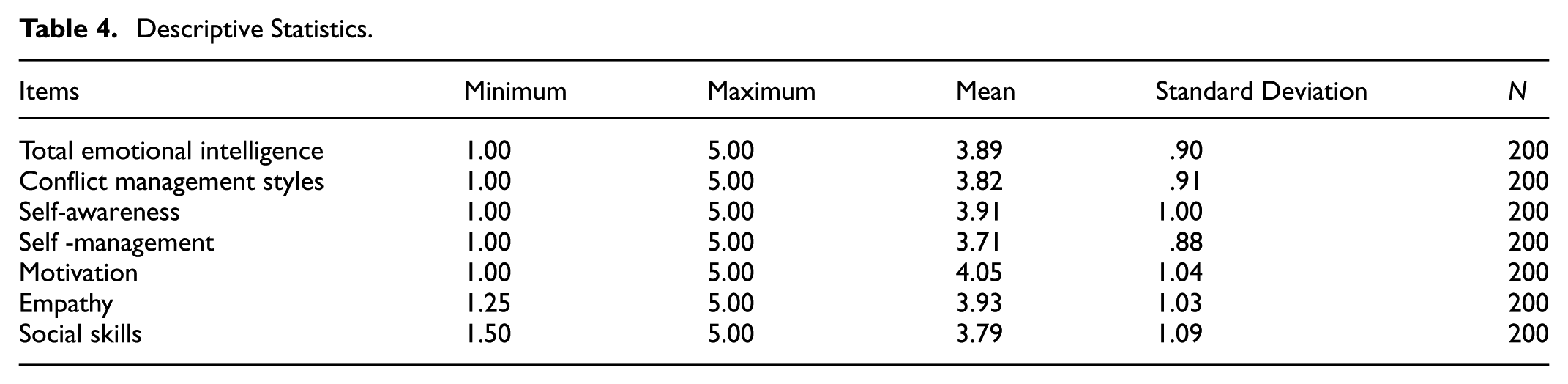
From the descriptive statistics in Table 4, it was clear that, all the two variables fall within the ‘excellent’ range as acceptable, where both skewness and kurtosis values all lie between ± 1.0. Skewness measures to what extent a distribution of values deviates from symmetry around the mean, whilst a kurtosis value near zero indicates a shape close to normal, with a strong positive correlation among the variables.
Descriptive Statistics.
Hierarchical Regression Analysis
From the Table 5 below, R shows a significant correlation between the three predictor variables for model 1 and the dependent variable; that is, conflict management style with the value of (0.803). Also, the five predictor variables have a significant relationship with the dependent variable with (0.821) of model 2, and these provide a clear excellent level of prediction. In the model summary table, R Square with variables entered in model 1 (Motivation, Self-Awareness, Self-Regulation) explained 70% of the variance in the dependent variable. After model 2 variables (Social Skills & Empathy) were added, the model then explained 73% of the variance in the dependent variable. However, model 2 with Social Skills & Empathy variables explained an additional 3% of the variance in the dependent variable. F Change the value for this line (0.000). shown by Sig. value, this indicates a significant contribution. This finding corroborates with the studies of Schlaerth et al. (2013), Hopkins and Yonker (2015), Bhattacharya et al. (2016), and Rezvani et al. (2019).
Regression Analysis.

Dependent Variable: CMS.
ANOVA
From Table 6, the F-value explains that from the overall regression model, the data was a good fit. Thus, the table indicates that the independent variables (M, SA, SR, SS, and E) were statistically significant to predict the dependent variable (CMS), where F (5, 194) = 106.896, p < .0005 implies that the regression model was good and was fit for the data.
Multiple Regression.

Dependent Variable: CMS.
Multiple Linear Regression
In Model 2, the β value and significant level show a positive significant prediction (p > .05) except for Social Skills (SS). Empathy shows (β = .30), then Self-Regulation (β = .25) Motivation (β = .24). and Self-Awareness (β = .17). All correlations were moderate to strong, ranging between r = .49, p > .005, and r = .76, p < .005, and r = .77, p < .005. This shows that issues pertaining to multicollinearity were corrected. All of the independent variables statistically correlated with the dependent variable (CMS). This further shows that the data is suitable, as it correlated with the dependent variable (CMS); hence, multiple linear regression is reliably to be undertaken. See Table 7.
Coefficients and Multicollinearity Test.

Dependent Variable: CMS.
Estimated Model Coefficients
The equation to predict CMS using the independent variables; Motivation, Self-Awareness, Self-Regulation, Social Skills and Empathy is;

Independent Sample T-test
From the group statistics results above, the level of Emotional Intelligence can be described with the mean and standard deviation. The average value of the level of Emotional Intelligence of India (M = 3.73, SD = .87) and Ghana is (M = 4.02, SD = .91; t (196) = −2.324, p = .769).
Therefore, a significant difference exists between the level of emotional intelligence of the participants in India and Ghana, with Ghana recording the highest in terms of mean and in terms of variability. See Table 8.
Independent Sample T-test.
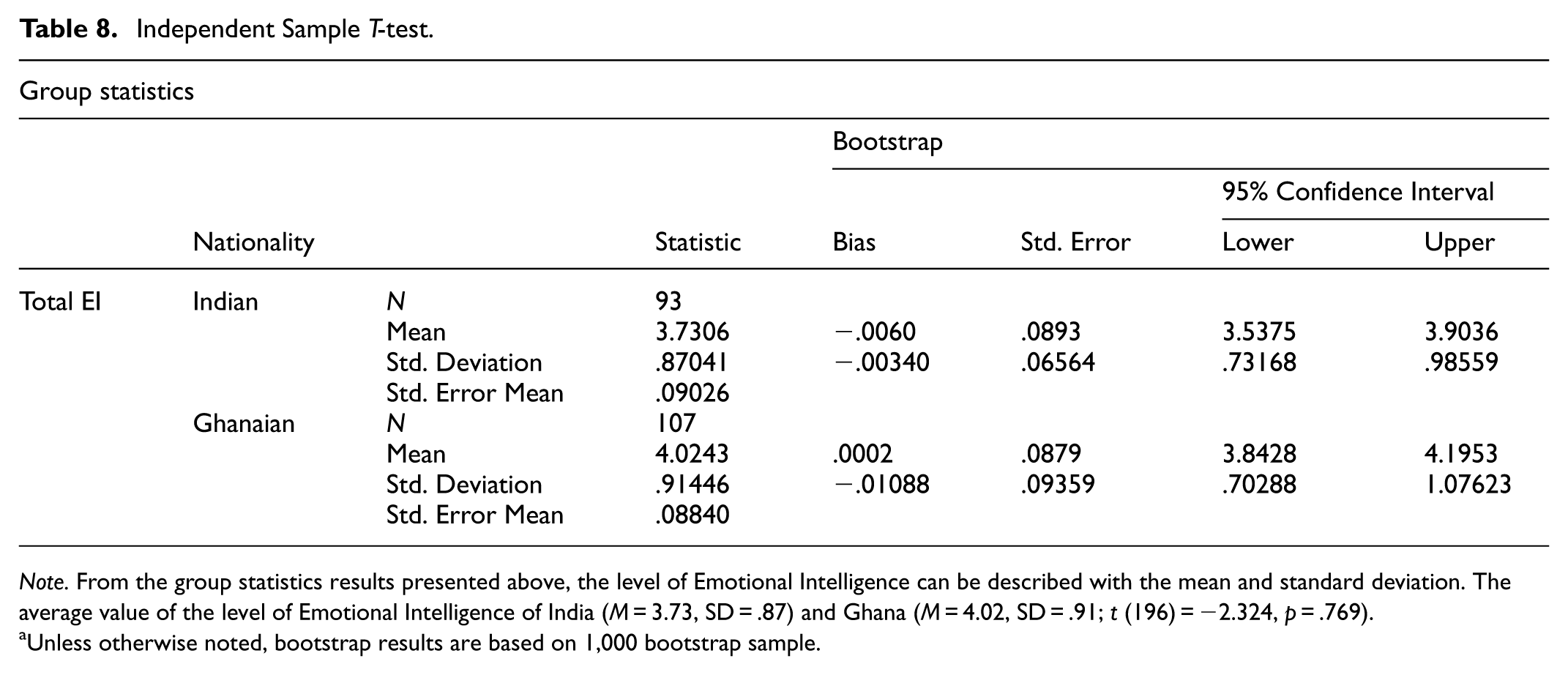
Note. From the group statistics results presented above, the level of Emotional Intelligence can be described with the mean and standard deviation. The average value of the level of Emotional Intelligence of India (M = 3.73, SD = .87) and Ghana (M = 4.02, SD = .91; t (196) = −2.324, p = .769).
Unless otherwise noted, bootstrap results are based on 1,000 bootstrap sample.
Levene’s test, which serves as the tool for the assumption of homogeneity of variance. From the Levene’s test, see Table 9; the Sig value of the test is 0.796, which is greater than the Sign level of 0.05; the researchers reject the alternative hypothesis that says ‘equal variance not assumed’ in favor of the null hypothesis. Thus, the t-test of equity of means, the Sig. value is thus 0.02, which is less than the Sig level of 0.05. Therefore, the researchers failed to reject the alternative hypothesis that ‘there is a significant difference in the mean level of Emotional intelligence between India and Ghana’ (M = 3.73, SD = 0.87) and Ghana (M = 4.02, SD = 0.91; t (196) = -2.324, p = 0.769).
Values for Independent Samples Test.

Note. Therefore, a significant difference exists between the level of Emotional Intelligence of the participants in India and Ghana, with Ghana recording highest in terms of mean and in terms of variability.
Ghana and India Cultural Dimension
Figure 2 shows the difference between Ghana and India using Hofstede Cultural Dimensions on Emotional Intelligence. The colour Azure blue represents Ghana, and Violet represents India.
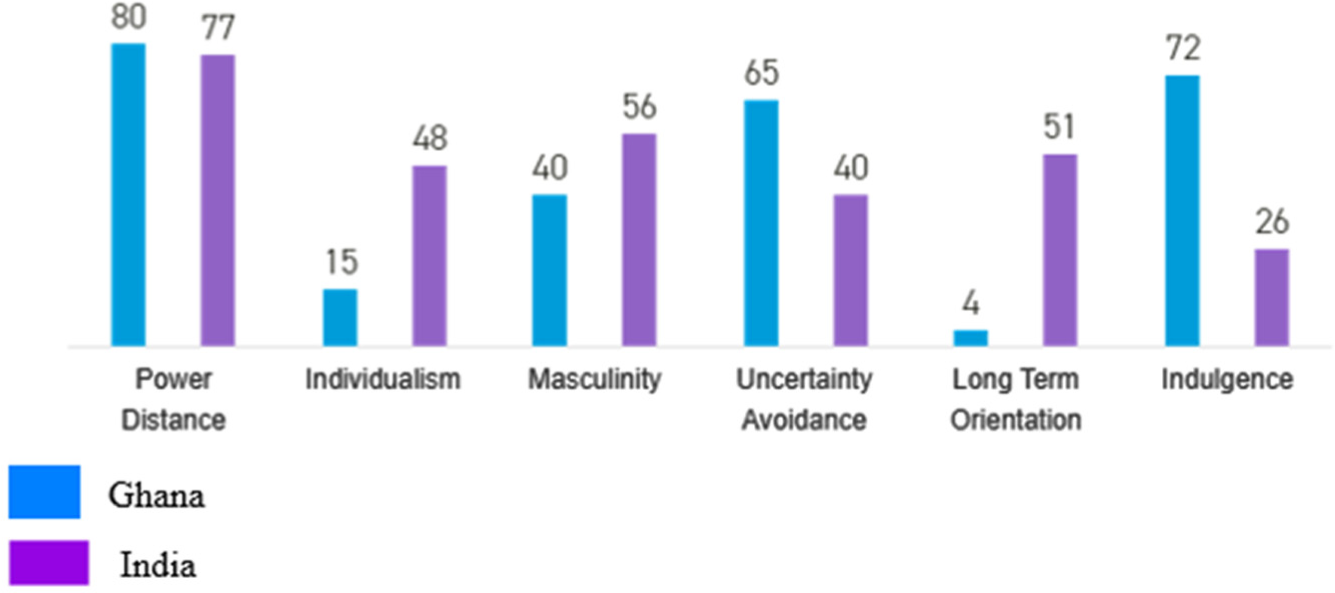
Shows the difference between Ghana and India using Hofstede cultural dimension on emotional intelligence. The color Azure blue represents Ghana and Violet represents India. A detailed explanation is on (2.8.1) Source (Hofstede-insight.com).
Mediation Analysis by Bootstrapping using SPSS
The bootstrapping results provide a more robust estimate of the mediation effect. The total effect of Emotional Intelligence (EI) on Conflict Management Styles (CMS) is significant (point estimate = 0.75, p < .001). The direct effect of EI on CMS is also significant (point estimate = 0.50, p < .001). The indirect effect of EI on CMS through Culture is significant (point estimate = 0.25, p < .001), indicating that Culture plays a significant role in mediating the relationship between EI and CMS. The BC 95% CI for the indirect effect does not include zero, providing further evidence of the significance of the mediation effect.
Discussions of Results
To begin with, the results of this study revealed that EI has a significant relationship with CMS. The relationship, however, was strong and positive. Also, all the sub-competencies of EI had a positive, strong correlation with the CMS. More so, the study revealed that all the sub-competencies of EI (i.e., Motivation, Self-Awareness, Self-Regulation, and Empathy) contributed significantly to predict CMS except Social Skills. This confirms the Hofstede Cultural Dimension and Emotional Intelligence where power distance describes leadership and employer/employee relationships. Here employees expect to be told what to do; this attitude is found in both countries' understudies. This supports the notion that people who can frame their relationship with others well are emotionally intelligent (Mayer & Salovey, 1993, 1997). As an individual can manage his or her emotions and those of others, they can deal with conflict. Their adeptness in emotional issues is a good indication for dealing with people. Therefore, whenever conflict arises, emotionally intelligent individuals can handle it, leaving the parties involved both satisfied and happy. Also, it is observed that there was a significant difference between the level of Emotional Intelligence amongst the participants of India and Ghana, with Ghana recording the highest in terms of mean and in terms of variability.
Similarly, regarding the difference between Ghana and India using Hofstede Cultural Dimensions on Emotional Intelligence. The participant’s country could influence their EI on CMS. That is an individual’s country, which is embedded in their cultural and religious beliefs, has the propensity to affect their emotional capabilities to interact with people. For instance, if a country has a high score on the power distance, it indicates their appreciation for hierarchical structures. This can affect how they relate to people, giving and showing respect for others, especially those in authority. Therefore, in a conflict situation, these individuals will tend to compromise for peace to prevail.
Moreso, the significant indirect effect of EI on CMS through Culture highlights the importance of considering cultural background in conflict management. The results suggest that cultural background influences how EI affects conflict management styles, emphasizing the need for culturally sensitive conflict management strategies.
Implications for Practice
Employees are in dire need of effective CMS because they are more likely to face conflict due to their frequent interactions with others at the workplace. Therefore, they require capabilities and skills to help them make knowledgeable decisions in any conflict situation. Managing CMS effectively requires Social Skills; thus, countries understudy should be able to improve on that. It is very interesting that emotions greatly affect the perception of conflict, and the ability to effectively manage conflict situations demands skills. Failure to effectively manage conflict might result in a high employee turnover rate, resulting in tarnishing the brand name of the organization (Lang, 2009).
Conflict can be said to be context- and situationally specific. Hence, employees should know how and when to handle any conflict they encounter. Certain situations will demand specific CMS. When to compromise, integrate, avoid, dominate, and oblige. The integrating style of CMS is linked with an individual’s capability to effectively resolve complicated issues. If a compromise cannot be reached, a provisional result could be used to handle the conflict by using making the parties compromise.
Due to the essence of CMS, HR managers unveil that conflict skills are essential for top-level managers and are enlisted in the leadership courses as a core competency (Nussbaum, 2009). Therefore, employers can train existing employees who might lack these skills and look out for potential employees who already possess such skills. As training is given to these employees, once they are promoted to the top-level positions, they would have improved upon their conflict skills.
Lastly, awareness training can be done for expatriates. Bringing to light the cultural differences in behavior. This might help reduce and avoid clashes that might hinder a business relationship. To be effective in the current global market, such awareness of cultural differences seems to be a great demand.
Limitations and Directions for Future Research
Despite the numerous benefits of this research work, it is still not free from some limitations. The research work focused on two countries, and as a result, the findings are the best fit for these two countries. Generalizing the results is not applicable to other countries. Especially those of different cultural dimensions. Also, the measures of Emotional Intelligence (EI) and Conflict Management Styles (CMS) were limited to variables identified in the mixed model of Daniel Goleman and Thomas- Kilmann Mode Instrument. These measures are self-report which is prone to be biased on the part of the participants. Although they were informed to be as honest as possible in their response. The success of the research depended on their honest opinion. Also, the study focused on employees. As a result, future studies can use employees from different countries which score differently on the Hofstede cultural dimension. Secondly, other measures of EI and CMS can be used either than self-report measures. Thirdly, with the analysis, the specific CMS could be used either than the overall CMS. Lastly, the target population can be broadened to include managers, board members, suppliers, and customers, amongst others in an organization since they are all prone to face conflict in one way or the other.
Conclusion
A conflict that is almost inevitable in the workplace and needs to be properly managed to enjoy its advantages whilst curbing the disadvantages. The importance of EI and CMS can therefore not be overlooked. Therefore, the current study was undertaken to explore the relationship between EI and CMS. To achieve the aim of this study, a 5-point Likert scale questionnaire was used to solicit data from 200 part-time executive students. Results from the regression analysis show that EI has a positive, significant relationship with CMS. This proves that people who are emotionally intelligent are able to frame their relationship with others (Mayer & Salovey, 1993, 1997). Overall, the study confirms the significant relationship between EI and CMS among part-time executive students. The study adds that the Research and Development department will receive innovative ideas and new ways of doing things in organizations. With the pertinent tangential points, the social skills of both countries should be developed to ensure effective CMS. Since influence, communication, leadership, change catalyst, conflict management, building bonds, collaboration and cooperation, and team capabilities are embedded in social skills. Owing to it, the diverse employees with different ideologies and styles of doing things will initiate such innovative ideas. Scholars and researchers can take up the new and emerging avenue of research by incorporating Africa and other cultures in their study.
Footnotes

Funding
The authors received no financial support for the research, authorship, and/or publication of this article.
Declaration of Conflicting Interests
The authors declared no potential conflicts of interest with respect to the research, authorship, and/or publication of this article.
Data Availability Statement
Data sharing not applicable to this article as no datasets were generated or analyzed during the current study.